
Wyoming City Zoning Code
ARTICLE 4C
PLANNED UNIT DEVELOPMENT ZONING DISTRICTS
PUD-1 Low Density Planned Unit Development
PUD-2 Commercial Planned Unit Development
PUD-3 Planned Health Care District
PUD-4 General Planned District
The location and boundaries of the districts are hereby established on a map entitled "City of Wyoming, Michigan Zoning Map", together with all notations, which map is hereby adopted and made a part of this chapter. The zoning map may be maintained by the city in such form as shall from time to time be deemed appropriate including an electronic database or information system. Unless otherwise shown on the zoning map, the district boundary lines follow lot lines or the centerlines of streets or alleys or such lines extended and the corporate limits of the city as they existed on January 3, 1979, and as subsequently revised. If the exact location of any district boundary line cannot be determined by the zoning map, it shall be resolved by the board of zoning appeals.
(Code 1983, § 60.3; Ord. No. 20-06, § 1, 7-3-06)
Sec. 90-401C. - Principal permitted uses.
(1)
Detached single-family dwellings.
(2)
Zero-lot-line detached single-family dwellings.
(3)
Two-family dwellings.
(4)
Multiple-family dwellings, including apartments, condominiums and townhouses.
(5)
Convalescent and nursing homes.
(6)
Boardinghouses (rooming houses).
(7)
Off-street parking.
(8)
Accessory buildings and uses customarily incidental to the above principal permitted uses.
(9)
Any principal permitted use in the B-1 local business district, provided the following:
(a)
The commercial node is located adjacent to or near the intersection of two major thoroughfares as identified in the city thoroughfare plan.
(b)
The minimum size of the entire PUD shall be 80 acres, of which no more than ten percent or ten acres, whichever is less, may be devoted to commercial uses.
(c)
Area and yard requirements shall meet or exceed those as listed in the B-1 local business district.
(10)
Foster care facilities, nursery schools, day nurseries and child care facilities for the care of not more than six people.
(11)
All principal permitted uses in the R-1 and R-2 districts. For mobile homes, see Section 90-329.
(12)
Accessory Dwelling Units incidental to the principal permitted dwelling unit. Sec. 90-334.
(Code 1983, § 60.240; Ord. No. 3-25, § 4, 1-21-25)
Sec. 90-402C. - Permitted uses after special approval.
The following uses shall be permitted in the PUD-1 low-density planned unit development district subject to the approval of the planning commission:
(1)
Private parks, country clubs, golf courses and golf driving ranges adjoining a golf course or country club.
(2)
Telephone exchange buildings, electric transformer stations and substations and gas regulator stations.
(3)
Nursery schools, day nurseries and child care facilities for the care of seven or more people.
(4)
Adult education facilities not operated for profit.
(5)
Home occupations.
(6)
Agricultural uses.
(7)
Secondhand dealers.
(8)
Drive through restaurants.
(Code 1983, § 60.241; Ord. No. 7-09, § 3, 12-21-09; Ord. No. 3-11, § 10, 5-2-11; Ord. No. 17-14, § 4, 8-4-14)
Sec. 90-403C. - Development standards.
| * for zero lot line detached dwellings within a PUD-1 low-density planned unit development district | ||
| Minimum Lot Area (2) | 6,600 sq. ft. | 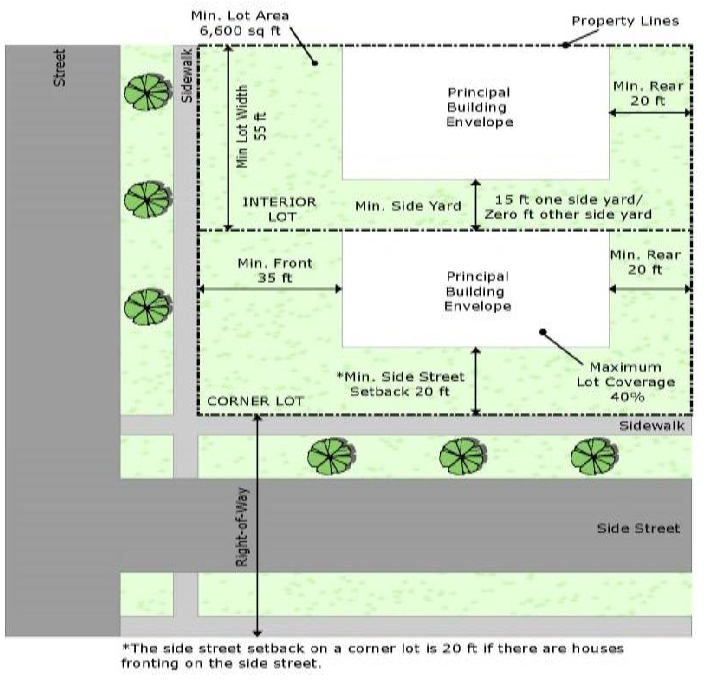 |
| Minimum Lot Width | 55 ft. | |
| Minimum Front Yard | 35 ft. | |
| Minimum Rear Yard (3) | 20 ft. | |
| Minimum Side Yard (3)(4) | 15 ft./Zero ft. | |
| Minimum Combined Side Yard (5) | 15 ft. | |
| Minimum Ground Floor Building Area | ||
| One-Story | 1,040 sq. ft. | |
| 1½-Story | 864 sq. ft. | |
| Two-Story | 672 sq. ft. | |
| Bi-Level | 672 sq. ft. | |
| Split Level | 1,040 sq. ft. | |
| Tri-Level | 1,040 sq. ft. | |
| Maximum Building Height | 35 ft. | |
| Maximum Lot Coverage | 40% | |
| Minimum Number of Parking Spaces/Unit | 2 | |
| Minimum Lot Area | 20 acres | |
| Minimum Lot Width | 500 ft. | |
| Minimum Front Yard | 35 ft. | |
| Minimum Rear Yard | 35 ft. | |
| Minimum Side Yard | 35 ft. | |
| Maximum Building Height | 35 ft. | |
| Minimum Number of Parking Spaces/Unit | 2 | |
Sec. 90-404C. - Specific requirements.
(1)
In the PUD-1 low-density planned unit development district, the following additional regulations apply:
(a)
Density shall not exceed four units per acre in the entire development. A mix of housing is allowed; however, no less than 50 percent of the total units shall be single-family detached, except if the single-family housing is built at R-1 zoning standards, then the minimum is 35 percent.
(b)
Unless otherwise specified, single-family detached dwellings shall comply with the same area and yard requirements as an R-2 district.
(c)
Multiple-family dwellings shall comply with the same area and yard requirements as an R-4 district.
(d)
Designated common open space shall be no less than 15 percent of the total area of the PUD. Such areas shall be utilized for the recreational needs and enjoyment of the residents of the development and shall consist of play areas, open fields, pathways and woodland. Other natural areas such as wetlands, drainage areas, bodies of water and steeply sloped areas, may also be included as designated common open space, but shall not exceed 35 percent of the total area designated to meet the minimum open space standard.
(e)
In the case of large developments, the following recreational amenities must be provided:
1.
200 units or more: In-ground swimming pool or two tennis courts.
2.
500 units or more: The above, plus a community building not less than 1,000 square feet in area.
(2)
Minimum lot size may be reduced to 5,500 square feet if the rear of such lots border designated open spaces.
(3)
Nonresidential uses shall contain ten-foot wide greenbelt adjoining the side and rear lot lines, with a minimum three-foot high berm or fencing provided in the greenbelt area where adjoined by both on-site parking and off-site residences. The berming or fencing requirements may be waived by the planning director in instances where existing property line solid fencing, natural features or other site or land use factors make this requirement unnecessary.
(4)
Side yard building setback for principal non-residential buildings shall be a minimum 25 feet.
(5)
Side yard requirements shall not be less than 20 feet if the side yard abuts a street having residences fronting.
Sec. 90-405C. - Additional regulations.
(1)
General requirements.
(a)
Façade Standards. 90-322.
(b)
Accessory Buildings. Section 90-311.
(c)
Accessory Dwelling Units. Section 90-334.
(d)
Fence Regulations. Section 90-312.
(e)
Landscaping for non-residential uses. Section 90-328.
(f)
Projections into yards. Section 90-306.
(g)
Signs. Article 7.
(h)
Off-street parking. Article 6.
(i)
Mechanical Appurtenances. Section 90-310.
(j)
Dwellings in non-residential zones. See Section 90-319.
(k)
Parking of recreational vehicles. Section 90-314.
(l)
Commercial vehicles in residential districts. Section 90-315.
(m)
Refuse disposal. Section 90-321.
(Ord. No. 3-25, § 7, 1-21-25)
Sec. 90-406C. - Principal permitted uses.
(1)
All principal permitted uses in the B-3 district.
(2)
Retail businesses whose principal activity is the sale or rental of merchandise within a completely enclosed building.
(3)
Business service establishments, such as office machine, computer and typewriter repair, printing and blueprinting.
(4)
Physical culture facilities, such as gymnasiums and reducing salons.
(5)
Business schools or private schools operated for a profit.
(6)
Hotels and motels.
(7)
Assembly halls.
(8)
Business recreation uses:
(a)
Indoor theater.
(b)
Bowling alley.
(c)
Dance hall.
(d)
Skating rink.
(9)
Accessory buildings and uses customarily included incidental to the above uses.
(10)
Off-street parking.
(Ord. No. 10-99, § 1, 6-21-99)
Sec. 90-407C. - Permitted uses after special approval.
The following uses may be permitted, subject to the approval of the planning commission:
(1)
Cocktail lounges, night clubs, taverns, when clearly accessory to a principal permitted use, and in the same building.
(2)
Residential and institutional care facilities.
(3)
Secondhand dealers.
(4)
Drive through restaurants.
(Ord. No. 10-99, § 2, 6-21-99; Ord. No. 3-11, § 11, 5-2-11; Ord. No. 17-14, § 5, 8-4-14)
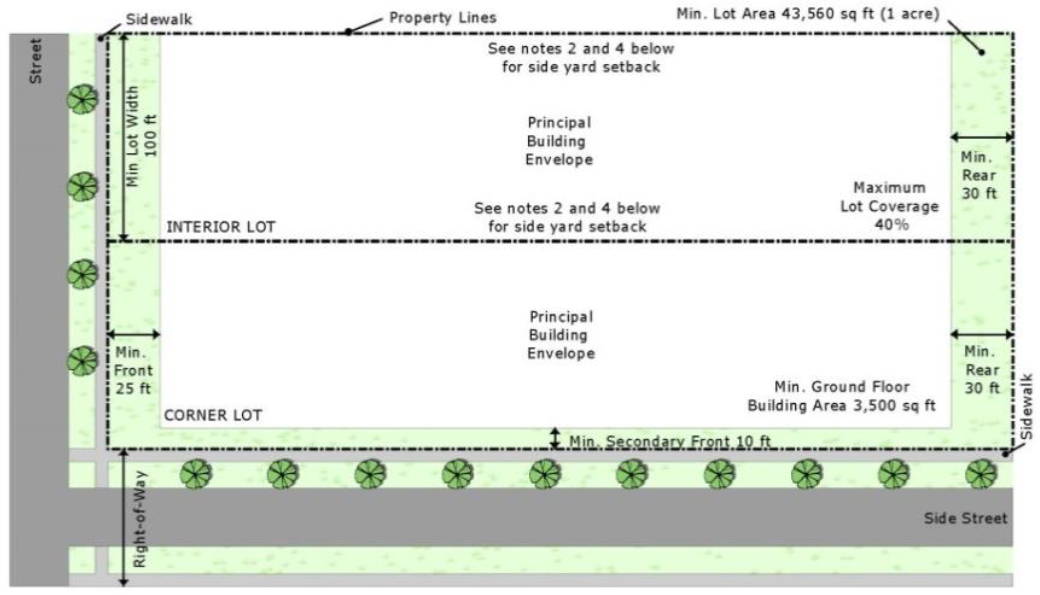
Sec. 90-408C. - Development standards.
Sec. 90-409C. - Specific requirements.
(1)
Wherever a PUD-2 district adjoins a single-family zoned residential district, except where there is a public street located between the districts, there shall be provided and maintained along the adjoining property line(s) a greenbelt having a minimum width of 100 feet. Any fencing required by this Code may be considered for locating along the inside of the greenbelt. Said greenbelt shall contain grass and landscaping, with the landscape to include a combination of hardwood and evergreen trees, averaging at least one per each 50 linear feet, but located in a pattern to be approved as part of site plan review. Hardwoods shall be a minimum of 2.5 inches in caliper; evergreens shall be at least six feet in height. However, in instances where existing topographic/woodland or other natural or manmade features are deemed by the planning commission to not necessitate these improvements, the planning commission may alter or waive the requirements. Minimum building setback shall be 200 feet.
Sec. 90-410C. - Additional regulations.
(1)
General requirements.
(a)
Façade standards. Section 90-322.
(b)
Accessory buildings. Section 90-311.
(c)
Fence regulations. Section 90-312.
(d)
Landscaping for non-residential uses. Section 90-328.
(e)
Projections into yards. Section 90-306.
(f)
Screening of roof top equipment. Section 90-318.
(g)
Signs. Article 7.
(h)
Off-street parking. Article 6.
(i)
Mechanical appurtenances. Section 90-310.
(j)
Dwellings in non-residential zones. See section 90-319.
(k)
Refuse disposal. Section 90-321.
(2)
Development Procedures.
(a)
PUD procedures. Section 90-510.
(b)
Special land uses. Section 90-507.
(c)
Site plan. Section 90-500.
(d)
Site condominiums. Section 90-509.
(3)
Administration and enforcement.
(a)
Board of zoning appeals. Article 10.
(b)
Permits. Section 90-1008.
(c)
Non-conforming lot and uses. Article 9.
Sec. 90-411C. - Principal permitted uses.
(1)
General hospitals.
(2)
Outpatient diagnostic and treatment centers, day surgery centers and urgent care facilities.
(3)
Offices.
(4)
Diagnostic or medical laboratories.
(5)
Educational facilities for the training of interns, nurses and allied health care personnel.
(6)
Ambulance service and maintenance facilities.
(7)
Assisted living, convalescent and nursing homes.
(8)
Foster care group homes.
(9)
Day nurseries and child care centers.
(10)
Private recreational facilities (indoor and outdoor) provided such facilities are for employees and patients and not available to the public.
(11)
Health clubs and fitness centers.
(12)
Chapels.
(13)
Accessory retail and personal service establishments within the hospital and primarily intended to serve employees, residents and visitors to the health care district including pharmacies, greeting card sales, florists, optical sales, financial institutions, cafeterias and restaurants.
(14)
Health care district accessory uses such as laundry, service buildings, emergency generators and related electromechanical systems.
(15)
Parking structures of up to three levels above grade.
(16)
Accessory transit facilities such as bus stops, shelters and taxi stands.
(17)
Municipal buildings and uses.
(18)
Colleges or universities.
(19)
Electric transformer stations, gas regulation stations and telephone exchange buildings.
(20)
Community centers not operated for profit.
(21)
Business schools or private schools operated for profit.
(22)
Uses permitted in the B-1 zoning district.
(Ord. No. 13-01, § 4, 6-4-01; Ord. No. 11-03, § 3, 7-7-03)
Sec. 90-412C. - Permitted uses after special approval.
The following uses shall be permitted in the PUD-3 planned health care district, subject to the approval of the planning commission:
(1)
Psychiatric or substance abuse centers.
(2)
Accessory incinerators used only for waste generated on the site and which meet all local, state and federal regulations.
(3)
Helipads and heliports accessory to a hospital.
(4)
Multiple family housing. Development provisions for the R-4 low density multiple family residential district shall apply.
(5)
Hotels and motels.
(6)
Retail and wholesale sales, distribution, storage, repair and service of medical equipment; storage of medical, dental and surgical supplies.
(7)
Radio, microwave or wireless communication towers accessory to a hospital.
(8)
Secondhand dealers.
(9)
Veterinary hospitals and clinics, excluding outdoor use of property for exercise yards, pens or similar use.
(10)
Funeral homes or mortuaries.
(11)
Gasoline/convenience store associated with a supermarket.
(12)
Drive through restaurants.
(Ord. No. 13-01, § 4, 6-4-01; Ord. No. 11-03, § 4, 7-7-03; Ord. No. 14-08, § 1, 8-18-08; Ord. No. 3-11, § 6, 5-2-11; Ord. No. 17-14, § 6, 8-4-14; Ord. No. 12-25, § 9, 10-20-25)
Sec. 90-413C. - Development standards.
Sec. 90-414C. - Specific requirements.
(1)
In the PUD-3 planned health care district, the following additional regulations shall apply, superseding any lesser standards in the Code.
(a)
Hospitals may be erected to 115 feet in height with a spire height up to 140 feet. Related medical facilities adjacent to the hospital, and hotels, may be erected up to 70 feet. All other buildings are limited to 45 feet in height.
(b)
Building setbacks shall be a minimum of 35 feet from Byron Center Avenue and 50 feet from Gezon Parkway. The planning commission may allow a lesser setback down to a zero yard setback on other public streets. Side and rear yard setbacks may also be waived by the planning commission.
(c)
Individual lots shall provide a minimum 25-foot greenbelt along major thoroughfares, exclusive of freeways, with a four-foot high berm along Byron Center Avenue, except that the planning commission can waive the berm in instances of topographic or other natural features. No parking shall be permitted within the required greenbelts.
(d)
A landscaped greenbelt, as described in section 90-328, shall be provided in the required front yard and secondary front yard unless parking is otherwise permitted as noted above.
Sec. 90-415C. - Additional regulations.
(1)
General requirements.
(a)
Façade standards. Section 90-322.
(b)
Accessory buildings. Section 90-311.
(c)
Fence regulations. Section 90-312.
(d)
Landscaping for non-residential uses. Section 90-328.
(e)
Projections into yards. Section 90-306.
(f)
Screening of roof top equipment. Section 90-318.
(g)
Signs. Article 7.
(h)
Off-street parking. Article 6.
(i)
Mechanical appurtenances. Section 90-310.
(j)
Dwellings in non-residential zones. See section 90-319.
(k)
Refuse disposal. Section 90-321.
(2)
Development procedures.
(a)
PUD procedures. Section 90-510.
(b)
Special land uses. Section 90-507.
(c)
Site plan. Section 90-500.
(d)
Site condominiums. Section 90-509.
(3)
Administration and enforcement.
(a)
Board of zoning appeals. Article 10.
(b)
Permits. Section 90-1008.
(c)
Non-conforming lot and uses. Article 9.
Sec. 90-416C. - Purpose.
It is recognized that traditional zoning, with its segregation of uses and rigid dimensional requirements may not be suitable in all situations to best achieve the objectives of the city relative to desired land use and preservation of its resources and character. In order to permit and encourage more creative and innovative land development for the benefit of the community as a whole and in furtherance of the vision and goals of the City of Wyoming Master Plan, Planned Unit Development (PUD) may be permitted as a zoning district to achieve one of more the following purposes:
(a)
Provide for flexibility in development that will result in a better project for the developer, residents and users, as well as for the city, in general;
(b)
Accomplish a more desirable and sustainable residential environment than would be possible through the strict application of minimum requirements of this Ordinance;
(c)
Achieve economy and efficiency in the use of land, natural resources, energy and the providing of public services and utilities;
(d)
Provide better housing, employment and shopping opportunities particularly suited to the needs of the residents of the city;
(e)
Preserve existing natural assets, such as stands of trees, floodplain, open fields, wetlands, lakes, streams and the like;
(f)
Encourage the utilization of open space and development of recreational amenities generally located within walking distance of all living units;
(g)
Encourage the use of lands in ways which are most in accord with their character and adaptability;
(h)
Encourage the efficient use of land by facilitating economical and suitable arrangements for buildings, streets, utilities and other land use features; and
(i)
Offer a unique attribute of development not achievable under conventional zoning requirements.
Sec. 90-417C. - Qualifying conditions.
(a)
Location. PUD's may be located in any part of the city, except that no portion of an existing PUD-1, PUD-2 or PUD-3 zoned property is eligible to be converted to a PUD-4, subject to meeting all other applicable requirements.
(b)
PUD Purpose. The applicant shall demonstrate that the PUD will achieve three or more of the purposes listed in section 90-416C.
(c)
Size. The PUD shall comprise an area of at least three acres; provided, a smaller area may be allowed when it is demonstrated to the Planning Commission that the proposed project will satisfy all other qualifying conditions of this section and the acquisition of additional contiguous land is not reasonably possible.
(d)
Residential density. Proposed density shall conform to the requirements of Table 90-420C(2) and Table 90-420C(3).
(e)
Housing variety. A residential PUD shall contain a variety of housing types and/or lot sizes and/or contribute to housing needs identified in current housing needs assessments to provide for varying lifestyles, diversity, and affordability.
(f)
Utilities. The PUD shall be served by public water and sanitary sewer facilities.
(g)
Ownership and control. The tract(s) of land for which a PUD application is submitted must be either in single ownership or the subject of an application filed collectively by all owners of the property. A PUD applicant shall submit written documentation that the owners of all property included within the PUD have consented to the PUD application. Where property is jointly owned, the consent must be from all owners. Written documentation must include the signatures of all individuals with an ownership interest and the signature of an officer, member, general partner or other individual authorized to sign on behalf of any entity with an ownership interest. Consent may be demonstrated by signatures on the PUD application or may be in the form of a letter or other signed written documentation consenting to the application or authorizing the applicant to file it.
(h)
Recognizable public benefit. The PUD shall achieve recognizable and substantial benefits that may not be possible under the existing zoning classification(s). At least two of the following benefits shall be accrued to the community as a result of the proposed PUD:
(1)
Preservation of significant natural features that would not be preserved under a conventional development,
(2)
A complementary mix of land uses or housing types within the PUD,
(3)
Preservation of common open space beyond the minimum required,
(4)
Connectivity of preserved open space with adjacent open space, greenways or public trails,
(5)
Connectivity of residential uses with adjacent dedicated public transit options,
(6)
Coordinated redevelopment of multiple lots or parcels, and/or
(7)
Removal or renovation of deteriorating and/or obsolete buildings, sites or contamination clean-up.
Sec. 90-418C. - Permitted uses.
Any land use, except as noted in this section, or combination of land uses may be considered for inclusion within a PUD; provided, the development standards of section 90-419C are met. Public/quasi-public uses such as, but not limited to, churches, schools, colleges and universities, municipal buildings, and parks shall only be permitted within a PUD under the following conditions:
(1)
When developed as the principal use with other related and/or accessory uses within a contiguous, integrated, and walkable campus setting; or
(2)
When included as an amenity or supplementary service to a residential or mixed-use PUD.
Sec. 90-419C. - Development standards.
(A)
Minimum Lot Size and Zoning Requirements. Lot area, width, setbacks, height, lot coverage, minimum floor area, parking, landscaping, lighting and other requirements for the district specified in the following table for the proposed use shall apply to all such uses within a PUD, unless modified in accordance with the provisions of Section 90-419C(C). Within a PUD, minimum buffer requirements between uses otherwise specified in this ordinance shall not apply; provided, the Planning Commission or City Council may require separation or buffering of uses as a condition of concept plan approval.
(B)
Project Scale. Based on the total area of the PUD site, the following shall be permitted:
(C)
Modification of Minimum Requirements. Regulations applicable to a land use in the PUD District may be altered from the requirements specified in Table 90-420C(1), including the following: modification from the lot area and width, building setbacks, height, lot coverage, signs and parking. However, for any residential use, a reduction in lot size shall not result in an increase in the number of dwellings otherwise permitted by the applicable zoning district, unless the PUD is under the maximum permitted density outlined in Table 90-420C(2) and Table 90-420C(3) or a density bonus is also granted in accordance with Subsection D below. In the absence of a density bonus, land gained by the reduction in lot sizes shall be added to the open space required within the PUD. The applicant for a PUD shall identify, in writing, all proposed deviations from the zoning district requirements. Modifications may be approved by the City Council during the preliminary development plan review stage, after Planning Commission recommendation. Adjustments to the minimum requirements may be permitted only if they will result in a higher quality and more sustainable development, consistent with the purpose of the PUD District, as expressed in Section 90-416C.
(D)
Density Bonus. In addition to the modification of minimum requirements permitted in Section 90-419C (C), the City Council, after Planning Commission recommendation, may permit an increase in the total number of residential units otherwise allowed within a PUD, according to the requirements in Table 90-420C(2) or Table 90-420C(3), where it is demonstrated that:
(1)
The appearance and construction will result in a development of high quality, as evidenced by:
(a)
varied roof and wall lines, unique architectural features, innovative transportation amenities, extraordinary energy efficiency, etc.;
(b)
use of more durable and aesthetically pleasing building materials and finishes (e.g., stone, masonry, wood, hardi-plank, and glass rather than vinyl or aluminum siding on exterior walls; slate, copper, steel, tile or other higher grade roofing materials rather than standard asphalt, vinyl or membranes; and using composite, concrete and steel decking materials rather than treated wood); and/or
(c)
unique transportation-related improvements (e.g., artful bicycle and other 2-wheeled transportation racks, bicycle maintenance or storage facilities; parking areas that are integrated into a pathway system and landscaping).
(2)
The PUD site is within one-quarter mile of a dedicated transit route and includes a fixed transit shelter. Greenfield sites are exempt from this requirement.
(3)
Amenities, beyond the minimum required open space, will be provided to create a more desirable and enjoyable living environment (e.g., universally accessible playground structures, made of the durable, high quality materials that offer unique play experiences); and
(4)
At least three (3) of the following will be included within the development:
(a)
Dedicated common open space is provided in excess of the minimum required, per Section 90-419C (E)(1).
(b)
The PUD site is within one-quarter mile of a full-line grocery store and is accessible via sidewalks.
(c)
One (1) or more parking structures are proposed within a mixed-use or nonresidential PUD to meet the minimum parking requirements of this ordinance.
(d)
One (1) or more LEED-certified buildings will be constructed.
(e)
Significant natural features will be preserved and/or substantial landscaping beyond the minimum requirements will be incorporated into the development.
(f)
Decorative pavers, public plazas, fountains, or similar aesthetic enhancements will be incorporated into the vehicular and pedestrian circulation system.
(g)
Sustainability enhancements such as rain gardens, electric vehicle charging stations, wind energy systems, or green infrastructure are incorporated into the PUD.
(h)
A commercial and/or office component is proposed within the PUD.
(i)
Affordable or missing middle housing will be incorporated into the residential design.
(j)
Three (3) or more public benefits, as identified in Section 90-417C(H), will be achieved.
(E)
Common Open Space. For purposes of the PUD requirements, "common open space" is defined as an area of land or water, or a combination of land and water, designed and intended for the perpetual use and enjoyment of the users of the development and/or the general public. Common open space may contain accessory structures and improvements necessary or desirable for noncommercial educational, recreational or cultural uses. A variety of open space and recreational areas is encouraged such as: children's informal play areas in close proximity to neighborhoods or dwelling unit clusters; formal parks, picnic areas and playgrounds; pathways and trails; scenic open areas and communal, noncommercial recreation facilities; and natural conservation areas. At a minimum, the following regulations shall apply to all common open space within a PUD:
(1)
The area of common open space shall comply with the open space requirements outlined in Tables 90-420C(2) and 90-420C(3). Land dedicated for recreation, in accordance with Section 90-419C(E)(3), shall count toward the common open space requirement.
(2)
The Planning Commission may reduce or waive open space requirements for PUD's on sites less than 5 acres in size upon an agreement with the City to provide funding for improving or sustaining public park amenities located within one-quarter mile of the development site. Such fees paid in lieu of land dedication shall satisfy the open space requirement.
(3)
All common open space shown on the final development plan must be reserved or dedicated by conveyance of title to a corporation, association or other legal entity, by means of a restrictive covenant, easement or through other legal instrument. The terms of such legal instrument must include provisions guaranteeing the continued use in perpetuity of such open space for the purposes intended and for continuity of proper maintenance of those portions of the open space requiring maintenance.
(4)
The open space shall meet the following minimum dimensions, contiguity and connectivity requirements:
(a)
The required open space shall be centrally located: along the street frontage of the PUD to protect or enhance views; located to preserve significant natural features; adjacent to dwellings; and/or located to interconnect other open spaces throughout the development or on contiguous properties.
(b)
Required open space areas shall be of sufficient size and dimension and located, configured, or designed in such a way as to achieve the applicable purposes of these regulations and enhance the quality of the development. The open space shall neither be perceived nor function simply as an extension of the adjacent yard of those lots abutting it.
(c)
If the site contains a lake, stream or other body of water, the city may require that a portion of the required open space abuts the body of water.
(d)
All required open space areas shall be configured so the open space is reasonably accessible to and usable by residents, visitors, and other users of the development. The minimum size of a required open space area shall be 15,000 square feet; provided, however, that the required open space abutting a public street may be less than 15,000 square feet; and, further provided, that the City Council, upon recommendation of the Planning Commission, may approve other open space areas of less than 15,000 square feet if these areas are designed and established as pedestrian or bicycle paths or are otherwise determined to be open space reasonably usable by residents, visitors, and other users of the development. The minimum average dimension of a required open space area shall be 100 feet.
(e)
Open space areas shall be linked with any adjacent open spaces, public parks, bicycle paths or pedestrian paths.
(f)
Grading in the open space shall be minimal, with the intent to preserve existing topography, trees and other natural features, where practical.
(g)
A sign, structure, or building may be erected within the required open space if it is determined to be accessory to a recreation or conservation use or an entryway. These accessory structure(s) or building(s), shall not exceed, in the aggregate, one (1) percent of the open space area. Accessory structures or uses shall not be located near the boundary of the development if they are determined by the Planning Commission to be inconsistent with the use, scale, or character of adjacent residential development. Pathways or sidewalks shall be exempt from this limitation.
(h)
The following areas shall not qualify as required common open space for the purposes of this section.
(i)
The area within any public street right-of-way.
(ii)
The area within private road easements.
(iii)
The area within a subdivision lot.
(iv)
Land within any required yard or setback area.
(v)
Land within 15' of a structure.
(vi)
Parking and loading areas.
(vii)
Fifty percent of any easement for overhead utility lines.
(viii)
Fifty percent of any steep slopes (12 percent or over).
(ix)
Fifty percent of any lakes, streams, detention ponds, wetlands or floodplains that are not generally accessible within the development. Accessible shall mean that the feature is bordered by a substantial open space area, park, playground, pathway or reasonable means of access for enjoyment of all owners, visitors or others, in which case the total area may qualify as required common open space.
(x)
Seventy percent of the area of any golf course 2 .
(F)
Connectivity. Pathways for bicycles and pedestrians shall be incorporated throughout the PUD and along all perimeter streets to ensure connectivity between uses and with adjacent properties. Pathways and sidewalks shall be constructed in accordance with the city design standards.
(G)
Parking. Minimum required parking ratio per residential unit is 1.3 spaces. This ratio may be decreased if the PUD has a dedicated transit line within one-quarter mile of the site and the developer provides transit supportive facilities e.g. bicycle facilities or covered bus stop. The maximum parking ratio per residential unit allowed in a PUD is 1.5 spaces. Requirements for minimum number of spaces for all non-residential uses shall be in accordance with Section 90- 600(7). Modifications to the required parking minimums and maximums may be granted by Planning Commission with sufficient justification provided to support any amendments.
(H)
Accessory Dwelling Units shall be considered principal permitted uses on single-family parcels within the PUD.
(Ord. No. 3-25, § 16, 1-21-25)

