
Wyoming City Zoning Code
ARTICLE 6
- OFF-STREET PARKING, LOADING, ACCESS, AND CIRCULATION REQUIREMENTS1
Editor's note— Sec. 1 of Ord. No. 10-11, adopted Oct. 3, 2011, amended Art. XIX in its entirety to read as herein set out. Former Art. XIX pertained to a similar subject matter, consisted of §§ 90-646—90-650, and derived from the 1983 Code.
Sec. 90-600.- Off-street parking requirements.
(1)
Applicability of parking requirements. For all buildings and uses established after the effective date of this article, off-street parking shall be provided as required by this article.
(a)
Whenever use of a building or lot is changed to another classification of use, off-street parking facilities shall be provided as required by this article.
(b)
If the intensity of use of any building (other than a single- or two-family residence) or lot is increased, through the addition of floor area, increase in seating capacity, number of employees or other means, additional off-street parking shall be provided for such increase in intensity of use.
(c)
Off-street parking facilities in existence on the effective date of this article shall not be reduced below the requirements of this article.
(d)
An area designated as required off-street parking shall not be changed to another use, unless equal facilities are provided elsewhere in accordance with the provisions of this article.
(2)
Location.
(a)
Off-street parking facilities required for all uses shall be located on the same lot or within 300 feet of the use(s) they are intended to serve, as measured from the nearest point of the parking facility to the nearest entry of the building(s) served.
(b)
Parking facilities shall be in the same zoning district as the use to be served, except as otherwise permitted in subsection 90-600(6).
(3)
Shared/common parking.
(a)
Two or more buildings or uses may use a common parking facility; provided the total number of parking spaces is equal to the required number of spaces for all of the uses computed separately. Cumulative parking requirements for mixed-use developments or shared facilities may be reduced in conjunction with site plan approval where it can be determined that one or more of the factors listed in subsection (4) below apply.
(b)
Parking facilities dedicated to and on the same site as a place of worship may be used to meet not more than 50 percent of the off-street parking requirement for theaters, stadiums, and other places of public assembly, stores, office buildings and industrial establishments lying within 300 feet of the place of worship, provided that the other uses are not normally operating between the hours of 6:00 a.m. and 6:00 p.m. on Sundays and that the place of worship, through written agreement, makes the spaces available. A copy of this agreement shall be furnished to the city. Should the agreement be voided or expire for any reason, the uses utilizing the parking facility of the place of worship shall provide all required parking spaces in accordance with the requirements of this article, or shall be in violation thereof.
(4)
Modification of parking requirements. The parking space requirements may be reduced by no more than 25 percent, as part of the site plan approval, based upon one or more of the following conditions:
(a)
Shared parking by multiple uses where there will be a high proportion of multipurpose visits or where uses have peak parking demands during differing times of the day or days of the week. Pedestrian connections shall be maintained between the uses. For separate lots, they shall be adjacent to each other, with pedestrian and vehicular connections maintained between the lots. Shared parking agreements shall be filed with the city planning department after approval.
(b)
Expectation of walk-in trade due to sidewalk connections to adjacent residential neighborhoods or employment centers. In allowing a parking space reduction, the site design shall incorporate pedestrian connections to the site and on-site pedestrian circulation providing safe and convenient access to the building.
(c)
Availability of other forms of travel such as transit. To qualify, the site design must incorporate transit stops, pedestrian connections to nearby transit stops, or bicycle parking facilities, as applicable.
(d)
Where the applicant has provided a parking study, conducted by a qualified professional, that demonstrates that another standard would be more appropriate based on actual number of employees or expected level of customer traffic. Actual counts at a similar establishment provided by the applicant may also be acceptable.
(e)
A parking study may be required as part of site plan review to document that any one of the criteria a. through c. above would be met.
(5)
Banked parking.
(a)
Where a reduction in the number of parking spaces is not warranted but an applicant demonstrates that the parking requirements for a proposed use would be excessive, the site plan review authority may defer ("bank") some of the required parking. The site plan shall designate portions of the site for future construction of the required parking spaces. This banked area shall be maintained in a landscaped appearance and not be located within required greenbelts or parking lot setback areas and shall not be used for any other purpose.
(b)
The site plan shall show the area proposed to be banked, with all required site plan elements, but shall indicate with hatching, dashed lines, or other means the area to be banked. The site plan shall include parking space requirements, with the number of spaces required, number proposed at initial construction, and number of spaces banked.
(c)
Construction of part or all of the additional spaces designated for the banked parking area may be initiated by the owner or required by the city, based on parking needs or observation of parking deficiencies, and shall require administrative approval of an amended site plan.
(6)
Parking lots serving adjacent commercial and industrial uses. A parking lot may be constructed in a different zoning district from the use being served, if approved by the planning commission. A parking lot constructed under this subsection must meet the following requirements:
(a)
The area proposed for the parking lot shall be contiguous to, or immediately across a street right-of-way from, the property containing the use to be served. This parking shall not be located across a major thoroughfare.
(b)
The proposed parking area shall be intended only to accommodate parking of passenger vehicles serving employees or customers of the use served. Outdoor storage of material or parking of equipment or vehicles other than passenger vehicles of employees or customers is prohibited.
(c)
The parking area shall retain the requirements of the zoning district in which it is located. No use, other than accessory parking, shall be permitted upon the lot that is not otherwise permitted in that zoning district.
(d)
The parking lot shall conform to the landscaping requirements of section 90-328. More extensive buffering or screening may be required during site plan review, if necessary, to protect adjacent uses, particularly if the lot is located within or adjacent to a residential district.
(7)
Required off-street parking spaces. The minimum number of required off-street parking spaces shall be provided and maintained on the premises or as otherwise allowed by this article, on the basis of the following and the specific requirements of Table 90-646.
(a)
When units or measurements determining the number of required parking spaces result in a fraction over one-half, a full parking space shall be required.
(b)
In the case of a use not specifically mentioned, the requirement for off-street parking facilities for a specified use which is most similar shall apply, as determined by the city planner.
(c)
Each 24 inches of bench, pew or similar seating facilities shall be counted as one seat.
(d)
Where parking requirements are based upon maximum seating or occupancy capacity, the capacity shall be as determined by the Building Code and the Fire Code.
(e)
In order to minimize excessive areas of pavement, which reduces aesthetics and contributes to high rates of stormwater runoff, the minimum parking space requirements shall not be exceeded by more than 20 percent, except as approved by the site plan approval authority. In granting additional spaces, the site plan approval authority shall determine that the parking is needed, based on documented evidence of use and demand provided by the applicant.
(f)
Each parking space provided for electric vehicle charging usage may count as one minimum required parking space up to a total of six required parking spaces.
(Ord. No. 10-11, § 1, 10-3-11; Ord. No. 5-13, § 1, 6-3-13; Ord. No. 15-14, § 7, 7-21-14; Ord. No. 8-25, § 5, 7-7-25)
Sec. 90-601. - Off-street parking facility design.
(1)
Off-street parking location and setbacks. Off-street parking lots shall meet the setback requirements of the zoning district in which they are located. Off-street parking facilities required for single- and two-family dwellings shall be located on the same lot or parcel as the building they are intended to serve, and shall consist of a driveway and/or garage. All residential driveways shall provide a minimum width of at least eight feet. Driveways must be paved and shall be set back at least one foot from adjoining side lot lines. In the ER estate residential zone, portions of driveways located more than 50 feet from the public street may be graveled. All parking spaces shall be paved and no more than one parking space shall be located within the required front yard. Additions to existing single- and two-family dwellings shall not require the paving of an unpaved driveway.
(2)
Parking construction and development. The construction of any parking lot shall require approval of a site plan in accordance with article 5. Upon completion, the parking lot shall be inspected and approved by the building department before issuance of a certificate of occupancy.
(a)
All parking lots and vehicle and equipment storage areas shall be paved with an asphalt or concrete binder, and shall be graded and drained so as to dispose of surface water which might accumulate. Alternative paving materials, such as permeable/grass pavers or porous pavement, may be approved for overflow, seasonal or low use parking areas, based upon the review and recommendation of the city engineer. For storage areas, a substitute for hard-surfaced pavement may be approved during site plan review upon a determination that there are no adverse effects on adjoining properties.
(b)
Surface water from parking areas shall be detained on site in accordance with the City of Wyoming Engineering Standards.
(c)
Parking space and aisle dimensions are in the following table. Angled parking between these ranges shall be to the nearest degree. All parking lots shall be striped and maintained showing individual parking bays and spaces, in accordance with the following minimum dimensions:
(d)
Waiting/stacking spaces for drive-through uses (such as banks, restaurants, car washes and oil change) shall be at least 24 feet long and ten feet wide. Required stacking spaces shall not block customer parking spaces. Where the drive-through waiting lane provides for a single lane of five or more vehicles an escape lane shall be provided to allow vehicles to exit the waiting lane.
(e)
Adequate ingress and egress to the parking lot by means of clearly limited and defined drives shall be provided for vehicles in accordance with section 90-601. All parking lots shall provide on-site circulation aisles and parking spaces shall be designed to not require vehicles to back into public right-of-way. Ingress and egress to a parking lot in a nonresidential zoning district shall not be through a residential district, except in instances where access is provided by means of an alley that forms the boundary between a residential and nonresidential district.
(f)
Off-street parking areas shall be landscaped in accordance with the requirements of section 90-328.
(3)
Parking structures.
(a)
Dimensional requirements. Parking stall and driving aisles shall meet the minimum dimensional requirements of subsection (2)(c), above.
(b)
Internal arrangement. Internal arrangement and design shall be approved by the city engineer for appropriate grades, traffic circulation, aisle length, column spacing, ceiling height, exit stairwell and elevator location.
(c)
Access points/lanes. Storage areas for entering and exiting traffic should be long enough to minimize backups of traffic onto surrounding streets or within the garage.
(d)
Lighting and security. Adequate lighting is necessary for the safe movement of vehicles and pedestrians and for the security of patrons and parked vehicles.
(e)
Location and setback requirements. Parking structures shall be set back the same distance as required for main buildings.
(f)
Architecture. Parking structures shall be architecturally compatible with the buildings they serve. Landscaping improvements may be required to screen the structure.
(4)
Maintenance. All parking lots shall be maintained free of trash and debris. Surface, curbing, light fixtures and signage shall be maintained in good condition.
(5)
Limitations on use of parking lots.
(a)
It shall be unlawful for any person, firm, or corporation to use private property for vehicle parking without the express consent, authorization, or ratification of the owner, holder, occupant, lessee, agent or trustee of the property.
(b)
Off-street parking areas are intended only for temporary vehicle parking for public safety by keeping parked cars off the streets. Except when land is used as storage space in connection with the business of a repair or service garage, use of parking areas or open land is not permitted for the storage or parking of wrecked or junked cars, or for creating a junk yard or nuisance in the area.
(c)
Loading spaces as required in section 90-602, and parking spaces required in section 90-600 shall be considered separate and distinct requirements and shall be considered separate components on the proposed site plan. In no case shall one component be construed as meeting the requirements of the other required components.
(d)
Parking lots and loading areas shall not be used for the storage of trucks or trailers, except for uses approved for this in the industrial districts.
(e)
Parking lots accessory to uses other than licensed vehicle sales lots shall not be used for private sales of vehicles.
(Ord. No. 10-11, § 1, 10-3-11; Ord. No. 3-12, § 6, 3-5-12)
Sec. 90-602. - Off-street loading requirements.
(1)
Uses requiring loading area. On the same premises with every building, structure or part thereof, erected and occupied for manufacturing, storage, warehouse, retails sales, consumer services or other uses similarly involving the receipt or distribution of vehicles, materials or merchandise, there shall be provided and maintained on the lot adequate space for standing, loading and unloading services in order to avoid undue interference with public use of the streets, alleys and parking spaces.
(2)
Loading area requirements. Loading and unloading spaces, unless otherwise adequately provided for, shall be ten feet by 50 feet, with 15-foot height clearance, according to the following schedule:
(3)
Loading deferment.
(a)
Where an applicant demonstrates that the loading requirements for a particular proposed use would be excessive, a parking lot plan can be administratively approved designating portions of required loading spaces and paving reserved for future use. Likewise, a loading deferment may be imposed upon a finding that the standard loading requirements would be initially excessive.
(b)
The approval shall include conditions under which the reserved loading areas must be provided.
(c)
Alterations to the deferred loading area to add loading spaces may be initiated by the owner or required by the city planner, based on loading needs, and shall require the submission and approval of an amended site plan.
(d)
The city planner may require the construction of additional loading within the deferred loading area if a change of use occurs for the building or property for which the deferred loading was approved.
(4)
Orientation of overhead doors. Overhead doors for truck loading areas shall not face the front yard and shall be screened from view from a public street or an adjacent residential district.
(5)
Adjacency to residential districts. No loading space shall be located closer than 55 feet to any residential zoning district unless adjoining a public alley or located within a completely enclosed building or enclosed on all sides facing a residential zoning district by a solid masonry wall or ornamental fence five feet in height of a type approved by the planning commission.
(Ord. No. 10-11, § 1, 10-3-11)
Sec. 90-603. - Driveway access management.
(1)
Purpose. The regulations of this section are designed to accomplish the following purposes:
(a)
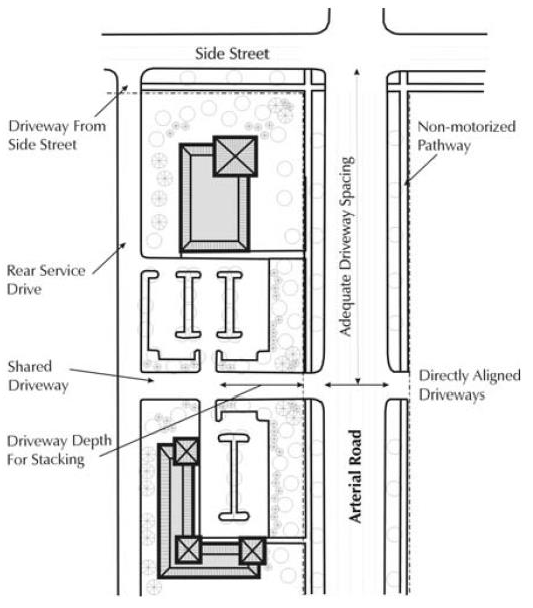
Preserve the capacity of the city's major streets by limiting and controlling the number, location and design of access points and by requiring alternate means of access through shared driveways, service drives, and access via cross streets in certain locations.
(b)
Encourage efficient flow of traffic by minimizing the disruption and conflicts between through traffic and turning movements.
(c)
Improve safety and reduce the potential for crashes.
(d)
Avoid the proliferation of unnecessary curb cuts and driveways and, when the opportunities arise, eliminate or reconfigure existing access points that do not conform to the standards of this section.
(e)
Implement the recommendations of the City of Wyoming Land Use Plan.
(f)
Require longer frontages or wider minimum lot widths than required in underlying zoning districts to help achieve acceptable distances for separation of driveways.
(g)
Require coordinated access among adjacent lands where possible.
(h)
Avoid the need for unnecessary and costly reconstruction of roadways which disrupts business operations and traffic flow.
(i)
Ensure efficient access by emergency vehicles.
(j)
Improve safety for pedestrians and other non-motorized travelers by reducing the number of conflict points at access crossings.
(k)
Establish uniform standards to ensure fair and equal treatment among property owners.
(2)
Driveway location in general.
(a)
The requirements of this section shall apply to all commercial/industrial driveways.
(b)
Driveways shall be located to minimize interference with the free movement of traffic, provide adequate sight distance, and provide the most favorable driveway grade.
(c)
Driveways, including the radii but not including right turn lanes, passing lanes and tapers, shall be located entirely within the right-of-way frontage, unless approved by the city engineer and upon written agreement from the adjacent property owner agreeing to such encroachment.
(d)
In the case of expansion, alteration or redesign of an existing development where it can be demonstrated that pre-existing conditions prohibit adherence to the minimum standards of this section, the city engineer may modify these requirements. Modifications shall be the minimum necessary, but in no case shall spacing of full-access driveways be less than 60 feet, measured centerline to centerline.
(3)
Driveway spacing standards.
(a)
Minimum spacing requirements between a proposed commercial/industrial driveway and an intersection, either adjacent or on the opposite side of the street, may be established on a case-by-case basis, but in no instance shall be less than the distances listed below. The following measurements are from the near edge of the proposed driveway, measured at the throat perpendicular to the street, to the near lane edge of the intersecting street or pavement edge for uncurbed sections.
(b)
For sites with insufficient street frontage to meet the above criterion, the driveway may be required to be located along a side street, shared with an adjacent property, constructed along the property line farthest from the intersection, or accessed from a service road.
(c)
Minimum spacing, between two commercial/industrial driveways, measured from centerline to centerline, shall be determined based upon posted speed limits along the parcel frontage as indicated below.
(d)
To reduce left-turn conflicts, new commercial/industrial driveways shall be aligned with those across the street, where possible. If alignment is not possible along arterial streets, driveways shall be offset from those on the opposite side of the street a minimum of 150 feet. These standards may be reduced as part of site plan approval, based upon the recommendation of the city engineer, on a case-by-case basis. Longer offsets may be required depending on the expected volumes of left-turns into the driveways.
(4)
Number of commercial/industrial driveways.
(a)
The number of commercial/industrial driveways serving a property shall be the minimum necessary to provide reasonable access for traffic and emergency vehicles, while preserving traffic operations and safety along the public roadway.
(b)
Access shall be provided for each separately owned parcel. This access may be from an individual driveway, shared driveway or a service drive. The planning commission may permit additional driveways for property meeting the following requirements:
1.
One additional driveway for properties with a continuous frontage of over 300 feet, and one driveway for each additional 300 feet of frontage.
2.
A traffic impact study determines that additional access is justified without compromising traffic operations along the public street.
3.
Two one-way driveways may be permitted where the frontage is at least 125 feet.
(5)
Commercial/industrial driveway design.
(a)
All commercial/industrial driveways shall be constructed according to the City of Wyoming or MDOT standards, as applicable. In commercial redevelopment areas, these standards shall be complied with to the maximum extent possible.
(b)
For high traffic generators, or for commercial/industrial driveways along streets experiencing or expected to experience congestion, two egress lanes may be required.
(c)
For a boulevard entrance, a fully curbed island, at least 180 square feet in area, shall separate the ingress and egress lanes. The radii forming the edges on this island shall be designed to accommodate the largest vehicle that will normally use the driveway.
(6)
Shared driveways, frontage roads and service roads.
(a)
The number of access points may be reduced where it is determined by the site plan review authority that there may be a beneficial effect on traffic operations and safety, while preserving the property owner's right to reasonable access. In this case, a shared commercial/industrial driveway, frontage road or rear service drive connecting two or more properties or uses may be required. Service roads may be required near existing traffic signals or near locations having potential for future signalization; along arterial roadways with high traffic volumes; and where a relatively high number of crashes or limited sight distances are found.
(b)
Shared commercial/industrial driveways and service roads shall be within a recorded access easement. A draft of the access easement shall be provided to the city engineer for review prior to filing.
(c)
Service road and shared driveway design standards.
1.
Location. Service roads shall generally be parallel or perpendicular to the front property line and may be in front of, adjacent to, or behind, principal buildings. The site plan review authority shall determine the most appropriate alignment, taking into account setbacks of existing buildings and anticipated traffic flow for the site and the corridor.
2.
Access easement. The service road shall be within an access easement permitting traffic circulation between properties.
This easement shall be 60 feet wide, except an access easement parallel to a public street right-of-way may be 40 feet wide, if approved by the city engineer. The required width shall remain free and clear of obstructions, unless otherwise approved.
3.
Construction and materials. Service roads shall have a base, pavement and curb with gutter in accordance with the city engineer requirements. The minimum required width of the service road shall be 27 feet, measured back to back of curb.
4.
Parking. The service road is not intended as a parking maneuvering aisle. The site plan review authority may require the posting of "no parking" signs along the service road. Temporary parking may be permitted in the easement area where a continuous service road is not yet available, provided that the layout provides for the removal of the parking to allow extension of the service road.
5.
Access to service road. All access to the service road shall be in accordance with the driveway spacing standards of this section. The planning commission may allow additional driveways if recommended by the city engineer.
6.
Temporary access. The site plan review authority, with concurrence of the city engineer, may approve temporary access where a continuous service road is not yet available and a performance guarantee is provided to assure elimination of temporary access when the service road is continued. Building permits shall not be issued until the performance guarantee has been deposited with the city.
7.
Elevation. The site plan shall indicate the proposed elevation of the service road at the property line. The city engineer shall maintain a record of all service road elevations so that their grades can be coordinated.
8.
Maintenance. Each property owner shall be responsible for maintenance of the easement and service drive across their frontage. The maintenance provisions shall be specified in the recorded access easement.
(Ord. No. 10-11, § 1, 10-3-11)

