
Beaufort County Unincorporated
City Zoning Code
City Zoning Code
ARTICLE 7
- Procedures
7.1.10 - Organization
This Article identifies the various types of development applications authorized by this Development Code and describes the review procedures applicable to them. Section 7.5.70 (Summary Table of Development Review Responsibilities) provides a summary table identifying the types of development applications and the advisory or decision-making roles the staff and various review boards play in each application review process. Division 7.2 (Application Specific Review Procedures) and Division 7.3 (Other Review Procedures) sets out the specific procedures and review standards for each different type of development application under this Development Code. In a number of instances, the procedures reference Division 7.4 (Standard Procedures), which sets out the review procedures and post-decision rules that apply to all development applications (until noted otherwise).
7.2.10 - Overview
A.
General. This Division sets forth the specific procedures, standards, and related information for each of the development applications reviewed under this Development Code.
B.
Structure of Procedures. For each type of development application reviewed under this Development Code, the following sections state the purpose of the section and/or type of development permit or approval, and the steps in the standard procedure set forth in Division 7.4 (Standard Procedures) that are applicable. They also include, for each step, any variations of, or additions to, the standard procedures. This is followed by the review standards for the application, and provisions addressing expiration and amendment.
7.2.20 - Zoning Permit
A.
Purpose. The purpose of a Zoning Permit is to ensure that proposed development and/or new land uses comply with all the requirements of this Development Code and have any required permits for access, potable water, sewer, and any other permits required under the Code of Ordinances and/ro state or federal law prior to issuance of a Building Permit or Business License.
B.
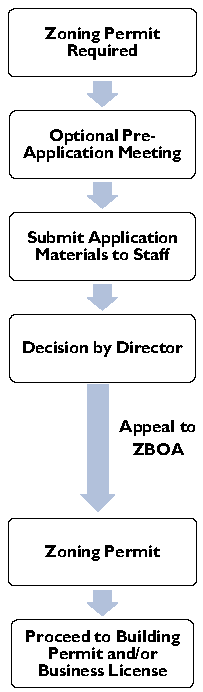
Applicability. A Zoning Permit is required before issuance of a Building Permit or a Business License.
C.
Zoning Permit Procedure.
1.
Pre-Application Conference is Optional. See Section 7.4.20 (Pre-Application Conference).
2.
Application Submittal and Acceptance. See Section 7.4.30 (Application Submittal and Acceptance).
3.
Staff Review and Action. Applicable to a decision by the Director. See Section 7.4.40 (Staff Review and Action). The Director's decision shall be based on the standards in Subsection 7.2.20.D.
4.
Appeal. The decision of the Director on a Zoning Permit may be appealed to the ZBOA. See Section 7.3.70 (Appeals).
D.
Zoning Permit Review Standards. A Zoning Permit shall be approved on a finding the applicant demonstrates the proposed development complies with:
1.
All applicable standards in this Development Code;
2.
All conditions of permits or development approvals approved under this Development Code;
3.
All required permits for access, potable water, and sewer; and
4.
All other applicable standards in the Code of Ordinances.
E.
Expiration. Approval of a Zoning Permit shall automatically expire if the development activity it authorizes is not commenced within twelve months after the date of approval, unless an extension of this period is authorized in accordance with Section 7.4.130 (Expiration of Development Approval).
F.
Amendment. A Zoning Permit may be amended only in accordance with the procedures and standards for its original approval.
(Ord. No. 2015/32, § 1, 11-9-15)
7.2.30 - Modulation Permit
A.
Purpose. A Modulation Permit is intended to allow minor adjustments to certain dimensional, numerical, and development standards of this Development Code based on specific review criteria, with the intent of allowing minor modulation where application of a standard creates practical difficulties in allowing development that otherwise advances the purposes served by the standards of this Development Code and the Comprehensive Plan, and is compatible with surrounding development. A Modulation Permit is also intended to provide limited flexibility, in specific areas, to allow alternative design that is equal to or better than that afforded by strict application of certain dimensional or numerical standards.
B.
Applicability. A Modulation Permit may be requested and granted in accordance with this Section for the standards identified in Table 7.2.30.A (Allowable Modulations), up to the limits set forth in the table.
C.
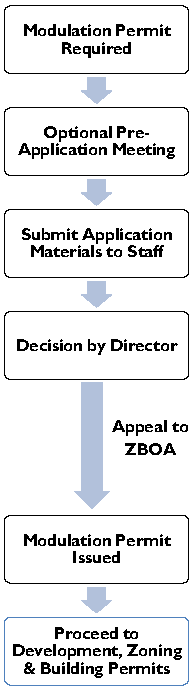
Modulation Permit Procedure
1.
Pre-Application Conference is Optional. See Section 7.4.20 (Pre-Application Conference).
2.
Application Submittal and Acceptance. See Section 7.4.30 (Application Submittal and Acceptance).
3.
Staff Review and Action. Applicable to a decision by the Director. See Section 7.4.40 (Staff Review and Action). The Director's decision shall be based on the standards in Subsection 7.2.30.D.
4.
Appeal. The decision of the Director on a Modulation Permit may be appealed to the ZBOA. See Section 7.3.70 (Appeals).
D.
Modulation Permit Review Standards. A Modulation Permit shall be approved on a finding the applicant demonstrates the following:
1.
Better Design: That the modulation leads to better design and achieves the intent of this Development Code in an alternate but equally effective manner.
2.
Environmental Protection: That the modulation conserves or enhances environmental assets on the site and will not cause impacts or harm to adjacent sites or the surrounding community.
3.
Site Limitations: That the modulation accounts for the site limitation caused by natural resource considerations or other distinguishing features related to size, shape or topography of the lot or site.
4.
Architecture: That the modulation allows for innovative design that enhances and supports the range of Lowcountry architectural styles of Beaufort County.
E.
Effect. Approval of a Modulation Permit authorizes only the particular adjustment of standards authorized by the approval. It does not exempt the applicant from the responsibility to obtain all other permits required by this Development Code and any other applicable laws, and does not indicate that the development for which the Modulation Permit is granted should receive approval of other development applications under this Development Code unless the relevant and applicable portions of this Development Code or any other applicable laws are met. Unless it expires in accordance with Section 7.4.130 (Expiration of Development Approval), a Modulation Permit, including any conditions of approval, shall run with the land, shall be binding on the landowners and their successors and assigns, and shall not be affected by a change in ownership.
F.
Expiration. Approval of a Modulation Permit shall automatically expire if a Development Permit or Zoning Permit, as appropriate, for the development incorporating the authorized adjustment is not obtained within one year after the date of the approval, or an extension of time period is authorized in accordance with Section 7.4.130 (Expiration of Development Approval).
G.
Amendment. A Modulation Permit may be amended only in accordance with the procedures and standards established for its original approval.
(Ord. No. 2015/32, § 1, 11-9-15; Ord. No. 2016/20, 6-27-16)
7.2.40 - Sign Permit
A.
Purpose. The purpose of this Section is to provide a uniform mechanism for reviewing applications for Sign Permits to ensure that signs comply with the standards of Division 5.6 (Sign Standards).
B.
Applicability. All signs, unless exempted in accordance with Section 5.6.10.B.4, or Section 5.6.10.B.5, shall obtain Preliminary Approval of a Sign Permit in accordance with the requirements of this Section before being erected, replaced, relocated or altered.
C.
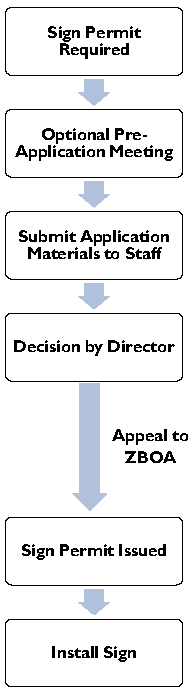
Sign Permit Procedure.
1.
Pre-Application Conference is Optional. See Section 7.4.20 (Pre-Application Conference).
2.
Application Submittal. An applicant for a sign permit shall submit to the office of the Director a completed application made on a form provided by the Director. The application shall be signed by the applicant and shall be notarized. An application shall be considered complete when it contains the following required information and/or items:
a.
The applicant's name, address, phone number, and email address.
b.
The name, address, phone number, email address, and business license number of the owner of the sign.
c.
The name and address of the owner of the property where the sign is (or is to be) located, the zoning district and tax map number and parcel number for the property, and the physical 911 address for the property.
d.
If the applicant does not own the property, the owner's written and signed authorization for the applicant to seek a permit to erect, replace, relocate, or alter the sign as described in the application.
e.
The address of the location of the sign and the related Development/Zoning Permit numbers.
f.
The type of sign, the material of the sign, and statements of whether and how the sign would be illuminated.
g.
A statement of the sign's height, width, total area of sign, and number of faces.
h.
A statement of the name of the sign.
i.
A statement of an identifying number assigned to the sign by a governing authority, if any.
j.
A statement of the value of the sign.
k.
A statement of whether the proposed sign would replace an existing sign.
l.
A statement of whether the sign owner plans to include the sign in its Business Inventory.
m.
A statement of whether the proposed sign is a temporary sign, and if so, the date(s) being requested.
n.
A form showing Business License Department approval concerning the sign manufacturer's business license number, the sign installer's business license number (if different from the sign manufacturer), and the sign permit applicant's business license number.
o.
A copy of the certificate of occupancy issued for the property on which the sign is to be erected, replaced, relocated or altered.
p.
A site plan of the property showing the proposed placement of the sign with respect to property lines, buildings, parking areas, driveways and any entrance island(s), and other improvements of the property. The sketch must also show the location and size of all existing signs on site. The sketch must also show the setbacks and separation distances for the sign.
q.
A drawing of the proposed sign showing the sign, sign face, and sign copy area, as well as the shape, design, colors, height, and dimensions of the various sign elements.
r.
Accurate color chips or Pantone Matching System (PMS) numbers included on the drawing of the proposed sign.
s.
For a wall sign, a photograph of the actual building showing the wall for the proposed sign.
t.
For a freestanding sign, a copy of the plans of any structure to support the proposed sign.
u.
A description of the materials and construction for the sign, showing that the sign and any sign structure complies with the requirements of Division 5.6.
v.
An application fee of 50¢ per square foot of the total area of the sign, or a minimum payment of $15 for each sign, payable to the Beaufort County Treasurer.
3.
Determination of Application Completeness. See Section 7.4.43.F.
4.
Issuance of Preliminary Approval of a Sign Permit. Within thirty (30) days of the filing of a completed sign permit application, the Director or designee shall either issue Preliminary Approval of a sign permit to the applicant or issue a written notice of denial to the applicant. The Director or designee shall issue Preliminary Approval of a sign permit unless:
a.
The applicant has failed to provide information required by Subsection 7.2.40.C.2 for issuance of a sign permit or has falsely answered a question or request for information on the application form.
b.
The application fee has not been paid.
c.
The applicant or the owner of the sign does not have a proper Development/Zoning Permit for the activity or land use actually occurring on the property.
d.
The sign is located, or proposed to be located, on a premises where an establishment, land use, or business is operated in violation of, or in noncompliance with, its certificate of use or occupancy.
e.
The permit sought is for a sign on a premises where an establishment, land use, or business is located, or is seeking to locate, contrary to the regulations of the Development Code.
f.
The sign is prohibited under Division 5.6 (Sign Standards) of the Development Code.
g.
The sign does not comply with the standards in Division 5.6 (Sign Standards) of the Development Code that govern the sign.
5.
Inspection; Issuance of a Sign Permit. Upon Preliminary Approval of a Sign Permit, the applicant may erect, replace, relocate, or alter the sign authorized by the Preliminary Approval, shall complete the work, and shall request an inspection from the Codes Enforcement Officer before the Preliminary Approval expires under Subsection 7.2.40.D. The Codes Enforcement Officer shall inspect the sign within ten (10) business days of receiving an inspection request. The Director or designee shall issue a Sign Permit to the applicant within five (5) business days of the inspection unless the sign work is incomplete or the sign as competed fails to comply with the Development Code or the permittee's building permit.
6.
Grounds for Revocation of a Preliminary Approval or a Sign Permit. The Director or designee is authorized to issue a written notice of revocation of a Preliminary Approval or of a Sign Permit if the approval or permit should have been denied under Subsection 7.2.40.C.4, or if the applicant/permittee erects, alters, or fails to maintain the sign in violation of the Development Code or the applicant/permittee's building permit. The Director or designee may also pursue any applicable remedies set forth in Subdivision 5.6.70.B (Impoundment of Signs).
7.
Denial or Revocation of a Preliminary Approval or a Sign Permit. When the Director or designee issues a written notice of denial or revocation of a Preliminary Approval or of a Sign Permit, the Director or designee shall immediately send such notice, which shall include the specific grounds under Subdivision 7.2.40.C.4 and/or Division 5.6 (Sign Standards) for such action, to the applicant/permittee by personal delivery, certified mail return receipt requested, or email. The notice shall be directed to the most current business address, other mailing address, or email address on file with the Director for the applicant/permittee. The notice shall also set forth the following: The applicant/permittee shall have thirty (30) days after receiving the written notice to deliver, at the office of the Director, a written Appeal application that specifies the grounds for the appeal. See Subsection 7.3.70.C.2. If the applicant/permittee does not deliver a written Appeal application within said thirty (30) days, the Director's written notice shall become a final decision on the thirty-first (31st) day after it is issued.
8.
Appeal from Denial or Revocation. The decision of the Director or designee on a Preliminary Approval or a Sign Permit may be appealed to the ZBOA. See Section 7.3.70 (Appeals).
a.
If the applicant/permittee (hereafter "petitioner") timely delivers a written Appeal application in accord with Subsection 7.2.40.C.7 above, then the Director or designee shall, within fifteen (15) days after the delivery of the request, send a notice to the petitioner indicating the date, time, and place of the hearing before the ZBOA. The hearing shall be conducted not less than twelve (12) days nor more than forty-five (45) days after the date that the hearing notice is issued.
b.
The public hearing (See Subsection 7.3.70.C.5 & C.6) shall be on the record of the appeal, with presentations limited to arguments on the record of the appeal as it relates to the grounds for appeal specified in the Appeal application. At the hearing, the petitioner and the Director shall have the opportunity to present all relevant arguments and to be represented by counsel. The hearing shall take no longer than one (1) day, unless extended at the request of the petitioner to meet the requirements of due process and proper administration of justice. The ZBOA may receive, consider, and adopt proposed written decisions tendered by the Director and/or the petitioner before or during the hearing. The ZBOA shall issue a final written decision, including specific reasons for the decision pursuant to this Development Code, to the Director and the petitioner within 15 business days after the hearing. The decision of the ZBOA may be appealed to the Circuit Court. (See Subsection 7.3.70.C.7.)
D.
Expiration. Preliminary Approval of a Sign Permit shall automatically expire if the sign installation it authorizes is not commenced within six months after the date of approval, unless an extension of this period is authorized in accordance with Section 7.4.130 (Expiration of Development Approval).
E.
Amendment. A Preliminary Approval of a Sign Permit may be amended only in accordance with the procedures and standards established for its original approval.
(Ord. No. 2021/32, 7-26-21)
7.2.50 - Tree Removal Permit
A.
Purpose. The purpose of this Section is to ensure protected trees on parcels of land subject to land disturbing or construction activities that are regulated under this Development Code are not cut prior to submittal of a development application reviewed under this Development Code.
B.
Applicability. Unless exempted in accordance with Subsection 7.2.50.C below, a Tree Removal Permit approved in accordance with this section is required before any land disturbing activities or the removal, relocation, or substantial alteration of a protected tree, as defined in Division 5.11 of this Development Code
C.
Exemptions. The following are exempt from the standards of this Section:
1.
Removal of trees that have been planted and are being grown in a plant nursery or botanical garden for the purpose of sale to the general public as landscaping material; and
2.
Land disturbing activities and tree removal, relocation, or substantial alteration in conjunction with bona fide forestry operations. See Article 3, Table 3.1.70 (Land Use Definitions).
3.
Removal of invasive trees as defined in Section 5.11.100.G
D.
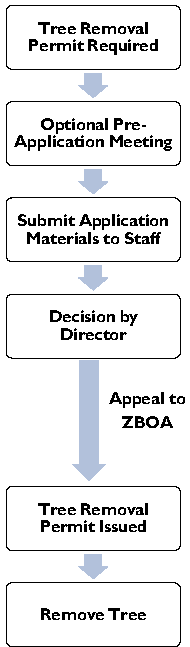
Tree Removal Permit Procedure.
1.
Pre-Application Conference is Optional. See Section 7.4.20 (Pre-Application Conference).
2.
Application Submittal and Acceptance. See Section 7.4.30 (Application Submittal and Acceptance).
3.
Staff Review and Action. Applicable to a decision by the Director. See Section 7.4.40 (Staff Review and Action). The Director's decision shall be based on the standards in Subsection 7.2.50.E below
4.
Appeal. The decision of the Director on a Tree Removal Permit may be appealed to the ZBOA. See Section 7.3.70 (Appeals).
E.
Tree Removal Permit Review Standards. A Tree Removal Permit shall be approved on a finding the applicant demonstrates the proposed tree removal complies with the standards in Section 5.11.100 (Tree Protection).
F.
Expiration. Approval of a Tree Removal Permit shall automatically expire if the tree removal it authorizes is not commenced within six months after the date of approval, unless an extension of this period is authorized in accordance with Section 7.4.130 (Expiration of Development Approval).
G.
Amendment. A Tree Removal Permit may be amended only in accordance with the procedures and standards for its original approval.
7.2.60 - Land Development Plan
A.
Purpose. The Land Development Plan provisions of this Section are intended to ensure that the layout and general site design of proposed development is compatible with surrounding uses and complies with all applicable standards in this Development Code and all other applicable County standards. The purpose of this Section is to establish the procedure and standards for review of a Land Development Plan.
B.
Applicability
1.
General. Approval of a Land Development Plan in accordance with this Section is required before issuance of a Development Permit.
2.
Major and Minor Land Development Plans Distinguished.
a.
Unless exempted in accordance with this Section, the following development shall be required to receive approval of a Major Land Development Plan in accordance with this Section:
(1)
Non-residential development of more than 5,000 square feet of gross floor area;
(2)
The addition of 5,000 square feet or 30 percent or more of the original building of a non-residential development which results in a building larger than 5,000 square feet; or
(3)
Apartment or multi-family development of six dwelling units or more.
b.
All other development, unless exempted in accordance with this Section, shall be required to receive approval of a Minor Land Development Plan in accordance with this Section.
C.
Exemptions. Development of a single-family dwelling, duplex, or multi-family development of less than six dwelling units on a lot of record or lot platted prior to December 8, 2014, is exempt from the requirements of this Section.
D.
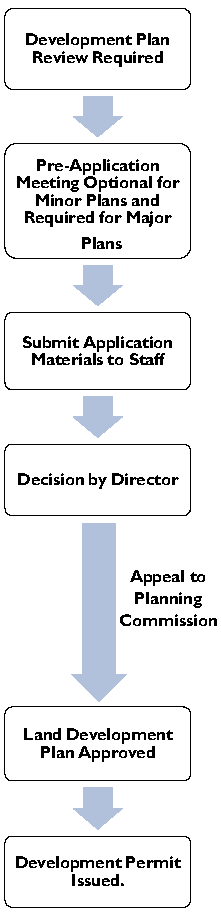
Minor Land Development Plan Procedure.
1.
Pre-Application Conference is Optional. See Section 7.4.20 (Pre-Application Conference).
2.
Application Submittal and Acceptance. See Section 7.4.30 (Application Submittal and Acceptance).
3.
Staff Review and Action. Applicable to a decision by the Director. See Section 7.4.40 (Staff Review and Action). The Director's decision shall be based on the standards in Subsection 7.2.60.F. Development located outside of a transect zone shall also require approval of a Certificate of Design Compliance (see Section 7.2.110 (Certificate of Design Compliance)) prior to final approval of a Minor Land Development Plan.
4.
Appeal. The decision of the Director on a Minor Land Development Plan may be appealed to the Planning Commission. See Section 7.3.70 (Appeals).
E.
Major Land Development Plan Procedure.
1.
Concept Plan.
a.
Pre-Application Conference is Required. See Section 7.4.20 (Pre-Application Conference).
b.
Application Submittal and Acceptance. See Section 7.4.30 (Application Submittal and Acceptance).
c.
Staff Review and Action. Applicable to a decision by the Director. See Section 7.4.40 (Staff Review and Action). The Director's decision shall be based on the standards in Subsection 7.2.60.F.
d.
Appeal. The decision of the Director on a Concept Plan for a Major Land Development Plan may be appealed to the Planning Commission. See Section 7.3.70 (Appeals).
2.
Final Land Development Plan.
a.
Pre-Application Conference is Optional. See Section 7.4.20 (Pre-Application Conference).
b.
Application Submittal and Acceptance. See Section 7.4.30 (Application Submittal and Acceptance).
c.
Staff Review and Action. Applicable to a decision by the Director.See Section 7.4.40 (Staff Review and Action). The Director's decision shall be based on the standards in Subsection 7.2.60.F. Development located outside of a transect zone shall require approval of a Certificate of Design Compliance, see Section 7.2.110 (Certificate of Design Compliance) prior to final approval of a Major Land Development Plan.
d.
Appeal. The decision of the Director on a Major Land Development Plan may be appealed to the Planning Commission. See Section 7.3.70 (Appeals).
F.
Land Development Plan Review Standards. An application for a Land Development Plan (major or minor) shall be approved on a finding the applicant has demonstrated the proposed development:
1.
Is consistent with the Comprehensive Plan;
2.
Complies with the applicable standards of this Development Code;
3.
Complies with all other applicable standards of State or Federal law and of the Code of Ordinances; and
4.
Complies with all standards or conditions of any prior applicable development permit or approval.
G.
Effect of Approval. Final approval of a Land Development Plan (major or minor) authorizes the issuance of a Development Permit in accordance with Section 7.2.80 (Development Permit).
H.
Expiration.
1.
Concept Approval of a Major Land Development Plan. Concept Approval of a Major Land Development Plan shall automatically expire if Final Plan Approval is not obtained within one year after the date of approval, unless extension of the time period is authorized in accordance with Section 7.4.130 (Expiration of Development Approval).
2.
Final Approval of a Land Development Plan (Minor or Major). Final approval of a Land Development Plan (minor or major) shall automatically expire, and the Development Permit revoked, if a Certificate of Compliance for the authorized development is not obtained within two years after the date of approval, unless extension of the time period is authorized in accordance with Section 7.4.130 (Expiration of Development Approval). The date of expiration shall be clearly noted on the Development Permit. It is the duty of the permit holder to insure that the permit is current.
I.
Amendment. A Land Development Plan (major or minor) may be modified or amended only in accordance with the procedures and standards established for its original approval.
7.2.70 - Subdivision Plat
A.
Purpose. The purpose of this Section is to provide a uniform means for the review and approval of divisions of land and to ensure, in conjunction with Article 6 (Subdivision and Land Development), that subdivisions promote the health, safety, convenience, order, prosperity and welfare of present and future residents of the County by:
1.
Providing for the orderly growth and development of the County;
2.
Coordinating streets and roads within proposed subdivisions with the County's street system and transportation plans, and with other public facilities;
3.
Providing rights-of-way for streets and utility easements;
4.
Ensuring there is adequate open space and recreation facilities to serve development; and
5.
Ensuring there is proper recordation of land ownership or property owner association records, where applicable.
B.
Applicability. Unless exempted in accordance with Subsection 7.2.70.D, approval of a Subdivision (Major, Minor, or Commercial), in accordance with the provisions of this Section is required before the division of land (whether improved or unimproved) into two or more lots or parcels is recorded or otherwise made effective. No land may be sold, transferred, or offered for sale until a final plat is recorded.
C.
Overview. For the purposes of this Development Code, there are three types of subdivisions:
1.
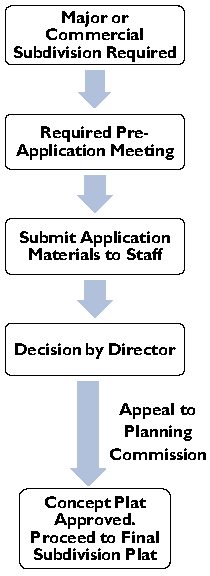
Major Subdivision. A Major Subdivision is any subdivision of land into five or more lots, or subsequent minor subdivisions of property (see Subsection 7.2.70.C.2 below) that results in five or more lots being served by a single road. Development of a Major Subdivision requires approval of a Major Subdivision Concept Plat and then a Major Subdivision Final Plat by the Director in accordance with this Section.
2.
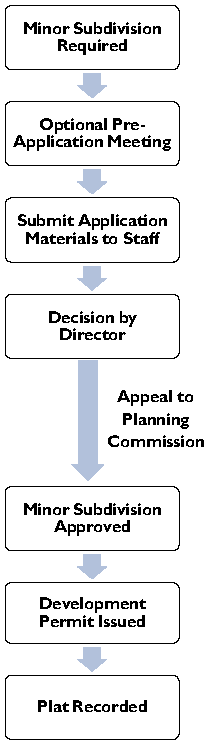
Minor Subdivision. A Minor Subdivision is a subdivision of land proposing not more than four lots to be served by a single road or access easement. Development of a Minor Subdivision requires approval of a Minor Subdivision Plat by the Director in accordance with this Section. A Minor Subdivision Plat is considered a Final Plat for the purposes of this Section.
3.
Commercial Subdivision. A Commercial Subdivision is a subdivision of land that includes master planning and subdividing into two or more lots any tract or parcel of land located in commercial regional, commercial suburban, research and development, light industry, and industrial park districts. These subdivisions are limited to commercial and/or industrial uses only. This type of subdivision includes all of the following:
a.
Separate ownership of lots, coupled with undivided interest in common property;
b.
Restrictive land use covenants or easements that govern use of both the common area and separate ownership interests; and
c.
Management of common property and enforcement of restrictions by a property owners' association.
D.
Exemptions. The following developments are exempt from the requirements of this Section. The County Director shall be notified by the owner about the exemption, and the plat recorded with the Register of Deeds identifying the exemption from the County's subdivision standards:
1.
The combination or recombination of portions of previously platted lots where the total number of lots is not increased, and the resultant lots are equal to the standards of the County;
2.
The division of land into parcels of five acres or more where each parcel abuts an existing road right-of-way or access easement recorded prior to December 8, 2014.
3.
The combination or recombination of entire lots of record where no new street or change in existing streets is involved;
4.
The division of land into parcels for conveyance to other persons through the provisions of a will or similar document, and in the settlement of an intestate's estate or as determined by an order of a court of competent jurisdiction;
5.
Property trades or swaps between immediately adjacent landowners not resulting in the creation of new parcels of record;
6.
Division of land for the purpose of sale or transfer to an immediately adjacent landowner for the sole purpose of enlarging the adjacent landowner's property, and not resulting in the creation of new parcels, or the creation of new nonconforming parcels;
7.
The recordation of a plat of land or property for purposes other than the sale or transfer of title to land including the following:
a.
The creation or termination of leases, easements, or liens;
b.
The creation or termination of mortgages on existing parcels of record, approved subdivisions or commercial projects, partly or undeveloped land;
c.
Lot line corrections on existing recorded properties;
d.
The creation, termination or amendment of private covenants or restrictions on land; and
e.
A transfer of title to land not involving the division of land into parcels.
E.
Minor Subdivision Plat Procedure.
1.
Pre-Application Conference is Optional. See Section 7.4.20 (Pre-Application Conference).
2.
Application Submittal and Acceptance. See Section 7.4.30 (Application Submittal and Acceptance).
3.
Staff Review and Action. Applicable to a decision by the Director. See Section 7.4.40 (Staff Review and Action). The Director's decision shall be based on the standards in Subsection 7.2.70.G.
4.
Appeal. The decision of the Director on a Minor Subdivision Plat may be appealed to the Planning Commission. See Section 7.3.70 (Appeals).
F.
Major and Commercial Subdivision Plat Procedure.
1.
Concept Plat.
a.
Pre-Application Conference is Required. See Section 7.4.20 (Pre-Application Conference).
b.
Application Submittal and Acceptance. See Section 7.4.30 (Application Submittal and Acceptance).
c.
Staff Review and Action. Applicable to a decision by the Director. See Section 7.4.40 (Staff Review and Action). The Director's decision shall be based on the standards in Subsection 7.2.70.G.d. Appeal. The decision of the Director on a Concept Plat may be appealed to the Planning Commission. See Section 7.3.70 (Appeals).
2.
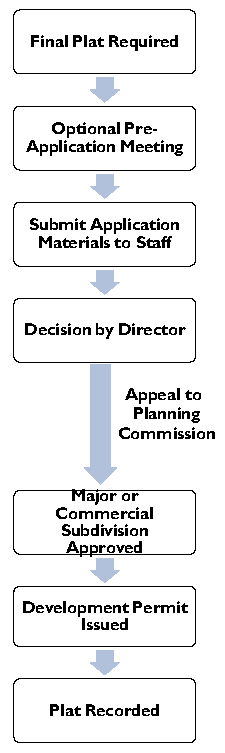
Final Plat.
a.
Pre-Application Conference is Optional. See Section 7.4.20 (Pre-Application Conference).
b.
Application Submittal and Acceptance. See Section 7.4.30 (Application Submittal and Acceptance).
c.
Staff Review and Action. Applicable to a decision by the Director. See Section 7.4.40 (Staff Review and Action). The Director's decision shall be based on the standards in Subsection 7.2.70.G. A major or commercial subdivision located outside of a transect zone shall also require approval of a Certificate of Design Compliance (see Section 7.2.110 (Certificate of Design Compliance)) for all subdivision entrance features (e.g. walls/fencing, landscaping, lighting, signage, etc.) prior to final plat approval.
d.
Appeal. The decision of the Director on a Major or Commercial Subdivision Final Plat may be appealed to the Planning Commission. See Section 7.3.70 (Appeals).
G.
Subdivision Review Standards. An application for a Subdivision (major, minor, or commercial) shall be approved on a finding the applicant has demonstrated the proposed subdivision:
1.
Is consistent with the Comprehensive Plan;
2.
Complies with the applicable standards of this Development Code;
3.
Complies with all other applicable standards of the County's Code of Ordinances and State and Federal law; and
4.
Complies with all standards or conditions of any prior applicable development permits and approvals.
H.
Effect of Final Plat Approval. Final approval of a Subdivision Plat (major, minor, or commercial) authorizes the issuance of a Development Permit in accordance with Section 7.2.80 (Development Permit). Upon completion of the construction or installation of public infrastructure improvements, or County approval of performance and maintenance guarantees ensuring such completion, the subdivider is authorized to have the Final Subdivision Plat certified and recorded.
I.
Expiration.
1.
Concept Approval of a Major or Commercial Subdivision Plat. Concept Approval of a Major or Commercial Subdivision Plat shall automatically expire if Final Plat Approval is not obtained within one year after the date of approval, unless extension of the time period is authorized in accordance with Section 7.4.130 (Expiration of Development Approval).
2.
Final Approval of a Subdivision Plat (Major, Minor, or Commercial). Final approval of a Subdivision Plat (major, minor, or commercial) shall automatically expire, and the Development Permit revoked, if the plat is not recorded and a Certificate of Compliance is not issued within two years after the date of approval, unless extension of the time period is authorized in accordance with Section 7.4.130 (Expiration of Development Approval). The date of expiration shall be clearly noted on the Development Permit. It is the duty of the permit holder to insure that the permit is current.
J.
Recordation of Final Plat. Upon approval and submission in an approved format, the final plat shall be signed, sealed and dated by the Director, certifying that final approval has been given. No sales or transactions involving lots shall be permitted until a final plat is recorded.
K.
Amendment. A Subdivision Plat (minor, major, or commercial) may be modified or amended only in accordance with the procedures and standards established for its original approval.
7.2.80 - Development Permit
A.
Purpose. The purpose of this Section is to provide a uniform mechanism for landowners to commence public facility, infrastructure, or support facility improvements to land, after approval of a Final Subdivision Plat (minor, major, or commercial), or a Land Development Plan (minor or major), to ensure compliance with this Development Code and all terms and conditions of permit approval.
B.
Applicability. Prior to initiating the construction of any public facility, infrastructure, or support facility improvements to land after approval of a Final Subdivision Plat (minor, major, or commercial), or a Land Development Plan (minor or major), the landowner shall receive a Development Permit in accordance with this Section.
C.
Appeal. The decision of the Director on a Development Permit may be appealed to the Planning Commission. See Section 7.3.70 (Appeals).
D.
Development Permit Conditions. A Development Permit may include such conditions as are necessary to insure compliance with this Development Code. At a minimum, the following conditions shall apply:
1.
All tree aeration systems, natural resource, archeological and tree protection barriers, and silt fencing shall be constructed prior to any other site work approved in accordance with the Development Permit. Upon their completion, the applicant shall request an inspection by the County prior to receiving an authorization to proceed with other construction activities;
2.
A Development Permit associated with a Subdivision approval is for construction of infrastructure only, unless infrastructure bonding is posted and accepted in accordance with the requirements of this Development Code;
3.
Subdivision Plats shall not be recorded and sale of lots permitted until final approval is affixed and certified on the Final Subdivision Plat and the plat is duly recorded by the Register of Deeds;
4.
A Certificate of Occupancy shall not be issued until all site work is completed, inspected by the County, and granted a Certificate of Compliance;
5.
A landscape survival bond is required prior to issuance of a Certificate of Compliance for all landscape materials planted or relocated on site;
6.
Subdivision infrastructure bonding is for one year. In order to obtain a release of bond, all infrastructure shall be completed and a Certificate of Compliance issued;
7.
All bonding shall be in the form of cash, certified check, irrevocable bank letter of credit, or surety bond as approved by the County; and
8.
The owner of the land, or if such owner is a corporate entity, an officer of the corporation, shall sign a document provided by the County Attorney accepting full civil and criminal responsibility for any violations of the Code of Ordinances arising out of or relating to the development of the subject land during the pendency of the Development Permit."
E.
Field Modifications. All construction of on-site improvements on land subject to a Development Permit is to be in accordance with the approved final development plan or plat. Final engineering may be modified in the field provided as-built drawings are submitted. As-built drawings must be accepted by the County Engineer. If unacceptable, the work must be corrected at the developer's expense prior to accepting improvements and return of any surety.
F.
Expiration. Approval of a Development Permit shall be effective beginning on the date of approval and shall remain effective for the period indicated in the permit, unless an extension of this time period is authorized in accordance with Section 7.4.130 (Expiration of Development Approval).
G.
Amendment. A Development Permit may be amended only in accordance with the procedures and standards established for its original approval.
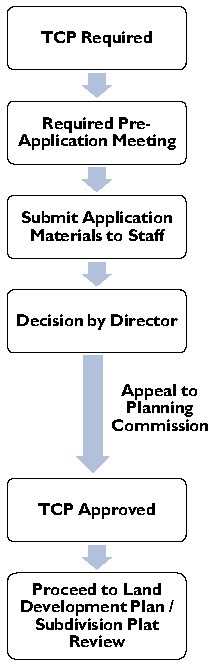
7.2.90 - Traditional Community Plan (TCP)
A.
Purpose. The purpose of this Section is to provide a uniform means for establishing a Traditional Community Plan that allows for compact, walkable neighborhoods and place-based development to occur in C3, C4, and C5 Districts.
B.
Traditional Community Plan Procedure.
1.
Pre-Application Conference is Required. See Section 7.4.20 (Pre-Application Conference).
2.
Application Submittal and Acceptance. Applicable. See Section 7.4.30 (Application Submittal and Acceptance). The application shall meet the requirements of Section 2.3.20 (General Requirements), and include the following:
(a)
A Building Form regulating plan that clarifies the location, size, and disposition of the transect zones;
(b)
A Thoroughfare Regulating Plan that clarifies the location of all primary streets and the type and location of all secondary streets, alleys, and other publicly accessible right-of-ways; and
(c)
A Civic Space Regulating Plan that identifies the types, sizes, and locations of all civic spaces.
3.
Staff Review and Action. Applicable to a decision by the Director. See Section 7.4.40 (Staff Review and Action). The Director's recommendation shall be based on the standards in Division 2.3 (TCP) and Subsection 7.2.90.C.
4.
Public Hearing Scheduling and Notice. A public hearing is not applicable; however, the applicant shall post the property for two weeks prior to final action by the Director on the TCP.
5.
Appeal. The decision of the Director on a TCP may be appealed to the Planning Commission. See Section 7.3.70 (Appeals).
C.
Traditional Community Plan Standards. An application for a TCP shall be approved on a finding the applicant has demonstrated the proposed plan:
1.
Is consistent with the Comprehensive Plan;
2.
Complies with the applicable standards of this Development Code; and
3.
Complies with all other applicable standards of the Code of Ordinances.
D.
Effect of Approval. Approval of a TCP authorizes the submittal of an application for a Development Plan or Subdivision Plat approval and any other development application that may be required to develop the TCP.
E.
Expiration. Approval of a TCP shall automatically expire if a Final Development Plan or Final Subdivision Plat for at least one phase of the TCP is not obtained within two years after the date of approval of the TCP."Thereafter, the TCP shall remain valid for a period of 10 years as long as development plans/plats for the TCP do not expire. See Section 7.4.130 (Expiration of Development Approval). An extension of this period may be authorized by the Director on submittal of a request for extension to the Director before the expiration date and a showing of good cause.
F.
Amendment. A TCP may be amended only in accordance with the procedures and standards established for its original approval.
7.2.100 - Street Renaming
A.
Purpose. The purpose of this Section is to establish a mechanism for renaming streets within the County's jurisdiction. A consistent, efficient, and easily understood street renaming system promotes the public health, safety, and welfare of the County and its residents by providing directional clarity, enhanced traffic flow, and ease of locating land.
B.
Applicability. All official street renaming in the County shall be approved in accordance with this Section.
C.
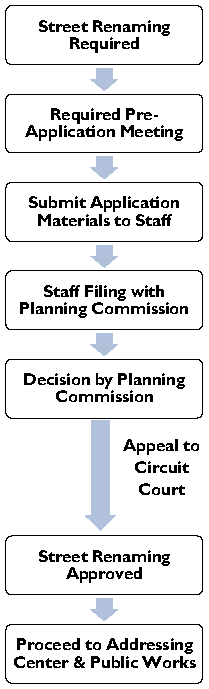
Street Renaming Procedure.
1.
Pre-Application Conference is Required. See Section 7.4.20 (Pre-Application Conference).
2.
Application Submittal and Acceptance. See Section 7.4.30 (Application Submittal and Acceptance). Applications to rename an existing street may be initiated by the County Council, the Planning Commission, the E-911 Addressing Center, or a landowner who owns property frontage on the affected street. If the applicant is an abutting landowner, the applicant is required to obtain property owner signatures approving of the proposed change for at least 51% of all properties that touch any portion of the subject street. In cases where there are only two properties involved, both property owners must agree in writing to the proposed change.
3.
Staff Review and Action. Applicable to a staff report and recommendation by the Director. See Section 7.4.40 (Staff Review and Action). The Director's recommendation shall be based on the standards in Subsection 7.2.100.D.
4.
Public Hearing Scheduling and Notice. See Section 7.4.50 (Public Hearing Scheduling and Notice).
5.
Public Hearing Procedures. See Section 7.4.70 (Public Hearing Procedures).
6.
Decision-Making Body Review and Decision. Applicable to a decision by the Planning Commission following a public hearing. See Section 7.4.90 (Decision-Making Body Review and Decision). The Planning Commission's decision shall be based on the standards in Subsection 7.2.100.D.
7.
Appeal. The decision of the Planning Commission may be appealed to the Circuit Court.
D.
Street Renaming Review Standards. All renamed streets shall comply with the following standards:
1.
Road renaming requests after individuals for any collector or higher order street should be reserved for individuals whose contribution has been of notable significance to the citizens of Beaufort County;
2.
Duplication or near duplication of street names is not permitted;
3.
Use of numbered (e.g., 1st) or lettered (e.g., "A") names and complicated, lengthy, offensive, or unconventionally spelled words or phrases are not permitted; and
4.
Street names shall be consistent with the historical or physiographical features of the local area in which the street name exists.
E.
Expiration. The renaming of a street shall not expire, but an existing street name may be changed under the Street Renaming procedure.
F.
Amendment. A street name may be amended only in accordance with the procedures and standards of this Section.
7.2.110 - Certificate of Design Compliance

A.
Purpose. The purpose of a Certificate of Design Compliance is to ensure compliance with the architectural, design, landscaping, signage, and lighting standards in this Development Code.
B.
Applicability. Unless exempted in accordance with this Section, all development in Beaufort County located within any Conventional District (C3, C4, C5, S1, CP, etc.), or within a T1, T2R, T2RL, or T2RN Transect Zone, shall receive a Certificate of Design Compliance from the Design Review Board in accordance with this Section.
C.
Exemptions. The exemptions from this section are as follows:
1.
Single Family Residential Subdivision Plats, except for entrance features (e.g. walls/fencing, landscaping, lighting, signage, etc.);
2.
New or replacement signs not part of a Development Plan application for a new non-residential or multi-family development.
3.
All Single Family and Two-Family Residential development, including residential accessory structures, on a single lot.
D.
Certificate of Design Compliance Procedure.
1.
Concept Plan
a.
Pre-Application Conference is Optional. See Section 7.4.20 (Pre-Application Conference).
b.
Application Submittal and Acceptance. See Section 7.4.30 (Application Submittal and Acceptance). The application shall include a design review Development Plan that demonstrates compliance with all standards and requirements of this Section.
c.
Staff Review and Action. Applicable to a staff report and recommendation by the Director. See Section 7.4.40 (Staff Review and Action).The Director's recommendation shall be based on the standards in Subsection 7.2.110.E.
d.
Public Hearing Scheduling and Notice. A public hearing is not applicable; however, the applicant shall post the property in accordance with the procedures in Section 7.4.50.B4 two weeks prior to the scheduled DRB meeting.
e.
Decision-Making Body Review and Decision. Applicable to a decision by the DRB. See Section 7.4.90 (Decision-Making Body Review and Decision). The DRB's decision shall be based on the standards in Subsection 7.2.110.E.
f.
Appeal. The decision of the DRB on a Certificate of Design Compliance may be appealed to the Circuit Court.
2.
Final Plan
a.
Pre-Application Conference is Optional. See Section 7.4.20 (Pre-Application Conference).
b.
Application Submittal and Acceptance. See Section 7.4.30 (Application Submittal and Acceptance). The application shall include a design review Development Plan that demonstrates compliance with all standards and requirements of this Section.
c.
Staff Review and Action. Applicable to a staff report and recommendation by the Director. See Section 7.4.40 (Staff Review and Action).The Director's recommendation shall be based on the standards in Subsection 7.2.110.E.
d.
Public Hearing Scheduling and Notice. A public hearing is not applicable; however, the applicant shall post the property in accordance with the procedures in Section 7.4.50.B4 two weeks prior to the scheduled DRB meeting.
e.
Decision-Making Body Review and Decision. Applicable to a decision by the DRB. See Section 7.4.90 (Decision-Making Body Review and Decision). The DRB's decision shall be based on the standards in Subsection 7.2.110.E.
f.
Appeal. The decision of the DRB on a Certificate of Design Compliance may be appealed to the Circuit Court.
E.
Certificate of Design Compliance Review Standards. A Certificate of Design Compliance shall be approved on a finding the application demonstrates compliance with all of the following standards (or the standard is not applicable):
1.
The proposed development complies with the architectural standards in Division 5.3 (Architectural Standards and Guidelines), landscaping standards in Division 5.8 (Landscaping, Buffers, and Screening Standards), signage standards in Division 5.6 (Sign Standards), exterior lighting standards in Division 5.7 (Exterior Lighting) of this Development Code and all other applicable provisions of this Development Code.
2.
The proposed development is compatible based on the standards found in Division 5.9 (Neighborhood Compatibility Standards) with surrounding development and uses in terms of size and scale, and adheres to the architectural styles and materials of the lowcountry and, more specifically, Beaufort County;
F.
Expiration. A Certificate of Design Compliance shall automatically expire if a Zoning Permit or Development Permit, as appropriate, for the development authorized by the permit is not obtained within one year after the date of approval, unless an extension of this time period is authorized in accordance with Section 7.4.130 (Expiration of Development Approval).
G.
Amendment. The Director is authorized to grant minor amendments to a Certificate of Design Compliance after conferring with the DRB Chairman. For all other changes, a Certificate of Design Compliance may be amended only in accordance with the procedures and standards established for its original approval.
7.2.120 - Certificate of Appropriateness
A.
Purpose. The purpose of this Section is to provide for the review and approval of all alterations, construction, relocations, or demolitions of all National Register listed, or National Register eligible properties or districts, to ensure compliance with the standards of Division 5.10 (Historic Preservation).
B.
Applicability. All alterations, construction, relocations, or demolitions of all National Register listed, or National Register eligible properties or districts shall receive approval of a Certificate of Appropriateness in accordance with this Section, prior to development, alteration, relocation, or demolition.
C.
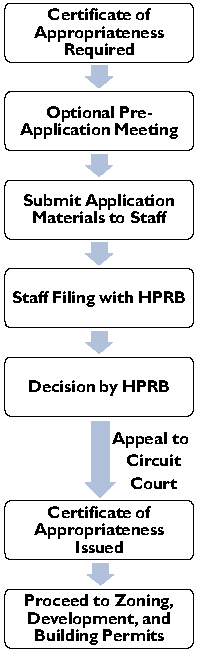
Certificate of Appropriateness Procedure.
1.
Pre-Application Staff Conference is Optional. See Section 7.4.20 (Pre-Application Conference).
2.
Application Submittal and Acceptance. See Section 7.4.30 (Application Submittal and Acceptance).
3.
Staff Review and Action. Applicable to a staff report and recommendation by the Director. See Section 7.4.40 (Staff Review and Action). The Director's recommendation shall be based on the standards in Subsection 7.2.120.D.
4.
Public Hearing Scheduling and Notice. A public hearing is not applicable; however, the applicant shall post the property two weeks prior to the scheduled Historic Preservation Review Board (HPRB) meeting.
5.
Decision-Making Body Review and Decision. Applicable to a decision by the HPRB. See Section 7.4.90 (Decision-Making Body Review and Decision). The HPRB's decision shall be based on the standards in Subsection 7.2.120.D.
6.
Appeal. The decision of the HPRB on a Certificate of Appropriateness may be appealed to the Circuit Court.
D.
Certificate of Appropriateness Review Standards. When considering an application for a Certificate of Appropriateness for new construction, alteration, repair, demolition, or restoration, the HPRB shall use the Secretary of the Interior's Standards for Rehabilitation as guidelines in making its decisions. These guidelines serve as the basis for determining the approval, approval with modifications, or denial of an application.
E.
Effect of Approval. Approval of a Certificate of Appropriateness authorizes the submittal of an application for a Zoning Permit and any other development application that may be required before the development authorized by the certificate.
F.
Expiration. Approval of a Certificate of Appropriateness shall automatically expire if a Zoning or Development Permit, as appropriate, for the development authorized by the permit is not obtained within one year after the date of approval, unless an extension of this time period is authorized in accordance with Section 7.4.130 (Expiration of Development Approval).
G.
Amendment. A Certificate of Appropriateness may be amended only in accordance with the procedures and standards established for its original approval.
7.2.130 - Special Use Permit
A.
Purpose. A use designated as requiring a Special Use Permit in the allowed use tables in Article 3 (Specific to Zones) is a use that may be appropriate in the zone, but because of its nature, extent, and external effects, requires special consideration of its location, design, and methods of operation before it can be deemed appropriate in the zone and compatible with its surroundings. The purpose of this Section is to establish a mechanism to review special uses to ensure they are appropriately developed in the zone.
B.
Applicability. A use designated as requiring a Special Use Permit shall receive approval of a Special Use Permit in accordance with this Section before approval of a Development Permit or Zoning Permit for development of the use.
C.
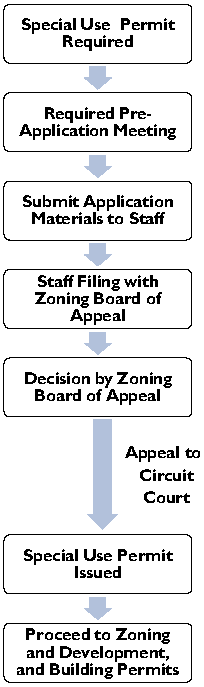
Special Use Permit Procedure.
1.
Pre-Application Conference is Required. See Section 7.4.20 (Pre-Application Conference).
2.
Application Submittal and Acceptance. See Section 7.4.30 (Application Submittal and Acceptance). The application shall include a Special Use Development Plan that demonstrates compliance with the applicable standards in Article 3 (Specific to Zones), Article 4 (Specific to Use), and the review standards in Subsection 7.2.130.D.
3.
Staff Review and Action. Applicable to a staff report and recommendation by the Director. See Section 7.4.40 (Staff Review and Action). The Director's recommendation shall be based on the standards in Subsection 7.2.130.D.
4.
Public Hearing Scheduling and Notice. See Section 7.4.50 (Public Hearing Scheduling and Notice).
5.
Public Hearing Procedures. See Section 7.4.70 (Public Hearing Procedures).
6.
Decision-Making Body Review and Decision. Applicable to a decision by the ZBOA following a public hearing. See Section 7.4.90 (Decision-Making Body Review and Decision). The ZBOA's decision shall be based on the standards in Subsection 7.2.130.D.
7.
Appeal. The decision of the ZBOA on a Special Use Permit may be appealed to the Circuit Court.
D.
Special Use Permit Review Standards. A Special Use Permit shall be approved on a finding the applicant demonstrates the proposed special use:
1.
Is consistent with the Comprehensive Plan's purposes, goals, objectives, and policies, and applicable standards of this Development Code, including standards for building and structural intensities and densities and intensities of use;
2.
Is compatible with the character of land in the immediate vicinity;
3.
Is designed to minimize adverse effects, including visual impact of the proposed use on adjacent lands; and
4.
Is designed to minimize adverse impacts on the environment, traffic and congestion, infrastructure, or governmental services. (A Traffic Impact Analysis (TIA) may be required as determined by the Director.)
E.
Conditions of Approval. The ZBOA may impose conditions of approval on a Special Use Permit to accomplish any of the following:
1.
Ensure the special use is developed exactly as presented in drawings, exhibits, and assertions made at the hearings.
2.
Limit uses, reduce density, increase open space, landscaped surfaces, or environmental protection to ensure it meets the standards by which it is approved.
3.
Limit the length of time a use may exist, or provide for periodic review of the appropriateness of the use, or provide for elimination of the use.
4.
Ensure the general purposes, goals, and objectives of the Comprehensive Plan and this Development Code are met.
5.
Prevent or minimize adverse effects from the proposed use and development on other properties in the neighborhood and on the public health, safety, and welfare.
F.
Expiration. A Special Use Permit shall automatically expire if a Zoning or Development Permit, as appropriate, for the Special Use authorized by the Special Use Permit is not obtained within one year after the date of approval, unless an extension of this time period is authorized in accordance with Section 7.4.130 (Expiration of Development Approval).
G.
Amendment. A Special Use Permit may be modified or amended only in accordance with the procedures and standards established for its original approval.
H.
Revocation.
1.
The Director may initiate, and the ZBOA may revoke, a Special Use Permit for violation of the conditions of approval in accordance with the procedures and standards of this Subsection.
2.
Prior to the public hearing on the revocation by the ZBOA, the Director shall provide notice in the same manner as was provided for the permit's original approval, as described in Section 7.4.50 (Public Hearing Scheduling and Notice), prepare a staff report, forward it to the applicant and the ZBOA, and make it available to the public.
3.
At the public hearing, the ZBOA shall consider the staff report, any evidence provided of violations of the conditions of approval or other threats to the health or safety of users or the residents of the surrounding neighborhood, the response of the permittee, and public comment. After the conclusion of public hearing, the ZBOA shall decide whether to revoke the permit because it is in violation of the conditions of approval or other provisions of this Development Code, or if it is creating other threats to the health or safety of users or the residents in the surrounding neighborhood.
7.2.140 - Variance Permit
A.
Purpose. The purpose of a Variance Permit is to allow certain deviations from the dimensional standards of this Development Code (such as height, yard setback, lot coverage, or similar numerical standards) when the landowner demonstrates that, owing to special circumstances or conditions beyond the landowner's control (such as topographical conditions, beachfront setbacks, narrowness, shallowness, or shape of a specific parcel of land), a literal application of the standards would result in undue and unique hardship to the landowner and the deviation would not be contrary to the public interest. Variance Permits are to be exercised only in rare instances, and under exceptional circumstances.
B.
Applicability. The Variance Permit procedure may be used to seek hardship relief from the dimensional or numerical standards in this Development Code, provided that no variance may be sought that increases development density (e.g., units per acre) beyond that allowed in a base zone, or increases the number of a particular type of signs beyond that allowed by signage standards. No Variance Permit may be sought that would permit a use not permitted in a zone, or would have the effect of allowing a prohibited use or a prohibited sign.
C.
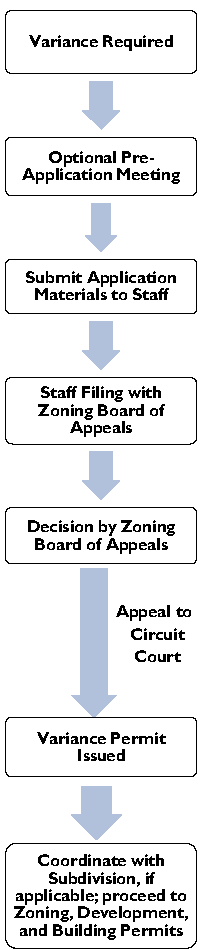
Variance Permit Procedure.
1.
Pre-Application Conference is Optional. See Section 7.4.20 (Pre-Application Conference).
2.
Application Submittal and Acceptance. See Section 7.4.30 (Application Submittal and Acceptance).
3.
Staff Review and Action. Applicable to a staff report and recommendation by the Director. See Section 7.4.40 (Staff Review and Action). The Director's recommendation shall be based on the standards in Subsection 7.2.140.D.
4.
Scheduling and Notice of Public Hearing. See Section 7.4.50 (Public Hearing Scheduling and Notice).
5.
Public Hearing Procedures. See Section 7.4.70 (Public Hearing Procedures).
6.
Decision-Making Body Review and Decision. Applicable to a decision by the ZBOA following a public hearing. See Section 7.4.90 (Decision-Making Body Review and Decision). The ZBOA's decision shall be based on the standards in Subsection 7.2.140.D.
7.
Appeal. The decision of the ZBOA may be appealed to the Circuit Court.
D.
Variance Permit Review Standards.
1.
A Variance Permit application shall be approved on a finding the applicant demonstrates all of the following standards are met:
a.
There are extraordinary and exceptional conditions (such as topographical conditions, beachfront setback lines, narrowness, shallowness, or the shape of the parcel of land) pertaining to the particular land or structure for which the Variance Permit is sought, that do not generally apply to other lands or structures in the vicinity;
b.
The extraordinary and exceptional conditions referred to in Subsection 7.2.140.D.1.a, above, are not the result of the actions of the landowner;
c.
Because of the extraordinary and exceptional conditions referred to in Subsection 7.2.140.D.1.a, above, the application of this Development Code to the land or structure for which the Variance Permit is sought would effectively prohibit or unreasonably restrict the utilization of the land or structure and result in unnecessary and undue hardship;
d.
The Variance Permit would not confer any special privilege on the landowner that is denied to other lands or structures that are similarly situated;
e.
The extent of the Variance Permit is the minimum necessary to allow a reasonable use of the land or structure;
f.
The Variance Permit is in harmony with the general purpose and intent of this Development Code and preserves its spirit;
g.
The Variance Permit would not adversely affect the health or safety of persons residing or working in the neighborhood, be injurious to land or improvements in the surrounding neighborhood, or otherwise be detrimental to the public welfare; and
h.
The Variance Permit is consistent with the Comprehensive Plan.
2.
The following factors do not constitute sufficient grounds for approval of a Variance Permit:
a.
A request for a particular use that is expressly, or by inference, prohibited in the zone;
b.
Hardships resulting from factors other than application of standards of this Development Code;
c.
The fact that land or a structure may be utilized more profitably or be more marketable with a Variance Permit; or
d.
The citing of other nonconforming or conforming uses of land or structures in the same or other zones.
E.
Effect of Approval. Approval of a Variance Permit authorizes only the particular regulatory relief approved. It does not exempt the applicant from the responsibility to obtain all other approvals required by this Development Code and any other applicable laws, and does not indicate that the development for which the Variance Permit is granted should receive other development permits or approvals under this Development Code unless the relevant and applicable portions of this Development Code or any other applicable laws are met. Unless it expires in accordance with Section 7.4.130 (Expiration of Development Approval), a Variance Permit, including any conditions of approval, shall run with the land, shall be binding on the landowners and their successors and assigns, and shall not be affected by a change in ownership.
F.
Expiration. Not applicable.
G.
Amendment. A Variance Permit may be amended only in accordance with the procedures and standards for its original approval.
7.3.10 - Development Agreements
A.
Purpose.
1.
General. The purpose and intent of this section is to authorize Development Agreements to be entered into between a developer and the County Council in accordance with the terms of this section to encourage comprehensive planning and capital facilities planning, to ensure the provision of adequate public facilities for development, and to encourage the efficient use of resources, while providing certainty in the process of obtaining development permits and approvals, and reducing the economic costs of development by providing greater regulatory certainty.
2.
Findings. The County Council finds and determines that Development Agreements may be useful to both Beaufort County and developers by providing more regulatory certainty, establishing a schedule for development, and assisting both developers and the County to coordinate the provision of adequate public facilities to serve development, coordinate the phasing of development, and administer and manage efforts to maintain open space and environmentally sensitive lands.
B.
Authority. Beaufort County is authorized to enter into Development Agreements in accordance with S.C. Code of Laws Section 6-31-10 et. seq., the "South Carolina Local Government Development Agreement Act."
C.
Development Agreement Procedure.
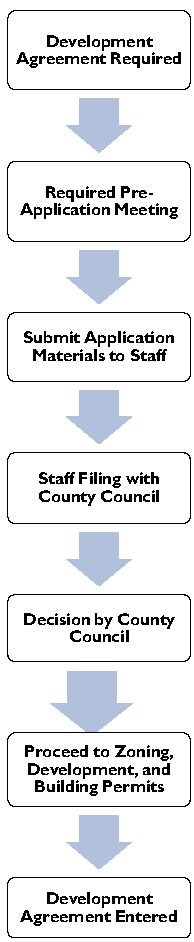
1.
Pre-Application Conference is Required. See Section 7.4.20 (Pre-Application Conference).
2.
Application Submittal and Acceptance. See Section 7.4.30 (Application Submittal and Acceptance).
3.
Staff Review and Action. Applicable to a staff report and recommendation by the Director. See Section 7.4.40 (Staff Review and Action). The recommendation shall be based on the standards in Subsection 7.3.10.D.
4.
Public Hearing Scheduling and Notice. See Section 7.4.50 (Public Hearing Scheduling and Notice).
5.
Decision-Making Body Review and Decision. Applicable to a decision by the County Council following two public hearings. See Section 7.4.90 (Decision-Making Body Review and Decision). The Development Agreement shall comply with the standards in Subsection 7.3.10.D. The County Council's action shall be one of the following:
a.
Enter into the Development Agreement as submitted;
b.
Enter into the Development Agreement, subject to modifications agreed to in writing by the developer; or
c.
Not enter into the Development Agreement.
D.
Development Agreement Standards. Any Development Agreement entered into by the County with a developer shall include the following:
1.
Land Threshold. Development on at least 25 contiguous acres of high land.
2.
Legal Description and Owner. A legal description of the land subject to the Development Agreement and the names of the legal and equitable owners.
3.
Duration. A provision stating the duration of the Development Agreement, which shall be consistent with the requirements of S.C. Code of Laws Section 6-31-10 et. seq., the "South Carolina Local Government Development Agreement Act."
4.
The Plan for Development. The plan for the development of the land, including proposed uses, the types of residential dwelling units, the non-residential development proposed, the general location of development, the densities/intensities, the lot area, height, and other dimensional standards that will be applied to the development, the internal traffic circulation system, how the development will connect to external streets, greenways, trails, open space areas, recreational facilities, environmentally sensitive lands that will be protected, lands that are eligible to receive development rights in accordance with Division 2.10, a development schedule including commencement dates and interim completion dates of no greater than five-year intervals, and any other matter determined appropriate for the plan for development of the land."
5.
Future Land Use Designation. The current zone classification of the land subject to the Development Agreement, and the future zone classification, if it is proposed to be different.
6.
Public Facility Adequacy. A description of public facilities that will service the development, including who shall provide such public facilities, the date any new public facilities, if needed, will be constructed, and a schedule to verify that public facilities will be available concurrent with the impacts of the development on the public facilities. Any public facilities to be designed and/or constructed by the developer shall be in compliance with all applicable Federal, State, and County standards to ensure the quality of the public facilities. The standards shall include, but not be limited to, guarantees of performance and quality, and project controls (including scheduling, quality controls, and quality assurances). If the County is to provide any public facilities to the development, they shall be tied to defined completion percentages or other defined performance standards that must be met by the developer.
7.
Traffic Impact. An evaluation of the traffic impact of the development proposed in the Development Agreement and assurance that the impact will be mitigated.
8.
Reservation or Dedication of Land. Where appropriate, a description of any reservations or dedications of land for public purposes.
9.
Environmentally Sensitive Lands. Where appropriate, a description of any provisions to protect environmentally sensitive lands as may be required or permitted in accordance with laws in effect at the time the Development Agreement is entered into between the County and the developer.
10.
Historic Structures. Where appropriate, a description of any provisions to protect and preserve historic structures.
11.
Local Development Permits. A description of all local permits or development approvals approved or needed to be approved for development of the land, specifically, to include at least the following:
a.
Any required amendments to this Development Code.
b.
Any required amendments to the Official Zoning Map.
c.
Any other development permits or approvals under this Development Code.
d.
Any other required permission from regional, state, or federal governments.
12.
Local Development Permits Obtained by Applicant / Property Owner. A statement and agreement by the developer that all local development permits or approvals identified shall be obtained at the sole cost of the developer, and that in the event that any such local development permits are not received, no further development of the land subject to the Development Agreement shall be allowed until such time as the County Council has reviewed the matter and determined whether or not to terminate the Development Agreement, or to modify it in a manner consistent with the public interest and the Comprehensive Plan.
13.
Consistency with Comprehensive Plan and this Development Code. A finding that the development permitted or proposed in the Development Agreement is consistent with the Comprehensive Plan and this Development Code.
14.
Compliance with Laws not Identified in Development Agreement. A statement indicating that failure of the Development Agreement to address a particular permit, condition, term or restriction shall not relieve the developer of the necessity of complying with the law governing said permitting requirements, conditions, terms or restrictions, and that any matter or thing required to be done under existing ordinances or codes of the County shall not be otherwise amended, modified or waived unless such modification, amendment or waiver is expressly provided for in the Development Agreement with specific reference to the provisions so waived, modified, or amended.
15.
Conditions Necessary to Ensure Compliance with Code, Plan, and Public Health, Safety, and Welfare. Such conditions, terms, restrictions, or other requirements determined to be necessary by the County Council to ensure compliance with this Development Code and the Comprehensive Plan, and to ensure the public health, safety, and welfare of the citizens of the county.
16.
Effect of Subsequently Adopted Laws. A statement identifying which laws in force at the time of the execution of the Development Agreement apply; identification of any subsequently adopted laws which will apply; and recognition that other subsequently adopted laws may be applied by the County in accordance with State law.
E.
Execution of Development Agreement. A Development Agreement shall be executed by all persons having legal or equitable title in the land subject to the Development Agreement, including the fee simple owner and any mortgagees, and the Chair of the County Council, on behalf of the County.
F.
Legislative Act. A Development Agreement is determined to be a legislative act undertaken on behalf of Beaufort County by the County Council in the furtherance of its powers to plan and regulate development, and as such, shall be superior to the rights of existing mortgagees, lien holders or other persons with a legal or equitable interest in the land subject to the Development Agreement, and the obligations and responsibilities arising thereunder on the landowner shall be superior to the rights of said mortgagees or lien holders and shall not be subject to foreclosure under the terms of mortgages or liens entered into or recorded prior to the execution and recordation of the Development Agreement.
G.
Recordation. It shall be the responsibility of the developer, within 14 days after the Development Agreement has been executed, to record the Agreement with the Beaufort County Clerk of Court. If the Development Agreement is amended, cancelled, modified, extended, or revoked, the developer shall be responsible for ensuring the amended Development Agreement is recorded with the Beaufort County Register of Deeds office within 14 days of its execution.
H.
Local Laws and Policies Governing a Development Agreement. Unless otherwise provided for by the Development Agreement, the laws and policies in force at the time of the execution of the Development Agreement govern the development of the land subject to the agreement, except that the County may apply subsequently adopted laws and policies if the County Council holds a public hearing and determines:
1.
Laws Not in Conflict and Do Not Prevent Redevelopment. The laws are not in conflict with the laws governing the Development Agreement and do not prevent the development set forth in the Development Agreement;
2.
Laws Essential to Public Health, Safety, or Welfare. The laws are essential to the public health, safety, or welfare, and expressly state that they shall apply to a development that is subject to a Development Agreement;
3.
Laws Anticipated in Development Agreement. The laws are specifically anticipated and provided for in the Development Agreement;
4.
Substantial Changes. It is demonstrated that substantial changes have occurred in pertinent conditions existing at the time of approval of the Development Agreement, which changes, if not addressed by the County, would pose a serious threat to the public health, safety, or welfare; or
5.
Agreement Based on Substantially and Materially Inaccurate Information. It is demonstrated that the Development Agreement is based on substantially and materially inaccurate information supplied by the developer.
I.
Periodic Review.
1.
General. The Director shall undertake a periodic review of the development subject to the Development Agreement every 12 months, commencing one year after the effective date of the Development Agreement. The developer subject to the Development Agreement must demonstrate good faith compliance with the terms and conditions of the Agreement, and must provide such information as the Director requests.
2.
Director Report of Material Breach. If as a result of any annual review, the Director determines the developer has committed a material breach of the terms and conditions of the Development Agreement, the Director shall report such circumstances to the County Council."
3.
County Council Notifies Developer of Material Breach. If the County Council concurs with the findings of the Director's report, the Council shall serve written notice to the developer, within a reasonable time after the periodic review, setting forth with reasonable particularity the nature of the breach and the evidence supporting the findings and determination, and provide the developer a reasonable period of time to correct the breach.
4.
Remedies and Corrections. If the developer fails to cure the material breach within the time provided for correction by the County Council, County Council may unilaterally terminate or modify the Development Agreement, if it provides the developer an opportunity to either rebut the findings of material breach, or consent to amend the Development Agreement to address the material breach, as long as County Council has otherwise complied with the provisions of the Development Agreement pertaining to a material breach.
J.
Burden/Benefits. All burdens of a Development Agreement are binding upon, and the benefits of the Development Agreement shall inure to, all successors in interest to the parties to the Development Agreement.
K.
Amendment or Cancellation of Land Development Agreement by Mutual Consent. A Development Agreement may be amended or cancelled by mutual consent of the parties to the Development Agreement, or by their successors in interest. A Development Agreement may be amended, extended, or modified only in accordance with the procedures established for its original approval.
L.
Effect of Contrary State or Federal Laws. In the event state or federal laws are enacted after the execution of a Development Agreement that are applicable to and preclude the parties compliance with the terms of the Development Agreement, such Development Agreement shall be modified or revoked as is necessary to comply with the relevant state or federal laws. Such modification or revocation shall occur only after notice and a public review is conducted.
M.
Technical Codes. Development subject to a Development Agreement shall comply with the requirements of all building, housing, electrical, plumbing, and gas codes, in affect or hereafter adopted by the County.
N.
Enabling Legislation. In the event a court of competent jurisdiction determines S.C. Code of Laws Section 6-31-10 et. seq., or any part thereof, invalid or unenforceable, or in the event that the South Carolina General Assembly amends or repeals S.C. Code of Laws Section 6-31-10 et. seq., in whole or in part, any Development Agreement adopted in accordance with this section shall be reviewed to determine if such change in the state act results in a substantial impairment of the County's rights or obligations in relation to such Development Agreement. Beaufort County shall have the right to immediately terminate the Development Agreement as to all parties thereto by written notice to the parties to the Agreement in the event a change in the state act results in a substantial impairment to the County's rights in relation to such Development Agreement.
7.3.20 - Comprehensive Plan Amendments

A.
Purpose. The purpose of this Section is to provide a uniform means for amending the text or map of the Comprehensive Plan whenever the public necessity, changed conditions, general welfare, or appropriate land use practices justify or require doing so.
B.
Comprehensive Plan Amendment Procedure.
1.
Pre-Application Conference is Required. See Section 7.4.20 (Pre-Application Conference).
2.
Application Submittal and Acceptance. See Section 7.4.30 (Application Submittal and Acceptance). Applications may be initiated by the County Council, the Planning Commission, the Director, as well as a person who may submit applications in accordance with Section 7.4.30 (Application Submittal and Acceptance).
3.
Staff Review and Action. Applicable to a staff report and recommendation by the Director. See Section 7.4.40 (Staff Review and Action). The Director's recommendation shall be based on the standards in Subsection 7.3.20.C.
4.
Public Hearing Scheduling and Notice. See Section 7.4.50 (Public Hearing Scheduling and Notice).
5.
Public Hearing Procedures. See Section 7.4.70 (Public Hearing Procedures).
6.
Advisory Body Review and Recommendation. Applicable to a recommendation by the Planning Commission following a public hearing. See Section 7.4.80 (Advisory Body Review and Recommendation). The Planning Commission's recommendation shall be based on the standards in Subsection 7.3.20.C.
7.
Decision-Making Body Review and Decision. Applicable to a final decision by the County Council following a public hearing. See Section 7.4.90 (Decision-Making Body Review and Decision). The County Council's decision shall be based on the standards in Subsection 7.3.20.C.
C.
Comprehensive Plan Amendment Review Standards. The advisability of amending the Comprehensive Plan is a matter committed to the legislative discretion of the County Council and is not controlled by any one factor. In determining whether to adopt or deny the proposed amendment, the County Council shall weigh the relevance of and consider the following:
1.
Whether capital investments, population trends, land committed to development, density, use, or other conditions have changed that justify the amendment;
2.
Whether the proposed amendment is consistent with the Comprehensive Plan's goals and policies;
3.
Whether the proposed amendment is necessary to respond to state and/or federal legislation;
4.
Whether the proposed amendment would result in development that is compatible with surrounding land uses;
5.
Whether and the extent to which the proposed amendment would affect the capacities of public facilities and services, including roads, utilities, law enforcement, fire, EMS, schools, parks and recreation, solid waste, and drainage facilities; and
6.
Whether, and the extent to which, the proposed amendment would result in negative impacts to natural resources.
D.
Expiration. Approval of a Comprehensive Plan Amendment shall not expire, but the amendment is subject to further amendment in accordance with the Comprehensive Plan Amendment procedures set forth in this Section.
7.3.30 - Text Amendments
A.
Purpose. The purpose of this Section is to provide a uniform means for amending the text of this Development Code whenever the public necessity, changed conditions, general welfare, or appropriate land use practices justify or require doing so.
B.
Text Amendment Procedure.
1.
Pre-Application Conference is Required. See Section 7.4.20 (Pre-Application Conference).
2.
Application Submittal and Acceptance. See Section 7.4.30 (Application Submittal and Acceptance). Applications may be initiated by the County Council, the Planning Commission, the Director, as well as a person who may submit applications in accordance with Section 7.4.30 (Application Submittal and Acceptance).
3.
Staff Review and Action. Applicable to a staff report and recommendation by the Director. See Section 7.4.40 (Staff Review and Action). The Director's recommendation shall be based on the standards in Subsection 7.3.30.C.
4.
Public Hearing Scheduling and Notice. See Section 7.4.50 (Public Hearing Scheduling and Notice).
5.
Public Hearing Procedures. See Section 7.4.70 (Public Hearing Procedures).
6.
Advisory Body Review and Recommendation. Applicable to a recommendation by the Planning Commission following a public hearing. See Section 7.4.80 (Advisory Body Review and Recommendation). The Planning Commission's recommendation shall be based on the standards in Subsection 7.3.30.C.
7.
Decision-Making Body Review and Decision. Applicable to a decision by the County Council following a public hearing. See Section 7.4.90 (Decision-Making Body Review and Decision). The County Council's decision shall be based on the standards in Subsection 7.3.30.C.
C.
Code Text Amendment Review Standards. The advisability of amending the text of this Development Code is a matter committed to the legislative discretion of the County Council and is not controlled by any one factor. In determining whether to adopt or deny the proposed text amendment, the County Council shall weigh the relevance of and consider whether, and the extent to which, the proposed amendment:
1.
Is consistent with the goals, objectives, and policies of the Comprehensive Plan;
2.
Is not in conflict with any provision of this Development Code or the Code of Ordinances;
3.
Is required by changed conditions;
4.
Addresses a demonstrated community need;
5.
Is consistent with the purpose and intent of the zones in this Development Code, or would improve compatibility among uses and ensure efficient development within the County;
6.
Would result in a logical and orderly development pattern; and
7.
Would not result in adverse impacts on the natural environment, including but not limited to water, air, noise, stormwater management, wildlife, vegetation, wetlands, and the natural functioning of the environment.
D.
Expiration. Approval of a Code Text Amendment shall not expire, but the amended text of this Development Code is subject to further amendment in accordance with the Text Amendment procedures set forth in this Section.
7.3.40 - Zone Map Amendment (Rezoning)

A.
Purpose. The purpose of this Section is to provide a uniform means for reviewing and deciding proposed amendments to the Official Zoning Map whenever the public necessity, general welfare, Comprehensive Plan, or appropriate land use practices justify or require doing so.
B.
Zone Map Amendment Procedure.
1.
Pre-Application Conference is Required. See Section 7.4.20 (Pre-Application Conference).
2.
Application Submittal and Acceptance. See Section 7.4.30 (Application Submittal and Acceptance). Applications may be initiated by the County Council, the Planning Commission, the Director, as well as a person who may submit an application in accordance with Section 7.4.30 (Application Submittal and Acceptance).
3.
Staff Review and Action. Applicable to a staff report and recommendation by the Planning Director. See Section 7.4.40 (Staff Review and Action). The Director's recommendation shall be based on the standards in Subsection 7.3.40.C.
4.
Public Hearing Scheduling and Notice. See Section 7.4.50 (Public Hearing Scheduling and Notice).
5.
Public Hearing Procedures. See Section 7.4.70 (Public Hearing Procedures).
6.
Advisory Body Review and Recommendation. Applicable to a recommendation by the Planning Commission following a public hearing. See Section 7.4.80 (Advisory Body Review and Recommendation). The Planning Commission's recommendation shall be based on the standards in Subsection 7.3.40.C.
7.
Decision-Making Body Review and Decision. Applicable to a decision by the County Council following a public hearing. See Section 7.4.90 (Decision-Making Body Review and Decision). The County Council's decision shall be based on the standards in Subsection 7.3.40.C., and shall be one of the following:
a.
Approval of the application as submitted;
b.
Approval of the application with a reduction in the area proposed to be rezoned;
c.
Approval of a rezoning to a more restricted base zone than requested in the application; or
d.
Denial of the application.
C.
Zone Map Amendment Review Standards. The advisability of an amendment to the Official Zoning Map is a matter committed to the legislative discretion of the County Council and is not controlled by any one factor. In determining whether to adopt or deny a proposed Zone Map Amendment, the County Council shall weigh the relevance of and consider whether and the extent to which the proposed amendment:
1.
Is consistent with and furthers the goals, and policies of the Comprehensive Plan and the purposes of this Development Code. In areas of new development, a finding of consistency with the Comprehensive Plan shall be considered to meet the standards below, unless compelling evidence demonstrates the proposed amendment would threaten the public health, safety, and welfare if the land subject to the amendment is classified to be consistent with the Comprehensive Plan;
2.
Is not in conflict with any provision of this Development Code, or the Code of Ordinances;
3.
Addresses a demonstrated community need;
4.
Is required by changed conditions;
5.
Is compatible with existing and proposed uses surrounding the land subject to the application, and is the appropriate zone and uses for the land;
6.
Would not adversely impact nearby lands;
7.
Would result in a logical and orderly development pattern;
8.
Would not result in adverse impacts on the natural environment—including, but not limited to, water, air, noise, storm water management, wildlife, vegetation, wetlands, and the natural functioning of the environment; and
9.
Would result in development that is adequately served by public facilities (e.g., streets, potable water, sewerage, stormwater management, solid waste collection and disposal, schools, parks, police, and fire and emergency medical facilities).
D.
Expiration. Approval of a Zone Map Amendment shall not expire, but the amended Official Zoning Map is subject to further amendment in accordance with the map amendment procedures set forth in this section.
7.3.50 - Place Type Overlay (Rezoning)
A.
Purpose. The purpose of this Section is to provide a uniform means for establishing transect zones to implement a Place Type Overlay district through an amendment to the Official Zoning Map whenever the public necessity, convenience, general welfare, Comprehensive Plan, or appropriate land use practices justify or require doing so.
B.
Place Type Overlay (Rezoning) Procedure.
1.
Pre-Application Conference is Required. See Section 7.4.20 (Pre-Application Conference).

2.
Application Submittal and Acceptance. See Section 7.4.30 (Application Submittal and Acceptance). Applications may be initiated by the County Council, the Planning Commission, the Director, as well as a person who may submit an application in accordance with Section 7.4.30 (Application Submittal and Acceptance).
3.
Staff Review and Action. Applicable to a staff report and recommendation by the Director. See Section 7.4.40 (Staff Review and Action). The Director's recommendation shall be based on the standards in Section 3.4.80 (Place Type Overlay (PTO) Zone Standards) and Subsection 7.3.50.C.
4.
Public Hearing Scheduling and Notice. See Section 7.4.50 (Public Hearing Scheduling and Notice).
5.
Public Hearing Procedures. See Section 7.4.70 (Public Hearing Procedures).
6.
Advisory Body Review and Recommendation. Applicable to a recommendation by the Planning Commission following a public hearing. See Section 7.4.80 (Advisory Body Review and Recommendation). The Planning Commission's recommendation shall be based on the standards in Section 3.4.80 (Place Type Overlay (PTO) Zone Standards) and Subsection 7.3.50.C.
7.
Decision-Making Body Review and Decision. Applicable to a decision by the County Council following a public hearing. See Section 7.4.90 (Decision-Making Body Review and Decision). The County Council's decision shall be based on the standards in Section 3.4.80 (Place Type Overlay (PTO) Zone Standards) and Subsection 7.3.50.C., and shall be one of the following:
a.
Approval of the application as submitted;
b.
Approval of the application with a reduction in the area proposed to be rezoned;
c.
Approval of a rezoning to a different mix of transect zones than submitted; or
d.
Denial of the application.
C.
Place Type Overlay Rezoning Standards. The advisability of an amendment to the Official Zoning Map is a matter committed to the legislative discretion of the County Council and is not controlled by any one factor. In determining whether to adopt or deny a proposed Zone Map Amendment to implement a PTO, the County Council shall consider the Zone Map Amendment Review Standards in Section 7.3.40.C, in addition to whether the proposed application complies with the standards in Section 3.4.80 (Place Type Overlay (PTO) Zone Standards).
D.
Expiration. Approval of a Zone Map Amendment to implement a PTO shall not expire, but the amended Official Zoning Map is subject to further amendment in accordance with the procedures set forth in this section.
7.3.60 - Interpretations
A.
Purpose. The purpose of this Section is to provide a uniform mechanism for rendering formal written interpretations of this Development Code when it is unclear or when a use is not identified in the consolidated use table in Article 3 (Specific to Zones).
B.
Interpretation Procedure.
1.
Application Submittal and Acceptance. See Section 7.4.30 (Application Submittal and Acceptance). An application for a formal written interpretation may be initiated by any party of interest.
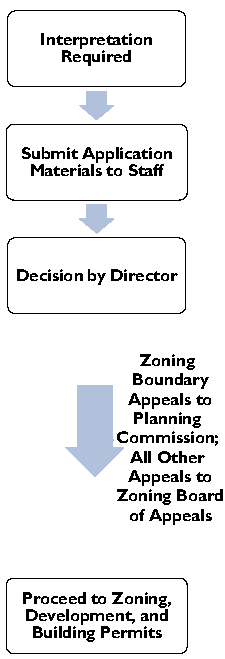
2.
Staff Review and Action. Applicable to a rendering of a written interpretation by the Director. See Section 7.4.40 (Staff Review and Action). Prior to rendering the interpretation, the Director shall consult with the County Attorney and other affected County officials. The Director's interpretation shall be based on the standards in Subsection 7.3.60.C.
3.
Appeal. The interpretation of the Director may be appealed to the ZBOA for all interpretations of this Development Code except Zone District Map Boundaries. See Section 7.3.70 (Appeals). Zone District Map Boundaries may be appealed to the Planning Commission.
C.
Interpretation Standards.
1.
Zone District Map Boundaries. Interpretation of zoning district boundary line locations on the Official Zoning Map shall be in accordance with the standards in Section 3.1.20 (Establishment of Zones), and consistent with the Comprehensive Plan.
2.
Unspecified Uses. Uses not listed in Articles 3 (Specific to Zones) shall be placed into the most similar category. For nonresidential use, the NAICS (North American Industrial Classification System) code shall be the first guide. Where an NAICS code is found in several categories, the Director shall seek similar characteristics, including the use's intensity and its likely adverse impacts. Where a choice remains after reviewing for adverse impacts, the use should be classified with the similar use that has the most adverse impacts.
3.
Text Provisions. Interpretation of text provisions and their application shall be based on the following considerations:
a.
The clear and plain meaning of the provision's wording, as defined by the meaning and significance given specific terms used in the provision as established in Table 3.1.70 (Land Use Definitions) and Article 10 (Definitions), and by the common and accepted usage of the term;
b.
The intended purpose of the provision, as indicated by purpose statements, its context and consistency with surrounding and related provisions, and any legislative history related to its adoption;
c.
The general purposes served by this Development Code, as set forth in Division 1.2 (Purpose and Intent); and
d.
Consistency with the Comprehensive Plan.
D.
Official Record of Interpretations. The Director shall maintain a record of written interpretations that shall be available in the Director's office for public inspection, on reasonable request, during normal business hours.
E.
Effect of Interpretation. A written interpretation shall be binding on subsequent decisions by the Director or other County administrative officials in applying the same provision of this Development Code in the same circumstance.
7.3.70 - Appeals
A.
Purpose. The purpose of this Section is to establish an appeal for an aggrieved party affected by a decision made by an administrative decision-maker to determine if the decision complies with the requirements of this Development Code.
B.
Types of Appeal. Appeals may be taken by an aggrieved party from the following decisions, to either the ZBOA, or the Planning Commission, as follows:
1.
ZBOA. The ZBOA is authorized to serve as the appellate body for decisions on:
a.
Zoning Permits, see Section 7.2.20 (Zoning Permit);
b.
Modulation Permits, see Section 7.2.30 (Modulation Permit);
c.
Sign Permits, see Section 7.2.40 (Sign Permit);
d.
Tree Removal Permits, see Section 7.2.50 (Tree Removal Permit); and
e.
Interpretations of all provisions of this Development Code, except for Zone District Map Boundaries, see Section 7.3.60 (Interpretations).
2.
Planning Commission. The Planning Commission is authorized to serve as the appellate body for decisions on:
a.
Minor Land Development Plans, see Section 7.2.60 (Land Development Plan);
b.
Major Land Development Plans (Concept Plan and Final Land Development Plan), see Section 7.2.60 (Land Development Plan);
c.
Minor Subdivisions, see Section 7.2.70 (Subdivision Plat);
d.
Major Subdivisions (Concept Plat and Final Plat), see Section 7.2.70 (Subdivision Plat);
e.
Traditional Community Plans (TCP), see Section 7.2.90; and
f.
Interpretations of zoning district boundaries, see Section 7.3.60 (Interpretations).
C.
Appeal Procedure.
1.
Pre-Application Conference is Optional. See Section 7.4.20 (Pre-Application Conference).
2.
Application Submittal and Acceptance. See Section 7.4.30 (Application Submittal and Acceptance). An Appeal application shall specify the grounds for the appeal and shall be submitted to the Director within 30 days after receipt of notice of the decision being appealed.
3.
Staff Review and Action. See Section 7.4.40 (Staff Review and Action). On accepting an Appeal application, the Director shall transmit the appeal and the record of material considered by the decision-maker in making the decision (including but not limited to, for example, the application and support materials, staff report, other plans, documents, reports and studies considered in making the decision, and any minutes, transcripts, or record of the meetings held to consider and make the decision). These materials, plus the Comprehensive Plan and this Development Code shall constitute the record of the appeal.
4.
Public Hearing Scheduling and Notice. See Section 7.4.50 (Public Hearing Scheduling and Notice). The Director shall also provide notice of the public hearing to the applicant for the decision being appealed, if different from the appellant.
5.
Public Hearing Procedures. See Section 7.4.70 (Public Hearing Procedures). Appeals from a decision of administrative agents shall be heard by the ZBOA or the Planning Commission as appropriate, based solely on the materials (plans, documents, reports, studies, drawings, and testimony) available to the body or agent rendering the initial decision and advisory bodies prior to the decision. Appeals shall not consider new or altered plans, except that information submitted, but not discussed or considered in rendering a decision, shall be considered part of the original evidence. If hearings were held and testimony given, transcripts and other record items of those proceedings shall be the exclusive basis of the appeal. The appeal shall also consider this Section's standards and state law.
6.
Decision-Making Body Review and Decision. Applicable to a decision by the appropriate appellate body following a public hearing. See Section 7.4.90, (Decision-Making Body Review and Decision). The public hearing shall be on the record of the appeal, with presentations limited to arguments on the record of the appeal as it relates to the grounds for appeal specified in the Appeal application.
a.
The appellate body shall base its decision solely on the record of the appeal, as supplemented by arguments presented at the public hearing, and the standards in Subsection 7.30.70.D. The final decision of the appellate body shall be one of the following:
(1)
Affirmation of the decision or interpretation (in whole or in part);
(2)
Modification of the decision or interpretation (in whole or in part); or
(3)
Reversal of the decision or interpretation (in whole or in part).
b.
Reserved.
7.
Appeal. The decision of the appellate body may be appealed to the Circuit Court.
D.
Appeal Review Standards.
1.
An appellate body is limited to the following determinations in considering the appeal, which shall be based on clear and substantial evidence in the record:
a.
The decision-maker made an error in determining whether a standard was met. The record must indicate that an error in judgment occurred or facts, plans, or regulations were misread in determining whether the particular standard was or was not met;
b.
The decision-maker made the decision based on a standard not contained in this Development Code or other appropriate County ordinances, regulations, or state law, or that a standard more strict or broad than the standard established in this Development Code was applied. (This Development Code does not allow administrative decision-makers to consider or create standards not officially adopted); or
c.
The decision-maker made an error in applying a standard or measuring a standard.
2.
Where conflicting evidence exists, the appeal is limited to determining what evidence or testimony bears the greatest credibility in terms of documentation and qualifications of those making the determination.
3.
The appellate body shall not hear any evidence or make any decision based on hardships or special conditions.
E.
Effect of Pending Appeal. An appeal stays all legal proceedings in furtherance of the action appealed from, unless the Director certifies to the appellate body, after the notice of appeal has been filed with him, that by reason of facts stated in the certificate a stay would, in his opinion, cause imminent peril to life and property. In that case, proceedings may not be stayed other than by a restraining order which may be granted by the board or by a court of record on application, on notice to the officer from whom the appeal is taken, and on due cause shown.
(Ord. No. 2021/16, 3-8-21)
7.4.10 - General
This Section describes the procedural steps and other rules that are generally applicable to development applications reviewed under this Development Code. These standard procedures shall apply to all applications reviewed under this Development Code where specified in Division 7.2 (Application Specific Review Procedures) or Division 7.3 (Other Review Procedures).
7.4.20 - Pre-Application Conference
A.
Purpose. The purpose of a pre-application conference is to provide an opportunity for the applicant to determine the submittal requirements and the procedures and standards applicable to an anticipated development application. A pre-application conference is also intended to provide an opportunity for County staff to become familiar with, and offer the applicant preliminary comments about, the scope, features, and impacts of the proposed development, as it relates to Code standards.
B.
Applicability.
1.
Pre-Application Conference Required. A pre-application conference between the applicant and County staff designated by the Director shall be held if a pre-application conference is identified as "applicable" or "required" for the individual permit procedures in Division 7.2 (Application Specific Review Procedures) or Division 7.3 (Other Review Procedures).
2.
Pre-Application Conference Optional. A pre-application conference may be requested and held at the applicant's option for any other development application reviewed under this Development Code. Such requests shall be submitted to the Director, who shall determine which County staff members will conduct the conference.
C.
Information Submitted For Conference.
1.
Special Use Permit and Major Land Development Plan or Subdivision Plat. At least three business days before a pre-application conference for a Special Use Permit or Major Land Development or Subdivision Concept Plan or Plat, the applicant shall submit to the Director a sketch plan or conceptual drawings that show the location, general layout, and main elements of the development to be proposed as part of the application.
2.
Other Applications. When a pre-application conference is held for any development application other than those subject to Subsection 7.4.20.C.1 above, the applicant shall submit to the Director a description of the character and location of the proposed development, and the type of development approval sought, or if a text amendment is proposed, a description of the nature and purpose of the text amendment.
D.
Scheduling. Upon receipt of the request for a pre-application conference, the Director shall schedule the pre-application conference and notify the applicant of the time and place of the pre-application conference.
E.
Conference Determinations. County staff shall review the materials submitted by the applicant prior to the conference, and at the conference ask the applicant questions about the proposed application, as appropriate, and identify any concerns, problems, or other factors the applicant should consider about the application.
F.
Written Summary. Within a reasonable period of time after completion of the pre-application conference, the Director shall provide the potential applicant a brief summary of the issues discussed at the pre-application conference.
G.
Effect. The pre-application conference is intended as a means of facilitating the review process. Discussions held in accordance with this Section are not binding on the County. Processing times for review of development applications do not begin until a formal application is submitted and determined to be complete.
7.4.30 - Application Submittal and Acceptance
A.
Authority to File Applications.
1.
Unless expressly stated otherwise in this Development Code, development applications reviewed under this Development Code shall be submitted by:
a.
The owner, contract purchaser, or any other person having a recognized property interest in the land on which development is proposed; or
b.
A person authorized to submit the application on behalf of the owner, contract purchaser, or other person having a recognized property interest in the land, as evidenced by a letter or document signed by such owner, contract purchaser, or other person.
2.
If there are multiple owners, contract purchasers, or other persons authorized to submit the application, all such persons shall sign the application or a letter or document consenting to the application.
B.
Application Content. The Director is authorized to and shall establish the requirements for the content and form for each type of development application reviewed under this Development Code. The Director may amend and update these standards as determined necessary to ensure effective and efficient review under this Development Code. The applicant bears the burden of ensuring that an application contains sufficient information to demonstrate compliance with applicable standards.
C.
Application Fees. The County Council shall establish application fees and may amend and update those fees as necessary.
D.
Submittal and Review Schedule. The Director is authorized to and shall establish rules for the submittal and a review schedule (including timeframes for review) for the various types of development applications. The Director may amend and update these provisions as is determined necessary to ensure effective and efficient review under this Development Code.
E.
Application Submittal. Applications shall be submitted to the Director, as noted in Subsection 7.4.30.B above, along with a fee established in accordance with Subsection 7.4.30.C above.
F.
Determination of Application Completeness
1.
Completeness Review. On receiving an application, the Director shall, within a reasonable period of time, determine whether the application is complete or incomplete. A complete application is one that:
a.
Contains all information and materials established by the Director as required for submittal of the particular type of application;
b.
Is in the form established by the Director as required for submittal of the particular type of application;
c.
Includes information in sufficient detail to evaluate the application to determine whether it complies with the appropriate review standards of this Development Code; and
d.
Is accompanied by the fee established for the particular type of application.
2.
Application Incomplete.
a.
On determining that the application is incomplete, the Director shall notify the applicant of the submittal deficiencies. The applicant may correct the deficiencies and resubmit the application for completeness determination.
b.
If the applicant fails to resubmit an application within 30 calendar days after being first notified of submittal deficiencies, the application shall be considered withdrawn.
c.
The Director shall not process an application for further review until it is determined to be complete.
d.
Notwithstanding the other provisions of this Subsection, after an application is determined to be incomplete three times, the applicant may request, and the Director shall undertake, processing and review of the application even though it is not determined to be a complete application.
3.
Application Complete. On determining that the application is complete, the Director shall accept the application for review in accordance with the procedures and standards of this Development Code.
G.
Application Revision.
1.
An applicant may revise an application after receiving initial staff review comments on the application, or on requesting and receiving permission from the Director or an advisory or decision-making body after that body has reviewed but not yet taken action on the application. Revisions shall be limited to changes that directly respond to specific requests or suggestions made by the Director or the advisory or decision-making body, as long as they constitute only minor additions, deletions, or corrections and do not include significant substantive changes to the plan for development proposed in the application.
2.
Any other revisions to the application may be submitted at any time during the review procedure, but the revised application shall be submitted and reviewed as if it were a new application, and may be subject to additional application fees to defray the additional costs of processing the revised application.
3.
All revised applications shall be submitted to the Director.
H.
Application Withdrawal.
1.
An applicant may withdraw a development application at any time by submitting a letter of withdrawal to the Director.
2.
Applications withdrawn after required notice of any public hearing scheduled for the application shall be subject to limitations on the subsequent submittal of similar applications (see Section 7.4.100, Limitation on Subsequent Similar Applications). Application fees shall not be refunded for withdrawn applications.
7.4.40 - Staff Review and Action
A.
Staff Review. When an application is determined complete, it shall be distributed by the Director to all appropriate staff and review agencies for review and comment, and the preparation of a staff report. In preparing the staff report the Director or other County staff (as appropriate) shall review the application, relevant support material, and any comments or recommendations from other staff and review agencies to which the application was referred. If deficiencies in complying with applicable standards of this Development Code are identified, the Director shall notify the applicant of such deficiencies and provide the applicant a reasonable opportunity to discuss the deficiencies and revise the application to address them.
B.
Staff Report and Recommendation. Upon completion of the County staff review on an application, the Director shall prepare a written staff report. The staff report shall conclude whether the application complies with all applicable review standards of this Development Code and recommend one of the decisions authorized for the particular type of application, based on the review standards applicable to the application type, as set forth in Division 7.2 (Application Specific Review Procedures) or Division 7.3 (Other Review Procedures). The staff report may identify and recommend conditions of approval addressing how compliance deficiencies might be corrected and adverse effects of the development application might be mitigated.
C.
Distribution and Availability of Application and Staff Report. Within a reasonable time period before the meeting or public hearing at which the application is scheduled for review by an advisory or decision-making body, the Director shall:
1.
Schedule and ensure notice of any required public hearing on the application (if appropriate) in accordance with Section 7.4.50 (Public Hearing Scheduling and Notice);
2.
Transmit the application, related materials, and the staff report to the appropriate advisory or decision-making body;
3.
Transmit a copy of the staff report to the applicant; and
4.
Make the application, related materials, and the staff report available for examination by the public in the Community Development Department during normal business hours, and make copies of such materials available at a reasonable cost.
D.
Applications Subject To Director Decision.
1.
Decision. If an application is subject to staff review and a final decision by the Director, the Director shall approve the application, approve the application subject to conditions, or disapprove the application, based on the review standards set forth in Division 7.2 (Application Specific Review Procedures) or Division 7.3 (Other Review Procedures), as appropriate, for the particular type of application.
2.
Conditions of Approval. Conditions of approval shall be limited to those deemed necessary to ensure compliance with the standards of this Development Code. They shall be related in both type and amount to the anticipated impacts of the proposed development on the public and surrounding development. All conditions of approval shall be expressly set forth in the development permit or approval.
7.4.50 - Public Hearing Scheduling and Notice
A.
Public Hearing Scheduling.
1.
Application to be Scheduled for Meeting. When a development application is subject to a public hearing, as identified in Table 7.4.50.A (Required Public Hearings), the Director shall ensure that the public hearing on the application is scheduled for a regularly scheduled meeting or a meeting specially called for that purpose by the advisory or decision-making body reviewing the application.
2.
Timing. The public hearing(s) on the application shall be scheduled so there is sufficient time for a staff report to be prepared and for the public notification requirements to be satisfied under state law.
3.
Public Hearing by Review Boards. A public hearing shall be conducted by the following advisory or decision-making bodies for the following development applications. See Table 7.4.50.A (Required Public Hearings).
B.
Public Hearing Notification. All development applications requiring a public hearing shall comply with the S.C. Code of Laws, the provisions listed in Table 7.4.50.B (Public Hearing Notification Timing Requirements), and the other provisions of this Section with regard to public notification. Failure to receive notice in accordance with this Section shall not invalidate the proceedings for which notice was required, nor shall failure to receive notice constitute a basis for legal action against the County.
1.
Notice Timing Requirements. Public notification of a public hearing on a development application shall be provided in accordance with the timing requirements in Table 7.4.50.B (Public Hearing Notification Timing Requirements), for the type of application and the type of notice. In computing the required time periods, the day the notice is published or postmarked shall not be included, but the day of the hearing shall be included.
2.
Published Notice Requirements.
a.
When the provisions of this Development Code require that notice be published, the Director or the Clerk to County Council (as appropriate) shall be responsible for preparing the content of the notice and publishing the notice in a newspaper of general circulation in the County.
b.
The Director shall prepare an affidavit certifying that published notice has occurred in compliance with the standards of this Subsection. The affidavit shall be conclusive that notice has been given in compliance with the terms of this Subsection.
c.
The affidavit shall be included in the support materials on the application.
3.
Written Notice Requirements.
a.
When the provisions of this Development Code require that written notice be provided, the Director shall be responsible for preparing and mailing the written notice. Notice shall be mailed to:
(1)
All owners of the land subject to the application; and
(2)
All owners of land within 500 feet of the property lines of land subject to the application whose address is known by reference to the latest ad valorem tax records.
b.
Notice shall be deemed mailed by its deposit in the United States mail, properly addressed, postage paid.
c.
A copy of the mailed notice shall be maintained in the office of the Director for public inspection during normal business hours.
4.
Posted Notice Requirements.
a.
When the provisions of this Development Code require that notice be posted on the land subject to the application, notice shall comply with the following standards:
(1)
One sign, provided by the Director, shall be placed on each public thoroughfare that the land subject to the application abuts. The Director may require additional signs to be placed on the parcel to carry out this Development Code's intent.
(2)
The sign shall be set back no more than five feet from the street right-of-way.
(3)
All signs shall be placed in a conspicuous location so as to be clearly visible to the traveled portion of the respective street. Where the land does not have frontage on a public street, an additional sign shall be erected on the nearest street right-of-way with an attached notation generally indicating the direction and distance to the land subject to the application.
(4)
The sign shall be removed after the close of the public hearing on the application.
b.
The applicant shall sign and provide to the Director an affidavit stating that posted notice has been provided in accordance with the standards of this Subsection. The affidavit shall be accompanied by a photograph showing the posted notice on the land subject to the application. The affidavit and photograph shall be conclusive that notice has been given in accordance with the terms of this Subsection. The affidavit shall be submitted to the Director prior to the public hearing to which the notice pertains.
c.
The applicant shall ensure that the posted notice is maintained on the land subject to the application until the completion of the public hearing to which the notice pertains. Failure of any such posted notice to remain in place after the notice has been posted shall not be deemed a failure to comply with the requirements of this Development Code or be grounds to challenge the validity of any decision made on the application. However, it shall be a violation of this Development Code for any person to remove, mar, scratch, obliterate, or in any manner deface, hide from view, or tamper with such signs.
d.
The sign(s) shall be removed by the applicant within five days after the public hearing to which the notice pertains.
5.
Notice Content. All notices for public hearings, unless expressly noted otherwise, whether done by mail (written notice), publication (publishing in a newspaper of general circulation in the County), or posting shall:
a.
Identify the application or application number and the name of the applicant or the applicant's agent;
b.
Indicate the type of development application submitted;
c.
Indicate the date, time, and place of the public hearing;
d.
Describe the land involved by street address or legal description, general area of the county, and property size (except posted notice);
e.
Identify the current zone designation of the land subject to the application;
f.
Describe the nature, scope, and purpose of the application or proposal;
g.
Include a statement describing where interested members of the public may submit written comments or evidence prior to the public hearing;
h.
Include a statement that interested members of the public and adjoining landowners may appear at the public hearing, be heard, and submit evidence and written comments with respect to the application; and
i.
State the application, and all relevant information about the application may be obtained at the Community Development Department during normal business hours, and provide the Community Development Department street address and a contact phone number.
(Ord. No. 2015/32, § 1, 11-9-15; Ord. No. 2023/36, 10-23-23)
7.4.60 - Deferral of Application
A.
An applicant may request that an advisory or decision-making body's consideration of a development application at public hearing be deferred by submitting a written request for deferral to the Director.
B.
Director Action. If public notification has not been provided in accordance with this Development Code, the Director shall consider and decide the deferral request. A request for deferral shall be approved only for good cause.
C.
Advisory or Decision-Making Board Action. If public notification has been provided in accordance with this Development Code, the request for deferral shall be placed on the public hearing agenda of the advisory or decision-making body on the date the application is to be considered and acted upon by the body. The advisory or decision-making body shall approve the request for deferral only for good cause.
7.4.70 - Public Hearing Procedures
A.
If the development application is subject to a public hearing by an advisory or decision-making body, the advisory or decision-making body shall hold the public hearing in accordance with the following procedures.
B.
Conduct of Public Hearing.
1.
Burden of Proof or Persuasion. The burden of demonstrating that an application complies with applicable review and approval standards of this Development Code is on the applicant. The burden is not on the County or other parties to show that the standards have not been met by the applicant.
2.
Rights of All Persons. Except for appeals to the Planning Commission or the Zoning Board of Appeals (7.3.70.C) any person may appear at a public hearing and submit testimony, either individually or as a representative of a person or an organization. Each person who appears at a public hearing shall be identified, state an address, and if appearing on behalf of a person or organization, state the name of the person or organization being represented. If the person states they represent an organization, the body conducting the hearing may request written evidence of that person's authority to speak on behalf of the organization in regard to the matter under consideration.
3.
Exclusion of Testimony. The body conducting the public hearing may exclude testimony that it finds to be irrelevant, immaterial, or unduly repetitious.
4.
Offers of Testimony. In the event any testimony is excluded as irrelevant, immaterial, or unduly repetitious, the person submitting such testimony shall have an opportunity at that hearing to offer such testimony to be entered into the record. Such offer shall be made at the public hearing.
5.
Continuance of Public Hearing. The body conducting the public hearing may, on its own motion or at the request of any person, continue the public hearing to a fixed date, time, and place. An applicant shall have the right to request and be granted one continuance. Any subsequent continuances requested by any party shall be granted at the discretion of the body conducting the public hearing only upon good cause shown.
6.
Recording. A record of the hearing shall be kept as follows.
a.
General. The body conducting the public hearing shall record the public hearing. The written or taped record of oral proceedings (including testimony and statements of personal opinions), the hearing minutes, all applications, exhibits and papers submitted in any proceeding before the review board, the staff report, and the recommendation or decision shall constitute the record. The establishment of a verbatim transcript, if requested, shall be the sole responsibility of the applicant.
b.
Public Record. All records of public hearings conducted by an advisory or decision-making body shall be a public record, and open for inspection at the offices of the Director during normal business hours upon reasonable notice.
c.
Copy. A copy of the public hearing record may be obtained by any person upon applying to the Director and paying the cost for duplication of the record.
7.
Close of Hearing. Upon the completion of all testimony or public comment, the hearing shall be closed. No further direct or informal testimony, comments or evidence shall be provided or considered on the matter. The applicant may be asked questions or allowed to comment on proposed conditions.
C.
General Procedures and Findings Following Public Hearing.
1.
Time. Any review body conducting the hearing shall act in accord with any time limits established in state law, this Development Code or the body's own by-laws. Action shall be taken as promptly as possible in consideration of the interests of the applicant, the citizens of the County, and shall include a recommendation or decision of approval, approval with conditions, or disapproval (whichever is appropriate).
2.
Form of Decisions. The form of all decisions shall include at least the following elements:
a.
A summary of the information presented before the body;
b.
A statement of findings or other factors considered, whichever is appropriate, and a statement of the basis upon which such facts were applied with respect to the relevant review standards, if required by state law; and
c.
A statement of a recommendation or decision of approval, approval with conditions or disapproval (whichever is appropriate).
(Ord. No. 2023/36, 10-23-23)
7.4.80 - Advisory Body Review and Recommendation
A.
If an application is subject to a recommendation by an advisory body, such advisory body shall review and act on the application in accordance with the following procedures.
B.
General. The advisory body shall hold any required public hearing, noted in Table 7.4.50.A (Required Public Hearings), in accordance with Section 7.4.70 (Public Hearing Procedures), and consider the application, relevant support materials, staff report, and any public comments. It shall then recommend one of the decisions authorized for the particular type of application, based on the review standards applicable to the application type, as set forth in Division 7.2 (Application Specific Review Procedures) or Division 7.3 (Other Review Procedures).
C.
Clearly State Factors for Decision. The advisory body's recommendation shall clearly state the factors considered in making the recommendation and the basis or rationale for the recommended decision.
D.
Timing. The advisory body shall take action as promptly as possible in consideration of the interests of the applicant, affected parties, and citizens of the County.
7.4.90 - Decision-Making Body Review and Decision
A.
If an application is subject to a final decision by the County Council, the Planning Commission, the ZBOA, the HPRB, or the DRB, such decision-making body shall review and decide the application in accordance with the following procedures.
B.
Review and Decision.
1.
General. The decision-making body shall hold any required public hearing(s), see Table 7.4.50.A (Required Public Hearings) in accordance with Section 7.4.70 (Public Hearing Procedures), and consider the application, relevant support materials, staff report, any advisory body recommendations, and any public comments. It shall then make one of the decisions authorized for the particular type of application, based on the review standards applicable to the application type, as set forth in Division 7.2 (Application Specific Review Procedures), or Division 7.3 (Other Review Procedures).
2.
Remand. The decision-making body may remand the application to the appropriate County staff for further consideration of new information or specified issues or concerns by the staff or any advisory bodies.
3.
Clearly State Factors for Decision. Unless stated otherwise in this Development Code, the decision-making body's decision shall clearly state the factors considered in making the decision and the basis or rationale for the decision.
4.
Timing. The decision-making body shall take action as promptly as possible in consideration of the interests of the applicant, affected parties, and citizens of the county.
C.
Conditions of Approval. Conditions of approval shall be limited to those deemed necessary to ensure compliance with the review standards for the particular type of application, or to prevent or minimize adverse effects from the proposed development on surrounding lands. They shall be related in both type and amount to the anticipated impacts of the proposed development on the public and surrounding development. All conditions of approval shall be expressly set forth in the statement of approval.
7.4.100 - Limitation on Subsequent Similar Applications
A.
Prior Application Denial.
1.
If a development application requiring a public hearing is denied, no application proposing the same or similar development on all or part of the same land shall be submitted within one year after the date of denial unless the decision-making body waives this time limit in accordance with Subsection 7.4.100.A.2 below.
2.
The owner of land subject to this Subsection, or the owner's authorized agent, may submit a written request for waiver of the time limit, along with a fee to defray the cost of processing the request, to the Director, who shall transmit the request to the decision-making body. The decision-making body may grant a waiver of the time limit only on a finding by two-thirds of its membership that the owner or agent has demonstrated that:
a.
There is a substantial change in circumstances relevant to the issues or facts considered during review of the prior application that might reasonably affect the decision-making body's application of the relevant review standards to the development proposed in the new application;
b.
New or additional information is available that was not available at the time of review of the prior application and that might reasonably affect the decision-making body's application of the relevant review standards to the development proposed in the new application;
c.
The new application proposed to be submitted is materially different from the prior application; or
d.
The final decision on the prior application was based on a material mistake of fact.
B.
Prior Application Withdrawal. If a development application requiring a public hearing is withdrawn after required notice of the public hearing is provided, no application proposing the same or similar development on all or part of the same land shall be submitted within six months after the date of withdrawal.
7.4.110 - Effect of Approval
Approval of any development application in accordance with this Development Code authorizes only the particular use, plan, or other specific activity approved, and not any other development requiring separate application. Development approvals shall run with the land, except for zoning and Comprehensive Plan text changes and zoning interpretations.
7.4.120 - Vested Rights for Land Development Plan / Plat
A.
General. A vested right is established for two years on final approval of a Land Development Plan or Final Plat for Subdivision. An applicant shall have two years from final approval to obtain a Certificate of Compliance. Upon written request by the landowner submitted to the Director no later than one month prior to expiration of the approval, the body who made the decision on the development application may grant up to, but not exceeding, five one-year vested right extensions, for good cause, unless there has been an amendment to this Development Code that prohibits extension of the vested right.
B.
Plans must be Received and Approved. A vested right for approval of a Land Development Plan or Final Plat for Subdivision shall not be valid and effective until all plans are received and approved, and all fees paid in accordance with this Development Code.
C.
Phased Development. A phased Land Development Plan or Subdivision shall remain subject to review and approval of all phases prior to any portion of the project being vested in accordance with this Section.
D.
Material Misrepresentation. A vested right is subject to revocation by the County Council upon its determination, after notice and public hearing, that there was a material misrepresentation by the landowner or substantial non-compliance with the terms and conditions of the original or amended Development Permit or approval.
E.
Subject to Subsequent Regulations That Do Not Affect Use and Density / Intensity. A Land Development Plan or Final Plat for Subdivision is subject to overlay zone district standards and other development standards adopted subsequent to establishment of the vested right in accordance with this Subsection, as long as the subsequently adopted regulations do not affect allowable uses, densities, or intensities.
F.
ZBOA Has No Authority to Grant Vested Right. The ZBOA does not have the authority to grant a vested right and no such right shall accrue as a result of its decision.
G.
Variances or Special Use Permits Create No Vested Rights. Variance Permits or Special Use Permits do not create a vested right.
7.4.130 - Expiration of Development Approval
A.
General. Development approvals granted in accordance with this Development Code shall expire as provided in Division 7.2 (Application Specific Review Procedures) for the particular type of development permit or approval as summarized in Table 7.4.130.A (Time Limits and Extensions for Development Approvals) below:
1.
If no expiration period is provided for a particular type of development permit or approval, the development permit or approval shall expire if a Zoning Permit authorizing the approved development is not obtained within two years. A change in ownership of the land shall not affect the established expiration time period. The filing of an appeal shall delay the established expiration period until final resolution of the appeal.
2.
Reserved.
B.
Exceptions. Zoning map amendments and street renaming, shall be exempt from the standard in Subsection 7.4.130.A, above.
C.
Modification or Amendment of Development Permit or Approval. Except as otherwise provided in Division 7.2 (Application Specific Review Procedures) or Division 7.3 (Other Review Procedures), for the particular type of development application, any modifications of approved plans or conditions of approval shall require a new application that is submitted and reviewed in accordance with the full procedural and fee requirements applicable to the particular type of development application.
(Ord. No. 2015/32, § 1, 11-9-15)
7.5.10 - County Council
A.
Powers and Duties. In accordance with state law, the County Council shall have the following powers and duties under this Code:
1.
Review and Decide Applications. Review and decide the following applications:
a.
Comprehensive Plan Amendments. See Section 7.3.20 (Comprehensive Plan Amendments);
b.
Text Amendments to this Code. See Section 7.3.30 (Text Amendments);
c.
Zone Map Amendments. See Section 7.3.40 (Zone Map Amendments (Rezoning)) and Section 7.3.50 (Place Type Overlay (Rezoning)).
d.
Development Agreements. See Section 7.3.10 (Development Agreements).
2.
Adopt Schedule of Fees. Approve a schedule of fees governing development applications reviewed under this Code.
3.
Other Powers and Duties. Take any other action not delegated to the Planning Commission, Zoning Board of Appeals (ZBOA), Historic Preservation Review Board (HPRB), Design Review Board (DRB), Director, or other County staff member, as the County Council may deem desirable and necessary to implement the provisions of this Code.
7.5.20 - Planning Commission
A.
Establishment. The Planning Commission is established in accordance with state law.
B.
Powers and Duties. The Planning Commission shall have the following powers and duties under this Code:
1.
Review and Decide Applications. Review and decide applications for Street Renaming. See Section 7.2.100 (Street Renaming).
2.
Review and Make Recommendations on Applications. Review and make recommendations on the following applications:
a.
Comprehensive Plan Amendments. See Section 7.3.20 (Comprehensive Plan Amendments);
b.
Text Amendments to this Code. See Section 7.3.30 (Text Amendments); and
c.
Zone Map Amendments. See Section 7.3.40 (Zone Map Amendments (Rezoning)) and Section 7.3.50 (Place Type Overlay (Rezoning)).
3.
Decide Appeals. Review and decide the following appeals:
a.
Major and Minor Land Development Plans. See Section 7.2.60 (Land Development Plan);
b.
Major and Minor Subdivisions. See Section 7.2.70 (Subdivision Plat);
c.
Traditional Community Plans. See Section 7.2.90 (Traditional Community Plan (TCP)); and
d.
Interpretations of Zoning District Boundaries. See Section 7.3.60 (Interpretations).
4.
Other Powers and Duties.
a.
Initiate, prepare, and recommend adoption of the Comprehensive Plan;
b.
Review the Comprehensive Plan and recommend amendments to the County Council as necessary, at least every five years;
c.
Initiate, prepare, and update the County's zoning, subdivision, land development, and landscape standards, as appropriate;
d.
Initiate, prepare, and update an official map showing the exact location of existing or proposed public street, highway, and utility rights-of-way and public building sites, together with standards to control the erection of buildings or other structures or changes in land use within the rights-of-way, building sites, or open spaces within the County;
e.
Initiate, prepare, and update a capital improvements program, setting forth projects required to implement plans that are prepared and adopted, including an annual listing of priority projects for consideration by the County Council prior to preparation of its capital budget;
f.
Request County staff assistance in the preparation of special studies to carry out its powers and duties under this Code;
g.
Adopt rules governing its proceedings, conduct regular public meetings, call special meetings, and create committees to help carry out its powers and duties; and
h.
Carry out any other powers and duties delegated to it by the County Council, in accordance with state law.
C.
Appointment and Composition, Terms of Office, Removal from Office and Vacancy.
1.
Appointment and Composition.
a.
All members of the Planning Commission shall be appointed by the County Council.
b.
The Planning Commission shall consist of nine members as follows:
(1)
Four members who reside in northern Beaufort County, including the municipalities (one each from Sheldon Township, Port Royal Island, Lady's Island, and St. Helena Island);
(2)
Four members who reside in southern Beaufort County, including the municipalities; and
(3)
One at-large member who may reside anywhere in the County, including the municipalities.
c.
No member of the Planning Commission shall hold elective office in Beaufort County.
d.
Although no specific experience standards are necessary as a prerequisite to appointment, consideration shall be given to applicants who have experience or education in planning, law, architecture, natural resource management and related fields.
2.
Terms of Office. Members shall be appointed to three-year terms. The terms shall be staggered so that approximately one-third of the members have terms expiring each year.
D.
Quorum and Voting. Five Planning Commission members shall constitute a quorum of the Planning Commission necessary to take action and transact business. The concurring vote of a simple majority of Planning Commission members present and constituting a quorum is required for all decisions of the Planning Commission.
E.
Rules of Procedure. The Planning Commission shall adopt rules of procedure governing its procedures and operations. Copies of adopted rules of procedure shall be made available for public inspection in the office of Director during normal business hours.
7.5.30 - Zoning Board of Appeals (ZBOA)
A.
Establishment. The Zoning Board of Appeals (ZBOA) is established in accordance with state law.
B.
Powers and Duties. The ZBOA shall have the following powers and duties:
1.
Review and Decide Applications. Review and decide the following applications:
a.
Special Use Permits. See Section 7.2.130 (Special Use Permit); and
b.
Variance Permits. See Section 7.2.140 (Variance Permit).
2.
Decide Appeals. Review and decide the following appeals:
a.
Zoning Permits. See Section 7.2.20 (Zoning Permit);
b.
Sign Permits. See Section 7.2.40 (Sign Permit);
c.
Tree Removal Permits. See Section 7.2.50 (Tree Removal Permit);
d.
Modulation Permits. See Section 7.2.30 (Modulation Permit); and
e.
Administrative Interpretations by the Director. See Section 7.3.60 (Interpretations).
3.
Other Powers and Duties.
a.
Seek information from other County agencies that is pertinent to the ZBOA's work; and
b.
Carry out any other powers and duties delegated to it by the County Council, in accordance with state law.
C.
Appointment and Composition, Terms of Office, Removal and Vacancy.
1.
Appointment and Composition.
a.
All members of the ZBOA shall be appointed by the County Council.
b.
The ZBOA shall consist of seven members, as follows:
(1)
Three members who reside in northern Beaufort County, including the municipalities;
(2)
Three members who reside in southern Beaufort County, including the municipalities; and
(3)
One at-large member who may reside anywhere in the County, including the municipalities.
c.
Membership shall include, to the greatest extent practical, at least one attorney, one design professional, and either a registered architect, registered civil engineer, or a registered landscape architect.
d.
No member of the ZBOA shall hold elective office in Beaufort County.
2.
Terms of Office. Members shall be appointed to three-year terms. The terms shall be staggered so that approximately one-third of the members have terms expiring each year.
D.
Quorum and Voting. Four members of the ZBOA shall constitute a quorum necessary to take action and transact business. The concurring vote of a simple majority of the ZBOA members present and constituting a quorum is required for all decisions of the ZBOA.
E.
Rules of Procedure. The ZBOA shall adopt rules of procedure governing its procedures and operations. Copies of adopted rules of procedure shall be made available for public inspection in the office of the Director during normal business hours.
7.5.40 - Historic Preservation Review Board (HPRB)
A.
Establishment. The Historic Preservation Review Board (HPRB) is established in accordance with state law.
B.
Powers and Duties. The HPRB shall have the following powers and duties under this Code:
1.
Review and Decide Applications. The HRPB shall review and decide Certificates of Appropriateness. See Section 7.2.120 (Certificate of Appropriateness).
2.
Other Powers and Duties.
a.
Review and comment on any nominations to add sites or districts to the National Register of Historic Places;
b.
Advise and assist owners of historic sites or structures within historic districts, on physical and financial aspects of preservation, renovation, rehabilitation, and reuse, and procedures for listing on the National Register of Historic Places;
c.
Explore funding and grant sources which might be available for the identification, protection, enhancement, perpetuation, and use of historic, architectural, archaeological, and cultural resources, and advise land owners of availability of funds or grants;
d.
Develop design guidelines for alteration, construction, or relocation of individual sites and structures within specific historic districts or for historic properties, where necessary or appropriate;
e.
As needed, update the Beaufort County Above Ground Historic Survey, following South Carolina State Historic Preservation Office guidelines; and
f.
Carry out any other powers and duties delegated to it by the County Council, in accordance with state law.
C.
Appointment and Composition, Terms of Office, Removal, and Vacancy.
1.
Appointment and Composition.
a.
All members of the HPRB shall be appointed by the County Council.
b.
The HPRB shall consist of seven members as follows:
(1)
One member from northern Beaufort County;
(2)
One member from southern Beaufort County;
(3)
One member from Port Royal Island;
(4)
One member from Lady's Island;
(5)
One member from St. Helena Island;
(6)
One member from the Historic Beaufort Foundation; and
(7)
One member from the Bluffton Historic Preservation Organization.
c.
Although no specific experience standards are necessary as a prerequisite to appointment, consideration shall be given to applicants who have established professional qualifications in history (with a specific knowledge of local history), architecture, historic preservation, historic architecture (an architect or, if an architect is unavailable, a person who is knowledgeable about building design and construction, with specific experience or training in historic resources), or architectural history.
d.
No member of the HPRB shall hold elective office in Beaufort County.
2.
Terms of Office. Members shall be appointed to four-year terms. The terms shall be staggered so that approximately one or two members have terms expiring each year.
D.
Quorum and Voting. Four HPRB members shall constitute a quorum of the HPRB necessary to take action and transact business. The concurring vote of a simple majority of HPRB members present and constituting a quorum is required for all decisions of the HPRB.
E.
Rules of Procedure. The HPRB shall adopt rules of procedure governing its procedures and operations. Copies of adopted rules of procedure shall be made available for public inspection in the office of the Director during normal business hours.
7.5.50 - Design Review Board (DRB)
A.
Establishment. The Design Review Board (DRB) is established in accordance with state law.
B.
Powers and Duties. The DRB shall have the following powers and duties under this Code:
1.
Review and Decide Applications. Review and decide Certificates of Design Compliance. See Section 7.2.110 (Certificate of Design Compliance).
2.
Other Powers and Duties. Carry out any other powers and duties delegated to it by the County Council, in accordance with state law.
C.
Appointment and Composition, Terms of Office, Removal, and Vacancy.
1.
Appointment and Composition.
a.
All members of the DRB shall be appointed by County Council.
b.
The DRB shall consist of seven members, as follows:
(1)
Two members should be registered architects;
(2)
Two members should be registered landscape architects;
(3)
Two members should be either an architect, landscape architect, a professional knowledgeable about building design, or a civil engineer; and
(4)
One member shall be an at-large citizen representative from Beaufort County.
c.
No member of the DRB shall hold elective office in Beaufort County.
2.
Terms of Office. Members shall be appointed to four-year terms. The terms shall be staggered so that approximately one or two members have terms expiring each year.
D.
Quorum and Voting. Four members of the DRB shall constitute a quorum necessary to take action and transact business. The concurring vote of a simple majority of DRB members present and constituting a quorum is required for all decisions.
E.
Rules of Procedure. The DRB shall adopt rules of procedure governing its procedures and operations. Copies of adopted rules of procedure shall be made available for public inspection in the office of the Director during normal business hours.
7.5.60 - Department of Community Development and Director
A.
Department of Community Development.
1.
Establishment. The Department of Community Development (DCD) is established to ensure that all administrative functions of the County government relating to the administration of this Code are performed.
2.
Administrative Organization. The DCD may be subdivided into several divisions, with each performing responsibilities that may, from time to time, be assigned by the Director of the Department (hereinafter Director).
3.
Powers and Duties of Director. The Director shall have final responsibility for daily implementation and interpretation of this Code. The Director may assign responsibility for implementation and interpretation of this Code to staff. The Director or designee shall have the following powers and duties under this Code:
a.
Review and Decide Applications. Review and decide the following applications:
(1)
Zoning Permits. See Section 7.2.20 (Zoning Permit);
(2)
Development Permits. See Section 7.2.80 (Development Permit);
(3)
Sign Permits. See Section 7.2.40 (Sign Permit);
(4)
Tree Removal Permits. See Section 7.2.50 (Tree Removal Permit);
(5)
Modulation Permits. See Section 7.2.30 (Modulation Permit);
(6)
Land Development Plans (Minor and Major). See Section 7.2.60 (Land Development Plan);
(7)
Subdivision Plats (Minor and Major). See Section 7.2.70 (Subdivision Plat);
(8)
Administrative Interpretations. See Section 7.3.60 (Interpretations); and
(9)
Traditional Community Plans. See Section 7.2.90 (Traditional Community Plan (TCP)).
b.
Review and Make Recommendations. Review and make recommendations on the following applications:
(1)
Special Use Permits. See Section 7.2.130 (Special Use Permit);
(2)
Certificates of Design Compliance. See Section 7.2.110 (Certificate of Design Compliance);
(3)
Certificates of Appropriateness. See Section 7.2.120 (Certificate of Appropriateness);
(4)
Street Renaming. See Section 7.2.100 (Street Renaming);
(5)
Variance Permits. See Section 7.2.140 (Variance Permit);
(6)
Comprehensive Plan Amendments. See Section 7.3.20 (Comprehensive Plan Amendments);
(7)
Text Amendments to this Code. See Section 7.3.30 (Text Amendments);
(8)
Zone Map Amendments. See Section 7.3.40 (Zone Map Amendments (Rezoning)) and Section 7.3.50 (Place Type Overlay (Rezoning));
(9)
Development Agreements. See Section 7.3.10 (Development Agreements).
c.
Other Powers and Duties. The Director shall have responsibility for all administrative functions necessary to ensure the administration of this Code. The Director, through assigned staff, shall:
(1)
Receive and process all applications for development approval;
(2)
Conduct all pre-application conferences;
(3)
Review all development applications;
(4)
Where applicable, schedule applications for review by the DRB, ZBOA, HPRB, and Planning Commission;
(5)
Ensure that proper notice is given prior to all hearings on development applications;
(6)
Ensure that all time limits prescribed by this Code are met;
(7)
Issue permits;
(8)
Compile and maintain an administrative manual; and
(9)
Enforce the provisions of this Code in accordance with Article 9 (Enforcement).
(10)
Administers the County's Transfer of Development Rights Program.
(Ord. No. 2015/32, § 1, 11-9-15)
7.5.70 - Summary Table of Development Review Responsibilities
(Ord. No. 2015/32, § 1, 11-9-15)

