Zoneomics Logo
search icon

Beaufort County Unincorporated
City Zoning Code

Appendix B

- Daufuskie Island Community Development Code

B.1.10 - Purpose

This Division provides regulatory standards governing land use and building form within the transect zones. The Form-Based Code reflects the community vision for implementing the intent of the Comprehensive Plan to preserve Daufuskie Island's character and create livable and walkable places. These standards are intended to ensure that proposed development is compatible with existing character and future development on neighboring properties produces an environment of desirable character.

(Ord. No. 2019/08, 1-28-19)

B.1.20 - Applicability

The requirements of this Division shall apply to all proposed development within the transect zones and shall be considered in combination with the standards for specific uses in Article 4 (Specific to Use), if applicable, and the development standards in Article 5 of the Beaufort County Community Development Code (Supplemental to Zones). If there is a conflict between any standards, the provisions of Article 4 of the Beaufort County Community Development Code (Specific to Use) control over this Article 3 (Specific to Zones) and Article 5 (Supplemental to Zones).

(Ord. No. 2019/08, 1-28-19)

B.1.30 - Transect 1: DI Natural Preserve (DINP) Standards
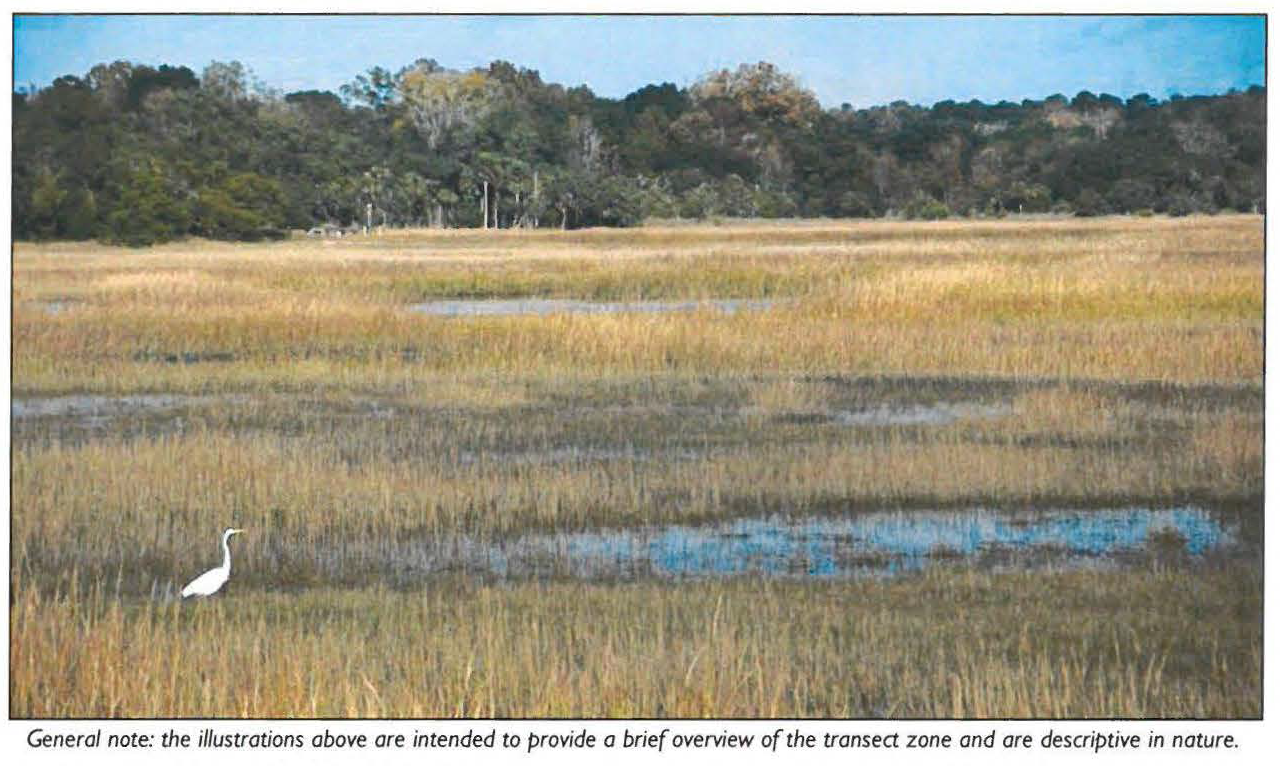
A. Purpose
The Natural Preserve (DINP) Zone is intended to preserve areas that contain sensitive habitats, open space, and limited agricultural uses. This Zone typically does not contain buildings; however, single-family dwellings, small civic buildings or interpretive centers may be located within this zone if approved as a part of a conservation agreement.


B. Building Placement
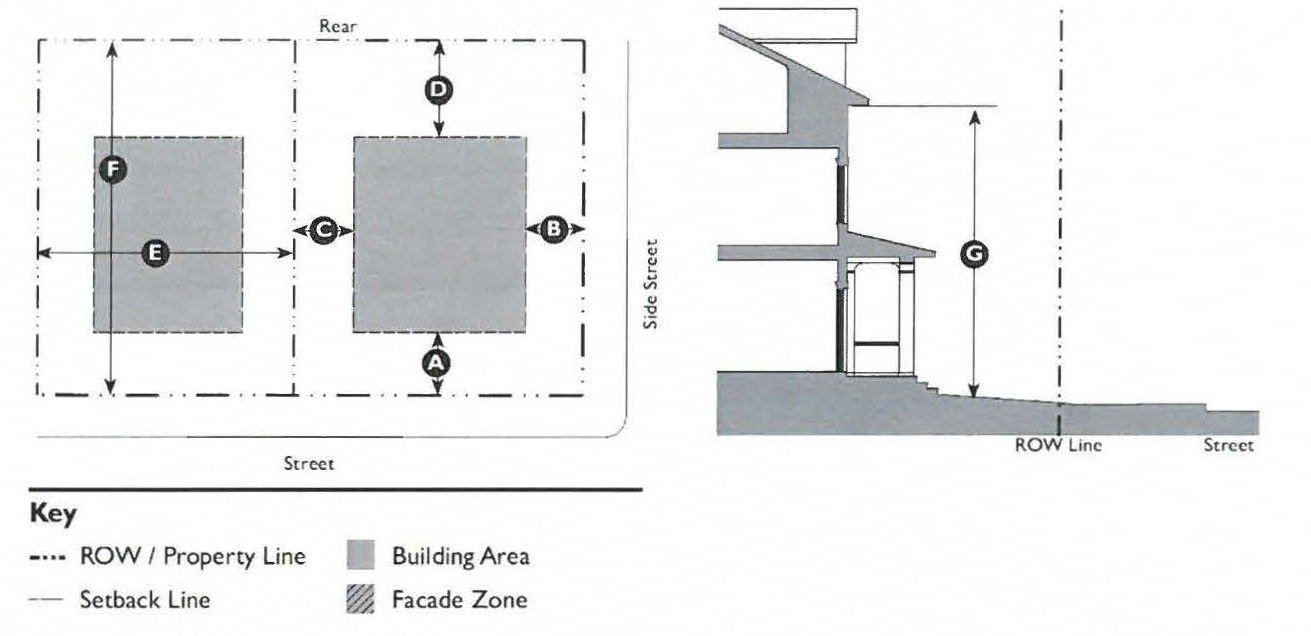
Setback (Distance from ROW/Property Line)
Front 50' min.
Side Street 50' min.
Side:
 Side, Main Building 50' min.
 Side, Ancillary Building 20' min.
Rear 100' min.
Lot Size (One Acre Minimum)
Width 150' min.
Depth n/a
Miscellaneous
Where existing adjacent buildings are in front of the regulated BTL or front setback, the building may be set to align with the façade of the front-most immediately adjacent property.
C. Building Form
Building Height
Main Building 35 feet/2 stories max.
Ancillary Building 35 feet/2 stories max.
Ground Floor Finish Level 1 No minimum
Footprint
Maximum Lot
Coverage
n/a
Lot coverage is the portion of a lot that is covered by any and all buildings including accessory buildings.
Notes
1 Buildings located in a flood hazard zone will be required to be built above base flood elevation in accordance with Beaufort County Building Codes
D. Gross Density 2
Gross Density 0.1 d.u./acre
2 Gross Density is the total number of dwelling units on a site divided by the Base Site Area (Division 6.1.40.F)


(Ord. No. 2019/08, 1-28-19)

B.1.40 - Transect 2: D2 Rural (T2R) Standards
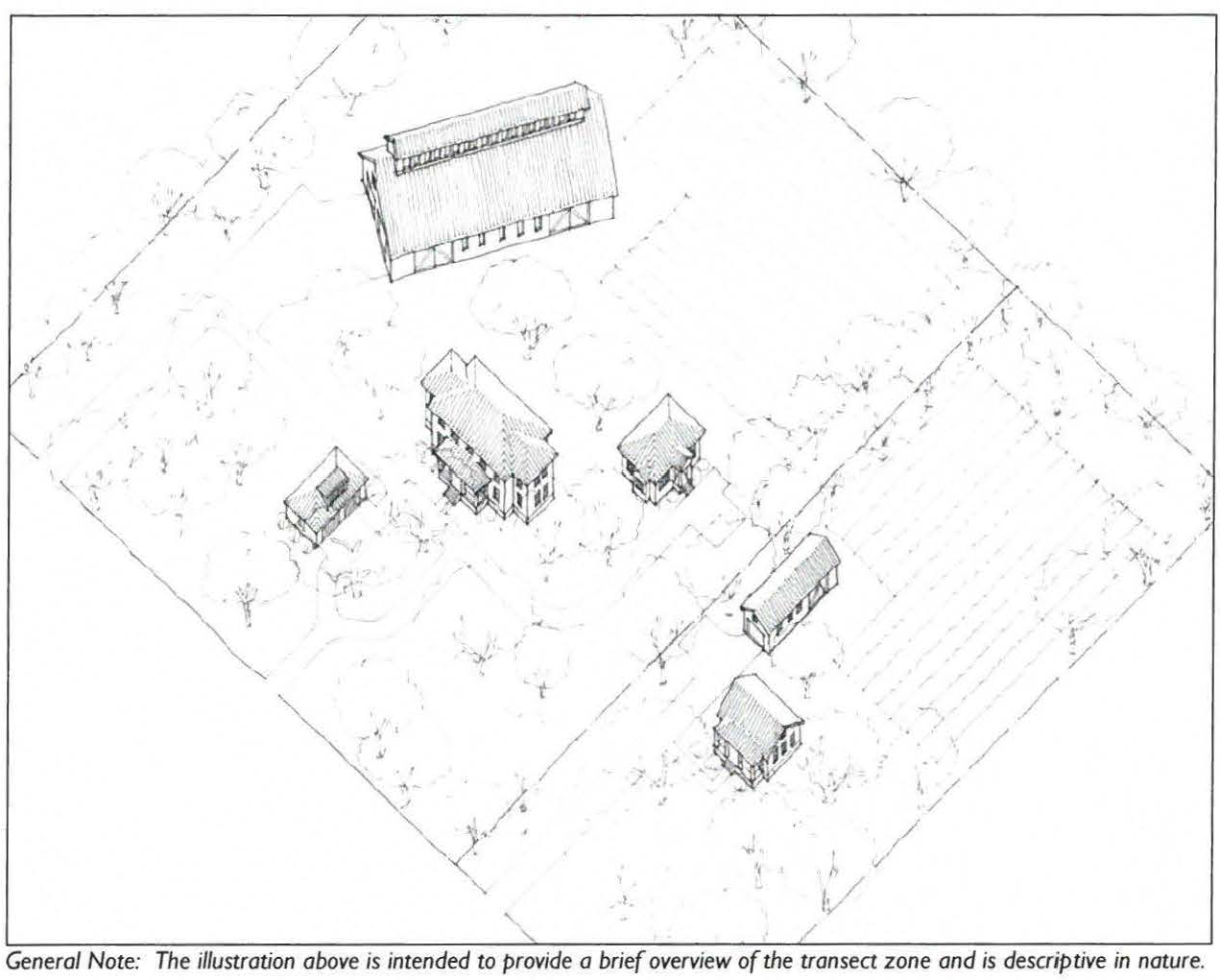
A. Purpose
The zones within transect 2 are rural in character. This transect, and the zones included, implement the Comprehensive Plan goals of preserving the rural and historic character of Daufuskie Island.
The Rural (D2R) Zone is intended to preserve the rural character of Daufuskie Island. This Zone applies to areas that consist of sparsely settled lands in an open or cultivated state. It may include large lot residential, small commercial or restaurant uses, farms where animals are raised, or crops are grown, parks, woodland, grasslands, trails, and open space areas.
The D2R Rural Zone implements the Comprehensive Plan goals of preserving the rural and historic character of Daufuskie Island.
B. Subzones
D2R-CP (Rural-Conventionally Platted)
The intent of the D2R-CP subzone is to provide a district that preserves the currently approved conventionally platted subdivisions within this area of Daufuskie Island. This subzone allows for smaller lots that have already been approved by Beaufort County, however no further subdivision or recombination of the existing lots is allowed without obtaining a special permit from Beaufort County.
D2R-GH (Rural-Gullah Heritage)
The intent of the D2R-GH subzone is to provide a district that preserves the Gullah heritage, while maintaining the rural character within this area of Daufuskie Island. This subzone preserves the Gullah heritage sites and ensures that new development is in character with the Gullah heritage.


C. Building Placement
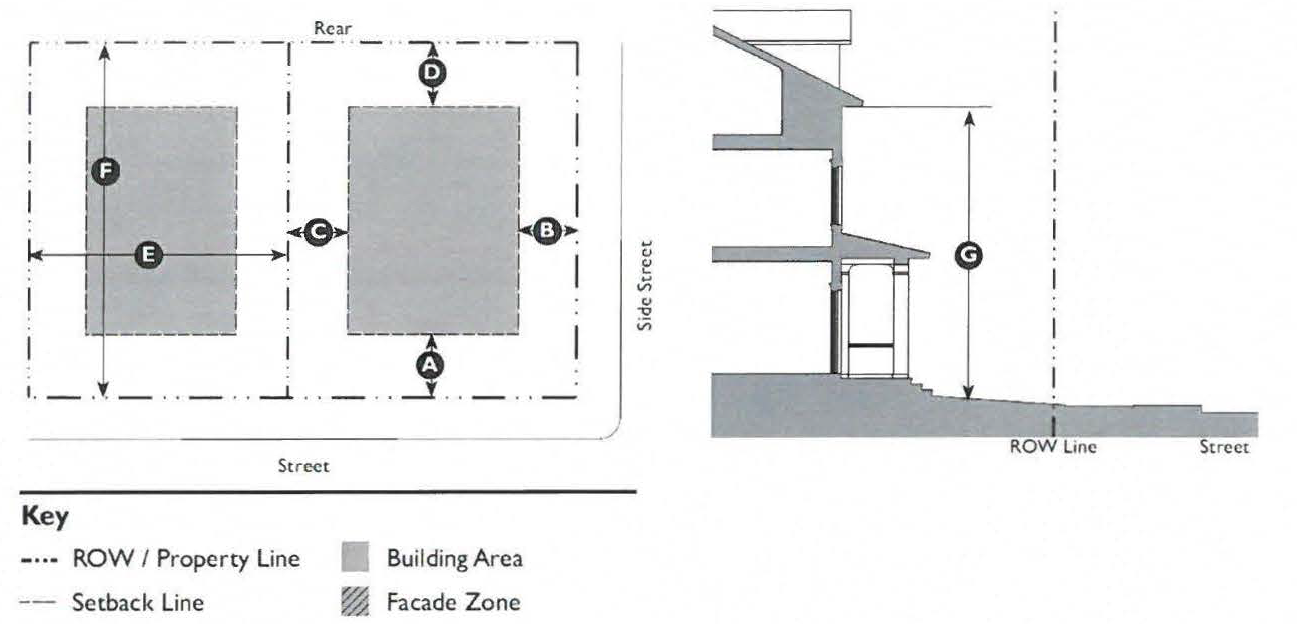
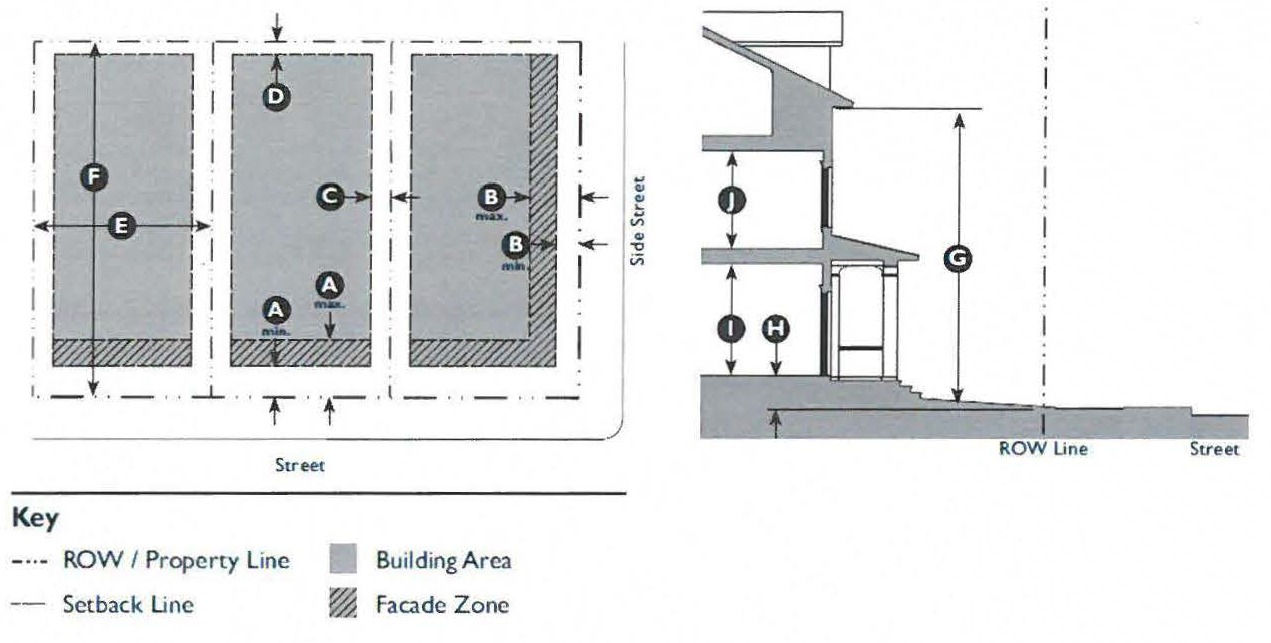
Setback (Distance from ROW/Property Line
Front 50' min.
Side Street 50' min.
Side
 Side, Main Building 20' min.
 Side, Ancillary
 Building
20' min.
Rear 50' min.
Lot Size (One Acre Minimum)
Width 100' min.
Depth n/a
Miscellaneous
Where existing adjacent buildings are in front of the regulated BTL or front setback, the building may be set to align with the facade of the front-most Immediately adjacent property.
D. Building Form
Architectural Guidelines
Although not required, the preferred architectural style in Transect 2 is Lowcountry Vernacular as illustrated in 5.3.40.B of the Beaufort County Community Development Code. Also allowed in Transect 2 is a style referred to as Everyday Island. The Everyday Island style of architecture includes a large group of structures and construction techniques for those not wanting the traditional local vernacular. This Everyday Island style also includes modular and prefab construction These preferred building types and everyday island styles apply in all zones and subzones in Transect 2.
D. Building Form (Continued)
Building Height
Main Building 2 stories max.
Ancillary Building 2 stories max.
Ground Floor Finish Level 1 Footprint No minimum
Maximum Lot
Coverage 2
n/a
Miscellaneous
Loading docks, overhead doors, and other service entries may not be located on street-facing facades.
Notes
1 Buildings located in a flood hazard zone will be required to be built above base flood elevation in accordance with Beaufort County Building Codes.
2 Lot coverage is the portion of a lot that is covered by any and all buildings including accessory buildings.
E. Gross Density 3
Gross Density 1.0 d.u. per acre
3 Gross Density is the total number of dwelling units on a site divided by the Base Site Area (Division 6.1.40.F)


G. Encroachments and Frontage Types
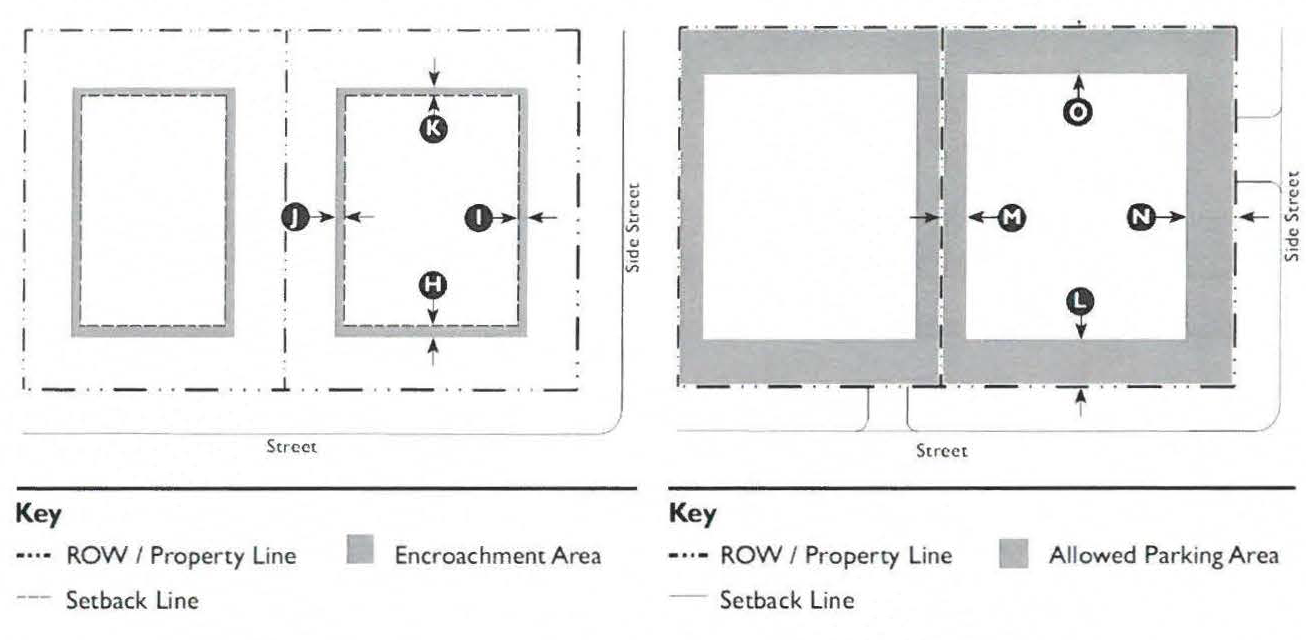
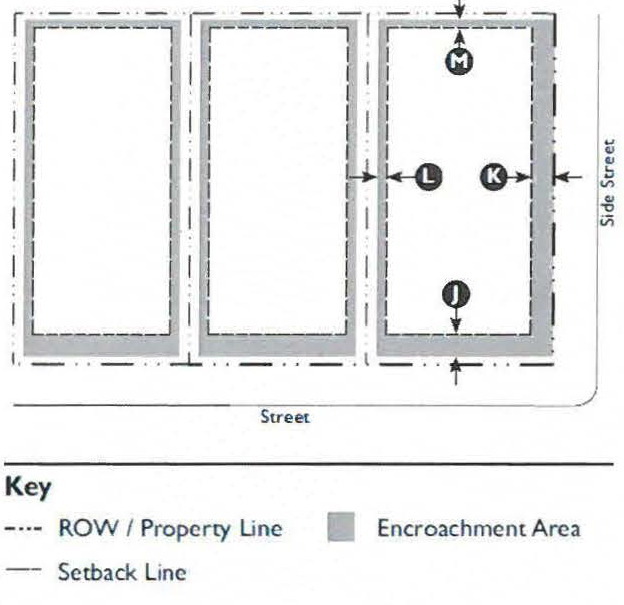
Encroachments
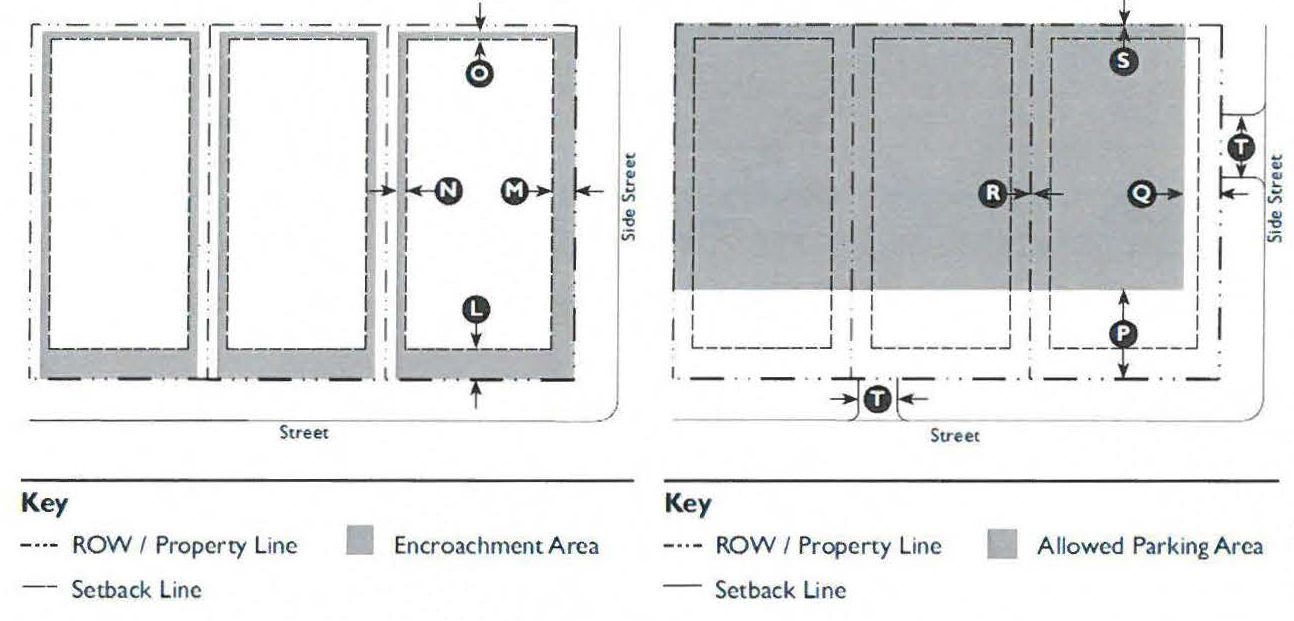
Front 5' max.
Side Street 5' max.
Side 5' max.
Rear 5' max.
Encroachments are not allowed within a Street ROW/Alley ROW, or across a property line.
G. Buffers
In both D2R and D2R-HC a buffer of natural vegetation and trees shall be retained when developed. If the buffer area has been cleared prior to development, or does not exist, a buffer consisting of natural vegetation and trees shall be installed. Minimum buffer requirements are:
Width of Buffer
Front 20' min.
Side Street 20' min.
Side 10' min.
Rear 20' min.
Miscellaneous
All development in both D2R and D2R-HC abutting any street or road open and used by the public shall be subject to the requirements of the thoroughfare buffer for 2 or 3 lanes as described in Division 5.8.50 of the Beaufort County Community Development Code. These buffers do not apply to the CP and GH sub-districts, however if a property is located in one of these sub-districts and lies within the Heritage Corridor Overlay District, the buffers in the Overlay District shall apply.


(Ord. No. 2019/08, 1-28-19)

B.1.50 - Transect 3: D3 General Neighborhood (D3GN) Standards
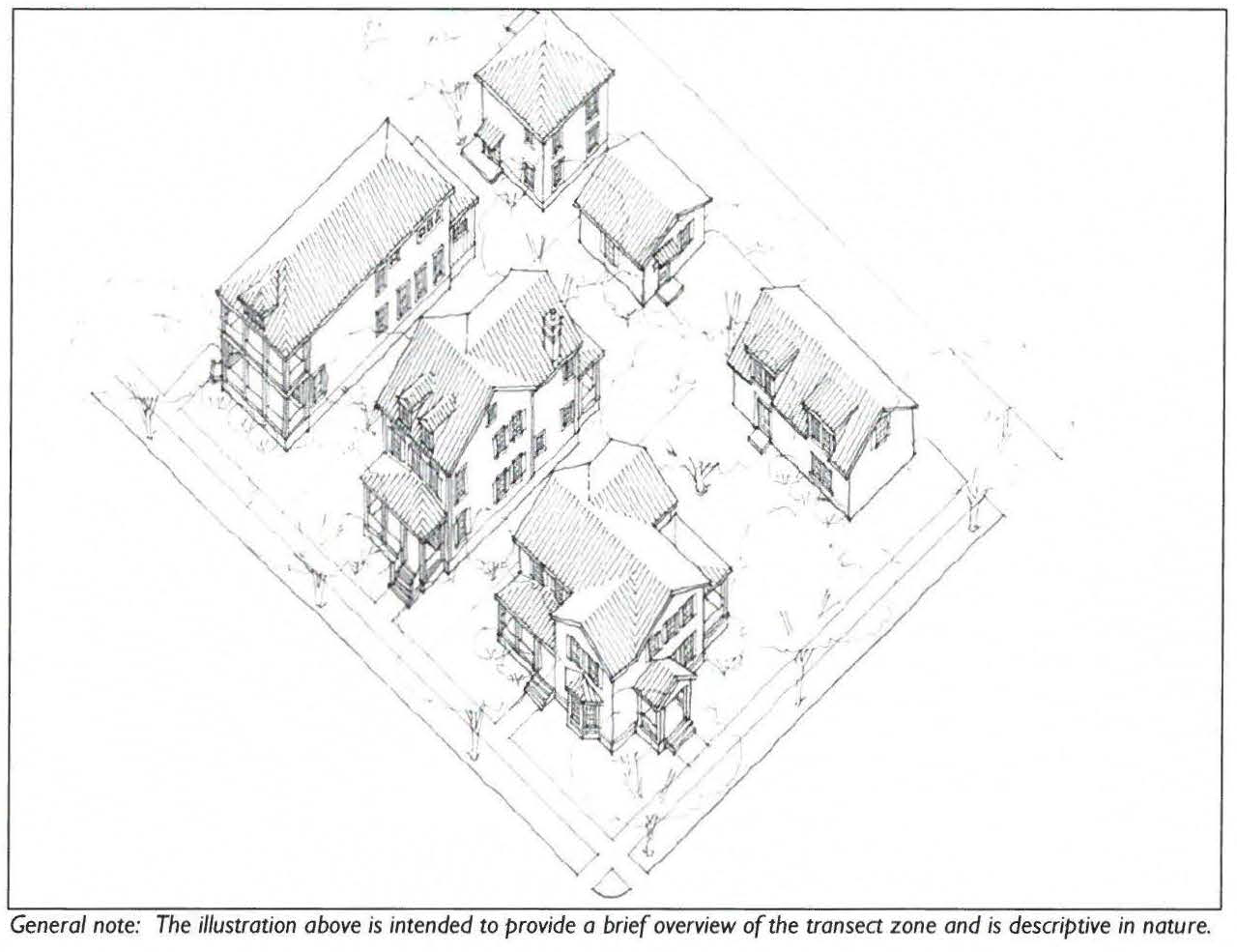
A. Purpose
The (D3GN) Zone is intended to preserve the historic character and natural environment of Daufuskie Island. The (D3GN) Zone is intended to provide a walkable, predominantly single-family neighborhood that integrates compatible multi-family housing types, such as duplexes and cottage courts within walking distance to village centers and commercial areas.
The D3GN Zone implements the Comprehensive Plan goals of preserving and building upon the walkable character of portions of Daufuskie Island.
B. Allowed Building Types
Building TypeSpecific Regulations
Carriage House 5.1.40
Estate House 5.1.50
Village House 5.1.60
Miscellaneous
Existing manufactured homes that are being replaced with another manufactured home that does not exceed the size and/or setbacks of the existing unit are exempt from Building Type (Division 5.1) and Private Frontage (Division 5.2) Standards.


C. Building Placement
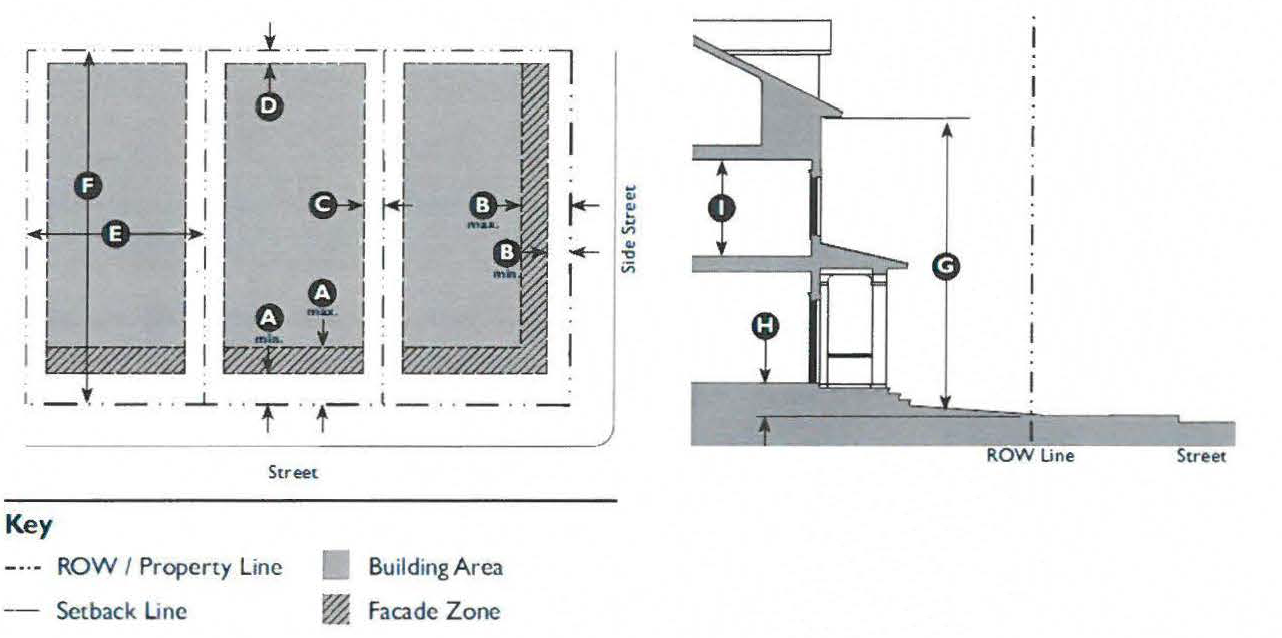
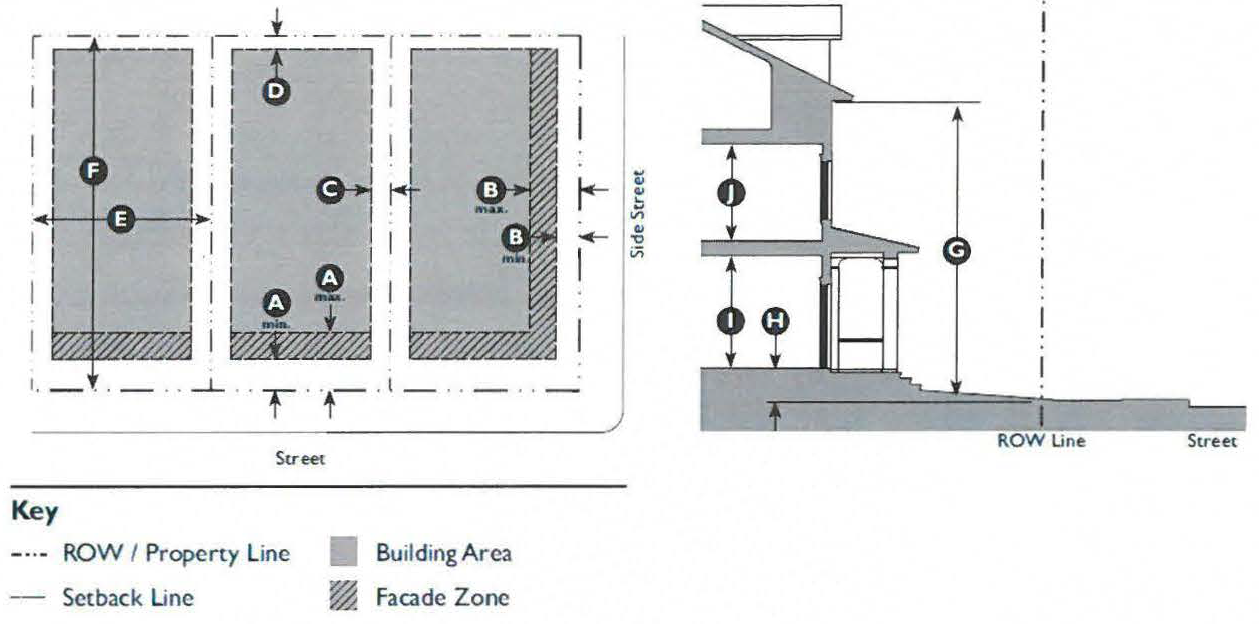
Setback (Distance from ROW/Property Line)
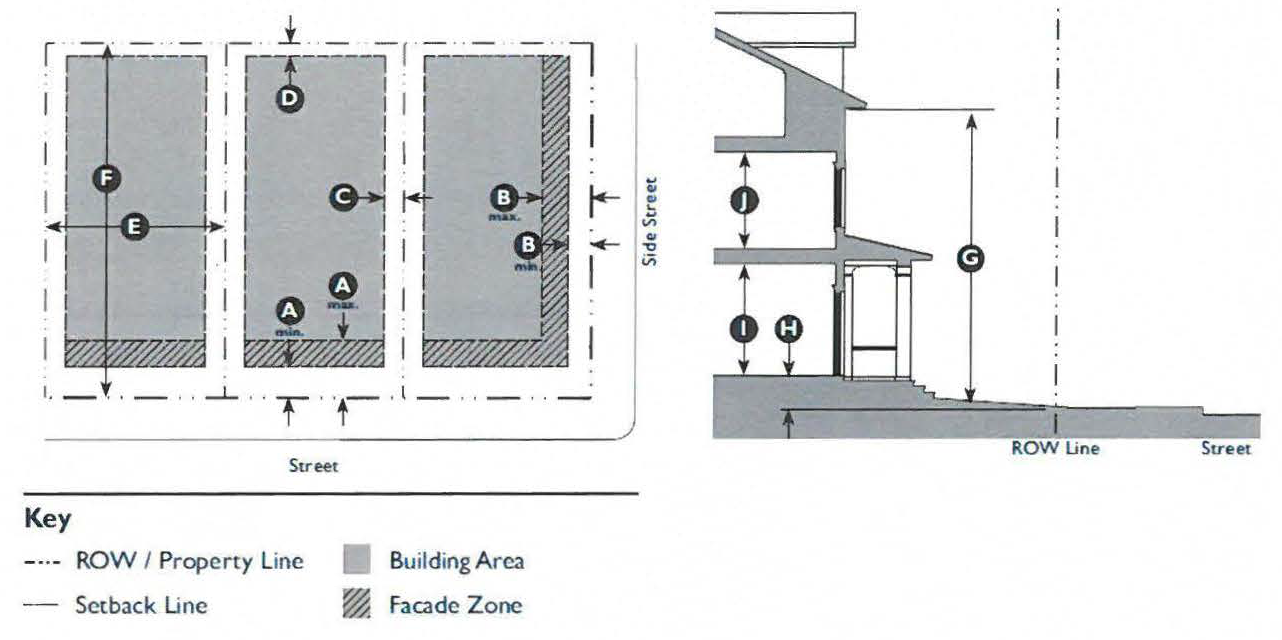
Front 15' min., 50' max.
Side Street 10' min., 50' max.
Side:
 Side, Main Building 7 ½' min.
 Side, Ancillary
 Building
5' min.
Rear
 Rear, Main Building 15' min.
 Rear, Ancillary
  Building
5' min.
Façade within Façade Zone:
 Front 75%
 Side Street 50%
Lot Size (43,560 SF Maximum)
Width 100' max.
Depth 200' max.
Miscellaneous
Where existing adjacent buildings are in front of the regulated BTL or front setback, the building may be set to align with the facade of the front-most immediately adjacent property.
Maximum lot size does not apply to Recreation, Education, Safety, Public Assembly uses
Maximum lot size does not apply to minor residential subdivisions meeting the requirements of Section 6.1.30.A
D. Building Form
Building Height
Main Building 2 stories max.
Ancillary Building 2 stories max.
Ground Floor Finish Level 1 18" min.
Upper Floors(s) Ceiling 8' min. clear
Footprint
Maximum Lot
Coverage 2
30% of lot area
Miscellaneous
Loading docks, overhead doors, and other service entries may not be located on street-facing facades.
Notes
1 Buildings located in a flood hazard zone will be required to be built above base flood elevation in accordance with Beaufort County Building Codes.
2 Lot coverage is the portion of a lot that is covered by any and all buildings including accessory buildings.
E. Gross Density 1
Gross Density 3.0 d.u. per acre
1 Gross Density is the total number of dwelling units on a site divided by the Base Site Area (Division 6.1.40.F)


F. Encroachments and Frontage Types
Encroachments
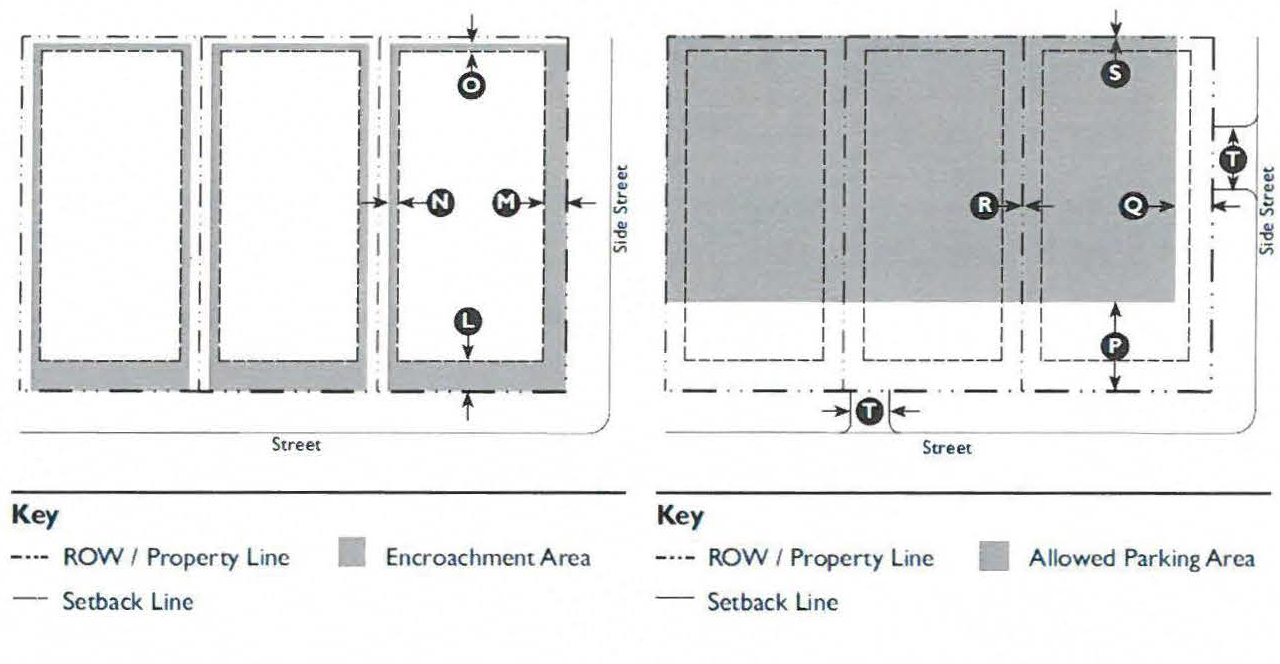
Front 5' max.
Side Street 5' max.
Side 3' max.
Rear 5' max.
Encroachments are not allowed within a Street ROW/Alley ROW, buffers, or across a property line.
See Division 5.2 (Private Frontage Standards) for further refinement of the allowed encroachments for frontage elements.
Allowed Frontage Types
Common Yard Porch: Engaged
Porch: Projecting Porch: Side Yard


(Ord. No. 2019/08, 1-28-19; Ord. No. 2020/48, 10-26-20)

B.1.60 - Transect 4: D4 Mixed Use (D4MU) Standards
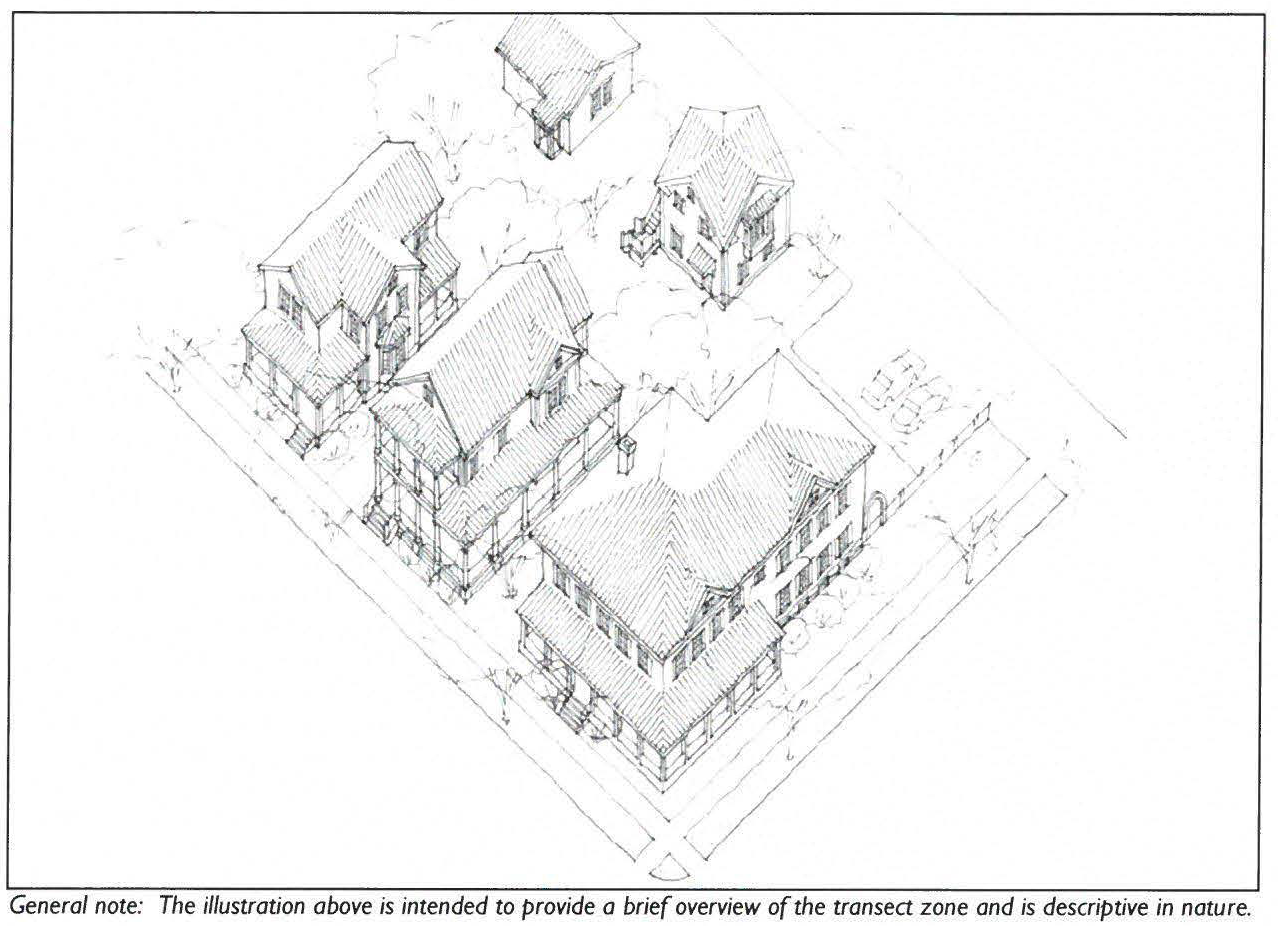
A. Purpose
The Mixed Use (D4MU) Zone is intended to integrate vibrant residential, commercial and retail environments, providing access to day-to-day amenities within walking distance within the zone as well as to the village centers.
The Mixed Use Zone implements the Comprehensive Plan goals of creating areas of higher intensity residential and commercial uses for Daufuskie Island.
B. Allowed Building Types
Building TypeSpecific Regulations
Carriage House 5.1.40
Village House 5.1.60
Small Lot House 5.1.70
Cottage Court 5.1.80
Duplex 5.1.90
Townhouse 5.1.100
Mansion Apartment 5.1.110
Apartment House 5.1.120
Industrial/Agricultural 5.1.140
Miscellaneous
Existing manufactured homes that are being replaced with another manufactured home that does not exceed the size and/or setbacks of the existing unit are exempt from Building Type (Division 5.1) and Private Frontage (Division 5.2) Standards.


C. Building Placement
Setback (Distance from ROW/Property Line)
Front 15' min., 30' max.
Side Street 10' min., 30' max.
Side:
 Side, Main Building 7 ½' min.
 Side, Ancillary
  Building
5' min.
Rear:
 Rear, Main Building 15' min.
 Rear, Ancillary
  Building
5' min.
Lot Size (20,000 SF Maximum)
Width 100 ft. max.
Depth 200 ft. max.
Miscellaneous
Where existing adjacent buildings are in front of the regulated BTL or front setback, the building may be set to align with the facade of the front-most immediately adjacent property.
Maximum lot size does not apply to Recreation, Education, Safety, Public Assembly uses, and buildings with a footprint Exceeding 10,000 square feet.
Maximum lot size does not apply to minor residential subdivisions meeting the requirements of Section 6.1.30.A
D. Building Form
Building Height
Main Building 2 stories max.
Ancillary Building 2 stories max.
Ground Floor Finish Level: 1 18" min.
Ground Floor Ceiling: 10' min.
Upper Floor(s) Ceiling 8' min.
Ground Floor lobbies and Common areas in multi-unit buildings may have a 0" to 6" ground floor finish level.
Footprint
Maximum Lot
Coverage 2
30% of lot area
Notes
1 Buildings located in a flood hazard zone will be required to be built above base flood elevation in accordance with Beaufort County Building Codes.
2 Lot coverage is the portion of a lot that is covered by any And all buildings, including accessory buildings.
E. Gross Density 1
Base site area less than 5 ac. 8.0 d.u. per acre
Base site area greater than 5 ac. 4.0 d.u. per acre
1 Gross Density is the total number of dwelling units on a site divided by the Base Site Area (Division 6.1.40.F)


F. Encroachments and Frontage Types
Encroachments
Front 12' max.
Side Street 12' max.
Side 3' max.
Rear 5' max.
Encroachments are not allowed within a street ROW, property line, or across a curb.
See Division 5.2 (Private Frontage Standards) for further refinement of the allowed encroachments for frontage elements.
Allowed Frontage Types
Common Yard Forecourt
Porch: Projecting Dooryard
Porch: Engaged Porch: Side Yard
Stoop
G. Parking
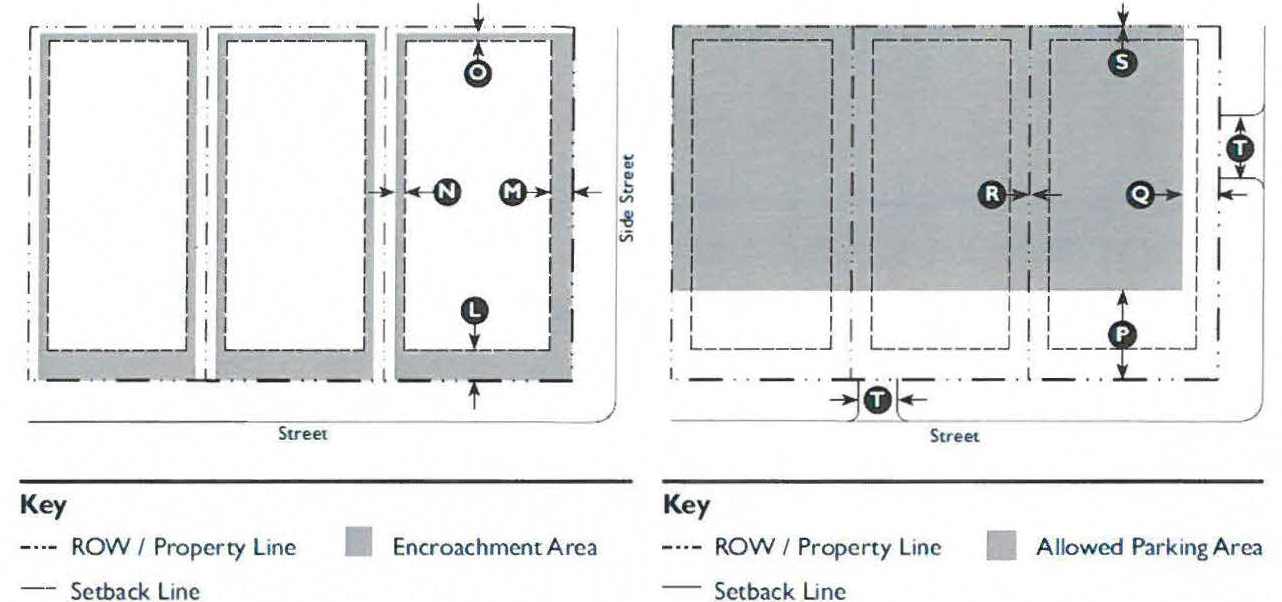
Location (Setback from Property Line)
Front 5' behind front façade of main building
Side Street 5' behind front façade of main building
Side 0' min.
Rear 5' min.


(Ord. No. 2019/08, 1-28-19; Ord. No. 2020/48, 10-26-20)

B.1.70 - Transect 5: Village Center (D5VC) Standards
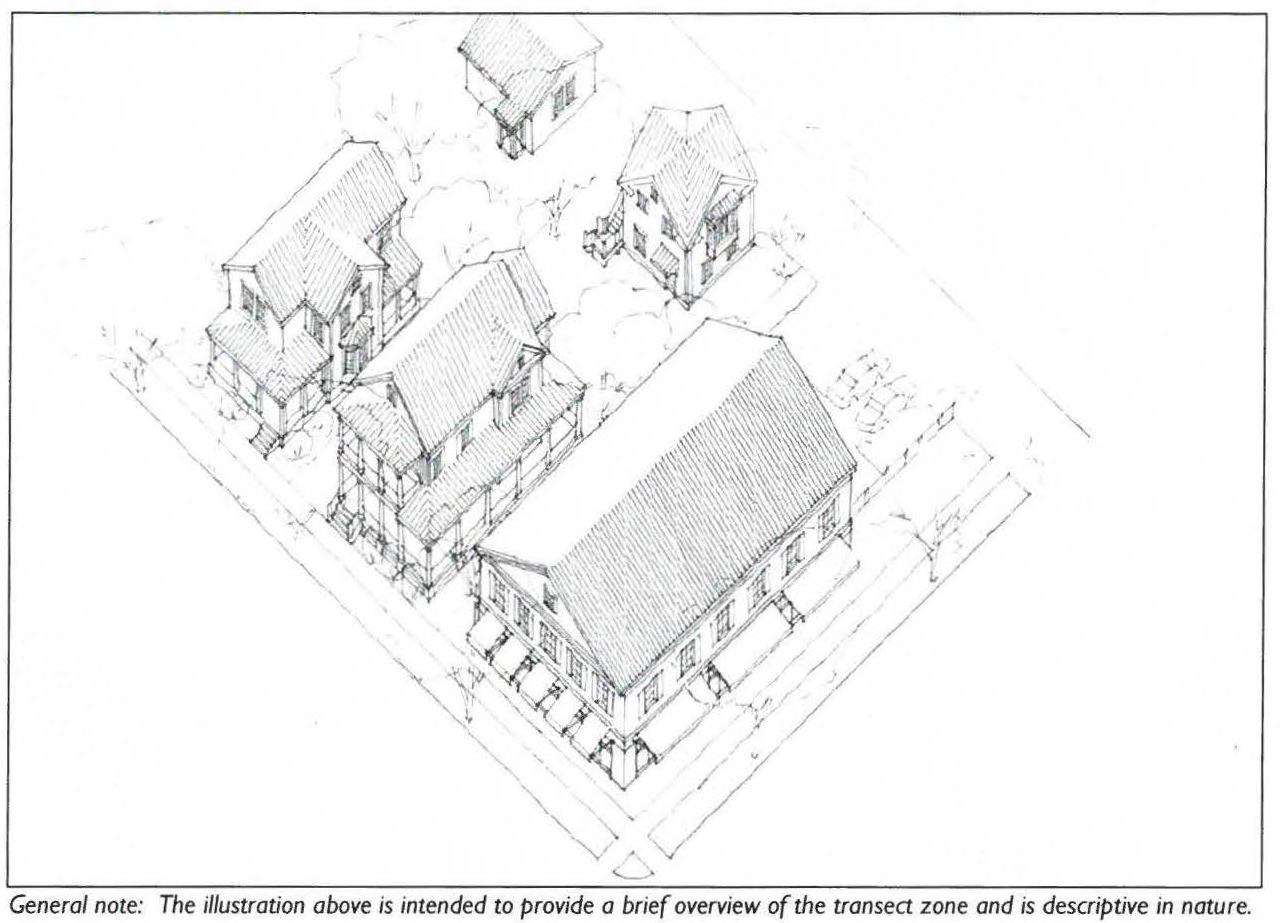
A. Purpose
The zones within transect 5 are the most urban in character. This transect, and the zones included, implement the Comprehensive Plan goals of preserving the character of Daufuskie Island while providing for the commercial needs of the island.
The Village Center (D5VC) Zone is intended to integrate vibrant main-street commercial and retail environments, providing access to day-to-day amenities within walking distance, creating potential for water ferry embarkation points, and serving as a focal point for Daufuskie Island.
The Village Center Zone implements the Comprehensive Plan goals of creating areas of higher intensity residential and commercial uses for Daufuskie Island.
B. Allowed Building Types
Building TypeSpecific Regulations
Carriage House 5.1.40
Small Lot House 5.1.70
Cottage Court 5.1.80
Duplex 5.1.90
Townhouse 5.1.100
Mansion Apartment 5.1.110
Apartment House 5.1.120
Main Street Mixed Use 5.1.130
Industrial/Agricultural 5.1.140
Miscellaneous
Existing manufactured homes that are being replaced with another manufactured home that does not exceed the size and/or setbacks of the existing unit are exempt from Building Type (Division 5.1) and Private Frontage (Division 5.2) Standards.


C. Building Placement
Setback (Distance from ROW/Property Line)
Front 5' min., 20' max.
Side Street 5' min., 20' max
Side:
 Main Building 7 ½' min.
 Ancillary Building 5' min.
Rear
 Main Building 15' min.
 Ancillary Building 5' min.
Lot Size (20,000 SF Maximum)
Width 100' max.
Depth 200' max.
Miscellaneous
Where existing adjacent buildings are in front of the regulated BTL or front setback, the building may be set to align with the facade of the front-most immediately adjacent property.
Maximum lot size does not apply to Recreation, Education, Safety, Public Assembly uses, and buildings with a footprint exceeding 20,000 square feet.
Maximum lot size does not apply to minor residential subdivisions meeting the requirements of Section 6.1.30.A
D. Building Form
Building Height
Main Building 2 ½ stories max.
Ancillary Building 2 stories max.
Ground Floor Finish Level: 1
 Residential 18" min.
 Commercial 6" max.
Ground Floor Ceiling: 10' min.
Upper Floor(s) Ceiling 8' min.
Ground Floor lobbies and common areas in multi-unit buildings may have a 0" to 6" ground floor finish level.
Footprint
Maximum Lot
Coverage 2
30% of lot area
Miscellaneous
Loading docks, overhead doors, and other service entries may not be located on street-facing facades.
Notes
1 Buildings located in a flood hazard zone will be required to be built above base flood elevation in accordance with Beaufort County Building Codes.
2 Lot coverage is the portion of a lot that is covered by any and all buildings, including accessory buildings.
E. Gross Density
Gross Density 1 8.0 d.u. per acre
1 Gross Density is the total number of dwelling units on a site divided by the Base Site Area (Division 6.1.40.F)


F. Encroachments and Frontage Types
Encroachments
Front 12' max.
Side Street 12' max.
Side 3' max.
Rear 5' max.
Encroachments are not allowed within a street ROW, Alley ROW, or across a property line.
See Division 5.2 (Private Frontage Standards) for further refinement of the allowed encroachments for frontage elements.
Awnings, Galleries and Arcades may encroach further into the street ROW to within 2' of the face of curb. Eaves may encroach up to 3' into the street ROW. All other encroachments are not allowed within street ROW.
Allowed Frontage Types
Porch: Projecting Dooryard
Porch: Engaged Porch: Side Yard
Stoop Shopfront
Forecourt Terrace
G. Parking
Location (Setback from Property Line)
Front 40' min.
Side Street 15' min.
Side 0' min.
Rear 5' min.


(Ord. No. 2019/08, 1-28-19; Ord. No. 2020/48, 10-26-20)

B.1.80 - Transect 5: Gateway Corridor (D5GC) Standards
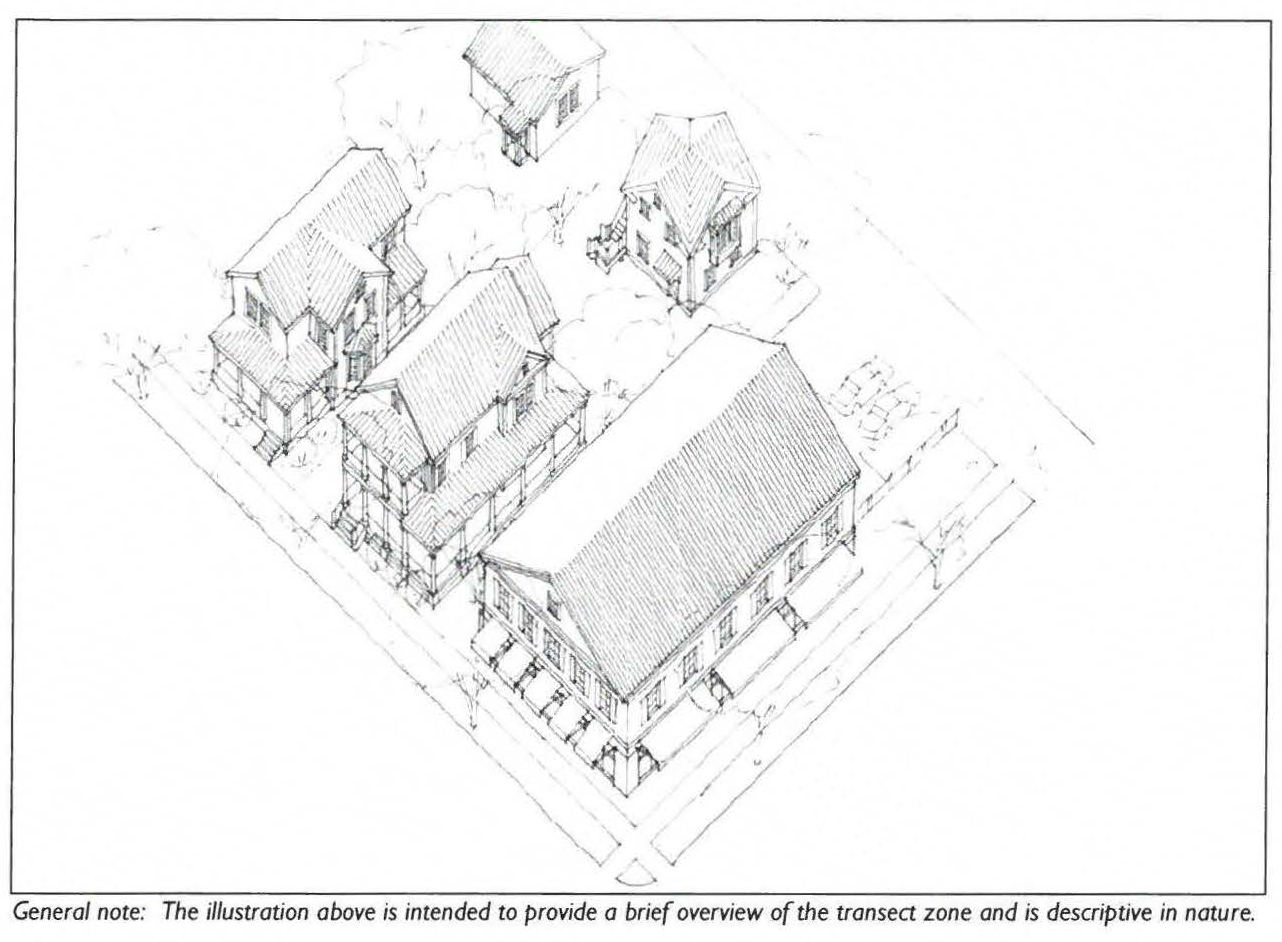
A. Purpose
The zones within transect 5 are the most urban in character. This transect, and the zones included, implement the Comprehensive Plan goals of preserving the character of Daufuskie Island while providing for the commercial needs of the island.
The Gateway Corridor (D5GC) Zone is intended to extend the concept of a vibrant main-street commercial and retail environments from the Village Center to public places in the Gateway Corridor, providing access to day-to-day amenities within walking distance, creating, and serving as a focal point for public space for Daufuskie Island.The Gateway Corridor Zone implements the Comprehensive Plan goals of creating areas of higher intensity residential and commercial uses for Daufuskie Island and provide for public and civic uses.
B. Allowed Building Types
Building TypeSpecific Regulations
Carriage House 5.1.40
Small Lot House 5.1.70
Cottage Court 5.1.80
Duplex 5.1.90
Townhouse 5.1.100
Mansion Apartment 5.1.110
Apartment House 5.1.120
Main Street Mixed Use 5.1.130
Industrial/Agricultural 5.1.140
Miscellaneous
Existing manufactured homes that are being replaced with another manufactured home that does not exceed the size and/or setbacks of the existing unit are exempt from Building Type (Division 5.1) and Private Frontage (Division 5.2) Standards.


C. Building Placement
Setback (Distance from ROW/Property Line)
Front 15' min., 30' max.
Side Street 10' min., 30' max
Side:
 Main Building 7 ½' min.
 Ancillary Building 5' min.
Rear
 Main Building 15' min.
 Ancillary Building 5' min.
Lot Size (20,000 SF Maximum)
Width 100' max.
Depth 200' max.
Miscellaneous
Where existing adjacent buildings are in front of the regulated BTL or front setback, the building may be set to align with the facade of the front-most immediately adjacent property.
Maximum lot size does not apply to Recreation, Education, Safety, Public Assembly uses, and buildings with a footprint exceeding 20,000 square feet.
Maximum lot size does not apply to minor residential subdivisions meeting the requirements of Section 6.1.30.A
D. Building Form
Building Height
Main Building 2 stories max.
Ancillary Building 2 stories max.
Ground Floor Finish Level: 1
 Residential 18" min.
 Commercial 6" max.
Ground Floor Ceiling: 10' min.
Upper Floor(s) Ceiling 8' min.
Ground Floor lobbies and common areas in multi-unit buildings may have a 0" to 6" ground floor finish level.
Footprint
Maximum Lot
Coverage 2
30% of lot area
Miscellaneous
Loading docks, overhead doors, and other service entries may not be located on street-facing facades.
Notes
1 Buildings located in a flood hazard zone will be required to be built above base flood elevation in accordance with Beaufort County Building Codes.
2 Lot coverage is the portion of a lot that is covered by any and all buildings, including accessory buildings.
E. Gross Density
Gross Density 1 4.0 d.u. per acre
1 Gross Density is the total number of dwelling units on a site divided by the Base Site Area (Division 6.1.40.F)


F. Encroachments and Frontage Types
Encroachments
Front 12' max.
Side Street 12' max.
Side 3' max.
Rear 5' max.
Encroachments are not allowed within a street ROW, Alley ROW, or across a property line.
See Division 5.2 (Private Frontage Standards) for further refinement of the allowed encroachments for frontage elements.
Awnings, Galleries and Arcades may encroach further into the street ROW to within 2' of the face of curb. Eaves may encroach up to 3' into the street ROW. All other encroachments are not allowed within street ROW.
Allowed Frontage Types
Porch: Projecting Dooryard
Porch: Engaged Porch: Side Yard
Stoop Shopfront
Forecourt Terrace
G. Parking
Location (Setback from Property Line)
Front 40' min.
Side Street 15' min.
Side 0' min.
Rear 5' min.


(Ord. No. 2019/08, 1-28-19; Ord. No. 2020/48, 10-26-20)

B.2.10 - Purpose

This Division provides regulatory standards governing land use and building form within special overlay zones. These zones are typically applied to certain areas of the County on Daufuskie Island where extreme physical or cultural constraints need increased planning guidelines and consideration.

(Ord. No. 2019/08, 1-28-19)

B.2.20 - Applicability

The requirements of this Division shall apply to all proposed development within the overlay zones and shall be considered in combination with the standards for specific uses in Article 4 (Specific to Use), if applicable, and the development standards in Article 5 (Supplemental to Zones) of the Beaufort County Community Development Code. If there is a conflict between any standards, the provisions of Article 4 (Specific to Use) control over Article 3 (Specific to Zones) and Article 5 (Supplemental to Zones).

(Ord. No. 2019/08, 1-28-19)

B.2.30 - Heritage Corridor Overlay (HCO) Standards

A.

Purpose. The Heritage Corridor Overlay (HCO) zone is established to provide for the long-term protection of the culturally significant resources found on Daufuskie Island. The zone acknowledges Daufuskie Island's historic cultural landscape and its importance to Daufuskie Island and Beaufort County s most notable concentration of Gullah culture.

B.

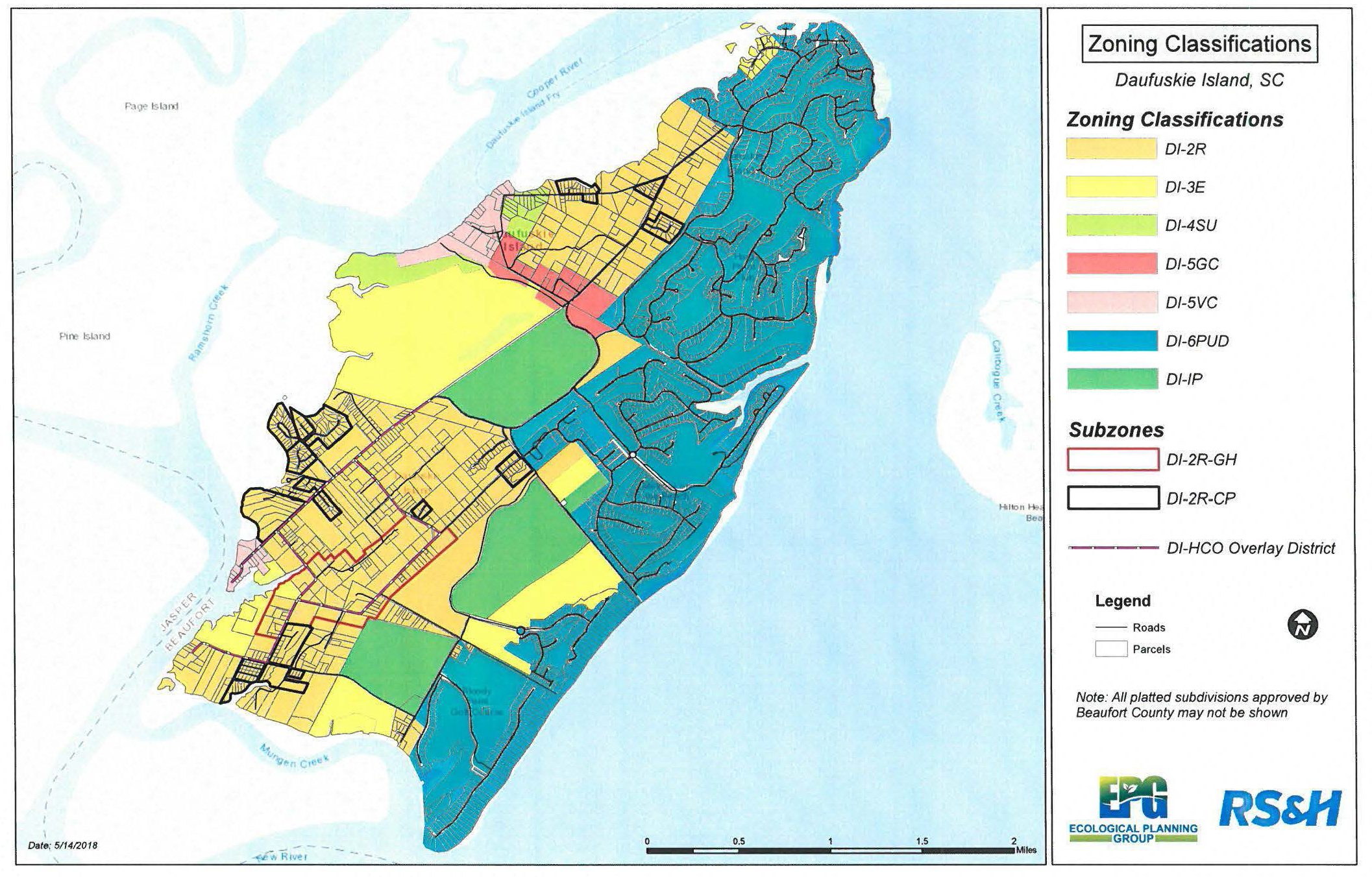
District Boundaries. The boundaries of the HCO zone on Daufuskie Island are depicted on the Beaufort County Official Zoning Map. The Overlay District extends 200 feet from the centerline of each street that is identified on the Zoning Map, and any parcel that abuts the defined boundary shall be considered to be included within the overlay corridor and its standards. Where the zone applies, the permitted uses shall be limited to the base zoning in D2R, except where additional limitations are established within the overlay zone.

C.

Site Design and Architecture. Design features that impact other culturally significant locations, and franchise design are prohibited. All development within 200 feet of the streets of roads that define the district boundary in this zone shall be reviewed by the Beaufort County Design Review Board for both the site design and building style. Any development outside of this 200-foot standard shall not require review by the Design Review Board. All design and buildings shall meet the requirements of Lowcountry Vernacular design architectural style as set forth in Division 5.3 of the Beaufort County Community Development Code.

D.

Use Limitations. The following specific uses are deemed to be incompatible with the DI-HC-O zone; and therefore, are prohibited:

1.

Restricted Access (Gated Communities). An intentionally designed, secured bounded area with designated and landscaped perimeters, usually walled or fenced, that are designed to prevent access by non-residents.

2.

Resorts. This use includes lodging that serves as a destination point for visitors and designed with some combination of recreation uses or natural areas. Typical types of activities and facilities include marinas, beaches, pools, tennis, golf, equestrian, restaurants, shops, and the like. This restriction does not apply to ecotourism or its associated lodging.

3.

Golf Courses. This use includes regulation and par three golf courses having nine or more holes.

E.

Buffers. A buffer of natural vegetation and trees shall be retained when developed. If the buffer area has been cleared prior to development, or does not exist, a buffer consisting of natural vegetation and trees shall be installed. Minimum buffer requirements are in Table B.1.30.E.

Table B.1.30.E: Heritage Corridor Overlay District Buffer Requirements
BufferWidth
Front 50 feet minimum
Side Street 20 feet minimum
Side 10 feet minimum
Rear 20 feet minimum


All development shall be subject to the requirements of the thoroughfare buffer for 2 or 3 lanes as described in Division 5.8.50 of the Beaufort County Community Development Code.

(Ord. No. 2019/08, 1-28-19)

B.3.10 - Purpose

This Division establishes the land uses allowed in all zones within the County on Daufuskie Island and defines each of the land uses.

(Ord. No. 2019/08, 1-28-19)

B.3.20 - Consolidated Land Use Table and Land Use Definitions

The following table shown in B.3.20 defines the land uses that are allowed in each zone on Daufuskie Island. The uses are indicated as:

Permitted Use. A use that is permitted by right in a zone.

Conditional Use. A use that is permitted in a zone subject to the standards specified for that use being met, as determined by the Planning Commission.

Special Use. A use that may be permitted within a zone upon approval of a special use permit by the Zoning Board of Appeals (ZBOA). See Section 7.2.130 (Special Use Permits).

Not Permitted Use. A use that is not allowed or permitted in a zone.

The following table also B.3.20 defines the land use types for Daufuskie Island.

Table B.3.20. Consolidated Use Table
Land Use TypeD1
NP
D2
R
D2
CP
D2
GH
D3
GN
D4
MU
D5
VC
D5
GC
Definition
AGRICULTURE
1. Agriculture & Crop Harvesting P P P P A nursery, orchard, or farm, greater than 10,000 SF, primarily engaged in the growth and harvesting of fruits, nuts, vegetables, plants, or sod. The premises may include agricultural accessory structures, plant nurseries, and secondary retail or wholesale sales.
2. Agricultural Support Services P P P P Nursery, orchard, forestry, or farm supply and support services including, but not limited to: equipment dealers, support uses for agricultural, harvesting, and/or animal production, seasonal packing sheds, etc.
3. Animal Production C C C The raising, breeding, feeding, and/or keeping of animals for the principal purpose of commercially producing products for human use or consumption, including, but not limited to: cattle, pigs, sheep, goats, fish (aquaculture), bees, rabbits, and poultry. This does not include "Factory Farming" operations.
4. Animal Production: Factory Farming S S S The raising, breeding, feeding, and/or keeping of livestock (typically cows, pigs, turkeys, or chickens) in confinement at high stocking density for the purpose of commercially producing meat, milk, or eggs for human consumption.
5. Seasonal Farmworker Housing/Construction Worker Housing S S S S S S Housing designated for temporary occupancy for workers during seasonal farming or construction activity.
6. Forestry P P P P P P P P Perpetual management, harvesting, replanting, and enhancement of forest resources for ultimate sale or use of wood products, subject to S.C. Forestry Commission BMPs.
7. Commercial Stables C C C Stabling, training, feeding of horses, mules, donkeys, or ponies, or the provision of riding facilities for use other than by the resident of the property, including riding academies. Also includes any structure or place where such animals are kept for riding, driving, or stabling for compensation or incidental to the operation of any club, association, ranch or similar purpose.
RESIDENTIAL
1. Dwelling: Single Family Detached Unit P P P P P P P A structure containing one dwelling unit on a single lot.
2. Dwelling: Single Family Attached Unit P P P A structure containing one dwelling unit on a single lot and connected along a property line to another dwelling unit on an adjoining lot by a common wall or other integral part of the principal building such as a breezeway or carport.
3. Dwelling: Two Family Unit (Duplex) P P P A structure containing two dwelling units on a single lot.
4. Dwelling: Multi-Family Unit P P P A structure containing three or more dwelling units on a single lot.
5. Dwelling: Accessory Unit P P P P P P P An auxiliary dwelling unit, no larger than 800 SF attached to a principal dwelling unit or located within an accessory structure on the same lot.
6. Dwelling: Family Compound P P A form of traditional rural development which provides for the placement of additional single-family detached dwelling units on, and/or subdivisions of, a single parcel of land owned by the same family for at least 50 years.
7. Dwelling: Cluster Compound P P P A form of development which provides for the placement of small, single-family detached dwelling units on, and/or subdivisions of, a single parcel of land. Central facilities that provide services to the residents of the cluster compound may be included.
8. Dwelling: Group Home P P P P P P P Residential facility for nine or fewer mentally or physically handicapped persons providing care on a 24-hour basis and licensed by a state agency or department, or is under contract with a state agency or department, for that purpose.
9. Community Residence (dorms, convents, assisted living, temporary shelters) S S S S S S 1. Dormitory: A building, or portion thereof, which contains living quarters for five or more students, staff, or members of a college, university, primary or secondary boarding school, theological school, or other comparable organization, provided that such building is either owned or managed by such organization, or is under contract with such organization for that purpose.
2. Convent or Monastery. The living quarters or dwelling units for a religious order or for the congregation of persons under religious vows.
3. Assisted Living Facility: A state-licensed facility for long-term residence exclusively by seniors and persons with disabilities who require assistance with daily activities, and which may include, without limitation, common dining, social and recreational features, special safety and convenience features designed for the needs of the elderly or disabled, such as emergency call systems, grab bars and handrails, special door hardware, cabinets, appliances, passageways, and doorways designed to accommodate wheelchairs, and the provision of social services for residents which must include at least two of the following: meal services, transportation, housekeeping, linen, and organized social activities. May include an accessory skilled nursing component.
4. Group Home (more than 9 persons). A state-licensed residential facility for more than 9 mentally or physically handicapped persons providing care on a 24-hour basis.
Temporary Shelter: A supervised publicly or privately operated shelter and services designed to provide temporary living accommodations to individuals or families who lack a fixed, regular and adequate residence. This does not include residential substance abuse facilities or halfway houses (see "Community Care Facility").
10. Home Office P P P P P P P An office use carried out for gain by a resident and conducted entirely within the resident's home. This use permits the employment of one individual who does not live in the home.
11. Home Business P P P P P P P An office or service use carried out for gain by a resident and conducted entirely within the resident's home and/or accessory structures. This use permits the employment of up to three individuals who do not reside on the premises.
12. Cottage Industry P S P S S S Light industrial uses and boat, small engine (e.g. lawn mowers, but not vehicles), and farm equipment repair services carried out for gain by a resident and conducted on, or adjacent to, the property that contains the operator's residence. This use permits the employment of up to six individuals who do not reside on the premises.
13. Live/Work P C P C P P P An integrated housing unit and working space, occupied and utilized by a single household in a structure that has been designed or structurally modified to accommodate joint residential occupancy and work activity, and which includes: complete kitchen, living, and sleeping space and sanitary facilities in compliance with the Building Code, and working space reserved for and regularly used by one or more occupants of the unit. Workspace is limited to a maximum fifty percent (50%) of the structure and located on the first floor with living space located to the rear or above. Activities are limited to those uses permitted in the underlying Zone in which the Live/Work unit is located.
RETAIL AND RESTAURANTS
1. General Retail 3,500 SF or less P P P P P P Stores and shops that sell and/or rent goods and merchandise to the general public. This category does not include "Open Air Retail," "Vehicle Sales and Rental," or "Gas Stations/Fuel Sales."
2. General Retail 10,000 SF or less S P P
3. General Retail over 10,000 SF S S
4. Bars, Taverns and Nightclubs S P P 1. Bar, Tavern. A business where alcoholic beverages are sold for on-site consumption that is not part of a larger restaurant. Includes bars, taverns, pubs, and similar establishments where any food service is subordinate to the sale of alcoholic beverages. May also include beer brewing as part of a micro-brewery ("brew-pub"), and other beverage tasting facilities.
2. Night Club. A facility serving alcoholic beverages for on-site consumption, and providing entertainment, examples of which include live music and/or dancing, comedy, etc. Does not include adult oriented businesses.
5. Gas Stations and Fuel Sales P P P An establishment where petroleum products are dispensed for retail sale. This use may include a retail convenience store and/or a single bay carwash. It does not include towing, vehicle body or engine repair (see "Vehicle Services"), or overnight vehicle storage.
6. Open Air Retail P P P P P P A retail sales establishment operated substantially in the open air including, but not limited to: flea markets, monument sales, beach recreation rentals, and the like. Does not include "Vehicle Sales and Rental", agricultural equipment sales and rental (see "Agricultural Support Services"), plant nurseries (see "Agriculture and Crop Harvesting"), or roadside stands and farmers markets (see "Temporary Uses").
7. Restaurant, Café, Coffee Shop: Less than 40 seats in structure P P P P P P A retail business selling ready-to-eat food and/or beverages for on- or off-premise consumption. These include eating establishments where customers are served from a walk-up ordering counter for either on- or off-premises consumption ("counter service"); and establishments where customers are served food at their tables for on-premises consumption ("table service"), that may also provide food for take-out, but does not include drive-through services, which are separately defined and regulated. This use includes all mobile kitchens.
8. Restaurant, Café, Coffee Shop: 40 seats or more in structure P P P
9. Vehicle Sales and Rental - Light S P P A retail or wholesale establishment selling and/or renting automobiles, light trucks (less than 2-ton load capacity), vans, trailers, boats, and/or any other motorized or non-motorized vehicles (e.g. scooters, jet skis, golf carts, motorcycles) that includes outdoor display. May also include repair shops and the sales of parts and accessories incidental to vehicle dealerships. Does not include businesses dealing exclusively in selling used parts, auto wrecking and/or salvage (see "Salvage Operations"); the sale of auto parts/accessories separate from a vehicle dealership (see "General Retail"); or service stations (see "Vehicle Services").
OFFICES & SERVICES
1. General Offices and Services 3,500 SF or less C C C P P P 1. Bank/Financial Services. Financial institutions, including, but not limited to: banks, credit agencies, investment companies, security and commodity exchanges, ATM facilities.
2. Business Services. Establishments providing direct services to consumers, including, but not limited to: employment agencies, insurance agent offices, real estate offices, travel agencies, landscaping and tree removal companies, exterminators, carpet cleaners, and contractors' offices without exterior storage.
3. Business Support Services. Establishments providing services to other businesses, including, but not limited to: computer rental and repair, copying, quick printing, mailing and mailbox services.
4. Personal Services. Establishments providing non-medical services to individuals, including, but not limited to: barber and beauty shops, dry cleaners, small appliance repair, laundromats, massage therapists, pet grooming with no boarding, shoe repair shops, tanning salons, funeral homes. These uses may include incidental retails sales related to the services they provide.
5. Professional and Administrative Services. Office-type facilities occupied by businesses or agencies that provide professional or government services, or are engaged in the production of intellectual property.
2. General Offices and Services 10,000 SF or less P P P
3. Animal Services: Clinic/Hospital P C P P An establishment used by a veterinarian where animals are treated. This use may include boarding and grooming as accessory uses.
4. Animal Services: Kennel C C C C P P A commercial facility for the boarding, breeding, and/or maintaining of animals for a fee that are not owned by the operator. This use includes pet day care facilities, animal training facilities (except horses - see "Commercial Stables"), and may include grooming as an accessory use. This use includes the breeding of animals in outdoor structures, cages or pens for sale, but does not include animals for sale in pet shops (see "General Retail").
5. Body Branding, Piercing, Tattooing S S S An establishment whose principal business is the one or more of the following: any invasive procedure in which a permanent mark is burned into or onto the skin using either temperature, mechanical or chemical means; creation of an opening in the body for the purpose of inserting jewelry or other decorations (not including ear piercing); and/or placing designs, letters, figures, symbols or other marks upon or under the skin of any person using ink or other permanent coloration.
6. Day Care: Family Home (up to 8 clients) C C C C S S A state-licensed facility in a private home where an occupant of the residence provides non-medical care and supervision for up to 8 unrelated adults or children, typically for periods of less than 24 hours per day for any client.
7. Day Care: Commercial Center (9 or more clients) C S S A state-licensed facility that provides non-medical care and supervision for more than 8 adults or children, typically for periods of less than 24 hours per day for any client. Facilities include, but are not limited to: nursery schools, preschools, after-school care facilities, and daycare centers.
8. Short-term Rentals S S S S P P P A property with a residential dwelling where lodging is offered, advertised, or provided to Short-Term Rental Tenants (excluding family members) for a fee or any form of compensation with individual rental terms not exceeding 29 consecutive days. This definition does not regulate or replace other definitions for real or personal property taxes. Those standards must be complied with in accordance with the applicable regulations and State Laws.
9. Lodging: Bed and Breakfast (5 rooms or less) C C C P P P The use of a single residential structure for commercial lodging purposes, with up to 5 guest rooms used for the purpose of lodging transient guests and in which meals may be prepared for them, provided that no meals may be sold to persons other than such guests, and where the owner resides on the property as his/her principal place of residence.
10. Lodging: Inn (up to 24 rooms) S P P P A building or group of buildings used as a commercial lodging establishment having up to 24 guest rooms providing lodging accommodations to the general public.
11. Lodging: Hotel (25 to 50 rooms) S P P A lodging establishment of 25 or more rooms in a building or group of buildings offering transient lodging accommodations on a daily rate to the general public.
12. Residential Storage Facility S S S A building or buildings consisting of individual, small, self-contained units that are leased or owned for the storage of household goods. Outdoor storage of boats, trailers, and vehicles may be provided as an accessory use.
13. Medical Service: Hospital S P P An institution licensed by the State, where people, including inpatients, receive medical, surgical or psychiatric treatment and nursing care.
14. Medical Service: Clinics/Offices P P P 1. Clinic. A facility other than a hospital where medical, mental health, surgical and other personal health services are provided on an outpatient basis. Examples of these uses include: Medical offices with five or more licensed practitioners and/or medical specialties, outpatient care facilities, urgent care facilities, other allied health services. These facilities may also include incidental medical laboratories and/or pharmacies. Counseling services by other than medical doctors or psychiatrists are included under "General Services - Professional/Administrative."
2. Medical Office. A facility other than a hospital where medical, dental, mental health, surgical, and/or other personal health care services are provided on an outpatient basis, and that accommodates no more than four licensed primary practitioners (for example, chiropractors, medical doctors, psychiatrists, etc., other than nursing staff) within an individual office suite. A facility with five or more licensed practitioners is classified under "Medical Services - Clinic." Counseling services by other than medical doctors or psychiatrists are included under "General Services - Professional/Administrative."
15. Vehicle Services: Minor Maintenance and Repair C C C P P P Incidental minor repairs to include replacement of parts and service to passenger cars and light trucks, but not including any operation defined as "Vehicle Services - Major Maintenance and Repair" or any other operation similar thereto. Examples include quick service oil, tune-ups, tires, brake and muffler shops. This use also includes car washes and detailing businesses as a principal use.
16. Vehicle Services; Major Maintenance and Repair S S S General repair, rebuilding or reconditioning of boats and/or motor vehicles; collision service including body or frame straightening or repair; vehicle paint shops; auto wrecker services.
RECREATION, EDUCATION, SAFETY, PUBLIC ASSEMBLY
1. Community Oriented Cultural Facility (less than 5,000 SF) C C C P P P Public or non-profit facilities that provide educational and cultural experiences for the general public, examples of which include: aquariums, arboretums, art galleries, botanical gardens, libraries, museums, planetariums, civic centers and theaters predominantly used for live performances, and zoos. May also include accessory retail uses such as a gift/book shop, restaurant, etc.
2. Community Oriented Cultural Facility (5,000 SF or greater) C C C C P P
3. Community Public Safety Facility P P P P P P P A public safety facility operated by a public agency including fire stations, other fire preventive and fire-fighting facilities, police and sheriff substations and headquarters, including interim holding facilities. May include ambulance dispatch on the same site. Does not include "Detention Facilities."
4. Institutional Care Facility S S S S Facilities licensed by the State that provide living, sleeping, and sanitation accommodations in coordination with the provision of social, rehabilitative and/or medical services in a protective living environment for persons residing voluntarily, by court placement, or under protective control of the federal, state or county government; including, but not limited to, post-correctional facilities, residential substance abuse treatment facilities, residential treatment facilities for the mentally ill, skilled nursing homes not part of an assisted living or continuing care facility (see "Community Residence").
5. Detention Facility S S S S A facility operated by a public agency, or is under contract with a public agency, that houses persons convicted of, or being held for, a crime. Such facilities include: prisons, detention facilities, work-release facilities, work camps, etc.
6. Meeting Facility/Place of Worship (less than 15,000 SF) P P P P P P A facility for public or private meetings, including: community centers, places of worship (e.g., churches, mosques, synagogues, etc.), meeting halls for clubs and other membership organizations, etc. This use includes all cemeteries.
7. Meeting Facility/Place of Worship (15,000 SF or greater) C C C P P P
8. Park, Playground, Outdoor Recreation Areas S P P P P P P P An outdoor recreation facility that may provide a variety of recreational opportunities including playground equipment, playing fields, outdoor tennis and basketball courts, outdoor swimming pools, boat ramps and fishing piers; and areas for passive recreation such as hiking trails, picnic areas and bird blinds.
9. Recreation Facility: Community Based P P P P P P A community recreation center that may include one or more of the following: gymnasium; indoor swimming pool; indoor tennis, racquetball, and/or handball courts, and other indoor sports activities. This use includes all not-for-profit organizations chartered to provide community-based recreation services. Does not include commercial health/fitness facilities, which are included under "General Offices and Services."
10. Recreation Facility: Commercial Indoor S P P P An establishment providing indoor amusement and entertainment services, often for a fee or admission charge, including, but not limited to: bowling alleys, coin-operated amusement arcades, movie theaters, electronic game arcades (video games, pinball, etc.), indoor ice skating and roller skating rinks, pool and billiard rooms as primary uses. Does not include adult-oriented businesses. May include bars and restaurants as accessory uses. Any establishment with four or more electronic games or amusement devices (e.g., pool or billiard tables, pinball machines, etc.) or a premise where 50 percent or more of the floor area is occupied by electronic games or amusement devices is considered an indoor recreation facility; three or fewer machines or devices are not considered a use separate from the primary use of the site.
11. Recreation Facility: Commercial Outdoor S P P P A facility for outdoor recreational activities where a fee is often charged for use. Examples include, but are not limited to, amusement and theme parks; go-cart tracks; golf driving ranges; miniature golf courses; marinas; watercraft rentals; and water parks. May also include commercial facilities customarily associated with the above outdoor commercial recreational uses, including bars and restaurants, video game arcades, etc. Marinas may include marine-related retail (bait and tackle, boat supplies), fuel sales, minor boat repair, and boat storage. This use does not include golf courses or campgrounds.
12. Recreation Facility: Campground S S S S S S Form of lodging where guests bring tents, travel trailers, campers, or other similar forms of shelter to experience natural environments. Campgrounds rent two (2) or more pads or spaces to guests. May also include accessory uses such as a camp store, shower/bathroom facilities, and recreational facilities.
13. Ecotourism S C C P P P P Organized, educational and mainly outdoor recreation with or without lodging that invites participants to learn about and promote ecological preservation, conservation, and sustainability. This use shall include at least two of the following characteristics:
1. Located near or within a wilderness setting, park, or protected area;
2. Interpretive educational program with or without guides;
3. Outdoor activities; or Cultural experiences.
14. School: Public or Private C C S P P P A public or private academic educational institution, including elementary (kindergarten through 6th grade), middle and junior high schools (7th and 8th grades), secondary and high schools (9th through 12th grades), and facilities that provide any combination of those levels. May also include any of these schools that also provide room and board.
15. School: Specialized Training/Studios S S S P P P Small-scale facilities that provide individual and group instruction, education and/or training, including tutoring and vocational training in limited subjects, including, but not limited to: the arts, dance, photography, martial arts training, gymnastics instruction, production studios for individual musicians, painters, sculptors, photographers, and other artists, business and vocational schools, and driver education schools.
16. School: College or University S S S S A facility for post-secondary education that grants associates, bachelors, masters, or doctoral degrees, and may include research functions. Includes professional schools (law, medicine, etc.) and technical colleges.
INFRASTRUCTURE, TRANSPORTATION, COMMUNICATIONS
1. Airport, Aviation Services S An airport, runway, landing strip, seaport, or heliport providing accommodations by public, private, or not-for-profit entities for the conveyance of persons from one location to another by airplane, seaplane, helicopter, or other means of aviation. Includes facilities for loading and unloading areas.
2. Infrastructure and Utilities: Regional (Major) C S C C C C Utility facilities that provide County-wide or regional service. Examples include public utility substations; water towers; waste treatment plants; and electrical substations.
3. Parking Facility: Public or Commercial S P P P A public or commercial parking lot or structure providing parking either for free or for a fee. Does not include towing impound and storage facilities.
4. Transportation Terminal S P P P A public or commercial site or structure providing access via water ferry or aviation, such as helicopter, to transport people or goods to a mainland location. Parking facilities either for free or for a fee may be included.
5. Waste Management: Community Collection and Recycling C S C C S S A site, location, tract of land, or building that may be used for the purpose of collecting all types of residential waste and recyclables that are generated "off-site" in the local community to be transported by public or private companies to a waste recycling, transfer or disposal/recovery facility, permitted by South Carolina Department of Health and Environmental Control (SCDHEC) as required. This use includes county collection (convenience) centers.
6. Waste Management: Regional Waste Transfer and Recycling S S S S S S Disposal uses including sanitary landfills, construction waste and debris landfills, sludge disposal or storage; and resource recovery facilities, excluding disposal of industrial or radioactive waste materials.
7. Wireless Communication Facility S S S S S S S Public, commercial and private electromagnetic and photoelectric transmission, broadcast, repeater and receiving stations for radio, television, telephone, data network, and wireless communications, including commercial earth stations for satellite-based communications. Includes antennas, commercial satellite dish antennas, and equipment buildings. Does not include telephone, telegraph and cable television transmission facilities utilizing hard-wired or direct cable connections.
INDUSTRIAL
1. Manufacturing, Processing, and Packaging - Light (Less than 15,000 SF) C S P P P A facility accommodating manufacturing processes involving less intense levels of fabrication and/or production such as the assembly, fabrication, and conversion of already processed raw materials into products, where the operational characteristics of the manufacturing processes and the materials used are unlikely to cause significant impacts on surrounding land uses or the community. The premises may include secondary retail or wholesale sales. Examples of light manufacturing uses include: artisan/craft product manufacturing; clothing and fabric product manufacturing; furniture and fixtures manufacturing, cabinet shop, media production, photo/film processing lab not accessory to a retail business, printing & publishing, food preparation and packaging, winery, micro-brewery.
2. Manufacturing, Processing, and Packaging - Light (15,000 SF or greater) S S S S S
3. Mining & Resource Extraction S S S S S S Extractive uses such as surface mining for sand, gravel, clay and topsoil and any other such use. Quarrying is not permitted.
4. Outdoor Maintenance/ Storage Yard S S S S S S An outdoor storage area for large equipment, vehicles, and/or other materials used by a public agency or a general or specialty contractor; lumberyards; and other industrial outdoor storage uses, excluding salvage operations. May include an accessory office.
5. Warehousing S S P P Facilities for the storage of furniture, household goods, or other commercial goods of any nature. May include an outdoor storage component, provided that the outdoor storage is not the primary use. Does not include mini-storage facilities offered for rent or lease to the general public (see "Residential Storage Facility") or warehouse facilities primarily used for wholesaling and distribution (see "Wholesaling and Distribution").
6. Wholesaling and Distribution S S P P An establishment engaged in selling merchandise in bulk quantities to retailers; to contractors, industrial, commercial, agricultural, institutional, or professional business users; to other wholesalers; or acting as agents or brokers in buying merchandise for or selling merchandise to such persons or companies.


(Ord. No. 2019/08, 1-28-19; Ord. No. 2023/27, Exh. A, 7-10-23; Ord. No. 2025/19, Exh. A, 4-14-25)

B.3.30 - Other Standards

A.

Short-Term Rental.

1.

Purpose and Applicability.

a.

Purpose. The County is committed to working to protect the traditional quality of life and character of its residential neighborhoods and coastal islands. The County has concerns about permitted short-term rentals resulting in increased traffic, noise, trash, parking needs, safety and possible adverse impacts and other undesirable changes to the nature of the historic districts of Daufuskie Island. Therefore, the County Council finds it appropriate and in the best interests of its residents, property owners, and visitors to regulate Short-Term Rental Properties (STRPs) within all Transect Zones on unincorporated Daufuskie Island.

This Article sets out standards for establishing and operating Short-Term Rental Properties. These regulations are intended to provide for an efficient use of residential dwellings as STRPs by:

1)

Providing for an annual permitting process to regulate STRPs;

2)

Balancing the interests of owner-occupied dwellings with properties that are frequently used in whole or in part by Short-Term Rental Tenants;

3)

Allowing homeowners to continue to utilize their residences in the manner permitted by this Ordinance for the Zoning District in which a particular home is located;

4)

Providing alternative accommodation options for lodging in residential dwellings;

5)

Complementing the accommodation options in environments that are desirable and suitable as a means for growing tourism; and

6)

Providing an opportunity for public comment on the granting of STRP permits in residential transect zones.

b.

Applicability.

1)

Short-Term Home Rental (STHR). A property with a residential dwelling where lodging is offered, advertised, or provided to Short-Term Rental Tenants (excluding family members) for a fee or any form of compensation with individual rental terms not exceeding 29 consecutive days. The subject property must be a legally permitted dwelling unit of one or more rooms arranged for complete independent housekeeping purposes with space for living and sleeping, facilities for eating and cooking, and provisions for sanitation. For the purposes of this regulation and for the avoidance of doubt, recreational vehicles, campers, fifth-wheel trailers, tents, shipping containers, and motor vehicles are not considered dwelling units. This definition does not regulate or replace other definitions for real or personal property taxes. Those standards must be complied with in accordance with the applicable regulations.

2)

Applicable Zoning Districts. STRPs shall be allowed within the Zoning Districts of this Ordinance in accordance with Division B.3.20: Consolidated Land Use Table and Land Use Definitions.

3)

Application. Applications for STRPs shall be made in compliance with this Article.

4)

All legally permitted dwelling units operating as STRs up through the year 2022 which can provide proof that accommodation taxes have been paid shall be allowed to continue to operate. All new STRs thereafter shall be subject to the processes established in B.3.20.

c.

Registration. All STRPs require a Short-Term Rental Property (STRP) Permit and Business License. Upon adoption of this Ordinance, STRPs will have 60 calendar days to submit applications to comply with the provisions of this Article. All STRs grandfathered shall complete an STR application and submit to the county to receive necessary permits.

2.

Operating Standards and Requirements.

a.

Permits and Renewals.

1)

After a STRP use has been authorized through the applicable zoning process(es), a Short-Term Rental Property (STRP) Permit for a STRP use and a Business License must be obtained prior to offering, advertising, or providing Short-Term Rental Properties for lodging as provided for in this Article.

2)

Short-Term Rental Property (STRP) Permits for all STRP uses must be renewed annually in compliance with this Article.

3)

STRP permits are not transferrable when a dwelling is sold. The new owner must complete the application process for a new permit.

b.

Short-Term Rental Property Tenant Notices.

1)

Each STRP must contain a Short-Term Rental Tenant notice posted in each room where Short-Term Rental Tenants may lodge. The notice must provide the following information:

a.

Contact information for the owner of the STRP;

b.

Short-Term Rental Property (STRP) Permit Number for the STRP use;

c.

Trash collection location and schedules, if applicable; and

d.

Fire and Emergency evacuation routes.

2)

A permanent 8.5" x 11" weatherproof sign shall be installed at the entrance to the property with the following information clearly shown:

a.

The street address;

b.

The STRP License Number;

c.

The 24-hour emergency contact's name and telephone number; and

d.

Maximum occupancy.

3)

Each STRP must contain a prominently posted "Good Neighbor Notice" providing information about local rules and regulations such as age limits for driving golf carts, local leash laws, "lights out" regulations during turtle nesting season, and information about the Beaufort County noise ordinance #2021/07.

3.

General Standards.

a.

Use Limitations and Standards.

1)

Legally permitted Principal Dwelling Units and Accessory Dwelling Units may be used as STRPs, even when they are located on the same property; however, Accessory Structures shall not be used as STRPs.

2)

Parking for Short-Term Rental Tenants shall comply with requirements in Division 5.5 of the County Community Development Code.

3)

Signage advertising STRPs is prohibited in Residential Zoning Districts.

4)

Due to Short-Term rentals on Daufuskie Island prominently being served by Well and Septic systems, maximum occupancy shall be considered. The maximum occupancy is two adults per bedroom plus two additional adults. Persons aged 12 years and older are to be considered adults. All persons aged less than 12 years old do not count against the maximum occupancy.

5)

Any designated agent shall be identified on the application for the Short-Term permit and posted within the rental.

6)

The owner must have a plan for the proper disposal and removal of trash and shall ensure any outdoor trash containers remain secured to avoid spills, animal intrusions, and unsightly conditions.

b.

Advertising.

c.

Whether by a hosting platform, via Internet or paid advertising, or other postings, advertisements, or announcements, the availability of a STRP shall include the County issued Short-Term Rental Property (STRP) Permit Number.

d.

Annual Short-Term Rental Property (STRP) Permit Renewal.

1)

Short-Term Rental Property (STRP) Permits for all STRPs must be renewed annually. An application for annual renewal of the Short-Term Rental Property (STRP) Permit must include:

a.

The application fee.

b.

A notarized affidavit signed by the property owner stating that the type of STRP use and the information submitted as part of the application for the previous year's Short-Term Rental Property (STRP) Permit for the STRP use has not changed in any manner whatsoever and that the STRP use complies with the most recently adopted version of this Article (form of Affidavit Provided by the County). A legible copy of a valid photo ID may be submitted in lieu of providing a notarized signature; and

c.

The applicant shall file an application for a new Short-Term Rental Property (STRP) Permit for a STRP use if the requirements are not met.

2)

If the Director of the Community Development Department determines that the STRP use is not consistent with the Special Exception that authorizes the use and/or Site Plan Review approval that authorizes the use, the applicant shall file an application for a new Short-Term Rental Property (STRP) Permit for the STRP use, including applicable Special Exception and/or Site Plan Review applications and fees.

3)

By the end of January of each calendar year, the owners of all registered STRPs will be mailed an annual renewal notice informing them that they must renew the Short-Term Rental Property (STRP) Permit for the STRP use on or before April 1st of the same calendar year or their existing Short-Term Rental Property (STRP) Permit will expire. The Short-Term Rental Property (STRP) Permit for the STRP use will terminate on April 1st of each year regardless of whether the applicant receives notice from the Zoning and Planning Department Director.

4.

Use Limitations and Requirements.

a.

Applicability. The limitations and requirements of this Section apply to all types of Short-Term Rental Properties (STRPs).

b.

Application Submittal Requirements. No application for a STRP shall be accepted as complete unless it includes at minimum the required fee and the information listed below.

1)

The name, address, email, and telephone number of all property owners of the Short-Term Rental Property (STRP).

2)

Completed Short-Term Rental Property application signed by all current property owner(s). For properties owned by corporations or partnerships, the applicant must submit a resolution of the corporation or partnership authorizing and granting the applicant signing and authority to act and conduct business on behalf of and bind the corporation or partnership.

3)

Restricted Covenants Affidavit(s) signed by the applicant or current property owner(s) in compliance with state law.

4)

Address and Property Identification Number of the property on which the STRP is located.

5)

The type of Dwelling Unit(s) that is proposed to be used as a STRP must be a legally permitted dwelling unit of one or more rooms arranged for complete independent housekeeping purposes with space for living and sleeping, facilities for eating and cooking, and provisions for sanitation.

6)

The maximum number of bedrooms in the Dwelling Unit(s) proposed to be used as a STRP.

5.

Enforcement and Violations.

a.

Notwithstanding the provisions of this Ordinance, a STRP Short-Term Rental Property (STRP) Permit may be administratively revoked by the Community Development Department Director or his designee if the STRP has violated the provisions of this Article on three or more occasions within a 12-month period. Provided however, a STRP Short-Term Rental Property (STRP) Permit may be immediately revoked if the Community Development Department Director determines the STRP has Building Code violations, there is no Business License for the property, the property is being used in a manner not consistent with the Short-Term Rental Property (STRP) Permit issued for the STRP use, or the advertisement for the STRP does not include the County issued Short-Term Rental Property (STRP) Permit Number.

b.

If a STRP Short-Term Rental Property (STRP) Permit is administratively revoked or an application for a STRP Short-Term Rental Property (STRP) Permit is administratively denied, a STRP owner (or authorized agent) may appeal the Community Development Department Director's administrative decision revoking or denying the STRP Short-Term Rental Property (STRP) Permit to the Board of Zoning Appeals within 30 calendar days from the date of the denial or revocation. All appeals shall be addressed in accordance with the appeal procedures as defined in the Community Development Code.

c.

Subsequent Application. Once a County-issued Short-Term Rental Property (STRP) Permit and/or a Business License for a STRP use has been revoked, no new Short-Term Rental Property (STRP) Permit and/or Business License for a STRP use shall be issued to the applicant for the same property for a period of one year from the date of revocation. Upon expiration of the revocation period, a new Short-Term Rental Property (STRP) Permit application for a STRP use must be submitted in accordance with this Article. This provision may be waived provided the property is sold to a new owner that has no business or personal affiliation with the previous owner.

(Ord. No. 2023/27, Exh. A, 7-10-23)

B.4.10 - Purpose

The purpose of this Division is to:

A.

Provide standards for the subdivision of rural lands on Daufuskie Island that maintain the character and heritage of the rural lands while allowing to opportunity to provide for small dwellings in a Cottage Court design in Cluster Compounds to provide for affordable housing and housing that will allow the elderly to remain on Daufuskie Island.

B.

Allow long-time rural residents to protect a traditional way of life and provide affordable housing for family members that in turn helps stabilize and preserve the Island's traditional rural communities.

(Ord. No. 2019/08, 1-28-19)

B.4.20 - Applicability

The standards found in this Division apply to zones and subzones within D2R district of Transect 2 on Daufuskie Island.

B.4.30 - Small Lot Cottage Court Subdivision

A.

Intent. The rural small lot subdivision, or also known as the cottage close type of development, is designed to allow landowners of rural lots greater flexibility to subdivide land that is generally not allowed to be subdivided under this Development Code because of the density limitations in the D2R Zone to provide for Cluster Compound developments.

B.

Applicability. Use of the rural small lot cottage court subdivision option is limited as identified in Table 2.1.30.A and cannot be transferred to any other parcel.

C.

Minimum Development Standards for Rural Small Lot Cottage Court Subdivisions. Rural small lot cottage court subdivisions shall comply with the following:

1.

Parent Parcel. The parent parcel constitutes the total site. Any development of this type shall require a minimum of a four-acre parent parcel with a maximum parent parcel of eight acres. All residential units or parcels shall be clustered around a courtyard or small access street, and the area not developed shall be preserved and all significant tress saved.

2.

Residential Units or Lots. The number of lots or units allowed in a rural small lot subdivision is established in Table B.4.30.C. All lots or residential structures shall be clustered within a one or two-acre envelope as shown in Table 2.1.30.A.

Table B.4.30.C: Maximum Number of Lots that can be Subdivided from a Parcel of Record Utilizing the Small Lot Cottage Court Subdivision
Parent Parcel SizeMaximum Number of Residential UnitsMaximum Area or Envelope to be Developed
4 acres 6 1 acre
6 acres 8 1½ acres
8 acres 12 2 acres


D.

Restrictions on Future Subdivisions. A note shall appear on all plats for rural small lot cottage court subdivisions specifying the number of remaining by-right lots that can be subdivided from the parent tract should the maximum lots or residential units defined in Table 2.1.30.A not be developed initially. If all by-right lots are subdivided or units constructed, the note shall state that no subdivisions of the parent parcel shall be allowed.

(Ord. No. 2019/08, 1-28-19)

B.4.40 - Family Compound Standards

Family compounds shall comply with the following standards

A.

Fifty (50) Years of Ownership. A single member of the family, multiple members of the family, or an unbroken succession of family members shall own a family compound property for no less than 50 years. All owners of the property shall request the family compound.

B.

Familial Relationship of those Receiving Property and/or Dwelling Unit. The person(s) for whom the family dwelling units are built, and/or the property subdivided shall be related to the owner of the property by blood, marriage, or adoption.

C.

Property May be Subdivided. Family compounds shall be developed, and the dwelling units built, or the family compound property may be subdivided and conveyed by the landowner to a family member to build a dwelling unit. Family compounds that are subdivided are limited to the maximum number of units without clustering shown in Table 2.7.40.A.

D.

Family Compound Design. The family compound shall be designed as follows:

1.

Lots or dwelling units may be designed in a conventional form, or as a traditional cluster. For the purposes of this Section, traditional cluster means there must be a minimum of two dwelling units on the parcel and the average distance between dwelling units is no greater than 50 feet.

2.

The maximum density that may be achieved on family compounds is outlined in Table 2.1.40.A (Maximum Densities of Family Compounds). This maximum density includes dwelling units and accessory dwelling units.

3.

For family compounds that are clustered:

a.

There is no minimum lot area;

b.

The minimum separation between dwelling units is 15 feet; and

c.

A land development plan shall be submitted for approval. See Section 7.2.60 (Land Development Plan). The land development plan shall be drawn to scale and clearly indicate all property lines and the location of all existing and proposed structures.

4.

For family compounds that are not clustered the minimum lot area is one-half acre.

E.

Covenants Required. Family compounds that are subdivided shall be accompanied by covenants and cross easements, or similar restrictions and reservations, guaranteeing essential infrastructure and 50 feet of vehicular access for each lot.

F.

Septic Systems and Reserve Areas. No family dwelling unit shall be built unless the appropriate agency has determined that septic systems and reserve areas in the family compound are sufficient to serve all units in the compound.

G.

Leasing. No family dwelling unit shall be leased for five years from the date of approval unless the lessee is related to the property owner by blood, marriage, or adoption.

H.

Conveyance of Land Approved as Family Compound. No portion of a tract of land approved as a family compound in accordance with this Section shall be conveyed for five years from the date of approval of the family compound unless the grantee is related to the property owner by blood, marriage, or adoption. This limitation on conveyance shall:

1.

Be recorded on the plat of the property, on the plats of any property subdivided and conveyed by the landowner(s) under this Section, and in a database accessible to county staff.

2.

Not operate to prohibit actions in foreclosure brought by lenders that are participating in the secondary mortgage market.

3.

Not operate to prohibit sale by the county of the entire tract or a portion of it for nonpayment of property taxes.

I.

Affidavit Required. Applicants must submit a sworn affidavit recorded in the Register of Deeds Office with the following information:

1.

There has been no intentional misrepresentation during the application process;

2.

There shall be no lease of a family dwelling unit to a nonfamily member within five years of approval; or

3.

There shall be no conveyance of any portion of a tract of land granted a dwelling unit or lot under this section to a nonfamily member within five years of approval.

J.

Violations and Enforcement.

1.

A violation of this section shall consist of the following:

a.

Intentional misrepresentation during the application process;

b.

Lease of a family dwelling unit to a nonfamily member within five years of approval; or

c.

Conveyance of any portion of a tract of land granted a dwelling unit or lot under this section to a nonfamily member within five years of approval.

2.

Penalties may be waived by the Director if it can be shown that lease or conveyance to a nonfamily member was absolutely necessary to avoid foreclosure on either a family dwelling unit or any portion of a tract granted a dwelling unit under this section.

3.

Until the violation has been addressed in accordance with Article 9 (Enforcement), the Director shall not permit additional dwelling units on the family compound or further subdivision under this section in the violator's family compound.

4.

As a condition of approval, the applicant and the person(s) for whom the family dwelling unit is to be built or the property subdivided shall read and sign disclosure forms describing any violations of this section and applicable penalties.

5.

A violation shall not have the effect of clouding the title of a parcel subdivided under this Section.

Table B.4.40.D: Maximum Densities of Family Compounds
Minimum Site Area (in Acres)Maximum Number of Units (with Clustering)Maximum Number of Units (without Clustering)
Up to 1.00 3 2
2 4 3
3 6 4
4 8 6
5 10 8
6 12 10
7 14 12
8 16 14
9 18 16
10 20 18
Greater than 10 2.0 units per acre 1.8 units per acre


(Ord. No. 2019/08, 1-28-19)

B.5.10 - Applicability of the Community Development Code

Table B.5.10 provides a listing of each of the relevant articles and sections of the CDC and their applicability to Appendix B.

Table B.5.10: Applicability of the Community Development Code
Article or DivisionApplicability to Appendix B
Article 1: General ProvisionsApplicable
Article 2: Multi-lot Single-Lot Community Scale DevelopmentLimited Applicable (see below)
Division 2.1: Overview Applicable
Division 2.2: General to Community Design Applicable
Division 2.3: Traditional Community Plans Not Applicable
Division 2.4: Multi-Family Oriented Communities Not Applicable
Division 2.5: Manufactured Home Communities Not Applicable
Division 2.6: Commercial Oriented Communities Not Applicable
Division 2.7: Developments within Rural Areas Not Applicable
Division 2.8: Civic and Open Space Standards Applicable
Division 2.9: Thoroughfare Standards Applicable
Division 2.10: Transfer of Development Rights Not Applicable
Article 3: Specific to ZonesNot Applicable
Article 4: Specific to UseLimited Applicable (see below)
Division 4.1: Specific to Use Applicable
Division 4.2: Accessory Uses and Structures Applicable
Division 4.3: Temporary Uses and Structures Not applicable
Article 5: Supplemental to ZonesLimited Applicable (see below)
Division 5.1: Building Type Standards Applicable
Division 5.2: Private Frontage Standards Applicable
Division 5.3: Architectural Standards and Guidelines Section 5.3.30.B is applicable.
Division 5.4: Fences and Walls Applicable
Division 5.5: Off-Street Parking Applicable
Division 5.6: Sign Standards Applicable
Division 5.7: Exterior Lighting Applicable
Division 5.8: Landscaping, Buffers, and Screening Standards Applicable
Division 5.9: Neighborhood Compatibility Standards Not Applicable
Division 5.10: Historic Preservation Applicable
Division 5.11: Resource Protection Standards Applicable
Division 5.12: Stormwater Standards Applicable
Article 6: Subdivision and Land DevelopmentApplicable
Article 7: ProceduresApplicable
Article 8: NonconformitiesApplicable
Article 9: EnforcementApplicable
Article 10: DefinitionsApplicable


(Ord. No. 2019/08, 1-28-19)

(Ord. No. 2019/08, 1-28-19)