
Cape Coral City Zoning Code
ARTICLE 7
- SIGNS
Section 7.1.1. - Purpose and intent.
It is the purpose of this Article to promote the public health, safety, and general welfare through reasonable, consistent, and non-discriminatory sign standards. The sign regulations in this Article are not intended to censor speech or to regulate viewpoints, but instead are intended to regulate the adverse secondary effects of signs. The sign regulations are especially intended to address the secondary effects that may adversely impact aesthetics and traffic and pedestrian safety. The sign regulations are designed to serve substantial governmental interests and, in some cases, compelling governmental interests, such as traffic safety and warning signs of threats to bodily injury or death. This Article is not intended to extend its regulatory regime to objects that are not traditionally considered signs for purpose of government regulation.
In order to preserve and promote the City as a desirable community in which to live, visit, work, play, and do business, a pleasing, visually attractive, and safe environment is of foremost importance. The regulation of signs within the City is a highly contributive means by which to achieve this desired end. Further it continues to be the purpose of this Article to promote optimum conditions for serving sign owners' needs and respecting their rights to identification while balancing the aesthetic and safety interests of the community. The regulation of signs within the City is necessary and in the public interest, and these regulations have been prepared with the intent of enhancing the visual environment of the City and promoting its continued well-being, and are intended more specifically to:
A.
Aesthetics. To maintain and enhance the beauty, unique character, aesthetic environment, and quality of the City, that will attract commerce, businesses, economic development, residents, and visitors; to preserve, conserve, protect, and enhance the aesthetic quality and scenic beauty of all zoning districts of the City; to regulate the appearance and design of signs in a manner that promotes and enhances the beautification of the City and that complements the natural surroundings in recognition of the City's reliance on its natural surroundings and beautification efforts in retaining economic advantage for its community; and to assure that the benefits derived from the expenditure of public funds for the improvement and beautification of streets, sidewalks, public parks, public rights-of-way, and other public places and spaces, are protected by exercising reasonable controls over the physical characteristics and structural design of signs.
B.
Traffic and Pedestrian Safety. To maintain and improve traffic and pedestrian safety through properly located signs; to regulate signs in a manner so as to not interfere with, obstruct the vision of, or distract motorists, bicyclists, or pedestrians; to allow for traffic control devices consistent with national standards and whose purpose is to promote roadway safety and efficiency by providing for the orderly movement of road users on streets and roadways, and that notify users of regulations and provide warning and guidance necessary for the safe, uniform, and efficient operation of all elements of the traffic stream.
C.
Economic Development. To promote economic development and the value of nonresidential properties, through sensitivity to surrounding land uses and maintaining an attractive community appearance.
D.
Effective Communication. To encourage signs which are clear and legible; and to encourage the effective use of signs as a means of communication.
E.
Identification of Goods and Services. To aid the public and private sectors in identifying the location of goods and services.
F.
Compatibility with Surroundings. To allow signs that are compatible with their surroundings and aid orientation, while precluding the placement of signs that contribute to sign clutter or that conceal or obstruct adjacent land uses or signs; to preclude signs from conflicting with the principal permitted use of the site and adjoining sites; and to minimize the possible adverse effect of signs on nearby public and private property.
G.
Reduction of Visual Clutter. To reduce visual clutter that may otherwise be caused by the proliferation, improper placement, illumination, animation, excessive height, and excessive size (area) of signs which compete for the attention of pedestrian and vehicular traffic.
H.
Zoning District Considerations. To encourage and allow signs that are appropriate to the zoning district in which they are located.
I.
Scale, Integration, and Design. To establish sign size in relationship to the scale of the lot and building on which the sign is to be placed or to which it pertains; to foster the integration of signs with architectural and landscape designs; to provide flexibility and encourage variety in signs, and to relate signage to the basic principles of good design; and to promote the use of signs that positively contribute to the aesthetics of the community, are appropriate in scale to the surrounding buildings and landscape, and advance the City's goals of quality development.
J.
Maintenance and Safety. Except to the extent expressly preempted by state or federal law, to ensure that signs are constructed, installed, and maintained in a safe and satisfactory manner, and to protect the public from unsafe signs.
K.
Property Values. To protect property values by precluding, to the maximum extent possible, sign types that create a nuisance to the occupancy or use of other properties because of their physical characteristics such as their size (area), height, number, illumination, and movement; and to protect property values by ensuring that the number of signs are in harmony with buildings, neighborhoods, and conforming signs in the area.
L.
Enforcement. To enable the fair and consistent enforcement of these sign regulations; and to provide standards regarding the non-communicative aspects of signs, which are consistent with local, county, state, and federal law.
Section 7.1.2. - Scope.
This article shall control the regulation of signs and other outdoor displays. If any part of this article conflicts with any other codes adopted by the city, the most restrictive provision shall apply.
Section 7.1.3. - Compliance with codes and ordinances.
No sign shall be erected or maintained in the city, except in accordance with the provisions of this article. All signs erected, installed, or located in the City of Cape Coral shall conform to all requirements of the National Electrical Code, the Florida Building Code, this article, and other applicable law.
Section 7.1.4. - Substitution.
It is not the purpose of this article to regulate or control the copy, content, or viewpoint of signs. Nor is it the intent of this article to afford greater protection to commercial speech than to non-commercial speech. Any sign, display, or device allowed under this article may contain, in lieu of any other copy, any otherwise lawful non-commercial message that complies with all other requirements of this article. The non-commercial message may occupy the entire sign area or any portion thereof and may substitute for or be combined with the commercial message. The sign message may be changed from commercial to non-commercial or from one non-commercial message to another, as frequently as desired by the sign's owner, if the sign is not prohibited and the sign continues to comply with all requirements of this article.
Section 7.1.5. - Severability.
A.
Generally. If any part, section, subsection, paragraph, subparagraph, sentence, phrase, clause, term, or word of this article is declared unconstitutional by the final and valid judgment or decree of any court of competent jurisdiction, this declaration of unconstitutionality or invalidity shall not affect any other part, section, subsection, paragraph, subparagraph, sentence, phrase, clause, term, or word of this article.
B.
Severability where less speech results. This subsection shall not be interpreted to limit the effect of Section 7.1.5.A above, or any other applicable severability provisions in the code or any adopting ordinance. The City Council specifically intends that severability shall be applied to these sign regulations even if the result would be to allow less speech in the city, whether by subjecting currently exempt signs to permitting or by some other means.
C.
Severability of provisions pertaining to prohibited signs. This subsection shall not be interpreted to limit the effect of Section 7.1.5.A above, or any other applicable severability provisions in the code or any adopting ordinance. The City Council specifically intends that severability shall be applied to Section 7.2.1 of this article, "Prohibited signs," so that each of the prohibited sign types listed in that section shall continue to be prohibited irrespective of whether another sign prohibition is declared unconstitutional or invalid.
D.
Severability of prohibition on off-premises signs and commercial signs. This subsection shall not be interpreted to limit the effect of Section 7.1.5.A above, or any other applicable severability provisions in the code or any adopting ordinance. If any, or all, of this article or any other provision of the code is declared unconstitutional or invalid by the final and valid judgment of any court of competent jurisdiction, the City Council specifically intends that that declaration shall not affect the prohibition of off-site signs in Section 7.2.1 of this article.
Section 7.1.6. - Definitions.
Article 11 of this code contains definitions as they relate to this article.
Section 7.2.1. - Prohibited signs.
The following signs are prohibited:
A.
Abandoned signs;
B.
Animated signs, except electronic message centers, provided such signs comply with the requirements of Section 7.4.3;
C.
Back Lit Awning Signs;
D.
Bandit Signs;
E.
Blinking Signs;
F.
Unless allowed under Section 7.2.2 of this article, signs on public property, rights-of-way, or attached to trees or utility poles, other than by or with the permission of the owner of the public property or right-of-way;
G.
Signs attached to fences on improved property; however, this prohibition shall not extend to signs attached to recreational fences around activity fields, playgrounds, or playing fields (such as football fields, baseball diamonds, etc.) in public parks owned and operated by one or more governmental entities and where the signs:
1.
Are only visible from inside the park, or
2.
If visible from outside the park, face the inside of the park;
H.
Figure structured signs;
I.
Flashing signs;
J.
Intermittent;
K.
Moving;
L.
Obscene signs;
M.
Off-site signs;
N.
Parasite signs;
O.
Projected image signs;
P.
Portable signs;
Q.
Reflective;
R.
Roof signs;
S.
Rotating;
T.
Signs or sign support structures that obstruct means of egress, including any fire escape, any window, any door opening, any stairway, any opening, any exit, any walkway, any utility access or Fire Department connection;
U.
Signs that interfere with any opening required for ventilation;
V.
Signs resembling Traffic Control Device Signs;
W.
Signs with exposed raceways;
X.
Snipe Signs; and
Y.
Vehicle signs.
(Ord. 43-21, § 1, 6-2-2021)
Section 7.2.2. - Signs in the public right-of-way.
A.
Signs allowed in the public right-of-way. No signs shall be erected, installed, or located in the public right-of-way or shall project over the public right-of-way, except permanent signs of the following type(s):
1.
Public signs erected by or on behalf of a governmental body to post legal notices, identify public property, convey public information, announce public events, and direct or regulate pedestrian or vehicular traffic.
2.
Signs that are placed within or on structures that are public service related, including bus stop signs, bench/shelter signs, and other informational signs. These structures shall be erected by or on behalf of a public transit or communications company or the city. These structures and the character, size, content, nature, and design of signs on such structures shall be approved by the city through a contract or other agreement approved by the City Council prior to the erection of such structures or the installation of such signs. If such structures cannot be in the public right-of-way as the result of safety factors, right-of-way constraints, or other factors or if it is more practicable to locate such structures on a site other than public right-of-way, the structure may be placed on private property, provided that prior written consent is obtained from the property owner.
3.
Informational signs of a public utility regarding its poles, lines, pipes, or facilities.
4.
Development identification signs in conformity with 7.4.2.
5.
Directional signs in conformity with 7.4.2.
6.
Non-commercial signs in conformity with 7.4.2.
7.
Traffic Control Device Signs installed by or on behalf of a government body.
B.
Removal and forfeiture of unauthorized sign in the public right-of-way. The city shall have the right to remove from the public right-of-way any sign which is erected, installed, or located in such public right-of-way and which does not conform to the requirements of this article. Such signs shall be deemed to have been forfeited to the city and the city shall have the right to dispose of such signs as it sees fit. In addition to other remedies, the city shall have the right to recover from the owner of such sign or the person responsible for placing the sign in the public right-of-way all costs associated with the removal or disposal of the sign.
Section 7.2.3. - Activities exempt from permitting.
The following types of activities are exempt from the permitting requirements of this article:
A.
Changing the advertising copy, announcement, or message on a marquee or changeable copy sign board so designed to alter such copy; subject to any restrictions in this article, including frequency limitations;
B.
Cleaning, painting, electrical, or comparable general maintenance or repair of a sign that does not alter any regulated feature of such sign; and
C.
Changing the message or locating official public notices or traffic control signs.
Section 7.2.4. - Requirements applicable to all signs.
A.
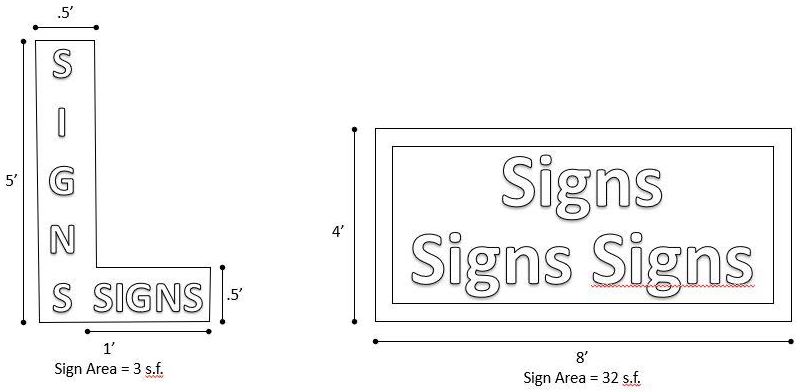
Computation of sign area. The area of a sign shall be measured from the outside edges of the sign or the sign frame, whichever is greater, excluding the area of the supporting structures provided that the supporting structures are not used for advertising purposes and are of an area equal to or less than the permitted sign area. Supporting framework and bracing which are incidental to the display itself shall not be included in the computation of the area unless, by the nature of their design, they form a continuation of the sign.
1.
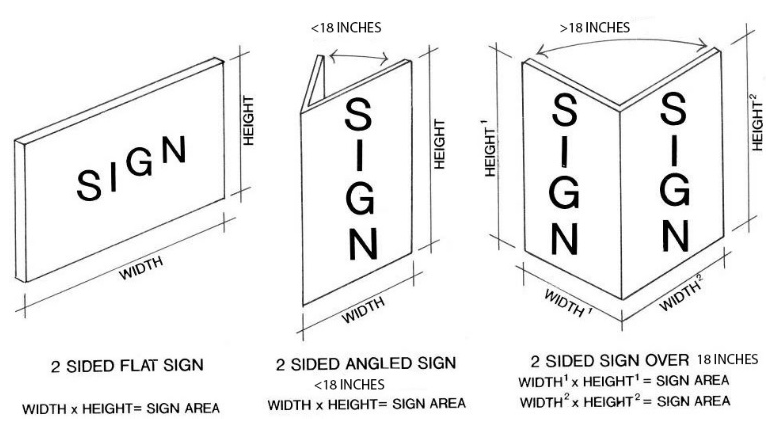
The area of a multi-faced sign shall be computed on one face in the same manner as the sign area of an individual sign, provided that the faces of the sign are not separated at any point by more than 18 inches. If the faces of a multi-faced sign are separated at any point by more than 18 inches, then each face constitutes a separate sign.
2.
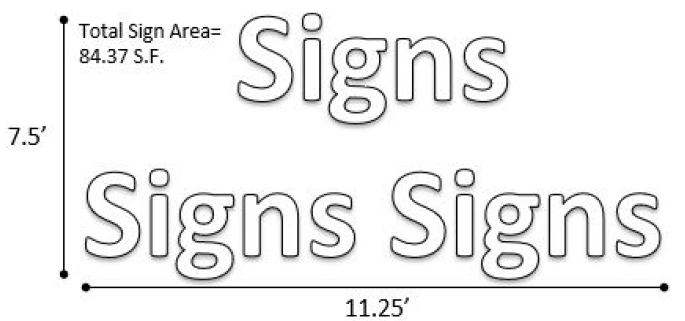
Where individual characters are used without a supporting panel (channel letters), the overall dimensions from the beginning of the first character to the end of the last character in the longest line and from the top of the uppermost character to the bottom of the lowermost character shall be regarded as the extreme dimensions in calculating the overall sign area of the sign.
B.
Computation of height. The vertical height of a freestanding sign shall be computed from the established mean grade of the development site to the highest component of the sign or supporting framework, whichever is higher. The maximum vertical height of a building mounted sign shall not exceed the roof line of the structure.
C.
Location of signs on property.
1.
Setbacks. The distance of a sign from a property line, right-of-way, or other point shall be computed by measuring a perpendicular line from the foremost part of the sign to the ground and then measuring from that point to the nearest point of the property line, right-of-way, etc.
2.
Distance between freestanding signs. A minimum distance of 25 feet shall be maintained between freestanding signs regardless of whether such signs are on one site or whether they are located on adjacent sites.
3.
Location. No sign may project beyond the property line(s) of the property on which the sign is located, except that sign(s) may be flush-mounted to the walls of buildings which are constructed with a zero setback from the property line. Except as otherwise provided herein, signs shall be located on the same site on which the advertised goods or services are available. No part of any banner, sign, flag, or flagpole shall be hung, attached, or erected in any manner as to project into the right-of-way.
4.
Freestanding signs are prohibited in the 6' perimeter utility easement.
D.
Illumination. Signs may be illuminated by any method not prohibited by this article provided that any light source shall be shielded in such a manner as to prevent direct rays of light from being cast into an occupied residence, hotel or motel room, a commercial business, at any pedestrian traveling upon a street or sidewalk, or any vehicle traveling upon a public street.
Section 7.2.5. - Maximum total sign area per site.
A.
Residential uses in residential zoning districts. Except for signs identified as permitted, no signs are allowed on sites containing residential uses in residential zoning districts. Any sign on a residential site in a residential zoning district shall comply with the provisions for such sign(s).
B.
Non-residential uses in all zoning districts. Except as otherwise provided in this chapter, the number of building signs located on property lawfully used for non-residential purposes shall not be limited so long as the cumulative total sign area (in square feet) of all such signs, except exempt signs, does not exceed the building sign allowance for the property. The allowable building sign area (in square feet) of all signs, except exempt signs, erected, installed, or located on a site lawfully containing a non-residential use in any zoning district shall be computed as follows:
1.
Building mounted signs.
a.
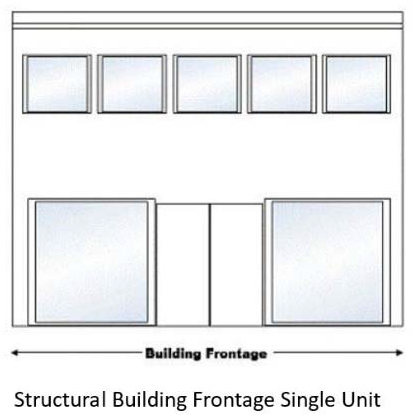
If a building contains more than one floor or story, the dimension of the primary side of the building shall be determined by measuring (in linear feet) the overall width of the first floor or story of the building on the side that faces the front lot line and the sign allowance for each business establishment or other entity occupying the building shall be shared by such business establishments or other entities as determined by the property owner based on the frontage of the building.
b.
If a building contains more than one business establishment or other entity, but the exterior of the building has not been subdivided into units, the sign allowance for each business establishment or other entity occupying the building shall be shared by such business establishments or other entities as determined by the property owner based on the frontage of the building.
c.
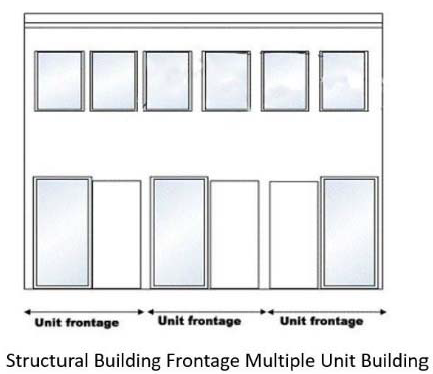
If all or part of the exterior of a building has been subdivided into two or more fully enclosed units capable of containing one or more business establishments or other entities (such as a multiple unit shopping center), the front dimension of each such unit shall be considered the building frontage of the unit and the sign allowance for each business establishment or other entity occupying such unit shall be shared among the business establishments or other entities occupying such unit in the manner prescribed by the property owner. Any remaining part of the exterior of the building which has not been subdivided into fully enclosed units shall be treated the same as a building which has not been subdivided into units.
d.
If a single business establishment or other entity occupies more than one consecutive fully enclosed unit, the building frontage of such business or other entity shall be the total linear dimension of building frontage of all such units combined.
e.
The allowable signage to be mounted on a building shall be based on the building frontage of a business or other entity as follows:
f.
In addition to the sign area otherwise allowed in this section, business establishments or other entities which meet the following criteria shall be allowed additional sign area for building-mounted signs as follows:
i.
Businesses or other entities fronting on more than one platted street shall be permitted an additional sign area allowance of one-half square foot per linear foot of building frontage on such additional street up to a maximum of 50 square feet per street. Such additional sign area allowance for a second street shall be added to the building-mounted sign area allowance resulting from the building frontage calculation. If a business or other entity fronts on three or four streets, then the additional sign allowance resulting from frontage on the third or fourth streets shall be used on the building face actually abutting the third or fourth streets. For purposes of this article, when a business or other entity fronts three or four streets, the side(s) of the business establishment or other entity shall be deemed to be fronting on the second and, if applicable, the fourth streets and the rear of the business establishment or other entity shall be deemed to front on the third street.
ii.
Businesses or other entities whose side or rear building frontages abut a public alley, public parking area, or mall parking area shall be permitted an additional allowance of one-half square foot per linear foot of such side or rear building frontage up to a maximum of 50 square feet. Such additional allowance shall only be used on the side or rear of the building which actually abuts the public alley, public parking area, or mall parking area.
C.
Freestanding signs.
1.
Individual business or entity sites.
a.
Except as otherwise provided in Section 7.4.3 of this article, "Gasoline pricing signs," no site shall have more than two freestanding signs.
b.
The allowable freestanding sign area (in square feet), the maximum number of freestanding signs, and the maximum height of freestanding signs erected, located, or placed on lawfully existing non-residential uses in all zoning districts shall be based on the street frontage of the site.
c.
When only one freestanding sign is permitted, the sign shall provide architectural design features, including colors or materials or both consistent with those used in the design of the building to which the sign is accessory. These features shall apply to the sign frame and supporting materials, not to the sign panel or panels that provide the actual advertising area.
d.
When two freestanding signs are permitted, signs must be similar in design, color and materials.
e.
For all individual non-residential use sites, the following maximum freestanding sign(s) number, maximum freestanding sign area, and height limitations shall apply:
2.
Multiple business or entity sites.
a.
When only one freestanding sign is permitted, the sign shall provide architectural design features, including colors or materials consistent with those used in the design of the building the sign is accessory to. These features shall apply to the sign frame and supporting materials, not to the sign panel or panels that provide the actual advertising area.
b.
On sites that are approved through a Planned Unit Development which contain commercial, professional, industrial, mixed use, or agricultural uses together with residential properties as part of the same Planned Unit Development, and the residential uses front the road on which the development faces with non-residential uses located inside the development not visible from the road, the Director may allow signs that are used to direct motorists to facilitate finding the non-residential component of the development. The Director shall take into consideration factors that include:
(i)
The location of the non-residential uses within the development;
(ii)
The location of permitted signage for the non-residential uses within the development; and
(iii)
Roadway conditions.
c.
Although the distribution of freestanding signage among the tenants or occupants of a multiple business or entity site shall be the responsibility of the real property site owner, the following limitations concerning maximum number, sign area, and height of freestanding signs shall apply to all multiple business or entity sites containing non-residential uses:
Section 7.2.6. - Sign permits.
A.
Required. Except as otherwise required, no sign shall be located, placed, erected, constructed, altered, extended, or displayed without first obtaining a sign permit and meeting all requirements of the Florida Building Code. In the event a sign is located, installed, or maintained upon real property without any required permits, after the expiration or lapse of a sign permit, after the closure of a business, or otherwise in violation of the requirements of this article, the owner of the real property shall be deemed to be responsible for the prompt removal of such sign and shall be responsible for and subject to all fines or penalties which shall result from such violation.
B.
Procedure. The procedure for obtaining a sign permit shall in conformance with application requirements in Article 3.1.
1.
Upon request by the Department, the applicant shall provide such supplementary information as may be specifically requested by the Department to determine compliance with this article.
2.
The Department shall review the application, plans, and specifications to determine whether the proposed sign conforms to all applicable requirements of this article and, based on such review, shall either approve or deny the application for the sign permit.
a.
Sign permit applications which include a request for a deviation to this article, pursuant to Section 7.2.8 of this article, shall either be approved or denied. However, if the applicant has applied for a building permit or certificate of use for the non-residential use at the subject site or for an electrical permit for the illumination of a sign, no sign permit shall be issued by the city until after the requested building or electrical permit or certificate of use has been issued by the city.
b.
In no event shall the issuance of a sign permit following the issuance of a building permit, but prior to the completion of the construction project, result in an increase in the sign(s) allowed under this article based on the structure as it is eventually completed. In other words, if the city issues sign permit(s) following the issuance of a building permit, but before the construction of the building or structure is completed, and one or more sign(s) are installed or erected pursuant to such sign permit, but then the building plans are modified in such a way as to reduce the number, size, etc. of the sign(s) which would be allowed under this article, then the property owner shall be required to bring such sign(s) into compliance with the provisions of this article and to obtain a valid sign permit for such sign(s).
C.
Submission requirements. No request for a sign permit shall be considered complete until all required documents and fees are received.
D.
Plans and specifications. Plans and specifications for any proposed sign shall be drawn to scale and shall include the following:
1.
Dimensions and elevations, including the message of the sign;
2.
Parcel frontage on all street rights-of-way for freestanding signs only;
3.
Linear dimension(s) of the subject building or unit(s) adjacent to all public rights-of-way, such as streets, alleys, or public parking lots for freestanding signs only;
4.
Maximum height of the sign, as measured in accordance with this article;
5.
Location of the sign in relation to property lines, public rights-of-way, easements, buildings, and other signs on the property;
6.
Dimensions and anchoring of the sign's supporting members;
7.
For illuminated signs, the type, location, and direction of illumination sources;
8.
Construction and electrical specifications, enabling determination that the sign meets all applicable structural and electrical requirements of the building code; and
9.
Number, type, location, and surface area of all existing signs on the same property or building on which the sign is to be placed, except that in the event all or part of the exterior of a building has been subdivided into two or more fully enclosed units capable of containing one or more business or entity establishments, such as a multiple unit shopping center, the number, type, location, and surface area of all building mounted signs on the unit for which the proposed sign is sought and all freestanding signs on the property shall be included.
E.
Deviations. Certain deviations to the requirements of this article are authorized pursuant to Section 7.2.8. No other deviations are permitted.
F.
Lapse. A sign permit shall lapse automatically if the business tax receipt for the premises lapses, is revoked, or is not renewed. A sign permit shall also lapse if the business activity on the premises is discontinued for a period of 30 days and is not renewed within 30 days from the date a written notice is sent from the city to the last permittee that the sign permit will lapse if such activity is not resumed. A sign permit shall also lapse if the sign for which it is issued either is not erected or placed within 180 days following the issuance of the sign permit or is removed for a period of 60 days. Once a sign permit has lapsed, it shall be considered void and a new application and review process shall be necessary to have such a permit reissued.
G.
Identification. All signs requiring a permit shall have the permit number permanently imprinted or otherwise placed in the lower right-hand corner of the sign.
H.
Removal. The permittee or property owner shall be responsible for the removal of a sign once the sign permit has expired or lapsed, without an application for a new permit, or the purpose in displaying the sign has ended.
Section 7.2.7. - Non-conforming signs.
A.
Non-conforming sign compliance. All signs lawfully erected prior to February 1, 2019 that do not comply with the requirements of this article shall be considered non-conforming signs. All non-conforming signs shall be removed or brought into conformity with this article no later than February 1, 2029. The owners of the real property on which such non-conforming signs exist shall be responsible for ensuring that such signs are removed or brought into conformity. Non-conforming signs shall not be altered, replaced, or repaired if such alteration, replacement, or repair would constitute more than 50% of the replacement value of the non-conforming sign. All other signs that were not lawfully erected prior to February 1, 2019 that do not comply with the requirements of this article shall be removed no later than December 31, 2024.
B.
Effect of annexation on sign compliance. Any sign that was lawfully erected on property that was located outside of the jurisdiction of the city at the time the sign was erected but which was annexed into the city prior to February 1, 2019 and that does not comply with the requirements of this article shall be considered a non-conforming sign and shall be removed or brought into conformity with this article no later than February 1, 2029. Any sign that was or is lawfully erected on property that was located outside of the jurisdiction of the city at the time the sign is erected but which was annexed into the city on or after February 1, 2019 and that does not comply with the requirements of this article, shall be considered a non-conforming sign and shall be removed or brought into conformity with this article no later than ten years from the effective date of the annexation.
C.
Restrictions on permitting certain non-conforming signs. Sign permits will not be issued for the alteration, replacement, or repair of a non-conforming sign if such alteration, replacement, or repair constitutes more than 50% of the replacement value of the existing non-conforming sign. Changing the information on the face of an existing non-conforming sign shall not be deemed an action increasing the degree or extent of the non-conformity to constitute a violation of this article. Any other alteration to an existing non-conforming sign will be required to conform to this article.
D.
Exceptions. A sign which is erected, located, or installed prior to the adoption of this ordinance and which was approved by a dimensional variance from the Board of Zoning Adjustment and Appeals, [HIDDEN]earing H[/HIDDEN] Hearing Examiner, or the City Council shall retain such variance approval. A sign which is erected, located, or installed prior to the adoption of this ordinance and which was approved by a deviation from the Director shall retain such deviation approval. However, any sign which has been approved by such a dimensional variance or deviation and is then changed to conform to this article shall forfeit the sign variance or deviation.
Section 7.2.8. - Sign deviations.
A.
Deviations. A deviation may be granted from the strict application of the regulations in this chapter which apply to:
1.
Allow a 25% increase in allowable sign area;
2.
Allow a 25% increase in allowable sign height;
3.
Allow for decrease in minimum distance between freestanding signs; or
4.
Allow an additional freestanding sign.
B.
Requests for deviations shall be initiated by the applicant in the application for a sign permit and shall be accompanied by documentation including sample detail drawings, schematic architectural drawings, site plans, elevations, and perspectives which shall graphically demonstrate the proposed deviation(s) and illustrate how each deviation would operate to the benefit, or at least not to the detriment, of the public interest. Deviations listed in Sec. 7.2.8.A may be approved by the Director provided that such deviation will not be contrary to the public interest and in harmony with the general intent and purpose of this article and where one or both of the following criteria are satisfied:
1.
Conditions exist that are not the result of the applicant and which are such that a literal enforcement of the regulations involved would result in unnecessary or undue hardship; or
2.
There is something unique about the building or site configuration that would cause the signage permitted by this article to be ineffective in identifying a use or structure that would otherwise be entitled to a sign.
C.
Subject to the standards and criteria stated above, the Director shall approve only the minimum deviation from the provisions of this article necessary to avoid the undue hardship or to cause the signage for the site to be effective in identifying the use or structure on the site. However, no deviation shall be approved that would have the effect of allowing a type or category of sign that would otherwise be prohibited by this article.
D.
Any person aggrieved by the decision of the Director concerning a deviation may apply for a variance.
Section 7.2.9. - Maintenance of signs.
A.
Maintenance Required.
It is unlawful for any owner of record, lessor, lessee, manager, or other person having lawful possession or control over a building, structure, or parcel of land to fail to maintain any signs on the building, structure, or parcel in compliance with this chapter. Failure to maintain a sign constitutes a violation of this chapter and shall be subject to enforcement under the enforcement provisions of Chapter 1.6.
All signs, if in existence prior to adoption of this chapter, shall be maintained and kept in good repair and in a safe condition. Maintenance of a sign shall include periodic cleaning, replacement of flickering, burned out or broken light bulbs or fixtures, repair or replacement of any faded, peeled, cracked, or otherwise damaged or broken parts of a sign, and any other activity necessary to restore the sign so that it continues to comply with the requirements and contents of the sign permit issued for its installation, if required, and the provisions of this chapter.
B.
Removal.
1.
Every person maintaining a sign must, upon vacating the premises where a sign is maintained, remove or cause to be removed the sign within 180 days from the date of vacating the premises. When the Director determines that the sign has not been removed within the required period, the Director shall remedy and enforce said violation in accordance with the enforcement provisions of this chapter.
2.
Any vacant or unused sign support structures, angle irons, sign poles, or other remnants of old signs which are currently not in use or are not proposed for immediate reuse by a sign permit application for a permitted sign, shall be removed.
3.
The Director shall have the authority to require the repair, maintenance, or removal of any sign or sign structure which has become dilapidated or represents a hazard to the safety, health, or welfare of the public, at the cost of the sign or property owner.
4.
Any sign posted in violation of this chapter on public property or on public rights-of-way shall be subject to summary removal by the City.
5.
Any person responsible for any sign posting made in violation of this chapter shall be liable to the City for the costs incurred by the City in removal thereof and, in event of failure to pay, for billing and collection charges, including interest and reasonable attorneys' fees.
Section 7.3.1. - Temporary signs.
A.
1.
Temporary signs, identified in this chapter as not requiring a sign permit, unless indicated below, must otherwise meet all the applicable requirements of this section and this article. Any temporary sign not meeting these requirements, in any way, including quantity, shall be treated as a non-exempt sign subject to permitting. The area of temporary signs displayed on a site shall not be included in the calculation of the total signs on such site.
2.
Temporary signs are prohibited on real property in the City without the written approval of the property owner, lessee, or person in control of such property. Such written approval shall be available and provided to the City upon the City's request. The written approval required hereunder shall be available and provided to the City upon request regardless of whether the temporary signs are displayed by the property owner or any other person. The failure to provide such written approval to the City upon the City's request shall be a violation of this section.
3.
Temporary signs are prohibited in any public Right-of-Way. Violations of this Subsection A.3. shall be subject to immediate removal and enhanced civil penalties, as provided in Section 7.3.1.G.2.
4.
Temporary signs are prohibited in any Visibility Triangle.
5.
It is prohibited to illuminate a temporary sign.
6.
It is prohibited to display, place, or locate a temporary Freestanding Sign within five feet of another temporary Freestanding Sign.
G.
Penalties and enforcement.
1.
Except for violations of Section 7.3.1.A.3., any violation of Section 7.3.1. shall be subject to the following penalties:
a.
If the violation is the first offense, a person or business shall receive a civil fine of $25, per sign;
b.
If the violation is the second violation within the preceding 12 months, a person or business shall receive a civil fine of $100, per sign;
c.
If the violation is the third violation within the preceding 12 months, a person or business shall receive a civil fine of $500, per sign; and
d.
If the violation is the fourth or subsequent violation within the preceding 12 months, a person or business shall receive a civil fine of $1,000, per sign.
2.
Enhanced civil penalties. Any violation of Section 7.3.1.A.3. shall be subject to the following penalties:
a.
If the violation is the first offense, a person or business shall receive a civil fine of $500, per sign;
b.
If the violation is the second or subsequent violation within the preceding 12 months, a person or business shall receive a civil fine of $1,000, per sign.
c.
In addition to the imposition of civil penalties provided herein, City officials are hereby authorized to immediately remove and confiscate any sign(s) located in any public Right-of-Way in violation of Section 7.3.1.A.3. The City shall notify the responsible person or entity for installing the sign(s) that the sign(s) may be retrieved from the City upon the timely payment of any civil penalty due or a successful appeal of the violation. If the civil penalty is not paid or an appeal filed within ten days of service of a notice of violation, the City is authorized to destroy any signs removed and confiscated hereunder.
3.
Enforcement.
a.
The Cape Coral Police Department or the Code Compliance Division shall enforce this Section 7.3.1. This shall not preclude other law enforcement agencies from any action to assure compliance with this section and all applicable laws. If a violation of this section is observed, the enforcement officer will be authorized to issue a notice of violation to the property owner of the subject real property and/or the responsible person or entity for installing the sign. The notice of violation shall inform the violator of the nature of the violation, amount of civil fine for which the violator is liable, instructions and due date for paying the civil fine, that the violation may be appealed by requesting an administrative hearing before the special magistrate within ten days after service of the notice of violation, and that the failure to appeal the violation within ten days of service shall constitute an admission of the violation and a waiver of the right to a hearing. All notices required by this section shall be provided to the violator in accordance with Section 2-85(c) through (g) of the City Code of Ordinances.
b.
In the event the violator does not request an administrative hearing before the special magistrate within such ten-day period, the City may take any and all necessary actions to remediate the violation and bring the property into compliance and charge the violator with the reasonable cost of the repairs or the reasonable cost for removing or correcting the violation, along with the civil fine imposed pursuant to this section. The City correcting, remediating, or repairing the violation does not constitute a continuing obligation on the part of the City to make future repairs or to maintain the property and does not create any liability against the City for any damages to the property if the repairs were completed in good faith.
4.
Rights of violators; payment of fine; right to appear; failure to pay civil fine or to appeal; appeals from decisions of the special magistrate.
a.
A violator who has been served with a notice of violation must elect to either:
i.
Pay the civil fine in the manner indicated on the notice of violation; or
ii.
Request an administrative hearing before the special magistrate to appeal the notice of violation, which must be requested within ten days of the service of the notice of violation.
b.
The procedures for appeal by administrative hearing of the notice of violation shall be as set forth in Sections 2-86 and 2-87 of the City Code of Ordinances, except as specifically provided in this section. Appeals for an administrative hearing of the notice of violation must be accompanied by a fee as approved by a resolution of the City Council, which fee shall be refunded if the named violator prevails in the appeal.
c.
If the named violator, after issuance of the notice of violation, fails to pay the civil fine, or fails to timely request an administrative hearing before a special magistrate, the special magistrate may be informed of such failure by report from the enforcement officer. The failure of the named violator to appeal the decision of the enforcement officer within the prescribed time period shall constitute a waiver of the violator's right to an administrative hearing before the special magistrate and shall be treated as an admission of the violation, for which fines and penalties shall be assessed accordingly.
d.
A certified copy of an order imposing a civil fine, or a civil fine plus remediation costs, shall be recorded in the public records, and thereafter shall constitute a lien upon any real or personal property owned by the violator, which may be enforced in the same manner as a court judgment by the sheriffs of this state, including levy against the violator's real or personal property, but shall not be deemed to be a court judgment except for enforcement purposes. On or after the 61st day following the recording of any such lien that remains unpaid, the city may foreclose or otherwise execute upon the lien.
e.
Any party aggrieved by a decision of a special magistrate may appeal that decision to a court of competent jurisdiction.
f.
The special magistrate shall be prohibited from hearing the merits of the notice of violation or considering the timeliness of a request for an administrative hearing if the violator has failed to request an administrative hearing within ten (10) days of the service of the notice of violation.
g.
The special magistrate shall not have discretion to alter the penalties prescribed in Subsections G.1. and G.2.
h.
Nothing in this section shall be construed to prohibit the City from enforcing these provisions by any other supplemental means as may be allowed by law.
(Ord. 43-21, § 1, 6-2-2021; Ord. No. 30-24, § 1, 5-15-2024)
Section 7.4.1. - Permanent signs—Residential
(Ord. 43-21, § 3, 6-2-2021)
Section 7.4.2. - Permanent signs—Non-residential.
Sign Requirements Non-Residential Zoning Districts and Lawfully Existing Non-Residential Uses in Residential Zoning Districts
Section 7.4.3. - Miscellaneous signs.
A.
Gasoline Pricing Signs
In addition to any other signs allowed herein, automobile service stations and other commercial uses lawfully containing fuel pumps for the sale of fuel to the public shall be allowed an additional 24 square feet of signs to advertise gasoline pricing provided that the gasoline pricing sign(s) shall be incorporated into a freestanding sign or located flat on the building or canopy.
Sites at the intersection of two platted streets shall be permitted one additional freestanding sign to be placed on the second platted street for the sole purpose of displaying gasoline prices. The second sign shall not exceed a total of 24 square feet of which a maximum of 25% may be utilized for the business name or logo.
B.
Electronic Message Center or Sign (EMC). Electronic message center or sign shall meet the following criteria:
1.
EMC's shall not operate at brightness levels of more than 0.3 foot candles above ambient light, as measured using a foot-candle meter at a pre-set distance. The pre-set distances to measure the foot-candles are calculated using the following formula.
Measurement Distance = The square root of the sign area x 100.
The measurement distance may be rounded to the nearest whole number.
2.
If the electronic message center is a text-only message displays, then the text may move along the face of the sign, but the text shall not exceed 12 inches in height.
3.
Only one electronic message center shall be allowed per site.
4.
An electronic message sign center shall not be installed on or added to a non-conforming sign.
5.
Minimum display time is 8 seconds.
6.
The use of video display, flashing, or blinking is prohibited for any EMC.
7.
EMC's shall include photo-sensors to provide automatic intensity adjustment based on ambient lighting conditions.
All electronic message center or sign not meeting these criteria are prohibited under § 7.2.2 of this article.

