
Chino City Zoning Code
CHAPTER 20
10 - STANDARDS FOR ALL DEVELOPMENT AND LAND USES
20.10.010 - Purpose.
This chapter establishes city-wide standards for specific types of structures, activities and development. These standards supplement the zoning-district specific standards in Chapters 20.03 to 20.09 (Zoning Districts). The intent of these standards is to minimize impacts of development and uses, clarify rules for measurement and promote high quality design in Chino.
(Ord. 2010-05, § 1(exh. A), 2010.)
20.10.020 - Performance standards.
All uses and structures shall comply with the following performance standards to minimize environmental impacts and conflicts between land uses:
A.
No use shall create a nuisance due to noise, odor, dust, mud, smoke, steam, vibration or other similar causes.
B.
All uses or activities shall be conducted within a wholly enclosed building, unless otherwise permitted in the applicable zoning district.
C.
Repealed by Ord. 2015-002.
D.
Waste materials that are associated with any use causing fumes or dust, are a fire hazard, or that are edible by, or otherwise attractive to, rodents or insects, shall be stored in closed containers.
E.
No use shall cause the emission of any smoke, ash, dust, fumes, vapors, gases or other forms of air pollution that can cause damage to human health, vegetation, or other forms of air pollution that can cause excessive soiling on any other parcel. No emission shall be permitted which exceeds the requirements of the South Coast Air Quality Management District or the requirements of any air quality plan adopted by the City of Chino.
F.
No use shall be permitted which emits odorous gases or other odorous matter in such quantities as to be dangerous, harmful, noxious or otherwise objectionable at a level that is detectable with or without the aid of instruments at or beyond the project site boundary.
G.
No use shall discharge at any point into any public or private street, public sewer, storm drain, private stream, body of water, or into the ground, any material that can contaminate any water supply, interfere with bacteriological processes in sewerage treatment, or otherwise cause the emission of dangerous or offensive elements, except according to the standards approved by the California Department of Public Health, or any other federal, state or local government agency.
H.
No use shall be permitted to cause a steady state, earth-borne oscillation that is continuous and occurring more frequently than one hundred times per minute beyond the project site. Ground vibration caused by moving vehicles, trains, aircraft, or temporary construction or demolition is exempt from this requirement.
(Ord. 2010-05, § 1(exh. A), 2010; Ord. 2013-003, § 11, 2013; Ord. 2015-002, § 2, 2015.)
20.10.030 - Height measurement and exceptions.
A.
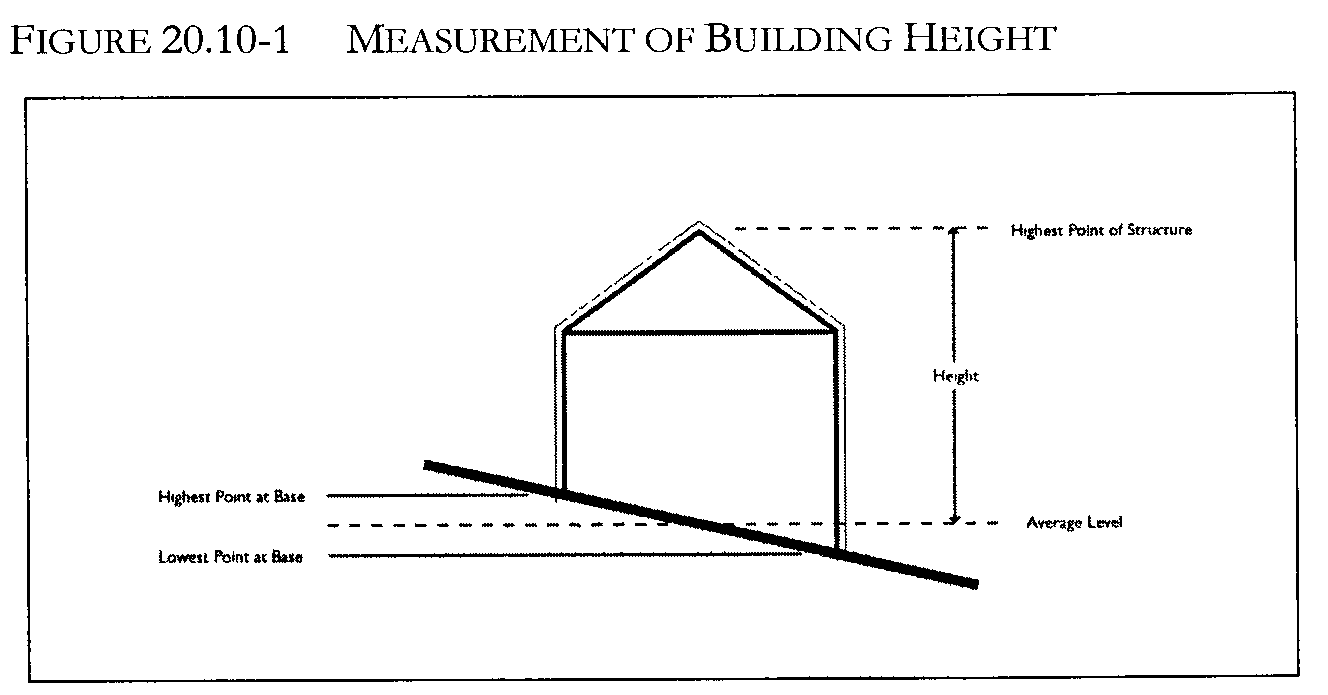
Height measurement. The height of a structure shall be measured as the vertical distance from the average level of the highest and lowest point of the portion of the lot covered by the structure to the highest point of the structure.
B.
Maximum height of structures. The maximum height of each structure shall not exceed the height limit established for the applicable zoning district in Chapters 2.04 to 2.09 (Zoning Districts). No structure shall be constructed or altered to exceed the height limit established in these chapters except as otherwise provided by this section.
C.
Height limit exceptions.
1.
Towers, spires, cupolas, chimneys, elevator penthouses, water tanks, flagpoles, monuments, antennas, and similar structures and necessary mechanical appurtenances may exceed the maximum permitted height in the applicable district.
2.
No portion of a structure that exceeds the height limit shall cover an area greater than fifteen percent of the building footprint area.
3.
Structures may exceed the height limit set forth in each district subject to the following:
a.
Ten feet or less shall be subject to an administrative approval.
b.
More than ten feet shall be subject to approval of a site approval by the planning commission.
(Ord. 2010-05, § 1(exh. A), 2010.)
20.10.040 - Setback requirements and exceptions.
A.
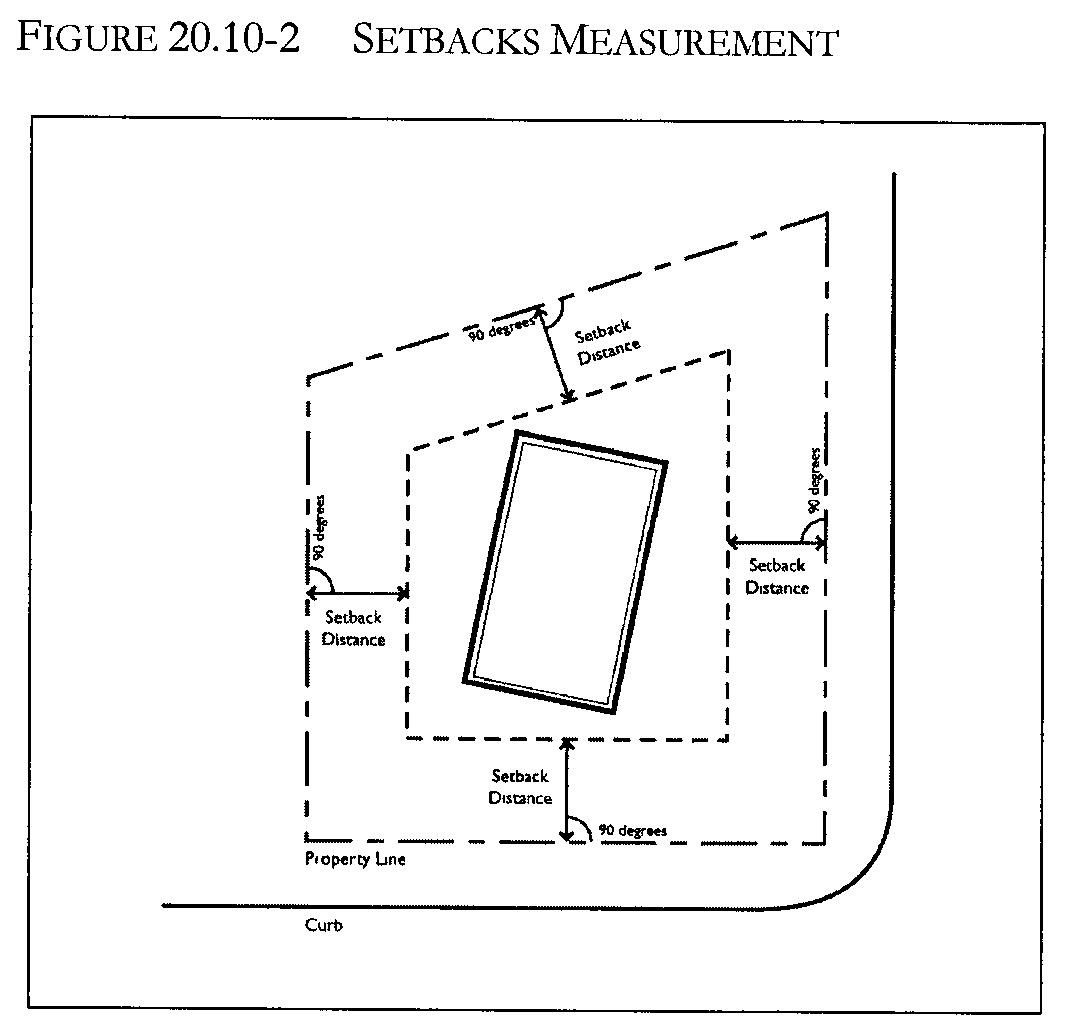
Setbacks measurement. Setbacks shall be measured as the distance between the property line and the nearest point of the wall of the structure along a line at a right angle to the property line.
B.
Minimum setbacks. The minimum setbacks of structures from property lines shall be as established for the applicable zoning district in Chapters 2.04 to 2.09 (Zoning Districts). No structure shall encroach into required setbacks except as otherwise provided by this section.
C.
Allowed projections. The following exceptions shall apply to minimum setback requirements:
1.
Eaves, canopies, or other similar roof projections may extend a maximum of four feet into a required front or rear yard, and a maximum of two feet six inches into a required side yard.
2.
Cornices, fireplaces, sills, built-up reveals and other similar architectural features may extend a maximum of two feet into a required front, rear, or side yard. However, in no case shall the side yard width be reduced to less than three feet.
3.
Open, unenclosed stairways and balconies, not covered by a roof or canopy, may extend a maximum of four feet into a required front or rear yard.
4.
Fences, hedges and walls may be permitted in any required yard, subject to the provisions of section 20.10.80 (Walls and Fences) of this Code.
5.
Signs and advertising structures may be permitted within a required yard, subject to the provisions of Title 16 of the Chino Municipal Code.
D.
Projections over property lines. No portion of a structure shall extend beyond a property line or street right-of-way.
(Ord. 2010-05, § 1(exh. A), 2010.)
20.10.050 - Mechanical equipment.
Mechanical equipment shall comply with the following regulations:
A.
Any mechanical equipment (e.g., HVAC, fans, blowers, etc.), or any other similar equipment appurtenant to a structure, whether located on the roof, side of a structure, or on the ground, shall be completely screened from public view.
B.
The method of screening shall be architecturally compatible with the serviced building in terms of materials, color, shape and size.
C.
A continuous screen shall be provided where a number of individual pieces of equipment are used over a single area.
D.
Large ground-mounted equipment, such as silos and/or dust collectors, shall be appropriately located so as to minimize dust, noise, steam, vibration, vectors or other similar impacts on surrounding properties.
(Ord. 2010-05, § 1(exh. A), 2010.)
20.10.060 - Refuse and recycling facilities.
A.
Purpose and intent. This section establishes standards for refuse and recycling facilities in order to:
1.
Reduce solid waste generation in Chino and increase levels of recycling.
2.
Ensure the high quality design of refuse and recycling areas.
3.
Minimize the impacts on refuse and recycling areas on residents, tenants and adjacent uses.
B.
Applicability.
1.
The refuse and recycling facility standards for single-family uses contained in this section apply to all single-family uses, including those established prior to the adoption of this Code.
2.
Refuse and recycling standards for multiple-family and nonresidential uses contained in this section apply to:
a.
All new multiple-family and nonresidential development projects.
b.
Modifications to existing multiple-family and nonresidential uses that add thirty percent or more to the existing floor area of the principal structure, either through a single alteration or through multiple alterations within a twelve-month period.
C.
Single-family uses.
1.
Refuse and recycling bins shall be stored out of public view, either behind a fence or within a garage or other enclosure. If storing bins out of public view is physically impossible, bins may be stored adjacent to the side of the house or garage in an area behind the front yard setback that is specifically designed to accommodate the bins.
2.
For developments designed to store refuse and recycling bins within the garage, the bins shall be stored in an area outside of the required twenty-foot by twenty-foot clear area for parking.
3.
Refuse and recycling bins may not be placed for collection before 12:00 p.m. on the day preceding scheduled collection, and must be removed no later than 12:00 p.m. on the day following the scheduled collection. Containers must be placed for collection along the curb in front of the dwelling where the refuse was generated.
4.
Enclosures for refuse and recycling bins visible from public view shall be softened with landscaping to the greatest extent possible.
5.
Enclosures shall be located so that refuse and recyclables collection activities do not block driveways accessing the property.
D.
Multiple-family and nonresidential uses. The following standards apply to multiple-family and nonresidential uses that provide large refuse and recycling bins for the joint use of multiple occupants or tenants. Multiple-family and nonresidential uses that do not provide such joint-use bins shall comply with Subsection C. (Single-Family Uses), above:
1.
All uses and structures shall provide separate bins for the collection of refuse and recyclable materials.
2.
The minimum number of bins shall be as determined by the director of community development, based upon the type, size and intensity of development, and the anticipated frequency of trash/recyclables pick-up.
3.
Bin design.
a.
Bins shall be designed in accordance with standard drawings as approved by the planning commission.
b.
Bins containing recyclable materials shall provide covers or lids to protect against weather conditions that might render the materials unmarketable.
4.
Bin enclosures.
a.
Bins shall be enclosed by a six-foot-high decorative masonry block walls and solid gates to entirely obscure bins from view.
b.
Gates shall be fitted with self-closing door devices with cane bolts in front of the masonry block walls to secure the gates when in the open position. Gates should be equipped with rod locks and corresponding rod holes to secure gates in both the open and closed gate positions.
c.
Enclosures for refuse and recyclable materials bins shall be provided with a separate walk-in entrance no greater than four feet in width.
d.
For multiple-family, commercial, and business park uses, a shade structure shall be provided and designed so as to be compatible with surrounding buildings and structures.
e.
All bin enclosures shall be surrounded by a minimum eighteen inch wide planter area, exclusive of any required curb, for the purpose of providing landscape material, with the exception of the gate area. The landscape requirement shall not apply to enclosures located within private yard areas for industrial zoned property.
5.
Bin enclosure location.
a.
Refuse/recycling enclosure shall be located outside of all required setback areas.
b.
For multiple-family uses, enclosures shall be located so as to minimize noise, odor and aesthetic impacts on dwelling units.
c.
A sign clearly identifying all refuse and recycling collection areas shall be posted adjacent to all points of access to the enclosure.
6.
As a condition of permit approval, a project applicant may be required to develop a written recycling plan to be reviewed and approved by the director of community development. At a minimum, the recycling plan shall include:
a.
Identification of targeted materials to be recycled;
b.
Collection frequency of refuse collection and recycling service;
c.
Refuse collection and recycling company authorized by the city to provide solid waste handling services; and
d.
Method of recycling program promotion and communication with tenants, business owners and their employees.
7.
Refuse storage and recycling areas shall be used only for the storage of refuse and recycling materials.
8.
Refuse storage and recycling areas shall be kept in a neat and orderly condition and in good repair at all times.
(Ord. 2010-05, § 1(exh. A), 2010; Ord. 2016-005, § 5, 2016.)
20.10.070 - Alternative energy structures.
Alternative energy structures shall comply with the following regulations:
A.
Solar panels.
1.
All photovoltaic solar panel systems shall meet all applicable safety and performance standards established by the National Electrical Code, the Institute of Electrical and Electronics Engineers, and other accredited testing laboratories and, where applicable, rules of the public utilities commission regarding safety and reliability.
2.
Roof mounted solar panels are permitted with a zoning clearance, subject to the regulations in section 20.10.070.A. Ground mounted solar panels are permitted as an accessory use with an administrative approval.
3.
Solar panel systems servicing multifamily residential and nonresidential uses shall comply with the following standards:
a.
Ground-mounted solar panels may not be located in a front setback area and shall not exceed eight feet in height above the ground.
b.
Roof-mounted solar panels may extend six feet above the height requirements of the applicable zoning district.
c.
Roof-mounted solar energy systems shall be located to ensure emergency access to the roof and provide emergency egress from the roof.
4.
Solar panel systems servicing a single-family residential home shall comply with the following standards:
a.
All equipment except for solar panels and conduit shall be screened from view along the front elevation.
b.
Solar energy equipment shall be installed in the location that is least visible from adjacent streets so long as this does not significantly decrease energy performance or significantly increase cost.
c.
Solar panels shall be integrated into the design of the structure as an architectural element to the greatest extent possible.
B.
Wind turbines.
1.
Turbines shall only be allowed on parcels one acre or larger in size.
2.
Turbines shall be painted a neutral, nonreflective color, such as beige or white.
3.
Power lines shall be placed underground when feasible.
4.
A turbine shall be designed and appropriately sized to serve the needs of a home, small business or farm.
5.
The turbine and tower shall not exceed the maximum building height for the zone in which they are located, as measured when rotor blades are in vertical (or highest) position.
6.
The wind energy system structure or anchoring system shall be set back from all property lines by one foot in distance for every one foot in height of turbine tower.
7.
Appropriate warning signs shall be placed on or near wind turbines.
8.
Noise levels resulting from normal operation of the wind turbine shall not exceed forty decibels.
9.
When appropriate or necessary, climb lock or prevention measures should be taken to avoid potential safety hazards.
10.
The turbine shall be placed and oriented to avoid casting shadow or causing "flicker" on any buildings of adjacent landowners, especially windows.
(Ord. 2010-05, § 1(exh. A), 2010; Ord. 2011-06, § 7, 2011; Ord. 2016-005, § 6, 2016.)
20.10.080 - Walls and fences.
Walls and fences shall comply with the following regulations:
A.
Measurement of fence or wall height.
1.
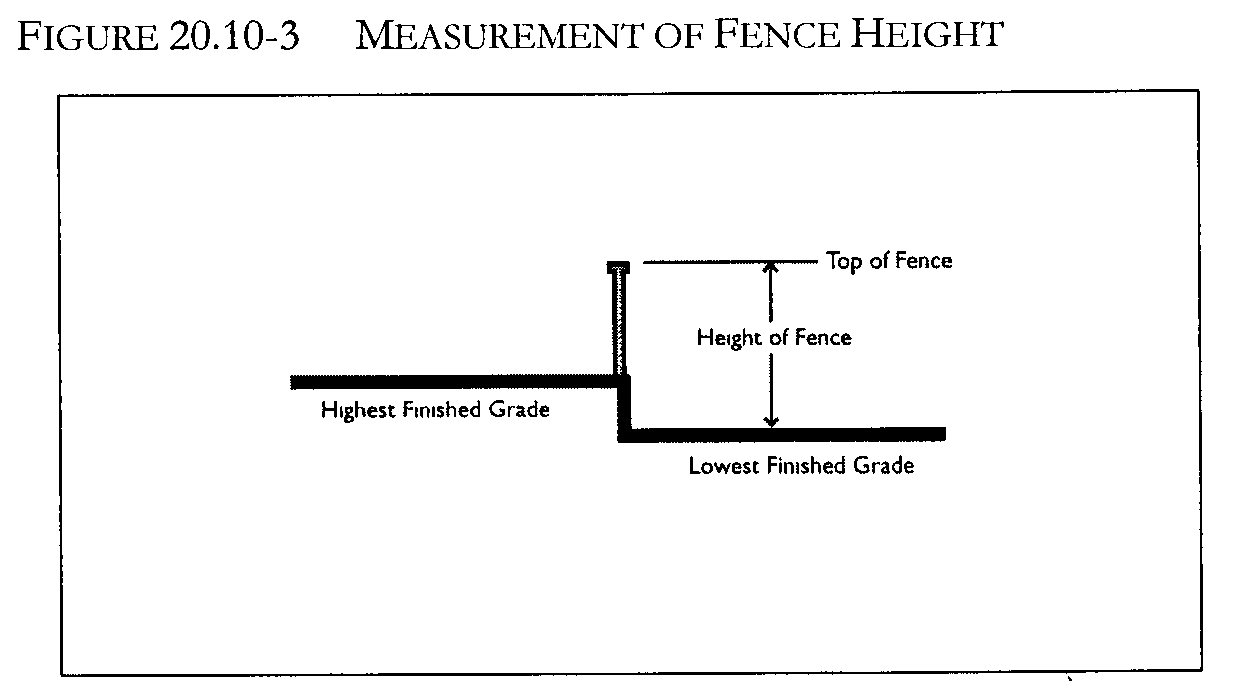
The height of a fence, wall or other similar structure shall be measured from the finished grade at the base to the top edge of the fence material, as shown in Figure 20.10-3.
2.
If the fence is atop a wall, the height shall be measured from the base of the wall.
3.
If there is a difference from one side of fence to the other within, the height shall be measured from the side with the lowest finished grade.
4.
The director of community development may permit a wall up to eight (8) feet in height if the topography of a lot would result in a wall less than five feet in height on a residential lot.
B.
Height limits. A fence, wall or other similar structure shall not exceed the height limits in Table 20.10-1 (Maximum Height of Fences).
TABLE 20.10-1 MAXIMUM HEIGHT OF FENCES
C.
Location standards.
1.
No fence shall be constructed within the public right-of-way.
2.
No fence shall be constructed within three feet of the center of any fire protection hydrant.
3.
There shall be a twelve-inch minimum clearance around all meter boxes.
4.
There shall be a two-foot minimum clearance around street lights.
5.
There shall be a three-foot minimum clearance around sign posts.
6.
On an interior lot where the side or rear property line of the lot is common with another lot's side or rear property line, a wall or fence may be constructed along the common property line for purposes of property division and/or security.
7.
On a corner lot where the rear property line of a lot is common with another lot, a wall or fence may be constructed on the lot at least eighteen inches from the street side property line. The area between the wall or fence and the sidewalk (or curb) shall be fully landscaped and maintained.
D.
Materials standards.
1.
Walls or fences shall be constructed of decorative masonry, ornamental steel or iron, or wood and shall be of a complementary color and/or material with adjacent buildings. Other materials may be considered if the director determines the design to be compatible with adjacent structures and its surrounding neighborhood.
2.
Chain-link or wire mesh fences are prohibited in areas visible from a public or private street, or a main drive aisle serving a complex or center of three or more units.
3.
Fences shall be constructed so that no hazards, such as nails, spikes, wires or other sharp or pointed objects, protrude from or exist upon the fence, excluding decorative spires. The use of barbed wire, razor wire and other similar materials is prohibited, unless deemed necessary for safety by the Director.
4.
Long expanses of fence or wall (fifty or more feet in length) adjacent to a public right-of-way shall have offset areas (decorative pilasters or a jog in the wall) of a minimum of three to four feet along its length and shall be architecturally designed to prevent monotony.
5.
For new perimeter walls, pilasters shall be decorative in nature, shall occur at angled turns in wall directions, vertical grade changes of wall height, and end wall transitions to fencing. Pilasters shall be a minimum twenty-four inches square and provided along all street frontages and areas visible from public view. The number and spacing of the pilasters shall be determined by the length and location of the wall to achieve an aesthetically-pleasing design. An eight inch gap shall be provided between the top of wall or fence and pilaster cap.
E.
Protection of visibility.
1.
There shall not be visual obstruction in the form of any wall, fence, obstacle, mature landscaping, or object allowed, installed, set out, or maintained, which exceeds a height of three feet above the nearest street pavement surface or, if there is no pavement, the existing traveled roadway; excepting existing or future permanent buildings which are otherwise constructed or maintained in accordance with applicable zoning and building regulations, public utility poles, trees trimmed at the trunk to a point at least eight feet above the level of the street or traveled roadway (provided that trees are spaced so that trunks do not create a visual barrier), and official traffic or other governmental signs.
2.
Intersecting streets, intersecting alleys and alleys intersecting streets. At intersecting streets, intersecting alleys and alleys intersecting streets, a certain area shall be maintained free of visual obstructions (corner cutoff) to assure adequate sight distance for vehicular and/or pedestrian traffic. The corner cut-off shall be provided pursuant to standard drawings established by the city engineer.
F.
Required walls and fences.
1.
Zone boundary separation. A six-foot high solid masonry block wall shall be constructed along property lines and/or zone boundary lines that separate industrial and commercial zoning districts from adjoining residential zoning districts. The wall shall be reduced to three feet in height within any required front yard. Walls that face a street or are in full public view shall be decorative.
2.
Unsafe areas. A six-foot high wall or fence shall be constructed along the perimeter of all areas determined by the director of community development, the building official, or the city engineer, to pose a danger to the public health or safety.
3.
Swimming pools.
a.
Areas surrounding a swimming pool shall be fully enclosed by a minimum five-foot high nonclimbable fence.
b.
All entrances and exits from an enclosed swimming pool area shall have self-closing, self-latching closures installed. All latches shall be located at least four and one-half feet above finish grade.
4.
Residential developments. The following shall apply to all new and move-on residential development projects:
a.
Residential developments of two or more dwelling units shall provide six foot high walls as follows:
i.
Perimeter walls. A decorative masonry wall (slump or split-face block, or plaster/stucco finish only) with pilasters and a decorative cap shall be constructed along the perimeter of all new residential developments. For the purposes of this section, "perimeter" shall mean interior side and rear project boundaries, and street frontages without front-on units.
ii.
Interior walls and fences. A six-foot high masonry wall shall be constructed along interior side and rear yards, and connecting between property line walls and dwellings with appropriate gates for rear yard access.
iii.
Retaining walls. If any part of a perimeter wall retains earth on either side of the property line, the required height of the wall shall be six feet, measured from the side of the wall adjacent to the residential property. If the retaining portion of the wall is taller than two feet, measured from the side of the wall adjacent to the street, a second wall shall be constructed on the side adjacent to the street, at least two feet from the retaining wall.
iv.
Street-facing walls. A six-foot high decorative masonry wall (slump or split-face block, or plaster/stucco finish only) shall be constructed along all street side yards, and shall be set back at least eighteen inches from the property line. The area between the wall or fence and the sidewalk (or curb) shall be fully landscaped and maintained.
b.
A development consisting of one single-family dwelling unit, including move-on houses, shall provide a six-foot high decorative wood fence or masonry block wall at the rear and side property lines, and across the side yards to fully secure the rear yard.
(Ord. 2010-05, § 1(exh. A), 2010; Ord. 2013-003, §§ 12, 13, 2013; Ord. 2019-013, § 19, 2019.)
20.10.090 - Outdoor lighting.
Outdoor lighting shall comply with the following regulations:
A.
Illumination.
1.
Lighting on private and public property shall be designed to provide safe and adequate lighting while minimizing light spillage to adjacent properties.
2.
Outdoor lighting shall utilize energy-efficient fixtures and lamps.
3.
All areas with frequent vehicular and pedestrian traffic shall have lighting providing a minimum one foot candle of light at ground level during the hours of darkness.
4.
Lighting for parking facilities shall be designed to provide a minimum average illumination of one and a half-foot candles of light, measured at ground level. However, maximum average illumination shall not exceed three foot candles for commercial developments and two foot candles for multifamily residential and industrial developments, measured at ground level.
5.
No lighting on private property shall produce an illumination level greater than one foot candle on any property within a residential zoning district.
6.
Permanently installed lighting shall not blink, flash, or be of unusually high intensity or brightness.
7.
Lighting within and adjacent to the OS2 zoning district shall be designed so as to minimally impact habitat areas.
B.
Fixtures.
1.
Maximum height of freestanding outdoor light fixtures shall be as follows: For residential property with non-residential uses, the maximum height shall be twelve feet. For non-residential property adjacent to residential development, the maximum height shall be fourteen feet. Otherwise the maximum height shall be twenty-five feet. Overall, light fixtures shall be the minimum height necessary to maintain the average illumination requirement.
2.
Light fixtures shall be shielded, recessed, and directed downward and away from adjoining properties and public rights-of-way to reduce light spillage.
(Ord. 2010-05, § 1(exh. A), 2010; Ord. 2016-005, § 7, 2016.)
20.10.100 - Recreational vehicles and campers.
The parking and storage of recreational vehicles and campers on single-family residential lots shall comply with the following regulations:
A.
Permanent residences. Mobile homes, travel trailers, motorhomes and campers used as permanent residences shall be located only in officially designated mobile home parks. Recreational vehicles used as temporary living units shall comply with Chapter 20.12.030 (Temporary Uses).
B.
Parking and storage.
1.
A recreational vehicle shall only be stored on property owned by the owner of the recreational vehicle or on property where the registered owner resides.
2.
A stored recreational vehicle shall bear current vehicle registration (if required by state law).
3.
Recreational vehicles shall not be stored within any required front or street side setback area. For the purposes of these provisions, the term "stored" means continuously parked in the same location for more than seventy-two hours.
4.
All stored recreational vehicles shall be screened from public view by building walls, decorative screen walls or fences and landscaping to the greatest extent possible.
5.
A stored recreational vehicle shall bear current vehicle registration as required by state law.
6.
Vehicles may be stored within an interior side yard without screening if the vehicle is placed upon a paved surface.
7.
Recreational vehicles stored within an interior side yard area shall not be stored in a wrecked, dismantled or inoperative condition.
8.
A recreation vehicle may be stored within a street side yard, provided it does not encroach over a sidewalk or other parts of the public right-of-way and the vehicle is screened from view of the street by a minimum five-foot high decorative wall or fence.
9.
A recreational vehicle may be parked for a maximum of seventy-two hours in the driveway or on a paved surface in the front yard area, provided the vehicle is parked perpendicular to the street and does not encroach over a sidewalk or other part of the public right-of-way.
10.
For the purposes of this section, the term "recreational vehicle" shall also include horse trailers, tractors, and farm equipment, except for legal nonconforming agricultural properties.
C.
Exemption for disabled persons. The intent of this exemption is to provide emergency shelter and convenience for disabled persons.
1.
The recreational vehicle storage requirements stipulated by this section shall not be applicable to any recreational vehicle dwelling unit as defined by Subsection 20.24.020R. of this Code, that is owned and operated by a disabled person provided the disabled person can present evidence of issuance of a special license plate for the disabled persons issued under section 5007 of the California Vehicle Code or a distinguishing placard or temporary distinguishing placard as defined by sections 22511.55 or 22511.59 of the California Vehicle Code for at least one fully operable vehicle owned and operated by the disabled person and registered to the same address or location.
2.
A person using a distinguishing placard issued under sections 22511.55 or 22511.59 of the California Vehicle Code, or a special license plate issued under section 5007 of the California Vehicle Code of the purposes of this exemption, shall, upon request of a peace officer or person authorized to enforce parking laws, ordinances, or regulations, present identification and evidence of the issuance of that placard or plate to that person. Failure to present the requested identification and evidence of the issuance of that placard or plate shall be a rebuttable presumption that the placard or plate is being misused. In addition to any other applicable penalty for the misuse of a distinguishing placard or special license plate, the exemption from the RV storage requirements shall be voided.
3.
Certain specialized trailers used for the transportation of a wheelchair, electric cart, or similar transportation device used by a disabled person, may also qualify for this exemption as determined by the director of community development.
4.
Camper shells, whether mounted on a truck or not, or boats/watercraft of any kind, shall not be allowed to utilize this exemption.
(Ord. 2010-05, § 1(exh. A), 2010.)
20.10.110 - Metal buildings.
The use and construction of metal buildings is generally discouraged throughout the city, except where the characteristics of a use necessitate the use of metal buildings, such as aircraft hangars. Prefabricated metal buildings for use in residential zoning districts shall be regulated by the provisions of Chapter 20.11.050 of this Code.
(Ord. 2010-05, § 1(exh. A), 2010.)

