
Chino City Zoning Code
CHAPTER 20
24 - GLOSSARY
20.24.010. - Purpose.
This chapter provides definitions of terms and phrases used in this Zoning Code that are technical or specialized, or which may not reflect common usage. If any of the definitions in this chapter conflict with others in the City Code, these definitions shall control for only the provisions of this Zoning Code. If a word is not defined in this chapter or in other provisions of the Chino Zoning Code, the director shall determine the appropriate definition.
20.24.020. - Definitions.
A.
Definitions, "A".
Abandoned shopping cart. Any cart removed from a business establishment's premises without written permission of the owner and located on either public or private property.
Abandon use. A business or activity with no reported sales or activity for a period of at least one hundred eighty days. Exceptions are temporary closures for repairs, alterations, or other similar situations.
Accessory building. See "Building, accessory."
Accessory dwelling unit. An attached or detached dwelling unit that provides complete, independent living facilities for one or more persons and is located on a lot with a proposed or existing primary residence. This definition shall be interpreted as consistent with the definition for "accessory dwelling unit" in Government Code § 65852.2.
Accessory use. A use or structure clearly incidental to and customarily found in connection with an established primary use of a site, or of a building located on the same site. The terms "incidental use" and "accessory use" shall be used interchangeably within this Title.
ACLUP (airport comprehensive land use plan). A master plan prepared in accordance with Public Utilities Code section 21670 et seq., which provides for the orderly growth of airports and provides measures for mitigating the public's exposure to excessive noise and safety hazards within areas around public airports.
Administrative approval. A permit for a specified land use, building or structure that is issued by the director of community development at the city's discretion.
Adult oriented businesses. See Title 5 of the Municipal Code for a definition of adult oriented businesses.
Affordable dwelling units. See "target units."
Affordable housing. A housing unit which is available for rent or sale to households with income levels at the very low, low-, or moderate-income level as those terms are defined in this section.
Affordable housing agreement. A legally binding agreement between an applicant and the City of Chino to ensure that continued affordability of affordable housing units that may be required by this title persists and the units are maintained in accordance with this title.
Affordable housing development. A development project of ten or more residential units, including mixed-use developments, that includes affordable housing.
Affordable rent. means the total housing costs paid by a qualifying household, which shall not exceed a specified fraction of their gross income, adjusted for family size appropriate for the unit, as follows:
1.
For purposes of the city's density bonus in the AHO and MUO zoning districts, the low income rent shall be based on thirty percent of eighty percent multiplied by the area median income for San Bernardino County as published by the California Department of Housing and Community Development.
2.
For applicants seeking a density bonus under Government Code Section 65915, the calculation methodology in Section 50053(b) of the Health and Safety Code will be applied.
Affordable sales price. The maximum purchase price that can be charged for an affordable unit calculated in accordance with Section 50052.5 of the California Health and Safety Code. The affordable sales price is equal to the lesser of: 1) the sum of the assumed mortgage cost plus the benchmark down payment, which is used solely for calculation of the affordable sales price, or 2) the purchase price prospective buyers are willing to pay in return for purchasing a home that is subject to restrictive covenants. The benchmark down payment is set at five percent of the affordable sales price.
Agriculture. The tilling of soil, the raising of crops, horticulture, livestock farming, dairying or animal husbandry, including accessory supply, service, storage and processing areas and facilities to accommodate agricultural products produced on the premises; provided, however, that the accessory uses shall not include slaughter houses, feed yards, hog farms, fertilizer works, bone yards, plants for the rendering of animal matter or similar commercial or industrial uses.
Agricultural processing, on-site. A facility used for the cooking, dehydrating, refining, bottling, canning, washing, packaging, or other treatment of agricultural products which changes the naturally grown product for consumer use. May include warehousing and packaging as secondary uses.
Agricultural product stands. A structure where unprocessed produce, including fruits, vegetables and nuts is sold.
Airport. Any area of land or water designated and set aside for the landing and taking off of aircraft, which is utilized or will be utilized in the interest of the public for such purposes, and has a valid permit to operate from the State of California.
Alcoholic beverage sales. The retail sale of beer, wine or distilled spirits for on-premises or off-premises consumption.
Alley. An unnamed public or private right-of-way designed to provide vehicular access to a property.
Amendments. Any material added to a soil to improve its physical properties, such as water retention, permeability, water infiltration, and drainage.
Amusement or theme park. A commercially operated park with a predominance of outdoor games and activities for entertainment, including motorized rides, waterslides, miniature golf, batting cages and the like.
Animal keeping, commercial. Any establishment that keeps animals for sale or hire, provides medical treatment for animals on the premises or regularly offers any temporary boarding facilities for animals.
Animal keeping, household. Any establishment that keeps animals only as pets, or for the production of eggs, milk or meat for personal use.
Animal sales and services. A retail sales establishment primarily involved in the sale of products for domestic animals, such as dogs, cats, fish, birds, and reptiles, including indoor boarding, grooming, or veterinary services as incidental to the primary retail use; a retail sales establishment primarily involved in the sale of domestic animals, such as dogs, cats, fish, birds, and reptiles; or any place or establishment, public or private, where domestic animals are bathed, clipped, or combed for the purpose of enhancing their aesthetic value and/or health for which a fee is charged.
Antenna. Any system of towers, poles, panels, rods, wires, drums, reflecting discs or similar devices used for the transmission or reception of electromagnetic waves. See also "Satellite dish" and "Satellite antenna."
Anti-drain valve. See "Check valve".
Antitranspirant. A protective coating, generally applied to plant materials prior to or immediately after transplanting, that reduces water loss through the leaf surface.
Apartment. One or more rooms in an apartment building intended or designed to be occupied by one family for living and sleeping purposes, and containing a kitchen and bath facilities.
Apartment building. A building or portion of a building, other than a temporary lodging such as a hotel or motel, containing three or more dwelling units.
Applicant. Any person required to submit a landscape documentation package. Applicant may include the property owner or an agent of the owner.
Application rate. The depth of water applied to a given area, usually measured in inches per hour.
Applied water. The portion of water supplied by the irrigation system to the landscape.
Area, adjusted gross. The area of a lot, exclusive of all land within the ultimate right-of-way for expressways, major arterials, primary arterials, secondary arterials, and collector streets, as shown in the transportation element of the general plan. (The number of residential units permitted for a parcel is determined by multiplying the residential density factor by the adjusted gross acres of the parcel.)
Area, gross. The area of a lot measured to the centerline of the street or alley.
Area, net. The area of a lot, exclusive of all street and alley rights-of-way, and dedications transferring title of land to a public agency.
Area of a lot. The net area of a single recorded lot.
Art gallery. A room or structure in which original works of art or limited editions of original art are bought, sold, loaned, appraised or exhibited to the general public.
As-builts. See "Record drawing."
Athletic instruction. A facility offering instruction and/or study oriented toward dance, sports, or fitness, such as yoga studios, martial arts, social and artistic dance, cheerleading, gymnastics, CrossFit, and individual or team sports. Facilities operated by a public agency are not included in this definition.
Automatic irrigation controller. A timing device used to remotely control valves that operate an irrigation system. Automatic irrigation controllers are able to self-adjust and schedule irrigation events using either evapotranspiration (weather-based) or soil moisture data.
Automobile and vehicle sales and rental. The use of any building or portion thereof, or other premises or portion thereof, for the display, sale, rental or lease of new motor vehicles, or used motor vehicles as an ancillary use of a zoning lot, and any warranty repair work and other repair service conducted as an accessory unit.
Automobile, light truck and van cleaning. Mechanical facilities for the washing, waxing, and vacuuming of automobiles, light trucks and vans.
Awning. A cloth, plastic or other nonstructural covering that either is attached permanently to a building or can be raised or retracted to a position against the building when not in use.
B.
Definitions, "B".
Backflow prevention device. A safety device used to prevent pollution or contamination of the water supply due to the reverse flow of water from the irrigation system.
Balcony. A platform that projects from the wall of a building and is surrounded by a railing.
Bank or financial service. A financial institution such as a bank, credit agency or lending institution.
Bar. An area primarily devoted to the serving of alcoholic beverages and in which the service of food is only incidental to the consumption of such beverages.
Basement. A story of a building that is partly below grade, and is located so that the vertical distance from the grade to the floor is greater than the vertical distance from the grade to the ceiling.
Bedroom. A habitable space within a dwelling unit in which people sleep, which can also include permanent provisions for living, eating, and either sanitation or kitchen facilities but not both.
Bed and breakfast. A residential structure with one family or manager in permanent residence and from two to six guest rooms rented for overnight lodging, where meals may be provided for compensation subject to applicable health department regulations and where no provision is made for cooking in any individual room or suite. A bed and breakfast with more than six guest rooms shall be considered a hotel or motel, as applicable.
Block. All property fronting on one side of a street between intersecting and intercepting streets; or between a street, railroad right-of-way, waterway, natural barrier or unsubdivided acreage.
Boardinghouse. A single-family residential dwelling, accessory dwelling unit, or junior accessory dwelling unit wherein two or more rooms, with or without individual or group cooking facilities, are rented, licensed or otherwise provided in exchange for rent or other remuneration to an individual or individuals under separate written or oral rental leases, licenses or other agreements. Notwithstanding the previous sentence, a boardinghouse does not include a single-family residential dwelling that includes a junior accessory dwelling unit and an attached accessory dwelling unit where the junior accessory dwelling unit and attached accessory dwelling unit are both rented.
Botanical gardens and arboretums. A public or private facility for the demonstration and observation of the cultivation of flowers, fruits, vegetables, or ornamental plants.
Breezeway. A roofed structure open on at least two sides attached to and connecting portions of a main building, or portions of a main building and an accessory building.
Bridle path. See "Neighborhood equestrian trail."
Broadcasting studios. A commercial or public facility where broadcasts originate.
Building. A structure having a roof or similar enclosure supported by columns or walls and intended or used for shelter, confinement or housing of any person, animal or property.
Building, accessory. A subordinate building, the use of which is clearly incidental and secondary to that of the main building on the same site.
Building, apartment. See "Apartment building."
Building, attached. A building that has at least one of its walls permanently attached, in part or in whole, to the wall of another building.
Building, detached. A building with none of its walls permanently attached to the walls of another building.
Building, main. A building in which one of the site's principal and permitted uses is conducted. In residential districts, the largest building on a site that contains a dwelling unit shall be deemed the main building. A site may have more than one main building.
Building, nonconforming. A building or structure, or a portion of a building or structure, that does not conform to the regulations contained in this chapter.
Building area. The total amount of ground area occupied by all buildings and structures on a parcel of land.
Building frontage. A building wall facing a parcel boundary that abuts a street.
Building height. See "Height, building or structure"
Building official. The building official, or his or her authorized representative.
Building site. See "Site."
Building supply. A wholesale or retail establishment that sells lumber, wallboard, fixtures and similar large building materials. The term "building supply" does not include establishments primarily devoted to the retail sale of tools, paint and similar products, which are classified as general retail.
Bus and large truck cleaning. Mechanical facilities for the washing, waxing and vacuuming of heavy trucks and buses.
Bus and large truck repair and maintenance. Repair and maintenance facilities for buses and large trucks whose primary or incidental uses include but are not limited to uses such as repair, service, towing, and finishing.
Business, freeway-oriented. Any business that supplies food, fuel or lodging that is essential to support travelers on a freeway, and that is directly dependent upon and adjacent to a freeway.
Business support service. An establishment primarily within a building that provides services that are necessary to other businesses, such as blueprinting, computer rental and repair, mailing and mailbox services, copying and other services of like kind or character.
C.
Definitions, "C".
California Invasive Plant Council (Cal-IPC). Across California, invasive plants damage wildlands. Invasive plants displace native plants and wildlife, increase wildfire and flood danger, consume valuable water, degrade recreational opportunities, and destroy productive range and timber lands. Cal-IPC works with land managers, researchers, policy makers, and concerned citizens to protect the state from invasive plants.
California Irrigation Management Information System (CIMIS). CIMIS is a program in the Office of Water Use Efficiency (OWUE), California Department of Water Resources (DWR) that manages a network of over one hundred twenty automated weather stations in the State of California. CIMIS was developed in 1982 by the California Department of Water Resource and the University of California at Davis to assist California's irrigators manage their water resources efficiently.
Canopy. A permanent covering over a walkway or driveway that is wholly supported on each side by posts or walls.
Car wash. A permanent, self-service or full-service establishment that provides facilities for car washing.
Caretaker quarters. A permanent residence that is provided as an accessory use to a non-residential use, and is used to house a caretaker and the caretaker's family for security purposes or to provide around-the-clock care or monitoring of the site or any person or thing on the site.
Carport. A permanent roofed building that is open on at least two sides and is used or designed for the shelter and storage of vehicles.
Cart/Kiosk. Means any portable, non-motorized wagon, cart, or similar non-wheeled unit used by a vendor from which retail goods, food, and/or beverages are offered for sale.
Catering service. A business that prepares food for consumption on the separate premises of a client, and that is not part of a restaurant. A vehicular food vendor or a restaurant that provides catering shall not be considered a catering service.
Cemetery. Any place for the burial, disposal or long-term storage of human remains, including but not limited to a columbarium, crematory or mausoleum.
Centerline. The right-of-way centerline for a street or alley, as established by official survey.
Certified irrigation designer. A person certified to design irrigation systems by an accredited academic institution, a professional trade organization or other program such as the US Environmental Protections Agency's WaterSense irrigation designer certification program and Irrigation Association's Certified Irrigation Designer program.
Certified landscape irrigation auditor. A person certified to perform landscape irrigation audits by an accredited academic institution, a professional trade organization or other program such as the US Environmental Protection Agency's WaterSense Irrigation Auditor Certification Program and Irrigation Association's Certified Landscape Irrigation Auditor program.
CFS. Cubic feet per second.
Check cashing services. A place of business where one can cash a check for a fee.
Check valve. A valve located under a sprinkler head to hold water, or other location in the irrigation system, to hold water in the system to prevent drainage from sprinkler heads when the sprinkler is off.
Chicken coop. An enclosed area for chicken habitation that contains a chicken run and a henhouse.
Chicken run. An outdoor area within the coop that provides a protected place for chickens to freely wander about; the equivalent to a dog run.
Child or family-oriented business. A business establishment that has as its primary clientele children or families with children, including but not limited to toy stores, children's clothing stores, family amusement arcades, or family recreation facilities.
Cigar lounges. An establishment were patrons can smoke and purchase cigars.
City engineer. The city engineer, or his or her authorized representative.
Club. Buildings and facilities, owned or operated by a corporation, association, person or persons, for a social, educational or recreational purposes, to which membership is required for participation and not primarily operated for profit nor to render a service that is customarily carried on as a business.
CNEL (community noise equivalent level). An average daily noise level (averaged for each twenty-four hours) and weighted more heavily during evening and nighttime hours to account for the lower tolerance of persons to noise during those hours.
Code. The Municipal Code of the City of Chino.
Code enforcement official. The lead code compliance inspector, or his or her authorized representative.
Commercial animal keeping. See "Animal keeping, commercial."
Commercial recreational facility. Any establishment that provides entertainment activities or services for a fee or admission charge, including bowling alleys, electronic game arcades, billiard rooms, miniature golf courses, sports clubs, indoor party centers, amphitheaters, and other uses of like kind or character. An establishment that offers a small number of game machines to its customers as an accessory use, such as a restaurant or laundromat, shall not be considered a commercial recreational facility. Facilities operated by a public agency are not included in this definition.
Commercial wireless communication facility. See "Wireless communication facility, commercial."
Common interest developments. Community apartment projects, condominium projects, planned development, and stock cooperatives per Civil Code section 4100.
Common open space. See "Open space, common."
Compost. The safe and stable product of controlled biologic decomposition of organic materials that is beneficial to plant growth.
Condominium. Means an undivided interest in common in a portion of real property coupled with a separate interest in space called a unit, the boundaries of which are described on a recorded final map, parcel map, or condominium plan.
Congregate care facility. A facility for long-term residence exclusively by persons sixty years of age or older, and which shall include, without limitation, common dining and social and recreational features, special safety and convenience features designed for the needs of the elderly such as emergency call systems, grab bars and handrails, special door hardware, cabinets, appliances, passageways, and doorways designed to accommodate wheelchairs, and the provision of social services for residents which must include at least two of the following: meals services, transportation, housekeeping, linen, organized social activities, health screenings, and health/nutrition education.
Construction yard. A temporary staging area for supplies, equipment and materials that are being used in conjunction with an approved building permit or grading permit. A construction yard may include a temporary contractor's office as an accessory use.
Control valve. A device used to control the flow of water in the irrigation system. It may also mean all of the sprinklers or emitters in a line controlled by the valve.
Controller. An automatic timing device used to control valves or heads to operate an irrigation system. A weather-based controller is a controller that uses evapotranspiration or weather data. A self adjusting irrigation controller is a controller that uses sensor data (i.e. soil moisture sensor).
Conversion factor. A number that converts acre-inches per acre per year, to gallons per square foot per year. The conversion factor is calculated as follows:
(325,851 gallons/43,560 SF)/12 inches=0.62
Where: 325,851 gallons = 1 acre-foot
43,560 = 1 acre
12 inches = 1 foot
To convert gallons per year to 100 CF per year, divide gallons per year by seven hundred forty-eight (748 gallons equals 100 CF).
Correctional institutions and facilities. Publicly or privately operated facilities housing persons awaiting trial or persons serving a sentence after being found guilty of a criminal offense.
Courtyard. An open, unoccupied space other than a yard on the same site with a building, and bounded on two or more sides by one or more buildings on the site.
Covered patio. See "Patio, covered."
Crematorium. A location containing properly installed, certified apparatus for use in the act of cremation.
Crop cultivation. The process of growing, farming, fertilizing and producing agricultural produce.
Cultivated landscape area. Planted areas that are frequently maintained by mowing, irrigating, pruning, fertilizing, etc.
Cyber cafes. An establishment that provides more than six computers and/or other electronic devices for access to the internet, e-mail, video games or computer software programs for the primary purpose of recreation, which are networked or which function as a client/server program, and which seeks compensation from users. Cyber cafe is synonymous with PC cafe, internet cafe, computer gaming center, or cyber centers.
D.
Definitions, "D".
Dairy. Any premises where milk or a milk product is produced for sale or distribution and where ten or more cows or goats are in lactation.
Day care facility. Any facility that provides non-medical care and supervision of minor children for periods of less than twenty-four hours; that does not qualify as a small or large family day care home; and that meets the licensing requirements of the state. Any establishment may provide child day care as an accessory use that is not subject to additional permit requirements, provided that the establishment offers child day care only to its customers or employees, and only during the period when the customers or employees are visiting or working in the establishment.
Day spa. An establishment where professionals provide personal beauty, health and therapeutic treatments including massage, facials.
dBA. An A-weighted sound level, in decibels, as measured on a sound level meter equipped with weighting networks that represent the way the human ear hears certain sounds.
Dead storage. The storage of inactive items that will not be used for an extended period of time.
Decibel (db). A unit for describing the intensity or level of sound, equal to twenty times the logarithm to the base ten of the ratio pressure of the sound measured to a standard reference pressure.
Deck. A roofless, floored structure, typically with a railing, that adjoins a building.
Density bonus. An increase in the maximum number of residential dwelling units that are allowed on a site, granted in exchange for reserving dwelling units for certain types of households.
Desertscape. Inherently involves fewer plants and large areas of open unplanted space. Seen as undesirable because it may be devoid or almost devoid of life, uncultivated, and desolate.
Developer. A landowner or owner's agent responsible for the development of land. Does not include homeowners or landlords of single-family homes.
Development. The uses to which land will be put; the buildings and structures to be constructed on the land; and all alteration of the land and other construction incident to these uses, buildings and structures.
Development costs. The aggregate of all costs incurred in connection with a development which are reasonable and necessary, including, but not limited to, those costs listed in California Health and Safety Code Section 50065.
Development, infill. Any vacant lot or parcel within developed areas of the city, where at least eighty percent of the land within a three hundred-foot radius of the site has been developed, and where water, sewer, streets, schools, and fire protection have already been developed and are provided.
Development review. The process of reviewing a development proposal or proposed land use.
Development standard. A site or construction condition, including, but not limited to, height limits, required setbacks, maximum floor area ratio, on-site open-space requirement, or required parking that applies to a development pursuant to any ordinance, general plan, specific plan, or other local condition, law, policy, resolution, or regulation.
Director of community development. The director of community development, or his or her authorized representative.
Director of parks. The director of community services, or his or her authorized representative.
Discretionary approval. Any entitlement or approval, including but not limited to a use permit, variance, site approval, and subdivision map.
Distribution uniformity. The measure of the uniformity of irrigation water over a defined area.
District. An area defined on the official zoning map within which certain regulations and requirements apply under the provisions of this chapter.
Drip irrigation. Any non-spray low volume irrigation system utilizing emission devices with a flow rate measured in gallons per hour. Low volume irrigation systems are specifically designed to apply small volumes of water slowly at or near the root zone of plants.
Drive-in theater. Any land, building or structure used for the showing of outdoor motion pictures for compensation, the viewing of which is from the patron's automobile.
Drive-thru facilities. A building where a customer is permitted or encouraged, either by the design of physical facilities or by the service procedures offered, to be served while remaining seated within a vehicle, including but not limited to drive-through restaurants, pharmacies, automatic teller machines (ATMs), and automatic car washes.
Duplex. Two dwelling units on one residential lot of record, and designed for occupancy by two independent households. Each dwelling unit of a duplex dwelling contains its own cooking, sleeping and sanitary facilities; its own entrance; and, shares no common interior space. Duplex dwellings may be attached (e.g. sharing a common wall or a single unit on the first floor with another above it) or detached.
Dwelling, multiple-family. A building or portion of a building that provides three or more dwelling units. Multiple-family dwellings include apartment buildings, as well as townhouses or rowhouses that have apartments located above them. Multiple-family dwellings do not include temporary lodging such as hotels or motels.
Dwelling, single-family. A single dwelling unit, including kitchen and bath facilities, that is designed for occupancy exclusively by one family. A single-family dwelling may be either detached or attached.
Dwelling, single-family, attached. A two-story single-family dwelling, such as a townhouse or rowhouse, within a dwelling group in which no unit is located above another unit.
Dwelling, single-family, detached. A single-family dwelling that is not attached to any other single-family dwelling, other than an attached accessory dwelling unit.
Dwelling group. A group or row of detached or semi-detached dwellings that share a yard, courtyard or other open space, including apartment buildings and townhouses, but not including temporary lodging such as hotels or motels.
Dwelling unit. A building or a portion of a building containing one or more habitable rooms used or designed for occupancy by one family for living and sleeping purposes, including kitchen and bath facilities.
Dwelling unit, primary. A dwelling unit located in a main building.
E.
Definitions, "E".
Easement. A space on a parcel of land, indicated on a subdivision map or in a deed restriction, where the owner has granted one or more property rights to a person, corporation, public agency or other entity.
Ecological restoration project. A project where the site is intentionally altered to establish a defined, indigenous, historic ecosystem.
Effective precipitation. The portion of total precipitation which becomes available for plant growth.
Emergency shelter. A structure that provides temporary shelter and feeding of indigents or disaster victims, and that is operated by a public or non-profit agency.
Emitter. A drip irrigation emission device that delivers water slowly from the system to the soil.
Engineering design standards. The engineering requirements developed by the city engineer, and adopted by resolution of the city council, for the construction and configuration of various types of infrastructure within the city, including but not limited to rights-of-way, water and sewer lines, storm drainage and parking areas.
Equipment rental and sales, heavy equipment. Establishments primarily engaged in the sale or rental of tools, trucks, tractors, construction equipment, agricultural implements, and similar industrial equipment, and the rental of mobile homes.
Equipment rental and sales, light equipment. Establishments primarily engaged in the sale or rental of small trucks and light equipment including chain saws, hedge trimmers, drills, saws, etc.
Equity share agreement. An agreement by which appreciation on the value of an affordable unit from the time of the original purchase at an affordable price to the time of resale shall be shared between the purchaser of the affordable unit and the city according to details specified in the affordable housing agreement for the project. Having such an agreement shall be a condition of sale of the affordable unit.
Established landscape. The point at which plants in the landscape have developed significant root growth into the soil. Typically, most plants are established after one or two years of growth.
Establishment period of the plants. The first year after installing the plant in the landscape or the first two years if irrigation will be terminated after establishment. Typically, most plants are established after one or two years of growth. Native habitat mitigation areas and trees may need three to five years of establishment.
Estimated total water use (ETWU). The annual total amount of water estimated to be needed to keep plant material in a landscaped area in a healthy and thriving condition, based upon such factors as the local evapotranspiration rate, the size of the landscaped area, the types of plants and the efficiency of the irrigation system.
ET adjustment factor (ETAF). A factor of 0.55 for residential areas and 0.45 for non-residential areas, that, when applied to reference evapotranspiration, adjusts for plant factors and irrigation efficiency, two major influences upon the amount of water that needs to be applied to the landscape. The ETAF for new and existing (non-rehabilitated) Special Landscape Areas shall not exceed 1.0. The ETAF for existing non-rehabilitated landscapes is 0.8.
ETo. See the "Reference evapotranspiration".
Evapotranspiration rate. The quantity of water evaporated from adjacent soil and other surfaces and transpired by plants during a specific time.
Exotic Animal. Any animal that is not commonly domesticated in the United States or is wild by nature.
F.
Definitions, "F".
FAA (Federal Aviation Administration). A federal agency charged with regulating air commerce to promote its safety and development, encouraging and developing civil aviation, air traffic control and air navigation, and promoting the development of a national system of airports.
Fair market value. The real estate market value of an affordable housing unit at the time of initial purchase of that unit without regard to any restrictions on sales price, as substantiated by an appraisal in a form and substance, and by an appraiser, acceptable to the city.
Fairgrounds. An area wherein buildings, structures and land are used for the exhibition of livestock, farm products, and other things and/or for carnival-like entertainment.
Family. One or more persons sharing a dwelling unit in a living arrangement that includes the sharing of living expenses, such as rent or mortgage payments, food costs and utilities; the maintenance of a single lease or rental agreement for all persons sharing the dwelling unit; or other characteristics indicative of a single household.
Family day care home, large. In accordance with section 1597.465 of the Health and Safety Code, "large family day care home" means a home that regularly provides care, protection and supervision of nine to fourteen children, including children under the age of ten years who reside in the home, in the provider's own home, for periods of less than twenty-four hours, while the parents or guardians are away.
Family day care home, small. Means a home that regularly provides care, protection and supervision of eight or fewer children, including children under the age of ten years who reside in the home, in the provider's own home, for periods of less than twenty-four hours while the parents or guardians are away.
Farm employee. A person employed in agriculture or activities associated with agricultural packing and storage and transportation of agricultural products. The employment may be full-time, full-time seasonal, temporary, or part-time.
Farm employee housing, large. Farm employee housing consisting of more than thirty-six beds in group quarters used exclusively for farm employees, or more than twelve units or spaces designed for use by a single family or household with one or more farm employees.
Farm employee housing, small. Farm employee housing consisting of no more than thirty-six beds in group quarters used exclusively for farm employees, or twelve units or spaces designed for use by a single family or household with one or more farm employees. Farm employee housing includes single-family dwelling units occupied by a farmworker employed full-time and working on-site where the dwelling unit is located and the farmworker's household.
Feature, noncontributing. Any property, structure or object which adds to the historical integrity or architectural qualities that make a historic district significant.
Federal Communications Commission (FCC). The federal agency charged with regulating communications, radio and television.
Fence. A structure forming a physical barrier made of wire, wood, metal, masonry or other material, including walls; trellises; and barriers of plant material that substantially obstruct visibility, such as hedges. A wall of a building shall not be considered a fence.
Fence, solid. An opaque or substantially opaque fence, such as a cinderblock wall or a wooden fence with minimal gaps between boards. A chain-link fence with slats shall not be considered a solid fence.
Fire chief. The Fire Chief of the Chino Valley Independent Fire District, or his or her authorized representative.
Floor area, gross. See "gross floor area."
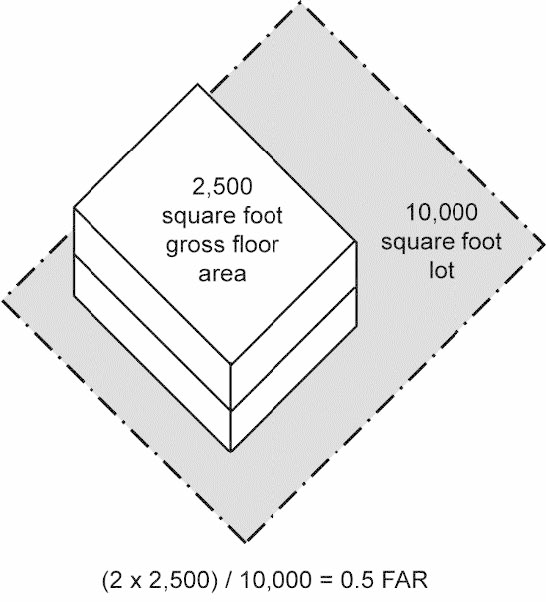
Figure 20.24-1 Example of Floor Area Ratio (FAR)
Floor area ratio (FAR). The ratio of the total gross floor area of all buildings on a site, excluding structured parking areas, divided by the total site area. For example, if a ten thousand square foot site has one two-story building, and the gross floor area of each story is two thousand five hundred square feet, the site has a total gross floor area of five thousand square feet and an FAR of 0.5, as shown in Figure 20.24-1.
Flow rate. The rate at which water flows through pipes, valves, and emission devices, measured in gallons per minute, gallons per hour, or cubic feet per second.
Flow sensor. An inline device installed at the supply point of the irrigation system that produces a repeatable signal proportional to flow rate. Flow sensors must be connected to an automatic irrigation controller, or flow monitor capable of receiving flow signals and operating master valves. This combination flow sensor/controller may also function as a landscape water meter or submeter.
Food and beverage sales. A retail establishment in which the majority of the floor area open to the public is occupied by food products or non-alcoholic beverages that are packaged for consumption away from the store. A food and beverage sales establishment may also sell alcoholic beverages, provided that this is not the establishment's primary business purpose.
Food preparation. A place where food is prepared to be consumed off premises including catering or test kitchens.
Fortunetelling. Means the telling of fortunes, forecasting of future events, or furnishing of any information not otherwise obtainable by the ordinary process of knowledge, by means of any occult or psychic power, including, but not limited to, clairvoyance, clairaudiance, cartomancy, psychometry, phrenology, tea leaves, or other reading, seership, prophecy, augury, astrology, palmistry, life reading, mind reading, fortunetelling by handwriting analysis, spirit photography, spirit writing, spirit materialization, character reading, necromancy, telepathy, card reading, talisman, magnetized article or substance, crystal gazing, or magic of any kind or nature.
Freeway-oriented business. See "Business, freeway-oriented."
Friable. A condition that allows soil to be easily crumbled or loosely compacted down to a minimum depth per planting material requirements, whereby the root structure of newly planted material will be allowed to spread unimpeded.
Front lot line. See "Lot line, front."
Front setback. See "Setback, front."
Front yard. See "Yard, front."
Funeral parlor. See "Mortuary."
G.
Definitions, "G".
Garage. An enclosed attached or detached accessory structure that is used for the parking or temporary storage of automobiles by the occupants of the primary structure(s).
Garden supply store. An establishment engaged in the wholesale or retail sale of ornamental plants and other nursery products, including sales outside and within a building. Garden supply stores do not include the sale of house plants or other nursery products entirely within a building, which is considered to be general retail.
Gas station. See "Service station."
General plan. The city's statement of goals and policies adopted by the city council as a long-range, comprehensive guide to the city's growth and development.
General retail. A retail establishment that sells a variety of merchandise and is not otherwise identified in this chapter as a unique retail use, including but not limited to antique stores, bookstores, drugstores, hobby shops, secondhand stores, retail bakeries, hardware stores, appliance and electronics stores and any use of like kind or character.
Golf course. A commercial recreational facility that provides at least nine holes for playing the game of golf and is improved with tees, greens and fairways. A golf course may include accessory uses such as a clubhouse.
Golf course, miniature. A theme-oriented recreational facility, typically comprised of nine or eighteen putting greens, each with a "cup" or "hole," where patrons in groups of one to four pay a fee to move in consecutive order from the first hole to the last.
Government facility. Any facility owned and operated by the city, county, state or federal government, regardless of the use. Any use that is listed as an allowed use for a given district may be provided as a government facility, even if the district does not list "government facility" as an allowed use.
GPM. Gallons per minute.
Grade. The average finished ground level at the center of all the exterior walls of a building or structure.
Graywater. Untreated wastewater that has not been contaminated by any toilet discharge, has not been affected by infectious, contaminated, or unhealthy bodily wastes, and does not present a threat from contamination by unhealthful processing, manufacturing, or operating wastes. "Graywater" includes, but is not limited to, wastewater from bathtubs, showers, bathroom washbasins, clothes washing machines, and laundry tubs, but does not include wastewater from kitchen sinks or dishwashers. Health and Safety Code section 17922.12.
Gross floor area. The area within the inside perimeter of a building's exterior walls, including corridors, stairways, closets, the thickness of interior walls, columns and other features. The gross floor area shall not include vent shafts, interior courtyards, or any area used for off-street vehicle parking or loading.
Ground cover. Plants, other than turf grass, normally reaching an average maximum height of not more than two feet at maturity.
Ground-mounted antenna. Any antenna that is attached to a support structure resting on the ground, and that has an overall height not greater than ten feet above the finished grade at the base of the structure. This definition includes the types of antennas that are sometimes referred to as "post mounts" and "ground builds."
Group homes. A private residence that provides foster care to children, housing for the mentally or physically handicapped or chemically dependent.
Guns and ammunition sales. Any premises or portion thereof used for the sale, vending, dealing, exchange or transfer of firearms and ammunition.
Gym. A fitness center or health club that provides exercise machines, free weights, or a swimming area for use by clients.
H.
Definitions, "H".
Hardscape. Decorative materials used within required landscape areas such as mulch, garden walkways, decorative pavers (pervious or non-pervious), paved patios or courtyards, fountains or statues, boulders, decorative rock (e.g. decomposed granite, pea gravel, river rock), and dry riverbed swale features. Other materials not listed are subject to the approval of the director of community development.
Hazardous waste. Any refuse or discarded material that has the potential to cause, or significantly contribute to an increase in mortality or an increase in serious irreversible, or incapacitating reversible illness; or pose a substantial hazard to human health or the environment when improperly treated, stored, transported, or disposed of, or otherwise managed.
Hazardous waste facility. Any structure, appurtenances and/or improvements on the land, and all contiguous land, used for treatment, transfer, storage, resource recovery, disposal or recycling of hazardous waste, including the following:
(1)
Hazardous waste landfill. A disposal facility or part of a disposal facility where hazardous waste is placed in or on land that is not a land treatment facility, a surface impoundment, or injection treatment well (Title 22, section 66123, CCR);
(2)
Land farming (land application, land spreading). A treatment technique that involves spreading waste on land and utilizing evaporation and microbial action to degrade wastes. Used primarily for crude oil waste;
(3)
Off-site hazardous waste facility. An operation involving the handling, treatment, storage or disposal of hazardous waste at a site physically separate from the site where the waste was generated; at a site not owned by, or leased to the producer of the waste; or at a site that receives waste from more than one generator;
(4)
On-site hazardous waste facility. An operation involving the handling, treatment, storage or disposal of hazardous waste on land owned by, or leased to the waste producer, at or next to the site of waste generation, and that receives hazardous waste projected only by the generator;
(5)
Residuals repository. A hazardous waste facility that only accepts treated hazardous waste, meets all applicable federal and state regulations, and holds a hazardous waste facility permit;
(6)
Specified hazardous waste facility. An off-site hazardous waste facility that accepts wastes from more than one producer of hazardous waste (section 25199.1(m), HSC). For the purpose of the city's hazardous waste management plan, a household hazardous waste collection center with a capacity less than fifty drums of waste is not considered a specified hazardous waste facility and is not subject to the requirements specified thereto;
(7)
Storage facility. An off-site or on-site hazardous waste facility where hazardous wastes are maintained for a period greater than ninety-six hours (section 25123.3, HSC);
(8)
Surface impoundment. A facility, or part of a facility, which is a natural topographic depression, man-made excavation, or diked area formed primarily of earthen materials (although it may be lined with man-made materials), which is designed to hold an accumulation of liquid wastes containing free liquids, and is not an injection well. Examples of surface impoundments include holding, storage, settling and aeration pits, ponds and lagoons (Title 22, section 66200, CCR);
(9)
Transfer station. Any hazardous waste facility where hazardous wastes are loaded, unloaded, pumped or packaged (Title 22, section 66122, CCR);
(10)
Treatment facility. Any facility at which hazardous waste is subjected to treatment, or where a resource is recovered from a hazardous waste; or
(11)
Waste pile. Any non-containerized accumulation of solid, non-flowing hazardous waste used for treatment or storage (Title 22, section 66160, CCR).
Hazardous waste treatment and disposal facility. All structures, other appurtenances and improvements on the land used for treating, storing, or disposing of hazardous waste, including all operations or storage areas, diked overflow, or emergency spillway areas. A hazardous waste disposal facility may consist of several treatment, storage or disposal operational units; it includes all areas where hazardous waste may be received, stored, handled or processed.
Hedge. A barrier formed by branches, shrubs, or small trees growing close together in a line with interwoven branches.
Height, building or structure. The height measured in accordance with the requirements of section 20.10.030 of this Title.
Heliport. An area designed to be used for the landing or takeoff of helicopters including operations facilities, such as maintenance, loading and unloading, storage, fueling, or terminal facilities.
Henhouse. A small structure located within the coop where chickens sleep (roast) and lay eggs; the equivalent to a dog house.
Historic integrity. The authenticity of a landmark or landmark site's historic identity, evidenced by the survival of physical characteristics, such as location, design, setting, materials, workmanship and overall character, that existed at the time of the construction or events that make the landmark or landmark site historically significant.
Hookah bar. An establishment where patrons communally smoke flavored tobacco.
Hospital. A medical facility engaged primarily in the provision of diagnostic services and extensive medical treatment, including surgical services and inpatient beds.
Hotel. A facility containing seven or more guestrooms that provides paid lodging on a short-term basis. The term "hotel" may be used interchangeably with the term "motel."
Household hazardous waste collection center. A collection center with a capacity less than two thousand seven hundred fifty gallons of hazardous waste, which accepts household hazardous waste from residents, including, but is not limited to, paint, waste oil, thinners, solvents, and household cleansers. In approving such a use, the final approving authority may impose special operational conditions, requirements or standards, as it deems necessary to ensure the public health, safety and general welfare.
Household, lower-income. "Lower-income household" means persons and families whose income does not exceed the qualifying limits for lower-income families, as established and amended from time to time and published by the State of California.
Household, moderate-income. "Moderate-income household" means persons and families whose income does not exceed the qualifying limits for moderate-income families, as established and amended from time to time and published by the State of California.
Household, very-low-income. "Very-low-income household" means persons and families whose income does not exceed the qualifying limits for very-low-income families, as established and amended from time to time and published by the State of California.
Hydrozone. A portion of landscaped area having plants with similar water needs and rooting depth. A hydrozone may be irrigated or non-irrigated.
I.
Definitions, "I".
Incidental use. A use or structure clearly incidental to and customarily found in connection with an established primary use of a site, or of a building located on the same site. The terms "incidental use" and "accessory use" shall be used interchangeably within this Title.
Income (household), very low. A household whose gross income does not exceed fifty percent of the area median income for San Bernardino County, adjusted for family size, as published and periodically updated by the U.S. Department of Housing and Urban Development and the state department of housing and community development pursuant to Section 50105 of the California Health and Safety Code.
Income (household), low. A household whose gross income does not exceed eighty percent of the area median income for San Bernardino County, adjusted for family size, as published and periodically updated by the U.S. Department of Housing and Urban Development and the state department of housing and community development pursuant to Section 50079.5 of the California Health and Safety Code.
Income (household), lower. A household whose gross income falls under the categories of very low-, or low-income as those terms are defined in this glossary.
Income (household), moderate. A household whose gross income does not exceed one hundred twenty percent of the area median income for the San Bernardino County, adjusted for family size, as published and periodically updated by the state department of housing and community development pursuant to Section 50093 of the California Health and Safety Code.
Infiltration rate. The rate of water entry into the soil, expressed as a depth of water per unit of time (inches per hour).
Invasive plant species. Species of plants not historically found in California that spread outside cultivated areas and can damage environmental or economic resources. Invasive species may be regulated by the county agricultural agencies as noxious species. List of invasive plants are maintained at the California Invasive Plant Inventory and USDA invasive and noxious weeds database.
IPH. Inches per hour.
Irrigation audit. An in-depth evaluation of the performance of an irrigation system conducted by a certified landscape irrigation auditor. An irrigation audit includes, but is not limited to: inspection, system tune-up, system test with distribution uniformity or emission uniformity, reporting overspray or runoff that causes overland flow, and preparation of an irrigation schedule. The audit must be conducted in a manner consistent with the Irrigation Association's Landscape Irrigation Auditor Certification program or other U.S. Environmental Protection Agency "Watersense" labeled auditing program.
Irrigation efficiency. The measurement of the amount of water beneficially used, divided by the amount of water applied. Irrigation efficiency is derived from measurements and estimates of irrigation system characteristics and management practices. The irrigation efficiency for purposes of the Landscaping Chapter is 0.75 for overhead spray devices and 0.81 for drip systems.
Irrigation survey. An evaluation of an irrigation system that is less detailed than an irrigation audit. An irrigation survey includes, but is not limited to: inspection, system test, and written recommendations to improve performance of the irrigation system.
Irrigation system. A permanent, artificial watering system designed to transport and distribute water to plants.
Irrigation water use analysis. A review of water use data based on meter readings and billing data.
J.
Definitions, "J".
Junior accessory dwelling unit. A unit that is no more than five hundred square feet in size and contained within or attached to a single-family residence. This definition shall be interpreted as consistent with the definition for "junior accessory dwelling unit" in Government Code § 65852.22.
Junk. Any worn-out, cast-off or discarded articles or materials that are ready for destruction or have been collected or stored for salvage or conversion to some other use. Any article or material that can be used for its original purpose as readily as when it was new with only reconditioning, and without any other changes or alterations, shall not be considered junk.
Junk yard. The primary or accessory use of a site for the dismantling or wrecking of automobiles or other motor vehicles or machinery, or for the storage or keeping of junk, including scrap metal or other scrap materials.
K.
Definitions, "K".
Kennel. An establishment where five or more animals are boarded, maintained, kept for hire, or trained. The term "kennel" includes for-profit establishments, such as a pet boarding service, as well as nonprofit and charitable organizations, such as an animal shelter. The term "kennel" does not include animal sales and services establishments or veterinarians, provided that all animals in those facilities are housed indoors.
Kiosk. See "Cart."
Kitchen. Any room or space used or intended for cooking or preparation of food.
L.
Definitions, "L".
Land use. An activity conducted on a site or in a structure, or the purpose for which a site or structure is designed, arranged, occupied or maintained.
Landmark. Any site, including buildings, structures, furniture, signs, works of art, natural features, trees, permanent landscaping or other objects, that has special historic interest or value, and that has been designated as a landmark as provided in this chapter.
Landmark site. The site on which a landmark is situated, and any abutting land used by and constituting part of the landmark's premises; or any site designated as a landmark.
Landscape architect. A person licensed to practice landscape architecture as defined in California Business and Professions Code, section 5615.
Landscape area. All planting areas, turf areas, and water features in a landscape design plan subject to the maximum applied water allowance (MAWA) calculation. The landscape area does not include footprints of buildings or structures, sidewalks, driveways, parking lots, decks, patios, gravel or stone walks, other pervious or non-pervious hardscapes, and other non-irrigated areas designated for non-development (e.g., open spaces and existing native vegetation).
Landscape contractor. A person licensed by the State of California to construct, maintain, repair, install, or subcontract the development of landscape systems.
Landscape documentation package. The documents required under section 20.19.030.
Landscape irrigation audit. A process to perform site inspections, evaluate irrigation systems and develop efficient irrigation schedules.
Landscape material sales. A wholesale or retail establishment that sells unpackaged landscape material such as rocks, gravel and bark. The term "landscape material sales" does not include garden supply stores, which are separately defined.
Landscape project. Total area of landscape in a project as defined in "landscape area" for the purposes of this ordinance, meeting requirements under 20.19.020.
Landscape water meter. An inline device installed at the irrigation supply point that measures the flow of water into the irrigation system and is connected to a totalizer to record water use.
Landscaping. Any combination of living plants (such as turf, ground cover, shrubs, vines, hedges or trees) and nonliving landscape material (see Hardscape).
Large family day care home. See "Family day care home, large."
Lateral line. The water delivery pipeline that supplies water to the emitters or sprinklers from the valve.
Laundry or dry-cleaning plant. A service establishment that is primarily engaged in high-volume laundry and garment services, including dry-cleaning and garment pressing, linen suppliers, uniform services, diaper services, industrial laundries, and carpet and upholstery cleaners. The term "laundry or dry-cleaning plant" does not include facilities that are considered "personal services," including coin-operated laundries and dry-cleaning stores where the dry-cleaning does not occur on site.
Library. A public, quasi-public or privately-owned facility that is open to the public for the use, but not sale, of literary, musical, artistic or reference materials.
Live/work units. Buildings or spaces within buildings that are used jointly for commercial and residential purposes where the residential use of the space is secondary or accessory to the primary use as a place of work.
Livestock. Larger animals traditionally kept for use on a farm, including but not limited to pigs, sheep, goats, equine and bovine animals such as horses and cows, and ratites such as ostriches and emus.
Living area. The interior habitable area of a dwelling unit, including finished basements and attics but not including garages or accessory structures.
Loading space. A space or berth that is on the same site with a building or contiguous to a group of buildings; that is designed for the temporary parking of a commercial vehicle while loading and unloading merchandise or materials; and that can be accessed from a street or alley.
Local water purveyor. Any entity, including a public agency, city, county, or private water company that provides retail water service.
Lodge. See "club."
Lot. A recorded lot or parcel of real property, lawfully created in accordance with all applicable requirements of the Subdivision Map Act and of this Code.
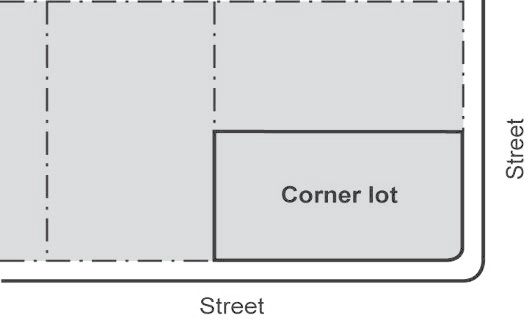
Figure 20.24-2 Corner Lot
Lot, corner. A lot located at the intersection of two or more streets having an angle of intersection of not more than one hundred twenty degrees, as shown in Figure 20.24-2. If the angle of intersection is more than one hundred twenty degrees, the lot shall be considered an interior lot.
Lot, double-frontage. A lot that has frontages on two streets that do not intersect, not including alleys, and that has the right of access to both streets, as shown in Figure 20.24-3.
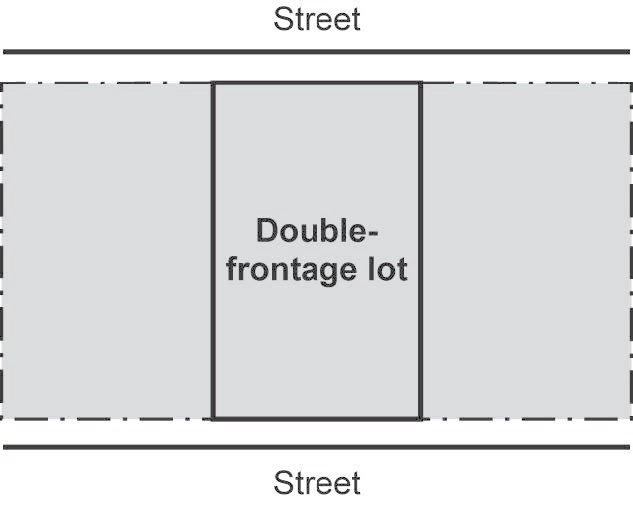
Figure 20.24-3 Double Frontage Lot
Lot, flag. A lot that has no frontage on any street except for a narrow access strip, and that has boundaries such that another lot is located between the main portion of the flag lot and the street, as shown in Figure 20.24-4.
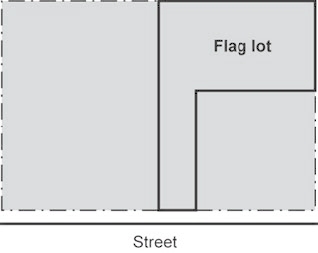
Figure. 20.24-4 Flag Lot
Lot, interior. A lot abutting only one street, as shown in Figure 20.24-5.
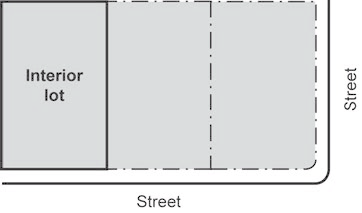
Figure 20.24-5 Interior Lot
Lot area. The total area included within the lot lines of a parcel of land.
Lot coverage. The total area of a site covered by buildings, accessory buildings, structures and covered patios. For structures that have walls, the site coverage is measured based on the perimeter of the exterior wall. For structures with no walls, such as a patio cover, the site coverage is measured based on the dimensions of the overhead canopy.
Lot depth. The horizontal length of a straight line drawn from the midpoint of the front lot line to the midpoint of the rear lot line.
Lot line, front. In the case of an interior lot, "front lot line" means a line separating the lot from the street; and in the case of a corner lot, "front lot line" means a line separating the narrowest street frontage of the lot from the right of way.
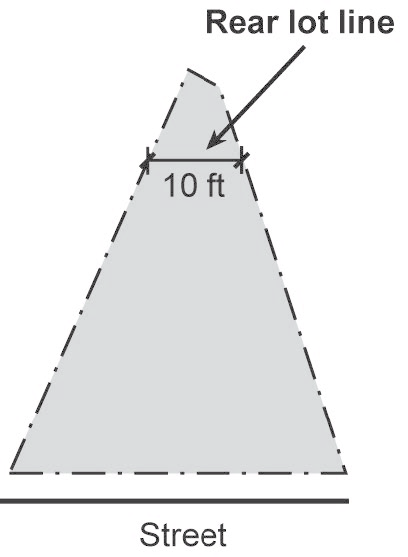
Figure 20.24-6 Rear Lot Line for
Irregular Lot
Lot line, rear. A lot line that is opposite and most distant from the front lot line. If the lot has an irregular or triangular shape, the rear lot line shall be a line within the lot at least ten feet in length, located parallel to the front lot line and as far as possible from the front lot line, as shown in Figure 20.24-6.
Lot line, side. Any lot line other than the front or rear lot line.
Lot width. The distance between the side lot lines, measured at the minimum front yard building setback line, parallel to the street. For irregularly-shaped lots, the lot width shall be determined by the director of community development.
Lounge. See "Bar."
Low-head drainage. Drainage from a sprinkler that is caused by water flowing down an irrigation system from a higher level of elevation.
Low-impact personal services. See "personal services, low-impact."
Lower-income household. See "household, lower-income."
Low volume irrigation. The application of irrigation water at low pressure through a system of tubing or lateral lines and low-volume emitters such as drip, drip lines, and bubblers. Low volume irrigation systems are specifically designed to apply small volumes of water slowly at or near the root zone of plants.
M.
Definitions, "M".
Machine shop. A facility for the production or assembly of metal parts, not including shops that use casting, smelting, drop hammers or punch presses.
Main building. See "building, main."
Main line. The pressurized pipeline that delivers water from the water source to the valve or outlet.
Manufactured home. In accordance with section 18007 of the Health and Safety Code, "manufactured home" means a structure transportable in one or more sections, which, in the traveling mode, is eight body feet or more in width, or forty body feet or more in length, or when erected on site, is three hundred twenty or more square feet, and which is built on a permanent chassis and designed to be used as a dwelling with or without a permanent foundation when connected to the required utilities, and includes the plumbing, heating, air conditioning and electrical systems contained in the home; except that this term shall include any structure that meets all the requirements of this paragraph except the size requirements and with respect to which the manufacturer voluntarily files a certification and complies with the standards established under this part. "Manufactured home" includes a mobile home, subject to the National Manufacturing Housing Construction and Safety Act of 1974 (42 U.S.C., section 5401 et seq).
Manufacturing and processing, general. Any establishment engaged in any of the following activities within enclosed structures: manufacturing or compounding of raw materials, manufacturing of finished products or parts from predominantly previously prepared materials, fabrication, assembly, processing or distribution.
Manufacturing and processing, heavy. The manufacture or compounding process of raw materials. These activities or processes would necessitate the storage of large volumes of highly flammable, toxic matter or explosive materials needed for the manufacturing process. These activities may involve outdoor operations as part of their manufacturing process.
Manufacturing and processing, light. The manufacture, predominantly from previously prepared materials, of finished products or parts, including processing, fabrication, assembly, treatment and packaging of such products, and incidental storage, sales and distribution of such products, but excluding basic industrial processing and custom manufacturing.
Manufacturing and processing, outdoor. Manufacturing facilities, usually classified as heavy industrial uses, which are located outdoors and may produce negative impacts to adjacent properties.
Marijuana. Any and all parts of a cannabis plant, any compound derived thereof, any synthetic compound designed to replicate or mimic the effects of cannabis, any ingestible or consumable product infused with or containing any of the forgoing, whether intended to be, or actually used, for medical, non-medical or recreational purposes. Marijuana also includes tetrahydrocannabinols (THC), synthetic equivalents of the substances contained in the cannabis plant, or in the resinous extractives of cannabis, or derivatives of cannabis or THC.
Marijuana cultivation. Planting, growing, harvesting, drying, curing, grading, trimming, processing, or developing marijuana or producing marijuana in any other way.
Marijuana delivery. Any commercial transfer or exchange of marijuana. Delivery also includes, but is not limited to, the use by a dispensary of any technology platform owned and/or controlled by a marijuana dispensary, as defined in this Code, that enables qualified patients, primary caregivers, or any other person to arrange for or facilitate the commercial transfer by a marijuana dispensary.
Marijuana dispensary. Any individual, group, association, business, office, facility, location, store, retail storefront, wholesale location, automobile, truck, vehicle, machine, or other apparatus, or place, whether mobile, fixed or otherwise, that delivers, provides, distributes or makes available marijuana to any person for any purpose whether for medical, recreational or other non-medical purposes in any commercial manner, including based on donations or any other transaction. Marijuana dispensary includes, but is not limited to, a collective, cooperative or any other group that collectively or cooperatively distributes marijuana.
Marijuana processing. Any method used to prepare marijuana for any commercial use, whether retail or otherwise, including but not limited to: drying, cleaning, curing, extracting, preparing, deriving, producing, or packaging of marijuana and marijuana related products and concentrates.
Marquee. A permanent structure other than a roof that is attached to, supported by and projecting from a building and that provides protection from the elements.
Massage. Any method of pressure on, or friction against or stroking, kneading, rubbing, tapping, pounding, vibrating, or stimulating the external parts of the human body with the hands or with the aid of any mechanical or electrical apparatus or appliance, or with or without supplementary aids such as rubbing alcohol, liniment, antiseptic, oil, powder, cream, ointment, or other similar preparations commonly used in this practice.
Massage establishment. Any establishment having a fixed place of business where any individual, firm, association, partnership, corporation, or combination of individuals, engages in, conducts, carries on or permits to be engaged in, conducted or carried on, massages, or health treatments involving massage where fifteen percent or more of the floor area is used for such activities carried on in the establishment.
Massage technician. Any person who performs massage in exchange for anything of any value whatsoever, whether or not that person has a valid permit from the city.
Master shut-off valve. An automatic valve installed at the irrigation supply point which controls water flow into the irrigation system. When this valve is closed water will not be supplied to the irrigation system. A master valve will greatly reduce any water loss due to a leaky station valve.
Maximum applied water allowance. For design purposes, the upper limit of annual applied water for the established landscaped area. The maximum applied water allowance (MAWA) is based upon the reference evapotranspiration, the envapotranspiration adjustment factor (ETAF) and the size of the landscaped area. Special landscape areas, including recreation areas, areas permanently and solely dedicated to edible plants such as orchards and vegetable gardens, and areas irrigated with recycled water are subject to the MAWA with an ETAF not to exceed 1.0. MAWA = (ETo)(0.62)[(ETAF x LA) + ((1-ETAF) x SLA)].
Mausoleum. See "Cemetery."
Maximum allowable density. The maximum number of dwelling units per acre as allowed under the general plan land use designation. Where an affordable housing development is permitted by an overlay in a land use designation that does not provide a residential density allowance, the maximum allowable density shall be calculated in reference to the residential density allowance designated in the Zoning Code for the overlay zone. In non-residential zones, the maximum allowed density shall be the maximum number of dwelling units, without the inclusion of density bonus units or associated incentives, concessions, waivers, and reductions, that can be developed on the site in substantial conformance with general plan policies, and applicable development standards.
Maximum applied water allowance (MAWA). For design purposes, the upper limit of annual applied water for the established landscape area as specified in section 20.15.040.B of this chapter (calculation of the maximum applied water allowance). The maximum applied water allowance is based upon the reference evapotranspiration, the ET adjustment factor, and the size of the landscape area.
Medical clinics and labs. A facility, not including a hospital, where medical, mental, dental, or other personal health services are provided. All services are provided on an outpatient basis.
Medical office. Offices of firms or organizations providing medical services and containing medical professionals such as physicians, dentists, chiropractors, optometrists or other similar medical professionals. This classification includes medical or dental laboratories incidental to an office use.
Meeting facility. Any facility for public or private meetings, excluding commercial entertainment facilities. Meeting facilities include community centers, clubs, lodges, houses of worship, auditoriums, union halls and other uses of like kind or character.
Metalwork. Any manufacturing or repair use that involves the production, assembly or dismantling of metal parts, including machine shops, welding shops and sheet metal shops.
Microclimate. The climate of a small, specific area that may contrast with the climate of the overall landscape area due to factors such as wind, sun exposure, plant density, or proximity to reflective surfaces.
Mined-land reclamation projects. Any surface mining operation with a reclamation plan approved in accordance with the Surface Mining and Reclamation Act of 1975.
Mini-storage facility. A building or group of buildings in a controlled access compound that contains varying sizes of individual, compartmentalized and controlled access stalls or lockers for self-service storage of customers' goods.
Mixed-use development. A development that provides both residential and nonresidential uses. A mixed-use development may include vertical mixed use, with residential units located above nonresidential uses, as well as horizontal mixed use, with residential units located behind nonresidential uses.
Mobile food vendor. Any food service establishment designed to be readily movable, including but not limited to carts, mobile kitchens, taco trucks and catering trucks, in which food is heated or otherwise prepared and then sold.
Mobile home. In accordance with section 18008 of the Health and Safety Code, "mobile home" means a structure transportable in one or more sections, designed and equipped to contain not more than two dwelling units to be used with or without a foundation system. The term "mobile home" does not include a recreational vehicle, commercial coach or manufactured housing.
Mobile home park. A residential development designed and developed for occupancy by mobile and manufactured homes. Home sites (spaces) within a mobile home park may be rented or leased by park residents, or the park may be owned in common by all residents.
Mobile marijuana dispensary. Any individual, group, association, business, office, facility, location, store, retail storefront, wholesale location, automobile, truck, vehicle, machine, or other apparatus, or place of a non-fixed, moveable or mobile nature that delivers, provides, distributes or makes available marijuana to any person for any purpose whether for medical, recreational or other non-medical purposes in any commercial manner, including based on donations or any other transaction. Mobile marijuana dispensary includes, but is not limited to, a collective, cooperative or any other group that collectively or cooperatively distributes marijuana using a mobile marijuana dispensary.
Moderate-impact personal services. See "Personal services, moderate-impact."
Moderate-income household. See "Household, moderate-income."
Mortuary. Any funeral home or parlor where the deceased may be prepared for burial or cremation, funeral services may be conducted and cremation may occur. A mortuary may include funeral merchandise sales as an accessory use.
Motel. See "Hotel."
Motion picture production and distribution services. Facilities which include indoor, outdoor, or both indoor and outdoor facilities for the production and/or distribution of motion pictures, television, video, music, or other media. Motion picture production and distribution service facilities may include outdoor sets, backlots, indoor workshops and craft shops. Warehouse-type soundstage facilities for the production and use of indoor sets may also be considered motion picture production and distribution services.
Mulch. Any organic material such as leaves, bark, straw, compost, or inorganic mineral materials such as rocks, gravel, or decomposed granite left loose and applied to the soil surface for the beneficial purposes of reducing evaporation, suppressing weeds, moderating soil temperature, and preventing soil erosion.
Multiple-family dwelling. See "Dwelling, multiple-family."
Multiple-tenant building. A shopping center, office complex or any other nonresidential development where multiple tenants share a building or complex of buildings.
Museum. A building having public significance by reason of its architecture or former use or occupancy or a building serving as a repository for a collection of natural, scientific, or literary curiosities or objects of interest, or works of art, and arranged, intended, and designed to be used by members of the public for viewing, with or without an admission charge, and which may include as an accessory use the sale of goods to the public as gifts or for their own use.
N.
Definitions, "N".
Natural resource extraction. The extraction, quarrying, and preparing of minerals removed from the earth and the operation or development of oil and gas fields and wells.
Neighborhood equestrian trail. A trail developed for the use of equestrians in rural residential neighborhoods, which may or may not be connected to other equestrian trails.
New construction. For the purposes of landscaping described in Chapter 20.19, a new building with a landscape or other new landscape, such as a park, playground, or greenbelt without an associated building.
NIER professional. A certified professional electrical engineer, health physicist or other technical expert with an understanding of NIER and its health effects. An NIER professional must have substantial professional experience performing environmental measurements of radio frequency (RF) exposure and preparing RF environmental evaluation reports for a variety of entities.
Nightclub. A commercial establishment dispensing alcoholic beverages for consumption on the premises and in which dancing and musical entertainment are permitted.
Nonconforming building. See "Building, nonconforming."
Nonconforming lot. A lot that does not conform to the development standards, including area and width regulations, of the district in which it is located or that does not conform to subdivision regulations.
Nonconforming use. A use that lawfully occupied a building or land at the time the use was established, but that no longer conforms with the use regulations of the district in which it is located.
Noncontributing feature. See "Feature, noncontributing."
Non-ionizing electromagnetic radiation (NIER). Electromagnetic radiation associated with the extra low frequency, radio, microwave, infrared and visible light portions of the electromagnetic spectrum.
Non-residential landscape. Landscapes in commercial, institutional, industrial and public settings that may have areas designated for recreation or public assembly. It also includes portions of common areas of common interest developments with designated recreational areas.
Nursery. See "Child day care."
O.
Definitions, "O".
Occupancy. The use of a structure, or any portion of a structure, by an owner or tenant.
OFA (object free area). A two-dimensional ground area surrounding runways, taxiways and taxi lanes, which is completely clear of objects, excepting those whose location is fixed by function.
Office, professional. An office used by persons who provide professional services, including but not limited to accountants, architects, dentists, doctors, engineers, lawyers, real-estate agents. The term "professional office" shall not include any facility that provides intensive medical treatment or overnight lodging for persons, such as a hospital; any facility that provides permanent or temporary boarding of animals, such as a veterinary office or kennel; any use that is considered a "personal service," as defined in this chapter; or any adult-oriented business.
Open porch. A landing or platform providing a transition from the interior to the exterior of a structure that is covered with a roof and open on two or more sides.
Open space, common. A usable open space that is shared by all of the residents of a residential development.
Open space, private. A usable open space that is available only to the residents of a single dwelling unit.
Open space, usable. An outdoor space that includes landscaping or other features which provide for active or passive recreation, including any ornamental landscaping that is a part of the outdoor space. Parking and loading areas, service areas, driveways, walkways and areas that provide access to dwelling units shall not be counted as usable open space.
Operating pressure. The pressure at which the parts of an irrigation system are designed by the manufacturer to operate.
Operator. Any person or organization that controls the operation and maintenance of a facility.
Outdoor sports courts, private. Any private, outdoor recreational facility on residentially-zoned property, ancillary to the primary dwelling unit, requiring fencing and lighting, and for the sole use of the occupants of the premises and their guests, including but not limited to tennis courts, basketball courts, and soccer fields, but excluding pools and driveways used exclusively for access to a garage.
Outdoor storage. See "Storage, outdoor."
Overhead sprinkler irrigation systems. Systems that deliver water through the air (e.g., spray heads and rotors).
Overspray. The irrigation water which is delivered beyond the target area.
P.
Definitions, "P".
Paint and auto body repair. Establishments engaging in the repair, alteration, restoration, painting or finishing of automobiles, trucks and other vehicles as a primary use.
Park or playground. A non-commercial public outdoor recreational facility that provides active or passive recreational opportunities.
Parking area, public. An open area, other than a street or alley, that is paved or otherwise surfaced; used for parking and storage of vehicles; and available for public use, whether for free or for compensation, or as an accommodation for patrons, customers or clientele of a business, professional office or other commercial enterprise.
Parking garage. Any building or structure, other than a garage on the premises of and used exclusively by a single-family dwelling, that is used for the parking or storage of vehicles, whether for free or for compensation.
Parking lot. Any property used temporarily or permanently for parking or storage of vehicles of any type in exchange for compensation, or as an accommodation for patrons, customers, or clientele of a business, professional office, or other commercial enterprise.
Parking space. A space within a parking lot, parking garage, building or other designated parking area that is designated for the temporary parking or storage of one vehicle or bicycle.
Parkway. The area between a sidewalk and the curb or traffic lane. This area is planted with or without pedestrian egress.
Patio. A paved area adjacent to a building that is intended for people's recreational use that is not used for vehicle parking and that is separated from parking areas by landscaping or other physical barriers.
Patio, covered. A patio that includes an impermeable roof or canopy.
Pawn shop. A facility that lends money at a specified rate of interest on articles of personal property left as security.
Payday advance. An establishment that is not a bank and provides services such as short-term loans, unsecured loans (signature loans), and auto-title loans intended to cover a borrower's expenses until his or her next payday.
Permit, administrative. See "Administrative permit."
Permit, use. See "Use permit."
Personal services. An establishment other than a professional office that provides services to individuals as a primary use, which tends to create minimal adverse impacts on its surroundings, and that may provide accessory retail sales of products related to the services provided. Typical uses include, but are not limited to beauty and barber shops, shoe repair shops, tailor shops, dry-cleaning services with no on-site dry-cleaning equipment, laundromats, tanning salons, and other uses of like kind or character.
Personal services, restricted. An establishment other than a professional office that provides services as a primary use which are typically limited by specific use attributes or appearance, including but not limited to tattoo parlors, body piercing, pawnshops, spas and hot tubs for hourly rental, massage establishments, and adult oriented businesses as defined in Title 5 of the Municipal Code.
Pervious. Any surface or material that allows the passage of water through the material and into the underlying soil.
Pharmacy. A professional office where medications are dispensed by licensed pharmacists.
Pistol, skeet, rifle and archery ranges. A facility designed or used for shooting at targets with rifles, pistols, shotguns or bow and arrow.
Places of worship, community scale. A place of worship having a seating capacity of less than one thousand five hundred persons in the sanctuary or main activity/assembly area.
Places of worship, large storefront. A place of worship located in a structure not typically used for such purposes or activities, such as a commercial shopping center, commercial offices, or business park having a seating capacity of one hundred or more persons in the sanctuary or main activity/assembly area.
Places of worship, regional scale. A place of worship having a seating capacity of one thousand five hundred or more persons in the sanctuary or main activity/assembly area.
Places of worship, small storefront. A place of worship located in a structure not typically used for such purposes or activities, such as a commercial shopping center, commercial offices, or business park having a seating capacity of less than one hundred persons in the sanctuary or main activity/assembly area.
Plant factor. A factor that when multiplied by referenced evapotranspiration, estimates the amount of water used by plants. For the purposes of this chapter, the plant factor range for: very low water use plants is 0 to 0.1; low water use plants is 0.1 to 0.3; moderate water use plants is 0.4 to 0.6; and high water use plants is 0.7 to 1.0. Plant factors cited in Chapter 20.19 are derived from the publication "Water Use Classification of Landscape Species." Plant factors may also be obtained from horticultural researchers from academic institutions or professional associations as approved by the California Department of Water Resources (DWR).
Plant water use factor. See "Plant factor."
Playground. See "Park or playground."
Porch. A one-story structure attached to a building that has no floor space located above it, and with at least one side that is not enclosed by a vertical wall, window or screening material.
Potable Water. Water meant for human consumption that is treated to legal standards for human consumption.
Pot-bellied pig. Pot-bellied pig shall mean a domesticated miniature Vietnamese, Chinese or Asian pot-bellied pig not exceeding ninety pounds in weight and eighteen inches in height (measured at the shoulder), and characterized by a swayed back and straight tail.
Pressure regulator. A device used in sprinkler systems for radius and high pressure control.
Primary dwelling unit. See "Dwelling unit, primary."
Primary use. An activity or combination of activities that comprise one of the main purposes for which the land or structures are intended, designed or ordinarily used. A site may have more than one primary use.
Private open space. See "Open space, private."
Project. Any proposed development for a site.
PSI. Pounds per square inch.
Public parking area. See "Parking area, public."
Public safety facility. A facility operated by a public agency for the purpose of protecting public safety, including but not limited to fire stations and other fire-fighting facilities, police stations and ambulance dispatch facilities.
Public storage facility. A business comprised of any more than one small, compartmentalized storage structures for individual access, for rental or sale and designed to meet temporary storage needs.
Q.
Definitions, "Q".
Quonset hut. A lightweight, prefabricated structure clad in corrugated galvanized iron, or other metal, with a semicircular cross section and ribbing supports.
R.
Definitions, "R".
Radio frequency (RF). The measure of the amplitude of the radio wave on which a given signal is transmitted.
Rain sensor. A component which automatically suspends an irrigation event when it rains.
Rain sensing shutoff device. See "Rain sensor."
Ranch. A lot used primarily for the breeding of horses; raising of livestock; boarding only of horses, mules or ponies directly involved with current breeding or training activities; and ancillary sales and previews of livestock. Permanent housing for ranch employees shall be permitted as an accessory use to the ranch.
Rear lot line. See "Lot line, rear."
Rear setback. See "Setback, rear."
Reclaimed water. See "Recycled water."
Record drawing. A set of reproducible drawings which show significant changes in the work made during construction and which are usually based on drawings marked up in the field and other data furnished by the contractor.
Recording studio. A indoor facility for sound production, editing, post-production and administrative functions relating to motion pictures, television, video, sound, computer and other media production. These facilities may include sound stages such as foley stages, recording studios, and other indoor facilities for the production of media in the above or similar formats.
Recreational area. Areas, excluding private single-family residential areas, for active play, recreation or public assembly in parks, sports fields, picnic grounds, amphitheaters or golf course tees, fairways, roughs, surrounds and greens.
Recreational facility. Country clubs, riding stables, golf courses and other recreation areas and facilities or recreation centers, including swimming pools.
Recreational vehicle (RV). A vehicle towed or self-propelled on its own chassis or attached to the chassis of another vehicle and designed or used for recreational or sporting purposes. The term recreational vehicle includes, but is not limited to, travel trailers, pick-up campers, truck campers, camping trailers, fifth-wheel trailers, motor homes, converted trucks or buses, boats and boat trailers, off-road vehicles and trailers used in their transport, personal watercraft and trailers used in their transport, and utility trailers.
Recreational vehicle living unit. A fully functional and operable motor home, fifth-wheel trailer, converted bus, or truck camper (camper mounted on a truck), or similar vehicle, designed for human habitation for recreational, emergency, or other occupancy, that contains one or more habitable rooms designed to be occupied by one family with facilities for living, sleeping, cooking, eating and sanitation.
Recycled water. Treated or recycled wastewater of a quality suitable for non-potable uses, such as landscape irrigation and water features. This water is not intended for human consumption.
Recycling facility. A center for the collection and/or processing of recyclable materials certified by the California Department of Conservation as meeting the requirements of the California Beverage Container Recycling and Litter Reduction Act of 1986. A recycling facility does not include storage containers or processing activity on the premises of a residential, commercial or industrial use, and used solely for the recycling of material generated by the residential property, business or industry. For the purposes of these provisions, recyclable material shall mean reusable material, including, but not limited to metals, glass, plastic and paper intended for reuse, remanufacture or reconstitution for the purpose of using the altered form. Recyclable material may include used motor oil collected and transported in accordance with the California Health and Safety Code.
Recycling facilities, heavy processing. Any processing facility other than a light processing facility. Such a facility shall meet all requirements specified in this table for light processing facilities. In approving such a use, the final approving authority may impose special operational conditions, requirements or standards, as it deems necessary to ensure the public health, safety and general welfare.
Recycling facilities large collection. A center for the acceptance by donation, redemption or purchase, of recyclable materials from the public, that occupies an area of more than five hundred square feet, is not appurtenant to a host use and may use a permanent building. In addition, large collection facilities may have the capacity for aggregating and storing large amounts of material on-site.
Recycling facilities, light processing. A facility used for the collection and processing of recyclable materials that occupies less than forty-five thousand square feet of gross collection, processing and storage area; and has an average of up to two out bound truck shipments per day. Light processing facilities are limited to baling, briquetting, crushing, compacting, grinding, shredding, and sorting of source-separated recyclable materials, and repairing of reusable materials sufficient to qualify as a certified processing facility. The facility shall not shred, compact or bale ferrous metals, other than food and beverage containers. For the purposes of these provisions, "processing" means the preparation of materials for efficient shipment, or to an end-users specifications, by such means as baling, briquetting, compacting, flattening, grinding, crushing, mechanical sorting, shredding, cleaning, and/or manufacturing.
Recycling facilities, material recovery facility (MRF). A facility that receives, processes and recycles municipal mixed solid wastes, commercial high-grade wastes (such as corrugated cardboard, newspaper, mixed papers, etc.), construction debris, commingled recyclable materials and green waste, and ships recovered recyclables and residual solid waste to market or disposal destinations. Such facilities typically include: (1) materials handling, sorting, processing and compacting equipment and facilities; (2) shipping/hauling of sorted materials, either by truck or rail; (3) administrative functions, such as office, employee and training areas; (4) weighing of vehicles and collection of fees; and 5) maintenance of vehicles and equipment.
Recycling facilities, reverse vending machines. An automated mechanical device that accepts one or more types of empty beverage containers, including, but not limited to, aluminum cans, glass and plastic bottles and issues a cash refund or a redeemable voucher. A reverse vending machine may sort and process containers mechanically, if the entire process is enclosed within the machine.
Recycling facilities, small collection. A center of not more than five hundred square feet in area for the acceptance by donation, redemption or purchase, of recyclable materials from the public, and consisting of one or more of the following: (1) a mobile recycling unit in the form of an automobile, truck, trailer or van, licensed by the Department of Motor Vehicles, which is used for the collection of recyclable materials. A mobile recycling unit also means bins, boxes or containers transported by trucks, vans or trailers, and used for the collection of recyclable materials; (2) a bulk reverse vending machine, larger than fifty square feet in area and is designed to accept more than one container at a time, paying by weight rather than by individual container; (3) a kiosk-type portable recycling unit which may include small permanent structures; or (4) unattended containers placed for the donation of recyclable material.
Reference evapotranspiration. A standard measurement of environmental parameters which affect the water use of plants. ETo is expressed in inches per day, month, or year and is an estimate of the evapotranspiration of a large field of four-to seven-inch tall, cool-season grass that is well watered. Reference evapotranspiration is used as the basis of determining the maximum applied water allowance so that regional differences in climate can be accommodated.
Rehabilitated landscape. Any re-landscaping project that requires a permit, plan check, or design review, meets the requirements of section 20.19.020.
Repair service. Any facility where electrical, electronic or mechanical equipment is repaired away from the premises of the customer. The term "repair service" does not include vehicle service or repair.
Repair service, small appliances. A repair service that repairs small household items, such as televisions and stereo systems.
Repair service, large equipment. A repair service that repairs large household items, such as refrigerators and air conditioners, or large commercial machinery.
Repair service, vehicle. See "Vehicle service or repair."
Required minimum setback. See "Setback, required minimum."
Research laboratory. A facility for scientific research, including pharmaceutical, chemical and biotechnology research, or the design, development and testing of electrical, electronic, magnetic, optical, computer or telecommunications components.
Residential care facility. In accordance with section 1502 of the Health and Safety Code, "residential care facility" means any family home, group care facility or similar facility for twenty-four-hour nonmedical care of persons in need of personal services, supervision or assistance essential for sustaining the activities of daily living or for the protection of the individual.
Residential care facilities, large. Housing that provides seven or more residents with a program of assisted-living services to deal with the activities and instrumental activities of daily living.
Residential care facilities, small. Housing that provides less than seven residents with a program of assisted-living services to deal with the activities and instrumental activities of daily living.
Residential landscape. Landscapes surrounding single or multifamily homes.
Restaurant. Any retail business that sells ready-to-eat food or beverages for on-premise or off-premise consumption.
Retail, general. A commercial enterprise that provides goods and/or services directly to the consumer where such goods are available for immediate purchase and removal from the premises by the purchaser.
Retail, thrift and secondhand stores. A profit or nonprofit business or organization that engages in or specializes in the sale or resale of previously owned or use goods and merchandise.
Retaining wall. A wall that is designed to resist lateral pressure and prevent the advance of soil or other materials.
Review authority. The city official or city body that is responsible, under the provisions of this chapter, for approving or denying a development review application, permit application or other request for official city approval.
Roof-mounted. Any object or equipment attached to the roof or the top-most level or levels of a building.
RPZ (runway protection zone). A two-dimensional ground area located beyond the runway ends used to enhance the safety of aircraft operations, as shown in the ACLUP prepared for Chino Airport.
Runoff. Water that is not absorbed by the soil or landscape to which it is applied and flows from the landscape area. For example, runoff may result from water that is applied at too great a rate (application rate exceeds infiltration rate) or when there is a steep slope.
S.
Definitions, "S".
Safety zone. An area located in the vicinity of an airport in which land use restrictions are established to protect the safety of the public. Safety zone is further de-fined as follows: (1) Safety Zone I, also known as the RPZ; (2) Safety Zone II (Outer Safety Zone), a three-dimensional area extending from the end of each runway, the center of which runs along an imaginary projection of the runway centerline, as shown in the ACLUP prepared for Chino Airport; (3) Safety Zone III (Traffic Pattern/Overflight Zone), an area consisting of the envelope of aircraft flight paths associated with aircraft take-off and landing (traffic pattern area), and the area used by aircraft for maneuvering to enter a pattern for landing (overflight area), as shown in the ACLUP prepared for Chino Airport.
Salvage yard. See "Junk yard."
San Bernardino County area median income. The median income published by the California Department of Housing and Community Development ("HCD") each year as required by California Code of Regulations, Title 25, Section 6932 and Health and Safety Code Section 50093.
Satellite antenna. Any device incorporating a reflective surface that is solid, open mesh, or bar-configured to form a shallow dish, cone, horn or cornucopia used to transmit or receive electromagnetic signals. This definition includes antennas that are sometimes called "SES," "TVRO," "TVBS" and "DBS."
Satellite dish. See "Satellite antenna."
School for personal enrichment and fulfillment. A facility offering instruction and/or study oriented toward one's personal growth, fulfillment and/or enrichment, such as arts and crafts, music, cooking, etc.
School, private. An academic institution that is not operated under the authority of a public school board or district. The term "private school" shall include only elementary, middle and high schools, as well as colleges and universities, and shall not include training facilities.
School, public. An academic institution that is operated under the authority of a public school board or district, including a charter school.
Second primary unit. A second residential dwelling unit, other than an accessory dwelling unit or junior accessory dwelling unit, on a parcel with one and only one existing primary dwelling unit.
Service station. Any building, structure, premise or other place used primarily for the retail sale and dispensation of motor fuels, lubricants and motor vehicle accessories, and the rendering of services and minor repairs to such vehicles, not including painting, body work or fender work. A gas station may include food and beverage sales, as well as a car wash, as an accessory use.
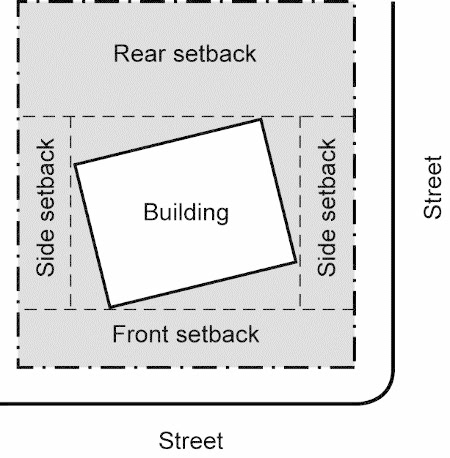
Figure 20.24-7 Setback
Setback. The minimum distance by which a building or structure must be separated from a lot line, as shown in Figure 20.24-7.
Setback, front. A setback extending across the full width of the site, the depth of which is the distance between the front lot line and the foundation of any structure. The designation of the front setback of a corner lot shall be as described in the definition of the term "Lot line, front".
Setback, rear. A setback extending across the full width of the site, the depth of which is the distance between the rear lot line and the foundation of any structure.
Setback, required minimum. The smallest setback from any lot line that is allowed under the provisions of this chapter.
Setback, side. A setback between the foundation of any structure and the side lot line, extending from the front setback to the rear setback. The width of the side setback shall be measured horizontally from the nearest point of the side lot line to the nearest part of the foundation of any structure.
Setback line. A line parallel to a specified lot line that defines a required minimum setback for the foundation of any structure.
Shade tree. A self-supporting woody plant or species normally growing to a mature height of at least twenty feet and a mature spread of at least fifteen feet. Clusters of more than one tree may be used when it is demonstrated that the grouping of trees will, at maturity, surpass the fifteen feet diameter requirement and that the grouping of trees is suitable for the proposed location.
Shopping center. A primarily retail-oriented commercial site with at least three separate businesses that share common pedestrian and parking areas.
Short-Term Rental. Rental of any residential building, portion of such building, or group of such buildings in which there are guest rooms or suites, including housekeeping units, for transient guests, where lodging with or without meals is provided for a period of less than a calendar month or less than thirty-one consecutive days.
Shrub. A self-supporting woody perennial plant of low to medium height, characterized by multiple stems and branches continuous from the base, usually not more than eight feet in height at maturity.
Side lot line. See "Lot line, side."
Side setback. See "Setback, side."
Single-family dwelling. See "Dwelling, single-family."
Site. A parcel or adjoining parcels that are under single ownership or single control, and that are considered a unit for the purposes of development or other use.
Site area. The total area included within the boundaries of a site.
Slaughter house. A facility for the slaughtering and processing of animals and the refining of their byproducts.
Small family day care home. See "family day care home, small."
SMART irrigation controller. A controller that monitors and uses information about environmental conditions, such as soil moisture, rain, wind, slope, soil type, plant type, etc., to automatically adjust watering schedules for specific hydrozones.
Social services, charitable institutions and services. Facilities other than offices providing a social service directly to the adjacent community, such as food banks, blood banks, employment training, etc.
Solid fence. See "Fence, solid."
Soil moisture sensing device (soil moisture sensor). A device that measures the amount of water in soil. The device may also suspend or initiate an irrigation event.
Soil test. A test done by a soil test lab that indicates at minimum soil texture, water holding capacity, pH, and soluble salts.
Soil texture. The classification of soil based on its percentage of sand, silt, and clay.
Soil type. The classification of soil based on the percentage of its composition of sand, silt, and clay.
Special conditional use permit. A permit to allow a specified land use, building or structure that is not allowed as of right on a given property, subject to the discretion of the city.
Special landscape area (SLA). Landscape areas dedicated to edible plants, recreational areas, areas irrigated with recycled water, or water features using recycled water.
Specified anatomical areas. See Title 5 - Business Licenses and Regulations.
Specified sexual activities. See Title 5 - Business Licenses and Regulations.
Sports club. A club or business establishment designed to host sporting activities, including, but not limited to, football, soccer, basketball, volleyball, hockey, boxing, tennis, airsoft, paintball, etc.
Sports stadium or arena. A large open or enclosed space used for games or major events, and partly or completely surrounded by tiers of seats for spectators.
Sprinkler head. A device which delivers water through a nozzle.
Stables, commercial. A structure and/or land use in or on which horses, mules or ponies are sheltered, fed and/or kept for hire.
Stables, private. A detached accessory building for the keeping of horses, mules or ponies owned by the occupants of the premises and not kept for remuneration, hire or sale.
Static water pressure. Water supply pressure when it is not flowing.
Station. An area served by one valve or by a set of valves that operate simultaneously.
Storage area. Any place outside of a structure where various materials are stored.
Storage business. A business that accepts and stores goods from one or more customers but does not provide individual, compartmentalized and controlled access to each customer's goods.
Storage container. Any fully-enclosed area other than a structure, such as a cargo container or shipping container, where various materials are stored or could be stored.
Storage, outdoor. The storage of various materials, equipment and/or vehicles outside of a structure, either as an accessory or a primary use.
Storage, public. See "Public storage facility."
Story. Any one of a building's floors that has a ceiling at least six feet above its floor and at least six feet above grade.
Street. A thoroughfare, including a road or highway, which provides the principal means of access to abutting property. For the purpose of interpreting this chapter, any throughway except an alley shall be considered a street.
Street line. The boundary line between the street right-of-way and abutting property.
Structural alteration. Any change in the supporting members of a building or structure, including bearing walls, columns, beams or girders, floor joists, ceiling joists or roof rafters.
Structure. That which is built or constructed.
Structure, mounted. Any object or equipment attached to a building, billboard, tank, sign, utility pole, or other structure, but not attached to a dedicated support structure resting on the ground. When referring to wireless communication facilities, this definition includes antennas sometimes referred to as "façade mounts "and "sign mounts."
Structure, temporary. A structure that is erected for a limited period of time, typically no longer than two years, and that does not permanently alter the character or physical facilities of a property.
Sunset Western Climate Zone System. The Sunset Western Climate Zone System utilizes data from climate zones to determine which plants are best suited for each climate zone.
Supportive housing. Housing with no limit on length of stay that is occupied by a target population, and that is linked to on-site or off-site services that assist the supportive housing resident in retaining housing, improving his or her health status, and maximizing his or her ability to live and, when possible, work in the community.
Swap meet. A building or open area in which stalls or sales areas are set aside, and rented or otherwise provided, and which are used or intended for use by unrelated individuals to sell, trade, exchange, or swap articles that are either new, homemade, homegrown, old, obsolete, or antique and includes the selling of goods and/or services at retail by businesses or individuals who are generally engaged in retail trade.
Swimming pool. Any pond, wading pool, swimming pool, or similar body of water that is more than one and one-half feet in depth, whether located above or below ground.
Swing joint. An irrigation component that provides a flexible, leak-free connection between the emission device and lateral pipeline to allow movement in any direction and to prevent equipment damage.
Submeter. A metering device to measure water applied to the landscape that is installed after the primary utility water meter.
T.
Definitions, "T".
Target unit. A dwelling unit within a housing development that is reserved for very-low-income, lower-income, moderate-income or senior citizen households.
Temporary commercial recreation facility. Any establishment that provides entertainment activities or services on a temporary basis, that may have a fee or admission charge, including miniature golf courses, sports clubs, outdoor inflatable theme parks and obstacle courses, amphitheaters, parking lots and other uses of like kind or character. Facilities operated by a public agency are not included in this definition.
Temporary structure. See "Structure, temporary."
Temporary use. A short-term activity that may or may not meet the normal development or use standards of the applicable zoning district, but that occurs for a limited period of time and does not permanently alter the character or physical facilities of a property.
Theaters and auditoriums. A building or part of a building devoted to showing motion pictures, or for dramatic, dance, musical, or other live performances.
Tower-mounted. Any object or equipment attached to a dedicated support structure resting on the ground whose principal use is to support similar objects or equipment, and that has an overall height greater than ten feet above finished grade at the base of the structure. When referring to wireless communication facilities, this definition includes antennas that are sometimes referred to as "monopoles," "lattice towers" and "guyed towers."
Townhouse. See "Dwelling, single-family, attached."
Trade and vocational schools. A specialized instructional establishment that provides on-site training of business, commercial and/or trade skills such as accounting, data processing, computer repair, hairdressing and automobile repair.
Trade service. A business that provides services to residential and non-residential customers for the maintenance and improvement of facilities, including but not limited to plumbing, electrical, extermination, cleanup and restoration, janitorial, landscaping, etc. These businesses often have vehicles and equipment stored at their offices that are deployed to the field when called for service.
Training facility. A private school that primarily provides specialized education or training for a particular profession or trade.
Transfer business. A business whose primary purpose is the movement of goods from one location to another, and which may use storage facilities incidentally to that purpose.
Transitional housing. A facility in which occupants live for a specified period of time while they receive assistance and counseling in personal and household income management.
Transportation terminals. A depot or station that functions as a passenger loading and unloading facility specifically designed for public and private transportation modes, such as buses and trains, but excluding airports and airport operations. Transportation terminals are usually located along major transportation routes and may include ancillary uses, such as passenger ticket booths, long-term parking areas and small retail shops and restaurants. For the purposes of these provisions, transportation terminals also include park and ride, kiss and ride or other similar facilities.
Treated sewage effluent water. See "Recycled water."
Tree. Any self-supporting woody perennial plant which has a trunk diameter of two inches or more and which attains an overall height of at least fifteen feet at maturity, usually with one main stem or trunk and many branches; however, in some cases, may appear to have several stems or trunks.
Turf. A ground cover surface of mowed grass. Annual bluegrass, Kentucky bluegrass, Perennial ryegrass, Red fescue, and Tall fescue are cool-season grasses. Bermuda grass, Kikuyugrass, Seashore Paspalum, St. Augustine grass, Zoysia grass, and Buffalo grass are warm-season grasses.
U.
Definitions, "U".
Understory. Assemblages of natural, low-level, woody herbaceous and ground cover species that exist in the area below the canopy of trees.
Usable rainfall. See "Effective precipitation."
Usable open space. See "Open space, usable."
Use. See "Land use."
Use, accessory. See "Accessory use."
Use, nonconforming. See "Nonconforming use."
Use, primary. See "Primary use."
Use, temporary. See "Temporary use."
Utilities, major. Services of a regional nature that normally entail the construction of new buildings or structures such as generating plants and sources, electrical switching facilities, stations or substations, community wastewater treatment plants and similar facilities.
Utilities, minor. Services that are necessary to support development within the immediate vicinity and that involve only minor structures. Included in this use type are small facilities such as transformers, relay and booster devices and well, water and sewer pump stations.
Utility building or substation. Any facility that is used for production, distribution or processing related to a public utility that involves the use of direct physical connections, such as water, sewage, electricity, natural gas or telecommunications services.
V.
Definitions, "V".
Valve. A device used to control the flow of water in an irrigation system.
Vape lounge. An establishment where patrons can smoke and purchase vapor products and e-cigarettes.
Vegetation, native. Any plant species with a geographic distribution indigenous to all or part of the southern region of the State of California. Plant species that have been introduced by man are not native vegetation.
Vehicle. A device by which any person or property may be propelled, moved or drawn, except a device moved by human power or used exclusively upon stationary rails or tracks.
Vehicle depot. A facility that is used primarily for the storage of operative vehicles in a fleet, including associated repair facilities for temporarily inoperative vehicles.
Vehicle sales. An establishment for the retail sales or rental of vehicles. Vehicle sales may include parts sales and vehicle repair, provided that these activities are incidental to the sale of vehicles.
Vehicle service or repair. An establishment that provides any repair, alteration, servicing, restoration or finishing of any vehicle as a primary use, including but not limited to muffler and radiator shops, oil change and quick-lube shops, tire and battery sales and installation, and towing. The term "vehicle service or repair" does not include repair shops that are part of a vehicle sales establishment on the same site.
Vending station. The vehicle, cart or other device used by a mobile food vendor for the preparation and distribution of food.
Very-low-income household. See "Household, very-low-income."
Veterinary clinics. A professional office where animals receive medical treatment on the premises from a licensed veterinarian, and where all animals are housed indoors. The outdoor housing of animals shall be considered a "kennel" and is not permitted as an accessory use.
Viable. In the judgment of the director of community development, a tree, shrub, or any other type of plant capable of sustaining its own life processes, unaided by man, for a reasonable period of time.
W.
Definitions, "W".
Walk-in clientele. A business providing direct services to patrons or clientele that may or may not require appointments. This classification includes employment agencies, insurance agent offices, real estate offices, travel agencies, utility company offices, and offices for elected officials.
Warehousing. The provision of facilities used primarily for the storage of commercial goods, including documents. "Warehousing" does not include mini-storage.
Water conserving plant species. A plant species identified as having a very low or low plant factor.
Water feature. A design element where open water performs an aesthetic or recreation function. Water features include ponds, lakes, waterfalls, fountains, artificial streams, spas, and swimming pools (where water is artificially supplied). The surface area of water features is included in the high water use hydrozone of the landscape area. Constructed wetlands used for on-site wastewater treatment or stormwater best management practices that are not irrigated and used solely for water treatment or stormwater retention are not water features and, therefore, are not subject to the water budget calculation.
Watering window. The time of day irrigation is allowed.
Wholesaling and distribution. The provision of facilities used primarily for selling or distributing goods to retailers, contractors, commercial purchasers or other wholesalers, or to the branch or local offices of a company or organization.
Wireless facility. See Chapter 20.22.
WUCOLS. The "Water Use Classification of Landscape Species" published by the University of California Cooperative Extension, and the Department of Water Resources, 2014. The project was developed by the San Francisco and San Mateo County Office in cooperation with thirty-two landscape professionals. This project was initiated and funded by DWR. The purpose and intended use is to provide guidance to landscape professionals when selecting plant material, while taking into consideration water needs. It also serves as a guide to assist in developing irrigation schedules for existing landscapes.
X.
Definitions, "X".
No specialized terms beginning with "X" are defined.
Y.
Definitions, "Y".
Yard. See "Setback."
Yard, front. The portion of a lot between the front line of the lot and the portion of the front line of the main building which faces the front and is closest to the street and which extends across the entire width of the lot; provided however, that upon vacant property, the front yard shall be the yard between the front line of the lot and the front yard setback line ascribed to such lot, and which extends across the entire width of the lot.
Z.
Definitions, "Z".
Zone. See "District."
Zoning clearance. A verification by the director of community development that a proposed structure or use meets the requirements of this Title.
Zoning map. The official map and its underlying Geographic Information System (GIS) data, adopted by the City of Chino, that serves to delineate the boundaries of each district as defined in this chapter.
Zoological garden. An area, building, or structures which contain wild animals on exhibition for viewing by the public.
(Ord. 2010-05, § 1(exh. A), 2010; Ord. 2011-01, § 5, 2011; Ord. 2011-06, §§ 37—41, 2011; Ord. 2013-003, § 48, 2013; Ord. 2014-013, § 19, 2014; Ord. 2015-008, § 3, 2015; Ord. 2016-001, §§ 10,11, 2016; Ord. 2016-005, § 19, 2016; Ord. 2017-009, §§ 35—39, 2017; Ord. 2019-013, §§ 39—41, 2019; Ord. 2020-006, §§ 20—24, 2020; Ord. 2021-001, §§ 20—22, 2021; Ord. 2022-010, § 14, 7-19-2022; Ord. 2023-008, § 7, 2023; Ord. No. 2024-004, § 4, 2024.)

