
Chino City Zoning Code
CHAPTER 20
17 - DESIGN STANDARDS
20.17.010 - Purpose.
The purpose of these standards is to promote high quality development that will enhance the design character of Chino.
(Ord. 2010-05, § 1(exh. A), 2010.)
20.17.020 - Applicability.
A.
These standards apply to all new and substantially renovated residential, commercial and industrial and office uses throughout the city.
B.
All development shall comply with the City of Chino Design Guidelines, established by city council resolution, in addition to the standards contained in this chapter.
(Ord. 2010-05, § 1(exh. A), 2010.)
20.17.030 - Design standards that apply to all uses.
A.
Siting and orientation. Building entrances shall be oriented towards the street.
B.
Building massing. Entries shall be visually and functionally distinct, pedestrian-oriented and visible from the adjacent street system. This may be achieved by recessing the entry, creating an arcade, by the use of bollards and accent materials, provision of seating areas, by providing lush landscaping in combination with enhanced hardscape materials, or by the addition of a compatible entry structure.
C.
Building façade. Long, flat building façades along streets shall be avoided to the extent possible. The planes along an exterior wall elevation shall be staggered to create pockets of light and shadow, and to provide relief from monotonous, uninterrupted expanses of wall.
D.
Architectural details.
1.
All windows within a building and across a façade shall be related in design, operating type, proportions and trim.
2.
All building elevations adjacent to a street or highway shall provide architectural detail and relief intended to break up building mass and roof lines, and provide architectural interest.
3.
Simulated nonnatural finishes (e.g., artificial stone using concrete form liners simulating naturalistic lines and shapes such as rubblestone) shall be of a high quality that successfully mimic the natural material.
4.
Roof materials shall relate to the design and architectural style of the building.
E.
Lighting.
1.
The location of light fixtures should correspond to anticipated use. Lighting of pedestrian movement paths should illuminate changes in grade, path intersections, seating areas and any other uses along the movement path that, if left unlighted, would create an unsafe situation.
2.
All lighting fixtures shall be shielded to confine light spread on-site.
F.
Equipment and systems.
1.
All building drainage gutters, down spouts, vents, etc., located on the exterior walls shall be architecturally compatible with the exterior building design and color, or shall be completely concealed from view.
2.
All mechanical equipment and appurtenances of any type (including, but not limited to, skylights, stack vents or fans), whether located on rooftops, ground level or anywhere on the building structure, shall be completely screened so as not to be visible from any public street and/or adjacent property. The parapet wall should serve as the primary method of screening, or the facilities shall be enclosed. Such enclosure of facilities shall be of compatible design related to building structure for which such facilities are intended to serve.
3.
Ladders for roof access shall be mounted on the inside of the building, or shall be completely concealed from view.
(Ord. 2010-05, § 1(exh. A), 2010.)
20.17.040 - Single-family residential design standards.
A.
Lot Access.
1.
Lots with no street frontage may be accessed from an alley as the primary means of access.
2.
Each lot taking access from a primary or secondary arterial street as specified in the circulation element of the city's general plan shall provide a circular driveway or other acceptable drive which will allow vehicles to enter traffic safely in a forward motion.
B.
Driveways. Each lot shall be provided with a concrete (or equal material, subject to approval by the director of community development) driveway between the street/alley and the garage/carport. The design and section of the driveway shall be subject to review and approval by the city.
1.
Driveways accessed from streets shall be twenty feet or greater in length, measured from the back of sidewalk to the garage/carport opening.
2.
Driveways accessed from alleys shall be five feet or less in length or twenty feet or greater in length, measured from the property line to the garage/carport opening.
C.
Reserved.
D.
Floor plans and elevations. A variety of floor plans and building elevations shall be provided. All developments shall comply with Table 20.17-1 (Schedule for Architectural Variation).
TABLE 20.17-1 SCHEDULE FOR ARCHITECTURAL VARIATION
E.
Building foundations. All dwellings and accessory structures shall be affixed to a permanent, continuous perimeter foundation, consistent with the requirements of the city's building code.
F.
Type V wiring. All new single-family and duplex dwelling units shall have Type V wiring or similar data-transfer/network wiring system installed throughout the unit.
G.
Neighborhood context. Roof forms and pitches shall be consistent with those that are found on surrounding homes.
H.
Massing and scale. Entries shall not be the tallest feature of the façade and shall not dominate the structure.
I.
Roof materials.
1.
Roofing material used on new home construction shall be of clay or concrete tile with a class A fire rating. Developments consisting of four or fewer homes may use a thirty-year laminated composition dimensional shingle with a class A fire rating, provided the roofing material of homes within the immediate neighborhood are a material other than clay or concrete tile.
2.
When replacing a roof, the roofing material that is to be replaced shall be of a material that is equal to, or better than the material to be removed, as determined by the director of community development. If the roofing material to be replaced is wood shake/shingle, a thirty-year laminated composition dimensional shingle with a class A fire rating shall be used at a minimum. The director of community development may grant exceptions from this provision if it can be shown that its application would require significant structural alteration to a roof's supporting members, thereby adding significantly to the cost of the replacement roof.
3.
Roof material color shall be compatible with the surrounding neighborhood.
J.
Façade.
1.
Residential entries shall be located on the front façade and shall directly access the sidewalk or street.
2.
Roof flashings, rain gutters and downspouts, vents and similar features shall be finished to coordinate with adjacent finish materials and/or colors.
(Ord. 2010-05, § 1(exh. A), 2010; Ord. 2014-013, § 14, 2014.)
20.17.050 - Multiple-family residential design standards.
A.
Massing and scale.
1.
The massing of apartment buildings larger than four units shall incorporate architectural features that help to individually distinguish them, such as wall breaks, projections, distinct color schemes and individual roof treatments.
2.
Access points to units shall be clustered in groups of four or less. The use of distinctive architectural elements and materials to denote entrances is encouraged.
B.
Open space.
1.
Open space areas between buildings shall be scaled to the size of the buildings so that the height of buildings does not overwhelm the adjacent open space.
2.
A minimum of forty percent of the net lot area shall be dedicated to improved permanent open space, exclusive of driveways, parking areas, dwellings and nonrecreation building areas. Open space areas shall be provided as follows:
a.
Thirty-five percent of the net lot area shall be devoted to common open space area, including recreation facilities and accessory structures and buildings. All projects shall provide a flat, open play field within the common area.
b.
Common open space shall not be less than five feet in width at its narrowest dimension.
3.
Each dwelling unit within a multiple unit residential development shall be provided a private open space area, free and clear of any attached or detached accessory structure as follows:
a.
Ground level units shall be provided a two hundred square foot private yard at grade level with a minimum interior dimension of ten feet.
b.
Upper level units shall be provided a one hundred square foot balcony with a minimum interior dimension of eight feet.
C.
Recreation facilities requirements.
1.
All multifamily residential developments shall provide major and minor recreation facilities in accordance with Table 20.17-2 (Minimum Recreation Facilities for Multifamily Developments). For the purpose of this provisions, recreational amenities shall be categorized as follows:
TABLE 20-17.2 MINIMUM RECREATION FACILITIES FOR MULTIFAMILY DEVELOPMENTS
a.
A major recreation facility is intended to be a significant recreation node or focal point for residents and include recreation buildings, swimming pools, tennis courts, basketball courts, child care facilities and other such amenities requiring the significant investment and appropriate to serve project residents, as determined by the city.
b.
A minor recreation facility is intended to augment the variety and availability of recreation facilities and include children's play areas, spas or saunas, picnic and barbecue areas, volleyball courts and other such amenities requiring significant investment and appropriate to serve project residents as determined by the city.
D.
Minimum dwelling amenities.
1.
At a minimum, each unit shall be provided with the following amenities:
a.
Wall to wall carpeting.
b.
Curtains, drapes, mini-blinds or an equivalent covering for all windows and glass doors. This requirement may be waived by the planning commission when the dwelling unit is for sale and will be owner occupied.
c.
Central heating and air conditioning.
d.
Built-in dishwashers.
e.
Fully enclosed, securable storage closet not less than one hundred twenty cubic feet in area and accessible from a patio or balcony of a dwelling unit. This requirement shall only apply to units that do not include garages or carports with fully enclosed, securable storage closets not less than one hundred twenty cubic feet in area.
f.
Clothes washer and dryer electrical gas hookups for standard side-by-side washer and dryer appliances, except that a bachelor/studio unit may provide facilities for stackable washer/dryer appliances.
E.
Architectural style.
1.
A variety of materials shall be used within an architectural theme that emphasizes a differentiation between the various components of the building.
2.
Windows shall be used as architectural elements that add relief to the façade and wall surface.
F.
Roof material.
1.
Roofing material used on new home construction shall be of clay or concrete tile with a class A fire rating. Developments consisting of four or fewer homes may use a thirty-year laminated composition dimensional shingle with a class A fire rating, provided the roofing material of homes within the immediate neighborhood are a material other than clay or concrete tile.
2.
When replacing a roof, the roofing material that is to be replaced shall be of a material that is equal to, or better than the material to be removed, as determined by the director of community development. If the roofing material to be replaced is wood shake/shingle, a thirty-year laminated composition dimensional shingle with a class A fire rating shall be used at a minimum. The director of community development may grant exceptions from this provision if it can be shown that its application would require significant structural alteration to a roof's supporting members, thereby adding significantly to the cost of the replacement roof.
3.
Roof material color shall be compatible with the surrounding neighborhood.
G.
Off-street parking accessibility. Off-street parking spaces shall be located within one hundred fifty feet from the dwelling unit (front or rear door) for which the parking space is provided.
H.
Driveway approaches. Driveway approaches serving developments of five or more units shall be delineated with enhanced paving treatment, such as interlocking pavers, textured and color pigmented concrete, or stamped concrete.
I.
Paved access. All parts of all structures shall be located within one hundred fifty feet of paved vehicular access.
J.
Exterior building color. The exterior building color shall be reviewed and approved by the director of community development prior to application. Colors shall be color coordinated between structures utilizing compatible hues and intensities. Final review and approval of paint colors utilizing a color test shall take place prior to painting a building.
K.
Security plan. Prior to the issuance of building permits, the developer or owner shall provide a detailed security plan outlining private and common security measures. The analysis shall include assessment of defensible space, visual line-of-sight limitations, screening effects of buildings, fencing and landscaping, exterior illumination and building and unit address visibility. Access ways with security gates shall be provided with a Knox box or Knox lock assembly to allow entry of emergency equipment and personnel.
L.
Façade. Façades shall be designed so as to include entries, porches and other architectural elements that relate to the human scale.
(Ord. 2010-05, § 1(exh. A), 2010; Ord. 2011-06, § 17, 2011.)
20.17.060 - Mixed use design standards.
A.
Transparency.
1.
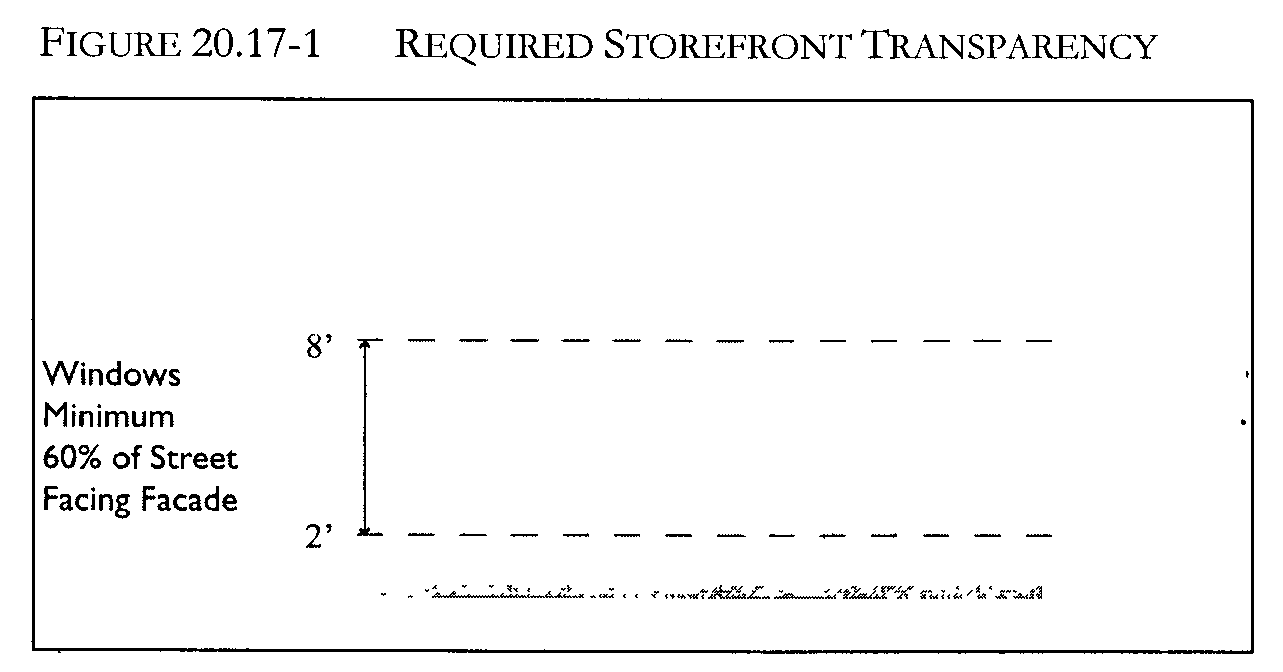
A minimum of sixty percent of the street-facing building façade between two feet and eight feet in height shall be comprised of clear windows that allow views of indoor space or product display areas, as shown in Figure 20.17-1.
2.
The bottom of any window or product display window used to satisfy the transparency standard of Subsection 1. above, may not be more than three feet above the adjacent sidewalk.
3.
Product display windows used to satisfy these requirements shall have a minimum height of four feet and be internally lighted.
B.
Entrances. Buildings shall have a primary entrance door facing a public sidewalk. Entrances at building corners adjacent to a public sidewalk may be used to satisfy this requirement.
(Ord. 2010-05, § 1(exh. A), 2010.)
20.17.070 - Commercial design standards.
A.
Siting and orientation.
1.
Structures shall be clustered, creating plazas or pedestrian malls, and preventing long linear expanses of building or long "barracks-like" rows of structures.
2.
Structures and on-site circulation systems shall be located to minimize pedestrian/vehicle conflicts. Structures shall be linked to the public sidewalk, where possible.
3.
Single, freestanding commercial structures shall be oriented with the major entry toward the street where primary site access is provided.
4.
Loading facilities shall be located at the rear of the site, screened from view of the public street by the structure it serves.
B.
Pedestrian orientation.
1.
Commercial mixed use areas shall emphasize pedestrian orientation by creating attractive pedestrian spaces which utilize such features as plazas, interior walkways and paseos, ornamental gates, trellises, lighting, plant materials, seating, fountains, etc.
2.
Attractive well-marked pedestrian links shall be provided between parking areas and buildings. These connections shall be designed as safe, clearly marked and attractive pedestrian walkways across parking spaces and landscaped areas.
3.
All commercial buildings shall be publicly accessible via a path or walkway from a public sidewalk.
4.
Parking area design shall include provisions for pedestrian access from parking areas to building entrances.
C.
Building massing.
1.
Variety in building forms shall be used to create visual character and interest.
2.
Buildings shall be architecturally subdivided into horizontal increments at both the ground floor and upper stories.
3.
Avoid long, flat building façades along streets. The staggering of planes along an exterior wall elevation shall be employed in a sensitive manner to create pockets of light and shadow, and to provide relief from monotonous, uninterrupted expanses of wall.
D.
Building façade.
1.
Buildings shall have a clearly defined base and roof edge so that the façade has a distinct base, middle and top at a scale that relates to an individual person.
2.
Where multiple tenant spaces are incorporated into a building, individual tenant spaces shall be located within the building bays. This can be achieved by any of the following:
a.
Placing a column, pier or pilaster between façade elements.
b.
Applying a vertical slot or recess between façade elements.
c.
Providing variation in plane along the building wall.
d.
Varying the building wall by recessing the storefront entrance or creating a niche for landscaping or for a pedestrian area.
3.
All façades shall emphasize three-dimensional detailing such as cornices, window moldings, textures and reveals to cast shadows and create visual interest on the façade.
E.
Roofs.
1.
Variations in building roof lines shall be provided to reduce the massive scale of the building and add visual interest.
2.
The form, color and texture of the roof shall be an integral component of the building design.
F.
Architectural details.
1.
Monotony among colors throughout the project site shall be avoided.
2.
Entries into buildings shall portray a quality appearance, and shall not appear as an added-on or unrelated element. Customer entrances shall be clearly defined and highly visible.
G.
Lighting.
1.
Lighting shall be used to provide illumination for the security and safety of on-site areas, such as parking and loading areas, pathways and working areas.
2.
Exterior lighting shall be designed as an integral part of the building and landscape design.
3.
All lighting fixtures shall be shielded to confine light spread on-site.
(Ord. 2010-05, § 1(exh. A), 2010.)
20.17.080 - Office and industrial design standards.
A.
Siting and orientation.
1.
Where industrial uses are adjacent to nonindustrial uses, appropriate buffering techniques (such as increased setbacks, screening and dense landscaping) shall be provided to mitigate any negative effects of industrial operations.
2.
Loading docks, truck doors and service areas shall not be located between the primary building and the street where the building entrance faces.
3.
Loading docks, truck doors and service areas shall be screened from public view.
4.
Loading areas shall be located so that trucks that are being loaded or unloaded do not disrupt the flow of traffic within the project area.
5.
Loading docks and/or truck doors shall be located within the interior side and rear yard area with two exceptions, which the planning commission may approve through the issuance of a special conditional use permit:
a.
Loading docks/truck doors may face a local or collector street for buildings designed for rail service, provided that the loading docks/truck doors are set back a minimum of one hundred fifty feet from the street property line and are completely screened from view from the street by a decorative wall.
b.
Loading docks/truck doors on nonrail served properties may face a street in the M2 zoning district provided that they are set back a minimum of one hundred fifty feet from the street property line and are completely screened from view from the street by a decorative wall. However, they shall not be permitted to face the following streets: Central, Edison, Eucalyptus, Euclid, Kimball, Ramona, and Schaefer Avenues, El Prado Road or Chino Hills Parkway.
B.
Lighting. All lighting fixtures must be shielded to confine light spread on-site.
C.
Building massing and amenities.
1.
Buildings shall be designed with elements that relate to the human scale and incorporate the following components:
a.
Outdoor patios for passive or active recreation.
b.
Awnings or overhangs.
c.
Changes in building massing (e.g. change in wall planes or varying height).
d.
Changes in building materials and colors.
e.
Unbroken façades in excess of one hundred twenty-five feet, without changes in wall planes, shall be avoided by providing a minimum offset of three feet.
f.
Changes in the façade plane shall be employed to add shade and shadow patterns that will render the façade more interesting and aesthetically pleasing.
g.
For industrial developments, outdoor employee break areas which include permanent seating and tables, enhanced paving, decorative trash receptacles, hose bibs, and shade structures and/or shade trees, to the satisfaction of the director of community development.
D.
Building façade.
1.
Variety in building forms shall be used to create visual character and interest.
2.
All building elevations adjacent to a street or highway shall provide architectural detail and relief intended to break up building mass and roof lines and provide architectural interest.
(Ord. 2010-05, § 1(exh. A), 2010; Ord. 2016-005, § 11, 2016; Ord. 2019-013, § 26, 2019.)

