
Chino City Zoning Code
CHAPTER 20
18 - PARKING
20.18.010 - Purpose.
The purpose of this chapter is to:
A.
Provide sufficient on-site parking and loading facilities for all land uses.
B.
Provide accessible, attractive, secure, properly lighted, and well maintained parking facilities.
C.
Reduce traffic congestion and hazards.
D.
Protect neighborhoods from the effects of vehicular noise and traffic generated by adjacent nonresidential land use districts.
E.
Assure the maneuverability of emergency vehicles.
(Ord. 2010-05, § 1(exh. A), 2010.)
20.18.020 - Applicability.
A.
Generally.
1.
Off-street parking shall be provided for any new structure or use in compliance with the requirements of this chapter.
2.
All parking facilities and areas, required or not, shall comply with the requirements of this chapter.
B.
Expansion of structure.
1.
When an existing structure other than a single-family dwelling unit is enlarged or increased in capacity, additional off-street parking as required by this chapter shall be provided only for that portion of the structure that has been expanded. The parking area shall comply with sections 20.18.050 (Parking Design Standards) and 20.19.050 (Parking Lot Landscape Standards) of this Zoning Code.
2.
When a single-family dwelling unit without off-street parking (garage or carport) is enlarged by more than five percent of the GFA of the existing dwelling unit, or the existing attached garage is converted into habitable space (other than for an accessory dwelling unit or junior accessory dwelling unit), parking shall be provided as follows:
a.
Dwelling units constructed on or before May 20, 1965 shall provide one covered space within a garage or carport.
b.
Dwelling units constructed after May 20, 1965 shall provide two covered spaces within a garage.
C.
Changes to use. When a change in use requires more off-street parking than the existing use, parking shall be provided in compliance with this chapter.
(Ord. 2010-05, § 1(exh. A), 2010; Ord. 2021-001, § 14, 2021.)
20.18.030 - Number of parking spaces required.
A.
Off-street parking. Off-street parking spaces shall be provided as specified in Table 20.18-1 (Off-Street Parking Requirements) of this chapter.
B.
Uses not listed. Off-street parking requirements for uses not specifically listed shall be as determined by the director of development services, based upon the requirements for comparable uses and the particular characteristics of the site and proposed use.
C.
Multiple uses. Whenever more than one land use is conducted on a lot or parcel, the required number of parking spaces shall be the sum of the requirements for each individual use.
D.
Fractional spaces. If the number of required parking spaces does not result in a whole number, the number shall be rounded up to the nearest whole number.
TABLE 20.18-1 OFF-STREET PARKING REQUIREMENTS
(Ord. 2010-05, § 1(exh. A), 2010; Ord. 2011-06, § 18, 2011; Ord. 2013-003, § 18, 2013; Ord. 2017-009, § 25, 2017; Ord. 2021-001, § 15, 2021; Ord. 2022-010, § 9, 7-19-2022; Ord. 2023-008, § 4, 2023.)
20.18.040 - General parking regulations.
A.
General requirements.
1.
All off-street parking facilities required by this chapter shall be designed and maintained to be fully usable for the duration of the use requiring such facilities.
2.
Areas required to meet applicable parking requirements may not be used for any purpose other than parking.
3.
Off-street parking facilities may not be used for the overnight parking and/or storage of recreational vehicles.
B.
Parking for persons with disabilities.
1.
Parking for persons with disabilities shall be provided in accordance with California Code of Regulations Title 24 for each public parking area serving clients, guests or employees.
2.
The minimum number of disabled parking spaces provided shall be as shown in Table 20.18-2 (Minimum Number of Required Disabled Parking Spaces).
TABLE 20.18-2 MINIMUM NUMBER OF REQUIRED DISABLED PARKING SPACES
3.
A building or facility with less than five parking spaces is not required to provide parking spaces for persons with disabilities. However, one parking spot shall be fourteen feet wide and striped to provide a nine-foot parking area and a five-foot loading area.
4.
All parking spaces for the physically handicapped shall be striped and marked in accordance with state standards.
5.
Surface slopes of the disabled parking spots shall be kept to a minimum and shall not exceed one unit vertical to fifty units horizontal (two percent slope) in any direction.
6.
All parking spaces for persons with disabilities shall be located in accordance with state law, as close as possible to the entrance(s) to the use which they are intended to serve, and oriented so that the user of the parking space need not go past the rear of automobile parking spaces in order to reach the building's entrance.
7.
Buildings with multiple entrances shall have disabled parking spaces dispersed so that disabled parking spaces are located near all entrances.
C.
Compact parking stalls.
1.
Compact parking stalls may be provided at a maximum rate equal to twenty-five percent of the total required parking spaces.
2.
All parking spaces for compact cars shall be clearly marked with the word "Compact" either on the wheel stop or curb, or on the pavement at the opening of the space.
3.
Compact parking spaces shall be reasonably dispersed throughout the parking area, subject to review and approval by director of community development.
D.
Off-site parking. Required parking spaces shall be provided on the same building site as the use it is intended to serve. However, the city may approve required parking off-site if guarantees are recorded to assure availability of the off-site parking spaces for the duration of the use that it is to serve. In no case shall off-site parking be located more than two hundred fifty feet from the building site of the use that it is intended to serve.
E.
Reductions to the required number. The planning commission may grant a reduction in the amount of required parking when one or more of the following conditions exist:
1.
Shared parking. Multiple uses may use joint parking facilities when operations for the respective uses are not normally conducted during the same hours, or when hours of peak use differ. Requests for the use of shared parking must meet the following conditions:
a.
A parking demand study has been prepared which demonstrates that there will be no substantial conflicts between the subject uses with regard to principal hours of operation and periods of peak parking demand.
b.
The total number of parking spaces required for the subject uses does not exceed the number of parking spaces reasonably anticipated to be available at periods of maximum use.
c.
The proposed joint parking facility is not located further than four hundred feet from the uses which it serves.
d.
A written agreement by and between the City of Chino and all other affected parties shall be executed and recorded with the county recorder, assuring the availability of the number of parking spaces designated for joint use, during the hours specified in the agreement, for the duration of the uses.
2.
Low demand. The number of parking spaces required by this chapter may be reduced if it can be demonstrated that the use will not utilize the required number of spaces due to the nature of the specific use, or the manner in which the specific use is conducted.
3.
Transportation management plan. The number of required parking spaces may be decreased, subject to the approval of an alternate commute mode awareness plan, prepared in accordance with standards set forth by the city's transportation manager and adopted by resolution of the city council.
4.
Bus stop/transportation facility credit. A commercial or multiple-family development project located within four hundred feet of a bus stop may reduce the number of required parking spaces by up to five percent with approval of a site approval. If a commercial or multiple-family development project is located within four hundred feet of a bus transportation facility, the project may reduce the number of required parking spaces by up to ten percent with approval of a site approval. A transportation facility is defined as a place where more than four bus routes converge and where passenger amenities, such as trash receptacles, benches and covered waiting areas are also located.
5.
Mixed use projects. A mixed use project with both commercial and residential units may reduce parking requirements up to fifty percent for either the commercial or residential use, whichever parking requirement is smaller. A mixed use project with both office and commercial uses and residential may reduce parking requirements up to seventy-five percent for either the office or residential uses, whichever parking requirement is smaller, with approval of a site approval if the planning commission makes the following findings in addition to the findings otherwise required:
a.
That adequate measures will be put in place to reduce parking demand, such as promoting use of public transit, bicycling, and walking, and allowing telecommuting; and
b.
That the reduction or elimination of the required parking spaces will not substantially reduce the availability of on-street parking for the occupants of nearby commercial, office, and/or residential buildings.
6.
Affordable housing projects. Where an applicant can demonstrate to the satisfaction of the planning commission that variations in the number of spaces or the standards or dimensions otherwise required by this chapter are warranted for affordable housing, an alternative parking area design and loading plan may be allowed with site approval. To grant such a variation, the planning commission must make the following findings in addition to the findings otherwise required for a site approval:
a.
That the applicant qualifies for reduced parking under Section 65915 of the Government Code; or
b.
That the applicant has convincingly demonstrated that the alternative plan is a superior solution and the requested modifications in the design and parking area layout standards are warranted to be able to reduce development costs and as a consequence of provide affordable housing; and
c.
That the alternative parking arrangement will be in place at all times during operation and life of the principal uses to be served by the parking (a minimum of forty-five years for for-sale projects and a minimum of seventy-five years or as long as the property is in residential use, whichever is greater, for rental projects).
(Ord. 2010-05, § 1(exh. A), 2010; Ord. 2023-008, § 4, 2023.)
20.18.050 - Parking design standards.
A.
Dimensions.
1.
Standard spaces. Standard parking spaces shall have a minimum dimension of nine feet in width by nineteen feet in length.
2.
Compact spaces. Compact spaces shall have a minimum dimension of eight and one-half feet in width by seventeen feet in length.
3.
Covered spaces. Parking spaces in carports shall have a minimum dimension of nine feet in width by nineteen feet in length, unless they are located adjacent to a supporting post or column where they shall have a minimum dimension of nine and one-half feet in width by nineteen feet in length.
4.
Uncovered spaces. Uncovered parking spaces for accessory dwelling units shall have a minimum dimension of nine feet in width by nineteen feet in length.
5.
Garage spaces. Parking spaces in a garage that are counted towards required parking shall be as follows:
a.
Each space shall have a minimum open interior dimension of ten feet in width by twenty feet in length.
b.
For-sale residential units with a one-car garage shall have a minimum open interior dimension of eleven feet in width by twenty feet in length.
c.
For-rent residential units with a one-car garage shall have a minimum open interior dimension of ten feet in width by twenty feet in length.
6.
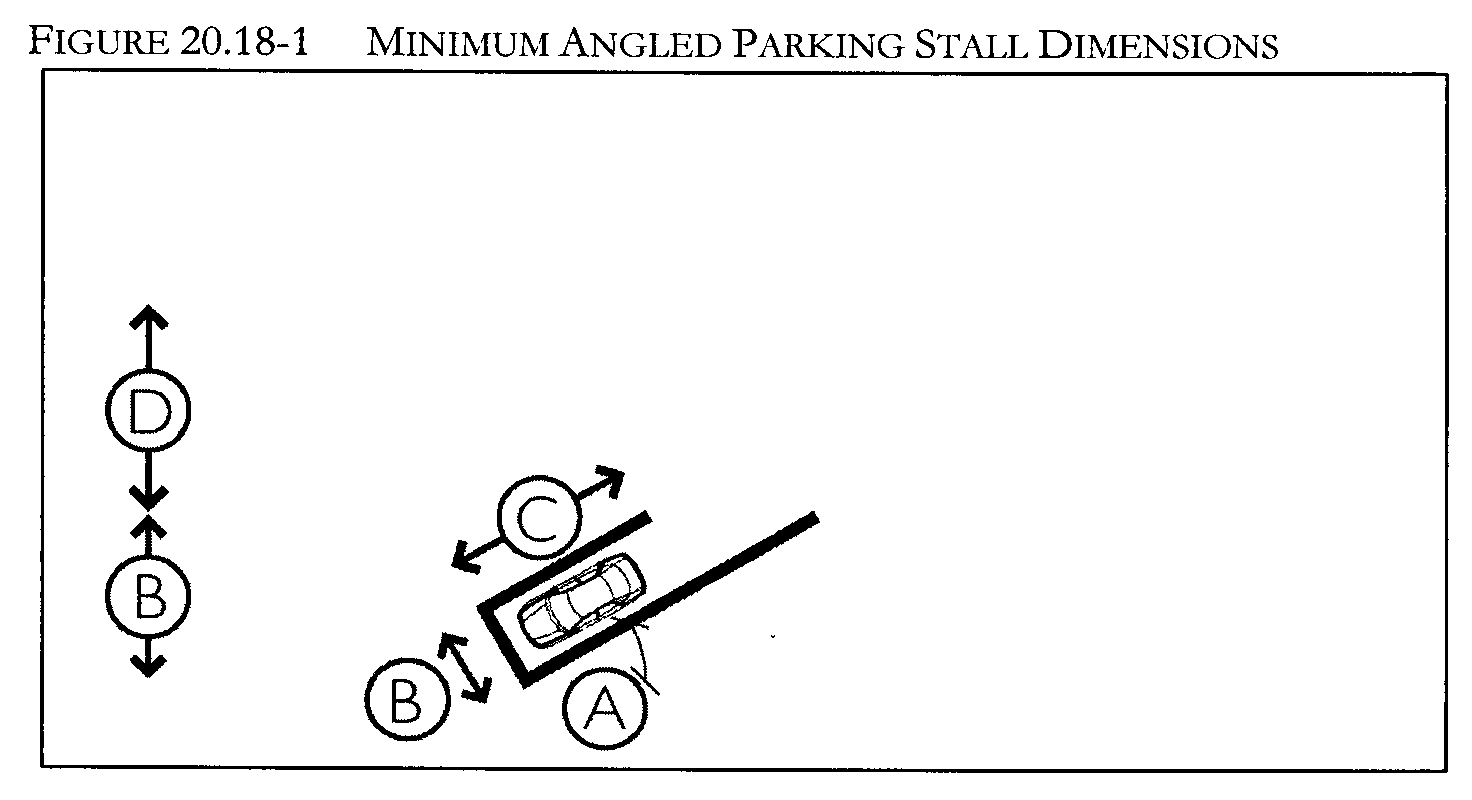
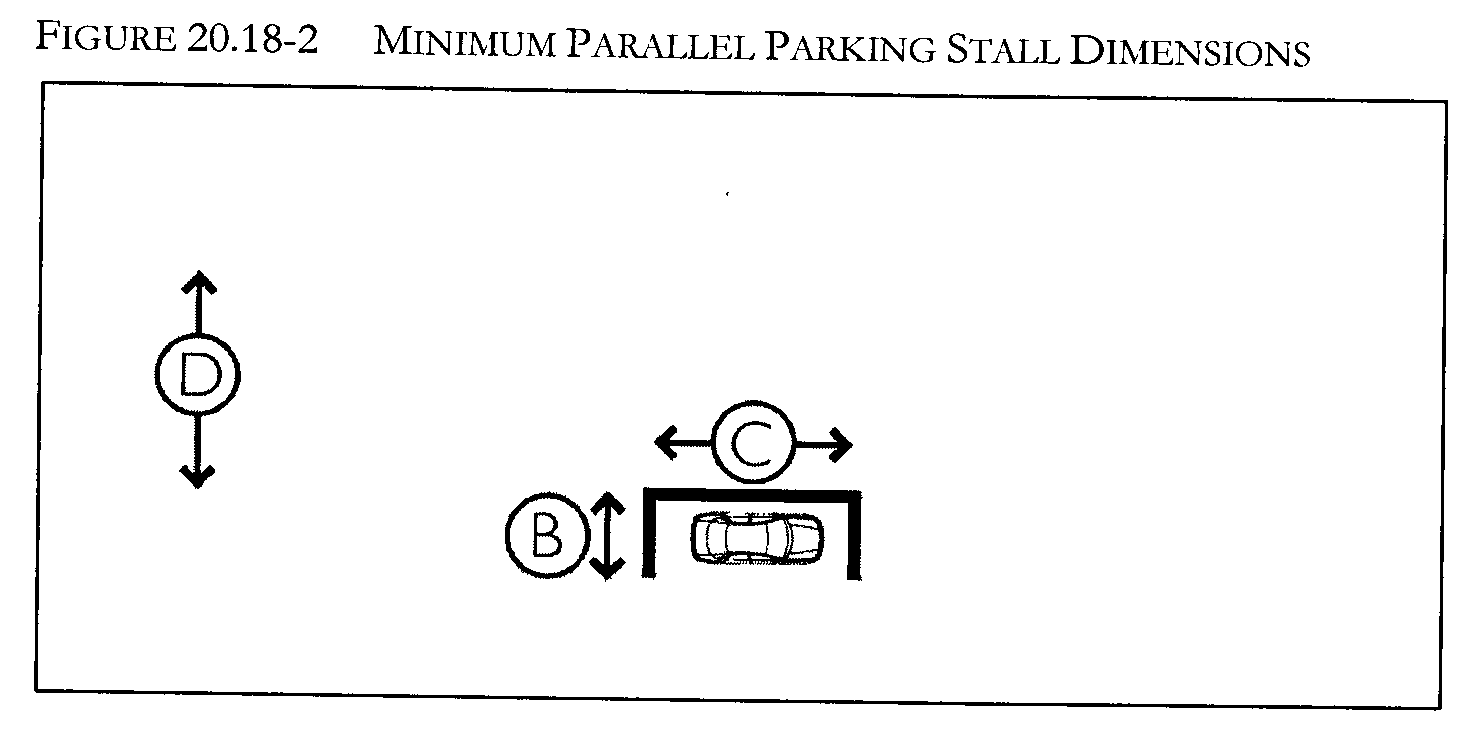
Angled and parallel parking. Angled and parallel parking spaces and parking lot aisles shall be as specified in Table 20.18-3 (Minimum Angled and Parallel Parking Stall Dimensions), Figure 20.18-1 (Minimum Angled Parking Stall Dimensions) and Figure 20.18-2 (Minimum Parallel Parking Stall Dimensions).
TABLE 20.18-3 MINIMUM ANGLED AND PARALLEL PARKING STALL DIMENSIONS
B.
Location of parking areas and spaces.
1.
Setbacks of parking stalls and drive aisles from property lines and buildings shall be as provided in Table 20.18-4 (Parking and Drive Aisle Setbacks, Minimum).
2.
Carpool and vanpool spaces should be located as close as possible to the primary employee entrance(s) of the user(s) which they are intended to serve.
3.
Parking spaces for multiple unit residential dwellings shall be located within one hundred fifty feet from the dwelling unit (front or rear door) for which the space is provided.
4.
For residential development at densities exceeding sixteen units per acre, including residential uses in mixed use development, required off-street parking located in the front half of a lot or within twenty-five feet of the side street on a corner lot shall be covered with a carport, garage or roofed structure. Other spaces may be uncovered if located in the rear half of the lot or site or when more than twenty-five feet from a side street. On larger sites with ten or more dwelling units, uncovered spaces are allowed if setback at least fifty feet from a front property line and twenty-five feet from a street side property line and screened by a wall or landscaping so as not to be visible from a public street.
TABLE 20.18-4 PARKING AND DRIVE AISLE SETBACKS, MINIMUM
C.
Striping and identification.
1.
All automobile parking spaces shall be clearly outlined with double lines painted on the surface of the parking area, with a line located nine inches from each side of the stall sidelines. The striping shall be permanently maintained in a clear and visible manner.
2.
All spaces reserved for carpools and vanpools shall be clearly marked with the words "Carpool Only" or "Vanpool Only", as applicable, on either the wheel stop or curb at the back of each space, or on the pavement at the opening of the space.
3.
Within multiple-family residential developments, required guest parking spaces shall be clearly marked with the word "Guest" either on the wheel stop or curb at the back of each space, or the pavement at the opening of the space.
D.
Pedestrian access.
1.
Commercial and office developments with more than one hundred parking spaces shall include pedestrian walkways at a minimum width of four feet to improve pedestrian safety when walking between the parking area and the commercial or office development.
2.
The design of the pedestrian walkway shall be distinctive to set it apart from the parking area and other paved surfaces.
E.
Surfacing.
1.
All permanent parking spaces and drive aisles shall be paved with asphalt, concrete or other all-weather surface, subject to approval by the director of community development and the city engineer.
2.
Permeable paving materials such as porous concrete/asphalt, open-jointed pavers, turf/gravel grids are a permitted surface material.
3.
The use of light colored materials to help reduce surface temperatures is encouraged.
F.
Wheel stops and curbs.
1.
Drive aisles and parking surfaces contiguous with planter areas shall have a six-inch raised curb separation, constructed per city standards. Where planter areas are used to facilitate drainage and water quality treatment, a flush curb may be approved and wheel stops provided in lieu of a raised curb, at the discretion of the director of community development.
2.
All parking spaces located adjacent to buildings or walls shall have concrete wheel stops located a minimum of two feet from the building or wall.
G.
Maintenance. All parking facilities shall be permanently maintained, free of weeds, litter and debris.
H.
Passenger loading areas.
1.
Passenger loading areas shall be provided for any building or building complex that will generate one hundred or more employees at maximum occupancy. Such areas shall be located convenient to the primary employee entrance(s) of the user(s) that they are intended to serve, and shall be so designated either by signs or painted pavement.
2.
Passenger loading areas shall be designed such that vehicles can safely stop and discharge passengers.
I.
Lighting.
1.
Parking facilities for multiple-family residential, mixed use, commercial, and industrial developments shall be provided with nighttime security lighting designed to confine emitted light to the parking areas.
2.
Parking facilities for commercial and industrial uses shall be lighted from dusk to the termination of business every operating day.
3.
Parking facilities for multiple unit residential developments shall be lighted from dusk until dawn every day.
J.
Screening.
1.
All unenclosed off-street parking areas shall be screened from view of the street by either a three-foot high decorative masonry wall (decorative treatment shall occur on both sides of the wall) or a combination of both decorative wall and landscaped berm as determined by the director of community development.
2.
Other screening methods, such as landscaping (e.g., plantings of evergreen trees and shrubs, densely planted hedges) may be approved by the director of community development.
3.
Within commercial and industrial zoning districts, parking areas that abut residentially zoned property shall be screened by a row of densely planted evergreen trees or similar landscaping. The type, size and spacing of tree shall be subject to review and approval by the director of community development.
K.
Access to right-of-way. Any parking lot or loading facility with vehicular access to or across a public right-of-way shall meet the following standards:
1.
All parking areas shall provide suitable maneuvering room so that all vehicles may enter and exit an abutting street in a forward direction.
2.
No parking space shall be located so that a vehicle will be required to maneuver for position to enter or exit the space within thirty feet of a vehicular entrance from a primary or secondary arterial street, or within twenty feet of a collector or local street.
3.
Access to driveways shall be minimized when possible between adjacent uses. Joint access ways serving adjacent uses are encouraged as a means to minimize curb cuts and avoid breaks in the continuity of street frontages.
L.
Driveways.
1.
Driveways for single-family residences shall have a minimum width of ten feet.
2.
All other driveways or aisles shall have a minimum width of twelve (12) feet for one-way traffic and twenty feet for two-way traffic.
3.
A residential lot with vehicular access from a major, primary, or secondary arterial shall provide a circular driveway or turnaround so that vehicles may enter and exit the street in a forward motion.
(Ord. 2010-05, § 1(exh. A), 2010; Ord. 2011-06, §§ 19, 20, 2011; Ord. 2013-003, § 19, 2013; Ord. 2014-013, § 15, 2014; Ord. 2017-009, §§ 26, 27, 2017; Ord. 2023-008, § 4, 2023.)
20.18.060 - Bicycle facilities.
A.
Parking for bicycles.
1.
Bicycle parking spaces shall be provided at a rate equal to five percent of the total required parking spaces. Spaces shall be in the form of racks (for more transient use) or lockers (for long-term use by employees).
2.
Bicycle parking shall be located in highly visible locations and weather protected areas.
3.
Bicycle and automobile parking areas shall be separated from one another by a physical barrier or sufficient distance to protect bicycles and their rider's from damage by maneuvering automobiles.
4.
All bicycle parking and storage areas shall be paved with asphalt, concrete or other all-weather surface, subject to approval by the director of community development and the city engineer.
(Ord. 2010-05, § 1(exh. A), 2010.)
20.18.070 - Parking structures.
A.
Maximum height. Parking structures shall comply with the building height requirements of the applicable zoning district.
B.
Setbacks.
1.
Above-ground parking structures shall comply with all setback requirements of the applicable zoning district.
2.
Subterranean parking may be located within any required setback area.
C.
All openings for parking structure ingress and egress that face a public street shall be setback a minimum of thirty feet from the street property line.
D.
Stairwells within parking structures shall be substantially open so as to facilitate casual observation.
E.
Safe pedestrian connections shall be maintained between the parking structure and the building(s) it serves.
F.
All exterior walls of the structure shall be furnished with material so as to maintain a common architectural character with the building(s) served by the parking structure.
G.
Parking structure façades shall be broken-up through the use of textured concrete on exterior walls, the incorporation of planters and trellises at each parking level, and other architectural treatments to minimize large blank walls without architectural relief.
H.
At ground level, the perimeter of the parking structure shall be landscaped with a minimum of one tree for every fifteen feet of linear distance of structure façade in addition to required streetscape landscaping. Groundcover and shrubs shall also be provided to break-up the mass of the structure.
I.
Parked vehicles at each level within the structure shall be shielded from view from adjoining streets through the use of architectural appurtenances and landscaping.
(Ord. 2010-05, § 1(exh. A), 2010; Ord. 2019-013, § 27, 2019.)
20.18.080 - Off-street loading.
A.
General requirements.
1.
Off-street loading spaces required. Off-street freight and equipment loading spaces shall be provided for all hospitals, schools, institutions, commercial and industrial land uses.
2.
Minimum number of spaces. The minimum number of loading spaces per building shall be as shown in Table 20.18-5 (Required Loading Spaces) or as determined necessary by the approving authority.
TABLE 20.18-5 REQUIRED LOADING SPACES
3.
Trailer parking/waiting space required. Industrial developments having two or more dock-high loading spaces shall provide one trailer parking/waiting space, minimum twelve feet wide by forty-five feet long, for each two loading spaces.
B.
Dimensions.
1.
Minimum loading space shall be twelve feet in width, forty-five feet in length, and fourteen feet in vertical clearance.
2.
Deviations from the minimum maneuvering standards may be granted by the approving authority if it can be shown that the spatial needs are less than the minimum required due to the truck size and type that will be utilized in the operation of a specific business. In permitting such deviation(s), a covenant of restriction to run with the land shall be recorded that specifies limitations relating to truck size and/or type.
C.
Location.
1.
Loading areas shall be designed to provide for backing and maneuvering on-site, and not from a public street.
2.
Loading and maneuvering areas shall not encroach into required front yard setback areas.
3.
Loading docks and doors shall only be permitted within the interior side or rear yard area, except that the approving authority may authorize loading activities facing a local or collector street for industrial buildings that are designed for rail service. The approving authority may also authorize loading activities facing a public street for industrial buildings located in M2 zones provided that loading activities do not face Central, Edison, Eucalyptus, Euclid, Kimball, Ramona or Schaefer Avenues or El Prado Road, Chino Hills Parkway, Bickmore Avenue, Pine Avenue and Hellman Avenue.
4.
Loading docks and doors shall be set back a minimum of seventy feet from a public street property line. Where loading docks and doors front a public street, the minimum setback from the public street property line shall be one hundred fifty feet.
5.
Where loading docks or doors face a private street or main drive aisle serving three or more units, loading doors and openings shall be positioned such that they do not face the private street or drive aisle.
6.
Truck maneuvering areas shall not encroach into required employee or visitor parking areas.
D.
Striping and identification.
1.
Loading areas shall be striped, indicating the loading spaces and identifying that the spaces are for loading only.
2.
Striping shall be permanently maintained in a clear and visible manner.
E.
Surfacing. All loading areas shall be paved with asphalt, concrete or other all-weather surface, subject to approval by the director of community development and the city engineer.
F.
Wheel stops and curbs. Loading areas contiguous with planter areas shall have a six-inch raised curb separation, constructed per city standards.
G.
Maintenance. All loading areas shall be permanently maintained, free of weeds, litter and debris.
H.
Lighting.
1.
Loading areas shall be provided with nighttime security lighting designed so as to confine emitted light to the loading area and adjacent parking areas.
2.
Loading areas shall be lighted from dusk to the termination of business every operating day.
I.
Screening.
1.
All loading and tractor/trailer parking areas shall be screened from public view by a decorative screen wall, ornamental landscaping or on-site buildings.
2.
All screen walls shall be of compatible material with adjacent buildings, and shall be of sufficient height to provide complete visual screening.
3.
A line-site analysis shall be filed with the development application to demonstrate compliance with loading door screening requirements.
(Ord. 2010-05, § 1(exh. A), 2010.)

