
Chino City Zoning Code
CHAPTER 20
21 - STANDARDS FOR SPECIFIC LAND USES
20.21.010 - Purpose.
The purpose of this chapter is to establish standards for specific land uses that apply city-wide.
(Ord. 2010-05, § 1(exh. A), 2010.)
20.21.020 - Crop cultivation and agricultural product stands.
A.
Crop cultivation. Crop cultivation may be conducted subject to the following regulations:
1.
A minimum setback of fifteen feet is required between the crop cultivation area and all adjacent property lines.
2.
Sufficient on-site circulation shall be provided to accommodate vehicles and equipment used in the farming operation.
3.
The amount of vehicles, equipment, and packing crates maintained on the site shall be limited to that which is only necessary to support the farming operation.
4.
All farming equipment shall use properly operating mufflers. All staging areas shall be located away from adjacent residential uses.
5.
All vehicles and equipment shall be located at the rear of the site away from public view.
6.
Review and approval by the director of community development is required for the use of manure, pesticides, herbicides, or other chemicals in the farming operation. If permitted, they shall be used and stored according to industry standards to prevent such products from becoming airborne.
7.
At all times during the farming operation and including any interim period between crops, the operator shall be responsible for dust suppression and erosion control.
B.
Agricultural product stands. Stands for agricultural products grown on-site shall comply with the following regulations:
1.
Agricultural product stands are permitted as an incidental use to an administratively permitted crop cultivation use.
2.
The owner of the stand shall be the owner or lessee of the parcel on which it is located.
3.
A maximum of one stand per parcel is allowed.
4.
The floor area of a stand shall not exceed five hundred square feet.
5.
General standards:
a.
Stands shall be an accessory use to an on-site agricultural use.
b.
Stands shall only be for the retail sale of plant products grown or produced on-site.
c.
A minimum of twenty-five percent of the parcel on which the stand is located shall be devoted to agricultural uses.
d.
The stand shall comply with the height and setback requirements specified for the zoning district in which it is located.
e.
Produce shall not be sold or purchased directly from motorized vehicles.
f.
Signs in conjunction with the farming operation shall only be permitted on the sales stand, and shall only advertise the product being sold and pricing information. Directional signs may be permitted on the site subject to review and approval by the city.
g.
Parking areas shall either be paved or treated with gravel to control dust.
(Ord. 2010-05, § 1(exh. A), 2010; Ord. 2011-06, § 21, 2011.)
20.21.030 - Animal keeping.
Animal keeping activities shall comply with the following regulations.
A.
General standards.
1.
Proper management of animal waste shall be carried out in accordance with the San Bernardino County Uniform Environmental Health Code.
2.
Animals shall be secured by a fence or wall at least five feet in height, made of chain-link, wood with horizontal members no less than six inches apart, solid masonry or other appropriate solid confining material. Property line walls and fences may be used to secure animals, provided the appropriate restraint distances are maintained.
3.
Animals other than cats shall be prevented from leaving the premises on which they are kept, through the use of an appropriate method of containment.
4.
Animals shall be kept a minimum of one hundred feet from any domestic water well.
5.
Kennels and catteries shall only be permitted on lots or parcels two or more acres in size.
6.
Lot area used to qualify one animal type shall not be reused to qualify another animal type.
B.
Noncommercial (Household) Animal Keeping.
1.
Animal keeping as a primary use of the property must be on a lot or parcel no less than two acres in size.
2.
No person shall slaughter any animal on any lot or parcel.
3.
Crowing poultry and fowl shall not be permitted on any lot or parcel.
4.
Table 20.21-1 (Maximum Number of Animals for Noncommercial Uses) establishes the maximum number of animals permitted per square foot for noncommercial uses.
5.
Potbelly pigs are permitted only if spayed or neutered with tusks removed. No potbelly pigs may exceed ninety pounds. The keeping of potbelly pigs and/or pygmy goats as a household pet requires the approval of an Administrative Approval.
6.
Animals not listed in Table 20.21-1 are considered Exotic Animals and are allowed subject to an Administrative Approval only within the RD 1 and RD 2 districts. One animal is allowed per lot. Exotic animals include those animals not listed in this section, which are generally able to be domesticated such as llamas, alpacas, and emus. Excessively large, ferocious, wild, and/or venomous animals are not permitted.
7.
The keeping of five to ten chickens in the RD 4.5 districts requires the approval of an administrative approval.
8.
Chickens shall be provided a coop.
9.
Chickens shall be confined to the rear and side yard at all times.
10.
Chicken droppings and food scraps shall be properly disposed of at least once a week or more frequently if, in the opinion of the director of community development, it is necessary to prevent an unsanitary condition.
TABLE 20.21-1 MAXIMUM NUMBER OF ANIMALS FOR NONCOMMERCIAL USES
C.
Commercial animal keeping.
1.
General standards.
a.
Animals shall be restrained at a distance of at least forty feet, measured in a straight line, from any habitable structure or structure used for public assembly located on adjoining property.
b.
Animals shall be restrained a distance of at least five feet from interior side and rear property lines, and fifteen feet from street side property lines.
c.
Exotic animal livestock shall only be permitted in the AG zone, at the rate of one animal for each six thousand square feet of lot area. Lot area used to qualify one animal type shall not be reused to qualify another animal type.
2.
Dairies shall comply with the following:
a.
Property shall contain a minimum of ten acres.
b.
Corrals shall have a minimum of five hundred square feet per cow.
c.
Animals shall be permitted at a rate not to exceed twenty per acre.
d.
A minimum of five gross acres per two hundred cows, or fraction thereof, shall be provided for waste disposal and open uses such as field crops and pastures. For each additional forty cows, one acre must be provided for waste disposal.
3.
Ranches shall comply with the following:
a.
The site shall contain a minimum of five acres.
b.
Where the ranch abuts a residentially zoned property, the site shall be screened from view by a six-foot-high decorative masonry block wall or other similar view obstructing fence or wall, as approved by the director of community development.
4.
Maximum number. Table 20.21-2 (Maximum Number of Animals for Commercial Uses) establishes the maximum number of animals permitted per square foot for commercial uses.
TABLE 20.21-2 DEVELOPMENT STANDARDS FOR CHICKEN COOPS
[1] Chicken coops shall be located in the rear yard.
TABLE 20.21-3 MAXIMUM NUMBER OF ANIMALS FOR COMMERCIAL USES
(Ord. 2010-05, § 1(exh. A), 2010; Ord. 2011-06, § 22, 2011; Ord. 2013-003, §§ 21—23, 2013; Ord. 2021-001, § 16, 2021; Ord. 2022-010, §§ 10, 11, 7-19-2022.)
20.21.040 - Home occupations.
A.
Purpose. These standards allow for the operation of limited home-based businesses that are incidental to and compatible with residential uses permitted within residential zoning districts.
B.
Permit Required. Establishment of a home occupation shall require an Administrative Approval of a home occupation permit.
C.
Exempt Uses. A home occupation permit shall not be required for an in-home educational activity, including but not limited to music lessons, academic tutoring or religious instruction, provided no more than five students are present at any one time, or a business that requires only a phone and/or computer, with no deliveries or storage of items related to the business to occur at the home.
D.
Prohibited uses. The following uses are prohibited as home occupations:
1.
Gun and/or ammunition sales.
2.
Barber and beauty shops, physical therapy, psychotherapy, or similar personal services.
3.
Businesses which involve the harboring, training, breeding, raising, grooming, or veterinary care of cats, dogs or other animals on the premises.
4.
Carpentry, cabinet making or furniture refinishing.
5.
Bee keeping.
6.
Medical and dental offices, clinics or laboratories.
7.
Repair, fix-it or plumbing shops.
8.
Storage of equipment, materials and other accessories to the construction or service trades.
9.
Motor vehicle repair (body or mechanical), upholstery or painting.
10.
Welding or machining.
11.
Gymnastics or athletic instruction.
12.
Recording studios.
13.
Outdoor recreation.
14.
Retail sales, excepting Cottage Food Operations per Government Code section 51035.
15.
Commercial food preparation (catering), excepting Cottage Food Operations per Government Code section 51035.
16.
Any other use determined by the director that is not incidental to and/or compatible with residential activities.
E.
Operating standards. Home occupations shall comply with the following operating standards:
1.
A home occupation shall be clearly incidental and subordinate to the primary residential use.
2.
Only the occupants of the dwelling may engage in the home occupation.
3.
There shall be no change in the outward appearance of the premises resulting from the home occupation.
4.
There shall be no advertising that identifies the home occupation by street address.
5.
The home occupation shall be conducted within an enclosed structure, completely confined to one room of the dwelling, excepting the garage, and shall occupy no more than ten percent of the gross floor area of the dwelling.
6.
Only one vehicle, no larger than a one-ton pick-up truck or van, may be maintained on the property, either directly or indirectly in connection with the home occupation.
7.
There shall be no outdoor use or storage of material or mechanical equipment not recognized as being part of a normal household or hobby use.
8.
There shall be no storage of flammable, combustible, explosive, and/or hazardous materials associated with the home occupation.
9.
Activities conducted and equipment or material used shall not change the fire safety or occupancy classifications of the premises.
10.
The home occupation shall not generate vehicular or pedestrian traffic in greater volumes than would reasonably be expected in a residential neighborhood.
11.
The home occupation shall not involve the use of commercial vehicles for delivery of materials at greater frequency than would reasonably be expected in a residential neighborhood.
12.
No equipment or processes shall be used which create noise, odor, smoke, glare, dust, fumes, vibration, or result in interference with radio or television reception detectable to the normal senses outside the dwelling unit in which the home occupation is conducted.
13.
If the home occupation is to be conducted on rental property, the property owner's written authorization shall be provided on the home occupation permit application.
14.
If the home occupation is to be conducted in a residence that is part of a homeowner's association, the association's written authorization shall be provided on the home occupation permit application.
15.
No home occupation shall be conducted without a current business license obtained pursuant to the provisions of Title 5 (Business Licenses and Regulations) of the Chino Municipal Code.
16.
Retail sales from the location of the home occupation, in conjunction with a Cottage Food Operation per Government Code section 51035, shall be limited to the hours of 8:00 a.m. to 8:00 p.m.
(Ord. 2010-05, § 1(exh. A), 2010; Ord. 2013-003, §§ 24—27, 2013; Ord. 2016-005, § 14, 2016.)
20.21.050 - Conversion of residential structures.
A.
Permit required. Conversion of a structure originally constructed for residential use and currently occupied by a resident, to a commercial use requires planning commission approval of a special conditional use permit. To approve the conversion, the planning commission shall make the following findings:
1.
All applicable provisions of this Code are met, including but not limited to landscaping and parking.
2.
The proposed conversion is consistent with the general plan and any applicable specific plans.
3.
The overall design and physical condition of the conversion achieves a high degree of appearance, quality and safety.
4.
The conversion would not displace predominantly low- and moderate-income families or tenants without adequate provision for suitable relocation of such families or tenants.
B.
Improvements required. A structure that is permitted to be converted shall be remodeled and upgraded to meet all federal, state and local codes and ordinances for commercial buildings, which are in effect at the time of conversion.
(Ord. 2010-05, § 1(exh. A), 2010.)
20.21.060 - Live/work units.
A.
Purpose. This section establishes standards for dwelling units that function as both work space and a residential accommodation.
B.
Limitations on use.
1.
Nonresidential uses of a live/work unit shall be only those uses that are allowed within the applicable zoning district.
2.
A live/work structure shall be occupied by only the business operator. Live/work structures shall serve primarily as a business with accommodations for living space.
3.
Exclusive residential use is not allowed in a live/work unit.
C.
Prohibited uses. The following uses are not permitted as part of a live/work unit:
1.
Adult-oriented businesses.
2.
Vehicle sales, service, maintenance or repair.
3.
Welding, machining or open-flame work.
4.
Manufacturing or processing activities.
5.
Any use that might affect the health or safety of nearby residents or associated with hazardous materials and other uses determined incompatible by the community development director because of their potential to create dust noise, vibration, noxious gases, odors, smoke or any other negative impacts are not permitted in live/work units.
D.
Design standards.
1.
Floor area requirements. The minimum floor area of the live/work unit shall be one thousand square feet. A maximum of thirty percent of this space shall be reserved for work space, the rest reserved for occupancy.
2.
Access. Each unit shall be clearly separate from other units and any different uses which may be in the structure and should be accessed from common public access areas, corridors, halls and/or public sidewalks.
3.
Commercial or industrial use. The design of live/work units shall be similar to structures occupied by commercial or industrial uses commonly found in the vicinity of the live/work units.
E.
Operating standards.
1.
Occupancy. Living space and working space shall not be separately rented or sold as a residential space for persons not working on the premises or as a place of business for persons not living on the premises, but both uses shall be occupied by the same person, the business operator of the unit.
2.
Sale or rental. No portion of the live/work unit may be rented or sold separately from the business operator working or living in the unit.
3.
Notice to occupants. All adjacent occupants and users shall receive written notice that levels of noise, dust odor, fumes or other effects associated with commercial or industrial use may be present in the area surrounding the live/work unit.
4.
Business license. The operator and resident of a live/work space shall maintain at all times a valid City of Chino business license.
(Ord. 2010-05, § 1(exh. A), 2010.)
20.21.070 - Residential care facilities, large.
A.
Purpose. This section establishes standards for residential care facilities for the physically and/or mentally handicapped to provide quality services and facilities and minimize impacts to neighboring properties.
B.
Applicability. The standards below apply only to large residential care facilities with seven or more residents in addition to the caregiver.
C.
Permit required. Planning commission approval of a special conditional use permit is required to establish a large residential care facility. The application for a residential care facility shall include the following information:
1.
The number of persons being cared for.
2.
The number of employees.
3.
The facility's hours of operation.
4.
The state license number.
5.
A site plan, including locations of existing residences or any other nearby structures.
6.
An accurate traffic circulation plan detailing parking, circulation and areas for pick-up and drop-off.
D.
State licenses and permits required.
1.
All required state licenses and permits shall be obtained or applied for prior to applying for a permit to operate a residential care facility.
2.
No city permit shall be effective until satisfactory evidence has been provided demonstrating that all necessary state licenses and permits have been obtained.
E.
Development standards within commercial zones. Residential care facilities in commercial zones shall be developed in accordance with all development standards and density requirements applicable to the RD 20 zone.
F.
Maximum concentration. No residential care facility may locate within five hundred feet of any other such facility.
G.
Density. The total square footage of the residential care facility shall average three hundred fifty square feet per resident.
H.
Recreation areas.
1.
Recreation areas shall be enclosed by a minimum six-foot-high fence or wall. Property line fences or walls may be used to fulfill this requirement.
2.
Any swimming pool, pond, wading pools, or similar bodies of water greater than eighteen inches in depth shall be fully enclosed by a minimum five-foot-high nonclimbable fence.
3.
All entrances and exits shall have self-closing and latching gates. All latches shall be located at least fifty-four inches above adjacent grade.
4.
The minimum size of recreation and entertainment facilities shall equal one hundred fifty square feet for each living unit.
5.
An assembly/lounge area with enough seating capacity to accommodate sixty percent of all residents at one time shall be included in the care facility, in addition to adequate restroom facilities and an activity room.
I.
Open space requirements.
1.
A minimum of thirty percent of the net lot area shall be dedicated to improved permanent open space accessible to all residents of the development, exclusive of driveways, parking areas, dwellings and nonrecreation building areas.
2.
Open space shall not be less than six feet in width at its narrowest dimension.
J.
Minimum unit size. A minimum interior unit area of three hundred fifty square feet shall be provided.
K.
Building accessibility and safety equipment. Indoor common areas and living units shall be handicapped adaptable and be provided with all necessary safety equipment (e.g., grab bars, ramps etc.), as well as emergency signal/intercom systems.
L.
Parking. Off-street parking spaces shall be located a maximum of one hundred fifty feet from building entrances.
(Ord. 2010-05, § 1(exh. A), 2010.)
20.21.080 - Emergency shelters.
A.
Purpose and Intent. The purpose of these standards is to ensure the development of emergency shelter facilities does not adversely impact adjacent property or the surrounding neighborhood, and that these facilities will be developed in a manner that protects the public health, safety, and general welfare of all city residents while meeting the housing needs of the community.
B.
Use standards.
1.
Number of beds.
a.
Emergency shelter facilities shall contain no more than thirty beds and shall serve no more than thirty persons at any one time.
b.
Reserved.
2.
Duration of stay.
a.
Emergency shelter shall be available to residents for no more than ninety days.
b.
Reserved.
3.
Staff and services shall be provided to assist residents in obtaining permanent shelter, at no cost to the residents.
4.
Emergency shelter providers shall have a written management plan including, as applicable: Provisions for staff training, neighborhood outreach, security, and screening of residents to insure compatibility with the type of services provided.
5.
Proximity to other emergency shelters. Emergency shelters shall be located a minimum of three hundred feet from any other emergency shelter.
6.
Hours of operation. Facilities shall establish set hours for client intake and discharge.
7.
On-site management. On-site personnel shall be provided at all times.
8.
Lighting. Facilities shall provide security and safety lighting in the parking lot, on buildings, and areas of pedestrian access.
9.
Security. Facilities shall provide secure areas for personal property.
10.
Waiting area. If intake of clients will occur on-site, a minimum two hundred square foot enclosed or screened waiting area shall be provided to prevent queuing in the public right-of-way. Additional waiting area may be required depending on the anticipated client load.
11.
Living area. One hundred twenty square feet of indoor living area of indoor living area, plus an additional fifty square feet of living area for each additional person over two persons, excluding staff, of which thirty percent shall be common or recreational space.
(Ord. 2010-05, § 1(exh. A), 2010; Ord. 2013-003, §§ 28—30, 2013.)
20.21.090 - Child day care facilities.
A.
Purpose. This section provides regulations for child day care facilities to protect the safety and well-being of children and minimize impacts to neighboring properties.
B.
Types of child day care facilities.
1.
Residential day care facilities may provide care for up to fourteen children and are required to have an adult assistant on the premises.
2.
Child day care centers are childcare facilities that are not provided within a residential use. Child day care centers include pre-schools, nursery schools, infant care centers and after-school facilities.
C.
General standards that apply to all child day care facilities.
1.
In addition to those off-street parking spaces required of the primary residential land use, one off-street parking space shall be provided for each employee of the day care provider. The driveway may be used to fulfill this requirement.
2.
Written verification that all fire and life safety standards have been met shall be submitted to the director of community development prior to the commencement of the use.
3.
Any swimming pool, pond, wading pools, or similar bodies of water greater than eighteen inches in depth shall be fully enclosed by a minimum five-foot-high non-climbable fence. Additionally, all entrances and exits shall have self closing and latching gates. All latches shall be located at least fifty-four inches above adjacent grade.
4.
All trash receptacles and air-conditioning units located outdoors and next to any active play area shall be fully enclosed by a wall or fence to protect children.
5.
Trash receptacles shall be maintained in a sanitary condition with no odor detectable from adjacent properties.
6.
Hours of operation shall be less than twelve hours per day.
7.
Noise levels shall comply with Title 9 of the Municipal Code.
D.
Residential day care facilities.
1.
The use shall be clearly incidental and subordinate to the primary.
2.
All required state licenses and permits shall be obtained.
3.
There shall be a maximum of fourteen children allowed per residential day care facility.
E.
Child day care centers.
1.
An on-site vehicle turn-around or separate entrance and exit points, and passenger loading area must be provided. The city shall specifically consider the location and appearance of the proposed turn-around or access in determining compatibility with surrounding uses.
2.
The operator must obtain the written consent of the property owner when the child day care facility is located.
3.
Outside play areas shall have a minimum fence height of five feet.
4.
Outside play areas shall be located a minimum of ten feet from public rights-of-way.
5.
Outside play areas shall be a minimum of seventy-five square feet per child, excluding infants.
(Ord. 2010-05, § 1(exh. A), 2010; Ord. 2023-001, § 6, 2023.)
20.21.100 - Hotels, motels, and bed and breakfast and boarding houses.
Hotels and motels shall comply with the following standards:
A.
Occupancy restrictions.
1.
Guestrooms may only be rented once in any single twenty-four-hour period.
2.
The maximum length of stay by guests shall not exceed thirty consecutive days.
B.
Site design.
1.
A vehicle drop-off zone shall be provided to accommodate guest loading and unloading.
2.
A buffer shall be provided between adjacent residential uses including a screening fence with a minimum height of seven feet and a landscaped area with a minimum width of ten feet.
(Ord. 2010-05, § 1(exh. A), 2010.)
20.21.110 - Caretakers quarters.
A.
Purpose and minimum size. Caretaker quarters shall be permitted for the purpose of providing twenty-four-hour property surveillance and shall not exceed six hundred square feet in total floor area, unless approved as part of a special conditional use permit.
B.
Permitted use. Caretaker quarters shall be permitted within the principal structure on the property.
C.
Occupancy. The owner or an employee shall occupy the caretaker quarters.
D.
Maximum bedrooms. The caretaker quarters shall have a maximum of two bedrooms.
E.
Reversion to industrial use. Caretaker quarters located in industrial districts shall revert to industrial uses upon termination of the conditional use permit or upon the business's closure.
(Ord. 2010-05, § 1(exh. A), 2010.)
20.21.120 - Public assembly.
Public assembly uses shall comply with the following:
A.
Applicability. This section applies to all public assembly uses including, community centers, religious institutions, schools, museums, recreational facility or similar use.
B.
Location. Public assembly uses shall be located on a major collector or arterial street.
C.
Parking and traffic.
1.
Peak traffic flows shall be managed by the owner of the property.
2.
All public assembly uses shall design traffic flows to minimize impact to residential uses and adjacent properties.
D.
Noise. Noise levels shall comply with Title 9 of the Municipal Code.
(Ord. 2010-05, § 1(exh. A), 2010.)
20.21.130 - Mobile home parks.
Mobile home parks shall be constructed and maintained in accordance with the following:
A.
Minimum setbacks.
1.
Front yard: Fifteen feet, measured from the face-of-curb of internal private streets or parking spaces.
2.
Rear yard: Ten feet, measured from the space line.
3.
Interior side yard: Five feet, measured from the space line.
4.
Street side yard: Fifteen feet, measured from the face-of-curb of internal private streets.
B.
Permitted projections into setback areas. Eaves, canopies, porches or other similar projections may extend a maximum of one and a half feet into a required internal setback area.
C.
Space coverage. Maximum mobile home space coverage shall be seventy-five percent.
D.
Support pad. Each mobile home shall be equipped with skirting, or provided with a support pad designed to give the appearance of the mobile home being located on-grade.
E.
Utilities. All on-site utilities shall be located underground.
F.
Driveway approaches. Driveway approaches serving developments of ten or more units shall be delineated with enhanced paving treatment, such as interlocking pavers, textured and color pigmented concrete, or stamped concrete.
G.
Security plan. Prior to occupancy of the first space, the developer or owner may be required to provide a detailed security plan identifying security measures provided as part of the mobile home park.
(Ord. 2010-05, § 1(exh. A), 2010.)
20.21.140 - Convenience markets and grocery stores.
A.
Convenience markets. Where a convenience market abuts residentially zoned property, no commercial loading activity is permitted between the hours of 6:00 p.m. and 6:00 a.m.
B.
Grocery stores.
1.
Where a grocery store or supermarket abuts residentially zoned property, no commercial loading activity is permitted between the hours of 6:00 p.m. and 6:00 a.m. In addition, the planning commission may restrict hours of operation based upon potential adverse impacts on the surrounding neighborhood.
2.
The final approving authority may impose additional special operational conditions, requirements or standards, as it deems necessary to ensure the public health, safety and general welfare.
3.
New or substantially altered commercial development utilizing outdoor shopping carts shall develop and implement, in coordination with the property owner, an anti-theft/abandoned cart prevention plan. The anti-theft/abandoned cart prevention plan must include, at a minimum, the following information subject to review and approval by the director of community development:
a.
Pertinent business information, including the name and address of the business, phone number for the premises where business is conducted. If the address and phone number of the cart owner is different from the business owner, this information shall also be provided.
b.
Cart identification conforming to state law.
c.
A complete cart inventory of all carts belonging to, maintained on or in the premises.
d.
Standard procedure for written notification to customers that removal of carts from the premises is prohibited and a violation of state and local law. Appropriate notification may be provided in the form of shopping bags, flyers, or any form of written notification effective in notifying customers of the prohibition.
e.
A description of physical measures designed to prevent the removal of carts from the premises. These measures may include, but are not limited to: Devices attached to carts which prevent their removal from the premises or a designated employee or security guard posted to deter or stop customers from removing carts from the premises.
f.
A standard procedure for retrieval of abandoned carts, or proof that the owner has entered into a contract approved by the City of Chino for cart retrieval services.
g.
A description of an ongoing employee training program designed to educate all employees on the anti-theft/abandoned cart prevention plan.
(Ord. 2010-05, § 1(exh. A), 2010.)
20.21.150 - Carts and kiosks.
A.
Applicability. The standards in this section apply to any portable, nonmotorized wagon, cart, or similar nonwheeled unit used by a vendor from which retail goods, food, and/or beverages are offered for sale.
B.
Operating conditions.
1.
A cart/kiosk shall only be permitted on public or private property within a defined plaza area between buildings that are part of a professional office, commercial or mixed use development.
2.
The cart/kiosk should generally not exceed five feet in width, nine feet in length, and no more than six feet in height excluding canopies, umbrellas or transparent enclosures. Deviations in size may be approved by the director of community development on a case-by-case basis based on unique site or user circumstances.
3.
The cart/kiosk shall not obstruct access to or occupy a parking space, obstruct access to a parked vehicle, impede the delivery of materials to an adjoining property, interfere with access to public property or any adjoining property, or interfere with maintenance or use of street furniture.
4.
The number of employees per individual cart/kiosk shall be a maximum of two persons at any one time.
5.
All cart/kiosk uses shall be self-contained or located on a site that has been specifically designed to provide for water, waste and power to operate. No exposed pipes or wires are permitted.
6.
All packaging containers or boxes shall be stored within the cart/kiosk.
7.
The sale of alcoholic beverages shall be prohibited.
8.
The design, color scheme and signage of the cart/kiosk shall be appropriate to its location.
(Ord. 2010-05, § 1(exh. A), 2010.)
20.21.160 - Outdoor seating areas.
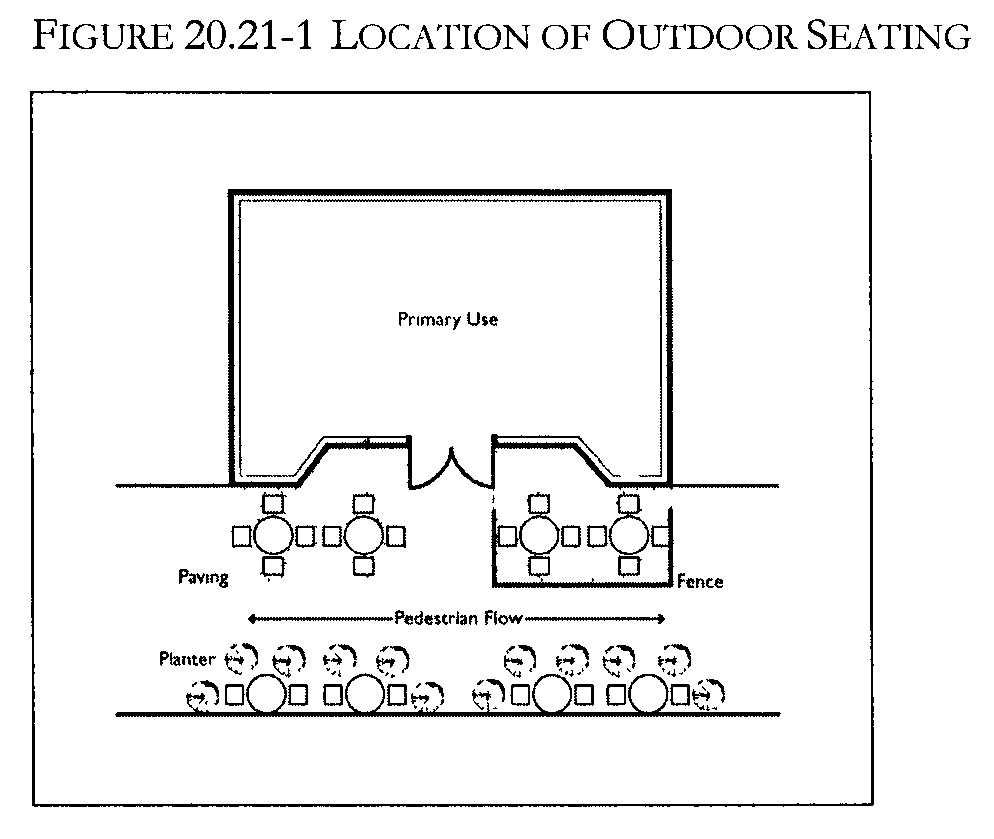
Outdoor seating areas permitted in conjunction with an established eating and/or drinking place shall comply with the following, as shown in Figure 20.21-1:
A.
Location.
1.
The seating area shall be located adjacent to the building (or portion of building) occupied by the primary use.
2.
The seating area may also be located in the front, side, or rear of an adjacent business provided that permission is granted by the adjacent businesses.
B.
Alcohol service.
1.
Alcohol may only be served to the outdoor seating areas if the accompanying restaurant holds an active liquor license.
2.
If alcoholic beverages are served to the outdoor seating area, the seating area must be fenced and a restaurant employee shall seat restaurant patrons.
C.
On-site parking required. Outdoor seating areas shall be included in the required parking calculation for the use which it serves.
D.
Barrier. A barrier is required for the leading edge of all outdoor seating areas. The leading edge of the outdoor seating is defined as the section of the outdoor seating area boundary which is perpendicular or nearly perpendicular to the building wall or curb line.
E.
Clearance. The outdoor seating area shall be constructed so as to provide a minimum through-pedestrian traffic pathway of five feet in width and be clear from all structures, including streetlamps, trees, fire hydrants, and buildings. The pathway shall also comply with the disabled access regulations in the latest adopted edition of the California Building Code.
F.
Seating area.
1.
Overhead awnings, patio covers, and other shade structures for the purposes of covering the seating area are permitted. Shade structures shall be set back a minimum of ten feet from any street side property line and shall be architecturally compatible with the main building.
2.
Outdoor seating areas shall be enclosed by appropriate materials in instances where the seating is served by wait-staff or alcohol is served, or both. Appropriate materials for enclosure of outdoor seating include metal or wood railings, or other suitable material approved by the community development director and the building official.
G.
Menu board.
1.
Outdoor seating areas, including sidewalk cafes, may have a menu board.
2.
The menu board shall be located within the area devoted to outdoor seating and shall not exceed two feet in width and three feet in height.
3.
When the accompanying restaurant is closed, the menu board must be stored.
H.
Hold harmless. If the outdoor seating area is or will be located within the public right-of-way, the applicant shall provide the city a satisfactory agreement to indemnify and hold the city harmless from any and all claims of injury or damage to persons or property attributable in whole, or in part, to the location, existence or operation of the outdoor seating area. The use of any public right-of-way shall be subject to review by the director of community development and the city engineer.
I.
Permits required. Establishment and operation of an outdoor seating area shall be subject to administrative approval. Applications for approval of an outdoor seating area shall include the following in addition to all materials as required by Chapter 20.23:
1.
A site plan drawn to scale of the proposed outdoor seating area including location and placement of tables, chairs, seats, planters, umbrellas, business entrances and windows.
2.
Photographs or brochures depicting the tables, chairs, umbrellas or other pertinent physical features of the outdoor seating area.
(Ord. 2010-05, § 1(exh. A), 2010; Ord. 2011-06, §§ 23—25, 2011; Ord. 2016-005, § 15, 2016.)
20.21.170 - Drive-thru facilities.
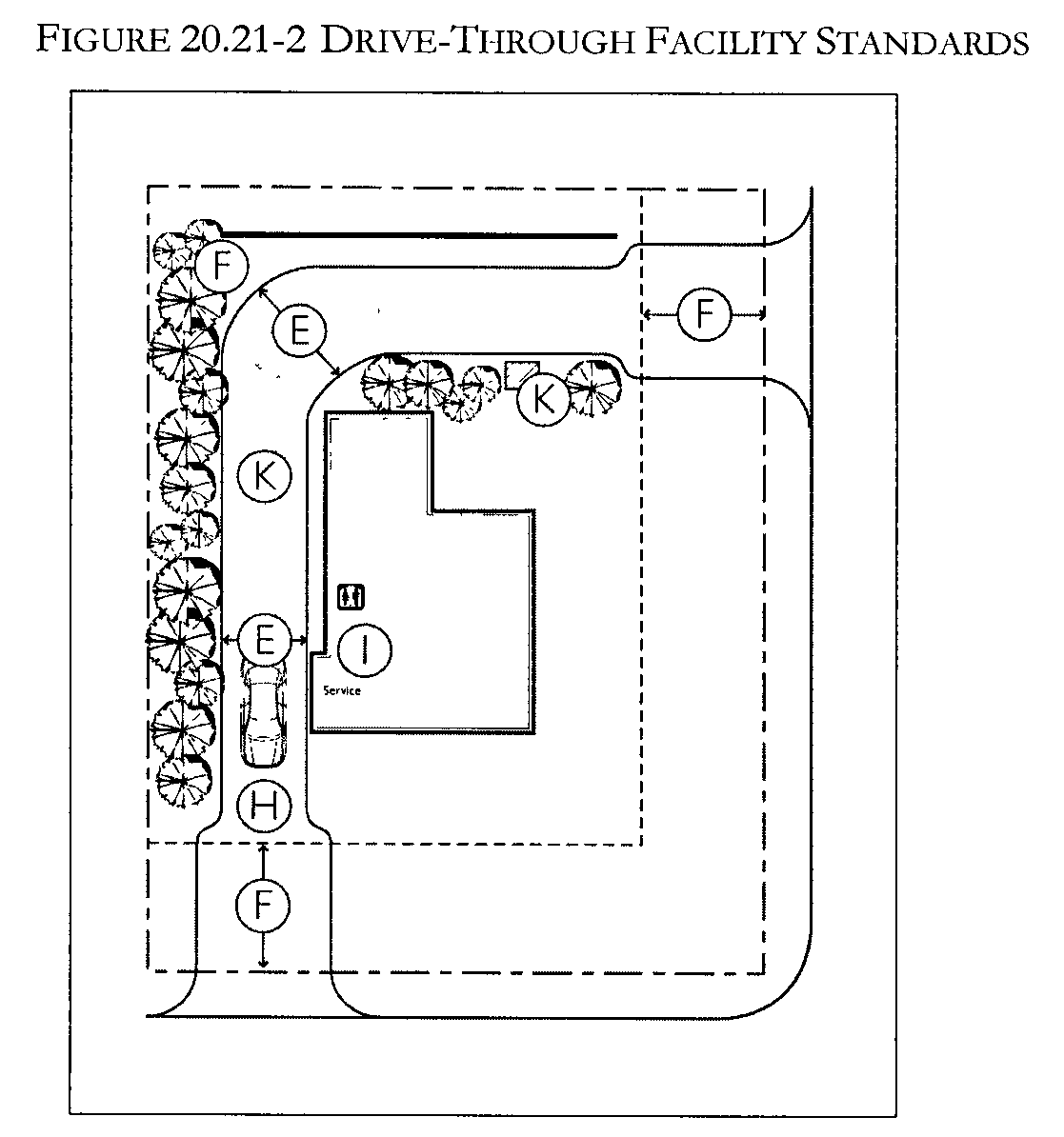
Drive-through facilities shall be developed in accordance with the following standards, as shown in Figure 20.21-2:
A.
Aisle width. Drive-through aisles shall have a minimum width of eleven feet on straight sections and twelve feet on curved sections.
B.
Aisle setback. Drive-through aisles shall be set back a minimum of fifteen feet from all street property lines and shall be screened by landscape berms, low garden walls, or a combination thereof.
C.
Landscape buffer. There shall be a minimum twenty-five-foot-wide landscaped buffer between drive-through aisles and any abutting residentially zoned property.
D.
Exits. No drive-through aisle shall exit directly onto a public street or alley.
E.
Screening. All service areas and restrooms accessed from the exterior of the building shall be screened from view of the public street.
F.
Design. Drive-through facilities within an integrated shopping center shall be consistent with the center in terms of architectural design and detailing, roof material, exterior finish materials and color.
G.
Noise. Drive-through facilities that rely upon the use of speaker/microphone stations for the placing and/or receiving of customer orders, shall locate the station a minimum of fifty feet from any residentially zoned property. In no case, however, shall noise emanating from a speaker/microphone station be audible beyond the property line.
H.
Length of queuing lane. Drive-through facilities shall provide a queuing lane sufficient in length to accommodate five vehicles at the point of food ordering.
(Ord. 2010-05, § 1(exh. A), 2010.)
20.21.180 - Schools for personal enrichment.
A.
Submittal requirements. At a minimum, the following information shall be submitted with an application requesting approval of a school of personal enrichment:
1.
The proposed hours of operation.
2.
A schedule of classes including the times of each class and anticipated number of students.
3.
The number of parking stalls dedicated to the lease area, location of a pick-up/drop-off area, an access/parking plan, and the anticipated parking demand.
4.
If the school of personal enrichment is to be located within a business or industrial park, provide a list of tenants within the park, type of business, and hours of operation.
5.
Provide information on how the walls of the lease area will be insulated or other measures utilized to ensure music and/or other noises will not adversely affect adjacent tenants.
(Ord. 2010-05, § 1(exh. A), 2010.)
20.21.190 - Outdoor displays and sales.
A.
Permanent open-air sales. Permanent open-air sales, displays and activities shall only be permitted in conjunction with a permitted commercial use and shall be subject to the following standards:
1.
Outdoor display along a store front shall be limited to plant material, garden tools and patio furniture (including outdoor tables and chairs, barbecues, lighting fixtures, umbrellas, hammocks, and other similar items). The outdoor display of any other type of item shall be screened from view of the public street, and driveways and parking areas accessible to the public, except that the approving authority may approve specific areas for the display of bulk retail items along a store front provided:
a.
The display area along the store shall not exceed ten percent of the lineal frontage of the building; and
b.
The materials being displayed shall be stacked no higher than fifteen feet.
2.
Outdoor display shall only be permitted in conjunction with a freestanding building exceeding fifty thousand square feet in area.
3.
The items being displayed shall be of the type that are lawfully displayed and sold inside the building.
4.
The aggregate display area along the store front shall not exceed twenty-five percent of the lineal frontage of the building, except that there shall be no maximum outdoor display area for the display or living plant material in conjunction with an outdoor nursery or garden center.
5.
Items placed along the storefront shall not project more than ten feet from the store's exterior wall and shall only be displayed during normal business hours.
6.
Items being displayed shall not be placed within any permanent landscaped area.
7.
No item shall be displayed within any required parking space or loading area.
8.
Items shall be displayed only during operating hours of the associated commercial uses. Items shall be removed from display and moved into a permanently enclosed structure upon close of business.
9.
No items shall be displayed on public property.
10.
No item shall be displayed in a manner that:
a.
Causes a safety hazard;
b.
Obstructs the entrance to a building;
c.
Interferes with or impedes the flow of pedestrian or vehicular traffic;
d.
Is unsightly or creates any other condition that is detrimental to the appearance of the premises or any other surrounding property; or
e.
In any other manner which is detrimental to the public health, safety or general welfare, or causes a public nuisance.
B.
Temporary open-air activities. Temporary open-air activities shall be subject to the following:
1.
Promotional sale. A commercial business shall be permitted to hold special sales and sidewalk and parking lot sales subject to the following:
a.
A temporary open-air activities application shall be filed at least ten days in advance of the sale, which will include a site plan showing buildings, parking spaces, drive aisles, and the proposed display area. The application shall also state the proposed days and hours of operation for the sale.
b.
Events shall be limited to sixty days per year, per business address.
c.
The outdoor display shall be limited to merchandise available for purchase at the business. Restaurants shall not be permitted to sell food outdoors as a promotional sale. The outdoor display of merchandise shall be restricted to an area directly next to the exterior storefront of the business.
d.
The display of merchandise shall not impede pedestrian or vehicular circulation.
e.
All merchandise, materials, signs and debris shall be removed from the outdoor area by nine a.m. following the last day of sale.
2.
Holiday sales. Christmas tree sales, firework sales, and pumpkin sales shall be permitted to operate subject to the following:
a.
A temporary open-air activities application shall be filed at least ten days in advance of the sale, which will include a site plan showing buildings, parking spaces, drive aisles, and the proposed display area. The application shall also state the proposed days and hours of operation for the sale.
b.
Such use shall not be permitted on any residentially zoned property.
c.
Sales shall be limited to thirty calendar days, three times per year.
3.
Yard sales. Yard sales shall only be permitted in residential zoning districts by the owner/occupant of a permitted residential unit; or in all other zoning districts by a school or bona-fide nonprofit organization on property under their ownership. Yard sales shall be conducted in accordance with Chapter 5.40 of the Chino Municipal Code.
4.
Fundraiser car washes. Car washes held by bona-fide nonprofit organizations to raise money in support of their organization or by groups of people raising money for an individual's medical expenses or funeral shall be permitted subject to the following:
a.
A temporary open-air activities application (no-fee) shall be filed at least ten days in advance of the event. The application shall include a site plan showing the location of the wash area, parking spaces, site access, drive aisles, and driveways.
b.
A car wash event is limited to four days per calendar year, per organization or individual.
c.
The area used for the car washing activity shall be located as far away from the storm drain inlet as possible in order to minimize the amount of runoff into the storm drain.
d.
The use of chemicals is prohibited, and the use of soap shall not be excessive.
e.
The car wash operation shall not impede pedestrian and vehicular traffic on or off-site.
f.
Advertising for the event is only permitted on-site where the event is being held or on the sidewalk adjacent to the site. All signs shall be removed at the end of the event.
g.
All applicable provisions of section 13.05 of the Municipal Code (Water conservation) shall be complied with.
(Ord. 2010-05, § 1(exh. A), 2010; Ord. 2011-06, § 26, 2011; Ord. 2016-005, § 16, 2016.)
20.21.200 - Outdoor storage and storage containers.
A.
Outdoor storage of vehicles, equipment and materials.
1.
Outdoor storage areas shall be completely screened from public view through use of building walls, decorative screen walls, view obstructing access gates with decorative screening, and landscaped berms or mounding, or a combination thereof.
2.
Items stored outside, within one hundred feet of any residentially zoned property or a public street, shall be stacked no higher than six feet.
3.
Combustible materials stored outside shall be placed no closer than twenty feet from any property line, and a minimum twenty feet wide clear access drive shall be provided to the rear of the property to permit free access of fire trucks or any other safety vehicles at any time.
4.
No materials or waste stored outside shall be deposited on the subject property in such form or manner that may be transferred off the lot by natural causes or forces (i.e., stormwater runoff, wind, etc.). All waste material shall be stored in an enclosed area, accessible to service vehicles.
B.
Storage in agricultural districts. Outdoor storage of vehicles, equipment and materials that are used for crop cultivation, animal husbandry, or other related uses in agricultural districts is permitted in agricultural districts provided that it is screened from street view from adjacent residential uses.
C.
Storage, shipping and sea cargo containers. Storage containers, shipping containers, sea cargo containers, PODS, or other such containers ("containers") shall be limited to one hundred twenty square feet or less and be subject to the following regulations:
1.
Containers are not permitted in any residential zoning district, except as follows:
a.
Relocation or moving of an occupant of a permitted residence, in which case a container shall not be permitted for a period of more than thirty days.
b.
In conjunction with a building permit for an approved addition, remodel, or similar project at an existing residence. The storage container shall be removed within seven days of the permit expiring or being finaled and shall not exceed six months. Additional time may be granted by the director of community development if it can be shown that progress is being made and there is a schedule for the completion of the work.
c.
In conjunction with a residential housing tract development. Plans for the location and timeframe for removal shall be included in the site approval application for such development.
2.
Containers shall only be permitted in commercial zoning districts on a temporary basis pursuant to the requirements of Subsection 20.12.020.B.4 of this Code. However, bona-fide nonprofit charitable organizations that distribute food, clothing, and goods to the public shall be allowed one storage container for a period of time to be determined by the community development director, provided the container is placed on the same lot or parcel where the nonprofit organization has its business address or where the primary use/operation is located, the container is located out of public view from a public or private street right-of-way, and the placement of the container is not located in a required parking area.
3.
Containers shall be permitted in industrial zoning districts only in conjunction with and incidental to a permitted land use, and in accordance with the following:
a.
Containers shall be screened from public view through the use of building walls, decorative screen walls, a landscaped berm or mounding, or a combination thereof.
b.
Containers shall not be placed within forty feet of residentially zoned property.
4.
Containers shall be permitted in agricultural zoning districts only in conjunction with and incidental to a permitted agricultural use, and shall be placed no closer than one hundred feet to any street or right-of-way.
D.
Planning commission exemption. The planning commission may grant an exemption from the regulations contained in this section through the issuance of a special conditional use permit, if they find that the exemption will not endanger the public health, safety or general welfare.
(Ord. 2010-05, § 1(exh. A), 2010; Ord. 2011-06, § 27, 2011; Ord. 2016-005, § 16, 2016; Ord. 2019-013, § 28, 2019.)
20.21.210 - Public storage.
Public storage uses shall comply with the following standards:
A.
Prohibited uses. The following uses are prohibited in public storage:
1.
Automotive repair.
2.
Practice facilities for musical bands.
3.
Living quarters for human habitation.
4.
The keeping of animal life.
5.
Storage of hazardous materials.
6.
Metal, wood or other working shops, for business or for hobby.
7.
Any business activity.
B.
Enclosure of stored materials. Outdoor storage within a public storage facility is prohibited.
C.
Setbacks.
1.
Public storage structures shall be set back a minimum of twenty feet, measured from the property line, from any public street.
2.
Public storage buildings over one story shall be set back from the property line thirty feet or more.
D.
Utilities. Public storage units shall not have separate water, sewer, or electrical services, except for needed lighting purposes.
E.
Walls and screening.
1.
Landscaping shall be provided continuously along any frontage on public streets, excepting authorized entry points.
2.
A major corner landscape feature, consisting of a combination of undulating berms, low garden walls, trees, flowering shrubs and groundcover, shall be provided at the corner of a lot in cases where the property on which the storage buildings are sited is located at a street intersection. The use of decorative rockscapes and outcroppings is also encouraged.
3.
Where required or proposed, exterior walls shall be constructed of decorative block, concrete panel, stucco or similar material. Exterior walls shall include architectural relief through height variance, the use of architectural caps, attractive posts, or similar measures. Gates through exterior walls shall be decorative iron or similar material. Chain-link or wood fencing or gating is prohibited.
F.
Lighting.
1.
Wall-mounted lights shall be located below the roofline of storage facilities and shall be directed downward.
2.
Freestanding lighting shall be no higher than sixteen feet in height and shall be set back a minimum of fifty feet from property lines adjacent to residential uses.
G.
Building design.
1.
Entrance doors to storage compartments are prohibited from fronting on any public street.
2.
Building walls shall be constructed of tinted or face block, stucco, brick, stone, architectural concrete masonry units or other similar material.
3.
A change in building wall plane of at least twelve inches shall be used at least every sixty feet. Additionally, building walls adjacent to or visible from a public street or abutting public property that are sixty feet or more in length, shall have offset areas of at least four feet in depth.
4.
Building roofs may be sloped or flat with a parapet. Sloped building roofs shall have a minimum pitch of four to one. Metal roofs shall have a flat finished to reduce reflective glared. A change in roof plane of at least twelve inches shall be used at least every sixty feet.
(Ord. 2010-05, § 1(exh. A), 2010.)
20.21.220 - Equipment rental and sales.
A.
Light equipment. Light equipment rental and sales shall be wholly conducted within an enclosed structure. No outside storage, including vehicle storage, shall be permitted.
B.
Heavy equipment.
1.
Equipment and vehicles shall be screened from public view by a minimum six feet high decorative screen wall.
2.
No item shall be displayed within any parking space or loading area required pursuant to Chapter 20.18 (Parking).
3.
No item shall be displayed on public property.
4.
No item shall be displayed in a manner that:
a.
Causes a safety hazard;
b.
Obstructs the entrance to a building;
c.
Interferes with or impedes the flow of pedestrian or vehicular traffic;
d.
Is unsightly or creates any other condition that is detrimental to the appearance of the premises or any other surrounding property; or
e.
In any other manner which is detrimental to the public health, safety or general welfare, or causes a public nuisance.
(Ord. 2010-05, § 1(exh. A), 2010.)
20.21.230 - Service stations.
Facilities for the sale of fuels shall comply with the following standards:
A.
Self-service gas stations. All self-serve facilities shall be subject to and comply with Chino Municipal Code Chapter 8.24.
B.
Accessory uses permitted. Convenience markets, alcoholic beverage sales for off-premises consumption, fast-food sales and drive-thru facilities may be permitted and ABC licenses, carwashes, and drive-thru facilities may be conditionally permitted in conjunction with any service station, subject to all applicable development and land use regulations and design guidelines specified by this section.
C.
Location. A service station may only be located at:
a.
The intersection of two primary arterial streets;
b.
The intersection of a primary and secondary arterial street; or
c.
The intersection of a primary arterial street and a freeway.
D.
Minimum site parcel size. The project site for all new service stations shall have a minimum area of forty thousand square feet. The remodel of an existing service station is exempt from this requirement.
E.
Minimum parcel dimension. The project site shall have a minimum width and depth of two hundred feet.
F.
Setbacks. The minimum building setback, including canopies, from all street property lines shall be twenty-five feet.
G.
Pump island setbacks. Pump islands shall be set back a minimum of twenty-five feet from any street property line.
H.
Landscaping. Landscaping shall comprise a minimum of twenty percent of the lot area.
I.
Landscaping strip. A minimum five-foot-wide landscape strip shall be provided along interior property lines.
J.
Pavement. Enhanced pavement sections shall be provided to relieve visually dominant asphalt surfaces.
K.
Canopies. Canopies shall be architecturally compatible with the main building.
(Ord. 2010-05, § 1(exh. A), 2010.)
20.21.240 - Vehicle repair garages.
Garages for the repair of automobiles, boats, buses and trucks shall be comply with the following standards:
A.
Development standards.
1.
Service bays should be oriented toward an interior side or rear yard and shall not directly face or front a public street; and
2.
Service and associated vehicle storage areas shall be completely screened from view from the public street.
B.
Landscaping. A minimum four-foot-wide planter should be provided around the footprint of all buildings where feasible, excepting pedestrian and vehicular entrances to the building.
(Ord. 2010-05, § 1(exh. A), 2010.)
20.21.250 - Motor vehicle sales and leasing.
Motor vehicle sales and leasing establishments shall comply with the following standards:
A.
Minimum lot area. A vehicle sales and leasing use shall not be conducted on a site less than two and a half acres in size.
B.
Minimum building size. A minimum three hundred square feet building shall be provided on the same lot or parcel for the sole benefit of the motor vehicle sales, leasing, or rental business. At a minimum, the building shall contain employee restroom facilities and private office space for the business.
C.
Vehicle display areas.
1.
Motor vehicle display areas shall not utilize parking spaces or loading areas required pursuant to Chapter 20.18 (Parking).
2.
Vehicle display areas shall not be permitted within a required landscape setback.
3.
If vehicles are stored or displayed along a street frontage, a minimum ten-foot landscape setback that includes a combination of trees, shrubs and appropriate groundcover shall be provided.
D.
Paving. The surface of open-air display areas shall be paved with an impervious surface (i.e., concrete or asphalt) to the satisfaction of the community development director and the city engineer.
E.
Projections into setback areas. Open-air display areas shall not project into any required setback area.
F.
Screening. Service and associated car storage areas shall be completely screened from public view. Vehicle maintenance and repair shall only be conducted within an enclosed building
G.
Landscaping.
1.
If vehicles are stored or displayed along a street frontage, a minimum ten-foot landscape setback that includes a combination of trees, shrubs and appropriate groundcover shall be provided.
2.
A vehicle sales and leasing use that is located adjacent to a residential zoned property shall provide a landscape buffer pursuant to Subsection 20.06.040.B.2 of this Code.
(Ord. 2010-05, § 1(exh. A), 2010.)
20.21.260 - Hazardous materials use and storage.
A.
General requirements.
1.
Any quantity of hazardous material that exceeds the exempt amounts per control area or outdoor area as specified in the Uniform Fire Code, latest edition, shall require the approval of a special conditional use permit.
2.
No changes in practices or procedures, or the type and/or maximum quantity of material shall occur without first notifying the Chino Valley Independent Fire District and appropriate amendments made to the approved business emergency/contingency plan and/or risk management prevention program on file with the San Bernardino County Department of Environmental Health Services.
3.
All operations shall comply with all applicable requirements of the Uniform Fire Code, latest adopted edition.
4.
At all times, all operations shall be in full compliance with all federal, state and local regulations pertaining to containment, including restricting use/storage to designated areas, stacking height limitations of materials, and the provision of appropriate preapproved containment walls where required.
B.
Explosive or extremely hazardous substances, radioactive material and quantities exceeding the exempt amounts per control area or outdoor area. The use, generation, processing, production, treatment, storage, emission or discharge of explosives, extremely hazardous substances, radioactive material and quantities exceeding the exempt amounts per control area or outdoor area shall be conditionally permitted only as a use incidental to the primary permitted land use.
C.
Hazardous waste generators—More than fifty-five gallons, five hundred pounds or two hundred cubic feet of a compressed gas. Hazardous waste generators shall file with the community development director a copy of an approved business emergency/contingency plan from the County of San Bernardino, pursuant to the provisions of sections 25501(d) and 25504 of the California Health and Safety Code.
D.
Outdoor propane storage. The outdoor storage of propane shall comply with the following:
1.
The use shall be incidental to the primary land use.
2.
Propane storage up to five hundred gallons shall be permitted to be stored outdoors provided such storage is at least two hundred fifty feet from a residential structure.
3.
Propane storage in excess of five hundred gallons or within two hundred fifty feet from a residential structure shall be conditionally permitted.
(Ord. 2010-05, § 1(exh. A), 2010.)
20.21.270 - Alcoholic beverage sales.
A.
Alcoholic beverage sales for on-premises consumption. The sale of alcoholic beverages for on-site consumption shall only be permitted in conjunction with a legally established permitted, administratively permitted, or conditionally permitted use. When the alcoholic beverage sales are incidental to a bona-fide eating establishment that has full kitchen facilities and serves food on a regular basis, they may be permitted with an administrative approval.
B.
Alcoholic beverage sales for off-premises consumption. A facility that has obtained a license from ABC for the sale of alcoholic beverages for consumption off the premises where it is sold shall require a special conditional use permit and shall comply with the following:
1.
The consumption of any alcoholic beverage on the premises shall be prohibited.
2.
No alcoholic beverages shall be displayed within ten feet of the cash register or the front door.
3.
When alcoholic beverages are sold concurrently with gasoline or any other fuel, no advertisement of alcoholic beverages shall be displayed at fuel pumps or fuel islands.
4.
The management at each location involved in the concurrent sales of alcoholic beverages and gasoline or other fuel is encouraged to educate the public regarding drunk driving laws and the related penalties for breaking those laws, including minimum age law, open container law and laws pertaining to driving while intoxicated. This may be accomplished by posting prominent signs, decals or brochures at the point of purchase, and providing adequate training for employees.
5.
Any business that includes retail sales with the sale of gasoline or other fuels in existence before September 6, 1988 shall be granted an amortization schedule to continue business practices for a period not to exceed one year. At the end of the amortization period, all operations shall comply with herein listed standards. This paragraph is outdated; there is no need to refer to what happened in 1988. You should consider deleting this paragraph altogether.
6.
No sale of alcoholic beverages shall be made from a drive-up window.
7.
The promotional display of alcoholic beverages shall be made at room temperature.
8.
No illuminated advertising for alcoholic beverages shall be permitted to be located on the exterior of buildings or on the interior of a building when visible through a window.
9.
The final approving authority may impose additional special operational conditions, requirements or standards, as it deems necessary to ensure the public health, safety and general welfare.
C.
Alcoholic beverage manufacturing microbrewery and microdistillery. A facility that has obtained a license from ABC for the sale of alcoholic beverages in conjunction with alcoholic beverage manufacturing shall require a special conditional use permit and shall comply with the following:
1.
A tasting room may be permitted.
2.
A grain silo may be permitted to be located outside of the building. The grain silo shall not be located within any required landscaping, parking, loading, yard (setback area), or pedestrian walkway.
3.
Any outdoor equipment shall be screened in accordance with the requirements of section 20.21.450 (Ancillary Industrial Facilities).
4.
Any proposed roof-mounted equipment shall be completely screened from public view.
5.
No video, electronic, or other forms of games shall be permitted.
6.
There shall be no admission fee, cover charge, or minimum purchase required to enter the premises.
7.
Live entertainment, amplified music, or dancing shall require approval of a live entertainment permit.
8.
Alcoholic beverages shall not be displayed outside of the building or within five feet of any public entrance to the building.
9.
A licensed alcoholic beverage manufacturer may sell to consumers alcoholic beverages that are produced and bottled at the licensed premises for off-site consumption.
(Ord. 2010-05, § 1(exh. A), 2010; Ord. 2011-06, § 28, 2011; Ord. 2016-005, § 17, 2016; Ord. 2019-013, § 29, 2019.)
20.21.280 - Nightclubs, bars and cocktail lounges.
Nightclubs, bars and lounges shall comply with the following standards:
A.
Location. Nightclubs, bars and lounges shall not be located within six hundred feet of any sensitive land use, including residentially zoned properties, schools, churches, public park and playgrounds, or nonprofit youth facilities.
B.
Conditions. The final approving authority may impose additional special operational conditions, requirements or standards, as it deems necessary to ensure the public health, safety and general welfare.
C.
Signs. No illuminated advertising for alcoholic beverages shall be permitted to be located on the exterior of buildings or on the interior of a building when visible through a window.
D.
Restaurants excluded. For the purposes of these provisions, the terms "nightclub", "bar" or "cocktail lounge" shall not refer to a bona fide eating place serving alcoholic beverages.
(Ord. 2010-05, § 1(exh. A), 2010.)
20.21.290 - Live entertainment.
Any use involving live entertainment shall be subject to and comply with the provisions of Title 5 (Business Licenses and Regulations) relative to live entertainment. Any use involving live entertainment shall comply with the following standards:
A.
Incidental use. Live entertainment shall be subordinate and incidental to the primary use. Live entertainment with an observation area of one thousand square feet or less that does not sell tickets or charge admission shall be permitted. Live entertainment with a stage area exceeding eighty square feet and/or an audience observation area exceeding one thousand square feet shall require approval of a special conditional use permit by the planning commission.
B.
Frequency. The entertainment shall occur on a schedule as approved by the Chino Police Department and the city council through the live entertainment process.
C.
Litter Control. Disposable items distributed by the establishment shall be printed with the name of the establishment. The applicable review authority may impose litter cleanup conditions if it is determined that the use is creating or will create a litter problem.
D.
Entrances and Exits. Entrances to or exits from a building with live entertainment are prohibited from facing a residential use.
(Ord. 2010-05, § 1(exh. A), 2010; Ord. 2011-06, § 29, 2011; Ord. 2019-013, § 30, 2019.)
20.21.300 - Check cashing.
Check cashing centers shall comply with the following standards:
A.
Permits required. A special conditional use permit must be obtained to operate a check cashing center.
B.
Location.
1.
Check cashing centers are conditionally permitted in the service commercial (SC) zoning district only.
2.
No more than one check cashing center shall be located within a one-fourth-mile radius to prevent the over concentration of such businesses and to maintain existing financial establishments such as banks and other lending institutions.
3.
Check cashing centers shall be located no less than five hundred feet from any sensitive land uses including public or private schools, religious institutions or state- or federally-owned bank, savings association, credit union or similar use.
4.
Check cashing centers shall be separated by no less than three hundred feet from any residential district or existing residential use.
C.
Operational standards.
1.
The exterior of the building shall be adequately illuminated on all frontages and shall illuminate persons standing outside so as to be identifiable from fifty feet away. Off-site lighting shall be designed so as not to cast off-site glare.
2.
Storefronts shall be glass, and no more than twenty-five percent of any window area shall be obscured by signs, banners, or any opaque covering at any time.
3.
Hours of operation shall be limited to between 7:00 a.m. and 7:00 p.m. daily.
4.
Pay phones are prohibited from being located on the premises of the check cashing establishment.
5.
A security plan shall be provided to the Chino Police Department and Planning Division for review and approval.
6.
Graffiti shall be removed within seventy-two hours of application to property on the check cashing premises.
(Ord. 2010-05, § 1(exh. A), 2010.)
20.21.310 - Cyber cafes.
All cyber cafes shall comply with the following regulations:
A.
Location and design.
1.
No cyber cafe shall be maintained within five hundred feet of any primary or secondary public or private school, park or public playground.
2.
Front windows shall not be tinted, shaded, painted, blacked-out, or similarly covered or obscured during business hours.
3.
A waiting area inside the establishment shall be provided, with seating equal to one seat for every four computer stations. No waiting list shall be maintained beyond the seating capacity of the waiting area. No outside waiting or seating areas are permitted.
B.
Operating standards.
1.
The number of computer stations shall not exceed thirty or one for every forty square feet of floor area, whichever is less. If the number of computer stations exceeds twenty, one security guard shall be on-site during business hours in addition to the adult manager.
2.
An adult manager, age twenty-one or older, shall be on-site during business hours and shall be responsible for maintaining order inside the establishment.
3.
Hours of operation for cyber cafes shall be limited to 10:00 a.m. to 10:00 p.m. Sunday through Thursday, and 10:00 a.m. to 12:00 midnight on Friday and Saturday.
4.
No intoxicated person shall be permitted to enter or remain on the premises, and no alcoholic beverages shall be permitted on the premises.
5.
No minors shall be allowed on the premises during the following times unless accompanied by a parent or guardian: between 10:00 a.m. and 3:00 p.m. Monday through Friday, and after 8:00 p.m. Sunday through Thursday and after 10:00 p.m. on Friday and Saturday. Notice of this prohibition shall be posted at the entrance of the establishment by the owner in lettering at least two inches in size.
6.
There shall be no loitering allowed around any cyber cafe establishment.
7.
A video surveillance system, approved by and accessible to the police department, shall be established, operated and maintained on the site.
8.
No amplified music or sounds shall be audible on the exterior of the premises, and walls separating the establishment from other business establishments shall be soundproofed.
9.
Patrons are prohibited from viewing and/or using computer software and/or internet sites which display "specified anatomical areas" or "specified sexual activities" as described in Subsections 5.05.020B. and C. of the Chino Municipal Code.
C.
Planning commission exemption. The planning commission may grant an exemption from one or more of the regulations contained in Subsections A. and B. of this section through the issuance of a special conditional use permit, based upon the specific operating characteristics of the use, after determining the exemption will not endanger the public health, safety or general welfare.
(Ord. 2010-05, § 1(exh. A), 2010.)
20.21.320 - Cigar lounges and hookah bars.
Cigar lounges, vape lounges, and hookah bars shall comply with the following regulations:
A.
Distance from residential zone. Cigar lounges, vape lounges, and hookah bars shall be at least two hundred feet from the boundary of any residential zone or property.
B.
Distance from schools. Cigar lounges, vape lounges, and hookah bars shall be at least one thousand feet from any public or private school.
C.
Admission charge. There shall be no charge, nor shall tickets be sold, for admission to a cigar lounge, vape lounge, or hookah bar.
D.
Owner-operated business. The business shall be owner-operated or otherwise exempt from the prohibition of smoking in the workplace set forth in California Labor Code section 6404.5.
E.
Alcohol prohibited. The sale or consumption of alcoholic beverages shall not be permitted on the premises.
F.
Age of patrons. All patrons of cigar lounges, vape lounges, or hookah bars shall be at least twenty-one years.
(Ord. 2010-05, § 1(exh. A), 2010; Ord. 2016-005, § 18, 2016; Ord. 2017-009, § 28, 2017.)
20.21.330 - Tattooing, body piercing and body art.
A.
Commercial zoning districts. Within the Commercial zoning districts, tattooing for cosmological purposes (i.e., permanent make-up) shall only be permitted and may only operate in conjunction with a beauty shop or medical office.
B.
SC zoning district. Within the SC zoning district, tattooing, body piercing and body art shall be permitted as a stand-alone use or may be in conjunction with another use; however, any business engaging in tattooing, body piercing or body art on those anatomical areas specified in Subsection 5.05.020.B of the Chino Municipal Code shall be deemed an adult-oriented business and shall be subject to and comply with all requirements of this Code relative to adult-oriented businesses.
(Ord. 2010-05, § 1(exh. A), 2010; Ord. 2017-009, § 29, 2017)
20.21.340 - Senior housing projects.
A.
Consistency with California Civil Code. Senior housing projects shall be limited to occupancy consistent with section 51.3 of the California Civil Code.
B.
Development standards. Except as provided in subsection (C), senior housing projects shall be developed in accordance with the development standards and guidelines applicable to the RD 20 zoning district.
C.
Projects in the affordable housing overlay or mixed use overlay. Senior housing projects in the affordable housing overlay or the mixed use overlay shall be subject to the density requirements and development standards of the overlay in which the project is located, which are found in Section 20.09.090.
(Ord. 2010-05, § 1(exh. A), 2010; Ord. 2011-06, § 30, 2011; Ord. No. 2024-003, § 3, 2024.)
20.21.350 - Places of worship.
A.
Storefront churches in the BP, M1 and M2 zoning districts. Storefront churches shall be subject to the following standards:
1.
Storefront churches may be located within a multi-tenant building that has access to a secondary collector or local street.
2.
Storefront churches shall be reviewed to include a determination of whether there is adequate parking potential land use conflicts with other uses in the industrial park, and whether any site enhancements or upgrades to the exterior of the building are needed.
3.
Storefront churches with a seating capacity of more than one hundred shall be subject to the review and approval of a special conditional use permit by the planning commission.
B.
Places of worship in M1 and M2 zoning districts. Places of worship within the M1 and M2 zoning districts shall be subject to the following standards:
1.
The use must be on a separate lot or parcel that does not contain any industrial uses, and may not be located within an industrial park or multi-tenant industrial building.
2.
The use should only be permitted on a lot or parcel with frontage on a primary arterial street. However, the Planning Commission may make exceptions based on access, parking, safety, and other considerations.
(Ord. 2010-05, § 1(exh. A), 2010; Ord. 2013-003, § 31, 2013; Ord. 2019-013, § 31, 2019.)
20.21.360 - Recycling facilities.
A.
Large collection facility.
1.
All operations shall be conducted within an enclosed building and shall conform to all development standards of the zone in which it is located.
2.
The site shall be maintained in a clean and litter-free condition at all times.
3.
The facility shall comply with the city's adopted noise standards.
4.
Any containers provided for after hours collection of recyclable materials shall be constructed of durable waterproof and rustproof material, have sufficient capacity to accommodate materials collected, and be secure from unauthorized entry or removal of recyclable materials.
5.
Collection containers shall be clearly marked to identify the type of material that may be deposited, the name and telephone number of the facility operator and the hours of operation, and display a notice stating that no materials shall be left outside the recycling enclosure or containers.
6.
Identification and informational signs shall meet the standards of the zone in which the facility is located. Directional signs bearing no advertising message may be installed with the approval of the director of community development if deemed necessary to facilitate traffic circulation, or if the facility is not visible from the public right-of-way.
B.
Light processing facility.
1.
Light processing facilities shall be subject to the following operational conditions, requirements and standards:
a.
The facility shall comply with all requirements of the zone in which it is located;
b.
The site shall be maintained in a clean and litter-free condition at all times;
c.
The site shall be secured from unauthorized entry and removal of recyclable materials; and
d.
All exterior storage of material shall be in sturdy containers or enclosures covered, and secured and maintained in good condition. Storage containers for flammable material shall be constructed of nonflammable material. Oil storage must be in containers approved by the Chino Valley Independent Fire District and San Bernardino County Department of Environmental Health Services.
2.
The facility shall comply with the city's adopted noise standards.
3.
Any containers provided for after hours collection of recyclable materials shall be constructed of durable waterproof and rustproof material, shall have sufficient capacity to accommodate materials collected, and shall be secured from unauthorized entry or removal of materials.
4.
Collection containers shall be clearly marked to identify the type of material that may be deposited, shall clearly identify the name and telephone number of the facility operator and the hours of operation, and shall display a notice stating that no materials shall be left outside the recycling enclosure(s) or container(s).
5.
Identification and informational signs shall meet the standards of the zone in which the facility is located. Directional signs bearing no advertising message may be installed with the approval of the director of community development if deemed necessary to facilitate traffic circulation, or if the facility is not visible from the public right-of-way.
C.
Heavy processing facility.
1.
The facility shall comply with all requirements of the zone in which it is located.
2.
The site shall be maintained in a clean and litter-free condition at all times.
3.
The site shall be secured from unauthorized entry and removal of recyclable materials.
4.
All exterior storage of material shall be in sturdy containers or enclosures covered, and secured and maintained in good condition. Storage containers for flammable material shall be constructed of nonflammable material. Oil storage must be in containers approved by the Chino Valley Independent Fire District and San Bernardino County Department of Environmental Health Services.
5.
The facility shall comply with the city's adopted noise standards.
6.
Any containers provided for after hours collection of recyclable materials shall be constructed of durable waterproof and rustproof material, have sufficient capacity to accommodate materials collected, and be secure from unauthorized entry or removal of recyclable materials.
7.
Collection containers shall be clearly marked to identify the type of material that may be deposited, the name and telephone number of the facility operator and the hours of operation, and display a notice stating that no materials shall be left outside the recycling enclosure or containers.
8.
Identification and informational signs shall meet the standards of the zone in which the facility is located. Directional signs bearing no advertising message may be installed with the approval of the director of community development if deemed necessary to facilitate traffic circulation, or if the facility is not visible from the public right-of-way.
D.
Reverse vending machines.
1.
Reverse vending machines located inside an existing building do not require city review or approval.
2.
Reverse vending machines located outside of a building shall be subject to approval by the director of community development, and shall comply with the following:
a.
The facility shall be established with an existing commercial use that meets all zoning, building and fire codes of the city.
b.
The facility shall be located within approximately fifty feet of the entrance to the commercial building.
c.
The facility shall occupy no more than fifty square feet per installation, including any protective enclosure, and shall be no more than ten and one-half feet in height.
d.
The facility shall be constructed and maintained with durable waterproof and rustproof material.
e.
The facility shall be clearly marked to identify the type of material to be deposited, operating instructions, and the name and phone number of the operator or responsible person to call if the machine is inoperative.
f.
The facility shall be maintained in a clean and litter-free condition at all times.
g.
The facility shall not occupy parking spaces required by the primary use.
E.
Small collection facilities.
1.
The facility shall be established with an existing commercial use or community service facility that meets all zoning, building and fire codes of the city.
2.
Upon termination of any small collection facility, the property owner shall be responsible for restoring the site to its original condition.
3.
The facility shall be no larger than five hundred square feet and occupy no more than five parking spaces, not including space that will be periodically needed for removal of materials or exchange of containers.
4.
The facility shall be set back at least twenty-five feet from any street property line and shall not obstruct pedestrian or vehicular circulation, or inhibit driver visibility.
5.
The facility shall use no power-driven processing equipment, excepting reverse vending machines.
6.
The facility shall use containers constructed and maintained with durable waterproof and rustproof material, be covered when the site is not attended, be secured from unauthorized entry or removal of material and be of a capacity sufficient to accommodate materials collected.
7.
All recyclable material shall be stored in containers or in a vehicle. Materials shall not be left outside containers when an attendant is not present.
8.
The facility shall be maintained in a clean and litter-free condition at all times.
9.
The facility shall not exceed adopted city noise standards.
10.
Facilities located next to residentially zoned property or a residential use shall operate only during the hours of 7:00 a.m. and 7:00 p.m.
11.
Containers shall be clearly marked to identify the type of material that may be deposited, the name and telephone number of the facility operator, hours of operation, and shall display a notice stating that no material shall be left outside the recycling enclosure or containers.
12.
Design details and/or additional landscaping may be required of a facility as deemed necessary by the director of community development.
13.
Mobile recycling units shall have an area clearly marked to prohibit other vehicular parking during hours when the mobile unit is scheduled to be present.
14.
The occupation of parking spaces by a small collection facility and its attendant shall not reduce available parking spaces below the minimum required for the primary use unless a parking study is conducted which shows that existing parking lot capacity is not already fully used during the time the recycling facility will be on the site. If this is the case, a reduction in available parking spaces in an established facility may then be allowed as follows:
(Ord. 2010-05, § 1(exh. A), 2010.)
20.21.370 - Commercial recreation.
A.
Street Frontage and Location. Commercial recreation facilities should only be permitted on a lot or parcel with frontage on a primary or secondary arterial street, and in a single-tenant building. However, the Planning Commission may make exceptions based on access, parking, safety, and other considerations.
B.
Location limitation. The use shall not be located within any industrial park or any multi-tenant building, lot or parcel. However, the planning commission may make exceptions based on access, parking, safety, and other considerations.
C.
Submittal requirements. At a minimum, the following information shall be submitted with an application requesting approval of a commercial recreation facility:
1.
The proposed hours of operation.
2.
A schedule of activities including the times of each and anticipated number of participants.
3.
The number of parking stalls dedicated to the lease area, location of a pick-up/drop-off area, an access/parking plan, and the anticipated parking demand.
4.
If the facility is to be located within a business or industrial park, provide a list of tenants within the park, type of business, and hours of operation.
5.
Provide information on how the walls of the lease area will be insulated or other measures utilized to ensure music and/or other noises will not adversely affect adjacent tenants.
D.
Arcades. Arcades shall be subject to the provisions of Title 5 of the Municipal Code, and shall only be permitted to operate in the CR and CG zones with a special conditional use permit.
(Ord. 2010-05, § 1(exh. A), 2010; Ord. 2013-003, § 32, 2013.)
20.21.380 - Outdoor manufacturing and processing.
A.
Screening. Outdoor manufacturing and assembly areas shall be completely screened from public view through use of building walls, decorative screen walls, landscaped berms or mounding, or a combination thereof.
B.
Outdoor storage. Materials and equipment kept outside shall comply with all requirements for outdoor storage as specified in section 20.21.200 (Outdoor storage) of this chapter.
(Ord. 2010-05, § 1(exh. A), 2010.)
20.21.390 - Retail sales in conjunction with a manufacturing use.
The area used for retail sales in conjunction with warehousing and manufacturing shall be limited to twenty percent of the gross floor area of the building. A special conditional use permit shall be required for all retail sales areas larger than twenty percent of the gross floor area of the building.
(Ord. 2010-05, § 1(exh. A), 2010.)
20.21.400 - Health care offices.
Health care offices and clinics located in the M1 zoning district shall be subject to the following:
A.
Employee serving. It is the intent that the primary business activity shall be for serving the employees of the city's industrial sector, although the use shall not be precluded from serving the general population.
B.
Separate lot. The use must be on a separate lot or parcel that does not contain an industrial use and may not be located within an industrial park or multi-tenant industrial building.
C.
Street frontage required. The use shall only be permitted on a lot or parcel with frontage on a primary arterial street.
(Ord. 2010-05, § 1(exh. A), 2010.)
20.21.410 - Automobile rental and truck rental.
A.
Automobile rental.
1.
Automobile rental agencies with ten or fewer vehicles parked on-site at any given time require an administrative approval. Automobile agencies with more than ten vehicles parked on-site at any given time require a special conditional use permit.
2.
The display of automobiles shall not occur in loading and parking areas required pursuant to Chapter 20.18 (Parking).
3.
If vehicles are stored or displayed along a street frontage, a minimum ten-foot landscape setback that includes a combination of trees, shrubs and appropriate groundcover shall be provided.
4.
Automobile display areas shall not be permitted within a required landscape setback.
5.
Automobile maintenance and repair shall only be conducted within an enclosed building.
6.
An office building that is a minimum of three hundred square feet in size shall be provided on-site.
7.
An automobile rental use that is located adjacent to a residentially zoned property shall provide a landscape buffer pursuant to Subsections 20.06.040.B.2 and 20.07.040.B.2 of this Code.
B.
Truck and trailer rental.
1.
Within the M1 and M2 zones, an administrative approval is required for the rental of trucks and/or trailers on a lot or parcel with a single-tenant building. A special conditional use permit is required for the rental of trucks and/or trailers within a multi-tenant industrial park.
2.
Trucks and/or trailers greater than eight feet in height shall not be located within thirty-five feet of any residentially zoned property.
3.
Trucks and/or trailers greater than eight feet in height shall not be located within thirty-five feet of a street right-of-way unless screened by a minimum six-foot high decorative screen wall or fence.
4.
The display of truck and trailers shall not occur in loading and parking areas required pursuant to Chapter 20.14 (Off-Street Parking) of this Code.
5.
If trucks and/or trailers are stored or displayed along a street frontage, a minimum ten-foot landscape setback that includes a combination of trees, shrubs and appropriate groundcover shall be provided.
6.
Truck and trailer display areas shall not be permitted within a required landscape setback.
7.
Truck and trailer maintenance and repair shall only be conducted within an enclosed building.
8.
An office building that is a minimum of three hundred square feet in size shall be provided on-site.
9.
A truck and trailer rental use that is located adjacent to a residentially zoned property shall provide a landscape buffer pursuant to Subsection 20.07.040.B.2 of this Code.
(Ord. 2010-05, § 1(exh. A), 2010.)
20.21.420 - Common interest subdivisions.
Covenants codes and restrictions (CC&R's) shall be drafted for all common interest subdivisions in accordance with the following:
A.
Contents of CC&R's. A property owners association shall be formed and appropriate CC&R's shall be recorded with the County of San Bernardino Office of the County Recorder, establishing the purpose of the association is to maintain common areas and facilities, enforce CC&R's, regulate operations and uses within the development, and specify architectural design standards for the purpose of ensuring continued architectural and landscaping compatibility within the development.
B.
City involvement. The CC&R's shall be subject to review and approval by the city prior to recordation. Additionally, the city may, at its discretion, require that it be a nonvoting member of the association and maintain the right of enforcement of the CC&R's.
(Ord. 2010-05, § 1(exh. A), 2010.)
20.21.430 - Offices, professional/business.
Executive and business offices as the primary land use within a multi-tenant industrial building in the M1 and M2 zones shall be permitted subject to the following:
A.
Permit Required. The use shall be subject to the review and approval of a Zoning Clearance.
B.
Building Characteristics. The building must be a multi-tenant building containing four or more tenant spaces and shall not contain dock high loading doors. Offices as a primary use shall not be permitted in a single tenant industrial building or building containing less than four tenant spaces.
C.
Location. The primary office use should generally not be located adjacent to a business that manufactures or stores hazardous waste or creates loud noise, unless all impacts can be mitigated to the satisfaction of the director of community development.
D.
Criteria for Zoning Clearance. The zoning clearance shall include a determination of whether there is adequate parking.
E.
Signs. Signs shall be regulated according to the sign standards for industrial zones.
(Ord. 2010-05, § 1(exh. A), 2010; Ord. 2014-013, § 16, 2014.)
20.21.440 - Gym/athletic instruction.
Gym/athletic instruction facilities shall be classified as major facilities, minor facilities, or small/boutique fitness studios, and are subject to the following standards:
A.
Major Facilities. Major facilities are those facilities that exhibit one or more of the following characteristics:
1.
The facility is fifteen thousand square feet or larger in size;
2.
The facility hosts tournaments, shows, meets, or other competitions;
3.
The facility utilizes large-scale equipment such as trampolines, trapeze, swimming pools, mechanical ball throwers, or other similar athletic apparatus.
B.
Location Limitation for Major Facilities. Major facilities should only be permitted on a lot or parcel with frontage on a primary or secondary arterial street, and in a single-tenant building. However, the planning commission may make exceptions based on access, parking, safety, and other considerations.
C.
Minor facilities. Minor facilities are those facilities that do not exhibit any of the criteria in subsection A. above.
D.
Submittal requirements. Major and minor facilities are required to submit the following information when submitting an application requesting approval of an athletic instruction facility:
1.
The proposed hours of operation.
2.
A schedule of classes including the times of each class and anticipated number of students.
3.
The number of parking stalls dedicated to the lease area, location of a pick-up/drop-off area, an access/parking plan, and the anticipated parking demand.
4.
If the facility is to be located within a business or industrial park, provide a list of tenants within the park, type of business, and hours of operation.
5.
Provide information on how the walls of the lease area will be insulated or other measures utilized to ensure music and/or other noises will not adversely affect adjacent tenants.
E.
Small/boutique fitness studios.
1.
Small/boutique fitness studios shall be permitted in commercial zones for one on one instruction and/or small classes limited to twenty members, one class at a time.
2.
Classes may include uses such as spin, Pilates, and yoga uses.
(Ord. 2010-05, § 1(exh. A), 2010; Ord. 2013-003, §§ 33—35, 2013; Ord. 2023-001, § 7, 2023.)
20.21.450 - Ancillary industrial facilities.
Ancillary industrial facilities, such as dust collectors, silos, storage tanks, cooling towers, etc., shall comply with the following:
A.
Screening. Facilities shall be screened from view of any public or private street by buildings, walls, berms and landscaping. Facilities that are taller than the tallest building on the lot shall be set back one hundred fifty feet from any arterial street.
B.
Location restriction. Facilities shall not be permitted within any required landscaping, parking, loading or yard (setback) area.
C.
Design. Facilities shall be painted to match or compliment existing buildings or structures on the property upon which they are located, and where possible, shall be architecturally modified to reduce their visual obtrusiveness.
D.
Exceptions. The planning commission may make an exception to any of the standards contained in this section through the issuance of a special conditional use permit.
(Ord. 2010-05, § 1(exh. A), 2010.)
20.21.460 - Congregate care facilities.
A.
Additional setback requirements. Buildings shall be set back a minimum of ten feet from drive aisles, measured from face-of-curb, and five feet from uncovered parking stalls.
B.
Recreation and entertainment facilities requirements. Recreation and entertainment facilities of a size and scale consistent with the number of living units shall be provided. The minimum size shall equal one hundred square feet for each living unit, and shall include an assembly/lounge area with a seating capacity large enough to accommodate sixty percent of all residents at one time, restroom facilities and an activity room.
C.
Open space requirements. A minimum of thirty percent of the net lot area shall be dedicated to improved permanent open space accessible to all residents of the development, exclusive of driveways, parking areas, dwellings and nonrecreation building areas. Open space shall not be less than five feet in width at its narrowest dimension.
D.
Minimum unit size. A minimum interior unit area of three hundred fifty square feet shall be provided.
E.
Laundry facilities. Common laundry facilities of sufficient number and accessibility shall be provided, consistent with the number of living units. At a minimum, one washer and dryer shall be provided for each ten living units. The facilities shall have keyed access for tenants only.
F.
Building accessibility. Indoor common areas and living units shall be handicapped adaptable and be provided with all necessary safety equipment (e.g., grab bars, etc.), as well as emergency signal/intercom systems.
G.
Off-street parking accessibility. Off-street parking spaces shall be located a maximum of one hundred fifty feet from building entrances.
H.
Driveway approaches. Driveway approaches serving developments of ten or more units shall be delineated with enhanced paving treatment, such as interlocking pavers, textured and color pigmented concrete, or stamped concrete.
I.
Paved access. All parts of all structures shall be located within one hundred fifty feet of paved vehicular access.
J.
Security plan. Prior to occupancy of the first space, the developer or owner may be required to provide a detailed security plan as described in this section.
(Ord. 2011-06, § 31, 2011)
20.21.470 - Vehicle towing services.
A.
Outdoor storage in conjunction with a towing service requires an administrative approval subject to the following standards:
1.
Outdoor storage areas shall be completely screened from public view through use of building walls, decorative screen walls, landscaped berms or mounding, or a combination thereof.
2.
Vehicles stored outside shall not be located within one hundred feet of any residentially zoned property.
3.
Vehicles stored outside shall be placed no closer than twenty feet from any property line, and a minimum twenty feet wide clear access drive shall be provided to the rear of the property to permit free access of fire trucks or any other safety vehicles at any time.
4.
No towed motor vehicles are permitted to be parked outside of fenced/secured area.
B.
Planning Commission Exemption. The planning commission may grant an exemption from the regulations contained in this section through the issuance of a special conditional use permit, if they find that the exemption will not endanger the public health, safety or general welfare.
(Ord. 2017-009, § 31, 2017.)
20.21.480 - Portable toilets.
A.
The use of portable toilets shall be permitted within all zoning districts in conjunction with a building permit for an approved construction project. Portable toilets may also be permitted in conjunction with residential projects that do not require a building permit, such as painting and landscaping.
1.
The portable toilet shall be removed within three days of the permit expiring or being finaled, or commencement of the work, whichever occurs first.
2.
For projects at an existing residence, the presence of a portable toilet on-site shall not exceed six months. Additional time may be granted by the director of community development if it can be shown that progress is being made and there is a schedule for completion of the work.
B.
The use of portable toilets shall be permitted within all zoning districts in conjunction with an approved special event, as described in section 20.12.020 of this Code.
C.
Portable toilets shall only be leased from a bona-fide company that handles the delivery, pickup, and disposal of waste product for portable toilets. The name, address and phone number of the portable toilet business/owner shall be clearly indicated on the outside of the portable toilet.
D.
The portable toilet shall be maintained regularly so as to minimize nuisances to adjoining properties such as, but not limited to, odor, leakage of waste material, and appearance. If, in the opinion of the director of community development, any of the aforementioned conditions exist, it shall be cause for the immediate removal of the portable toilet. The city, or its designee, may remove the portable toilet for cause at the expense of the owner.
E.
The placement of the portable toilet shall be, to the extent feasible, out of public view. However, in no case shall it be placed within five feet of any property line that is shared with an adjacent property owner, unless written permission is given by the property owner adjacent to the shared property line.
F.
A portable toilet may be placed within the public right-of-way with the approval of the director of community development and the issuance of a right-of-way encroachment permit.
(Ord. 2011-06, § 32, 2011)
20.21.490 - Farm employee housing.
Farm employee housing must be located, developed, and operated in compliance with the following standards, where allowed by the land use regulations for the agricultural or open space zoning district in Chapter 20.08.
A.
Eligible facilities. Farm employee housing may consist of a variety of living quarters, dwelling units, group housing, tents, bunkhouses, recreational vehicles, mobile homes, or other housing designed and maintained for use by eligible farm employees for temporary or seasonal residency or permanent residency. Farm employee housing does not include a hotel, motel, inn, tourist hotel, multiple-family dwelling, or single-family homes where the housing is offered and rented to nonagricultural employees on the same terms as to farm employees, the owner of the housing is not an agricultural employer, or the housing is classified as "employee community housing" under the California Health and Safety Code Section 17005.5, which is owned by a public entity or is privately owned by a qualified nonprofit entity and has been granted an exemption under Health and Safety Code Section 17031.3.
B.
Streamlined review - when only a zoning clearance is required in an agricultural zone. Small farm employee housing, consisting of no more than thirty-six beds in group quarters or twelve units or spaces designed for use by a single family or household on a site in an agricultural zone, OS 1 zone, or OS 2 zone, is a permitted agricultural use and only requires a zoning clearance under Section 20.23.120 to confirm that the standards of this section and other applicable requirements of this title are met. Large farm employee housing requires site approval by the planning commission; however, the time limits for review and approval, established in Section 17021.8 of the California Health and Safety Code apply.
C.
Limits on location. No farm employee housing shall be allowed in the following locations:
1.
Within seventy-five feet of barns, pens, or structures housing livestock or poultry;
2.
Within fifty feet of a residential zoning district;
3.
On wetlands as defined in the United States Fish and Wildlife Service Manual, Part 660 FW 2 (June 21, 1993);
4.
Within a high fire hazard severity zone, as determined by the California Department of Forestry and Fire Protection;
5.
On a hazardous waste site, unless the department of toxic substances control has cleared the site for residential use or residential mixed uses;
6.
Within a delineated earthquake fault zone, as determined by the state geologist, unless the development complies with applicable seismic protection building code standards adopted by the California Building Standards Commission and by the city's building department;
7.
Within a flood plain as determined by the Federal Emergency Management Agency, unless the development has been issued a flood plain development permit;
8.
Within a floodway as determined by the Federal Emergency Management Agency;
9.
On land subject to a natural community conservation plan, habitat conservation plan, or other adopted natural resource protection plan, or subject to a conservation easement (excluding Williamson Act contracts); and
10.
On land where the groundwater is within five feet of the soil surface where onsite wastewater disposal would serve six or more family units.
D.
Limits on fees. No taxes or permit fees that are not normally required for other agricultural activities in an agricultural zone, OS 1 zone, or OS 2 zone can be required of an applicant developer of farm employee housing.
E.
Maximum height. Twenty-five feet.
F.
Minimum sleeping area - group quarters. In group quarters, the minimum floor area available for sleeping purposes shall be fifty square feet per occupant.
G.
Accessory uses and structures - group quarters. The following accessory uses and structures are allowed for farm employee group quarters: food service for residents with a kitchen and dining hall; laundry facilities; storage facilities; and community facilities for education, group or individual meetings, reading, health, or other services.
H.
No limits on density. Farm employee housing is exempt from the density limits of the agricultural zoning district
I.
No occupancy restrictions. The occupants are not required to live in the housing as a condition of employment or of securing employment and the occupants are not required to live in the housing by the employer of the occupants, an agent of the employer of the occupants, or an agricultural employer as defined the California Labor Code.
J.
Open space required. When a farm employee housing project includes more than ten dwelling units, recreational facilities and common open space for residents' use shall be provided as follows:
1.
Common area. A minimum of twenty percent of the site area for the farm employee housing shall be outdoor common area with recreational facilities for activities such as baseball, basketball, soccer, horseshoes, or children's play areas.
2.
Private open space. Private open space shall be provided as follows:
a.
A minimum of eighty square feet per unit for ground-floor units with a minimum horizontal dimension of eight feet; and
b.
A minimum of thirty-six square feet for upper-level units with a minimum horizontal dimension of six feet.
K.
Employee housing for six or fewer employees. Employee housing that accommodates six or fewer employees shall be considered a single-family structure and residential use pursuant to California Health and Safety Code Section 17021.5 and only has to meet the standards that apply to a single family dwelling on a lot. Use of a single-family dwelling for such housing does not constitute a change of occupancy for purposes of state housing law or the city's building code.
L.
Permit required. A permit from the California Department of Housing and Community Development (HCD) is required for housing for five or more employees pursuant to the California Employee Housing Act; a copy of the HCD permit shall be provided to the director of development services within fourteen days of issuance.
M.
Exterior lighting. Exterior lighting shall be limited to security needs only, directed downward, and full shielded from streets and adjacent residences.
N.
Off-street parking. Off-street parking shall be provided as required by Chapter 20.18, Parking. The minimum parking requirement for farm employee housing shall be one parking space for one bedroom or studio units, two spaces for units with two or more bedrooms, and one space per three beds for group quarters.
O.
Setbacks. All farm employee housing shall be a minimum of seventy-five feet from any barn, pen, or other structure that houses livestock or poultry and a minimum of fifty feet from any other agricultural use.
P.
Water and wastewater disposal. All farm employee housing shall have public water service and public wastewater collection service unless a private on-site wastewater disposal system in approved by the city.
Q.
Minimum period of occupancy. The owner of farm employee housing approved under this section must agree to maintain this housing for a minimum period of ten years after issuance of a final building permit. Failing to do so would allow the county to recover any taxes, fees, assessments, or charges that were waived for the farm worker housing.
R.
Compliance with other codes. Farm employee housing shall conform with all the requirements of the city that are applicable to agricultural uses in an agricultural zone in which the property is located. All farm employee housing must satisfy building, fire, and safety standards, such as fire lane widths, minimum fire flows, and emergency egress, as established through State of California's Fire and Building Codes and as amended by the city.
(Ord. 2023-008, § 5, 2023.)

