
Chino City Zoning Code
CHAPTER 20
09 - OVERLAY DISTRICTS
20.09.010 - General purpose.
The general purpose of overlay districts is to establish standards and regulations that apply to specified areas in addition to the provisions provided by the base zoning district. Overlay district address special characteristics and needs of specified areas, prevent potential hazards and land use conflicts and provide flexible development standards in a manner consistent with the City of Chino General Plan.
(Ord. 2010-05, § 1(exh. A), 2010.)
20.09.020 - Applicability.
The requirements of Chapter 20.09 (Overlay Districts) apply to all land, uses and structures in addition to all applicable requirements of Chapters 20.03 to 20.08 (Zoning Districts), Chapter 20.21 (Standards for Specific Land Uses) and any other applicable provisions of this Code.
(Ord. 2010-05, § 1(exh. A), 2010.)
20.09.030 - Conflict between provisions.
In the event of any conflict between Chapter 20.09 (Overlay Districts) and Chapters 20.03 to 20.08 (Zoning Districts) of this Code, the requirement specified in the overlay district shall apply. In the event that the overlay district is silent, the requirements of the base zoning district shall apply.
(Ord. 2010-05, § 1(exh. A), 2010.)
20.09.040 - Agricultural overlay district.
A.
Purpose and intent. In addition to the general purpose of overlay districts as provided in section 20.09.010 of this Code, the specific purpose of the agriculture (AO) overlay district is to permit and support existing agricultural uses on properties that are or were under Williamson Act contracts at the time of annexation into the city. These properties are expected to remain in agricultural use until they transition to their underlying zoning designation, as shown on the zoning map.
B.
Permitted uses. In addition to the uses allowed under the base zoning, land, buildings and structures may be put to the uses allowed or conditionally allowed in the AG zone on unimproved, undeveloped, underdeveloped, or vacant property. The expansion of uses shall be subject to the requirements of the underlying zoning district.
(Ord. 2010-05, § 1(exh. A), 2010.)
20.09.050 - Airport overlay district.
A.
Purpose and intent. The planning boundaries of the airport overflight area have been established by the airport comprehensive land use plan (ACLUP), prepared for Chino Airport pursuant to California Public Utilities Code section 21670 et seq. and generally shown on the zoning map. The provisions contained herein shall regulate the use and development of all property located within the airport overflight area. In addition to the general purpose of overlay districts as provided in section 20.09.010 of this Code, the specific purpose of the airport (A) overlay district is to:
1.
Implement the airport comprehensive land use plan, prepared for the Chino Airport pursuant to California Public Utilities Code section 21670 et seq.;
2.
Identify areas of the city subject to high noise levels and crash impacts by the operation of the Chino Airport; and
3.
Encourage the orderly use and development of the area around Chino Airport, which is compatible with continued airports operations.
B.
Permitted uses.
1.
Within each aviation safety zone identified in the ACLUP prepared for the Chino Airport, permitted uses shall be only those allowed by both the base zoning district and the airport overlay as shown in Table 20.09-1 of this chapter.
2.
An avigation easement shall be recorded against the property deed of all new development projects and use permits within a ten thousand-foot radius of Chino Airport (safety zone I, II and III), advising current and future property owner(s) of potential impacts and stating that the property may be subject to overflight noise, vibration, and dust from aircraft.
TABLE 20.09-1 AIRPORT LAND USE COMPATIBILITY
Legend: Clearly Acceptable—No restrictions.
Normally Acceptable—Restricted development undertaken only after detailed analysis
and satisfactory mitigation measures are initiated.
Normally Unacceptable—No new development shall be permitted.
Clearly Unacceptable—New construction or development should not be undertaken. Furthermore,
an effort should be made to relocate existing uses.
* Assembly is the gathering together of persons for such purposes as deliberation,
education, instruction, worship, entertainment, amusement, drinking or dining, or
awaiting transportation, as defined in the California Building Code.
** Some specific uses in this group may be acceptable, provided the density criteria
are met.
C.
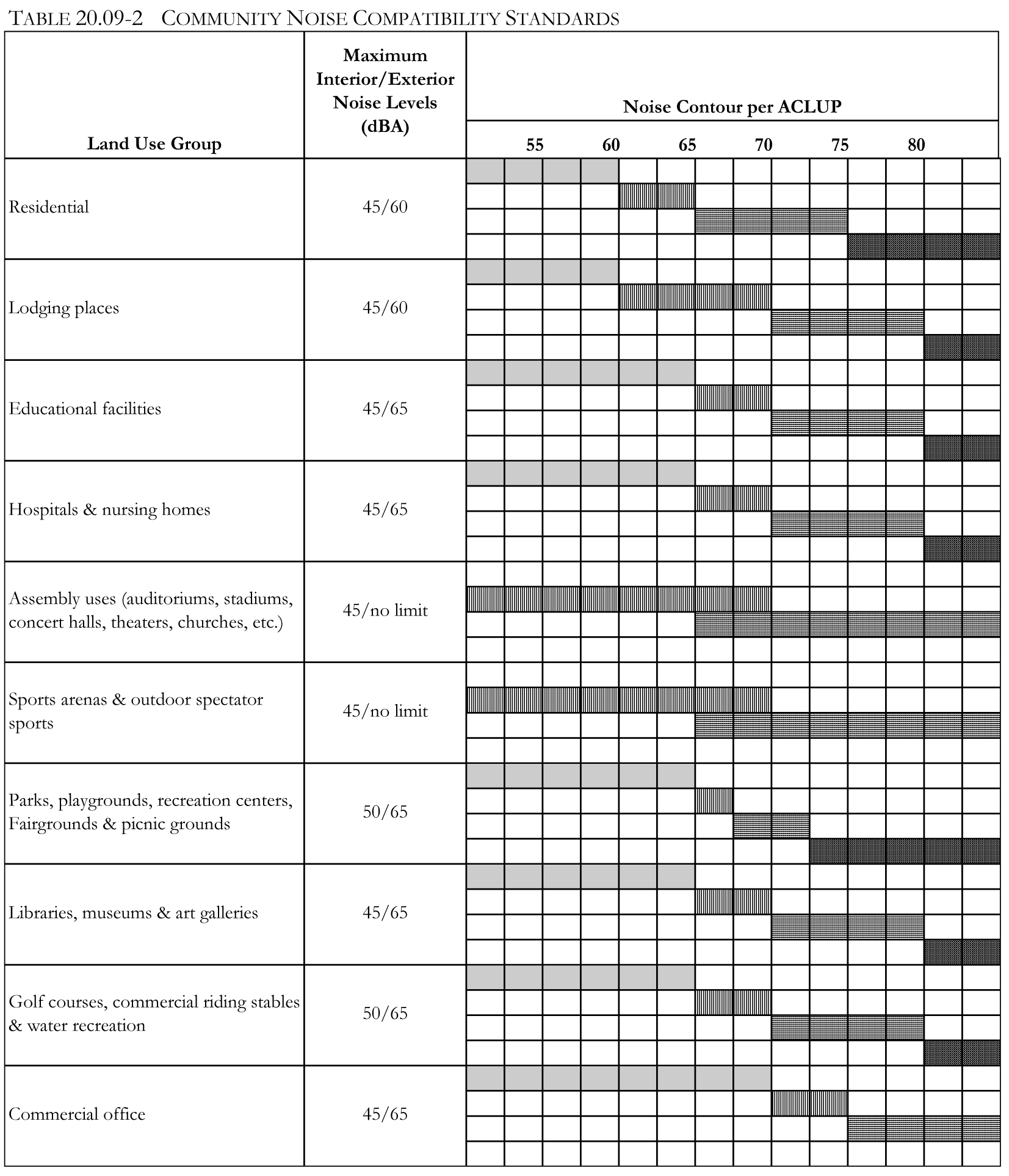
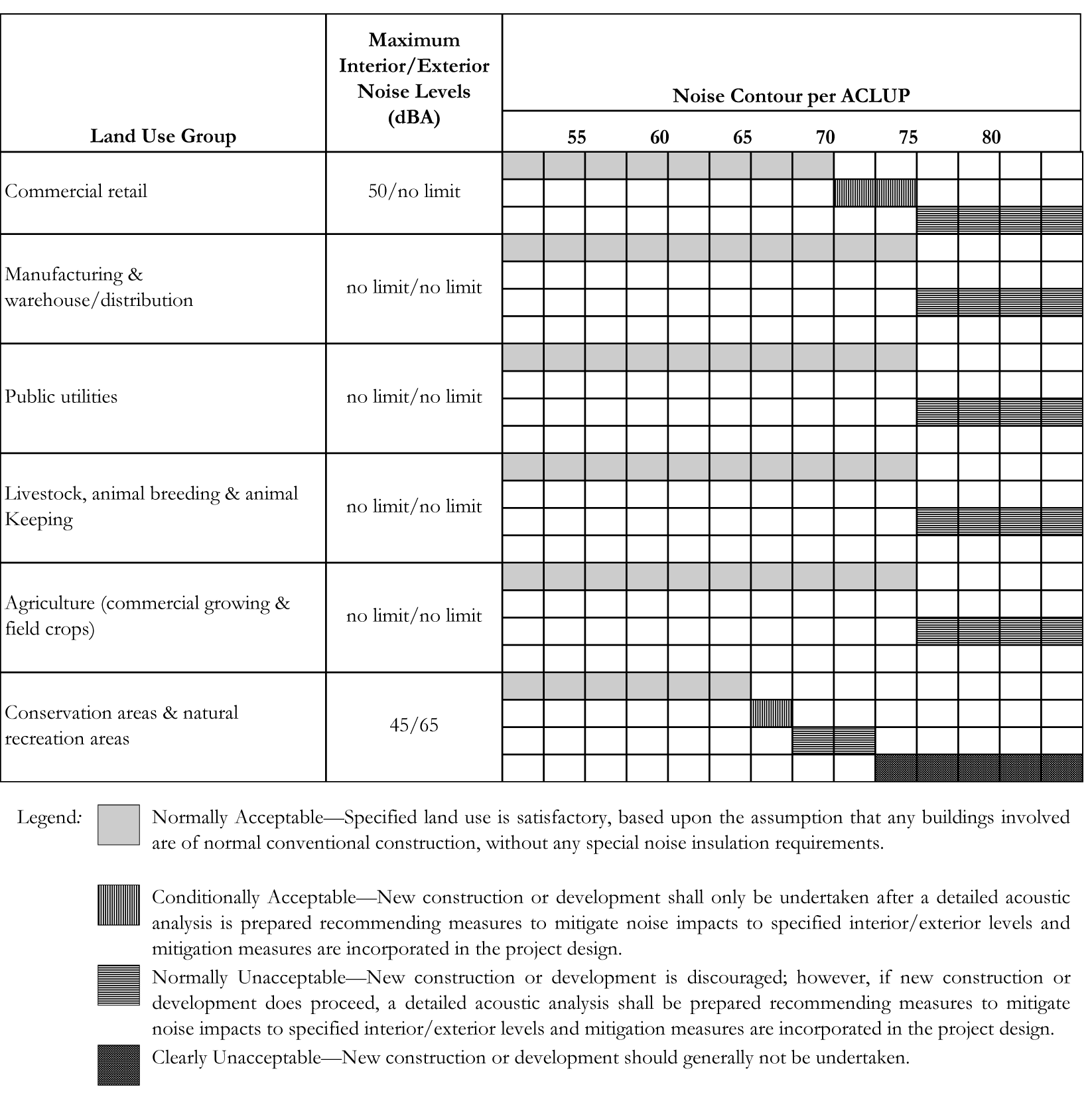
Noise standards. California Administrative Code section 5000 et seq., establishes criteria for the regulation of noise in the vicinity of airports. In an effort to reduce and control the impact of noise generated from Chino Airport on the community, noise contours have been established by the ACLUP prepared for Chino Airport. Within each noise contour identified on the noise contour map contained within the ACLUP, land shall only be used and/or developed in accordance with Table 20.09-2 of this chapter. The table establishes the degree of acceptability of certain land use groups within each noise contour.
In addition to the requirements of the ACLUP, a noise impact notification notice shall be recorded against the property deed of all new development projects and use permits within the 65 CNEL noise contour, advising current and future property owner(s) of potential impacts and stating that the property may be subject to overflight noise, vibration, and dust from aircraft.
D.
Objects affecting navigable airspace. Federal Aviation Regulation (FAR) Part 77, establishes criteria for determining obstructions in navigable airspace, sets forth procedures for noticing the FAA of certain proposed construction or alteration projects, provides for aeronautical studies of obstructions to air navigation to determine their effect on the safe and efficient use of airspace and provides for public hearings on the hazardous effect of proposed construction or alteration on air navigation. The review of and restrictions on objects affecting navigable airspace shall be as prescribed by FAR Part 77.
(Ord. 2010-05, § 1(exh. A), 2010.)
20.09.060 - Downtown overlay district.
A.
Purpose. The downtown overlay district is intended to:
1.
Create pedestrian-friendly environments in downtown Chino that balance the needs of automobiles, bicycles and pedestrians.
2.
Promote high quality urban design in areas in high visibility areas of the city.
B.
Residentially zoned properties.
1.
Development standards. Residentially zoned properties within the downtown overlay district shall comply with the development standards in Table 20.09-3.
2.
General regulations. The design and development of residentially zoned property shall comply with the requirements of Table 20.09-3, Development Relations for Residentially Zoned Properties in Downtown Overlay District.
3.
Siting and Orientation. New street curb cuts on lots with alley access are discouraged and shall require approval by the director of community development and the city engineer.
TABLE 20.09-3 DEVELOPMENT REGULATIONS FOR RESIDENTIALLY ZONED PROPERTIES IN DOWNTOWN OVERLAY DISTRICT
Notes:
[1] Units constructed on or before May 20, 1965, without off-street parking shall provide one covered space at the time of any structural enlargement adding more than five percent to the GFA of the existing dwelling unit. Two garage spaces shall be provided for the primary dwelling unit prior to issuance of building permits for an accessory dwelling unit and its required parking.
[2] An additional five feet of setback shall be provided along primary and secondary arterial streets.
[3] A building or structure with a nonconforming side yard setback, in existence on September 16, 1977, may be added to, extended or enlarged, provided that a side yard setback equal to or greater than the existing side yard setback is provided.
[4] A minimum twenty-foot setback must be provided for garages and carports facing a street side yard, measured from the door/opening, to the property line.
[5] Open porches may be constructed in the front and street side setbacks to encroach no closer than twelve feet to the front property line and five feet to the street side property line.
4.
Compatibility. New primary dwelling units and expansions of existing primary dwelling units shall be compatible with the neighborhood in size, footprint, height, bulk, scale, coverage, and addressing security concerns.
C.
Nonresidentially zoned properties. Commercial and other nonresidentially zoned properties within the downtown overlay district shall comply with the following regulations:
1.
Setbacks.
a.
Maximum front setback: Ten feet.
b.
Building walls shall be built to the front property line for a minimum of seventy percent of the primary street frontage.
c.
Setback areas along the primary street frontage may be used only for building entryways, street-facing courtyards, sidewalk, landscape or other similar features.
d.
The building wall at the street frontage built with a minimum of fifty percent of the ground floor consisting of windows or storefronts with views into the building.
2.
Building entrances.
a.
Principal building entries shall front upon the primary street.
b.
Building entries shall be accented with features such as moldings, lighting, overhangs or awnings.
3.
Building mass and scale.
a.
Buildings shall be articulated to reflect a human-scale street frontage rhythm, with building storefront widths of approximately thirty to fifty feet.
b.
Minimum ground floor height for retail and office uses: Twelve feet.
c.
Buildings shall have a clearly defined base and roof edge so that the façade has a distinct base, middle and top at a scale that relates to an individual person.
4.
Architectural details.
a.
All façades shall emphasize three-dimensional detailing such as cornices, window moldings, textures and reveals to create a visually interesting pedestrian environment.
b.
Buildings located on corners shall include special design and architectural features that help to anchor the intersection.
5.
Pedestrian orientation.
a.
All development shall incorporate features as plazas, interior walkways, paseos, ornamental gates, trellises, lighting, plant materials, seating, fountains or other similar features to support attractive pedestrian spaces.
b.
Outdoor pedestrian space shall be landscaped and shall include appropriate street furniture to encourage pedestrian activity.
c.
Clearly-marked pedestrian connections shall be provided between parking areas and buildings.
6.
Parking.
a.
Parking areas are prohibited between the building and primary street edge.
b.
Multi-story parking structures shall be lined with commercial, retail or residential use at the ground floor at street frontages.
c.
To the extent possible, all outdoor parking areas should be divided into smaller units to reduce visual impacts associated with large expanses of pavement and vehicles.
d.
Building siting and parking design shall maximize opportunities for shared parking, access entries and driveways in order to minimize the number of curb cuts and thus limit possible conflict between pedestrians and automobiles.
e.
Whenever possible, vehicle access should be provided from side streets and alleys to limit the number of driveways along the main thoroughfares.
7.
Landscaping.
a.
Street trees shall be included along all street frontages of commercial development. Trees shall be selected from a list of city-approved trees and shall be approved by the director prior to installation.
b.
Where pedestrian paths or walkways cross parking areas or driveways, the paths shall incorporate landscaping and decorative paving to define the pedestrian space.
c.
Where appropriate, landscape beds shall be provided along street curbs. Suitable landscaping beds include pots, planters and sustainable stormwater retention features.
d.
All landscaped areas shall have automatic irrigation systems installed to ensure that plant materials survive.
e.
Landscaped areas, including trees and other planting, as well as paving, walls and fences shall be regularly maintained.
(Ord. 2010-05, § 1(exh. A), 2010; Ord. 2014-013, § 7, 2014; Ord. 2016-005, § 4, 2016; Ord. 2017-009, § 6, 2017; Ord. 2019-013, § 17, 2019; Ord. 2020-006, §§ 6, 7, 2020.)
20.09.070 - Central Avenue specific plan.
A.
Purpose and intent. Due to the high number of small contiguous lots, sporadic existing development, the opportunity to develop the properties behind those fronting onto Central Avenue, the desire to develop the area in an aesthetic and functional manner, and the need to minimize and control traffic flow onto Central Avenue, the city council has found and declared that the property within the Central Avenue specific plan presents unique problems for its development.
1.
The Central Avenue specific plan is intended to:
a.
Promote a positive image for the Central Avenue corridor by attracting quality development and by structuring land use, circulation and urban design in a manner that creates a coherent whole; and
b.
Provide specific urban design guidelines to ensure that, as the plan is implemented, each project will contribute positively to the overall character and ambience of Central Avenue.
B.
Applicability.
1.
The Central Avenue specific plan is intended to supplement the provisions of this title. In the event of conflicts between the provisions of the specific plan document and the zoning ordinance of the city, the provisions of the Central Avenue specific plan shall apply, unless otherwise specified by this section.
2.
In addition to the requirements of the Central Avenue specific plan, the planning commission may impose specific requirements which are reasonably necessary to overcome the problems recognized in Subsection A.1. of this section. Upon request of a project applicant, the planning commission shall prepare findings supporting the relationship (nexus) between the standards set forth by this title and the requirements imposed upon a proposed development.
C.
Permitted uses. Uses permitted or conditionally permitted on property within the Central Avenue specific plan area shall be in accordance with the zoning district within which such property is located, as shown on the official zoning map and zoning maps distributed for general information to the public, except that, within Central Avenue specific plan district 5A and the downtown/civic center master plan area, those uses listed within the specific plan shall apply.
D.
Development requirements. The development or alteration of any property, or the erection, installation, alteration or enlargement of any building or structure thereon, shall be subject to the standards and guidelines of the Central Avenue specific plan, and the following development requirements:
1.
Property shall only be developed in such a manner as to overcome the problems of development recognized in Subsection A.1. of this section.
2.
The owner(s) of any property upon which a development project is proposed, or the erection, installation, alteration or enlargement of any building or structure thereon, shall convey any and all easements necessary for ingress and egress onto and from contiguous or nearby properties in order to overcome the problems of development recognized in Subsection A.1. of this section.
3.
Existing residential development which is converted to commercial use shall have a minimum width of ninety-six feet, measured along the front lot line, except as permitted within district 4A, district 5A, and the downtown/civic center master plan area (phases 1 and 2) of the Central Avenue specific plan. Furthermore, the exterior of the structure to be converted may be required to be upgraded to conform to all codes and ordinances in effect at the time of conversion.
4.
New commercial development may only occur on lots having a minimum width of ninety-six feet, measured along the front lot line, except as permitted within district 4A, district 5A, and the downtown/civic center master plan area (phases 1 and 2) of the Central Avenue specific plan.
5.
Any item not covered by the Central Avenue specific plan, shall be governed by the provisions of this title.
(Ord. 2010-05, § 1(exh. A), 2010.)
20.09.080 - Industrial planned development overlay district.
A.
Purpose. The purpose of the industrial planned development overlay district is to achieve superior development, as compared to that which can be achieved through the strict application of the standards of a specific zoning district, by permitting greater flexibility in the design of industrial development, and promote a more efficient, aesthetically pleasing, and desirable use of land.
B.
Permitted uses. Uses permitted or conditionally permitted within the industrial planned development overlay district shall be in accordance with the base zoning district. However, in establishing an industrial planned development overlay district or approving a project within an industrial planned development overlay district, the planning commission and/or city council may limit, or for mixed use developments, add certain land uses, finding that such revisions are necessary to enhance the quality and character of the development and to ensure the compatibility between uses located within a planned development project and with existing or potential uses within the general area of the site. For the purpose of this section, a mixed use development shall be considered a development that consists of a variety of complementary uses including, but not limited to: Residential, office, commercial retail and entertainment, that is planned and designed as a unified, comprehensive project area and that is visually integrated through architectural design, and functionally integrated through the use of shared vehicular and pedestrian access and parking areas.
C.
Special conditional use permit required. An application for a special conditional use permit shall be filed in accordance with the provisions of section 20.23.080 of this Code for any modifications to an existing industrial planned development overlay district. An application for a zone change shall be filed in accordance with the provisions of section 20.23.060 of this Code for the establishment of an industrial planned development overlay district, and shall set forth a master plan of development for property located within the industrial planned development overlay district.
(Ord. 2010-05, § 1(exh. A), 2010.)
20.09.090 - Overlay districts for affordable housing.
A.
Purpose and intent. The purpose of the overlay districts for affordable housing—the affordable housing overlay (AHO) district and the mixed use overlay (MUO) district—is to promote the development of affordable housing for low and very low-income households in specific areas identified in the general plan at densities of up to thirty dwelling units per acre if affordability requirements established in this section are met. More specifically, the AHO and MUO allow residential uses where they would not otherwise be allowed and provide for additional density in return for projects providing more affordable housing. The AHO is intended for standalone affordable housing projects, while the MUO provides for mixed use development with affordable housing either on upper floors or in separate buildings. This section also provides the residential development community two alternatives for construction of affordable housing within market-rate development and offers a streamlined process for administrative review of qualifying projects with affordable housing using checklists and objective standards as required by state law.
B.
Relation to base zoning. The AHO and MUO district regulations shall apply in the case of a conflict with the base zoning district regulations when a housing project is proposed. However, when an applicant proposes only non-residential uses, then only the base zoning district land use regulations and development standards apply. The AHO and MUO regulations and development standards only apply to proposed housing projects.
C.
Permitted uses. Table 20.09-4 identifies residential land uses permitted in the AHO and MUO districts in addition to the uses that are permitted within the existing base zoning district.
TABLE 20.09-4: ADDITIONAL LAND USES PERMITTED IN AHO AND MUO DISTRICTS
D.
Required density and increased density for affordable housing.
1.
Minimum and maximum density.
a.
Rental projects. The maximum density for residential development with rental units in the AHO and MUO districts shall be twenty-six units per adjusted gross acre unless a project qualifies for additional density by providing more affordable housing pursuant to subsection (2) below or qualifies for additional density under state law under subsection (3) below, or both.
b.
For sale projects. The maximum density for residential development with for-sale units in the AHO and MUO districts shall be thirty units per adjusted gross acre provided that at least three percent of the units are available for purchase by moderate income households at an affordable purchase price.
c.
Minimum density. The minimum residential density in the AHO and MUO districts shall be twenty-six units per adjusted gross acre.
2.
Additional density for affordable rental housing. An increase in the maximum density is allowed, as shown in Table 20.09-5, for qualifying residential development with rental units if the percentage of low-income units meets or exceeds the percentages shown, provided that the maximum density shall not exceed thirty units per adjusted gross acre.
TABLE 20.09-5: ADDITIONAL DENSITY FOR QUALIFYING AFFORDABLE
RENTAL HOUSING PROJECTS IN AHO AND MUO DISTRICTS
3.
Additional density under state law. Applicants also may be eligible for a density bonus, incentives, and/or concessions under the state density bonus law, the Affordable Housing and High Road Jobs Act of 2022, and other applicable state laws.
E.
Additional land use regulations for MUO district.
1.
Types of mixed use allowed. Both horizontal and vertical mixed use development shall be allowed in the MUO district.
a.
Horizontal mixed use development allows a range of uses adjacent to one another, either in separate buildings or parcels. Individual buildings may share project components, such as parking, serving, loading, and utility areas.
b.
Vertical mixed use allows for a mix of uses within a single building where non-residential uses occupy the ground floor and residential uses are on the upper levels. A vertical mixed use project may have surface parking, subterranean parking decks, and/or at grade and above grade parking decks.
2.
Minimum amount of residential use required in a mixed-use project. In a mixed use project, at least fifty percent of the gross floor area shall be reserved for residential use.
3.
One hundred percent residential use allowed. Projects developed in an MUO district may be one hundred percent residential. No minimum percentage of non-residential uses is required.
4.
Active and pedestrian-oriented frontages required. Along the primary building frontage, active ground floor uses are required in mixed use buildings with residential uses above commercial uses for at least sixty percent of street-facing spacing. These may include retail shops, eating and drinking establishments, retail banks, financial and business services, personal services, and offices for walk-in clientele, such as employment agencies, insurance offices, real estate offices, travel agencies, and offices for elected officials. For residential only buildings along a primary building frontage, an active frontage with a pedestrian orientation can include windows and glass doors, stoops and steps, covered entries, and windows providing views into active space within the building, such as lobbies and gyms. The director of development services also may allow these active and pedestrian-oriented frontages to be provided along private streets, interior walkways, and around plazas and courtyards within the interior of a mixed use project rather than on exterior frontages facing arterial streets.
5.
Public storage facilities. In addition to the requirements of Section 20.21.210, public storage shall comply with the following standards:
a.
Minimum site size. Public storage facilities are only allowed within mixed use development on sites with of five acres or more.
b.
Setbacks. Public storage facilities shall be setback a minimum of fifty feet from front and street side property lines.
c.
Maximum building height. If freestanding, the maximum building height for a public storage facility shall not exceed the building height of an adjacent residential only or mixed us building.
d.
Maximum floor area. The maximum floor area for public storage facilities on a site shall not exceed twenty-five percent of the gross floor area for all residential and non-residential uses.
e.
Exterior building materials. The exterior building materials, colors, and finishes of the public storage facility shall be the same as those used for residential and mixed use buildings on the project site to create a unified appearance.
f.
Building articulation. The building facades of public storage facilities that face streets or residential and mixed use buildings in a project shall include building projections or recesses, doorways or window trim, and other details that provide architectural articulation and visual interest.
g.
On-site management. On-site, twenty-four-hour management shall be provided, and the planning commission may establish specific hours of operation as a condition of approval of a conditional use permit for a public storage facility.
F.
Development standards for the AHO district. All residential development in the AHO district shall comply with the development standards in Table 20.09-6 and the supplemental design standards following the table; and with the multiple-family residential design standards in Section 20.17.050 to the extent these are not superseded by the supplemental design standards following the table. If no housing is proposed, then non-residential development must comply only with the standards of the base zoning district with which the AHO district is combined and the commercial design standards in Section 20.17.070.
TABLE 20.09-6: DEVELOPMENT STANDARDS FOR RESIDENTIAL
DEVELOPMENT IN THE AHO DISTRICT
Notes:
[1] Additional FAR is allowed up to 1.25 for projects with affordable rental units.
The amount of additional FAR shall be calculated based on the increase in density
allowed for qualifying projects meeting affordable housing criteria. For example,
if a project receives a one unit per acre increase in density, then it receives a
0.125 increase in allowable FAR.
[2] Additional height is allowed up to 45 feet for lots with at least 100 feet of
primary street frontage to enable provision of sloped roofs and common open space
for recreational facilities. The upper story above 40 feet shall be setback back an
additional seven feet from the interior property line if the project is adjacent to
a residential zoning district.
[3] The front setback may be reduced to 10 feet on the following streets: Riverside
Drive and Central Avenue.
[4] A minimum 20-foot setback must be provided for garages and carports facing a street.
[5] Open or covered porches may be constructed in the front and street side setbacks
to encroach no closer than 12 feet to the front property line and 5 feet to the street
side property line.
[6] New street curb cuts are not allowed on lots with alley access unless approved
by the director of development services and the city engineer to accommodate affordable
housing units.
1.
Required side and rear yards for residential uses. In order to provide light and air for residential units and additional separation for rooms that contain areas that require additional privacy considerations, the following minimum setbacks shall apply to any building wall containing windows and facing an interior side or rear yard. The required setbacks apply to that portion of the building wall containing and extending three feet on either side of any window.
a.
For any wall containing living room or other primary room windows, a setback of at least fifteen feet shall be provided.
b.
For any wall containing sleeping room windows, a setback of at least ten feet shall be provided.
c.
For all other walls containing windows, a setback of at least five feet shall be provided.
2.
Required building wall on designated streets. Along Riverside Drive and Central Avenue south of Highway 60, building walls shall be constructed along or within ten feet of the front property line for a minimum of seventy percent of the primary street frontage and forty percent on secondary street frontages. This requirement may be waived by the director of development services upon finding that:
a.
Ground-floor residential uses are proposed, a minimum fifteen-foot setback is proposed, and substantial landscaping will be located between the build-to and ground-floor residential units as a buffer;
b.
Entry courtyards, plazas, entries, or outdoor eating areas are located between the build-to line and the building and buildings are constructed at the edge of the courtyard, plaza, or dining area;
c.
The building incorporates an alternative entrance design that creates a welcoming entry facing the street.
3.
Building entrances.
a.
Principal building entries shall front upon the primary street or be in a visually-prominent location as determined by the director of development services.
b.
Building entries shall be accented with features such as moldings, lighting, overhangs, or awnings.
4.
Building mass and scale.
a.
To reduce upper-story building mass, floorplates for the third story and above shall not exceed eighty percent of the ground-floor floorplate. The director of development services may waive this requirement upon finding the architectural articulation of exterior walls and a sloped roof modulates the visual mass of the top of the building and avoids the appearance of a box-like structure.
b.
Buildings that are more than one hundred fifty feet in length shall include a minimum two-foot vertical variation in height for at least fifty feet.
5.
Pedestrian orientation and accessible pedestrian facilities on designated streets.
a.
Along Riverside Drive and Central Avenue south of Highway 60, all development on sites over two acres in size shall incorporate such features as plazas, interior walkways, canopies, arcades, paseos, ornamental gates, trellises, lighting, plant materials, seating, fountains, or other similar features, as appropriate, to support and enhance pedestrian spaces.
b.
Outdoor pedestrian space shall be landscaped and shall include appropriate street furniture to encourage pedestrian activity.
c.
Clearly marked pedestrian connections shall be provided between parking areas and buildings.
d.
All sidewalks, crosswalks, courts, plazas and residential buildings shall be designed to be safe, accessible, and convenient for individuals of all abilities, whether travelling by foot, wheelchair, or other mobility aid, consistent with the city's adopted policy on accessible pedestrian facilities.
6.
Parking.
a.
Parking areas are prohibited between the building and primary street edge. On-site parking shall be in the rear half of the site or within a parking structure.
b.
Multi-story parking structures within twenty-five feet of a street frontage shall be lined with foundation landscaping at the ground floor.
c.
Building siting and parking design shall maximize opportunities for shared parking, access entries, and driveways in order to minimize the number of curb cuts and thus limit possible conflict between pedestrians and automobiles.
d.
Whenever possible, vehicle access shall be provided from side streets and alleys to limit the number of driveways along arterial streets.
7.
Landscaping.
a.
Street trees shall be included along all street frontages with multi-family housing development. Trees shall be selected from a list of city-approved trees and shall be approved by the director of development services prior to installation.
b.
Where pedestrian paths or walkways cross parking areas or driveways, the paths shall incorporate landscaping and decorative paving to define the pedestrian space.
G.
Development standards for the MUO district. All residential-only buildings and mixed use development with residential units in the MUO district shall comply with the development standards in Table 20.09-7 and the supplemental design standards following the table, and with the multiple-family residential design standards in Section 20.17.050 and the mixed use design standards in Section 20.17.060 to the extent these are not superseded by the supplemental design standards following the table. Non-residential development shall comply with the standards of the base zoning district with which the MUO district is combined and the commercial design standards in Section 20.17.070.
TABLE 20.09-7: DEVELOPMENT STANDARDS FOR RESIDENTIAL AND
MIXED USE DEVELOPMENT IN MUO DISTRICT
Notes:
[1] Additional FAR is allowed up to 1.25 in mixed use development with affordable
rental units. The amount of additional FAR shall be calculated based on the increase
in density allowed for qualifying projects meeting affordable housing criteria. For
example, if a project receives a one unit per acre increase in density, then it receives
a 0.0625 increase in allowable FAR.
[2] Additional height is allowed up to 55 feet for lots with 100 feet of street frontage
to enable provision of sloped roofs and common open space for recreational facilities.
The upper story above 40 feet shall be setback back an additional seven feet from
the interior property line if the project is adjacent to a Residential zoning district.
[3] A minimum 15 feet of front and street side setback shall be provided along primary
and secondary arterial streets. A reduced front setback may be allowed on the following
streets: Riverside, Central, and Euclid.
[4] A minimum 20-foot setback must be provided for garages and carports facing a street.
[5] Open or covered porches may be constructed in the front and street side setbacks
to encroach no closer
than 12 feet to the front property line and 5 feet to the street side property line.
[6] New street curb cuts are not allowed on lots with alley access unless approved
by the director of development services and the city engineer to accommodate for affordable
housing units.
1.
Required side and rear yards for residential uses. In order to provide light and air for residential units and additional separation for rooms that contain areas that require additional privacy considerations, the following minimum setbacks shall apply to any building wall containing windows and facing an interior side or rear yard. The required setbacks apply to that portion of the building wall containing and extending three feet on either side of any window.
a.
For any wall containing living room or other primary room windows, a setback of at least fifteen feet shall be provided.
b.
For any wall containing sleeping room windows, a setback of at least ten feet shall be provided.
c.
For all other walls containing windows, a setback of at least five feet shall be provided.
2.
Required building wall on designated streets. Along Riverside Drive and Central Avenue south of Highway 60, building walls shall be constructed along or within ten feet of the front property line for a minimum of seventy percent of the primary street frontage and forty percent on secondary street frontages. This requirement may be waived by the director of development services upon finding that:
a.
Ground-floor residential uses are proposed, a minimum fifteen-foot setback is proposed, and substantial landscaping will be located between the build-to and ground-floor residential units as a buffer;
b.
Entry courtyards, plazas, entries, or outdoor eating areas are located between the build-to line and the building and buildings are constructed at the edge of the courtyard, plaza, or dining area;
c.
The building incorporated an alternative entrance design that creates a welcoming entry facing the street.
3.
Required ground floor transparency for non-residential uses. Exterior walls for non-residential ground-floor uses facing and within twenty feet of a front or street side property line shall include windows, doors, or other openings for at least sixty percent of the building wall area between two feet and eight feet above the sidewalk. No wall shall run in a horizontal plane more than twenty-five feet without an opening.
a.
Openings fulfilling this requirement shall have transparent glazing and provide views into display areas, sales areas, work area, lobbies or other active spaces, and window displays shall be at least three feet in depth.
b.
Parking garages are not required to meet these transparency requirements.
c.
Alternatives to the building transparency requirement may be approved by the director of development services for uses that have unique operational requirements making windows or doors infeasible or for street-facing building walls that exhibit architectural relief and detail with landscaping that creates visual interest at the pedestrian level.
4.
Building entrances.
a.
Principal building entries shall front upon the primary street.
b.
Building entries shall be accented with features such as moldings, lighting, overhangs, or awnings.
5.
Building mass and scale.
a.
To reduce upper-story building mass, floorplates for the fourth story shall not exceed eighty percent of the ground-floor floorplate. The director of development services may waive this requirement upon finding the architectural articulation of exterior walls and a sloped roof modulates the visual mass of the top of the building and avoids the appearance of a box-like structure.
b.
Buildings that are more than one hundred fifty feet in length shall include a minimum two-foot vertical variation in height for at least fifty feet.
c.
To maintain a human-scale at the street level where ground floor commercial space is provided, building storefront widths shall not exceed thirty feet without a recess or a break, which may be a building entry or a separate display window.
d.
Minimum ground floor height for commercial uses, including retail shops, restaurants, and offices: fourteen feet.
6.
Pedestrian orientation and accessible pedestrian facilities on designated streets.
a.
Along Riverside Drive and Central Avenue south of Highway 60, all development on sites over two acres in size shall incorporate features such as plazas, interior walkways, canopies, arcades, paseos, ornamental gates, trellises, lighting, plant materials, seating, fountains, or other similar features, as appropriate, to support and enhance pedestrian spaces.
b.
Outdoor pedestrian space shall be landscaped and shall include appropriate street furniture to encourage pedestrian activity.
c.
Clearly marked pedestrian connections shall be provided between parking areas and buildings.
d.
Encroachments into the public right-of-way are allowed for outdoor seating in conjunction with full-service restaurants and food retailers, provided a minimum six-foot wide walkway and pedestrian clear zone is maintained, and the outdoor eating area is contiguous with interior eating space and does not encroach into the public right-of-way of an adjacent business. An encroachment permit issued by the city is required, and a fee may be charged.
e.
All sidewalks, crosswalks, courts, plazas, and residential buildings shall be designed to be safe, accessible, and convenient for individuals of all abilities, whether travelling by foot, wheelchair, or other mobility aid, consistent with the city's adopted policy on accessible pedestrian facilities.
7.
Parking.
a.
Long-term parking and residents' guest parking areas are prohibited between the building and primary street edge. On-site parking shall be in the rear of buildings in the back half of the lot or development site. Short-term drop-off spaces, short-term parking for retail shops, and a limited number of parking spaces for guests of residents may be allowed with valet service in courtyards and at building entries with approval of the planning commission.
b.
Multi-story parking structures within twenty-five feet of a street frontage shall be buffered with foundation planting or lined with commercial, retail, or residential use at the ground floor.
c.
Building siting and parking design shall maximize opportunities for shared parking, access entries and driveways in order to minimize the number of curb cuts and thus limit possible conflict between pedestrians and automobiles.
d.
Whenever possible, vehicle access shall be provided from side streets and alleys to limit the number of driveways along arterial streets.
8.
Landscaping.
a.
Street trees shall be included along all street frontages of mixed-use development. Trees shall be selected from a list of city-approved trees and shall be approved by the director of development services prior to installation.
b.
Where pedestrian paths or walkways cross parking areas or driveways, the paths shall incorporate landscaping and decorative paving to define the pedestrian space.
H.
Open spaces standards for residential projects. The open space requirements of the multiple-family residential design standards in Section 20.17.050 for private areas and common areas shall apply to all proposed residential development and to residential units in mixed use development with the following modifications. Private areas shall consist of balconies, decks, patios, or fenced yards directly accessible from the residence. Common areas shall consist of landscaped areas, walks, patios, swimming pools, picnic and barbeque areas, playgrounds, children's play areas, playing courts, turf, rooftop areas, gym and fitness facilities, space for yoga, dance and instruction, or other such improvements as are appropriate to enhance the outdoor living environment of the development and to provide recreational facilities for residents. Landscaped courtyard entries that are oriented towards the public street and create a welcoming entry feature are also considered common areas. All areas not improved with buildings, parking, vehicular accessways, trash enclosures, and similar items or devoted to perimeter landscaping shall be developed as common areas with the types of attributes described above.
1.
Minimum amount of outdoor living area (private or common open space). The minimum percentage of net lot area devoted to permanent open space is twenty percent, and the minimum area to be devoted to outdoor living area (private or common open space) shall be four hundred square feet per unit.
2.
Minimum amount of private open space. The minimum amount of private open space shall be at least twenty-five percent of the amount of outdoor living area required. This space shall be provided on patios, decks or balconies shall be as follows:
a.
Ground floor units: one hundred fifty square feet patio with a minimum horizontal dimension of ten feet or seventy-two square foot deck with a minimum horizontal dimension of six feet; and
b.
Upper level units: seventy-two square feet with a minimum horizontal dimension of six feet.
3.
Minimum amount of common open space areas. A minimum of sixty-five percent of the required outdoor living area shall be provided as common open space with a minimum horizontal dimension of twenty feet. This common open space shall be a well-designed, coherent area that is an essential component of the project's design, not merely space left over after the building mass is placed.
a.
Landscape areas having minimum dimensions of less than twenty feet but at least five feet at any point which are contiguous with and an integral part of the common open space or are connected to the common open space by walkways, may be included in calculating the area of such space. Non-contiguous landscape areas proposed to be included shall not exceed twenty percent of the total area of common open space.
b.
Up to one-half of covered patio areas designed to be commonly used by residents of a development may be included in calculation of common open space provided such area does not comprise more than twenty-five percent of the total common open space.
c.
Up to fifteen percent of the required common open space area may be provided within a recreational building.
4.
Usability. A surface shall be provided that allows convenient use for outdoor living and/or recreation. Such surface may be any practicable combination of lawn, garden, flagstone, wood planking, concrete, or other serviceable, dust-free surfacing. The maximum slope shall not exceed ten percent.
5.
Accessibility.
a.
Private open space. The space shall be accessible to only one living unit by a doorway to a habitable room or hallway.
b.
Common open space. The space shall be accessible to the living units on the lot. It shall be served by any stairway or other accessway qualifying as an egress facility from a habitable room.
6.
Recreational facilities requirements. In high density multi-family or mixed use development with a minimum of twenty-five dwelling units per gross adjusted acre, essential recreational facilities, as prescribed below, may be proposed in lieu of the requirements of major and minor facilities in Section 20.17.050(C) which require more land than may be available in a high density project. These essential recreational facilities may include: 1) a gym or fitness room, 2) space for yoga, dance, or other instruction, 3) enclosed or outdoor space for playing courts or games, 4) children's play area, 5) picnic and barbeque area, or 6) children's daycare space. At least two hundred fifty square feet per unit shall be provided for these recreational facilities, and there shall be a minimum of two of these facilities in projects with ten to fifty units, three of these facilities in projects with fifty-one to one hundred units, and four or more of these facilities in projects with more than one hundred units. No essential recreational facilities are required in a small project, with less than ten dwelling units. The space allocated for recreational facilities shall count toward the requirement for common open space, and this space may be within buildings.
I.
Minimum affordable housing requirement.
1.
Requirement. Residential development projects in an AHO and an MUO district with ten or more dwelling units shall provide the following minimum numbers of affordable housing units:
a.
Rental projects: nine percent of the total units affordable to low-income households at an affordable rent.
b.
For-sale projects: three percent of the total units in a common interest development for moderate income households at an affordable sales price, provided that all of the units are offered to the public for purchase.
c.
Projects with both rental units and for sale units: The minimum numbers shall be calculated separately for each type of housing.
2.
Calculations. All calculations of the number of affordable units required to be built on-site in a project that result in fractional units shall be rounded up to the next whole number.
3.
Common owners and control. An applicant for development within an AHO or MUO district shall not avoid the requirements of this section by submitting piecemeal planning applications. At the time of the first application for residential development, the applicant shall identify all contiguous property under common ownership and control. The applicant shall not be required to construct housing on contiguous property but must include such property in a comprehensive affordable housing plan.
4.
Income qualifications. Household income qualifications shall be those established by the California Department of Housing and Community Development each year for San Bernardino County, as adjusted for household size, pursuant to California Code of Regulations, Title 25, Section 6932, and Health and Safety Code Section 50093.
5.
Location, size, design, and distribution of affordable units. Affordable units shall have the same bedroom and bathroom count ratio as the market rate units in a project, be equally distributed within the project, and have the same type or quality of appliances, fixtures, and finishes. The affordable housing units shall be integrated with other housing units in the housing development with regard to siting and placement within buildings and shall not differ in exterior appearance from the other housing units. The location of the affordable housing units may or may not be on contiguous parcels within the site. In no event shall the affordable housing units be located in only one portion of the housing development or situated in one building of a multi-building development.
6.
Timing of construction. All required affordable units shall be made available for occupancy prior to, or concurrently with, the market-rate units. The affordable units may be constructed in phases if the market-rate units are constructed in phases, provided that the percentage of affordable units developed in each phase shall be equivalent to or greater than the total percentage of affordable units to be developed as part of the residential development until such time that all the affordable units have been built.
J.
Alternatives. In lieu of providing the affordable units in the housing development project required by Section 20.09.090.D. and I., the requirements of those subsections may be satisfied through one or more of the alternatives set forth below.
1.
In-lieu fee.
a.
For housing development projects proposing up to twenty units, the developer may, by right, pay a fee in lieu of providing affordable units on site.
b.
For housing development projects proposing more than twenty units, the developer shall only be allowed to pay in-lieu fees if the planning commission makes a finding that providing affordable units on-site would result in an extreme financial hardship to the developer and make the proposed project financially infeasible. The developer shall submit a request to pay a fee in lieu of providing affordable units on site as part of the project application. Such request shall include sufficient documentation and financial analysis to allow the planning commission to make the required findings. At the city's discretion, the city may contract with a third-party financial consultant to evaluate the documentation and analysis submitted by the applicant and make a recommendation to the city regarding the issues of extreme financial hardship and financial infeasibility. The developer shall be required to reimburse the city for all costs related to hiring any such third-party consultant, which shall be in addition to any other required application fees. The demonstration of financial hardship and infeasibility may be based on, among other things, such factors as project size, site constraints, and/or excessively large affordability gaps, or upon a demonstration that in the absence of allowing for payment of in-lieu fees, the imposition of the affordable housing production requirements in this section would violate the California and/or United States Constitutions because it would be a regulatory taking of property without fair and just compensation.
c.
In-lieu fees shall be paid as follows:
(i)
The amount of the fee shall be calculated using the fee schedule established by resolution of the city council at the time the fee is paid.
(ii)
One-half of the in-lieu fee required by this subsection shall be paid (or a letter of credit posted) prior to issuance of a building permit for all or any part of the housing development project. The remainder of the fee shall be paid before a certificate of occupancy is issued for any unit in the housing development project. In a phased project, payment of fees also may be allowed in phases, corresponding to the number of units in each phase.
(iii)
The fees collected shall be deposited in the overlay district affordable housing fund established by Section 20.09.090(M).
2.
Land dedication. In lieu of providing affordable units on-site, a developer may request city council approval to dedicate land to the city or to a city-approved affordable housing developer that the director of development services determines is suitable for the construction of the required number of affordable units and is within one mile of the project site. To accept a land dedication in lieu of on-site affordable units, the city council must determine the fair market value of the dedicated land is equivalent to or greater than the amount of in-lieu fees that would have been needed to satisfy the housing development project's affordable housing obligation and that the required number of units for very low-income residents will be built on this land based on a proposed conceptual site plan and proforma financial analysis demonstrating project feasibility with available funding.
a.
The developer must submit evidence that the land proposed to be dedicated is under the developer's control, will be conveyed at no cost to the city or a city-approved affordable housing developer with experience building rental housing for very low-income households, is free of any liens, all property taxes and special taxes have been paid, does not contain any hazardous materials, has the appropriate general plan designation and zoning to allow construction of the required number of units, and has the necessary infrastructure and public improvements to support the required number of affordable units. Only sites within an AHO or MUO district that are within one mile of the project site can be considered for land dedication.
b.
The developer must disclose whether any hazardous materials were previously contained on the site; and hazardous materials were previously remediated, the developer must provide evidence that the cleanup was performed in accordance with applicable law.
c.
The land proposed for dedication cannot have been improved with any residential use for at least five years prior to the submission of a land dedication proposal.
d.
The affordable units to be constructed on the dedicated land shall be at least twenty percent of the total number of units in the project, and these units must be rental units affordable to very low income households.
3.
Off-site construction. A market-rate developer may enter into an agreement with an affordable housing developer to construct, own, and operate affordable rental housing units required by Sections 20.09.090(D) and (I), provided:
a.
The affordable housing developer is approved by the director of development services on the basis of recent relevant experience;
b.
The affordable housing developer does not request any financial assistance from the city;
c.
The affordable rental housing units shall be constructed prior to or concurrently with the market-rate development triggering the affordable housing requirement; and
d.
At least twenty percent of the total number of units to be built on the site shall be rental units affordable to very low-income residents.
K.
Review procedures.
1.
Preliminary review. A developer requesting additional density above twenty-six units per adjusted gross acre for a rental project under Section 20.09.090(D) shall submit an application for preliminary review, accompanied by the required application fee, for feedback prior to the submittal of any formal requests for approval of additional density. The purpose of the preliminary review is to determine whether the proposed development is in substantial compliance with applicable planning regulations and to establish the basis and procedures for granting the additional density. The following information is required to be submitted for preliminary review in the form of a proposed affordable housing plan in addition to information required by the department's preliminary review checklist:
a.
Evidence that the project includes the qualifying percentages of affordable units set forth in Section 20.09.090(D) to justify the additional density requested;
b.
Calculations showing the maximum base density and the density with the additional units;
c.
Number and percentage of total units that are proposed to meet affordability criteria and the income level to which the units will be restricted; and
d.
A description of any proposed waivers or reductions of development standards or other zoning requirements, consistent with the provisions of Government Code Section 95915(k).
2.
Site approval required. All residential development or mixed use development with residential units in an AHO or MUO district shall require approval of a site approval application as outlined under Section 20.23.090. For residential development and mixed use development with residential units, design review by the planning commission shall be undertaken only to determine compliance with the city's objective design standards using the site approval process.
3.
Additional findings for approval. The planning commission shall grant a site approval if it makes the findings required by Section 20.23.090 and the following additional findings:
a.
The proposed development meets the affordability criteria for the requested density in accordance with the requirements of subsection (D) and (I); and
b.
The increased density would not have a specific adverse impact, as defined in paragraph (2) of subdivision (d) of Section 65589.5 of the Government Code, upon public health and safety or the physical environment or on any real property listed in the California Register of Historic Resources.
4.
Conditions of approval. The planning commission has the authority to impose reasonable conditions that are related and proportionate to what is being requested by the applicant, as deemed necessary and appropriate to ensure that the provisions of the general plan, any applicable specific plan adopted by the city council, and this title are met, including requirements for needed off-site public improvements. The commission may require reasonable guarantees and evidence that such conditions are being, or will be, met.
5.
Special procedures for projects with at least twenty percent affordable units. Notwithstanding any other provision of this Section 20.09.090, owner-occupied and rental multifamily residential developments in either an AHO or MUO district that are located on a site that is included in Appendix B (Candidate Sites Analysis) of the city's Sixth Cycle Housing Element (2021—2029), meet the objective development standards and density requirements in this section, and in which at least twenty percent of the units are affordable to lower income households shall be a use by right. For purposes of this subsection (K)(5), "use by right" shall have the meaning given in Government Code section 65583.2(i), as may be amended. Developments that qualify under this subsection (K)(5) shall be subject to the review procedures in this subsection (K), except that neither the design review nor the site approval shall be considered a "project" for purposes of the California Environmental Quality Act.
L.
Required affordable housing agreement for continued affordability. Prior to the issuance of a building permit for any residential development project with affordable housing units in an AHO or MUO district, the applicant shall enter into a written agreement with the city ensuring the continued affordability of the affordable dwelling units for a period of not less than seventy-five years or as long as the property is in residential use, whichever is greater, for rental units and forty-five years for for-sale units. The terms and conditions of the agreement shall be binding upon the successor in interest of the developer and shall be recorded in the main office of the San Bernardino County assessor-recorder-clerk. The agreement shall be executed by the city manager, be in a form acceptable to the city attorney, and include provisions for the following:
1.
The number and proportion of housing units affordable to moderate-income, low-income, and very low-income households by type, their location, and the number of bedrooms in each one;
2.
Standards for maximum qualifying household incomes and maximum rents or sale prices;
3.
Minimum home buyer payments and sources of funds for them;
4.
The party responsible for certifying rents and sales prices of affordable housing units and reporting this information to the city;
5.
The process that will be used to certify incomes of tenants or purchasers of the affordable housing units;
6.
The manner in which vacancies will be marketed and filled, including the screening and qualifying of prospective renters and purchasers of the affordable units;
7.
Deed restrictions on the affordable housing units binding on property upon sale or transfer and any subsequent sale or transfer;
8.
Enforcement mechanisms to ensure that the affordable rental units are continuously occupied by eligible households and are not rented, leased, sublet, assigned, or otherwise transferred to non-eligible households, with reasonable allowances for inherited units and units initially occupied by very low-income individuals who incomes may increase to a low-income level;
9.
Provisions allowing moderate income homebuyers to resell the unit at fair market value in return for the city receiving payment equal to the original affordability gap plus a defined share of the equity appreciation achieved on sale, which shall be deposited in the city's overlay district affordable housing fund and used within three years for any of the purposes described in subdivision (e) of Section 33334.2 of the Health and Safety Code that promote homeownership; and
10.
Project phasing, including the timing of completions, and rental or sale of the affordable housing units, in relation to the timing of the market-rate units.
M.
Overlay district affordable housing fund. There is a separate fund of the city known as the overlay district affordable housing fund, and all in-lieu fees or other funds collected under this section shall be deposited into the overlay district affordable housing fund. Additional funds from other sources also may be deposited in the overlay district affordable housing fund.
1.
Money deposited in the overlay district affordable housing fund may be used to pay for the direct costs associated with administration and enforcement of the affordable housing program established for the AHO and MUO districts.
2.
After payment of expenses, at least seventy percent of the remaining money shall be expended to provide housing affordable to low income and very low-income housing holds; the remaining money may be expended to provide housing affordable to moderate-income households.
3.
The fund shall be administered by the director of development services.
4.
A developer receiving funding from the fund shall implement a local preference in their resident selection criteria.
(Ord. 2023-008, § 3, 2023; Ord. No. 2024-003, § 2, 2024.)

