
Clinton City Zoning Code
CHAPTER 28
18 Light Manufacturing MP-1
28-18-1 Purpose And Intent
The following district is hereby established primarily to accommodate enterprises engaged in the light manufacturing and its associated uses.
28-18-2 Site Development Standards
Site Development Standards shall be known as Table 18.2.
| Table 18.2 | ||||
| Minimum Lot Area | 6000 sq. ft. | |||
| Minimum Lot Width | 60 ft. | |||
| Minimum Yard Setback | Front | 40 ft. | ||
| Side | Interior | None except 20 feet when adjacent to a zone boundary | ||
| Exterior | Major Street | 30 feet | ||
| Other Street | 20 feet | |||
| Rear | None except 20 feet when building rears on a zone boundary, this does not include any required bufferyard. | |||
| Building Height a | Minimum | 1 story | ||
| Maximum | 35 feet | |||
| Lot Coverage | Not including required buffers, the minimum landscape area of a lot is 10% | |||
| a Buildings on lots which rear on a zone boundary shall not have a structure taller than that allowed in the adjoining zone | ||||
28-18-3 Site Plan Review Required
Uses specified in this chapter require site plan review by the Planning Commission of Clinton City before building permits are issued for a respective use. Additionally, Conditional Uses are regulated by Chapter 28-5 of this Ordinance.
28-18-4 Special Provisions
- Containment. All activities and uses listed herein which are manufacturing in nature, shall be performed only within completely enclosed buildings.
- Emissions. All uses shall be free from objectionable appearance, odor, dust, noise, and all premises kept free from refuse and debris as determined by the Planning Commission and Community Development Department. All operations shall comply with the State Division of Air Quality for stationary sources, all emissions, except steam shall not be visible.
- Noise. Table 18.4.1 establishes the maximum permissible noise levels for permitted and conditional uses within the district. Measurements shall be taken at the boundary line of the lot where the use is located, and, as indicated, the maximum permissible noise levels very according to the zoning of the lot adjacent to the lot on which the MP classification use is located.a A decibel is a measure of a unit of sound pressure. Since sound waves having the same decibel level "sound" louder or softer to the human ear depending upon the frequency of the sound wave in cycles-per- second (i.e., whether the pitch of the sound is high or low) an A-weighted filter constructed in accordance with the specifications of the American national Standards Institute, which automatically takes account of the varying effect on the human ear of different pitches, shall be used on any sound level meter taking measurements required by this section. All measurements are expressed in dB(A) to reflect the use of the A-weighted filter.
Table 18.4.1 Table of Maximum Permitted Sound Levels, dB(A)a Zoning of Lot Adjacent to a MP Use 6 a.m.-11 p.m. 7 p.m.-7 a.m. Residential, Agricultural, & PRUD 55 dB (A) 50 dB (A) Commercial 60 dB (A) 55 dB (A) Manufacturing 80 dB (A) 75 dB (A) - Vibration.
- No permitted or conditional use may generate any ground-transmitted vibration that is perceptible to the human sense of touch measured at:
- The outside boundary of the immediate space occupied by the enterprise generating the vibration if the enterprise is one of several located on a lot.
- The lot line if the enterprise generating the vibration is the only enterprise located on a lot.
- Vibrations resulting from temporary construction activity that occurs between 7 a.m. and 7 p.m. shall be exempt from the requirements of this section.
- Odors.
- For the purpose of this section, the "odor threshold" is defined as the minimum concentration in air of a gas, vapor, or particulate matter that can be detected by the olfactory systems of a panel of healthy observers.
- No permitted or conditional use in the MP-1 District may generate any odor that reaches the odor threshold, measured at:
- The outside boundary of the immediate space occupied by the enterprise generating the odor if the enterprise is one of several located on a lot.
- The lot line if the enterprise generating the odor is the only enterprise located on a lot.
- Air Pollution.
- Any permitted or conditional use that emits any "air contaminant" as defined in the state statutes shall comply with applicable state standards concerning air pollution, as set forth in the Air Conservation Act §19-2-101 Utah Code Unannotated.
- No use shall be permitted with respect to development or operation until the State Air Quality Board has certified to Clinton City that the appropriate state permits have been received by the developer, or that the developer will be eligible to receive such permits and that the development is otherwise in compliance with air pollution laws.
- Disposal of Liquid Wastes.
- No permitted or conditional use may discharge any waste contrary to the provisions of Utah Law governing discharges of radiological, chemical, or biological wastes into surface or subsurface waters.
- Or, discharge into the city sewage system any waste that cannot be adequately treated by the North Davis County Sewer District.
- No use shall be permitted with respect to development or operation until the North Davis County Sewer District has certified to Clinton City that the appropriate District permits have been received by the developer, or that the developer will be eligible to receive such permits and that the development is otherwise in compliance with District standards.
- Water consumption. No permitted or conditional use that requires for its operation a supply of treated culinary water shall be permitted with respect to development or operation until the City has certified the results of the demands upon the city system.
- Electrical Disturbance or Interference.
- No permitted or conditional use may create any electrical disturbance that adversely affects any operations or equipment other than those of the creator of such disturbance.
- Or, otherwise cause, create, or contribute to the interference with electronic signals (including television and radio broadcasting transmissions) to the extent that the operation of any equipment not owned by the creator of such disturbance is adversely affected.
- Landscaping Requirements. 149 See Section 28-3-20 and 28-4-18 for details.
- On Site Exterior Lighting Standards.
- Purpose.
- The purpose of this section is to regulate the spill-over of light and glare on operators of motor vehicles, pedestrians, and land uses in the proximity of the light source. With respect to motor vehicles in particular, safety considerations from the basis of the regulations contained herein. In other cases, both the nuisance and hazard aspects of glare are regulated. This section is not intended to apply to public street lighting.
- Definitions.
- “Candlepower.” The amount of light that will illuminate a surface one (1) foot distant from a light source to an intensity of one (1) foot-candle. Maximum (peak) candlepower is the largest amount of candlepower emitted by any lamp, light source, or luminaire.
- “Cutoff.” The point at which all light rays emitted by a lamp, light source, or luminaire are completely eliminated (cutoff) at a specific angle above the ground.
- “Cutoff Angle.” The angle formed by a line drawn from the direction of light rays at the light source and line perpendicular to the ground from the light source, above which no light is emitted.
- “Cutoff-type Luminaire.” A luminaire with elements such as shields, reflectors, or refractor panels which direct and cut off the light at a cutoff angle that is less than ninety (90) degrees.
- “Foot-candle.” A unit of illumination produced on a surface, all points of which are one (1) foot from a uniform point source of one (1) candle.
- "Glare." The brightness of a light source which causes eye discomfort.
- "Luminaire." A complete lighting unit consisting of a light source and all necessary mechanical, electrical, and decorative parts.
- “Maximum Permitted Illumination.” The maximum illumination measured in foot-candles at the interior bufferyard line at ground level in accordance with the standards of Subsection (11)(c) below.
- The following standards are required of all exterior lighting except the outdoor recreational uses specifically exempted below. Many uses have the option of providing a lower light post with a noncutoff type luminaire or a higher pole, up to sixty (60) feet, with a luminaire that totally cuts off light spillover at a cutoff angle smaller than ninety (90) degrees.
- The maximum height light post permitted is dependent on amount of cutoff provided. This is designed as a protection against excessive glare and light spilling over to neighboring properties. The exceptions which are permitted provide adequate protection for neighboring residential property.
- Exterior lighting shall meet one (1) of the standards outlined in Tables 18.3, 18.4 or 18.5.
- Additional Regulations. Notwithstanding any other provisions of this section to the contrary:
- No flickering or flashing lights shall be permitted
- Light sources or luminaries shall not be located within bufferyard areas except on pedestrian walkways.
- Measurement.
- Metering Equipment. Lighting levels shall be measured in foot-candles with a direct-reading, portable light meter. The meter shall have a color and cosine-corrected sensor with multiple scales and shall read within an accuracy of plus or minus five (5) percent. It shall have been tested, calibrated, and certified by an independent commercial photometric laboratory or the manufacturer within one (1) year of the date of its use.
- Method of Measurement. The meter sensor shall be mounted not more than (6) inches above ground level in a horizontal position. Readings shall be taken by qualified personnel only after the cell has been exposed long enough to provide a constant reading. Measurements shall be made after dark with the light sources in question on, then with the same sources off. The difference between the two readings shall be compared to the maximum permitted illumination at property line at ground level in Section 28-18-15. This procedure eliminates the effects of moonlight and other ambient light.
- Exterior Lighting Plan.
- At the time any exterior lighting is installed or substantially modified, and whenever a site plan approval is sought, an exterior lighting plan shall be submitted to the City in order to determine whether the requirements of this section have been met.
- At the time any exterior lighting is installed or substantially modified, and whenever a site plan approval is sought, an exterior lighting plan shall be submitted to the City in order to determine whether the requirements of this section have been met.
- Purpose.
28-18-5 Permitted Uses
- Storage and display of goods outside fully enclosed building within a fully fenced area.
TABLE 18.5.1 When light source or luminaire has no cutoff: Standard Maximum Permitted Illumination Maximum Permitted Height of Luminaire 0.30 20 feet An illustration of this type of luminaire is provided below. 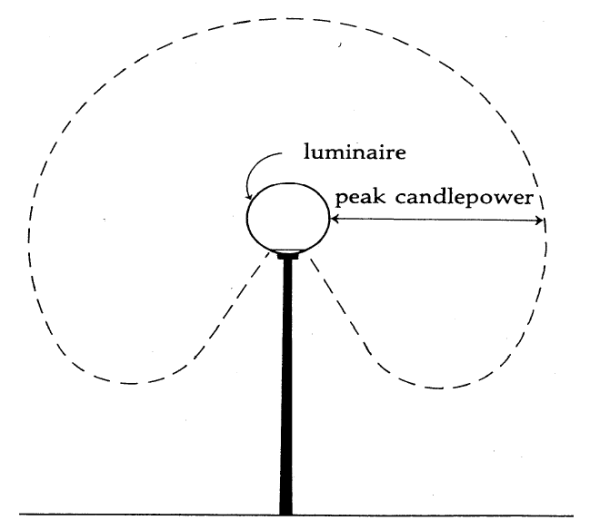
NO CUTOFF LUMINAIRE TABLE 18.5.2 When a luminaire has total cutoff of an angle greater than ninety (90) degree, the maximum illumination and the maximum permitted luminaire height shall be: Standard Maximum Permitted Illumination Maximum Permitted Height of Luminaire 1.5 35 feet An illustration of this type of luminaire is provided below. 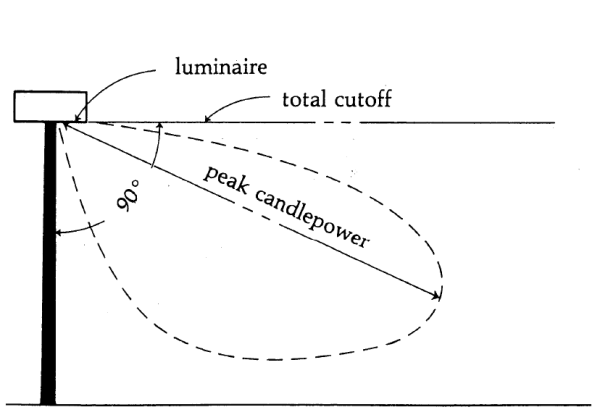
90° CUTOFF LUMINAIRE TABLE 18.5.3 When a luminaire has total cutoff of light at an angle less than ninety (90) degrees and is located so that the bare light bulb, lamp, or light source is completely shielded from the direct view of an observer five (5) feet above the ground at a point where the cutoff angle intersects the ground, then the maximum permitted illumination and the maximum permitted height of the luminaire shall be: Standard Maximum Permitted Illumination Maximum Permitted Height of Luminaire 4.00 50 feet An illustration of this type of luminaire is provided below. 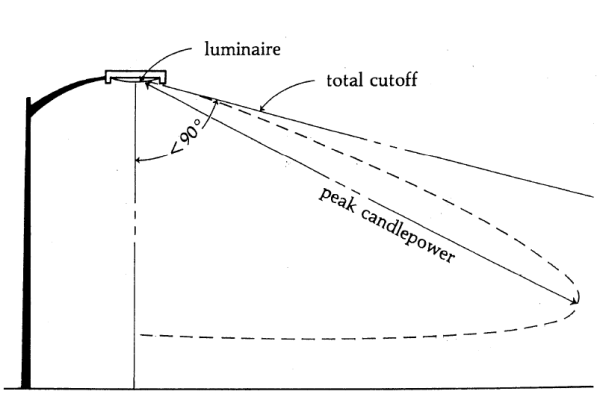
LUMINAIRE WITH LESS THAN 90° CUT-OFF - All operations conducted entirely within fully enclosed building.
- Operations designed to attract and serve customers or clients on the premises, such as the offices of engineers, surveyors, contractors, government office buildings, etc.
- Operations designed to attract little or no customer or client traffic other than employees of the entity operating the principal use.
- Operations conducted within fully enclosed buildings and in a fully fenced outside space.
- Operations designed to attract and serve customers or clients on the premises.
- Operations designed to attract little or no customer or client traffic other than employees of the entity operating the principal use.
- All operations conducted entirely within fully enclosed building.
- Majority of dollar volume of business done within walk-in-trade.
- Majority of dollar volume of business not done with walk-in trade.
- Operations conducted within or outside fully enclosed building.
- Storage of either raw materials or finished products within fully fenced outside space.
- Storage of raw materials and finished products within fully enclosed outside space.
- Restaurants.
- Carry-out and delivery service, consumption outside fully enclosed structure allowed.
- No substantial carry-out or delivery service, no drive-in service, no service or consumption outside fully enclosed structure except in attached patio setting.
- Motor vehicle repair and maintenance.
- Not including substantial body work conducted within fully enclosed building.
- Motor vehicle painting and body work conducted within fully enclosed building.
- Not including substantial body work conducted within fully enclosed building and storage of vehicles within fully enclosed outside space.
- Motor vehicle painting and body work conducted within fully enclosed building with storage of vehicles within fully enclosed outside space.
- Public services to include Police Stations, Fire Stations, Public Utility Substations, Rescue Squad, Ambulance Services, Post Office, Community or Regional Structures.
28-18-6 Conditional Uses
Conditions for approval shall be determined by the planning Commission by reference to Chapter 28-5.
- Buildings of height greater than thirty feet (30') or less than ten feet (10').
- Towers and related structures.
- Towers and antennas 50 feet tall or less.
- Towers and antennas more than 50 feet tall and receive only earth station.
- Sexually Oriented Business. 71
28-18-7 Accessory Uses
- Accessory Buildings and uses customarily incidental to the above.
- Signs as follows: nameplate; identification sign; on-premises business signs.
- Temporary buildings and uses incidental to construction work.
28-18-8 Sign Regulations
Signs erected in the MP-1 Zone shall be in accordance with an approved site plan and the Clinton City Sign Ordinance.
28-18-9 Bufferyards
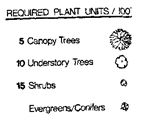
- The bufferyard is a unit of yard together with the planting required thereon. Both the amount of land and the type and amount of planting specified for each bufferyard requirement of this ordinance are designed to ameliorate nuisances between adjacent land uses or between a land use and a public road. the planting units required of bufferyards have been calculated to insure that they do, in fact function as "buffers". Bufferyards shall be required to separate different land uses form each other in order to eliminate or minimize potential nuisances such as dirt, litter, noise, glare of lights, signs, and unsightly buildings or parking areas, or to provide spacing to reduce adverse impacts of noise, odor, or danger from fires or explosions.
- Bufferyards shall be located at the perimeter of light manufacturing lots where the lot abuts against a zone other than light manufacturing.
- Bufferyards may remain in the ownership of the original developer (and assigns) of a land use, or they may be subject to deed restrictions and subsequently be freely conveyed, or they may be transferred to any consenting grantees, such as adjoining landowners, City, or an open-space or conservation group, provided that any such conveyance adequately guarantees the protection of the bufferyards for the purposes of this ordinance.
28-18-10 Bufferyard Requirements
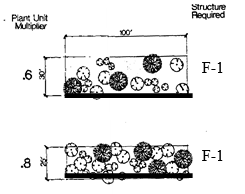
- Bufferyard requirements are outlined in Table 18.7.
- The following plant material substitutions shall satisfy the requirements of this section.
- Evergreen canopy or evergreen understory trees may be substituted for deciduous canopy forest trees without limitation.
- In all bufferyards, evergreen or conifer shrubs may be substituted for deciduous shrubs without limitation.
- The following plant material substitutions shall satisfy the requirements of this section.
- If the development on the adjoining use is existing, planned, or deed-restricted for solar access, understory trees may be substituted for canopy trees where canopy trees would destroy solar access.
- Any existing plant material which otherwise satisfies the requirements of this section may be counted toward satisfying all such requirements.
- The exact placement of required plants and structures shall be the decision of each user except that evergreen (or conifer) plant materials shall be planted in clusters rather than singly in order to maximize their chances of survival.
- All bufferyard areas shall be planted, irrigated, and maintained consistent with the water efficient landscape standards of this Title.
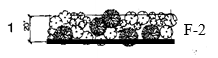
TABLE 18.7 BUFFERYARD STANDARDS AND FENCE REQUIREMENTS Symbol Height Material Chain Link F-1 6' 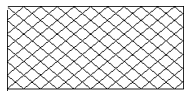
Chain Link with Vinyl Slats F-2 6' 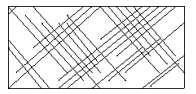
Cedar Slats with Metal Posts F-3 6' 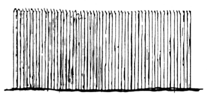
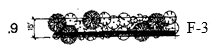
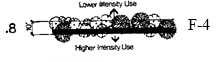
Solid Vinyl F-4 6' 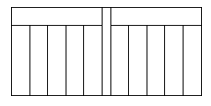
FENCES BUFFERYARD
Amended by Ord. 23-04Z on 6/27/2023
28-18-11 Use Of Bufferyards
A bufferyard may be used for passive recreation; it may contain pedestrian, bike, or equestrian trails, provided that: a. No plant material is eliminated, b. the total width of the bufferyard is maintained, and c. all other regulations of the ordinance are met. In no event, however shall the following uses be permitted in bufferyards: ice skating rinks, playfields, ski hills, stables, swimming pools, and tennis courts.
28-18-12 Contractual Reduction Of Bufferyard Abutting Vacant Land
When a land use is proposed adjacent to vacant land which is in another zone, and the owner of that vacant land enters into a contractual relationship with the owner of the land that is to be developed first, a reduced buffer may be provided by that first use, provided that:
- The contract contains a statement by the owner of the vacant land of an intent to develop at no greater than a specified land use intensity class; and
- The vacant landowner makes an agreement to assume all responsibility for additional buffer, if needed, by his development of a less intense use than had been agreed upon.

