
Clinton City Zoning Code
CHAPTER 28
4 Parking And Loading Space Vehicle Traffic And Access Regulations Parking
Historic Changes to Chapter (see section 28-24-2 for details) 3, 100, 104, 123, 134, 137, 148, 149, 150, 158, 173, 181, 198, 199, 203, 204
28-4-1 Application Of Chapter
- The requirements set forth in this chapter shall apply and govern all use of buildings and use of land.
- When any addition to or enlargement of an existing building or use increases the building or the developed area of the use or the parking requirements of the building or structure, the parking requirements of this Code must be met. Moreover, if the addition, enlargement, or change in use increases the building or the developed area of the use, or the required parking by ten percent (10%) or more, then the parking for the entire building shall be brought into conformance with all requirements of this Code, including required number of spaces, access, landscaping, lighting, screening, and other applicable standards.
- Any change in the use of a building or lot which increases the off-street parking as required under this Code, shall be unlawful and a violation of this Code until such time as the off-street parking complies with the provisions of this Code.
- Nothing in this Code shall be deemed to deprive the owners or operators of property generating a need for parking the right to maintain control over such property devoted to off-street parking not inconsistent with this Code or to charge whatever fees they deem appropriate to off-street parking users.
28-4-2 Off-Street Parking Required
There shall be provided at the time of the establishment of any use of land, or time any main building or structure is enlarged or increased in capacity, or upon a change of use or occupancy, minimum off-street parking spaces with adequate provisions for ingress or egress by standard sized automobiles as provided and described in this chapter.
28-4-3 Use Of Front Yard For Parking Prohibited
- No portion of a front yard as required in this Zoning Ordinance shall be used for the parking of automobiles or other vehicles unless developed as a public parking area in conjunction with a permitted multi-family, commercial or industrial use.
- No portion of a required front yard, other than driveways leading to a garage or properly located parking area, shall be paved or improved so as to encourage or make possible the parking of vehicles therein. Hard surface driveways leading to a garage or properly located parking area may be used as an approved parking area for additional vehicles to meet the requirements of this chapter.
28-4-4 Parking Space For All Residential Dwelling Units
In all zones with a permitted, conditional or nonconforming residential use, in accordance with other sections of this chapter, there shall be provided in the type of structure or space indicated sufficient parking of automobiles. If two (2) or more parking spaces are required the parking spaces must be side-by-side with direct access from a driveway or drive-lane. All required parking shall be upon a hard surface with hard surface access and properly located. For new buildings or structures, additional units, or for the enlargement or increase in capacity, floor area, or guest rooms of an existing main building or structure, there shall be the following minimum number of permanently maintained parking spaces on the same lot with the main building as follows:
- Apartments. For apartments, parking requirements shall be as follows:
Table 4.4.1 Number of Parking Spaces a Visitor Parking Per Unit a Unit Type Studio 1.0 .25 1 Bedroom 1.5 .25 2 Bedroom 2.0 .25 3 Bedroom 2.0 .25 4 Bedroom 2.5 .25 a At least fifty percent (50%) of all parking spaces shall be enclosed or have an overhead covering.199 - Assisted Living Facility with Resident Drivers. One and one quarter (1.25) stalls per unit plus one (1) space for each employee on the highest shift.
- Assisted Living Facility No Resident Drivers. One (1) stall for every Two (2) beds.
- Dwellings. In all zones where these type of residential units are allowed there shall be provided:
Table 4.8.1 198, 199 Type of Unit Number of Enclosed Spaces Other Parking Spaces Single Family 2a Within an enclosed garage Two Family 4 Three Family 6 2 additional per unit Four Family 8 2 additional per unit a Refer to the applicable Zone chapter for additional requirements associated with the specific zone. - Qualification. To meet the requirements of a parking space required by this Title: a space shall have a Hard Surface with Hard Surface access and properly located with a minimum size of ten (10) feet by twenty (20) feet.104, 199
- Conversion of Required Parking Space into Living Space. In the event that an attached garage or carport is to be converted into living space, the parking spaces required by §28-4-4(4) shall be relocated on site prior to the existing attached garage or carport being converted into living space.
199Exception: Model home is outlined elsewhere in this ordinance.
28-4-5 Parking Space For Commercial, Industrial, And Institutional Uses
For new buildings, changes in occupancy, enlargement or increase in seating capacity, floor area, or guest rooms of any existing building, a minimum number of parking spaces shall be provided as follows:
- Assembly Areas. Dance halls, exhibition halls, assembly halls, except when associated with a place of worship: Three (3) spaces for every one hundred square feet of assembly or dance floor area.
- Auditorium, Stadium or Theater. One (1) space per three and one half (3.5) seats provided in areas of assembly. 165
- Automobile and Machinery Sales and Service Garages.
- Sales: One (1) space per 100 sq.-ft of floor area or ten (10) spaces, whichever is greater and One (1) space per employee at the highest shift.
- Service: Six (6) spaces per bay. Any vehicles that are parked or stored overnight must be screened from public view.
- Banks, Savings and Loans, Credit Union, Finance Companies, Drive-in Banking. One (1) space per employee at the highest shift plus one (1) space per two hundred square feet of main floor area and one (1) space per five hundred square feet of basement or second floor area.
- Barber Shop/Beautician Shop. Three (3) spaces per chair.
- Boarding and Rooming Houses, Hotels. One and one-half (1.5) spaces for every two guests such building is designed to sleep.
- Car Wash. Three (3) spaces in each approach lane to each wash bay, plus one (1) per employee.
- Commercial Recreation.
- Billiard halls: Five (5) spaces min, plus two (2) per table.
- Bowling alleys: Four (4) spaces per alley.
- Golf courses: Four (4) spaces per green + one (1) per driving range tee.
- Swimming pools, etc.: Shall be determined by the City based on an analysis of parking requirements for similar uses or on anticipated parking demands.
- Day Care Center, Children's Nursery or Pre-School. Four (4) spaces plus one (1) space per five hundred square feet of floor area, plus one (1) space per employee at the highest shift.
- Drive-in, Fast Food Establishments. One (1) space per one hundred square feet of floor area but not less than ten (10) spaces. For drive-up windows, one (1) space in use plus four (4) in the approach lane.
- Dry Cleaner. One (1) space per employee plus five (5) spaces for customer use.
- Eating and Drinking Establishments. Cafes, cafeterias, restaurants, lounges, night clubs, private clubs or taverns: One (1) space for each one hundred (100) square feet of gross floor space, or one stall for every 3 seats, whichever is greater.
- Institutional Uses. Hospitals, sanatoriums, convalescent hospitals: One (1) space for each two-bed capacity, plus one (1) space for every employee at the highest shift.199
- Laundromat. One (1) space for each 200 square feet of floor area.
- Library. Twenty (20) spaces for each floor open to public uses.
- Liquor Store. One (1) space per 250 sq.-ft.
- Medical / Dental Laboratory / Research Services. Five (5) spaces, plus one (1) space per employee at the highest shift.
- Medical Clinics. (Doctors, dentists, optometrists, psychiatrists, etc.) Six (6) spaces per 1,000 sq.-ft. for the first 9,000 sq.-ft. floor area, plus one (1) space per 200 sq.-ft. after 9,000 sq.-ft. of floor area.
- Mortuary. One (1) space for each forty square (40) feet of floor area in assembly rooms, plus one (1) space per company vehicle.
- Motel/Hotel. One (1) parking space for each unit and one (1) space for every 200 square feet of assembly area, plus one (1) space per employee at the highest shift.
- Museum. One (1) space per 300 sq.-ft. of floor space.
- Places of Worship. One (1) space for every four seats in the auditorium; however, where a church/temple building is designed with the intention to be used by two congregations at the same time, one and one-half (1.5) parking spaces shall be provided for every four seats in the auditorium.
- Post Office. One (1) space per vehicle used by the operation plus one space per employee at the highest shift plus ten (10) spaces for customers.
- Professional Office. Legal, employment insurance, travel, photo, real estate, etc.: One (1) space for each two hundred (200) square feet of floor area on the main floor, plus one (1) space for each four hundred (400) square feet on any other floor excluding storage area.
- Reception Center and Wedding Chapels. A minimum of thirty (30) spaces or as outlined for auditoriums, whichever is greater.
- Retail Stores and Shops. One (1) space for each two hundred square feet of retail floor space.
- Schools.
- Elementary and Junior High: Two (2) spaces for each classroom, plus one (1) space per administrator.
- Senior High: One (1) space for each four seats provided in the auditorium or stadium, whichever is greater.
- Public or private college or trade or vocational school: one (1) space per 100 sq.-ft. of building.
- Housing associated with such schools: One (1) space per two (2) beds.
- Shopping Centers (Regional). One (1) space for each two hundred square feet leasable floor space.
- Warehousing/Manufacturing. One (1) space per employee at the highest shift, plus one (1) space per 500 sq.-ft. of floor area.
- Wholesale Business. One (1) space per employee at the highest shift, plus one (1) space per 500 sq.-ft. of floor area.
- Other. Uses not listed above, or commercial units with undetermined occupants at the time of construction: To be assigned by the planning director and approved by the Planning Commission being guided by the requirements set forth herein for uses which are similar to the proposed use.
28-4-6 Computation Of Parking Requirements
When the computation of required parking spaces results in a fractional space, any fraction up to one-half shall be disregarded, and fractions including one-half and over shall require one parking space. Where there is a combination of uses into one structure, each use shall be calculated as a separate unit.
28-4-7 Location Of Parking Facilities
Parking space as required above shall be on the same lot with the main building, except for when overflow parking for an existing building is needed to meet no more than fifty (50%) of the required off-street parking for any commercial, industrial and institutional use, structure or building which existed prior to December 12, 2017, which due to the size or location of the parcel, cannot be provided on the premises, may be provided on other property not more than five hundred feet in distance from the building site measured along the shortest available pedestrian rout of access, and designated with a legal crosswalk for safety when crossing a public street which is designated as a local road as shown in the City’s street plan. All exterior routes to parking facilities containing accessible parking shall meet the requirements of the International Building Code adopted by the State. The building overflow parking parcel shall have added to its recorded plat with the County Recorder a statement saying ‘Restriction on Property Use: Clinton City Code 28-4-8 requires that this parcel be maintained for overflow parking for Assessor parcel # (list number) in perpetuity unless released from this restriction by the Clinton City Council.’ The building parcel shall have added to its plat: ‘overflow parking parcel # (Assessor number) is tied to this parcel in perpetuity unless this connection is released by the Clinton City Council.’
28-4-8 Maintenance Of Parking Facilities
Space for off-street parking located on site or on other property to which it is accessory and required for a particular use shall not thereafter be utilized for any other purpose but shall be maintained in perpetuity as long as the requirement for the off-street parking is required.
28-4-9 Accessible Parking Spaces
- Designation of Spaces. The required number of parking spaces designated for the handicapped shall be provided according to this section. The spaces required by this section shall be allocated from the required parking stalls of this Chapter. In no way does this designation apply to single-family homes.
- Required Spaces. The required number of parking spaces intended for the physically handicapped shall be provided at a rate based on the following:Notwithstanding the chart above, medical offices shall provide ten percent (10%) of their parking spaces as accessible parking, hospitals shall provide twenty percent (20%) of their parking spaces as accessible parking and apartment buildings shall provide two percent (2%) of their parking spaces as accessible parking. The required spaces shall be located to provide the least travel distance to accessible facilities served. They shall be located, where feasible, to allow those parking in the spaces to access the associated building without crossing vehicle traffic area. The distance between the most remote principal entrance of a building and any one space shall not exceed two hundred feet (200').
Total Parking
SpacesMinimum Required Number of
Accessible Spaces1-25 1 26-50 2 51-75 3 76-100 4 101-150 5 151-200 6 201-300 7 301-400 8 401-500 9 501-1,000 2% of total spaces Over 1,000 20 spaces plus 1 space for every 100 spaces or fraction thereof over 1,000 - Size. Required spaces have an adjacent access aisle not less than eight feet (8') wide for the first access aisle then five feet (5') wide for each additional stall aisle. Two (2) adjacent spaces may share a common access aisle. Such aisles shall provide an accessible route of travel to the building or facility entrance. Boundaries of the required parking spaces and aisles shall be marked to identify the use of such spaces.
- Signage. Every parking space required by this section shall be identified by a sign centered from three (3) to five feet (5') above the ground at the head of the required space. The sign shall be marked with the international symbol of access. Such signage shall not be less than twelve inches (12") in height. The symbol shall be proportioned according to the figure below. The lettering shall be not less than one inch (1") nor more than two inches (2") in height and shall be on a background of contrasting value.
- Surface. Parking spaces and access aisles shall slope not more than one inch (1") in forty eight inches (48") and shall be firm, stable, smooth and slip resistant.
28-4-10 Size Of Parking Spaces
Each off-street parking space shall be at least nine feet by twenty feet for diagonal or ninety degree spaces, or nine feet by twenty-two feet for parallel spaces exclusive of access drives or aisles; except that commercial and industrial parking lots may have ten percent of the parking spaces designated for small cars which shall measure eight and one-half feet by eighteen feet and five percent of the parking spaces designated for motorcycles which shall measure four feet by eight feet. (Parking spaces required to be twenty feet deep by this section may be eighteen feet deep where they abut a curb against a landscape area where the back of curb is a minimum of two feet from the property line and the landscaping is not subject to vehicle damage or where the curb is adjacent to a walking area a minimum of six feet wide from the back of curb.)
28-4-11 Driving Isle Width
Minimum driving isle width within a parking area is twenty-six (26) feet.
28-4-12 Parking Lot Improvement Requirements
Every parcel of land hereafter used as a public or private parking area, including commercial parking lots and automobile, farm equipment, or other open-air sales lots shall be developed and maintained in accordance with the following requirements:
- Surface and Drainage. Lots shall be properly graded for drainage, surfaced with concrete, asphaltic concrete, asphalt, oil or any other dust-free, hard surface and maintained in good condition, free of weeds, dust, trash and debris;
- Screening. The sides and rear of any off-street parking area for more than five vehicles which adjoins a residential or institutional building, or is contiguous to a residential zone, shall be effectively screened by light-tight masonry wall or solid fence. Such wall or fence shall be of a design, type and height determined by the Planning Commission not to exceed eight feet in height, and shall be maintained in good condition. Advertising on walls and fences is prohibited except as an integral architectural part of the wall or fence and when approved by the Planning Commission;
- Exits. Lots shall be provided with entrances and exits so located as to minimize traffic congestion in compliance with Sections 28-4-16 and 28-4-17 of this ordinance;
- Wheel Bumpers. Lots shall be provided with wheel or bumper guards at least eighteen inches from a lot line, designated pedestrian walking area less than six (6) feet wide, accessible route or building, located so that no part of a parked vehicle will extend beyond the parking space. 123
Lighting facilities shall be so arranged so that they neither disturb occupants of adjacent residential properties nor interfere with traffic. - Signage and Striping. Lots shall be marked to indicate the number of parking spaces and the pattern of parking and circulation. Additionally, such areas as fire lanes, no parking areas, accessible exterior routes, and pedestrian walking areas shall be appropriately marked. Interior traffic control signs shall be installed and at exits to public streets stop signs shall be installed. Other signage established during the site plan approval process shall also be installed.
- Application. All applications for a site plan review, building permit or occupancy permit shall be accompanied by a plot plan showing the required parking spaces, with ingress and egress. Said plan shall be reviewed and approved by the Planning Commission as outlined in § 28-3-10 of this Title or as directed by the Community Development Director.
28-4-13 Loading Space Requirements
No building shall be designed, erected, altered, increased in capacity, used or occupied, and no land shall be used or occupied for manufacturing, storage, warehouse, goods display, vehicle sales, department store, grocery, hotel, hospital, mortuary, laundry, dry cleaning, or other uses similarly involving the receipt or distribution, by vehicle, of materials or merchandise, unless adequate off-street loading space is provided therefore, excepting that off-street loading space need not be provided for buildings or uses actually occupied, operated, or used on the effective date of the ordinance codified herein, where no such space has been provided, unless such buildings are thereafter enlarged, increased in capacity, expanded or have change of occupancy.
- Loading Space Berth Requirements. Each use for which off-street loading space is required shall provide the number of loading berths necessary to properly service that use, plus an area or means for adequate ingress and egress to each berth. Where any required or permitted loading dock or area is to be constructed in conjunction with a proposed use which is adjoining a residential zoning district, said loading dock or area shall be screened from the adjoining property by constructing a light-tight masonry wall or solid fence at a height to be determined by the Planning Commission but not exceeding eight feet. A landscape buffer may also be specifically required by the Planning Commission which shall be properly maintained in perpetuity by the commercial/industrial use.
- Loading Space Location. Off-street loading space shall be located on the same site or lot as the use for which it is provided. No loading space shall be designed, arranged, or used where all or part of the space would permit loading, unloading, or service from a public street or sidewalk.
- Loading Space Maintenance. Off-street loading facilities, either existing or hereafter provided, shall not thereafter be decreased, but shall be maintained in order to provide continuous use, if necessary.
28-4-14 Authorization For Parking Space Reduction Or Combination
The Board of Zoning Adjustments may authorize reduction of off-street parking and loading space as follows:
- Reduction in Parking Space. The Board of Zoning Adjustments may authorize on appeal, a reduction in the proportions required in this chapter if it should find that in the particular case, the peculiar nature of the buildings or premises, or the exceptional situation or condition would mitigate the need for the parking spaces as specified in this chapter.
- Combine Parking Space. When two dissimilar uses are located adjacent to each other and the demand for parking in conjunction with those uses would not conflict, the Board of Zoning Adjustments may authorize the use of such combined facilities requiring the maximum number of parking spaces for the larger use.
28-4-15 Access To Residential Property Including Four Or Less Dwellings
Access to parking spaces and private garages used in conjunction with dwellings shall be limited as follows:
- Proximity to Intersection. Driveways shall be located a minimum of forty (40) feet from any street intersection. Said measurement to be taken from the point of intersection of the two converging front lot lines lying tangent to and in the same direction as the front lot lines, to the edge of the driveway.
- Proximity to Property Line. No driveway approach shall be located closer than four and one-half (4 1/2) feet to a side lot line of a lot as it is projected to the back of the curb and gutter. This measurement is to be taken to the beginning of the flare or radius on the curb.
- Drainage. A driveway on private property may be constructed up to the side or rear property line so long as the driveway does not interfere with the surface drainage of the lot or adjacent lots where drainage easements are provided. The drainage from the driveway must be kept within the property.
- Driveways and Accessory Parking. 173, 199, 203, 204
- All driveways, streets, isles, etc. intended to provide a means of access to parking spaces intended to meet the requirements of this chapter shall be paved with a hard surface and shall have a hard surface approach designed to meet the requirements of the Clinton City Engineering and Standard Specifications. 199
- Accessory parking areas on a lot with a single family residential unit with an established driveway that meets the requirements of “a” above are allowed within the front setback area of a lot based upon the
- An area if hard surface meeting the requirements of a driveway; or,
- An area constructed of three-quarter (3/4) inch gravel a minimum of four (4) inches thick. If road base is used as an underlining material sufficient gravel shall be used to cover the road base; and
- Except for corner lots the area shall be on the side of the dwelling adjacent to an established driveway; and
- The area shall have a substantially durable boarder, extending a minimum of one (1) inch below the depth of the gravel. The intent of this boarder is to prevent the migration of gravel from the parking area to adjoining landscaped areas or property. An example of a substantially durable boarder would be railroad ties or concrete mow strip; and
- A drive access to the accessory parking area shall be by an approach of concrete designed to meet the requirements of the Clinton City Engineering and Standard Specifications. Access shall not be by jumping the curb, temporary ramps, or other means of driving over the curb; and
- The accessory parking area shall be kept weed and vegetation free; and
- The accessory parking area shall be for parking of licensed vehicles, trailers, and boats, owned by the resident, and not for storing project vehicles, vehicle parts, or other storage; and
- On corner lots, accessory parking shall not be within the exterior side yard facing a street setback area; and
- The accessory parking area may extend from the edge of the existing driveway to the property line.
- Additional accessory parking may be established behind a solid fence, adjacent to the dwelling on the same side as the driveway, constructed of a dust and weed free gravel, or similar surface.
- Corner Lots where one of the streets is not a Collector Street, as described in the Clinton City Transportation Master Plan Update 2005-2030, or where access to the lot has not been restricted by ordinance or plat, access to the lot from a side street, not associated with the drive to the garage, is allowed and the following shall apply:
- Access to a corner lot from a Principal Arterial or Minor Arterial is not allowed;
- Access shall lead to a parking pad constructed of hard surface or gravel (if gravel then as outlined in “v” above) or an approved garage or accessory building;
- Access shall be a minimum of 10-feet behind the dwelling on the lot;
- Impervious surface ratio for the zone shall not be exceeded; and
- Curb cut shall comply with the requirements established by ordinance.
- Number of Approach. 134, 149 Lots shall be limited to one driveway approach except where a second driveway approach is specifically approved by the Community Development Director. Lots may have two driveway approaches under the following circumstances:
- Corner lots with frontages on two (2) local streets may have two (2) driveway approaches, one on each frontage totaling the maximum percentage set in Table 4.15.7. Corner lots having a frontage of at least 100 feet on a local may have two (2) driveway approaches on a single frontage with the combination of the two (2) approaches not exceed the percentage set in Table 4.15.7 and shall be separated by 30 feet measured from the two inside edges of the driveway approaches.
- Inside lots with frontages on a local roads and having a frontage of at least 100 feet, may have two (2) driveway approaches on a single frontage, with the combination of the two (2) approaches not to exceed the percentage set in Table 4.15.7. The two (2) approaches shall be separated by a minimum of 30 feet measured from the two inside edges of the drive approaches.
- Inside lots with frontages on collector streets (800 North, 1300 North, 1800 North, 2300 North, 1000 West, 1500 West, 2000 West or 3000 West) having a frontage of at least 100 feet or more may have two (2) drive approaches on a single frontage with the combination of the two (2) approaches not exceed that set in Table 14.15.7. The two drive (2) approaches shall be separated by a minimum of 50 feet measured from the two inside edges of the drive approaches. However, lots with frontages on 1800 North and/or 2000 West, must first gain approval from the Utah Department of Transportation (UDOT).
- Double Frontage Lots. Lots that are double fronted with one frontage on an arterial, minor arterial or collector street, or corner lots with frontage on an arterial, minor arterial or collector street, shall not be allowed to have a drive approach on the higher classification street. Upon approval by the Community Development Director, corner lots with frontages on two local streets may have a total of two drive approaches; one on each frontage of the street with a maximum width indicated in (7) below. Drive approaches shall comply with the criteria in 28-4-15(5)(a) – (c). above, and shall not create a traffic hazard.
- Width of Drives. 104 The width of residential property driveway approaches is regulated as follows: Width: The percentage of frontage indicated in Table 4.15.7 above shall be inclusive of all drive approaches allowed any one frontage of a lot. The width of a drive approach shall be measured where the approach attaches to the sidewalk or at a distance four and one-half (4 1/2) feet behind the curb. Any flare or radius shall not be counted in the approach width.
Table 4.15.7 149 Zone Min Width Percent of Frontage Allowed
in ApproachA-1 10’ 40% A-E 10’ 40% R-1-6 10’ 33% R-1-8 10’ 33% R-1-8a 10’ 33% R-1-9 10’ 50% R-1-10 10’ 50% R-1-15 10’ 50% R-M 10’ 33% R-M approaches are to be approved during the site plan review and established as unchangeable without site plan review. 104 - Width. The percentage of frontage indicated in (7) above shall be inclusive of all drive approaches allowed any one frontage of a lot. The width of a drive approach shall be measured where the approach attaches to the sidewalk or at a distance four and one-half (4 1/2) feet behind the curb. Any flare or radius shall not be counted in the approach width.
- All park strip areas providing access from a public way shall be Hard Surface.
28-4-16 Access To All Other Uses
Access to all uses not listed hereinabove, including parking lots and apartments, mobile home developments, business and industrial uses, shall be limited as follows:
- Location of Driveway. Where access is provided by one driveway or two or more connecting driveways shall be as follows:
- Access shall be by not more than one driveway for the first one hundred feet of frontage and one additional driveway for each additional one hundred fifty feet of frontage. For lots with more than one hundred seventy-five feet and less than two hundred fifty feet of frontage, two driveways may be allowed by the Planning Commission.
- No two of these driveways shall be closer to each other than fifty feet, and no driveway shall be closer to a side lot line than twenty feet except as granted by the Board of Zoning Adjustments upon recommendation from the Planning Commission.
- Driveways are to be located in conformance with Chapter 4 of the AASHTO book "Geometric Designs of Highways and Streets", or as approved by the City Engineer. In no case shall a driveway be located closer than eighty feet from the point of intersection of two arterial streets, or fifty feet from the intersection of an arterial and other classification of street. For all non-arterial streets this distance shall be fifty feet. The distance shall be measured from the point of intersection of the two converging front lot lines or of two lines lying tangent to and in the same direction as the front lot lines. No driveway shall be located across any curved section of frontage lying between the point of intersection and the point of tangency.
- Lots with frontages of one hundred fifty feet or less are encouraged to share access to streets with adjacent lots. Where this is feasible, the Planning Commission may require joint access. Where it is determined to be infeasible by the Planning Commission, they may refer the proposed driveway location(s) to the Board of Zoning Adjustments with a recommendation for exception.
- The design and location of all driveways entering a state highway shall be done as required by the Utah Department of Transportation. Approval of the driveway(s) shall be provided to the city in writing prior to the issuance of any building permit.
- Access points from Arterials and Sub-Arterials, as outlined in the Clinton City Transportation Master Plan, shall be designed as street entrances rather than a curb cut.134
- Width of Driveway. Each driveway shall have a width of not less than twenty feet nor greater than thirty-five feet in width on local and collector streets. On arterial streets the width shall not exceed forty feet in width. The measurement of driveways shall be taken at right angles to the centerline of the driveway at the front lot line and shall be from face to face of the curb radii.
- All parkstrip areas providing access from a public way shall be Hard Surface.
28-4-17 Permits And Certificates Of Occupancy
No permit for any contemplated use or building shall be issued unless the location of the driveways for vehicular access to the property is shown on the plot plan and no certificate of occupancy shall be issued or approved unless and until the requirements of this chapter have been complied with in full.
28-4-18 Parking Lot Landscaping
Parking lot screening, perimeter and interior landscaping shall be consistent with the water efficient landscape standards and landscape plan requirements set forth in Section 28-3-21 of this Title.
- Landscaping and Screening: Whenever parking spaces for five or more cars and their associated access driveways are located in or near a residential zone, screening is required to protect residential properties from potential impacts of lights, noise, increased pedestrian and automobile traffic, invasions of privacy and physical intrusions on property. Based on the applicant's site plan, the department will determine the potential impacts resulting from location, site design and layout as they relate to the areas of concern identified in Table A of this section. The nature of surrounding topography may be considered in determining whether impacts exist. The applicant may then choose from among those screening options in Table A of this section that are designed to mitigate identified impacts. The specified standard for each option is identified in Table B of this section. Determinations may be appealed to the Planning Commission. If there are no potential impacts, screening may not be required. The fencing and landscaping required under this section shall be maintained and replaced as needed in order to provide an effective screen. Whenever a fence abuts a parking area, tire blocks will be required; the tire blocks must be set back a minimum of two and one-half feet from the curb, in order to protect the fence from traffic. Landscaping shall be protected from automobile overhang, excluding low growing ground covers.
TABLE A: SCREENING OPTIONS
| IMPACTS ON ADJACENT RESIDENTIALLY ZONED PROPERTY | |||||
| Area Of Concern | |||||
| Dumpster | Lights | Noise | Privacy | Objectionable Views | Access Restriction |
| D or E | C1, D, E, or H1 | C1, E, or H1 | C1, D, E or H1 | C1, D, E, G, or H1 | D, E, F, G, H1 or I |
| 1This is an option only when abutting residentially zoned property is vacant or has substantial existing vegetation. In either instance the time needed for growth of vegetation will not be detrimental to the buffering needs. | |||||
TABLE B: SCREENING OPTION DESCRIPTIONS
| Option | Screening Type | Purpose And Standards |
| A | 3' berm | Screens vehicles in parking lot and decreases asphalt appearance, except when difference in topography offsets screening. Any berm shall have a minimum height of 3' and a stabilized side slope of no greater than 3 to 1 ratio of run to rise. Berms shall be a minimum width of 9'. |
| B | Berm with shrub landscaping sufficient to achieve a four-foot-high screen | Screens parking lot and buffers building. Evergreen shrubs shall be of a locally adapted species. Shrubs shall be a minimum of five gallons when planted and shall be expected to reach a height of at least four feet within five years of planting. Shrubs shall be planted at a maximum of five feet on center. The berm shall have a stabilized side slope no greater than three-to-one ratio of run to rise. |
| C | Evergreen hedge with an ultimate height of at least 5' | Screens parking lot except when difference in topography offsets screening and buffers building which is close to property line. Shrubs shall be of a locally adapted evergreen species such as arborvitae (Thuja occidentalis or orientalis), juniper (Juniperus virginiana or chinensis), pyracantha, yew (Taxus media), or evergreen euonymus (Euonymus japonica), with a 5 gallon minimum planted size, and shall be expected to reach a height of at least 5' within 5 years of planting. Shrubs shall be planted at a minimum of 5' on center. |
| D | A 6' tall solid fence of either wood, vinyl or chain-link with interlocking opaque vinyl or a 6' tall decorative masonry wall with textured surfacing facing residential use | Screens ground level lights, noise, objectionable views, provide privacy and access restriction, and texturing provides aesthetic relief. "Decorative masonry" shall include split-face block or brick, brick, fluted block, or masonry wall with stucco finish, but shall not include openings in the wall surface below a height of 6'. Bumper guards set back a minimum of 2 1/2' from the fence shall be required when fence abuts parking. |
| E | A six-foot wide landscaped strip and either a six-foot tall solid fence of either vinyl or chain-link with interlocking opaque vinyl, or a six-foot tall decorative masonry wall with textured surfacing facing residential use | Screens ground level lights, higher level lights, noise, and objectionable views; provides privacy, access restriction and additional noise mitigation. Trees shall be a minimum of two-inch caliper in size, spaced at a minimum of 20 feet on center. |
| F | 6' chain-link fence | Provides security and access restriction. Used only when these are the major impacts. Bumper guards, set back a minimum of 2 1/2' from the fence, shall be required when fence abuts parking. |
| G | 6' chain-link fence with inserts in the fence fabric | Provides security and access restriction. Inserts help screen objectionable views. Inserts shall be of a durable opaque material and shall be kept in good repair. Bumper guards, set back a minimum of 2 1/2' from the fence, shall be required when fence abuts parking. |
| H | 6' open fence with evergreen trees and shrubs | Screens ground level and higher level lights, provides security and access restriction. Vegetative screen provides additional noise mitigation and screens objectionable views. Trees and shrubs shall be of a locally adapted evergreen species such as arborvitae, juniper, pyracantha, evergreen euonymus, pines or spruces, with a planted size of at least 15 gallons for trees and 5 gallons for shrubs, and shall be expected to reach a height of at least 5' within 5 years of planting. Trees shall be planted at 20' on center and shrubs at 5' on center. |
| I | Ornamental wrought iron fence or other decorative see through fencing | Provides some access restriction. Used when this is the only impact from the proposed development. Bumper guards, set back a minimum of 2 1/2' from the fence, shall be required when fence abuts parking. |
- Parking Lot Perimeter Landscaping. Parking lots with four (4) or more spaces shall be buffered from public streets. At least seventy percent (70%) of the length of the parking lot fronting the street shall be screened to a height of thirty six inches (36"). To screen the parking area, the landscaped area may either be bermed, planted with shrubs or evergreen trees.
- Parking Lot Interior Landscaping.
- Required parking areas shall install landscaped islands with raised curbs. Islands shall not be placed over asphalt or concrete. A curb shall be provided along all interior roadways to prevent vehicular intrusion into landscape areas. Whenever a landscaped island under this provision is required it shall be a minimum width of nine feet and the length of the parking stalls it abuts. Landscaped islands shall be required for each of the following conditions:
- The end of all rows of stalls.150
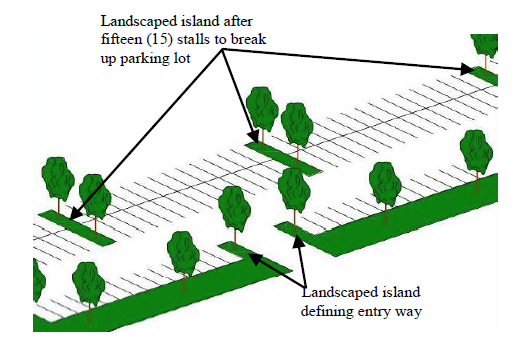
- A row of parking has over 15 parking stalls. One island shall be placed between every 15 stalls in the row. In the light manufacturing zone, if the parking is located behind the building and is not in public view from the street, the island placed between every 15 stalls can be relocated and placed as one large island. The area for the large island shall be the cumulative square footage of the separate islands. Such combined area shall be located at the entrance to the row of parking which is most visible from the public street.
- To define parking lot entrances.
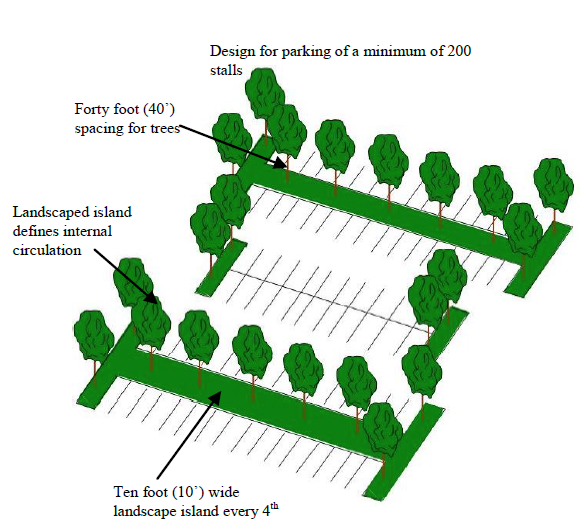
- To define the main interior circulation road pattern.
- When landscaped islands are required, a minimum of one deciduous tree shall be planted in each island. This tree requirement is in addition to the number of trees required on the remainder of the lot. The surface of the island shall be planted in mulch, ground cover, or shrubs. Plantings shall be maintained at a height not to exceed two feet.
- Required public and employee parking areas over 200 stalls shall be divided by a minimum 10-foot wide landscaped planting island perpendicular to the parking stalls. The planting island shall be placed along every fourth row of parking. Trees shall be planted in the island at 40 feet on center and shall be a minimum two-inch caliper size. Where possible, these islands should line up with exit & entryways of the buildings and have a minimum of a five-foot walkway, within the island.
- A minimum of six percent of the interior space (as measured by drawing a rectangular shaped area around the maximum extent of each parking area) of all parking lots with 99 or less spaces, and 10 percent of all parking lots with 100 or more spaces shall be landscape areas.
- Required parking areas shall install landscaped islands with raised curbs. Islands shall not be placed over asphalt or concrete. A curb shall be provided along all interior roadways to prevent vehicular intrusion into landscape areas. Whenever a landscaped island under this provision is required it shall be a minimum width of nine feet and the length of the parking stalls it abuts. Landscaped islands shall be required for each of the following conditions:
Amended by Ord. 23-04Z on 6/27/2023

