
Clinton City Zoning Code
CHAPTER 28
9 Non-Conforming Regulations
28-9-1 Purpose And Intent
It is the purpose of this chapter to provide for the continual use of any building, structure or tract of land lawfully established at the time of passage of the zoning ordinance, other land use ordinance, or any amendments thereto, which does not conform to the present regulations of the zone in which it is located. It is the intent of this chapter to regulate such uses and structures in such a manner to lead eventually to the elimination of non-conforming uses and noncomplying structures over time and in no way perpetuate said uses beyond reasonable abandonment.
28-9-2 Non-Complying Structures
A non-complying structure, or what has previously been referred to as a non-conforming building, is any building or structure that legally existed before its current land use designation, and because of one or more subsequent changes to the zoning ordinance, or other land use ordinance, does not conform to the setback, height restrictions, or other regulations now governing the use of land, which regulations generally include yard regulations, lot coverage or landscaping requirements, parking regulations governing the location, design or number of parking stalls. Non-conformity as to regulations governing the use of land such as area or density requirements or parking requirements, established as a minimum requirement for the use of land in the applicable zone, shall render any structure located on the land to be both a non-complying structure and a nonconforming use. For purposes of this chapter, an expansion of structure where the use is otherwise allowed in the applicable zoning district shall be reviewed under § (2) of this section. If the use is not otherwise allowed in the applicable zoning district, the expansion shall be reviewed under § 28-9-3(2) of this chapter.
- Ordinary Maintenance and Repair. A non-complying structure may be maintained or repaired so long as such work does not increase the non-complying or non-conforming conditions of the building or structure.
- Addition or Enlargement.
- Authorization; Determination. A non-complying structure shall not be added to or enlarged in any manner, unless the Community Development Director or his appointee, finds that such expansion is otherwise authorized under § (2)(b) through (2)(d) of this section, or except by issuance of a non-complying structure permit by the Planning Commission. In reviewing a request to expand a non-complying structure, the Planning Commission shall determine that:
- Granting the expansion will not adversely impact the attainment of the general plan of the city;
- The expansion will improve the general appearance or safety of the area;
- By expanding the building, the character of the neighborhood is not adversely impacted;
- The expansion will improve the area by providing additional or adequate parking;
- Any expansion will be adequately screened or buffered, if needed, so as not to increase impacts to the adjoining properties; and
- The expansion will not otherwise violate the standards established in § (2)(b) through (2)(d) of this section for any particular type of expansion.
- Non-complying as to Height. A main building non-complying as to height regulations can be expanded provided the addition meets all required setbacks of the zone in which it is located and does not increase any other non-complying or nonconforming status of the property on which it is located. If only a portion of the building is noncomplying as to height then the addition or expansion must meet the height regulations of the zone in which it is located. A non-complying accessory building cannot be enlarged or expanded unless the addition or expansion complies with the height regulation and required setbacks of the zone and does not increase any other non-complying or non-conforming status of the property on which it is located.
- Non-complying as to Setbacks or Yard Regulations.
- A main building non-complying to front yard setbacks may be expanded and maintain the existing non-conforming front yard setback provided such expansion will not displace required parking or otherwise require a parking variance, or will not result in the removal of existing landscaping in the required front yard setback.
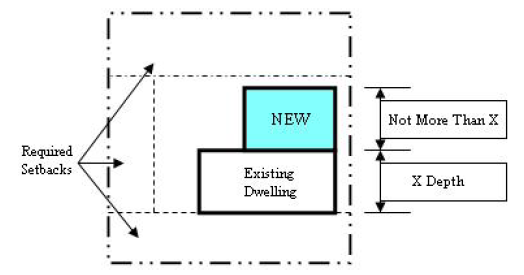
- A residential main building with non-complying side yard setbacks but having a minimum side yard of not less than three (3) feet, may be extended in depth along the non-conforming building line to a maximum of the depth of the existing dwelling if such extension is for the purpose of enlarging and maintaining the existing dwelling or required parking, and provided such enlargement does not increase any other nonconformity which may exist and conforms to all other regulations of the zone in which it is located.
- A main building non-complying to rear yard setbacks may be expanded provided the expansion does not increase the non-complying rear yard setback and does not require any other variance.
- Single Family; Expansion Of Parking. A single family detached dwelling non-conforming as to the number of properly located off street parking spaces located on the lot may add additional spaces not to exceed the minimum required in accordance with the following standards:
- Side Yard Parking With One Legal Stall. If the lot has at least one properly located off street parking space, or if no legal off street parking exists and cannot be developed, then one parking stall may be constructed in one required side yard; provided, that:
- The parking area is at least nine (9) feet wide and is at least twenty (20) feet in length and that no portion of the vehicle extending forward of the front face of the dwelling;
- The parking area and its associated driveway shall be hard surfaced;
- The appurtenant driveway to the side yard parking must be tapered if using an existing driveway and approach or a new driveway and approach must be installed to the new parking space;
- Any parking in the side yard setback must remain open and unobstructed to the sky;
- All storm water runoff from the hard surface of the parking area must be directed so as to prevent drainage onto adjacent properties; and
- No parking shall be permitted within the required side yard facing a street on a corner lot.
- Front Yard Parking. A maximum of two (2) hard surfaced parking spaces may be added in the front yard setback, if all of the following standards are met:
- No legal parking has existed on the property and space is not available, or there is no reasonable access, to locate legal parking either in the side or rear yards;
- Such space must remain open and unobstructed to the sky;
- No portion of a parked vehicle shall extend beyond the front property line into the public right of way;
- The parked vehicle shall not exceed eight feet (8') in width, twenty feet (20') in length, and seven feet (7') in height; and
- The parking area and its associated driveway shall be hard surface and the parking area shall not exceed fifty percent (50%) of the front yard area.
- Non-conforming or Non-complying as to Lot Area.
- A single-family dwelling with inadequate lot area in a residentially zoned district shall be allowed to expand or construct on the lot provided that the construction will meet required setbacks or has received the needed setback variances.
- A single-family dwelling shall be allowed to be constructed on a vacant subdivided lot with inadequate lot area in a residentially zoned district provided that the construction will meet required setbacks or has received the needed setback variances.
- A multiple-family dwelling and associated buildings with inadequate lot area may expand the buildings or structure on the lot; provided, that:
- The construction will meet required setbacks or has received the needed setback variances; and
- The expansion will create covered parking in areas that are presently paved and used for parking.
- Side Yard Parking With One Legal Stall. If the lot has at least one properly located off street parking space, or if no legal off street parking exists and cannot be developed, then one parking stall may be constructed in one required side yard; provided, that:
- Authorization; Determination. A non-complying structure shall not be added to or enlarged in any manner, unless the Community Development Director or his appointee, finds that such expansion is otherwise authorized under § (2)(b) through (2)(d) of this section, or except by issuance of a non-complying structure permit by the Planning Commission. In reviewing a request to expand a non-complying structure, the Planning Commission shall determine that:
- Damage or Destruction.
- A non-complying structure that is involuntarily damaged or destroyed, in whole or in part, by fire, flood, wind, earthquake or other natural disaster or calamity may be restored or rebuilt; provided, that such restoration is started within a period of one year and is diligently pursued to completion and the noncompliance is not increased.
- Non-complying structure shall not be rebuilt or restored if:
- The structure is allowed to deteriorate to a condition that the building is rendered uninhabitable and a building permit has not been issued to repair or restore within six (6) months after written notice to the property owner that the structure is uninhabitable and that the right to rebuild or restore such noncomplying structure will be lost if a building permit has not been issued to repaired or restored within six (6) months; or
- The property owner has voluntarily demolished or removed a majority of the non-complying structure.
28-9-3 Non-Conforming Uses
A non-conforming use is a use of land, including the use of any building or structure located thereon, that legally existed before its current land use designation, has been maintained continuously since the time the land use ordinance governing the land changed, and because of one or more subsequent changes to the zoning ordinance, or other land use ordinance, does not conform to the regulations that now govern the use of the land. Nonconformity as to regulations governing the use of land such as area or density requirements or parking requirements established as a minimum requirement for the use of land in the applicable zone shall render any structure located on the land to be both a non-complying structure and a nonconforming use. For purposes of this chapter, an expansion to such structure where the use is otherwise allowed in the applicable zoning district shall be reviewed under § 28-9-2(2) of this chapter. If the use is not otherwise allowed in the applicable zoning district, the expansion shall be reviewed under § (2) of this section.
- Right of Use. Except as otherwise provided herein, a non-conforming use may be continued by the present or any future owner.
- Expansion of Use.
- Building or Structure.
- A non-conforming use may be extended through the same building or structure provided no structural alteration of the building is proposed or made for the purpose of the expansion.
- A building or structure non-conforming as to use regulations shall not be added to or enlarged in any manner if the expansion involves any structural alterations of the building unless the director finds that such expansion is otherwise authorized under § 28-9-2(2) of this chapter, or except by issuance of a non-conforming use permit by the planning commission. The planning commission shall find that:
- The expansion of the use would not adversely impact the surrounding properties;
- The proposed expansion is compatible with the surroundings;
- The site of the proposed expansion conforms to all site development requirements as much as physically possible given existing site limitations;
- The proposed expansion shall not create new nonconformities or conditions of noncompliance; and
- No expansion of a non-conforming use shall be allowed which would extend beyond the original lot or tract of land.
- Land. The non-conforming use of land, not related to the non-conforming use of a building or structure, shall not be expanded or extended.
- Building or Structure.
- Change of Non-conforming Use. The non-conforming use of a building or structure may not be changed to another non-conforming use, except by issuance of a non-conforming use permit by the planning commission. No change of use shall be permitted if the new use is more intensive than the existing use in its zoning classification and its nature or character. A use shall be considered to be more intensive in its zoning classification if it is not allowed as a permitted use either in the zone where the existing non-conforming use is first allowed as a permitted use or in a more restrictive zone. The planning commission shall find that the proposed change of use:
- Would not adversely impact the surrounding properties more than the existing non-conforming use;
- Would not intensify the use of the site or impacts to the neighborhood;
- Would not change the character of the existing building or site unless the change would make the building or site more compatible with the surroundings and existing zoning; and
- Any site development meets all site development requirements as much as physically possible, given existing site limitations.
- Damage or Destruction which affects Use. A building or structure which contains a non-conforming use and is involuntarily damaged or destroyed by fire, flood, wind, earthquake or other natural disaster or calamity may be restored or rebuilt and the occupancy or use of such building, structure or part thereof, which existed at the time of such destruction, may be continued or resumed; provided, that such restoration shall be started within a period of one year and diligently pursued to completion. In restoring such building or structure, the nonconforming use shall not be changed, enlarged or expanded except in accordance with the other provisions of this chapter and the following:
- The reconstruction and reuse of the structure shall not change the character of the neighborhood by using construction materials that did not exist previously on the building; provided that other building materials may be approved by the director if the materials are determined to be compatible with the neighborhood and make the building or site more compatible with the surroundings;
- The reconstruction shall not expand the floor area of the use, increase its intensity or expand accessory uses from what had previously existed; and
- The new construction shall meet all site development requirements as much as physically possible, given existing site limitations and the existing development before damage occurred.
- Loss of Right.
- A non-conforming use of a building or structure shall be terminated if the building or structure in which the use is located is allowed to deteriorate to a condition that the structure is rendered uninhabitable and a building permit has not been issued to repair or restore within six (6) months after written notice to the property owner that the structure is uninhabitable and that the right to rebuild or restore such non-complying structure will be lost if a building permit has not been issued to repair or restore within six (6) months; or
- A non-conforming use of a building or structure shall be lost if the property owner voluntarily demolishes a majority of the building or structure that houses the non-conforming use.
- The non-conforming use of a building, structure or tract of land that has been abandoned shall be terminated and the building or structure not occupied or used thereafter except in conformance with the present use regulations of the zone in which it is located. Any party claiming that a non-conforming use has been abandoned shall have the burden of establishing the abandonment.
- A use shall be presumed to be abandoned if:
- A majority of the primary structure associated with the non-conforming use has been voluntarily demolished;
- The use has been discontinued for a continuous period of one year; or
- The primary structure associated with the non-conforming use remains vacant for a continuous period of one year, excluding vacancies due to:
- Remodeling or renovation under a valid building permit, or
- Pending court actions which affect occupancy or possession of the property, i.e., probate, ownership disputes.
- The property owner may rebut the presumption of abandonment under § (5)(d) of this section and shall have the burden of establishing that any claimed abandonment has not in fact occurred.
- The non-conforming status of a school district or charter school use or structure shall terminate when the property associated with the school district or charter school use or structure ceases to be used for school district or charter school purposes for a continuous period of one year. Such termination shall not prevent the reuse of such building or structure under the other provisions of this chapter.
- Reuse of Residential Structures in Residential Zone. If a right to use land non-conforming as to area or density requirements of residential uses is lost pursuant to § (5) of this section, the residential buildings shall not thereafter be occupied or used except in conformance with the area or density requirements of the respective zone, except as otherwise provided in this section or except as follows:
- The loss of right shall not prohibit the use of an existing residential building as a single-family dwelling in any zone permitting said use.
- The loss of right shall not prohibit the use of an existing residential building as a single-family dwelling in any zone permitting said use.
28-9-4 Non-Conforming Certificate
The existence of any non-complying building or non-conforming use will be recognized by the city through issuance of a non-complying structure or non-conforming use certificate. The certificate shall describe the nature and extent of any noncompliance or nonconformity. The certificate shall also include any permits authorizing expansions, additions or changes of use approved by the director or the planning commission under the provisions of this title and any conditions imposed thereon.
- Issuance. A non-complying or non-conforming certificate shall be issued by the director upon the applicant establishing the existence of the non-complying structure or non-conforming use right by a preponderance of the evidence. Any application for a non-complying structure or non-conforming use certificate shall include:
- A complete description of the nature and character of the noncompliance or nonconformity, including any accessory uses;
- A site plan showing all existing buildings, structures, parking facilities and other improvements on the applicable lot;
- Any evidence the applicant intends to submit to establish the noncompliance or nonconformity; and
- Whether the applicant requests at that time an administrative hearing for additional submission of evidence.
- Review Procedures.
- Except as provided in subsection B4 of this section, the burden of proving the non-complying structure or non-conforming use shall be upon the applicant. The director may investigate the accuracy or credibility of any information submitted and may conduct its own investigation into any facts pertaining to the existence or nonexistence of the non-complying structure or non-conforming use.
- Once the application has been submitted and reviewed, the director shall, within a reasonable period of time, either approve issuance of the certificate, request additional information, or deny the application stating the reasons for denial. The applicant may request an administrative hearing within fifteen (15) days of the mailing of the decision on the application. The hearing shall be held at a time and place to be determined by the director after notice to the applicant.
- The decision of the director shall be considered to be a final administrative order or decision, subject to appeal to the board of zoning adjustment.
- Expansions, Additions, or Changes of Non-complying Structures or Non-conforming Uses.
- No expansions, additions or changes of a noncomplying structure or non-conforming use under § 28-9-2 and § 28-9-3 of this chapter shall be approved unless and until a non-complying structure or nonconforming use certificate has been issued as described above.
- Any non-complying structure or non-conforming use permit approving an expansion or change shall become a part of the original certificate and subject to any conditions placed thereon.
- Any approval granted by the planning commission or the director for an expansion, addition or change of a non-complying structure or nonconforming use shall expire if, within a one year period, there is no substantial action taken to complete the change or expansion.
- The permit portion of a non-complying structure or non-conforming use certificate issued for an expansion, addition or change may be revoked by the issuing body if any of the conditions or terms are violated. The holder of the certificate shall first be afforded an opportunity to be heard before the board or commission, as applicable, and show cause why the certificate should not be revoked. In addition, a violation of a condition or term of the certificate shall constitute a violation of this title, and the revocation of a certificate shall not prohibit any other remedy provided herein.
- Revocation; Incorrectly Issued Certificate. A non-complying structure or non-conforming use certificate may be revoked by the director if the director determines that such certificate was incorrectly issued due to mistake, misrepresentation, or the discovery of new evidence demonstrating that the rights of a non-complying structure or non-conforming use did not exist. Notice of revocation shall be mailed to the owner of the property, and at the address, as shown in the records of the Davis County recorder's office. The property owner may request an administrative hearing within thirty (30) days of the mailing of the notice of revocation. Said hearing shall be held at a time and place to be determined by the director after notice to the owner. If a hearing is not requested, or if the director determines after hearing that the notice of revocation should not be rescinded, the director's decision to revoke shall be considered to be a final administrative determination. A decision that the permit should be revoked shall not restrict the right of the property owner to make further application for a non-complying structure or non-conforming use permit after presentation of additional evidence or information.
- Building Permit. After the effective date hereof, no building permit shall be issued which encompasses any non-conforming use or non-complying building without the prior issuance and except in accordance with the terms and conditions of a non-conforming or non-complying certificate. The city shall continue to recognize any non-conforming use or non-complying building previously approved, but the character, nature and extent of the non-conforming use or non-complying building must hereafter be documented through the application and certificate issuance process described in this section.
- Loss Of Right; Procedure. If it has been determined by the director that a loss of a non-conforming use or non-complying structure right has occurred under the provisions of this chapter, the director shall notify the owner of the property, and at the address, as shown in the records of the Davis County recorder's office, that the loss of non-conforming or non-complying rights has occurred. The owner may, within thirty (30) days of receipt of said notice, request a hearing before the director to present any evidence or reasons why the certificate should not be revoked. If, after the hearing, the director determines that the right has been lost, the decision shall be considered to be a final administrative order or decision, subject to appeal to the board of zoning adjustment.
28-9-5 Amortization
The provisions of this chapter are not intended to restrict the city council's authority under section 10-9a-511, Utah Code Annotated, to terminate all non-conforming uses, by providing a formula establishing a reasonable time period during which the owner can recover or amortize the amount of his or her investment in the non-conforming use, if any.

