
Clinton City Zoning Code
CHAPTER 28
20 Central Business District Design Standards
Historic Changes to Chapter (see section 28-24-2 for details) 3, 181
28-20-1 The Design Review Process
- The Vision.
- The vision of the Central Business District is to achieve a professional and a uniform appearance among all Clinton City downtown businesses following the Prairie Style architecture. Uniformity implies continuity or a complimentary look, not cookie-cutter sameness, with variance options and some flexibility within the adopted design standards. The desired effect is that the downtown businesses will have an appearance that is simple, clean and bold.
- The Central Business District will be a welcoming location. It will have characteristics that encourage walking in and through the area, and will not create obstacles to a pedestrian-friendly environment. Landscaping and other streetscape elements will be important to creating this environment.
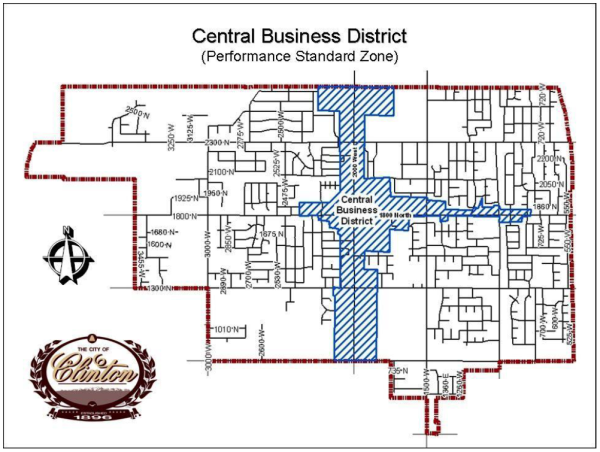
- The Central Business District Area. The area known as the Central Business District is comprised of areas within the Performance Standard Zone, as identified by the Zoning Map and Ordinance, and as shown on Map 1 on the 20-2. Its core is at the intersection of 2000 West and 1800 North Streets, and the area stretches north, south, east and west along these main corridors.
- General Goals.
- The Central Business District will develop in a cohesive and visually attractive manner, with emphasis on the use of Prairie style architecture.
- An architectural design review process will occur in the planning of all new developments in the Central Business District.
- Design Objectives. To achieve the vision, the City of Clinton has identified design objectives, following the Prairie style architecture, to guide new construction. The standards provide specific direction for a particular aspect of design. They are considered important in achieving the objectives the city has set for the Central business District.
- Administration.
- The Clinton City Business District Design Standards and Guidelines are authorized by and relevant to the requirements of Performance Standards Zone in the Zoning Ordinance of the City of Clinton. A Design Review (DR) notation attached to uses listed in the Performance Standard Zone will require an Architectural Design Review and site plan Evaluation by the City’s Planning Commission.
- In the case that a development design is not approved, by the Planning Commission, the applicant may do one of the following:
- Revise and re-submit, however, re-submittals may incur additional processing fees. Or
- Make an appeal to the City Council, to determine if an error occurred during the Design Review process.
- Amendments to the Design Standards and Guidelines may be made following public hearings and review held by both the Planning Commission and the City Council.
- Design Review Procedures.
- The design review of all projects designated in the Zoning Ordinance with a (DR) notation shall begin with a pre-submittal conference. The conference shall be attended by the applicant and City staff in the Community Development Department to review the submittal requirements and the design review process. Following submittal of the development design, additional staff reviews may occur prior to scheduling a review by the Planning Commission.
- The City requires that all projects within the Central Business District be approved through the design review process before final site plan approval can be granted, and before a building or other development permit is granted.
- The Planning Commission will perform an Architectural Design Review – Points Evaluation to determine adherence to the Prairie Style architecture and character as described in the Design Standards. Points shall be awarded for each design component listed below according to the committee’s evaluation of the project. The standards and requirements found in zoning, subdivision and other land development regulations are not evaluated.
- Points are assigned as follows:
+2 points: If a project exceeds or meets excellently the intent of the standard or guideline. +1 point: If a project meets well the intent of the standard or guideline. 0 points: If a project adequately meets the minimum intent of the standard or guideline. -1 point: If the project does not adequately meet the intent of the standard or guideline. -2 points: If the project substantially fails to follow the intent of the standard or guideline. - The following chart is used to perform the Architectural Design Review - Points Evaluation. All applicable characteristics are rated and points are totaled.
- In addition to the above, the Planning Commission must make findings that the development site plan will meet the general purpose and spirit of the Performance Standard Zone ordinance.
Table 20.1 Architectural Design Review – Points Evaluation Point Weight (optional) Total ------- ------- ------- 1. Building orientation a. To the street b. For future infill 2. Roofing type and pitch 3. Roof line length 4. Building height 5. Building materials 6. Façade length variation 7. Color schemes 8. Location and proportion of porches, and entrances 9. Location and proportion of windows 10. Ornamentation and details 11. Parking integration 12. Sign integration 13. Site landscaping design ------- ------- ------- a. Fencing/walls b. Sidewalks c. Trees d. Solid waste enclosures e. Additional features 14. Exterior lighting TOTAL DESIGN REVIEW AVERAGE SCORE (Total / 19)
- Approval and Incentives. 136
- Any project with a Design Review Average Score of “0”, or more, will receive recommendation for approval. Chapter 28-19 (Performance Standard Zone) demonstrates several incentives that may be awarded for projects achieving a positive score.126
- Adjustment to requirements of § 28-4-16 this Ordinance may be awarded based upon;
- Requirements of UDOT when dealing with SR-37 (1800 North) and SR-108 (2000 West);
- Recommendations of a qualified Utah State Licensed Traffic Engineer as outlined in an acceptable traffic study;
- Parking Lot Design.
- Reduction of drive isle width from twenty (26) feet to twenty four (24) feet.
- An increase in the percentage of compact car spaces.
- Modifications. If it becomes impossible or impractical to complete construction of a project in accordance with the approved design, an alternative design may be submitted which follows as closely as possible the original design. This shall be considered a new application and be subject to the same review process.
- Change of Use. 149 When there is any change of use, as defined by this title and in the IBC, with existing residential of commercial buildings, and/or any modifications to the exterior of the building, including but not limited to material and color changes, the exterior of the building must comply with the requirements/provisions of this chapter with regards to design standards and site standards as found within this title.
28-20-2 Prairie Style Architecture
- General.
- The ideas and principles of Prairie Architecture evolved on the drafting boards of Chicago, Illinois beginning in the 1890’s. Following the lead of Frank Lloyd Wright, a group of architects developed over the course of the next 25 years a style of architecture that was unique to America.
- Frank Lloyd Wright believed that rooms in Victorian era homes were boxed-in and confining. He attempted to refine American housing by designing houses with low horizontal lines and open interior spaces. Prairie houses were designed to blend in with the flat, prairie landscape.
- Many other architects produced Prairie homes throughout the American Midwest. The style was popularized by pattern books, and a subtype of the style, the American Foursquare, became one of the most common housing forms in the United States.
- Elements of Prairie Style Architecture.
- Elements common to the Prairie style of architecture include:
- Simple, clean and bold
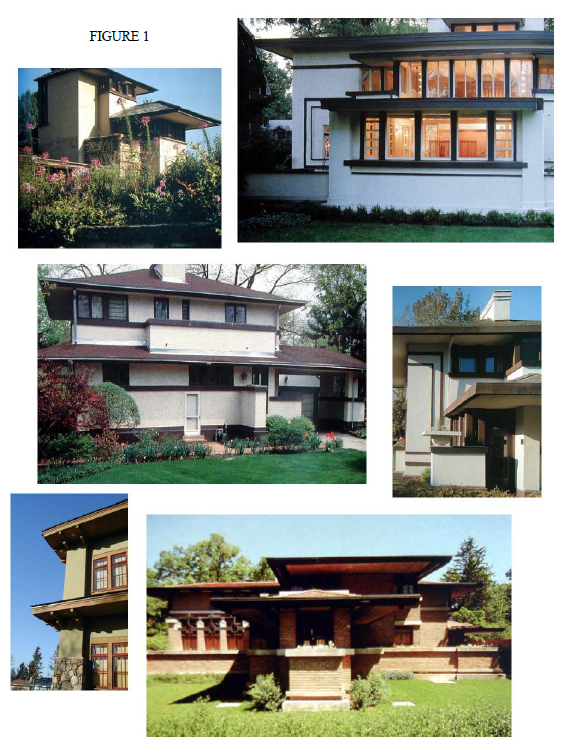
- Horizontal lines, massing and patterns
- Predominance of hipped roofs with a low roof pitch, gabled roofs used for accents, entries etc.
- Large, wide overhanging eaves
- Detailing – ornamentation on windows, handrails, etc emphasizing horizontal lines
- Fenestration – clustering and repetition of windows
- Use of geometric shapes
- Use of square columns
- Long, low walls (fencing)
- Contrasting color schemes
- Similar to Prairie style architecture is the Craftsman style, which was a popular style from the early 1900’s to 1930. Although the Prairie style has been selected as the preferred architectural style for the Clinton City Central Business District, use of the Craftsman style architecture is also deemed acceptable. Although many elements are the same between the two styles, the following are examples of some elements in the Craftsman style, which vary from the Prairie style:
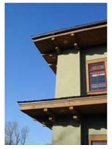
- Exposed rafters
- More use of vertical patterns
- More use of wood and siding
- Trellises
- Elements common to the Prairie style of architecture include:
- Why Was the Prairie Style Chosen for Clinton?
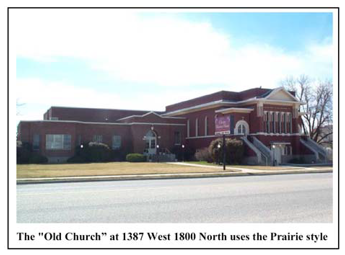
- In April of 1998, the City presented with its first commercial development and during the development of the project the Planning Commission and City Council desired to create a cohesive look and aesthetic theme within the central business district of the City. At the direction of the Council, the Planning Commission surveyed the existing structures within the City and surrounding area looking for an architectural theme that could be utilized to establish individuality within the district. The Commission focused its attentions on the existing “Old Church”, located at 1387 West on 1800 North, as a prominent architectural feature within the City.
- Research determined that this structure, constructed in 1910 was of a design that predominately exhibited the features of Prairie architecture, which was prominent in the eastern portion of the U.S. at the time. The Commission, after additional research recommended that the Council direct staff to indicate to potential developers the desire for this type of architecture in all future commercial development in the central business district. At that time the staff utilized, A Field Guide to American Houses, by Virginia and Lee McAlester as a reference. In the latter part of 2003, the Council recognized that the pressure for commercial development within the City mandated a greater emphasis in order to maintain the architectural design desired. It was this greater concern that dictated the development of this document.
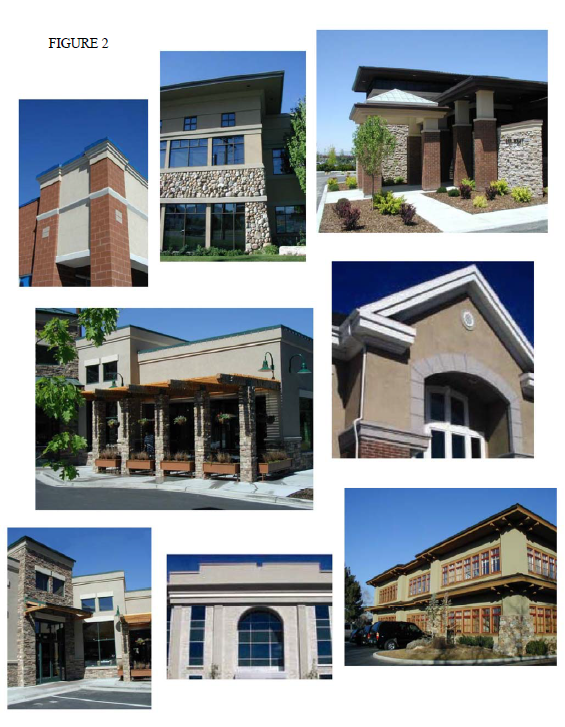
- Goal of Using the Prairie Style Architecture. Goal: To achieve a professional and a uniform appearance among all Clinton City downtown businesses following the Prairie Style architecture, as shown in the attached exhibits. Uniformity implies a complimentary look, not cookie-cutter sameness, with variance options and some flexibility within the adopted design standards. The desired effect of the downtown businesses will have an appearance that is simple, clean and bold.
28-20-3 Residential Design Objectives
- Design Standards (Requirements).
- Roofing type / pitch. Roofing shall be compatible with Prairie style architecture, including the encouraged use of hipped roofs with a low roof pitch, with gabled roofs used for accents, entries, etc. Eaves shall be no less than three (3) feet, which will help maintain horizontality of the Prairie style architecture. Pitch of roofing shall be no higher than 5 feet of rise to 12 feet of run.
- Roof Line Length. For sides of the building facing a public street, roof lines shall vary in depth, shape or dimension every 20 feet. The change in depth, shape or dimension must run the length of the changed roof line
- Height Limitation. Buildings shall be limited to two stories with a maximum height limit of 35 feet. Additional may be approved with a conditional use permit, considering whether the proportionate design of the building maintains a chiefly horizontal appearance.
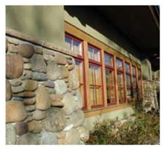
- Building Materials. Acceptable materials include brick, stucco, horizontal rock or split face block, No flat or smooth face block (Concrete Masonry Unit [CMU]) is allowed. Additional materials compatible with the Prairie style may be approved by the Planning Commission
- Color Schemes. All structures shall have contrasting color schemes using earth tones
- Façade Length. Facades lengths shall vary in depth, shape or dimension every 20 feet at a minimum depth of twenty four (24) inches. The change in depth, shape or dimension must run the length of the changed façade length.
- Fenestration. The use of windows shall include repetition and clustering of rectangular, narrow windows. Window framing shall have a bold appearance.
- Mechanical Shielding. Mechanical equipment, solar panels, and other rooftop equipment shall be shielded from view with roofing materials or other architectural features with a horizontal appearance compatible with the architecture.
- Fencing / Walls. When required, fencing shall consist of long, low walls achieving a horizontal appearance. Columns are acceptable as long as the overall appearance remains horizontal in character. Chain link fencing is not permissible. If a chain link fence exists prior to the development occurs, replacement of the fence will be required.
- Ornamentation. Ornamentation consistent with Prairie style architecture is encouraged, including detailing on windows, handrails, columns, etc. Emphasis should be on the use horizontal lines.
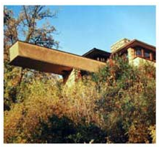
- Roofing type / pitch. Roofing shall be compatible with Prairie style architecture, including the encouraged use of hipped roofs with a low roof pitch, with gabled roofs used for accents, entries, etc. Eaves shall be no less than three (3) feet, which will help maintain horizontality of the Prairie style architecture. Pitch of roofing shall be no higher than 5 feet of rise to 12 feet of run.
- Landscaping. Residential landscaping should be compatible with the building architecture. The installation of well designed landscaping, including the use of green, drought resistant and native plants is encouraged. (see 28-3-20) Trees are encouraged to be planted, following the tree planting guidelines as shown on table 20.2.
- Architectural Design Photos. Figure 1 on the following page displays several examples of the application of the Prairie style architecture on residential buildings.
28-20-4 Commercial Design Objectives
- Design Standards (Requirements).
- Roofing type / Pitch. Roofing shall be compatible with Prairie style architecture, including the encouraged use of hipped roofs with a low roof pitch, with gabled roofs used for accents, entries, etc. Eaves shall be no less than three (3) feet, which will help maintain horizontality of the Prairie style architecture. Pitch of roofing shall be no higher than 5 feet of rise to 12 feet of run. 183
- Roof Line Length. For sides of the building facing a public street, roof lines shall vary in depth, shape or dimension every twenty (20) feet. For sides of the building which do not face a public street, roof lines shall vary in depth, shape or dimension every forty (40) feet. The change in depth, shape or dimension must run the length of the changed roof line.
- Height Limitation. Buildings shall be limited to maximum height limit established in Chapter 28-19, Performance Standard Zone. When designing and approving buildings the architectural review must always consider whether the proportionate design of the building maintains a chiefly horizontal appearance. 183
- Building Materials. Acceptable materials include brick, stucco, horizontal rock, or split face block. No flat or smooth face block (CMU) is allowed. Additional materials compatible with the Prairie style may be approved by the Planning Commission.
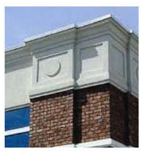
- Color Schemes. All structures shall have contrasting color schemes using earth tones.
- Fenestration. The use of windows shall include repetition and clustering of rectangular or tall, narrow windows. Window framing shall have a bold appearance.
- Facade Length. Facades lengths shall vary in depth, shape or dimension every twenty (20) feet at a minimum depth of twenty four (24) inches. For sides of the building which do not face a public street, facades shall vary in depth, shape or dimension every forty (40) feet. The change in depth, shape or dimension must run the length of the changed façade length.
- Mechanical Shielding. Mechanical equipment, solar panels, and other rooftop equipment shall be shielded from view with roofing materials or other architectural features with a horizontal appearance compatible with the architecture. This also includes screening and sound proofing of the equipment that is on the ground.
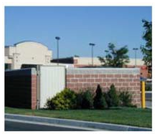
- Fencing / Walls. When required, fencing shall consist of long, low walls achieving a horizontal appearance. Columns are acceptable as long as the overall appearance remains horizontal in character. Chain link fencing is not permissible. If a chain link fence exists prior to the development occurs, replacement of the fence will be required.
- Lighting.
- Parking Lot Lights within the development shall have a decorative style reflecting the architectural style of the building, and shall be in accordance with City lighting requirements. No cobra-style light standards are allowed.
- Exterior building lighting shall reflect the architectural style of the building.
- Solid Waste Enclosure. Solid waste receptacles and compactors which are not located within a building, shall be gated and enclosed on three sides with the same materials as used on the main structures and reflect a style complimentary to the Prairie style architecture.
- Ornamentation. Ornamentation consistent with Prairie style architecture is encouraged, including detailing on windows, handrails, columns, etc. Emphasis should be on the use horizontal lines.
- Landscaping. Residential landscaping should be compatible with the building architecture. The installation of well designed landscaping, including the use of green, drought resistant and native plants is encouraged. (see 28-3-20) Trees are encouraged to be planted, following the tree planting guidelines as shown on table 20.2.
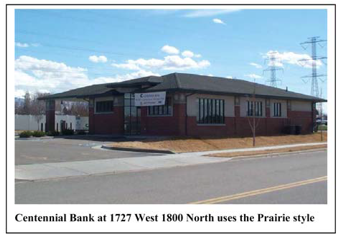
- Architectural Design Photos. Figure 2 on the following page displays several examples of the application of the Prairie style architecture on commercial buildings.
28-20-5 Big Box Design Objectives
The following design objectives apply to big box buildings, defined as having at least 25,000 square feet. Two or more buildings with less than 25,000 square feet each that are attached by an enclosed walkway must also comply with big box design requirements. Such buildings attached by open breezeways are not subject to big box design requirements.
- Design Standards.
- Applications of Prairie Style Architecture. Design options exist for the development of big box commercial operations in order to comply with the architectural standards. Big box design shall emphasize the use of:
- horizontal lines, massing and patterns
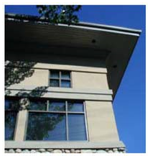
- low pitch roofs with large overhangs, fascia
- square columns contrasting color schemes
- low wall planters in front of the building
- Roofing Type / Pitch. Roofing for all entrances, drive- throughs, accents, and special architectural features shall be compatible with Prairie style architecture, including the use of hipped or gabled roofs with a low roof pitch. Eaves shall be no less than three (3) feet, which will help maintain horizontality of the Prairie style architecture. Pitch of roofing should be no higher than 6 feet of rise to 12 feet of run. Drive through areas should be covered with a compatible roof style.
- Roof Line Length. For sides of the building facing a public street, roof lines shall vary in depth, shape or dimension every thirty (30) feet. For sides of the building which do not face a public street, roof lines shall vary in depth, shape or dimension every sixty (60) feet. The change in depth, shape or dimension must run the length of the changed roof line.
- Height Limitation. Buildings shall be limited to two stories with a maximum height limit 40 feet. Increased height or additional stories may be approved with a conditional use permit, considering whether the proportionate design of the building maintains a chiefly horizontal appearance.
- Building Materials. Acceptable materials include brick, stucco, horizontal rock, or split face block. No flat or smooth face block (CMU) is allowed. Additional materials compatible with the Prairie style may be approved by the Planning Commission.
- Color Schemes. All structures shall have contrasting color schemes using earth tones.
- Fenestration. The use of windows shall include repetition and clustering of rectangular or tall, narrow windows. Window framing shall have a bold appearance.
- Façade Length. Façades lengths shall vary in depth, shape or dimension every thirty (30) feet at a minimum depth of twenty four (24) inches. For sides of the building which do not face a public street, façades shall vary in depth, shape or dimension every sixty (60) feet. The change in depth, shape or dimension must run the length of the changed façade length.
- Solid Waste Enclosure. Solid waste receptacles and compactors which are not located within a building, shall be enclosed on three sides with the same materials as used on the main structures, and reflect a style complimentary to the Prairie Architecture Style.
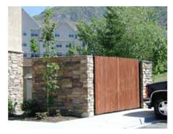
- Fencing / Walls. When required, fencing should consist of long, low walls achieving a horizontal appearance. Columns are acceptable if overall appearance is horizontal. Chain link fencing is not permissible. If a chain link fence exists prior to the development occurs, replacement of the fence will be required.
- Lighting.
- Parking Lot Lights within the development shall have a decorative style reflecting the architectural style of the building, and shall be in accordance with City lighting requirements. No cobra-style light standards are allowed.
- Exterior building lighting shall reflect the architectural style of the building.
- Mechanical Shielding. Mechanical equipment, solar panels, and other rooftop equipment shall be shielded from view with roofing materials or other architectural features with a horizontal appearance. This also includes screening and sound proofing of the equipment that is on the ground.
- Ornamentation. Ornamentation consistent with Prairie style architecture is encouraged, including detailing on windows, handrails, columns, etc. Emphasis should be on the use horizontal lines.
- Applications of Prairie Style Architecture. Design options exist for the development of big box commercial operations in order to comply with the architectural standards. Big box design shall emphasize the use of:
- Landscaping. Residential landscaping should be compatible with the building architecture. The installation of well designed landscaping, including the use of green, drought resistant and native plants is encouraged. (see 28-3-20) Trees are encouraged to be planted, following the tree planting guidelines as shown on table 20.2.
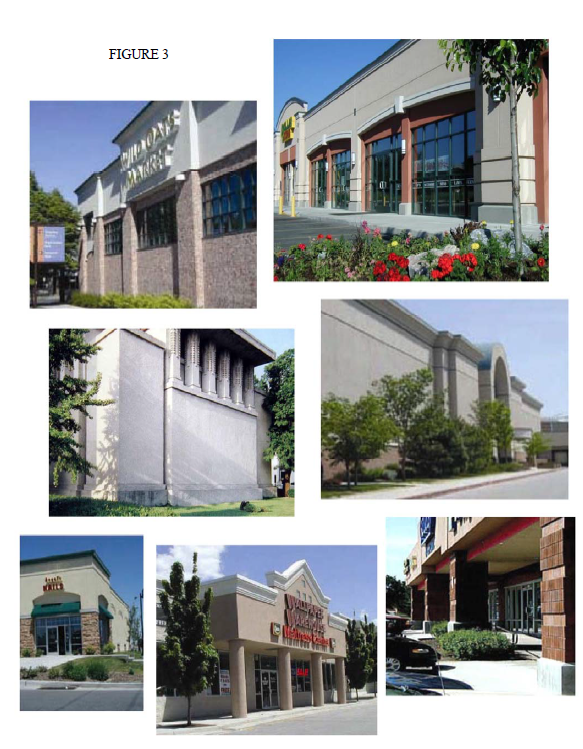
- Architectural Design Photos. Figure 3 on the following page displays several examples of the application of the Prairie style architecture on big box commercial buildings.
28-20-6 Additional Design Objectives
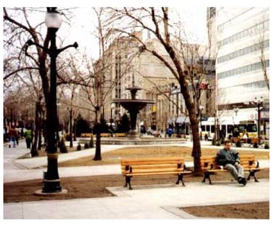
- Landscaping. The installation of streetscape elements is required or all new developments along 2000 West and 1800 North Streets. Non-plant elements shall be complimentary to the Prairie Style Architecture, reflecting an old-fashioned, or pre-1930’s style and appearance. Requirements for streetscape elements shall be considered separate and in addition to site design, landscaping and setback requirements. At a minimum, the following streetscape elements shall be installed by new developments:
- Street Trees. Trees shall be planted in accordance with the following:
- A minimum of two (2) trees shall be planted every fifty feet (50’) in the landscaped strip, in tree grates/wells on wide sidewalks, or in the on-site buffer areas.
- Trees shall be two (2) inches in caliper measured at ground level.
- Trimmed to a height of 7 feet over the sidewalk and 14 feet over the street.
- Trees to be planted within the park-strip shall be chosen from Table 20.2.
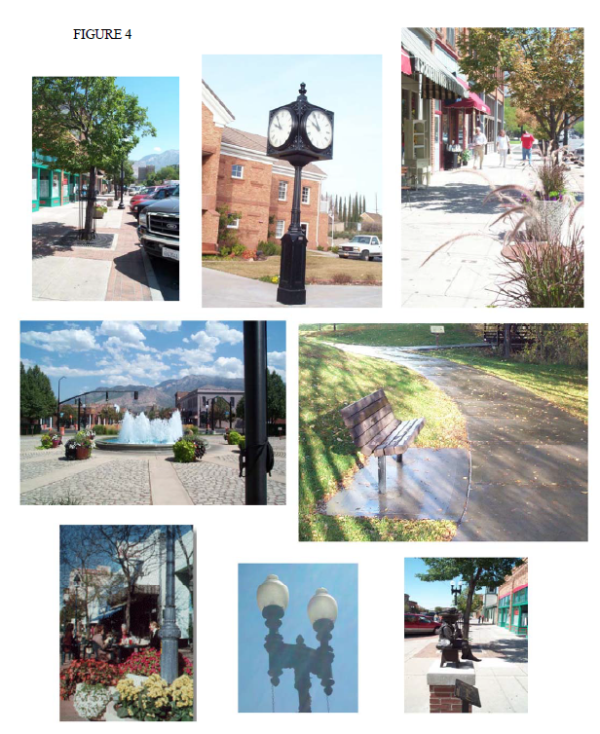
- Other Features. The following streetscape features shall be encouraged to be installed, and will offer a bonus multiplier in Architectural Design Review points:
- drinking fountains
- outdoor clocks
- monuments
- public art, significant in size
- special surface walkways
- others approved by the Planning Commission.
Clinton City STREET Trees List
Table 20.2
In a 3 to 4 foot park strip: | ||
Columnar Norway Maple | Chanticleer Pear | Mountain Ash |
Queen Elizabeth Hedge Maple | Bradford Pear | Bechtel Crabapple |
Flowering Plum | Aristocrat Pear | Eastern Redbud |
In a 4 to 5 1/2 foot park strip: | ||
Chanticleer Pear | Imperial Honey locust | Emerald Queen Norway Maple |
Bradford Pear | Sunburst Honey locust | Schwedleri Norway Maple |
Aristocrat Pear | Shademaster Honey locust | Deborah Norway Maple |
Little Leaf Linden | Hackberry | Queen Elizabeth Hedge Maple |
Trees listed above to be cross referenced with the Weber Basin Water Efficient Tree List as part of the landscape plan review and approval process. | ||
The following are not acceptable or allowed as street trees: | ||
All varieties of Bearing Nut Trees (including Walnut, Pecan, & Hickory) | All species of Willow | All up-right-growing species and varieties of Conifers (including Spruce, Pine, Fir, and Juniper) |
Tree of Heaven (Bird of Paradise Tree) | All varieties of bearing fruit trees (including Crabapple) | All species of Birch |
All species of Elm | ||
All species of Cottonwood | All species of Poplar | Catalpa |
Paul’s Scarlet Hawthorn | Globe Catalpa | Silver Maple |
London Planetree | Boxelder | Black Locust |
Apple, Pear, Plum & Cherry | Sycamore | Mulberry |
| Umbrella Catalpa |
|
Amended by Ord. 23-04Z on 6/27/2023

