
Clinton City Zoning Code
CHAPTER 28
3 Regulations Applicable To All Zones
Historic Changes to Chapter (see section 28-24-2 for details) 13, 20, 28, 29, 35, 38, 61, 67, 71, 81, 82, 83, 88, 95, 101, 104, 118, 119, 123, 126, 134, 137, 147, 148, 149, 150, 159, 167, 169, 170, 175, 181, 192, 198, 199, 213, 219
28-3-1 Applicability
The regulations hereinafter set forth in this Chapter qualify or supplement, as the case may be, the Zone regulations contained elsewhere in this Ordinance.
28-3-2 Additional Use Regulations
- The requirements of this Ordinance as to minimum building site area shall not be construed to prevent the use for a single-family dwelling of any lot or parcel of land existing as a legal conforming lot prior to the adoption of this Ordinance or to subsequent zone changes.
- The City recognizes that a governmental entity may acquire additional right of way to widen a road in any zone in the City impacting improvements such as landscaping, setbacks, and parking. In such a case, the City will recognize into the future the property owner's vested rights for the continued operation of activities allowed in the zone of the impacted property. Said right-of-way impacts will not result in zoning nonconformities, and the City will allow businesses and residences to continue operation, requiring the property owner to coordinate any redesigns with the City to meet the general intent of the zone.
Amended by Ord. 22-07Z on 9/13/2022
28-3-3 Additional Area Regulations
- Every dwelling unit shall be located and maintained on a “buildable lot” as defined in this Ordinance.67
- In determining compliance with the minimum lot area standards for each zone, buildable area shall be used in all areas, with the following exception:
- If a portion of a lot or parcel of land which meets the minimum lot area requirements of a respective zone is acquired for public use in any manner, including dedication, condemnation or purchase, and such acquisition reduces the area below such minimum requirements, the remainder of such lot or parcel shall nevertheless be considered as having the required minimum lot area if all of the following conditions are met:
- Such lot or parcel contains a rectangular space of at least thirty (30) by forty (40) feet exclusive of applicable front and side yard requirements, and exclusive of one-half of the applicable rear yard requirements, and such rectangular space is usable for a principal use or structure.
- The remainder of such lot or parcel of land has an area of at least 75% of the required lot area of the zone in which the lot or parcel is located.
- The remainder of such lot or parcel of land has access to a public street with a width of not less than twenty-six (26) feet.
- If a portion of a lot or parcel of land which meets the minimum lot area requirements of a respective zone is acquired for public use in any manner, including dedication, condemnation or purchase, and such acquisition reduces the area below such minimum requirements, the remainder of such lot or parcel shall nevertheless be considered as having the required minimum lot area if all of the following conditions are met:
28-3-4 Additional Yard Regulations
- No required yard or other open space around an existing building or which is hereafter provided around any building for the purpose of complying with the provisions of this Ordinance, shall be considered as providing a yard or open space on an adjoining lot whereon a building is to be erected or established.
- On any lot under a separate ownership from adjacent lots and of record at the time of the initial enactment of this provision and such lot having a smaller width than required for the Zone in which it is located, the following regulations shall apply:
- For interior lots, each side yard may be equal to but not less than the same percentage of the required side yard width as the lot is of the required lot width, provided that in no case shall the smaller of the two side yards be less than five feet or the larger less than eight feet.
- On corner lots, each side yard may be equal to but not less than the same percentage of the required side yard width as the lot is of the required lot width, provided that in no case shall the side yard on the street side be less than fifteen feet and the other side yard shall not be less than five feet in all Residential Zones.
- Every part of a required yard shall be open to the sky unobstructed except for accessory buildings in a rear yard, and except for the ordinary projections of skylights, sills, belt courses, roof eaves, cornices and other ornamental features.
- Side-yards shall remain free of buildings except as otherwise noted in this ordinance. A hard surface (asphalt, cement) may be permitted on one side yard for additional parking or movement of motor vehicles into the rear-yard; hard surfaced area shall be designed to drain onto the landscaped area of the lot on which they are located or directly into the frontage street, in no instance shall drainage be onto an adjoining lot. The opposite side-yard shall remain clear of impervious surfaces. On corner lots street side side-yards shall not have a hard surface area extending more than 12-feet from the dwelling; all drive access distances from corners shall be compiled with for access to this area. 20, 118
- No space needed to meet the width, yard, area, coverage, parking or other requirements of this Ordinance for a lot or building may be conveyed away from such lot or building, except as permitted by the Board of Adjustment, and any attempted conveyance or lease in violation hereof shall be void.
- No parcel of land which has less than the minimum width and area requirements for the zone in which it is located may be cut off from a larger parcel of land for the purpose, whether immediate or future, of building or development as a lot, except by permit of the Board of Zoning Adjustment.
- Front-yards shall remain free of impervious surfaces except as allowed in 28-4 for parking and access to covered parking or as allowed in 28-3-4 (4) above.118
- Every Dwelling on a Lot. Every dwelling structure shall be located and maintained on a separate lot having no less than the minimum area, width, depth, and frontage required by this Title for the zone in which the dwelling structure is located, except that group dwelling complexes or other more flexible requirements as permitted by this Title, may vary from this requirement. 118, 181
- Lot Standards. Except for more flexible requirements such as those pertaining to planned residential unit developments, group dwellings, or as may be otherwise provided in this Title, every lot within the City shall have such area and the required frontage upon a dedicated public or approved private street as is required by this Title, before a building permit may be issued. 118
- Approval of Culinary Water Supply and Sewage Disposal Required. Where either a supply of piped culinary water under pressure and piped secondary water under pressure, approved for use by the municipality or a connection to an approved sanitary sewer system is not available, no building permit shall be issued for main buildings, or other buildings which would utilize such facilities until the proposed plan for sewage disposal and the proposed source of water supply has been approved by the Davis County Board of Health and Clinton City. 118
- No Obstructions in Flood Plain. No building, structure, fence, or other obstruction may be constructed within any portion of Zone A as defined on the FEMA Flood Insurance Map. No such flood plains as defined by FEMA may be otherwise reduced in effectiveness in any manner by the dumping of garbage, other refuse, or earth, or by leveling or obliterating it otherwise. 118
Amended by Ord. 23-04Z on 6/27/2023
28-3-5 Additional Height Regulations
- Penthouse or roof structures for the housing of elevators, stairways, tanks, ventilating fans or similar equipment required to operate and maintain a building, and fire or parapet walls, skylight, towers, steeples, flagpoles, chimneys, smokestacks, and water tanks, wireless or television masts, theater lots, silos or similar structures may be erected above the height limits prescribed in the Zone Height Regulations, but no space above the height limit shall be allowed for the purpose of providing additional floor space.
- No dwelling unit shall be erected to a height less than ten feet, and no accessory building in a residential zone shall be erected to a height greater than twenty-five feet.
28-3-6 Fence Regulations
- No fence or other similar structure shall be erected in any required front yard of a dwelling to a height in excess of four feet; nor shall any fence or other similar structure be erected in any side or rear yard to a height in excess of six (6) feet. EXCEPTION: where otherwise stipulated in this ordinance, e.g. 28-19.88
- On corner lots, the following restrictions shall apply:16
- No fence or other similar structure shall be erected in any required front yard of a dwelling to a height in excess of four feet.
- No solid fence, shrubs, or other obstructions to view between the heights of two feet and seven feet shall be allowed within the sight triangle.126
- On rear and exterior side yards bordering a street, no fence or similar structure shall be erected to a height in excess of six feet.
- Where a fence is erected upon a retaining wall or for other reasons there is a difference in the elevation of the surface of the land on either side of a fence, the height of the fence shall be measured from a point half-way between the top of the retaining wall and the land on the lower side or from the average elevation of the surface of the land on either side of a fence, but nothing herein contained shall be construed to restrict a fence to less than four feet in height measured from the surface of the land on the side having the highest elevation.
- On public property, when it is determined to be necessary for public safety, a fence no higher than six feet may be erected in a yard bordering a street or front yard of an adjoining lot, provided that:
- The fence is constructed of materials that do not create a barrier to vision, i.e. chain link.
- The fence is not constructed on any portion of a public right-of-way.
- The Planning Commission makes the determination that the fence is necessary for the public safety.
- Residential yard fences and fences placed for protection of private property shall not be placed upon public property or in a public right-of-way. Fences shall be placed a minimum of one foot from sidewalks. Fences on public property shall be placed with concerns for public safety as determined by the Planning Commission.38
- Fences shall not be of hazardous or potentially dangerous materials or construction such as barbed wire, razor wire, electrified, etc. except in agricultural uses, as permitted in this ordinance or as otherwise approved in the site plan approval process in commercial, performance, or light manufacturing areas. Hazardous or potentially dangerous materials shall not be allowed in any residential uses within the city.38
- The materials used in a constructed fence are limited to materials made of wood, metal, concrete, masonry, stone or vinyl. The materials used to construct the fence shall be of dimensions and design commonly intended for typical fence construction and shall not be materials or reused materials that have been designed for another function and are now being used to create a fence.148
Amended by Ord. 23-03Z on 6/13/2023
28-3-7 Lighting
- Exterior Lighting. No spotlight or floodlight shall be installed in any way which will permit the direct rays of such light to penetrate into any residential zone or onto any property used for residential purposes.
- Lights Not To Constitute Traffic Hazard. No light, sign, or other advertising structure as regulated by this Ordinance shall be erected at the intersection of any street in such a manner as to obstruct free and clear vision; or at any location where, by reason of the position, shape or color, it may interfere with, obstruct the view of, or be confused with any authorized traffic sign, signal, or device; or which makes the use of the words "STOP", "LOOK", "DANGER", or any other word, phrase, symbol or character in such a manner as to interfere with, mislead or confuse traffic.
28-3-8 Public Utility Substations
In all residential zones, public utility substations shall meet the following requirements:
- Lot Area. Each public utility substation in a residential zone shall be located on a lot not less than two thousand square feet in area.
- Yards. Each public utility substation in a residential zone shall be provided with a yard on each of the four sides of the building not less than five feet in width, except that for such stations located on lots fronting on a street abutted by one or more residential lots, the front yard, side yards, and rear yard shall equal those required for a single-family residence in the same zone.
- Street Access. Each public utility substation in a residential zone shall be located on a lot which has adequate access from a street, alley or easement.
- Site to be Approved. The location and appearance of public utility substation in a residential zone shall be subject to approval by the Planning Commission, through issuance of a "Conditional Use Permit".
28-3-9 Special Provisions Relating To The Keeping Of Animals And Fowl
- Animals and Agricultural Fowl.170
- All pens, corrals, feeding troughs, barns, stables and other similar buildings or enclosing structures shall be located not less than 150 feet from a public street except on corner lots the setback from one street may be reduced to not less than 75 feet.
- These types of buildings or structures shall be constructed of materials that are typically associated with the use. The architecture of these building shall be similar to those typically found throughout the state.148
- Temporary feeding troughs, i.e. those moved at least ten feet from one location to another at not more than ten-day intervals may be located not closer than 50 feet from a public street.
- All such buildings, enclosing structures, pens, corrals, troughs and permanent concentrated feeding areas shall be located not less than 100 feet from all dwellings on adjoining lots, and not less than 30 feet from dwellings on the same lot.
- All land except seeded pasture used for winter feeding and pasturing shall be plowed or deep disked at least once immediately following the close of the period permitted herein.
- Future residential areas to be protected. In any residential zone and in any parcel of an agricultural zone, sharing a common boundary with a residential zone, placement of a barn, corral, trough, etc. shall be limited in location so as to not preclude through Section 3.9.3 above, future rights of adjacent property owners to develop residential land uses. In cases where existing structures listed in Section 3.9.3 would preclude residential development, the 100 foot separation may be waived provided ample protection of the health and safety of the dwelling occupants is provided. Ample protection shall be determined by the Planning Commission.
- All pens, corrals, feeding troughs, barns, stables and other similar buildings or enclosing structures shall be located not less than 150 feet from a public street except on corner lots the setback from one street may be reduced to not less than 75 feet.
- Residential Chickens.170, 208
- All coops, and enclosed areas (chicken run) shall be located in the rear yard and shall be located not less than five (5) feet from a property line and not less than ten (10) feet from a dwelling on the same lot and twenty-five (25) feet from all dwellings on adjoining lots.
- Up to six (6) chickens are allowed on any residentially zoned lot. More than six (6) chickens are allowed on at least 7,000 square feet at a ratio of one (1) chicken per 1,000 square feet of lot area up to a maximum of 12 (twelve) chickens.
- Coops shall be a minimum of 2 sq.-ft per chicken.
- Coops shall be constructed of materials that are typically associated with the use and shall be predator-resistant, covered & ventilated.
- Chickens shall be confined within a secure outdoor, enclosed, and covered area. The enclosed area shall be a minimum of ten (10) sq.-ft per chicken and no larger than 150 sq.-ft.
- The enclosed area shall be covered with a mesh, netting or other material.
- Chickens shall not be permitted to roam outside the coop or enclosed area.
- Coops & enclosed areas shall be maintained in a neat and sanitary condition and shall be cleaned as necessary to prevent any odor detectable at a property line. Chicken waste shall be composted or disposed of properly.
- Feed shall be stored in and dispensed from rodent and predator-proof containers.
- Chickens shall be hens (female). No roosters (males) are allowed.
- Quail may be substituted for chickens and are subject to the provisions of this Section.
- Only one type of fowl, chickens or quail, are allowed on any residential lot to properly protect against increased risk of disease.
- Other fowl, such as ducks and turkeys, or a mixture thereof, are only allowed on agricultural properties as regulated by this Title.
- Only one type of fowl, chickens or quail, are allowed on any residential lot to properly protect against increased risk of disease.
- Chickens shall not be kept on a residential lot or parcel unless the person keeping chickens first registers with the City.
- The registrant shall acknowledge the rules set forth in this section and shall, as a condition of filing the registration, agree to comply with such rules.
- The cost of filing a registration shall be a one-time fee and be as shown on the consolidated Fee Schedule adopted by the Municipal Council.
- The registration shall be good for as long as the registrant continues to abide by the standards of this section.
- Violations are subject to provisions within this Title (Zoning) and the administrative code enforcement standards and procedures of Section 2-16-5 of the Code.
- Chickens kept as provided in this section shall not be deemed to be household pets as defined in Section 28-2-2 of this title.
- Compliance is required with UCA 4-4 regarding egg grades and standards as well as rule R58-6 regarding egg production.
- All coops, and enclosed areas (chicken run) shall be located in the rear yard and shall be located not less than five (5) feet from a property line and not less than ten (10) feet from a dwelling on the same lot and twenty-five (25) feet from all dwellings on adjoining lots.
- Household Pets. 134, 208
- Household pets shall be limited to the keeping of not more than two (2) dogs and one (1) un-neutered cat or three (3) neutered cats, or combination thereof, four months old or older.
- Kennel licenses are issued by Davis County Animal Control where permitted by this ordinance and based upon issuance of a conditional use permit by the Clinton City Planning Commission.
- In addition to the two (2) permitted dogs, one seeing-eye, search and rescue, or other aid dog may be allowed under the following circumstances:
- A conditional use permit is issued by the Planning Commission. In addition to the typical items considered by the Planning Commission for a conditional use, the following shall also be reviewed:
- The location and size of any outdoor pens, runs, or enclosures;
- The owners demonstrated ability to keep the additional dog in a clean and healthy environment, and in a manner that is not contrary to the general health and welfare of the citizenry;
- That the dogs will be kept in accordance to all Davis County Health and Davis County Animal Control requirements; and
- The premises may be subject to inspection annually by the Community Development Department.
- The aid dog is certified to serve in the capacity intended by the independent and qualified agency. Aid dogs that are in the process of being trained shall have not more than 6 (six) months to become certified unless a longer period is granted by the Planning Commission. The certification of the aid dog is subject to inspection annually by the Community development Department. Failure to obtain the certification in the prescribed time period, and maintenance of it thereafter, shall result in the revocation of the Conditional Use Permit; and
- The owner of the aid dog owns and was keeping two dogs or combination thereof prior to obtaining the aid dog.
- A conditional use permit is issued by the Planning Commission. In addition to the typical items considered by the Planning Commission for a conditional use, the following shall also be reviewed:
- If after receiving a permit for the third dog, either of the two (2) non-certified dogs becomes absent from the premises, for whatever reason, said dog shall not be replaced.
- Show, hunting, or other dogs not trained and certified to give aid to the physically or mentally impaired, or serve in search and rescue efforts, shall not qualify for the keeping of the third dog.
- A residence may have a total of six (6) small animals, in addition to the dogs and cats listed in sub-section (1) above, or fowl customarily kept within the home, such as hamsters, guinea pigs, parakeets, canaries, rabbits etc. Said animals shall be for family use only and not raised for commercial purposes.
- Animals normally associated with being kept outdoors and/or normally associated with agricultural areas such as horses, cows, goats, sheep, pigs, rabbits, chickens, ducks, geese or other farm animals, shall not be allowed as household pets, except for rabbits.
- Conditional use permits for kennels or catteries shall not be issued for agricultural property directly adjacent to a residential (R-1-X) zone. Conditional use permits within the A-1 zone for kennels and catteries shall be limited to no more than ten (10) animals.
Amended by Ord. 25-05Z on 6/25/2025
28-3-10 Site Plan And Architectural Approval
- A site plan and architectural approval shall be required of all uses in Commercial, Manufacturing, Performance, and R-M Zones prior to issuance of a building permit; and for all Conditional Use applications upon submission to the Planning Commission.
- A site plan shall include the following items:
- Site plan, drawn to scale, showing main and accessory building relationships with one another, open space on the site, buildable areas of lots, required buffer spaces, easements, rights-of-way, and all other information necessary for approval of the site plan.28
- Height and bulk of building(s) [elevation drawing(s)]
- Provision for off-street parking spaces and provisions for the ingress and egress of traffic, also the traffic circulation within the site. Dwellings in single family, conventional subdivisions, shall comply with 28-3-15 (15) 150
- Display of any signs in accordance with the Clinton City Sign Ordinance.
- Landscaping.147
- Landscape Plan. As part of any proposed development, the owner or developer shall submit a landscape plan to the Community Development Department for approval. All landscaping plans shall demonstrate conformance with the applicable requirements contained in this Section and other applicable regulations in this Title.
- Landscape Objectives. Landscaping should substantively satisfy the following objectives to the extent that they apply to the specific site:
- Landscaping should be encouraged that will serve the function of enhancing the visual environment by:
- Adding visual interest through texture, color, size and shape, etc;
- Enhancing perspective by framing views, complementing architecture, screening and creating points of interest and activity; and
- Defining and screening parking areas and associated access lanes from adjacent residential zones and public rights of way.
- Landscaping, combined with other design elements, shall be encouraged that will serve the function of ensuring public safety by:
- Guiding the circulation of cars and people;
- Controlling access to parking lots;
- Making traffic diverters prominent; and
- Defining the relative importance of streets by varying the species, height and location of landscaping.
- Landscaping should be encouraged that will serve the function of minimizing the nuisance of noise and glare.
- Landscaping should be encouraged that will service the function of conserving energy by:
- Shading hot summer sun; and
- Blocking cold winter winds.
- Care should be taken to integrate the project to the site. Landscaping is one tool in carrying out this thoughtful consideration of the land. Sensitivity to topography and useful existing vegetation should be used in determining building location and special uses. The total landscape should be harmonious with the overall neighborhood concept.
- Preservation of existing landforms and mature trees is usually desirable.
- Visual variety should be the aim of landscaping treatment. Landscaping should be used to break up large expanses of pavement.
- Species that are a public nuisance or that cause excess litter should be avoided.
- Landscaping and other design elements, such as pavers, lighting, seating, etc., as deemed appropriate, should enhance the visual environment by creating a visually obvious and definite entry point or entry corridor, framing views, complementing the architecture, screening objectionable views and creating points of interest.
- Landscaping should be encouraged that will serve the function of enhancing the visual environment by:
- General Requirements.
- All areas not occupied by buildings, parking, storage, future phased plan areas or access-ways, as well as the area of the public right of way defined by a curb or gutter shall be landscaped utilizing ground covers, turf, trees and/or shrubs.
- Planting beds shall be covered with rock or wood mulch to a minimum depth of three inches.
- Plant material shall be species that are regionally appropriate and suitable for the site-specific planting conditions, including available moisture, shade, salt tolerance, wind exposure and soil pH.
- The maximum allowable cut or fill slope is two feet horizontal distance for one foot of rise. Slopes steeper than two to one will require retaining walls or other types of approved slope stabilization methods.
- No plant material greater than 24 inches in height shall be located within 25 feet of a curb cut or drive approach except for street trees as required herein.
- All areas not occupied by buildings, parking, storage, future phased plan areas or access-ways, as well as the area of the public right of way defined by a curb or gutter shall be landscaped utilizing ground covers, turf, trees and/or shrubs.
- Size of Landscape Materials at Time of Planting. Unless specified elsewhere in this Code:
- Deciduous shade trees shall have a minimum caliper size of two inches as defined by industry standards.
- Evergreen trees shall be a minimum of six feet tall.
- Shrubs shall be of a size generally known in the landscape industry as requiring at least a one gallon container.
- Tree Preservation.
- Existing trees that are in a healthy condition and have a minimum caliper of four inches as measured by industry standards shall be considered "significant", and shall be preserved to the extent reasonably feasible. Existing trees and shrubs within areas that can be developed may be used to satisfy the landscaping requirements of this Section. All required landscape plans shall accurately identify the locations, species, size, condition and proposed disposition of all significant trees.
- Species that are a public nuisance or that causes excess litter should be avoided.
- Existing trees that will remain and their root systems shall receive adequate water to ensure survival, and shall be protected from damage, soil contamination and compaction within the drip line during construction through the use of barricades or fencing.
- Street Trees. When the public street frontage has existing curbs or is required to install curbs as part of the development improvements, street trees shall be required to be installed in the park strip. Trees shall be spaced based upon the species or as established in the site plan review. If the space in the park strip is less than four feet wide, the required trees shall be placed outside of the park strip but within 25 feet of the curb line and may be arranged in a formal or informal manner. 183
- Fencing, walls, hedges, or other similar devices constructed to meet City Ordinances.
- Architectural plans.
- Evaluation of infrastructure to include sanitary sewer, culinary water, secondary water, and storm water as established in the Clinton City Comprehensive Plan.28
- Evaluation of buffers/fencing next to primary and secondary arterials as established in the Clinton City comprehensive Plan. Buffers/fencing should be required in rear lots abutting these arterials adequate to suppress noise and ensure safety of residents within their yards.28
- Width to depth ratio of lots. Dwelling lots within conventional subdivisions shall not have a width to depth ratio greater than 1:4. Single family dwelling lots within the Performance Zone shall not have a width to depth ratio greater than 1:2.5.28
- Expiration Date. Unless specifically stated by the Planning Commission during the site plan approval motion a site plan approval shall expire six months from the date of Commission motion if a building permit has not been issued.119
- In considering any site plan hereunder, the Planning Commission shall endeavor to assure safety and convenience of traffic movements both within the area covered and in relation to access streets, harmonious and beneficial relation among the buildings and uses in the area covered, and a satisfactory and harmonious relationship between such areas and contiguous land, buildings and adjacent neighborhoods.
Amended by Ord. 23-04Z on 6/27/2023
28-3-11 Private Swimming Pools, Tennis Courts, And Skateboard Ramps
- Swimming Pool (Private). 181
- No such pool shall be allowed in any district except as an accessory use and unless it complies with the following conditions and requirements:
- It is an accessory use to a main building and is located within the side or rear yard thereof.
- It is intended and is to be used solely for the enjoyment of the occupants and guests of the principal use of the property on which it is located.
- It may not be located closer than five (5) feet to any property line of the property on which it is located.
- It shall not be less than twenty (20) feet from any neighbor’s residence, or twelve (12) feet from any side lot line of an adjacent vacant lot.
- It shall not be less than fifteen (15) feet from any neighbor’s non livable area of their residence, which includes, but is not limited to, the garage, carport, or storage areas.
- The swimming pool shall be walled or fenced to a minimum height of six (6) feet. The fence shall be constructed to limit any individual from accessing the pool area. The fence shall comply with all current building and county codes. All gates on said fence shall be self closing and fitted with a self latching device located on the interior side of the gate.
- Any pool lighting shall be installed and directed in such a manner as to not cause disturbance to neighboring residents.
- Where a swimming pool is completely enclosed in a building, the location requirements for accessory and main buildings shall apply.
- All owners and operators of any artificially created or constructed pool of water, including, but not limited to, fish ponds, lily ponds, bird baths and swimming and wading pools shall comply with Davis County Code § 8.12.010.
- No such pool shall be allowed in any district except as an accessory use and unless it complies with the following conditions and requirements:
- Tennis Court (Private). 181
- No tennis court shall be allowed in any district except as an accessory use and unless it complies with the following conditions and requirements:
- It is an accessory use to a main building and is located within the side or rear yard thereof;
- It is intended and is to be used solely for the enjoyment of the occupants and guests of the principal use of the property on which it is located;
- It may not be located closer than five (5) feet to any property line of the property on which it is located. It shall not be less than (20) feet from any neighbors residence, or twelve (12) feet from any side lot line of an adjacent vacant lot.
- Any court lighting shall be installed and directed in such a manner as to not cause disturbance to neighboring residents.
- No tennis court shall be allowed in any district except as an accessory use and unless it complies with the following conditions and requirements:
- Skateboard Ramp (Private). 181
- No skateboard ramp shall be allowed in any district in the City except as an accessory use and unless it complies with the following conditions and requirements:
- It is an accessory use to a main building and is located within the side or rear yard thereof;
- It is intended and is to be used solely for the enjoyment of the occupants and guests of the principal use of the property on which it is located. No commercial or advertised use of the ramp shall be permitted and no donations or contributions shall be solicited or received for use of or attendance at ramp activities;
- It may not be located closer than twenty (20) feet to any property line of the property on which it is located. It shall not be less than twenty (20) feet from any neighbors residence, or twelve (12) feet from any side lot line of an adjacent vacant lot;
- The hours of operation shall be from 8:00 a.m. to 9:00 p.m.;
- Ramp lighting shall not be installed more than 6 feet above ground level and shall be directed in such a manner as to not cause disturbance to neighboring residents;
- The ramp shall be of such a scale and design and constructed of materials which will minimize noise, vibration, and other nuisance factors commonly associated with ramp usage. Portions of the ramp may be located below ground level, but in no case shall any portion of the ramp exceed six (6) feet in height above ground level, excluding handrails. The ramp shall comply with all pertinent sections of the International Residential Code and all zoning requirements of accessory structures and a building permit shall be obtained;
- A set of written rules adopted to insure safe and reasonable usage and operation of the ramp shall be posted at all times and enforced by the owner of the property on which the ramp is located; and
- The ramp must be inside an enclosure or within an enclosed yard.
- No skateboard ramp shall be allowed in any district in the City except as an accessory use and unless it complies with the following conditions and requirements:
28-3-12 Above Ground Storage Of Flammable, Combustible Liquids
- Location. Prior to locating or installing aboveground tanks for Class I, Class II, and Class III liquids, the applicable requirements of Chapter 34 of the International Fire Code must be satisfied and a Fire Department Permit and Applicable Building Permit shall be obtained. In addition to the aforementioned requirements above ground tanks shall only be permitted in zones, A-1, A-E, MP-1 and CP-2 Zones (Ref. Table 3-12-1). Uses in the Performance Zone that are not residential in nature may, upon site plan review by the Planning Commission petition for storage; storage shall meet the requirements of the CP-2 Zone.
TABLE 3.12.1 A-1 A-E MP-1 CP-2 Temporary Construction Site Storage Class 1 Liquid Protected Above-Ground Tanks Yesa, b Yesc Yes Yes Yesb Class II & III Liquid Protected Above-Ground Tanks Yesa, b Yesc Yes Yes Yesb Distance From Combustibles Evaluated with site plan and fire department requirements Distance From Property Line Evaluated with site plan and fire department requirements Drainage and containment Tanks Based upon fire department permit Permit From Fire Department Yes Yes Yes Yes Yes a In A-1 Zone, will not be allowed on lots smaller than 2 acres. b Gravity Fill tank, not to exceed 1,100 gallon tanks. c In A-E Zone, will only be allowed in golf courses or similar recreational areas with a minimum of 100 acres. - Storage of Flammable and Combustible Liquids in a Residential Zone. Storage and issue of permits for storage of flammable and combustible liquids shall be in accordance with the requirements outlined in the International Fire Code.
- Fire Department Permit. Application for a Fire Department Permit shall be on forms provided by the Clinton City Fire Department. Approval and issuance of a permit shall be as set forth in Section 105.6 and 105.7 of the International Fire Code.
- Use of Liquefied Petroleum Gas (LP GAS).
- Storage, handling and Transportation of LP-Gas. Prior to storage and or installation of LP-Gas equipment, the applicable requirements of Chapter 38 of the International Fire Code must be satisfied and a Fire Department Permit and Applicable Building Permit shall be obtained. In addition to the aforementioned requirements storage and or installation of LP-Gas equipment shall only be permitted in zones, A-1, MP-1 and CP-2 Zones. Uses in the Performance Zone that are not residential in nature may, upon site plan review by the Planning Commission petition for storage; storage shall meet the requirements of the CP-2 Zone.
- Use of LP-Gas in Residential Zones.
- The use of LP-Gas shall be limited to recreational use, minor maintenance and construction. Spare bottles shall not be stored in buildings other than those approved.
- The use of LP-Gas to support medial devises shall be allowed with the following conditions:
- Max tank size shall not exceed 100 gal of water.
- Must be a minimum of ten (10) feet behind the house
- Can not be any closer than ten (10) feet from any property line
- Meet all applicable requirements of the International Fire Code (IFC) § 3809 or it’s successor
- Obtain a permit from the Community Development Department.
- Obtain a permit from the Fire Department
- The tank must be removed when the need to support a medical device is no longer required and/or when the permit holder vacates the residence.
- Storage outside of Building/Cylinder Exchange. Storage of portable LP-Gas containers awaiting use or resale, the applicable requirements of the International Fire Code Section 3809 must be satisfied.
- Storage quantities
- Distances to doors (10 feet), distances to vehicle fuel dispensers.
- Distances to combustible material.
- Permit Required. Site approval and issuance of a permit as set forth in this ordinance and in Section 105.6 and 105.7 of the International Fire Code.
- Parking and Garaging. Parking of LP-Gas tank vehicles shall comply with Section 3811.2 and 3811.3 of the International Fire Code.
28-3-13 Mail Box
Placement of Mailboxes within the City right-of-way shall conform to the guidelines of the U.S. Postal Service and these criteria:
- General Requirements.
- Height. The bottom of the open mailbox shall be 40 – 42 inches above the curb or where no curb is placed 46 - 48 inches above the edge of the roadway.
- Set Back. The front of the mailbox shall be even with the back of the curb or where no curb is placed, the front of the mailbox shall be 48 inches behind the paved surface of the roadway.
- Multiple Mailboxes on One Stand. When more than one box is placed on one stand or structure, boxes shall not be more than 12 inches apart.
- Address Lettering and Placement. Address lettering shall be at least one (1) inch in height and placed on the side visible to the carrier as he approaches. If boxes are placed so that it is difficult to read the address on the approach, then the address lettering shall be placed on the front of the box door.
- Clear Area. It is the responsibility of the box user to ensure clearance of the approach used by the mail carrier. Snow, vehicles, trash receptacles and other obstructions shall all be kept clear of boxes.
- Box Support. Box support should be sufficiently strong to support the box(es), however; it shall not present a hazard to traffic or pedestrian travel. The mailbox and its support shall not exceed more than 24” in depth; this is to avoid interfering with pedestrian traffic on the sidewalk.
- Requirements Specific to Residential Subdivisions.
- Cul-de-sac Lots. Lots within a cul-de-sac shall have a single stand erected outside of the “bulb” of the cul-de-sac to service all lots within the cul-de-sac as well as the lots directly adjoining the cul-de-sac. Gang boxes shall not be located as to block the sight triangle at intersections of streets.
- Adjoining Lots. Curbside delivery will be served with mailboxes that are located two to a property line.
EXCEPTION. to 28-3-13 (2) (b) above: Where an odd number of lots exist on one side of a street one single mailbox will be permitted. The location of this mailbox will be determined during the preliminary plat review process outlined in the Subdivision Ordinance of the City of Clinton 28-5-15 (1).
28-3-14 Codes And Standards
Any dwelling or other structure which is designed or intended for human habitation, which is to be located in Clinton City outside of a Mobile Home Park, Mobile Home Subdivision or Manufactured Home Subdivision or P.R.U.D., must meet the appropriate construction codes adopted by the State of Utah or specifically adopted by the City, or if it is a Manufactured home, it must meet the standards of, and be certified under the National Manufactured Housing and Standards Act of 1974 and must prominently display an Insignia approved by the United States Dept. of Housing and Urban Development and must not have been altered in violation of such codes.
28-3-15 Additional Standards
In addition to the above Codes and Standards, the following requirements shall also be met:
- The dwelling must be taxed as real property. If the dwelling is a manufactured home, an affidavit must be filed with the State Tax Commission pursuant to Utah Code Annotated §59-2-602. A copy of the affidavit of affixture shall be provided to the city building official prior to issuance of a certificate of occupancy.
- The dwelling must be permanently connected to and approved for all required utilities.
- The Dwelling have a minimum two car garage, (minimum 20' x 20') attached to or detached from the primary structure. 198
- The dwelling must be permanently connected and attached to a site permanent foundation which meets appropriate construction codes adopted by the State of Utah or specifically adopted by the City. If manufactured housing, I.C.B.O. Guidelines for Manufactured Housing Installations shall be met. The space beneath any dwelling shall be enclosed at the perimeter in accordance with such guidelines, and constructed of materials that are weather resistant and aesthetically consistent with concrete or masonry type foundation materials. Porches and landings for ingress and egress to the dwelling must be built in accordance with the appropriate construction codes adopted by the State of Utah or specifically adopted by the City. All manufactured home running gear, tongues, axles and wheels must be removed at the time of installation and stored out of sight.
- At least sixty percent of the roof of the dwelling must be pitched at a minimum of two to twelve (2:12) and shall have a roof surface of wood shakes; asphalt, composition, wood shingles; concrete; fiberglass, metal or slate tiles; or built-up gravel materials or other materials approved by the appropriate construction codes adopted by the State of Utah or specifically adopted by the City.
- The dwelling shall have exterior siding material consisting of wood, masonry, concrete, stucco, masonite, or metal or vinyl lap or other material meeting the appropriate construction codes adopted by the State of Utah or specifically adopted by the City. The roof overhang must not be less than six inches, not including rain gutters. The roof overhang requirements shall not apply to areas above porches, alcoves and other appendages which together do not exceed twenty-five percent of the length of the dwelling.
- The width of the dwelling shall be at least twenty feet (20), excluding eves at the narrowest part of its first story for a length of at least twenty feet (20) exclusive of any eves or garage. The width shall be considered the lesser of the two primary dimensions. If the width of the dwelling faces a street and is less than one half (1/2) of the length, the required off-street parking shall be in a 2 car garage attached to the length of the dwelling. Factory built or manufactured homes shall be multiple transportable sections at least ten feet wide unless transportable in three or more sections, in which case only one section need be ten feet wide.
- The Clinton City Community Development Director, as the Building Official in concert with the Clinton City Planning Commission may, approve deviations from one or more of the developmental or architectural standards provided herein on the basis of a finding that the architectural style proposed provides compensating design features and that the proposed dwelling will be compatible and harmonious with existing structures in the vicinity. Together, they may also require other deviations to achieve the overall goals and purposes of this ordinance. These requirements may be appealed to the Board of Zoning Adjustment pursuant to the provisions of 28-9 of this ordinance.
- The dwelling must meet the minimum square footage requirements pursuant to the provisions set forth in the site development standards outlined for each zone within this ordinance.
- Replacement of an existing nonconforming manufactured home on a lot outside a mobile home park or mobile home subdivision shall comply with all requirements herein.
- Required off-street parking spaces shall be side by side (see 28-4-2).
- In order to protect the city roadways at the points of access onto lots all approaches onto a lot where a structure is being developed shall be hard surfaced the full width of the approach from the edge of existing roadway to the property line. As a minimum the hard surfaced area shall be the same design as the street onto which the access enters. A standard approach with curb, gutter, and sidewalk will fulfill this requirement.61
- Due to the generally level terrain of the city and in order to prevent overflow from city streets running into dwellings elevations on residential sites, the top of any exterior foundation shall extend above the elevation of the street gutter, or design elevation of a gutter at the point of discharge or the inlet of an approved drainage device a minimum of 12 inches plus 2 percent. Driveway approaches, where there is no established sidewalk shall be established at the property line at an elevation 8.5 inches above the flow-line of the gutter or designed gutter elevation. All driveways which go to a garage attached to a dwelling shall be hard surfaced from the garage to property line with a positive grade away from the structure. All openings into a basement or crawl space, (vents, windows, doors etc.) shall be protected from storm water infiltration from the outside through positive site design, (window wells, positive grade, elevation above grade).61
- Regulations for New Commercial Construction.123
- Commercial development within the Clinton City Central Business District shall be designed and evaluated during the site plan review in accordance with the Clinton City Central Business District Design Standards and Guidelines, Chapter 20 of this Ordinance.
- Special Provisions for Development Adjacent to Arterial, Sub Arterial, and Collector Streets.150 Subdivisions developing adjacent to an arterial, sub-arterial or collector street, as established in the Clinton City Transportation Master Plan shall be designed within the following guidelines.
- Residential lot access shall not be allowed from an arterial street.
- Residential lot access from a sub-arterial and collector streets shall be severely restricted during the sketch plat and preliminary plat approval processes. Where permitted the lots shall be of sufficient width, per 28-4-15 (5), for and have a circular drive access installed.
- Rear yards shall be buffered from the arterial, sub-arterial or collector with a solid decorative, durable fence (e.g. vinyl, block, concrete slide in panel).
- Rear yard setback may be reduced from 35-feet to 30-feet where a 5-foot landscape buffer is placed between the property line adjacent to the arterial, sub-arterial or collector streets and the decorative fence. Landscape buffer shall be the responsibility of a professionally managed homeowners association.
- The buffer easement will not be utilized for structures or other use which would interfere with the possible development of a landscape buffer.
- Buffer easements may be used in conjunction with the public utility and drainage easement required in the Clinton City Subdivision Ordinance.
- Accessory building setback shall be measured from the interior edge of the buffer where a buffer is established between the street and rear yard.
- For restrictions on double frontage lots reference § 28-4-15(6).
28-3-16 Sexually Oriented Business
- Purpose. The City council finds that there is a compelling interest in restricting sexually oriented businesses due to convincing documented evidence that a concentration of sexually oriented businesses and adult businesses have a deleterious effect on both the existing business and the surrounding residential areas adjacent to such sexually oriented businesses, causing increased crime and a diminution in property values. To respond to these concerns and an increase in public concern, the City Council has enacted this ordinance to restrict sexually oriented businesses as follows:
- Qualification of Location.81, 126 Where the zoning permits the establishment of a Sexually Oriented Businesses as stipulated in the Zoning Ordinance of the City of Clinton, the following shall apply:
- Sexually Oriented Businesses as defined in this ordinance shall be allowed only in a MP-1 (Light Manufacturing) Zone as outlined in this code.
- No Sexually Oriented Business shall be established within 600 feet of any civic buildings, public or private school, church, library, public playground or park, or 400 feet of any residences, residential zones, retail establishments and/or as outlined elsewhere in this code. This distance is to be measured from the nearest entrance/exit of the business by following the shortest ordinary pedestrian route, where sidewalks and crosswalks are available, or the shortest vehicular travel route along a public thoroughfare when no sidewalks and crosswalks are available, to the property boundary of the above listed protected locations. In no case shall the above protected locations be any closer than 400 feet measured in a straight line from the nearest entrance/exit of the business to the nearest property boundary of the protected location. In no case shall the property on which a Sexually Oriented Business is located, be directly adjacent to a property where a protected location is situated.
- Sign Restrictions. The use of signs by a sexually oriented business shall comply with all requirements of the Clinton City Sign Ordinance.
28-3-17 Agriculture Protection Area
- Application for establishment of new or amendment to existing agricultural protection areas. All applications shall be filed with the Clinton City Recorder and contain the following. Filing of the required information may be in letter format or on applications provided by the City, if available with attachments as necessary to provide the required information.
- The proposal shall be signed by a majority in number of all owners of real property and the owners of a majority of the land area in agricultural production within the proposed agriculture protection area.
- The proposal shall contain a copy of the county plats identifying the boundaries of the land proposed to become part of an agriculture protection area showing all adjoining streets and all dimensions of the property(s) being included in the proposed area.
- The proposal shall contain a legal description, obtained from the county recorders office or prepared by a Utah licensed surveyor of each property proposed to be within the area. Description shall include the acreage of each parcel and total acreage of the entire area.
- The proposal shall indicate the current zoning of each parcel to be within the area and the properties surrounding the proposed area.
- The proposal shall outline the extent and nature of existing or proposed farm improvements within the area.
- The proposal shall outline a brief history of the agriculture use of the property covering the most recent five years.
- The proposal shall list the types of agriculture production to be allowed within the area and any limits on the types of agriculture production to be allowed within the area.
- The proposal shall contain the tax parcel numbers or account numbers identifying each parcel and the names of the owners of each parcel.
- The proposal shall list all non agriculture uses to be within the area.
- Included with the application shall be the necessary fee, as established by resolution, from time to time by the Clinton City Council.
- The total area to be established as an agriculture protection area shall not be less than 50 acres with a maximum of five acres being of non-agricultural use.
- Property within an agriculture protection area is to be contiguous.
- The official date of application with the City shall not be established until a complete application, with all required attachments and applicable fees is filed with the city recorder.
- City owned property and/or established rights-of-way shall not be included within an agriculture protection area without approval of the City Council.
28-3-18 Telecommunication Structures
- Application for Installation of Telecommunication Structures. All applications shall be made in the form of a Clinton City Excavation Permit filed with the Community Development Department. The City may not issue an excavation permit until all application procedures are complete and any fees associated with the permit have been paid unless other arrangements for payment have been made and approved by the Community Development Director. Filing of the required fees will be with an application and is to include attachments as necessary to provide all the required information.
- Exemption from Excavation Permits. Any installation design that has been approved as part of and during the required development approval process is exempted from (1) above.
- The Community Development Director or his representative has review and approval authority over site plans for telecommunication equipment. Applicants that do not agree with the decision of the Department Director may appeal that decision to the Planning Commission as a Conditional Use Permit.
- Multiple structures may be placed on one site provided each structure meets the definition of a telecommunication structure and the entire site area meets all requirements of this ordinance.
- Telecommunication equipment shall only be located on easements dedicated as part of a recorded plat or acquired through lawful procedures.
- All sites acquired through means other than the recording of a plat shall be large enough to facilitate the structures independent of any recorded “Public Utility and Drainage Easements”.
- A copy of all easements shall be included with the application to the City, after they are recorded with the County Recorder’s Office or prior to commencing any construction where the easement is secured after the application is reviewed by the City.
- Telecommunication equipment shall be located and designed in such a way that they do not block surface drainage through a public utility and drainage easement.
- Location.
- It is desired that location of telecommunication equipment be considered during the evaluation of all development design elements.
- Telecommunication equipment shall not be located within a right-of-way in such a way that it will obscure the line of sight vision of pedestrians or vehicle operators.
- In residential zones telecommunication equipment shall not be located:
- in a front lot set-back area if the equipment is over four-feet (4’) tall or if the total footprint of equipment in this area to be larger than twelve (12) square feet;
- in the sight triangle area of a corner lot if it does not meet the requirements outlined elsewhere in this ordinance;
- in the side-lot set-back area if the equipment has a total area greater than 120 square-feet or obscures the access through any part of a required side-lot;
- if the equipment causes the lot to have an impervious surface ratio higher than permitted by this ordinance; or
- if the equipment exceeds any limitations for structures located on a residential lot as stated elsewhere in this ordinance.
- Equipment located behind the front of a house on a residential lot shall be fenced from view from adjacent property. Equipment located on corner lots, in the area that is considered the rear yard shall have a six foot solid fence located on the property lines, a gate may be placed in the fence for ease of access to the equipment from the adjacent public right-of-way. Gates are not to swing into any public right-of-way.
- Telecommunication Equipment located in zones other than residential shall be situated as shown on approved site plans. During the review process the following will be evaluated:
- sight triangle at intersections and driveways;
- location of equipment within required buffer areas adjacent to residential zones;
- landscaping and changes in required landscape area;
- impervious surface ratio;
- fencing; and
- location in relation to other structures on the site.
- Telecommunication equipment located in underground vaults shall be evaluated as part of the application and site plan review. The location of underground vaults or similar structures may be esthetically desirable to above ground structures and may be considered where above ground structures are not allowed. Underground vaults will meet the following requirements:
- where not in a paved right-of-way landscaping shall be placed over the vault;
- access to the vault shall be in the paved right-of-way or in a landscaped area, access shall not be gained through an opening in a sidewalk, path, or other pedestrian route; and
- other public utilities shall not be affected by the location of the vault.
28-3-19 Outdoor Storage
In addition to requirements found elsewhere in the Clinton Codes and laws of the state of Utah, all outdoor storage shall be done under the requirements of this Section.
- No yard or other open space around an existing building, or which is hereafter provided around any building for the purpose of complying with the provisions of this Title, shall be used for the storage of junk, trash, building materials, debris, inoperable vehicles or commercial equipment, fuel, and no other land shall be used for such purposes except as specifically permitted in this Code.
- All outdoor storage facilities, except for agricultural products, shall be enclosed by a fence or wall at least six (6) feet in height and impervious to sight. No items may be stacked higher than the fence or wall of the enclosure unless expressly exempted elsewhere in this Title.
- No materials or waste shall be deposited upon any property in such form or manner that they may be transferred off such property by natural causes or forces. All materials or wastes which might cause fumes or dust, or which constitute a fire hazard, or which may be edible by, or otherwise be attractive to rodents or insects may not be stored outdoors unless put in closed containers.
- Open storage of hay or other agricultural products shall be located not less than forty (40) feet from a public street, and fifty (50) feet from any residence on adjoining property; except, that any accessory building containing such products shall be located as required for all agricultural accessory building containing such products shall be located as required for all agricultural properties have the same zone.
- Outdoor storage in the MP-1 zone may exceed the height of six feet (6’) when all surrounding properties have the same zone.
- All automobile repair shops and reconditioning shops shall have all vehicles kept for repair for more than one day, stored in an area screened from the view of any adjacent property or street. Such screening shall be accomplished by placing said vehicles within an area surrounded by a solid, view obstructing fence or wall at least six feet (6’) in height; fence placement shall be reviewed and approved by the Planning Commission during the site review. The Planning Commission may require higher fences or walls where deemed appropriate. The storage area may not be used as a junkyard. No items stored in the enclosed area may be stacked higher than the fence or wall of the enclosure. Such facilities shall also meet the parking lot requirements of Chapter 28-4 of this Title.
- Vehicles, machinery, or equipment that stand above the height of six feet (6’) do not need to be screened above six feet (6’), except as required by the Planning Commission or elsewhere in this Title.
- The storage of licensed, registered, registration exempt and operable personal autos, recreational vehicles, and utility trailers is permitted in residential zones and screening is not required. Storage of these vehicles shall be subject to other requirements of this Code.
28-3-20 Required Residential And Commercial Landscaping
28-3-20.1 Required Residential Landscaping
- All front & side yards that are visible from public view (excluding fenced rear yards), shall be landscaped; as well as the area within the public right of way between the curb and gutter and otherwise known as the "park strip".
- The park strip may be covered with non-turf landscaping or non-living landscaping. Concrete is not allowed in park strips of local streets, only major streets, known as collector and arterial streets. Concrete placed in the park strip area of collector and arterial streets around the water meter ring, fire hydrants and similar utilities shall be separated from the utilities with expansion joint material or other approved material on each side. This joint material shall be located one foot from the largest edge of the item on each side, extending from sidewalk to curb, thus facilitating removal of the concrete around the item without damage to the adjacent concrete in the park strip. In no case will the City be required to replace any concrete or other material that it may remove. Caution should be exercised not to place items in the park strip that could be a hazard to pedestrian or vehicular traffic.
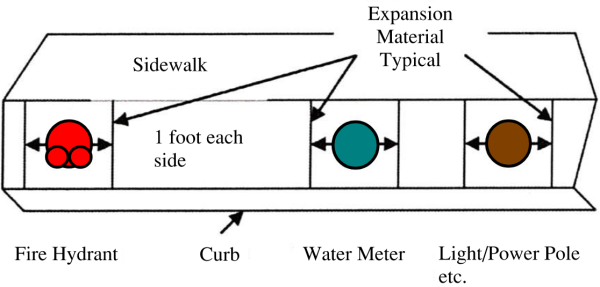 Additional information related to structures, trees, excavation, height limitations, and maintenance requirements associated with the right-of-way and park strip can be found in Title 25, Chapters 15 and 16.
- The park strip may be covered with non-turf landscaping or non-living landscaping. Concrete is not allowed in park strips of local streets, only major streets, known as collector and arterial streets. Concrete placed in the park strip area of collector and arterial streets around the water meter ring, fire hydrants and similar utilities shall be separated from the utilities with expansion joint material or other approved material on each side. This joint material shall be located one foot from the largest edge of the item on each side, extending from sidewalk to curb, thus facilitating removal of the concrete around the item without damage to the adjacent concrete in the park strip. In no case will the City be required to replace any concrete or other material that it may remove. Caution should be exercised not to place items in the park strip that could be a hazard to pedestrian or vehicular traffic.
- Existing and New Residential Uses:
- Existing single-family residential uses which have either not installed landscaping, or residential uses where the landscaping no longer exists, must install landscaping according to these regulations within 18 months from the enactment of this provision.
- For all single-family homes that are constructed after the enactment of this provision, landscaping must be installed within 18 months after the initial occupancy of the home.
- Existing single-family residential uses which have either not installed landscaping, or residential uses where the landscaping no longer exists, must install landscaping according to these regulations within 18 months from the enactment of this provision.
28-3-20.2 Required Commercial Landscaping
When an area is required to be landscaped under the terms of this Title, the requirements shall be met by the installation and maintenance of improvements as set forth in 28-3-10 and below:
- General Requirements:
- All plantings shall be maintained in a healthy and attractive condition.
- Landscaping materials shall be contained so as not to spill into the public right-of-way.
- All areas not occupied by buildings, parking, storage, future phased plan areas or access-ways, shall be landscaped; as well as the area within the public right of way between the curb and gutter and sidewalk shall be landscaped, unless the area falls along a gateway or entry corridor as designated in the general plan.
- Gateway and Entry Corridor Rights Of Way:
- For areas at an entry point or along an entry corridor, the area within the public right of way between the curb and gutter and sidewalk may be fully landscaped, or may invoke a combination of landscaping, pavers and other design elements to create the desired visual impact. The use of landscaping and pavers at entry points and along entry corridors should substantively satisfy the following objectives:
- Landscaping, combined with pavers and other design elements such as lighting, seating, etc., as deemed appropriate, should enhance the visual environment by creating a visually obvious and definite entry point or entry corridor through use of a texture, color, size and shape, etc., enhancing perspective by framing views, complementing architecture, screening, and creating points of interest and activity;
- Landscaping, combined with other design elements, shall be encouraged that will serve the function of ensuring public safety by:
- Guiding the circulation of cars and people;
- Controlling access to parking lots;
- Making traffic diverters prominent; and
- Defining the relative importance of streets by varying the species, height and location of landscaping.
- Landscaping combined with other design elements should minimize maintenance to ensure these points of first impression are maintained at an optimum level.
- Care should be taken to integrate the design of the entry point or entry corridor to the surrounding areas in a way that maximizes the assets of the area while still maintaining the desired continuity and visual impact.
- Visual continuity and overall design shall control the balance of landscaping and other design elements. However, whenever possible, landscaping shall be used.
- For areas at an entry point or along an entry corridor, the area within the public right of way between the curb and gutter and sidewalk may be fully landscaped, or may invoke a combination of landscaping, pavers and other design elements to create the desired visual impact. The use of landscaping and pavers at entry points and along entry corridors should substantively satisfy the following objectives:
Amended by Ord. 23-04Z on 6/27/2023
28-3-21 Water Efficient Landscape Requirements
- Purpose.
The purpose of this ordinance is to protect and enhance the community's environmental, economic, recreational, and aesthetic resources by promoting efficient use of water in the community's landscapes, reduce water waste, and establish a structure for designing, installing, and maintaining water efficient landscapes throughout the City. - Definitions.
Active Recreation Area: Areas of the landscape dedicated to active play where lawn may be used as the playing surface (ex. sports fields and play areas).
Bubbler: An irrigation head that delivers water to the root zone by "flooding" the planted area, usually measured in gallons per minute. Bubblers exhibit a trickle, umbrella or short stream pattern.
Check Valve: A device used in sprinkler heads or pipe to prevent water from draining out of the pipe through gravity flow. Used to prevent pollution or contamination of the water supply due to the reverse flow of water from the secondary irrigation system.
Davis and Weber Counties Canal Company (DWCCC): The local secondary water (pressurized irrigation) provider for Clinton City.
Grading Plan: The Grading Plan shows all finish grades, spot elevations as necessary and existing and new contours with the developed landscape area.
Ground Cover: Material planted in such a way as to form a continuous cover over the ground that can be maintained at a height not more than 12 inches.
Hardscape: Patios, decks, and paths. Does not include driveways and sidewalks.
Irrigation Plan: The irrigation plan shows the components of the irrigation system with water meter size, backflow prevention (when outdoor irrigation is supplied with culinary water), precipitation rates, flow rate, and operating pressure for each irrigation circuit, and identification of all irrigation equipment.
Landscape Architect: A person who holds a certificate to practice landscape architecture in the state of Utah. Only a Landscape Architect can legally create commercial landscape plans.
Landscape Designer: A person who may or may not hold professional certificates for landscape design/architecture and cannot legally create commercial landscape plans. Landscape Designers generally focus on residential design and horticultural needs of home landscapes.
Landscape Education Package: A package that is intended to inform and educate water users in the City about water efficient landscapes. This package should include a listing of water conserving plants, certified landscape designers, landscape architects, certified irrigation designers, and certified irrigation contractors. Information regarding the City's water rates, billing format for water use, and commitment to water conservation may also be included.
Landscape Plan: The preparation of a graphic and written criteria, specifications, and detailed plans to arrange and modify the effects of natural features such as plantings, ground and water forms, circulation, walks and other features to comply with provisions of this ordinance. The Landscape Plan shall include a project data sheet, a Planting Plan, an Irrigation Plan, and a Grading Plan.
Landscape Zone: A portion of the landscaped area having plants with similar water needs, areas with similar microclimate (i.e., slope, exposure, wind, etc.) and soil conditions, and areas that will be similarly irrigated. A landscape zone can be served by one irrigation valve, or a set of valves with the same schedule.
Landscaping: Any combination of living plants, such as trees, shrubs, vines, ground covers, flowers, or grass; natural features such as rock, stone, or bark chips; and structural features, including but not limited to fountains, reflecting pools, outdoor art work, screen walls, fences, or benches.
Lawn: See Turf/Turf grass/Lawn, below.
Localscapes: A locally adaptable and environmentally sustainable urban landscape style that requires less irrigation than traditional Utah landscapes (see www.Localscapes.com).
Microclimate: The climate of a very small restricted area that is different from the surrounding area. These areas include shade areas, sun areas, and areas protected by surrounding structures.
Mulch: Any material such as rock, bark, wood chips, or other materials left loose and applied to the soil.
Park Strip: A typically narrow landscaped area located between the back-of-curb and sidewalk.
Planting Plan: A Planting Plan shall clearly and accurately identify and locate new and existing trees, shrubs, ground covers, turf areas, driveways, sidewalks, hardscape features, and fences.
Pop-up Spray Head: A sprinkler head that sprays water through a nozzle in a fixed pattern with no rotation.
Precipitation Rate: The depth of water applied to a given area, usually measured in inches per hour.
Pressure Compensating: A drip irrigation system that compensates for fluctuating water pressure by only allowing a fixed volume of water through drip emitters.
Pressure Regulating Valve: A valve installed in an irrigation mainline that reduces a higher supply pressure at the inlet down to a regulated lower pressure at the outlet.
Rehabilitated Landscaping: Significantly altering a majority of a landscape, including the replacement of turf areas with water efficient plant material in accordance with the provisions of this Chapter.
Rotor Spray Head: A sprinkler head that distributes water through a nozzle by the rotation of a gear or mechanical rotor.
Runoff: Irrigation water that is not absorbed by the soil or landscape area to which it is applied, and which flows onto other areas.
Smart Automatic Irrigation Controller: An automatic timing device used to remotely control valves in the operation of an irrigation system using the internet to connect to a real time weather source or soil moisture sensor. Smart Automatic Irrigation Controllers schedule irrigation events using either evapotranspiration or soil moisture data to control when and how long sprinklers or drip systems operate and will vary based on time of year and weather/soil moisture conditions.
Spray Sprinkler: An irrigation head that sprays water through a nozzle.
Stream Sprinkler: An irrigation head that projects water through a gear rotor in single or multiple streams.
Total Landscaped Area: Improved areas of property that incorporate all of the completed features of the landscape. The landscape area does not include footprints of buildings or structures, sidewalks, driveways, and other non-irrigated areas intentionally left undeveloped.
Turf/Turfgrass/Lawn: A surface layer of earth containing grass species with full root structures that are maintained as mowed grass; generally, non-agricultural land planted in closely mowed, managed grasses; does not include a golf course, park, athletic field, or sod farm.
Water-Conserving Plant: A plant that can generally survive with available rainfall once established although supplemental irrigation may be needed or desirable during spring and summer months.
Weber Basin Water Conservancy District (WBWCD): Regional water supplier within the Ogden and Weber River drainages providing a variety of water supplies and strategies to conserve water extend existing supplies. The WBWCD provides rebates for various products and programs that help save water in this region. - Applicability of Water Efficient Landscape Ordinance.
- The provisions of this ordinance shall apply to all new and rehabilitated landscaping of public agency projects, private commercial, planned multi-family developments, and industrial development projects. Developer-installed and homeowner-installed landscape projects for the front and side yards of single-family residential areas may adhere to the standards set forth in Sections 4 and 5 of this Chapter, but shall be subject to the standards of Section 6 of this Chapter.
- For the purposes of this Chapter, single-family residential areas are those located in the A (Agricultural) and R (Residential) zones and multi-family residential areas are those located in the R-M Residential, Multi-Family) zone. Individual multi-family buildings on separate lots shall follow the same regulations as single-family residential.
- Certain special purpose landscape areas (e.g. stormwater management areas, etc.) may receive exceptions from the slope limitations and other elements of this Chapter, and are to be considered on a case by case basis with input form the Public Works Department.
- These standards are not intended to be in conflict with other landscaping requirements as defined by Utah law, including stormwater retention requirements and low-impact development (LID) guidelines. Notwithstanding these standards, whenever any requirement may be in conflict with Utah law, such conflicting requirements shall not apply.
- Landscape Design Standards.
- Plant Selection
- Plants shall be well-suited to the microclimate and soil conditions at the project site. Both native and locally-adapted are acceptable. Plants with similar water needs shall be grouped together as much as possible.
- It is recommended that plants be selected from the Weber Basin Water Conservancy District water-wise plant list for ground covers, perennials, shrubs, ornamental grasses, and trees.
- Areas with slopes greater than 25% shall be landscaped with deep-rooting, water-conserving plants for erosion control and soil stabilization.
- If landscaped with living material, areas less than eight feet wide shall be landscaped with water-conserving plants that do not require uniform overhead spray irrigation.
- Mulch. After completion of all planting, all irrigated non-turf areas shall be covered with a minimum three-inch layer of mulch to retain water, inhibit weed growth, and moderate soil temperature. Non-porous material shall not be placed under the mulch.
- Soil Preparation. When a soil report is required, soil preparation will be suitable to provide healthy growing conditions for the plants and to encourage water infiltration and penetration. Soil preparation shall include tilling the soil to a minimum depth of six inches and amending the soil with organic material as per specific recommendations of the Landscape Designer/Landscape Architect based on the soil conditions.
- Tree Selection. Tree species shall be selected based on growth characteristics and site conditions, including available space, overhead clearance, soil conditions, exposure, and desired color and appearance. Trees shall be selected as follows:
- Broad canopy trees shall be selected where shade or screening of tall objects is desired;
- Low-growing trees shall be selected for spaces under utility wires;
- Select trees from which lower branches can be trimmed to maintain a healthy growth habit where vision clearance and natural surveillance is a concern;
- Narrow or columnar trees shall be selected where awnings or other building features limit growth, or where greater visibility is desired between buildings and the street for natural surveillance;
- Street trees shall be planted in accordance with the standards of this Title. Tree placement shall provide canopy cover (shade) and avoid conflicts with existing trees, retaining walls, utilities, lighting, and other obstacles; and
- For commercial, industrial, institutional and planned multi-family residential developments, trees less than a two-inch (2") caliper shall be double-staked until the trees mature to a two-inch (2") caliper.
- Plant Selection
- Irrigation Design Standards.
- Smart Automatic Irrigation Controller. Landscaped areas shall be provided with a WaterSense labeled smart irrigation controller which automatically adjusts the frequency and/or duration of irrigation events in response to changing weather conditions. All controllers shall be equipped with automatic rain delay or rain shut-off capabilities and shall be setup to operate in "smart" mode.
- Each valve shall irrigate a landscape with similar site, slope and soil conditions and plant materials with similar watering needs. Turf and non-turf areas shall be irrigated on separate valves. Drip emitters and sprinklers shall be placed on separate valves.
- Drip emitters or a bubbler shall be provided for each tree. Bubblers shall not exceed one and a half gallons per minute per device. Bubblers for trees shall be placed on a separate valve unless specifically exempted by the City due to the limited number of trees on the project site.
- Drip Irrigation or bubblers shall be used to irrigate plants in non-turf areas. Pop-up spray heads shall be at a minimum of four inches in height to avoid blockage from lawn foliage.
- Sprinklers are recommended to have matched precipitation rates with each control valve circuit.
- Sprinkler heads shall be attached to rigid lateral lines with flexible material (swing joints) to reduce potential for breakage.
- Check valves shall be required where elevation differences cause low-head drainage. Pressure compensating valves and sprinklers shall be required where a significant variation in water pressure occurs within the irrigation system due to elevation differences.
- Filters shall be required on all secondary water service connections. Filters shall have as a minimum a 30 mesh screen and shall be cleaned and maintained by the property owner on a regular basis.
- Drip irrigation lines shall require additional filtration at or after the zone valve at a minimum of 200 mesh and end flush valves are required as necessary for drip irrigation lines.
- Valves with spray or stream sprinklers shall be scheduled to operate in accordance with Davis and Weber Counties Canal Company restrictions to reduce water loss from wind, evaporation or other environmental conditions not suitable for irrigation.
- Valves shall be programmed for multiple repeat cycles where necessary to reduce runoff, particularly on slopes and soils with slow infiltration rates.
- Landscapes in New Single-Family Residential Developments
- Homebuilders, developers and homeowners installing new or rehabilitated residential landscapes are required to submit a landscaping and irrigation plan to the Community Development Department for review and approval. Landscape/irrigation plans shall be subject to the following:
- Plant material in mass requiring overhead spray irrigation, such as common turf grass, shall not exceed 35% of the total landscaped area of the front and side yards.
- No turf or overhead spray is allowed in park strips or in areas less than eight feet in width. Park strips are not required to have living plants.
- Plantings shall be done such that a minimum of 35% of the total ground surface of non-turf areas shall be covered by living plants at mature growth. The park strip is included in the total ground surface of non-turf areas. The coverage does not include the area covered by any deciduous tree canopy above the ground.
- Landscaping of the front and side yard areas for new home construction shall be completed 18 months from the time of occupancy.
- Residential Landscape/Irrigation Plan.
A copy of a Landscape/Irrigation Plan shall be submitted to and approved by the Community Development Department. Homeowners may reference Localscapes for guidance in designing front and side yard area landscapes. The Landscape/Irrigation Plan shall consist of the following items:- Project Information Summary including the following:
- Project name and address;
- Applicant's name, address, phone number, and email address;
- Landscape designer's name (if other than applicant), address, phone number, and email address; and
- Landscape contractor's name (if other than applicant), address, phone number, and email address, if available at this time.
- Project name and address;
- Planting Plan drawn at a scale that identifies the following:
- Location, name, and size of plant materials, with labels or a legend;
- Property lines and street names;
- Existing and proposed buildings, walls, fences, paved areas, and other site improvements;
- Trees and plant materials to be removed or retained;
- Scale: graphic of written; and
- Date of Design.
- Irrigation Plan drawn at the same scale as the planting plan and containing the following information:
- Layout of the irrigation system with labels or a legend summarizing the type and size of components; and
- Installation details for irrigation components.
- Project Information Summary including the following:
- The City will review the landscape and irrigation plan to ensure all landscaping meets the intent of this Chapter.
- Homebuilders, developers and homeowners installing new or rehabilitated residential landscapes are required to submit a landscaping and irrigation plan to the Community Development Department for review and approval. Landscape/irrigation plans shall be subject to the following:
- Prohibition on Restrictive Covenants Requiring Uniform Plant Material Irrigated with Spray Irrigation
- Any provisions of Homeowners Association governing documents, such as bylaws, operating rules, covenants, conditions, and restrictions that govern the operation of a common interest development, are void and unenforceable if they:
- Require the use of any uniform plant material requiring overhead spray irrigation in landscape areas less than eight feet wide or require any uniform plant material needing overhead spray irrigation in front and side yards that exceeds 35% of the landscaped area; or
- Prohibit, or include conditions that have the effect of prohibiting, the use of water-conserving plants as a group; or
- Have the effect of prohibiting or restricting compliance with this ordinance or other water conservation measures.
- Any provisions of Homeowners Association governing documents, such as bylaws, operating rules, covenants, conditions, and restrictions that govern the operation of a common interest development, are void and unenforceable if they:
- Landscapes in Commercial, Industrial, Institutional and Planned Multi-Family Residential Developments.
- Commercial, industrial, institutional, and planned multi-family residential landscapes shall meet the Landscape Design Standards and Irrigation Design Standards of this ordinance, and the plant material in mass requiring overhead spray irrigation, such as common turf grass, shall not exceed 15% of the total landscaped area, outside of active recreation areas.
- Plantings shall be done such that a minimum of 35% of the ground surface of non-turf areas shall be covered by living plants at mature growth. The coverage does not include the area covered by any deciduous tree canopy above the ground.
- Landscape Plans for Commercial, Industrial, Institutional and Planned Multi-Family Residential Projects.
Landscape Plan. A Copy of a Landscape Plan shall be submitted to and approved by the City prior to the issue of any permit. A copy of the approved Landscape Plan shall be provided to the property owner or site manager. The Landscape Plan shall be prepared by a registered landscape architect and shall consist of the following items:- Project Data Sheet. The Project Data Sheet shall contain the following:
- Project name and address;
- Applicant of applicant agent's name, address, phone number, and email address;
- Landscape architect's name, address, phone number, and email address; and
- Landscape contractor's name, address, phone number, and email address, if available at this time.
- Planting Plan. A detailed planting plan shall be drawn at a scale that clearly identifies the following:
- Location of all plant materials, a legend with botanical and common names, and size of plant materials;
- Property lines and street names;
- Existing and proposed buildings, walls, fences, utilities, paved areas, and other site improvements;
- Existing trees and plant materials to be removed or retained;
- Scale: graphic and written;
- Date of design;
- Designation of a landscape zone; and
- Details and specifications for tree staking, soil preparation, and other planting work.
- Irrigation Plan. A detailed irrigation plan shall be drawn at the same scale as the planting plan and shall contain the following information:
- Layout of the irrigation system and a legend summarizing the type and size of all components of the system, including manufacturer name and model numbers;
- Static water pressure in pounds per square inch (psi) at the point of connection to the public water supply;
- Flow rate in gallons per minute and design operating pressure in psi for each valve and precipitation rate in inches per hour for each valve with sprinklers; and
- Installation details for irrigation components.
- Grading Plan. A Grading Plan shall be drawn at the same scale as the Planting Plan and shall contain the following information:
- Property lines and street names, existing and proposed buildings, walls, fences, utilities, paved areas, and other site improvements; and
- Existing and finished contour lines and spot elevations as necessary for the proposed site improvements.
- Project Data Sheet. The Project Data Sheet shall contain the following:
- Plan Review, Construction Inspection, and Post-Construction Monitoring for Commercial, Industrial, Institutional, and Planned Multi-Family Residential Projects.
- As part of the Building Permit approval process, a copy of the Landscape Plan shall be submitted to the City for review and approval before construction begins.
- All installers and designers shall meet state and local license, insurance, and bonding requirements, and be able to show proof of such.
- During construction, site inspection of the landscaping may be performed by the Community Development Department.
- Following construction and prior to issuing the approval for occupancy, an inspection shall be scheduled with the Community Development Department to verify compliance with the approved landscape plans. The Certificate of Substantial Completion shall be completed by the property owner, contractor, or landscape architect and submitted to the City.
- The City reserves the right to perform site inspections at any time before, during, or after the irrigation system and landscape installation, and to require corrective measures if requirements of this ordinance are not satisfied.
- Restricted Watering Practices.
Regardless of the age of a development (commercial, industrial, office, or residential), outdoor water shall be used in a manner consistent with Davis and Weber Counties Canal Company restrictions and standards. - Enforcement, Penalty for Violations.
- The Community Development Director and other employees of the Community Development and Public Works Departments are authorized to enforce all provision of this Ordinance.
- Any consumer who violates any provisions of this Ordinance shall be issued a written notice of violation. The notice will describe the violation and order that it be corrected in accordance with the provision of this Title.
Adopted by Ord. 23-04Z on 6/27/2023
28-3-22 Financial Guarantee Requirements
- Required. No site work shall be commenced, no development improvements shall be made, or no building permits shall be issued until the owner or developer provides a sufficient financial guarantee to ensure completion of the following "required improvements":
- Any landscaping improvements, whether upon public or private property, required under the provisions of this Title, or under any condition imposed under authority of the provisions of this Title; or
- Any improvement to adjacent road surfaces, curbs, gutters or sidewalks required under the provisions of this Title; or
- Any improvement for storm drainage, sewer, or water infrastructure required under the provisions of this Title, or under any condition imposed under authority of the provisions of this Title; or
- Common open space improvements, private streets or private utilities for which a financial guarantee is required under the subdivision Title of this Code.
- Escrow Account, Agreement. A sufficient financial guarantee shall be provided by the establishment of a City escrow account for one hundred fifteen percent (115%) of the estimated cost of the above required improvements, based on the actual cost estimate provided by the owner or developer. The financial guarantee shall provide that the required improvements be installed upon the completion of the development or the account funds may be called by the City to complete the improvements.
- Warranty.
- All required improvements shall be warranted by the property owner for two (2) years from the date of final inspection approval by the city for all such improvements.
- The City may, as a warranty, either retain fifteen percent (15%) of the guarantee amount or require an escrow equal to fifteen percent (15%) of the required total improvement costs. The warranty shall be established as set in Title 26; Chapter 4.
- Effect of Noncompliance on Subsequent Applications. No building permits shall be issued nor development approvals given for any expansion, amendment or subsequent phase of a development, if the required improvements have not been installed in accordance with prior permits or approvals for the site. This prohibition may be waived, if the reviewing official or body determines the following:
- The approval of the expansion, amendment, or subsequent phase would result in the removal of the previously required improvements; and
- Any previously required improvements which are not affected by the proposed expansion, amendment or subsequent phase have been installed; and
- Adequate escrow is provided for the previously uninstalled required improvements, as well as for any new required improvements imposed in regards to the expansion, amendment or subsequent phase.
- Installation of Improvements; Completion. Required improvements shall be installed and completed before occupancy or use of any building, structure or improvement approved in regards to the site plan, permit or other development. In the case of inclement weather that prevents the installation of the required improvements, the time of the improvements may be extended, in writing, upon approval of the applicable reviewing official or body, or designee. However, in no case shall the time for completion be extended beyond June 1 immediately following the completion date and no additional phases of any development shall be permitted during such period of extension.
- Replacement. If at any point during the warranty period that all or any portion of the required landscaping has been removed, stolen, dies or any combination the landscaping will be replaced prior to the release of all or any portion of the warranty.
- Release. The funds provided under the financial guarantee shall not be released until an authorized representative of the City has certified in writing that the required performance is completed and that the City releases its right to draw funds either in full or in part. Upon expiration of the warranty period, the City shall release the established security in whole or in part by providing the issuer a certificate, signed by an authorized representative of the City, that the City releases its right to draw funds or to the extent applicable. As portions of the required improvements are completed for large developments, the owner or developer may petition the City to reduce the amount of the original financial guarantee. If the City determines that the portions of the required improvements that have been completed are in compliance with City ordinances, the approved site plan, and any conditions of approval, and that the amount to be released is sufficient to justify the administrative expense, the City may cause the amount to be partially released; provided, that a minimum of twenty percent (20%) is retained as follows:
- Fifteen percent (15%) is retained until expiration of the warranty period; and
- At least fifteen percent (15%) is retained to ensure completion of any remaining required improvements.
- Failure To Complete Required Improvements. In those cases where the financial guarantee has been provided and the required improvements have not been installed as required, the City may, in its discretion:
- Pursue any available criminal or civil remedies to require the responsible party to complete the required improvements;
- Declare the development in default and obtain funds under the escrow agreement and complete, at the City's discretion, all or a portion of the required improvements either itself or through a third party;
- Assign its right to receive funds under the security to any third party, including a subsequent owner of the development, in whole or in part, in exchange for the third party's or subsequent owner's promise to complete the improvements for the development; or
- Exercise any other rights available under the law.
- Administrative Procedures. The Community Development Director may establish procedures consistent with this Section relating to the administration of the financial guarantee, including, but not limited to, fund management, release, default and collection.
28-3-23 Residential Facility For Elderly Persons
A residential facility for elderly persons is a dwelling unit that offers living quarters to a limited number of non-related elderly persons. Residential facilities for elderly persons shall be allowed as a permitted use in multi-family zoning districts and a conditional use in single-family zoning. A residential facility for elderly persons may not operate as a business. A residential facility for elderly persons may not be considered a business because a fee is charged for food or for actual and necessary costs of operation and maintenance of the facility.
- Residential facilities for elderly persons shall comply with all of the following requirements:
- Compliance with the requirements of Utah State Code and this chapter;
- Shall be owned by one of the residents or by an immediate family member of one of the residents or be a facility for which the title has been placed in trust for a resident;
- Shall be consistent with existing zoning of the desired location;
- Shall be occupied on a twenty-four (24) hour per day basis by eight (8) or fewer elderly persons in a family type arrangement;
- Shall meet all applicable building, safety, zoning and health ordinances applicable to similar dwellings;
- Shall provide adequate off-street parking space as per Chapter 28-4;
- Shall be capable of use as a residential facility for elderly persons without structural or landscaping alterations that would change the structure’s residential character;
- No residential facility for elderly persons be established within three-quarters (3/4) mile of another residential facility for elderly persons or residential facility for persons with a disability, as defined by section 10-9-605 of the Utah State Code;
- No person being treated for alcoholism or drug abuse shall be placed in a residential facility for elderly persons; and
- Placement in a residential facility for elderly persons shall be on a strictly voluntary basis and not a part of, or in lieu of, confinement, rehabilitation, or treatment in a correctional facility.
- The use granted and permitted by this section is non-transferable and terminates if the structure is devoted to a use other than a residential facility for elderly persons or if the structure fails to comply with the ordinances adopted under this part.
- Discrimination against elderly person facilities for elderly persons and persons with disabilities is prohibited.
- Elderly Apartments. Each elderly apartment shall meet all state and federal codes and have the following minimum requirements:
- Non-skid bathtubs;
- Handicap accessible door ways;
- Bath facilities designed to accommodate wheelchairs;
- Grab bars in showers, tubs, and near toilets;
- Central heating and cooling;
- Lever type door handles and water facets;
- Electrical receptacles to be at least twenty-four inches (24”) above floor level;
- No stairs within apartments, and elevator access for more than one-story dwelling buildings;
- Emergency signals in each apartment to a twenty-four (24) hour manned facility; and,
- Elderly households shall be limited to three persons per dwelling unit.
28-3-24 Residences For Persons With A Disability
A residential facility for persons with a disability (as defined in Utah State Code Section 57-21-2) means a residence in which more than one person with a disability resides. Residential facilities for person with a disability must conform to all of the following:
- Compliance with the requirements for Utah State Code and this chapter;
- All applicable standards and requirements of the Department of Human Services under Title 62A Chapter 2, Licensure of programs and facilities;
- Meets all municipal building, safety, and health ordinances applicable to similar dwellings and complies with Title 57, Chapter 21, Utah Fair Housing Act, and the Federal Fair Housing Amendments Act of 1988, 42 U.S.C. Sec. 3601 et seq.;
- Provides assurances that the residents of the facility will be properly supervised on a twenty-four (24) hour basis;
- Shall be occupied on a twenty-four (24) per day by five (5) or fewer person in a family type arrangement;
- Provides adequate off-street parking space;
- Is capable of use as a residential facility for handicapped persons without structural or landscaping alterations that would change the structure’s residential character;
- Not be established or maintained within three-quarters (3/4) mile of another residential facility for elderly persons or residential facility for persons with a disability;
- Not allow a person being treated for alcoholism or drug abuse be placed in a residential facility for handicapped persons;
- Not allow a person who is violent to be placed in a residential facility for handicapped persons;
- Require that placement in a residential facility for handicapped persons be on a strictly voluntary basis and not a part of, or in lieu of, confinement, rehabilitation, or treatment in a correctional facility;
- Obtain permits to facilitate inspections for compliance with the building, safety and health regulations that are applicable to similar structures; and
- The responsibility to license programs or entities which operate facilities for persons with a disability, as well as to require and monitor the provision of adequate services to persons residing in those facilities, shall rest with the Department of Human Services as provided in section 62A-2-1114 and Title 62A, Chapter 5, Services to People with Disabilities.
28-3-25 Garages, Accessory Buildings, Sheds, Carports - Single Family Dwelling
- Garage and Carport General Requirements. These requirements apply to garages and carports.
- Structures shall meet the minimum set back requirements established in this ordinance for the zone.
- Eaves shall not extend into any setback requirements established in this ordinance for the zone by more than twelve (12) inches.
- All run-off from the roof, drive or any hard surface associated with the structure shall be designed to drain onto the building lot where the structure is located.
- Adherence to the maximum impervious surface ratio.
- Structures built within five (5) feet of a property line shall not have openings, (windows, doors, etc.), in the wall that is within the five (5) feet.
- Structures built within five (5) feet of a property line shall have the wall constructed to meet the requirements of the International Residential Code.
- A curb cut and appropriate apron shall be established to meet the requirements of the city standards and §28-4 of this ordinance.
- Construction shall meet the requirements of the International Residential Code or International Building Code as applicable.
- Garage Accessory.199
- A Garage Accessory, as defined in this ordinance, may serve to satisfy the parking requirements established for a residence in Chapter 28-4 of this ordinance providing that there is also a hard surface drive from the street to the Accessory Garage.
- The minimum distance from any wall surface, attached deck, awning, or other extension of the dwelling to any wall surface or extension on the Garage, shall not be less than ten (10) feet. The eves of either structure shall not extend more than twelve (12) inches into the required ten (10) foot separation.
- Structure shall be designed with the intended use of storing vehicles designed for transportation or recreation.
- Garage Accessory shall compliment the color scheme of the existing dwelling. Significance of colors shall be determined by the planning staff at the time of plan review.198
- If the structure is not intended to meet the requirements of Chapter 28-4 for a residence as stated in (2) (a) (ii) it shall have a gravel drive, meeting the requirements of §28-4-15 (4) (b), or hard surface drive from the street to the garage unless the structure is behind a 6-foot solid fence with gates then the gravel or hard surface shall extend from the street to behind the fence gates.198, 199
- Garage Detached.
- A Garage Detached, as defined in this ordinance, may satisfy the parking requirements established for a residence in Chapter 28-4 of this ordinance providing that there is also a hard surface drive from the street to the Detached Garage.
- The minimum distance from any wall surface, attached deck, awning, or other extension of the dwelling to any property line shall meet the requirements established in this ordinance for the applicable zone. The minimum distance from a wall surface or any extension on the structure to the wall surface or extension on the residence shall be a minimum of ten (10) feet.
- Structure shall be designed with the intended use of storing vehicles designed for transportation or recreation.
- Garage Detached shall have the same architectural features; utilize the same building materials and same pattern as the existing dwelling. Street view of the structure shall be similar in the use of materials, brick, rock, etc., as the residence on the lot. Sides and rear of the structure may utilize less primary materials, siding, stucco, etc., found on the residence. Equality of materials and features shall be determined by the planning staff at the time of plan review. Allowances may be made when considering the availability of materials due to the age of the original structure.
- Accessory Building and Sheds General Requirements. The following requirements apply to Accessory Buildings and Sheds: 198, 199
- Structures shall meet the minimum setback requirements established in this ordinance for the zone.
- The structure shall be located in the rear yard setback as defined in this ordinance with a minimum distance from any wall surface, attached deck, awning, or other extension of the dwelling to any wall surface or extension on the structure, shall not be less than ten (10) feet.
- Eaves shall not extend into any setback or separation requirements established in this ordinance for the zone by more than twelve (12) inches.
- All run-off from the roof, drive or any hard surface associated with the structure shall be designed to drain onto the building lot where the structure is located.
- Adherence to the maximum impervious surface ratio.
- A curb cut shall NOT be established to provide access to the structure.
- Construction shall meet the requirements of the International Residential Code or International Building Code as applicable.
- Structure shall not be designed with the ability to store vehicles intended for transportation or recreation, access into the structure shall be less than six (6) feet wide.
- Accessory Buildings or sheds, as defined in this ordinance, do not meet the parking requirements of Chapter 28-4 of this ordinance.
- Accessory Buildings shall compliment the color scheme of the existing dwelling. Significance of colors shall be determined by the planning staff at the time of plan review.
- Carport General Requirements.192, 199
- Carports associated with structures other than single family dwellings shall be evaluated and approved as part of the site plan approval process.
- Eaves shall be measured from the exterior wall where one exists and from the exterior of support posts where no wall exists.
- Carports shall have a hard surface, concrete or asphalt, under the roof area.
- Any Carport shall have a solid wall, adjacent to the closest property line, when located closer than ten (10)-feet to an adjacent property line if no privacy fence is present between the carport and adjacent property.
- Carport Attached.199, 213
- Attached carports intended to satisfy requirements of Chapter 28-4 shall meet the minimum size requirements to park a car of ten by twenty feet.
- Carport Accessory.199
- The minimum distance from any wall surface, attached deck, awning, or other extension of the dwelling to any wall surface or extension on the Carport, shall not be less than ten (10) feet. The eaves of either structure shall not extend more than twelve (12) inches into the required ten (10) foot separation.
- Structure shall be designed with the intended use of storing vehicles designed for transportation or recreation.
- Shall have a gravel drive, meeting the requirements of §28-4-15(4)(b), or hard surface drive from the street to the carport unless the structure is behind a six (6)-foot solid fence with gates then the gravel or hard surface shall extend from the street to behind the fence gates.198
- Carport Detached.199
- The minimum distance from any wall surface, attached deck, awning, or other extension of the dwelling to any wall surface or extension on the structure, on the lot, shall meet the minimum setback requirements established for a Detached Garage.
- It shall have a hard surface drive from the street to the structure.
- Structure shall be designed with the intended use of storing vehicles designed for transportation or recreation.
- Carport Detached shall have similar architectural features and utilize similar colors and materials as on the dwelling on the lot. In this case similar is intended to be complementary to the design of the dwelling.
- Nonconforming Structures.199
- Any Garage Accessory, Garage Detached, Accessory Building, or Accessory Building Large Lot that does not conform to the requirements of this ordinance, that has been declared a nuisance or unsafe for occupancy by authority of the City Code, health code, or building codes, shall not be repaired unless it is brought into significant compliance with the requirements of this code. Any Garage Accessory that is demolished shall not be reconstructed unless it complies with the requirements of this ordinance.
- Any Shed that does not conform to the requirements of this ordinance, that has been declared a nuisance or unsafe by authority of the City Code, health code, or building codes, shall not be repaired or reconstructed unless it is brought into significant compliance with the requirements of this code.199
28-3-26 Model And Display Homes
Model and Display Homes are permitted uses within all residential zones within the City, under the following guidelines:
- Model Homes.
- A Model home can also have a sales office within it.
- A Model home shall only be operated within the approved platted subdivision within the city.
- A Model home shall only be operated for sales within the city.
- A business license shall be obtained by the broker from the city for operation of the model home.
- Hours of operation shall be limited to 8:00 a.m. to 8:00 p.m.
- No exterior lighting other than what would be considered conventional residential lighting shall be installed on the lot.
- If the garage area has been built for an office area, it will be retrofitted into a garage prior to the sale of the model home. As well as a certificate of notice will be recorded against the property indicating the need to retrofit the garage.
- Adequate off street parking is provided, but no more than typically allowed for a residential dwelling.
- Full landscaping, consistent with the water efficient landscape provision of this Chapter, must be installed prior to occupying the building as a model home. The Community Development Director or an appointed staff member may grant one time up to a six-month extension for weather-related reasons.
- Signs shall comply with the Clinton City Sign Ordinance.
- Display Homes.
- No business shall be conducted on site.
- A Display home shall only be operated within the approved platted subdivision within the city.
- Hours of operation shall be limited to 8:00 a.m. to 8:00 p.m.
- No exterior lighting other than what would be considered conventional residential lighting shall be installed on the lot.
- Full landscaping, consistent with the water efficient landscape provisions of this Chapter, must be installed prior to occupying the building as a display home. The Community Development Director or an appointed staff member may grant one time up to a six-month extension for weather-related reasons.
- Signs shall comply with the Clinton City Sign Ordinance.
Amended by Ord. 23-04Z on 6/27/2023
28-3-27 Accessory Dwelling Unit Standards
- Accessory dwelling units (“ADUs”) in single-family residential zones are an important tool in the overall housing goals and needs of the city, and allow for alternative and flexible housing options on owner-occupied single-family lots. The purpose of the standards of this chapter are to:
- Preserve and enhance life safety standards required for residential occupancy through the creation of a regulatory process for ADUs;
- Provide housing options for individuals and families in all stages of life and/or with a moderate income that might otherwise have difficulty finding adequate housing within the city;
- Provide opportunities to offset rising housing costs and promote reinvestment in existing single-family residential zones;
- Preserve the character of single-family neighborhoods through adequate standards governing ADUs; and
- Comply with UTAH CODE ANN. 10-9a- 530, which designates internal ADUs as permitted uses in all single-family residential zones and imposes limitations on the extent that municipalities may regulate internal ADUs.
- ADUs - Where Permitted.
- Internal, attached, and detached ADUs are a permitted use in primary dwellings and on lots under owner occupancy in the city’s R-1 (single-family), and A (agricultural) zones, and existing single-family homes in the PZ (performance) zone, subject to the approval process detailed in this chapter.
- Internal, attached, and detached ADUs are prohibited where the primary dwelling is served by a failing septic tank.
- ADU - Approval Process. The approval process for ADUs in the city is as follows:
- ADU permit applications shall be filed through the city's online building permit portal and shall include the following:
- Documentation that demonstrates the property is owner occupied;
- A to-scale site plan showing all building on the lot, required off-street parking, and floor plans of all building associated with the proposed ADU. Such plans may be conceptual but shall provide reasonable detail and specification for full understanding of the proposed ADU;
- Applicable structural, electrical, and mechanical specifications and drawings compliant with pertinent building code requirements;
- Payment of applicable permit and inspection fees;
- Completion of a satisfactory property/building inspection; and
- Issuance of necessary building permits.
- A portion of a principal dwelling unit with the characteristics of a separate dwelling unit but not occupied by a second family is exempt from obtaining an ADU permit upon completion and recordation of an exemption form provided by the city.
- ADUs shall comply with all other applicable building permit, zoning code, and building code requirements.
- The Fire Department shall review ADU permits for access and safety compliance with City and International Fire Code (IFC) requirements.
- Upon approval of an ADU permit and where the ADU occupant is paying rent, the owner shall be subject to the Residential Rental Dwelling license and fee requirement outlined in Chapter 15-19 of this Title.
- Upon approval and issuance of a building permit for an ADU, the city shall record a notice in the office of the county recorder that shall include:
- a description of the primary dwelling;
- for an internal or attached ADU, a statement that the primary dwelling contains an accessory dwelling unit; and
- for a detached ADU, a statement that the lot contains a detached accessory dwelling unit; and
- a statement that the accessory dwelling unit may only be used in accordance with the city’s land use regulations.
- The city shall, upon recording the notice, deliver a copy of the notice to the owner of the ADU.
- ADU permit applications shall be filed through the city's online building permit portal and shall include the following:
- ADU Development Standards.
- The property’s record owner (including titleholders and contract purchasers) must occupy either the primary dwelling unit or the approved ADU as such owner’s permanent residence and at no time receive rent for the owner-occupied unit. An application for an ADU permit shall include evidence of owner occupancy in the form of the affidavit required by Section 28-3-5 of this chapter and such other verification(s) as the city reasonably may require.
- Owner occupancy for a dwelling with an accessory dwelling unit shall not be required when:
- The owner cannot live in the dwelling because of a bona fide temporary absence of three years or less for a temporary job assignment, sabbatical, or voluntary service;
- The owner was living in the dwelling immediately prior to leaving for the temporary job assignment, sabbatical, or voluntary service; and
- The owner intends to make the dwelling his/her primary place of residence upon returning from the temporary job assignment, sabbatical, or voluntary service.
- The owner cannot live in the dwelling because of a bona fide temporary absence of three years or less for a temporary job assignment, sabbatical, or voluntary service;
- ADUs shall not be used as short-term rentals for occupancy of fewer than 30 consecutive days.
- Only one ADU may be created per lot or property.
- The design and size of the ADU shall conform to all current applicable standards in the building, plumbing, electrical, mechanical, fire, health, and any other applicable codes. When a new ADU is proposed in or attached to an existing home, the entire ADU shall be brought up to all minimum standards, as inspected and approved by city staff.
- The installation of separate utility meters for an ADU is prohibited.
- Each ADU shall require one off-street parking space in addition to the required parking for the primary dwelling unit. In no case shall fewer than three total off-street parking stalls be provided for any property with an ADU.
- Any parking spaces contained within a garage or carport shall be replaced if an ADU is created within the garage or carport.
- ADUs shall maintain the same address as the primary dwelling with the addition of “Unit B.”
- ADUs may not be created within a mobile home as defined in UTAH CODE ANN. 57-16-3, as amended. or within a mobile home community.
- The combined maximum rear yard area coverage for detached ADUs and other detached structures is 25%. Other rear yard hard surfaces (i.e. patios, driveways, sport courts, etc.) shall not be counted towards said 25% maximum coverage.
- Applicability.
Structures legally existing prior to March 25, 2025 that do not comply with the setback requirements established by the Chapter may be converted to a detached ADU subject to the conditions outlined herein.- Conditions for Conversion
- The conversion must meet all applicable building, fire, safety, and other municipal codes.
- No new windows or other openings shall be permitted on any building elevation located closer to property lines than the setbacks prescribed in this Chapter.
- Existing openings on elevations located within detached ADU setback areas may remain as originally constructed or be reduced in size or eliminated provided they are not expanded or relocated.
- Additional Regulations. Compliance with this section does not exempt the ADU structure from any other applicable city ordinances, codes, or regulations.
- Restrictions on Additions. Any additions or expansions to the existing structure intended for conversion into a detached ADU shall adhere strictly to current setback requirements and height restrictions.
Table 3.27.1 ADU SETBACKS1. In no case shall a detached ADU exceed the height the primary dwelling measured at the peak of the roof.REQUIREMENTS INTERNAL ADU ATTACHED ADU DETACHED ADU DETACHED ADU
Single StoryDETACHED ADU
Single StoryDETACHED ADU
2-StoryDETACHED ADU
2-StoryLOCATION Inside Primary Dwelling Attached to Primary Dwelling Side Yard Area Rear Yard Area Side Yard Area Rear Yard Area MAXIMUM HEIGHT LIMIT1 & 2 Same as Primary Dwelling Same as Primary Dwelling 16' to Roof Peak 16' to Roof Peak 25' to Roof Peak 25' to Roof Peak MINIMUM SIDE SETBACKS3 Same as Primary Dwelling Same as Primary Dwelling Same as Primary Dwelling 5 feet 10 feet 10 feet MINIMUM CORNER SIDE SETBACKS Same as Primary Dwelling Same as Primary Dwelling Same as Primary Dwelling Same as Primary Dwelling Same as Primary Dwelling Same as Primary Dwelling MINIMUM REAR SETBACKS Same as Primary Dwelling Same as Primary Dwelling 10 feet 10 feet Same as Primary Dwelling 20 feet MINIMUM DISTANCE FROM HOME No Restriction No Restriction 10 feet 10 feet 10 feet 10 feet ENTRANCE Side or Rear Side or Rear Side or Rear Front, Side, Rear Side or Rear Front, Side, Rear SIZE LIMIT4 No Limitation 50% up to 1,500 sf 50% up to 1,500 sf 50% up to 1,500 sf 50% up to 1,500 sf 50% up to 1,500 sf
2. Minimum roof pitch shall be 4:12; maximum roof pitch shall be 12:12 .
3. ADU entrance/exit doors in side yards shall be set back 10' from side property lines for detached and attached ADUs.
4. ADU livable square footage cannot exceed 50% of the primary dwelling unit's livable space (parking and non-habitable storage areas shall not be counted).
- Conditions for Conversion
- Affidavit.
- All applications for ADU permits shall include a notarized affidavit, signed by the record owner of the property, that includes a description of the primary dwelling unit; an acknowledgement that the primary dwelling unit contains or will contain an accessory dwelling unit; a declaration of onsite owner occupancy of the primary or accessory dwelling unit and a statement that the ADU may only be used in accordance with the city’s land use regulations. Change in ownership of the primary dwelling shall not require any additional zoning approval, but shall require an updated ADU permit, site inspection (if applicable), and signed affidavit.
- Inspection.
- Prior to approval of an ADU permit, all required building permits shall be completed by the applicant and inspected by the city’s building official or designee to verify compliance with all applicable city standards.
- If no additional work is proposed or required to ready an ADU for occupancy, the applicant shall submit a minimum-fee building permit application, accompanied by an inspection by the city's building official, to ensure compliance with all applicable standards.
- Termination.
- If the primary dwelling’s record owner changes and is not accompanied by a new ADU application, or if the primary dwelling’s record owner is no longer permanently residing in the primary dwelling, then the ADU shall be immediately vacated and shall no longer be used as an internal ADU. The city may revoke, or may choose to deny license renewal, to any property with unresolved violations of this code arising from or related to operation of an ADU. The city may also hold a lien against a property that contains an ADU that violated this chapter pursuant to the procedures detailed in UTAH CODE ANN. 10-9a-530(5), as amended.
- If the primary dwelling’s record owner changes and is not accompanied by a new ADU application, or if the primary dwelling’s record owner is no longer permanently residing in the primary dwelling, then the ADU shall be immediately vacated and shall no longer be used as an internal ADU. The city may revoke, or may choose to deny license renewal, to any property with unresolved violations of this code arising from or related to operation of an ADU. The city may also hold a lien against a property that contains an ADU that violated this chapter pursuant to the procedures detailed in UTAH CODE ANN. 10-9a-530(5), as amended.
Adopted by Ord. 22-06Z on 9/27/2022
28-3-28 Sight Triangle Requirements
- Sight Triangle Across Corner Property Required.
- No obstruction to view will be permitted on that portion of a corner lot defined as the sight triangle area.
- Where curb, gutter, park strip and sidewalk are installed, the sight triangle area shall being at the corner of the lot and measure 40 feet along both lot lines. The end points connected diagonally to form a triangle. The lot line is situated one foot behind the sidewalk (See Figure 3-28-1).
- Where only curb exists, the measuring distance shall be 49 1/2 feet from the back of curb. If no street frontage improvements exist, the measuring distance shall be 49 1/2 feet from the edge of asphalt. At no time shall the sight triangle be less than 40 feet from the planned right-of-way line for a street.
- The City Engineer and Zoning Administrator or their designees may require additional sight triangle area based on distance visibility associated with the horizontal or vertical curves of the intersecting street.
- Sight Triangle Area for Driveways.
The sight triangle area for the intersection of a drive approach and a public or private street shall be located in the triangular areas bounded by lines drawn from a point on the driveway edge and the street right-of-way, measured as follows:- From the point of intersection of the driveway edge and the street right-of-way, measuring 20 feet along the property line away from the driveway, and 10 feet along the edge of the driveway toward the primary structure. A line is then drawn diagonally between the termini of the two legs forming a triangle (See Figure 3-28-2). This is required on both sides of the driveway. The following driveway sight triangle standards shall apply:
- Measurements along the edge of the driveway shall be even with the outside edge of the garage and align with the edge of an approved drive approach.
- No view-obstructing fence, wall, hedge, or plant exceeding two feet in height above the level of the sidewalk.
- The City Engineer and Zoning Administrator or their designees may require additional sight triangle area based on distance visibility associated with the horizontal or vertical curves of the intersecting street.
- Enforcement of the sight triangle area for a particular driveway shall not extend across an adjacent property line.
- From the point of intersection of the driveway edge and the street right-of-way, measuring 20 feet along the property line away from the driveway, and 10 feet along the edge of the driveway toward the primary structure. A line is then drawn diagonally between the termini of the two legs forming a triangle (See Figure 3-28-2). This is required on both sides of the driveway. The following driveway sight triangle standards shall apply:
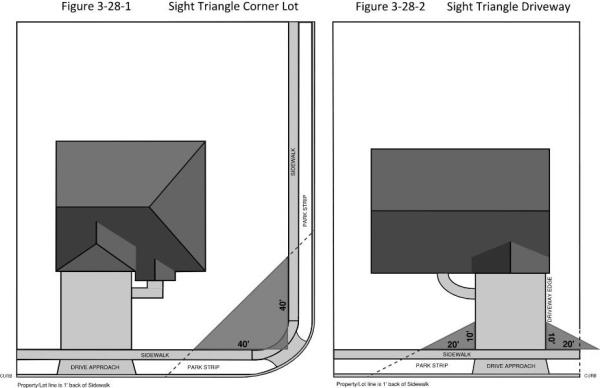
Adopted by Ord. 23-03Z on 6/13/2023

