
Commerce City Zoning Code
CHAPTER 19
19 - SITE PLANNING AND GENERAL DEVELOPMENT STANDARDS
19.19.010 - Intent and purpose.
Site planning and general development standards regulate the use of a building or land and are established to minimize public hazards and prevent the creation of nuisances and other conditions that are potentially harmful or discomforting to the users of the project or surrounding area. The purpose of these standards is to protect and improve the environment and the appearance of the community, and to deter blighting and nuisance conditions.
(Ord. 544 §1(part), 2000).
19.19.020 - Applicability.
A.
Site planning and general development standards shall apply to all new construction, renovation, and alteration of existing uses or structures in all zone districts and land uses. No building or land shall be used or constructed if it creates a dangerous, noxious, fire, explosive, or other hazard; noise or vibration; smoke, dust, odor, or air pollution; glare; or liquid or solid wastes in amounts that adversely affect surrounding areas.
B.
The standards contained in this Chapter 19.19 shall be applied in addition to the development standards contained in this Title 19 for any given zone. Whenever the performance and development standards are different, the more stringent standard shall govern.
(Ord. 544 §1(part), 2000).
19.19.030 - Property maintenance.
The following standards are established to regulate the maintenance of all properties, land uses, and structures in the city:
A.
Abandoned and inoperable automobiles, recreational vehicles, camper shells, or boats shall not be kept on the driveways of private property for more than seven days.
B.
Debris, rubbish, and trash, including but not limited to discarded old furniture, appliances, boxes, toys, etc.; discarded building materials; and equipment and materials stored on rooftops shall not be visible from public rights-of-way for more than three days.
C.
Structurally unsafe buildings, including but not limited to those with known fire hazards; faulty weather protection broken roofs; windows and doors; partially constructed structures when construction has ceased; unoccupied buildings that are left open; hazardous fences or walls; abandoned signs; and damaged buildings shall be demolished, removed, or fenced to prevent public access.
D.
Clotheslines shall not be allowed in front yards, nor shall fences be used as clotheslines.
E.
Erosion, subsidence, and surface water problems within a property shall be abated.
F.
Trash receptacles shall not be stored in any front yard with any residential zone.
(Ord. 544 §1(part), 2000).
19.19.040 - Solid waste receptacles and enclosures.
A.
Facilities Required. The design of any new, substantially remodeled, or expanded multifamily, commercial, or industrial building or structure shall provide for proper trash storage or handling that will accommodate solid waste loading and allow for efficient and safe waste removal or collection. Such facilities shall also be capable of accommodating recyclable materials collection bins as may be required by Chapter 6.13 of the Municipal Code.
B.
Size Requirements.
1.
The following size requirements apply to residential developments with four to twelve units:
a.
If waste storage areas are provided for individual units, such areas shall be at least three feet wide by four feet long per unit, plus an additional storage area at least twelve square feet overall and at least three feet wide.
b.
If a single storage area is provided, it shall be at least four and one-half feet wide by six feet long for the first four units, plus three square feet of additional space for each additional unit thereafter.
2.
The following size requirements apply to residential developments with more than twelve units:
a.
If waste storage areas are provided for individual units, they shall be at least three feet wide by four feet long per unit, plus an additional storage area four and one-half feet wide by six feet long.
b.
If a single storage area is provided, it shall be at least four and one-half feet wide by fifteen feet long for the first thirteen units, plus five square feet of additional space for each additional unit.
3.
Industrial, commercial, and institutional facilities shall have ten square feet of storage area for every one thousand square feet of net floor area or portion thereof for the first twenty thousand square feet of net floor area, plus five square feet for every one thousand additional square feet thereafter. If the building has less than two thousand square feet, the minimum storage area shall be four and one-half feet by six feet.
C.
Site Development Standards.
1.
Waste storage areas shall be located where they do not interfere with the traffic patterns of individuals or vehicles.
2.
Waste storage areas shall be located where they are readily accessible to collection personnel at all times.
3.
Exterior waste storage areas for residential developments shall be located so as to be screened from view from public streets and highways.
4.
Waste storage areas shall be provided on a level surface so that storage containers remain at rest without auxiliary restraining devices.
D.
Solid Waste Storage Area Enclosures.
1.
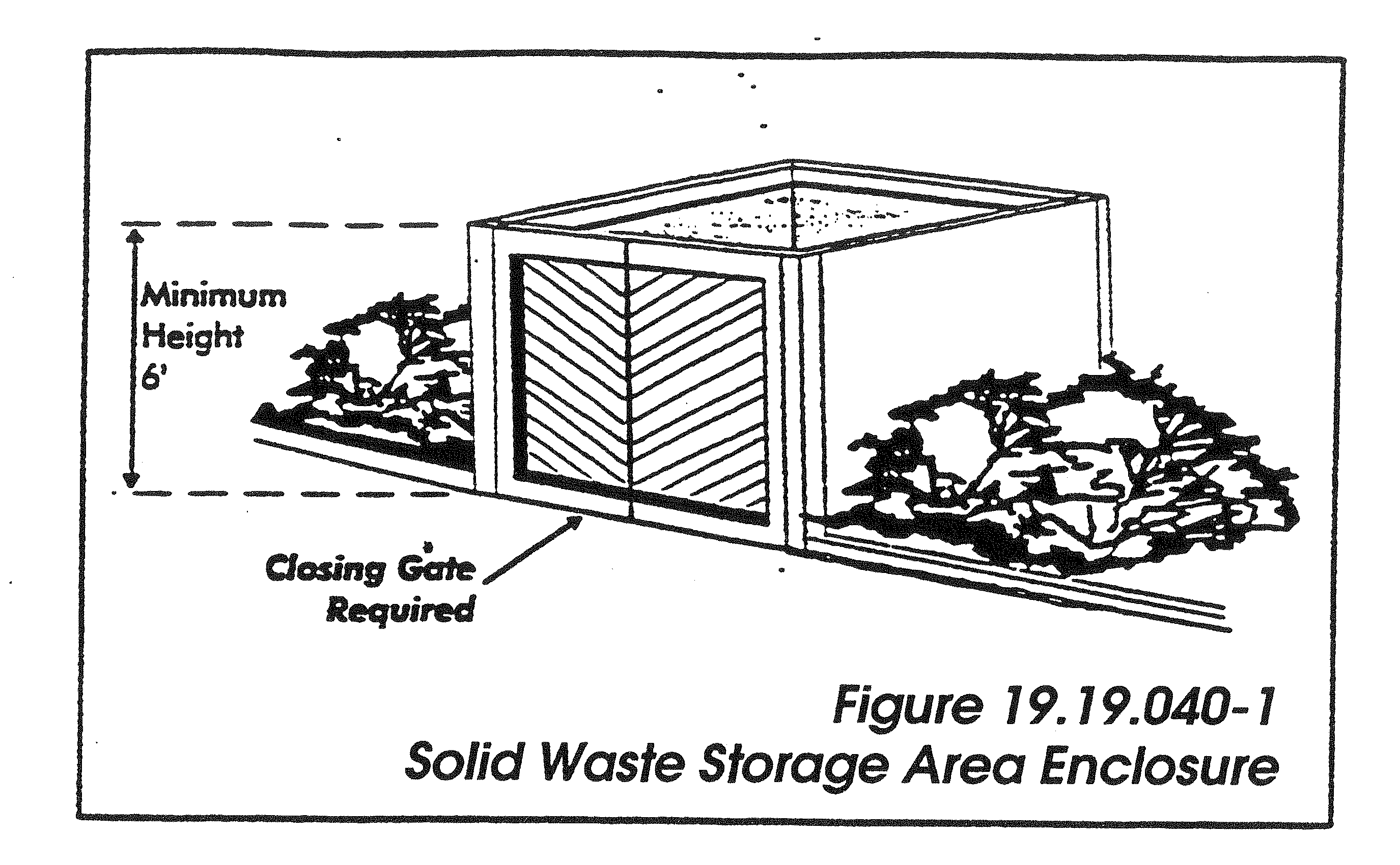
All solid waste storage areas for all uses except single-family residences and duplexes shall be enclosed within a masonry wall of minimum height six feet.
2.
The exterior architectural treatment of waste storage areas shall be compatible with the main building treatment.
3.
All business and property owners shall be responsible for policing trash and debris generated from their property.
4.
Solid waste storage areas shall not be allowed in front yards.
5.
All solid waste enclosures shall have an opaque gate with a closable latch.
(Ord. 544 § 1(part), 2000).
19.19.050 - Street dedications and improvements.
A.
To mitigate potential problems associated with project generated traffic and circulation, dedication of street right-of-way and construction of street and related improvements may be required as a condition of approval of permits issued in compliance with this title.
B.
The following standards shall govern any street dedication or improvement:
1.
No new construction or renovation shall be granted utility connections and a certificate of occupancy until one-half of the street along the entire length of the lot frontage is dedicated and improved according to city standards. For development of a portion of a lot, dedication and improvement shall apply only to abutting streets of that portion of the lot. A bond may be placed in lieu of improvements until the director of public services deems it practical to construct the improvements.
2.
The maximum area of land required for dedication shall not exceed twenty-five percent of the total lot area.
3.
Additional street improvements shall not be required when the abutting street is already improved according to city standards.
4.
A deed granting an easement for a public street shall be submitted to the city engineer before approval of any permit is issued.
C.
Street Improvement Standards.
1.
All streets shall be dedicated to the width established in the general plan circulation element.
2.
Street improvements shall include curb and gutter, sidewalks, storm drains, landscaped parkway.
3.
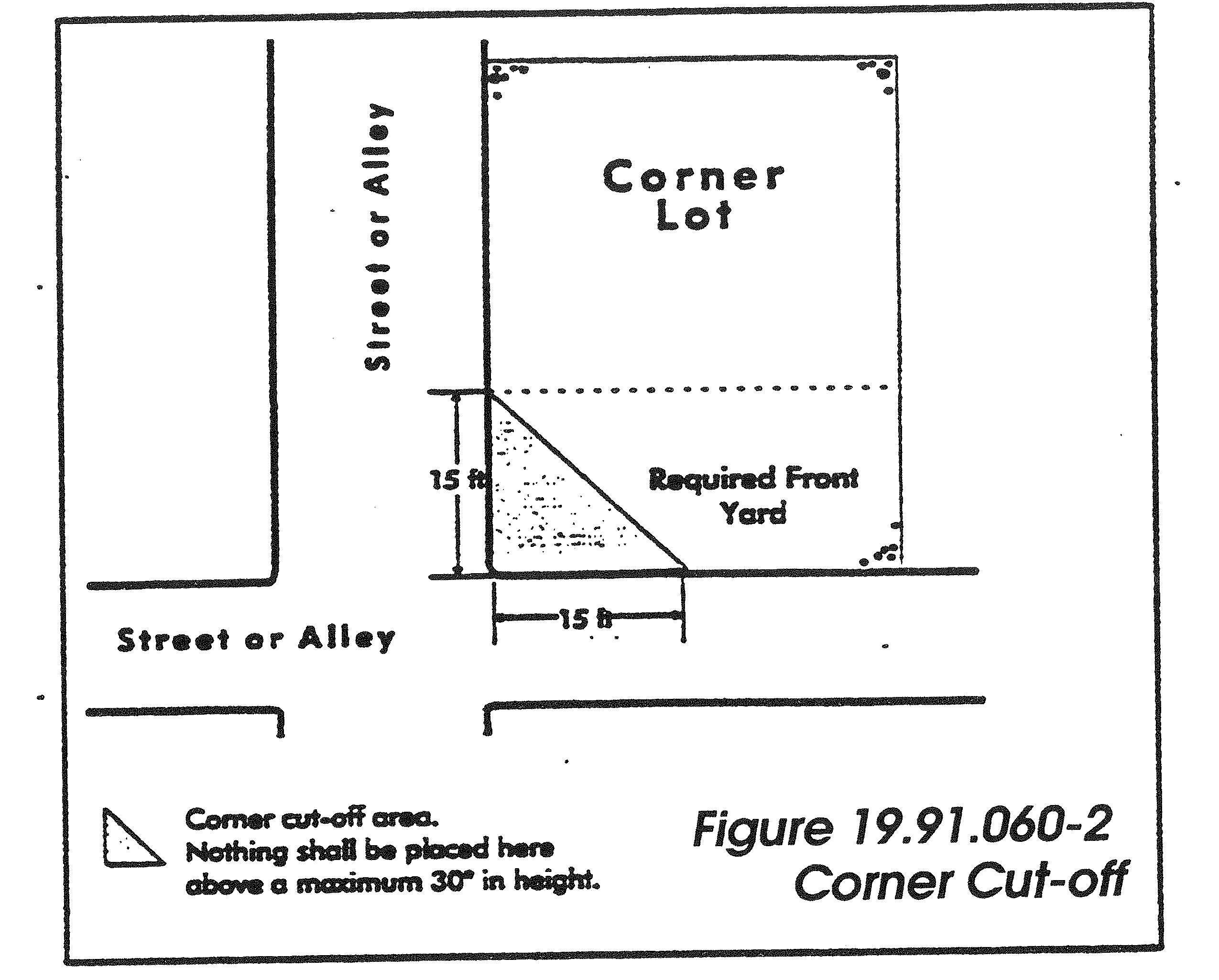
Street dedication shall include a corner cut-off area at intersections.
D.
Whenever uncertainty exists regarding the need for street dedication and improvement, the director of public services or his designee shall determine the need for dedication or improvement based upon studies and analysis and information contained in any applicable plans.
(Ord. 544 § 1(part), 2000).
19.19.060 - Corner cut-off area.
Nothing shall be placed, planted, erected, or allowed to grow in the corner cut-off area that could impair vision above thirty inches above street grade (Figure 19.19.060-2).
(Ord. 544 § 1(part), 2000).
19.19.070 - Construction materials.
A.
Standards for construction materials are established to ensure that all buildings and structures in the city are attractive, durable, safe, and appropriate to the area in which they are located.
B.
The proposed materials and methods of construction of all buildings and structures shall meet the safety requirements of the Los Angeles County Fire Department for that type of structure and use, as well as the requirements of the city's building code.
C.
The expected life of the proposed construction material shall be at least as long as that of other materials typically in use for the type of building or land use.
D.
The appearance of the proposed construction materials, including, but not limited to, colors and textures, shall be compatible with other structures on the same lot, adjoining lots, other nearby buildings, and the overall character of the neighborhood.
E.
Walls and fences may be constructed of masonry, metal, or wood, so long as the material is new, in good condition, and compatible with the exterior appearance of the property on which it is located.
F.
Metal buildings are prohibited. However, this restriction shall not preclude the continued use, reuse, or rehabilitation of any legally established metal building.
(Ord. 544 § 1(part), 2000).
(Ord. No. 612, § 1, 10-7-2008)
19.19.080 - Outdoor storage.
Outdoor storage areas shall be permitted only in the C/M-1, M-1, and M-2 zones, subject to the following regulations:
A.
All outdoor storage areas must be kept neat, orderly, and completely concealed from view from the public right-of-way by buildings, solid masonry walls, vine-covered chain-link fences or evergreen hedges a minimum of six feet in height.
B.
No outdoor storage shall be permitted within any required off-site parking or loading area.
C.
No materials within the outdoor storage area shall exceed eight feet in height.
D.
Materials that may cause fumes, dust, odor, or attract rodents or insects shall be stored in closed containers. Materials that may be transferred off a property by wind, rain, or other natural causes shall not be placed in outdoor storage areas.
(Ord. 544 § 1(part), 2000).
19.19.090 - Outdoor sales.
Outdoor sales are not permitted unless a temporary use permit is obtained pursuant to Division 11, Chapter 19.39 of this Title 19.
(Ord. 544 § 1(part), 2000).
19.19.100 - Mechanical equipment screening.
A.
Visual Screening. All mechanical equipment such as air filters, air conditioning units, heating units, and ventilation units shall be screened from view from adjacent properties and public rights-of-way. Screening materials shall consist of materials architecturally compatible with the building for which the equipment is provided.
B.
Screening to Achieve Noise Reduction. Hoppers, cyclones, and similar large equipment shall be screened as necessary to achieve the noise standards set forth in Section 19.19.160 of this Title 19.
(Ord. 544 § 1(part), 2000).
19.19.110 - Air quality.
A.
No smoke of any type shall be emitted from a source in excess of South Coast Air Quality Management District (SCAQMD) standards.
B.
No elements of dust, fly ash, vapors, fumes, gases or other forms of air pollution shall be permitted in excess of the standards set by the SCAQMD or that can cause damage to human health, animals, vegetation, or that can cause excessive soiling at any location.
C.
In enforcing these regulations, the city shall use the same point of measurement as utilized by the SCAQMD.
D.
Before a building or occupancy permit is issued by the city, the applicant shall be required to show proof that he has secured the necessary permits from the SCAQMD or that the project is exempt from SCAQMD regulations as of the date of filing of the city application.
(Ord. 544 § 1(part), 2000).
19.19.120 - Hazardous materials and wastes.
A.
The United States Environmental Protection Agency (EPA) and the California Department of Health Services (DHS) identify hazardous materials and prescribe handling, use, and disposal practices. In order to protect the health and welfare of Commerce residents and visitors, the use, storage, manufacture, or disposal of hazardous materials shall be regulated and monitored according to standards established by these agencies and as outlined in this section.
B.
A risk management and prevention program in accordance with Article 2 of the California Health and Safety Code, together with an inventory statement that is in accordance with federal, state, and local laws shall be prepared for all structures and land uses using materials identified as hazardous by the DHS or the EPA.
C.
The use and storage of flammable or explosive materials shall comply with the fire prevention code of the city and all applicable ordinances. No open burning is permitted unless a written permit for such activity has been issued by the South Coast Air Quality Management District (SCAQMD).
D.
No liquid or solid waste or similar material that contaminates the water supply, or interferes with the bacterial processes in sewage treatment or otherwise causes the emission of dangerous or offensive elements shall be discharged into the public sewer or private disposal system, except in accordance with the requirements of the health ordinance, industrial waste ordinance, and other applicable regulations.
E.
No activity shall be permitted if it emits dangerous levels of radioactivity at any time.
F.
A health risk assessment may be required pursuant to the provisions of Section 19.11.070 of this Title 19.
(Ord. 544 § 1(part), 2000).
19.19.130 - Light and glare.
A.
Lighting for safety purposes shall be provided at entryways, along walkways, between buildings, and within parking areas.
B.
Lighting standards shall not exceed the maximum permitted building height or twenty-five feet, whichever is less.
C.
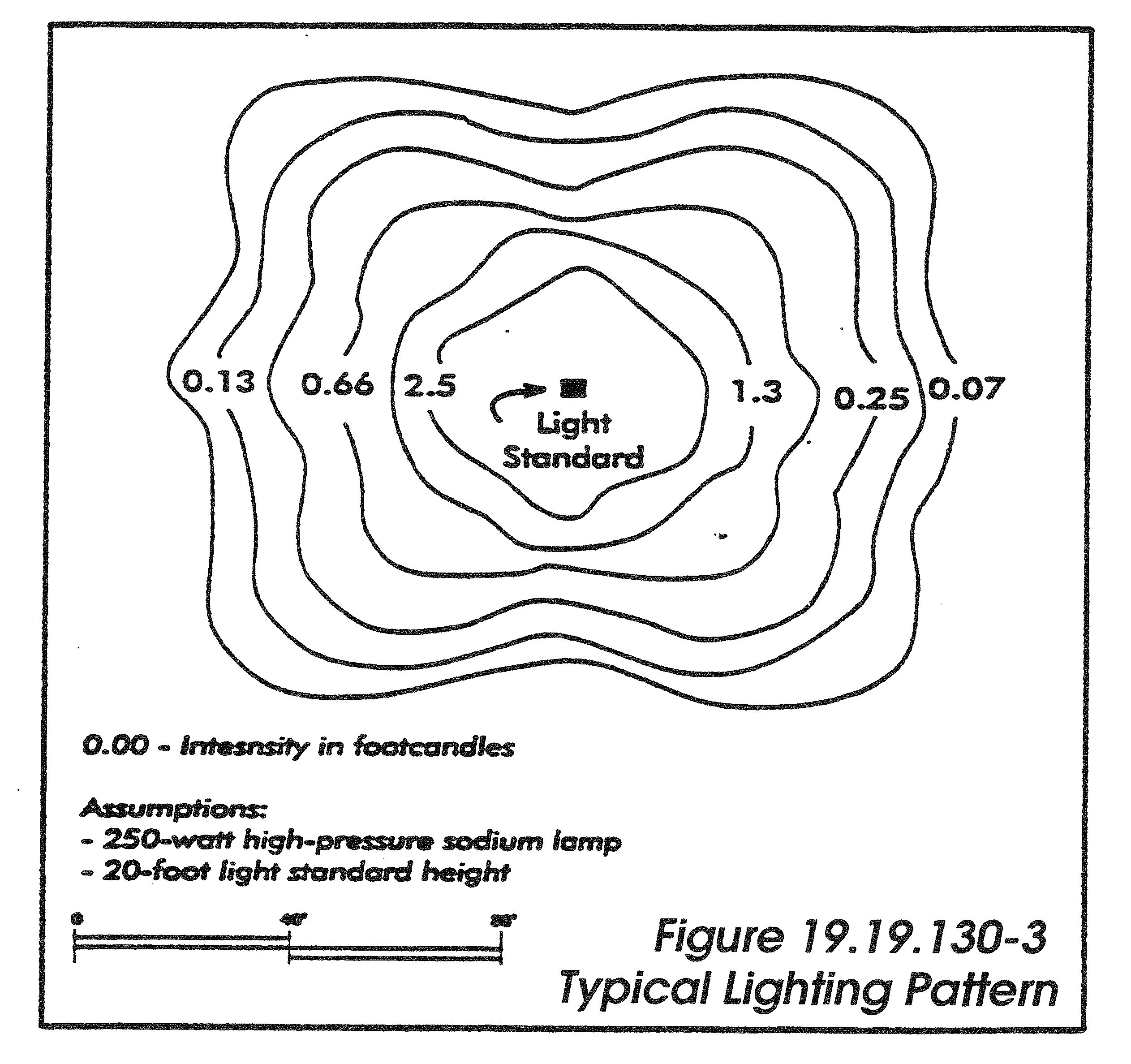
The candle power of all lights shall be the minimum needed to accomplish the purpose of the light. Figure 19.19.130-3 shall be used as a guide for determining the lighting required.
D.
No flickering or flashing lights shall be permitted in any residential or commercial zone. All lights shall be constant and shall not change intensity or color more often than once every thirty minutes.
E.
Lights sources shall not be located in buffer areas, except those required to illuminate pedestrian walkways.
F.
All lights shall be directed, oriented, and shielded to prevent light from shining onto adjacent properties, onto public rights-of-way, and into driveway areas in a manner that would obstruct drivers' vision. Landscape lighting shall be low-level, unobtrusive fixtures.
G.
Lighting for advertising signs shall not cause light or glare on surrounding properties.
H.
All light fixtures shall be compatible with the architectural style of the project.
(Ord. 544 § 1(part), 2000).
(Ord. No. 612, § 2, 10-7-2008)
19.19.140 - Utilities.
A.
The developer or owner of a property shall be responsible for utility service connections, in cooperation with the utility company.
B.
In order to protect the public safety and improve the appearance and functioning of the community, all electrical distribution lines of sixteen kilovolts or less, telephone, cable television, and similar wires that provide customer services shall be installed underground, except for:
1.
Utility poles within six feet of the rear lot line used for terminating underground facilities.
2.
Temporary utilities while construction is ongoing.
3.
Risers and poles as provided by developer or owner.
4.
Meter boxes, terminal boxes, and similar equipment.
5.
Transformers, except that all transformers shall be located in vaults.
6.
Infill development in R-1 zones where existing overhead lines serve the area, subject to the approval of the director of community development.
(Ord. 544 § 1(part), 2000).
19.19.150 - Electrical disturbance.
No activity shall be permitted if it causes electrical disturbance that affects the operation of equipment located beyond the property line. Radio, television, and microwave transmitters shall be suitably wired, shielded, and controlled so that they do not emit electrical waves or impulses that may affect other electronic devices or equipment.
(Ord. 544 § 1(part), 2000).
19.19.160 - Noise.
A.
It is the policy of the city to prohibit unnecessary, excessive, and annoying noises from all sources subject to its police power, as certain noise levels are detrimental to the health and welfare of individuals. Therefore, any individual or organization that creates, maintains, causes, or allows to be created, caused, or maintained, any noise or vibration in a manner prohibited by or not in conformity with the provisions of this subsection, shall be considered to be creating a public nuisance and shall be punishable as such.
B.
Any sound level measurement made pursuant to the provisions of this subsection shall be measured with a sound level meter using the "A" weighting scale at slow response or at a fast response for impulsive sounds.
C.
Precise noise measurements shall be taken throughout the city at specified locations. These measurements shall be established as the ambient levels for the areas in which the measurements are taken. The ambient levels established by the precise measurements shall be published periodically and utilized for determinations of violations of this subsection.
D.
The location selected for measuring exterior noise levels shall be at any point on the receptor property, and at least four feet above the ground and five feet from the nearest structure or wall. Interior noise measurements shall be made within the receptor dwelling unit, at a point at least four feet from the wall, ceiling, or floor nearest the noise source with windows and doors closed.
E.
No person shall, at any location within the city, create nor allow the creation of noise on property owned, leased, occupied, or otherwise controlled by such person, that causes the noise level when measured on any property to exceed the ambient noise level or the noise standards set forth in Table 19.19.160A, whichever is greater.
F.
Increases in permitted noise levels prescribed in Table 19.19.160A may be permitted in accordance with the standards outline in Table 19.19.160B.
Table 19.19.160A
Noise Standards
Table 19.19.160B
Permitted Increases in Noise Levels
G.
If the receptor property of a noise is located on the boundary between two different noise zones, the lower noise level standard applicable to the quieter zone shall apply.
H.
If a noise source is continuous and cannot be reasonably discontinued for sufficient time in which to determine the ambient noise level, the measured noise level obtained while the source is in operation shall be compared directly to the noise level standards in Table 19.19.160B.
I.
No person shall, at any location within the city, create any noise, nor shall any person allow the creation of any noise on property owned, leased, occupied, or otherwise controlled by such person that causes the noise level when measured within any receptor dwelling unit to exceed the noise standards outlined in Table 19.19.160C.
Table 19.19.160C
Permitted Increases in Interior Noise Levels
J.
In the event the ambient noise level exceeds the noise standards set forth in Table 19.19.160C, the levels in the allowable column shall be increased to reflect the actual ambient noise level.
K.
The following acts, or the causing thereof, are declared to be in violation of this subsection:
1.
No person shall, within any residential zone in the city, use or operate any radio receiving set, musical instrument, phonograph, tape player, compact disk player, television set, or other machine or device that produces, reproduces, or amplifies sound, between the hours of ten p.m. and seven a.m. such that it exceeds the exterior noise standards set forth in subsection L of this section.
2.
No person shall create any noise on any street, sidewalk, or public place adjacent to any school, institution of learning, or church while the same is in use or adjacent to any hospital, that exceeds the interior noise standards set forth in subsection L of this section.
3.
No person or organization within any residential zone, or within a radius of five hundred feet of a residential zone, shall operate equipment or perform any outside construction or repair work on buildings, structures, or projects, or operate any pile driver, steam shovel, pneumatic hammer, derrick, steam, electric hoist, or other construction type device between the hours of ten p.m. and seven a.m., unless a permit has been obtained from the city.
4.
No person within any residential zone shall repair, rebuild, or test any motor vehicle between the hours of ten p.m. and seven a.m. in a manner that exceeds the noise levels set forth in subsection L of this section.
5.
No person or organization shall use or operate for any noncommercial purpose any loudspeaker, public address system, or similar device between the hours of ten p.m. and seven a.m. in a manner that exceeds the noise levels set forth in subsection L of this section.
6.
No person or organization shall use or operate for any commercial purpose any loudspeaker, public address system, or similar device in a manner that creates noise in any residential zone in excess of the noise levels set forth in subsection L of this section.
7.
Loading, unloading, opening, closing, or other handling of boxes, crates, containers, building materials, garbage cans, or similar objects between the hours of ten p.m. and seven a.m. in such a manner as to cause noise in excess of the noise standards in any residential zone is unlawful.
L.
The city shall order an immediate halt to any sound that exposes any person to continuous sound levels in excess of those shown in Table 19.19.160D or Table 19.19.160E. Within ten working days following issuance of such an order, the community development director or his designee may apply to the appropriate court for an injunction to replace the order. No order shall be issued if the only persons exposed to sound levels in excess of those listed in Table 19.19.160D and Table 19.19.160E are exposed as a result of trespass; invitation upon private property by the person causing or permitting the sound; or employment by the person or a contractor of the person causing or permitting the sound.
Table 19.19.160D
Continuous Sound Levels
(Measured at 50 feet)
Table 19.19.160E
Impulsive Sound Levels
(Measured at 50 feet)
M.
Any person subject to an order pursuant to this section shall comply with such order until the sound is brought into compliance with the order, as determined by the noise control officer; or a judicial order has superseded the noise control officer order.
(Ord. 544 § 1(part), 2000).
19.19.170 - Odor.
A.
Any process that creates or emits any odors, gases, or other odorous matter shall comply with the standards set by the South Coast Air Quality Management District (SCAQMD).
B.
No odors, gases, and odorous matter shall be emitted in quantities to be detectable when diluted in a ratio of one volume diluted air to four volumes clean air at the point of greatest concentration.
(Ord. 544 § 1(part), 2000).
19.19.180 - Vibration.
Vibration may disturb the conduct of certain activities and create discomfort for some individuals. To minimize the disturbance and inconvenience from vibrations, the following performance standards shall apply to all uses:
A.
No use shall cause or create ground vibration that is harmful or injurious to the use or development of surrounding properties.
B.
No person or use shall create, maintain, or cause ground vibration that is perceptible without instruments to a person of normal sensitivity at any point on a property that is adjacent to the property of the vibration source.
(Ord. 544 § 1(part), 2000).
19.19.190 - Shade and solar access.
A.
No new construction or alteration of an existing structure shall result in more than two hours of shade on windows, doors, and other openings of adjacent buildings and uses. Taller sections of buildings shall be located where they will not obstruct sunlight to adjacent yards, patios, or rooms.
B.
Modification of heights limits shall not increase the area of shadow on adjacent or abutting residential properties.
(Ord. 544 §1(part), 2000).
(Ord. No. 612, § 3, 10-7-2008)
19.19.200 - Garage doors.
A.
All new garage doors shall be maintained in a workable, safe condition. The location and size of the garage and loading areas shall not dominate the street view of a structure. In no case shall any garage door be sealed or otherwise secured in a manner that prevents the door from being opened and closed for immediate access to the garage interior.
B.
For the purpose of this section, garage door shall mean the door covering the access way for vehicles.
(Ord. 544 §1(part), 2000).
(Ord. No. 612, § 1, 10-7-2008)
19.19.210 - Floodplain management regulations.
All new construction, reconstruction, rehabilitation, addition or other proposed new development of a structure, renovation or alteration of existing uses or structures, including manufactured homes, developments, subdivisions or manufactured home parks, determined to be within an area of special flood hazard shall be governed by the floodplain management regulations set forth in Title 6, Chapter 6.18, of this code.
(Ord. 597 §2, 2006).
19.19.220 - General development standards and design guidelines.
The following general development standards and design guidelines shall be applied to all new construction, renovation, and alteration of existing uses or structures in all zone districts and land uses.
A.
Site Planning and Contextual Design.
1.
Building siting shall maximize privacy through placement of windows, balconies, landscaping, and design of outdoor spaces. Building siting should be related to nearby structures as well as adjacent parcels.
2.
Primary structures should be oriented to face the street, avoiding views from the street of parking garages and alleys. Garages, parking, and loading areas shall not be the dominant element in the overall design of a project and should be designed to minimize visual disruption.
3.
All building entrances shall be well articulated and project a formal entrance statement through variations in architectural planes, pavement surface treatment, and landscape plazas, as well as relate to pedestrians.
4.
Building design and siting shall minimize negative impact on views from adjacent properties.
5.
Buildings shall be oriented to encourage use of outdoor spaces. Outdoor spaces between buildings shall have clear, recognizable shapes that reflect careful planning and must be compatible with adjoining building orientation.
6.
The scale of architectural details (doors, windows, porches, chimneys, etc.) shall be appropriate to the size and proportion of the building and relate to the scale and style of the building.
7.
Building forms and details should be in keeping with adjacent neighborhood character where appropriate.
8.
The mass and height of a new building shall not be disproportionate in size or designed to overwhelm neighboring structures. Upper stories should be stepped back from the ground level facade whenever possible to avoid overwhelming neighboring structures.
9.
A building front should provide visual interest and a sense of human scale. Freestanding, singular buildings shall be oriented with their major facade and entry toward the street.
10.
Building scale shall be reduced through window patterns, structural bays, roof overhangs, siding, awnings, moldings, fixtures and other details.
B.
Grading: Alterations to natural grade, except for minor grading for landscaping purposes, is discouraged and building designs should follow the natural contours of the property.
C.
Landscaping and Paving.
1.
Tree preservation and landscaping with specimen trees is encouraged.
2.
Landscaping shall be designed to minimize the impacts of development on surrounding properties and be used to provide privacy.
3.
A combination of water-conserving landscape and irrigation techniques is required, such as the use of drought tolerant plant species.
4.
Landscaping shall be used to define specific areas such as entrances to buildings and parking areas or transitions between land uses.
5.
Landscaping shall be provided around the base of buildings to reduce building mass and height.
6.
Use of quality materials, such as brick and exposed aggregate concrete, and use of porous materials is required.
7.
Driveways and service areas shall be subordinate to and blend well with adjacent buildings.
D.
Preservation.
1.
Existing structures of historical character or of quality design shall be preserved and renovated where appropriate.
2.
Where existing structures are preserved and incorporated into a development, the design of the development shall respect the character and siting of the existing structure to minimize impact on the neighborhood.
E.
Architectural Treatments.
1.
Exterior architectural treatments shall be of high quality and complement the overall design scheme. When appropriate, exterior architectural treatments shall complement existing structures in the immediate vicinity.
2.
Accent treatment, such as changes in exterior materials and texture is required and a minimum of two primary building materials shall be
3.
All exterior wall elevations of buildings shall have architectural treatment.
4.
At ground level, expanses of blank building walls shall be minimized with creative use of materials, textures, color and/or building form.
F.
Access and Circulation.
1.
The access and circulation of a development shall be designed to provide a safe and efficient system, both on and off-site.
2.
The circulation system shall be designed to reduce conflicts between vehicular and pedestrian traffic, minimize impacts on adjacent properties, combine circulation and access areas where possible, and provide adequate maneuvering areas.
G.
Roofs.
1.
Roofs shall be designed as an integral component of the overall form of a building and the design of roofs and rooflines should provide visual interest from the street and should complement overall facade composition.
2.
Roof lines of new structures shall be compatible with the character of roofs seen in the surrounding neighborhood where appropriate.
H.
Green Design. Design and construction techniques that are responsive to the environment and environmental resources are encouraged. Development strategies should consider sustainable site planning, water efficiency, energy efficiency and the conservation of materials and resources.
I.
Signage. On-site signs shall serve their primary purpose of identifying the business or activity of the site on which they are located and shall not present traffic or other public safety hazards, while complimenting the buildings and site design of the site on which they are located.
(Ord. No. 612, § 5, 10-7-2008)

