
Commerce City Zoning Code
CHAPTER 19
11 - MANUFACTURING ZONES
19.11.010 - Intent and purpose.
A.
Three manufacturing zones are established to provide locations for the assembly, manufacture, processing, and distribution of a wide variety of goods and materials, and to allow complementary commercial uses to locate in proximity to such uses. The different manufacturing zones are designed to concentrate these activities in appropriate areas of the city to promote efficiency in street and utility design, to segregate these uses from sensitive residential uses, and to ensure availability of adequate public services.
1.
Commercial-Manufacturing (C/M-1). The C/M-1 zone is established to provide for a wide variety of commercial uses and limited, compatible light industrial uses. The intent of the zone is to concentrate these uses along major arterials and in other areas that provide easy access and convenience. The industrial uses considered appropriate in the C/M-1 zone are limited to support services, such as machine shops and some light manufacturing. Commercial or industrial uses that might create offensive levels of noise, air pollution, glare, radioactivity or other nuisances are prohibited from this zone.
2.
Light Manufacturing Zone (M-1). The M-1 zone is designed to preserve city land appropriate for medium-intensity industrial uses, to attract and preserve desirable industrial plants, and to provide an aesthetically pleasing industrial environment. The intent of the M-1 zone is to provide safeguards and appropriate transitions to surrounding land uses that may be sensitive to industrial activities and to permit efficient design of infrastructure and public service to serve these uses.
3.
Heavy Manufacturing Zone (M-2). The purpose of the M-2 zone is to provide land suitable for heavy industrial uses. This zone is also the only zone where adult businesses and adult entertainment enterprises may be located in the city. The requirements of the zone are intended to provide safeguards and to establish adequate buffer distances between uses that pose potentially adverse public health, safety, and welfare impacts and land uses in adjacent, more restrictive zone districts.
(Ord. 544 §1(part), 2000).
19.11.020 - Use regulations.
A.
Table 19.11.030A identifies the uses permitted in the manufacturing districts. The uses identified in Table 19.11.030A are more precisely defined by reference to the Standard Industrial Classification (SIC) Manual published by the federal government's Office of Management and Budget. The 1987 SIC Manual, or the most current edition of the manual, as amended, is incorporated herein by reference. The SIC Manual identifies businesses according to the operating characteristics involved in creating the product (for example, slaughtering, manufacturing pulp, manufacturing industrial inorganic chemicals, petroleum refining) and the effects that these characteristics may have on nearby uses. The actual product created is of secondary importance.
B.
Certain permitted uses and conditionally permitted uses may be subject to special conditions regarding location, operation or the design of the use. Such uses are marked in Table 19.11.030A with an asterisk (*), and the special conditions that apply are contained in Chapter 19.31 (Standards for Specific Land Uses) of this title.
C.
The "notes and exceptions" column of Table 19.11.030A indicates more precisely the use regulations for specific SIC codes or operating characteristics. The notes and exceptions must be reviewed in conjunction with the other information for that class of use.
D.
For uses or activities not specifically identified in Table 19.11.030A, the community development director shall have the authority to interpret and assign the appropriate SIC code for that use or activity. The decision of the community development director can be appealed to the planning commission pursuant to Chapter 19.39, Division 4 (Appeals and Revocations) of this title.
E.
Any use or activity not identified by an SIC code included in Table 19.11.030A, or any use or activity not interpreted by the community development director as belonging to a listed SIC code, shall be prohibited.
(Ord. 579 §1, 2004; Ord. 575 §1, 2003; Ord. 574 §2, 2003; Ord. 544 §1(part), 2000).
19.11.030 - Meaning of the P/C designation.
A.
This section applies to those use categories in Table 19.11.030A classified as "P/C." "P/C" shall mean that the use is permitted by right unless the location criteria contained in Section 19.11.030(C) apply to the project, in which case conditional use permit (C) review shall be required pursuant to Chapter 19.39, Division 7 of this title.
B.
The community development director shall be authorized to determine whether a use identified in Table 19.11.030A as "P/C" is permitted by right or requires discretionary review based on the criteria defined in this section.
C.
The location of a proposed manufacturing or industrial use relative to residentially-zoned property shall represent the sole factor for determining whether discretionary review is required pursuant to this section. If any building housing the principal proposed use in an manufacturing district, or any outdoor activity which represents the principal use of the property, is located three hundred feet or less from the nearest residential district (see Figure 19.11.030-1), then conditional use permit review shall be required, as indicated in Table 19.11.030A.
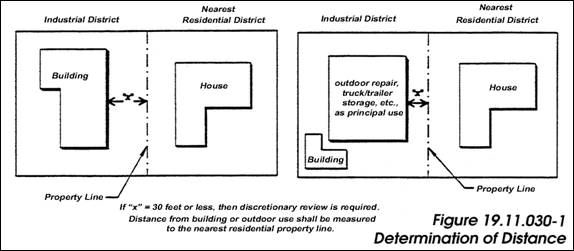
Table 19.11.030A
Uses in Industrial Districts
NOTE: All uses are subject to performance standards as defined in Chapter 19.19.
* = See "Notes and Exceptions" column.
P = Permitted by right.
X = Not permitted.
P/C = Either permitted by right or subject to conditional use permit review, depending upon criteria contained in Chapter 19.31.
C = Conditional use permit required.
(Ord. 579 §1, 2004; Ord. 575 §1, 2003; Ord. 574 §2, 2003; Ord. 550 §§1—8, 2000; Ord. 544 §1(part), 2000).
(Ord. No. 656, § 7 (Exh. D), 11-19-2013; Ord. No. 672, § 1, 11-3-2015; Ord. No. 681, §§ 4(C), 4(F), 11-15-2016; Ord. No. 799, § 2, 10-26-2022)
19.11.040 - Development standards.
All development in the manufacturing zones shall conform to the development standards set forth in Table 19.11.040A.
Table 19.11.040A
Development Standards—Manufacturing Zones
Abbreviations: sf = square feet; ft. = feet or foot
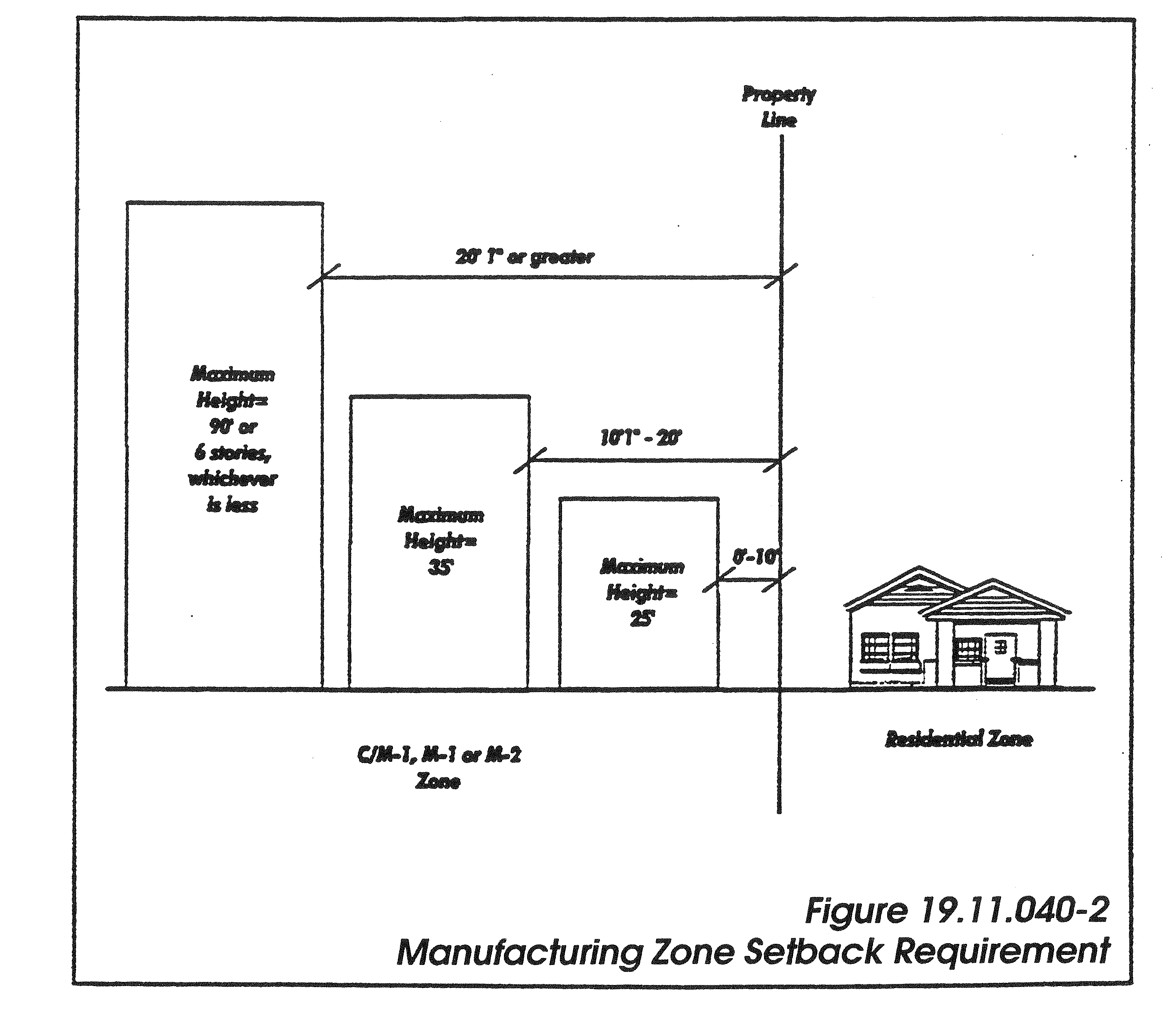
(Ord. 544 § 1(part), 2000).
19.11.050 - Fences, hedges, and walls.
A.
The maximum permitted heights for fences, hedges, and walls shall be as set forth in Table 19.11.050A.
Table 19.11.050A
Fence Heights—Manufacturing Zones
B.
A solid masonry wall with a minimum height of eight feet shall be required along any property line adjoining a residential zone school, church, or park. Such wall may be reduced in height to four feet along any such property line adjoining the front yard setback area.
C.
Barbed wire is a permitted fencing materials. However, such barbed wire shall not be used on any front yard fence, nor shall it be used on any fence visible from a public right-of-way.
D.
Razor wire is not permitted under any circumstance.
(Ord. 544 § 1(part), 2000).
19.11.060 - Landscape buffer required.
Whenever a required setback area adjoins a residential zone, the setback area shall be fully landscaped and provided with an automatic irrigation system consistent with the requirements of Chapter 19.23 (Landscaping Standards) of this Title 19.
(Ord. 544 § 1(part), 2000).
19.11.070 - Health risk assessment required.
Any business involved in the use, production, storage, or transfer of any material defined as hazardous and subject to regulation by Los Angeles County Department of Health and/or subject to regulation by the South Coast Air Quality Management District per Rules 1401, 1402, and 1403 shall be required to complete and submit to the community development director, in conjunction with any application authorized by this Title 19, a health risk assessment that identifies the chemicals or materials to be used and the potential risk to public health associated with the hazardous materials associated with the proposed business or operation.
(Ord. 544 § 1(part), 2000).
19.11.080 - Restrictions on use of required parking area.
No materials storage, conduct of industrial activity, or any other use or activity associated with a permitted use shall occur in any parking area required pursuant to Chapter 19.21 of this Title 19.
(Ord. 544 § 1(part), 2000).
19.11.090 - Additional conditional use permit findings for office space uses and medical, dental, osteopathic, and chiropractic offices and clinics.
The planning commission may approve and/or modify a conditional use permit for office space uses in the M-1 and M-2 zones provided that all of the findings required by Section 19.39.420 (Conditional use permits—Required findings) are made. The planning commission may also approve and/or modify a conditional use permit for medical, dental, osteopathic, and chiropractic offices and clinics in the C/M-1, M-1, and M-2 zones provided that all of the findings required by Section 19.39.420 are made. However, the following findings of fact shall also be made for office space uses and medical, dental, osteopathic, and chiropractic offices and clinics permitted pursuant to a conditional use permit:
(1)
Traffic will not exceed roadway capacity after necessary mitigation.
(2)
The project will contribute a fair share for roadway improvements through any existing city traffic impact fee program for both short and long term transportation system enhancements.
(3)
The project will incorporate pedestrian-oriented design features, to the extent reasonably feasible, including:
a.
Little or no on-site parking between the building and street, i.e., along street frontage.
b.
Providing at least one prominent main entry for visitors and customers directly fronting the public street, with convenient on-street and/or on-site visitor parking and a clear, comfortable, and attractive space or pathway for approaching visitors and customers.
c.
Where on-site parking along a street frontage cannot practically be avoided, screening elements shall separate it from the public sidewalk. Such elements may include a low screen wall with landscaping or a continuous low hedge, and/or a trellis or colonnade or other open vertical structure to define the property edge.
d.
Constructing master-planned street improvements along all project frontages, including, for example, a widened sidewalk and new street trees and planters, as well as bus stops and shelters.
e.
The project includes all feasible transportation demand management (TDM) measures.
(Ord. No. 681, § 4(G), 11-15-2016)
19.11.100 - Other applicable regulations.
In addition to the requirements contained in this Chapter 19.11, regulations contained in the following chapters of this Title 19 shall apply to development in the manufacturing zones:
Chapter 19.01: General Provisions
Chapter 19.15: Planned Development Overlay Zone
Chapter 19.19: Site Planning and General Development Standards
Chapter 19.21: Off-Street Parking and Loading
Chapter 19.23: Landscaping Standards
Chapter 19.25: Signs
Chapter 19.31: Standards for Specific Land Uses
Chapter 19.37: Nonconforming Uses and Structures
(Ord. 544 § 1(part), 2000).
19.11.110 - Nonconformities.
Notwithstanding anything to the contrary contained in Chapter 19.37 of this Code, any land use or structure in the Telegraph Road Corridor Study Area that becomes legally nonconforming as a result of this section may be continued indefinitely, including interior modifications and notwithstanding changes of ownership, subject to the provisions of this section.
(1)
A nonconforming use may be modified to a use deemed similar in nature, but lesser or equal in intensity and impact, including required number of parking spaces, as determined by the director of public works and economic development.
(2)
A nonconforming use is allowed modifications to its facility provided such modifications do not exceed ten percent of buildable areas of the use at the time it became nonconforming and complies with all other provisions of this title.
(3)
If any nonconforming use is abandoned, it shall be considered automatically terminated, and any future use of the premises shall conform to the provisions of this title. The determination of whether a nonconforming use has been abandoned shall be made pursuant to Section 19.37.120.
(4)
A building containing a nonconforming use shall not be enlarged or reconstructed, except as provided herein. Structural alterations or tenant improvements, including, but not limited to, replacements of walls, electrical fixtures or plumbing, may be permitted; provided the alterations comply with current code, and do not expand the nonconforming use or increase the required number of parking spaces, except as provided herein.
(5)
Any nonconforming building may be restored to the size that existed at the time of destruction as a result of fire, earthquake or other natural disaster, and the occupancy or use of such building or part thereof which existed at the time of destruction may be continued.
(Ord. No. 681, § 4(H), 11-15-2016)

