
Commerce City Zoning Code
CHAPTER 19
21 - OFF-STREET PARKING AND LOADING
19.21.010 - Intent and purpose.
The purpose of the parking and loading requirements identified in this Chapter 19.21 is to ensure that all land uses in the city provide adequate off-street parking facilities, loading areas, and vehicle movement area associated with a use. The intent of these regulations is to ensure that the use of land does not interfere adversely with the circulation of public rights-of-way, that private on-site circulation does not pose a potential safety issue, and that surrounding uses are insulated from the noise and traffic impacts associated with off-street parking and loading activities.
(Ord. 544 §1(part), 2000).
19.21.020 - Applicability.
A.
The minimum standards of this Chapter 19.21 shall apply to all new construction, expansion, renovation, conversion, and alteration of existing uses or structures in all zone districts.
B.
Off-street parking spaces shall be provided at the time of commencement of the use of the land or construction of the building, or at the time of renovation, conversion, alteration, or expansion by adding floor area, dwelling units, rooms, beds, or seats to a structure.
(Ord. 544 §1(part), 2000).
19.21.030 - Restrictions on use of parking facilities.
A.
Required parking spaces and areas shall not be used for the sale or display of goods and services, nor for the sale, display, repair or dismantling of motor vehicles, nor for the storage of inoperable or unlicensed vehicles, unless otherwise permitted by subsection C of this section.
B.
Parking areas in any zone may be used for temporary, special events with authorization from the owner or operator of the parking area and the planning commission. The commission may impose conditions to mitigate any adverse effect on surrounding properties. Provisions outlined in Chapter 19.39, Division 11 (Temporary Use Permits and Special Events Permits) shall govern the procedures and conditions for the application and approval of a temporary use/special event permit.
(Ord. 544 §1(part), 2000).
19.21.040 - Number of parking spaces required.
Table 19.21.040A specifies the number of off-street parking spaces required for permitted land uses.
A.
Fractional Spaces. All fractional spaces shall be rounded up to the next highest whole number.
B.
Combined Uses. When two or more uses are combined on a given site, the required parking shall be calculated as the combined total required for each individual use. Where two or more uses exist within a single building, parking shall be calculated based on the percentage of floor area devoted to each use.
C.
Compact and Handicap Parking. The calculation of the number of compact and handicap parking spaces to be provided shall be based on the total number of spaces required. Handicapped (accessible) parking shall comply with standards set forth in Chapter 11 of the Uniform Building Code.
D.
Unspecified Land Use. If a land use is not specifically listed in Table 19.21.040A, the community development director shall decide which standard most closely reflects the demand for parking that will be generated by the proposed project.
E.
Reduction of Spaces. No reduction of required parking spaces shall be allowed, except through approval of a variance in accordance with the provisions of this Title 19.
Table 19.21.040A
Off-Street Parking Requirements
(Ord. 609 § 3, 2007; Ord. 544 § 1(part), 2000).
19.21.050 - Driveway and access standards.
A.
General. All lots shall have adequate vehicular access from a dedicated and improved street or service road to permit unimpeded movement of goods and people. Visibility on streets and intersections shall not be blocked by signs, trees, hedges, fences, walls, or structures. Directional signs and graphics may be used to promote public safety and convenience.
B.
Driveways.
1.
Driveways shall not be located where they would impede traffic on streets or through intersections.
2.
Driveways and aisles shall be maintained unobstructed at all times.
3.
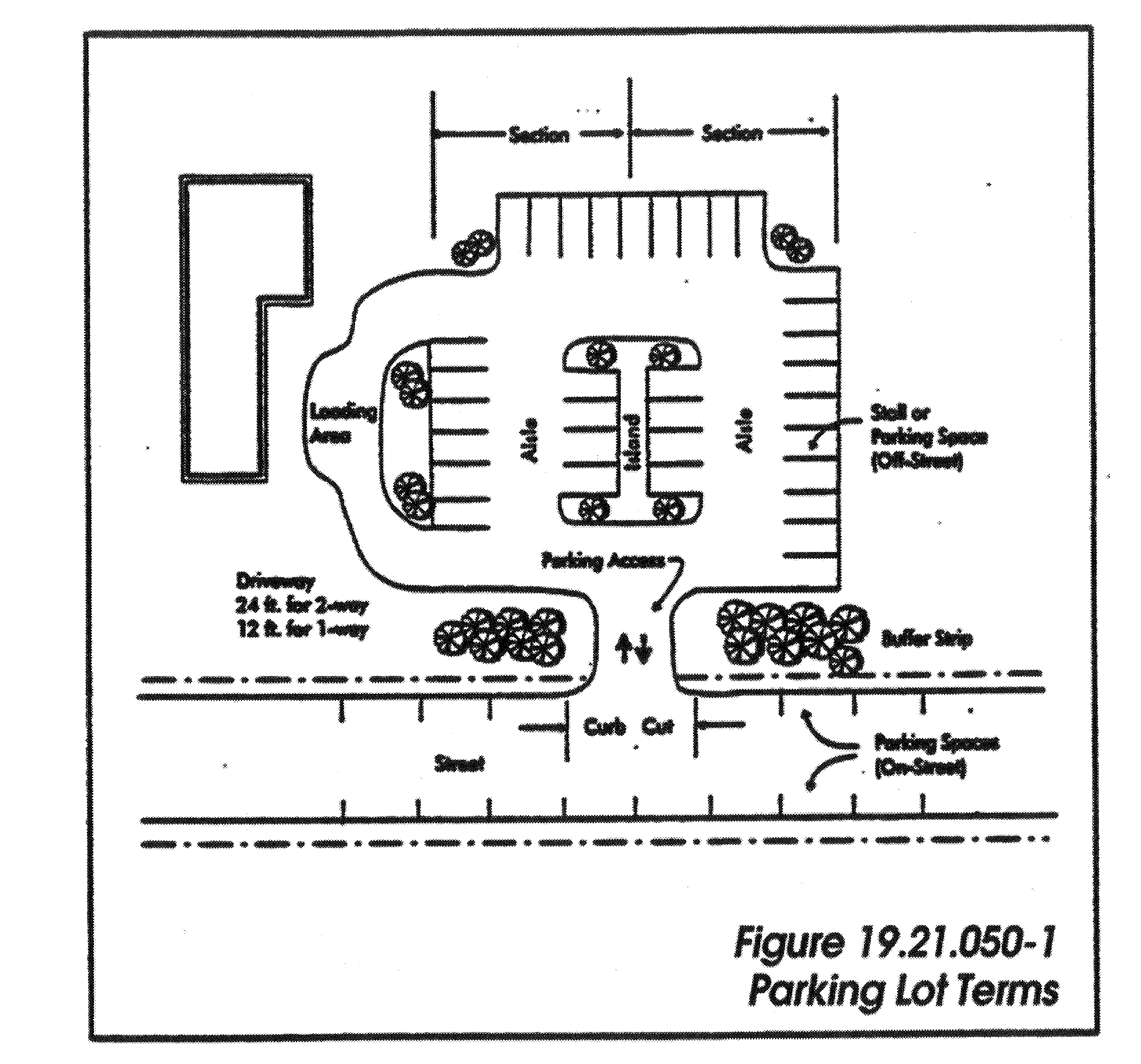
The minimum driveway width shall be twelve feet per lane for a one-way driveway and twenty-four feet for a two-way driveway.
C.
Aprons. Each garage shall have an adequate paved area in front of the garage (apron) for maneuvering. The minimum paved apron width shall be twenty-four feet.
D.
Emergency Access.
1.
Dedicated fire lanes to serve as access for fire vehicles and emergency apparatus from a public street shall be provided as set forth below and shall be posted as a fire lane:
a.
If any structure is fifty feet from a right-of-way and more than thirty feet high; or
b.
If any structure is one hundred fifty feet from a right-of-way and 30 feet high or less; or
c.
If the structure or use is commonly associated with a fire or explosion hazard; or
d.
If the structure or use attracts a large congregation of people, as determined by the fire department.
2.
Fire lanes must be at least twenty-six feet wide. An alley can serve as a fire lane if it meets the requirements. Likewise, an appropriately designed buffer strip unobstructed by landscaping or structures, can serve as a fire lane.
3.
Projects with other characteristics, such as distance from the nearest fire hydrant, site design, etc., which inhibit fire control may require provision of a fire lane at the discretion of the community development director.
4.
Alternative means of fire control may be provided, subject to the approval of the Fire Prevention Bureau of Los Angeles County Fire Department.
(Ord. 544 § 1(part), 2000).
19.21.060 - Parking facility standards and dimensions.
Parking facilities shall be designed to conform to the following minimum standards:
A.
Parking Facility Standard.
1.
Parking spaces shall be located on the same lot as the use to which they serve, unless remote parking is permitted by the community development director pursuant to the provisions of Section 19.21.090 (Remote parking).
2.
Access to parking stalls shall not be taken directly from a public or private street or alley.
3.
The entrance to a private garage or carport shall be located a minimum of twenty-four feet from the street which the garage or driveway faces.
4.
A fifteen-foot vertical clearance shall be maintained over all parking areas, driveways, and access points.
5.
Driveways serving a parking area with twenty or more spaces shall be designed with either one-way circulation or a double driveway system.
6.
No parking area shall be designed so that vehicles back into a street, except for single-family dwelling units.
7.
No parking space shall be located within 20 feet of the access driveway, except within the R-1 and R-2 zones.
8.
All carpooling parking spaces and bicycle racks shall be located near the main entrance of the facility they are intended to serve.
B.
Parking Space Dimensions.
1.
Table 19.21.060A identifies the minimum required dimensions for parking stalls and aisles for standard, compact, and truck parking spaces.
Table 19.21.060A
Parking Space Dimensions
Notes:
(a)
15′-10″ for overlapped or herringbone layout
(b)
45′-9″ for overlapped or herringbone layout
(Ord. 544 § 1(part), 2000).
19.21.070 - Required improvements.
A.
All parking spaces, maneuvering areas, turnarounds, and driveways shall be paved with asphalt concrete or Portland cement in accordance with standards set by the city engineer/director of public services.
B.
All parking spaces except those in garages or carports shall be marked with paint or other distinguishable material. Compact and handicap parking spaces shall be identified to preclude use by other vehicles.
C.
Directional signs shall mark one-way entrances and aisles and shall be visible to drivers of vehicles using the facility.
D.
Bumper guards and wheel stops shall be provided as needed to protect buildings, structures, landscaping, and other vehicles.
E.
The lighting of parking areas shall be designed in accordance with the standards for light and glare in Section 19.19.130 of this Title 19.
F.
Parking areas provided for commercial and industrial uses shall be separated from any adjoining residential zone, church, school, or park by a six-foot high masonry wall.
G.
Where parking for any nonresidential use is provided on any area of a lot whereby parking spaces or vehicle maneuvering areas will result in vehicle lights shining onto a public street, a wall or dense planting of shrubs or similar landscape material shall be provided as a buffer between the parking/maneuvering area and the street. The height of the wall or landscaping shall not be lower than three feet.
(Ord. 544 § 1(part), 2000).
19.21.080 - Shared parking.
A.
Special Study Required. Two or more uses may share parking facilities, subject to the approval of the director and the provisions of this section. A parking demand analysis for the uses proposed to share parking facilities shall be prepared. Preparation of the parking demand analysis shall be to the satisfaction of the director, who may require that it be prepared by a registered traffic engineer. When such analysis demonstrates, to the satisfaction of the director, that the uses have different peak parking requirements, then the parking space requirement may be reduced by the director. In no event, however, shall the parking requirement be reduced below the highest peak parking requirement of the use demanding the most parking.
B.
Conditions.
1.
The uses sharing the parking facilities shall be located on contiguous lots.
2.
A legal agreement shall be signed by all parties sharing parking facilities. Such agreement shall be approved by the city attorney and community development director, shall be recorded with the Los Angeles County Recorder's Office, and shall continue to be valid upon change of ownership of any property subject to the agreement or any lawfully existing building or structure on said properties.
3.
Shared parking arrangements must be authorized by any discretionary permit issued for the use for which the parking is provided. Where no discretionary permit is required, such shared parking arrangements shall meet all other requirements of this subsection B.
(Ord. 544 § 1(part), 2000).
(Ord. No. 749, § 2, 2-4-2020)
19.21.090 - Remote parking.
A.
Remote parking, may be permitted for multifamily, commercial and industrial uses, provided such parking facilities are located no more than three hundred feet from the use they are intended to serve. The proposed remote parking location may be an existing primary or ancillary use. The director may require a parking analysis on a case by case basis.
B.
A covenant for use of the lot for parking shall be required between the owner of the lot supporting the proposed use and the owner of the lot to be used for remote parking. The covenant for remote parking shall be prepared by the city and recorded with the County Recorder of Los Angeles County. The covenant may not be revoked, modified, or canceled without the consent of the city.
C.
Such agreements for remote parking shall be authorized by any required discretionary permit issued for the proposed multifamily structure or commercial or industrial use.
D.
Where no other application is involved, the director's decision shall be required to authorize remote parking.
E.
The director may opt not to make a decision and defer decisions to the planning commission at his/her discretion.
F.
Decisions made by the director are appealable to the planning commission.
G.
An applicant may apply for remote parking for up to one thousand feet from the use they are intended to serve with authorization of a conditional use permit.
(Ord. 544 § 1(part), 2000).
(Ord. No. 749, § 2, 2-4-2020)
19.21.100 - Carports prohibited.
Carports shall not be permitted within any residential zone, except carports legally established prior to the June 30, 1999.
(Ord. 544 § 1(part), 2000).
19.21.110 - Alternative fuel vehicle parking.
All newly designed and constructed parking facilities shall have reserved a minimum of five spaces for the parking of alternative fuel vehicles. Recharge facilities for electric vehicles may be provided. The total number of required spaces for alternative fuel vehicles may be reduced by the community development director if the total number of required spaces, pursuant to Section 19.21.040, is fifty or fewer.
(Ord. 544 § 1(part), 2000).
19.21.120 - Landscape requirements.
A.
Perimeter Landscaping—Adjoining Street. All parking areas shall be landscaped with a planter strip along the perimeter of the property bounded by a street, except for areas where pedestrian crosswalks and driveways are provided. The minimum width of the perimeter landscaping between the street right-of-way and parking area shall be ten feet.
B.
Perimeter Landscaping—Adjoining Residential Zone. Whenever a parking area for a nonresidential use adjoins a residential zone, a minimum fifteen-foot-wide landscaped strip/buffer area shall be provided. In any circumstance where a wall is required along the same property line, the required strip/buffer area may be reduced in width to five feet.
C.
Required Landscaping. In addition to perimeter landscaping, a minimum of seven and one-half percent of the total area of the parking lot, including perimeter landscaping, shall be landscaped.
D.
Trees. A minimum of one tree shall be provided for every eight parking spaces. In no case shall fewer than five trees be provided. All trees shall be of a minimum twenty-four-inch-box size. The trees shall be distributed throughout the parking and perimeter landscaped areas, and shall be planted to provide uniform shade coverage.
E.
Curbing. All landscaped areas shall be contained within curbing no less than six inches high if made of concrete, or eight inches high if made of masonry.
F.
Irrigation. All landscaped areas shall be equipped with an underground automated irrigation system.
G.
Maintenance. All landscaped areas shall be maintained in a neat and healthy condition.
(Ord. 544 § 1(part), 2000).
19.21.130 - Loading and unloading requirements.
A.
General. Every commercial, industrial, or office land use shall provide adequate off-street loading areas to accommodate the delivery vehicles associated with operation of the use on that site. Loading space shall be situated to serve the site and buildings without blocking vehicular movement to a driveway, parking stall, street, or alley.
B.
Loading Space Dimensions. An individual loading space shall be at least twelve feet wide by forty-five feet long and shall have a minimum vertical clearance of fifteen feet.
C.
Required Loading Spaces. Loading spaces shall be provided as set forth in Table 19.21.130A.
D.
Additional Spaces. Additional loading spaces may be required at the time of project review if determined to be necessary to assure adequate loading and parking spaces.
Table 19.21.130A
Required Loading Spaces
E.
Maneuvering and Queuing Areas.
1.
No loading dock or door shall be visible from a public right-of-way.
2.
Adequate area shall be provided to allow all maneuvering to occur on the site.
3.
Approaches shall be designed to preclude direct access to a loading dock or door from a street.
4.
Adequate queuing space shall be provided on site to ensure that vehicles waiting to access loading bays or spaces are not stopped on any public right-of-way. A minimum of one hundred fifteen feet of linear queuing space shall be provided between such bay or space and any adjacent public street or alley from which access is obtained.
F.
Loading from Alleys. For all commercial and industrial buildings on lots abutting an alley, a twenty foot long by twelve feet wide by fifteen feet high loading space shall be provided for every two thousand square feet of gross floor area. Vehicles shall not be permitted to park in any alley while loading or unloading.
G.
Markings.
1.
Each loading space shall be clearly marked. All such spaces shall be kept clear and unobstructed at all times.
2.
All loading areas must be appropriately striped and labeled with a minimum three-inch wide striping and lettering.
H.
Loading Doors. Loading doors shall be oriented either toward the rear or side property lines. Loading doors shall be designed and painted to blend with the exterior walls of the structure.
I.
Passenger Loading. Passenger loading areas shall be provided at schools, hospitals, clinics, and similar facilities where passengers are frequently loaded and unloaded. The loading area shall consist of a bay or similar feature that allows vehicles to load/unload passengers without impeding vehicle traffic flow on a public right-of-way.
J.
Within all Manufacturing Zones (as defined by Chapter 19.11) there shall be no loading or unloading, for any purpose, or as part of or related to any business activity, either in or within three hundred feet of properties located in the city's R-1 and R-2 zones after the hour of seven p.m., nor before the hour of seven a.m., seven days a week.
1.
Exceptions:
a.
The loading or unloading of any merchandise within a fully enclosed permanent building or structure of which all doors, windows and other potential openings are fully enclosed at the time of such loading and unloading; or
b.
The loading or unloading of any merchandise on any premises where the city has, either prior to or after the effective date of the ordinance codified in this chapter, approved a conditional use permit setting forth permissible hours for such loading or unloading different from those contained in this chapter, and in such event, the hours stated in the conditional use permit, as such may be amended from time to time, shall control.
(Ord. 544 §1(part), 2000).
(Ord. No. 806, § 2, 3-14-2023)

