
Commerce City Zoning Code
CHAPTER 19
31 - STANDARDS FOR SPECIFIC LAND USES
19.31.010 - Intent and purpose.
A.
These provisions regulating adult businesses and adult entertainment enterprises are established to guard against the known adverse effects such businesses can have on the community and the neighborhoods in which they are located, including conditions of blight, crime, and perceived and real threats to public health, safety, morals, and general welfare.
B.
These provisions are intended to prevent the concentration of such businesses and to ensure that any such use established operates in a manner that minimizes the potentially adverse effects on surrounding properties.
C.
In addition to the adult business regulations contained in this division, the city has established provisions regulating live nude entertainment in bars, theaters, public dance establishments, and other entertainment establishments. These provisions are contained in Chapter 9.36 of the Municipal Code (Regulations of Nudity and Public Exposure).
(Ord. 544 §1(part), 2000).
19.31.020 - Special business license required.
A special business license, obtained pursuant to the requirement of Chapter 5.58 (Adult Entertainment Establishments) of the Municipal Code, shall be required for the establishment and operation of any adult business or adult entertainment enterprise. This requirement shall apply to all new adult businesses and any adult business existing on or before the effective date of this title.
(Ord. 544 §1(part), 2000).
19.31.030 - Permitted in M-2 zone only.
Adult businesses shall be permitted only in the M-2 zone, provided such business meets all requirements contained in this Division 1, Chapter 19.31 and Chapter 5.58 of the Commerce Municipal Code.
(Ord. 544 §1(part), 2000).
19.31.040 - Conditions on use.
All adult businesses and adult entertainment enterprises shall be subject to the conditions on use set forth in Chapter 5.58 of the Commerce Municipal Code.
(Ord. 550 §12, 2000).
19.31.050 - Location standards.
All adult businesses shall comply with the location standards set forth in Section 5.58.030 of the Municipal Code.
(Ord. 544 §1(part), 2000).
19.31.060 - Amortization of nonconforming uses.
Nonconforming adult businesses shall be subject to the amortization provisions set forth in Section 5.58.140 (Nonconforming Uses) of the Municipal Code.
(Ord. 544 §1(part), 2000).
19.31.080 - Development standards and use conditions.
All airports and heliports shall be designed and operated in accordance with the following development standards:
A.
A valid permit for operation of the facility shall be obtained from the Federal Aviation Administration.
B.
The operation of the proposed use will comply with all requirements of Chapter 19.19 (Site Planning and General Development Standards), particularly those related to light, glare, and noise.
C.
The proposed use will protect the landing and takeoff approach zones, insure safe operations, and minimize potential accidents.
D.
An airport or heliport must demonstrate a necessity for the facility or the benefit of the facility on existing uses and shall not adversely affect the general welfare of the community.
(Ord. 544 § 1(part), 2000).
19.31.100 - Development standards and use conditions.
Any use providing alcohol sales shall be subject to the following standards and conditions on use:
(1)
A new use may only be established in a location such that the proposed use shall not contribute to undue proliferation of such uses in an area where additional ones would be undesirable, with consideration to be given to the area's function and character, problems of crime and loitering, traffic problems, and capacity.
(2)
The proposed use shall not be located within five hundred feet nor adversely affect adjacent or nearby religious facilities; residences; public or private schools; public parks or recreation centers; or public or parochial playgrounds. However, the distance requirement shall not apply to restaurant, sit-down defined by the Commerce Municipal Code and which are located along either Washington Boulevard or Atlantic Boulevard. While the distance requirement of this section may not apply to restaurant, sit-down, the city may deny an application if it is determined that a use adversely affects any adjacent or nearby religious facilities; residences; public or private schools; public parks or recreation centers; or public or parochial playgrounds.
(3)
The proposed use shall not interfere with the movement of people along an important pedestrian street.
(4)
The proposed development shall be of an architectural and visual quality and character that harmonizes with, or where appropriate, enhances the surrounding area.
(5)
Adequate litter receptacles shall be provided.
(6)
Where the proposed use is near residential uses, it shall be limited in hours of operation, or designed and operated, so as to avoid disruption of residents' sleep between the hours of ten o'clock p.m. and seven o'clock a.m. Through the CUP process, and on a case by case basis, the planning commission may approve and/or modify to allow alcohol sales between the hours of ten o'clock p.m. and seven o'clock a.m. provided all findings required by Section 19.39.420 are met.
(Ord. 544 § 1(part), 2000).
(Ord. No. 702, § 2, 9-4-2018)
19.31.120 - Development standards and use conditions.
Amusement arcades shall be subject to the following standards and conditions on use:
A.
Operating hours shall be restricted so as not to disturb neighboring uses.
B.
Loitering on the premises shall be controlled.
C.
Adult supervision for the control of patron behavior on the premises shall be provided.
D.
The sale and consumption of alcoholic beverages shall comply with city regulations.
E.
Noise from the premises shall be controlled and abated.
F.
All signs shall comply with Chapter 19.25 (Signs) of this Title 19.
(Ord. 544 § 1(part), 2000).
19.31.140 - General development standards for all car washes.
A.
In addition to the applicable landscaping requirements of Chapter 19.23 of this Title 19, landscaping for all car washes shall screen drive-through or drive-in aisles from public rights-of-way and shall be used to minimize the visual impact of reader-board signs and directional signs.
B.
Nonconforming gasoline service stations requesting to provide a car wash shall be required to upgrade their appearance by removing nonconforming signs, renovating facades, providing landscaping and upgrading service facilities without regard to Division 12 (Gasoline Service Station) of this Chapter 19.31.
C.
All car wash tunnels shall be insulated to minimize noise impacts on nearby properties.
D.
Existing and proposed driveways shall conform to standards established by the city public services director.
E.
All mechanical equipment and utility boxes shall be screened with landscaping.
F.
All vehicular circulation shall be entirely on site.
G.
If adjacent to a residential zone or adjoining public street, the car wash facility shall maintain a minimum front, side, and rear yard setback of ten feet.
H.
The car wash facility, including the blowers and vacuum motors, shall comply with noise standards contained in this Title 19.
I.
Other land uses, including the storage of trailers, trucks, boats, or other equipment for rental, sale, or parking shall not be permitted on-site.
J.
The sale of any product shall not be conducted outside of the car wash building.
K.
No servicing of motor vehicles other than cleaning, polishing, and dispensing of fuel and oil shall be allowed unless the facility also meets all requirements for a gasoline service station.
L.
The site shall be equipped with catch basins and water drains to prevent water from flowing over any public right-of-way.
M.
No car wash shall be operated unless a valid industrial waste permit has been issued. An industrial waste permit shall be required from the Los Angeles County Public Works Division of Waste Management prior to the issuance of any building permits.
N.
No gray water shall be discharged into the storm drain.
O.
All car wash sites shall be equipped with a clarifier.
P.
Car washes, full or self-service, shall use facade materials to produce texture and to provide interest. Such materials include, but are not limited to, split-face block, brick, slump stone, or textured block or stucco. No metal siding shall be permitted. Roof materials shall also provide texture and interest. Such materials include, but are not limited to, standing seam metal roofs and clay tile.
(Ord. 544 § 1(part), 2000).
19.31.150 - Automated and other enclosed facilities.
All automated and enclosed car wash facilities within the city shall comply with the following regulations:
A.
The drying area shall be a fully roofed structure, and shall be large enough to accommodate ten cars without encroaching into the drive aisles or rights-of-way of the facility.
B.
A customer waiting area shall be provided that incorporates benches, landscaping, and amenities, including but not limited to fountains, sculptures, information kiosks, enhanced paving and drinking fountains.
C.
The speaker volumes shall be adjusted to ensure that no speaker noise is heard beyond the site boundaries.
D.
Drive-through aisles shall provide adequate queuing distance to accommodate five vehicles before the first stopping point (such as the vacuum bays for a car wash). Aisles shall have a minimum twenty-five-foot interior radius for any curves. Pedestrian walkways should not intersect the drive-through aisles, but where allowed to do so they shall have a minimum fifteen-foot clear visibility, and they shall be emphasized by enriched paving.
E.
All auto detailing shall be done indoors.
F.
Required parking spaces shall be provided for all automated car washing facilities in accordance with Chapter 19.21 of this Title 19.
(Ord. 544 § 1(part), 2000).
19.31.160 - Self-service facilities.
All self-service and coin-operated car wash facilities shall comply with the following regulations:
A.
Self-service car washes and coin-operated car washes may be permitted as an ancillary use to a gasoline service station if the service station conforms to all other applicable provisions of Division 12 (Gasoline Service Station) of this Chapter 19.31.
B.
The drive-through aisle shall have sufficient queuing distance to accommodate three cars before the first stopping point.
C.
Required parking spaces shall be provided for all self-service car washing facilities in accordance with Chapter 19.21 of this Title 19.
(Ord. 544 § 1(part), 2000).
19.31.170 - Temporary car wash.
A.
To ensure the mitigation of any adverse impact, even though temporary, a temporary car wash shall not be held unless a temporary use permit has been obtained from the community development director or designee.
B.
The temporary use permit for a car wash shall be valid for a maximum of two consecutive days per calendar year.
C.
A letter of approval from the property owner on whose property the temporary car wash will be conducted shall be required for temporary car washes.
D.
The site where the temporary car wash is to be held shall have a valid industrial waste permit. The person or party wishing to hold a temporary car wash will be required to obtain an industrial waste clearance from the industrial waste permit.
(Ord. 544 § 1(part), 2000).
19.31.180 - Mobile car wash.
Mobile car washes are not permitted within the city limits unless the mobile vehicle is equipped with an approved industrial waste water transportable treatment system and has been issued a city business license.
(Ord. 544 § 1(part), 2000).
19.31.200 - Purpose of regulations.
Card clubs are businesses that, by the nature of the activity involved, are not appropriate for all zones in the city. Card clubs attract large groups of people and generate traffic that is beyond the capacity of many city streets. In order to minimize the adverse impacts on surrounding uses and ensure that all card clubs are appropriately designed, well maintained, operated by persons of honesty and integrity, and an asset to the community, all card clubs shall comply with the restrictions contained in this Division 6. For the purposes of this section, the term card clubs shall refer to all similar gaming establishments.
(Ord. 544 § 1(part), 2000).
19.31.210 - Number allowable.
There shall be only one card club for every ten thousand residents of the city, as reported by the latest available U.S. Census.
(Ord. 544 § 1(part), 2000).
19.31.220 - Location restrictions.
No card club shall be located within one thousand feet of any residential zone, church, school, or park.
(Ord. 544 § 1(part), 2000).
19.31.230 - Permits and licenses.
In addition to obtaining and maintaining a valid conditional use permit, the operator/owner of any card club shall comply with all city ordinances regulating card club licensing and operations.
(Ord. 544 § 1(part), 2000).
19.31.240 - Fees.
The city council may impose such fees as it deems necessary for the establishment and operation of a card club. Timely payment of all fees and licenses shall be a condition of approval of all card clubs.
(Ord. 544 § 1(part), 2000).
19.31.250 - Development standards.
In addition to the development standards of the zone in which they are located, all card clubs shall comply with the following standards:
A.
No card club shall be located on a lot less than one acre in net area.
B.
No card club, together with all related and accessory uses, shall have less than thirty thousand gross square feet of floor area.
C.
Required parking spaces shall be provided for all card clubs in accordance with Chapter 19.21 of this Title 19.
(Ord. 544 § 1(part), 2000).
19.31.280 - Development standards and conditions.
All cemeteries and mortuaries shall be subject to the following conditions:
A.
All applications for a cemetery or mortuary shall provide proof of financial ability to develop and maintain the proposed cemetery.
B.
All applications for a cemetery or mortuary shall provide assurance of perpetual care of the cemetery.
C.
Proper access that minimizes traffic congestion and adequate screening of adjacent properties must be demonstrated for all cemeteries or mortuaries.
D.
Mortuaries shall be located along a major or secondary highways as designated in the general plan circulation element.
E.
All cemetery or mortuary sites shall be of a size that allows for the makeup of funeral processions and provides the required off-street parking spaces, loading facilities, and landscaped areas.
(Ord. 544 § 1(part), 2000).
19.31.300 - Development standards and conditions.
All large-family child care homes and child card centers shall be subject to the following conditions:
A.
All such child care facilities shall comply with all applicable state laws at all times.
B.
The hours of operation for any such child care facility shall be compatible with the surrounding area.
C.
Required parking spaces shall be provided for all such child care facilities in accordance with Chapter 19.21 of this Title 19.
D.
Off-street loading areas shall be provided on-site and designed for the forward travel of vehicles both on entering and leaving the premises.
E.
All outdoor play areas shall be provided with approximately seventy-five square feet of area per child, based on maximum capacity. The area shall be enclosed by a masonry wall or ornamental fence at least six feet high. Outdoor play areas shall not occupy a required front or side yard.
(Ord. 544 § 1(part), 2000).
19.31.320 - Development standards and conditions.
A.
A circus or carnival is permitted in any nonresidential zone on a temporary basis subject to the issuance of a special use permit.
B.
In addition to such other conditions as may be ordered by the planning commission, the following conditions shall be incorporated into each special use permit for a circus or carnival:
1.
Adequate vehicular and pedestrian access shall be provided.
2.
Adequate off-street parking shall be provided.
3.
All noise, dust, and other objectionable elements shall be abated.
4.
Animals that cause excessive noise, odor, or disturbing elements shall not be permitted on the premises.
5.
The site shall be cleaned and restored within one week of termination of the use.
(Ord. 544 § 1(part), 2000).
19.31.340 - Intent and purpose.
The purpose of this Division 10 is to ensure that drive-through facilities do not result in adverse impacts on adjacent properties and residents or on surrounding neighborhoods due to customer and employee parking demand, traffic generation, noise, light, litter, or cumulative impact of such demands in one area, consistent with the goals, objectives, and policies of the general plan.
(Ord. 544 § 1(part), 2000).
19.31.350 - Development standards and conditions.
A.
Drive-through facilities may be permitted only with approval of a conditional use permit. The use shall comply with the property development standards of the underlying district, as well as the provisions of this Division 10.
B.
The following standards shall apply:
1.
When located on a site adjacent to or separated by an alley from any residentially zoned property, a drive-through facility shall not operate between the hours of ten p.m. and seven a.m.
2.
The minimum lot size of any drive-through facility shall be twenty thousand square feet.
3.
Drive-through facilities shall have two-way driveways.
4.
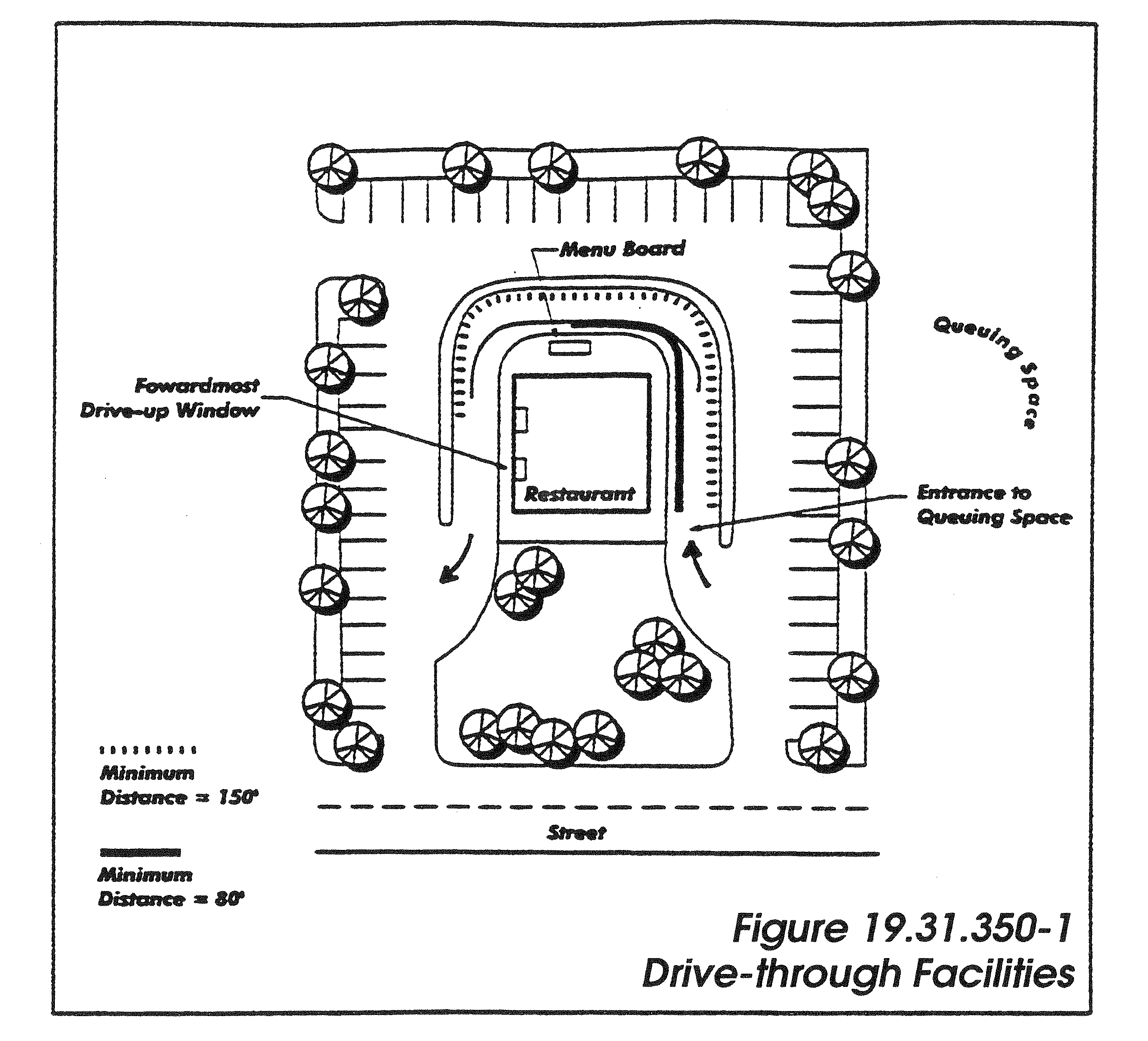
Minimum queuing distances shall be provided as illustrated in Figure 19.31.350-1.
5.
A parking and vehicular circulation plan encompassing adjoining streets and alleys shall be submitted for review and approval by the director of public services prior to approval of a conditional use permit.
6.
A minimum of one outdoor trash receptacle shall be provided on-site adjacent to each driveway exit. At least one additional on-site outdoor trash receptacle shall be provided for every ten required parking spaces.
7.
Employees shall collect on-site and off-site litter including food wrappers, containers, and packaging from restaurant products generated by customers within a radius of three hundred feet of the property at least once per business day.
8.
No noise-generating compressors or other such equipment shall be placed on or near any property line adjoining any residential district or any property used for residential purposes.
9.
Drive-up or drive-through speaker systems shall emit no more than fifty decibels four feet between the vehicle and the speaker and shall not be audible above the daytime ambient noise levels beyond the property boundaries. The system shall be designed to compensate for ambient noise levels in the immediate area and shall not be located within thirty feet of any residential district or any property used for residential uses.
10.
On any lot where a drive aisle or driveway is located such that vehicle headlights will shine onto an adjacent property zoned for residential use, a screen wall shall be provided to the satisfaction of the community development director.
(Ord. 544 § 1(part), 2000).
19.31.370 - Preconditions for permit issuance.
Because the term "garment manufacturing" is so broad and may include a variety of disparate uses, and because such uses also require state registration, prior to the issuance of any business license, certificate of occupancy, or permits for garment manufacturing businesses, the person applying for business license or permits shall be required to submit a copy of a current certificate of registration under Section 2675 of the California Labor Code.
(Ord. 544 § 1(part), 2000).
19.31.380 - Plans required.
A.
A floor plan shall be submitted to the department of community development and fire department for review of safety features incorporated into the physical plant. The floor plan shall clearly indicate dimensions of the interior of the building, including the number of windows and doors; the number of sewing machines and cutting tables; the proposed number of employees; and any other equipment related to garment manufacturing.
B.
A site plan shall be submitted to the department of community development for approval. The site plan shall illustrate all on-site parking, loading docks, and egress and ingress of vehicular access to the site.
C.
Every person registered as a garment manufacturer shall display in the front entrance of the building in which his or her business premises is located, his or her name, address, the department of community development approved floor plan and the garment manufacturing registration number.
(Ord. 544 § 1(part), 2000).
19.31.400 - Development standards and conditions.
A.
Service Station—General. In addition to the findings required for conditional use permit approval in Section 19.39.420 of this Title 19, service stations shall be subject to the following conditions:
1.
All repair or maintenance services shall be enclosed. Only fuel sales shall be permitted outside.
2.
The station shall be screened from view from any residence located within seventy-five feet or less from the station.
3.
No flammable liquid may be stored unless storage complies with the fire code and is approved by the fire department.
4.
All new merchandise shall be stored and displayed inside the service station building, except for lubrication items maintained in movable cabinets or racks.
5.
No used or discarded automobile parts or equipment of permanently disabled, junk, or wrecked vehicles shall be located or stored outside of the service station building.
6.
Trash shall be stored in areas shielded from public view by a masonry wall a minimum of five feet high and with adequate truck access to that area.
7.
No vehicle or appurtenances shall be parked or stored on the premises for the purpose of storage or lease.
8.
Perimeter flood lighting shall be hooded or shielded so that light shall not fall upon public streets, alleys, highways, or private property.
9.
All landscaped areas shall be enclosed within a masonry planter box or curb with a maximum height of six inches.
10.
All public utilities shall be installed underground.
11.
Handicap ramps shall be installed at corners of any street intersection.
12.
Each station shall provide a minimum of two operable, well-maintained bathrooms: one for men and one for women.
13.
The facility shall offer water and air free of charge and continue to accept waste oil from the public.
B.
Multiuse Stations. Service stations developed and used in conjunction with one or more complementary uses, such as a mini-market, fast-food restaurant, car wash, or oil change station, shall be subject to the following additional regulations:
1.
A minimum parcel size of twenty-five thousand square feet shall be required for any combination of two such uses. For each additional use, an additional lot area of five thousand square feet shall be provided.
2.
Any such use shall be located a minimum distance of three hundred feet from any property zoned for residential use.
3.
Parking shall be calculated and provided separately for each individual use pursuant to the provisions of Chapter 19.21 (Off-street Parking and Loading) of this Title 19.
4.
A minimum of two outdoor trash receptacles shall be provided.
5.
No noise-generating compressors or other such equipment shall be located on or near any property line adjoining any residential district or any property used for residential purposes.
C.
Establishments Operating 24 Hours. Any service station or multi-use station operating on a twenty-four-hour-per-day basis shall provide a secure environment for employees with improvements including, but not limited to, video surveillance cameras, silent alarms, and bullet-proof glass protecting the cashier area.
(Ord. 544 § 1(part), 2000).
19.31.410 - Signage.
Notwithstanding the regulations contained in Chapter 19.25 (Signs) of this Title 19, on-site signs at any gasoline service station and any multiuse station shall be limited to the following:
A.
One freestanding sign, of dimensions thirty-two feet maximum height, one hundred fifty square feet per sign face, and fifteen feet maximum width.
B.
One roof sign, located not more than four feet above the highest roof level, with a maximum of one hundred fifty square feet per sign face.
C.
One sign with changeable copy, of area twelve square feet maximum, and no higher than eight feet above grade.
D.
Restroom signs, premium stamp signs, business, or credit card signs shall be limited in area to one square foot per face. Such signs shall not be attached to a light standard or a freestanding sign.
E.
The business medallion shall have a maximum area of eight square feet, with a maximum letter height of eight inches. Alternatively, a sign for the service station and one advertising slogan on the face of the building is allowed, not to extend above the roof line.
F.
No portable or display signs are allowed.
G.
Signs shall not project over any street or alley.
H.
Banners, flags, balloons, and signs that change color or have attention-attracting characteristics are not allowed and shall not be permitted except within the first thirty days of the station's initial opening.
I.
No flashing or rotating signs or moving signs with speeds of more than eight revolutions per minute are allowed.
J.
Temporary window signs shall be placed within the building and shall cover no more than twenty-five percent of the window area. Visibility into the facility shall not be obscured in any way by sign placement.
(Ord. 544 § 1(part), 2000).
19.31.430 - Intent and purpose.
The issuance of a home occupation permit recognizes the need of some homeowners to operate small businesses from their homes, and provides a means of ensuring that adverse impacts, due to the mix of residential and commercial or professional uses, are mitigated in order to preserve the character of the residential area.
(Ord. 544 § 1(part), 2000).
19.31.440 - Permit required.
Home occupation permits shall be permitted in accordance with the provisions of Division 12 (Home Occupation Permits) of Chapter 19.39.
(Ord. 544 § 1(part), 2000).
19.31.450 - Development standards and conditions.
Approval of a home occupation permit shall be subject to the conditions contained in Division 12 (Home Occupation Permits) of Chapter 19.39.
(Ord. 544 § 1(part), 2000).
19.31.470 - Development standards and conditions.
A.
Trash incinerators are regional facilities that can be a cost-effective and efficient means of disposing garbage. However, they can generate traffic, dust, smoke, and odors that are disturbing to other land uses and residents. Therefore, incinerators are not appropriate in all zone districts or on some parcels within any given zone district.
B.
Solid waste facilities as defined in Public Resources Code 40194, inclusive of incinerators, shall be limited to one facility per twelve thousand residents of the City of Commerce, as shown by the last available U.S. Census. This provision shall have no effect on the continued operation of those facilities in existence and operational as of May 21, 1998, except that those facilities shall be counted in determining whether a new facility may locate in the city.
C.
In order to mitigate the adverse and nuisance side effects of trash incinerators, all existing facilities shall be subject to the following restrictions, in addition to the development standards of the zone in which a facility is located:
1.
No incinerator shall be located within one thousand feet of any residential zone, church, school, or park.
2.
Prior to issuance of a building permit, the owner or operator of the incinerator shall obtain all necessary permits from the South Coast Air Quality Management District, Air Resources Board, Solid Waste Management Board, and the California Department of Health Services. Maintenance of these permits in full force and effect shall be a condition of approval for the incinerator.
3.
An incinerator facility shall obtain a valid conditional use permit prior to the beginning of construction or operation.
4.
Each incinerator shall provide adequate off-street space for trash trucks to await unloading or loading at the incinerator. Determination of the amount of queuing area required shall be based on the operating characteristics of the facility, but will in no case be less than sufficient space for three trucks.
5.
Each incinerator shall be completely surrounded by a view-obscuring fence or masonry wall at least eight feet high.
6.
The minimum lot size for an incinerator facility shall be three acres.
7.
The facility shall be operated and maintained so that it is free from infestations of rodents, insects, and/or other animals that represent a health hazard to surrounding uses.
(Ord. 544 § 1(part), 2000).
19.31.490 - Development standards and conditions.
A.
Mobile homes or office trailers shall be allowed in nonresidential zones with approval of a conditional use permit (CUP).
B.
In addition to the findings required for approval of a CUP in Section 19.39.420 of this Title 19, mobile homes in nonresidential zones shall be subject to the following standards:
1.
Prior to issuance of a CUP for a mobile home in a nonresidential zone, the planning commission shall determine that it is not possible or desirable to locate the proposed use in any existing structure on site and that construction of a conventional structure is not possible or not desirable.
2.
The mobile home shall not be located on any required front yard or side yard adjoining a street.
3.
The proposed use shall be incidental and necessary to the operation of the primary use.
4.
The mobile home shall be adequately anchored and maintained so that it does not create or cause a nuisance or visual blight.
(Ord. 544 § 1(part), 2000).
19.31.510 - Development standards and conditions.
All hotels and motels shall comply with the following standards:
A.
On-site management shall be available twenty-four hours a day, seven days a week.
B.
Not less than weekly maid and housekeeping service shall be provided for each guest room. "Maid and housekeeping service" means basic cleaning, including but not limited to vacuuming, sweeping and/or mopping, dusting, and changing of bed linens and towels.
C.
No hotel/motel room shall be rented more than once in a twenty-four-hour period.
D.
All hotels/motels shall maintain daily records reflecting the names and permanent addresses of hotel/motel guests, as verified by valid driver's license or other valid identification along with the license number, state of license, make, model, and year of any guest's vehicle parked on-site or the corporate account information and guest names, the dates of occupancy, length of stay, and room rate. This registration information shall be maintained for at least one year past the last day of stay for each guest and shall be made available for review by any duly sworn peace officer of the city, state, or federal government or any authorized official of the city's code enforcement or finance department during normal business hours. Any person who knowingly or intentionally misrepresents any material facts required in this subsection shall be deemed guilty of a misdemeanor.
(Ord. 544 § 1(part), 2000).
19.31.520 - Limitations on stays.
A.
As used herein, the term "long-term occupancy" shall be defined as any stay in a hotel/motel exceeding either thirty consecutive days or sixty days per calendar quarter.
B.
No hotel/motel shall permit any long-term occupancy of any room unless all the following conditions are met, in which case a maximum of fifteen percent of the rooms may be rented for residential tenants subject to approval of a conditional use permit.
1.
In-room telephone service shall be provided for each long-term occupancy guest room.
2.
Each room rented for long-term occupancy shall be a minimum of two hundred seventy-five square feet.
3.
Each room rented for long-term occupancy shall contain a kitchenette (portion of the room containing any combination of facilities of sufficient size for the preparation of meals) or shall have on-site room service available.
(Ord. 544 § 1(part), 2000).
19.31.530 - Time limits for complying with requirements.
A.
Any hotel or motel not in compliance with this Division 16 shall be brought into compliance in accordance with the following schedule:
1.
Within one year, all hotels/motels shall comply with the required standards of Section 19.31.510; and
2.
Within one year, the number of guest rooms rented for long-term occupancy in each hotel/motel shall not exceed thirty percent of the total number of guest rooms in the hotel/motel, and such long-term occupancy guest rooms shall comply fully with Section 19.31.520(B)(1), (B)(2) and (B)(3); and
3.
Within two years, the number of guest rooms rented for long-term occupancy in each hotel/motel shall not exceed twenty percent of the total number of guest rooms in the hotel/motel, and such long-term occupancy guest rooms shall comply fully with Section 19.31.520(B)(1), (B)(2) and (B)(3); and
4.
Within three years, the number of guest rooms rented for long-term occupancy in each hotel/motel shall comply fully with Section 19.31.520.
B.
The provisions of Chapter 19.37 (Nonconforming Uses and Structures) of this Title 19 shall also apply.
(Ord. 544 § 1(part), 2000).
19.31.550 - Development and performance standards.
In addition to the findings required for approval of a conditional use permit in Section 19.39.420 of this Title 19, gas or oil production facilities shall be subject to the following standards:
A.
The exploration, drilling, development, production, storage, and removal of oil and gas shall comply with the property development standards of the zone in which it is located.
B.
All operations shall comply with the Commerce oil code, fire prevention code, and other applicable ordinances and obtain a valid emissions permit from the South Coast Air Quality Management District (SCAQMD).
C.
No oil or gas well shall be located within eighty feet of the centerline of a major highway, seventy feet of the centerline of a secondary highway, sixty feet of the centerline of any public street, or one hundred feet of any residential structure.
D.
All structures and storage facilities shall comply with the front yard setbacks for the zone in which they are located.
E.
Mitigating measures such as soundproofing and other noise control; limitations on hours of operation, height, location, appearance, and condition; and maintenance of equipment, fencing, and landscaping shall be incorporated into the design of the facility as determined necessary to ensure compatibility with surrounding uses.
(Ord. 544 § 1(part), 2000).
19.31.570 - Development standards and conditions.
In addition to the findings required for approval of a conditional use permit by Section 19.39.420 of this Title 19, truck terminals shall be subject to the following conditions:
A.
Trucking, transit, or transportation terminals, including facilities for the repair or storage of trucks, shall front on a major or secondary highway as designated on the city master plan of highways.
B.
The site shall have a minimum area two acres.
C.
The site shall not be located within five hundred feet of a residential use.
D.
The site must be fenced and screened from view from all public rights-of-way.
E.
All repair and washing shall occur within a completely enclosed building.
F.
A traffic study shall be completed that demonstrates all adverse traffic impacts can be mitigated.
(Ord. 544 § 1(part), 2000).
19.31.590 - Development and performance standards.
In addition to the findings required for approval of a conditional use permit by Section 19.39.420 of this Title 19, vehicle impound yards shall be subject to the following standards:
A.
The premises shall be maintained in a neat, orderly, and sanitary condition, and structures shall be maintained in good repair.
B.
No burning shall be permitted on-site.
C.
All fire prevention standards shall be met.
D.
The area shall be entirely enclosed with a view-obscuring wall or fence, except for gateways needed for access.
E.
No vehicles or materials shall be piled higher than the fence or wall.
F.
Vehicles parked overnight shall be within an enclosed area.
G.
No sign shall be placed on the sides or rear of the property adjoining a private property. No sign shall be painted or posted on fences or walls.
(Ord. 544 §1(part), 2000).
19.31.610 - Applicability, intent, and purpose.
The following standards apply to businesses that sell new or used vehicles and boats. Such businesses differ from other retail sales operations in the size of the equipment being offered for sale and thus, the need for storage, display and repair space. In addition, these businesses need adequate street access to permit customers to test-drive the vehicles. The regulations in this Division 20 are set forth in order to minimize the impacts on surrounding uses and ensure that all sales facilities are safe and attractive.
(Ord. 544 §1(part), 2000).
19.31.620 - Development standards and conditions.
In addition to the findings required for approval of a conditional use permit in Section 19.39.420 of this title, all automobile, truck and boat sales shall be subject to the following standards:
A.
The minimum lot size for an automobile, truck or boat sales area shall be twenty-five thousand square feet.
B.
No automobile, truck or boat sales use shall be located within three hundred feet of any residential use. However, where a public street separates such use from a residential zone, the three hundred-foot distance requirement shall not apply.
C.
All service and repair operations shall occur in a completely enclosed building.
D.
The landscaping and setback requirements of the commercial zone shall apply to all vehicles sales facilities, regardless of the zone in which the business is located.
E.
Only vehicles that are offered for sale may be stored outdoors.
F.
All outdoor vehicles on display shall be washed at least once per week. Permits for such activity shall be obtained pursuant to applicable requirements of Division 5 (Car Washes) of this Chapter 19.31.
(Ord. 544 §1(part), 2000).
19.31.640 - Development standards and conditions.
A.
The establishment of any new warehouse facility may require the issuance of a conditional use permit pursuant to the provision of Division 7, Chapter 19.39 of this title. Sections 19.11.020 and 19.11.030, and specifically Table 19.11.030A, indicate when a conditional use permit is required.
B.
All warehouse facilities shall be subject to the following standards:
1.
Adequate queuing space shall be provided on-site to prevent vehicles from using adjacent streets for maneuvering. Use of public streets or alleys for queuing or maneuvering shall be prohibited.
2.
All parking and storage areas for trailers must be provided on-site and must not encroach into any area providing required parking pursuant to Chapter 19.21 (Off-street Parking and Loading) of this title.
3.
The exposure of any adjacent residential use to noise, light, exhaust emissions and other similar nuisances shall be minimized through building orientation and facility design.
4.
Loading areas shall be provided and oriented pursuant to the requirements of Section 19.21.130 (Loading Requirements) of this title.
5.
Office operations for any warehouse facility shall be limited to fifteen percent of the gross building floor area. Required parking facilities shall be calculated separately for any office use.
6.
Off-site improvements shall be provided as required by the director of public services to ensure safe and adequate access and to minimize impact on public infrastructure.
7.
Security fencing shall be decorative in nature and compatible with building architecture.
(Ord. 544 §1(part), 2000).
19.31.650 - Development standards and conditions for mini-warehouse or self-storage facilities.
A.
The establishment of any new mini-warehousing, self-storage or public warehousing will require the issuance of a conditional use permit pursuant to Division 7, Chapter 19.39 of Title 19, Sections 19.11.120 and 19.11.130, and specifically Table 11-1, indicates when a conditional use permit is required.
B.
All mini-warehousing, self-storage or public warehousing facilities shall be subject of the following standards:
1.
Existing Applicable Ordinances and Laws. Mini-storage facilities must comply with applicable city ordinances that apply to commercial development within Commerce and requirements specified for uses within the M-2 zone. Mini-storage facilities must comply with all other applicable city ordinances and state and federal laws including building, life, fire and other safety codes, environmental regulations, sign ordinances and citywide development standards. The development standards provided in this section apply in addition to other applicable ordinances and laws and nothing in this section shall be interpreted as allowing exceptions to any of the aforementioned laws.
2.
Building Design and Materials.
a.
Materials.
i.
The building materials, colors, design and finishing system are consistent throughout the facility and in accessory buildings.
ii.
The materials used for buildings, roofs, fences and other structures are visually pleasing, especially near residential uses.
b.
Size and Scale.
i.
The building height shall be no greater than thirty-five feet above ground level as measured at the building's highest point.
c.
Facade.
i.
The facade shall be decorative and shall have distinctive elements such as clear windows, rooflines, cornices, doors, trim and finishing that suggest commercial use rather than storage.
ii.
The surfaces of the storage facility that face public roads or residential uses shall receive particular attention in their design; such surfaces shall be designed as to suggest commercial use rather than storage, and shall provide a varied and interesting facade. Considerations include the use of setbacks, building placement, variations in building walls, fencing, other structural elements and landscaping.
iii.
Facades that face streets or connecting pedestrian frontage shall be subdivided and proportioned using features such as windows, entrances, arcades, arbors, awnings, trellises with vines, along no less than fifty percent of the facade. The intent of this provision is to prevent long, uninterrupted, monotonous and flat facades.
iv.
Primary building entrances shall be clearly identifiable. They may be recessed or framed by a sheltering element such as an awning, arcade or portico in order to provide shelter.
d.
Screening.
i.
All warehouse doors shall face the inside of the mini-storage facility; no warehouse doors shall be sited along or in the exterior facade of the building except where they are screened from viewing from any adjacent property, any public right-of-way, or any public area. Warehouse doors can be screened by part of the building itself or by fences or walls that meet the standards established elsewhere in this zoning ordinance and other city ordinances.
ii.
All mechanical equipment, such as ventilation systems, HVAC units, AC units, and similar equipment shall be screened by roofs, fences, or by other means so that such equipment is not visible from adjacent properties, public right-of-way or other public areas.
3.
Circulation, Access and Parking.
a.
The site shall be designed to allow easy access for emergency vehicles.
b.
The site shall be designed to allow for loading and unloading to occur exclusively on site.
c.
Adequate queuing space shall be provided on site to prevent vehicles from using adjacent streets for maneuvering. Use of public streets or alleys for queuing or maneuvering shall be prohibited.
d.
The site shall include one parking space for each facility manager.
e.
The site shall include five parking spaces near the facility's office for customer transactions.
f.
The site shall include at least one parking space for every twenty thousand square feet of gross floor area.
4.
Number Allowable. There shall only be two mini-warehouses, self storage facilities for every thirteen thousand residents of city, as reported by the latest available U.S. census.
5.
Site Design.
a.
Fencing.
i.
Any proposed fencing shall be designed to be compatible with the character of the area.
ii.
No fencing shall include the use of rolled razor wire or chain link fencing.
b.
Signage.
i.
Signs shall be designed and located to avoid visual intrusion upon adjacent uses.
ii.
The design and placement of signs shall be included on site plans and must be approved by the planning director or by a member of the city planning staff appointed by the planning director to do so.
6.
Operation.
a.
Mini-storage facilities shall not operate before seven a.m. or after seven p.m.
b.
The facility shall not contain more than one residential unit. If a residential unit is provided for the caretaker or manager, the unit must be attractively integrated into the building design and shall not be a mobile, modular or a trailer home.
c.
RV storage shall be permitted as long as it is screened, can not be seen from the frontage of the property and it has a current DMV registration.
d.
A minimum of one trash collection areas must be provided. Collection areas must be screened by a minimum six-foot-high solid masonry wall or by the facility's buildings and must comply with all other adopted development standards and ordinances regarding solid waste. Such collection areas shall be located and designed to allow easy access by mini-storage clients and trash collection workers.
e.
The storage spaces shall not used for manufacturing, retail or wholesale selling, compounding, office functions, other business or service uses or human habitation.
f.
No water, sanitary facilities or electricity, with the exception of lighting fixtures, shall be provided in individual storage spaces, unless otherwise approved by the planning commission.
g.
Prefabricated shipping containers shall not be used as mini-warehouse facilities.
h.
The following materials shall not be stored in mini-warehouses:
i.
Flammable or explosive matter or materials;
ii.
Material which creates obnoxious dust, odor or fumes; or
iii.
Hazardous or extremely hazardous waste.
(Ord. 575 §3, 2003).
19.31.660 - Purpose.
This division sets forth a uniform set of standards for emergency shelters to provide temporary housing for the homeless pursuant to California Government Code Section.
(Ord. No. 656, § 8 (Exh. E), 11-19-2013)
19.31.670 - Emergency shelter standards and regulations.
Emergency shelters for homeless persons shall be subject to and comply with the following standards and regulations.
A.
A single emergency shelter for thirty occupants, or a combination of multiple shelters with a combined capacity not to exceed thirty occupants, shall be allowed as a permitted use, consistent with Section 65583(4)(A) of the Government Code. All emergency shelters, regardless of the number of occupants, shall meet all applicable development standards to the zoning districts in which they are permitted by right and minimum standards contained herein below. Any emergency shelter with a capacity greater than thirty occupants shall also be subject to the approval of a conditional use permit, as set forth in Chapter 19.39.
B.
The facility shall operate on a first-come, first-serve basis with clients only permitted on-site and admitted to the facility between six o'clock p.m. and seven o'clock a.m. during Pacific Daylight Time, and five o'clock p.m. and seven o'clock a.m. during Pacific Standard Time. Clients must vacate the facility by eight o'clock a.m. and have no guaranteed bed for the next night. A curfew of ten o'clock p.m. (or earlier) shall be established and strictly enforced and clients shall not be admitted after the curfew.
C.
To avoid over-concentration of emergency shelter facilities, a minimum distance of three hundred feet shall be maintained from any other emergency shelter, as measured from the property line.
D.
Emergency shelters shall not be located within one thousand feet of a public or private school (pre-school through twelfth grade), universities, colleges, student housing, senior housing, child care facilities, public parks, businesses licensed for on- or off-site sales of alcoholic beverages or parolee/probationer home as defined in Chapter 19.45 (Definitions) and as measured from the property line.
E.
Service providers shall provide sufficient numbers of male and female toilets—restrooms for clients and prospective clients to have access to use on a twenty-four-hour basis. For group housing and other similar shelter programs, adequate private male and female showers shall be provided along with lockers for clients to temporarily store their belongings.
F.
Any outdoor storage, including, but not limited to, items brought on-site by clients for overnight stays, shall be screened from public view by a minimum six-foot tall decorative wall or fence. Pets and shopping carts are not permitted on-site.
G.
Adequate waiting areas must be provided within the premises for clients and prospective clients including ten square feet per bed, minimum one hundred square feet to ensure that public sidewalks or private walkways are not used as queuing or waiting areas.
H.
Facility improvements shall comply with the Commerce Municipal Code and the most current adopted Building and Safety Code, specific to the establishment of dormitories and shall additionally provide:
1.
A minimum of one toilet for every eight beds per gender.
2.
A minimum of one shower for every eight beds per gender.
3.
Private shower and toilet facility for each area designated for use by individual families.
I.
An emergency shelter facility shall provide off-street parking at the ratio of one space per four beds, and/or 0.5 per bedroom designated as a family unit with children, plus one space per staff member. Service providers are responsible to provide and maintain adequate parking and freight loading facilities for employees, clients and other visitors who drive to the premises.
J.
Bike rack parking shall be provided at the facility.
K.
Exterior lighting shall be provided for the entire outdoor and parking area of the property per the lighting standards of Section 19.19.130 of this code.
L.
The facility may provide the following services in a designated area separate from sleeping areas:
1.
A recreation area inside the shelter or in an outdoor area visually separated from public view by a minimum six-foot tall visually screening decorative wall or fence.
2.
A counseling center for job placement, educational, health care, legal services, or mental health services.
3.
Laundry facilities to serve the number of clients at the shelter.
4.
Kitchen and dining area.
5.
Client storage area.
M.
Similar types of facilities to address the needs of homeless clients, as determined by the community development director. A shelter management plan shall be submitted as a part of the permit application, which addresses all of the following:
1.
Service providers shall maintain sufficient monetary resources to enable them to operate the facility per the shelter management plan, and shall demonstrate to the city prior to approval of the permit application that such funds shall be available for use upon first occupancy of the proposed project and shall reasonably be expected to be available for the life of the project.
2.
A minimum of one staff member per fifteen beds shall be awake and on duty when the facility is open. Facility staff shall be trained in operating procedures, safety plans, and assisting clients. The facility shall not employ staff who has been convicted of a felony or who are required to register as a sex registrant under Penal Code 290.
3.
Service providers shall maintain up-to-date information and referral sheets to give clients and other persons who, for any reason, cannot be served by the establishment.
4.
Service providers shall provide criteria to screen clients for admittance eligibility, with the objective to provide first service to individuals with connections to Commerce.
5.
Service providers will maintain information on individuals utilizing the facility and will ensure that the maximum stay at the facility shall not exceed one hundred twenty days in a three hundred sixty-five-day period.
6.
Service providers shall continuously monitor waiting areas to inform prospective clients whether they can be served within a reasonable time. If they cannot be served by the provider because of time or resource constraints, the monitor shall inform the client of alternative programs and locations where he or she may seek similar service.
7.
Service providers will educate on-site staff to provide adequate knowledge and skills to assist clients in obtaining permanent shelter and income, including referrals to outside assistance agencies. An annual report on this activity will be provided to the city.
8.
Service providers shall provide for the timely removal of litter attributable to clients within the vicinity of the facility every twenty-four-hour period.
9.
Service providers will maintain good communication and have procedures in place to respond to operational issues which may arise from the neighborhood, city staff, or the general public.
10.
Service providers shall establish standards for responding to emergencies and incidents expelling clients from the facility. Re-admittance policies for clients who have previously been expelled from the facility shall also be established.
11.
Alcohol and illegal drug use is prohibited on-site. Service providers shall expel clients from the facility if found to be using alcohol or illegal drugs.
12.
The establishment shall implement other conditions and/or measures as determined by the city, in consultation with other city/county agencies necessary to ensure that management and/or clients of the establishment maintain the quiet, safety and cleanliness of the premises and the vicinity of the use.
13.
Other requirements as deemed necessary by the city to ensure that the facility does not create an adverse impact to surrounding properties.
14.
On a monthly basis, provide an updated list of emergency shelter residents to the sheriff's department.
15.
All graffiti on the premises shall be removed by the business operator within twenty-four hours.
16.
Installation of anti-loitering signs.
17.
If there is conflict between code requirements, the most restrictive one shall apply.
N.
The facility shall comply with all other laws, rules, and regulations that apply including, but not limited to, Building and Fire Codes. The facility shall be subject to city inspections prior to the commencement of operation. In addition, the city may inspect the facility at any time for compliance with the facility's management plan and other applicable laws and standards.
O.
Emergency shelter operator shall obtain a city business license.
(Ord. No. 656, § 8 (Exh. E), 11-19-2013)
19.31.680 - Single resident occupancy (SRO) units, standards and regulations.
Transitional housing, including efficiency residential units, also known as single resident occupancy ("SRO"), shall be subject to and comply with the following standards and regulations.
A.
Tenancy of SRO (efficiency) units shall not be less than thirty days and maximum period of twelve months.
B.
Each facility shall comply with all applicable development standards for the applicable zoning district and minimum standards contained herein below.
C.
Units shall have a minimum size of one hundred fifty square feet and a maximum of four hundred square feet.
D.
Each unit shall accommodate a maximum of two persons.
E.
Exterior lighting shall be provided for the entire outdoor and parking area of the property per the lighting standards of Section 19.19.130 of this code.
F.
Laundry facilities must be provided in a separate enclosed room at the ratio of one washer and one dryer for every twenty units of fractional number thereof, with at least one washer and dryer per floor, which shall be enclosed.
G.
A cleaning supply room or utility closet with a wash tub with hot and cold running water shall be provided on each floor of the SRO (efficiency) unit facility.
H.
Each unit shall be required to provide a separate bathroom containing a water closet, lavatory and bathtub or shower.
I.
Each unit shall be provided with a kitchen sink, functioning cooking appliance and a refrigerator, each having a clear working space of not less than thirty inches in front.
J.
Each unit shall have a separate closet.
K.
Units shall comply with all requirements of the California Building Code and all other codes. All units shall comply with all applicable accessibility and adaptability requirements. All common areas shall be fully accessible.
L.
An SRO (efficiency) unit project shall not be located within five hundred feet of any other SRO (efficiency) unit project, emergency shelter, or other similar program, unless such program is located within the same building or on the same lot.
M.
An SRO (efficiency) unit project with ten or more units shall provide on-site management. A project with less than ten units may provide a management office on-site. The city administrator or their designee may reduce this standard as necessary.
N.
Off-street parking shall be provided for an SRO facility at a rate of one uncovered parking space per unit plus an additional space for the on-site manager and each employee.
O.
Each efficiency unit shall be provided at least one lockable bicycle parking space in a location that is adjacent to that SRO (efficiency) unit.
P.
Applications for SRO (efficiency) units projects shall be processed in a manner consistent with procedures for a multiple-family residential project per Chapter 19.39, Division 2 of this code.
(Ord. No. 656, § 8 (Exh. E), 11-19-2013)
19.31.690 - Notification.
In addition to the notification required by the Commerce Municipal Code, representatives of the sheriff's department shall be apprised of the proposed project in a timely fashion so that the department may respond to any concerns they may have regarding the proposed project.
(Ord. No. 656, § 8 (Exh. E), 11-19-2013)
19.31.710 - Purpose and intent.
This chapter may be known and cited as the "City of Commerce Art in Public Places Program." The intent of the art in public places program is to provide a collection of nationally recognized, permanent outdoor artwork throughout the city, to be of public benefit. The program is designed to present the community with a variety of artistic styles and themes, all of the highest possible quality.
(Ord. No. 679, § 2, 9-20-2016)
19.31.720 - Definitions.
As used in this chapter:
"Applicant" means the owner of the property or tenant utilizing the property and seeking the required permits.
"Art in public places fund" means the account funded by money collected from applicants in accordance with the in-lieu contribution provisions of this chapter, which will be used to fund artwork within the City of Commerce.
"Artwork" means original creations of art including, but not limited to, the following categories: sculpture, murals, mosaic and fountains. These categories may be realized through such mediums as steel, bronze, stained glass, concrete, wood, ceramic tile and stone, as well as other suitable materials.
"Project" means any new residential, commercial, or industrial project for development of new buildings, or any expansion, remodeling, or tenant improvements to existing buildings.
"Project cost" means the total value of a project, excluding the land value, as determined by the building official, and indicated on the building permits issued by the city for that project.
"Project site" means the physical site on which the project is located.
"Public place" means any exterior area on public or private property, which is accessible and visible to the general public.
"Theme" means the subjects that have been approved by the city.
(Ord. No. 679, § 2, 9-20-2016)
19.31.730 - Requirement to provide artwork or pay in-lieu contribution.
When a project is subject to the requirements of this chapter, the applicant shall comply with provisions of either subsection (1) or (2) of this section, or a combination of both:
(1)
The applicant shall acquire and install artwork in a public place on or in the vicinity of the project site as approved by the city council pursuant to this chapter. The cost or value of such work as approved by the city council shall equal or exceed the amount to be in-lieu contribution that would otherwise be made under subsection (2) of this section.
(2)
In-Lieu Contribution. In lieu of acquiring and installing artwork, applicants may contribute funds to the art in public places fund established pursuant to Section 19.31.700 et seq., equal to one percent of the total project cost. The in-lieu contribution shall be paid by the applicant before the issuance of building permits, unless otherwise provided by the city council. Applicants shall indicate on their art in public places application whether they wish to make an in-lieu contribution.
(Ord. No. 679, § 2, 9-20-2016)
19.31.740 - Projects subject to art in public places requirement.
(a)
The requirements of this chapter shall apply to the following activities:
(1)
Commercial or industrial developments, having a project cost equal to or in excess of two hundred fifty thousand dollars;
(2)
Residential development of more than four lots or units, including single-family residential structures, condominiums, apartments, townhouses or other dwelling units, if the aggregate project costs exceed two hundred fifty thousand dollars.
(b)
Exceptions. The requirements of this chapter shall not apply to the following activities:
(1)
All public work and governmental agency projects;
(2)
Residential development of more than four lots or units, including single-family residential structures, condominiums, apartments, townhouses or other dwelling units, if the aggregate project costs less than two hundred fifty thousand dollars.
(3)
Reconstruction of structures, which have been damaged by fire, flood, wind, earthquake or other calamity.
(4)
Religious, hospital, scientific or charitable organizations, if the project is constructed on property exempt from taxation pursuant to California Revenue and Taxation Code Section 214.
(Ord. No. 679, § 2, 9-20-2016)
19.31.750 - Processing.
The requirements and procedures for the processing of an art in public places application shall be as follows:
(1)
Prior to or at the time of submission of plans for plan check for a project subject to the requirements of this chapter, the applicant shall submit to the public works and development services department a completed art in public places application indicating whether the applicant has elected to acquire and install artwork or make an in-lieu contribution to the art in public places fund.
(2)
When the applicant has elected to make an in-lieu contribution to the art in public places fund, building permits shall not be issued until such contribution has been paid.
(3)
The public works and development services department shall submit to the city council an application to acquire and install artwork.
(4)
The city council shall evaluate and provide comments and/or make a recommendation on each proposed artwork within 30 days from the date of receipt of the application to acquire and install artwork.
(5)
When the applicant has elected to acquire and install artwork, no building permit shall be issued until the city council has approved the art in public places application. A certificate of occupancy shall not be issued for the project until the approved artwork has been installed or an amount equal to the in-lieu contribution the applicant would otherwise have been obligated to pay is deposited with the city to secure proper installation of the artwork. The deposit will be forfeited to the city and placed in the art in public places fund if the artwork is not installed within the ninety-day period or by the expiration of any extension to install the artwork the city council shall grant. The city shall use such forfeited funds for other public artworks complying with Section 19.31.710 (art in public places program).
(Ord. No. 679, § 2, 9-20-2016)
19.31.760 - Art in public places review committee.
Planning staff shall review any proposed art installation for public safety, weather resistance, theme balance within the overall program, verification of value, anticipated public response, proper lighting, public accessibility, installation methods, proportion, composition, the artist's previous experience on monumental scale sculpture, and the artist's art training and exhibition record. Any recommendation by staff will then be forwarded to the city council for their consideration.
(Ord. No. 679, § 2, 9-20-2016)
19.31.770 - Guidelines for artworks.
Guidelines for the approval and maintenance of artworks shall include, but are not limited to, the following criteria:
(1)
The artwork shall be displayed in an area that is open and freely accessible to the public for at least ten hours each day or displayed in a manner which otherwise provides public accessibility in an equivalent manner based on the characteristics of the artwork or its placement on the project site.
(2)
The art in public places application shall include a site plan showing the location of the artwork, complete with landscaping, lighting and other appropriate accessories to complement and protect the artwork.
(3)
The composition of the artwork shall be of a permanent type of material in order to be durable against vandalism, theft and weather, and in order to require a low level of maintenance.
(4)
The artwork shall be related in terms of scale, material, form and content to immediate and adjacent buildings and landscaping so that it complements the project site and surrounding environment.
(5)
The artwork shall be designed and constructed by persons experienced in the production of such artwork and recognized by critics and by his or her peers as one who produces works of art.
(6)
The artwork shall be permanently affixed to the project.
(7)
The artwork shall be maintained by the property owner in a safe, neat and orderly manner acceptable to the city. Any repair and maintenance shall be the responsibility of the applicant and completed in accordance with a maintenance plan approved by the city.
(8)
The artwork installed on a project site shall remain at the project site and shall be replaced in the event of theft or repaired in the event of damage. Artwork shall be insured for the full replacement value. Art may not be removed without prior approval from the city council. If removal is granted, an in-lieu contribution equal to the value of the artwork shall be made to the city's art in public places fund.
(9)
Prior to the issuance of building permits the property owner shall execute and record with the Los Angeles County Recorder, covenants, conditions and restrictions in form and content approved by the city administrator and the city attorney providing, among other things, that the property owner and its successor and assigns shall: (1) maintain the artwork as required by Section 19.31.770(G); (2) indemnify, defend and hold the city and related parties harmless from any and all claims or liabilities arising out of the artwork; and (3) maintain in the city clerk's office a certificate of public liability insurance naming the city as an additional insured including such coverage and liability limits as may be specified by the city administrator.
(10)
The following items are not to be considered as artwork:
a.
Art objects that are mass produced from a standard design. However, limited productions may be considered with specific restrictions;
b.
Reproductions of original artworks;
c.
Decorative, ornamental or functional elements that are designed by the building architect as opposed to an artist commissioned for the purpose of creating the artwork;
d.
Landscape architecture and landscape gardening except where these elements are designed or approved by the artist and are an integral part of the artwork by the artist;
e.
Any work that promotes a business or service;
f.
Services or utilities necessary to operate or maintain the artwork.
(Ord. No. 679, § 2, 9-20-2016)
19.31.780 - Art in public places fund.
(a)
Accounting. Any money collected in accordance with the in-lieu contribution provisions of this chapter shall be deposited in a separate account denominated as the "art in public places fund." The city administrator or his/her designee shall establish accounting records sufficient to identify and control these funds. The account containing these funds shall earn interest and the earned interest shall be used for and be subject to the same restrictions established in subsection (b) of this section.
(b)
Use of Fund. The art in public places fund shall be used to provide sites for, and works of art in, public places in order to further the intent and purpose of this chapter as set forth in Section 19.31.710.
(c)
Permissible Expenditures. Expenditures of funds shall be limited to the following uses:
(1)
The cost of artwork and its installation;
(2)
Waterworks, landscaping, lighting and other objects which are an integral part of the artwork;
(3)
Frames, mats, pedestals, and other objects necessary for the proper presentation of the artwork;
(4)
Walls, pools, landscaping or other architectural or landscape architectural elements necessary for the proper aesthetic and structural placement of the artwork;
(5)
Maintenance and repair of artworks funded through the art in public places fund.
(d)
Administration.
(1)
The art in public places fund shall be administered by the city council.
(2)
The public works and development services department shall make recommendations to the city council concerning the purchase or commissioning of artworks, including:
a.
Places which should be considered for artworks;
b.
The medium of the proposed artwork; and
c.
The artist whose work should be considered for placement in the recommended location.
(3)
Selection of artists and artworks shall be based on the guidelines set forth in Section 19.31.700.
(4)
The city will contract with the artist and with consultants as necessary for the purchase or commissioning as well as the execution and installation of the artwork.
(5)
On-site activity in connection with the artwork installation shall be coordinated by the city administrator.
(6)
Maintenance and repair of artworks funded through the art in public places fund shall be financed from that account.
(7)
So far as is practical, in the event repair of the artwork is required, the city shall first give the artist the opportunity to do that work for a reasonable fee. In the event the artist is unable or refuses to make the repair for such a fee, the city may proceed to contract for such repair with another qualified artist.
(e)
Endowments. The art in public places fund shall also be used as a depository for endowments, bequests, grants or donations. Such sums may be expended as set forth in subsection (c) of this section above as approved by the city council.
(Ord. No. 679, § 2, 9-20-2016)

