
Commerce City Zoning Code
CHAPTER 19
45 - DEFINITIONS
19.45.010 - General.
A.
For the purposes of this Title 19, certain words, phrases, and terms used herein shall have the meaning assigned to them by this chapter.
B.
For general terminology used throughout this Title 19, refer to Section 19.01.040 (Terminology). For terminology used in this Title 19 but not defined in this chapter or in Section 19.01.040, the definitions used in the Uniform Building Code or accepted dictionaries of the English language shall govern.
(Ord. 544 § 1(part), 2000).
19.45.020 - "A" Definitions.
"'A' band level" means the total sound level of all noise as measured with a sound level meter using the "A" weighting network. The unit is the dbA.
"Abandon" means to cease to use, operate, or occupy.
"Abatement" means the act or process of putting to an end the use of a structure, sign, or business that fails to comply with the provisions of this Title 19.
"Abut" or "abutting" means a parcel of land having a common boundary or lot line with another parcel of land.
"Access" means the place, means, or way by which pedestrians and/or vehicles have ingress and egress to a property or use.
"Accessory building or structure" means a building or structure or portion thereof that serves a secondary purpose to that of the principal building on the same lot.
"Accessory living quarters" means a dwelling structure used for living quarters of managers, security personnel, or caretakers for the nonresidential use that is the primary use of the property.
"Accessory use" means a use of a lot or building or portion thereof that is incidental, related, or subordinate to the principal use of the lot or building on the same lot.
Acreage, Gross. "Gross acreage" means the total land area within a defined boundary before the exclusion of public rights-of-way, public parks, and public school sites.
Acreage, Net. "Net acreage" means that portion of gross acreage exclusive of public streets and all public lands and rights-of-way. The area within the lot lines of a lot exclusive of any dedications for public rights-of-way, public parks, and public school sites.
"Addition" means any construction that is attached to an existing building or facility and which increases the size or capacity of a building or facility in terms of site coverage, height, length, width, or gross floor area.
"Adjacent" or "adjoining" refers to a lot or parcel of land which is separated by one or more lots or parcels of land by an alley, street, highway, or easement.
"Adult business" or "adult entertainment enterprise" means adult business or businesses, and any related or associated activities, shall be defined as set forth in Chapter 5.58 of the Commerce Municipal Code.
"Advertising display" means signs, banners, or sign structures used for announcements, business, names, services, or products, including:
1.
"Outdoor advertising display" means a sign, display of merchandise, or device that is placed on the ground, tree, wall, rock, outside of a structure, or other object that is open to public view.
2.
"Outdoor advertising structure" means a structure of any kind or character on which an outdoor advertising display is placed; a sign structure.
"Affordable ownership costs" means average annual housing costs, including mortgage payments, property taxes, homeowners insurance, and homeowners' association dues, if any, which do not exceed the following:
Very low income households: Fifty percent of area median income, adjusted for assumed household size based on unit size, multiplied by thirty percent.
Lower income households: Seventy percent of area median income, adjusted for assumed household size based on unit size, multiplied by thirty percent.
Moderate income households: One hundred ten percent of area median income, adjusted for assumed household size based on unit size, multiplied by thirty-five percent.
"Affordable rent" means annual rent, including utilities and all fees for housing services, which does not exceed the following:
Very low income households: Fifty percent of area median income, adjusted for assumed household size based on unit size, multiplied by thirty percent.
Lower income households: Sixty percent of area median income, adjusted for assumed household size based on unit size, multiplied by thirty percent.
"Affordable units" are dwelling units which are affordable to very low, lower, or moderate income households as defined by this Article or by any federal or state housing program and are subject to rental, sale, or resale restrictions to maintain affordability.
Aisle, Drive. "Drive aisle" means an open passageway within a parking lot used to access parking spaces and parking lot ingress/egress points.
"Alley" means a public or private right-of-way less than forty feet wide that provides a permanently reserved but secondary means of access to abutting lots.
"Alteration" means an exterior or interior change or variation of the structural or architectural features or visual characteristics of a building or structure, including but not limited to the following:
1.
Changes in paint, color, or surface texture;
2.
Site grading or surface painting;
3.
Moving or removing interior walls or partitions;
4.
Addition of new structures or rooms;
5.
Cutting or removal of trees or other natural features;
6.
Disturbance of archaeological sites; and
7.
Placement or removal of objects such as signs, plaques, light fixtures, street furniture, walls, fences, steps, planting or landscape accessories that affect the exterior visual qualities of a property.
"Ambient noise level" means the overall noise level within a given environment, as a composite of sounds from all sources.
"Amendment" means a change in the wording, context, or substance of this Title 19 or a change in the boundaries or classification on the zoning maps that are part of this Title 19, when adopted by ordinance of the city council and in the manner prescribed by law.
"Amortization" means a method of eliminating nonconforming uses and structures by requiring the termination of the use or demolition of the structure after a specified period of time.
"Amusement arcade" means a business, place, or location where four or more coin-operated amusement games are available for public use; or a business, place, or location where three or more coin-operated amusement games are available for public use if such games provide the business with more than fifty percent of its gross revenue.
Amusement Game Machine, Coin-Operated. "Coin-operated amusement game machine" means any mechanical, electric, or electronic device which, upon insertions of a coin, slug, token, or similar object, operates as a game contest or amusement through the exercise of chance or skill.
Animal, Domestic. "Domestic animal" means an animal that is commonly maintained in residence with human persons, as permitted by the Municipal Code.
Animal Hospital. See "Veterinary clinic."
Animal, Wild. "Wild animal" means an exotic, dangerous, or nondomestic species of mammal, fowl, fish, reptile, or other species.
"Antenna" means any system of wires, poles, rods, reflecting discs or similar devices used for the transmission, reception, or both of electromagnetic radiation waves.
"Apartment" means one or more rooms, with kitchen facilities, comprising an independent, self-contained dwelling unit located within a multiple dwelling structure.
Apartment, Bachelor or Efficiency. "Bachelor or efficiency apartment" means one room with a private bath, with or without kitchen facilities, located within a multiple dwelling structure.
Apartment House. See Dwelling Structure, Multiple.
"Applicant" means a developer or applicant for a density bonus who seeks and agrees to construct a qualified housing development on or after the effective date of this article pursuant to Section 65915, subdivision (b), of the California Government Code.
"Application rate" means the rate of irrigation (inches/hour or gallons/minute) at which water is applied by an irrigation system.
"Appurtenance" means a subordinate or adjunct portion of a structure.
Arcade. See "Amusement arcade."
Architectural Feature, Exterior. "Exterior architectural feature" means an architectural element embodying style, design, or general arrangement; a component of the outer surfaces of a structure or object including the kind, color, or texture of building materials and the type and style of windows, doors, lights, signs, and other appurtenant fixtures.
"Area median income" means area median income for Los Angeles County as published by the State of California pursuant to California Code of Regulations, Title 25, Section 6932, or a successor provision.
"Arterial street" means a street with access control, channelized intersections, and restricted parking, developed consistent with standards set forth in the commerce general plan.
"Assumed household size based on unit size" means a household of one person in a studio apartment, two persons in a one bedroom unit, three persons in a two bedroom unit, and one additional person for each additional bedroom thereafter.
"Attic" means that part of a building immediately below or partly within the roof framing.
"Auction house" means a business operating as either a full-time enterprise or a temporary use, involved in the public sale of property to the highest bidder.
"Auditorium" means a room intended for public assembly, lectures, entertainment, dance, or similar uses.
"Authorized agent of owner" means a person who has written authorization to act for, make commitments for, speak for, or make representations for the owner of a property.
"Automobile impound yard" means a facility designated by a public agency as a temporary storage for vehicles legally removed or impounded by a peace officer or local official from a public or private property.
Automobile Repair Garage. See Repair Garage, Vehicle.
Automobile Service Station. See "Service station."
"Automobile wrecking or salvage yard" means any premises used for the dismantling or wrecking of vehicles required to be registered by the State Vehicle Code, including the buying, selling, dealing, storage, or dumping of such vehicles or the integral parts or components.
"Awning" means a roof-like cover above a window or door that projects from the exterior wall of a building and serves as a shield from the elements.
(Ord. 544 § 1(part), 2000).
(Ord. No. 656, § 10 (Exh. G), 11-19-2013)
19.45.030 - "B" Definitions.
"Balcony" means a platform projecting from a building, supported from below or cantilevered, enclosed with a railing or banister, with or without direct access from the building it is attached to.
Bar. See "Tavern."
"Basement" means a story of a structure with a floor level lower than the outside ground level and a ceiling level above the outside ground level. A basement shall be counted as a story for all dwelling, business, or manufacturing purposes.
"Bedroom" means any habitable room, space, or area of a dwelling unit or accessory structure which is seventy square feet or greater in size and which is located along an exterior wall, but not including the following: hall, bathroom, kitchen, dining room (in proximity to kitchen, maximum of one per dwelling unit), living room (maximum of one per dwelling unit), and family room (maximum of one per dwelling unit). The director of community development may grant exceptions if a room by its design cannot function as a bedroom. The director of community development shall make the final determination as to the applicability of this definition.
"Block" means a parcel of land bounded on all sides by intersecting streets, or by at least one street and any combination of the following:
1.
Rights-of-way, except that alleys, railroads, and utility rights-of-way shall not be considered boundaries that define a block.
2.
Waterways;
3.
Terminus of a dead-end street; or
4.
City boundaries.
"Boardinghouse" means a building where lodging and meals are provided for a fee to three or fewer persons not related to the owner or lessor of the facility, excluding rest homes and convalescent homes.
"Buffer strip or zone" means a landscaped area used to screen the visual, noise, dust, light, or other adverse impacts of one land use from adjacent properties.
"Building" means a structure with a roof, excluding vehicles even though immobilized.
Building, Conforming. "Conforming building" means a building that fully meets the applicable standards of all codes and ordinances in effect.
Building Coverage. See "Lot coverage."
Building, Detached. "Detached building" means a freestanding building not attached to any other building or structure.
"Building frontage" means the exterior side of a building from which that building's address is taken, usually the side facing a public street or front yard.
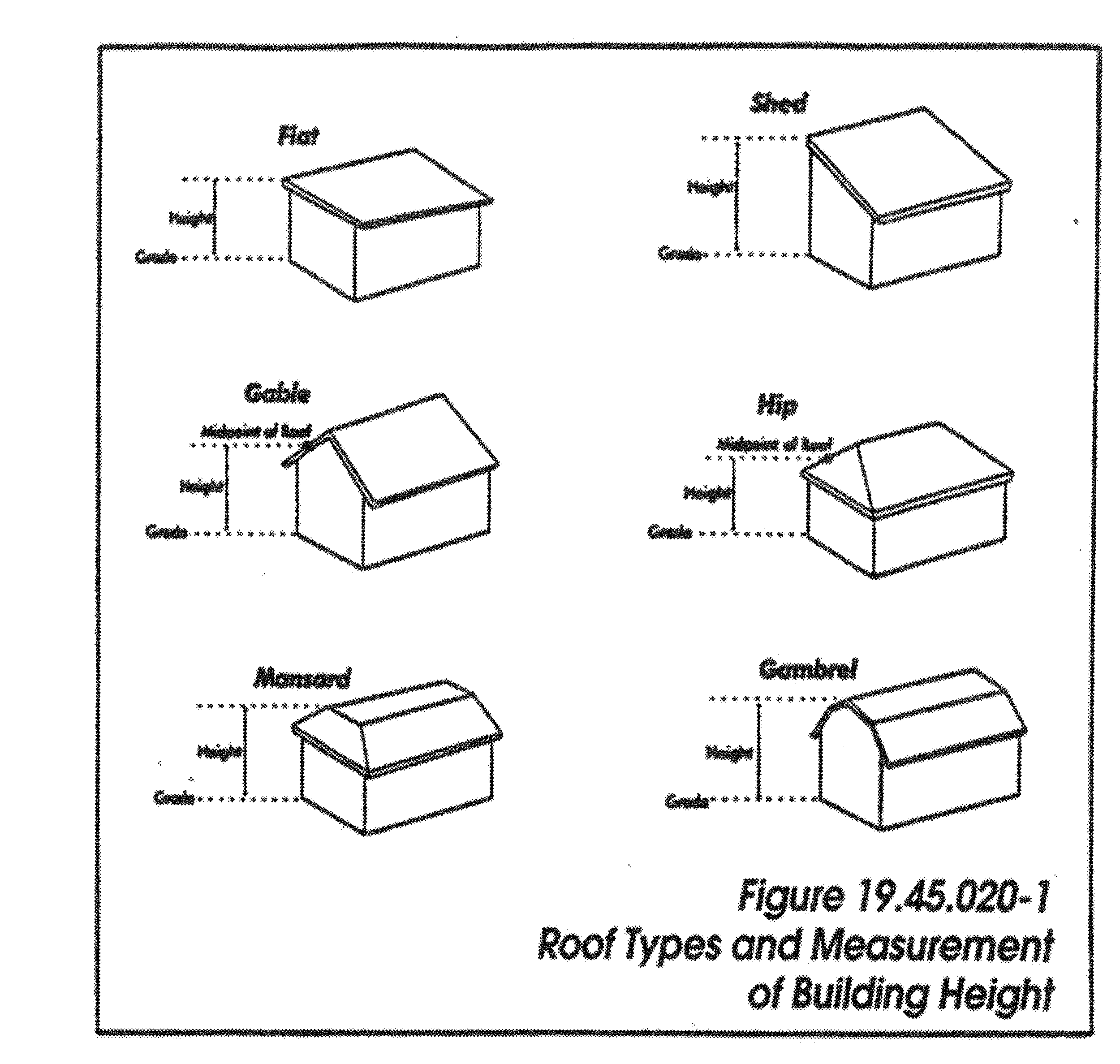
"Building height" means the vertical distance of a building measured from the average elevation of the finished grade to the roof point indicated in Figure 19.45.020-1.
Building, Main, Principal, or Primary. "Main, principal or primary building" means the building on a lot that contains the primary use of the lot as permitted by this Title 19. See "Principal building/structure."
"Building setback line" means a line within a lot, as determined under the standards of this Title 19, that delineates the area between this line and the street centerline within which no buildings or portions thereof can be located.
"Bulk storage" means the warehousing of materials or finished goods in an enclosed structure.
"Bumper guard" means a low fence or pole placed at the front of a parking stall to prevent vehicles from rolling forward.
"Business" or "commerce" means the purchase, sale, or other transaction involving the handling or disposition of an article, service, or product for livelihood or profit; the management of business facilities such as office buildings, offices, or recreational or amusement arcades.
"Business frontage" means that portion of a building frontage occupied by a single business tenant having a public entrance within the building frontage.
(Ord. 609 § 4, 2007; Ord. 544 § 1(part), 2000).
19.45.040 - "C" Definitions.
"Camper" means a structure, mounted on wheels or on a motor vehicle, that provides facilities for camping or temporary living quarters.
"Canopy" means a roof-like structure that projects from the wall of a building for the purpose of shielding a doorway or window from the elements.
"Canopy structure" means a freestanding exterior shade structure that consists of a cover made from canvas, fabric, plastic, rubber, nylon acetate or other pliable material that is fitted over a freestanding metal, plastic or PVC frame.
"Card club" means a business or enterprise licensed by the city where legal gaming is conducted. See also "Gaming or gambling establishment."
"Carport" means a permanently roofed structure with no more than two enclosed sides that is used for automobile storage and shelter, including structures used for the protection and convenience of loading and unloading passengers or cargo.
"Car wash" means an establishment providing facilities for the washing of motor vehicles that is open to the public, including, but not limited to full automated tunnel car washes, automated coin or token operated car washes, automated (program selector) code number generated car washes, hand car washes, one-half automated and one-half hand car washes and indoor car washes.
Car Wash, Mobile. "Mobile car wash" means a vehicle with a water transportable treatment system approved by the Los Angeles County Waste Management Division.
Car Wash, Self-service. "Self-service car wash" means a car wash wherein the customer provides labor and where no self-propelled wash racks are provided, including but not limited to, self-service (coin/token operated) car washes.
Car Wash, Temporary. "Temporary car wash" means a car wash event that is not intended to serve as the primary use of the lot, and takes place within a limited time period.
Casino. See "Card club."
Cellar. See "Basement."
"Cemetery" means any property used for the burial or interment of the dead, including crematories, mausoleums, columbaria, mortuaries, or chapels operated in connection with and located within the cemetery grounds.
"Change of use" means a transition from one business or occupancy within a structure or leasable space to another business or occupancy.
"Child care center" means a day care facility not conducted in a residence in which nonmedical care and supervision is provided for children between the ages of two and eighteen in a group setting on a less than twenty-four-hour basis. See also Day Care Home, Large Family, and Day Care Home, Small Family for other types of care facilities.
"Child care facility" means a child day care facility other than a family daycare home including, but not limited to, infant centers, preschools, extended day care facilities, and school age child care centers.
"Child care nursery" means a child care center for children less than two years old.
"Church" means any property used for regular religious worship and related activities, maintained and controlled by a religious body organized to support public worship.
"Clinic" means an organized outpatient health facility for human patients who remain therein less than twenty-four hours.
Club, Private or Public. "Private or public club" means a building or premises used by an incorporated or unincorporated group of persons organized for the purposes of promoting literature, science, politics, good fellowship, or other common cause, excluding services customarily carried on as a business.
"Common interest development" bears the same meaning as defined in Section 1351 of the California Civil Code.
"Community care facility" means any facility, place, or building which is maintained and operated to provide nonmedical residential care, day treatment, adult day care, foster care, or agency services to children and/or adults including, but not limited to, physically handicapped, mentally impaired, the mentally incompetent, substance abusers, battered persons, and abused or neglected people.
"Community garden" is a piece of land, public or private, where plants are grown and maintained by a group of individuals in the community. Community gardens may produce food for individual consumption or food for sale, may be designed for beautification of the community, and/or may be used for educational purposes.
"Conditional use" means a use permitted on a particular site and within a zone only upon a finding that such use in a specified location will comply with all the conditions and standards for the location or operation of such use as specified in this Title 19 and authorized by the city council.
"Conditional use permit" means an approval that is required for a use to be carried out in a particular zone that is not a use permitted by right.
"Condominium" means the interior airspace of two or more dwelling units that are individually owned and where the balance of the property is owned in common by the owners of the units.
"Construction" means the assembly, erection, substantial improvement, alteration, or similar action of a building or structure. This excludes demolition, but includes excavation, fill or drainage work, and similar activities.
"Contiguous" means adjoining; one or more parcels having a common boundary or lot line.
"Contour" means a line drawn on a plan that connects all points of equal elevation above or below a known or assumed reference point.
Control Valve, Automatic. "Automatic control valve" means a valve in the irrigation system that is activated by an automatic electric or hydraulic controller.
"Controller" means an automatic, enclosed timing device that signals automatic valves to open and close on a pre-set program.
"Convalescent home or hospital" means a state-licensed facility that provides long-term nursing, dietary, and other medical services, except surgery or primary treatments customarily provided in a hospital, to convalescents or invalids.
"Cooperative apartment project" means a residential project on a parcel of land where owners have an undivided interest in the land and structure and rights to the exclusive occupancy of apartments on site.
"Corner cut-off" means a triangular area of a corner lot at a street intersection that is formed by the front and side lot lines and a diagonal line between them. For rounded corners, the front and side lot lines are extended to form the corner cutoff.
"Court" means an unoccupied, uncovered area bounded on two or more sides by the exterior walls of a building. If all sides of a court are bounded by the exterior walls of a building, the court is considered an inner court.
Coverage. See "Lot coverage."
"Cul-de-sac" means the turnaround at the end of a dead-end street.
"Curb cut" means the opening along the curb line at which point vehicles may enter or leave a roadway.
"Cycle" means in irrigation, the complete operation of a controller station.
(Ord. 544 § 1(part), 2000).
(Ord. No. 628, § 1, 10-19-2010; Ord. No. 656, § 10 (Exh. G), 11-19-2013)
19.45.050 - "D" Definitions.
Day Care Center. See "Child care center."
Day Care Home, Large Family. "Large family day care home" means a residential home that is licensed by the State of California as a large family day care home to provide family day care, in the provider's own home, of up to fourteen children, including children under the age of ten years who reside at the home.
Day Care Home, Small Family. "Small family day care home" means a residential home that is licensed by the state of California to provide family day care, in the provider's home, of up to eight children, including children under the age of ten years who reside at the home.
Day Nursery. See "Child care nursery."
"Decibel" ("db") means a unit or level that denotes the ratio between two quantities that are proportional to power; the number of decibels corresponding to the ration of two amounts of power is ten times the logarithm to the base 10 of this ratio.
Deck, Raised. See Patio, Elevated.
"Dedication" means the giving of property for the purpose of providing public improvements consistent with approved city master plans or capital improvement programs.
"Demolition" means the dismantling, intentional destruction or removal of structures, utilities, public or private right-of-way surfaces, or similar property.
"Density" means the total number of permanent residential dwelling units per acre of land, exclusive of all existing public streets and rights-of-way.
"Density bonus" means a density increase over the otherwise allowable zoning maximum residential density on a site as of the date of application by the applicant to the city, granted pursuant to this article. See Section 19.07.150.
"Density bonus units" means dwelling units granted pursuant to Section 19.07.170 which exceed the otherwise allowable zoning maximum residential density for a housing development.
"Department store" means a retail facility that sells clothing, appliances, furniture, or other household items through a variety of separate departments, owned by a single corporate entity and operated entirely within one building or structure as one commercial use.
"Development" means a manmade change to a piece of real property that involves the construction, reconstruction, alteration, or removal of a building or structure, including mining, dredging, filling, grading, paving, excavation, or frilling operations.
Development Standards. See Standards, Development.
"Director" means the director of the community development department of the City of Commerce.
Distribution Center. See "Warehouse."
"Driveway" means a private roadway or access way providing vehicular access to a parking space, parking lot, garage, or other parking area.
Drug Store. See "Pharmacy."
Duplex. See Dwelling, Two-Family.
"Dwelling" or "dwelling unit" means any building or portion thereof designed for living and sleeping purposes that contains independent cooking and sanitation facilities.
Dwelling, Multiple-family. "Multiple-family dwelling" means a building or a portion thereof containing three or more dwelling units designed for the independent occupancy of three or more households.
Dwelling, Second Unit. "Second unit dwelling" means an attached or detached accessory dwelling unit in the R-1 zone that provides independent living facilities for one or more persons, and which was added to the parcel sometime after construction of the primary residence on that lot was completed.
Dwelling, Single-family. "Single-family dwelling" means a detached building containing no more than one dwelling unit which, regardless of form of ownership, is designed and/or used to house not more than one household, including all domestic employees of such household.
Dwelling, Two-family. "Two-family dwelling" means a building containing two dwelling units designed for the independent occupancy of two households.
(Ord. 544 § 1(part), 2000).
(Ord. No. 656, § 10 (Exh. G), 11-19-2013)
19.45.060 - "E" Definitions.
"Easement" means a portion of a lot that is reserved or used for utility rights-of-way, access, or any public or private use, as indicated on a subdivision map, deed restriction, or other recorded document.
Eating and Drinking Establishment. See "Restaurant" and "Tavern."
"Eave" means the projecting lower edges of a roof overhanging the wall of a building.
Educational Institution, Private. "Private educational institution" means an institution such as a school, college, or university operated for profit that is accredited by the State Board of Education to give academic instruction. See "School."
Educational Institution, Public. "Public educational institution" means an institution such as a school, college, or university supported in whole or in part by public funds that is accredited by the State Board of Education to give academic instruction. See "School."
"Electric distribution substation" means an assembly of equipment that may include microwave facilities that is part of a system of distributing electric power. The facility receives electric energy at a subtransmission voltage and transforms it to a lower voltage before distribution for general consumer use.
"Electric generating facility" means an installation containing prime movers, electric generators, auxiliary equipment, fuel storage, or microwave facilities that converts mechanical or chemical energy into electrical energy.
"Electric transmission substation" means an assembly of equipment that may include microwave facilities that is part of a system for transmitting electric power. The substation receives high voltage electric energy and transforms it to a low subtransmission voltage for large consumption by industrial consumers. The substation also serves as an interchange connection with an electric distribution substation.
"Emergency shelter" means a facility that provides immediate and short-term housing and supplemental services to homeless persons or families. Supplemental services may include food, counseling, and access to social programs.
"Emergency work" means work that is necessary to remedy an existing hazard or to restore property to a safe condition, including work needed to restore utility service.
"Encroachment" means an intrusion on the rights or possessions of another; advancing beyond the proper or prescribed limits as defined under this Title 19.
"Entertainment establishment" means a place of business that provides any form of live performance, exhibition, show, or act, including but not limited to the playing of musical instruments; singing; dancing; performing in a play, sketch, or scene; reciting prose or poetry; or exhibiting any clothing, wearing apparel, or costumes for the purpose of gaining, diverting, or holding the attention of guests, patrons, or invitees. A business or use shall be considered an entertainment establishment if such entertainment is either the primary business conducted on the premises or is provided in conjunction with any other primary business.
"Existing use" means the use of a lot or structure at the time of enactment of this Title 19 or any ordinance amending Title 19.
(Ord. 544 § 1(part), 2000).
19.45.070 - "F" Definitions.
"Facade" means the exterior wall of a building exposed to public view.
"Family" is defined as one or more persons, related or unrelated, living together as a single integrated household in a dwelling unit.
Family Day Care Home. See Day Care Home, Large Family and Day Care Home, Small Family.
"Fence" means an artificially constructed barrier of any material or combination of materials erected to enclose or screen areas of land.
Fill, Solid or Inert. "Solid or inert fill" means noncombustible materials that are insoluble in water and can be used for grading land or filling depressions, including soil, rock, sand, and gravel materials.
"Financial institution" means an establishment or facility for the custody, loan, exchange, or issue of money; for the extension of credit; and for facilitating the transmission of funds.
Finished Grade. See Grade, Finished.
Floor Area, Habitable. "Habitable floor area" means a floor area used for working, sleeping, eating, cooking, or recreation. This does not include areas used exclusively for storage, hallways, and bathrooms.
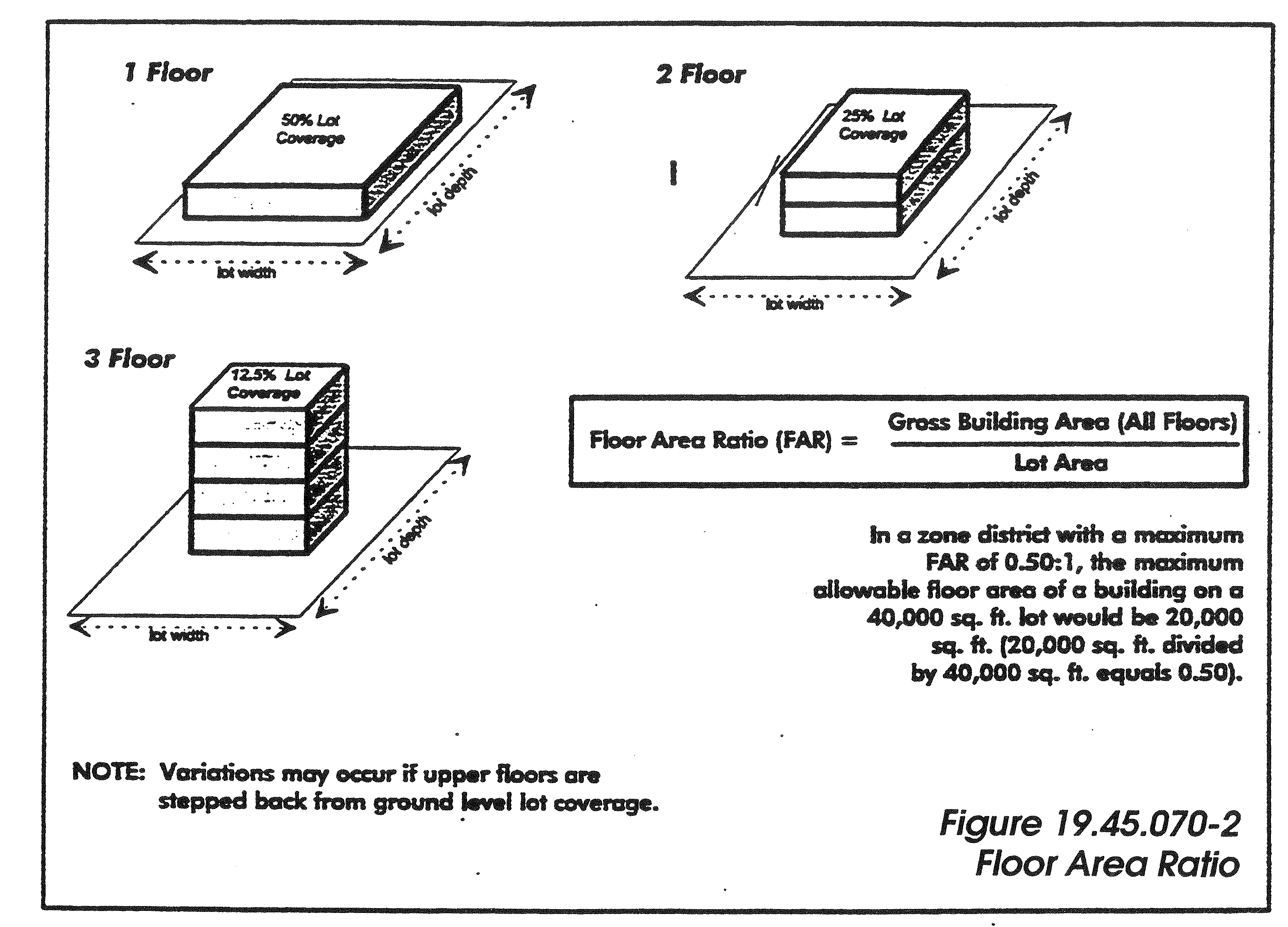
"Floor area ratio" means the total gross area of all buildings on a lot divided by the lot area (FAR). For the purpose of calculating floor area, floor area shall (1) not include exterior courts, garages, carports, elevator shafts, and stairwells; and (2) be calculated based on the exterior faces of walls (see Figure 19.45.070-2).
"Footcandle" means the unit of illumination when the foot is the unit of length.
"Foster home" means a residence used for the twenty-four-hour care of children unrelated to the household but containing no more than six children total, including children related to the household.
"Freeway" means a divided arterial highway for through traffic, with full control of access and grade separations at intersections.
Freeway, Landscaped. "Landscaped freeway" means a section of a freeway in which at least one side of the right-of-way is improved by the planting of ornamental vegetation for soil erosion control, traffic safety, fire hazard reduction, noise abatement, or other reasons.
"Frontage" means that portion of a structure facing a public street and from which the building address is taken.
Frontage Road. See "Service road."
(Ord. 544 § 1(part), 2000).
(Ord. No. 656, § 10 (Exh. G), 11-19-2013)
19.45.080 - "G" Definitions.
"Gaming or gambling establishment" means any premises whereon activities are undertaken involving banking or percentage games played with cards, dice, or any mechanical device or machine for money or property or any representative of value.
Garage, Private. "Private garage" means an accessory building or portion thereof enclosed on all sides designed for the shelter or storage of vehicles owned and operated by the occupants, tenants, or customers of the primary building on the lot.
Garage, Public. "Public garage" means a building other than a private garage where vehicles are sheltered or stored.
"Garment manufacturing" means sewing, cutting, making, processing, repairing, finishing, assembling, or otherwise preparing any garment or any article of wearing apparel or accessories designed or intended to be worn by any individual, including but not limited to clothing, hats, gloves, handbags, hosiery, ties, scarves, and belts, for sale or resale by any person or persons contracting to have the above operations performed.
"General plan" means the general plan of the City of Commerce, adopted pursuant to the State of California Government Code Section 65301 et seq., and adopted by the city council.
Grade, Existing. "Existing grade" means the elevation of the ground surface prior to alteration to accommodate a development project.
Grade, Finished. "Finished grade" means the average of the ground levels at the different midpoints of the exterior walls of a building. If the foundation line of a wall is parallel to and within five feet of a sidewalk, the ground level for that wall shall be measured at the sidewalk.
"Grading" means earthwork performed to alter the natural contours of an area to be planted.
"Grand opening" means a promotional activity not exceeding thirty calendar days used by newly established businesses, within two months of initial occupancy, to inform the public of their location and services available to the community. "Grand opening" does not mean an annual or occasional promotion of retail sales by a business.
"Greenhouse" means a building or structure with predominantly glass roof and walls built for the propagation and cultivation of plants.
"Gross leasable area" means the total floor area for which a tenant pays rent and which is used for the tenant's occupancy and exclusive use.
"Guest room" means a bedroom used by two or fewer guests.
(Ord. 544 § 1(part), 2000).
19.45.090 - "H" Definitions.
"Habitable floor area" means as defined in the building code.
"Hardscape" means decorative elements that may be combined with landscaping to satisfy the landscaping requirements of this Title 19. Hardscape elements include, but are not necessarily limited to, natural features such as rock and stone; and structural features such as fountains, reflecting pools, swimming pools, art works, screens, walls, fences, benches, and crushed granite.
"Hazardous material or waste" means any substance that, because of its quantity, concentration, or physical or chemical characteristics, is flammable, corrosive, explosive, toxic, or infectious, and poses a significant present or potential hazard to the health or safety of humans, domestic livestock, or wildlife, including those materials so defined pursuant to the State Health and Safety Code, Section 25117.1, or the federal government.
"Health club" means a facility that provides equipment or physical space for the conduct of sports, exercise, leisure activity, and recreation, and may also provide space and personnel for health services such as massage, hydrotherapy, and similar personal services. Health club includes sports club, health, spa, bath house, sauna, massage establishment and any similar use providing exercise, spa, and related facilities and services.
Height. See "Building height."
"Heliport" means a licensed helicopter landing area used or designed for receiving or discharging passengers and cargo on a regular basis, including helicopter repair, shelter, storage, or servicing areas and incidental facilities for passengers and cargo.
"Helistop" means a licensed helicopter landing area used or designed for receiving or discharging passengers and cargo on an intermittent basis, including shelter areas for passengers.
Highway, Major. "Major highway" means a state-owned road designated as a major highway in the master plan of highways of the city.
Highway, Secondary. "Secondary highway" means a state-owned road designated as a secondary highway in the master plan of highways of the city.
"Historic district" means an area containing improvements that have a special historical or aesthetic value or that represent an architectural period or style typical of the history of the city, as designated by the cultural resource management commission.
"Historic landmark" means a place, building, structure, work of art, or other object having a special character or historical or aesthetic value within the meaning of California Government Code Section 37361.
"Historic site" means a parcel or part thereof on which a landmark is located, and any abutting parcel constituting the premises of the landmark, as designated by the cultural resource management commission.
"Home occupation" means any commercial activity conducted entirely within a particular dwelling by the inhabitants of that dwelling. Home occupations are incidental uses that do not change the character of the dwelling nor adversely affect permitted uses in adjacent areas.
"Hospital" means a health facility having a duly-constituted governing body with overall administrative and professional responsibility and an organized medical staff which provides 24-hour inpatient care, including the following basic services: medical, nursing, surgical, anesthesia, laboratory, radiology, pharmacy, and dietary services.
Hospital, Mental. "Mental hospital" means a health facility having a duly-constituted governing body with overall administrative and professional responsibility and an organized medical staff that provides twenty-four-hour inpatient care for mentally disordered, incompetent, or other patients referred to in Division 5 (commencing with Section 5000) or Division 6 (commencing with Section 6000) of the State Welfare and Institutions Code, including medical, nursing, rehabilitative, pharmacy, and dietary services.
"Hotel" means a building or group of buildings containing six or more guest rooms, where no more than two rooms or five percent of the total number of rooms have kitchens. Hotels offer transient lodging accommodations to the general public and may or may not provide incidental services such as meals.
"Household income" means the combined adjusted gross household income for all adult persons living in a dwelling unit as calculated for the purpose of the Section 8 program under the United States Housing Act of 1937, as amended, or its successor provision.
Household Pet. See "Domestic animal."
"Housing development" means one or more groups of projects for dwelling units in the planned development of the city. "Housing development" also includes a subdivision or common interest development, as defined in Section 1351 of the California Civil Code, approved by the city and consisting of dwelling units or unimproved residential lots and either a project to substantially rehabilitate and convert an existing commercial building to residential use or the substantial rehabilitation of an existing multifamily dwelling, as defined in subdivision (d) of Section 65863.4, where the result of the rehabilitation would be a net increase in available dwelling units. For the purpose of calculating a density bonus, the dwelling units shall be on contiguous sites that are the subject of one development application, but do not have to be based upon individual subdivision maps or parcels.
"Hydrozone" means a portion of a planted area with plants grouped according to water need.
(Ord. 550 § 14, 2000; Ord. 544 § 1(part), 2000).
(Ord. No. 656, § 10 (Exh. G), 11-19-2013)
19.45.100 - "I" Definitions.
"Improvement" means any construction, building, paving, or landscaping activity which materially adds to the value of a facility, substantially extends its useful life, adapts it to new uses, or enhances its physical attributes.
Improvement, Substantial. "Substantial improvement" means a repair, improvement, or reconstruction of a structure that will cost more than fifty percent of the original structure's market value. For restoration work, the market value is determined before the damage occurred. This does not include alterations needed to comply with state or local health, sanitary, building, or safety codes, or work on structures listed in the national or state register of historic places. The first alteration of any wall, floor, or structural part, even if it does not affect the external parts of the structure, shall be considered the start of substantial improvement.
"Incentives and concessions" are regulatory concessions as listed in Section 19.07.220.
"Infiltration rate" means the rate (inches/hour) in which water moves through soil under natural conditions.
"Institution" means an establishment maintained and operated by a society, corporation, individual, foundation, or public agency for the purpose of providing charitable, social, educational, or similar services to individuals, groups, or the general public.
"Irrigation system" means a complete connection of system components, including the water distribution network, any necessary irrigation equipment, and those portions of the system located downstream from the backflow prevention device.
Irrigation System, Automatic. "Automatic irrigation system" means an irrigation system that can be controlled without manual manipulation and that operates on a pre-set program.
(Ord. 544 § 1(part), 2000).
(Ord. No. 656, § 10 (Exh. G), 11-19-2013)
19.45.110 - "J" Definitions.
"Junk" means any scrap, waste, reclaimable material, or debris, whether or not stored or used in conjunction with dismantling, processing, salvage, storage, baling, disposal, or other use or disposition.
Junk Yard. See "Salvage yard."
(Ord. 544 § 1(part), 2000).
19.45.120 - "K" Definitions.
"Kennel" means any public or private facility where four or more dogs or other domesticated animals are kept, boarded, or trained, with or without the payment of a fee, for the off-premises owners of such animals.
"Kiosk" means a freestanding structure upon which temporary information and/or posters, notices, and announcements are posted.
"Kitchen" means any room or portion of a room used for cooking or food preparation.
(Ord. 544 § 1(part), 2000).
19.45.130 - "L" Definitions.
"Laboratory" means a building or portion of a building that contains facilities for the testing and analysis of a product, person, animal, or part thereof.
"Landscape designer" means a person qualified to practice landscape architecture and/or irrigation design.
"Landscape plan" means a plan for landscaping of a parcel that identifies the location, spacing, number, and container size of all plant materials to be planted, including common and botanical names.
Landscape, Rehabilitated. "Rehabilitated landscape" means any planting area in which fifty percent of existing landscape materials are replaced or modified within any twelve-month period. Examples include a change of plants or ground cover, installation of a new irrigation system, and grading modifications.
"Landscaping" means areas devoted to, or developed and maintained predominantly with, native or exotic plant materials including lawn, ground cover, trees, shrubs, and other plant materials. Landscaping may also include small amounts of accessory decorative outdoor landscape elements (i.e., hardscape) such as pools, fountains, and paved or decorated surfaces, all of which are suitably designed, selected, installed, and maintained to enhance a site.
"Laundromat" means an establishment providing washing and drying machines on the premises for rental use to the general public for the laundering of clothes.
"Live/work development" is a development that provides for a live/work environment with ground floor office/retail/commercial in the same building as a single-family attached or multi-family attached dwelling unit. The ground floor office/retail/commercial area may be used as a separate dwelling unit.
"Loading space" means an off-street space or berth on the same lot as the building(s) it services that is used for the temporary parking of a commercial vehicle while loading or unloading merchandise, materials, or people.
"Lot" means a parcel that is separately owned or has been legally divided from a piece of real property according to the requirements of state law and the Commerce Municipal Code as shown on the recorded plat in the office of the county of Los Angeles.
"Lot area" means the total extent of the surface of a parcel of land within its lot lines as measured on a horizontal plane.
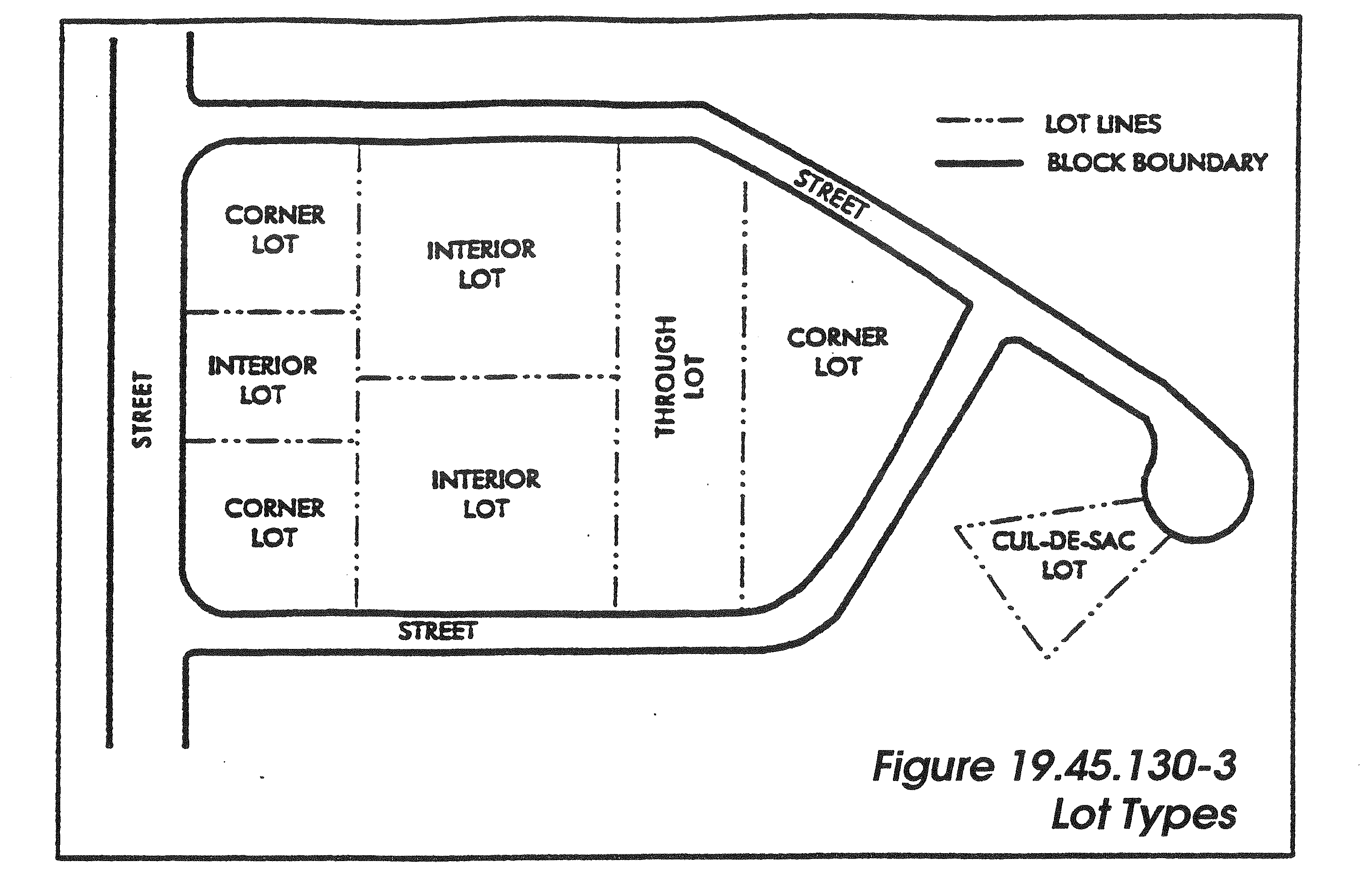
Lot, Corner. "Corner lot" means a lot or parcel of land abutting upon two or more streets at their intersection (see Figure 19.45.130-3).
"Lot coverage" means the percentage of the total lot area that is covered by all the buildings and structures on that lot.
Lot, Cul-de-Sac. "Cul-de-sac lot" means a lot located at any position on the circular portion of a cul-de-sac street.
"Lot depth" means the average distance between the front and rear lot lines measured in the mean direction of the side lot lines.
Lot, Flag. "Flag lot" means a lot with access to a street by means of a private driveway, access easement, or parcel of land with a minimum width of twenty feet.
"Lot frontage" means the length of the defined front lot line measured at the street right-of-way line.
Lot, Interior. "Interior lot" means a lot bounded on one side by a street or easement that the planning commission has determined is adequate for access.
Lot, Key. "Key lot" means an interior lot adjacent to the rear lot line of a reversed corner lot.
Lot, Reverse Corner. "Reverse corner lot" means a corner lot with a side lot line that is substantially a continuation of the front lot line of the key lot that abuts the reversed corner lot.
Lot, Substandard. "Substandard lot" means any lot that does not meet the minimum dimensions required by the Municipal Code.
Lot, Through. "Through lot" means an interior lot that fronts upon two streets that do not intersect at the boundaries of the lot.
Lot Area or Size, Net. "Net lot area or size" means the area within a lot exclusive of any dedications for public rights-of-way, public parks, and public school sites.
"Lot length" means the average horizontal distance between the front and rear lot lines, measured at right angles to the front lot line.
"Lot line" means any line bounding a lot as defined herein.
Lot Line, Front. "Front lot line" means the lot line abutting the street of an interior lot; the shortest lot line abutting the street of a corner lot; any lot line abutting the street of a through lot.
Lot Line, Rear. "Rear lot line" means the lot line opposite and most distant from the front lot line; or in the case of an irregularly shaped lot, a straight line not less than ten feet long entirely within the lot and most nearly parallel to, and at the maximum distance from, the front lot line.
Lot Line, Side. "Side lot line" means any lot line other than the front or rear lot lines.
Lot, Unimproved. "Unimproved lot" means a lot or real property for which the county assessor has determined a zero value for all improvements thereon.
"Lot width" means the average linear distance between the side lot lines measured at the midpoint and at right angles to the line measuring lot depth.
"Low-water-flow irrigation" means a system of watering plant material using drip/trickle, reduced water emitting devices, low precipitation heads, soaker lines, or other similar mechanisms that restricts the amount of water in gallons per minute to allow for deep percolation into the soil. The low water flow irrigation system, combined with watering practices outlined in this zoning ordinance, will reduce water loss through evaporation, wind drift, and overwatering.
"Lower income household" shall have the same meaning as provided in California Health and Safety Code Section 50079.5.
(Ord. 544 §1(part), 2000).
(Ord. No. 656, § 10 (Exh. G), 11-19-2013)
19.45.140 - "M" Definitions.
"Mall" means a shopping center in which stores front on both sides of a pedestrian way and which may be either open or enclosed.
"Manufacture" means to assemble, fabricate, compound, process, treat, or manufacture.
"Market-rate unit" means a dwelling unit which is not an affordable unit or an inclusionary unit.
"Marquee" means any hood, canopy, awning, or permanent construction which projects from a wall of a building.
Master Plan. See "General plan."
Massage Parlor. See "Adult business or entertainment enterprise."
"Maximum residential density" means the maximum number of dwelling units permitted by the zoning ordinance and community development element of the general plan or, if a range of density is permitted, means the maximum allowable density for the specific zoning range and community development element of the general plan applicable to the project. Where the density allowed under the zoning ordinance is inconsistent with the density allowed under the community development element of the general plan, the general plan density shall prevail. The maximum allowable density is based on the date an application for a housing development is deemed complete. This definition is used to calculate a density bonus pursuant to this article.
"Mezzanine" means a partial story between two full stories of structure.
"Mini-mart" means a retail establishment that provides a limited volume of goods and intended to provide quick service.
"Mini-warehouse" means a facility designed and operated for the storage of goods in individual compartments or rooms, which are available for use by the general public on a rental or lease basis.
"Mobile home" means a structure designed to be used without a permanent foundation for single-family detached residential use that has been manufactured pursuant to the National Manufactured Housing Construction and Safety Standards Act of 1974.
"Mobile home space" means a plot of ground within a mobile home park or subdivision designed to accommodate one mobile home.
"Mobile home park or subdivision" means a parcel (or contiguous parcels) of land divided into two or more mobile home lots for sale or rent.
"Moderate income household" shall have the same meaning as provided in California Health and Safety Code Section 50093.
"Modification" means a minor deviation in the requirements of the property development standards (but not permitted uses), as granted by the city in accordance with the procedures set forth in this title when it is determined that the strict enforcement of development standards will cause undue hardship.
"Moratorium" means the legally authorized stay or temporary prohibition on new construction or development.
Motel. See "Hotel."
"Mulch" means shredded or chipped wood from tree branches, tree trunks, uncontaminated wood products, or lumber. This material is often mixed with leaves and grass clippings for optimal effect.
"Multi-family attached dwelling" is a building containing two or more dwelling units and typically two or three stories in height. Examples of multiple-family attached dwellings include apartments, condominiums and multiple-family dwellings.
"Multiple-tenant site or center" means a commercial or industrial development consisting of two or more separate businesses that share either the same parcel or structure and use common access and parking facilities.
"Mural" means a picture painted or otherwise permanently applied directly to an exterior surface of a structure that does not contain any commercial message — either in graphic or written form — related to a business, product, or service.
(Ord. 575 §2, 2003; Ord. 544 §1(part), 2000).
(Ord. No. 656, § 10 (Exh. G), 11-19-2013)
19.45.150 - "N" Definitions.
"Newsrack" means a movable, temporary structure designed and intended for the vending of a single publication.
"Newsstand" means a temporary or permanent structure from which publications are sold.
"Nightclub" means an establishment wherein entertainment is offered or provided and in which the preparation and retail sale of alcoholic beverages are provided.
Noise, Commercial Purpose. "Commercial purpose noise" means the use, operation, or maintenance of any sound-amplifying equipment for the purpose of advertising any business, goods, or services for the purpose of attracting the attention of the public, advertising for, or soliciting patronage or customers for any performance, show, entertainment exhibition, or event for the purpose of demonstrating any such sound equipment.
Noise, Impulsive. "Impulsive noise" means a noise of short duration, usually less than one second, and of high intensity, with an abrupt onset and rapid decay.
Noise, Noncommercial Purpose. "Noncommercial purpose noise" means the use, operation, or maintenance of any sound-amplifying equipment for other than a commercial purpose, including but not limited to philanthropic, political, patriotic, or charitable purposes.
Noise Source, Fixed. "Fixed stationary noise" means a stationary device that creates sound, including but not limited to residential, commercial, and industrial machinery, equipment, fans, compressors, air conditioners, and refrigeration equipment.
"Nonconforming lot" means any subdivision of land that was lawfully established and in compliance with all applicable ordinances and laws at the time the property was subdivided, but which, due to a subsequently enacted ordinance or law, no longer complies with all the applicable regulations and standards of the zone in which the property is located.
"Nonconforming structure" means any structure, building, sign, or improvement that was lawfully established and in compliance with all applicable ordinances and laws at the time it was erected, but which, due to a subsequently enacted ordinance or law, no longer complies with all the applicable regulations and standards of the zone in which it is located.
"Nonconforming use" means a use or activity of land that was lawfully established and in compliance with all applicable ordinances and laws at the time it was undertaken, but which, due to a subsequently enacted ordinance or law, no longer complies with all the applicable regulations and standards of the zone in which the use is located.
"Nuisance" means an act or condition, when performed or existing upon a parcel of land or structure, that is considered dangerous or potentially dangerous to public health, safety, and welfare, degrades the appearance and value of surrounding properties, or can cause damage to public rights-of-way.
Nursery School. See "Day care center."
Nursing Home. See "Convalescent home or hospital."
(Ord. 544 §1(part), 2000).
19.45.160 - "O" Definitions.
"Occupy" means to use, design, build, alter, convert, rent, lease, base, or intend to occupy.
"Off-street improvements" means any property improvements performed outside of the public right-of-way.
Office, Professional. "Professional office" means any building or portion thereof used to provide business services primarily of a professional nature, such as in the fields of law, architecture, design, engineering, accounting, and similar professions.
"Official plan" means a zoning ordinance or amendment thereto adopted by the city council, including a master plan, precise plan, or regulation adopted by the city council as provided in Title VII of the California Government Code.
"Open space" means any undeveloped, uncovered parcel or area of land or water set aside, dedicated, designated, or reserved for public or private use or enjoyment.
Outdoor Display. See "Advertising display."
"Outdoor storage area" means an open area outside a building where merchandise, equipment, or other materials that are not outdoor displays are stored.
"Outlet store" means a retail establishment which sells a single brand or line of goods.
"Overlay zone" means a zone established by ordinance which may be applied to properties only when combined with an underlying zone.
(Ord. 544 § 1(part), 2000).
19.45.170 - "P" Definitions.
"Parapet" means the extension of the main walls of a building above the roof level.
Parcel. See "Lot."
"Parcel map" shall be defined as set forth in the subdivision ordinance, Chapter 25 of the Code of the city of Cypress.
Park, Public. "Public park" means a park, playground, swimming pool, golf course, or athletic field within the city that is under the control, operation, or management of the city, county, state, or other public agency.
Parking Area, Public. "Public parking area" means an off-street area used for the parking of vehicles with or without a fee that is available for public or quasi-public use.
"Parking lot" means an off-street, ground-level area, surfaced and improved, for the temporary storage of motor vehicles.
Parking, Shared. "Shared parking" means parking facilities designed and intended to serve two or more users with peak parking demands occurring during non-overlapping periods.
"Parking space or stall" means a permanent area for the parking of one vehicle designed to meet the minimum dimensions and access requirements established by the city.
Parking Space, Covered. "Covered parking space" means a parking space located within a carport, parking structure, or similar structure that provides protection from the elements in the form of a roof but which does not provide full enclosure or a closing and locking door.
Parking Space, Garage. "Garage parking space" means a parking space provided within an enclosed structure, with a closing and locking door, whose primary use is the storage of vehicles.
Parking Space, Off-Street. "Off-street parking space" means a permanent parking space for a vehicle which is designed to city standards and not located on a dedicated street right-of-way.
Parking Space, On-Street. "On-street parking space" means a parking space for a vehicle which is designed to city standards and located on a dedicated street right-of-way.
Parking Space, Uncovered. "Uncovered parking space" means a parking space located in a designated area which meets the dimension requirements of this ordinance but does not provide any protection from the elements in the form of a carport, parking structure, garage, or other structure.
"Patio cover" means an overhang or roof attached to a building that extends partly or entirely over a courtyard or room used for dining or recreation purposes.
Patio, Elevated. "Elevated patio" means a roofless area above the ground floor in a multiple dwelling structure that is designed for dining or recreation uses.
Performance Standard. See Standards, Performance.
"Permit" means written governmental permission issued by an authorized official, empowering the holder thereof to engage in some activity not forbidden by law, but not allowed without such authorization.
"Permitted use" means any use allowed in a zone by right and subject to the restrictions applicable to that zone.
"Person" means an individual, proprietorship, partnership, corporation, association, or other legal entity.
"Petroleum bulk plant" means premises for the storage and wholesale distribution of gasoline, oil, or petroleum gas; a tank farm or a number of tanks connected to a pipeline and constituting a petroleum terminal.
"Pharmacy" means a business where drugs, medicines, and often sundries are dispensed and sold.
"Planned development" means the planning, construction, implementation, or operation of one or more structures containing one or more land uses in accordance with a detailed, comprehensive plan encompassing such elements as circulation patterns, parking facilities, open space, recreational areas, utilities, and lots or building sites, together with a program for provisions, operation, and maintenance of all areas, improvements, facilities, and services provided for common use of the occupants, tenants, or customers thereof.
"Planning commission" means an appointed body in the City of Commerce authorized to conduct public hearings and render decisions on development applications pursuant to the provisions set forth in Chapter 2.16 of the Commerce Municipal Code.
"Planting area" means the parcel area less building pad(s), driveway(s), patio(s), decks(s), walkway(s), and parking area(s). Planting area includes water bodies (i.e., fountains, ponds, lakes) and natural areas.
"Plot plan" means a scaled and dimensioned drawing of a lot or parcel of land and its immediate vicinity, showing the location and use of all existing and proposed buildings and improvements on site.
"Poultry" means chickens, turkeys, ducks, geese, pigeons, and other fowl.
Pre-school. See "Child care center."
"Preservation" means the identification, study, protection, restoration, rehabilitation, or enhancement of a structure, resource, or landmark.
"Principal building/structure" means the primary or predominant building or structure on a lot. See Building, Main or Primary.
"Principal use" means the primary or predominant use of any lot.
"Processing" means a method that changes the nature of a material, its chemical composition, or its physical qualities.
"Project" means an activity involving the issuance to a person of a permit, license, certificate, or other entitlement.
"Property" means a lot or parcel of land where the owner obtains the right to use the land by virtue of ownership.
"Property frontage" means that side of a lot or parcel of land abutting on a public street.
"Public use" means a use conducted exclusively by a public agency for public health, safety, or general welfare purposes, such as public schools, parks, playgrounds, hospitals, and administrative and service facilities.
(Ord. 544 § 1(part), 2000).
19.45.180 - "Q" Definitions.
Quasi-Public Use. See "Semi-public use."
(Ord. 544 § 1(part), 2000).
19.45.190 - "R" Definitions.
"Rail yard" means a facility involved in the movement, transfer, repair, cleaning, and similar activities for railroad cars, tankers, and engines.
"Recreation facility" means a place designed and equipped for the conduct of sports, leisure time activities, and other customary and usual recreational activities.
"Recycling collection area" means any space allocated for the collection and loading of recyclable materials. The recyclable materials collection function shall only be an accessory use to the primary permitted land use.
"Recycling facility" means a building or enclosed space used for the collection and processing of recyclable materials. Processing includes, but is not limited to, sorting, baling, compacting, grinding, crushing, shredding, cleaning, and remanufacturing.
"Recyclable material" means a reusable material including, but not limited to, metals, glass, paper, waste oil, and plastics which is intended for reuse, remanufacture, or reconstitution.
"Religious institution" means an establishment that is used primarily for religious services and related religious activities.
Residence. See "Dwelling unit."
"Resource recovery station" means any facility for the sorting, handling, and recycling of solid waste to recover materials that may be used for the manufacture of other products, including the reloading of solid waste for off-site disposal.
Repair Garage, Vehicle. "Vehicle repair garage" means any facility that provides both minor and major vehicle engine service and repair or body or frame replacement, repair, or painting services.
Restaurant, Drive-through. "Drive-through restaurant" means an establishment that primarily serves food or refreshments to customers in vehicles or at pedestrian service windows. Such facilities may or may not have dining areas that are incidental to the primary operation of the drive-in restaurant. Also referred to as a fast-food, take-out, or carry-out restaurant.
Restaurant, Sit-down. "Sit-down restaurant" means an establishment where food and drink are prepared, served, and consumed primarily within the principal building.
Rest Home. See "Convalescent home."
"Retail establishment" means any business selling goods, wares, or merchandise directly to the consumer.
"Right-of-way" means a defined area of land, either public or private, on which a right of passage has been recorded.
"Retaining wall" means a structure made of wood, masonry, or concrete designed to hold earth. Retaining walls are normally associated with the preservation of soil stability or with grading necessary to alter the ground level of a property.
"Ringelmann chart" means a chart which illustrates graduated shades of grey, used in estimating the light-obscuring capacity of smoke.
"Ringelmann number" means a number of an area on the Ringelmann Chart that coincides with the light-obscuring capacity of a particular type of smoke.
"Risk management and prevention program" means all administrative and operational programs that are designed to prevent acutely hazardous material accident risks, including but not limited to, programs that include design safety of new and existing equipment, standard operating procedures, preventative maintenance programs, operator training, accident investigation procedures, risk assessment for unit operations or operating alternatives, emergency response planning, and internal or external audit procedures to ensure that these programs are being executed as planned.
"Roof edge" means on a pitched roof, the lowest portion of the facia board covering the roof rafters, or if no facia board exists, the lowest point on the roof rafters. On a flat roof, the top of the parapet wall.
"Roof level" means the uppermost edge of a building wall or parapet, excluding roof structures that cover less than twenty-five percent of the roof area.
Roof Types. Refer to Figure 19.45.020-1 for illustrations of various roof types.
(Ord. 544 § 1(part), 2000).
19.45.200 - "S" Definitions.
"Salvage yard" means any area, lot, parcel, building, or structure, or part thereof, used for the storage, collection, processing, purchase, sale, or abandonment of wastepaper, rags, scrap metal, or other scrap or discarded goods, materials, machinery, or other types of junk. Salvage yard uses also include the baling of cardboard, cardboard boxes, paper, and paper cartons, and areas that store materials from demolished houses, structural steel materials, and equipment.
Sanitarium. See "Convalescent home."
"Satellite dish antenna" means any dish-shaped antenna designed to receive satellite signals for the purpose of telecommunications reception.
"School" means any public or private child care facility or educational institution for minors that offers instruction in those courses of study required by the California Education Code or that is maintained pursuant to standards set by the State Board of Education. Schools include nursery schools, pre-schools, schools with any of the grades kindergarten through twelfth grade, or any special educational institution for minors, but does not include vocational or professional institutions of higher education such as a community college, junior college, college, or university. See "Educational institution."
"Second dwelling unit" is a second permanent dwelling that is accessory to a primary dwelling on the same site. A secondary unit provides complete, independent living facilities for one or more persons, including permanent provisions for living, sleeping, eating, cooking, and sanitation. See Section 19.07.090.
"Secondhand store" means a retail or wholesale business in which the largest portion of the merchandise is secondhand or used.
"Senior citizen housing development" means senior citizen housing as defined in Section 51.3 (a housing development developed, substantially rehabilitated, or substantially renovated for senior citizens that has at least thirty-five dwelling units) and Section 51.12 of the California Civil Code, or a mobile home park that limits residency based on age requirements for housing for older persons pursuant to Section 798.76 or 799.5 of the Civil Code.
"Senior housing" is housing units that are age-restricted for residents aged sixty-two and older.
"Service road" means a road that is part of a highway right-of-way but separated from the highway by means of a median or divider, except at controlled points of access. A service road serves as an access route to property abutting the highway.
"Screening" means a method of visually shielding or obscuring one abutting or nearby structure or use from another by fencing, walls, berms, or densely planted vegetation.
"Semi-public use" means a use owned or operated by a private nonprofit, religious, or charitable institution that provides educational, cultural, recreational, religious, or similar types of programs to the general public.
"Service station" means a building or lot used primarily for the retail sale of motor fuels, but also incidentally supplying goods and services required in the operation and maintenance of motor vehicles and in fulfilling motorists' needs. When the retail sale of gasoline is incidental to the use of a public garage, the premises shall not be considered an automobile service station.
"Setback" means the distance from a defined point or line governing the placement of buildings, structures, parking, or uses on a lot.
"Setback line" means a line within a lot, parallel to and measured from a corresponding lot line, forming the boundary of a required yard and governing the placement of buildings, structures, parking, or uses on a lot.
Shared Parking. See Parking, Shared.
"Shopping center" means a group of commercial establishments planned, constructed, and managed as a total entity, with customer and employee parking provided on-site, and provision of goods delivery separated from customer access.
Sign. Signs are defined as established in Chapter 19.25 (Signs) of this Title 19.
"Single-family attached dwellings" are dwelling units that are structurally connected with at least one other such dwelling unit and typically two or three stories in height. Each unit has its own front and rear access to the outside, no unit is located over another unit, and each unit is separated from any other unit by one or more common fire resistant walls. Examples of single-family attached dwellings include townhomes, rowhouses, and courtyard/cluster housing.
"Single room occupancy" (efficiency) unit, also known as an SRO, means housing consisting of single-room dwelling units typically with no more than four hundred square feet of habitable space that is the primary residence of its occupant or occupants. The unit must contain either food preparation or sanitary facilities (and may contain both). An accessory structure such as a garage, storage room, play room, pool house or rumpus room does not qualify as an SRO.
"Site plan" means a plan drawn to scale, showing uses and structures proposed for a property as required by the applicable regulations, including lot lines, streets, grades, building sites, reserved open space, and other specific development proposals.
"Slope" means the degree of deviation of a surface from the horizontal, usually expressed in percent or degrees.
"Solid waste" means solid waste shall be defined as set forth in Section 40191 of the California Public Resources Code.
"Sound-amplifying equipment" means any machine or device for the amplification of the human voice, music, or any other sound, not including standard automobile radios when used and heard only by the occupants of the vehicle in which the radio is installed, nor warning devices on authorized emergency vehicles, horns, or other warning devices on any vehicle used only for traffic safety purposes.
"Soundtruck" means any motor or other vehicle, whether in motion or stationary, having mounted thereon or attached thereto any sound-amplifying equipment.
"Specific adverse impact" means a significant, quantifiable, direct, and unavoidable impact, based on objective, identified, written public health or safety standards, policies, or conditions as they existed on the date that the application for the housing development was deemed complete. Mere inconsistency with the zoning ordinance or general plan land use designation shall not constitute a specific, adverse impact upon the public health or safety.
"Specific plan" means under Article 8 of the California Government Code 9 Section 65450 et. seq.), a legal tool for detailed design and implementation of a defined portion of the area covered by a general plan. A specific plan may include all detailed regulations, conditions, programs, and/or proposed legislation which may be necessary or convenient for the systematic implementation of any general plan element(s).
Standards, Development. "Development standards" means requirements in this Title 19 that govern building and development, including, but not limited to, lot area, height limits, frontage, landscaping, and floor area ratio.
Standards, Performance. "Performance standards" means requirements in this Title 19 that govern the operation and maintenance of uses in a particular zone.
"Station" means a position on an automatic irrigation controller that indicates the control point of automatic irrigation valves.
"Story" means that portion of a building included between the upper surface of any floor and the upper surface of the floor next above, except that the topmost story shall be that portion of a building included between the upper surface of the topmost floor and the ceiling above.
"Street" means a public thoroughfare or right-of-way, or approved private thoroughfare or right-of-way determined by the city to be adequate for the purpose of access, which affords the principal means of access for abutting property including avenue, place, way, drive, land, boulevard, highway, road, or any other thoroughfare. The word "street" shall include all major and secondary highways, traffic collector streets, and local streets.
Street, Arterial (Major). "Arterial street (major)" means a one hundred-feet wide street that provides regional, subregional, and intra-city travel service.
"Street centerline" means the line representing the midpoint between either side of a street or right-of-way, as established by official surveys or the director of public services.
Street, Collector. "Collector street" means a street that provides circulation in a defined geographic area and connects this area to major arterial and secondary streets and freeways.
"Street frontage" means the lot line adjoining a street or an easement; the length of the lot line that abuts a street or easement.
"Street line" means the boundary line between the street and an abutting lot or parcel of land.
Street, Local. "Local street" means a dedicated street serving as a principal means of access to property, but not a major or secondary highway, or a collector or through industrial street, as designated in the general plan circulation element.
Street, Secondary. "Secondary street" means an eighty-foot wide street designed to function as a major arterial street but carrying a lesser volume of through traffic.
Street Width, Planned. "Planned street width" means the proposed final width of a street right-of-way, as shown in the circulation element of the commerce general plan, the master plan of highways, or as established by an official action of the city.
"Structural alteration" means a change in the supporting framework of a building, such as foundation, bearing walls, columns, beams, floor or roof joists, girders, or rafters; a change in roof or exterior lines of a building.
"Structure" means a building or facility constructed and fixed on the ground, as defined in the Building Code, excluding fences and walls used as fences that are less than seven feet in height.
"Substantially enlarged" means the increase in floor area occupied by the business by more than ten percent of its floor area as it exists on the effective date of this Title 19.
"Sundeck" means an elevated uncovered platform on top of a garage or roof. A sundeck may be supported from below or cantilevered and enclosed with a railing or balustrade.
"Superintendent" means the director of the streets of the city, his assistants and deputies, or any other public officer designated by the city council to perform the duties imposed by Title 9 of the Commerce Municipal Code.
"Supportive housing" means housing with no limit on length of stay, that is occupied by the target population, and that is linked to onsite or offsite services that assist the supportive housing resident in retaining the housing, improving his or her health status, and maximizing his or her ability to live and, when possible, work in the community (per Health and Safety Code Section 50675.14(b)).
(Ord. 544 § 1(part), 2000).
(Ord. No. 656, § 10 (Exh. G), 11-19-2013)
19.45.210 - "T" Definitions.
Tank Farm. See "Petroleum bulk plant."
"Tavern" means an establishment used primarily for the serving of alcoholic beverages to the public, and where food may be served and sold as an accessory use.
"Temporary structure" means a structure without any foundation or footings which will be removed when the permit for the activity, or use for which the temporary structure was erected, has expired.
"Temporary use" means a use established for a fixed period of time with the intent to discontinue such use upon the expiration of the time period.
"Theater" means a building or part of a building devoted to showing films or videos, or for dramatic, musical, or live performances. For adult theater, see "Adult business or adult entertainment enterprise" definitions.
"Theme park" means an entertainment or amusement facility generally built around a theme which may be historic, architectural, or cultural.
Toxic Material or Substance. See "Hazardous material or waste."
Trailer, Automobile. "Automobile trailer" means a vehicle, other than a motor vehicle, designed for carrying persons or property by means of attachment to a motor vehicle.
"Transient" means a person who receives lodging accommodations for a fee, with or without meals, for a period of thirty days or less.
"Transitional housing" and "transitional housing development" means temporary rental housing intended for occupancy by homeless individuals or families transitioning to permanent housing that is operated under program requirements calling for the termination of assistance and recirculation of the assisted unit to another eligible program recipient at some predetermined future point in time, which shall be no less than six months (per Health and Safety Code Section 50675.2(h)).
"Truck terminal" means premises used for the parking, service, repair, or storage of trucks, including storage areas for rental and leasing purposes, not including areas used for the incidental parking, service, repair, or storage of trucks owned by the owners of the principal building or lot and used in connection with the business being carried on in the principal building.
"Turf" means a surface layer of earth containing grass with its roots.
(Ord. 544 § 1(part), 2000).
(Ord. No. 656, § 10 (Exh. G), 11-19-2013)
19.45.220 - "U" Definitions.
"Use" means the purpose for which land or a building is used, arranged, designed, intended, occupied, or maintained.
Utility, Public or Private. "Public or private utility" means any regulated agency which, under public franchise or ownership, or under certificate of convenience and necessity, provides the public with electricity, gas, heat, steam, communication, rail transportation, water, sewage collection, or other similar service.
"Utility service yard" means a building or premises where an public or private utility office, warehouse, storage yard, or maintenance facility is located.
(Ord. 544 § 1(part), 2000).
19.45.230 - "V" Definitions.
"Variance" means permission to depart from a provision of this ordinance when, due to special circumstances applicable to a property, strict application of the requirements deprives such property of privileges enjoyed by other identically zoned property in the vicinity. See Division 8, Chapter 19.39.
"Vehicular storage yard" means any area, lot, parcel, building, structure, or part thereof, used for the storage, collection, or abandonment of motor vehicles.
"Very low income household" shall have the same meaning as provided in California Health and Safety Code Section 50105.
"Veterinary clinic" means a facility where animals or pets are given medical aid and care. This includes incidental facilities such as kennels, areas where animals are boarded, and facilities for clipping, bathing, and other services.
"Visible" means capable of being seen by a person with normal vision and without visual aid.
"Visual obstruction" means one or more objects such as fences, hedges, trees, shrubs, or walls that impede visibility.
(Ord. 544 § 1(part), 2000).
(Ord. No. 656, § 10 (Exh. G), 11-19-2013)
19.45.240 - "W" Definitions.
"Wall" means a physical barrier with fifty percent or more of its vertical surface preventing the passage of light, air, and vision on a horizontal plane.
"Warehouse" means a building or portion thereof used for the shipping, receiving, storage, or wholesaling of goods and merchandise and any incidental or accessory activities. An area where goods are processed, manufactured, or serviced, or where equipment for rent or lease is stored is not considered a warehouse.
"Wheel stop" means a concrete barrier, at least six inches in height, that is place at the front of a parking stall to prevent vehicles from rolling forward.
"Wholesale" means the sale of goods by bulk for resale purposes and not for direct consumption.
"Window" means an opening which is an a wall of a building, designed to allow light and/or ventilation into the building, enclosed by easement or sash, and containing glass or other similar transparent or semi-transparent material.
"Window area" is computed by calculating each window pane or panel. The area shall be separate for each building face, and for each window. A group of window panes or panels may be considered one window if they are adjoining on the building face and are less than six inches apart.
"Wrecking yard" means premises registered under the state Vehicle Code to conduct the dismantling or destroying of vehicles, including any areas used for buying, selling, storing, or dealing in dismantled, partially dismantled, or wrecked vehicles or their component parts.
(Ord. 544 § 1(part), 2000).
19.45.250 - "X" Definitions.
Reserved.
(Ord. 544 § 1(part), 2000).
19.45.260 - "Y" Definitions.
"Yard" means an open space on a developed lot that, except as otherwise provided for in this Title 19, is unoccupied or unobstructed from the ground upwards.
Yard, Front. "Front yard" means the open space extending across the full width of the front of the lot, the depth of which is the horizontal distance between the front lot line and a line parallel thereto on the lot.
Yard, Rear. "Rear yard" means the open space extending across the full width of the rear of a lot, the depth of which is the horizontal distance between the rear lot line and a line parallel thereto on the lot.
Yard, Required. "Required yard" means the open space between a lot line and the buildable area within which no structure shall be located except as provided in this Title 19.
Yard, Side. "Side yard" means the space between the main building and the side lot line, extending from the front yard to the rear yard; the measured distance of the yard shall represent the shortest distance between the side lot line and that portion of the main building nearest the line from which the measurement is taken.
(Ord. 544 § 1(part), 2000).
19.45.270 - "Z" Definitions.
"Zero lot line" means the location of a building on a lot in such a manner that one or more of the building's walls is situated directly on a lot line.
"Zone" means a specifically delineated area or district within the city in which regulations and requirements uniformly govern the use, placement, spacing, and size of land and buildings.
"Zoning certification" means a written determination by the community development director or his authorized representative that an existing or proposed building, structure, or use complies with all the requirements of this Title 19.
"Zone change" means a legislative act of amending this Title 19 by transferring an area of land from one zone district to another on the official zoning map.
Zone District. See "Zone."
Zoning Map Change. See "Zone change."
Zoning Map, Official. "Official zoning map" means the map or maps which are a part of this Title 19 and which delineate the boundaries of zones.
(Ord. 544 § 1(part), 2000).

