
Council Bluffs City Zoning Code
CHAPTER 15
23 - OFF-STREET PARKING, LOADING AND UNLOADING
15.23.010 Statement Of Intent
This chapter is intended to provide standards on surface paving and design requirements for off-street parking lots and areas, sales lots, loading and unloading areas, personal and recreational vehicle parking, truck terminals, intermodal facilities and storage uses. The lawful use of such existing uses immediately prior to the effective date of the ordinance codified in this chapter may be continued although such designs do not conform to such standards. When any of these items are to be improved, the design shall meet the new requirements within this code.
(Ord. 5532 § 1 (part), 2001)
15.23.020 General Provisions
- All of the applicable provisions contained within this chapter regarding number of spaces, area or usability of existing parking, loading, and unloading spaces or other areas requiring a paved surface, shall be complied with when any of the following actions occur:
- Construction of any new residential and/or non-residential development;
- Building additions, expansions, and/or remodels for existing development:
- Non-residential uses: Any building addition(s), expansion(s), and/or remodel(s) that results an increase in the total number of required off-street parking spaces for a premises by 50% or more; and
- Residential uses: Any addition or remodel that increases the total number of dwelling units on a premises, or any conversion of an existing dwelling into a group care home, boarding, lodging, or rooming house and/or bed and breakfast use.
- Non-residential uses: Any building addition(s), expansion(s), and/or remodel(s) that results an increase in the total number of required off-street parking spaces for a premises by 50% or more; and
- Building additions and/or detached accessory structures that are designed in a manner where they are capable of being used for parking motorized vehicles, recreational vehicles, and/or boats, or which are intended to be used for loading/unloading, warehousing and distributing stored items, materials, and/or products shall be accessed by a hard-surfaced paved driveway in accordance with the standards stated in this Chapter; and
- All off-street parking requirements associated with any special zoning overlay, development plan, or master planned area in the City shall supersede the requirements stated in this Chapter.
- Contractual agreements may be made between uses which generate parking and at different intervals in such a manner that the requirements of more than one use may be met by the same space, provided the parking demand for each use involved is met. All other required parking spaces shall be located a distance not to exceed four hundred (400) feet from the building or use which they are required to serve, measured in a straight line from the building. Off-site parking owned by or affiliated directly with the owner of the use it serves may be located up to one thousand three hundred twenty (1,320) feet from the use it serves, measured in a straight line from the building.
- In the event several uses occupy a structure or parcel of land, the total requirements for off-street parking or loading and unloading spaces shall be the sum of the requirements of the several uses computed separately.
- Parking and loading or unloading spaces shall not be located in a required front yard with the exception of commercial and industrial districts, but may be located within a required side or rear yard.
- All such off-street parking lots and areas, sales lots, apron space and loading and unloading spaces shall be so drained as to prevent damage to abutting properties and/or public streets;
- All off-street parking lots and areas, sales lots and loading and unloading spaces, including entrances, exits and driveway approaches shall be constructed of hard surface concrete, concrete pavers, or asphalt, unless otherwise stated in this chapter, to prevent mud, dust, or loose material. Asphalt grindings and seal coats are not acceptable surfaces. Paving standards contained in this section should be considered minimum standards.
- In non one and two family uses, all parking surfaces, spaces, circulation and aisles along the outer boundaries of a parking lot, vehicle entry paths, apron spaces, all driveways and other traveled areas shall be set back a minimum of five feet from the property line unless required for approved access.
- Barriers must be located for lots over seven thousand five hundred (7,500) square feet in area to contain the parking within the approved parking lot. For parking lots with less than seven thousand five hundred (7,500) square feet in area the following setbacks shall only apply to the side(s) that directly abut public right-of-way. However, appropriate barriers are needed to protect adjacent buildings and structures on a zero setback side.
Barrier Setback from Property Line Setback from Parking Surface A curb at least six inches in height 5 feet 0 Bump rail at least four inches in height 5 feet 3 feet Guardrail barrier of eighteen to thirty (30) inches in height 5 feet 0 Post and cable barrier or bollard and chain of eighteen to thirty (30) inches in height 5 feet 0 Concrete, brick, metal or iron fence of twenty-four to forty-eight inches in height 5 feet 0 - Lighting which illuminates parking lots shall be consistent with CBMC 15.24.050.
- When a computation of required parking spaces results in a fraction of .5 or greater, the requirement shall be rounded up to the next whole number.
(Ord. 5532 § 1 (part), 2001)
Amended by Ord. 6414 on 6/22/2020
Amended by Ord. 6529 on 11/28/2022
15.23.025 Permit Required
No person or entity shall undertake any of the activities required by this chapter unless they have first applied for and received a permit from the building division for the city of Council Bluffs. Fees for these permits shall be established by the city council and set out in CBMC 2.
(Ord. 5532 § 1 (part), 2001)
15.23.030 Design Standards
Off-street parking lot and areas, sales lots, loading and unloading areas storage uses and non one and two family uses shall observe the following design guidelines:
- General Use Parking and Traveled Areas Including All Required and Nonrequired Parking, Driveways, Entrances and Exits, Vehicles or Sales.
- Required Parking and Aisle Widths. Each automobile space shall be not less than one hundred sixty two (162) square feet in area, with dimensions of nine feet by eighteen (18) feet. A maximum of ten (10) percent of required parking can be compact. A compact space shall be one hundred twenty-eight (128) square feet in area, with dimensions of eight by sixteen (16) feet. In addition, there shall be provided adequate entrance and exit driveways to connect each parking space with a street or alley open to use by the public, except where parking of vehicles by attendants is provided.
Type Minimum Aisle Width Two-way angled parking 18 feet Two-way perpendicular parking 24 feet One-way angled parking 16 feet One-way perpendicular parking 24 feet - Pavement Requirements. Five inches of Portland cement concrete or six inches rock base with four inches of asphalt cement concrete. The standards should be considered a minimum. Actual pavement design shall be based on consideration of traffic loadings, soil support capability and material specifications.
- Lower quality surface materials, such as crushed Portland cement concrete or crushed asphalt cement concrete, may be used for parking, drive aisles, and circulation areas associated with active farming operations, which do not have the appearance or scale of a commercial or industrial farming operation, on properties zoned A-2 with the written approval of the Community Development Director and Public Works Director. All surface materials shall be maintained such that the driving and parking surfaces are fully covered with the approved surface material and do not create any dust or hazardous conditions. The portion of a driveway within public right-of-way shall be hard surfaced to city standards.
- Lower quality surface materials, such as crushed Portland cement concrete or crushed asphalt cement concrete, may be used for parking, drive aisles, and circulation areas associated with active farming operations, which do not have the appearance or scale of a commercial or industrial farming operation, on properties zoned A-2 with the written approval of the Community Development Director and Public Works Director. All surface materials shall be maintained such that the driving and parking surfaces are fully covered with the approved surface material and do not create any dust or hazardous conditions. The portion of a driveway within public right-of-way shall be hard surfaced to city standards.
- Layout/Markings. The developer shall submit to the building official for review and approval a detailed and accurately scaled parking lot layout clearly showing the location of parking spaces and aisles, all conforming to said standards. Upon construction of the parking lot, the parking spaces must be marked on the parking lot surface according to the extent that those spaces are required in connection with the development. Spaces not required for a development need not be marked, or may be marked to lesser standards. Parking aisles should be designed to reduce pedestrian-vehicular conflicts by placing them perpendicular to the structure. Handicapped parking stalls shall be designed and signed as required by Iowa Admin. Code Chapter 18.
- Required Green Space. All parking lots with seven thousand five hundred (7,500) square feet shall meet the following requirements:
- A minimum of five feet of landscaped area is required between a parking surface and the property line.
- The maximum allowable area that can be paved is ninety (90) percent of total lot area.
- A minimum of ten (10) percent of the parking lot area must be landscaped with a permeable surface. Parking lot area is that which is contained within the property line and is adequate for approved parking. This can include the five-foot minimum landscaped setback.
- Adjacent parking lots and access points may have the five-foot landscaped area waived when they are shared. The 90/10 rule for required green space will still apply for each abutting lot. Lots less than seven thousand five hundred (7,500) square feet in area shall have five feet on landscaping on those side(s) which abut public right-of-way and the 90/10 rule is not applicable.
- Screening Requirements. All parking lots shall be screened along the boundary of the parking lot adjacent to residential uses. No screen is required between abutting parking lots. Screening shall conform to the standards in CBMC 15.24.040 Paragraph D.
- Required Parking and Aisle Widths. Each automobile space shall be not less than one hundred sixty two (162) square feet in area, with dimensions of nine feet by eighteen (18) feet. A maximum of ten (10) percent of required parking can be compact. A compact space shall be one hundred twenty-eight (128) square feet in area, with dimensions of eight by sixteen (16) feet. In addition, there shall be provided adequate entrance and exit driveways to connect each parking space with a street or alley open to use by the public, except where parking of vehicles by attendants is provided.
- Tractor/trailer Terminals, Service Centers, Intermodal Operations and Storage Areas, Including but not Limited To: Vehicle Entry Paths, Apron Space, all Driveways and Other Traveled Areas.
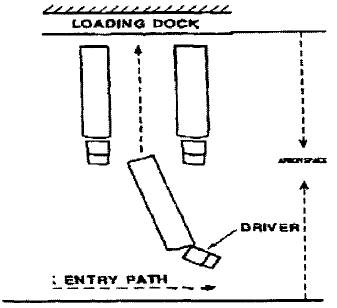
- Surface Layout. The developer shall submit to the building official for review and approval a detailed and accurately scaled hard surface layout clearly showing the location of parking spaces and aisles, truck entry paths, apron space, driveways and other traveled areas, all conforming to the provisions in this section.
- Pavement Requirements. Six inches of Portland cement concrete or six inches rock base with six inches of asphalt cement concrete. The standards should be considered a minimum. Actual pavement design shall be based on consideration of traffic loadings, soil support capability and material specifications.
- Required Green Space. A minimum of five feet of landscaped area is required between a parking lot, loading and unloading spaces and the property line.
- Screening. All parking spaces and aisles, truck entry paths, apron spaces, driveways and other traveled areas shall be screened along the boundary adjacent to residential uses. Screening shall conform to the standards in CBMC 15.24.040 Paragraph D.
- Parking Provisions for Personal Vehicles. All parking in one and two family residential uses shall be parked or stored in the following manner:
- All residential drives, approaches required and nonrequired parking surfaces shall be hard surfaced.
- All required parking spaces shall be a minimum of one hundred sixty two (162) square feet in area, with dimensions of nine feet by eighteen feet (18).
- Pavement Requirements. Four inches of Portland cement concrete or four inches rock base with two inches of asphalt cement concrete. The standards should be considered a minimum. Actual pavement design shall be based on consideration of traffic loadings, soil support capability and material specifications.
- Parking is permitted inside any enclosed structure when the structure otherwise conforms to the requirements of its specific zoning district.
- Parking is permitted outside in the side yard or in the rear yard, behind the required front yard setback and must be contiguous with the primary surfaced driveway;
- Personal vehicles shall not be used for storage of goods, materials or equipment other than those items, which are part of the unit or essential to its immediate use.
- Parking Provisions for Recreational Vehicles and Vessels. Parking and storing of recreational vehicles and vessels in residential zoning districts, as defined in CBMC 15.03, are subject to the following additional regulations. Recreational vehicles or vessels may be parked and stored by its owner on a single lot in a residential district, subject to the following:
- Parking of one recreational vehicle or vessel is permitted outside within the required front yard setback on a hard surface driveway or a hard surfaced pad contiguous with the driveway, provided:
- Space is not available in the side yard, behind the required front yard or there is no reasonable access to either the side or rear yard. A lot shall be deemed to have reasonable access to the rear yard if terrain permits and access can be had without substantial damage to existing large trees or major landscaping. A fence shall not be deemed to prevent reasonable access;
- Parking in an enclosed structure is not possible;
- The vehicle is parked perpendicular to the curb;
- The vehicle may not extend over the public sidewalk or public right-of-way.
- If a recreational vehicle or recreational vessel is equipped with liquefied petroleum gas containers, such containers shall meet all applicable fire safety codes. Any valves must be closed at all times when the vehicle is not being readied for immediate use.
- A recreational vehicle shall not be used or occupied for living, sleeping or housekeeping purposes except that nonpaying guests at a residence may occupy one vehicle, parked or stored consistent with the regulations of this chapter, for sleeping purposes only, for a period not exceeding seventy-two (72) consecutive hours and not more than fourteen (14) days in any calendar year.
- Pavement Requirements. Four inches of Portland cement concrete or four inches rock base with two inches of asphalt cement concrete. The standards should be considered a minimum. Actual pavement design shall be based on consideration of traffic loadings, soil support capability and material specifications.
- Parking of one recreational vehicle or vessel is permitted outside within the required front yard setback on a hard surface driveway or a hard surfaced pad contiguous with the driveway, provided:
(Ord. 5532 § 1 (part), 2001)
Amended by Ord. 6529 on 11/28/2022
15.23.040 Submission Of Plans
A plan drawn to scale and indicating how the off-street parking or loading and unloading requirements are to be fulfilled shall accompany an application for an off-street parking loading and unloading permit. Such plan shall show all elements necessary to indicate fulfillment of such requirements, inclusive of the following:
- Delineation of individual parking and loading spaces;
- Circulation area necessary to serve spaces;
- Ingress and egress;
- Material specifications and locations for paving, barriers, lighting and landscaping;
- Dimensions, continuity, and substance of screening;
- Grading, drainage, surfacing, and subgrading details;
- Delineation of obstacles to parking and circulation in finished parking areas;
- Specifications as to signage.
(Ord. 5532 § 1 (part), 2001)
15.23.050 Completion Time For Off Street Parking, Loading And Unloading Areas
Required parking lots and areas, sales lots, loading and unloading areas, personal and recreational vehicle parking, truck terminals and intermodal facilities shall be improved as required and made available for use before the final inspection is completed by the building official. An extension of time may be granted by the building official provided a performance bond or its equivalent is posted, equaling the cost of completing the improvement as estimated by the building official.
(Ord. 5532 § 1 (part), 2001)
15.23.060 Parking Spaces Required
The number of off-street parking spaces required shall be no less than as set forth in the following:
| Residential Types: | |
| Boarding, lodging, rooming houses, or bed and breakfasts | ½ space for each rooming unit |
| Dormitories | 1 space each 300 square feet of floor area |
| Dwelling, single-family attached and detached dwelling existing prior to the effective date of the ordinance codified in this chapter | 1 space per dwelling unit |
| Dwelling, single-family attached and detached dwelling, townhouse | 2 spaces per dwelling unit |
| Dwelling, two-family and multifamily | |
| Efficiency and 1 bedroom | 1 space per dwelling unit |
| 2 bedroom or more | 1 ½ space per dwelling unit |
| Government sponsored elderly housing | ½ space per dwelling unit |
| Group care home | ½ space per resident |
| Family home | ½ space per resident |
| Institutional Types: | |
| College/technical schools | 1 space for every 3 full-time equivalent students |
| Correctional placement residence | 1 space per 4 person capacity |
| Cultural service | 1 space per each 500 square feet |
| Detention facilities | 1 space per 4 person capacity |
| Hospitals | 1 ½ spaces for each bed |
| Convalescent and nursing homes | 1 space for every three beds |
| Religious assembly | 1 space per 6 person capacity in the main auditorium |
| Day care services | 1 space for every six children |
| Schools —Elementary and junior high | 2 spaces per classroom |
| Schools —High school | 12 spaces per classroom |
| Places of Public Assembly: | |
| Clubs and lodges | 1 space per 4 person capacity |
| Commercial recreation (indoor) | ½ space per capacity of the occupant load of the facility |
| Public assembly | 1 space per 4 person capacity |
| Sports arena or auditorium | 1 space per 4 person capacity |
| Theaters | 1 space per 4 person capacity |
| Commercial recreation (outdoor) | Parking spaces equal to 50% of the occupant load of the facility |
| Service and Retail Sales: | |
| Agricultural sales and service | 1 space per 1,500 square feet of gross floor area |
| Automobile repair, minor | 1 space per 500 square feet of gross floor area |
| Automobile repair, major | 1 space per 750 square feet of gross floor area |
| Automobile service establishment | 1 space per 750 square feet of gross floor area |
| Automobile sales and leasing | 1 space per 500 square feet of gross floor area |
| Consumer fireworks sale | 1 space per 200 square feet of gross floor area |
| Consumer service establishment | 1 space for every 400 square feet of gross floor area |
| Equipment sales and rental | 1 space for every 400 square feet of gross floor area |
| Financial services | 1 space for every 400 square feet of gross floor area |
| Funeral services | 1 space per 6 person capacity |
| Hotel and motels | 1 space for each guest room |
| Laundry and dry cleaning | 1 space for every 300 square feet of gross floor area |
| Medical and dental offices | 2 spaces for each office, examining room and treatment room |
| Professional offices | 1 space for every 400 square feet of gross floor area |
| Restaurant, general | 1 space for every 150 square feet of gross floor area |
| Restaurant, drive-in or carry-out | 1 space for every 100 square feet of gross floor area |
| Retail sales including grocery stores | 1 space for every 200 square feet of gross floor area |
| Retail sales, including bulky merchandise, household furniture, appliances | 1 space for every 700 square feet of gross floor area |
| Tavern | 1 space for every 100 square feet of gross floor area |
| Veterinary services | 1 space for each office, examining room and treatment room |
| Industrial Types: | |
| Contractor and construction yards | 1 space per employee |
| Laboratories and research facilities | 1 space for every 600 square feet of gross floor area |
| Printing and publishing | 1 space for every 400 square feet of gross floor area |
| Wholesale and distribution | |
| 0 to 25,000 square feet | 5 spaces |
| 25,000 square feet or more | 5 spaces plus 1 for each additional 5,000 square feet above 25,000 |
| Manufacturing | |
| Custom | See Schedule A |
| General | See Schedule A |
| Heavy | See Schedule A |
| Light | See Schedule A |
| Use types not listed: | See Schedule B |
Schedule A: This schedule sets forth minimum off-street parking requirements for uses with elements having different functions or operating characteristics.
| Function of Element | Requirement |
| Office or administrative activity | 1 space per 300 square feet |
| Indoor sales, display or service area | 1 space per 500 square feet |
| Outdoor sales, display or service area | 1 space per 2,000 square feet |
| Equipment servicing or manufacturing | 1 space per 1,000 square feet |
| Indoor or outdoor storage or warehousing | 1 space per 5,000 square feet |
Schedule B: Specific requirements shall be determined by the mayor or designee. Requirements shall be based on needs for similar uses, location of proposed use, expected demand and traffic generated by the proposed use, and appropriate traffic engineering and planning criteria and information. Determination of requirements may be appealed to the zoning board of adjustment.
(Ord. 5532 § 1 (part), 2001) (Ord. No. 6336, § 1, 6-11-2018)
15.23.070 Loading Spaces Required
Any use which involves the receipt or distribution of freight, merchandise supplies, vehicles, or equipment as part of its typical operation shall provide and maintain adequate space for off-street loading. The number of loading spaces required shall be no less than as set forth in the following:
- The following standards shall be used in determining the minimum number of spaces, which will be required:
Number of Spaces Gross Floor Area of the Building in Square Feet None 0 to 5,000 One 5,000 to 20,000 Two 20,000 to 75,000 Three 75,000 to 150,000 Four over 150,000 - All such areas shall be so drained as to prevent damage to abutting properties and/or public streets.
- Driving surfaces of off-street loading spaces shall be surfaced according to CBMC 15.23.030 Paragraph B,2.
- Loading and unloading berths shall each contain at least three hundred fifty (50) square feet measuring ten (10) feet in width and thirty-five (35) feet in length, and shall have a clearance of at least fourteen (14) feet.
- Off-street loading spaces may not be located in any required yard adjacent to a residential district.
- Circulation and access to loading spaces must allow maneuvering into or out of the space to occur outside of any public street or right-of-way.
(Ord. 5532 § 1 (part), 2001)
15.23.080 Nuisance Conditions - Improvement
In those areas under purview of this chapter and which on the effective date of the ordinance codified in this chapter, whose premises or private roadways are, which thereafter become adjacent to a paved street or streets or the means of access thereto is a paved alley or driveway, public or private and the premises are being used for public or private for any of the uses described within this chapter. In the event the city building official, after considering and evaluating such factors as the character of the neighborhood of such premises in respect to being improved or unimproved or residential or commercial, the amount and kind of traffic generated by the premises, the extent of such premises, finds and determines that the use of such premises causes air pollution, adverse drainage conditions, or flying or blowing dust, or that the premises are otherwise so conditioned as to be offensive or constitute a nuisance to the occupants or residents of the neighborhood or vicinity of the premises used for the purposes aforesaid shall be permanently improved as proposed in this chapter.
(Ord. 5532 § 1 (part), 2001)
15.23.090 Violations And Penalties
Any person found guilty of a violation of any of the provisions of this chapter shall be subject to the penalty provisions of CBMC 8.02.020. Each day that a violation is allowed to continue shall constitute a separate violation of the provisions of this chapter and may be pursued as a municipal infraction according to the terms of CBMC 1.95 in lieu of criminal prosecution.
(Ord. 5532 § 1 (part), 2001)

