
Council Bluffs City Zoning Code
CHAPTER 15
33 - SIGNS
15.33.010 Intent And Purposes
The purposes of this chapter are: to encourage the effective use of signs as a means of communication in the city; to maintain and enhance the aesthetic environment and the city's ability to attract sources of economic development and growth; to improve pedestrian and traffic safety; to minimize the possible adverse effect of signs on nearby public and private property; and to enable the fair and consistent enforcement of these sign restrictions. The intent of this chapter as more specifically set out is:
- Ensure that the informational needs of sign users are met in a way that is compatible with the surrounding urban environment;
- Improve the legibility, efficiency and graphic design of individual signs;
- Provide for the design, location, and maintenance of signs in a manner that does not endanger public safety, or increase the probability of traffic congestion and accidents;
- Reduce conflict among signs and lights and between public and private information systems;
- Provide flexibility for sign users to communicate effectively within certain standards;
- Recognize the special characteristics of specific areas and the impact of signage on urban environmental design.
(Ord. 5920 § 2 (part), 2007)
15.33.020 Applicability
A sign may be erected, placed, established, painted, created or maintained within the city only in conformance with the standards, procedures, exemptions and other requirements of this chapter. A sign is defined in CBMC 13 as a presentation or representation by words, letters, figures, designs, pictures or color (including its board, metal or other supporting space), publicly displayed upon a building, vehicle, structure, person or parcel of land so as to convey information or give notice about a business, merchandise, service, place, activity, assemblage, solicitation or request for aid or a political idea. The effect of this chapter as more specifically set out is:
- To implement a permit system to allow a variety of types of signs in commercial and industrial zones and a limited variety of signs in other zones, subject to the standards and permit procedures of this chapter;
- To allow certain signs that are small, unobstructive, and incidental to the principal use of respective lots on which they are located, subject to the substantive requirements of this chapter, but without a requirement for permits;
- To provide for temporary signs without commercial messages in limited circumstances in the public right-of-way;
- To prohibit all signs not expressly permitted by this chapter;
- To provide for the enforcement of the provisions of this chapter.
(Ord. 5920 § 2 (part), 2007)
15.33.030 Definitions And Interpretations
Words and phrases used in this chapter have the meanings set forth in this chapter. Words and phrases not defined in this chapter but defined elsewhere in the zoning ordinance or in the building code (CBMC 13) shall have the meanings set forth in the zoning or building code, respectively. All other words and phrases shall have their common, ordinary meanings unless the context clearly requires otherwise. Section headings or captions are for reference purposes only and shall not be used in the interpretation of this chapter.
(Ord. 5920 § 2 (part), 2007)
15.33.040 Compliance And Conflicts
Each sign or part of a sign within the jurisdiction of the city of Council Bluffs, Iowa, must comply with the terms and provisions of this chapter and CBMC 13 "Building Code". In the event of conflicts between or among code sections, the most restrictive of these provisions shall apply.
(Ord. 5920 § 2 (part), 2007)
15.33.050 Computations
The following principles shall control the computation of sign area and sign height:
- Computation of Area of Individual Signs. The area of sign face (which is also the sign area of a wall sign or other sign with only one face) shall be computed by means of the smallest square, circle, rectangle, triangle or combination thereof that will encompass the extreme limits of the writing, representation, emblem or other display, together with any material or color forming an integral part of the background of the display or used to differentiate the sign from the backdrop or structure against which it is placed, but not including any supporting framework, bracing or decorative fence or wall when such fence or wall otherwise meets zoning regulations and is clearly incidental to the display itself.
- Computation of Area of Multi-Faced Signs. The sign area from a sign with more than one face shall be computed by adding together the area of all sign faces visible from any one point. When two identical sign faces are placed back to back, so that both faces cannot be viewed from any point at the same time, and when such sign faces are part of the same sign structure and are not more than forty-two (42) inches apart, the sign area shall be computed by the measurement of one of the faces.
- Computation of Height. The height of a sign shall be computed as the distance from the base of the sign at normal grade to the top of the highest attached component of the sign. Normal grade shall be construed to be the lower of: (A) existing grade prior to construction, or (B) the newly established grade after construction, exclusive of any filling, berming, mounding or excavating solely for the purpose of locating the sign. In cases in which the normal grade cannot reasonably be determined, sign height shall be computed on the assumption that the elevation of the normal grade at the base of the sign is equal to the elevation of the nearest point of the crown of a public street or the grade of the land at the principal entrance to the principal structure on the zone lot, whichever is lower.
- Computation of Maximum Total Permitted Sign Area. The permitted sum of the area of all individual signs (attached, detached and on-premise directionals) on a lot shall be limited to the frontage of the premises along a street or private way. For property with frontage on more than one street, the total frontage shall be calculated as the longest frontage plus one-half the length of all additional frontages.
- For purposes of this chapter, that part of a property line abutting interstate right-of-way, including ramps, shall not be considered street frontage for calculating the maximum total permitted sign area.
- The maximum allowable area of each monument or ground sign face will be measured from the finish grade to the top of the structure and from one end of the structure to the other. The maximum allowable square feet per sign face shall not be greater than each property's linear feet of street frontage, as measured on one adjacent street, or one hundred fifty (150) square feet, whichever is less.
(Ord. 5920 § 2 (part), 2007)
15.33.060 Zoning District Designations
| For purposes of this chapter, agricultural/open space districts shall include the following zoning districts: | |
| A-1 | Open space district |
| A-2 | Parks, estates and agricultural district |
| A-3 | Riverboat docking district |
| For purposes of this chapter, residential districts shall include the following zoning districts: | |
| R-1E | Single-family residential estates district |
| R-1 | Single-family residential district |
| R-1M | Single-family manufactured housing district |
| R-2 | Two-family residential district |
| R-3 | Low density multifamily residential district |
| R-4 | High density multifamily residential district |
| PR | Planned residential district |
| A-P | Administrative-proffesional district |
| For purposes of this chapter, commercial districts shall include the following zoning districts: | |
| C-1 | Neighborhood commercial district |
| C-2 | Commercial district |
| C-3 | Commercial district |
| C-4 | Commercial district |
| PC | Planned commercial district |
| MCR | Mixed commercial residential district |
| For purposes of this chapter, industrial districts shall include the following zoning districts: | |
| P-I | Planned industrial district |
| I-1 | Light industrial district |
| I-2 | General industrial district |
| I-3 | Heavy industrial district |
(Ord. 5920 § 2 (part), 2007)
Amended by Ord. 6400 on 9/9/2019
15.33.070 Prohibited Signs
All signs not expressly permitted in these regulations or exempt from regulation in CBMC 15.33.080 are prohibited in the city. The following signs are prohibited in all zoning districts:
- Signs painted on or attached to rocks, trees, or other natural objects;
- Signs placed on utility poles (e.g., garage sale signs);
- Signs on or over public property and right-of-way unless specifically authorized by the appropriate public agency;
- Signs or sign structures which resemble or conflict with traffic control signs or devices, which mislead or confuse persons traveling on public streets, or which create a traffic hazard;
- Signs or sign structures which create a safety hazard by obstructing the clear view of pedestrians or vehicles, or which obscure official signs or signals;
- Signs which obstruct doors, windows, or public right-of-way;
- Searchlights or beacons;
- Flashing/blinking/pulsating signs;
- Swinging signs with over four feet of ground clearance and/or more than eight feet in height from the ground surface;
- Pennants and streamers, except for grand opening and/or special events by permit only;
- Portable or wheeled signs or signs painted on or attached to parked vehicles or other stationary conveyances where the sign is the primary use of the conveyance;
- Portable swinger signs and "A" frame or sandwich signs;
- Above peak roof signs;
- Off-premises directional signs;
- Inflatable and suspended signs, including tethered balloons, except those allowed by the city during city sanctioned events;
- Abandoned signs;
- Signs in the public right-of-way, except for the following:
- Public signs erected by or on behalf of a governmental body to post legal notices, identify public property, convey public information, advertise community events and direct or regulate pedestrian or vehicular traffic,
- Bus stop signs erected by the transit authority,
- Informational signs of a public utility regarding its poles, lines, pipes or facilities,
- Awnings or projecting signs extending over a public right-of-way as approved through a license to occupy by the public works department.
(Ord. 5920 § 2 (part), 2007)
15.33.080 Exempt Signs
The following signs are permitted in any zoning district and are exempt from the provisions of this title, except as otherwise provided for in CBMC 15.33.070 "Prohibited signs":
- Signs affixed to vehicles and trailers only where the sign is incidental and accessory to the primary use of the vehicle or trailer;
- Signs, not exceeding four square feet in total sign area, which provide direction or instruction to guide persons to facilities intended to serve the public, if such signs contain no advertising of any kind. Such signs include those identifying restrooms, public telephones, public walkways, affiliation with motor clubs, acceptance of designated credit cards and other similar signs providing direction or instruction to persons using a facility, but shall not include those signs accessory to parking areas;
- Flags, emblems and insignia of political, professional, religious, educational or corporate organizations displayed for noncommercial purposes only. Flags of the United States, the state, the city, foreign nations having diplomatic relations with the United States, and any other flag adopted or sanctioned by an elected legislative body of competent jurisdiction, must be flown in accordance with protocol established by the Congress of the United States for the Stars and Stripes. Any flag not meeting any one or more of these conditions shall be considered a banner sign and shall be subject to regulation as such;
- Governmental signs for control of traffic and other regulatory purposes, street signs, warning signs, railroad crossing signs, signs of public service companies indicating danger and aids to service or safety which are erected by, or at the order of a public officer or employee in the performance of the officer's or employee's duties;
- Signs identifying a public facility or public/civic event;
- Traffic control signs on private property, such as stop, yield and similar signs, the face of which meets the Manual on Uniform Traffic Control Devices standards and which contain no commercial message;
- Signs or other materials temporarily displayed on traditionally accepted civic, patriotic or religious holidays;
- Signs which are fully located within the interior of any building intended solely for the information relating to the interior operation of the building in which it is located;
- Signs which are not visible from a public right-of-way or from a property other than that on which the sign is installed;
- Window signs;
- Murals as works of graphic art painted or applied to building walls, which contain no advertising or identification message;
- Freestanding works of public art;
- Ground, monument, or wall signs for on-premise religious assembly or school use only; up to a maximum sign area of thirty-two (32) square feet per sign face;
- Memorials, plaques or tablets, grave markers, statuary, or other remembrances of persons or events that are noncommercial in nature;
- Signs, indirectly illuminated or not illuminated, not exceeding one and one-half square feet in area, identifying the premises and occupant, but not including advertising or commercial matter;
- Street and house numbers;
- Plaques identifying property on the National Register of Historic Places or recognized as a local landmark, landmark site or historic district;
- Temporary signs as defined in CBMC 15.33.090.
(Ord. 5920 § 2 (part), 2007)
15.33.090 Temporary Signs
The following signs are permitted in any zoning district and are exempt from this title except as provided for in CBMC 15.33.070 "Prohibited signs":
- Real estate signs advertising the sale, lease, or rent of a premise subject to the following:
- Maximum of one on-premise real estate sign for each zoning lot except where a lot abuts two or more streets, additional signs, one oriented to each abutting street, shall be permitted,
- Maximum of two off-premise real estate signs per residential listing providing direction or open house information for said listing only,
- Maximum sign area of six square feet per sign face in all agricultural/open space and residential zoning districts,
- Maximum sign area of thirty-two (32) square feet per sign face in all commercial and industrial zoning districts,
- Maximum height six feet from normal grade in all zoning districts,
- All real estate signs shall be removed within seven days of the sale or lease of the premise upon which the sign is located or refers to;
- Construction signs identifying the parties involved in the construction to occur or occurring on the premises on which the sign is placed shall be subject to the following:
- No more than one construction sign for each project or development, except that where a project or development abuts two or more streets, additional signs, one oriented to each abutting street, shall be permitted,
- Maximum of thirty-two (32) square feet per construction sign in all agricultural/open space and residential zoning districts,
- Maximum of one hundred fifty (150) square feet per construction sign in commercial and industrial zoning districts,
- Construction signs shall be located only upon the premise upon which construction is about to occur or is occurring. Such signs may be located in any required yard but shall not extend over any lot line or within fifteen (15) feet of any point of vehicular access from a zoning lot to a public roadway,
- Maximum height is eight feet from normal grade in all zoning districts,
- Construction signs shall be permitted only as accessory to an approved building permit for a project or development,
- Construction signs may be erected and maintained for a period not to exceed sixty (60) days prior to the commencement of construction and shall be removed within fourteen (14) days of project or development completion;
- Political signs announcing political candidates seeking public office, political parties, and/or political and public issues contained on a ballot subject to the following:
- Political signs shall not be placed within a right-of-way, street or on public grounds,
- Maximum size is thirty-two (32) square feet,
- Political signs may be erected or maintained for a period not to exceed sixty (60) days prior to the date of the election to which such signs are applicable is scheduled to occur and shall be removed within seven days following said election;
- Event signs announcing a campaign, drive, activity or event of a civic, philanthropic, educational or religious organization for noncommercial purposes shall be subject to the following:
- The administrative authority shall determine permitted number, area, height, location, and construction of such signs with consideration given to the public safety and the signage reasonably necessary and appropriate for the intended purpose,
- Such signs may be erected and maintained for a period not to exceed thirty (30) days prior to the date of which the campaign, drive, activity, or event advertised is scheduled to occur and shall be removed within three days of the termination of such campaign, drive, activity, or event,
- No more than two permits for such signs shall be issued for the same premises with one calendar year,
- Signs to be erected and maintained for a period not to exceed thirty (30) days and removed within three days of the termination of the activity, service, project, or sale;
- Temporary signs for the advertising of grand openings and special events located on-premise only, under the following conditions:
- Signs shall be limited to nonprojecting wall or attached ground type,
- Signs shall be permitted no more than twice per calendar year per premise with special permit only.
(Ord. 5920 § 2 (part), 2007)
15.33.100 On-Premise Signs - General Provisions
- Wall signs are subject to the following regulations:
- Wall signs shall be mounted to the primary face of the use. A wall sign may not extend beyond the corner of the wall to which it is attached, except where extension permits attachment to another wall sign.
- Wall signs may be placed on the secondary face for corner property or those with dual frontage, when the total does not exceed one hundred fifty (150) percent of the total allowable for attached sign area as calculated by the initial lineal foot frontage measurement.
- A wall sign shall not extend more than thirty (30) inches from the wall to which it is attached.
- A wall sign must be parallel to the wall to which it is attached.
- Wall signs may not cover in whole or in part any wall opening or major architectural feature of the building.
- A wall sign may not extend beyond or above the building's roofline.
- A wall sign attached to a building on its front property line may encroach upon public right-of-way by no more than eighteen (18) inches. Such a wall sign shall provide minimum vertical clearance of nine feet.
- For the purpose of calculating permitted sign area pursuant to this chapter, signs painted on the walls of buildings shall be considered wall signs.
- Where permitted, canopy signs are counted as wall signs when calculating total permitted sign area.
- Projecting Signs. Projecting signs, including blade signs where permitted, are subject to the following regulations:
- The maximum projection of any projecting sign shall be as follows:
- Nine feet over public sidewalks less than twelve (12) feet wide;
- Eight feet over public sidewalks twelve (12) feet wide or more, or over private property.
- A projecting sign may be no closer than two feet from the vertical plane of the inside curb line.
- Each projecting sign must maintain at least the following vertical clearances:
- Nine feet over sidewalks; except that a canopy may reduce its vertical clearance to seven feet, six inches;
- Fourteen (14) feet over parking lots;
- Sixteen (16) feet, six inches over alleys or driveways.
- No projecting sign extending three feet or more from a property line may be located within twenty-five (25) feet of any other projecting sign extending three feet or more from a property line. Projecting signs must minimize visible support structure and may not expose guy wires or cables for structural support.
- Projecting signs extending over the property line into public right-of-way must apply for a license to occupy from the public works department concurrent with the sign permit application. If the public works department does not approve the license to occupy the sign permit shall not be issued.
- The maximum projection of any projecting sign shall be as follows:
- Pole Signs. Pole signs are subject to the following general regulations:
- Pole signs may be used on a premise if the front wall of the building or structure which the sign serves is set back at least twenty-five (25) feet from the right-of-way line of the street, private way, or court to which the sign is oriented.
- Each pole sign must maintain at least the following vertical clearances:
- Nine feet over sidewalks;
- Fourteen (14) feet over parking lots;
- Sixteen (16) feet, six inches over alleys or driveways.
- Pole signs are limited to one per premise, unless otherwise permitted in that zoning district.
- Ground and Monument Signs.
- Ground and monument signs may be used on a premise if the front wall of the building or structure which the sign serves is set back at least fifteen (15) feet from the right-of-way line of the street, private way, or court to which the sign is oriented.
- Ground and monument signs shall be located along the frontage of the premises. On corner lots, the sign may be placed on either frontage.
- Ground and monument signs are limited to one per premise, unless otherwise permitted in that zoning district.
- Roof Signs. Roof signs are subject to the following regulations:
- Where permitted, below-peak roof signs may be used interchangeably with wall signs.
- A below-peak roof sign must be mounted parallel to the wall of the building on which the sign is attached.
- Banners. Banners and cloth signs are subject to the following regulations:
- A banner sign projecting from a building may not exceed the wall height of the building.
- Maximum projection for any banner is five feet, with a minimum clearance of ten (10) feet.
- Maximum size of a banner is the lesser of twice the permitted size of a projecting sign or one hundred twenty (120) square feet.
- Clocks. Clocks are not considered a moving sign for the purposes of this chapter.
- Signs may be illuminated, except as otherwise provided in residential districts subject to the following:
- The surface/face illumination of any sign shall not exceed the levels shown in Figure 1 below for different conditions of ambient light. Prior to the issuance of a sign permit, the applicant shall provide written certification from the sign manufacturer that the light intensity has been preset not to exceed the above illumination levels, and the preset intensity level is protected from end user manipulation by password protected software or other method approved by the chief building official. Such an illuminated sign shall be equipped with a sensor and/or timer or other device to automatically adjust the day/night light intensity levels in accordance with Figure 1 below.
Figure 1 - Maximum Sign Brightness with Varying Ambient Light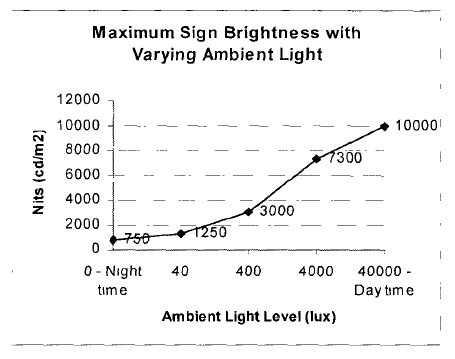
- No sign shall blink or flash, display an animated message, nor be illuminated by any device so as to appear to blink or flash or simulate animation.
- No sign shall move, rotate, revolve, or simulate animation by means of spinning, fluttering, or reflective devices or lighting, except a sign may rotate or revolve at a rate not to exceed six revolutions per minute.
- No message on an electronic changeable copy sign shall be animated. Transition between messages are permitted but such transitions may only fade, scroll, travel, or reveal, and the transition shall not exceed a duration of one second. If the sign area displaying electronic changeable messages is greater than eighty (80) square feet, the message shall hold for at least ten (10) seconds. If said sign area is eighty (80) square feet or less, the message shall hold for at least one second.
- On-premise electronic changeable signs shall be permitted in all commercial and industrial districts. The sign area displaying electronic changeable messages shall not exceed eighty (80) square feet of sign area and such sign area shall be included as part of the maximum permitted sign area for the premises on which it is located.
- The surface/face illumination of any sign shall not exceed the levels shown in Figure 1 below for different conditions of ambient light. Prior to the issuance of a sign permit, the applicant shall provide written certification from the sign manufacturer that the light intensity has been preset not to exceed the above illumination levels, and the preset intensity level is protected from end user manipulation by password protected software or other method approved by the chief building official. Such an illuminated sign shall be equipped with a sensor and/or timer or other device to automatically adjust the day/night light intensity levels in accordance with Figure 1 below.
- Special Signage Conditions. The following special conditions apply to stand-alone ATM's, coffee and other kiosks. Where the use is allowed, this signage is excluded from the calculation for maximum sign area for the premise.
- Stand-alone ATM's may have the following:
- One wall sign on each exterior wall not to exceed ten (10) percent of the applicable exterior wall and not to exceed forty (40) square feet in size.
- Where a canopy is integrated into the ATM, the canopy signs may be placed on each face of the ATM, provided the overall height of the canopy and sign do not exceed twenty-four (24) inches. In addition, the overall area of all canopy signs shall not exceed forty (40) square feet.
- Directional signage shall be contained on the ATM, painted within the drive lane or in any curbing defining a drive lane.
- All signs are subject to the required permitting process of this chapter.
- Signage shall be incorporated into the lighting plan and backlit to provide greater security for the premises.
- Coffee kiosks and other kiosks may have the following:
- One wall sign on each exterior wall not used for drive-up service, provided each wall sign does not exceed ten (10) percent of the applicable exterior wall and the total does not exceed forty (40) square feet in size.
- Where a canopy is integrated into the kiosk, a canopy sign may be placed on each face of the kiosk provided the overall height of the canopy and sign do not exceed twenty-four (24) inches. In addition, the overall area of all canopy signs shall not exceed forty (40) square feet.
- Directional signage shall be contained on the kiosk, painted within the drive lane or in any curbing defining a drive lane.
- Window signs limited to menu boards and daily specials shall not require a sign permit.
- All other signs are subject to the required permitting process of this chapter.
- Stand-alone ATM's may have the following:
(Ord. 5920 § 2 (part), 2007)
15.33.110 Historic Preservation Design Review
Any sign located or to be located at a landmark, landmark site or within a district designated as historic by the council pursuant to CBMC 16 shall also be subject to the review and approval of the historic preservation commission in addition to the requirements of this chapter prior to the issuance of a sign permit pursuant to CBMC 13.
(Ord. 5920 § 2 (part), 2007)
15.33.120 Neighborhood Identification Signs
Ground or monument signs for the purpose of identifying neighborhoods or subdivisions are permitted in any residentially zoned district subject to the following conditions:
- When constructed as a landscaping element in an easement or platted lot, the location and dimensioned site plan for the neighborhood sign shall be submitted with the final subdivision plat for approval. All other neighborhood signs shall be limited to the following criteria.
- Maximum height shall not exceed ten (10) feet from the normal grade.
- Maximum sign area shall not exceed thirty-two (32) square feet per sign face.
- Such signs are placed at an entrance to the neighborhood or development.
- A maximum of two signs may be placed at each entrance to a subdivision or neighborhood.
- The location of each sign shall comply with the regulations for vision-clearance areas consistent with public works standards.
(Ord. 5920 § 2 (part), 2007)
15.33.140 Interstate Oriented Signs
Subject to the maximum sign area limitation of the underlying zoning district, premises located within seven hundred (700) feet of the right-of-way of the National System of Interstate and Defense Highways (i.e., Interstate Highway Systems) which are not separated from the interstate by any other property, shall be allowed the following sign area and height:
- Maximum detached on-premise sign area (including extensions) shall not exceed one hundred fifty (150) square feet.
- Maximum electronic changeable copy sign area shall not exceed one hundred (100) square feet.
- Maximum height for detached on-premise signage is fifty (50) feet.
(Ord. 5920 § 2 (part), 2007)
15.33.150 Agricultural And Open Space District Signs
In addition to the exempt signs in CBMC 15.33.080 and temporary signs in CBMC 15.33.090, the following types of signs are permitted, subject to the following limitations:
- A-1/open space conservation district and A-2/parks, estates and agricultural district signs requiring permits.
- One non-illuminated on-premise sign of either type with maximum area of eight square feet identifying a permitted use in the zoning district.
- Detached ground or monument sign - maximum height - five feet.
- Attached wall sign.
- A-3/riverboat docking district signs requiring permits.
- Any combination of the following sign types with a total permitted sign area not to exceed three hundred (300) square feet.
- Attached wall, awning or canopy signs.
- Detached ground, monument or pole sign, maximum of one per premise and maximum height of fifteen (15) feet.
- On-premise directionals are limited to six square feet per face and maximum height of five feet.
(Ord. 5920 § 2 (part), 2007)
15.33.160 Residential District Signs
Only the exempt signs in CBMC 15.33.080, temporary signs in CBMC 15.33.090 and neighborhood identification signs in CBMC 15.33.120 are permitted in R-1E, R-1, R-1M, R-2 and R-3 districts. In addition to the exempt signs in CBMC 15.33.080, temporary signs in CBMC 15.33.090 and neighborhood identification signs in CBMC 15.33.120, the following types of signs are permitted in the residential districts listed below, subject to the following limitations:
- Additional signage types allowed in R-4/high density multifamily residential, PR/planned residential and AP/administrative professional districts:
- Attached wall, awning or canopy signs;
- Detached ground or monument signs;
- On-premise directionals.
- R-4/high density multifamily residential district sign regulations. In case of conflicts between these conditions, the most restrictive condition shall apply.
- Total permitted sign area shall not exceed forty (40) percent of the longest street frontage of the property. No other street frontage shall apply.
- Attached signage shall not exceed one square foot per lineal foot of the building to which it is attached.
- Detached signs shall not exceed fifty (50) square feet or ten (10) feet in height.
- On-premise directionals shall not exceed three square feet per face and exceed three feet in height.
- PR/planned residential district sign regulations are subject to approval of a planned residential development plan as approved by the city council. In case of conflicts between these conditions, the most restrictive condition shall apply. The following are general guidelines:
- Total permitted sign area shall not exceed forty (40) percent of the longest street frontage of the property. No other street frontage shall apply.
- Attached signage shall not exceed one and one-half square feet per lineal foot of the building to which it is attached.
- Detached signs shall not exceed fifty (50) square feet or ten (10) feet in height.
- On-premise directionals shall not exceed three square feet per face and exceed three feet in height.
- AP/administrative professional district sign regulations. In case of conflicts between these conditions, the most restrictive condition shall apply.
- Total permitted sign area shall not exceed one times the lineal street frontage of the premise. Total street frontage shall be calculated as the length of the longest street and one-half the distance of all other streets, or four hundred (400) square feet whichever is less.
- Attached signage shall not exceed one and one-half square feet per lineal foot of the building to which it is attached.
- Detached signs shall not exceed one hundred (100) square feet or ten (10) feet in height.
- On-premise directionals shall not exceed three square feet per face and exceed three feet in height.
- Any property, or combinations of contiguous properties owned by the same person or entity, that are zoned A-P District and contain a minimum of one and one-half acres of total land area, shall be allowed to adopt a site specific sign plan that is subject to review by the City Planning Commission and approval by City Council.
(Ord. 5920 § 2 (part), 2007)
(Ord. No. 6284, § 1, 2-27-2017)
Amended by Ord. 6392 on 7/8/2019
15.33.170 Commercial District Signs
In addition to the exempt signs in CBMC 15.33.080 and temporary signs in CBMC 15.33.090, the following types of signs are permitted in commercial districts, subject to the following limitations. In case of conflicts between these conditions, the most restrictive condition shall apply.
- Permitted sign types as limited below:
- Detached.
- Ground and monument signs;
- Pole signs;
- Center signs in lieu of pole sign;
- On-premise directionals.
- Attached.
- Wall, awning or canopy signs;
- Below peak roof signs;
- Projecting signs, including blade signs;
- Banners.
- Detached.
- Total permitted maximum sign area is limited as follows. With corner or double frontage premises, additional total sign area is based on the longest abutting street frontage plus one-half of the other length feet of the other street frontage, not to exceed four hundred (400) square feet.
District Maximum Sign Area C-1 1 × street frontage, or 100 sq. ft., whichever is less C-2 2 × street frontage C-3 2 × street frontage C-4 2 × street frontage PC Subject to an approved development plan MCR Subject to an approved development plan - Design Regulations for Detached Signage. If the property lies within the West Broadway design corridor as defined in CBMC 15.33.130 or within seven hundred (700) feet of Interstate right-of-way as defined in CBMC 15.33.140, additional regulations apply.
- Ground or monument signs, maximum of one per premise, exclusive of directional signs, subject to the limitations in CBMC 15.33.100.Unless modified by an approved development plan.
District Maximum Size Maximum Height Maximum Number C-1 1 × street frontage 10 feet 1 per premise C-2 1.5 × street frontage 10 feet 1 per premise C-3 1.5 × street frontage 10 feet 1 per premise C-4 1.5 × street frontage 10 feet 1 per premise PC* 1.5 × street frontage 10 feet 1 per premise MCR* Subject to an approved development plan - Pole signs, maximum of one per premise and subject to the limitations in CBMC 15.33.100. Pole signs are not permitted within the West Broadway design corridor as defined in CBMC 15.33.130.
- Center sign in lieu of a pole sign, maximum of one per premise.1Maximum height shall not exceed fifteen (15) feet within one hundred fifty (150) feet of a residential district.
District Maximum Size Maximum Height Maximum Number C-1 1 × street frontage 15 feet 1 per premise C-2 1.5 × street frontage 25 feet1 1 per premise C-3 1.5 × street frontage 25 feet1 1 per premise C-4 not permitted PC Subject to an approved development plan MCR Subject to an approved development plan - On-premise directional signs, which are included in the calculations for total permitted sign area for the premises, shall not exceed the following in each commercial district:
District Maximum Size Maximum Height Maximum Number C-1 3 square feet 4 feet 2 per entrance drive C-2 4 square feet 6 feet 2 per entrance drive C-3 4 square feet 6 feet 2 per entrance drive C-4 4 square feet 6 feet 2 per entrance drive PC Subject to an approved development plan MCR Subject to an approved development plan - Attached wall, banners, awning or canopy signs.
- Projecting signs, where permitted, are treated as wall signs for calculating maximum sign area. Projecting signs, one per premise are permitted in C-3 and C-4 districts, subject to the limitations in CBMC 15.33.100. Blade type signs are permitted in C-3 and C-4 districts, subject to the limitations in CBMC 15.33.100. Blade signs are the only type of projecting sign which is permitted in a MCR and PC district, subject to an approved development plan.
- Roof signs, below peak only, where permitted, are treated as wall signs for calculating maximum sign area. Below peak roof signs are permitted in C-2, C-3, C-4, MCR and PC districts. They are not permitted in a C-1 district.
District Maximum Sign Area C-1 1.5 square feet per lineal foot of the building to which it is attached C-2 2 square feet per lineal foot of the building to which it is attached C-3 2 square feet per lineal foot of the building to which it is attached C-4 2 square feet per lineal foot of the building to which it is attached PC Subject to an approved development plan MCR Subject to an approved development plan
- Ground or monument signs, maximum of one per premise, exclusive of directional signs, subject to the limitations in CBMC 15.33.100.
(Ord. 5920 § 2 (part), 2007)
Amended by Ord. 6400 on 9/9/2019
15.33.180 Industrial District Signs
In addition to the exempt signs in CBMC 15.33.080 and temporary signs in CBMC 15.33.090, the following types of signs are permitted in industrial districts, subject to the following limitations. In case of conflicts between these conditions, the most restrictive condition shall apply:
- Permitted sign types as limited below:
- Detached.
- Ground and monument signs;
- Pole signs;
- Center signs in lieu of pole sign;
- On-premise directionals.
- Attached.
- Wall, awning or canopy signs;
- Below peak roof signs;
- Projecting signs.
- Detached.
- Total permitted sign area is limited by the following conditions. In case of conflicts between these conditions, the most restrictive condition will apply.
District Maximum Permitted Area P-I* 1.0 x street frontage I-1 1.0 x street frontage I-2 1.0 x street frontage I-3 1.0 x street frontage - Design Regulations for Detached Signage. If the property lies within the West Broadway design corridor as defined in CBMC 15.33.130 or within seven hundred (700) feet of interstate right-of-way as defined in CBMC 15.33.140, additional regulations apply.
- Ground or monument signs, maximum of one per premise, exclusive of directional signs, subject to the limitations in CBMC 15.33.100.* Unless modified by an approved development plan.
District Maximum Size Maximum Height Maximum Number P-I* 1.0 x street frontage 10 feet 1 per premise I-1 1.0 x street frontage 10 feet 1 per premise I-2 1.0 x street frontage 10 feet 1 per premise I-3 1.0 x street frontage 10 feet 1 per premise - Pole signs, maximum of one per premise and subject to the limitations in CBMC 15.33.100. Pole signs are not permitted within the West Broadway design corridor as defined in CBMC 15.33.130.
- Center sign in lieu of a pole sign, maximum of one per premise.1Maximum height shall not exceed fifteen (15) feet within one hundred fifty (150) feet of a residential district.
District Maximum Size Maximum Height Maximum Number P-I* 1.0 x street frontage 35 feet1 1 per premise I-1 1.0 x street frontage 35 feet1 1 per premise I-2 1.0 x street frontage 35 feet1 1 per premise I-3 1.0 x street frontage 35 feet1 1 per premise - On-premise directional signs shall not exceed the following in each industrial district:* Subject to an approved development plan.
District Maximum Size Maximum Height Maximum Number P-I* 8 square feet 8 feet 2 per entrance drive I-1 8 square feet 8 feet 2 per entrance drive I-2 8 square feet 8 feet 2 per entrance drive I-3 8 square feet 8 feet 2 per entrance drive - Attached wall, awning or canopy signs.* Unless modified by an approved development plan.
District Maximum Sign Area P-I* 1.5 square feet per lineal foot of the building to which it is attached I-1 1.5 square feet per lineal foot of the building to which it is attached I-2 1.5 square feet per lineal foot of the building to which it is attached I-3 1.5 square feet per lineal foot of the building to which it is attached
- Ground or monument signs, maximum of one per premise, exclusive of directional signs, subject to the limitations in CBMC 15.33.100.
(Ord. 5920 § 2 (part), 2007)
15.33.190 Off-Premises Signs (Billboards)
This section contains the regulations for signs directing attention to a business, profession, commodity or service which is not located on the same property on which the sign is located. For purposes of this section, off-premises signs shall include billboards, bulletin boards and advertising signs as defined in the sign code as adopted by reference in CBMC 13. Off-premises signs shall be subject to the provisions of this section, notwithstanding any other applicable regulation of the zoning district in which the off-premises sign is located.
- Zoning. Off-premises signs may be placed on property zoned I-1, I-2 and I-3, subject to all other restrictions in this section.
- Spacing
- Unless otherwise provided, no off-premises sign shall be located within a seven hundred (700) foot radius of any other existing off-premises sign whether conforming or not. On-premises signs shall not be counted nor shall measurements be taken from them for the purpose of determining compliance with the off-premises spacing requirements.
- No more than one off-premises sign may be erected at any one sign location, each sign may have not more than two sign faces, provided that:
- The sign faces are oriented in opposite directions; and
- The maximum perpendicular distance between parallel sign faces is five feet; or
- Nonparallel sign faces must be connected at one point and must have an angle of separation no greater than thirty (30) degrees.
- The sign faces are oriented in opposite directions; and
- Unless otherwise provided, no off-premises sign shall be located within a seven hundred (700) foot radius of any other existing off-premises sign whether conforming or not. On-premises signs shall not be counted nor shall measurements be taken from them for the purpose of determining compliance with the off-premises spacing requirements.
- Surrounding Uses
- Off-premises signs shall not be located within a one hundred fifty (150) foot radius of any property in an agricultural or residential zoning district.
- Off-premises signs shall not be located within a one hundred fifty (150) foot radius of any property line of any property occupied by one of the following use types at the time of the installation of the sign:
- Cemetery;
- College and university;
- Cultural Service;
- Park and recreation services;
- Public assembly;
- Religious assembly;
- School.
- Cemetery;
- Siting Limitation.
- Off-premises signs shall not be permitted within seven hundred (700) feet of either side of the Loess Hills Scenic By-Way corridor, the Avenue G corridor (Avenue G from North 8th to North 16th Street), the West Broadway viaduct corridor (West Broadway from 8th to 16th Street), South 24th Street from 23rd Avenue to Highway 275/92, South 35th Street from the Union Pacific railroad trestle (located between 13th Avenue and 14th Avenue) to 23rd Avenue, 23rd Avenue from Indian Creek to South 35th Street and Highway 275 between Interstate 29 and the Iowa-Nebraska border.
- Off-premises signs shall not be permitted within a seven hundred (700) foot radius of any property on the National Register of Historic Places or designated as a local landmark, landmark site or historic district.
- The minimum distance between any two off-premises signs with electronic changeable copy shall be five thousand (5,000) feet measured in all directions.
- Off-premises signs erected on property adjacent to or within the area of the interstate or federal-aid primary road system shall also be subject to the advertising controls of the state of Iowa.
- Off-premises signs shall not be permitted within seven hundred (700) feet of either side of the Loess Hills Scenic By-Way corridor, the Avenue G corridor (Avenue G from North 8th to North 16th Street), the West Broadway viaduct corridor (West Broadway from 8th to 16th Street), South 24th Street from 23rd Avenue to Highway 275/92, South 35th Street from the Union Pacific railroad trestle (located between 13th Avenue and 14th Avenue) to 23rd Avenue, 23rd Avenue from Indian Creek to South 35th Street and Highway 275 between Interstate 29 and the Iowa-Nebraska border.
- Setbacks.
- Off-premises signs shall meet the minimum setback requirements for principal structures in the underlying zoning district.
- No portion of any off-premises sign shall encroach into any required front yard, rear yard, side yard or street side yard.
- Off-premises signs shall not encroach into the vision clearance area as cited elsewhere in this title.
- No portion of any off-premises sign shall project beyond the average distance of the actual building line of all structures along the street frontage in the same block where the off-premises sign is to be located. However, this shall not be construed to require a distance of more than fifty (50) feet from the property line, subject to all other applicable regulations in CBMC 15.33.100.
- No portion of any off-premises sign shall be placed or maintained in such a manner as to cover or obscure the front of any adjacent building or structure fronting on the same street.
- In addition to the other setback limitations, all off-premises signs located along any state or federal highway shall not be placed closer than twenty-five (25) feet from the right-of-way line of such street or highway.
- Off-premises signs shall meet the minimum setback requirements for principal structures in the underlying zoning district.
- Sign Size.
- Off-premises signs up to six hundred seventy-two (672) square feet in area are permitted where the sign face is oriented to interstate traffic, subject to all other provisions of this section.
- Off-premises signs up to a maximum sign area of three hundred (300) square feet are permitted when the sign face is oriented toward any other type of roadway, subject to all other provisions of this section.
- Off-premises signs up to six hundred seventy-two (672) square feet in area are permitted where the sign face is oriented to interstate traffic, subject to all other provisions of this section.
- Height. The maximum height of any off-premises sign shall be forty (40) feet as measured from the natural grade level below the sign to the topmost point of the sign structure.
- Ground Clearance. Off-premises signs shall be no less than five feet above the natural level of the ground upon which it is located, exclusive of foundation.
- Roof Mounted Signs. Off-premises signs shall not be installed upon or against a roof or on top of or above the parapet of any building.
- Animation and Motion. Off-premises signs shall not revolve or rotate. Slow or continuous motion or rotation within a portion of the sign face comprising less than thirty-eight (38) percent of the area of such sign shall be permitted.
- Illumination. Off-premises signs may be illuminated by indirect and internal lighting, subject to the following:
- Signs shall not contain or be illuminated by flashing lights. Neon or incandescent illumination, which is integral to the design of the sign, shall be permitted provided the illumination does not cause glare or impair vision.
- Signs may include electronic changeable copy.
- Lighting shall be shielded to direct light away from streets and surrounding property and shall not cause glare or impair vision when viewed from any public right-of-way.
- Signs shall not contain or be illuminated by flashing lights. Neon or incandescent illumination, which is integral to the design of the sign, shall be permitted provided the illumination does not cause glare or impair vision.
- Conflicts with Traffic Control. Off-premises signs shall not resemble an official marker erected by any governmental body nor shall it obstruct or conflict with the proper functioning of any traffic sign or signal. Off-premises signs shall not create a safety hazard by obstructing the clear view of pedestrians or vehicles.
- Measurement and Design Standards.
- Setback. The setback of the sign is measured from the nearest portion of any part of the sign or sign structure to the property line.
- Sign Size. The sign size is the area including the dimensions of the sign face and the supporting frame surrounding the sign face.
- The supporting structure for each off-premises sign shall be of metal construction.
- Setback. The setback of the sign is measured from the nearest portion of any part of the sign or sign structure to the property line.
- Installation After Approval. Off-premises signs shall be installed within six months of the date of issuance of the sign permit. The permit becomes invalid six months from the date of issue. An extension of time is not permitted. A new application with all fees and reviews is required.
- Sign Maintenance. All off-premises signs shall be continuously maintained in safe structural condition.
- Abandoned Signs. In addition to all other applicable regulations, an off-premises sign which contains no sign copy on all faces for a continuous period of six months shall be considered an abandoned sign and shall be removed. Removal shall include the sign face, along with all of the supporting structure. Removal shall be complete within thirty (30) days of the abandonment.
- Digital signs. A new off-premises electronic changeable copy sign (i.e. digital billboard) may be erected, or the face of an off-premises sign may be changed to an electronic changeable copy sign of equal or lesser face area, subject to the limitations in this chapter and approval of the appropriate sign permit. Conversion of an off-premises sign to an off-premises electronic changeable copy sign shall not be permitted in any zoning district in which off-premises signs are not permitted according to this section.
Amended by Ord. 6565 on 8/28/2023
15.33.200 Design, Construction And Maintenance
All signs shall be designed, constructed and maintained in accordance with the following standards:
- All signs shall comply with all applicable provisions of the building code and the National Electrical Code as adopted elsewhere in the municipal code.
- Except for flags, temporary signs and window signs conforming in all respects with the requirements of this chapter, all signs shall be constructed of permanent material and shall be permanently attached to the ground, a building or another structure by direct attachment to a rigid wall, frame or structure.
- All signs shall be maintained in good structural condition in compliance with all building and electrical codes and in conformance with this chapter at all times.
(Ord. 5920 § 2 (part), 2007)
15.33.210 Signage Plans And Application
- If a sign requiring a permit under the provisions of this chapter is to be placed, constructed, erected or modified, the owner or authorized representative shall secure a sign permit prior to the construction, placement, erection or modification of such sign.
- Modification shall include a change of the sign face while retaining the existing frame or support structure. Off-premises signs are exempt from the permitting requirements for refacing, except for initial placement and any change incorporating electronic changeable copy.
- No permit shall be issued for an individual sign requiring a permit unless and until a sign permit for the lot upon which the sign will be erected has been submitted to the city and approved by the building division as conforming to the requirements of this chapter.
- All signage plans and permit applications shall include the following minimum information:
- Location—address;
- Legal description;
- Inventory of all existing signage on the premises;
- Location and size of all signage being removed;
- Dimensions, including calculated area, of all signage being requested;
- Site plan showing location of detached signage on the property;
- Location of each attached sign and the dimensions of the building to which it will be attached;
- Lettering or graphic style;
- Color scheme;
- Material and lighting;
- Any other criteria as may be required specific to the site or zoning district.
(Ord. 5920 § 2 (part), 2007)
15.33.220 Nonconforming Signs - Legal
- Any sign lawfully existing or under construction on the effective date of this chapter which does not conform to one or more provisions of the municipal code may be continued in operation and maintained indefinitely as a legal nonconforming sign subject to the following:
- Normal maintenance of legal, nonconforming signs, including necessary nonstructural repairs, and incidental alterations which do not extend or intensify the nonconforming features of the sign shall be permitted.
- No structural alteration, enlargement, or extensions shall be made to a legal, nonconforming sign unless the alteration, enlargement, or extension will eliminate the nonconforming features of the sign. If a legal, nonconforming sign is damaged or destroyed by any means to the extent of fifty (50) percent or more of its replacement value at that time, the sign may not be rebuilt or used thereafter unless it conforms to all applicable sign regulations. If the damage or destruction of the nonconforming sign is less than fifty (50) percent of its replacement value at that time, the sign may be rebuilt to its original condition and may continue to be displayed.
(Ord. 5920 § 2 (part), 2007)
15.33.230 Nonconforming Signs - Illegal
- Any sign installed or erected after the effective date of this chapter which does not conform with one or more provisions of the municipal code shall be considered an illegal nonconforming sign.
- An illegal nonconforming sign shall be removed within ten (10) days after receipt of written notice from the building official. If such sign is not removed after the conclusion of said ten (10) day period, the building official is authorized and empowered to declare such sign a nuisance for purposes of this chapter, and to cause the sign to be removed, pursuant to the terms and conditions of CBMC 1.97—Enforcement of Municipal Code and Definitions.
- Any sign installed or placed on public property, except in conformance of this section, shall be forfeited to the public and subject to confiscation. In addition to other remedies in the municipal code, the city shall have the right to recover from the owner or person placing such sign the full costs of removal and disposal of such sign.
(Ord. 5920 § 2 (part), 2007)

