
Council Bluffs City Zoning Code
CHAPTER 15
03 - ZONING DEFINITIONS
15.03.010 Definitions - Zoning
For the purpose of interpreting this title, the following words and terms are defined as set forth in this chapter. Some chapters contain definitions in addition to those listed here. Words and terms that are not specifically defined shall be interpreted to give them the meaning they have in common usage as implied by their context and to give this title its most reasonable application. Words used in the present tense shall include the future. The singular number includes the plural and the plural includes the singular. The word "shall" is mandatory. The word "may" is permissive.
(Ord. 5222 § 1, 1995)
15.03.013 Abutting
Abutting: Having a common boundary for not less than five feet. Land areas separated by a public or private road, highway, street, alley or way, or by a waterway shall be construed as abutting herein.
(Ord. 4465 § 2, 1983)
15.03.015 Accessory Structure
Accessory structure: A structure which is incidental to and customarily associated with the principal use on the same lot. An accessory structure shall be subordinate in area, extent and purpose to the principal building.
(Ord. 5282 § 1, 1996)
15.03.020 Accessory Use
Accessory use: A use which is incidental to and customarily associated with the principal use on the same lot. An accessory use shall be subordinate in area, extent, and purpose to the principal use.
(Ord. 5282 § 2, 1996)
15.03.021 Adult Bookstore
Adult bookstore: An establishment that has a substantial or significant portion of its stock in trade in, or that has a segment or section devoted to the sale or display of, books, magazines or other periodicals, videos, tapes, holographs or holograms, sexually oriented paraphernalia, movies, games, materials, visual images or similar devices, along or in combination with each other, all or any of which are distinguished or characterized by their emphasis on matter depicting, describing, or relating to "specified anatomical areas" or "specified sexual activities" as defined in CBMC 15.03.605 and CBMC 15.03.606, respectively.
(Ord. 4513 § 2, 1983)
15.03.022 Adult Mini Motion Picture Theater
Adult mini motion picture theater: An enclosed building with a capacity for less than fifty (50) persons used for presenting material distinguished or characterized by an emphasis on matter depicting, describing or relating to "specified sexual activities" or "specified anatomical areas," as defined in CBMC 15.03.605 and CBMC 15.03.606, for observation by patrons therein.
(Ord. 4179 § 1 (part), 1976)
15.03.023 Adult Motion Picture Theater
Adult motion picture theater: An enclosed building with a capacity of fifty (50) or more persons used for presenting material distinguished or characterized by an emphasis on matter depicting, describing or relating to "specified sexual activities" or "specified anatomical areas," as defined in CBMC 15.03.605 and CBMC 15.03.606, for observation by patrons therein.
(Ord. 4179 § 1 (part), 1976)
15.03.024 Adult Entertainment Activities
Adult entertainment activities: Includes the following uses, activities or establishments:
- Adult bookstores;
- Adult mini-motion picture theaters;
- Adult motion picture theaters;
- Adult motion picture production;
- Artist-body painting studios;
- Escort services;
- Live dancing or entertainment, such as go-go dancing, strip-tease acts and exotic dancing;
- Modeling studios; and
- Other kindred or related uses, activities or establishments.
(Ord. 5033 § 1, 1991)
15.03.025 Agricultural Sales And Service
Agricultural sales and service: An establishment engaged in the sale of feed, grain, fertilizers, pesticides and other similar goods.
(Ord. 5282 § 5, 1996)
15.03.029 Alcoholic Beverages
Alcoholic beverages: Any beverage which contains alcohol, liquor, spirits, beer or wine, and every other liquid or solid, patented or not, containing alcohol, liquor, spirits, beer or wine, and which is susceptible to being consumed by a human being for beverage purposes.
(Ord. 4695 § 1, 1986)
15.03.030 Alley
Alley: A narrow street, public or private, extending through a block and designed primarily for vehicular service access to the rear or side of property which otherwise abuts on another street.
(Ord. 3968 § 1 (part), 1972)
15.03.033 Amusement Game Machine
Amusement game machine: A coin-operated machine or device which, whether mechanical, electrical, or electronic, shall be ready for play by the insertion of a coin and may be operated by the public for use as a game, entertainment, or amusement, the object of which is to achieve either a high or low score, which, by comparison to the score of other players whether playing concurrently or not, demonstrates relative skill or competence, or indicates in any other way competitive advantage of one player or team over another, regardless of skill or competence. It shall include devices such as pinball machines or any device which utilizes a video tube to reproduce symbolic figures and lines intended to be representative of real games or activities.
(Ord. 4480 § 2, 1983)
15.03.034 Amusement Machine Complex
Amusement machine complex: A group of more than four amusement game machines or other amusement machines, in the same place, location, or premises.
(Ord. 4480 § 3, 1983)
15.03.035 Animal Production
Animal production: The raising of animals or production of animal products, such as eggs or dairy products. Typical uses include grazing, dairy farming and poultry farming. Animal production shall not mean the use of a site of more than five thousand (5,000) square feet as a commercial feedlot for the feeding of livestock or poultry.
(Ord. 5282 § 6, 1996)
15.03.037 Animation
Animation: The movement or the optical illusion of movement of any part of a sign structure, design or pictorial segment thereof, including the movement of any illumination or the flashing, scintillating or varying of light intensity. Animation shall include the automatic changing of all or any part of the facing of a sign, and shall include any sign or part thereof set in motion by movement of the atmosphere. However, animation shall not include time and temperature devices.
(Ord. 4482 § 1, 1983)
15.03.045 Artist-Body Painting Studio
Artist-body painting studio: An establishment or business which provides the services of applying paint or other substance whether transparent or nontransparent to or on the human body while the sexual or genital body parts of the artist or model are not covered by opaque clothing.
(Ord. 4232 § 1 (part), 1978)
15.03.046 Auction
Auction: An establishment, structure, business or location which hosts an auction activity more than three times in any one calendar year.
(Ord. 4534 § 1, 1983)
15.03.046a Auction, Indoor
Auction indoor: An establishment, structure, business or location which hosts an auction activity confined only to an indoor enclosed space more than three times in a calendar year. The use of the outdoor space for the sale or storage of items offered for sale is not permitted. The staging of up to four vehicles being sold at an auction is allowed so long as the staging of the vehicles does not utilize more than one percent of the available parking for the indoor auction and that the staging does not begin more than twenty-four (24) hours before the auction is to begin or continue more than twenty-four (24) hours after the auction has ended. If the business is in a zoning district where it is classified as a conditional use, the applicant must delineate in its conditional use application where the staging area will be located.
(Ord. No. 6142, § 2, 12-12-2011)
15.03.047 Automobile Repair, Major
Major automobile repair: The general repair, rebuilding, or reconditioning of engines and engine parts, collision service, body repair, frame straightening, painting, tire recapping and other similar activities, but excluding dismantling or salvage.
(Ord. 5369 § 1, 1998)
15.03.048 Automobile Repair, Minor
Minor automobile repair: The repair of automobiles and noncommercial trucks including the sale, installation and servicing of parts. Typical uses include muffler shops, auto repair garages, tire sales and installation, wheel and brake shops and other similar activities, but excluding dismantling or salvage.
(Ord. 5369 § 2, 1998)
15.03.048a Automobile Sales And Rental
Establishment or place of business engaged in the storage and display for sale, lease or rental of more than two motor vehicles of any type of trailer (provided the trailer is unoccupied) at any one time and/or a total of ten (10) or more sold, leased or rented during the course of a calendar year and where repair or body work is incidental to the operation of the new or used vehicle sales, leasing or rental. Automobile sales includes all motor vehicle retail sales, leasing or rental, including noncommercial trucks, vans, recreational vehicles, boats, motorcycles or other similar motorized transportation vehicles. The minimum lot area for such an establishment shall be twenty-five thousand (25,000) square feet, except that the minimum lot area shall be fifteen thousand (15,000) square feet for an establishment engaged solely in the sales of motorcycles, motor scooters, all-terrain vehicles and other similar vehicles.
(Ord. No. 6025, § 1, 2-23-2009; Ord. No. 6120, § 1, 1-24-2011)
15.03.049b Automobile Sales And Rental, Indoor
Indoor automobile sales and rental: An automobile sales and rental establishment consisting only of premises on which fully operable noncommercial automobiles, light trucks, motorcycles, mopeds, golf carts, and similar motorized transportation vehicles are displayed for sale or lease within a fully enclosed structure. Such use shall not include any outdoor inventory display or storage areas. No minimum size requirement shall apply to indoor automobile sales and rental uses.
Adopted by Ord. 6518 on 9/12/2022
15.03.049 Automobile Service Establishment
Automobile service establishment: An establishment or place of business engaged in the service of automobiles and related light equipment. Typical uses include minor automotive repair, car washes, service stations, automotive accessory sales and convenience grocery stores with retail gasoline sales.
(Ord. 5369 § 3, 1998)
15.03.050 Basement
Basement: That portion of a building between the floor and ceiling which is partly below and partly above (established) grade, so located, however, that the vertical distance from said grade to the floor below is less than the vertical distance from the grade to the ceiling.
(Ord. 3968 § 1 (part), 1972)
15.03.055 Bed And Breakfast
Bed and breakfast: A dwelling for which transient lodging is provided for roomers for compensation. The number of rooming units shall not exceed six. Rooming units shall not be used for cooking or eating of meals. Meals may be served to overnight guests and private groups by reservation only.
(Ord. 5185 § 1, 1994)
15.03.060 Billboard
Billboard: A structure especially constructed for the display and/or advertising of characters, posters and other materials attached to the surface of such structure and commonly referred to as a poster board together with such other structures of a similar nature on which the advertising or display is painted and which are commonly referred to as paint boards, the area of which is in excess of seventy-two (72) square feet. (See CBMC 3.53.050, Sign Code).
(Ord. 3968 § 1 (part), 1972)
15.03.070 Board Of Adjustment
Board of adjustment: The Board of Adjustment of the City of Council Bluffs, Iowa, as established by the Iowa Code and this title.
(Ord. 3968 § 1 (part), 1972)
15.03.080 Boarding, Lodging, Rooming House Or Bed And Breakfast
Boarding, lodging, rooming house, or bed and breakfast: A roominghouse as defined in CBMC 17.01.
(Ord. 5185 § 2, 1994)
15.03.090 Building
Building: Any structure used or intended for supporting or shelter any human use or occupancy.
(Ord. 5222 § 2, 1995)
15.03.100 Building Code
Building code: The current Uniform Building Code, as adopted by the City of Council Bluffs, Iowa.
(Ord. 3968 § 1 (part), 1972)
15.03.110 Building Official
Building official: The Chief Building Official of the City of Council Bluffs, Iowa.
(Ord. 3968 § 1 (part), 1972)
15.03.113 Business Service Establishment
Business service establishment: An establishment or place of business engaged in the sale, rental, repair of equipment, supplies and material or provision of services to office, professional and service establishments but excluding construction and farm equipment and adult entertainment activities. Typical uses include advertising and public relations firms, building maintenance services, commercial art and photography studios, collection and consumer credit reporting agencies, computer services and data processing, photo copying and reproduction services, office equipment and supply, production facilities for radio, television and motion pictures, medical and dental laboratories, and research and development laboratories.
(Ord. 5369 § 4, 1998)
15.03.114 Business, Professional Office
Business, professional office: Use of a site or premises for business, professional, or administrative offices. General offices are characterized by a low proportion of vehicle trips attributable to visitors or clients in relation to employees. Typical uses include real estate, insurance, state licensed medical professions, legal, architecture and engineering, accounting and other professional offices.
(Ord. 5303 § 2, 1996)
15.03.115 Carport
Carport: A partially enclosed accessory structure attached to the principal building, intended for and used for the parking of the vehicles of the occupants of the premises. A carport shall not be construed to be a porch.
(Ord. 4391 § 1, 1981)
15.03.120 Cellar
Cellar: That portion of a building between the floor and ceiling which is wholly or partly below (established) grade, and so located that the vertical distance from said grade to the floor below is equal to or greater than the vertical distance from said grade to the ceiling.
(Ord. 3968 § 1 (part), 1972)
15.03.125 Cemetery
Cemetery: Land used or intended to be used for the disposal and interment of deceased persons and dedicated for cemetery purposes. The term includes columbaria, crematories and mausoleums when operated in conjunction with and within the boundaries of such cemetery.
(Ord. 5222 § 3, 1995)
15.03.126 Chemical Plant
Chemical plant: A site that manufactures, or otherwise processes chemicals. The general objective of a chemical plant is to create new material by chemical or biological transformation and/or separation of materials from chemicals or chemical byproducts.
(Ord. 5956 § 1, 2007)
15.03.130 City
City: The City of Council Bluffs, Iowa.
(Ord. 3968 § 1 (part), 1972)
15.03.140 City Clerk
City clerk: The City Clerk of the City of Council Bluffs, Iowa.
(Ord. 3968 § 1 (part), 1972)
15.03.150 City Council
City council: The City Council of the City of Council Bluffs, Iowa.
(Ord. 3968 § 1 (part), 1972)
15.03.155 City Planning Commission
City planning commission: The Planning and Zoning Advisory Commission of the City of Council Bluffs, Iowa.
(Ord. 5222 § 4, 1995)
15.03.155a Club Or Lodge
Club or lodge: A use providing meeting, recreational, or social facilities for a private, non-profit or non-commercial association, primarily for use by members. Typical uses include social clubs and fraternal organizations.
(Ord. 5457 § 2 (part), 1999)
15.03.156 Commercial Recreation (Indoor)
Commercial recreation (indoor): Businesses and organizations engaged in the provision of sports, entertainment, or recreation within an enclosed or screened building. Typical uses include bowling alleys, billiard parlors, skating rinks, amusement machine complex, racquetball, swimming, tennis and exercise/fitness centers.
(Ord. 5282 § 7, 1996)
15.03.157 Commercial Recreation (Outdoor)
Commercial recreation (outdoor): Businesses and organizations engaged in the provision of sports, entertainment, or recreation in an open or partially enclosed or screened facility. Typical uses include skating rinks, swimming pools, tennis, driving ranges, miniature golf and golf courses and the structures associated with its operation.
(Ord. 5282 § 8, 1996)
15.03.158 Commercial Storage
Commercial storage: Storage services primarily for personal items and household goods within enclosed storage areas having individual access but excluding use of areas as workshops, hobby shops, manufacturing, or commercial activities.
(Ord. 5303 § 3, 1996)
15.03.159 Common Open Space
Common open space: Undivided land in a subdivision or development which is jointly owned by all property owners of the subdivision or development, for the enjoyment and benefit of the owners and occupants of the individual building sites of said development.
(Ord. 5303 § 4, 1996)
15.03.159a Communication Tower
Communication tower: A structure principally intended to support transmitting and/or receiving antennas and accessory equipment related to communications.
(Ord. 5457 § 2 (part), 1999)
15.03.160 Community Development Department
Community development department: The community development and planning department of the City of Council Bluffs, Iowa.
(Ord. 5222 § 5, 1995)
15.03.161 Community Development Director
Community development director: The director of the community development department of the City of Council Bluffs, Iowa.
(Ord. 5222 § 6, 1995)
15.03.163 Community Recreation Services
Community recreation services: A recreational facility for use by residents and guests of a particular residential development, residential estates subdivision or planned unit development, including both indoor and outdoor facilities, which are located within or adjacent to such development.
(Ord. 5222 § 7, 1995)
15.03.165 Comprehensive Plan
Comprehensive plan: The adopted comprehensive or master land use plan of the City of Council Bluffs, Iowa.
(Ord. 5222 § 8, 1995)
15.03.170 Conditional Use
Conditional use: The use to which the land or property may be put which is one other than the outright main or principal use in existence or specifically designated therefor, as provided by this title.
(Ord. 3968 § 1 (part), 1972)
15.03.170a Congregate Housing
A residential facility for four or more persons with individual living/sleeping facilities and typically offering meal preparation, dining areas, laundry service, medication administration, housekeeping and common recreational, social and service facilities for the exclusive use of all residents, including resident staff personnel who occupy a room or unit in the facility.
(Ord. 5916 § 1, 2007)
15.03.171 Construction, Actual
Actual construction: The placing of construction materials in permanent position and fastened in a permanent manner, or, where excavation or demolition or removal of an existing building has been substantially begun preparatory to rebuilding, such excavation or demolition or removal shall be deemed actual construction, provided that work shall be carried on diligently.
(Ord. 4334 § 1, 1980)
15.03.171a Consumer Fireworks Sales
Consumer fireworks sales: The sale of first-class and second-class consumer fireworks as defined in Iowa Code § 727.2.
(Ord. No. 6331, § 1, 6-11-2018)
15.03.172 Consumer Service Establishment
Consumer service establishment: A store, shop or office providing personal, financial, professional, technical or repair service, and assistance or advice to individual customers, including but not limited to the following:
- Accountants;
- Appliance repair and rental;
- Architects;
- Arts and crafts studio;
- Attorneys;
- Banks, savings and loans, and credit unions;
- Barber shops and beauty shops;
- Dressmakers and tailors;
- Insurance agencies;
- Laundry and dry cleaning pick-up stations;
- Loan offices;
- Locksmiths;
- Management consultants;
- Medical office or clinic for people;
- Musical instrument repair shop;
- Pet shops;
- Photographers' studios;
- Print shop;
- Real estate office;
- Self-service automatic dry cleaning establishment of not more than ten (10) cleaning units;
- Self-service automatic laundry of not more than thirty (30) washing units;
- Shoe repair;
- Taxidermist shops;
- Travel agencies;
- Upholstery shops; and
- Watch repair.
"Consumer service establishment" shall not be construed or interpreted to include any adult entertainment activities.
(Ord. 4695 § 4, 1986)
15.03.172a Contractor Shop
Contractor shop: An establishment engaged in construction activities including office and/or shop facilities with no exterior storage of material and equipment. Typical uses include electrical, carpentry, heating and air conditioning and plumbing contractor shops.
(Ord. 5369 § 5 (part), 1998)
15.03.172b Contractor Yard
Contractor yard: An establishment engaged in construction activities including incidental exterior storage of building material and equipment related to the primary building trade.
(Ord. 5369 § 5 (part), 1998)
15.03.173 Correctional Placement Residence
Correctional placement residence: A residential facility occupied by three or more persons who have been convicted of public offenses and who have been released to such facility during any period of:
- Probation, or
- Work release while serving a sentence in a correctional institution, or
- Assignment to the judicial district department of correctional services after receiving a deferred sentence.
(Ord. 4458 § 1, 1983)
15.03.175 Cultural Service
Cultural service: A library, museum, or similar registered nonprofit organization displaying, preserving and exhibiting objects of community or cultural interest.
(Ord. 5303 § 5, 1996)
15.03.176 Data Center
Data center: A facility, or facilities, that house digital electronic equipment for internet site hosting, electronic data storage and transfer, credit card and financial transaction processing, telecommunications, and other activities that support the electronic information-based economy.
(Ord. 5956 § 2, 2007)
15.03.180 Day Care Services
Day care services: A facility which receives for temporary care, six or more individuals during part of the twenty-four-hour day. The term includes nursery schools, preschools, day care centers for children or adults, and similar uses.
(Ord. 5222 § 10, 1995)
15.03.185 Destruction
Destruction: Damage to a structure to an extent of more than fifty (50) percent of the replacement cost of such structure at the time of destruction.
(Ord. 4334 § 2, 1980)
15.03.186 Detention Facility
Detention facility: A publicly operated facility which houses and cares for individuals legally confined and designed to isolate those individuals from the surrounding community.
(Ord. 5369 § 5 (part), 1998)
15.03.188 Drive-In Services
Drive-in services: Services which involve the sale of products or provision of services to occupants in vehicles.
(Ord. 4695 § 5, 1986)
15.03.190 Dwelling
Dwelling: A building or portion thereof which is designed and used for residential purposes.
(Ord. 5303 § 6, 1996)
15.03.210 Dwelling, Two-Family
Two-family dwelling: A detached building designed or constructed to contain two individual dwelling units.
(Ord. 5303 § 8, 1996)
15.03.220 Dwelling, Multifamily
Multifamily dwelling: A building containing three or more dwelling units, other than a townhouse.
(Ord. 5303 § 9, 1996)
Amended by Ord. 6481 on 2/28/2022
15.03.230 Dwelling, Single-Family Detached
Single-family detached dwelling: A building containing only one dwelling unit, as defined in CBMC Chapter 17.01 "Housing Definitions," that is not attached to any other dwelling unit. A single-family detached dwelling can either be built on-site, a manufactured home, as defined in CMBC Section 15.03.457, or a modular home, as defined in CMBC Section 15.03.486. Mobile homes, recreational vehicles, housing mounted on self-propelled or drawn vehicles, tents, or other forms of temporary housing or portable housing shall not be included in this definition. All detached single-family dwellings shall include at least one kitchen and one bathroom.
(Ord. 5303 § 10, 1996)
Amended by Ord. 6481 on 2/28/2022
Amended by Ord. 6517 on 9/12/2022
15.03.235 Dwelling, Single-Family Attached
Single-family attached dwelling: A dwelling unit, as defined in CBMC Chapter 17.01 "Housing Definitions," which is located on one lot, is attached by a common vertical wall to only one other dwelling unit on an abutting lot, and is built on-site. Each dwelling unit shall include at least one kitchen and one bathroom.
(Ord. 5303 § 11, 1996)
Amended by Ord. 6481 on 2/28/2022
15.03.236 Dwelling, Townhouse
Townhouse dwelling: A series of attached single-family dwellings separated by exterior quality walls or a common wall between units as required by Council Bluffs Building Code, except that the minimum number of abutting dwelling units in any townhouse series shall be three. Each dwelling shall front wholly and directly on a public street, or upon a courtyard or way through which the owner of the townhouse dwelling unit has legally guaranteed ingress and egress to a public street.
(Ord. 5303 § 12, 1996)
Amended by Ord. 6481 on 2/28/2022
15.03.237 Electric Utility Generation Facility
Electric utility generation facility: A facility governed by the siting requirements of Iowa Code § 476, which generates electricity, together with associated ash ponds, coal piles and uses incidental to meet future environmental or endangered species requirements.
(Ord. 5956 § 3, 2007)
15.03.250 Emergency Shelter And Homeless Service Center
A facility managed by a public or non-profit agency providing emergency shelter for homeless individuals. This shall include other accessory uses, including transitional housing, meal sites with food preparation and other supportive services necessary to supervise, counsel and assist homeless and near homeless individuals.
(Ord. 5819 § 1, 2004)
15.03.260 Employee
Employee: A person employed by another or a firm, etc., for wages or salary.
(Ord. 3968 § 1 (part), 1972)
15.03.263 Enlarge
Enlarge: The acquisition or addition of land to the premises upon which is located an existing use or structure, the addition of floor space to an existing structure, or the addition of accessory uses and/or structures to a premises upon which is located an existing principal use or structure.
(Ord. 4334 § 3, 1980)
15.03.264 Equipment Repair
Equipment repair: The repair of trucks, semitrailers, tractors, construction equipment and similar heavy equipment. Typical uses include truck repair garages, tractor and farm implement repair services.
(Ord. 5369 § 5 (part), 1998)
15.03.265 Equipment Sales And Rental
Equipment sales and rental: The sale or rental of trucks, tractors, construction equipment, agricultural implements and similar heavy equipment. Typical uses include truck dealerships and construction equipment dealers.
(Ord. 5369 § 5 (part), 1998)
15.03.266 Extend
Extend: The use of additional land within an existing parcel, or additional floorspace or floors within an existing structure for the principal or any accessory use thereof.
(Ord. 4334 § 4, 1980)
15.03.267 Extraction
Extraction: The extraction of sand, gravel, top soil or other natural material as a commercial operation exclusive of the process of grading a lot preparatory to development or construction of a building.
(Ord. 5282 § 9, 1996)
15.03.271 Family Home
A community-based residential home licensed:
- As a residential care facility under Iowa Code Chapter 135C; or
- As a child foster care facility under Iowa Chapter 237; or
- As an elder family home under Iowa Code Chapter 231A; or
- As an elder group home under Iowa Code Chapter 231B; or
- As a residential care facility under Iowa Code Chapter 135C for not more than eight developmentally disabled persons and any necessary support personnel; or
- As a child foster care facility licensed under Iowa Code Chapter 237 for not more than eight developmentally disabled children and any necessary support personnel; or
- And designated under Iowa law as a 'family home'.
- Family home does not mean an individual foster care home licensed under Iowa Code Chapter 237. A family home shall be a permitted use in all residential zoning districts; however, new family homes owned and operated by public or private agencies shall not be located within contiguous city block areas;
- a residential home accredited and/or certified by the Iowa Department of Human Services, but not required to be licensed as a health care facility under Iowa Code 135C.6. The home shall provide care for not more than four individuals under a Home and Community Based Service (HCBS) waiver program for persons with mental retardation or other medical assistance programs provided for under Iowa Code Chapter 249A.
(Ord. 5222 § 16, 1995)
(Ord. No. 6039, § 1, 8-24-2009)
15.03.271a Fence, Electrical Security
Fence, electrical security: A fence that is designed to protect property from damage and theft.
(Ord. No. 6254, § 1, 1-11-2016)
15.03.272 Financial Service
Financial service: An establishment engaged in the receipt, exchange, loan, custody or issuance of money, extension of credit or facilitation of the transfer of funds to consumers or clients. Typical uses include banks, savings and loan associations, savings banks and credit unions.
(Ord. 5369 § 5 (part), 1998)
15.03.273 Firing Range
Firing range: A commercial establishment or use designed for the discharge of ordnance devices which throw a projectile.
(Ord. 5282 § 10, 1996)
15.03.280 Floodway
Floodway: The channel of a river or other watercourse and the adjacent land area which must be reserved in order to discharge the flows from a base flood without cumulatively increasing the water surface elevation more than one foot at any point. The designated floodway shall be based on those areas delineated on the flood boundary and floodway map issued by Federal Emergency Management Agency (FEMA).
(Ord. 5282 § 11, 1996)
15.03.285 Funeral Service
Funeral service: An establishment engaged in undertaking services such as preparing the human dead for burial, arranging funeral services and managing funerals. Typical uses include funeral homes or mortuaries.
(Ord. 5457 § 2 (part), 1999)
15.03.290 Garage, Private
Private garage: An enclosed accessory structure intended for and used for the parking of the vehicles of the occupants of the premises.
(Ord. 4392 § 1, 1981)
15.03.300 Garage, Public
Public garage: A building other than a private garage used for the care and repair of motor vehicles or where such vehicles are parked or stored for compensation, hire or sale.
(Ord. 3968 § 1 (part), 1972)
15.03.302a Garden, Residential Household
Residential household garden: The area of land managed and maintained on the primary premises by the inhabitants of a single-family, two family, or multi-family dwelling(s) to grow horticulture materials, such as flowers, shrubs, or trees intended for ornamental or landscaping purposes and/or for the purpose of food production such as vegetables and fruits for personal use, consumption or donation. Areas for growing may include common open space managed and maintained by any or all occupants of the premises.
(Ord. No. 6153, § 1, 4-23-2012)
15.03.302b Garden, Institutional/Organization Garden
Institutional/organization garden: The area of land managed and maintained on an institution/organization's primary premises and accessory to principle institution/organization's customary mission/activities to grow horticulture materials, such as flowers, shrubs, or trees intended for ornamental or landscaping purposes and food production such as vegetables and fruits for use, sale, consumption or donation by the institution or organization. Examples can include: places of religious assembly, philanthropic institutions, educational facilities, youth centers, community centers or other like premises.
(Ord. No. 6153, § 1, 4-23-2012)
15.03.302c Garden, Private Multiple-User Garden (Off-Premise)
Private multiple-user garden (off-premise): The area of land managed and maintained by a private individual or group/organization when not on the primary premises of the individual or group/organization to grow horticulture materials, such as flowers, shrubs, or trees intended for ornamental or landscaping purposes and/or for food production such as vegetables and fruits for use, sale, consumption or donation by the individual or group/organization.
(Ord. No. 6153, § 1, 4-23-2012)
15.03.303 General Government Use
General government use: Facilities owned and operated by a public agency accommodating administrative offices, recreation and public assembly. Typical uses include community auditoriums, convention facilities, government offices and postal facilities.
(Ord. 5369 § 5 (part), 1998)
15.03.305 Government Maintenance Facility
Government maintenance facility: A storage, repair and maintenance facility for public works vehicles, materials and equipment.
(Ord. 5282 § 12, 1996)
15.03.310 Grade (Ground Level)
Grade (ground level): The average of the finished ground level at the center of all walls of the building. In case of parallel to and within five feet of a sidewalk, the ground level should be measured at the sidewalk.
(Ord. 3968 § 1 (part), 1972)
15.03.312 Greenhouse Or Hoop House, Commercial
Commercial greenhouse or commercial hoop house: An establishment engaged in the propagation and growth of plant material for gardening, landscaping and/or food production purposes, intended for wholesale or retail sale.
(Ord. 5369 § 5 (part), 1998)
(Ord. No. 6153, § 1, 4-23-2012)
15.03.315 Gross Floor Area Ratio
Gross floor area ratio: That ratio derived by dividing the gross floor area of a building or buildings on any zoning lot by the net lot area of such lot. When used in this title, the floor ratio multiplied by the lot area in question produces the maximum amount of gross floor area that may be constructed on such lot.
(Ord. 4481 § 1, 1983)
15.03.320 Group Care Home
Group care home: A boarding, lodging or rooming house operated by a nonprofit corporation, which provides shelter and personal care or counseling to families or individuals on a temporary emergency basis not to exceed ninety (90) days per roomer. However, the term shall not include any home which is required to be licensed pursuant to any state regulation.
(Ord. 4570 § 1, 1984)
15.03.330 Height Of Building
Height of building: The vertical distance from the grade to the highest point of the coping of a flat roof or to the deck line of a mansard roof or to the average height of the highest gable of a pitch or hip roof.
(Ord. 3968 § 1 (part), 1972)
15.03.335 Historic Preservation Commission
Historic preservation commission: The commission established by CBMC 16, Historic Preservation.
(Ord. 5553 § 1, 2001)
15.03.340 Home-Based Business
Any business for the manufacture, provision, or sale of goods or services that is owned and operated by the owner or tenant of the residential property on which the business operates, as further specified in CBMC 15.24 and Section 414.33 of the Iowa Code.
(Ord. 3968 § 1 (part), 1972)
(Ord. No. 6127, § 1, 6-13-2011)
Amended by Ord. 6550 on 3/13/2023
15.03.345 Horticulture And Crop Production
Horticulture and crop production: The growing of horticultural materials such as flowers, shrubs, or trees intended for ornamental or landscaping purposes and the raising or harvesting of tree, row, or field crops; and/or food production such as vegetables and fruits for wholesale or retail sale.
The table below lists each definition, and example of each and the proposed regulatory action.
| Type | Accessory | Example | Regulate | Method |
| Garden, residential household | Yes to established residential uses including multi-family uses. | Backyard garden or garden plots for use multi-tenant occupants | Exempt | n/a |
| Garden, institutional/organizational | Yes, to primary customary mission, site | Schools, religious organizations, hospitals, non-profits | Exempt | n/a |
| Garden, private, multiple user (off-premise) | No, located off-premise of the customary mission site or ownership interest | General group of people or one individual using space for personal or commercial gardening. | Yes | Temporary use permit (administratively approved) |
| Any of the above on city owned property | Same as above | N/A | Yes | Temporary use and city lease agreement |
| Greenhouse or hoop house, commercial | No | Commercial production, retail or wholesale | Currently allowed in I-1 and I-2 | No change: Principle use |
| Horticulture and crop production | No | Commercial production, retail or wholesale and/or row crop production | Currently allowed in: A-1, A-2 and I-3 | No change: Principle use |
| Any of the above on city owned property | No | Commercial production, retail or wholesale and/or row crop production | Yes | Principle use— City lease agreement |
(Ord. 5282 § 13, 1996)
(Ord. No. 6153, § 1, 4-23-2012)
15.03.350 Hospital
Hospital: An establishment which provides sleeping and eating facilities to persons receiving medical, obstetrical or surgical care and nursing service on a continuous basis.
(Ord. 3968 § 1 (part), 1972)
15.03.360 Hotel/Motel
Hotel/Motel: An establishment engaged in the provision of transient lodging for compensation.
(Ord. 5457 § 1, 1999)
15.03.362a Kennel, Commercial
A place or establishment engaged in the for-profit business of buying, selling, breeding or boarding, including day-care services, for five or more dogs, cats or other similar small animals of the same species over six months old. A commercial kennel/cattery license from the city is required. Boarding services provide shelter and twenty-four-hour surveillance for the safety, nurturing and care of the pet's physical needs. A section of the kennel facility may be apportioned for an on-site manager's living quarters in accordance with the following:
- The manager's living quarters shall only be used in conjunction with an operating commercial kennel and shall be constructed as an integral component of the commercial kennel structure;
- The manager's living quarters shall be clearly subordinate to the commercial kennel in size and use and shall not exceed one thousand (1,000) square feet or twenty (20) percent of the gross square footage (whichever is less) of the commercial kennel; and
- All current adopted separation requirements found in the building codes shall be followed in the design and construction of the manager's living quarters.
(Ord. 5553 § 3, 2001)
(Ord. No. 6158, § 1, 7-23-2012)
15.03.362b Kennel, Noncommercial
Noncommercial kennel: A person who buys, keeps, owns, harbors or breeds five or more dogs, cats or other similar small animals over six months old, who does not engage in commercial activity relating to those animals. A noncommercial kennel/cattery license from the city is required.
(Ord. 5553 § 4, 2001)
15.03.363 Land-Lease Community
Land-lease community: Any site, lot, field, or tract of land under common ownership upon which ten (10) or more occupied manufactured homes or modular homes are harbored, either free of charge or for revenue purposes, and shall include any building, structure, or enclosure used or intended for use as part of the equipment of the land-leased community. A land-leased community shall not be construed to include homes, building, or other structures temporarily maintained by any individual, educational institution or company on their own premises and used exclusively to house their own labor or students.
(Ord. 5495 § 1, 2000)
15.03.364 Life Care Facility
A transitional residential facility for elderly or disabled persons, progressing from independent living, to congregate housing to nursing home care.
(Ord. 5916 § 2, 2007)
15.03.365 Local Utility Services
Local utility services: Overhead or underground services generally involving structures such as buildings, substations, pumping stations, poles, wires, manholes, switchgear, ducting, piping, hydrants, valving and other small facilities necessary to support principal development.
(Ord. 5222 § 20, 1995)
15.03.370 Lot
Lot: A parcel of land of at least a sufficient size to comply with the minimum zoning requirements for use, coverage, area, setbacks, open space and frontage. Frontage shall be on an improved public street or an approved private street and may consist of:
- A single lot of record;
- A portion of a lot of record;
- A combination of complete lots of record, of complete lots of record and portions of lots of record, or of portions of lots of record; and
- A parcel of land described by metes and bounds description.
However, that in no case of division or combination shall any residual lot be created which does not meet the requirements of this title. In no case shall a parcel of land conveyed under a lease be construed as a buildable lot unless said parcel has been platted as a lot in a recorded subdivision plat or has been included in an approved planned commercial or residential development.
(Ord. 4948 § 1, 1990)
15.03.380 Lot Area
Lot area: That total horizontal area within the lot lines of a lot.
(Ord. 3968 § 1 (part), 1972)
15.03.390 Lot, Corner
Corner lot: A lot abutting on two intersecting streets other than an alley; provided that the streets do not intersect at an angle greater than one hundred thirty-five (135) degrees.
(Ord. 3968 § 1 (part), 1972)
15.03.400 Lot Depth
Lot depth: The horizontal distance from the midpoint of the front lot line to the midpoint of the rear lot line.
(Ord. 3968 § 1 (part), 1972)
15.03.410 Lot, Interior
Interior lot: A lot other than a corner lot.
(Ord. 3968 § 1 (part), 1972)
15.03.420 Lot Line
Lot line: The property line bounding a lot.
(Ord. 3968 § 1 (part), 1972)
15.03.430 Lot Line, Front
Front lot line: In the case of an interior lot, means the lot line separating the lot from the street other than an alley; in the case of a corner lot, "front lot line" means the shortest lot line along a street other than an alley.
(Ord. 3968 § 1 (part), 1972)
15.03.440 Lot Line, Rear
Rear lot line: A lot line which is opposite and most distant from the front lot line, and in the case of an irregular, triangular, or other odd-shaped lot, a line ten (10) feet in length within the lot parallel to and at the maximum distance from the front line.
(Ord. 3968 § 1 (part), 1972)
15.03.450 Lot Line, Side
Side lot line: Any lot line not a front or rear lot line.
(Ord. 3968 § 1 (part), 1972)
15.03.455 Lot Of Record
Lot of record: Land designated as a separate and distinct parcel in a subdivision, the plat of which has been recorded in the office of the recorder of Pottawattamie County, Iowa, or a parcel recorded in the office of the recorder of Pottawattamie County, Iowa, prior to the adoption of this title.
(Ord. 4334 § 5, 1980)
15.03.456 Lot Width
Lot width: The horizontal distance between the side lot line ordinarily measured parallel to the front lot line.
(Ord. 5369 § 5 (part), 1998)
15.03.457 Manufactured Home
Manufactured home: A factory-built structure containing one dwelling unit, as defined in CBMC Chapter 17.01 "Housing Definitions," that is manufactured or constructed under the authority of 42 U.S.C., Section 5403, which is required by federal law to display a seal from the U.S. Department of Housing and Urban Development. A manufactured home must have been constructed on or after June 15, 1976. A manufactured home shall be considered the same as any site-built single-family detached dwelling.
(Ord. 5495 § 2, 2000)
Amended by Ord. 6517 on 9/12/2022
15.03.460 Manufacturing, General
General manufacturing: An establishment engaged in the processing, manufacturing, compounding, assembly, package, treatment or fabrication of materials and products from prepared materials or from raw materials without noticeable noise, odor, vibration or air pollution effects across property lines. Such uses will include the manufacture, processing and packaging of food and kindred items, asphalt, stone, clay, glass, plastic, paper, cement, and other products, welding shops, sawmills, petroleum storage and distribution, foundries and storage of chemicals.
(Ord. 5369 § 5 (part), 1998)
15.03.461 Manufacturing, Heavy
Heavy manufacturing: An enterprise engaged in the basic processing and manufacturing of products, predominately from raw materials, with noticeable noise, odor, vibration, or air pollution effects across property lines. Such uses may include the storage of, or processing of potentially hazardous, explosive, flammable, radioactive or hazardous materials. Typical uses include the manufacture of acetylene gas, acid, alcohol, ammonia, chlorine, sodium compounds, or other chemical compounds, petroleum and petroleum products distillation, manufacture of explosives and fertilizers, smelting and stockyards.
(Ord. 5369 § 5 (part), 1998)
15.03.462 Manufacturing, Light
Light manufacturing: An establishment engaged in the manufacture or processing of finished products from previously prepared materials. Such uses will include processing, fabrication, assembly, packaging and distribution of products with limited incidental storage. Typical uses include bakeries, bottling plants, publishing houses, warehousing and distribution, assembly of electronic and metal products, frozen food lockers, garment manufacturing, optical goods, pharmaceutical manufacture and printing.
(Ord. 5369 § 5 (part), 1998)
15.03.463 Marina
Marina: A retail business which is located adjacent to a navigable body of water and which has as its purpose to supply to boaters using the navigable waters goods or services including but not limited to the sale of gasoline, oil, and other lubricants for use in boats; the sale of boats, boat motors, and boat parts; the sale of groceries; the servicing and repair of boats and boat motors; and boat docking and boat storage.
(Ord. 4513 § 1, 1983)
15.03.469 Mixed Commercial/Residential Structure
Mixed commercial/residential structure: A building with two or more stories containing at least one dwelling unit to be used as a permanent residence and containing permitted commercial uses on at least the ground floor. Dwelling units shall, as a minimum standard, meet the requirements of the Uniform Building, Plumbing, Mechanical and Fire Codes and the National Electrical Code as adopted in CBMC 12 and CBMC 13.
(Ord. 4454 § 1, 1983)
15.03.470 Mobile Home
Mobile home: Any vehicle without motive power used or so manufactured or constructed as to permit its being used as a conveyance upon the public streets and highways and so designed, constructed, or reconstructed as will permit the vehicle to be used as a place for human habitation by one or more persons; but shall also include any such vehicle with motive power not registered as a motor vehicle in Iowa. A mobile home was not built to mandatory building code, contains no state or federal seals, and was built before June 15, 1976.
(Ord. 5495 § 4, 2000)
15.03.480 Mobile Home Park
Mobile home park: A site, lot, field, or tract of land upon which three or more mobile homes, manufactured homes, or modular homes, or a combination of any of these homes are placed on developed spaces and operated as a for-profit enterprise with water, sewer or septic, and electric services available. Mobile home park shall not be construed to include mobile homes, buildings, tents or other structures temporarily maintained by any individual, educational institution or company on their own premises and used exclusively to house their own labor or students.
(Ord. 5495 § 5, 2000)
15.03.485 Modeling Studio
Modeling studio: An establishment or business which provides the services of modeling for the purpose of reproducing the human body by means of photography, painting, sketching, drawing or otherwise while the sexual or genital body parts of the artist or model are not covered by opaque clothing.
(Ord. 4232 § 1 (part), 1978)
15.03.486 Modular Home
Modular home: A factory-built structure containing one dwelling unit, as defined in CBMC Chapter 17.01 "Housing Definitions," that is manufactured or constructed to comply with the Iowa State Building Code for Modular Factory-Built Structures, and must display the seal issued by the State Building Code Commissioner. A modular home shall be considered the same as any site-built single-family detached dwelling.
(Ord. 5495 § 3, 2000)
Amended by Ord. 6517 on 9/12/2022
15.03.510 Nonconforming Structure
Nonconforming structure: A lawful existing structure in existence at the time of the passage of this title that could not be built under the terms of this title by reason of requirements on area, lot coverage, setbacks and height.
(Ord. 5035 § 1, 1991)
15.03.515 Nonconforming Use
Nonconforming use: A lawful existing use in existence at the time of the passage of this title that would not be permitted under the terms of this title.
(Ord. 5035 § 2, 1991)
15.03.520 Nursing Home
Residential convalescent services offering care and inpatient services for persons requiring regular medical attention, but excluding facilities providing surgical or emergency medical services, in-patient mental health treatment and also facilities exclusively for the care of alcoholism, drug addiction, or communicable disease.
(Ord. 5916 § 3, 2007)
15.03.523 Occupant
Occupant: The person or entity lawfully in custody or control of any premises or parcel, or portion thereof, whether pursuant to contract, lease, license, or other legally cognizable interest therein.
(Ord. 4334 § 7, 1980)
15.03.526 Owner
Owner: Any person, individual, firm, association, partnership, corporation, or any other legal entity in whom is vested the title to real estate or an undivided interest therein, except that, where there is both a legal owner and an equitable owner as to the same real estate, then "owner" means both the equitable owner and the legal owner; where there is a life estate with vested remaindermen, then "owner" means both the life tenant and the vested remainderman. The term shall not include any option holder, lessee, mortgagee, or assignee for security purposes.
(Ord. 4465 § 1, 1983)
15.03.527 Parking Lot
Parking lot: An open-air surface parking facility for the parking of operable motor vehicles that is the sole primary use on a parcel or tract of land. A parking lot shall not be deemed the same as a storage yard or salvage yard as defined in CBMC 15.03.609. A parking lot is considered private when it is owned and controlled by a private entity.
Adopted by Ord. 6582 on 11/13/2023
15.03.528 Park And Recreation Services
Park and recreation services: Publicly owned and operated parks, playgrounds, golf courses, recreation facilities and open spaces.
(Ord. 5222 § 24, 1995)
15.03.529 Persons
Persons: Every natural person, firm, partnership, association or corporation.
(Ord. 5222 § 25, 1995)
15.03.530 Philanthropic Institution
Philanthropic institution: A benevolent or charitable organization not organized nor existing for profit, exclusive of mental institutions.
(Ord. 3968 § 1 (part), 1972)
15.03.570 Porch
Porch: A roofed projection which is principally designed and used as a main entrance to a dwelling(s) and which roofed projection has not more than the upper fifty (50) percent of each outside wall, other than the principal building wall, enclosed by a material other than mesh screen. A carport shall not be considered to be a porch.
(Ord. 4392 § 2, 1981)
15.03.575 Premises
Premises: A parcel or tract of land with the building(s) or other appurtenances thereon.
(Ord. 4334 § 9, 1980)
15.03.580 Principal Or Main Use
Principal or main use: The purpose for which land, a building or structure thereon is, under the provisions of this title, authorized to be occupied or maintained.
(Ord. 3968 § 1 (part), 1972)
15.03.582 Public Safety Services
Public safety services: A facility for police and fire protection services and emergency medical and ambulance services.
(Ord. 5222 § 29, 1995)
15.03.584 Radio Signal
Radio signal: Electrically generated currents, phenomena, or signals of frequencies between 15,000 cycles per second and (10) 11 cycles per second.
(Ord. 4305 § 1, 1979)
15.03.585 Recreational Vehicle
Recreational vehicle: A vehicle which is towed or self propelled on its own chassis or attached to the chassis of another vehicle and designed or used for temporary use, recreational, or sport purposes. Recreational vehicles include, but are not limited to travel trailers, campers, motor coach homes and converted buses and trucks.
(Ord. 5282 § 3, 1996)
15.03.586 Recreational Vessel
Recreational vessel: All manner of watercraft, other than a seaplane on water, whether impelled by wind, oars, or mechanical devices, and which is designed primarily for recreational or vacation uses. Recreational vessels, include, but are not limited to boats, boat trailers, and snowmobiles.
(Ord. 5282 § 4, 1996)
15.03.587 Religious Assembly
Religious assembly: A place where religious services are conducted, including accessory educational activities.
(Ord. 5282 § 14, 1996)
15.03.590 Residential Hotels
Residential hotel: A building with more than two stories containing ten (10) or more dwelling units to be used as permanent residences with a maximum of three adult inhabitants in each dwelling unit and containing permitted commercial uses on at least the ground floor.
(Ord. 3968 § 1 (part), 1972)
15.03.591 Restaurant
Restaurant: A use engaged in the preparation and sale of food and beverages. including the sale of alcoholic beverages when conducted as a secondary feature of the use, producing less than fifty (50) percent of the establishment's gross income.
- "Restaurant (drive-in or fast-food)" means a restaurant which principally supplies food and beverages in disposable containers and is characterized by high automobile accessibility and accommodation and short stays by customers.
- "Restaurant (limited)" means a restaurant normally housed in a space tinder five thousand (5,000) square feet and characterized by sit-down service to customers. Typical uses include coffee shops, cafes and other similar uses.
- "Restaurant (general)" means a restaurant normally housed in a space over five thousand (5,000) square feet and characterized by sit-down service to customers.
(Ord. 4695 § 3. 1986)
15.03.592 Retail Shopping Establishment
Retail shopping establishment: A store or shop engaged in the sale of commodities or goods to individual consumers for personal use rather than for resale, including but not limited to the following:
- Antique stores;
- Appliance, television and radio sales;
- Art galleries, commercial;
- Art supplies;
- Auto parts and accessory stores, including the machining of parts as an accessory use, but not including in-vehicle installation facilities;
- Bakeries;
- Bicycle sales and repair shop;
- Bookstores;
- Candy and ice cream stores;
- Clothing, clothing accessories and dry goods;
- Department stores;
- Drug stores;
- Floor coverings;
- Florists;
- Furniture stores;
- Greenhouse;
- Gift and card shop;
- Grocery, delicatessen and specialty food store;
- Hardware, paint and wallpaper stores;
- Jewelry, leather goods and luggage stores;
- Lawn and garden supply (including nursery stock) stores;
- Meat market, retail, provided that no killing, eviscerating, skinning, plucking, or smoking of food products occurs on the premises;
- Music stores;
- News and tobacco stores;
- Photographic equipment and supplies;
- Rental of small tools for household use;
- Shoe stores;
- Sporting goods;
- Toy and hobby stores; and
- Variety stores.
"Retail shopping establishment" shall not be construed or interpreted to include any adult entertainment activities.
(Ord. 4488 § 5, 1983)
15.03.593 Rubble Dump
Rubble dump: Any land, premises or property used for the storage of rubble. For purposes of this title, rubble shall mean stone, brick or similar inorganic material with a minimum dimension greater than twelve (12) inches.
(Ord. 4860 § 1, 1988)
15.03.594 Salvage Operation
Salvage operation: An establishment engaged in the storage, sale, dismantling or other processing of used or waste materials which are not intended for reuse in their original forms. Typical uses include automotive wrecking yards, junk yards, salvage yards and scrap processing yards.
(Ord. 5369 § 5 (part), 1998)
15.03.595 School
School: All schools, public or non-public, at all levels from prekindergarten level through grade twelve, which meet the requirements of the State Board of Public Instruction, and accredited schools that provide post-secondary education. Said "school" shall include the buildings and all land contiguous to said buildings.
(Ord. 4202 § 1 (part), 1977: Ord. 4179 § 1 (part), 1976)
(Ord. No. 6311, § 1, 11-13-2017)
15.03.597 Semi-Truck Trailer
Semi-truck trailer: A vehicle without motor power, designed for carrying goods, and being drawn by a motor truck, and constructed so some part of its weight rests upon another vehicle, being of metal construction, having a completely enclosed body, and being duly licensed by the state of Iowa.
(Ord. 4202 § 1 (part), 1977: Ord. 4172 § 1, 1976)
15.03.598 Sexual Or Genital Body Parts
Sexual or genital body parts: The genitals, pubic area, buttocks, anus, or perineum of any person or that part of the human female breast which includes the nipple or any portion below the nipple.
(Ord. 4232 § 1 (part), 1978)
15.03.600 Sign
Sign: A presentation or representation by words, letters, figures, designs, pictures, or color (including its board, metal, or other supporting surface), publicly displayed upon a building, vehicle, structure, person or parcel of land, so as to convey information or give notice about a person, business, merchandise, service, place, activity, assemblage, solicitation, or request for aid, or a political idea.
(Ord. 4690 § 1, 1986)
15.03.601 Small Alcohol Production Facility
Small alcohol production facility: A combined manufacturing and commercial facility of alcoholic beverages for direct sale to wholesalers or customers that includes accessory uses such as a retail outlet, tasting room, event space, tavern, or restaurant. Twenty-five (25) percent of the larger of the total gross square footage of the facility or licensed premises shall be dedicated to accessory uses. A small alcohol production facility shall include breweries, distilleries and wineries as defined in Iowa Code § 123.3. Production limitations for breweries shall not exceed fifteen thousand (15,000) barrels (four hundred sixty-five thousand (465,000) gallons) per year; distilleries and wineries shall not exceed fifty thousand (50,000) proof gallons per year. Alcohol production facilities exceeding the limitations stated above shall be classified as "manufacturing, light" as defined in this title.
(Ord. No. 6340, § 1, 8-13-2018)
15.03.605 Specified Anatomical Areas
Specified anatomical areas: Less than completely or opaquely covered (a) human genitals, pubic region; (b) buttock; and (c) female breast below a point immediately above the top of the areola; also, human male genitals in a discernibly turgid state, even if completely and opaquely covered.
(Ord. 4179 § 1 (part), 1976)
15.03.606 Specified Sexual Activities
Specified sexual activities: Human genitals in a state of sexual stimulation or arousal, acts of human masturbation, sexual intercourse or sodomy, fondling or other erotic touching of human genitals, pubic region, buttock or female breast.
(Ord. 4179 § 1 (part), 1976)
15.03.608 Stoop, Enclosed
Enclosed stoop: A roofed projection which is principally designed and used as an entrance to a dwelling(s), and which roofed projection has exterior dimensions no greater than five feet by five feet, and which roofed projection has no more than the upper fifty (50) percent of each outside wall, other than the principal building wall, enclosed by a material other than mesh screen or glass.
(Ord. 4391 § 2, 1981)
15.03.608a Storage
Non-transitory, semi-permanent or long-term containment, holding, leaving or placement of goods or materials, with the intention of retrieving them at a later time.
(Ord. No. 6131, § 1, 6-11-2012)
15.03.609 Storage Yard
Storage yard: The surface storage of operating or non-operating vehicles, materials, merchandise, stock, supplies, machines, equipment, manufacturing materials, containers, or property of any nature that are not kept in a structure having at least four walls and a roof, excluding dismantling or salvage, for a period of time exceeding 7 total days. All such uses shall comply with the requirements of CBMC 15.24.110. Typical uses include sales lots, automobile auctions, transfer facilities, container storage, impound lots, and commercial storage facilities for operable personal vehicles and recreational vehicles and vessels. This definition shall not apply to items for sale to the general public such as vehicles or the outdoor display of goods for sale, where such items are permitted for sale in the zoning district in which they are located. This definition shall not apply to building materials associated with and stored on the same property as an active construction project. A storage yard shall not be utilized as a home occupation in any residential zoning district.
(Ord. 5513 § 1, 2000)
Amended by Ord. 6582 on 11/13/2023
15.03.610 Story
Story: That portion of a building or structure included between the upper surface of any floor and the upper surface of the floor next above, except that the top story shall be that portion of a building or structure included between the upper surface of the top floor and the ceiling above. If the finished floor level directly above a basement or cellar is more than six feet above established grade, such basement or cellar shall be considered a story.
(Ord. 3968 § 1 (part), 1972)
15.03.620 Street
Street: The entire width between the boundary lines of every way which provides for public use for the purpose of vehicular and pedestrian traffic and for the placement of utilities and inclusive of the terms "drive," "road," "highway," "lane," "place," "avenue," "alley," or similar designations.
(Ord. 3968 § 1 (part), 1972)
15.03.630 Structure
Structure: An edifice or building of any kind, which is built or constructed, or any piece of work artificially built up or composed of parts joined together in some definite manner.
(Ord. 5222 § 30, 1995)
15.03.640 Structural Alteration
Structural alteration: Any change to the supporting members of a structure, inclusive of foundation, bearing walls, or partitions, columns, beams or girders or any structural changes in the roof of same.
(Ord. 3968 § 1 (part), 1972)
15.03.643 Tattooing
Tattooing: The process of injecting dyes into the epidermal layer of skin of an individual, by one qualified to perform such acts as licensed by the state of Iowa.
(Ord. 5553 § 10, 2001)
15.03.644 Tattoo Parlor
Tattoo parlor: An establishment engaged in the for-profit practice of tattooing, as defined by CBMC 15.03.643.
(Ord. 5553 § 11, 2001)
15.03.645 Tavern
Tavern: A use engaged in the preparation and retail sale of alcoholic beverages for consumption on the premises, including bars, cocktail lounges, and similar uses other than a restaurant as described in CBMC 15.03.591.
(Ord. 4695 § 2, 1986)
15.03.646 Tool Or Storage Shed
Tool or storage shed: An enclosed accessory structure for the keeping of items, equipment, vehicles, trailers, or materials for a longer duration than day-to-day use.
(Ord. 4391 § 3, 1981)
15.03.647 Transfer Of Interest
Transfer of interest: The conveyance of a premises by deed, the sale of a premises by contract or the lease of a premises, except residential leases.
(Ord. 4334 § 10, 1980)
15.03.650 Travel Trailers
Travel trailer: Any one of a variety of temporary recreational portable housing units designed to be used principally as a temporary vacation dwelling, which can be operated independently of utility connections, is limited in width to eight feet, in length to thirty-two (32) feet, and which can be towed by an automobile.
(Ord. 3968 § 1 (part), 1972)
15.03.651 Truck Service Establishment
Truck service establishment: A facility engaged in rendering service especially to trucks and related heavy equipment, including sales of fuel, lubricants, parts and accessories, parking, equipment repair, retail sales, restaurants and lodging. Typical uses include truck stops.
(Ord. 5513 § 2, 2000)
15.03.652 Truck Terminal
Truck terminal: A facility for the receipt, transfer, short term storage and dispatching of goods transported by truck.
(Ord. 5369 § 5 (part), 1998)
15.03.660 Use
Use: The purpose for which land, a building or structure is designed, arranged or intended or for which it is occupied or maintained.
(Ord. 3968 § 1 (part), 1972)
15.03.670 Variance
Variance: The use of which land, a building or structure may be authorized to be put, other than the outright, principal use in existence or hereunder authorized by law.
(Ord. 3968 § 1 (part), 1972)
15.03.675 Vehicle Or Vessel
Vehicle or vessel: Any device for conveyance of passengers, goods, or equipment.
(Ord. 4391 § 4, 1981)
15.03.680 Vision Clearance Area
Vision clearance area: A triangular area on a lot or parcel of land at the intersection of two streets or a railroad, two sides of which are lot lines measured from the corner intersection of the lot lines for a distance specified in these regulations. The third side of the triangle is a line across the corner of the lot or parcel of land joining the ends of the other two sides; where the lot lines at intersections have rounded corners, the lot line will be extended in a straight line to a point of intersection. The vision clearance area contains no planting, earth banks, terraces, walls, structures or temporary or permanent obstructions which shall exceed three and one-half feet in height, measured from the crown of the street at its centerline.
(Ord. 3968 § 1 (part), 1972)
15.03.681 Warehousing And Distribution, General
General warehousing and distribution: Open air storage, distribution and handling of goods and materials. Typical uses include monument yards and open storage.
(Ord. 5369 § 5 (part), 1998)
15.03.682 Warehousing And Distribution, Limited
Limited warehousing and distribution: Storage, warehousing and dispatching of goods within an enclosed structure. Typical uses include wholesale distribution, storage warehouses and moving/storage companies.
(Ord. 5369 § 5 (part), 1998)
15.03.685 Wind Energy Conversion System (WECS)
Any device, such as a wind turbine and tower, wind charger, windmill and associated control or conversion electronics, which converts wind energy to a form of usable energy. A Small Wind Energy Conversion System (SWECS) shall have a rated capacity of not more than one hundred kilowatts (100 kW) and which is intended primarily to reduce on-site consumption of utility power. A Commercial Wind Energy Conversion System (CWECS) shall have a rated generating capacity equal to or greater than one hundred kilowatts (100 kW). Tower height is the height above grade of the fixed portion of the tower, excluding the wind turbine itself. Total extended height is the height above grade to a blade tip at its highest point of travel. Wind energy conversion systems shall not be permitted within the corporate boundaries of the city of Council Bluffs.
(Ord. No. 6030, § 1, 6-8-2009)
15.03.690 Yard
Yard: An open space on a lot which is unobstructed by a structure other than those specified in CBMC 15.24.
(Ord. 3968 § 1 (part), 1972)
15.03.700 Yard, Front
Front yard: An open space extending between side lot lines and measured horizontally from the front lot line at right angles to the front lot line to the nearest point of the building and structure.
(Ord. 3968 § 1 (part), 1972)
15.03.710 Yard, Rear
Rear yard: An open space extending between side lot lines and measured horizontally from the rear lot line at right angles from the rear lot line to the nearest point of the main building or structure.
(Ord. 3968 § 1 (part), 1972)
15.03.720 Yard, Side
Side yard: An open space between a building or structure and the side lot line measured horizontally and at right angles from the side lot line of the nearest point of said building or structure.
(Ord. 3968 § 1 (part), 1972)
15.03.730 Yard Setbacks
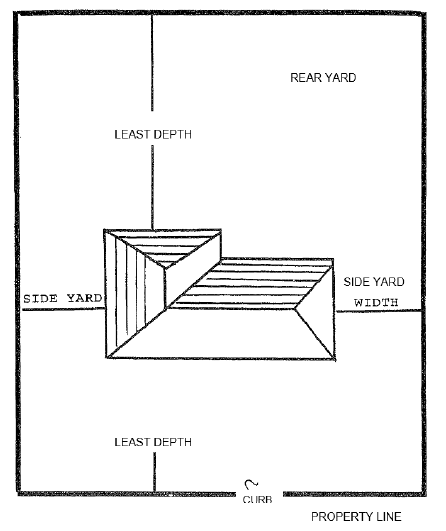 (Ord. 3968 § 1 (part), 1972)
15.03.740 Lot Definitions
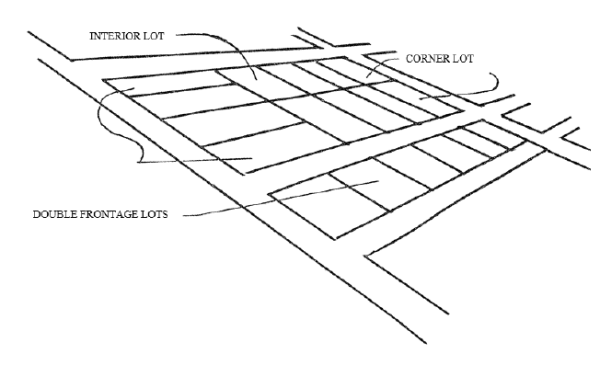 (Ord. 3968 § 1 (part), 1972)

