
Council Bluffs City Zoning Code
CHAPTER 15
32A - WEST BROADWAY CORRIDOR DESIGN OVERLAY
15.32A.010 Statement Of Intent
The purpose and intent of this West Broadway Corridor Design Overlay (CDO) is intended to promote a well-planned and visually attractive corridor that encourages private investment, opportunities for multi-modal transportation options, safe pedestrian access and walkability, improved traffic and parking conditions, and buildings constructed with high quality materials and timeless architectural design. These measures intend to enhance streetscapes, promote active public spaces, and encourage a mixture of land uses that collectively implement the vision of the adopted West Broadway Corridor Plan.
(Ord. 5955 § 2 (part), 2007)
Repealed & Reenacted by Ord. 6427 on 10/12/2020
15.32A.020 West Broadway Corridor Design Overlay Boundary
The West Broadway Corridor Design Overlay applies to an area of the City of Council Bluffs that is geographically bounded on the north by the north right-of-way line of Avenue ‘A’; on the south by the south right-of-way line of 2nd Avenue; on the east by the west right-of-way line of South 13th Street and on the west by the east right-of-way line of Interstate 29/480. A map depicting the West Broadway Corridor Design Overlay boundary is made part hereof as Exhibit A, and such map is designated the “West Broadway Corridor Design Overlay.”
(Ord. 5955 § 2 (part), 2007)
Repealed & Reenacted by Ord. 6427 on 10/12/2020
15.32A.030 Definitions
Build-to-width: The minimum cumulative building width that shall occupy the build-to-zone, based on the width of the parcel at the street.
Build-to-zone: The area on a lot, measured parallel from the front and/or corner side lot line, where a building must locate within the minimum and maximum range of setback provided.
Minor Street: For the purposes of the West Broadway CDO, minor streets are generally those which are not otherwise categorized as West Broadway or major streets. A map identifying the street hierarchy within the West Broadway CDO boundary is made part hereof as Exhibit B, and such map is designated the Street Hierarchy Map (West Broadway Corridor Design Overlay).
Major Street: For the purposes of the West Broadway CDO, major streets are 16th, 19th, 22nd, 25th, 28th, 31st, and 35th Streets and 1st Avenue. A map identifying the street hierarchy within the West Broadway CDO boundary is made part hereof as Exhibit B, and such map is designated the Street Hierarchy Map (West Broadway Corridor Design Overlay).
Principal building: A building or structure used to accommodate one or more of the principal permitted uses.
Street Hierarchy: For the purposes of the West Broadway CDO, West Broadway is considered the highest category street, followed by major streets, and then minor streets. A map identifying the street hierarchy within the West Broadway CDO boundary is made part hereof as Exhibit B, and such map is designated the Street Hierarchy Map (West Broadway Corridor Design Overlay).
(Ord. 5955 § 2 (part), 2007)
Repealed & Reenacted by Ord. 6427 on 10/12/2020
15.32A.040 Applicability Of The West Broadway Corridor Design Overlay
For all properties located within the West Broadway CDO, compliance with the provisions of this Section are as follows:
- New construction of commercial, mixed use, and multi-family structures and sites shall comply
entirely with the standards of this Chapter.
- New construction of townhomes shall not be subject to the full extent of the design standards
within this Chapter, but shall be designed in a manner that is consistent with the spirit and
intent of the West Broadway CDO, with particular emphasis on building placement, architectural
materials and design, and pedestrian and vehicular access. Specific requirements shall be
determined on a case-by-case basis based on the property’s location within the West Broadway
CDO.
- Building modifications equal to fifty (50) percent or more of the assessed value of the structure
in a twenty-four (24) month period of time shall be required to bring the entire structure into
compliance with the applicable standards of this Chapter. The assessed value shall be as most
recently established by the Pottawattamie County Assessor.
- Building modifications equal to fifty (50) percent or more of the total assessed value of the
property shall be required to bring the entire site into compliance with all standards of this
Chapter, with the exception of the standards listed in CBMC Section 15.32A.070, Build-to-Zone
for West Broadway and Major Streets. The assessed value shall be as most recently established
by the Pottawattamie County Assessor.
- Exceptions. Exceptions shall be provided in the following circumstances
- Existing or expanding single family and two family uses are exempt from the regulations
of this Chapter;
- New drive-through lanes added to existing sites shall meet the screening requirements
of this Chapter; and
- 3. Minor, equivalent deviations from the standards of this Chapter may be granted by the
Community Development Director
- Existing or expanding single family and two family uses are exempt from the regulations
of this Chapter;
- In the event of a conflict between the standards contained in this Section and standards
identified in an adopted development plan, the latter shall apply.
(Ord. 5955 § 2 (part), 2007)
Repealed & Reenacted by Ord. 6427 on 10/12/2020
Amended by Ord. 6564 on 8/14/2023
15.32A.050 Permitted, Conditional And Accessory Uses
- Uses permitted, conditional, or accessory in the West Broadway CDO shall be the same as the underlying zone, except as further limited by CBMC Section 15.32A.060, Prohibited Land Uses.
(Ord. 5955 § 2 (part), 2007)
Repealed & Reenacted by Ord. 6427 on 10/12/2020
15.32A.060 Prohibited Land Uses
The following uses, as defined in CBMC Section 15.03, Zoning Definitions, shall be prohibited on all properties located within the West Broadway CDO:
- Adult Entertainment;
- Automotive repair (major only);
- Automotive sales and rental;
- Building material, retail sales only;
- Cemeteries;
- Commercial storage;
- Contractor shop;
- Juvenile detention facility;
- Industrial and manufacturing;
- Warehousing and distribution.
- Equipment sales and rental
Repealed & Reenacted by Ord. 6427 on 10/12/2020
Amended by Ord. 6623 on 3/11/2025
15.32A.070 Build-To-Zone For West Broadway And Major Streets
- Statement of Intent: New buildings with frontage on West Broadway or a major street shall be situated on sites in such a manner that enhances pedestrian interest and comfort while establishing a consistent street wall that provides a strong visual and physical connection between the public and private realm.
- Figure 1: Build-to-Zone
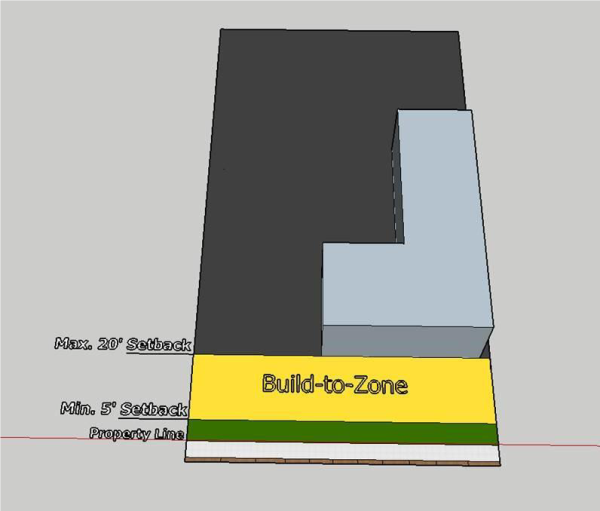
- All new buildings constructed shall be built within the build-to-zone. The build-to-zone is defined by a maximum setback of twenty (20) feet and a minimum setback of five (5) feet, as seen in Figure 1: Build-to-Zone. Accessory structures shall not be located in the build-to-zone.
- The build-to-zone supersedes any front or street side yard setback established in the underlying zoning district. All buildings shall comply with all other required setbacks of the underlying zoning district.
- Frontages.
- For properties with a single street frontage, the build-to-zone applies to that frontage.
- For corner properties, the build-to-zone applies to the highest category street.
- For properties that have two non-intersecting street frontages, the build-to-zone applies to West Broadway.
- Buildings shall have a minimum build-to-width of fifty (50) percent. The build-to-width shall be exclusive of pedestrian pathways, drive-through lanes, driveways, or required setbacks. Once the minimum build-to-width has been met, portions of the building, or additional buildings on the site may be placed outside the build-to-zone.
- (Ord. 5955 § 2 (part), 2007)
Repealed & Reenacted by Ord. 6427 on 10/12/2020
15.32A.080 Architecture
Statement of Intent: Buildings located within the West Broadway CDO shall be designed with coordinated, high-quality materials and architectural elements on all facades with design emphasis given towards West Broadway and major street facing facades.
- Building Materials. Building facades within the West Broadway CDO shall use the following materials:
- Durable
- Brick, tile and stone masonry;
- Glass (non-mirrored, non-tinted);
- Native stone or synthetic equivalent;
- Architectural metal (non-corrugated metal); and
- Other durable materials determined by the Community Development Director.
- Complementary
- Wood-clapboard or shingles;
- Architectural Concrete Masonry Unit (CMU) block (no smooth or flat faced block);
- Stucco, Exterior Finish Installation System (EFIS), or like systems;
- Glass block;
- Vinyl siding and trim; and
- Other complementary materials determined by the Community Development Director.
- The minimum percentage of durable and complementary materials per façade shall be as follows:
- West Broadway and Major Streets—60% of the total square footage of the façade to which the material is being applied shall consist of durable materials;
- Minor Streets—40% of the total square footage of the façade to which the material is being applied shall consist of durable materials; and
- All façade areas that do not utilize durable materials shall utilize complementary materials; and
- All facades and portions thereof that are not clearly visible from street right-of-way may utilize complementary materials.
- When a major façade exceeds the minimum 60% of durable materials required, the excess square footage of durable materials may be utilized as a 1:1 credit towards the minimum required durable materials on another facade. Allocation of excess durable materials shall be based upon the visibility of facades and the West Broadway CDO street hierarchy. At minimum, each minor façade shall be comprised of 20% durable materials.
- Durable
- Articulation.
- Building facades shall be constructed with architectural details such as color changes, material changes, minor wall offsets, height variations, wall setbacks, accent lines, colonnades, and upper floor step backs to articulate building elevations.
- The base of all facades shall be comprised of one of the following base materials:
- Architectural Concrete Masonry Unit (CMU) block (no smooth or flat faced block);
- Brick masonry;
- Stone masonry, or
- Tile masonry.
The base shall be comprised of a different material than the rest of the façade and shall be minimum of two (2) feet in height from the established grade and span the entire width of the façade.
- Building facades that are blank and/or void of architectural detailing shall not be permitted.
- Roofs shall be designed to be generally flat and shall be concealed from view by use of parapet walls, cornices or other architectural methods.
- All facades and portions thereof that are not visible from street right-of-way do not require articulation.
- Transparency.
- The minimum percentage of transparent windows and doors that shall cover a façade measured between two (2) and ten (10) feet above grade shall be as follows:
- West Broadway and Major Streets—40 percent ground floor, 20 percent upper stories; and
- Minor Streets—30 percent ground floor, 15 percent upper stories.
- Glass that counts towards the minimum transparency requirements shall be nonmirrored, non-tinted, unobstructed and shall have a visible light transmittance of 60 percent or more and an external reflectance of 20 percent or less.
- The minimum percentage of transparent windows and doors that shall cover a façade measured between two (2) and ten (10) feet above grade shall be as follows:
- Murals. The purpose of this section is not to hinder free speech, but to provide an alternate design option for retrofitting and/or additions to existing buildings that meets the spirit and intent of the West Broadway CDO. Murals may be utilized in lieu of meeting the minimum transparency and/or articulation requirements for existing buildings when it is demonstrated that meeting said requirements is not feasible due to building placement and/or internal building layout. Qualification for utilization of murals in lieu of meeting transparency and/or articulation requirements shall be determined on a case-by-case basis by the Community Development Director or their designee. All murals utilized in lieu of other requirements of this Section shall be subject to the following:
- Murals used in lieu of transparency requirements shall be at minimum double the square footage of the minimum required transparent area. Sizing of murals used in lieu of articulation requirements shall be determined on a case-by-case basis.
- Mural design and placement shall be approved by the Community Development Director or their designee and shall be designed in accordance with the following:
- Murals shall be compatible with the scale, color, materials and proportion of the building and integrate aspects of special architectural and design features of the building when possible.
- Murals shall be designed to engage and encourage pedestrian interaction, when possible.
- Murals shall not contain words, symbols or representations that are obscene, offensive, or derogatory in nature.
- Murals shall be compatible with the scale, color, materials and proportion of the building and integrate aspects of special architectural and design features of the building when possible.
- Size and placement of murals shall be finalized during the plan review and permitting process. Final mural design shall be approved by the Community Development Director or their designee. A temporary Certificate of Occupancy shall be issued until such time the mural is completed. A final Certificate of Occupancy shall be issued upon mural completion.
- Murals shall be maintained in good repair, free from peeling paint or damage to due age, weather, vandalism or the like at all times. Repairs or replacements shall be completed in a timely manner, as negotiated between the City and property owner.
- Any portion of a mural containing logos, symbols, or text for commercial advertising purposes shall be considered signage. The area of the mural containing said advertising shall be deducted from the overall minimum mural square footage requirements. All murals containing any signage elements shall be required to obtain a sign permit from the City.
- Murals used in lieu of transparency requirements shall be at minimum double the square footage of the minimum required transparent area. Sizing of murals used in lieu of articulation requirements shall be determined on a case-by-case basis.
(Ord. 5955 § 2 (part), 2007)
Repealed & Reenacted by Ord. 6427 on 10/12/2020
Amended by Ord. 6564 on 8/14/2023
15.32A.090 Landscaping And Streetscapes
Statement of Intent: Landscape design in the West Broadway CDO shall aid in softening the appearance of buildings and paved areas while creating visual interest for people in the corridor.
- Required Frontage Landscaping.
- A minimum five (5) feet wide landscape frontage strip shall be installed on all frontages as measured from the back of sidewalk or property line, whichever is a greater distance from the curb.
- Foundation plantings shall be placed along the perimeter of all façades visible from adjacent street right-of-way at a rate of one planting per lineal foot of facade, not inclusive of entrances.
- A minimum of one (1) deciduous, shade tree and ten (10) shrubs shall be planted every twenty (20) linear feet along frontage strips and shall be generally evenly spaced apart along the entire length of the frontage strip. Shrub plantings shall be designated in the approved shrub list. Frontage adjacent to buildings shall only be required to install foundation plantings and shall not be included in the required number of tree plantings.
- Trees planted in frontage strips shall be as designated in the Council Bluffs Street Tree Species Guide, which is made part thereof as Exhibit C.
- Required Parking Lot Landscaping.
- Minimum parking lot landscaped area.
- One large, deciduous shade tree shall be planted per 3,000 square feet of paved parking area not covered by buildings or canopies, such as parking stalls, driveways, drive aisles, drive through lanes, and loading areas. Shade trees shall have a minimum two (2) inch caliper at the time of planting and a minimum mature height of at least twenty-five (25) feet with a mature canopy spread of at least twenty (20) feet.
- Planting areas shall be a minimum of fifty (50) square feet of unpaved surface per tree in the form of interior landscape islands, endcap islands/peninsulas, or perimeter planting areas.
- Landscape islands shall be evenly distributed throughout the parking lot in order to maximize shade.
- Trees planted in perimeter planting areas as opposed to landscape islands or endcap islands/peninsulas shall be counted as ½ tree for the purpose of this requirement.
- Trees in frontage strips may also be counted as perimeter planting areas.
- Minimum parking lot landscaped area.
- Maintenance. All plant materials shall be maintained at all times. All deceased plantings shall be replaced with plant material(s) of the same or like species of equal size within six months of the plant’s demise. Failure to replace said plant materials within the specified time period shall result in enforcement action pursuant with CBMC Section 15.02.130, Violation and Penalty. All planting shall respect City codes for sight lines at intersections and electric line restrictions.
- Streetscapes:
- On-street parking is encouraged on all new development and redevelopment projects, whenever adequate right-of-way is available, in accordance with adopted Public Works standards.
- Street tree plantings shall be planted along major streets. Species type and spacing of street tree plantings shall be as designated in the Council Bluffs Street Tree Species Guide, which is made part thereof as Exhibit C.
(Ord. 5955 § 2 (part), 2007)
Repealed & Reenacted by Ord. 6427 on 10/12/2020
Amended by Ord. 6564 on 8/14/2023
15.32A.100 Pedestrian And Vehicular Access
Statement of Intent: Access to sites within the West Broadway CDO should prioritize pedestrian safety and minimize curb cuts off West Broadway and major streets whenever possible.
- Curb Cuts.
- Either one two-way curb cut or two one-way curb cuts are allowed where property has one hundred fifty (150) feet or more of street frontage. One curb cut is allowed on properties with less than one hundred fifty (150) feet of frontage.
- For corner lots, a maximum of one curb cut is allowed per frontage, regardless of the length of the frontage. In instances where no curb cut is provided on West Broadway, the intersecting street shall be allowed two (2) curb cuts.
- Curb cut widths, design, and spacing shall be in accordance with adopted Public Works standards.
- West Broadway curb cuts shall be located not less than seventy-five (75) feet from the intersecting street's curb. Side street curb cuts shall be located not less than twenty-eight (28) feet on un-signalized intersections and seventy-five (75) feet on signalized intersections from West Broadway.
- Shared curb cuts (between properties) are encouraged.
- Pedestrian Access. A five (5) foot wide, hard-surface accessible route shall be provided on all adjacent rights-of-way to a public entrance. An accessible route may be designated with painted markings on parking lot pavement.
- Drive-through lanes.
- Drive-through lanes along West Broadway and major streets shall be located to the side and rear of the property when possible. In situations where drive-through lanes are located in front of buildings, the drive-through lanes shall be screened from adjacent public street right-of-way by one of the following methods:
- A maximum four-foot masonry wall, subject to the base materials listed in CBMC Section 15.32A.080, Architecture;
- A vegetative wall capable of providing a substantially opaque barrier and attaining a mature height of four-feet within three (3) years of planting;
- An architectural feature attached to the building; or
- A combination thereof.
- Drive-through landscape plantings may count towards other landscaping requirements.
- On corner lots of West Broadway, drive-through ingress shall be taken off the adjacent major or minor street.
- Drive-through lanes along West Broadway and major streets shall be located to the side and rear of the property when possible. In situations where drive-through lanes are located in front of buildings, the drive-through lanes shall be screened from adjacent public street right-of-way by one of the following methods:
(Ord. 5955 § 2 (part), 2007)
Repealed & Reenacted by Ord. 6427 on 10/12/2020
15.32A.110 Outdoor Lighting
Statement of Intent. Lighting on each site shall create inviting and safe passageways for pedestrians while minimizing light pollution to neighboring properties and shall be incorporated into the overall building and site design.
- Light poles on private property shall not exceed twenty-five (25) feet in height from existing grade.
- Light pole materials shall be painted or finished aluminum or steel. Wood poles shall not be accepted.
- All lighting on private property shall comply with the standards stated in CBMC Section 15.24.050, Lighting controls.
(Ord. 6427 § 1, 2020)
Approved by Ord. 6427 on 10/12/2020
15.32A.120 Screening And Buffering
Statement of Intent. Screening shall be integrated into the overall design of the site and shall fully contain the visual impact of service equipment and functions from public view.
- Planting shall be accepted in lieu of the required fencing for buffering the back of commercial buildings abutting residential zones.
- Screening planting shall include a six feet minimum width planting strip with a tall hedge as defined in the attached plant list. The hedge shall include deciduous or evergreen shrubs in a double row planted in a triangular spacing. Shrub species shall be selected from the approved shrub list and confirm to the minimum sizes and spacing specified therein.
- Roof-mounted mechanical equipment shall be integrated into the design of the building so that the equipment is screened from public view in the adjacent street rights-of-way.
- Wall-mounted mechanical equipment shall not be located on any surface within the build-to-zone.
- Wall-mounted mechanical equipment located on any surface that is visible from an adjacent public street right-of-way shall be fully screened by architectural design features, landscaping, or a combination thereof.
- Ground-mounted mechanical equipment that is visible from an adjacent public street right-of-way shall be completely screened from view using architectural design features, fencing, masonry wall, landscaping, or a combination thereof.
- Loading and service areas shall be located to the side or rear of the principal building and shall be screened from view from adjacent property or public street right-of-way by architectural design features, landscaping, fencing, masonry wall, or a combination thereof.
- All dumpsters and exterior trash storage shall be screened using walls or fences that are a minimum of six feet in height and shall include a lockable gate that when closed completely eliminates the view of the trash area and its contents. All walls and fences used to screen dumpsters and exterior trash storage areas shall be constructed and installed in accordance with CBMC Section 15.32A.130, Fences and Walls.
(Ord. 6427 § 1, 2020)
Approved by Ord. 6427 on 10/12/2020
Amended by Ord. 6564 on 8/14/2023
15.32A.130 Fences And Walls
Statement of Intent: Fences and walls placed in the West Broadway CDO shall be constructed of high quality materials and be complementary in design to the overall site.
- All fencing shall comply with the standards stated in CBMC Section 15.24.040, Fence Regulations.
- Fences shall be constructed of the following materials or a combination thereof: wood, composite fencing, wrought iron, coated chain link, or other material approved by the Community Development Director.
- Walls shall be constructed of the following materials or a combination thereof: brick, stone, cast-stone, split-face blocks, stucco over standard concrete masonry blocks, glass block, or other material approved the by the Community Development Director.
- Non-coated chain link, barbed wire, non-permanent or electrically charged fencing shall not be allowed.
(Ord. 6427 § 1, 2020)
Approved by Ord. 6427 on 10/12/2020
15.32A.140 Signs
Statement of Intent. Signage in the West Broadway CDO shall be complementary in design to the overall site and help to accommodate buildings to a human scale by breaking up large wall masses and adding visual interest to passing pedestrians and motorists.
- The on-premises sign height and area regulations available for property within seven hundred (700) feet of the interstate highway system are not applicable within the corridor overlay district.
- A total of one detached on-premises sign shall be allowed for each property.
- Detached signs shall be ground or monument signs. No support posts shall be visible on these signs. Monument signs shall not have more than two sign faces. The sides of the monument sign that are not used for signage shall not exceed three (3) feet in width. The maximum height for monument signs shall be ten (10) feet. The maximum allowable height and area of each monument sign face will be measured from the finish grade to the top of the monument structure and from one end of the monument structure to the other. The maximum allowable square feet per sign face shall not be greater than each property's linear feet of street frontage, as measured on one adjacent street, or one hundred fifty (150) square feet, whichever is less.
- Off-premises signs are not permitted within the district.
- All signs shall be removed within ninety (90) days after abandonment of the business use. Removal shall include the sign face, all supports, poles and framing.
- Refacing existing signs are allowed in conformance with CBMC Section 15.33.220, Nonconforming Signs – Legal. Existing pole and pylon signs shall be brought into compliance with the standards of this Chapter upon the earlier of the following events: (a) development or redevelopment of the property in accordance with CBMC Section 15.32A.040(A) and Section 15.32A.040(D), Applicability of the West Broadway Corridor Design Overlay; or (b) destruction of the sign, by any means to the extent of fifty percent (50%) or more of its replacement value at the time of such damage.
(Ord. 6427 § 1, 2020)
Approved by Ord. 6427 on 10/12/2020
Amended by Ord. 6679 on 5/18/2026
15.32A.145 Other Regulations
A. Elevated vehicle display. All vehicles shall be parked at natural grade, unless located within structured parking, such as a parking garage. The use of ramps, earthen berms, rooftops, or other types of suspension for the purpose of displaying vehicles shall be prohibited.
Adopted by Ord. 6564 on 8/14/2023
15.32A.150 Adoption Of A Development Plan
Statement of Intent. Properties in the West Broadway CDO which are unable to meet any aspects of the above listed regulations shall be allowed the option of applying for a site specific development plan to be reviewed by the Planning Commission and City Council. Applicants shall submit development plans which enhance components of the development in exchange for relief of other requirements.
- These standards are not intended to prohibit creative design and development solutions by professional designers/developers that might generate a better quality development. Accordingly, certain departures from the design standards may be permitted. In order for a departure from the mandatory standards to be allowed, the development proposal must demonstrate that the departure would result in a development that better meets the intent, objectives, and principles of the design standards. The Community Development Director shall have the final authority to resolve any conflicts in the standards.
- Application. A completed application form, one (1) electronic copy and ten (10) paper copies of the development plan, along with the required fee, shall be submitted to the Community Development Department. The development plan shall be reviewed in accordance with the procedures outlined below. The following information shall be submitted to the Community Development Department:
- A letter of intent stating the proposed uses, improvements necessary to serve the development, construction time frame, and phasing;
- The development name and legal description of the boundary;
- A north arrow, scale, bar scale, and date;
- The names and addresses of the owner, and the architect or engineer preparing the plan;
- A location map showing the proposed development and its relationship to existing abutting subdivisions and community facilities such as streets, schools, parks, and commercial areas;
- All established floodway or floodway fringe encroachment limits;
- A soils and drainage report prepared by the engineer. The report shall show the general soil and drainage conditions and include preliminary recommendations as to the adaptability of the property proposed for development;
- Location and size of any sites to be considered for dedication to public use;
- Layout, numbers, and dimensions of proposed lots;
- The location, width, name, grade, and typical cross-sections of all proposed streets within the development and the width and name of any platted street located within two hundred (200) feet of the site;
- The location and width of other public ways, railroad rights-of-way, utility, and all other easements existing or proposed within the development and within two hundred (200) feet;
- Existing and proposed contour intervals of not more than five feet;
- All existing and proposed underground installations within the proposed development or adjacent thereto or the location of the nearest available facilities;
- The location of all existing and proposed structures, proposed parking areas, pedestrian ways, private and public streets, and landscaping;
- Proposed signage plan;
- Architectural drawings, renderings, or other visual documents which illustrate proposed building design.
The Community Development Director shall determine the adequacy and completeness of the development plan application. The Community Development Director may require additional information prior to scheduling review by the City Planning Commission.
- Review by City Planning Commission. The City Planning Commission, in reviewing the development plan, shall take into consideration conformance with the comprehensive plan, recognized principles of land use planning, landscape, architecture, the conservation and stabilization of the value of property, adequate open space for light and air, congestion of public streets, the promotion of public safety, health, convenience and comfort and the general welfare of persons using the facility. In addition to the proposed use meeting the general requirements herein set forth, the commission, in recommending approval of the proposed development plan, may recommend certain conditions to be attached to such use which the commission deems necessary in order to carry out the intent and purpose of this title. Such conditions may include, but are not limited to, an increase in the required lot or yard area, control of the location and number of vehicular access points to the property, limitations to the number of signs, limitations to coverage or height of buildings situated on the property because of obstruction to view and reduction of light and air to adjacent property, required screening and landscaping where necessary reduce noise and glare, and designation of responsibility for maintenance of the property.
- Review by City Council. After review of the development plan by the City Planning Commission, it shall be forwarded to the City Council, with its written recommendations, whether for approval or denial, whereupon the City Council may take action on the plan. Approval of the development plan shall be by City Council resolution.
- Building Permit Review. The Community Development Director shall review all building and Public Works construction permits for compliance with the approved development plan. No building or Public Works construction permit shall be issued if determined by the Community Development Director to be inconsistent with the approved development plan. If the Community Development Director determines that major changes are requested, review and approval by the City Planning Commission and City Council shall be required.
- Amendment to Development Plan. Proposed amendments to an approved development plan shall be subject to the same review and approval procedure as an initial application. Minor amendments to an adopted development plan may be administratively approved at the discretion of the Community Development Director.
(Ord. 6427 § 1, 2020)
Approved by Ord. 6427 on 10/12/2020

