
Culpeper City Zoning Code
ARTICLE XI
SUPPLEMENTAL REGULATIONS
Sec. 27-296.- Setback and yard requirements for certain uses and structures.
Any fence or wall enclosing a school or playground or public works facility or utility or industry and designed to prevent a person from incurring serious personal injury shall be of sufficient height and design to prevent entrance. Any other fence or wall shall not exceed seven (7) feet in height except between the front of the dwelling and the street right-of-way where the maximum height shall not exceed four (4) feet. The height of a fence at any point along its length shall be measured from the mean ground level of the property on each side of the fence. Notwithstanding the above, the height and placement of a wall or fence shall be consistent with the requirements for visual clearance at intersections (section 27-299).
Fences and walls in residential and commercial districts shall be made of standard building materials such as wood, concrete, masonry or vinyl coated black or green chain link metal, but shall not be made of exposed, galvanized steel chain link, barbed wire, chicken wire, reflective glass or other such materials or design that cause or are likely to cause unreasonable harm or nuisance to contiguous properties or occupants thereof. Agricultural-type fencing may be used to confine cattle or horses.
(Ord. of 5-8-01; Ord. of 6-14-05; Ord. of 6-12-07; Ord. of 10-14-08; Ord. No. O-2016-006, § 1, 12-13-16)
Sec. 27-297. - Motor vehicle parking and storage.
(a)
Storage of a travel or recreational trailer in an enclosed accessory building is permitted in any district, provided that no living quarters are maintained.
(b)
Construction equipment. Construction equipment and construction-related vehicles shall not be parked or stored in any residential district except during periods of active construction and in connection with the construction occurring on that lot where parked or stored. Valid zoning permits, grading plans, and/or site development plans and continuous pursuit of completion of the permitted construction or development shall be required to demonstrate the existence of bona fide construction activity.
(c)
Prohibited vehicles. Except as provided in subsection (b) above, the following vehicles registered with the Virginia Department of Motor Vehicles or any other state or government agency having a gross weight of ten thousand one hundred (10,100) pounds or more, shall not be parked or stored in any residential district:
(1)
Box trucks.
(2)
Flat bed trucks.
(3)
Stake bed trucks.
(4)
Step vans.
(5)
Trailers.
(d)
Prohibited vehicles regardless of weight. Except as provided in subsection (b) above, the following types of vehicles shall not be parked in any residential district:
(1)
Cement trucks.
(2)
Construction equipment (except as provided in subsection (b) of this section).
(3)
Dump trucks.
(4)
Garbage, refuse or recycling trucks.
(5)
Passenger buses (excluding school buses).
(6)
Tractors or trailers of a tractor-trailer truck.
(7)
Tow trucks.
(Ord. of 5-8-01; Ord. No. O-2011-007, 11-8-11)
Editor's note— Ord. No. O-2011-007, adopted Nov. 8, 2011, changed the title of § 27-297 from trailer parking to motor vehicle parking and storage.
Cross reference— Parking, § 11-36 et seq.
Sec. 27-298. - Structures permitted above height limit.
(a)
The following rooftop structures are exempt from the district height limitations provided that not more than one-third (⅓) of the total roof area may be occupied by such structures:
(1)
Chimneys, church spires, elevator shafts and similar structural appendages not intended as places of occupancy or storage;
(2)
Flagpoles and similar devices;
(3)
Heating and air conditioning equipment, solar collectors, satellite dishes and similar equipment, fixtures and devices;
(4)
Parapet walls and similar architectural features.
(b)
The following non-rooftop structures are exempt from the district height limitations:
(1)
Water storage tanks;
(2)
Silos.
(Ord. of 5-8-01)
Sec. 27-299. - Sight distance at intersections.
(a)
Stopping sight distance. Stopping sight distance shall be based on a height of eye of 3.5 feet and an object height of two (2) feet along the center of the travel lane.
(b)
Intersection sight distance. Intersection sight distance shall be measured presuming a stop condition of the minor roadway. Sight distance shall be based on a height of eve of 3.5 feet and an object height of 3.5 feet. Dedicated right-of-way shall be required to preserve appropriate sight distance at intersections. The town may consider an easement as an alternative to dedicated right-of-way.
(c)
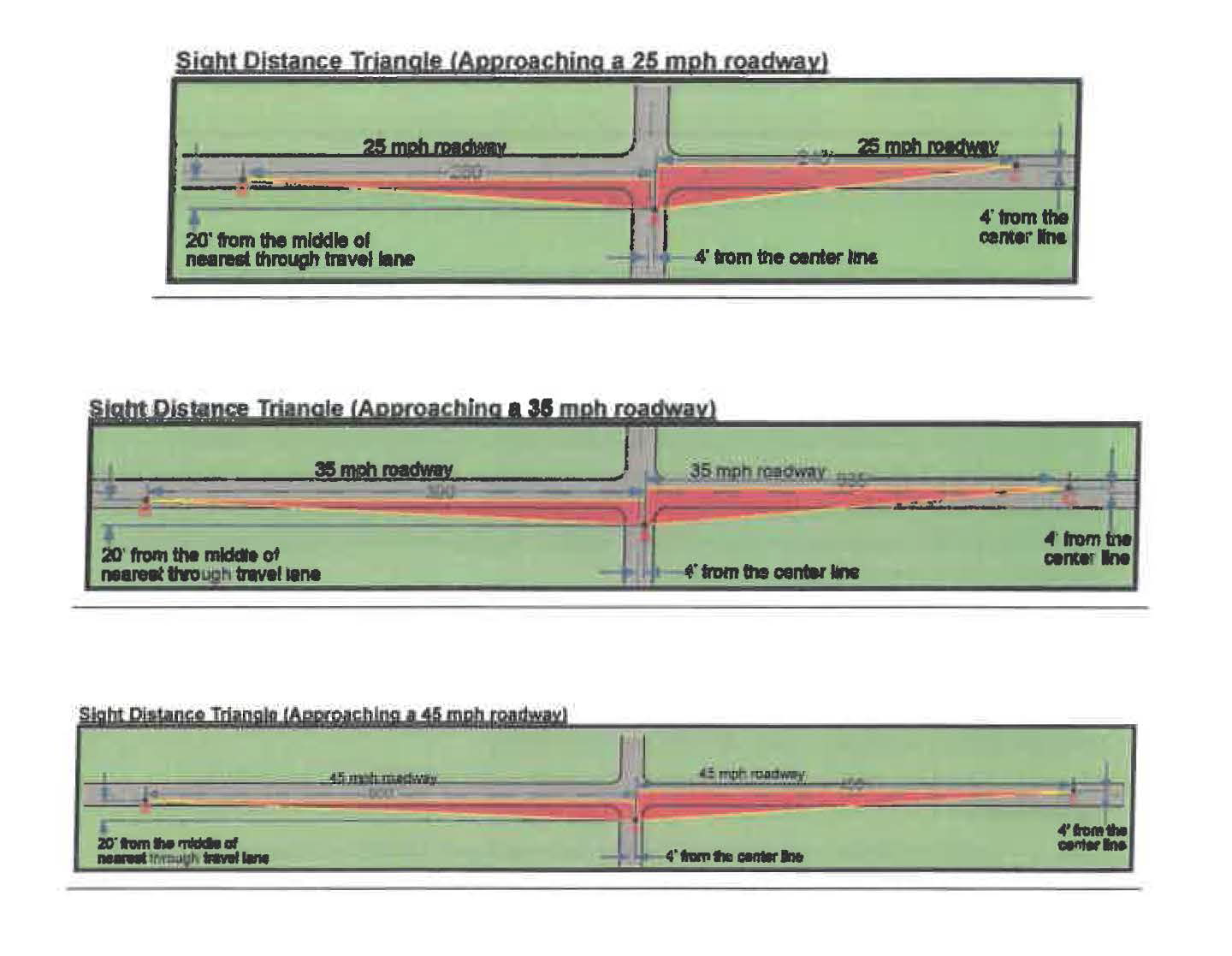
Sight distance triangles. The intersection sight distance is measured along the major roadway, based on the major roadway's design or, in the case of existing roadways, the operation speed limit. Three (3) diagrams are shown below which outlines the necessary sight distance triangles based on a vehicle approaching a 25, 35 and 45 mile-per-hour roadway:
(d)
Decision points A, B and C below represent the position of drivers along the major and minor roadways. Two (2) sight distance triangles are considered, one in each direction of the major roadway from decision point A, which represents the driver exiting the minor road.
(1)
Decision point A is located four (4) feet from the centerline or left edge of pavement of the minor roadway and twenty (20) feet from the middle of the nearest travel lane of the major roadway. (For reference purposes, AASHTO defines this point as 14.4 to 17.8 feet from the edge of the travel lane of the major roadway.)
(2)
Decision point B is located in the middle of the nearest travel lane of the major roadway.
(3)
Decision point C is located in the nearest right to left movement lane of the major roadway, four (4) feet from the centerline or the left edge of pavement.
(e)
Exceptions and waivers. The zoning administrator may grant an exception or waiver after circulating the request to all relevant town departments and agencies responsible for transportation related ordinances and requirements. No exception or wavier will be granted unless the applicant can clearly demonstrate adequate sight distance, given the roadway's design and that the request is sufficiently protective of persons and property.
(Ord. of 5-8-01; Ord. No. O-2016-006, § 1, 12-13-16)
Sec. 27-300. - Lighting.
Applicability. This section shall apply to each outdoor luminaire installed or replaced after the date of adoption of these regulations.
Standards. Exterior lighting shall be reasonably designed to provide for the safety of the public and their use of parking lots, walkways and entrance areas. These areas shall be illuminated by a source providing adequate light at the surface during the hours of darkness or business operation. Parking lights and fixtures shall be shielded in such a manner that all light emitted by the fixture does not cause glare or excessive light spillage onto neighboring sites. The spillover of lighting from parking area luminaires onto residential uses or zoning districts shall not exceed one-half (½) foot-candle. The spillover of lighting from parking area luminaires onto all other uses and zoning districts shall not exceed one (1) foot-candle.
Lighting shall be provided in all zoning districts in accordance with the requirements of the Facilities Standards Manual.
(Ord. of 5-8-01)
Sec. 27-301. - Temporary uses.
The following temporary retail activities and activities of a similar nature are permitted in all zoning districts that allow retail uses and may be administratively approved by the zoning administrator through the issuance of a zoning permit when, in his judgment, the public health, safety and welfare will not be impaired and when the use is not so recurring in nature as to constitute a permanent use requiring an approved site plan and when the following conditions are met:
(1)
Roadside stands, farmer's markets, flea markets craft fairs, and other temporary retail uses provided that:
a.
No structure of a permanent nature shall be constructed.
b.
Removal of temporary structures and removal of all associated signs, trash and debris from the site and immediate vicinity upon termination of the activity shall be guaranteed in writing, and such structures and materials shall be subsequently removed.
c.
Written approval of the owner of the site shall be obtained and submitted to the zoning administrator. Such approval shall identify the site address, owner, acknowledgment of proposed activity and dates during which the activity will occur.
d.
Adequate parking on-site or immediately adjacent, and safe ingress and egress.
e.
Adequate bond or other suitable guarantee that conditions of the permit will be met, such bond or guarantee being not less than one hundred dollars ($100.00) nor more than twenty thousand dollars ($20,000.00), depending upon the nature and extent of the activity.
(2)
Carnivals, circuses, outdoor concerts, car shows, revivals, picnics, catered events, horse shows, promotional events and similar activities not of a retail nature, for a period not to exceed fourteen (14) days and provided that:
a.
All standards of (1)(a) through (d) above shall be met; and
b.
Adequate bond or other suitable guarantee that conditions of the permit will be met, such bond or guarantee being not less than one hundred dollars ($100.00) nor more than two hundred thousand dollars ($200,000.00), depending upon the nature and extent of the activity.
(3)
All temporary uses and activities in the town's right-of-way or on public property shall be subject to section 21-46 of the Town Code.
(Ord. of 5-8-01; Ord. of 12-9-14)
Sec. 27-302. - Emergency shelters.
In addition to any other conditions that the town council may establish upon approval of a conditional use permit for an emergency shelter, the following minimum supplementary requirements shall also be met:
(1)
Number of occupants. Such facilities shall provide temporary housing facilities for up to twelve (12) occupants, in accord with the definition of emergency shelter contained in this chapter.
(2)
Age of occupants. No occupants under the age of eighteen (18) shall be permitted to occupy such facilities unless an occupant is a legal parent or guardian of an under the age of eighteen (18) occupant.
(3)
Gender of occupants. Such facilities shall be designed so that all living spaces are clearly segregated by gender except that legally related family members shall not have to be separated.
(4)
Duration and curfew.
(1)
Occupants shall stay in such facilities no longer than one (1) month (thirty (30) total days) in any given ninety-day period; exceptions may be made by the staff for mentally or physically handicapped people.
(2)
There shall be a 10:00 p.m. curfew required of all occupants, and this curfew requirement shall be communicated clearly to the occupants by the staff.
(5)
Staff. The facility shall be staffed by a resident manager from at least 5:00 p.m. to 8:00 a.m. daily.
(6)
Government relationships. The applicant shall provide satisfactory evidence of initial and ongoing sound relationships with related government agencies, including mental health, social services, sheriff and police departments.
(Ord. of 5-8-01)
Sec. 27-303. - Accessory dwelling unit.
Except for temporary family health care structures allowed under Code of Virginia, § 15.2-2292.1, as amended, accessory dwelling units may be allowed subject to the following conditions:
(a)
Purpose. This section is adopted to provide for an accessory dwelling unit as a secondary use to the primary residence, while ensuring that such uses do not negatively detract from the character of a single-family neighborhood.
(b)
Definition. An accessory dwelling unit is a separate accessory structure, or portion thereof, which is an insubordinate residential use of property.
(c)
Allowed by conditional use permit. In addition to any other conditions that the town council may establish, an accessory dwelling unit shall be subject to a conditional use permit in all residential zoning districts. The following supplemental requirements shall also be met:
(1)
Only one (1) accessory dwelling unit shall be allowed on any lot of record.
(2)
The minimum lot size shall be ten thousand (10,000) square feet unless the primary residence is located within fifteen (15) feet of the street right-of-way.
(3)
The maximum floor area of an accessory dwelling unit shall not exceed one thousand (1,000) square feet.
(4)
Maximum separation distance. An accessory dwelling unit shall not be located within fifteen (15) feet of the primary dwelling on the same property.
(5)
An accessory dwelling unit shall include one (1) or two (2) bedrooms, one (1) bathroom, and one (1) kitchen with a maximum of two (2) occupants.
(6)
An accessory dwelling unit must be architecturally compatible with its surroundings and provide quality architecture and building materials.
(7)
Adequate off-street, paved parking shall be available.
(8)
All public water and wastewater facilities shall be extended from primary dwelling services. No separate meters shall be allowed.
(Ord. of 6-12-07; Ord. of 9-14-10)
Sec. 27-304. - Household pets.
(a)
In all zones, no more than three (3) adult (six (6) months old or older) dogs shall be allowed.
(b)
The regulations of item one above shall not apply to other small animals kept within a residence, including fish, cats, small birds (parakeets, parrots), and rodents (mice, rats). Poisonous reptiles shall not be allowed.
(Ord. of 6-14-05; Ord. of 6-12-07)
Sec. 27-305. - Temporary portable storage containers.
Portable storage containers shall be permitted in any zoning district classification, subject to the following:
(1)
No more than one (1) portable storage container is located on a single lot or parcel of land.
(2)
The container does not remain on the lot or parcel longer than thirty (30) consecutive days and no more than sixty (60) calendar days per calendar year.
(3)
The container shall not obstruct view of pedestrians or motor vehicles entering the street right-of-way.
(Ord. of 6-14-05; Ord. of 6-12-07)
Sec. 27-306. - Temporary family health care structures.
The purpose of these regulations is to provide temporary family health care structures in accordance with Code of Virginia, § 15.2-2292.1, as amended, and in a manner consistent with the town's best interest.
(1)
All temporary family health care structures shall require the submission of an application to the planning and community development department with a fee as set by the town's fine and fee schedule. A zoning permit is also required for all temporary health care structures.
(2)
All temporary family health care structures shall require connection to the town's water and sewer utilities.
(3)
The property owner and/or caregiver must provide evidence of compliance with this section on an annual basis as long as the temporary family healthcare structure remains on the property.
(4)
The zoning administrator is authorized to revoke the permit if the permit holder violates any provision of this section.
(Ord. of 9-14-10)
Sec. 27-307. - Commercial and industrial outdoor storage.
Outdoor storage of materials and equipment is allowed in accordance with article III of this chapter, provided the following standards are met:
(1)
The outside storage area shall be designated on an approved site plan,
(2)
The outside storage area will not encroach onto any required off- street parking space or travel aisle way, or required open space,
(3)
The outdoor storage area will be screened with a minimum six-foot high opaque fence or wall.
(Amd. of 8-14-12)
Sec. 27-308. - Sexually oriented businesses.
(a)
Purpose. It is a purpose of this chapter to regulate sexually oriented businesses in order to promote the health, safety, and general welfare of the citizens of the town, and to establish reasonable and uniform regulations to prevent the deleterious secondary effects of sexually oriented businesses within the town. The provisions of this chapter have neither the purpose nor effect of imposing a limitation or restriction on the content or reasonable access to any communicative materials, including sexually oriented materials. Similarly, it is neither the intent nor effect of this chapter to restrict or deny access by adults to sexually oriented materials protected by the First Amendment, or to deny access by the distributors and exhibitors of sexually oriented entertainment to their intended market. Neither is it the intent nor effect of this chapter to condone or legitimize the distribution of obscene material.
(b)
Findings and rationale. Based on evidence of the adverse secondary effects of adult uses presented in hearings and in reports made available to the town council, and on findings, interpretations, and narrowing constructions incorporated in the cases of City of Littleton v. Z.J. Gifts D-4, L.L.C., 541 U.S. 774 (2004); City of Los Angeles v. Alameda Books, Inc., 535 U.S. 425 (2002); City of Erie v. Pap's A.M., 529 U.S. 277 (2000); City of Renton v. Playtime Theatres, Inc., 475 U.S. 41 (1986); Young v. American Mini Theatres, 427 U.S. 50 (1976); Barnes v. Glen Theatre, Inc., 501 U.S. 560 (1991); California v. LaRue, 409 U.S. 109 (1972); N.Y. State Liquor Authority v. Bellanca, 452 U.S. 714 (1981); and
Imaginary Images, Inc. v. Evans, 612 F.3d 736 (4th Cir. 2010); Independence News, Inc. v. City of Charlotte, 568 F.3d 148 (4th Cir. 2009); McDoogal's East, Inc. v. County Comm'rs of Caroline County, 341 F. App'x 918 (4th Cir. 2009); Allno Enters., Inc. v. Baltimore County, 10 F. App'x 197 (4th Cir. 2001); Steakhouse, Inc. v. City of Raleigh, 166 F.3d 634 (4th Cir. 1999); D.G. Restaurant Corp. v. City of Myrtle Beach, 953 F.2d 140 (4th Cir. 1991); Wall Distributors, Inc. v. City of Newport News, 782 F.2d 1165 (4th Cir. 1986); Boyd v. County of Henrico, 42 Va. App. 495, 592 S.E.2d 768 (2004) (en banc); and
Peek-a-Boo Lounge of Bradenton, Inc. v. Manatee County, — F.3d — 2011 WL 182819 (11th Cir. Jan. 21, 2011); Flanigan's Enters., Inc. v. Fulton County, 596 F.3d 1265 (11th Cir. 2010); East Brooks Books, Inc. v. Shelby County, 588 F.3d 360 (6th Cir. 2009); Entm't Prods., Inc. v. Shelby County, 588 F.3d 372 (6th Cir. 2009); Sensations, Inc. v. City of Grand Rapids, 526 F.3d 291 (6th Cir. 2008); World Wide Video of Washington, Inc. v. City of Spokane, 368 F.3d 1186 (9th Cir. 2004); Ben's Bar, Inc. v. Village of Somerset, 316 F.3d 702 (7th Cir. 2003); Daytona Grand, Inc. v. City of Daytona Beach, 490 F.3d 860 (11th Cir. 2007); Williams v. Morgan, 478 F.3d 1316 (11th Cir. 2007); H&A Land Corp. v. City of Kennedale, 480 F.3d 336 (5th Cir. 2007); Illinois One News, Inc. v. City of Marshall, 477 F.3d 461 (7th Cir. 2007); G.M. Enterprises, Inc. v. Town of St. Joseph, 350 F.3d 631 (7th Cir. 2003); Richland Bookmart, Inc. v. Knox County, 555 F.3d 512 (6th Cir. 2009); Richland Bookmart, Inc. v. Nichols, 137 F.3d 435 (6th Cir. 1998); Spokane Arcade, Inc. v. City of Spokane, 75 F.3d 663 (9th Cir. 1996); City of New York v. Hommes, 724 N.E.2d 368 (N.Y. 1999); For the People Theatres of N.Y., Inc. v. City of New York, 793 N.Y.S.2d 356 (N.Y. App. Div. 2005); Taylor v. State, No. 01-01-00505-CR, 2002 WL 1722154 (Tex. App. July 25, 2002); Gammoh v. City of La Habra, 395 F.3d 1114 (9th Cir. 2005); Z.J. Gifts D-4, L.L.C. v. City of Littleton, Civil Action No. 99-N-1696, Memorandum Decision and Order (D. Colo. March 31, 2001); People ex rel. Deters v. The Lion's Den, Inc., Case No. 04-CH-26, Modified Permanent Injunction Order (Ill. Fourth Judicial Circuit, Effingham County, July 13, 2005); Reliable Consultants, Inc. v. City of Kennedale, No. 4:05-CV-166-A, Findings of Fact and Conclusions of Law (N.D. Tex. May 26, 2005);
And based upon reports concerning secondary effects occurring in and around sexually oriented businesses, including, but not limited to, Austin, Texas - 1986; Indianapolis, Indiana - 1984; Garden Grove, California - 1991; Houston, Texas - 1983, 1997; Phoenix, Arizona - 1979, 1995-98; Chattanooga, Tennessee - 1999-2003; Los Angeles, California - 1977; Whittier, California - 1978; Spokane, Washington - 2001; St. Cloud, Minnesota - 1994; Littleton, Colorado - 2004; Oklahoma City, Oklahoma - 1986; Dallas, Texas - 1997; Ft. Worth, Texas — 2004; Kennedale, Texas - 2005; Greensboro, North Carolina - 2003; Amarillo, Texas - 1977; Jackson County, Missouri — 2008; Louisville, Kentucky — 2004; New York, New York Times Square - 1994; the Report of the Attorney General's Working Group On The Regulation Of Sexually Oriented Businesses, (June 6, 1989, State of Minnesota); Dallas, Texas - 2007; "Rural Hotspots: The Case of Adult Businesses," 19 Criminal Justice Policy Review 153 (2008); "Social Change and Crime Rate Trends: A Routine Activity Approach," 44 American Sociological Review 588-608 (1979); Duncan Associates, Survey of Florida Appraisers (2007); Texas City Attorneys Association, Survey of Texas Appraisers and Crime-Related Secondary Effects (2008); "Background Analysis and Recommendations: Zoning Amendments Related to Sex Businesses," Manassas, Virginia — 2010; and "Everything You Always Wanted to Know About Regulating Sex Businesses," American Planning Association, 2000, the town council finds:
(1)
Sexually oriented businesses, as a category of commercial uses, are associated with a wide variety of adverse secondary effects including, but not limited to, personal and property crimes, prostitution, potential spread of disease, lewdness, public indecency, obscenity, illicit drug use and drug trafficking, negative impacts on surrounding properties, declining property value, urban blight, litter, and sexual assault and exploitation.
(2)
Sexually oriented businesses should be separated from sensitive land uses, including schools, religious assembly or institutions, parks, libraries, public recreation areas, and residential areas, to minimize the impact of their secondary effects upon such uses, and should be separated from other sexually oriented businesses, to minimize the secondary effects associated with such uses and to prevent an unnecessary concentration of sexually oriented businesses in one (1) area.
(3)
Each of the foregoing negative secondary effects constitutes a harm which the town has a substantial government interest in preventing and/or abating. This substantial government interest in preventing secondary effects, which is the town's rationale for this chapter, exists independent of any comparative analysis between sexually oriented and non-sexually oriented businesses. Additionally, the town's interest in regulating sexually oriented businesses extends to preventing future secondary effects of either current or future sexually oriented businesses that may locate in the town. The town finds that the cases and documentation relied on in this chapter are reasonably believed to be relevant to said secondary effects.
The town hereby adopts and incorporates herein its stated findings and legislative record related to the adverse secondary effects of sexually oriented businesses, including the judicial opinions and reports related to such secondary effects.
(c)
Location of sexually oriented businesses. It shall be unlawful to establish, operate, or cause to be operated a sexually oriented business in the town, unless said sexually oriented business is in a zone permitting such use and is at least:
(1)
One thousand (1,000) feet from any parcel occupied by another sexually oriented business;
(2)
Seven hundred fifty (750) feet from any residential zoning district or residence; and
(3)
Seven hundred fifty (750) feet from any parcel occupied by a religious assembly or institution; a school or child care center serving students in grades K-12; a public park, Boys and Girls Club, YMCA, YWCA, or ballfield; or a public library.
(d)
For the purpose of this section, measurements shall be made in a straight line in all directions without regard to intervening structures or objects, from the closest part of the tenant space or structure occupied by the sexually oriented business to the closest point on a property boundary or right-of-way associated with any of the land use(s) identified in subsection (c) above which exists on or before the date that a completed application for a license to operate the sexually oriented businesses is filed with the town.
(e)
Any protected use listed in subsection (c) of this section may begin operation within seven hundred fifty (750) feet of sexually oriented business only if the owner of the protected use, in addition to any other requirements of this Code, gives the town a written statement that it acknowledges the presence of the sexually oriented business(es) and voluntarily waives the protection of subsection (c) of this section as to the sexually oriented business(es) for as long as the sexually oriented business(es) or any successor thereto remains. This written statement does not waive the protection of this section as to any sexually oriented business established or relocated after the written statement. If a sexually oriented business is discontinued for a period of two (2) years or more, then it must comply with the setback requirements of this section regardless of any such written statements by protected uses.
(Ord. No. O-2011-007, 11-8-11; Ord. No. O-2013-009, 11-12-13)
Sec. 27-309. - Liquor stores and short term loan establishments.
(a)
Purpose and intent. The purpose of this section is three-fold:
(1)
To ensure that liquor stores and short-term loan establishments are located so that they are separated from residential neighborhoods, libraries, parks, schools, ballfields, recreation centers and places of worship, where children are likely to be walking and playing and should not be forced to encounter such a business in their daily activities;
(2)
To ensure that liquor stores and short term loan establishments are sufficiently separated from incompatible land uses to ensure an attractive and harmonious community and minimize the negative effect on land values; and
(3)
To ensure that liquor stores and short term loan establishments do not locate in close proximity to sexually oriented businesses so that the town does not inadvertently create an area that is perceived to be dominated by such businesses or that causes the concentration of the secondary effects of such businesses in one (1) area.
(b)
Location of liquor stores and short term loan establishments. It shall be unlawful to establish, operate, or cause to be operated a liquor store or short term loan establishment in the town, unless said liquor store or short term loan establishment is in a zone permitting such use and is at least:
(1)
Seven hundred fifty (750) feet from any parcel occupied by a sexually oriented business;
(2)
Seven hundred fifty (750) feet from any residential zoning district or residence;
(3)
Seven hundred fifty (750) feet from any parcel occupied by a religious assembly or institution; a school or child care center serving students in grades K-12; a public park, Boys and Girls Club, YMCA, YWCA, or ballfield; or a public library; and
(4)
Seven hundred fifty (750) feet from another liquor store or short term loan establishment.
(c)
For the purpose of this section, measurements shall be made in a straight line in all directions without regard to intervening structures or objects, from the closest part of the tenant space or structure occupied by the liquor store or short term loan establishment to the closest point on a property boundary or right-of-way associated with any of the land use(s) identified in subsection (b) above that exist on or before the date that a completed application for a license to operate the liquor store or short term loan establishment is filed with the town.
(d)
Any protected use listed in subsection (b)(2) or (3) of this section may begin operation within seven hundred fifty (750) feet of a liquor store or short term loan establishment only if the owner of the protected use, in addition to any other requirements of this Code, gives the town a written statement that it acknowledges the presence of the liquor stores or short term loan establishments and voluntarily waives the protection of subsection (b) of this section as to the liquor stores or short term loan establishments for as long as the or any successor thereto remains. This written statement does not waive the protection of this liquor stores or short term loan establishments section as to any liquor store or short term loan establishment established or relocated after the written statement. If a liquor store or short term loan establishment is discontinued for a period of two (2) years or more, then it must comply with the setback requirements of this section regardless of any such written statements by protected uses.
(Ord. No. O-2011-007, 11-8-11; Ord. No. O-2013-009, 11-12-13)
Sec. 27-310. - Sex offender treatment services banned in residentially zoned subdivisions.
Notwithstanding any other provision of this Code, no sex offender treatment services may be offered or provided in any subdivision where some or all of the subdivision is zoned for residential purposes. As used in this section, "zoned for residential purposes" includes any zone designated R-E, R-1, R-2, R-3, R-MHP, and PUD.
(Ord. No. O-2011-007, 11-8-11)

