
Culpeper City Zoning Code
ARTICLE VIII
PARKING AND LOADING8
Editor's note— Ord. of March 12, 1991, pertaining to parking and loading, has been included herein as superseding former Art. VIII, §§ 27-206—27-209, which pertained to parking requirements and derived from Ord. of Dec. 11, 1984, §§ 28-40—28-43. See the Code Comparative Table for a detailed analysis of inclusion.
Cross reference— Parking generally, § 11-36 et seq.
Sec. 27-206.- General provisions.
Except as otherwise provided in this article, whenever a zoning or conditional use permit is required under this chapter, the development shall meet the standards set out in this article which include but are not limited to providing adequate off-street parking and loading space.
(1)
Parking spaces required. Except as otherwise provided in this article, every development or change of use shall provide a sufficient number of off-street parking spaces to accommodate the number of vehicles that are likely to be attracted to the development during the peak hour of a typical weekday or weekend, whichever is greater. In calculating the number of parking spaces needed, the number of spaces established for uses as set out in the table of parking standards, is presumed to be sufficient; however, the permit issuing authority may, where appropriate, establish a different number of spaces by calculating such a need from the appropriate methodology set out in the most recent version of the Institute of Transportation Engineers (ITE) Reference Manual entitled "Parking Generation," [9] or where that methodology is inadequate or inappropriate from studies done in the town and/or other similarly sized communities.
(2)
Storage and stacking spaces required. Furthermore, whenever a use involves the storage or stacking of vehicles awaiting service, the development shall also provide a sufficient number of storage spaces or adequate sized stacking lane to accommodate the peak hourly demand for the peak day in a typical week for said storage. [10] The following uses are presumed to require the following number of storage spaces or stacking area.
(3)
Reading the table of parking. Uses in the table of parking standards are keyed to the table of permitted uses. When a determination of the number of parking spaces required by this table results in a requirement of a fraction of a space, any fraction shall be counted as one (1) parking space.
(4)
Exemptions. Developments which are in the "parking overlay district," which map is adopted by reference and included in this subsection, [11] are exempt from the requirements of sections 27-208 and 27-209 of this article.
(5)
Adjustments; satellite parking.
a.
General. If the number of off-street parking spaces required by this article cannot reasonably be provided on the same lot where the principal use associated with these parking spaces is located, then spaces may be provided on adjacent or nearby lots in accordance with the provisions of this section.
b.
Location. Satellite parking spaces, other than those intended for employee use, shall be located within six hundred (600) feet of a public entrance of a principal building housing the use associated with such parking.
c.
Condition. Property owners who obtain satellite parking spaces in accordance with this section shall not be held accountable for ensuring that the satellite parking areas from which they obtain their spaces satisfy the design requirements of this article, however, satellite parking spaces are required to comply with all of the requirements of this article. [12]
A developer desirous of taking advantage of the provisions of this section must present satisfactory written evidence that he has the permission of the owner or other person in charge of the satellite parking spaces to use such spaces.
(6)
Adjustments; shared parking. One (1) parking area may contain required spaces for several different uses, but except as provided below, the required space assigned to one (1) use may not be credited to any other use. To the extent that developments that wish to make joint use of the same parking spaces operate at different times, the same spaces may be credited to both uses. In determining the parking requirements where the uses intend to share parking, the permit issuing authority will establish the peak hourly demand by calculating such a need from the appropriate methodology set out in the most recent version of the ITE Reference Manual entitled "Parking Generation," or where that methodology is inadequate or inappropriate from studies done in the town and/or other similarly sized communities. Persons intending to take advantage of this provision are required to demonstrate that an enforceable agreement exists between the parties who intend to share the parking.
(Ord. of 5-8-01)
PARKING OVERLAY DISTRICT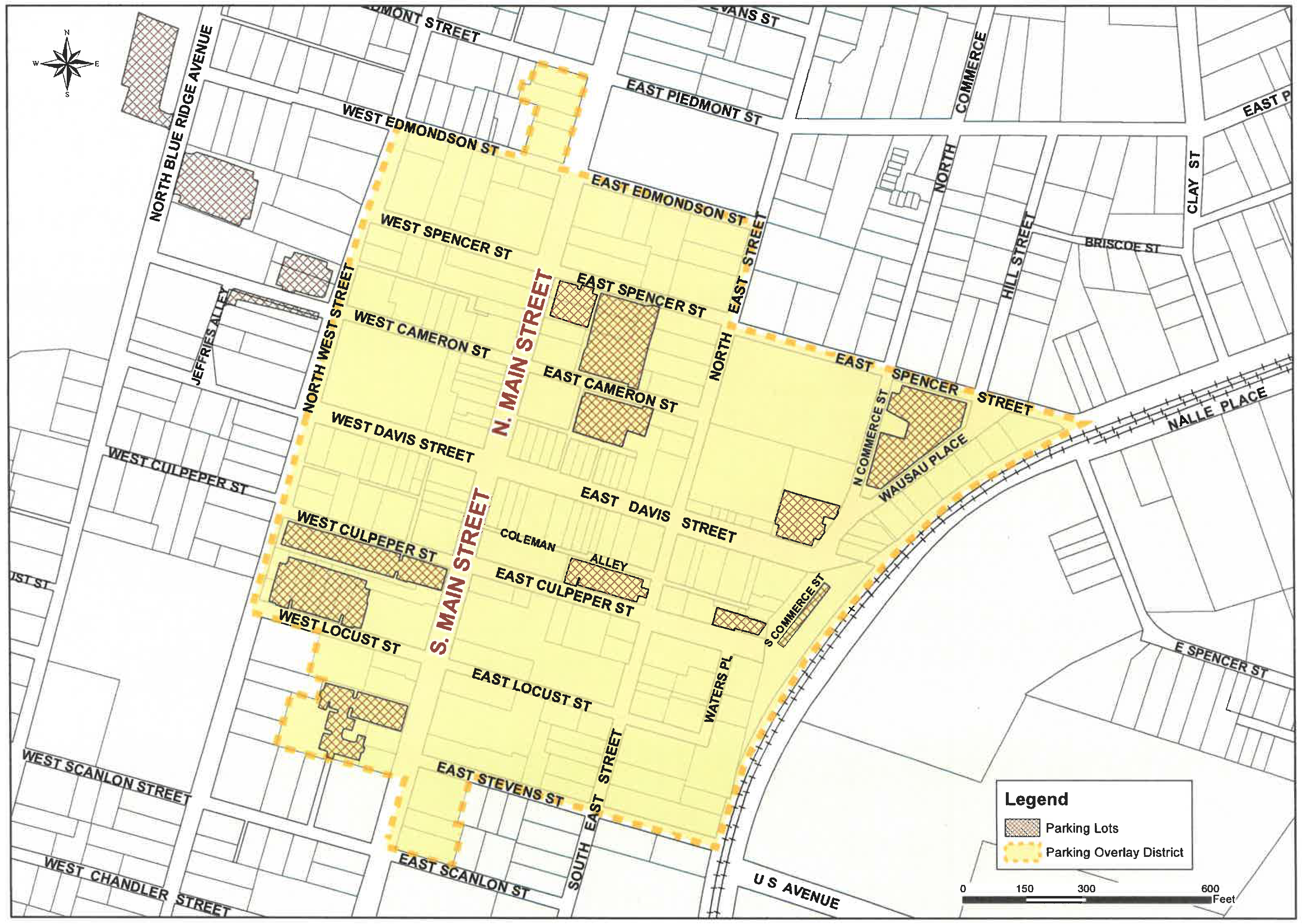
Map Updated on November 15, 2023 by the Town of Culpeper GIS Department
(Case AMD-001-2015, 12-8-15; Ord. No. O-2023-007, § 1, 11-14-23)
Note— The guide to the manual specifies that the standards set out in the individual use section need to be increased by fifteen (15) percent for parking lot design.
--- (10) ---
Note— A typical storage use is that involved in auto repair.
--- (11) ---
Note— The intent of this exemption is to recognize that in any areas where structures cover nearly the entire tract and where buildings share common walls, it is not feasible to provide parking on the site.
--- (12) ---
Note— This means that the person owning the lot on which satellite parking is being provided must secure a zoning or conditional use permit for the use and meet the requirements of this chapter.
Sec. 27-207. - General design.
(a)
Vehicular accommodation area.
(1)
Safety in relation to streets. Every off-street vehicular accommodation area shall be designed so it has access to a public street without impeding vehicular movement in that street. Vehicle accommodation areas, other than for single-family units and duplexes on local or minor streets, shall be designed so that vehicles exit such areas without backing onto a public street.
(2)
Pedestrian safety. Vehicular accommodation areas shall be designed so that vehicles can proceed without posing a significant danger to pedestrians or other vehicles. The permit issuing authority may allow driveways handling two-way traffic to be built to one-way traffic standards where the aisles will be less than sixty (60) feet in length and where the number of parking spaces served will be less than five (5) spaces. Traffic calming devices, to include but not limited to, on-street parking, stamped asphalt pedestrian crossings, landscaping islands and bump-outs shall be required.
(3)
Drainage. Except where the authority determines that adequate capacity in the storm drainage system to which the site is draining exists and is willing to accept the increased volume in runoff, no vehicle accommodation area shall be constructed in such a manner that a significant volume of surface water from the lot will be drained onto public streets or buildings. No vehicle accommodation area shall be constructed in such a manner that as to increase the quantity or decrease the quality of the runoff to adjacent lots.
(4)
Lighting. Adequate lighting shall be provided for vehicle accommodation areas that are used at night. Parking lights shall not exceed eighteen (18) feet in height. Lighting shall not interfere with the use of nearby properties or the safe use of public streets.
(5)
Setback. No part of any vehicle accommodation area other than the driveway entrance or exit shall be within four (4) feet of any right-of-way line or public sidewalk which is adjacent to the street right-of-way.
(6)
Landscaping. All vehicle accommodation areas shall be landscaped in accordance with the requirements of article VI of this chapter.
(7)
Screening. Plantings which meet the standards for screening set out in article VI will be used to screen every vehicle accommodation area other than those serving single-family and duplexes from an adjacent residential ("R") district. Fencing may be substituted for plantings with the approval of the authority.
(8)
Reductions for protecting trees. The minimum number of spaces required may be reduced where the permit issuing authority has determined that the reductions are necessary to preserve a healthy tree or trees with a three-inch or greater diameter from being damaged or removed, and where the site plan provides for the retention of said tree or trees. [13]
(9)
Handicap spaces. Any use which requires more than twenty-five (25) or more off-street parking spaces shall provide one (1) handicap space for each twenty-five (25) spaces in excess of twenty-five (25) spaces and less than one hundred (100) spaces, and one (1) handicap space for each fifty (50) spaces over one hundred (100) spaces. Handicap spaces shall be identified by appropriate restrictive signing and shall be twelve (12) feet in width with a grade not to exceed two (2) percent. Such spaces will be located near handicap access points.
(10)
Bike racks and motorcycle pads. The number of spaces required by this article may be reduced by one (1) space for each bicycle rack for five (5) or more bicycles and each motorcycle pad for two (2) or more motorcycles which are provided up to a total of five (5) percent of the required number of spaces.
(11)
Marking and maintenance. Parking stalls in paved parking areas shall be demarcated. Vehicular accommodation areas shall be properly maintained in all respects. Without limiting the foregoing, landscaping shall be kept healthy and well maintained, surfaces shall be free of potholes, lines marking parking stalls shall be distinct and clear.
(12)
Vehicles in working condition. All off-street parking facilities shall be used solely for the parking of vehicles in operating condition. No motor vehicle repair work except emergency service, no storage of merchandise, and no motor vehicles for sale, shall be permitted on any required vehicle accommodation area.
(13)
Residential parking restricted in front yards. All residential lots equal to or greater than ten thousand (10,000) sq. ft., not more than twenty-five (25) percent of the front yard, as defined, may be used for parking or vehicle accommodation area.
(b)
Parking stall and aisle dimensions.
(1)
Normal. A required off-street parking space or stall shall include a rectangular area with a length of at least eighteen (18) feet and a width of at least nine (9) feet, exclusive of access drives or aisles, ramps, columns, or office or work areas. Such space shall have a vertical clearance of at least six and one-half (6.5) feet. Aisles shall be not less than twenty-two (22) feet for ninety (90) degree parking, nor less than eighteen (18) feet for sixty (60) degree parking, nor less than sixteen (16) feet for forty-five (45) degree parking. Angles shall be measured between centerline of the parking space and centerline of the aisle. For parallel parking, the length of the space shall be increased an additional four (4) feet and the width shall be decreased by one (1) foot.
(c)
Surfacing.
(1)
Paved parking required. Except as provided below, all open off-street parking areas (spaces and aisles) and drives connecting such areas with the street shall be surfaced and constructed either:
a.
With a minimum depth of six (6) inches of number 21A aggregate base and a minimum of two (2) inches of asphalt; or
b.
With six (6) inches of concrete; or
c.
With four (4) inches of brick or porous paving block placed on four (4) inches of number 21A aggregate base.
(2)
Exceptions. The following situations are exempted from the requirements of this section:
a.
A parking lot used only for occasional use. (Occasional use is a use that occurs on two (2) or fewer days per week.) [14]
b.
A parking lot that is already surfaced with asphalt shall be exempted from having to provide a gravel or stone base as set out above.
(3)
Other exemptions and adjustments. Whenever a proposed development involves only one (1) of the following:
a.
The addition of an accessory structure;
b.
An addition to an existing structure which is less than twenty-five (25) percent of the existing floor area in the principal structure; or
c.
A change in use that does not substantially increase the intensity of the use of the site, and, where the effect of complying with the requirements of this article would create on said developer or landowner a disproportionate and unfair burden compared with the nature of the proposed development, the permit issuing authority may relieve the developer of a portion or all of the requirements set out in this section. [15]
(4)
Standards for non-paved areas. Whenever a vehicle accommodation area is exempt from the paved parking requirements under this section, the permit issuing authority:
a.
May require that landscape aisles or spatial separations be provided every three (3) or more spaces where it finds it is desirable to ensure that the parking stalls will be readily identifiable to the users; and
b.
May require the perimeter of the vehicle accommodation area, encompassing but not limited to the unpaved parking stalls and the side of any unpaved drive or aisle leading to said stalls, to be rimmed or edged with landscape timbers, railroad ties, brick, or curbing of adequate size where it finds that it is desirable to prevent erosion, or the washing away of surfacing materials, or where it is necessary to assist the public in ascertaining the shape of the parking area.
(5)
Porous paving materials may be required. The permit issuing authority may require that porous paving materials be substituted for other surfaces in any portion of a vehicle accommodation area where it finds it is necessary to protect the root system of a tree or trees from damage.
(6)
Storage spaces and stacking lanes required to be paved. Any stacking lanes shall be surfaced to the same standards as the paved parking area with which they are associated.
(Ord. of 5-8-01; Ord. of 8-12-03; Ord. of 6-14-05; Ord. of 6-12-07; Ord. No. O-2013-009, 11-12-13)
Note— This provision is intended to protect young trees. Large trees should be retained only where less than twenty-five (25) percent of the drip line of the tree is disturbed.
--- (14) ---
Note— For example, some church lots, special event uses (fairs), etc.
--- (15) ---
Note— This provision is intended to provide some flexibility to consider unusual situations and to allow for solutions which would not otherwise be available, such as allowing a parking lot previously unpaved to be paved in stages.
Sec. 27-208. - Loading and unloading.
(a)
Loading and unloading areas required. Whenever the normal operation of any development requires that goods, merchandise, or equipment be routinely delivered to or shipped from that development, a sufficient off-street loading and unloading area must be provided in accordance with this section to accommodate the delivery or shipment operations in a safe and convenient manner. This section also pertains to uses that regularly generate a need for customer parcel pickup.
(b)
Number of loading spaces required. The loading and unloading area must be of sufficient size to accommodate the numbers and types of vehicles that are anticipated to use this area. The following table indicates the number and size of spaces that are presumed to satisfy this requirement, however, the permit issuing authority may require more or less loading and unloading area where it finds that such an area is more appropriate for the development. Uses which normally handle large quantities of goods, including but not limited to the following use categories:
Schools;
Religious assembly or institution;
Care facilities;
Hospitals;
Retail sales;
Wholesale sales;
Storage;
Manufacturing; and
Agricultural.
Unless a different number of spaces is demonstrated to be necessary in accordance with section 27-206, off-street loading facilities in the following amounts shall be provided:
Uses which do not normally handle large quantities of goods presumably shall provide off-street loading facilities in the following amounts:
(c)
Location. Loading and unloading areas shall be located and designed so that the vehicles intended to use them can maneuver safely and conveniently to and from a public right-of-way, and complete the loading and unloading operations without obstructing or interfering with any public right-of-way or without substantially obstructing or interfering with on-site parking and movement of vehicles in the vehicle accommodation area. Loading and unloading areas shall be demarcated with appropriate restrictive signage.
(Ord. of 5-8-01; Ord. No. O-2013-009, 11-12-13)
Sec. 27-209. - Table of parking standards.
(Ord. of 5-8-01; Ord. No. O-2013-009, 11-12-13; Ord. No. O-2016-006, § 1, 12-13-16)

