
Culpeper City Zoning Code
ARTICLE V
- HISTORIC DISTRICT4
Editor's note— Ord. of June 23, 1992(3), amended Art. V to read as herein set out. Former Art. V pertained to the historical cultural district. See the Code Comparative Table.
Sec. 27-126.- Purpose and objectives.
(a)
To recognize areas having substantial historic resources which ought to be preserved or retained for future generations.
(b)
To provide protection to those areas so as to encourage the restoration and retention of historic structures therein.
(c)
To provide an attractive and beautiful area which will complement the historic buildings and be appropriate for the town's center.
(Ord. of 5-8-01)
Sec. 27-127. - Historic overlay district created.
There is hereby created an historic overlay district, also known as the historic district (HD), the boundaries of which are designated on the attached map. The boundary of this district shall overlay the boundaries of districts as shown on the official zoning map. Development of property lying in this district shall comply with both the requirements of the underlying district and of the overlay district. Where the requirements are in conflict, the requirements of this district shall take precedence. Any modification to the boundaries of the historic overlay district shall comply with the requirements of section 27-376 of this article.
(Ord. of 5-8-01)
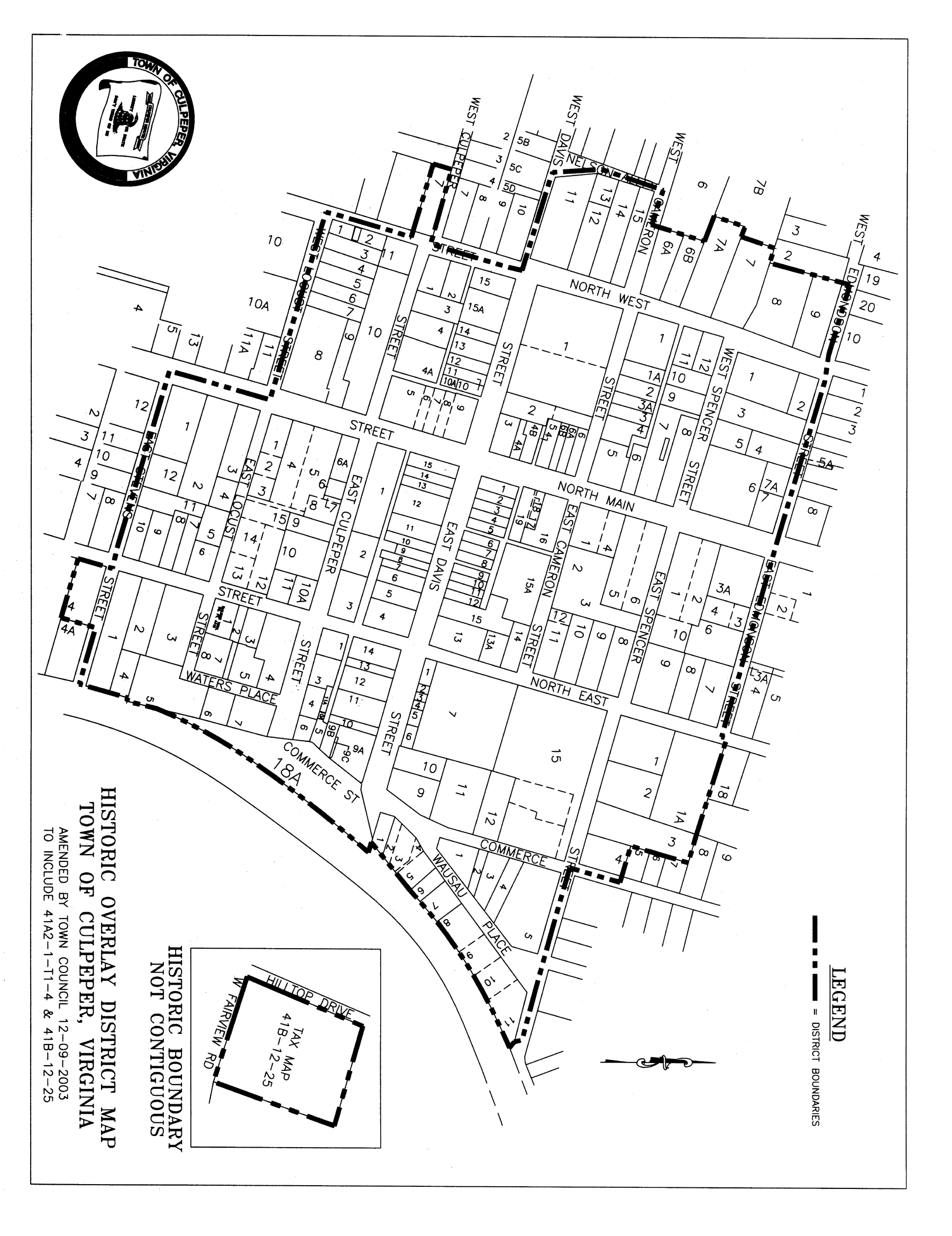
Historic overlay district map
Sec. 27-128. - Activity affected; standard for review.
Except as exempted in section 27-130, any structure which shall be erected, reconstructed, altered (other than razed, demolished or moved) or restored shall be architecturally compatible with the historic structures in the district. Furthermore, no historic structure shall be razed, demolished or moved unless the moving or removal would result in a situation that is architecturally compatible with the historic structures in the district. In making a determination of whether a proposed structure or modification to a structure is architecturally compatible, the permit issuing authority shall balance the importance of the historic structure or detail sought to be preserved or restored and the costs of construction or alteration that would be historically sensitive. In making that determination, the permit issuing authority shall utilize the Secretary of Interior's Standards for Rehabilitation and Guidelines for Rehabilitating Historic Buildings, Department of Interior, 1997, and, the Culpeper Historic District Handbook and Design Guidelines, Town of Culpeper, recent edition, and practical and economic considerations.
(Ord. of 5-8-01; Ord. No. O-2018-001, § 1, 2-13-18)
Sec. 27-128.1. - Evaluation criteria.
The Architectural Review Board shall use the following criteria in evaluating whether properties should be incorporated into the historic overlay district (HOD). These criteria shall be used for considering whether additional buildings, structures, landscapes, site, or districts possess the necessary characteristics to complement or add to the integrity of the historic overlay district. The property under review must meet at least one (1) of the following criteria:
(1)
Any building structure, landscape, or site designated as a National Historic Landmark, or listed on the National Register of Historic Places, or listed as a contributing resource in a National Register District, or listed on the Virginia Landmarks Register shall qualify for inclusion into the historic overlay district; or
(2)
Association with events that have made a significant contribution to the broad patterns of history of the Town and County of Culpeper, the state, or the nation; or
(3)
Association with the lives of persons significant in the history of the Town and County of Culpeper, the state, or the nation; or
(4)
Possession of distinctive characteristics of a type, period, or method of construction, or represents a significant and distinguishable entity whose components may lack individual distinction; or
(5)
Ability to yield information important to the prehistory or history of the Town and the County of Culpeper, the state, or the nation; or
(6)
Possession of an identifiable character which reflects the architectural, cultural, landscape design, or heritage of the Town and County of Culpeper, the state, or the nation.
(Ord. of 6-14-05)
Sec. 27-129. - Submission requirements.
In reviewing construction and modifications under this article the permit issuing authority may require materials to enable them to determine if the Secretary of the Interior's Standards can be met. The submission materials include:
(1)
Scaled drawings;
(2)
Facade elevations;
(3)
Samples of materials, if needed;
(4)
The scope of work for the project;
(5)
Specifications and details, as needed; and
(6)
Drawings showing context to surrounding buildings, if attached.
The zoning administrator may waive part or all of this requirement for emergency repairs.
(Ord. of 5-8-01; Ord. of 6-12-07)
Sec. 27-130. - Exemptions from permits.
Nothing in this article shall provide any jurisdiction over signs or over the color of structures, provided the color is from or closely resembles a color from a color chart approved by the board as compatible with the district, or over the color of banner signs installed on public infrastructure, or over any construction or modification of a structure, or part thereof, to the extent that it would not be visible from a viewpoint on the centerline of an existing public street at a height of four (4) feet and within six hundred (600) feet of the façade or other part of the structure being constructed or modified, or, to the extent that it is within the structure, or, to the extent that it involves only ordinary repair and maintenance.
(Ord. of 5-8-01; Ord. No. O-2022-005, 5-10-22)
Sec. 27-131. - Architectural review board created.
(a)
Board created. For purpose of making effective the provisions of this article, there is hereby created a board to be known as the architectural review board.
(b)
Membership.
(1)
Composition. The board shall consist of five (5) members who shall have a demonstrated interest, competence or knowledge in historic preservation. In making appointments to the board, the town council shall make every reasonable effort to appoint at least one (1) member who is an architect or architectural historian and at least one (1) additional member who has professional training or equivalent experience in architecture, history, architectural history, planning, or archaeology. The five (5) members shall be: (1) residents of the town, or; (2) property owners or merchants in the district, or; (3) a licensed architect or an architectural historian. Additionally, the town council may select one (1) of its members to act as a liaison to the board, with the right to attend and participate in all meetings of the board, but not entitled to vote.
(2)
Appointment and terms. The members shall be appointed by the town council for terms of office of four (4) years from the date of appointment. Vacancies occurring during the term of a member shall be filed for the unexpired term only. Members shall serve without compensation except for justifiable out-of-pocket expenses.
(c)
Organization. The board shall adopt bylaws governing election of officers, holding of meetings and keeping of records. Notwithstanding three (3) members of the board shall constitute a quorum for the transaction of business. A majority of those present shall be sufficient to take action. Conduct of the meetings shall follow policies adopted by the town council governing meetings.
(d)
Powers and duties of the board. The board shall have the power and duty to:
(1)
Undertake studies and review information related to historic structures and properties in the town; identify and recommend additional properties or areas to be designated as an historic district; identify and recommend boundary changes to the existing historic district;
(2)
Recommend to town council guidelines for applying the standards set out in section 27-128, including methods for revitalizing structures to preserve their historic character, an inventory and ranking of historic structures, a synopsis and ranking of historic aspects of construction and information related to costs of renovation;
(3)
Review applications for findings of architectural compatibility to the extent that they involve activities coming under the jurisdiction of section 27-128 above and to determine whether such applications comply with those standards, such a determination to be entitled a "finding of architectural compatibility."
(e)
Staff assistance. Upon the request of the board, with the approval of the town manager, the departments, divisions, board, commission, offices and agencies of the town government shall furnish to the board such available information and render such service as may be required for the exercise of the powers and performance of the duties of the board.
(Ord. of 5-8-01; Ord. of 9-10-02; Ord. No. O-2022-010, 11-10-22)
Sec. 27-132. - Property owner rights regarding demolition.
The owner of any historic structure for which a finding of architectural compatibility for its razing or demolition has been denied on appeal by the town council shall be entitled to raze or demolish the same as a matter of right pursuant to Code of Virginia, § 15.2-2306, as amended, provided that he files an application with the town council within one (1) year from the date of denial of a finding of architectural compatibility by the town council stating his intent to exercise that right, and submits a bona fide offer to sell the structure and land pertaining thereto at a price reasonably related to its fair market value to any entity as allowed by law that is willing to preserve and restore the same. [5] Within thirty (30) days from the filing of an application to exercise the right set out above the town council shall review the application and determine whether it accepts the applicant's submission as to what constitutes lands pertaining to the structure, the fair market value of the same and the adequacy of the offer to sell. The town council shall not accept a submission that would constitute a subdivision of the land in violation of chapter 22 of this Code. The acceptance of an application shall mark the beginning of the time schedule for the exercise of the aforementioned property owner's right.
In the event that no bona fide contract, binding on all the parties, has been executed for the sale of the structure and land pertaining thereto prior to the time set out in the code, the application shall be deemed approved.
Note— Where the offer to sell was delivered at time of application to the town, the zoning administrator may prepare an advisory letter that the conditions have been met; where the offer was placed with a realtor or attorney, the administrator should request an affidavit from that person before preparing an advisory letter.
(Ord. of 5-8-01)
Note— The razing, demolition or moving of a structure that is not historic does come within the jurisdiction of this ordinance.
Sec. 27-133. - Provisions for appeal.
(a)
Appeal of architectural review board decision to town council. Whenever the architectural review board shall, in a final decision, disapprove an application for a finding of architectural compatibility, the owner of the property or applicant for such certificate shall have the right to appeal such decision to the town council, provided that the applicant files with the department of planning and community development, within thirty (30) days after the decision of the board, a notice in writing of the intent to appeal.
(b)
Appeal of town council decision to circuit court. Within thirty (30) days after any final decision is rendered by the town council, the applicant or owner of the property may appeal, as a matter of right, to the circuit court by filing an appeal setting forth the alleged illegality of action by the town council. The filing of such appeal shall stay the decision of the town council pending the outcome of the appeal to the court except that the filing of such appeal shall not stay the decision of the town council if the decision denies the right to raze or demolish a historic landmark, building, or structure. The circuit court may reverse or modify the decision of the town council, in whole or in part, if the court finds upon review that the decision of the town council is contrary to law or that its decision is arbitrary or constitutes an abuse of discretion, or the circuit court may affirm the decision of the town council.
(Ord. of 9-10-02)
Sec. 27-134. - Historic district residential living.
Residential living units shall be permitted in the historic district provided the following conditions are met and approved by the zoning administrator:
(1)
Building use limitations. Residential dwelling units shall not be permitted on the ground level of buildings originally designed and intended for a nonresidential use.
(2)
Building use plan required. A building use plan shall be submitted with the application which specifies how each floor of the building will be designed, arranged and intended for occupancy. The building use plan shall satisfy the requirement of subsection 27-262(d) of this chapter.
(3)
Parking requirements. The applicant and/or property owner shall provide evidence that adequate parking for the proposed number of units is available in reasonable proximity to the site through public supply, private ownership or private lease agreement. The number of parking spaces required shall be determined in accordance with article VIII of this chapter. Parking arrangements shall be in writing and shall become a part of the permit.
(4)
Building inspection and certificate of occupancy required. No residential units created under this chapter shall be occupied unless a certificate of occupancy has been issued by the Culpeper County Building Official.
(Ord. of 5-8-01; Ord. of 9-10-02)
Sec. 27-135. - Historically significant architectural features.
Historically significant architectural features, including engraved stonework or inscriptions, shall not be covered by signage unless a certificate of appropriateness has been approved by the architectural review board. The town will not grant any sign permit, zoning permit or certificate of appropriateness that will remove any historically significant feature.
(Ord. No. O-2016-002, § 1, 6-14-16)

