
Culpeper City Zoning Code
ARTICLE XVIII
TELECOMMUNICATIONS TOWERS AND FACILITIES
Sec. 27-454.- Statement of intent.
The purpose of these regulations is to provide for telecommunications towers and facilities in accordance with the Federal Telecommunications Act of 1996, as amended, in a manner consistent with the town's best interests. These regulations seek to:
• Avoid the uncontrolled proliferation of telecommunications towers; utilizing existing towers, poles and public water storage facilities to the greatest extent possible;
• Protect residential areas and land uses from potential adverse impact of telecommunications facilities and towers;
• Require the collocation of telecommunications facilities and their associated on-ground facilities; and
• Minimize the negative visual and aesthetic impact of telecommunications facilities.
(Ord. of 10-9-01(2))
Sec. 27-455. - Height guidelines.
Telecommunications facilities and towers, as defined below, are exempt from the height requirements of article III of the zoning ordinance. All towers built, constructed or erected to a height of one hundred (100) feet or more shall be capable of supporting the telecommunications facilities of at least three providers, including the telecommunications facilities of the applicant. Towers of under one hundred (100) feet in height shall be capable of supporting the telecommunications facilities of at least two providers, including the telecommunications facilities of the applicant. Towers cannot exceed a total height limit of one hundred ninety-nine (199) feet.
(Ord. of 10-9-01(2))
Sec. 27-456. - Definitions.
Antenna support structure means any building or structure other than a tower, which can be used, for location of telecommunications facilities.
Appropriate certifying professionals shall include RF (radio frequency) engineers or a civil engineer trained in the telecommunications industry for items requiring the certification of engineering reports.
FAA means Federal Aviation Administration.
FCC means Federal Communications Commission.
Height means the distance measured from the adjacent ground level to the highest point on the tower structure and appurtenances.
Telecommunications facilities means cables, wires, lines, wave guides, antennas and any other equipment, structures or facilities associated with the transmission or reception of communications (other than radio or television broadcast communications) which a person seeks to locate or has installed upon or near a tower or antenna support structure. This term includes towers. The term "telecommunications facilities" shall not include:
(1)
Any satellite earth station antenna three feet in diameter or less which is located in an area zoned industrial or commercial;
(2)
Any satellite earth station antenna eighteen (18) inches or less in diameter, regardless of zoning category.
(3)
Any federally licensed amateur radio station operators.
Tower means any self-supporting lattice guyed or monopole structure constructed from grade, which supports telecommunications facilities.
(Ord. of 10-9-01(2))
Sec. 27-457. - Existing towers.
Exclusive of section 27-473, the use of any tower, including public water storage facilities and tanks, which lawfully existed at the time of adoption of this article may be continued even though such use may not conform to the provisions of this chapter.
To encourage collocation of telecommunications facilities and antenna, the height of towers, in existence at the time of the adoption of this article, may be increased to accommodate collocation not to exceed 25 feet above the existing tower or tank.
(Ord. of 10-9-01(2))
Sec. 27-458. - Application for new tower, conditional use permit required.
Except as permitted in Section 27-468 of this article, all new telecommunications towers and telecommunications facilities require the submission of an application and approval of a conditional use permit and site plan in every zoning district in the town. The applicant shall make such application in the planning and community development department with a fee as set by the town's fine and fee schedule.
(Ord. of 10-9-01(2))
Sec. 27-459. - Required information submitted with application.
In addition to the conditions for issuance of a conditional use permit, section 27-326 of the zoning ordinance, the town council, following a recommendation by the planning commission, may issue a conditional use permit provided that the following additional standards are met to the satisfaction of the town in granting a conditional use permit, the town council may designate additional conditions as it determines necessary to carry out the intent of this ordinance. An application to develop a tower or to construct or install telecommunications facilities shall include at least the following:
(1)
All licenses or permit requirements by applicable state and federal authorities must be submitted with application.
(2)
Applicant description. The name, address and telephone number of the applicant. If the applicant is not the owner of the parcel of land upon which the tower is situated, the written consent of the owner, and the name, address, and telephone number of the of owner, shall be evidenced in the application. The application shall also contain an affirmative statement indicating that both the owner and applicant are aware of and agree to comply with the provisions of section 27-471 regarding abandonment.
(3)
Property description. The legal description, property tax map number, and address of the parcel of land upon which the tower is to be situated.
(4)
Diligent unsuccessful efforts to collocate on existing facilities and towers must be demonstrated and exhausted. Documentation by appropriate certified professionals must be submitted by the applicant that demonstrate:
(a)
Diligent unsuccessful efforts to install and collocate the applicant's towers or facilities on existing towers or facilities and antenna support structures within a one (1) mile radius of the proposed tower site; or
(b)
Written, technical evidence from an engineer that the proposed tower or telecommunications facilities cannot be installed or collocated on another person's tower or cannot use another person's antenna support structure located within a one (1) mile radius of the proposed tower site and must be located at the proposed site in order to meet the coverage requirements of the applicant's wireless communication system.
(5)
Site plan required. The submission of a site plan which complies with article X of the zoning ordinance must be signed and scaled by appropriate certifying professionals, showing the location and dimensions of all improvements.
(6)
Lighting of towers. Towers shall not be artificially lighted except as required by the Federal Aviation Administration (FAA).
(7)
Noise. No equipment shall be operated at towers or telecommunications facilities so as to produce noise, except during emergencies or during periodic routine maintenance which requires the use of a back-up generator.
(8)
Camouflage. All towers and facilities shall be of camouflage design standards. Examples of camouflage facilities include but are not limited to architecturally screened roof mounted antennas, antennas integrated into architectural elements and towers designed to blend into the surrounding environment or to look like something other than a tower such as light poles, power poles, and trees. At a minimum, towers not requiring FAA painting or markings shall have an exterior camouflage finish, which is galvanized and finished in accordance with section 27-460 of this Code.
(9)
Visual simulations.
a.
The applicant shall provide visual simulations from at least three (3) different viewpoints of the proposed facility. The basic information shall be an actual photograph, with a simulated image superimposed. The simulation shall include foreground, mid-ground, and the background of the site or facility.
b.
In order to notify citizens and interested persons of the application and to assist the permit issuing authority in evaluating visual impact, the applicant shall erect a balloon of at least four (4) feet in diameter located directly over the proposed telecommunication facility. The balloon shall be flown at the height of the proposed tower structure or facility and tethered to prevent swaying. The balloon shall be flown for a period of one (1) week prior to the planning commission public hearing and one (1) week prior to the town council public hearing.
(10)
Propagation maps. The application shall provide copies of propagation maps demonstrating that the proposed facility locations, including co-locator locations, are not higher in elevation than necessary to provide the desired coverage.
(11)
Structural integrity requirements. All towers and facilities must be designed and signed by a professional engineer licensed by the Commonwealth of Virginia to be structurally solid and at a minimum, in conformance with the current building code as adopted by the Town of Culpeper and Culpeper County Building Official. All review fees to determine whether the tower and facilities are structurally stable are the responsibility of the applicant. In addition, towers must be located and equipped with step bolts and ladders so as to provide ready access for inspection purposes.
(12)
Grounding. All towers must be permanently and effectively grounded. The town may require a post-construction structural analysis from the applicant.
(13)
Maintenance bond. A maintenance bond is required in the amount of ten (10) percent of the cost of construction of the tower to ensure that the tower is maintained in a condition that complies with all applicable building standards and regulations, including but not limited to the provisions of this article.
(14)
Removal bond. A bond or irrevocable letter of credit is required in an amount determined by the town manager to ensure that, should the tower be abandoned pursuant to section 27-471, removal of said tower will be guaranteed.
(15)
Liability insurance. Proof of general liability insurance for claims for injury or death and property damage in an amount approved by the town is required.
(16)
Town claims. A statement that the applicant has no outstanding and overdue debt to the town.
(17)
Indemnification. An acknowledgment that by signing a permit application, the applicant agrees to indemnify and hold harmless the town consistent with indemnification language in the application.
(18)
Change of ownership. The tower and/or landowner shall promptly notify the court by certified or registered mail of the sale, transfer, or assignment of any tower or telecommunications facility. Each sublease shall be conditioned upon the sublessee obtaining the necessary approvals for the subject facility or site from the town prior to siting or purchasing, such facility.
(19)
Review fees. The applicant shall pay application fees, as set forth in the town's fine and fee schedule. In addition, the applicant is responsible for the costs to the town for engineering and evaluation services related to the evaluation of engineering data and the independent verification of technical data submitted
If the applicant does not include the information required, the zoning administrator shall return the application and fee to the applicant, citing reasons for incompleteness in accordance with this article.
(Ord. of 10-9-01(2); Ord. of 12-10-02)
Sec. 27-460. - Exterior finish and tower markings.
(a)
The exterior finish of all towers and facilities shall be compatible with the design of the tower and considered as part of the conditional use permit application.
(b)
Signs not exceeding six (6) square feet per side shall be allowed on any towers or telecommunications facilities at a height not to exceed eight (8) feet from adjacent ground elevation.
(c)
If high voltage is necessary for the operation of a tower or telecommunications facilities and it is present in a ground grid or in the tower, warning signs shall be permanently attached to the exterior side of the perimeter fence at a height of eight (8) feet from adjacent ground elevation and located every twenty (20) feet. The signs shall display in bold letters at least eight (8) inches high the following: "HIGH VOLTAGE: DANGER."
(d)
Identification tags or signs shall be posted on all communications towers and telecommunications facilities in accordance with FCC and OSHA requirements. The tags shall include the FCC tower registration number, the latitude and longitude of the tower, and the name, address, and telephone number of the tower owner. The identification tags shall be posted on the perimeter fence and shall be constructed of durable materials.
(Ord. of 10-9-01(2))
Sec. 27-461. - Landscaping and screening.
Landscaping and vegetative screenings shall be required on parcels containing towers, antenna support structures, or telecommunications facilities. Such landscaping and screening shall be in accordance with section 27-159 of this article. In addition, vegetative screening shall be designed to a height of at least six (6) feet from grade and to screen the base of the tower, antenna support structure and telecommunications facilities to the greatest extent possible.
All landscaping shall be maintained in a healthy and attractive manner.
(Ord. of 10-9-01(2))
Sec. 27-462. - Security.
All towers shall be reasonably posted and secured to protect against trespass. Tower equipment and base shall be secured by a minimum six (6) foot tall perimeter fence, which shall be constructed and maintained by applicant. No sign shall be placed on perimeter fencing except as provided in section 27-460(c) and (d) of this article.
(Ord. of 10-9-01(2))
Sec. 27-463. - Access.
All parcels upon which towers are located shall provide access to the town and its representatives.
(Ord. of 10-9-01(2))
Sec. 27-464. - Certifications and inspections.
(a)
All towers shall be certified by a structural engineer licensed by the Commonwealth of Virginia to be structurally sound and in conformance with the requirements of all applicable federal, state, and local laws and rules. For new towers, such certification shall be submitted with an application and every five (5) years thereafter. For existing towers, such certification shall be submitted within sixty (60) days of the effective date of this article and then every five (5) years thereafter. The tower owner may be required by the town to submit more frequent certification should there be a reason to believe that the structural or electrical integrity of the tower is or has been jeopardized.
(b)
The town and its agents shall have authority to enter onto the property upon which a tower is located, between the inspections and certifications required above, to inspect the tower for the purpose of determining whether it complies with applicable construction or safety standards.
(c)
The town reserves the right to conduct such inspections at any time, upon reasonable notice to the tower owner. All expenses related to such inspections by the town shall be borne by the tower owner.
(Ord. of 10-9-01(2))
Sec. 27-465. - Maintenance of towers and facilities.
(a)
Tower owners shall at all times employ ordinary and reasonable care and shall install and maintain in use nothing less than commonly accepted methods and devices for preventing failure and accidents which are likely to cause damage, injuries or nuisances to the public.
(b)
Tower owners shall install and maintain towers, telecommunications facilities, wires, cables, fixtures and other equipment. All towers and telecommunications facilities and antennas shall at all times be kept and maintained in good order and repair.
(c)
Tower owners shall install and maintain tower telecommunications facilities, wires, cables, fixtures, and other equipment in substantial compliance with the requirements of the National Electric Code and all FCC, state and local regulations, and in such manner that will not interfere with the use of other property.
(d)
All maintenance or construction on towers, telecommunications facilities, or antenna support structures shall be performed by licensed maintenance and construction personnel.
(e)
All towers shall maintain compliance with current radio frequency emission standards of the FCC.
(Ord. of 10-9-01(2))
Sec. 27-466. - Setbacks and fall zones.
(a)
Setbacks. Setback requirements for towers shall be a minimum distance equal to the underlying zoning district.
Setback requirements for towers shall be measured from the base of the tower to the line of the lease parcel on which it is located.
(b)
Fall zones. Every tower shall be designed to fall within the boundaries of the parcel on which the tower is located with a fall zone equal to the height of the tower. A permanent easement from an adjoining property owner(s) may be used to satisfy the above-referenced requirement. Habitable structures 1 shall not be located within the fall zone. In addition, every tower shall be installed in conformance with ANSI/EIA/TIA 222 Structural Steel Standards for Steel Antenna Towers and Antenna Support Structures, as amended or revised. The applicant shall submit written certification and supporting documentation from a professional engineer licensed by the Commonwealth of Virginia that the tower proposed for construction will fall within the specified fall zone and complies with ANSI/EIA/TIA standards.
In those instances in which there is a conflict between the required setback and the required fall zone, the greater distance shall apply.
1 Habitable structures include all dwelling units or structures designed for overnight occupancy. Structures occupied by schools and day care centers shall also be considered habitable under this section.
(Ord. of 10-9-01(2))
Sec. 27-467. - Existing tower sites identified.
There is hereby created an existing tower site map, which is designated on the attached map.
(Ord. of 10-9-01(2))
Sec. 27-468. - Telecommunications facilities and antenna on antenna support structures.
Any telecommunications facilities which are not attached to a tower, may be permitted on any antenna support structure, regardless of the zoning district where the structure is located as long as the facility complies with all requirements of the zoning ordinance and provided the antenna does not exceed the height limit for the district in which it is located. Telecommunications facilities are prohibited on all other structures. The owner of such structure shall by written certification to the zoning administrator, establish the following:
(1)
That the height from grade of telecommunications facility shall not exceed the height allowed in the zoning district. Facilities or antenna taller than the height limit shall be allowed subject to securing a conditional use permit and adherence of section 27-459 of this article, where applicable.
(2)
Such facilities shall be located above the primary roof and screened from view through the use of panels, walls, fences or other screening or camouflaging techniques.
(Ord. of 10-9-01(2))
Sec. 27-469. - Existing towers.
Exclusive of article VII of this chapter, an existing tower may be modified or rebuilt to accommodate collocation of additional telecommunications facilities in the following manner:
(1)
Application for a permit shall be made to the Town of Culpeper Planning and Community Development Department which shall have the authority to issue a zoning permit without the issuance of a conditional use permit.
(2)
The total height of the modified tower and telecommunications facilities attached shall not exceed the height of the existing tower except as provided in section 27-457 of this article.
(3)
A tower which is being rebuilt or modified to accommodate the collocation of additional telecommunications facilities may be located on the same parcel subject to the setback and fall zone requirements of this article. However, if it is impossible for the tower to be rebuilt in compliance with these requirements, such setback requirements may be waived by the zoning administrator.
(4)
Applicant must submit written documentation by a professional engineer licensed by the Commonwealth of Virginia that the existing tower is structurally sound and will support the proposed additions or modifications.
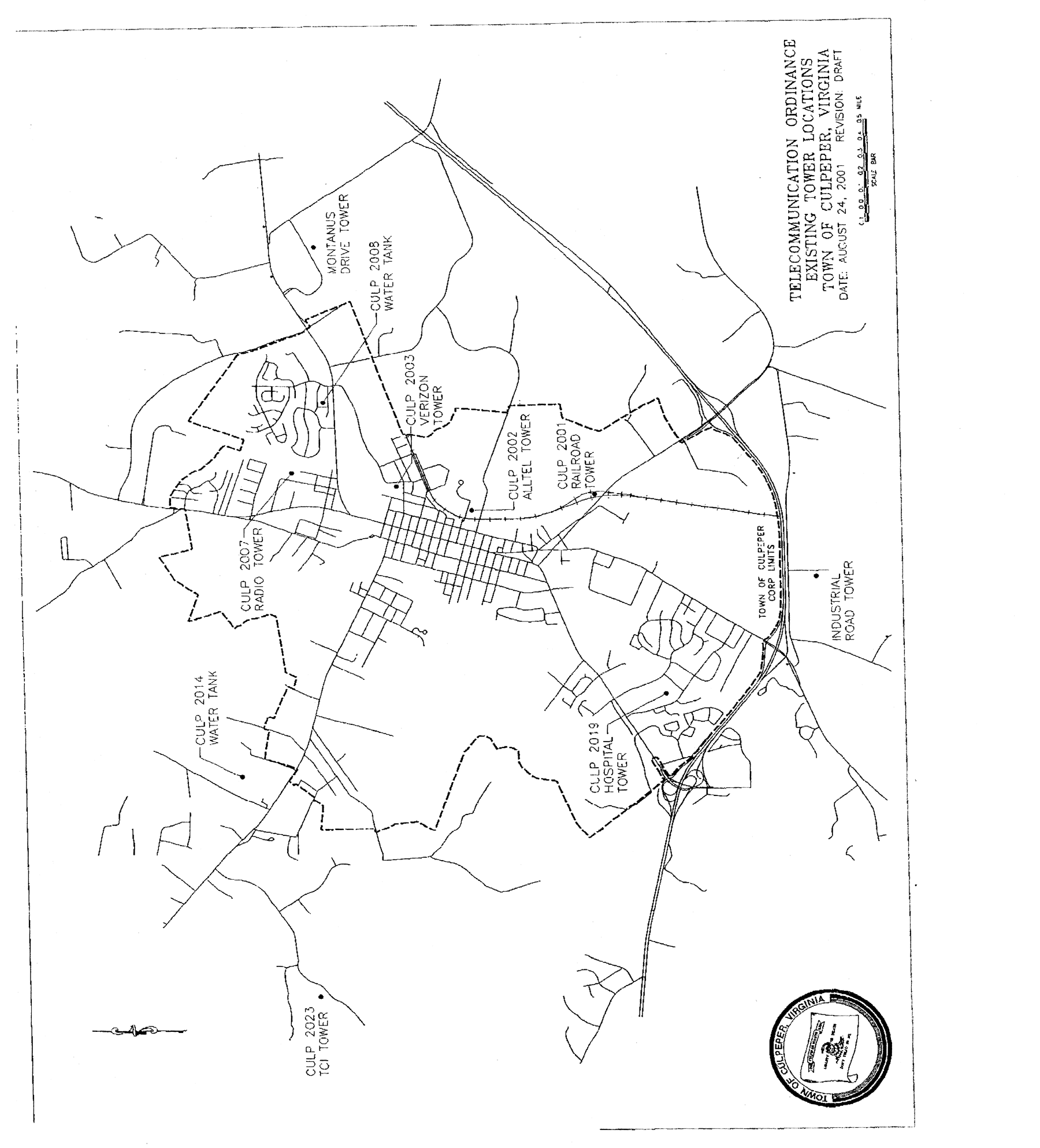
Existing Tower Locations Map
(Ord. of 10-9-01(2))
Sec. 27-470. - Non-transferability of permit.
A conditional use permit application and permit granted by the town are valid to the applicant and are non-transferable. The town shall receive notice from an applicant of any change in ownership and the town reserves the right to approve, disapprove, or make changes based on conditions of compliance with this article.
(Ord. of 10-9-01(2))
Sec. 27-471. - Discontinuance of use, abandonment, and removal.
(a)
In the event the use of a tower is discontinued by the tower owner, or in the event a tower owner files notice to the FCC of its intent to cease operating, the tower owner and/or the landowner shall provide written notice to the town manager of its intent to discontinue use and the date when the use shall be or was discontinued.
(b)
If the town manager receives notice, or if any tower shall cease to be used for a period of one hundred eighty (180) consecutive days, the town manager shall notify the owner, with a copy to the applicant, that the site will be subject to a determination that such site has been abandoned. The owner shall have thirty (30) days from receipt of said notice to show, by a preponderance of the evidence, that the tower has been in use or under repair during the period. If the owner fails to show that the tower has been in use or under repair during the period, the town manager shall issue a final determination of abandonment for the site. Upon issuance of the final determination of abandonment, the owner shall, within seventy-five (75) days, dismantle and remove the tower. If an owner fails to remove an abandoned tower within seventy-five (75) days of the final determination of abandonment, the town may dismantle the tower and recover the costs of the same from the owner or by accessing the bond set forth above.
(Ord. of 10-9-01(2))
Sec. 27-472. - Enforcement and reservation of rights.
(a)
The provisions of this article shall be enforced against all owners of towers or telecommunications facilities within the town and all owners of land upon which towers or telecommunications facilities are sited within the town. The town shall have the right to withhold any approvals with respect to any application by any such party in the event that it finds that the party is not in compliance with the provisions of this article until such noncompliance has been cured.
(b)
The town reserves the right to impose any other reasonable conditions it determines are necessary for the proper placement, construction, or modification of towers or telecommunications facilities, and to impose any other reasonable conditions on the issuance of a conditional use permit issued by the town for placement, construction, or modification of a tower or telecommunications facilities.
(Ord. of 10-9-01(2))
Sec. 27-473. - Properties exempt from placement of future telecommunication facilities, structures or towers.
By action of the Culpeper Town Council, on April 10, 2001, property identified as Tax Map 50-29B, commonly referred to as the Culpeper Standpipe Property, shall not be considered for any future or potential telecommunication facilities, structures or towers.
(Ord. of 10-9-01(2))
Sec. 27-474. - Public advertisement; notification requirements.
In addition to the advertisement and notification requirements mandated by Code of Virginia, § 15.2-2204, as amended, written notice of the public hearing shall be given by the planning commission and town council to all property owners within a one mile radius of the applicant's property. Costs of all notices required under this section shall be billed to the applicant.
(Ord. of 9-10-02)

