
Denton City Zoning Code
Subchapter 8
Subdivisions
8.1 - Purpose
This subchapter establishes standards that regulate the subdivision of property in order to:
8.1.1 Facilitate the orderly growth and harmonious development of the city and to protect and promote public health, safety, and welfare;
8.1.2 Provide lots and parcels of sufficient size and appropriate design for the purposes for which they are to be used;
8.1.3 Protect the natural environment;
8.1.4 Promote the use of good design, landscape architecture, and civil engineering to preserve and enhance natural features, watercourses, drainage ways, floodplains, native vegetation, and trees;
8.1.5 Provide safe ingress and egress for vehicular and pedestrian traffic;
8.1.6 Ensure safe and efficient traffic circulation through coordinated street systems with relation to major thoroughfares, adjoining subdivisions, adjoining streets, and public facilities;
8.1.7 Provide adequate water supply, sewage disposal, storm drainage and other utilities and facilities;
8.1.8 Provide for adequate sites for schools, recreation areas, and other public purposes;
8.1.9 Protect or enhance real property values;
8.1.10 Facilitate the transfer of lands having accurate legal descriptions and to establish and assure the rights, duties and responsibilities of subdividers and developers with respect to land development;
8.1.11 Ensure that the costs of providing the necessary rights-of-way, street improvements, utilities and public areas and facilities for new developments are borne fairly and equitably;
8.1.12 Encourage the clustering of dwellings and other structures to preserve open space, minimize adverse visual impacts, minimize public infrastructure costs, and prevent public safety hazards; and
8.1.13 Provide a common ground of understanding and an equitable working relationship between public and private interests, so that both independent and mutual objectives can be achieved in the subdivision of land.
8.2.1 - Regulatory Jurisdiction.
A.
Generally.
1.
This subchapter shall apply to all land and all developments within the regulatory jurisdiction of the City of Denton, except as otherwise provided for in this subchapter.
2.
The regulatory jurisdiction of the city shall be defined as follows:
a.
The area within the corporate limits of the city;
b.
The area within the extraterritorial jurisdiction (ETJ) of the city, provided that regulatory authority has not been ceded pursuant to agreement or operation of law; and
c.
Any other area to which the provisions of this subchapter are made applicable in accordance with and as permitted by federal, state or local law.
B.
Land Included. Except where otherwise specifically provided for in this subchapter, all the provisions of this subchapter shall apply to the following lands located within the regulatory jurisdiction of the city:
1.
Any tract of land which has not been recorded by plat in the plat records of Denton County, Texas, and which is intended to be sold, leased, or otherwise subdivided from another tract of land or which is intended or proposed to be used for the purpose of development.
2.
Any tract of land which has been recorded as a lot or block by plat in the plat records of Denton County, Texas; prior to and upon which no development has been constructed or placed prior to the effective date of this subchapter.
3.
The division of any previously platted lot into two or more parts.
4.
The removal of one or more lot lines of any platted lot so as to permit the combining of two or more contiguous platted lots into one or more new lots.
8.2.2 - Extraterritorial Jurisdiction.
A.
Official Regulatory Map.
1.
The extraterritorial jurisdiction of the City of Denton is classified into two divisions as indicated on the City of Denton Extraterritorial Jurisdiction map on file in the Development Services Department.
2.
The Development Services Department is directed to consider amendments to the regulatory line map whenever the certificate of public convenience and necessity for water and wastewater services is amended by the state or when directed by the City Council. Any amendments shall not be effective until the revised regulatory line map is approved by the City Council.
B.
Division 1. All subdivisions and developments within Division 1 are subject to all of the standards of this subchapter.
C.
Division 2. Subdivisions and developments within Division 2 are not subject to the standards of this subchapter, but shall be subject to the standards of the County of Denton and state law, as amended.
8.2.3 - Exemptions.
A.
Prior to the subdivision, re-subdivision, or development of any land within the city, or its extraterritorial jurisdiction, all plans, plats, and construction plans for public improvements shall first be approved in accordance with these regulations, except as provided in paragraph B. below.
B.
The following are exempt from the subdivision regulations of this subchapter, but are subject to all other standards in this DDC:
1.
The division of land into two or more parts, other than for purposes of development, if the smallest resulting parcels, tract or site is five acres or larger in size where each part has access and no public improvement is being dedicated.
2.
Development on a single tract which was subdivided prior to January 1, 1960, and for which extension of streets or public improvements (excluding sidewalks) are not required to support the proposed development.
3.
Construction of additions or alterations to an existing building where no drainage, street, utility extension or improvement, additional parking or street access changes required to meet the standards of this subchapter are necessary to support such building addition or alterations.
4.
Construction of accessory structures or fences.
5.
Dedication of easement or right-of-way by separate document recordable in the county records if approved by city.
6.
Cemeteries complying with all state and local laws and regulations.
7.
Divisions of land created by order of a court of competent jurisdiction.
8.
A change in ownership of a property through inheritance or the probate of an estate.
9.
Construction or reconstruction of a single-family residential structure in the extraterritorial jurisdiction, provided no utility extensions or right-of-way dedications are necessary.
10.
Development of an agricultural use.
8.2.4 - Compliance and Enforcement.
A.
It shall be unlawful for any person to begin, continue, or complete any development on any land within the regulatory jurisdiction of the city to which the provisions of this subchapter applies, except in accordance with and upon compliance with the provisions of this subchapter.
B.
Except as otherwise authorized by this subchapter, the city shall not issue a building permit or certificate of occupancy required by any subchapter of the city for any land located within the corporate limits to which this subchapter applies, until and unless there is compliance with this subchapter.
C.
The city may refuse to authorize or make utility connections on the grounds set forth in TLGC, § 212.012, as amended.
D.
No improvements shall be initiated until the approval of the city has been given. Disapproval of a final plat by the city shall be deemed a refusal by the city to accept offered dedications shown thereon.
E.
Approval of a final plat shall not be deemed an acceptance of the proposed dedications and shall not impose any duty upon the city concerning the maintenance or improvement of any such dedicated parts until the proper authorities of the city have both given their written acceptance of the improvements and have actually appropriated the same by entry, use, or improvements.
8.2.5 - Platting Requirements.
A.
Division of Property.
1.
No land may be subdivided or platted through the use of any legal description other than with reference to a plat approved pursuant to the procedures established in Section 2.5: Subdivision Procedures, and in accordance with the standards in this DDC.
2.
Excepting agricultural leases, no land described in this subchapter shall be platted or sold, leased, transferred, or developed until the property owner has obtained approval of the applicable plat pursuant to the procedures established in Section 2.5: Subdivision Procedures, and in accordance with the standards in this DDC.
3.
No person shall transfer, lease, sell, or receive any portion of a parcel of land before a conveyance plat or final plat of such parcel and the remaining parcel has been approved pursuant to the procedures established in Section 2.5: Subdivision Procedures, in accordance with the standards in this DDC, and filed with the county clerk.
4.
The subdivision of any lot or any parcel of land, by the use of metes and bounds description for the purpose of sale, transfer, lease or development is prohibited.
B.
Permits for Construction Activity or Public Improvements. The city shall not issue permits for any construction activity or allow any public improvements for a development until a plat is approved and filed of record and all public improvements have been accepted (if applicable) except as provided in Section 8.2: Applicability, or for a plot or tract conveyed prior to January 1, 1960, and remaining in the same configuration, or for the following:
1.
Model Homes. A developer may construct no more than four model homes within a single-family detached, duplex, or townhome development phase containing public improvements that have not yet been finally accepted, provided that:
a.
All off-site, drainage or regional improvements have been installed, inspected and accepted;
b.
Each model home is inspected and found to meet all building, plumbing and fire code requirements prior to being opened to observation by the public;
c.
The home will not be sold or occupied as a dwelling unit until all public improvements within that phase have been completed and accepted by the city; and
d.
The homes comply with Section 7.3: Land-Disturbing Activities.
2.
Multifamily or Nonresidential Development. Upon application and satisfaction of the following conditions, together with other DDC, City Ordinance, and Criteria Manual requirements, otherwise applicable to full building permits, the Building Official may issue a building permit for multifamily or nonresidential development to allow for limited construction subject to the following:
a.
The applicant shall complete installation of all drainage and other regional improvements, including off-site improvements. This requirement may be satisfied by constructing temporary drainage improvements (such as detention ponds) that, in the opinion of the City Engineer, are adequate to offset the decrease in permeable surface of the permitted phase of development and prevent harm to downstream properties, pending completion and acceptance of required permanent regional improvements for drainage;
b.
The applicant must enter into an agreement with the city, in a form approved by the City Attorney, which indemnifies and holds the city harmless for any failure of the applicant, owner, or builder to obtain necessary access and drainage easements and permits, or to build needed offsite improvements;
c.
A building permit issued in this manner may be withdrawn upon failure to meet any imposed condition, as set forth in Section 1.6: Enforcement;
d.
The applicant shall install and demonstrate proper function of fire hydrants and all-weather access improvements for fire apparatus required by the Fire Code and Chapter 29 of the Municipal Code of Ordinances, prior to any construction above slab; and
e.
The applicant complies with Section 7.3: Land-Disturbing Activities.
8.3.1 - General.
A.
Every subdivision shall comply with all other ordinances and regulations of the City and the TLGC.
B.
Public infrastructure shall be constructed in accordance with City of Denton Criteria Manuals or, if no standard or specification can be found, then the standard or specification used shall be subject to approval by the City Engineer based on professional engineering practices.
C.
The applicant shall make all required improvements, at his/her expense, according to city regulations, without reimbursement by the city, except for certain reimbursable costs as provided in Subsections 7.6.14 and 7.6.15, or as determined as a result of an exaction proportionality determination and appeal under Section 2.5.6.
8.3.2 - Lot Planning.
A.
General. The size, shape, and orientation of lots shall be appropriate to the location of the proposed subdivision and to the type of development contemplated. The following lot design standards shall apply to all subdivisions:
1.
All lots created through the subdivision process shall be developable and conform to the minimum zoning, development, and floodplain standards stated in this DDC. No subdivision shall create lots that prohibit development due to configuration of the lots, steepness of terrain, location of watercourses or floodplain, natural physical conditions, or other existing conditions, except when in conflict with ESA regulations.
2.
The minimum area and dimensions of all lots shall conform to the requirements of Subchapter 3: Zoning Districts, and Subchapter 6: Development Standards, relating to the zoning district in which the lot is located. This subsection does not apply to planned developments. Modifications may be granted pursuant to Subsection 8.3.2D of this subsection.
3.
Side lot lines shall be at right angles or radial to street lines, except where other terrain makes such design impractical.
4.
Double frontage lots may be allowed; however, access shall be in accordance with the requirements of the Denton Development Code, Fire Code, and Transportation Criteria Manual.
5.
Flag lots and other irregularly shaped lots are discouraged.
6.
Corner lots may be required to be wider than interior lots to facilitate conformance with setback and driveway spacing requirements.
7.
The city, county, school district, or other taxing agency boundary shall not divide a lot except in conformance with this DDC.
8.
Each residential lot shall have a minimum of 15 feet of frontage along an existing or proposed public street except as provided in paragraph 8.3.2C.2.
9.
Each mixed-use and nonresidential lot shall have a minimum 20 feet of frontage along an existing or proposed public street.
10.
Refer to Section 7.10.3C: Open Space Requirements, for common open space requirements for single-family detached dwelling, duplex, townhome, triplex, or fourplex developments.
11.
Full access to a site across a property must occur through a zoning district that allows the proposed use. Emergency only access is exempt from this requirement. Subdividing a lot and dedicating a public right-of-way to access the site does not exclude this requirement.
B.
Drainage. Lots shall be designed and located to provide positive drainage away from all buildings and shall comply with the standards in Section 7.5: Drainage.
C.
Access.
1.
Generally.
a.
Each lot shall be provided with adequate access to an existing or proposed public street.
b.
Development adjacent to existing public streets shall include the required improvements in accordance with the city's perimeter street policy and in accordance with TLGC, § 212.904.
c.
At least two full points of vehicular access into the proposed development shall be provided for the following:
i.
Residential Uses (as listed in Table 5.2-A).
a.
New construction with 30 dwelling units or more.
b.
Expansions or additional phases to an existing development resulting in a cumulative increase of 30 dwelling units or more.
c.
Properties within the MD Zoning District are exempt from this requirement.
d.
Development sites two (2) acres or less, with a parking structure are exempt from this requirement.
ii.
Nonresidential uses.
a.
Developments on lots 20,000 square feet or larger.
b.
Re-platting resulting with developments on lots 20,000 square feet or larger.
c.
Properties within the MD Zoning District are exempt from this requirement.
d.
Development sites two (2) acres or less, with a parking structure are exempt from this requirement.
d.
The requirement of Subsection 8.3.2C.1.c.ii may be waived when it is shown to the satisfaction of the City Engineer that two points of vehicular access are deemed unattainable on the basis of: topography; the presence of natural drainage features or Environmentally Sensitive Areas; adjacent site improvements making it unattainable to provide second access; or vehicular or pedestrian safety factors.
e.
All developments must meet Fire Code access and remoteness requirements and the Transportation Design Criteria Manual driveway spacing requirements.
f.
Full access (ingress and egress) shall be credited for providing access into the development.
2.
Single-Family Residential Private Drive.
a.
Up to three single-family detached or townhome residential dwelling units may access a public road by means of a flag drive within a private access easement as provided in the Transportation Design Criteria Manual.
b.
Each residential lot shall have a minimum of 15 feet of frontage on the private access easement.
Figure 8.3-A: Single Family Residential Private Drive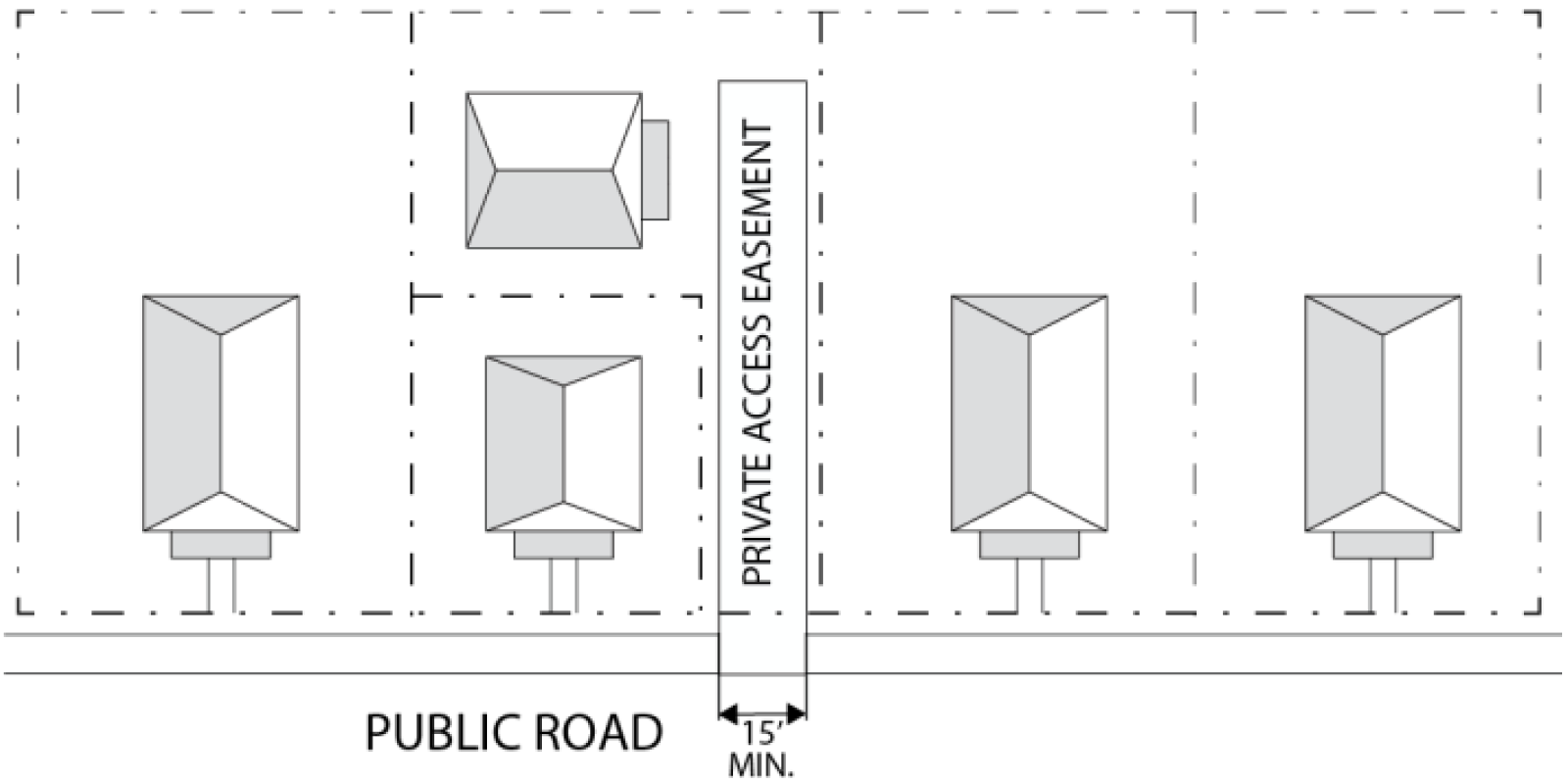
3.
Mixed-Use and Nonresidential Drives.
a.
Lots within a subdivision or addition that is surrounded by developed property making it unfeasible to provide street connectivity, do not have to abut a public street if such lots have access to a public street by a public access and fire lane easement approved by the city.
b.
Such easement shall be at least 24 feet wide and constructed, marked, and maintained to meet the standards for parking lots as contained in the Transportation Design Criteria Manual and for fire lanes as contained in the Fire Code.
c.
The stacking requirements for public streets shall apply to the public access and fire lane easement at the point where it intersects with a public street.
d.
In addition, the public access and fire lane easement shall be considered a driveway or curb cut access to the public street for all such lots.
e.
Each nonresidential lot shall have a minimum 20 feet of frontage on the public access and fire lane easement.
4.
Drilling and Production Site Access. Truck traffic related to gas well drilling and production shall not be allowed to use a plat's neighborhood streets to access a gas well drilling and production site. In addition, no plat shall be allowed to eliminate or alter an access road or easement depicted on a gas well development plat or gas well development site plan, unless written consent of the gas well operator is obtained and a separate access road or easement on the plat is provided for access to a drilling and production site.
D.
Common Area and Facilities. Such areas shall be noted on the plat and the association's covenants shall be filed with the county pursuant to Subsection 8.3.6J. Alternatively, other arrangements for permanent maintenance of these areas and facilities may be approved by the decision-making body.
E.
Flag Lots.
1.
Notwithstanding any other provision of this DDC, the width of the flagpole portion of a flag-shaped lot shall be no less than:
a.
Thirty feet when both public water and sewer systems are to serve such a residential lot.
b.
Forty feet when both public water and sewer systems are to serve such a commercial or industrial lot.
c.
Twenty-four feet when only a public water or a public sewer system is to serve such a lot.
d.
Twenty-four feet when the lot will not be served by a public water or public sewer system.
2.
The flagpole portion of the lot shall be ignored in measuring lot width.
3.
The length of the flag pole portion of the lot shall not exceed 300 feet and shall comply with all other standards and measurements of this DDC and other regulating agencies.
4.
Flag lots where the length of the flag pole portion exceeds 150 feet shall provide a permanent turn-a-round approved by the City Engineer and the Denton Fire Department.
(Ord. No. DCA22-0007a, § 2(Exh. A), 12-6-2022)
8.3.3 - Block Layout.
A.
Block Length. Residential blocks shall not be less than 300 feet nor more than 1,200 feet in length. The city may approve a longer block length when necessary to accommodate natural features such as steep slopes, environmentally sensitive lands, and pedestrian linkages.
Figure 8.3-B: Block Length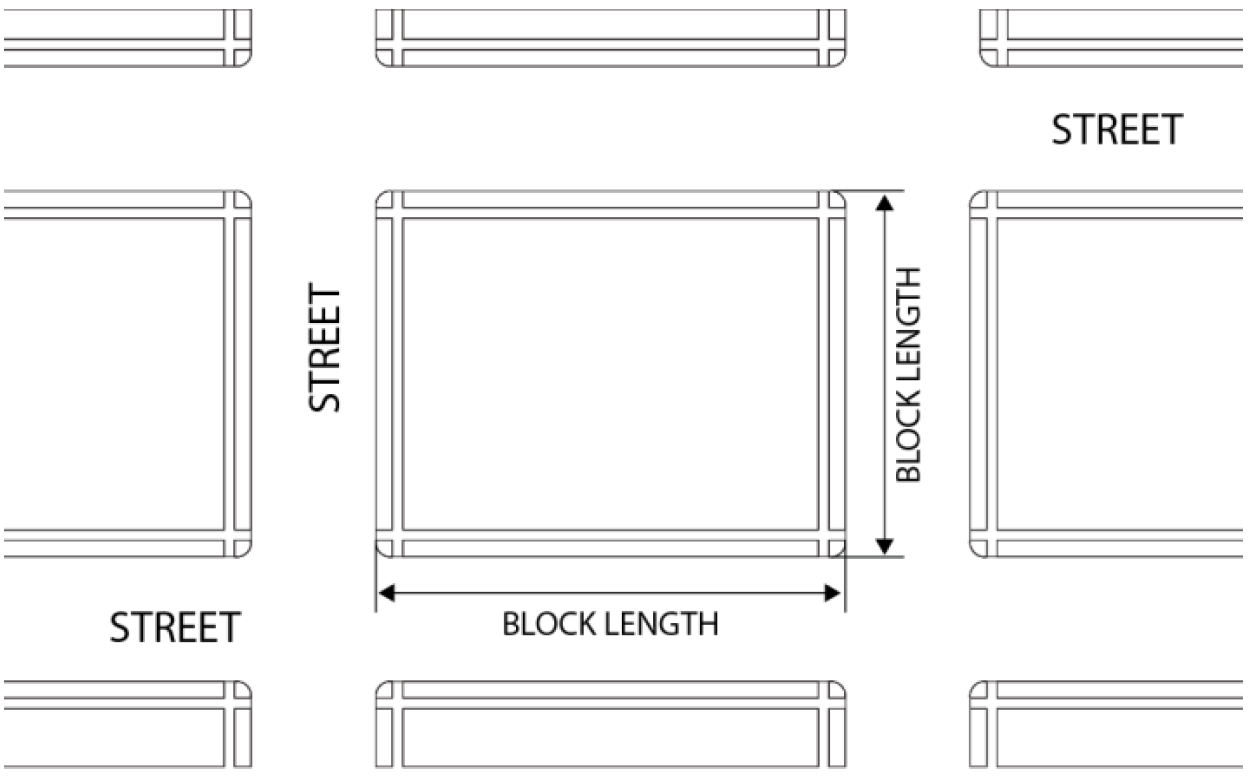
B.
Block Arrangement. Blocks shall have sufficient width to provide for two tiers of lots of depth meeting the minimum requirements of this DDC, except where lots back onto a collector or greater street, natural feature, or subdivision boundary, or where lots face an approved cul-de-sac.
8.3.4 - Cluster Subdivisions.
A.
Purpose. This section provides optional standards for cluster subdivision development to protect sensitive lands and common open space areas and to implement the comprehensive plan and/or adopted area plans. A cluster subdivision is a residential subdivision in which some or all of the lots are allowed to be smaller in area and width, thus allowing flexibility in development density in those areas in exchange for permanent protection of common open space.
B.
Applicability.
1.
The cluster subdivision option is available in all residential districts as identified in Table 3.1-A: Zoning District Designations.
2.
The minimum parcel size for a cluster subdivision shall be at least five acres.
i.
This minimum parcel size does not apply for sites affected by Gas Well Reverse Setbacks as provided for in Subsection 6.2.6C.2.
3.
All other standards in the DDC shall apply to cluster subdivisions unless modified by the cluster subdivision standards in this Subsection 8.3.4.
4.
In the case of conflict between the provisions of Table 8.A: Cluster Subdivisions, and any other portion of this DDC, the provisions of this Table 8.A: Cluster Subdivisions, shall govern.
C.
Review and Approval of Cluster Subdivisions.
1.
Cluster subdivisions require approval of a planned development (PD) and shall be reviewed through the rezone to a planned development (PD) district procedure in Subsection 2.7.3: Rezone to a Planned Development (PD) District.
a.
A PD is not required for cluster subdivision standards to be applied to sites affected by Gas Well Reverse Setbacks as provided for in Subsection 6.2.6C.2.
2.
Cluster subdivisions shall be reviewed through the preliminary plat and final plat procedures in Section 2.6, Subdivision Procedures.
D.
Cluster Subdivision Minimum Standards. The minimum standards for cluster subdivision lots are established in Table 8.A: Cluster Subdivisions below. The measurements and exceptions in Section 3.7, shall also apply to cluster subdivision lots unless otherwise stated in Table 8.A: Cluster Subdivisions.
E.
Common Open Space.
1.
Minimum Required. A minimum of 30 percent of the total site area of the cluster subdivision shall be set aside as common open space for the use of the site's residents and visitors.
2.
Identification and Maintenance.
a.
Common open space shall be identified on the final plat for a cluster subdivision, with a notation that indicates that those lands shall not be used for future development.
b.
Common open space shall be identified on-site with appropriate permanent signage markers in order to distinguish these areas from private property.
c.
Common open space shall be permanently maintained and preserved as:
i.
Open space lots with deed restrictions; or
ii.
Protected through a conservation easement; or
iii.
Land dedicated and accepted to the city, at the city's sole discretion.
d.
For any land not dedicated to the city, the developer shall provide a permanent mechanism acceptable to the City Attorney for the primary purpose of conservation, preservation, and management of protected/conserved lands.
e.
There shall be no further subdivision of land in an area approved for cluster subdivision; however, dedication of easements for public utilities may be permitted.
3.
Use of Common Open Space.
a.
Common open space shall be used for low-intensity recreation, agriculture, buffers, critical wildlife habitat, or other passive park or open space purposes. A pond may also count towards the minimum common open space requirement.
b.
The use of common open space may be further limited or controlled at the time of final approval where necessary to protect adjacent properties.
4.
Design of Open Space. Land set aside for common open space shall meet the following design criteria, as relevant:
a.
The lands shall be contiguous unless the land shall be used as a continuation of an existing trail, or specific topographic features require a different configuration. An example of such topographic features would be the provision of a trail or private open area along a riparian corridor.
b.
Where open space areas, trails, parks, or other public spaces exist adjacent to the tract to be subdivided or developed, the common open space shall, to the maximum extent feasible, be located to adjoin, extend, and enlarge the existing trail, park, or other open area land.
c.
In larger projects, open space should flow through the site linking recreation facilities to dwellings with uninterrupted green belts.
d.
If an ESA is preserved to meet the open space requirement, the land shall be left in an undisturbed natural state. Other open space shall be landscaped pursuant to Section 7.7, Landscaping, Screening, Buffering, and Fences.
F.
Auto Courts. Auto courts may be considered as an alternative layout for cluster subdivisions. Up to four single-family units (attached or detached) may share a single driveway access to a public street using an auto court arrangement, provided the layout is approved with a preliminary plat pursuant to Subsection 2.6.3, Preliminary Plat. Additionally, auto courts shall comply with the following:
1.
The surface of the shared driveway in the auto court shall be at least 20 feet wide and shall be surfaced with concrete or other permeable paving approved by the Director.
2.
Individual driveways leading from the shared driveway to each dwelling unit shall be at least 20 feet long, as measured from the front of the garage or carport to the closest edge of the shared driveway.
3.
The shared driveway shall be designed to comply with the standards of the Transportation Criteria Manual.
4.
The auto court design shall comply with the applicable off-street parking requirements.
5.
Maintenance and repair of auto courts shall be the responsibility of a property owners association or adjacent property owners. The city shall approve provisions for maintenance and repair during the subdivision review process.
6.
Parking on the shared driveway shall be prohibited and shall be clearly marked as such.
7.
The auto court access shall be from a standard-width street and the applicant shall demonstrate that there is adequate guest parking available on the street.
8.
The auto court shall comply with all other city standards including fire and emergency access, and utility provisions.
Figure 8.3-C: Auto Courts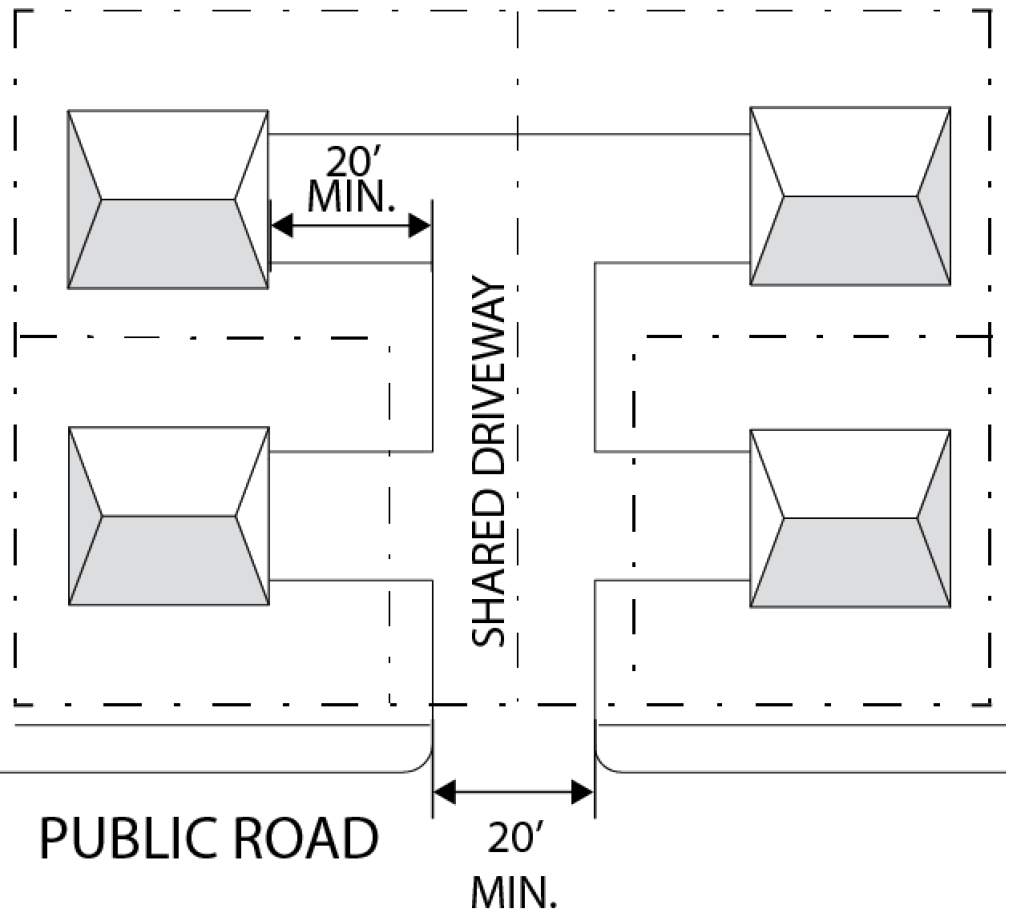
(Ord. No. DCA19-0009c, § 2(Exh. C), 11-19-2019; Ord. No. DCA19-0009e, § 2(Exh. C), 1-28-2020)
8.3.5 - Gas Well Notification Disclosure.
A plat that proposes single-family or multifamily residential lots that will be within 1,000 feet of one or more drilling and production sites, except for those drilling and production sites and their subsurface mineral interests which are eliminated through plugging and abandonment, the developer shall be required to provide all of the following disclosure notifications to all lot purchasers:
A.
A note shall be placed on the plat identifying the drilling and production site(s) and those proposed lots that are within 1,000 feet of the drilling and production site(s). Said note shall also include a statement that advises lot purchasers of the existence of producing wells on the drilling and production site(s), the possibility of new wells that may be drilled and fracture stimulated on the drilling and production site(s), as well as the possibility that gas wells on the drilling and production site(s) may be re-drilled and/or re-fracture stimulated in the future.
B.
There shall be depicted on the plat, and on a lot survey submitted as part of a building permit application, the location of the drilling and production site(s) in relation to the lots that are within 1,000 feet of a drilling and production site(s).
C.
A provision shall be included in the declaration of restrictive covenants that advises lot purchasers of the existence of producing wells on the drilling and production site(s), the possibility that new wells may be drilled and fracture stimulated on the drilling and production site(s), as well as the possibility that gas wells on the drilling and production site(s) may be re-drilled and/or re-fracture stimulated in the future.
D.
A notice document that advises lot purchasers of the existence of producing wells on the drilling and production site(s), the possibility that new wells may be drilled and fracture stimulated on the drilling and production site(s), as well as the possibility that gas wells on the drilling and production site(s) may be re-drilled and/or re-fracture stimulated in the future, shall be recorded with the Denton County Clerk's Office.
E.
The form of the disclosure notifications required in paragraphs C. and D. above shall be approved by the City Attorney.
8.3.6 - Gated Community.
A gated community may be approved only through the planned development (PD) procedures in Subsection 2.7.3, Rezone to a Planned Development (PD) District. All gated communities are subject to the following standards:
A.
Criteria Manuals. All public infrastructure within a gated community shall be constructed in accordance with City of Denton Criteria Manuals unless specific exceptions to such manuals is approved by the City Engineer during the gated community PD rezoning approval process.
B.
Access.
1.
All gated communities shall have a minimum of one point of access to a public street, and an alternative emergency access for emergency service vehicles if only one public access point is provided.
2.
Turnouts or turnarounds for the public shall be provided outside the gated perimeter, pursuant to the guidelines of the Transportation Design Criteria Manual.
3.
Turnout or turnaround areas shall be dedicated by the developer as public access easements, or as part of the public right-of-way, and shall be maintained by the developer where they are easements.
4.
Any private street that has an access control gate or cross arm must have a minimum uninterrupted pavement width of 22 feet at the location of the access control device. If an overhead barrier is used, it must be a minimum of 14 feet in height above the road surface.
5.
All gates and cross arms must be of a breakaway design.
6.
The Fire Chief, or his designated representative, shall approve the installation of access gates, which shall meet Fire Code requirements for emergency operation, and shall be maintained at all times by the homeowner's association (HOA).
7.
The HOA shall provide keypads and codes, as well as a receiver and mechanism designed to open gates automatically in response to a remote traffic signal preemption device meeting the specifications of emergency service providers, at all gates into the community.
8.
In the event that at any time any gate does not promptly and automatically open for an emergency vehicle utilizing a traffic signal preemption device, the emergency responders shall be privileged to remove, disable or destroy any locking device, gate or piece of a gate in order to gain access. The deed restrictions shall recognize and incorporate this requirement, and further hold the City and its emergency providers harmless from any and all claims or damages arising from the HOA's failure to maintain the gate to this standard or for the removal or destruction of such gates or devices.
9.
The HOA shall provide non-emergency access codes to solid waste providers, the Electric Utility, the Water Utility and Wastewater Utility Maintenance Department franchised utilities, and the US Postal Service.
C.
Fencing Adjacent to Entry Gates.
1.
On lots adjacent to entry gates, fences may exceed 40 inches in height, up to a maximum of eight feet within the side yard setback.
2.
Such fences must be constructed of wrought iron with brick columns. No solid fencing panels will be allowed.
D.
Streets.
1.
Private Streets.
a.
All streets and alleys in a gated community shall be private streets.
b.
Private streets shall meet all requirements and standards for public streets.
c.
Gated communities shall not be allowed to obstruct any existing arterial street or proposed arterial street as shown on the City Mobility Plan.
d.
Streets shown on the Mobility Plan shall not be gated or private streets.
e.
The Planning and Zoning Commission may recommend the denial of the creation of any other private street if, in the Commission's judgment, the private street would negatively affect vehicular or pedestrian traffic circulation on public streets, or impair access to property (either on-site or off-site), to the subdivision, access to or from public facilities (including schools, parks and libraries), or the response time of emergency vehicles.
f.
The city shall not pay for any portion of the cost of constructing or maintaining a private street.
2.
Private Street Lot.
a.
Private streets and alleys must be constructed within a separate lot owned by the property owners association. This lot must conform to all of the city's standards for a public street and/or alley right-of-way.
b.
An easement covering the street lot shall be granted to the city and franchised utilities, providing unrestricted use of the property for utilities and maintenance.
c.
The easement shall provide the city with the right of access for any purpose related to the exercise of a governmental service or function.
d.
The easement shall permit the city to remove any vehicle or obstacle within the street lot that impairs emergency access.
3.
Maintenance and Reconstruction. The city is not responsible for reconstruction or full depth repair to the private street. The city will follow customary practices in backfilling and repaving repaired sections of private streets after a utility repair, utilizing the least cost solution, with no further obligation of future maintenance for the repair, and no obligation to rebuild or repair pavements to any preexisting design or appearance, if different from the city's ordinary repair standards for public streets. Alternatively, the HOA may elect to privately undertake one or more aspects of the backfilling and pavement repair, and the city may participate in the funding of such private repairs, but only to the extent of any repair costs avoided by such private repairs.
E.
Water and Sewer.
1.
All water and sewer mains that serve inside the gated community and are located within public utility easements shall be dedicated to the city prior to approval of the final plat, and shall be publicly owned and maintained.
2.
All water and sewer mains and associated appurtenances shall be designed and built according to city standards.
3.
Public water and sewer mains and facilities shall be located within a public utility easement or other adequate water and sewer easement dedicated to the city.
4.
Water meters and sanitary sewer cleanouts shall be located within a public utility easement and outside of the paved portion of the private street.
F.
Street Lighting.
1.
Street lighting on private streets is required to meet the design standards of the city and shall be installed and maintained by the HOA at no cost to the city.
2.
Luminaries, fixtures, poles, foundations, conduit, wiring, appurtenances, and any other ancillary items associated with street lighting shall be owned, operated, and maintained by the HOA.
3.
All energy costs will be metered and invoiced to the HOA under the appropriate rate schedule.
4.
The HOA shall be solely responsible to obtain and pay for power needed to illuminate street lighting.
G.
Electric Utility Infrastructure.
1.
All electric facilities that serve inside the gated community shall be owned and maintained by the utility provider.
2.
All electric facilities shall be designed, built, and operated according to the standards of the utility provider.
3.
Electric utility infrastructure shall be located within a public utility easement or other adequate easement dedicated to the city.
H.
Solid Waste Requirements.
1.
Residential solid waste collection service shall be provided from the front of the property at the curbside of the private streets.
2.
For residential dwellings with rear entry garages, the solid waste collection service may be provided from the alley, if the alley is designed to provide adequate turning radii for all solid waste collection trucks and if the house address number is visible from the alley.
3.
All residential refuse collection criteria, as listed within the city's ordinances, shall apply to gated communities.
4.
In the event that a vehicular access gate is not operable and access is not available for solid waste collection vehicles, the Solid Waste Department shall continue on with the normal progression of their daily route, and report the inaccessibility of the area to customer service.
I.
Drainage Requirements. The developer is responsible for the installation of the stormwater system to city standards, and the HOA is responsible for maintenance of the stormwater system.
1.
Minor Drainage System.
a.
The minor drainage system includes the entire storm drainage collection systems within the streets, ditches and channels within the gated community that collect surface drainage originating from within the spatial boundaries of the gated community.
b.
The minor drainage system also includes all drainage systems within the gated community that collect drainage from offsite areas up to three acres.
c.
Drainage easements for the minor drainage system shall be consistent with this DDC and the City's Criteria Manuals, and shall be dedicated on the final plat.
d.
The minor drainage system shall be maintained by the HOA, and the city has no obligation for the inspection or maintenance of this system.
e.
Physical connection points shall be established between the minor and major drainage systems as described herein, that will be used to establish the physical limits for maintenance responsibilities.
2.
Major Drainage System.
a.
The major drainage system provides for the conveyance of stormwater runoff through the gated community, originating from any area outside of the gated community greater than three acres.
b.
To provide for the major drainage system, green space or open space areas and floodplain areas shall be reserved for stormwater detention, retention, or conveyance of drainage. These areas shall be dedicated by simple deed as separate lots, with ownership to be retained by the HOA. The entire lot or a portion thereof shall be dedicated on the final plat as a drainage easement or as a drainage and detention easement, as appropriate.
c.
The plat shall include dedication language stating that the drainage easement, or drainage and detention easement, will be reserved for the conveyance of drainage or floodwaters, and shall remain open at all times and maintained by the HOA in a safe and sanitary condition.
d.
The city will not be responsible for the maintenance and operation of said lots or easements, or for any damage to private property or person that results from conditions in the lots or easements, or for the control of erosion.
e.
No obstructions to the natural flow of stormwater run-off shall be permitted by construction of any type of building, fence or any other structure within the drainage easement or drainage and detention easement, as herein above defined, unless approved by the city.
f.
The HOA shall keep the drainage easement or drainage and detention easement clear and free of debris, silt, and any substance that would result in unsanitary conditions or obstruct the flow of water.
g.
The city shall have the right of ingress and egress to inspect and supervise maintenance by the HOA, or to optionally alleviate any undesirable conditions that may occur.
h.
The city shall have the right, but not the obligation, to enter upon the lot or drainage or drainage and detention easement to remove any obstruction to the flow of water, after giving the HOA written notice of such obstruction, upon failure of the HOA to remove such obstruction. The city shall be reimbursed by the HOA for reasonable costs for labor, materials, and equipment in each such instance.
i.
Any easement dedication shall conform to the provisions of TLGC, § 212.904.
J.
Homeowners Association (HOA) Required. Documents establishing the HOA shall be submitted as part of the final plat application, providing for the maintenance, repair and/or replacement obligations of the HOA for private roads, alleys, gates, fences, street lighting, drainage items and/or other like held facilities and/or common areas, their appurtenances and/or other associated ancillary items and improvements, shall be incorporated into the final plat.
1.
The HOA shall provide for the power to file a lien, to foreclose, or to otherwise secure payment from homeowners for the maintenance, repair and replacement, in part or in whole, of all privately held common areas, including but not limited to, drainage items, street lighting, and other appurtenances or associated ancillary items.
2.
The association documents shall be submitted to, reviewed by, and approved by the City Attorney prior to final plat approval.
3.
The covenants and restrictions documents shall indicate that the streets in the subdivision are private and are maintained by a Homeowners Association, that they are not public, and that the city has no obligation to maintain them.
4.
The covenants and restrictions shall also state that the city has no obligation to inspect the streets or drainage in the gated community.
5.
The covenants and restrictions documents shall indicate that the subdivision final plat, property deeds and home owner association restrictive covenants that certain city services shall not be provided on private streets. Among the services that will not be provided are: routine police patrols, enforcement of traffic and parking ordinances and preparation of accident reports. All private traffic regulatory signs shall conform to the Texas Manual of Uniform Traffic Control Devices. Depending on the characteristics of the proposed development, other services may not be provided.
6.
The covenants and restrictions shall also state that the city has no obligation to inspect the streets in the gated community.
7.
The Homeowners Association may not be dissolved, nor may deed restrictions and covenants providing for maintenance of common areas be deleted or amended, without the prior written consent of the Planning and Zoning Commission, by way of a plat amendment.
8.
The final plat and restrictive covenants shall contain language whereby the Homeowners' Association, as owner of various private improvements within a private street, lot or easement, agrees to release, indemnify, defend and hold harmless the city from claims and suits for property damage or bodily injury (including death) arising from the condition, use or operation of any privately-owned streets or facilities.
8.4.1 - Purpose.
This section establishes the minimum acceptable standards for improvement of streets and utilities. All improvements in streets or easements which are required as a condition to plat approval shall be the responsibility of the subdivider.
8.4.2 - Compliance Required.
A.
In addition to satisfying Section 7.6: Water and Wastewater, and all applicable City Criteria Manuals, the applicant shall demonstrate the ability to satisfy the requirements set forth herein prior to development, at each stage of the platting process, including applications for preliminary plats, and final plats.
B.
The city may deny a preliminary plat if the applicant cannot demonstrate the ability to satisfy these requirements, the requirements of Section 7.6: Water and Wastewater, and applicable City Criteria Manuals, prior to approval.
8.4.3 - Cost of Improvements and City Participation.
The applicant shall make all required improvements, at his expense, according to city regulations, without reimbursement by the city, except for certain reimbursable costs as provided in Subsections 7.6.14 and 7.6.15, or as determined as a result of an exaction proportionality determination and appeal under Subsection 2.5.6.
8.4.4 - Applicant to Extend Mains and Streets to Subdivisions.
A.
If the existing city mains and/or streets are not within or adjacent to a subdivision, the developer shall construct the necessary extension as specified in this subchapter.
B.
These mains or streets shall be constructed in accordance with the Mobility Plan of the city.
C.
These facilities shall be in public easements, secured and paid for by the developer.
D.
Such easements must be recorded as required by law before service is extended to the subdivision.
8.4.5 - Pre-Construction Phase Procedures and Requirements.
A.
Prior to beginning construction of public improvements the City Engineer shall schedule a preconstruction conference between the owner/applicant and applicable city departments.
B.
Representatives of public and franchise utilities shall be notified and maybe required by the city to review the proposed improvements to be made and the requirements of this subchapter.
8.4.6 - Development Contract Required.
A.
For all developments in which streets, drainage facilities, water or sewer lines or other improvements are to be constructed and dedicated or conveyed to the public, a development contract is required to ensure proper construction and completion of the improvements and payment is made.
B.
The developer shall submit the development contract, along with all required documents in conformity with all city construction standards.
8.4.7 - Construction, Inspection, and Acceptance.
The construction, inspection of construction, and acceptance of public improvements after completion shall be approved by the City Engineer, if the construction conforms to the requirements of all city construction standards.
8.4.8 - Streets.
Streets and right-of-way shall conform to the Mobility Plan, the Transportation Design Criteria Manual, and the standards in this DDC, as amended.
8.4.9 - Utilities.
A.
New utilities shall be installed underground unless an administrative determination is made that physical barriers render undergrounding utilities infeasible. Transformers, pedestals, fire hydrants, and other appurtenances normally associated with "underground" utility installations are permitted on the surface of the ground.
B.
When overhead utility lines exist within the property being platted, including boundary easements, these utility lines and new installations within the platted area shall be placed underground.
C.
When overhead utility lines exist on the periphery of the property being platted, they and any additions or replacements needed to increase capacity or improve service reliability may remain overhead; provided, that any service drops into the platted area from said peripheral overhead lines shall be underground.
D.
Underground utilities may be extended and easements shall be required to the boundaries of the plat to provide service connections to abutting un-subdivided land.
8.4.10 - Adequate Water System.
A.
Generally.
1.
The applicant shall demonstrate that the water system serving the development will be adequate to serve the development at the time of preliminary plat approval for development within the city limits, or at the time of final plat approval for developments within the city's extraterritorial jurisdiction.
2.
Where a development plan or phased preliminary plat is proposed, the applicant shall demonstrate that each phase of the development will be served by an adequate water system under this standard.
3.
The approach main shall be extended to serve the entire development subject to a development plan or phased preliminary plat prior to the time of final plat approval for the second phase of the development plan or phased preliminary plat, unless the extension is part of a funded capital improvement project that the City has initiated consistent with its adopted Capital Improvement Plan for water facilities.
B.
Criteria for Adequate Facilities. The water system serving the subdivision shall be deemed adequate when in conformance with Section 7.6: Water and Wastewater, and one of the following options, as applicable:
1.
City Facilities Not Used.
a.
Where the city is not the supplier, the applicant shall provide assurance of sufficient capacity, in accordance with the water capacity standards in the Administrative Criteria Manual, from the entity holding the certificate of convenience and necessity for the land to be subdivided.
b.
Such entity shall have sufficient water supply, water treatment, and transmission capacity to serve the development, considering all other commitments, in accordance with city standards.
c.
The applicant shall present written verification from the water supplier that it has agreed to provide water service to the development in conformance with Denton design and construction standards. The applicant shall provide assurances that water mains will be extended to serve the subdivision prior to the time of final plat approval for the second phase of a development plan or phased preliminary plat.
2.
City Facilities are Used.
a.
Where city distribution mains are to be used for supplying water, and there is an existing distribution main with adequate capacity to serve the development within one mile of the boundary of the proposed subdivision, the applicant may, at his initial expense, and subject to standard city participation policies, extend one or more approach mains from the existing distribution main to the subdivision, of a size sufficient to serve the development.
b.
The city reserves the right to require oversizing of the line in accordance with standard City of Denton oversize policies. This requirement does not apply where the approach main is already a component of a funded capital improvement project that the city has initiated, consistent with its adopted Capital Improvement Plan for water facilities.
C.
Water and Sewer Utilities Connections. The city shall not provide any water or sewer utility connection to land proposed for subdivision under this DDC until all of the following requirements have been met:
1.
The water supply, treatment, storage and off-site distribution system to serve the subdivision meet the requirements of Subsection 8.4.10;
2.
The sanitary sewer treatment and collection system to serve the subdivision meet the requirements of Subsection 8.4.11;
3.
The owner or developer of the subdivision or addition has executed a written agreement with the city, providing for the offsite extension of water and sewer mains to serve the development, in accordance with the existing water and sewer extension regulations;
4.
Off-site mains have been extended to the subdivision pursuant to the agreement and this section, and water and sewer mains have been installed in accordance with the city's specification in the block facing the street on which the property is situated and accepted by the City; and
5.
"As built" plans in digital format are required at the end of construction showing the actual location of all improvements.
8.4.11 - Adequate Sewer System.
A.
Generally.
1.
No preliminary or final plat application shall be approved unless the applicant demonstrates that there will be an adequate sanitary sewer system to serve the subdivision concurrent with development.
2.
The applicant shall demonstrate that the sanitary sewer system serving the development will be adequate at the time of preliminary plat approval for development within the city limits, or at the time of final plat approval for developments within the city's extraterritorial jurisdiction.
3.
Where a development plan or phased preliminary plat is proposed, the applicant shall demonstrate that each phase of the development shall be served by an adequate sanitary sewer system under this standard.
4.
The approach main shall be extended to serve the entire development subject to a development plan or phased preliminary plat prior to the time of final plat approval for the second phase of the development plan or phased preliminary plat, unless the extension is part of a funded capital improvement project that the city has initiated consistent with its adopted Capital Improvement Plan for wastewater facilities.
5.
Adequacy of treatment facilities cannot be demonstrated by reliance upon package treatment plants.
B.
Criteria for Adequate Facilities. The sanitary sewer system serving the development shall be deemed adequate when in conformance with Section 7.6: Water and Wastewater, and one the following options, as applicable:
1.
City Facilities Not Used.
a.
Where the city's sanitary sewer system is not to be used, the applicant shall provide assurance that the entity collecting the sewage holds a certificate of convenience and necessity for the land to be subdivided, that collection systems are adequate to accommodate sewage flows from the development and that the treatment system to be used has adequate capacity in accordance with the standards in Section 7.6: Water and Wastewater.
b.
The applicant shall provide assurances that sanitary sewer mains will be extended to serve the subdivision prior to the time of final plat approval for the second phase of a development plan, or phased preliminary plat.
2.
City Facilities are Used.
a.
Where city collection mains are to be used for collecting sewage, and there is an existing collection main with adequate capacity to serve the development within one mile of the boundary of the proposed subdivision, the applicant may agree to extend one or more existing collection mains to the subdivision of a size adequate to serve the development, at his expense, including the cost to construct all necessary lift stations and force mains, in accordance with standard city participation policies.
b.
The city reserves the right to require oversizing of the line in accordance with standard City of Denton oversize policies. This requirement does not apply where the approach main is already a component of a funded capital improvement project that the city has initiated, consistent with its adopted Capital Improvement Plan for wastewater facilities.

