
Denton City Zoning Code
Subchapter 9
Definitions
9.2 - Definitions
100-Year Water Surface Elevation (100-Yr W.S.E.): The water surface elevation established by hydrologic/hydraulic analysis of a stream, river, stream, or tributary, using the 100-year fully developed watershed, based upon the 100-year rainfall event.
Accessory Building: A building on the same lot with, and of a size and nature customarily incidental and subordinate to, the principal building.
Accessory Dwelling Unit: A subordinate dwelling unit added to, created within, or detached from a single-family residence, that contains a dwelling that is subordinate to a principal single-family detached dwelling and that provides basic requirements for living, sleeping, cooking, and sanitation. A HUD-Code manufactured home shall not be considered an accessory dwelling unit.
Accessory Use: A use incidental or secondary to the principal use of a lot, building or structure and located on the same lot as the principal use.
Administrative, Professional, or Government Office: A building in which services are provided and/or business is conducted including administrative, professional, governmental, or clerical operations. Typical examples include real estate, insurance, property management, investment, financial, employment, travel, advertising, law, architecture, design, engineering, accounting, call centers, and similar offices. This use includes accessory uses such as restaurants, coffee shops, health facilities, parking, limited retail sales, or other amenities primarily for the use of employees in the firm or building.
Adopted Plan: Any statement of goals, objectives, and policies adopted as an official plan by the City of Denton, Texas.
Adult Arcade: Any place to which the public is permitted or invited wherein coin-operated or slug-operated or electronically, electrically, or mechanically controlled still or motion picture machines, projectors, or other image-producing devices are maintained to show images to 5 or fewer persons per machine at any one time, and where the images so displayed are distinguished or characterized by an emphasis on matter depicting, describing or relating to "specified sexual activities" or "specified anatomical areas."
Adult Bookstore/Adult Video Store:
1.
A commercial establishment which as one of its principal business purposes offers for sale or rental for any form of consideration any one or more of the following:
a.
Books, magazines, periodicals or other printed matter, or photographs, films, motion pictures, video cassettes or video reproductions, slides, or other visual representations distinguished or characterized by an emphasis on matter depicting, describing or relating to "specified sexual activities" or "specified anatomical areas"; or
b.
Instruments, devices, or paraphernalia which are designed for use in connection with "specified sexual activities."
2.
For the purpose of this definition, a commercial establishment shall be considered to have as "one of its principal business purposes" the sale or rental of the materials described in subsection 1. above, if:
a.
The establishment makes use of a sign visible from any public street, whether located on or off the property of the establishment, advertising the availability at the establishment of any materials described in subsection 1.;
b.
The establishment devotes more than 30 percent of its total floor area which is open to the public to the display of items for sale or rental that are materials described in subsection 1.;
c.
More than 30 percent of the total number of items displayed for sale or rental by the establishment are materials described in subsection 1; or
d.
The establishment regularly maintains on the property for sale or rental materials described in subsection 1. whole total retail value is more than 50 percent of the total retail value of all materials kept on the premises for sale or rental.
Adult Cabaret: A nightclub, bar, restaurant, or similar commercial establishment which regularly features:
1.
Persons who appear in a state of nudity; or
2.
Live performances which are distinguished or characterized by an emphasis on "specified sexual activities" or the exposure of "specified anatomical areas"; or
3.
Films, motion pictures, video cassettes, slides, or other photographic reproductions which are distinguished or characterized by an emphasis on matter depicting, describing or relating to "specified sexual activities" or "specified anatomical areas."
Adult Entertainment Establishments: Adult entertainment establishments include: adult arcade, adult bookstore or adult video store, adult cabaret, adult motel, adult motion picture theater, adult theater, escort agency, nude model studio and all other adult entertainment establishments.
Adult Motel: A hotel, motel, or similar commercial establishment that:
1.
Offers accommodations to the public for any form of consideration; provides patrons with closed-circuit television transmissions, films, motion pictures, video cassettes, slides, or other photographic reproductions which are distinguished or characterized by an emphasis on matter depicting, describing or relating to "specified sexual activities" or "specified anatomical areas"; and has a sign visible from the public right-of-way which advertises the availability of this adult type of photographic reproductions; or
2.
Offers a sleeping room for rent for a period of time that is less than 10 hours; or
3.
Allows a tenant or occupant of a sleeping room to sub-rent the room for a period of time that is less than 10 hours.
Adult Motion Picture Theater: A commercial establishment where, for any form of consideration, films, motion pictures, video cassettes, slides, or similar photographic reproductions are regularly shown which are distinguished or characterized by an emphasis on matter depicting, describing or relating to "specified sexual activities" or "specified anatomical areas."
Adult Theater: A theater, concert hall, auditorium, or similar commercial establishment which regularly features persons who appear in a state of nudity or live performances which are distinguished or characterized by an emphasis on "specified sexual activities" or the exposure of "specified anatomical areas."
Adverse Impact: An impact that:
1.
Creates, imposes, aggravates, or leads to inadequate, impractical, unsafe, unhealthy conditions on a site or degrades or damages environmental or cultural resources on a site proposed for development or on off-site property or facilities; or
2.
Creates, imposes, or leads to a nuisance on a site proposed for development or on off-site property or facilities.
Advertise: As it applies to short-term rentals, the written, audio, oral or other methods of drawing the public's attention whether by brochure, written literature or on-line posting to a Short Term Rental in order to promote the availability of the short term rental.
Agricultural and Animal Uses: This category includes agricultural and farming activities, including nurseries and facilities for processing and selling agricultural products. Agricultural uses involve farming, dairying, pasturage, beekeeping, horticulture, floriculture, viticulture, and animal husbandry. Animal-related uses include the boarding and care of animals on a commercial basis. Accessory uses may include confinement facilities for animals, parking, and storage areas.
Airport Hazard: Any structure or object of natural growth, or use of land, which obstructs the air space required for the taking off, landing and flight of aircraft, or that interferes with the visual, radar, radio or other systems for tracking, acquiring data relating to, monitoring or controlling aircraft.
Airport, City-Owned: A landing area, runway, or other City-owned facility designed, used, or intended to be used for the landing or taking off of aircraft, including all necessary taxiways, aircraft storage and tie-down areas, hangars, and other necessary buildings and open spaces.
Alley: A public way that provides access to abutting property and which is not intended for general travel or circulation. Alleys are typically a secondary means of access to a property.
Alley Access Garage: See "Garage, Alley Access."
Alternative Mounting Structure: A man-made tree, clock tower, church steeple, bell tower, utility pole, light standard, identification pylon, flagpole, or similar structure, designed to support and camouflage or conceal the presence of telecommunications antennas.
Amenity Center: A building or facility owned or operated by a corporation, association, person, or persons for a place of meeting, social, cultural, educational, or recreational purposes, to which membership or residency requirements is required for participation.
Antenna: A structure or device used to collect or radiate electromagnetic waves, including directional antennas, such as panels, wireless cable and satellite dishes, and omni-directional antennas, such as whips, but not including satellite earth stations.
Antenna Array: An arrangement of antennas and their supporting structure.
Antenna, Dish: A parabolic bowl shaped device that receives and/or transmits signals in a specific directional pattern.
Antenna, Panel: An antenna which receives and/or transmits signals in a directional pattern.
Antenna, Stealth: A telecommunications antenna that is effectively camouflaged or concealed from view.
Antenna, Telecommunications: An antenna used to provide a telecommunications service. This excludes lightning rods, private mobile radio systems, amateur radio antennas less than 50 feet (15 meters) in height and whip antennas less than four inches (10 cm) in diameter and less than 10 feet (three meters) in height.
Antenna, Whip: An omni-directional dipole antenna of cylindrical shape which is no more than 6 inches (15 cm) in diameter.
Applicant: Unless otherwise specified, an owner or other person with a legal property interest, including heirs, successors, and assigns, or an owner's authorized agent, who has filed an application for zoning, subdivision, or development activity.
Approach Surface: A surface longitudinally centered on the extended runway centerline and extending outward and upward from each end of the primary surface. An approach surface is applied to each end of each runway based upon the type of approach available or planned for that runway end.
Architectural Compatibility: Consistency in roof pitch, exterior construction materials, exterior color, and architectural design and detail.
Architectural Element: Authentic architectural projections and details.
Architectural Projection: Eaves, decorative extensions, bay windows having no floor space, or other portions of a structure having neither living space nor key structural value.
Auto Court: Auto court development is an arrangement of single-family, duplex, or townhome dwellings with a shared access to minimize curb cuts and/or provide shared parking facilities.
Auto Wash: The use of a site for washing, cleaning, and detailing of passenger vehicles, recreational vehicles, or other light-duty equipment. This use includes self-service and any facility attended by an employee.
Automotive Fuel Sales: An establishment where fuel, motor oil, automobile lubricants, travel aids and other supplies are sold to the motoring public.
Automotive Repair Shop, Major: An establishment primarily engaged in providing major automotive repair services such as engine and drive train repair, body work, mechanical servicing, and/or painting.
Automotive Repair Shop, Minor: An establishment primarily engaged in providing minor automotive repair services such as lubrication, oil and tire changes, and tune-ups, brake repair, tire replacement, detailing and polishing, paint-less repair, window tinting, vehicle wraps, and audio installation. Major repairs such as automotive bodywork or painting or repair of engines or drive trains shall not be provided.
Automotive Sales or Leasing: The sale, lease, rental, outdoor storage, or outdoor display of motor vehicles. This definition shall not include salvage operations, scrap operations, impound yards, or commercial parking lots available for short-term use.
Automotive Wrecking Service, Impound Lot, Junkyard and Salvage Yard: A business that stores, buys, or sells materials that have been discarded or sold at a nominal price by a previous owner and that keeps all or part of the materials outdoors until disposing of them. This definition includes activities such as junk or salvage storage or operation; vehicle wrecking and salvage operation; and vehicle storage at a state licensed facility. A licensed vehicle storage facility is a garage, parking lot, or other facility owned or operated by a person other than a governmental entity for storing or parking 10 or more vehicles per year.
Bank or Financial Institution: An establishment that provides retail banking, mortgage lending, and financial services to individuals and businesses. Accessory uses may include automatic teller machines, drive-through service, offices, and parking.
Bar, Tavern, or Lounge: An eating and drinking establishment providing or dispensing by the drink for on-site consumption fermented malt beverages, and/or malt, special malt, vinous, or spirituous liquors, and in which the sale of food products is secondary. A bar, tavern, or lounge may include the provision of live entertainment and/or dancing; however, shall not include any adult entertainment. Accessory uses may include the manufacture of alcoholic beverages for on-site consumption and/or retail sales.
Base Flood: A flood having a one percent chance of being equaled or exceeded in any given year based on a fully developed watershed. Also known as the 100-year flood.
Basement: A building story partially or completely underground. A basement shall be counted as a story in computing building height where any portion of a basement has more than one-half of its height above grade.
Basic Utilities: Infrastructure services and the structures necessary to provide those services including electricity, natural gas, telephone, telecommunications, water, or sewer. This definition includes water towers and water treatment plants.
Bed and Breakfast: A single-family detached dwelling that is owner-occupied or occupied by a resident manager in which rooms are rented and meals may be served to transient guests on an overnight basis for a period of time less than 30 consecutive days.
Bedroom: Any room other than a living room, family room, dining room, kitchen, bathroom, closets, or utility room, for the purpose of this DDC, shall be considered a bedroom. Dens, studies, etc. with or without closets and similar areas, which may be used as bedrooms shall be counted as bedrooms for the purposes of this DDC.
Block Length: The distance between intersections of through streets, such distance being measured along the longest street bounding the block and from right-of-way line to right-of-way line of the two intersecting streets.
Board of Adjustment/Board: The Board of Adjustment of the City of Denton, Texas.
Boarding or Rooming House: A building or portion of a building, other than a hotel, motel, or multifamily dwelling wherein non-transient lodging and/or meals are provided for compensation to more than four but fewer than 20 persons. Provision for meals may be made, provided cooking is done in a central kitchen and not in individual rooms or suites.
Buffer: A strip of land that includes landscaping, fencing, walls, vegetated earthen berm, or any combination thereof.
Building: Any permanent structure designed, used, or intended to be used for human occupancy or use or to support the human occupancy or use of land, including manufactured homes.
Building Coverage: The portion of the lot that is covered by the principal building and all accessory buildings. The coverage is expressed as a percentage of such area in relation to the total gross area of the lot or site.
Building Materials and Supply Store: A business involved in the sale, outdoor storage, and outdoor display, distribution of structure supplies and services including lumber, brick, tile, cement, insulation, floor covering, lighting, plumbing supplies, electrical supplies, cabinetry and roofing materials. Accessory uses may include repair or delivery services and outdoor sale of plants and gardening supplies.
Building Pad: The actual foundation area of the principal building and a 10-foot clear area extending from the foundation perimeter necessary for construction and grade transitions.
Building Permit: A document signed by the Building Official or their authorized representative as a condition precedent to the commencement of a use or the erection, construction, reconstruction, restoration, repair, remodeling, rehabilitation, alteration, conversion, demolition, moving, installment, or portion of a structure or building, which acknowledges that such use or building complies with the provisions of this Chapter or an authorized variance or specific use permit there from.
Building, Principal: A building in which the principal use of the lot on which the building is located is conducted.
Business or Trade School: A secondary school offering instruction in a professional, vocational, or technical field.
Calculated dbh: The combined dbh of the tree(s) to be removed, multiplied by the appropriate tree classification ratio, as described in paragraph 7.7.4H.5.
Carport: A partially enclosed structure used for the housing of motor vehicles, the property of, and for use only by the occupants of the lot upon which such structure is located. For purposes of zoning, a carport attached to a principal structure shall be regarded as part of that principal structure and not as an accessory structure. A detached carport shall be classified as an accessory structure.
Cementitious Siding: Siding used for exterior building finishes that is formed by combining water, wood pulp, fly ash, and Portland cement.
Cemetery, City-Owned: A City-owned facility or area used or intended to be used for the interment or burial of the dead, including graveyard, burial park, mausoleum, columbarium, or any other area containing one or more graves.
Cemetery Element: A grave, memorial, crypt, mausoleum, columbarium, or other item that is associated with the cemetery, including a fence, road, curb, wall, path, gate, or bench and the lighting and landscaping.
Cemetery, Privately-Owned: A place, established by an individual, corporation, partnership, firm, trust, or association, that is used or intended to be used for internment, and includes a graveyard, burial park, mausoleum, or any other area containing one or more graves.
Certificate of Appropriateness (COA): An order issued by the Historic Preservation Officer (often with the approval of the Historic Landmark Commission) indicating approval of plans for alteration, construction, or removal affecting a designated landmark or property within a designated district.
Certificate of Occupancy: Certificate issued by the Building Official for the use of a building, structure or land, when it is determined by the Building Official that the building, structure or proposed land use complies with the provisions of all applicable Codes of the City of Denton
Certified Local Government: A local government certified or approved by the State Historic Preservation Office (SHPO), which has an appointed commission to oversee the survey and inventory of historic resources, to review areas for historically significant structures, and to develop and maintain community planning and education programs.
Channel: An open conduit in which water flows with a free surface.
Chapter House: A place of residence other than a hotel, rooming or boarding house, or dormitory that is operated by a nationally chartered membership organization or a local chartered organization and used, occupied and maintained for persons enrolled in a college, university or other educational institutions, and which is recognized and subject to controls by such educational institution.
City: The City of Denton, Denton County, Texas, and its extraterritorial jurisdiction.
City Council: The City Council of the City of Denton, Texas.
City Engineer: The individual holding the office of City Engineer of the City of Denton, Texas, who shall actively maintain licensure in good standing as a professional engineer under the laws of the State of Texas. Those duties assigned by this DDC to the City Engineer which relate to the development review process may be reassigned by the City Manager, in whole or in part, to one or more licensed professional engineers, as needed to adjust workflow or to provide specific expertise.
Civil Engineering Plans: Plans, profiles, cross-sections, and other required technical drawings and details for the construction of public and private improvements prepared by a registered engineer.
Clearing and Grading: The removal of vegetation by manual or mechanical means, or altering surfaces to specified elevations or slopes including stripping, cutting, filling, stockpiling, shaping, or any combination thereof.
Club or Lodge: A group of people associated with or formally organized for a common purpose, interest or pleasure, including organizations with facilities for the storage, sale, possession, or serving of any alcoholic beverage permitted by the law of the State of Texas and where none of such facilities are available except by membership qualifications, dues, or regular meetings.
College or University: An institution of higher learning providing facilities for teaching and research and authorized to grant academic degrees.
Co-Location: A single telecommunications tower and/or site used by more than one telecommunications service provider.
Commercial Animal Service (Indoor): An establishment or business related to the grooming, training, boarding, adoption, or daycare service of domestic animals (usually dogs or cats) which is primarily located indoors. Excluding veterinary clinics or the sale of animals.
Commercial Animal Service (Outdoor): An establishment or business related to the grooming, training, boarding, adoption, or daycare service of domestic animals (usually dogs or cats) which is primarily located outdoors. Excluding veterinary clinics or the sale of animals.
Commercial Greenhouse or Nursery: An establishment, including a building, part of a building, or open space, for the growth, display, and/or sale of plants, trees, and other materials used in indoor or outdoor planting for retail sales and incidental wholesale trade.
Commercial Incinerator: Establishments primarily engaged in the collection and disposal of refuse by processing or destruction for profit. Examples would be furnaces or similar devices for the burning to ash of trash or bodies.
Commercial Incinerator, Transfer Station: A commercial facility for the collection, source separation, storage, transportation, transfer, processing, treatment or disposal of solid waste that does not impose a present or potential hazard to human health or the environment, including pollution of air, land, surface water or ground water. This definition includes any commercial incinerator, boiler, percolator or other solid waste facility at which solid waste, including previously processed solid waste is burned for the purposes of volume and weight reduction or steam heat, power or energy generation.
Commercial Stable: A facility or area where livestock (as defined by Chapter 6 of the Code of Ordinances) are kept, housed, boarded, lodged, fed, hired, trained, sold, or bred as a commercial activity. The definition includes accessory uses such as riding lessons, clinics, and similar activities.
Common Open Space: A portion of a development permanently set aside to preserve elements of the natural landscape for public or private use, which will not be developed or subdivided.
Community and Cultural Facilities: Uses including buildings, structures, or facilities owned, operated, or occupied by a governmental entity or nonprofit organization to provide a service to the public.
Community Center: A building used as a place of meeting, recreation, or social activity and not operated for profit and which neither alcoholic beverages or meals are normally dispensed or consumed, and typically for use by the residents of a particular development or the community.
Community Garden: A facility where members of the community have access to individual garden plots for the cultivation of fruits, flowers, vegetables, or ornamental plants.
Community Home: A community-based residential home containing not more than six disabled persons with two supervisory personnel which meets the requirements of the Community Homes for the Disabled Persons Location Act, Tex. Hum. Res. Code Chapter 123.001, et seq. (Vernon 1990), as amended. This definition does not include Recovery Housing as defined by Texas Health and Safety Code Chapter 469, as amended.
Community Service: A structure or group of structures that are governmentally owned or controlled for social, educational, and/or recreational activities. Community Service facilities include federal, state, county, and City of Denton activities. Fire stations, libraries, and civic buildings are included in this definition.
Comprehensive Plan: The comprehensive plan of the City of Denton, Texas as adopted by the City Council. The comprehensive plan shall consist of a land use plan, a mobility plan, a water system plan, a sanitary sewer plan, a storm drainage plan, a parks and recreation plan, and such other plans as may be adopted by the City.
Concrete or Asphalt Batching Plant: A temporary facility where asphalt or concrete, or its ingredients or products, are ground up, mixed, or otherwise prepared for use on-site or for transportation to another site.
Conduit: Any open or closed device for conveying flowing water.
Conical Surface: A surface which extends outward and upward from the periphery of the horizontal surface at a slope of 20:1 for a horizontal distance of 4,000 feet.
Conservation District: Any neighborhood or region designated by the City Council as a conservation district.
Conservation Easement: A voluntary and permanent deed restriction which limits the development and/or subdivision of property for the purposes of protecting conservation values in the land. The easement is a recorded restriction, applies to and binds all subsequent owners, and may be held by either a non-profit entity or organization that manages open space, such as a land trust or other qualified entity, pursuant to Section 170(h) of the Internal Revenue Code, as amended, or a governmental entity.
For the purposes of tree preservation, the conservation easement shall contain the prescribed minimum preservation amount, included a stand of trees and understory, and shall be the greater of 10 percent of the property or 5,000 square feet.
Conveyance Plat: An interim plat recording the subdivision of property or defining a remainder of property created by the approval of a final plat for sole purpose of conveying land and not for development for a portion of property, where approval of final development plans is not sought.
Cornice: A continuous, molded projection that crowns a wall or other construction, or divides it horizontally for compositional purposes.
Craft Alcohol Production: A facility in which processing and production of beverages occurs, including canning, bottling, and packaging for sale and/or distribution to retailers, drinking establishments, restaurants, or wholesalers, but may also include onsite consumption and/or retail sales.
Credit Access Business: A credit services organization that obtains for a consumer or assists a consumer in obtaining an extension of consumer credit in the form of a deferred presentment transaction or a motor vehicle title loan, as established in Section 393.601 of the Texas Finance Code, as amended.
Criteria Manual: A manual pertaining to the technical and design requirements of this DDC.
Critical Root Zone (CRZ): The area of soil extending from the tree trunk where roots required for future tree health and survival are located. This area can also be defined as a circle with a minimum radius of one-foot for every one-inch in trunk diameter at 4.5 inches above ground.
Data Center, Modular: As a principal use, the long term (more than 24 hours) storage of specialized computing systems and hardware within a modular structure(s) including but not limited to pods, shipping containers, cargo containers, and similar storage containers that are used for the sole purpose of remote storing, gathering, processing, and/or analyzing large amounts of data information. Accessory uses may include office and/or electrical equipment for localized distribution. This definition excludes accessory storage of computer systems and hardware within or outside of an existing building, where the primary use is residential, commercial, or institutional in nature.
Data Center, Warehouse: As a principal use, a building or buildings intended for large-scale storage of specialized computing systems and hardware that are used for the sole purpose of remote storing, gathering, processing, and/or analyzing large amounts of data information. Accessory uses may include office and/or electrical equipment for localized distribution on-site.
Daycare, Adult or Child: A facility or area licensed, certified, or registered by the State to provide daytime care, training, education, custody, treatment, or supervision to children, adults, or elderly in a family setting for less than 24 hours a day, whether for compensation or not. This definition shall not include education facilities listed elsewhere in this DDC. The following are child- or adult-care facilities:
Adult Day Care: A facility providing care for the elderly and/or functionally impaired adults in a protective setting for a portion of a 24-hour day. The facility provides services under an adult day-care program on a daily or regular basis but not overnight to four or more elderly or handicapped persons who are not related by blood, marriage, or adoption to the owner of the facility.
Child-Care Institution: A child-care facility that provides care for more than 12 children for 24 hours a day, including facilities known as children's homes, halfway houses, residential treatment centers, emergency shelters, and therapeutic camps.
Day-Care Center: A child-care facility that provides care for more than 12 children under 14 years of age for less than 24 hours a day.
Family Home: A home that provides regular care in the caretaker's own residence for not more than six children under 14 years of age, excluding children who are related to the caretaker, and that provides care after school hours for not more than six additional elementary school children, but the total number of children, including children who are related to the caretaker, does not exceed 12 at any given time. The term does not include a home that provides care exclusively for any number of children who are related to the caretaker.
Group Day-Care Home: A child-care facility that provides care for seven to 12 children under 14 years of age for less than 24 hours a day.
Dead or Unhealthy Tree: Any tree certified by a certified arborist, certified forester, or a registered landscape architect, to be dead or significantly diseased beyond recovery, injured, or hazardous and in danger of falling or dying.
Demolition by Neglect: The deterioration of a property, potentially beyond the point of repair, through neglect in the maintenance or repair of any structure on property designated as an historic property or located in a Historic or Conservation District.
Detention: The storage of storm runoff for a controlled release during or immediately following the design storm. Regional detention refers to storage of storm runoff from an entire drainage area or basin.
Developed Floodplain: Area within the FEMA one-percent Annual Chance Floodplain (a.k.a. 100-year floodplain) for which the natural stream has been redesigned and no longer exhibits characteristics of a natural channel and/or its floodplain has been significantly modified, graded, filled, or otherwise disturbed.
Developer: The legal or beneficial owner or owners of a lot or any land proposed to be included in a proposed development including the holder of an option or contract to purchase, or other person having an enforceable proprietary interest in such land.
Development: Any man-made change to improved or unimproved real estate, including but not limited to, buildings or other structures, paving, drainage or utilities. Development activities include: subdivision of land; construction or alteration of structures, roads, parking, fences, pools, signs, temporary uses, utilities, and other facilities; installation of septic systems; grading; excavation, mining or drilling operations; deposit of refuse, debris, or fill materials; and clearing of natural vegetative cover (with the exception of agricultural activities as defined and as permitted). Routine repair and maintenance activities are exempted.
Development Assistance Team: The Development Assistance Team of the City of Denton, Texas.
Development Impact Area: Means and includes any man-made change to improved or unimproved real estate, including but not limited to, buildings or other structures, paving, drainage or utilities. Development activities include: subdivision of land; construction or alteration of structures, roads, parking, fences, pools, signs, temporary uses, utilities, and other facilities; installation of septic systems; grading; excavation, mining or drilling operations; deposit of refuse, debris, or fill materials; and clearing of natural vegetative cover (with the exception of agricultural activities as defined and as permitted). Environmental Sensitive Areas (ESA), Conservation Easements, and Preserved Habitat are excluded from the Development Impact Area.
Diameter at Breast Height (dDH): The tree trunk diameter measured in inches at a height of 4.5 feet above ground level. For multi-trunk trees, combine the diameter of the largest stem or trunk with one-half of the diameter of each additional stem or trunk, all measured at 4.5 feet above ground level.
Director: The Director of Development Services or his or her designee.
Disability: (1) A physical or mental impairment which substantially limits one or more of such person's major life activities, (2) a record of having such an impairment, or (3) being regarded as having such an impairment, but such term does not include current, illegal use of or addiction to a controlled substance (as defined in section 102 of the Controlled Substances Act (21 U.S.C. 802)*) but does include former use of controlled substances and/or alcohol.
District: An area, region, or section with a distinguishing character, or the regulations governing the height, area, use and design of the land and buildings.
Disturbed Area: An area of land subjected to erosion due to the removal of vegetative cover and/or earthmoving activities, including but not limited to filling.
Donation Box: A portable container for the acceptance of donations operated by a non-governmental entity, a for-profit company, or a non-profit organization that can be emptied and readily moved.
Dormitory: A place of residence, other than a hotel, rooming house, or boarding house that is used, occupied, and maintained by at least 50 or more persons enrolled in a college, university, or other educational institution, with sleeping accommodations, common gathering rooms, and may include group cooking and dining facilities designed to service the entire residency of the dormitory, and that is recognized and subject to controls by such educational institution.
Drainage Area/Basin: The land area upon which all rainfall that falls on that area is directed towards or flows to a given point or stream.
Drainage Facilities/Systems: Physical provisions to accommodate and regulate stormwater runoff to preclude excessive erosion and sedimentation and to control and regulate the rate of flow. Facilities/systems can include natural features and conduits, channels, ditches, swales, pipes, detention devices or other devices designed or intended to carry, direct, detain or otherwise control stormwater.
Dripline: The outermost circumference of a tree canopy.
Dwelling, Duplex: A building containing two dwelling units, each of which is a separate household that has an individual exterior entrance and separate utility meters.
Dwelling, Fourplex: A single building on a single lot containing four dwelling units, each of which is a separate household that has an individual exterior entrance and separate utility meters.
Dwelling, Manufactured Home HUD-Code: A structure constructed on or after June 15, 1976, according to the rules of the United States Department of Housing and Urban Development, transportable in one or more sections, which, in the traveling mode, is eight body feet or more in width, or 40 body feet or more in length, or, when erected on-site, is 400 or more square feet, and which is built on a permanent chassis and designed to be used as a dwelling with or without a permanent foundation when connected to the required utilities, and includes the plumbing, heating, air conditioning and electrical systems. The term does not include a recreational vehicle as that term is defined by 24 C.F.R. Section 3282.8(g).
Dwelling, Mobile Home: A structure that was constructed before June 15, 1976, transportable in one or more sections which, in the traveling mode, is eight body feet or more in width or 40 body feet or more in length or, when erected on-site, is 400 or more square feet and which is built on a permanent chassis and designed to be used as a dwelling with or without a permanent foundation when connected to the required utilities and includes the plumbing, heating, air conditioning and electrical systems.
Dwelling, Modular Home: See definition of "Single-Family Detached Dwelling."
Dwelling, Multifamily: A single lot containing five or more dwelling units. This definition includes residential condominiums developed on a single lot.
Dwelling, Residential Condominium: A property comprise of multiple individual dwelling units on a single lot where each unit is owned separately. See definition of "Multifamily Dwelling."
Dwelling, Single-Family Detached: A building containing one dwelling unit not physically attached to any other principal structure. This definition includes "Modular Homes" and "Dwelling, Manufactured Home HUD-Code." This definition does not include "Manufactured Home Development."
Dwelling, Tiny Home: A single-family detached dwelling that is less than 500 square feet and more than 300 square feet in size on a permanent foundation. This does not include "Recreational Vehicle" that are allowed only in a RV Park.
Dwelling, Townhome: Three to eight attached single-family dwelling units, each of which is a separate household on its own lot.
Dwelling, Triplex: A single building on a single lot containing three dwelling units, each of which is a separate household that has an individual exterior entrance and separate utility meters.
Dwelling, Work/Live: A dwelling unit containing an integrated living and working space in different areas of the unit.
Dwelling/Dwelling Unit: A structure or portion thereof that provides living, sleeping, eating, cooking, and sanitation accommodations. This term does not include short-term rental.
Easement: A grant of the right to use a strip of land for specific purposes.
Educational Facilities: Uses in this category include public, private, and parochial institutions at the primary, elementary, middle, high school, or post-secondary level, trade or business schools, or colleges and college campuses. Accessory uses commonly include play areas, cafeterias, recreational and sport facilities, auditoriums, and day care facilities.
EIA-222: Electronics Industries Association Standard 222, "Structural Standards for Steel Antenna Towers and Antenna Support Structures."
EIFS: Exterior Insulation and Finish Systems (EIFS) is a non-load bearing exterior wall cladding system consisting of insulation board attached to the stubstrate, with a reinforced base coat and a textured protective finish coat.
Elderly Housing: A residential facility or community licensed by the State of Texas, 80 percent of whose occupants are 55 years of age and older and must include at least two of the following: common dining or meals, transportation, housekeeping, organized social activities, special safety and accessibility features, skilled nursing, memory care, and/or assistance with daily activities.
Electric Distribution Line: Any electric line or part of the power system which distributes electric power at less than 60kV when measured phase to phase, and is utilized to deliver and serve electric power to local utility customers. Electric Distribution Lines include both overhead and underground facilities and circuits that operate at our primary rated distribution voltage level of 13.2kV/7.62 kV Grounded Wye. The distribution system includes that part of the distribution line transformers and all other necessary equipment to step the primary voltage down to a lower secondary voltage level to meet service requirements.
Electric Substation: An enclosed assemblage of equipment, e.g. switches, circuit breakers, busses, and transformers, under the control of qualified persons, through which electric energy is converted from a transmission voltage level (60 kV or higher) to a lower, distribution level (below 60 kV).
Electric Switch Station: A substation without transformers and operating only at a single voltage level.
Electric Transmission Line: Any electrical line operating at a nominal line-to-line voltage equal to or greater than 60,000 volts.
Environment: The physical condition which exists within the area that will be affected by a proposed development, including: land, air, water, mineral, flora, fauna, noise, and objects of historic or aesthetic significance.
Environment, Natural: This environment is characterized by severe biophysical limitations, presence of some unique or natural or cultural features intolerant of intensive human use, or its value is retained only in its natural condition. Management objectives are oriented toward preserving unique features, restricting activities that may degrade the actual or potential value of this environment, and severely restricting development in hazardous areas.
Equal Conveyance Principle: An area of the cross-section of a stream, in its existing condition, carrying a percentage of the stream flow, will continue to carry the same percentage of the stream flow after filling of the flood plain occurs, without any rise in the 100-year floodplain elevation.
Equipment Sales and Rental: An establishment engaged in the display, sale, and rental of equipment, tools, supplies, machinery or other equipment used for building construction, manufacturing, farming or agriculture. This use includes the sale of farm-specific vehicles such as tractors, tillers, farm trailers, back hoes, graders, boom lifts, and front-end loaders, but not including car or truck rentals.
Erosion: The detachment and movement of soil or rock fragments, or the wearing away of the land surface by water, wind, ice, or gravity, caused either by natural or human created conditions.
Escort: A person who, for consideration, agrees or offers to act as a companion, guide, or date for another person, or who, for consideration, agrees or offers to privately model lingerie or to privately perform a striptease for another person.
Escort Agency: A person or business association who furnishes, offers to furnish, or advertises to furnish escorts as one of its primary business purposes, for a fee, tip, or other consideration.
Estate-Style Subdivision: Estate style subdivisions are those subdivisions using barrow ditches as drainage along streets, on public or private streets.
Existing Development: Development not otherwise exempted by this DDC that meets one of the following criteria:
1.
It either is built or has established a statutory or common-law vested right as of the effective date of this DDC; or
2.
It occurs after the effective date of this DDC, but does not result in a net increase in built-upon area and does not decrease the infiltration of precipitation into the soil.
Expansion: An increase in the floor area of an existing structure or building, or the increase of area of a use.
FAA: Federal Aviation Administration or any successor agency.
Fabricating: The process of assembling using standardized parts.
Family: One or more persons related by blood, marriage, or legal adoption.
FAR: See Floor-Area-Ratio.
Farmer's Market or Open Air Market: The seasonal selling or offering for sale at retail directly to the consumer of fresh fruits, vegetables, flowers, herbs, or plants, processed food stuffs and products such as jams, honey, pickled products, sauces, baked goods, crafts, and art, clothing and other goods, occurring in a pre-designated area, where the vendors are generally individuals who have raised the produce or have taken the same or other goods on consignment for retail sales.
FCC: Federal Communications Commission or any successor agency.
Feedlot, Slaughterhouse, or Packaging Plant: The feeding of livestock, poultry, pigs, or small animals for commercial purposes in lots, pens, ponds, sheds or buildings where food is supplied primarily by means other than grazing, foraging, or other natural means, and/or a facility for the slaughtering and processing of domestic farm animals and the refining, packaging, and distribution of their byproducts.
FEMA: Federal Emergency Management Agency.
Fence: A vertical device used as a boundary or means of providing protection, confinement or privacy.
Fence, Residential Subdivision Perimeter: Fences or walls that are placed within 50 feet of the edge of the right-of-way of an arterial or collector street for the horizontal distance around the perimeter of a subdivision that includes single-family detached, townhome, duplex, triplex, or fourplex dwellings. Fences or walls that have a surface area that is 25 percent or less opaque, and hedges and screens composed of living plant material, shall not be included in this definition.
Field or Construction Office: A temporary modular building located at a construction site which serves only as an office until the given construction work is completed. This definition shall also include leasing offices and sales trailers for new developments.
Filling: The depositing on land, whether submerged or not, of gravel, earth, or other natural materials in any combination.
Fire Code: The most recently adopted International Fire Code as published by the International Code Congress.
Flood Fringe: The area located within the floodplain and outside the floodway.
Flood Hazard Boundary Map (FHBM): An official map of a community, issued by the Federal Insurance Administration, where special flood hazard areas have been designated.
Flood Insurance Rate Map (FIRM): An official community map showing special flood hazard areas and the risk premium zones applicable to the community as issued by the Federal Insurance Administration.
Floodplain: An area identified by the Federal Emergency Management Agency as possibly being flood-prone, or below the immediate flood line (100-year floodplain).
Floodway: Area regulated by federal, state, or local requirements to provide for discharge for the base flow, so that the cumulative increase in water surface elevation is no more than a designated amount within the 100-year floodplain. A river, channel or other watercourse and the adjacent land areas that must be reserved in order to discharge the base flood without cumulatively increasing the water surface elevation more than a designated height. Normally, the floodway will include the stream channel and that portion of the adjacent land areas required to pass the base flood (100-year flood) discharge without cumulatively increasing the water surface elevation at any point more than one foot above that of the pre-floodway condition, including those designated on the flood insurance rate map.
Floor Area: The floor area is the gross horizontal area of the one or more floors of a structure, excluding interior parking spaces. Residential floor space shall be exclusive of carport, basement, attic, patios and open porches. Same as Gross Leasable Floor Space.
Floor Area Ratio (FAR): The ratio which is the result of dividing the total floor area of a structure by the area of the lot on which it is located. For example, a structure with a floor area of 20,000 square feet, located on a lot of 40,000 square feet has a floor area ratio (FAR) of one-half.
Figure 9.2-A: Floor Area Ratio (FAR)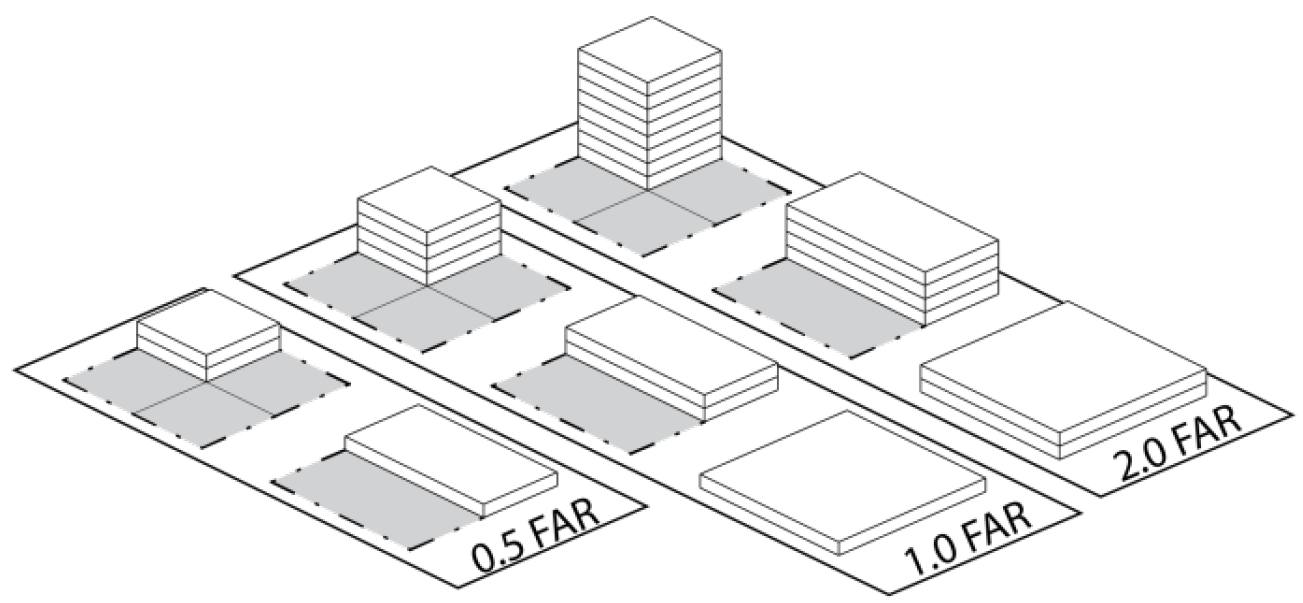
Food and Beverage Services: Uses in this category include establishments that serve prepared food or beverages for consumption on or off the premises. Accessory uses may include food preparation areas, offices, and parking.
Food Processing, Less than 2,500 Square Feet: A facility or area containing not more than 2,500 square feet of gross floor area in which food for human consumption in its final form, such as candy, baked goods, tortillas, and ice cream is produced, and the food is distributed to retailers or wholesalers for resale on or off the premises. This use does not include commercial feedlots, meatpacking, poultry dressing, stockyards, fat rendering, or the tanning, cutting, curing, cleaning or storing of green hides or skins.
Food Processing, More than 2,500 Square Feet: A facility or area containing more than 2,500 square feet of gross floor area in which food for human consumption in its final form, such as candy, baked goods, tortillas, and ice cream is produced, and the food is distributed to retailers or wholesalers for resale on or off the premises. This use does not include commercial feedlots, meatpacking, poultry dressing, stockyards, fat rendering, or the tanning, cutting, curing, cleaning or storing of green hides or skins.
Freeboard: The vertical distance between the design water surface level and the top of an open conduit left to allow for wave action, floating debris or any other condition or emergency without overtopping the structure.
Front yard: See "Yard, Front."
Frontage: That side of a lot, parcel or tract abutting a street right-of-way.
Funeral and Internment Facility: An establishment for the care, preparation, or disposition of the deceased for burial and the display of the deceased and rituals connected with, and conducted before, burial or cremation. This use includes mortuaries, which are facilities in which dead bodies are prepared for burial or cremation, crematoriums, columbariums, and funeral homes, and may include a facility for the permanent storage of cremated remains of the dead.
Garage, Alley Access: A garage with vehicular access from a public or private alley, typically from the rear of the lot.
Garage, Rear Access: A garage with vehicular access doors that faces the rear of the lot.
Garage, Side Access: A garage with vehicular access doors primarily oriented toward one of the side lot lines or perpendicular to the street.
Garage, Private or Public: A structure for the use of the owner or occupant of a principal structure for the storage of motor vehicles with no facilities for mechanical service or repair of a commercial or public nature.
Gas Well: Any well drilled for the production of gas or classified as a gas well under the Texas Natural Resources Code.
Gated Community: A subdivision or housing development with two or more dwellings with private streets controlled through the use of a vehicular or pedestrian gate.
General Agriculture: This category includes agricultural and farming activities, including cultivating the soil; producing crops or growing vegetation for human food, animal feed, livestock forage, forage for wildlife management, planting seed, or fiber; floriculture; viticulture; horticulture; silviculture; wildlife management; raising or keeping livestock or poultry, including veterinary services; the commercial sale of animals; and planting cover crops or leaving land idle for the purpose of participating in any governmental program or normal crop or livestock rotation procedure as defined in the Texas Agriculture Code.
General Retail Unless Otherwise Specified, Between 5,000 Square Feet and 15,000 Square Feet: Retail sales containing between 1,500 square feet and 10,000 square feet of gross floor area.
General Retail Unless Otherwise Specified, Less than 5,000 Square Feet: Retail sales containing not more than 1,500 square feet of gross floor area.
General Retail Unless Otherwise Specified, More than 15,000 Square Feet: Retail sales containing more than 10,000 square feet of gross floor area.
Grade:
1.
The inclination or slope of a conduit, channel or natural ground surface, usually expressed in the percentage of units of vertical rise or fall per unit of horizontal distance;
2.
The elevation of the invert at the bottom of a conduit, canal, culvert, sewer, etc.; or
3.
The finished surface of a canal bed, roadbed, top of an embankment or bottom of excavation.
Grade Separation: The physical development of structures or intersections that separate motor vehicle from motor vehicles; motor vehicles, pedestrians, and bicyclists from trains and other transit; motor vehicles from pedestrians and bicyclists; as well as pedestrians from bicyclists.
Grade, Existing: The vertical elevation of the ground surface prior to excavation or filling; the surface of the ground or pavement at a stated location as it exists prior to disturbance in preparation for a development regulated by this DDC; or, the vertical elevation of a site which is currently developed and built upon.
Grade, Ground Level: The average of the finished ground level at the center of all walls of the structure. In case a wall is parallel to and within five feet of a sidewalk, the ground level shall be measured at the sidewalk.
Grade, Natural: The existing grade or elevation of the ground surface that exists in its unaltered state.
Grade, Percentage of: The rise or fall of a slope in feet and tenths of a foot for each 100 feet of horizontal difference.
Grading: The mechanical or physical act of disturbing, moving, removing, transferring, or redistributing soil.
Gross Leasable Floor Space: The gross horizontal floor area of the one or more floors of a structure, excluding interior parking spaces. Residential floor space shall be exclusive of carport, basement, attic, patios, and open porches.
Ground Cover: Low growing plants, vines, or grasses that form dense, extensive growth, and have a positive effect against soil erosion and soil moisture loss. Permeable natural landscape materials, such as mulch and rock, are also considered ground cover to the extent they are used in combination with live plant materials.
Group Home: A facility, home, or structure for the protective care of persons, both adult and adolescent, who need protective care and watchful oversight. Residents may, but are not required, to have a disability. Protective care and watchful oversight requires 24-hour supervision and responsibility for the well-being of residents and may include, but not limited to, daily awareness by management of the residents' whereabouts, asking and reminding of residents of their appointments for medical checkups, readiness of management to intervene if a crisis arises for a resident, counseling services, supervision by management in areas of nutrition and medication, and provision of medical, psychiatric, habilitative, rehabilitative, hospice, palliative, and nursing care. Group Homes are exempt from the definition of a family. This definition does not include Recovery Housing as defined by Texas Health and Safety Code Chapter 469 as amended.
Grubbing: The mechanical or physical act of removing stumps, underbrush, and rocks, prior to clearing and grading. Grubbing does not allow for any grade changes, only vegetation removal down to bare soil. A tree removal permit is required for all trees with a three-inch or greater diameter, measured at four and a half feet above natural grade.
Hazardous Materials or Waste: A substance classified as a hazardous material under state or federal law or a chemical, petroleum product, gas, or other substance that if discharged or released, is likely to create an imminent danger to individuals, property or the environment. A hazardous material includes, but is not limited to any one of the following, as defined by 40 C.F.R 173, or, with respect to hazardous waste, listed as a substance subject to 40 C.F.R. 262: Radioactive material; Explosives, Class A; Explosives, Class B; Poison A; Poison B; Flammable gas; Nonflammable gas; Flammable liquid; Oxidizer; Flammable solid; Corrosive material; Combustible liquid; Etiologic agent; other regulated material (ORM); or, Hazardous waste.
Healthcare Facilities: Uses characterized by activities focusing on medical services, particularly licensed public or private institutions that provide primary health services and medical or surgical care to persons suffering from illness, disease, injury, or other physical or mental conditions. Accessory uses may include laboratories, outpatient, or training facilities, and parking, or other amenities primarily for the use of employees in the firm or building.
Height, Airport Overlay Zone: For the purpose of determining height limitations in all zones established in Subchapter 4: Overlay and Historic Districts, and shown on the zoning map, the vertical distance of an object above mean sea level elevation unless otherwise specified.
Height, Building or Structure: Height shall be measured as the vertical distance above finished grade measured to the highest point of the roof of a flat roof or to the deck line of a mansard roof, or to the midpoint of the highest gable of a pitched or hipped roof.
Figure 9.2-B: Examples of Building Height Measurement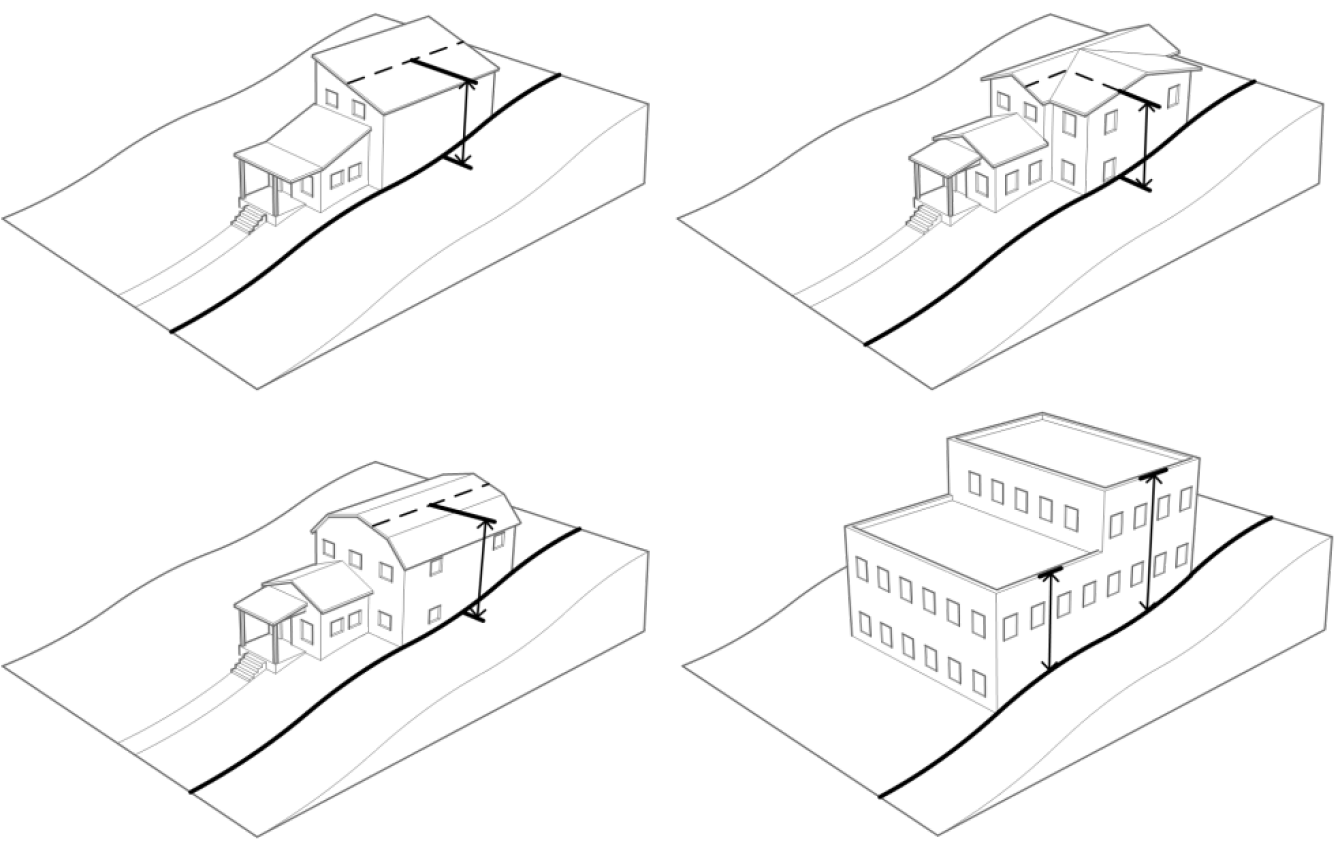
Heritage Trees: All Quality trees with a dbh greater than 18 inches and all Post Oaks with a dbh of six inches or greater.
Historic District: Any neighborhood or region designated by City Council as a historic district.
Historic Landmark: A building, district, object, site, or structure that is officially recognized by the State of Texas, or the United States government, for its outstanding architectural, archeological, cultural, social, economic, ethnic and political history significance.
Historic Landmark Commission (HLC): The City of Denton Historic Landmark Commission.
Historic Preservation: The protection, reconstruction, rehabilitation, repair or restoration of landmarks of historical, architectural or archeological significance.
Historic Preservation Officer (HPO): The Historic Preservation Officer for the City of Denton (HPO).
Historic Resource: Any building, structure, object or site that is 50 years or older or any resource that has been identified as a high or medium priority because of its unique history or architectural characteristics.
Historic Resources Survey: A systematic, detailed examination of an area designed to gather information about historic properties sufficient to evaluate them against predetermined criteria of significance.
Historic Site: The location of a significant event, a prehistoric or historic occupation or activity, which may include open spaces, or a building or structure, whether standing, ruined, or vanished, where the location itself possesses historic, cultural, or archeological value regardless of the value of any existing structure.
Home Occupation: An occupation commonly carried on within a dwelling by members of the family occupying the dwelling. The use of the home as an occupation shall be incidental and subordinate to the use of the home as a dwelling.
Homeless Shelter: A supervised private facility that provides temporary living accommodations for homeless individuals.
Horizontal Surface: A horizontal plane 150 feet above the established airport elevation of, the perimeter of which is constructed by swinging arcs of 10,000 feet radii from the center of each end of the primary surface of runways 17L-35R and 17R-35L of the airport, and connecting the adjacent arcs by lines tangent to those arcs.
Horticulture: The cultivation of row crops, a garden, or an orchard for noncommercial purposes.
Hospital Services: An institution providing primary health services, psychiatric services, and medical or surgical care to persons primarily on an inpatient basis. This use differs from medical clinics in that it may require stays for longer than 24 hours. This definition includes birthing center, general hospital, private psychiatric hospital, niche hospital, special hospital, and trauma facilities. This definition does not include nursing home and institutions where persons suffering from permanent types of illness, injury, deformity, deficiency, or age are given care and treatment on a prolonged or permanent basis.
Hotel: A facility offering transient lodging accommodations at a daily rate for a period of time not to exceed 30 days, and providing additional services, such as restaurants, meeting rooms, and recreational facilities. Guest quarters are accessible through a main entrance and by hallways.
Hotel Occupancy Tax: The hotel occupancy tax as defined in the Municipal Code of Ordinances, and Chapter 351 of the Texas Tax Code.
Household Living: Uses in this category are characterized by residential occupancy of a dwelling unit by a household. Tenancy is arranged on a month-to-month or longer basis. Common accessory uses include recreational activities, raising of pets, gardens, personal storage buildings, hobbies, and resident parking. Specific use types include:
Impact Fee: A fee levied by the City pursuant to TLGC, Chapter 395, as a total or partial reimbursement for the total or partial cost of providing additional facilities or services needed as a result of new development.
Impervious: Any hard-surface, man-made area that does not readily absorb or retain water, including but not limited to building slabs, building roofs, swimming pools, parking and driveway areas, sidewalks, paved recreation areas, and other surfaces that do not generally absorb water and are not considered by the City to be pervious surfaces.
Impervious Surface: A surface that has been compacted or covered with a layer of material so that it is highly resistant to infiltration by water.
Imported Fill: The mechanical or physical act of bringing soil in from offsite. When stockpiling imported fill, it shall occur on private property only.
Indoor Recreation Facility: A commercial recreational use conducted entirely within a building, including arcade, arena, art gallery and studio, art center, assembly hall, athletic and health clubs, auditorium, bowling alley, community center, conference center, exhibit hall, gymnasium, library, movie theater, museum, performance theater, pool or billiard hall, skating rink, swimming pool, and tennis court. Accessory uses may include limited retail, concessions, parking, and maintenance facilities.
Infill Development: Development on a vacant parcel or groupings of vacant lots within an existing block surrounded by existing development that is contiguous on at least two sides for corner lots and contiguous on at least three sides for interior lots (existing development located directly in front on the other side of the street may count as a side for interior lots only), no greater than two acres in size, and is served with all or most public services and facilities, including but not limited to water, wastewater and drainage. Annexed areas on the periphery of the City limits are not considered infill sites.
Infrastructure: The provision of systems that provide transportation, water, waste water, solid waste, stormwater drainage, electrical and franchise facilities typically required to service development.
Inlet: An opening into a storm drain system for the entrance of surface storm runoff.
Inoperable: See definition for inoperable in Subpart A - Code of Ordinances, Chapter 17 - Property Maintenance, Article I - In General, Section 17-2, Definitions.
Institutional Use: A non-profit or quasi-public use, such as a religious institution, library, public or private school, hospital services, or government-owned or government-operated structure or land used for public purpose.
Land-Disturbing Activity: Alteration of the land surface by:
1.
Any grading, scraping, excavating, dredging, transporting or filling of land;
2.
Any clearing of vegetation;
3.
Any construction, rebuilding, or alteration of a building, road, driveway, parking area, or other structure, not including routine maintenance such as painting, repair, or reconstruction of existing structures or surfaces;
4.
Any substantial activity or use which may result in soil erosion from water or wind and the movement of sediments into waters or lands protected by this Chapter; and,
5.
It shall not include activities such as ordinary maintenance and landscaping operations, individual home gardens, repairs, additions or minor modifications of an existing single-family dwelling, and the cutting of firewood for personal use.
Landfill, City-Owned: A city-owned facility for the collection, source separation, storage, transportation, transfer, processing, treatment, or disposal of solid waste, including the destruction/conversion of solid waste into energy. Uses may include a sanitary landfill, debris landfill, facility treatment of natural gas, and a fueling station.
Landmark Trees: A healthy tree that is designated by the property owner on the Texas Big Tree Registry regardless if the tree is protected or a non-protected tree; or a tree designated as a historic tree where an event of historic significance occurred that had local, regional, or national importance; or at the home of a citizen who is famous on a local, regional, or national basis; or that has taken on a legendary stature in the community, is mentioned in literature or documents of historic value, or is considered unusual due to size, age, or other landmark status. Historic trees shall be designated following the historic landmark designation procedure.
Landscaping: A planted area containing trees, shrubs, and groundcovers providing a transition between structures on a site and the property line, adjacent structures, or street rights-of-way.
Lane: A driving surface with a width as specified in the street design standards for that class of street.
Large Secondary Trees: All healthy Bois d'Arc, Hackberry, or Cottonwood trees with a 12-inch or greater dbh.
Laundry Facility, Industrial: An establishment that cleans clothing, carpeting, drapes, and other cloth or synthetic fiber materials using a chemical process. This definition includes uses such as rug cleaning or repair service; pressing of garments or fabrics; carpet or upholstery; power laundry; industrial launderers; and linen supply. Such establishments may also include self-service laundering facilities.
Laundry Facility, Self-Service: An establishment providing washing, drying, or ironing machines for use on the premises by rental to the general public. This definition includes automatic, self-service, or hand laundries only.
Legal Nonconforming: The continued existence of land, buildings, structures, uses, and site features that were lawfully established prior to the time of adoption, revision or amendment of this DDC, or granted variance of the DDC, but that fails, by reason of such adoption, revision, amendment or variance, to conform to the present requirements of this DDC.
Living Space: Space within a dwelling unit used for living, sleeping, eating, cooking, bathing, washing, and sanitation purposes.
Loading Space, Off-Street: Space logically and conveniently located for bulk pickups and deliveries, and scaled to delivery vehicles expected to be used.
Local Drainage System: Any drainage facility or system, which serves an area having a contributing drainage basin of less than one square mile in area.
Local Emergency Contact: The property owner, registrant, or individual designated by the property owner who is available on a 24-hour basis, have access to the Short-Term Rental Property, and be authorized to address any complaints, disturbances, and emergencies.
Local Historic Landmark: A building, district, object, site, or structure that has been officially recognized by the City of Denton for its outstanding architectural, archeological, cultural, social, economic, ethnic and political history significance.
Lodging Facilities: For-profit facilities where lodging, meals, and the like are provided to transient visitors and guests for a defined period.
Lot: A designated parcel, tract or area of land established by a plat or otherwise permitted by law to be used, developed or built upon as a unit.
Lot Area: The total horizontal area within the lot lines of a lot, said area to be exclusive of street right-of-way.
Lot Depth: The horizontal distance from the midpoint of the rear of lot line to the midpoint of the front lot line.
Lot Frontage: That portion of a lot adjacent to a street.
Figure 9.2-C: Lot Frontage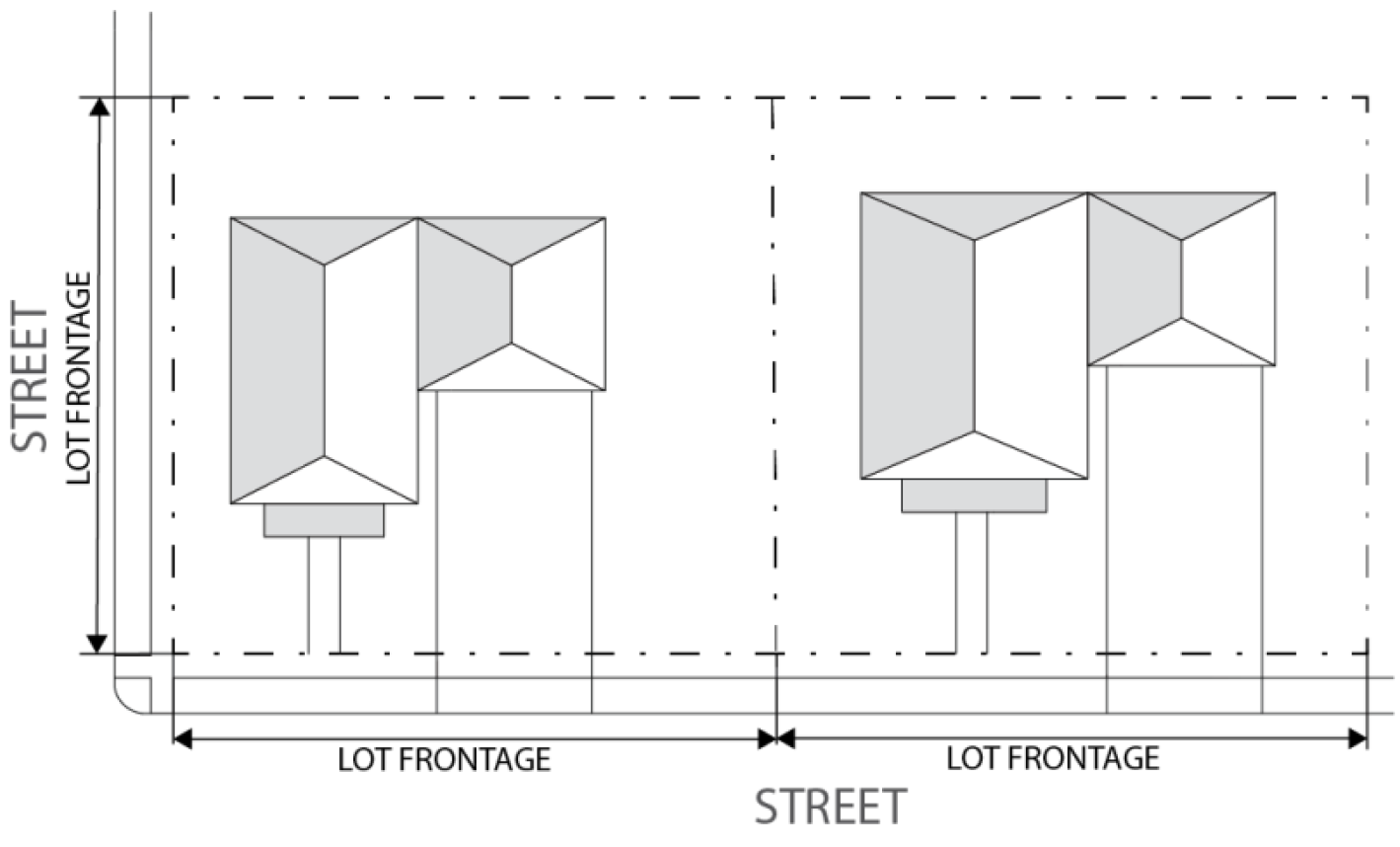
Lot Line: A boundary of a lot. "Lot line" is synonymous with "property line."
Lot Line, Front: The lot line separating the lot from the street other than an alley. In the case of a corner lot, there shall only be one street line considered the front lot line. The front lot line adjoins the public or private rights-of-way where the entrance/address is located.
Lot Line, Rear: A lot line which is opposite and most distant from the front lot line, and in the case of an irregular, triangular, or other shaped lot, a line 10 feet in length within the lot parallel to and at a maximum distance from the front lot line.
Lot Line, Side: Any lot line not a front or rear lot line.
Figure 9.2-D: Side Lot Line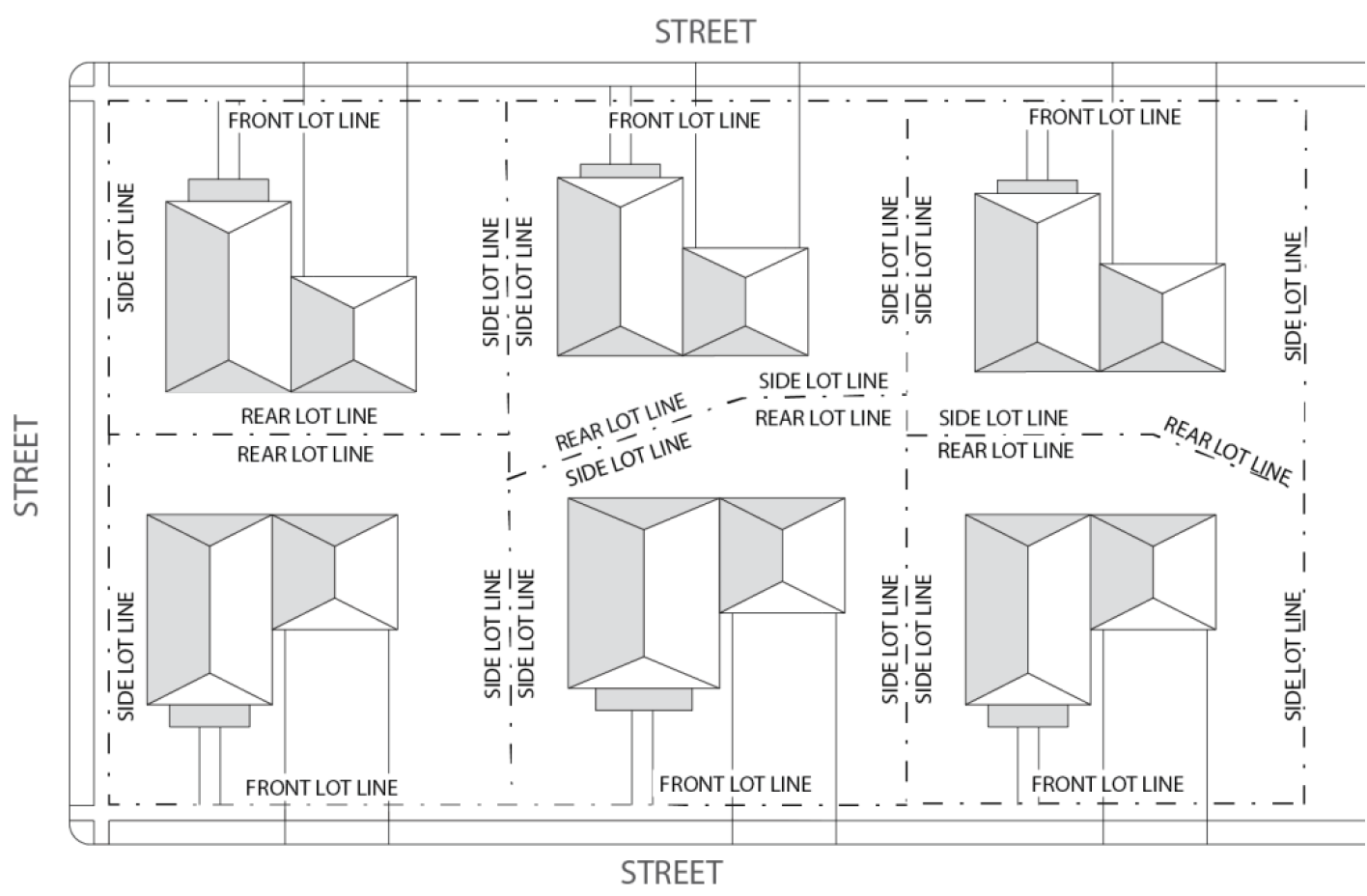
Lot of Record: An individual lot or a lot which is a part of a subdivision, the map of which has been legally recorded in the office of the Denton County Clerk; or a parcel of land the deed of which has been recorded in the office of the Denton County Clerk.
Lot Width: The horizontal distance between the side lines, measured at the front property line adjacent to the public right-of-way. The lot width for a corner lot shall be measured along the right-of-way upon which the address is assigned. The flagpole portion of a flag lot shall be ignored in measuring lot width.
Figure 9.2-E: Lot Width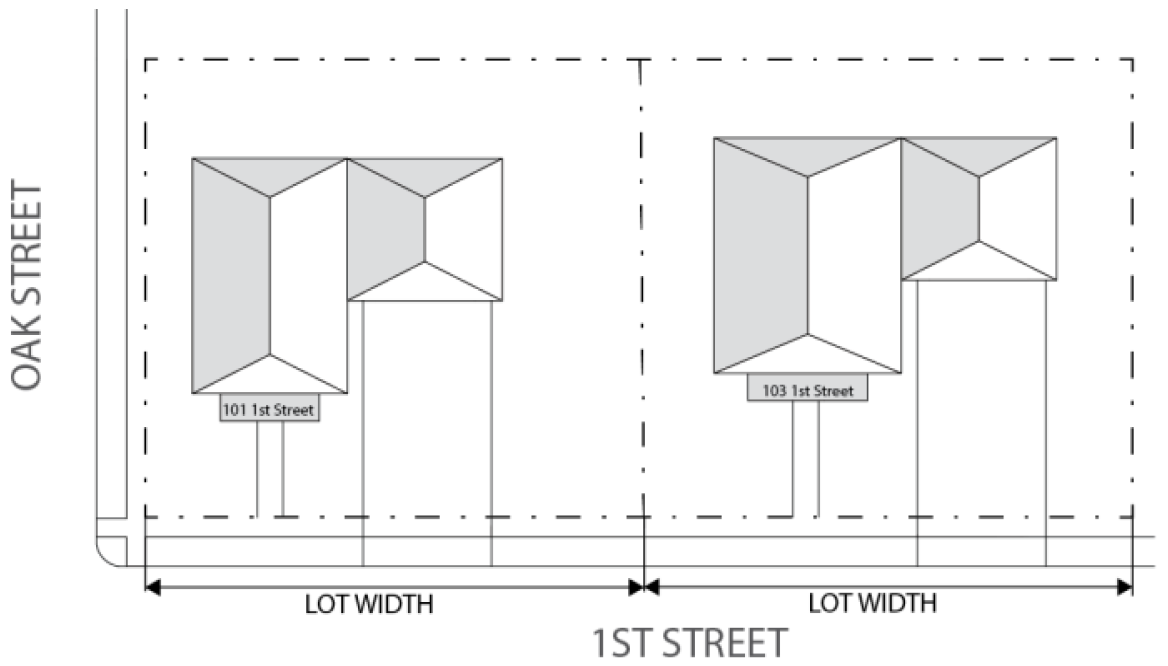
Lot, Corner: A lot abutting the intersection of two or more streets other than an alley.
Lot, Double Frontage: A lot having frontage on two nonintersecting streets, as distinguished from a corner lot.
Lot, Flag: Any lot without standard legal access to a city street, and that is provided with access by a driveway parallel to the lot line of a lot having standard access to a public right-of-way.
Lot, Gross Area: An area under public or private property ownership, whose lot lines are described by plat or deed.
Lot, Interior: A lot other than a corner lot or a through lot.
Lot, Through: An interior lot having frontage on two parallel or approximately parallel streets other than alleys. Through lots are prohibited.
Figure 9.2-F: Through Lot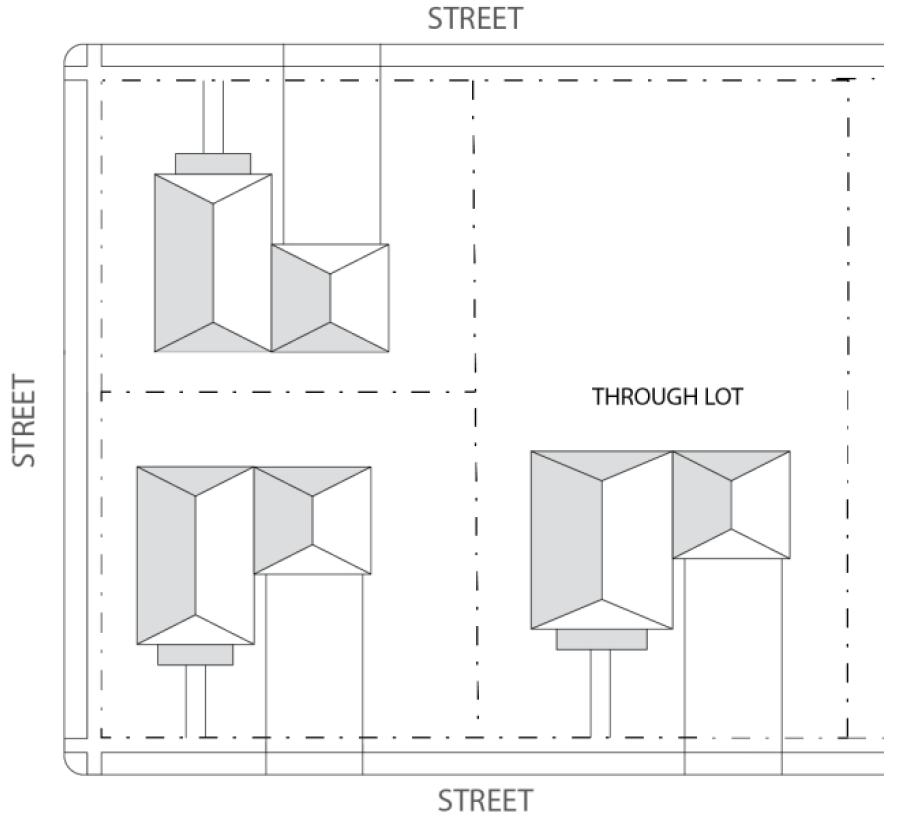
Manufactured Home Development (HUD Code): A development of a single lot divided into more than one stand for the placement of HUD-Code manufactured homes, accessory uses, and service facilities, meeting all requirements of this DDC and any applicable deed restrictions and state laws.
Group Living: Uses in this category are characterized by residential occupancy of a structure by a group of people who do not meet the definition of "household living." Tenancy is arranged on a monthly or longer basis and the size of the group may be larger than a family. Generally, group living structures have a common eating area for residents. Residents may receive care, training, or treatment, and caregivers may or may not also reside at the site. Accessory uses commonly include recreational facilities and vehicle parking for occupants and staff.
Manufacturing and Processing: Uses including all transformative processes, regardless of whether or not the new product is finished or semi-finished. Production is typically for commercial wholesaling rather than for direct sales. Accessory uses may include retail sales, offices, storage, cafeterias, employee amenities, parking, warehousing, and repair facilities.
Manufacturing, Artisan: An establishment or business where an artist, artisan, or craftsperson teaches, makes, or fabricates crafts or products by hand or with minimal automation and may include direct sales to consumers. This definition includes uses such as small-scale fabrication, manufacturing, and other industrial uses and processes such as welding and sculpting.
Manufacturing, High-Impact: An establishment or business that uses hazardous inputs or creates hazardous by-products in the course of manufacturing, assembly, fabrication, or materials treatment, or that uses manufacturing, assembly, fabrication, or treatment processes that create potentially hazardous impacts on the environment or surrounding areas. Examples include but are not limited to: acid manufacture; acid bulk storage; cement, lime, gypsum or plaster manufacture; central concrete mixing or concrete proportioning plant; distillation, manufacture or refining of bones, coal or tar asphalt; explosives, manufacture or storage; fat, grease, lard or tallow rendering or refining; fertilizer manufacture from organic matter; glue or size manufacture; paper manufacture; petroleum or asphalt refining or storage; smelting of tin, copper, zinc or iron ores; and storage or processing raw hides or fur.
Manufacturing, Low-Impact: Industrial operations relying on the assembly, distributing, fabricating, manufacturing, packaging, processing, recycling, repairing, servicing, storing, or wholesaling of goods or products, using parts previously developed from raw material. Low-impact manufacturing uses include only those uses that will not create noise, smoke, fumes, odors, glare, or health or safety hazards outside of the building where such assembly, fabrication, or processing takes place.
Manufacturing, Medium-Impact: Industrial operations relying on the assembly, distributing, fabricating, manufacturing, packaging, processing, recycling, repairing, servicing, storing, or wholesaling of goods using raw materials and mechanical power and machinery.
Masonry: Building materials consisting of clay brick, natural and manufactured stone, granite, marble, architectural concrete block, tilt wall concrete panels and other similar materials. This definition does not include cementitious siding or EIFS.
Maximum Extent Feasible: As determined by the Director, no feasible and prudent alternative exists, and all possible efforts to comply with the regulation or minimize potential harm or adverse impacts have been undertaken. Economic considerations may be taken into account but shall not be the overriding factor in determining "maximum extent feasible."
Maximum Extent Practicable: The degree to which a project meets an adopted standard in which all possible efforts to comply with the standard or to minimize harmful or adverse effects have been undertaken by the applicant, but full compliance cannot be achieved, and no feasible or practical alternative exists. Economic considerations may be taken into account, but shall not be the overriding factor determining "maximum extent practicable."
Mechanical Equipment: Equipment or devices installed for a use appurtenant to the principal use. Such equipment shall include heating and air conditioning equipment, solar collectors, parabolic antennas, disc antenna, radio or TV receiving or transmitting antennas, and any power generating devices. The following equipment or devices are exempt:
1.
Private, noncommercial radio and television antennas not exceeding a height of 70 feet above grade or 30 feet above an existing structure, whichever height is greater. No part of such antenna shall be within the yards required by this Chapter. A structure permit shall be required for any antenna mast, or tower over 50 feet above grade or 30 feet above an existing structure when the same is constructed on the roof of the structure.
2.
Parabolic antennas under three feet in diameter.
Medical Clinic: An establishment for the provision of medical, psychiatric, or surgical services on an outpatient basis. These facilities can be differentiated from a medical office in that such facilities may either be open to and operated for the general, walk-in public, or require an appointment. This definition includes ambulatory surgical center (ASC); end-stage renal disease facility (dialysis), outpatient services, freestanding emergency medical care facility.
Medical Office: An establishment where patients receive consultation, diagnosis, therapeutic, preventative, or corrective personal treatment by doctors, dentists, or similar practitioners of medical and healing arts for humans, medical or dental laboratories. These facilities can be differentiated from a medical clinic in that such facilities primarily operate on an appointment basis, are generally not open to the general walk-in public, and offer specialized services or attention. This definition includes dentist's office and doctor's office.
Minor Plat: A subdivision resulting in four or fewer lots, where all lots involved front an existing public street, and that does not require the creation of any new street or the extension of municipal facilities.
Mitigation dbh: The total combined dbh of trees removed that must be mitigated by replanting, or by alternative means as described in Subsection 7.7.4F. This total is determined by subtracting credits granted for preserved trees from the Preliminary Mitigation dbh.
Mixed-Use Building: A building containing more than one type of use, such as governmental, institutional, office, personal service, retail, and residential; including a mix of residential and non-residential uses.
Mobile Food Business: A business that serves food or beverages from a self-contained unit either motorized or in a trailer on wheels, and is readily movable, without disassembling, for transport to another location.
Mobile Food Court: The lot or parcel where mobile food truck(s) or trailer(s) can be located for the business of selling food.
Mobile Food Trailer: A mobile food business that serves food or beverages from a nonmotorized vehicle larger than three feet in width and eight feet in length that is normally pulled behind a motorized vehicle.
Mobile Food Truck: A mobile food business that serves food or beverages from an enclosed self-contained motorized vehicle.
Motel: A structure or group of structures on the same lot containing individual guest units for rental to transients, with separate exterior entrances, and consisting of individual sleeping quarters, detached or in connected rows, with or without cooking facilities.
Motor Vehicle: See definition for motor vehicle in Subpart A - Code of Ordinances, Chapter 17 - Property Maintenance, Article I - In General, Section 17-2, Definitions.
Musician Studio: A facility where the principal use is the production, editing, and/or storage of audio media occurs, or formal private instruction in playing a musical instrument or singing.
National Register of Historic Places: The Nation's official list of buildings, districts, and sites (including structures and objects) significant in American history and culture, architecture, archeology, and engineering maintained by the National Park Service and administered on a state-wide basis by the Texas Historical Commission. Restrictions on these properties exist only when there is an undertaking that uses federal funds or that requires a federal permit or license.
Neighborhood: A sub area of the City of Denton in which the residents (or non-residential uses) share a common identity focused around a school, park, or community business center that are generally within walking distance of the homes or businesses, architecture, or other features with boundaries that may include highways, railroads or such natural features as rivers. The neighborhood character shall be deemed to be the prevailing character of structures within 300 feet in either direction along street frontages, irrespective of intervening streets.
New Development: Development of a site that was previously unimproved (with no existing principal structures or uses) or has been or will be cleared of structures. New development is distinguished from existing development and the expansion or alteration of existing development.
Nonconforming Lot: A lot that was legally established before the effective date of this DDC or subsequent amendment thereof, but that does not comply with the dimensional standards that apply in the zoning district in which the lot is located.
Nonconforming Site Feature: Any site feature established or constructed legally at the time of passage or amendment of this DDC which does not conform, after the passage or amendment of this DDC, with the regulations of the district in which it is located.
Nonconforming Structure: Any structure established or constructed legally at the time of passage or amendment of this DDC which does not conform, after the passage or amendment of this DDC, with the regulations of the district in which it is located.
Nonconforming Use: Any use of land established legally at the time of passage or amendment of this DDC that does not conform, after the passage or amendment of this DDC, with the regulations of the district in which it is located.
Non-Protected Tree: The following are considered Non-Protected Trees:
1.
Dead or Unhealthy Trees;
2.
Trees that pose an imminent or immediate threat to persons or property;
3.
Crepe Myrtles and ornamental pears;
4.
Mesquite unless part of a Preserved Habitat or Conservation Easement;
5.
Honey Locust, unless part of a Preserved Habitat or Conservation Easement; or
6.
Any tree listed on the Texas Department of Agriculture Noxious and Invasive Plant List.
Nude Model Studio: Any place where a person who appears in a state of nudity or displays "specified anatomical areas" is provided to be observed, sketched, drawn, painted, sculptured, photographed, or similarly depicted by other persons who pay money or any form of consideration.
Nudity or a State of Nudity:
1.
The appearance of a human bare buttock, anus, male genitals, female genitals, or female breasts; or
2.
A state of dress which fails to opaquely cover a human buttock, anus, male genitals, female genitals, or areola of the female breast.
Nuisance: Physical or environmental conditions resulting in regular and/or continuous problems affecting the health, safety, and quality of life of citizens.
Nursing Home: A home for the aged, chronically ill, or incurable persons who are unable to care for themselves and in which three or more persons not of the immediate family are kept or provided with food and shelter or care for compensation; but not including hospitals, clinics, or other similar institutions devoted primarily to the diagnosis and treatment of the sick or injured.
Obstruction: Any structure, growth, or other object, including a mobile object, which exceeds a limiting height set forth in Section 4.5: MAO - Municipal Airport Overlay District.
Occasional Sales: Occasional sales are the sale, or offering for sale, of tangible personal property to the public, upon the premises of an existing residential dwelling, by the owner or lessee of the residential dwelling. Such sales commonly include garage or yard sales.
Odor Threshold: The concentration of odorous matter in the atmosphere necessary to be perceptible to the olfactory nerve of a normal person. Determination of the odor threshold is prescribed by A.S.T.M.D. 1931-57, Standard Method for Measuring Odor in Atmosphere.
Office, Business, and Professional Services: Uses in this category provide executive, management, administrative, governmental, or professional services, but do not sell merchandise except as incidental to a permitted use. Typical uses include real estate, insurance, property management, investment, employment, travel, advertising, law, architecture, design, engineering, accounting, call centers, and similar offices. Accessory uses may include cafeterias, health facilities, parking, or other amenities primarily for the use of employees in the firm or building.
Off-Site: Located outside the boundary of a development.
On-Site: Located within the boundary of a development.
Open Space: See "Park, Playground, Open Space."
Outdoor Display: The outdoor display outside an enclosed building, of new or used merchandise, products, stock, supplies, materials, machines, equipment, or other items intended for immediate sale, rent, lease, or special order affiliated with the principal use.
Outdoor Recreation Facility: Uses in this category provide recreation and entertainment activities mostly outdoors or partially within a building, including golf courses, outdoor swimming pools, tennis courts, basketball courts, amphitheater, outdoor arena, and outdoor theater. Accessory uses may include limited retail, concessions, parking, and maintenance facilities.
Outdoor Storage: The storage of objects, items, products or materials outside an enclosed building (more than 24 hours), and not intended for immediate sale.
Outdoor Storage (as a Primary Use): As a principal use, a property or area used for the long term (more than 24 hours) storage of materials, merchandise, products, stock, supplies, machines, operable motor vehicles, equipment, manufacturing materials, or other items not kept within a structure having at least four walls and a roof. New or used motor vehicles sales and leasing display and parking, and outdoor sales and display and parking areas shall not be defined as outdoor storage. Automotive wrecking service, impound lot, junkyard, or salvage yard shall not be defined as outdoor storage.
Outdoor Storage, Accessory: The keeping of goods, materials, or equipment as an accessory use to a principal use located on the same lot, where such goods, materials, or equipment are not kept in a structure having at least four walls and a roof. New or used motor vehicle sales and leasing display and parking, and outdoor sales and display and parking areas shall not be defined as accessory outdoor storage. Automotive wrecking service, impound lot, junkyard, salvage yard shall not be defined as accessory outdoor storage.
Owner: The owner of a tract of land as recorded in the Denton County Deed Records. An owner may include: a person, firm, corporation, partnership or agent, attorney-in-fact, manager or Director, or developer. Such term as used in this chapter always includes one or more of the persons enumerated in this section who own all or any part of the land which is contemplated to be developed.
Owner-Occupied: A lot or structure that is occupied by the legal owner of record or, where there is a recorded land sales contract in effect, the purchaser thereunder.
Park, Playground, Open Space: Any parcel or area of land or water set aside, dedicated, designated, or reserved for public use or enjoyment of for the private use and enjoyment of owners and occupants of neighboring or adjoining land that are designed or used for recreational purposes and are available to the general public. Uses include neighborhood park, an urban park or plaza, a historic site, a community-wide park, a natural area, public swimming pools, golf courses, tennis courts, recreational centers, and city-owned athletic complexes.
Parking Lot as a Principal Use: The ownership, lease, operation, or management of a surface parking lot, above-ground structure, or below-ground structure.
Parking Space: A space within a public or private parking area, exclusive of driveways, ramps, columns, offices and work areas, which is for the temporary parking or storage of one motor vehicle.
Particulate Matter: Finely divided solid or liquid matter, other than water, which is released into the atmosphere.
Pedestrian Path: A graded, cleared way for individuals who travel on foot. When located along any improved street or parking area, these paths shall be adjacent to the curb at curb level.
Pedestrian Way: A right-of-way for pedestrian traffic.
Permitted Use: That use of a lot which is among the uses allowed as a matter of right, and subject to the restrictions of the zoning district.
Person: An individual, firm, partnership, proprietorship, association, corporation, estate, receiver, syndicate, branch of government, social or fraternal organization, or any other group or combination acting as a legal entity, and including any trustee, assignee, or other representative.
Personal Service, General: An establishment that provides repair, care, maintenance or customizing of wearing apparel or other personal articles or human grooming services and includes such uses as beauty/barber shops, dry cleaning, shoe repair, alterations, spas, and tanning salons, photography studios, house cleaning services, weight reduction centers, or florist. This use does not include commercial laundry and dry-cleaning facilities.
Phase: One final platted section of a larger overall development.
Photovoltaic System (also "Photovoltaic Installation"): An active solar energy system that converts solar energy directly into electricity.
Photovoltaic System, Ground-Mounted: An active solar energy system that is structurally mounted to the ground and is not roof-mounted; may be of any size (small-, medium- or large-scale).
Photovoltaic System, Roof-mounted: An active solar energy system that is structurally mounted atop a structure.
Pilot Channel: A concrete channel section used to convey normal low flows, fix the location of the flow line of a channel, minimize erosion and provide access for maintenance.
Planned Development (PD): A land area under unified control designed and planned to be developed in a single phase or a series of phases according to an approved development plan.
Planning and Zoning Commission: The Planning and Zoning Commission for the City of Denton, Texas. Also referred to as the "Commission."
Planting Area: An outdoor area, the surface of which shall not be covered by impervious surface materials or structures, and devoted entirely to the planting or maintenance or plant materials, except as otherwise allowed by this DDC, such as walls, fences, plazas, landscape architectural features such as gazebos, pergolas, arbors, fountains, or sculpture. Landscape architectural features shall not include tennis courts, basketball courts or other pervious recreational facilities.
Plants, Plant Material: Live plant material, including grasses, annuals, perennials, bulbs, groundcover, shrubs, and trees, are botanical plants that are nourished through the processes of air, water, and soil nutrients. Plastic, fibrous, silk, or other non-live materials, are not considered live plant materials.
Plat or Final Plat: A map of a subdivision, addition, or development to be recorded in the County Clerk Plat Records after approval by the city.
Pole-Mounted Antenna: Any antenna which is preassembled off-site and designed to be moved from site to site.
Power Stations, Electric Substations, Interchanges, and Switch Stations: A structure that is part of an electric generation, transmission, and distribution system that:
1.
Converts electric energy to a lesser voltage for the purpose of subregional or localized distribution;
2.
Functions as a transition point from overhead to underground electric transmission lines; or
3.
Acts as the point of convergence for two or more transmission lines.
Precision Instrument Runway: A runway having an existing instrument approach procedure utilizing an Instrument Landing System (ILS) or a Precision Approach Radar (PAR). It also means a runway for which a precision approach system is planned and is so indicated on an approved airport layout plan or any other planning document.
Preliminary Mitigation dbh: The numeric result determined by multiplying the total calculated dbh of trees to be removed by 50 percent.
Preliminary Plat: A map showing the salient features of a proposed development as required by this DDC submitted for the purpose of preliminary consideration prior to the submission of a final plat.
Preserved Habitat: Areas adjacent to an ESA where vegetation is retained to preserve natural ecological conditions and protect wildlife.
Primary Residence: The usual dwelling place of the applicant's residential dwelling and is documented as such by at least two of the following: motor vehicle registration, driver's license, Texas State Identification card, voter registration, property tax documents, or utility bill. For purposes of the short-term rental standards, a person may have only one primary residence.
Primary Surface: A surface longitudinally centered on a runway. When the runway has a specially prepared hard surface, the primary surface extends 200 feet beyond each end of that runway; but when the runway has no specially prepared hard surface or planned hard surface, the primary surface ends at each end of that runway. The elevation of any point on the primary surface is the same as the elevation of the nearest point on the runway centerline.
Printing, Copying, and Publishing Establishment: An establishment where printed material is produced, reproduced and/or copied by either a printing press, photographic reproduction techniques, or other similar techniques. This use does not include the on-site manufacture of paper products.
Prior Regulations: Any ordinance adopted by the City of Denton related to issues addressed within this DDC and replaced by this DDC.
Private Club: An organization that owns, leases, or occupies a building used exclusively for club purposes at all times and:
1.
Is operated solely for a recreational, fraternal, social, patriotic, political, benevolent, or athletic purpose, but not for pecuniary gain;
2.
Sells alcoholic beverages only incidentally to its operation;
3.
The affairs and management of the organization are conducted by a board of directors, executive committee, or similar body chosen by the members at an annual meeting;
4.
Has established bylaws or a constitution to govern the club's activities; and
5.
Is exempt from federal income taxation under Section 501(a), Internal Revenue Code, as a club described by Section 501(c)(7) of that Code.
Private Covenants: Private legal restrictions on the use of land contained in the deed, plat, and other legal documents pertaining to the property.
Private Utility Provider: The owner of a wire network (i.e. cable, electric, or telephone company) utilized in connecting the various cell sites to telephone switching offices, long distance providers or the public switched telephone network.
Protected Trees: Landmark, heritage, quality, or secondary trees.
Public Improvements: The public infrastructure needed or required by the development, or by a single phase within a larger overall development.
Public Right-of-Way: Any designated public street, sidewalk, or alley.
Public Street: A street which is owned or maintained by city.
Public Utilities: The term Public Utilities means:
1.
Entities franchised by the city to use public rights-of-way for the conduct of their business;
2.
Entities that are "public utilities" under pertinent provisions of the Texas Utilities Code or Texas Water Code but are specifically exempted by state law from the requirement that they receive a franchise from the city for the use of public rights-of-way;
3.
Public sanitary sewers;
4.
Public water mains;
5.
Public streets;
6.
Public storm sewers;
7.
Public detention ponds;
8.
Municipally-owned electric utilities; and
9.
Any contractor hired by these entities.
Quality Trees: All healthy non-secondary trees, except Post Oaks, that measure between six inches and 18 inches dbh.
Rear Access Garage: See "Garage, Rear Access"
Rear Yard: See "Yard, Rear."
Recorded Texas Historical Landmark: A state designation for buildings important for their historical associations and which have retained a high degree of their original historic fabric. They must be at least 50 years of age and retain their original exterior appearance. State historical landmarks receive greater legal protection than National Register of Historic Places designations.
Recreation and Entertainment: This category includes indoor and outdoor recreation and entertainment activities. Accessory uses may include limited retail, concessions, parking, and maintenance facilities.
Recreational Vehicle ("RV"): A motorized vehicle or recreational trailer, designed or maintained for use as a temporary dwelling or sleeping place for travel or recreation purposes exclusively, having no foundation other than wheels or jacks.
Recreational Vehicle Park: A parcel of land which is used solely for the rental or lease of lots for transient campers, trailers, motor homes, or temporary parking of any other recreational vehicle that is not a HUD-code manufactured home or tiny home.
Redevelopment: Development on a tract of land with existing structures where all or a majority of the existing structures would be razed and a new structure or structures built.
Regional improvements: Those public improvements which are required of the development for the protection of either:
1.
Health, safety and welfare of the public at large; or
2.
Property outside or surrounding the development;
Examples of Regional improvements include, but are not limited to:
1.
Water line "loops" or extensions for service;
2.
Regional detention facilities;
3.
Off-site drainage improvements.
Religious Assembly: A structure used by a religious organization or congregation for regular organized religious activities.
Replacement Inches: The total combined dbh, in inches, of all protected trees that are proposed to be removed and that are located within the development impact area.
Replat: A change in a map of an approved or recorded subdivision plat if such change affects any street layout on such map or area reserved thereon for public use or any lot line or if it affects any map or plan legally recorded prior to the adoption of any regulations controlling subdivisions.
Residential Use: A single-family detached dwelling, townhome, duplex, triplex, fourplex, multifamily dwelling, manufactured home development, and tiny home development.
Residential Zoning District: A one-family, two-family, or multi-family zoning district, or any area within a planned development zoning district which is designated for residential use, as shown on the approved site plan for the zoning district.
Restaurant: A food establishment that is open to the public, where food and beverages are prepared, served, and consumed primarily within the principal building. Accessory uses may include an outdoor dining area or sidewalk café, and the manufacture of alcoholic beverages for on-site consumption and/or retail sales.
Restaurant with Drive-Through: Any restaurant designed to permit or facilitate the serving of food or beverages directly to, or permitted to be consumed by, patrons in or on motor vehicles on the premises.
Retail Sales: Uses involving the sale, lease, or rent of new or used products directly to the final consumer for whatever purpose but not specifically or exclusively for the purpose of resale. Accessory uses may include offices, parking, storage of goods, and assembly, repackaging, or repair of goods for on-site sale.
Rezoning: To change the zoning of a parcel of land, also referred to as a zoning amendment. Rezoning may require an amendment to the comprehensive plan.
Right-of-way: A strip of land occupied or intended to be occupied by a street, crosswalk, railroad, road, electric transmission line, oil or gas pipeline, water main, sanitary or storm sewer main or for another Specific Use. The usage of the term "right-of-way" for land platting purposes means that every right-of-way established and as shown on a Final Plat is to be separate and distinct from the lots or parcels adjoining such right-of-way and not included within the dimensions or areas of such lots or parcels. Right-of-way intended for streets, crosswalks, water mains, sanitary sewers, storm drains or any other use involving maintenance by a public agency shall be dedicated to public use by the maker of the Plat on which such right-of-way is established.
Riparian Buffer: Areas within 100 feet, measured from both sides of the stream centerline, with drainage areas greater than one square mile, and 50 feet from both sides of any streams centerline that drain areas of one square mile or less. This also applies to the outer edges of surface water bodies.
Runway: A defined area in an airport for landing and take-off of aircraft along its length.
Sale of Produce and Plants Raised on Premises: The incidental on-site sale of feed, grain, fruits, flowers, vegetables, ornamental plants, or similar goods.
Salvage Yard: Any lot or parcel of land on which wastes or used secondhand materials are bought, sold, exchanged, stored, processed, or handled. Materials include but are not limited to: scrap iron and other ferrous metals, paper; rags, rubber tires, bottles, discarded goods, machinery, or two or more inoperable motor vehicles.
Satellite Earth Stations: Are considered to be accessory structures and are defined as a combination of:
1.
An antenna or dish antenna whose purpose is to receive communication or other signals from orbiting satellites and other extraterrestrial sources;
2.
A low-noise amplifier (LNA) which is situated at the focal point of the receiving component and whose purpose is to magnify and transfer signals;
3.
A coaxial cable whose purpose is to carry the signals into the interior of the structure; and,
4.
The station must be located to the side or rear of the structure unless a usable satellite signal cannot be obtained; in which case, the property owner may request a variance from the requirement through the Board of Adjustments. Ground-mounted stations shall be no more than 10 feet above the maximum height requirement of the zoning district in which they are located.
School, Charter: Any home-rule school district charter, campus or campus charter, or open-enrollment charter school that complies with Chapter 12, Sections B, C, or D of the Texas Education Code as applicable and amended. A facility or area for pre-kindergartens, kindergartens, elementary, or secondary education governed by a Charter.
School, Private: Any private school meeting all requirements of the compulsory education laws of the State of Texas. A facility or area for pre-kindergartens, kindergartens, elementary, or secondary education supported by a private organization, including a church or parish organization. This definition includes licensed private preschool facilities in which the principal use of the property is for preschool. This does not include home-schooling facilities that are located within residential structures or other structures on a part time basis.
School, Public: Any public school meeting all requirements of the compulsory education laws of the State of Texas. A facility or area for pre-kindergartens, kindergartens, elementary, or secondary education supported by a public organization. This definition includes licensed public preschool facilities in which the principal use of the property is for preschool.
Screening: A method of visually shielding or obscuring land-uses or structures via fencing, opaque buffer, or some other opaque physical barrier.
Seasonal Sales: The temporary sale of goods or products associated with the season or a cultural event, including but not limited to the sale of healthy, nonhazardous, cut or live evergreen trees, wreaths, tree stands, pumpkins, fireworks, and seasonal produce.
Secondary Tree: A healthy Ash, Bois D' Arc, Hackberry, or Cottonwood tree, with a dbh greater than six inches.
Self-Service Storage: A building or group of buildings consisting of individual, self-contained units that are leased to individuals, organizations, or businesses for self-service storage of personal property.
Semi-Nude: A state of dress in which clothing covers no more than the genitals, pubic region, and areola of the female breast, as well as portions of the body covered by supporting straps or devices.
Setback: The minimum distance between by which any building or structure must be separated from a street right-of-way or lot line.
Sexually Oriented Business: An adult arcade, adult bookstore or adult video store, adult cabaret, adult motel, adult motion picture theater, adult theater, escort agency, or nude model studio.
Shared Drive: A common driveway or access shared by adjoining properties.
Short-Term Rental: The rental of an entire dwelling unit or bedroom for monetary consideration for a period of time not less than 24 hours and not more than 29 consecutive days, not including a bed and breakfast, boarding or rooming house, hotel, or motel. This definition does not include offering the use of one's property where no fee is charged or collected.
Side Access Garage: See "Garage, Side Access"
Side Yard: See "Yard, Side."
Site Plan: A graphic representation, drawn to scale, indicating the outlines of the land included in the plan and all proposed use locations, accurately dimensioned, and indicating the relation of each use to that adjoining and to the boundary of the property.
Site Plan Review: The comprehensive evaluation of a development and its impact on neighboring properties and the community as a whole, from the standpoint of: land use, site design, landscape design, environmentally sensitive areas protection, architecture, lighting, signs, clearing and grading, engineering design, health and safety, other adopted standards and criteria of this DDC, all other adopted codes and ordinances of the City.
Smoke: The visible discharge of particulate matter from a chimney, vent, exhaust or combustion process.
Smoke Shop: An establishment primarily engaged in the sales of tobacco products, smoking equipment, or smoking accessories. Establishments engaged in sales of tobacco products and/or smoking equipment as an incidental or accessory use shall not be classified as a smoke shop.
Solar Access: The access of a solar energy system to direct sunlight.
Solar Energy: Radiant energy received from the sun that can be collected in the form of heat or light by a solar collector.
Solar Energy System: An energy system that consists of one or more solar collection devices, solar energy related "balance of system" equipment, and other associated infrastructure with the primary intention of generating electricity, storing electricity, or otherwise converting solar energy to a different form of energy. Solar energy systems may generate the energy requirements of a property in accordance to applicable local and national codes, standards, ordinances, and laws.
Solar Energy System, Interconnected: A photovoltaic system that is physically connected to the city's electrical system so that parallel operation (on-site generation) can occur.
Solar Energy System, Stand-Alone: A photovoltaic system that is not connected to the city's electrical system in any way.
Special Events: A temporary outdoor use on private property that extends beyond the normal uses and standards allowed by this DDC. "Special events" include, but are not limited to, outdoor entertainment, educational and cultural events, art shows, sidewalk sales, haunted houses, carnivals, fairs, special auto sales, grand openings, festivals, home exhibitions, and church bazaars.
Specific Use Permit: A use that is not automatically permitted by right, but that may be permitted within a zoning district subject to meeting specific conditions contained in this DDC.
Specified Anatomical Areas: Human genitals in a state of sexual arousal.
Specified Sexual Activities: Includes any of the following:
1.
The fondling or other erotic touching of the human genitals, pubic region, buttocks, anus, or female breasts;
2.
Sex acts, normal or perverted, actual or stimulated, including intercourse, oral copulation, or sodomy;
3.
Excretory functions as part of or in connection with any of the activities set forth in subsections 1. through 2. above.
Stealth: See "Antenna, Stealth."
Stockpiling: The holding on land of material or products such as any soil, sand, gravel, clay, mud, debris, vegetation, or any other material, organic or inorganic, in a concentrated state.
Storage and Warehousing: Uses in this category are engaged in the storage or movement of goods for themselves or other businesses. Goods are generally delivered to other businesses or the final consumer, except for some will-call pickups. There are typically few customers present. Accessory uses may include offices, truck fleet parking, and maintenance areas.
Storage Containers and Other Portable Storage Units: Temporary storage containers and other portable storage units used for the storage of items on a property (excluding use for storing equipment during multi-family dwelling and nonresidential alterations and construction projects).
Storage of Hazardous Materials: A facility or site engaged in the storage and handling of flammable or otherwise hazardous materials, liquids, waste, or gasses.
Story, Building: That portion of a building included between the surface of any floor and the surface of the floor next above it, or if there be no floor above it, then the space between the floor and the ceiling next above it.
Stream: Linear geographic feature that conveys flowing waters. Headwater streams are the uppermost, low-order streams of a watershed and comprise the majority of streams in the United States, both in terms of number and length. Streams can be perennial, intermittent, or ephemeral.
Street: A public right-of-way for roadway, sidewalk, and utility installation including the terms "road," "highway," "land," "place," "avenue," "alley," or other similar designations. The entire width between the right-of-way lines of every way which provides for public use for the purpose of vehicular and pedestrian traffic.
Structure: An edifice of any kind or any piece of work artificially built up or composed of parts joined together which requires location on, in, or above the ground or which is attached to something having a location on, in or above the ground. Flatwork or in-ground swimming pools are excluded.
Structure, Accessory: Any structure on the same lot with and that is incidental and subordinate to the principal structure. Flatwork, in-ground swimming pools and fences or walls used as fences are excluded.
Structure, Principal: The structure in which the principal permitted use of the lot on which the structure is located is conducted.
Subdivision: The division or redivision of land into two or more lots, tracts, sites, or parcels that are either improved or unimproved and can be separately conveyed by sale or lease.
Surface Water Body: Term to include streams, ponds, lakes, and freshwater wetlands.
Tattoo and Body Piercing Parlor: An establishment where permanent marks, scars, or designs are made on the skin by a process of pricking and ingraining an indelible pigment or by raising scars; or in which other bodily decorations, such as piercing, are provided. For the purposes of zoning, jewelry stores or other retail facilities or clinics that provide piercing as an incidental and accessory use shall not be classified as a tattoo and body piercing parlors.
Telecommunications: The transmission, between or among points specified by the user, of audio and/or visual information of the user's choosing, without change in the form or content of the information as sent and received.
Telecommunications Service: The offering of telecommunications for a fee directly to the public, or to such classes of users to be effectively available directly to the public, regardless of the facilities used.
Temporary Portable Wireless Telecommunications Facility: A portable self-contained telecommunications facility that can be moved to a location and set up to provide wireless services on a temporary or emergency basis. A temporary portable wireless telecommunications facility is normally vehicle-mounted and contains a telescoping boom as the Antenna support structure.
Temporary Storage Container: See "Storage Containers and Other Portable Storage Units."
Temporary Structure: A structure without any foundation or footings which is attached to the ground or other structure in some nonpermanent fashion. Temporary structures shall require a permit from the Building Inspection Department and shall be removed from the site when the designated time period, activity, or use for which the temporary structure was established has ceased, but not exceeding six months in duration unless an extension is obtained from the Building Inspection Department upon just cause.
Temporary Uses: Temporary uses are defined as those activities permitted and described in Section 5.5.
Thoroughfare Plan: The thoroughfare component of the Mobility Plan, the official map depicting the city's existing and future street system and roadway network, together with explanatory text.
Tiny Home Development: A development that has been subdivided into separate platted lots or a single lot divided into stands for the placement of tiny homes, accessory uses, and service facilities, meeting all requirements of this DDC and any applicable deed restrictions and state laws.
Topography: The physical land surface relief describing the terrain elevation, position of land features and slope. Topography includes land forms, water and other drainage features, and features such as gravel pits. A single feature such as a hillside or valley is called a topographic feature.
Tower, Electric Transmission: A self-supporting structure in excess of 50 feet (15 meters) in height designed to support high voltage electric lines. This does not include local utility or distribution poles (with or without transformers) designed to provide electric service to individual customers.
Tower, Guyed: Any telecommunications tower supported in whole or in part by cables anchored to the ground.
Tower, Monopole: A self-supporting telecommunications tower which consists of a single vertical pole fixed into the ground and/or attached to a foundation.
Tower, Self-supporting Lattice: A telecommunications tower which consists of an open network of metal braces forming a tower which is usually triangular or square in cross-section.
Tower, Telecommunications: A self-supporting or guyed structure more than 20 feet (6 meters) in height, built primarily to support one or more telecommunications antennas.
Toxic and Noxious Matter: Any solid, liquid or gaseous matter which is present in sufficient quantities to endanger health, safety and comfort of persons in the vicinity or which may cause injury or damage to property.
Trailer: A non-motorized vehicle, pulled by an automobile or truck designed or maintained for use as a temporary dwelling or sleeping place for travel or recreation purposes exclusively.
Transfer Station: A temporary storage facility for the consolidation and eventual transfer of solid waste to a landfill.
Transitional Surface: A surface extending outward and upward at right angles to the runway centerline at a slope of 7:1 from the sides of the primary surface and from the sides of the approach surface. Transitional surfaces for those portions of the precision approach surface which project through and beyond the limits of the conical surface, extend a distance of 5,000 feet measured horizontally from the edge of the approach surface and at right angles to the runway centerline.
Transportation Impact Analysis: A study performed by a registered traffic engineer analyzing the impacts of the expected traffic generated by a development on the existing and proposed road system including recommendations for mitigating such traffic.
Travel Plaza: An establishment that provides refueling, servicing, repair, parking (rest), and other services to motorists. A travel center may also include the sale of accessories and equipment for vehicles, overnight accommodations, showers and restaurant facilities.
Tree Protection Zone (TPZ): An area shown on a tree survey and preservation plan and field inspected where construction activities are prohibited or restricted to prevent injury to preserved trees, especially during pre-construction and construction, and includes the critical root zone and/or beyond.
Ultimate Developed Condition: A fully developed area based on current approved land use plans or "C" factor of six tenths (0.6) for remaining undeveloped land in a watershed.
Understory: A grouping of native, noninvasive low-level woody, herbaceous, or ground covers species with stems less than one inch dbh.
Undeveloped Floodplain: Areas within the FEMA one-percent Annual Chance Floodplain (a.k.a. 100-year floodplain), that are undeveloped and in their natural state.
United States Secretary of Interior Standards for the Treatment of Historic Properties: A document that includes guidelines for preserving, rehabilitating, restoring and reconstructing historic buildings.
Upland Habitat or Cross Timbers Upland Habitat: Contiguous areas ten acres or larger of cross timbers habitat.
Urban Farm: A private facility for the primary purpose of farming fruits, flowers, vegetables, or ornamental plants.
Use: The purpose or purposes for which land or a structure is designed, arranged, or intended, or to which such land or structure is occupied, maintained, or leased.
Vacating Plat: The termination of, or termination of interest in, an easement, right-of-way, or public dedication of land.
Valley Storage: Water storage capacity of a stream and is a volume that is measured below the base flood elevation.
Variance: A deviation from the specific terms of this DDC that will not be contrary to public interest and is justified because, owing to special conditions, a literal enforcement of this DDC's provisions will result in practical difficulties and/or hardship.
Vegetation: All plant life; however, for the purposes of this Chapter shall be restricted to mean trees, shrubs, ground cover, annuals, perennials, bulbs, grasses, vines, and aquatic plants, with the exception of state and federally protected and endangered vegetative specie which in all cases shall be preserved.
Vehicles and Equipment: Uses include a broad range of uses for the maintenance, sale, or rental of motor vehicles and related equipment. Accessory uses may include incidental repair and storage and offices.
Veterinary Clinic: Facility for the diagnosis, treatment, or hospitalization of domestic animals, operated under the supervision of a licensed veterinarian. The incidental temporary overnight boarding of animals that are recuperating from treatment is included in this definition.
Vibration: A periodic displacement of the earth measured in inches.
Vision Clearance Area: A triangular area on a lot at the intersection of two streets or a street and a railroad, two sides of which are lot lines measured from the corner intersection of the lot lines for a distance specified in these regulations. The third side of the triangle is a line across the corner of the lot joining the ends of the other two sides. Where the lot lines or intersections have rounded corners, the lot lines will be extended in a straight line to a point of intersection.
Figure 9.2-G: Vision Clearance Area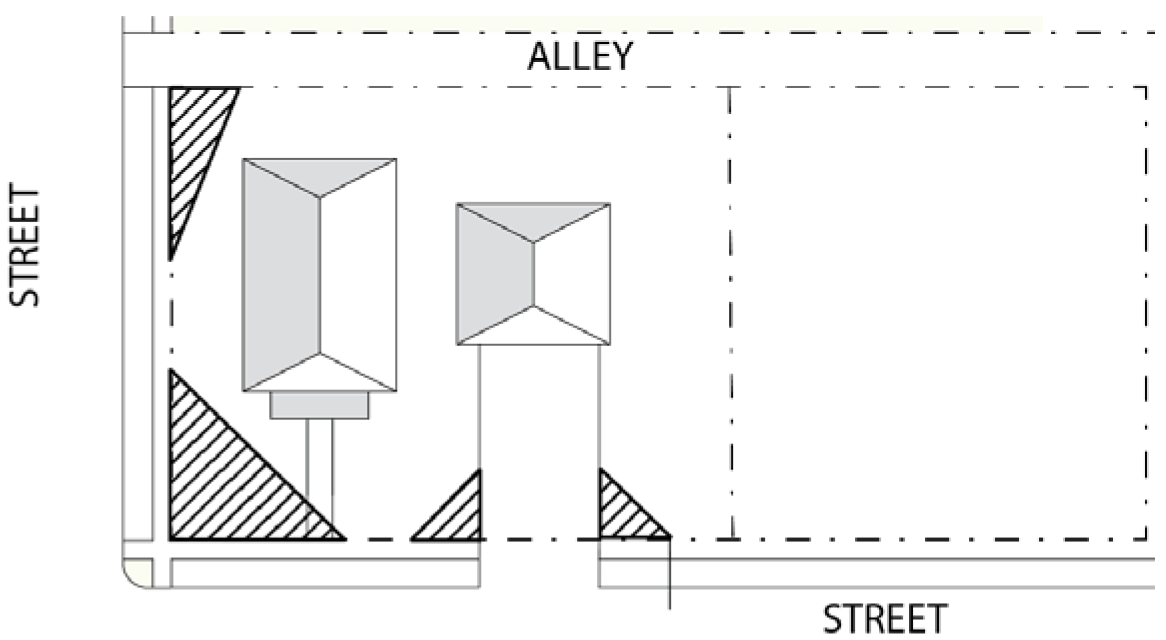
Warehouse and Wholesale Facility: A building or area for storage, wholesale, and/or distribution of goods and materials, supplies, and equipment that are manufactured or assembled off-site. This definition excludes the bulk storage of materials that are flammable or explosive or that create hazardous or commonly recognized offensive conditions. Accessory uses may include retail and office uses.
Water-Related Habitat: Areas designated as wetlands, and trees and understory vegetation containing 50 percent or more of predominately native bottomland hardwood. Bottomland hardwoods occur on the first terrace of floodplains and flats along channels. Periodic inundation prevents establishment of upland species and maintains the functioning of this type of vegetation.
Watershed: The land area(s) that contribute surface runoff or drainage to a water system or body.
Wind Energy Conversion System (WECS): A large wind energy conversion system (WECS) that has an output rating greater than 100 KW that converts wind energy into electrical power for the primary purpose of sale, resale, or off-site use.
Wind Energy Conversion System (WECS), Small (Building-Mounted): A small wind energy conversion system (WECS), mounted to a legally existing building or structure, other than a building or structure accessory to a WECS facility, that has a rated capacity of 100 KW or less and is an accessory use within a zoning district. The small wind system shall support the energy needs of the principal use on the site.
Wind Energy Conversion System (WECS), Small (Ground-Mounted): A small wind energy conversion system (WECS), mounted to the ground, that has a rated capacity of 100 KW or less and is an accessory use within a zoning district. The small wind system shall support the energy needs of the principal use on the site.
Wetland: Area that is inundated or saturated by surface or ground water at a frequency and duration sufficient to support, and that under normal circumstances do support, a prevalence of vegetation typically adapted for life in saturated soil conditions. Wetlands generally include swamps, marshes, bogs, and similar areas. Includes adjacent and isolated wetlands.
Window: An opening in the wall of a building or structure for admitting light and fitted with a frame containing panes of glass.
Window, False: A device in the wall of a building or structure fitted with a frame containing panes of glass so as to resemble a window, but not admitting light.
Wireless Telecommunications: A structure that is designed and constructed primarily for the purpose of supporting one or more antennae that transmit information (audio, video, data) in the form of electromagnetic signals to one or more receivers without the use of a physical connection between the transmitting and receiving source.
Yard: A required open space located on the same lot as the principal structure, unoccupied and unobstructed except for accessory uses and landscaping.
Figure 9.2-H: Yards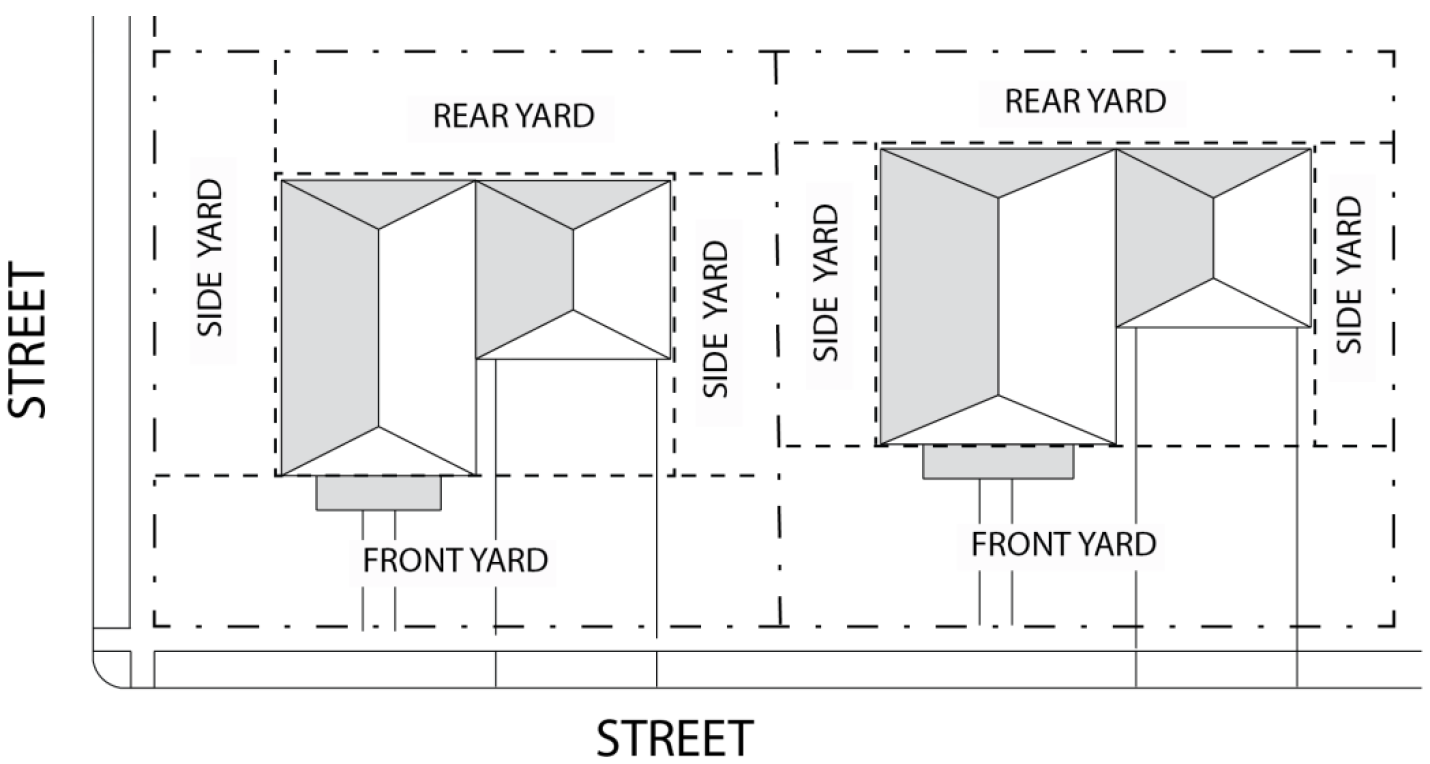
Yard, Front: A yard extended across the full width of and situated between the front lot line and the principal structure extending to the side lot lines. In the case of a corner lot, the front yard adjoins the public or private rights-of-way where the entrance/address is located.
Yard, Rear: A yard extended across the full width of and situated between the rear lot line and the principal structure extending to the side lot lines. In the case of a corner lot, the rear yard shall not extend past the corner side yard.
Yard, Side: A yard extended across the full width of and situated between the side lot line and the principal structure extending from the front yard to the rear yard. In the case of a corner lot, the corner side yard shall extend from the front yard to the rear lot line.
(Ord. No. DCA22-0003a, § 2(Exh. A), 9-20-2022; Ord. No. DCA22-0005a, § 2(Exh. A), 10-18-2022; Ord. No. DCA22-0008a, § 2(Exh. A), 3-7-2023; Ord. No. DCA23-0010b, § 2(Exh. A), 9-19-2023; Ord. No. DCA23-0001b, § 2(Exh. A), 9-26-2023; Ord. No. DCA23-0011b, § 2(Exh. A), 12-5-2023; Ord. No. DCA24-0006a, § 2(Exh. A), 6-4-2024; Ord. No. DCA24-0009a, § 2(Exh. A), 8-20-2024; Ord. No. DCA23-0002l, § 2(Exh. A), 10-22-2024; Ord. No. DCA24-0011d, § 2(Exh. A), 5-20-2025)
9.1.1 - General.
All provisions, terms, phrases, and expressions contained in this DDC shall be liberally construed in order that the true intent and meaning of the City Council may be fully implemented. The Director is responsible for making any interpretations of this subchapter.
9.1.2 - Headings, Illustrations, and Text.
In the event of a conflict or inconsistency between the text of this DDC and any heading, caption, figure, illustration, table, or map, the text shall control.
9.1.3 - Lists and Examples.
Unless otherwise specifically indicated, lists of items or examples that use terms such as "for example," "including," and "such as," or similar language are intended to provide examples and are not exhaustive lists of all possibilities.
9.1.4 - Computation of Time.
The time in which an act is to be done shall be computed by excluding the first day and including the last day. If a deadline or required date of action falls on a Saturday, Sunday, or holiday observed by the city, the deadline or required date of action shall be the next day that is not a Saturday, Sunday, or holiday observed by the city.
A.
"Day" means a calendar day.
B.
"Week" means seven calendar days.
C.
"Month" means a calendar month.
D.
"Year" means a calendar year.
9.1.5 - Delegation of Authority.
Whenever a provision appears requiring the head of a department or some other officer or employee to do some act or perform some duty, it is to be construed to authorize the head of the department or other officer to designate, delegate, and authorize a subordinate to perform the required act or duty, unless the terms of the provision or section specifies otherwise.
9.1.6 - Nontechnical and Technical Words.
Words and phrases shall be construed according to the common and approved usage of the language, but technical words and phrases and such others as may have acquired a peculiar and appropriate meaning in law shall be construed and understood according to such meaning.
9.1.7 - Mandatory and Discretionary Terms.
The words "shall," "must," and "will" are mandatory, establishing an obligation or duty to comply with the particular provision. The words "may" and "should" are permissive.
9.1.8 - Conjunctions.
Unless the context clearly suggests the contrary, conjunctions shall be interpreted as follows:
A.
"And" indicates that all connected items, conditions, provisions, or events apply; and
B.
"Or" indicates that one or more of the connected items, conditions, provisions, or events apply.

