
Denton City Zoning Code
Subchapter 4
Overlay and Historic Districts
4.1 - Purpose
This subchapter establishes procedures and standards to allow the creation of Overlay and Historic Districts in Denton to protect and enhance specific lands and structures which, by virtue of their type or location, have characteristics which are distinct from lands and structures outside such special districts. The districts shall contain such reasonable and necessary requirements to ensure the protection and enhancement of said lands and structures.
4.2 - Applicability of Underlying Zoning Districts
4.2.1 Land within an Overlay or Historic District shall remain part of the underlying zoning district designation established in Subchapter 3: Zoning Districts, and may, in addition, lie in one or more overlay districts in accordance with the designation of each.
4.2.2 Whenever any provision of the underlying zoning district is in conflict with the Overlay and/or Historic Districts, the provisions of the Overlay and/or Historic Districts shall govern.
4.3 - Conflicts with Other Ordinances
4.3.1 To the extent the provisions of this section conflict with any other ordinances of the City of Denton, the provisions of this section shall govern. All other regulations and ordinances of the City of Denton not in conflict with this section shall remain in full force and effect.
4.3.2 Where the regulations of this section modify any provision of any other applicable ordinance, the words used in this section shall have the meaning defined in the provisions of the ordinance modified, unless the definition is otherwise provided in this section.
4.8 - RZR - Rayzor Ranch Overlay District
Please see Appendix A: Rayzor Ranch Overlay District, for development regulations governing the Rayzor Ranch Overlay District.
4.4.1 - Overlay Districts.
The creation and amendments to an Overlay District shall be made pursuant to Subsection 2.7.4: Zoning Text Amendment, and Subsection 2.7.2: Zoning Map Amendment.
4.4.2 - General Standards.
Every recommendation to create or amend any Overlay or Historic District shall address the following, as applicable:
A.
Statement of Purpose.
1.
A statement of purpose specifying the nature of the special and substantial public interest and public welfare involved;
2.
Objectives to be promoted by creation of the Overlay or Historic District; and
3.
Imposition of the regulations and design standards proposed.
B.
Proposed Boundary. Proposed district boundaries, depicted on one or more maps, including the Official Zoning Map of City, which shall include all other zoning regulations applicable to the property(s) proposed for inclusion in the district.
C.
Proposed Regulations.
1.
Regulations and/or design standards proposed to promote the special purposes of the Overlay or Historic District.
2.
Regulations or design standards shall be designed to reasonably promote the purposes of the district, and may require or address any of the following, in addition to or in lieu of other regulations affecting property within the Overlay or Historic District:
a.
Protection of features designated as being of special concern within the district;
b.
Levels of permission for land use types within the district;
c.
Special performance standards, use-specific standards, and development regulations;
d.
Other matters as appropriate to promote the special public interests of the district.
4.5.1 - Purpose.
The Municipal Airport Overlay (MAO) district is intended to regulate and restrict the height of structures and objects of natural growth and the use of property in the vicinity of the Denton Enterprise Airport to prevent the creation or establishment of obstructions that are a hazard to air navigation. Application of this district will help prevent the encroachment of noise sensitive or otherwise incompatible land uses which may endanger the health, safety, and welfare of the owners, occupants, or users of the land. This district is also intended to implement state and federal rules associated with land uses in the vicinity of airports. Such state and federal rules shall apply within the MAO district.
4.5.2 - Municipal Airport Overlay District Established.
A.
Generally. The MAO district is the area generally located outside the airport boundaries and within a rectangle bounded by lines located no farther than one and one-half statute miles from the centerline of an instrument or primary runway and no farther than five statute miles from each end of the paved surface of precision instrument runways. Where only a portion of a lot or parcel is within the boundaries explained above, the entire parcel shall be subject to the MAO regulations.
B.
Subdistricts Established. The MAO district imposes two types of overlay zoning districts that combine with existing and future zoning district regulations:
1.
Airport Height Hazard District (AHHD). The Airport Height Hazard District (AHHD), as established in Subsection 4.5.8, establishes height limitations on structures and natural objects within an area generally traversed by the flight tracks of aircraft using the Denton Enterprise Airport.
2.
Airport Compatibility Land Use District (ACLUD). The Airport Compatibility Land Use District (ACLUD), as established in Subsection 4.5.9, establishes land use compatibility regulations that prohibit certain types of land uses and that impose performance standards on other land uses that potentially are subject to noise impacts from aircraft operation in the vicinity of the airport.
4.5.3 - Applicability.
A.
The requirements of this Section 4.5, shall apply to all lands lying within the city's extraterritorial jurisdiction (ETJ) as well as to lands within city boundaries. For properties in the ETJ, the AHHD and the ACLUD regulations constitute zoning district regulations that shall be administered through this DDC.
B.
Nothing contained in Subsection 4.5.4, shall be construed as permitting or intending to permit any construction, or alteration of any structure, or growth of any natural object in excess of any of the height limits established in Subsection 4.5.8C.
C.
When a parcel of land lies within more than one airport zoning subdistrict, or only a portion of a parcel lies within an airport zoning district, the provisions of the most restrictive regulations shall apply to the use of land and structures for the entire parcel, except when:
1.
It is determined by the Director that a structure is located within a single airport zoning subdistrict, then the provisions of that subdistrict shall apply to such structure; or
2.
It is determined by the Director that a structure is located outside any airport zoning district, then the provisions of the standard zoning district in which the structure is located shall apply.
4.5.4 - Conflicts with Other Provisions.
A.
Where there exists a conflict between any standard, restriction, limitation, requirement, or regulation prescribed by this section and any other applicable regulation, the provisions of this section shall govern and prevail; provided that the more stringent limitation or requirement shall control in the event of a conflict, with respect to the height of a structure or object of natural growth.
B.
In the event of a conflict between the requirements of this DDC and any provision of state law, state law requirements shall prevail.
C.
Consistent with TLGC, § 241.012, it is the intent of this section that federal laws or rules controlling the use of land located adjacent to or in the immediate vicinity of an airport, as they may be amended from time to time, that impose more stringent limitations than are imposed under provisions herein set forth, shall be applied to any application submitted under this section until such time as the city is able to conform its airport zoning regulations to such law or rules.
4.5.5 - Exemptions.
Unless otherwise provided in this DDC, the following shall be exempt from the provisions of this section:
A.
Areas in the Horizontal Zone and Conical Zone. Any natural object(s) or structure(s) less than 75 feet of vertical height above the ground, except when, because of terrain, land contour, or topographic features, such object(s) or structure(s) would extend above the height limits established in Subsection 4.5.8C.
B.
Areas in the Approach Zone. Any natural object(s) or structure(s) less than 75 feet of vertical height above the ground at a horizontal distance more than 4,200 feet from each end of the runway, except when such object or structure would extend above the height limit established in Subsection 4.5.8C.
4.5.6 - Nonconformities.
A.
Generally. Whenever the Director determines that a nonconforming structure or natural object within the area subject to this section has been abandoned or more than 50 percent torn down, physically deteriorated, or decayed, no permit shall be granted that would allow such structure or natural object to exceed the applicable height limit or otherwise deviate from the zoning regulations of this DDC. In all other cases, the continuation, repair, reconstruction, or remodeling of non-conforming uses or structures shall be governed by Section 1.5, Nonconformities; provided, however, the Director shall apply the standards in this section.
B.
Regulations Not Retroactive. The regulations prescribed by this section shall not be construed to require the removal, lowering, or other change or alteration of any structure or natural object not conforming to the regulations of this section, or otherwise interfere with the continuance of any nonconforming use. Nothing herein contained shall require any change in the construction, alteration or intended use of any structure, for which a complete application was accepted for filing prior to the effective date of this section, which is consistent with existing regulations and for which construction is diligently pursued.
C.
Marking and Lighting. Notwithstanding Subsection 4.5.6B, the owner of any nonconforming structure or area is hereby required to permit the installation, operation, and maintenance hereon of such markers and lights as shall be deemed necessary by the Director, in order to indicate to the operators of aircraft in the vicinity of the airport, the presence of such airport hazards. Such markers and lights shall be installed, operated, and maintained at the expense of the city or the Federal Aviation Administration (FAA).
4.5.7 - General Prohibition on Airport Hazards.
Notwithstanding any other provisions of this section, no person shall use land or water within any zone established by this DDC in such a manner as to create electrical interference with navigational signals or radio communication between the airport and aircraft; make it difficult for pilots to distinguish between airport lights and other lighting; result in glare in the eyes of pilots using the airport; impair visibility in the vicinity of the airport; create bird strike hazards; or otherwise in any way endanger or interfere with the landing, taking off, or maneuvering of aircraft intending to use the airport.
4.5.8 - AHHD - Airport Height Hazard District.
A.
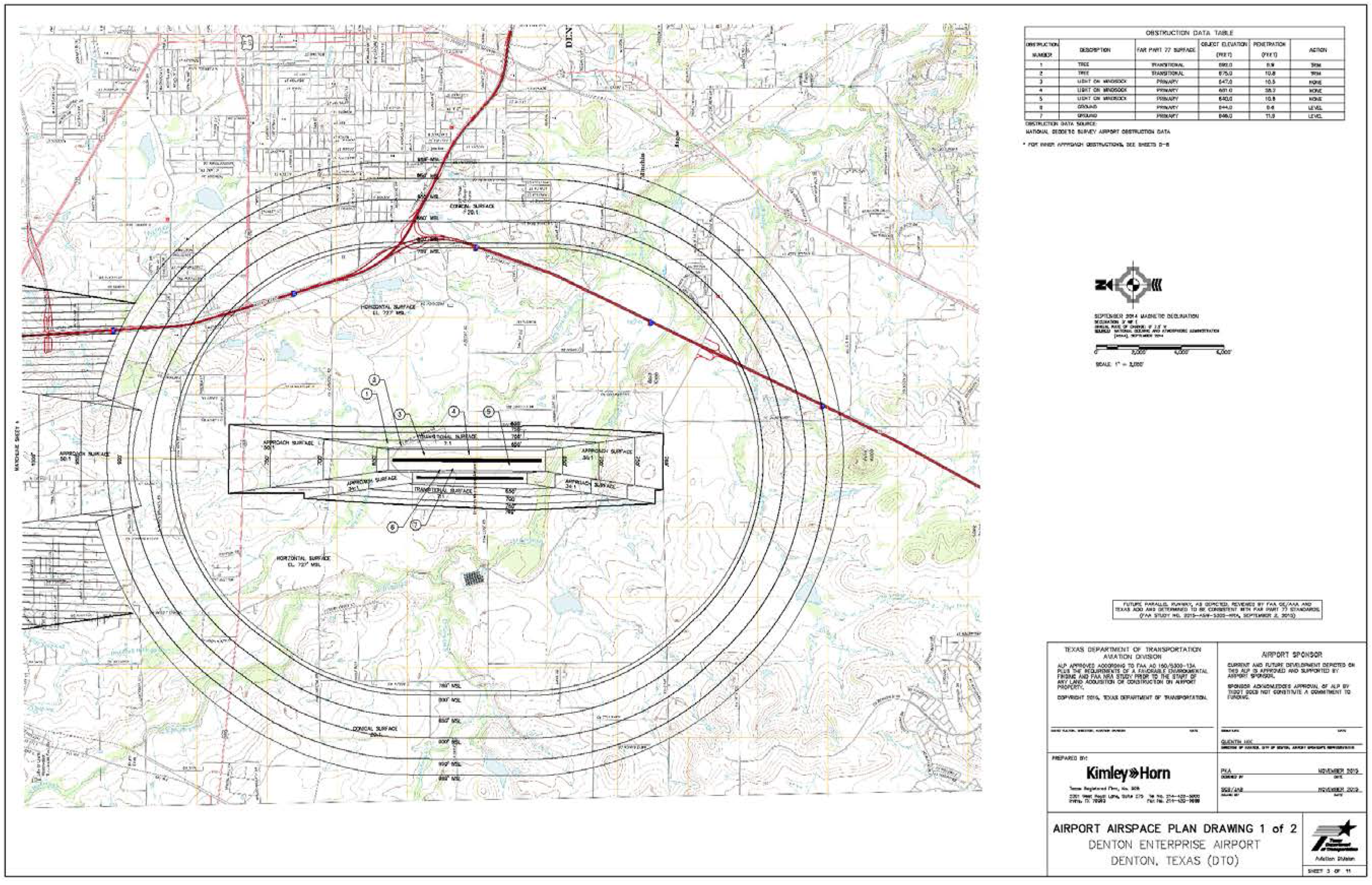
District Established. There is hereby established an Airport Height Hazard District (AHHD) within that area lying beneath the Approach Surfaces, Transitional Surfaces, Horizontal Surface and Conical Surface of the Denton Enterprise Airport. The AHHD consists of the following subdistricts, which are depicted in Figure 4.5-1: Airport Height Hazard District Map, and which constitutes the zoning map for the district.
Figure 4.5-1: Airport Height Hazard District Map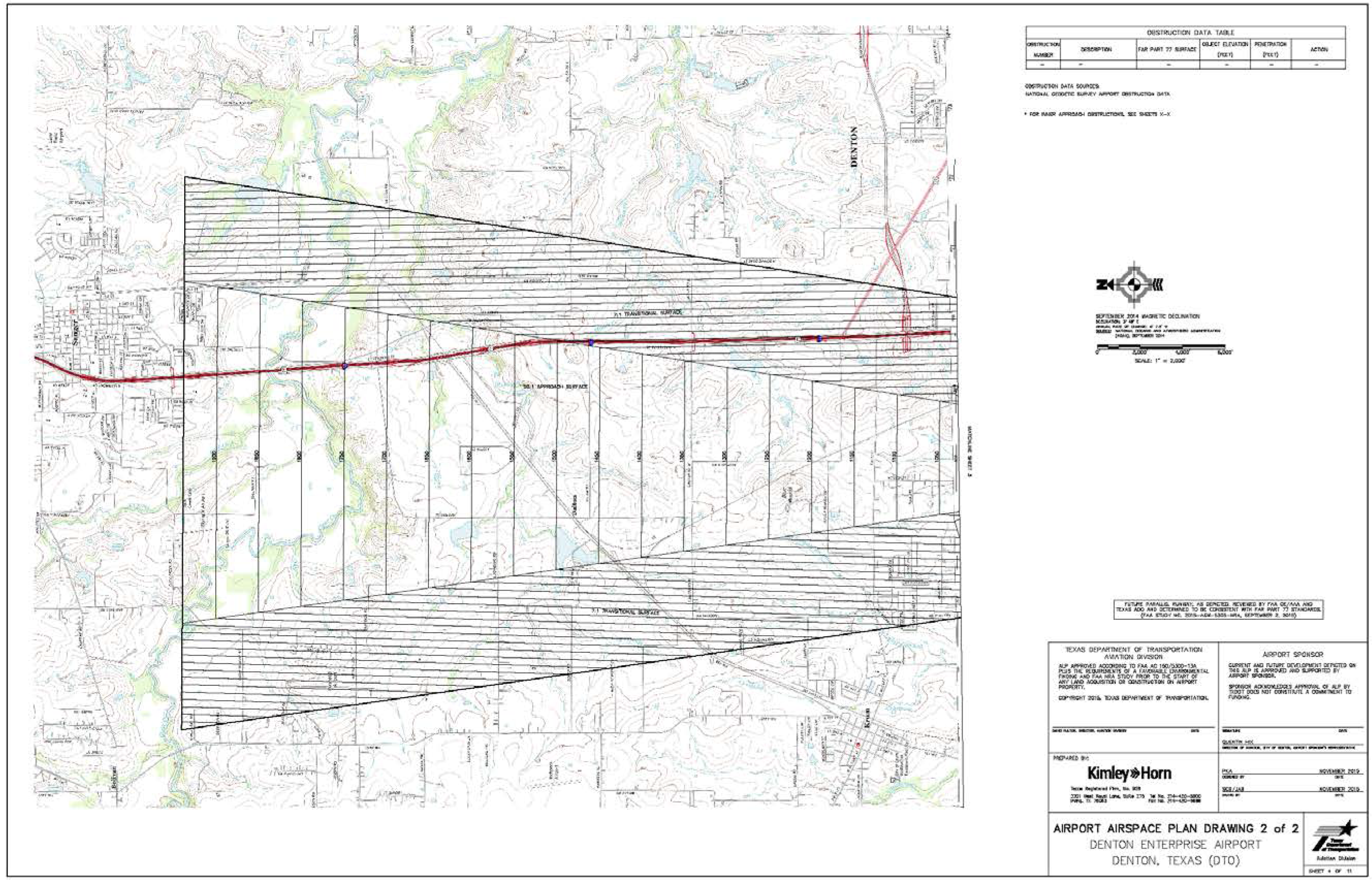
B.
Subdistrict Descriptions. The AHHD consists of the following subdistricts that are described by reference to definitions, rules, restrictions, and regulations, as may be amended from time to time, by the FAA, as follows:
1.
Approach Zones. Approach zones for runways 18L-36R and 18R-36L hereby are established beneath the approach surfaces at each runway end on the Denton Municipal Precision Instrument Airport for landings and takeoffs. The inner edge of the approach zone shall have a width of 1,000 feet which coincides with the width of the primary surface at a distance of 200 feet beyond each end of each runway, widening thereafter uniformly to a width of 16,000 feet at a horizontal distance of 50,000 feet beyond each end of the primary surface, its centerline being the continuation of the centerline of the runway.
2.
Transitional Zones. Transition zones hereby are established beneath the transition surface adjacent to runways 18L-36R and 18R-36L, and to each approach surface as indicated on the zoning map. Transition surfaces symmetrically located on either side of runways, have variable widths as shown in Figure 4.5-1: Airport Height Hazard District Map.
3.
Horizontal Zone. The horizontal zone hereby is established at the area beneath the horizontal surface of the airport.
4.
Conical Zone. The conical zone hereby is established as the area beneath the conical surface of the airport.
C.
Height Limitations. Except as otherwise provided in this section, no person shall erect, alter, or maintain a structure, and no person shall allow a tree or other natural object to grow in excess of the applicable height limitations established herein for each airport height hazard subdistrict as follows:
1.
Approach Zones. For runways 18L-36R and 18R-36L:
a.
Beginning at the end of and at the elevation of the primary surface, one foot in height for each 50 feet in horizontal distance; and
b.
Beginning at a point 10,000 feet from the end of the primary surface and extending an additional 40,000 feet along the extended runway centerline, one foot in height for each 40 feet in horizontal distance.
2.
Transitional Zones.
a.
Beginning at the sides of and at the same elevation as the primary surface and the approach surface, and extending to a height of 150 feet above the airport elevation (660 feet above mean sea level), one foot in height for every seven feet in horizontal distance;
b.
Beginning at the sides of and at the same elevation as the approach surfaces, and extending to where they intersect the conical surface, one foot in height for every seven feet in horizontal distance; and
c.
Where the precision instrument runway approach zone projects beyond the conical zone, and beginning at the sides of and at the same elevation as the approach surface, and extending a horizontal distance of 5,000 feet measured at 90 degree angles to the extended runway centerline, one foot in height for every seven feet in horizontal distance.
3.
Horizontal Zone. Within the horizontal zone, 150 feet in height above the airport elevation, or a height of 810 feet above mean sea level.
4.
Conical Zone. From the periphery of the horizontal zone and at heights between 150 and 350 feet above the airport elevation, one foot in height for every 20 feet in horizontal distance.
4.5.9 - ACLUD - Airport Compatibility Land Use District.
A.
District Established. There is hereby established an Airport Compatibility Land Use District (ACLUD), consisting of two subdistricts (ACLUD-1 and ACLUD-2), the boundaries of which are shown in Figure 4.5-2: Airport Compatibility Land Use District Map, and which constitutes the zoning map for the district.
Figure 4.5-2: Airport Compatibility Land Use District Map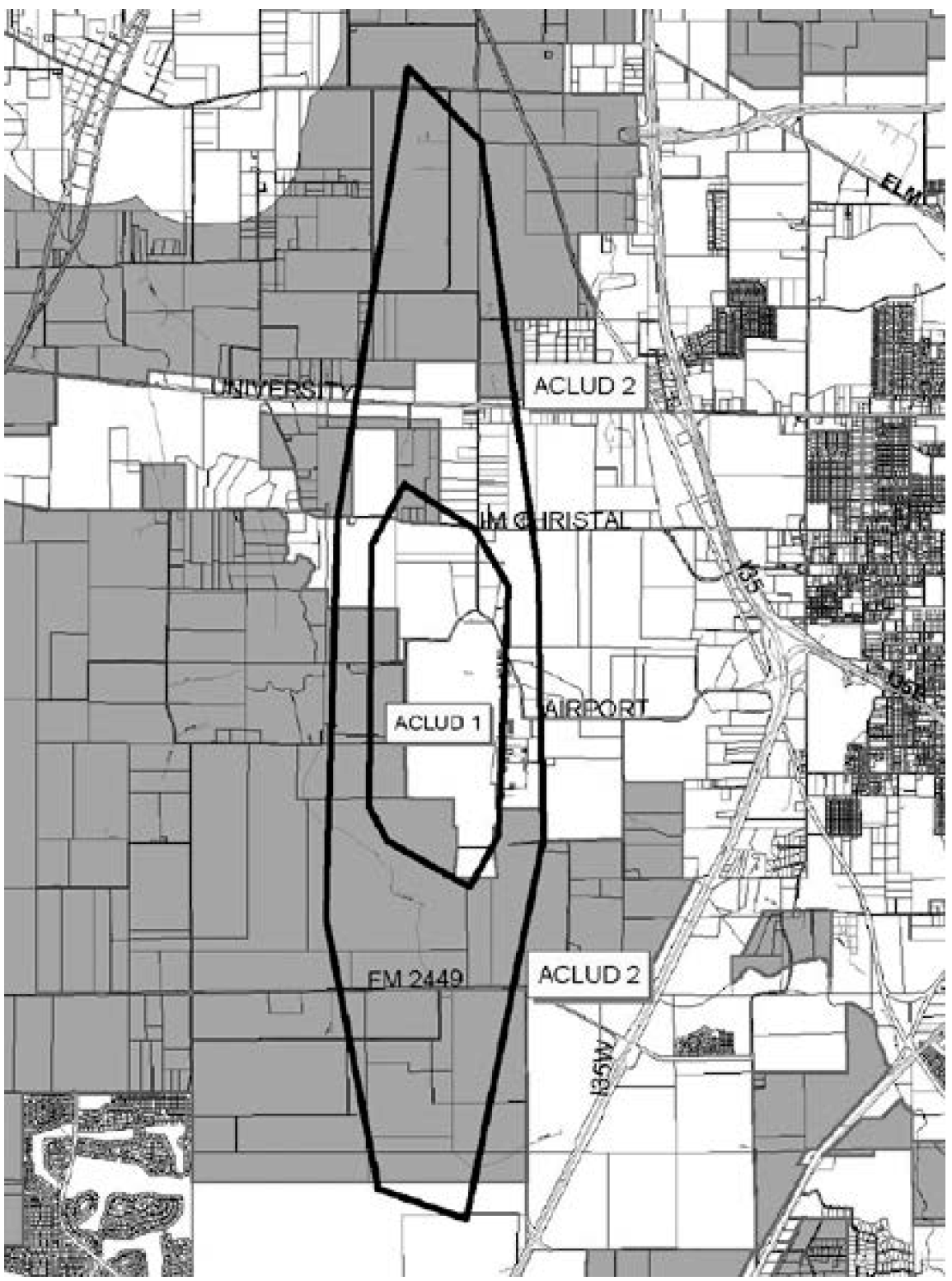
B.
Prohibited Uses. The following uses shall be prohibited within the ACLUD:
1.
Educational Facilities. All educational uses, including but not limited to, business or trade schools, college or universities, public schools, and private schools are prohibited in the ACLUD; provided, however, that the following educational facilities are permitted within the district:
a.
Schools for flight instruction or for vocations associated with the airport, airplanes, or aviation related activities; and
b.
Facilities for employee or client training or instruction related to services or products associated with the business of the entity providing such training or instruction and which is not the primary business of such entity.
2.
Healthcare Facilities. Healthcare facilities, including specifically hospital services, elderly housing, group homes, and group homes for the disabled are prohibited within the ACLUD.
C.
Subdistrict ACLUD-1. The following regulations apply within the ACLUD-1 subdistrict:
1.
Compatible Land Uses. All land uses allowed within the underlying zoning district or, within the ETJ, any land use not otherwise prohibited by this section shall be allowed within the ACLUD-1 subdistrict, except for new residential uses, which are expressly prohibited.
2.
Noise Mitigation. Any residential structure that was established prior to the effective date of this DDC and that is permitted to be repaired, rebuilt, or remodeled in accordance with the provisions of Section 1.5, Nonconformities, shall be repaired, rebuilt, or remodeled in compliance with the noise mitigation standards established in Subsection 4.5.10, Noise Mitigation.
D.
Subdistrict ACLUD-2.
1.
Compatible Land Uses. All land uses allowed within the underlying zoning district or, within the ETJ, and any land use not otherwise prohibited by this section shall be allowed within the ACLUD-2 subdistrict.
2.
Performance Standards for Residential Uses. Property owners that propose to construct a new residential building, or who propose to repair, rebuild, or remodel an existing residential structure within the boundaries of the district, shall do one of the following:
a.
Noise Mitigation Standards. Construct, repair, rebuild, or remodel the residential structure in accordance with the noise mitigation standards in Subsection 4.5.10, Noise Mitigation; or
b.
Avigation Easement. Execute an avigation easement, approved as to form by the City Attorney, conveying to the City of Denton an unobstructed right-of-way for the passage of all aircraft and rights to cause within such easement such noise, vibration, fumes, dust, fuel particles and all other effects that may be caused by the operating or aircraft landing at, taking off from, or operating at, the Denton Enterprise Airport.
4.5.10 - Noise Mitigation.
A.
Noise mitigation shall be required in accordance with FAA requirements.
B.
The Building Official may approve alternative standards upon the submission of plans signed by a qualified acoustical engineer certifying that the alternative standard will reduce outside noise levels to the day-night average sound level (Ldn) of 45 decibels (dB) or less inside the building.
4.6.1 - Purpose.
The Fry Street Overlay District (FSO) is intended to promote the public peace, safety, cleanliness, and general welfare for community members and patrons of the FSO district by regulating off-street and remote parking, the location of solid waste containers, and the regulation of signs, setbacks, and residential and commercial density.
4.6.2 - Fry Street Overlay District Established.
A.
Generally. The FSO district, as established in Figure 4.6-1: Fry Street Overlay District Area Boundary and Subareas, is the area approximately 12.42 acres in size which is bounded by Welch Street to the east, Oak Street to the north, Ave. B to the northwest, Ave. A to the southwest, Mulberry Street to the south, and Hickory to the southwest.
B.
Subareas Established. The FSO district is further divided into subareas A and B, as depicted in Figure 4.6-1: Fry Street Overlay District Area Boundary and Subareas. Each subarea is subject to distinct regulations as provided in this section.
Figure 4.6-1: Fry Street Overlay District Area Boundary and Subareas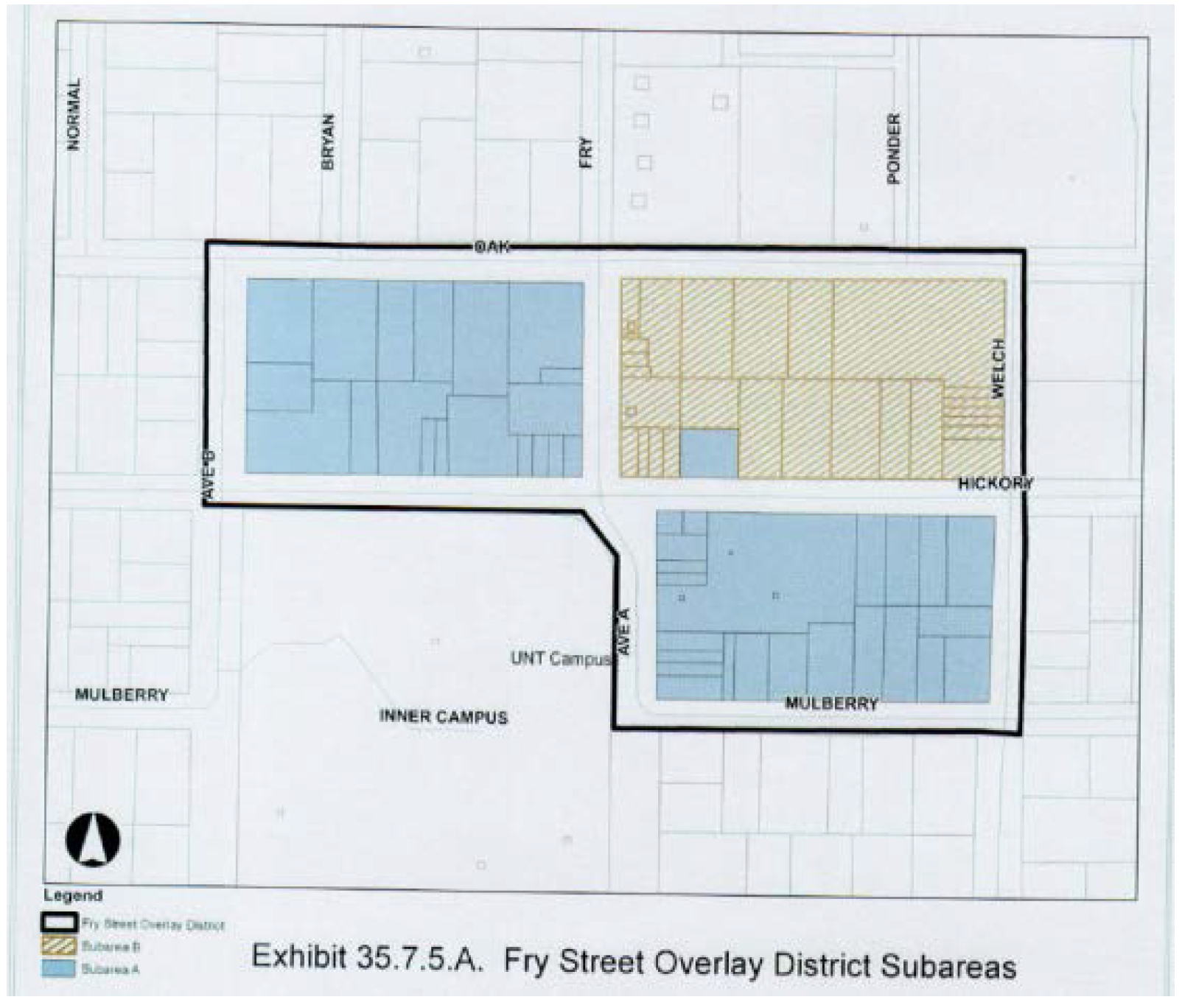
4.6.3 - Applicability.
The requirements of this section, shall apply to all buildings, structures, sites, and properties within the FSO district as described in Subsection 4.6.2.
4.6.4 - FSO District Dimensional Standards.
The dimensional standards established in Subchapter 3: Zoning Districts, shall apply to the FSO district, except as modified in Table 4.6-A below:
4.6.5 - Permitted Uses.
In addition to the uses listed in Table 5.2-A: Table of Allowed Uses, for each base zoning district, multifamily dwelling uses shall be allowed within the FSO district.
4.6.6 - Development Standards.
A.
Off-Street Parking. The standards established in Section 7.9, Parking and Loading, shall apply to the FSO district, except as follows:
1.
Shared and/or Off-Site Parking. Remote off-street parking to serve a building or use within the FSO district may be provided on a tract or parcel of land provided that the required off-street parking space shall be within 1,000 feet of the building or use being served and shall provide convenient pedestrian access to the building or use being served.
2.
Minimum Parking Required for Nonresidential Uses. Nonresidential uses including, but not limited to restaurant, retail, private club, and on-premises sale of beer and/or wine shall provide a minimum of one parking space for each 400 square feet of floor area, or one space for each six seats under maximum seating arrangements, whichever is greater.
3.
Additional Standards for Subarea A. The minimum number of parking stalls required for multifamily residential development in Subarea A shall be:
a.
Efficiency units: One and one-fourth (1.25) spaces per dwelling unit.
b.
Units with one bedroom: One and one-half (1.50) spaces per dwelling unit.
c.
Units with two or more bedrooms: One space per bedroom.
d.
Fraternities, sororities, boarding and lodging houses: One space per bedroom.
B.
Solid Waste Containers.
1.
Generally.
a.
Location. Solid waste containers shall be located off the street in centralized locations, to the rear of buildings served by each container, and shall be screened with devices made of masonry or wood.
b.
Consolidation. Each owner, occupant, tenant, or lessee of any business, commercial, or institutional property, or other property not served by residential solid waste collection service, shall contract with the city for shared or consolidated commercial solid waste collection and disposal services, unless otherwise required by ordinance.
2.
Additional Standards for Subarea B. Development in Subarea B shall provide adequate area to accommodate two trash compactors to serve the subarea, in a location specified by the approved site plan for the subarea.
4.6.7 - Additional Development Standards for Subarea B.
A.
Landscaping. Subarea B shall provide landscaping as depicted in in Figure 4.6-2. Copies can be found in the Development Services Department.
Figure 4.6-2: Fry Street Overlay District Subarea B Landscaping Plan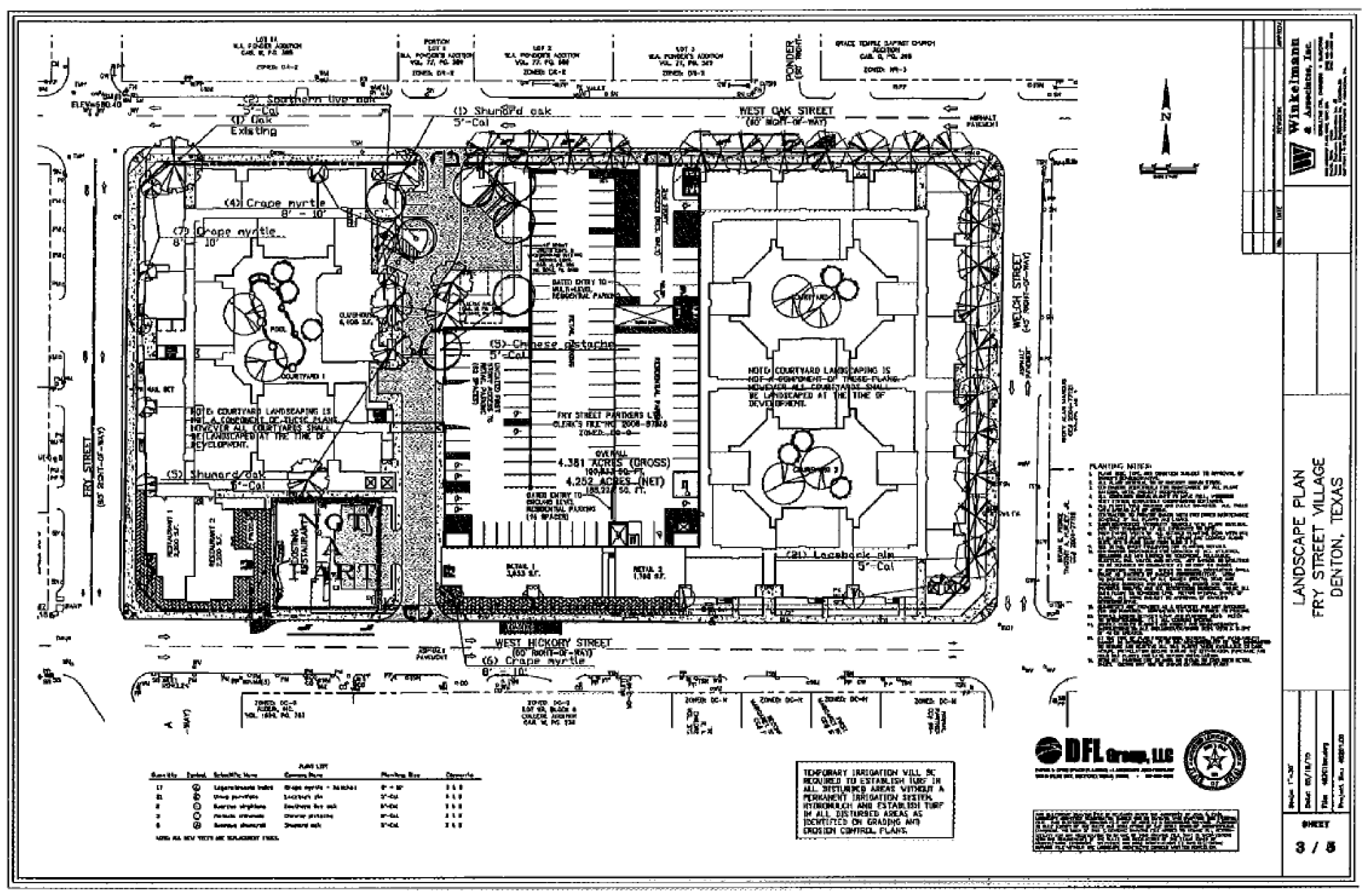
B.
Site Design. Construction shall substantially conform to the site plan shown below in Figure 4.6-3. Copies can be found in the Development Services Department.
Figure 4.6-3: Fry Street Overlay District Subarea B Site Plan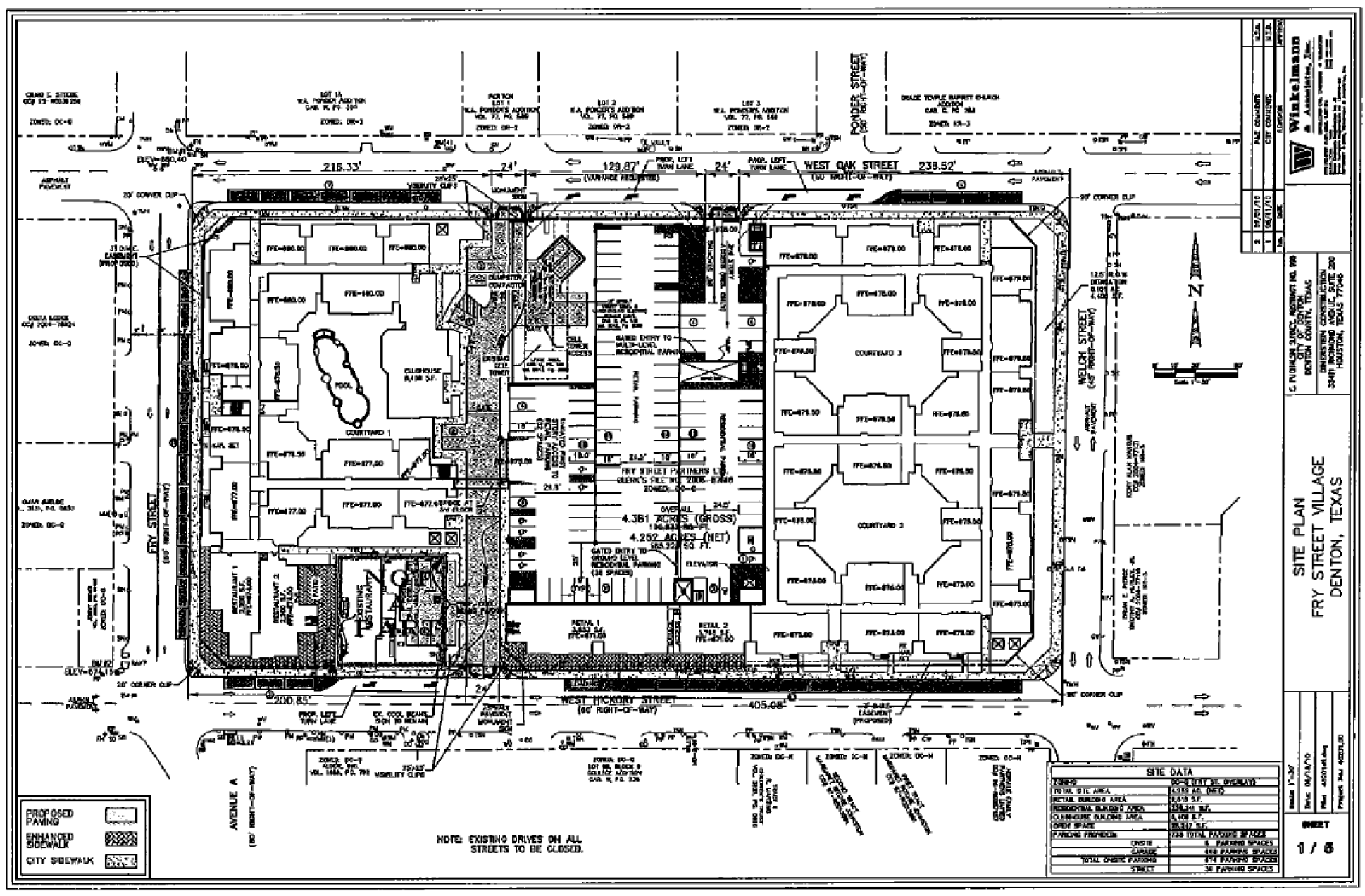
C.
Parking Structures. Parking Structures shall be provided with a facade designed to mimic the adjacent buildings within the subarea, so as to assist in integrating the structure into the balance of the subarea, and to assist in camouflaging the structure from the public right-of-way.
D.
Building Design. The following requirements shall apply to Subarea B, in addition to any other requirements in this DDC or other city ordinances:
1.
Residential units fronting Welch Street shall incorporate sloped roof pitches.
2.
Each principal facade or massing area shall incorporate a minimum of two of the features identified in Figure 4.6-4: Subarea B Architectural Image Board, including but not limited to:
a.
Store front design;
b.
Awnings;
c.
Stoops on the street level;
d.
Accent bay windows;
e.
Cornice details;
f.
Brick facades with flat roof lines;
g.
The incorporation of a bench and street tree in front of the building;
h.
Arch details; and
i.
Shutters.
Figure 4.6-4: Subarea B Architectural Image Board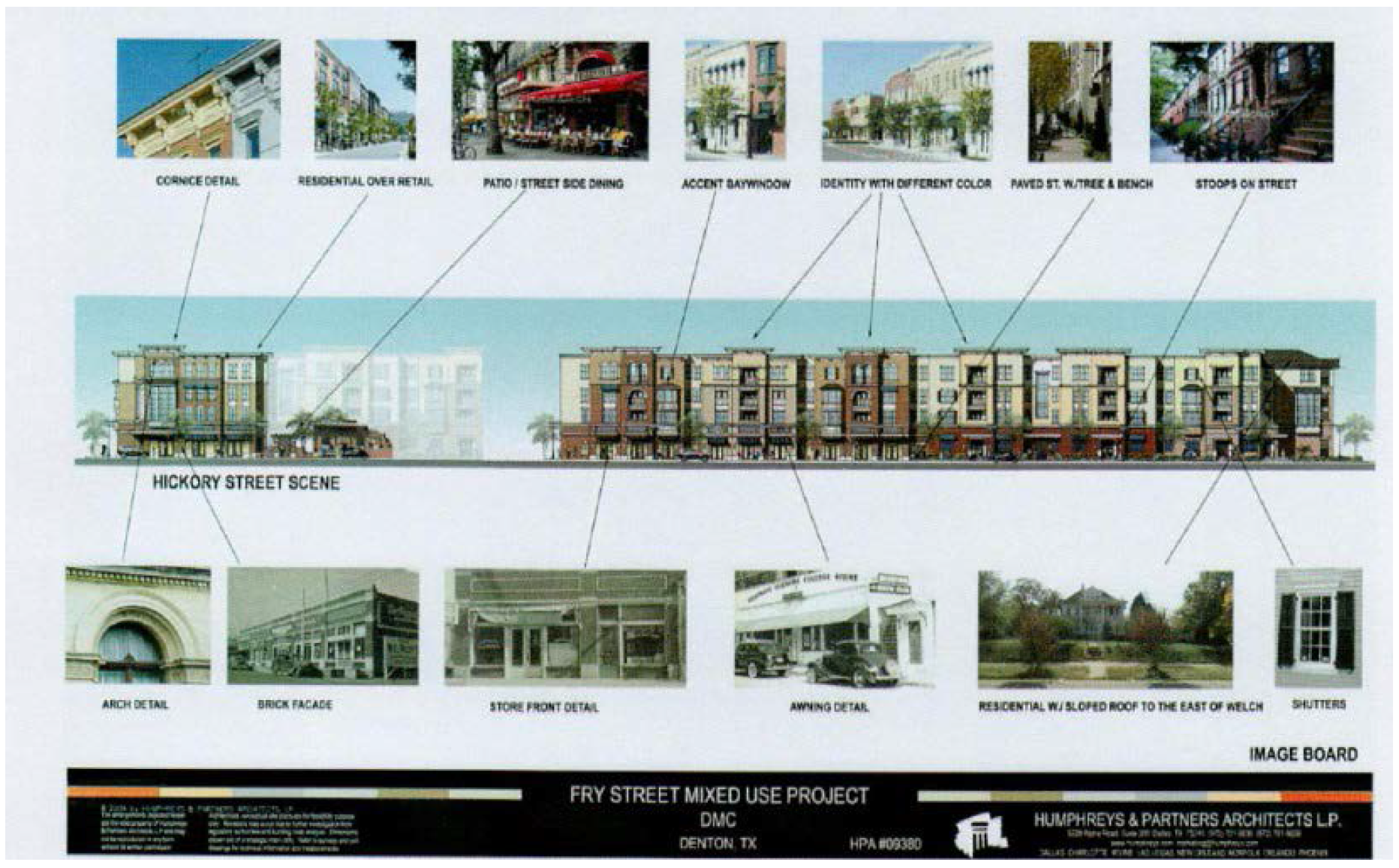
4.6.8 - Sign Regulations.
The provisions of Subpart B, Chapter 33: Signs and Advertising Devices, of the City Code of Ordinances, as hereafter amended, superseded, or replaced, shall apply, except as modified for each subarea below:
A.
Wall Signs.
1.
Subarea A.
a.
Mounting and Orientation. All signs in Subarea A shall be wall mounted signs, mounted parallel with, and not perpendicular to, the face of the wall upon which the sign is secured.
b.
Mixed-Uses with Residential Component. Signs associated with mixed uses in subarea A shall be allowed only on those stories of a building that include non-residential uses.
2.
Subarea B. Wall signs in Subarea B may be mounted perpendicular to building faces, provided they do not encroach into public rights-of-way.
B.
Ground and Monument Signs.
1.
Subarea A. Ground and monument signs are prohibited in Subarea A.
2.
Subarea B. Ground and monument signs may be allowed in Subarea B subject to the following standards:
a.
Size and Location. Monument signs, not exceeding 15 square feet of effective area, may be permitted at entrances to mixed-use developments, as depicted in the site plan for Subarea B. (See Figure 4.6-3.)
b.
Design. Signs in Subarea B shall be in a style and size consistent with the conceptual designs provided in Figure 4.6-5.
Figure 4.6-5: Subarea B Conceptual Sign Renderings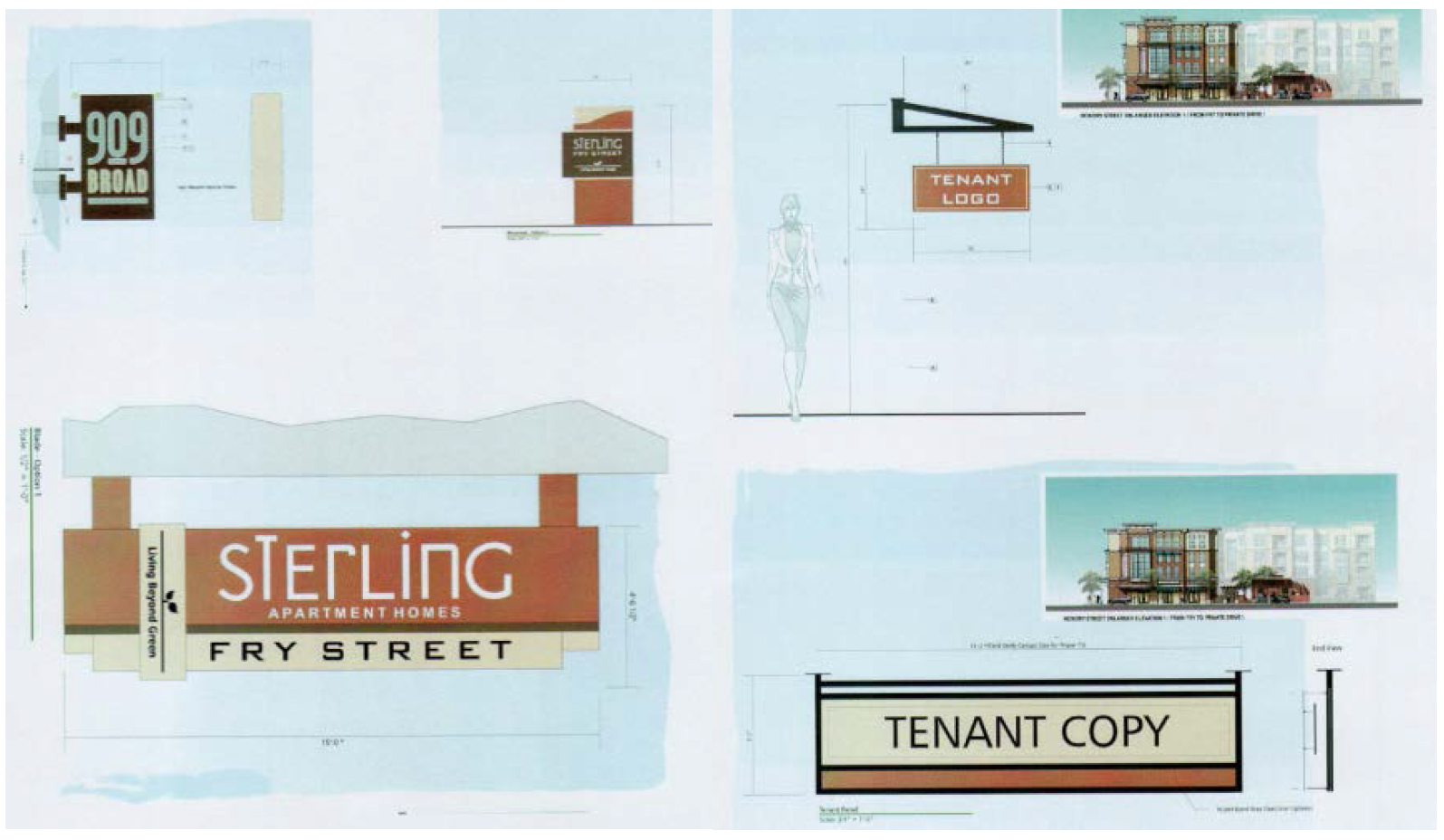
4.6.9 - Minor Amendments.
A.
Upon request of the applicant, the Director may authorize minor amendments to the site or landscape plan so long as such minor amendments do not change the land use or substantially change the character, development standards, or design of the development as shown on the approved site or landscape plans. For purposes of this provision, a "substantial change" shall mean a change which will increase the number of proposed dwelling units or bedrooms, height, or number of stories; or decrease the amount of required off-street parking spaces.
B.
The Director shall make such authorization only in writing and such document shall be placed in the ordinance file governing the specific plan.
4.7.1 - Purpose.
The Unicorn Lake Overlay District (ULD) is intended to stabilize and improve property values, ensure compatibility of new construction with the existing scale and characteristics of surrounding properties, and balance the economic development goals and the environmental goals of the city.
4.7.2 - Unicorn Lake Overlay District Established.
The ULD district, as established in Subchapter 3: Zoning Districts, is the area depicted in Figure 4.7-1 below:
Figure 4.7-1: Unicorn Lake District Area Boundary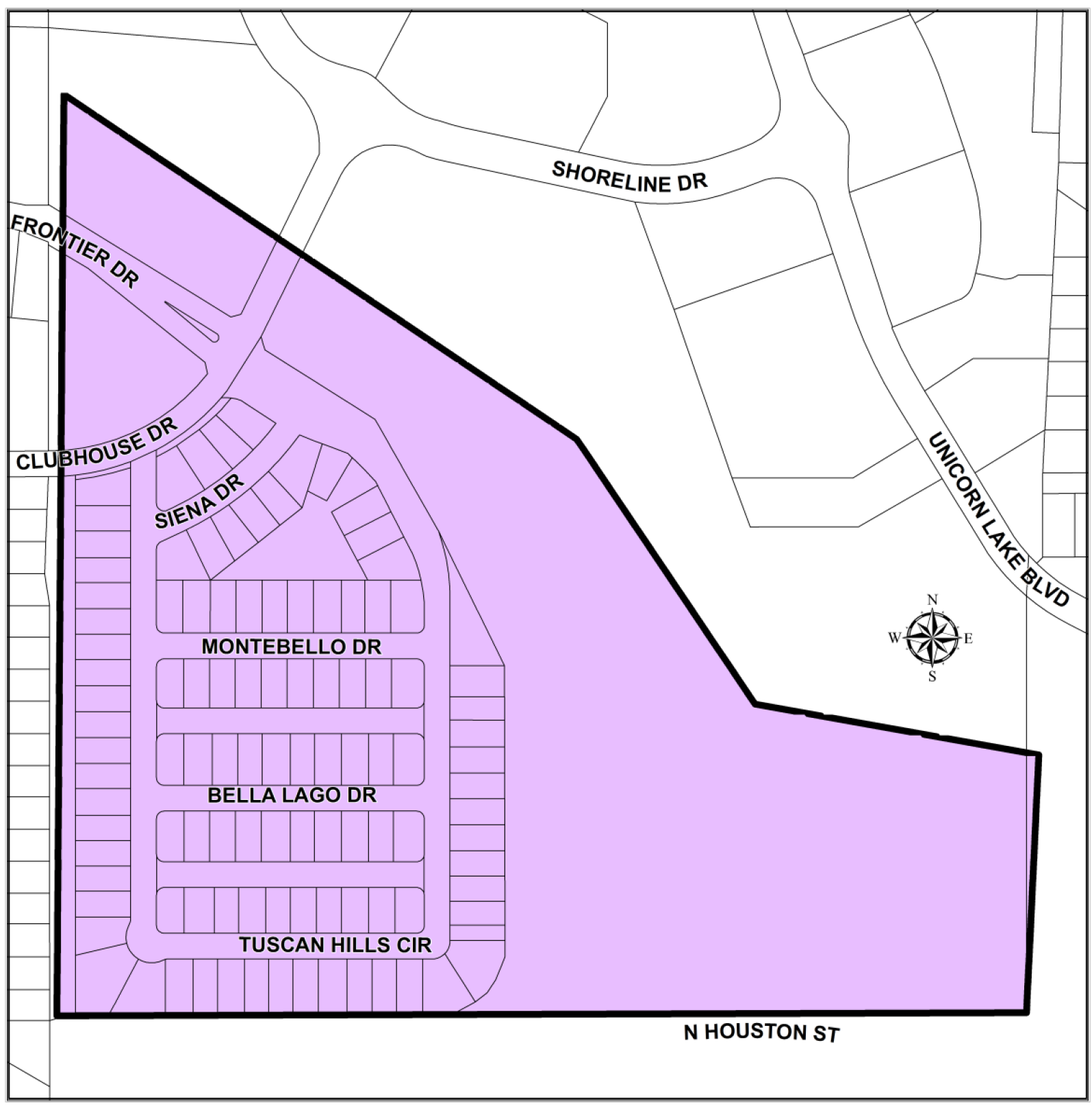
4.7.3 - Applicability.
The standards in this Section 4.7 shall apply to all property within the ULD district boundaries, unless specifically modified herein.
4.7.4 - ULD District Dimensional Standards.
The dimensional standards established in Subchapter 3: Zoning Districts, shall apply to the ULD district, except as modified in Table 4.7-A: Unicorn Lake Overlay District Dimensional Standards, below:
4.7.5 - Permitted Uses.
The land uses allowed in the MN zoning district as provided in Table 5.2-A: Table of Allowed Uses, are allowed in the ULD district, and are restricted to the areas shown in the attachments in Ord. No. 2006-0139 from which this section derives and the following standards:
A.
A maximum of 112 single-family dwelling units, and any accessory uses to such dwelling units, including an amenity center;
B.
Gas wells, including drilling operations and uses accessory to gas wells; and
C.
Administrative, professional, or government offices not to exceed a total of 8,000 square feet, and any accessory uses to such offices.
4.7.6 - Development Standards.
Any applicable regulations for development of property in the underlying zoning district are applicable to the ULD district with the following exceptions:
A.
Private Streets.
1.
Generally.
a.
Except as otherwise provided by this DDC, private streets and sidewalks shall be designed and constructed according to public street standards.
b.
In the event any of the standards of this section fall below any applicable city standards, the minimum standards set by ASHTO shall apply. For purposes of applying ASHTO standards, Clubhouse Drive shall be considered an urban collector.
c.
A private street system with gated access may be constructed to serve the property.
d.
Clubhouse Drive shall be a public street.
2.
Deed Restrictions Required.
a.
Prior to the recordation of any final plat allowing the construction of a private street system, deed restrictions for the property shall be recorded in the deed records of Denton County containing provisions in substantially the same form as the attachments in Ord. No. 2006-0139 from which this section derives:
i.
Article II (and related definitional provisions);
ii.
Section 4.10;
iii.
The provisions of Section 6.02 requiring that liability insurance be obtained in an amount approved by the City, and naming the City as an additional insured;
iv.
The provisions of Section 10.03 precluding amendment (without City consent) of any of the provisions which specifically require City consent to an amendment; and
v.
Section 10.12.
3.
Design Standards. Notwithstanding any other regulation to the contrary in this DDC or city criteria manuals, the following requirements shall apply to private streets:
a.
The maximum street grade for Clubhouse Drive shall be eight percent.
b.
The maximum street grade within 60 feet of an intersection shall be eight percent.
c.
No traffic calming features are required.
d.
Cul-de-sacs may be a maximum of 300 feet in length. Cul-de-sacs shall have a minimum radius of 50 feet.
e.
Barrier free ramps shall be required at intersection curb returns.
f.
All private streets shall have a total minimum right-of-way of 50 feet.
4.
Access and Connectivity. Discontinuity with other existing or future neighborhoods is unavoidable due to adjacent conditions and constraints including:
a.
An existing subdivision to the west of the property that does not have street stubs to connect to;
b.
Flood plain and lake areas to the east of the property, which present a significant physical barrier; and
c.
State school property to the south of the property that does not, and likely will never, provide street connection points to the property.
5.
The proposed ingress and egress for the property consists of two streets directly connecting to a collector roadway (Clubhouse Drive) that provides adequate ingress and egress for a development of 106 single-family lots. When developed for single-family uses, the property shall contain fewer units than allowed under the prior zoning, thus mitigating any concern regarding the number of ingress and egress points associated with the property. If the property is developed with any uses other than detached single-family uses, the adequacy findings of paragraph 4.7.6A.4 shall not apply.
B.
Utilities.
1.
All water and sewer lines that serve the property shall be publicly owned and maintained and shall be designed and built according to city standards.
2.
A public utility easement or other adequate water and sewer easement shall be dedicated to the City of Denton for all water and sewer lines.
3.
Utilities may be located within a public utility easement or other adequate water and sewer easement dedicated to the City of Denton as shown on the attachments in Ordinance No. 2006-0139 from which this section derives.
4.
The city is not responsible for repairing damage to private streets resulting from city repairs to utilities located underneath the street paving. However, if the city makes such repairs, the city shall first give the home owners association the option of paying to upgrade the repair work so that the streets are repaired to city standards.
C.
Pedestrian Access. Development within the ULD district is exempt from the requirement to provide pedestrian access by linking to any adjacent sidewalk(s), multi-use path(s), or public transportation stops.
D.
Nonresidential and Mixed-Use Building Orientation. The alternatives authorized under paragraph 7.10.5A.3 shall not apply to the ULD district.
E.
Single-Family Building Design.
1.
Orientation. Primary entrances shall face the street and sidewalk.
2.
Architectural Variety.
a.
No elevation shall be repeated more frequently than every fifth lot on the same side of the street.
b.
No elevation shall be repeated on the lot directly across the street or next door to the lot directly across the street.
3.
Building Mass and Form. Buildings shall incorporate at least three of the following design features to provide visual relief along the front of the residence:
a.
Dormers;
b.
Gables;
c.
Recessed entries, a minimum of three feet deep;
d.
Covered front porches;
e.
Cupolas;
f.
Architectural pillars or posts;
g.
Bay window, a minimum 24-inch projection;
h.
Clay tile, slate, copper, or high definition composition roofing materials;
i.
Fireplace chimneys matching exterior finish of home;
j.
Windows and doors made of wood, metal clad or metal with bronze anodized finish;
k.
Decorative wrought iron or wood railings as extensions of the architecture of the home;
l.
Trim and accent colors that are dark, rich earth tones that come from stains and refined woods, medium browns, or medium to dark greens;
m.
Four to twelve (4:12) to twelve to twelve (12:12) single pitch roofs or double pitch roofs up to twelve to twelve (12:12), with shed roofs used only as secondary elements; and/or
n.
A minimum 10 foot first floor wall height and minimum nine foot second floor wall height.
4.
Garage Design.
a.
For front-entry garages, the total width of the garage door(s) shall not occupy more than 40 percent of the ground floor building frontage, unless the garage door is located at least 30 feet behind the front of the house.
b.
Attached front-entry garages shall not extend beyond the front building wall, except side load or J-swing garages.
5.
Building Transparency/Windows. Windows shall be provided with trim or shall be recessed. Windows shall not be flush with exterior wall treatment.
6.
Building Materials.
a.
Exterior finishes shall consist of the following materials:
i.
Stone;
ii.
Brick;
iii.
Plaster with stone; and/or
iv.
Wood.
b.
Siding and exterior insulation and finish system (EIFS) shall be prohibited.
F.
Tree Preservation. Development within the ULD is exempt from the standards in Subsection 7.7.4: Tree Preservation.
G.
Buffer Requirements.
1.
A minimum buffer of 50 feet in width, in the location shown on the attachments in Ordinance No. 2006-0139 from which this section derives, must be provided. Alterations to the required buffer area are prohibited except as necessary to do the following:
a.
Accommodate drainage flows from adjacent and upstream property and meet all applicable city drainage requirements;
b.
Construct a fence or wall along the boundary of the property;
c.
Install a retaining wall along the east line of the buffer, if necessary; and
d.
Remove dangerous, diseased, or dead trees from the buffer.
2.
The only machinery that may be used in the required buffer to do the work in 1. above is machinery that is reasonably necessary and appropriate to the scope of work being performed, as determined by the Director.
H.
Clubhouse Drive. No additional lanes are required on Clubhouse Drive to serve single-family development, whether an additional lane is for the purpose of providing a turn lane or bus lane or for any other purpose.
4.9.1 - Purpose.
The City Council hereby finds as a matter of public policy that the protection enhancement, preservation and use of historic landmarks is a public necessity and is required in the interest of culture, prosperity, education and general welfare in order to:
A.
Protect, enhance, promote, and perpetuate historic landmarks which represent or reflect distinctive and important elements of the city's and state's architectural, archeological, cultural, social, economic, ethnic and political history and to develop appropriate settings for such places;
B.
Safeguard the city's historic and cultural heritage, as embodied and reflected in such historic landmarks by appropriate regulations;
C.
Stabilize and improve property values in such locations;
D.
Foster civic pride in the beauty and accomplishments of the past;
E.
Protect and enhance the city's attractions to tourists and visitors and provide incidental support and stimulus to business and industry;
F.
Strengthen the economy of the city;
G.
Promote the use of historic landmarks for the culture, prosperity, education, and general welfare of the people of the city and visitors of the city.
4.9.2 - Penalty.
A.
It shall be unlawful to construct, reconstruct, structurally alter, remodel, renovate, restore, demolish, raze, or maintain any building, structure or land with a historic landmark designation or located in a historic or conservation district in violation of the provisions of this DDC, and the city in addition to other remedies, may institute any appropriate action or proceedings to prevent such unlawful construction, restoration, demolition, razing, or maintenance to restrain, correct or abate such violation to prevent any illegal act, business or maintenance in and about such premises.
B.
Any person violating any provision of this section shall be guilty of a misdemeanor and shall be punished as provided in Section 1.6, Enforcement.
4.9.3 - Enforcement.
A.
No person shall construct, reconstruct, alter, remodel, renovate, restore, demolish, raze, or maintain any building, structure or land with a Historic Landmark designation or a building, structure or land located in a locally designated Historic or Conservation District unless application is made for a Certificate of Appropriateness (COA) for said work and such a certificate is granted as provided in Subsection 2.9.2, and appropriate construction or demolition permits are obtained.
B.
The city in addition to other remedies, may institute any appropriate action or proceedings to prevent such unlawful construction, restoration, demolition, razing or maintenance to restrain, correct or abate such violation to prevent any illegal act, business or maintenance in an about such premises.
C.
Other regulations applicable to Historic Landmarks, Conservation Districts, and Historic Districts as contained in this DDC shall continue to apply, except as specifically modified in this section.
4.9.4 - Oak-Hickory Historic District.
A.
Purpose. The purpose of this subsection is to ensure the protection and preservation of the Oak-Hickory Historic District by providing regulations for the use, construction, alteration, repair, improvement and alteration of buildings, structures, properties and sites within the district. All properties within the district must comply with the underlying zoning district and use classification regulations.
B.
Boundaries. The Oak-Hickory Historic District is generally bounded by Hickory Street to south, N. Welch Street to the west, Pearl Street to the north, and Williams Street to the east as established by Ordinance No. 87-224. Major Public Streets in the District are West Oak, West Hickory, Mounts, Denton, Pearl and Fulton Streets.
Figure 4.9-1: Approximate Boundaries of the Oak-Hickory Historic District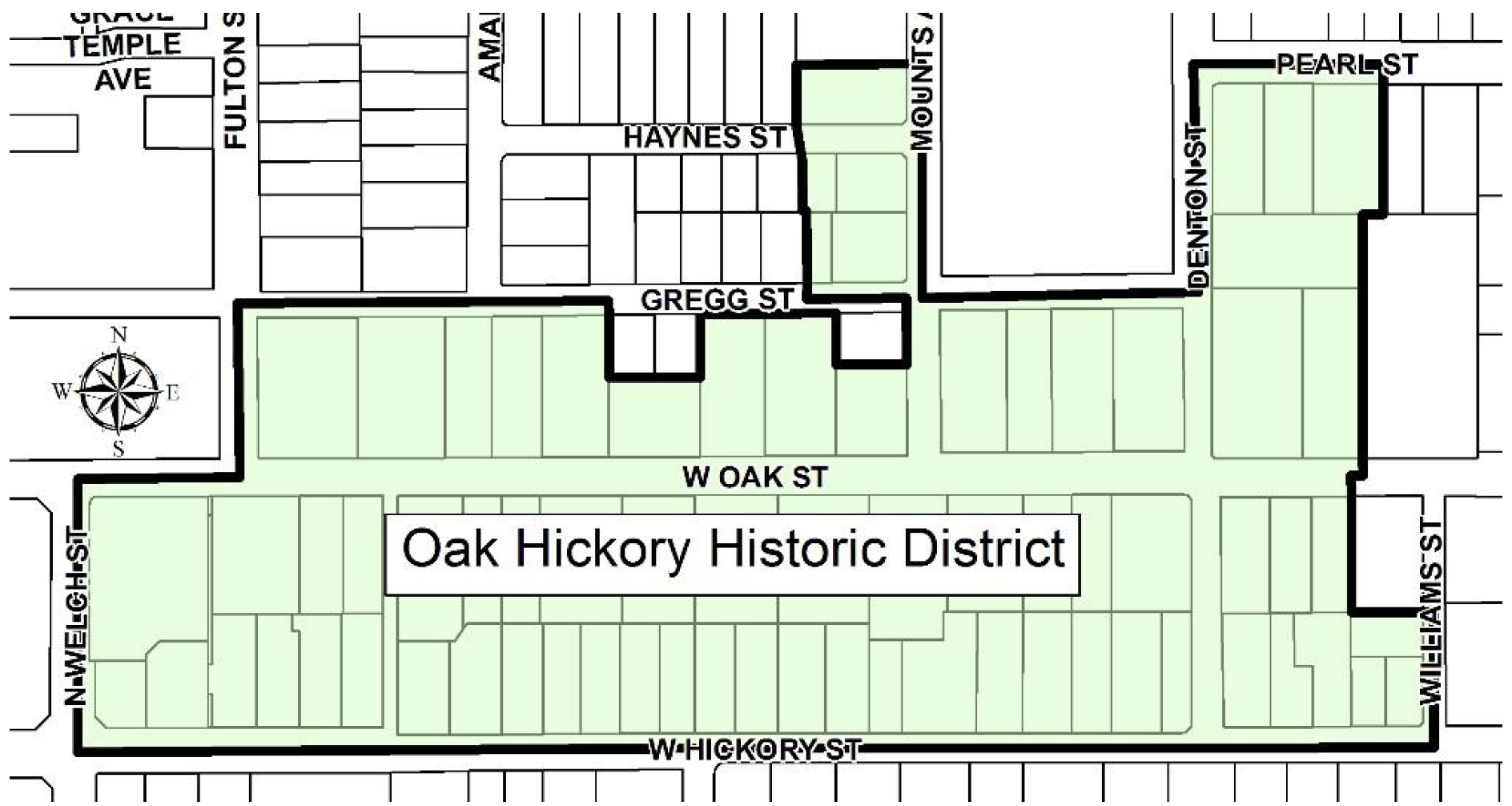
C.
Architectural Requirements. Architectural requirements in the Oak-Hickory Historic District shall be as follows:
1.
Principal Structure. The principal structure must be compatible in scale with principal structures existing in the district. The combined square footage of all structures on a given lot may not exceed 50 percent building coverage. Compatibility or the appropriateness with respect to additions or alterations to an existing structure shall be determined by comparison with historical photographs or documentation whenever available.
2.
Accessory Buildings. Accessory buildings which are visible from any public street, as determined by the Historic Preservation Officer, must be compatible with the scale, shape, roof form, materials, detailing and color of the main building. The combined square footage of all structures on a given lot may not exceed 50 percent of the square footage of said lot. Compatibility and or the appropriateness with respect to additions or alterations to an existing structure shall be determined by comparison with historical photographs or documentation whenever available.
3.
Architectural Detail. Materials, colors, structural, and decoration elements and the manner in which they are used, applied or joined together must be compatible with nearby and adjacent structures.
4.
Destruction. If the exterior of historic structures are to be altered and if previous alterations have modified the original design, then the alteration process shall return the structure to a form based on historic documentation. In the case of destruction by natural forces, replacement structures and or repairs shall conform with the original form based on historical documentation, or if none exists, shall conform in scale and proportion to the remaining structure and or the scale and proportion of structures similarly designed.
5.
New Construction and Additions. Generally, all buildings must be placed so as to not adversely affect the rhythm of spaces between buildings on the block. Additions and or replacement buildings shall have a front setback that is the average of the adjacent lots of contributing buildings.
6.
Chimneys. All chimneys must be compatible with the style of the proposed building. Chimneys must be constructed of brick, stucco, stone, or other materials compatible in texture, color, and style with the proposed main building.
7.
Additions. All additions to a building must be compatible with the dominant horizontal or vertical characteristics, scale, shape, roof form, materials, detailing, and color of the existing building.
8.
Color. Structures in the Oak-Hickory Historic District may be painted any color from the following paint manufacturer's preservation color pallets: Sherwin Williams America's Heritage Historical Exterior Colors Pallet, Valspar Paint National Trust Historic Colors, Pittsburgh Paints Historic Collection, or similarly intended pallets. Any paint brand is allowed. Fluorescent and metallic colors are not permitted on the exterior of any structure in the district. The Historic Preservation Officer may administratively approve repainting of homes in this District.
a.
Dominant and Trim Colors. All structures must have a dominant color which shall not be of vivid saturation. The colors of a structure must be complementary to each other and the overall character of the main building.
b.
Gutters and Downspouts. Gutters and downspouts must be of a color that matches or complements the color scheme of the main building.
c.
Roof Colors. Roof colors must complement the style and overall color scheme of the structure.
d.
Masonry and Brick Surfaces. Masonry and brick surfaces not previously painted must not be painted unless it is determined that:
i.
The painting is absolutely necessary to restore or preserve the masonry or brick; or
ii.
The color and texture of replacement masonry or brick cannot be matched with that of the existing masonry or brick surface.
e.
Stain. The use and color of stain must be typical of the style and period of the structure.
9.
Façade Materials.
a.
Generally. The permitted façade materials are brick, wood siding, wood, stone, and stucco. The use of cementitious siding is also permitted on new construction and accessory buildings. Artificial facsimiles of these materials will be considered on a case-by-case basis as material technologies progress. All façade treatments and materials must be typical of the style and period of the main building.
b.
Wood Façades. Existing wood façades must be preserved as wood façades.
10.
Front Entrances and Porches.
a.
Detailing. Railings, moldings, tile work, carvings, and other detailing and architectural decorations must be applied in a manner typical of the style and period of the main building.
b.
Enclosures. A front entrance or porch may not be enclosed with any material, including iron bars, glass, or mesh screening.
c.
Façade Openings. New porches must not obscure or conceal any façade openings in the main buildings.
d.
Floor Coverings. Carpeting is not permitted as a porch floor or step covering. Doormats are exempt from this requirement.
e.
Style. Each proposed main building must have a front porch or entry treatment with a shape, roof form, materials, and colors that are typical of the style of the proposed main building. A front entry or porch must reflect the dominant horizontal and vertical characteristics of the proposed main building.
11.
Roof Forms.
a.
Material and Colors. Roof material and colors must complement the style and overall color scheme of the structure.
b.
Patterns. Roof patterns must be typical of the style and period of the main building.
c.
Slope and Pitch. The degree and direction of the roof slope and pitch must be typical of the style and period of the main building.
d.
Skylights and Solar Panels. The HLC may allow skylights and solar panels on a building if their placement does not have an adverse effect on the architecture of a building or the District as a whole. Skylights are permitted on the rear of accessory buildings only.
12.
Windows and Doors.
a.
Front Façade Openings. The location and size of windows and doors in proposed façades must be compatible in scale with the typical style and period of the main building.
b.
Glass. Reflective, tinted, and mirrored glass and plastic are not permitted in any opening.
c.
Screen, Storm Doors, and Storm Windows. Screens, storm doors, and storm windows may be permitted if:
i.
Their frames are painted to match or complement the color scheme of the main building; and
ii.
They do not obscure significant features of the windows and doors they cover.
d.
Security and Ornamental Bars. Security and ornamental bars are only permitted on the exterior of an accessory building, the rear façade of the main building and the interior of the building.
e.
Shutters. Shutters must be typical of the style of the proposed main building and appear to be installed in a manner to perform their intended functions.
f.
Style. All windows and doors in the front façade of the main building must be proportionally balanced in a manner typical of the style and period of the building.
g.
Size. The size and proportion of window and door openings located on the front and sides of the main building must be typical of the style and period of the main building.
h.
Frames. The frames of the windows must be trimmed in a manner typical of the style and period of the building.
i.
Openings. All windows, doors, and lights in the front and side façades of the main building must be typical of the style and period of the building. Sidelights must be compatible with the door.
13.
Outdoor Lighting. Outdoor light fixtures must be compatible with the style and period of the main building and not obscure or conflict with significant architectural details of the building.
D.
Fences. Fences are not mandatory; however, when installed or replaced, they shall comply with Subsection 7.7.8: Walls, Fences, and Screening, and shall require an administratively approved COA.
1.
Color and Style. Fences must be of a color, style, and material that is compatible to the main building.
2.
Masonry Columns and Bases. The color, texture, pattern, and dimensions of masonry and the color, width, type, and elevation of mortar joints in a fence column or base must match the masonry and mortar joints of the main building.
E.
Signs. All signs located within the Oak-Hickory Historic District shall be subject to the provisions of Subpart B, Chapter 33, of the Code of Ordinances, except as modified as follows:
1.
Signs Prohibited. Ground, roof, projecting, portable, and off-premises signs are prohibited.
2.
Wall Sign Regulations.
a.
Only one wall sign per premises is permitted.
b.
No wall sign shall have a maximum dimension that is greater than two feet, measured along the greater distance of any one line which defines the effective area of the sign.
3.
Address or Name Signs. The sign regulations of this section shall not apply to the signs or numbers which are used solely to identify the street address of the premises or they identify by name the occupants of a residential building.
4.
Approval Procedure for Signs. No signs shall be constructed or located, and no existing wall sign shall be altered, until a COA is issued in accordance with the procedure applicable to alterations or changes of the exterior architectural features of buildings, and a sign permit is obtained as required by Subpart B, Chapter 33, of the Code of Ordinances.
F.
Parking. The provisions of this DDC applicable to parking shall apply to the Oak-Hickory District, except as modified as follows:
1.
Location. All off-street parking spaces for any building used as a multifamily dwelling or for a nonresidential use shall be located between the building fronting the public street and the rear property line.
2.
Number of Parking Spaces. Each specified use shall provide the following number of parking spaces:
a.
Multifamily buildings shall have a minimum of two parking spaces for each dwelling unit.
b.
Nonresidential uses shall provide one and one-half times the number of parking spaces required for that use as established in Section 7.9: Parking and Loading.
4.9.5 - Bell Avenue Historic District.
A.
Purpose. The purpose of establishing the Bell Avenue Historic District is to safeguard the heritage of the City of Denton by preserving the Bell Avenue area of the city. The area contains landmarks, buildings, and/or sites which reflect elements of the city's cultural, social, economic, political, or architectural or archeological history. The Bell Avenue Historic is also intended to: ensure compatibility of new construction and structural alterations with the existing scale and characteristics of surrounding properties; foster civic pride in the beauty and accomplishments of the past; and identify and promote the use of historic resources for the education, pleasure, and welfare of citizens of the City of Denton.
B.
Boundaries. The Bell Avenue Historic District includes all the properties that front Bell Avenue between East University Drive and East Sherman Drive, as established by Ordinance No. 2005-099.
Figure 4.9-2: Approximate Boundaries of the Bell Avenue Historic District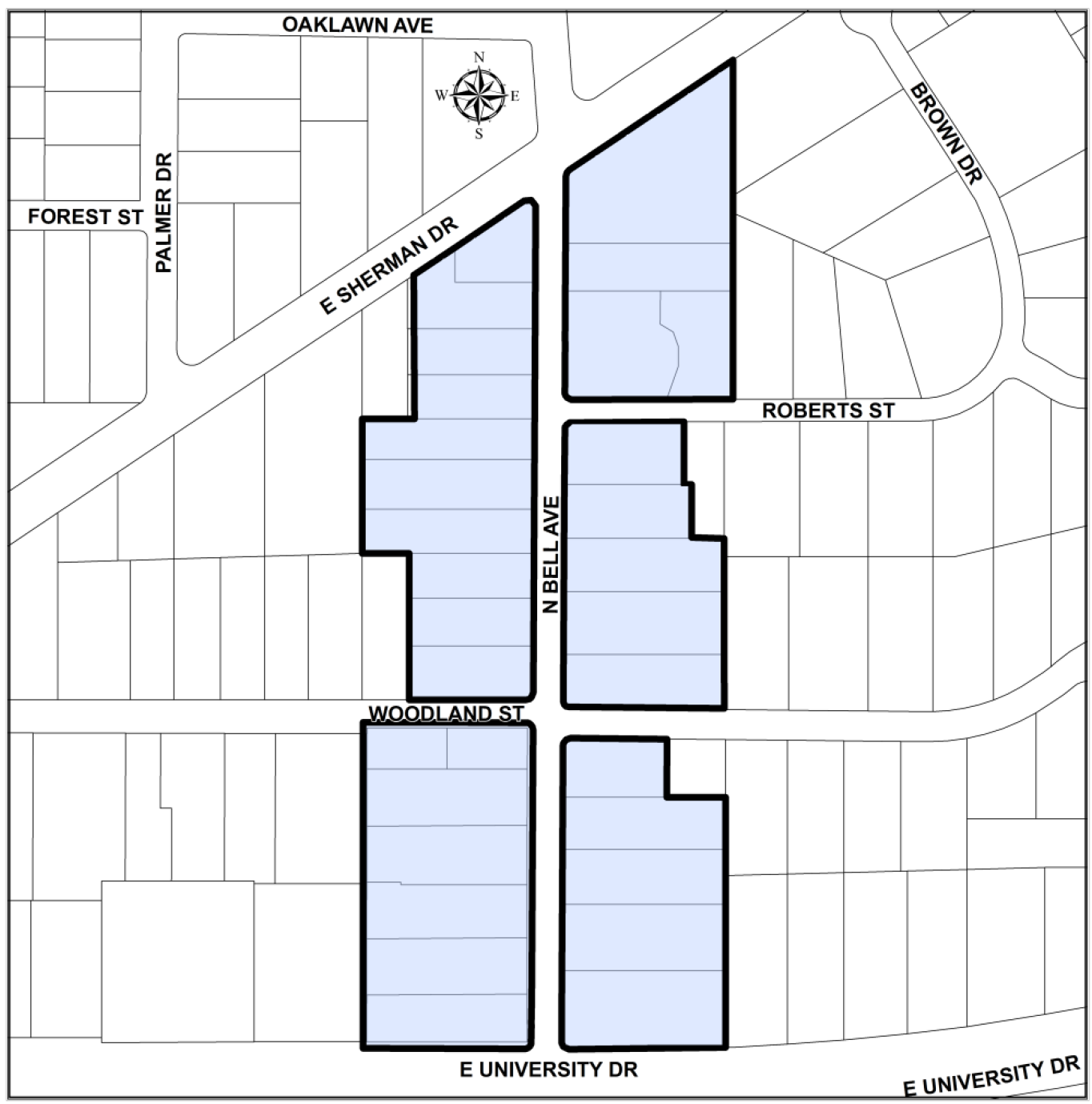
C.
Architectural Regulations. Architectural requirements in the Bell Avenue Historic District shall be as follows:
1.
Principal Structures. Principal structures must be compatible in scale with principal structures existing in the district.
2.
Accessory Buildings. Accessory buildings which are visible from any public street, other than an alley, as determined by the Historic Preservation Officer, must be compatible with the scale, shape, roof form, materials, detailing, and color of the main building.
3.
Architectural Detail. Materials, colors, structural, and decoration elements and the manner in which they are used, applied, or joined together must be compatible with nearby and adjacent structures.
4.
Additions. All additions to a building must be compatible with the dominant horizontal or vertical characteristics, scale, shape, roof form, materials, detailing and color of the existing building.
5.
Color. Colors of all structures should be complementary to each other and the overall character of the main building. The Historic Preservation Officer may administratively approve re-painting of homes in this District.
6.
Façade Materials.
a.
The permitted façade materials are brick, wood siding, wood, stone, and stucco. The use of cementitious siding is also permitted on new construction and accessory buildings. Artificial facsimiles of these materials will be considered on a case-by-case basis as material technologies progress. All façade treatments and materials must be typical of the style and period of the main building.
b.
Retain significant character defining wooden or metal façade elements. Examples include cornice brackets, gingerbread, decorative trim elements, ornamental barge/fascia board, and soffit.
7.
Historic Architectural Elements. Historic architectural elements of the façade are to be preserved if they are still historically accurate at the time of the creation of the District. Every effort should be made to repair damaged portions of original materials.
8.
Roof Material and Colors. Roof materials and colors must complement the style and overall scheme of the structure.
a.
Existing roofs that are visible from the public right-of-way should retain their profile as it relates to shape and slope. Appropriate roof treatments include dimensional shingles, real or synthetic slate shingles, or standing seam metal.
b.
Historic systems that are integral to the roof, such as flashing, and leader/conductor boxes, built-in gutters, downspouts or snow guards, should be retained and maintained on a regular basis, as these types of systems often were crafted of heavy gauge, resilient materials such as copper or zinc, and generally outperform modern materials, as well as retain a patina and contribute to the appearance of the structure.
c.
Buildings that incorporate a sloped roof, such as a gable and/or hipped roof, often feature decorative elements that should be retained, including but not limited to, roof cresting, ridge caps, and finials.
9.
Fencing. A certificate of appropriateness is not required to install a fence in the Bell Avenue Historic District; however fencing shall comply with Subsection 7.7.8: Walls, Fences, and Screening.
10.
Doors. Replacement doors should be sized to fit in the existing opening. The opening should not be altered so as to accept either a smaller door (e.g., filling in excess space with material such as lumber, bricks, or cement blocks) or to facilitate a larger door or doors (e.g., knocking out part of the surrounding wall and reframing the opening).
11.
Windows.
a.
Window openings should not be altered to accommodate replacement windows (e.g., "blocking down" or "blocking in" the opening).
b.
Replacement windows should relate to and be appropriate for the age and architectural style of the structure.
c.
In situations where original windows remain, every effort should be made to repair such windows, rather than replace them outright.
4.9.6 - West Oak Area Historic District.
A.
Purpose. The purpose of the West Oak Area Historic District is to ensure the protection and preservation of the West Oak Area Historic District by providing regulations for the use, construction, alteration, repair, improvement, and alteration of buildings, structures, properties and sites within the District.
B.
Boundaries. The West Oak Area Historic District is generally bounded by Oak Street to the south, Thomas Street to the west, Houston Place to the north, and Jagoe Street to the east, as established by Ordinance No. 2008-136.
Figure 4.9-3: Approximate Boundaries of the West oak Area Historic District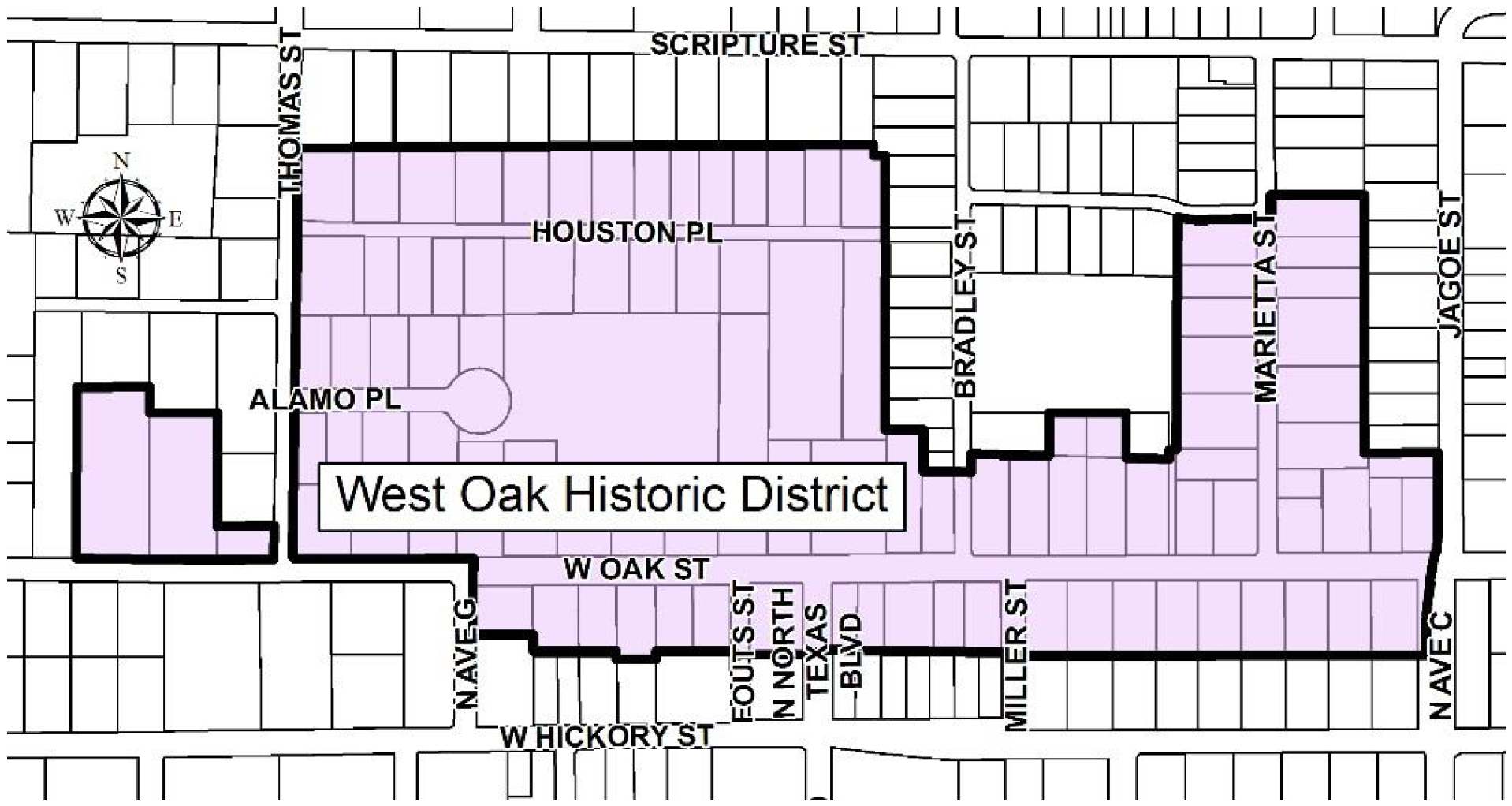
C.
Architectural Requirements. Architectural requirements in the West Oak Area Historic District shall be as follows:
1.
Principal Structure. Principal structures must be compatible in scale with the principal structures existing in the district.
2.
Accessory Buildings. Accessory buildings which are visible from any public street, other than an alley, as determined by the Historic Preservation Officer, must be compatible with the scale, shape, roof form, materials, detailing, and color of the main building.
3.
Architectural Detail. Materials, colors, structural, and decoration elements and the manner in which they are used, applied, or joined together must be compatible with nearby and adjacent structures.
4.
Awnings. Metal and corrugated plastic awnings are only permitted on an accessory building or the rear façade of a main building, if not visible from any public street, other than an alley, as determined by the Historic Preservation Officer. Other awnings must be typical of any proposed structure and the character of the main building.
5.
Building Placement. All buildings must be placed so as to not adversely affect the rhythm of spaces between buildings on the block. The front setback for new construction shall be 30 feet. Additions and or replacement buildings shall have a front setback that is the average of the adjacent lots of contributing buildings.
6.
Chimneys. All chimneys must be compatible with the style of the proposed building. Chimneys must be constructed of brick, stucco, stone, or other materials compatible in texture, color and style with the proposed main building.
7.
Additions. All additions to a building must be compatible with the dominant horizontal or vertical characteristics, scale, shape, roof form, materials, detailing, and color of the existing building.
8.
Color.
a.
Roof Colors. Roof colors must complement the style and overall color scheme of the structure.
b.
Masonry and Brick Surfaces. Masonry and brick surfaces not previously painted must not be painted unless it is determined that:
i.
The painting is absolutely necessary to restore or preserve the masonry or brick; or
ii.
The color and texture of replacement masonry or brick cannot be matched with that of the existing masonry or brick surface; or
iii.
The structure is not a contributing structure to the District and/or the brick and style of the building are not complimentary to such a degree that together they define an architecturally significant whole.
c.
Certificate of Appropriateness. A COA shall not be required for exterior painting of structures in the West Oak Historic District; however, it is suggested that structures in the West Oak Historic District be painted colors from the following paint manufacturer's preservation color pallets: Sherwin Williams Preservation Pallet (including America's Heritage Historical Exterior Colors and Suburban Modern Historical Exterior Colors); Valspar Paint National Trust Historic Colors; Pittsburgh Paints Historic Collection; or similarly appropriate products.
9.
Façade Materials.
a.
Generally. The permitted façade materials are brick, wood siding, wood, stone, and stucco. The use of cementitious siding is also permitted on new construction and accessory buildings. Artificial facsimiles of these materials will be considered on a case-by-case basis as material technologies progress. All façade treatments and materials must be typical of the style and period of the main building.
b.
Wood Façades. Existing wood façades must be preserved as wood façades.
10.
Front Entrances and Porches.
a.
Detailing. Railings, moldings, tile work, carvings, and other detailing and architectural decorations must be typical of the style and period of the main building.
b.
Enclosures. A front entrance or porch may not be enclosed with any material, including iron bars, glass, or mesh screening.
c.
Façade Openings. Porches must not obscure or conceal any façade openings in the main buildings.
d.
Floor Coverings. Carpeting is not permitted as a porch floor or step covering.
e.
Style. Each proposed main building must have a front porch or entry treatment with a shape, roof form, materials, and colors that are typical of the style of the proposed main building. A front entry or porch must reflect the dominant horizontal and vertical characteristics of the proposed main building.
11.
Roof Forms.
a.
Material and Colors. Roof material and colors must complement the style and overall color scheme of the structure.
b.
Patterns. Roof patterns must be typical of the style and period of the main building.
c.
Slope and Pitch. The degree and direction of the roof slope and pitch must be typical of the style and period of the main building.
d.
Skylights and Solar Panels. The Historic Landmark Commission may allow skylights and solar panels on a building if their placement does not have an adverse effect on the architecture of a building or the district as a whole.
12.
Windows and Doors.
a.
Front Façade Openings. The location and size of windows and doors in proposed façades must be compatible in scale with the typical style and period of the main building.
b.
Glass. Reflective, tinted, and mirrored glass and plastic are not permitted in any opening.
c.
Screen, Storm Doors and Storm Windows. Screens, storm doors, and storm windows may be permitted if:
i.
Their frames are painted to match or complement the color scheme of the main building; and
ii.
They do not obscure significant features of the windows and doors they cover.
d.
Security and Ornamental Bars. Security and ornamental bars are only permitted on the exterior of an accessory building, the rear façade of the main building, and the interior of the building.
e.
Shutters. Shutters must be typical of the style of the proposed main building and appear to be installed in a manner to perform their intended functions.
f.
Style. All windows and doors in the front façade of the main building must be proportionally balanced in a manner typical of the style and period of the building.
g.
Size. The size and proportion of window and door openings located on the front and sides of the main building must be typical of the style and period of the main building.
h.
Frames. The frames of the windows must be trimmed in a manner typical of the style and period of the building.
i.
Openings. All windows, doors, and lights in the front and side façades of the main building must be typical of the style and period of the building. Sidelights must be compatible with the door.
13.
Outdoor Lighting. Outdoor light fixtures must be compatible with the style and period of the main building and not obscure or conflict with significant architectural details of the building.
14.
Fencing. A certificate of appropriateness is not required to install a fence in the West Oak Historic District; however fencing shall comply with Subsection 7.7.8: Walls, Fences, and Screening.
D.
Signs. A Special Sign District is hereby established, imposing additional regulations upon all signs located within the West Oak Area Historic District subject to the additional provisions of Subpart B, Chapter 33, of the Code of Ordinances, except as modified as follows:
1.
Additional Wall and Stake Sign Regulations.
a.
Number of Wall Signs. Only one wall sign per premises is permitted.
b.
Size. No wall sign shall have a maximum dimension which is greater than two feet, measured along the greater distance of any one line which defines the effective area of the sign.
2.
Address or Name Signs. The sign regulations of this section shall not apply to the signs or numbers which are used solely to identify the street address of the premises or they identity by name the occupants of a residential building.
3.
Approval Procedure for Wall Signs. No new signs shall be constructed or located and no existing sign shall be altered until a sign permit is obtained pursuant to Subpart B, Chapter 33, of the Code of Ordinances, and a COA is issued in accordance with the procedure applicable to alterations or changes of the exterior architectural features of buildings, as provided for in this DDC.
E.
Parking. The provisions of this DDC applicable to parking shall apply to the West Oak Area District, except for the following modifications:
1.
Location. All off-street parking spaces for any building used as a multifamily dwelling or for a nonresidential use shall be located between the building fronting the public street and the rear property line.
2.
Number of Parking Spaces. Each specified use shall provide the following number of parking spaces:
a.
Multifamily buildings shall have a minimum of two parking spaces for each dwelling unit.
b.
Nonresidential uses shall provide one and one-half times the number of parking spaces required for that use as established in Section 7.9, Parking and Loading.
4.10.1 - Purpose and Overall Intent.
A.
Purpose. The purpose of the Denton Square District ("The Square") is to preserve historic resources and build upon the image of the Square as the historic, vibrant, small-town heart of a growing city by establishing design standards for new construction, certain exterior renovations, and demolition of property in the Denton Square that serve to protect and enhance the historic character of the area, preserve property values, and encourage high-quality, sustainable, pedestrian-friendly development.
B.
Overall Intent. The Overall Intent of the Denton Square District ("DSD") and the Denton Square Design Standards ("DSDS") is as follows:
1.
Encourage creativity and architectural diversity, while ensuring that the overall historic character of the Denton Square is protected:
The design review process is intended to be flexible, allowing for creativity while encouraging designs that are compatible with the historic character of the surrounding properties in the District.
2.
Encourage and support the preservation of historically significant buildings:
The DSD includes historically significant buildings. the Denton Square Design Standards are intended to maintain the authenticity of the district by working in conjunction with the City's Historic Preservation Ordinance to encourage preservation, rehabilitation, and restoration of historically significant buildings, and to ensure that the integrity of any individual historic resource is preserved, as much as possible.
3.
Support building designs and the use of design elements in new or renovated buildings that maintain and continue the established historic design patterns found in adjacent or adjoining buildings, which contribute to the District's unique sense of place.
Within the District, patterns and rhythms in exterior building qualities can be seen, including in setbacks, mass and scale, building form, exterior materials, placement and type of doors and windows, and use of key architectural design features. Where possible, these should be continued in new or renovated buildings and building facades.
4.
Support the use of materials which protect structural integrity and preserve building longevity, while also maintaining the historic character of the Square through their similarity in appearance, quality, and type to the prevalent materials in use in adjacent buildings, and throughout the District.
5.
Promote urban vitality and livability that welcomes residents and visitors of all ages by fostering a sense of community:
The DSDS support pedestrian-oriented design within the Square, which includes a diverse mix of uses, creating engaging public spaces, and functional pathways to enable and encourage enjoyment by all, day and night, throughout the week.
6.
Take into account the importance of maintaining property values and supporting new and existing businesses in the Denton Square District:
When applying the DSDS, the Director and City Council should take into account the importance of supporting the success of existing and new businesses in the District and promoting reinvestment into one of the City's most enduring spaces.
7.
Encourage the integration of art into public and private development:
Art should be integrated into architecture, streetscapes, and public spaces. Art enhances the built environment and contributes to the area's success in attracting new residents and businesses.
(Ord. No. DCA18-0007e, § 5, 6-4-2019)
4.10.2 - Relation of the Denton Square District to Base Zoning Districts.
the Denton Square District is a zoning overlay that supplements the primary underlying zoning district classification. The permitted uses of the property shall be determined by the use regulations set forth for the primary zoning district classification for the property. Development of projects in the Denton Square District shall be subject to the Denton Square Design Standards in accordance with this section. In the event of any conflict between the design standards and the provisions of the Denton Development Code, the design standards shall control.
(Ord. No. DCA18-0007e, § 5, 6-4-2019)
4.10.3 - Boundaries of the Denton Square District.
the Denton Square District includes all land located within the area bounded by the following: Beginning at the intersection of Cedar Street and Pecan Street, running east along Pecan Street to Austin Street, running south along Austin Street to Walnut Street, running west along Walnut Street to Cedar Street, and running north along Cedar Street to Pecan Street. The area of the district shall include all properties adjacent to the boundary streets, though it shall only include the building exteriors, either existing or which may be built along the district boundary streets in the future.
(Ord. No. DCA18-0007e, § 5, 6-4-2019)
4.10.4 - Definitions.
The following words, terms, and phrases, when used in this subsection, shall have the meanings ascribed to them in this section, except where the context clearly indicates a different meaning:
Administrative Review: Refers to the review process specifically described in Section 2.1.10.D.4.
Antenna: Any exterior apparatus designed for telephonic, radio, or television communications through the sending and/or receiving of electromagnetic waves, excluding satellite dish antennas and antennas accessory to residential uses. Antennas ancillary to residential uses shall mean television antennas and amateur radio equipment not used for commercial purposes, including ham radio and CB equipment.
Awning: A shelter extending from the exterior wall of a building and composed of nonrigid materials except for the supporting framework.
Balcony: A platform which projects from the exterior wall of a structure, is exposed to the open air and remains unenclosed, is surrounded by a railing or balustrade, has direct access to the interior of the building, and is not supported by posts or columns extending to the ground.
Basement: A story below the first story as hereinafter defined. See also "Story."
Bays: Repetitive divisions into which a building is divided.
Block: A piece or parcel of land entirely surrounded by highways or streets, other than alleys. In cases where the platting is incomplete or disconnected, the Director of Public Works shall determine the outline of the block.
Building: A structure having a roof supported by columns or walls for the housing or enclosure of persons, animals, or chattels.
Building Frontage: The linear dimensions of a building which faces upon a public street, projected along the street property line. Where a building faces two or more streets, the frontage containing the principal street address shall be designated as the building frontage.
Building Permit: Authorization given by the City of Denton to erect, construct, renovate, maintain, or conduct any other specified activity on any building or structure, or on any installations or facilities therein. The term "building permit" shall include but not be limited to building permits, electrical permits, mechanical permits, and plumbing permits.
Column: A vertical support normally consisting of a base, a round shaft, and a capital. The Greek Doric order is exceptional in that it has no base.
Contributing Building: A building on a property which is depicted on the National Register of Historic Places' map of the Denton County Courthouse National Register District as a "Contributing Property."
Cornice: A projecting shelf along the top of a wall, along the exterior trim at the meeting of a roof and wall, or at the uppermost division of an entablature.
Construction: The erection of any on-site improvements on any parcel of ground located within the Denton Square District, whether the site is presently improved, unimproved, or hereafter becomes unimproved by demolition, destruction of the improvements located thereon by fire, windstorm, or other casualty, or otherwise.
Context: The buildings, structures, landscape elements and features immediately surrounding a building.
Design Consistency Certificate: A document demonstrating compliance with the Denton Square Design Standards and/or the Purpose and Intent of the Denton Square District and Standards in Section 4.10.1.
Director: The Director of Development Services or designee.
District: The area encompassed in the Denton Square District as established by and described above in Section 4.10.3.
Design Standards: As laid out in the Denton Square District Standards are objective, measurable regulations, sometimes illustrated through diagrams and sketches, with which all projects must comply. Unless noted as a guideline, all provisions in this document are standards. If a project of exceptional design is clearly consistent with the General Design Principles but does not conform to a certain standard, the City Council may vote to approve a Certificate of Design Consistency, citing the project's consistency with those principles.
Design Guidelines: Are more subjective statements, through which the City proposes additional design strategies. The guidelines should be suitable for most projects, and developers should endeavor to ensure that guidelines are followed to the extent possible. City staff and the City Council will work with developers to explore design approaches that maximize conformance with design guidelines. City Council will not deny a Certificate of Design Consistency because a project fails to comply with design guidelines.
Facade: Any exterior building wall fronting on the public right-of-way.
Facade, Front-Facing: The facade which contains the primary entrance for the building. For buildings fronting on the Square Proper, the facade fronting on the Square Proper shall be the front-facing facade.
Fiber-Cement Siding: A lightweight, solid material that is manufactured in similar sizes and shapes to wood products.
First Floor: For the purposes of this section, shall refer to the building story which begins at grade on the front-facing facade of the building. For buildings fronting on the Square Proper, the first floor is the first building story on the facade facing the Square Proper.
Fully Shielded: Attribute of a lighting fixture provided with internal and/or external shields and louvers to prevent light pollution.
Glare: Excessive brightness in the field of view that is sufficiently greater than the brightness to which the eyes are adapted, to cause annoyance or loss in visual performance and visibility, so as to jeopardize health, safety, or welfare.
Grade: Ground level.
Guidelines, The: See "Design Guidelines."
High-Quality: Describes a material that, for the intended purpose, is above average, by relevant industry standards, in reliability, durability, and performance of essential functions.
High Intensity Discharge (HID) Lamps: Lamps which produce visible light directly by the electrical heating or excitation of a gas. Examples of such lighting include, but are not limited to, metal halide, high-pressure sodium, low-pressure sodium and mercury vapor. For purposes of this chapter, fluorescent lights are not considered HID lighting.
Historic Preservation: Historic preservation, for the purposes of this section and for the Denton Square District, means to take the measures necessary to sustain the existing form, integrity, and materials of historic buildings, and also to ensure that new construction complements the adjacent historic and architecturally significant buildings. Historic preservation includes ensuring that the character of historically significant structures without local, state, or national designation is also respected. Historic preservation efforts may include the restoration or rehabilitation of a historic property.
Illuminated Sign: Any sign for which an artificial source of light is used in order to make readable the sign's message, including internally and externally lighted signs and reflectorized, glowing, or radiating signs.
Light Trespass: Light emitted by a luminaire that shines beyond the boundaries of the property on which the luminaire is located.
Luminaire: A device or fixture containing a light source and means for directing and controlling the distribution of light from the source.
Mews Streets: Mews streets are the four smaller streets (Walnut, Austin, Pecan, and Cedar) located behind the streets that front the Denton Courthouse.
Minor Alteration: Is work that is proposed to be done on a building in the DSD that meets the definition provided in Section 2.10.1.D.3.a.ii of the Denton Development Code.
Mural: Is a visual depiction and/or work of art, including mosaic or painting, applied, painted, or affixed directly onto the exterior of any wall of a building.
Ordinary Maintenance: Is work that is proposed to be done on a building in the DSD that meets the definition provided in Section 2.10.1.D.3.a.i of the Denton Development Code.
Overall Intent: The statements of Overall Intent, more fully described in Section 4.10.1, that serve as the basis for the Denton Square Design Standards.
Parapets: The portion of a wall that projects above an adjacent roof surface.
Pilaster: A shallow rectangular feature projecting from a wall, having a capital and a base and architecturally treated as a column.
Pitch: The angle or slope of a roof.
Rehabilitation: The process of returning a property to a condition that makes a contemporary use possible, while retaining as many of its historic, architectural, and culturally significance features as possible.
Restoration: The process of accurately recovering the form, features, and character of a property as it appeared at a particular period in history, which can include removal of features from later periods in history and reconstruction of missing features from the "restoration period."
Roofing material: The outermost layer on the surface of a building roof.
Sign: Shall be as defined in Section 33-2 of the Code of Ordinances of the City of Denton. Notwithstanding any language in this subchapter, all proposed signs are subject to the permitting requirements of Code of Ordinances Chapter 33 Signs and Advertising Devices. Provisions related to signs in this subchapter are in addition to, and not in place of, the provisions of Chapter 33.
Square, The: See "District."
Square Proper, The: Refers to the area bounded by West Oak Street on the north, North Locust Street on the east, West Hickory Street on the south, and North Elm Street on the west.
Standards, The: See "Design Standards."
Story: The space between the surface of any floor and the surface of the next floor above it; or if there is no floor above it, the space between the floor surface and the top of the ceiling joists or roof rafters above it.
Theater Marquee: A marquee is a permanent roofed structure which is attached to and supported entirely by a building; no part of which shall be used for occupancy or storage; having the purpose of providing protection from sun and rain or embellishment of a facade. A Theater Marquee is a marquee that is attached to a building which contains an area regularly used for theatrical performances or for showing motion pictures.
Uptight: A type of light pollution in which light is directed above the horizontal plane of the luminaire, which can contribute to artificial sky glow.
(Ord. No. DCA18-0007e, § 5, 6-4-2019)
4.10.5 - Work Requiring a Permit.
A.
It shall be unlawful for any person to do, or allow or cause any other person to do, any of the following work on property located within the district, without first applying for and receiving a Certificate of Design Consistency under the terms of Section 2.10.1.D.3 of the Denton Development Code:
1.
Construction of a new building or making an addition to an existing building.
2.
Redeveloping, reconstructing, altering, changing, or restoring the exterior of any existing building.
3.
Demolition of an existing building or facade.
4.
Construction or reconstruction of a parking lot.
5.
New sign or mural.
6.
Ordinary maintenance to the exterior of an existing building, as defined in this subchapter.
Changes to the interior of buildings do not require a Certificate of Design Consistency.
B.
The requirements and procedures found in Section 2.10 Design Standards Review Procedures will govern the process of application for and provision of any Certificate of Design Consistency required by this subsection.
C.
All regulations applicable to the District as contained in the Code of Ordinances or Denton Development Code shall continue to apply to the District, except as specifically modified herein.
(Ord. No. DCA18-0007e, § 5, 6-4-2019)
4.10.6 - Procedures.
All planning actions related to the Denton Square Design Standards and Guidelines shall be processed by one of the following procedures:
1.
Denton Square Design Standards and Guidelines Amendment: Refer to "Zoning Text Amendment" found in Section 2.7.4 of the 2019 Denton Development Code as approved by City Council on April 23, 2019.
2.
Design Consistency Certificate: Refer to "Certificate of Design Consistency Procedure" found in Section 2.10.1.
(Ord. No. DCA18-0007e, § 5, 6-4-2019)
4.10.7 - Design Standards.
A.
Intent: The standards provide a framework of basic design parameters to guide the form and scale of buildings within the District, ensuring that the key attributes of the built environment of The Square are maintained. The standards provide flexibility and allow for creativity within the framework, in order to enable and encourage innovative, sustainable, high-quality development that preserves the historic character of The Square while adapting to changing conditions over time.
B.
Building Orientation, Setback, Frontage, and Height Standards:
1.
Orientation: Buildings must have their primary entrance face the street or other public spaces.
2.
Setback: Buildings must front on the property line.
3.
Frontage: One hundred precent of all lot frontages on The Square must be occupied by a building, except for building entry or access conditions, to a minimum height of the first story.
4.
Building Height: The following standards shall apply to all new facades and additions to facades, except that new or altered facades on existing buildings shall not be required to be higher or lower than the existing facade.
a.
New building facades fronting on the Square Proper must be a minimum of two stories in height.
b.
New building facades and additions to facades fronting on the Square Proper must not exceed a maximum of two stories, nor exceed a maximum of 45 feet in height.
c.
New buildings facades on the Mews Streets must be a minimum of two stories in height.
d.
New building facades and additions to facades on the Mews Streets must not exceed a maximum of three stories, nor exceed a maximum of 65 feet in height.
e.
Building and Facade Height Standards - Catastrophic Loss. In the event of partial or complete destruction of a building or building facade in The Square by a fire, natural disaster, or other catastrophic event, the following standards shall apply, if and when the subject building and/or facade is reconstructed:
i.
The building or facade must be reconstructed to a minimum of the existing height previously.
ii.
The building or facade may be reconstructed to a height higher than the previous existing height - subject to the Denton Square District maximum building restrictions in Sections 4.10.7.B.4.b and 4.10.7.B.4.d.
a.
Such reconstruction must be commenced within one year of such event and completed within 18 months of such event, after which time District minimum height standard will apply.
b.
By written request from the property owner, City Council may grant one extension, up to six months, of either the work commencement and/or the completion of work time period.
C.
Facade Standards:
1.
Existing unpainted brick and stone facades must not be painted.
2.
The ground floor of buildings must include a minimum of three elements of architectural relief at least every 25 linear feet. These elements must comply with other applicable Design Standards, and may include, but are not limited to, the following:
a.
Doors.
b.
Change in depth.
c.
Columns or posts.
d.
Windows.
e.
Awnings.
f.
Changes in materials.
g.
Other elements of architectural relief may be approved by the Director if they are determined to meet the Overall Purpose and Intent of the District.
3.
All new buildings, or new floors added to an existing building, must create a clear visual differentiation between the first and second floor, using one or more of the following elements, which must comply with all applicable Design Standards for such elements:
a.
Change in depth.
b.
Columns or posts.
c.
Transom Windows.
d.
Awnings.
e.
Changes in materials, including a horizontal trim line of different material between the first and second floors.
f.
Other elements of architectural relief may be approved by the Director if they are determined to meet the Overall Purpose and Intent of the District.
4.
A minimum of 75 percent of the building front of a new building, on the first floor, for a depth of at least 20 feet from the building front, shall be occupied by a non-residential use.
5.
Facade Material Standards: New facades must conform to the following material standards. Facade projects that incorporate unlisted materials may be submitted for review; the Director shall approve or disapprove unlisted materials based on compliance with the Purpose and Overall Intent.
a.
Primary materials are limited to the following:
i.
Brick.
ii.
Stone or stone veneer.
iii.
Wood.
iv.
Cement composite board.
v.
Tile terra cotta, porcelain, or ceramic.
vi.
Stucco above the first (ground) floor.
b.
The following material may be used as accents and trim:
i.
All primary materials listed above.
ii.
Metal galvanized, painted, or ornamental.
iii.
Pre-cast masonry (trim and cornice only).
iv.
EIFS (exterior insulation and finish system) above the first floor.
v.
Concrete fiber simulated wood siding.
c.
Inappropriate materials.
i.
Vinyl or aluminum siding.
ii.
Mirrored glass.
iii.
Stucco above the first (ground) floor.
iv.
EIFS on the first (ground) floor.
D.
Fenestration, Glazing, and Entry Standards:
1.
Fenestration and glazing must be provided in all new facades.
2.
Ground floor windows must use clear glass (80 percent minimum Visible Light Transmittance). All window glass must allow a minimum 60 percent Visible Light Transmittance and must not exceed 15 percent Visible Light Reflectance when measured at a perpendicular angle. The use of Low Emissivity (Low-E) glass is permitted.
3.
Windows, floors, stoops, and porches must open out to the street.
4.
Primary building entrances must be clearly articulated, preferably with a covered-projected type of entry. Options, which must meet all applicable Design Standards, include:
a.
Awnings.
b.
Canopies.
c.
Recessed entry.
d.
Other similar treatments may be may be approved by the Director if they are determined to meet with the Overall Purpose and Intent of the District.
5.
Awnings, canopies, and other covered-projected types of building features are permitted to encroach partially into the public right-of-way, but do require completion and approval of a City of Denton Right-of-Way Use permit/application.
6.
Awning, canopies, and other covered-projected types of building features must comply with the following:
a.
Must be placed so as to provide weather protection for pedestrians.
b.
Must be consistent in height with similar covered-projected features on adjacent or joining buildings.
c.
Must be mounted in locations that do not obscure ornamental features over storefronts, such as rooflines, arches, and banding.
d.
Must not exceed the width of the sidewalk
e.
Must not be torn, frayed, ripped, faded, or stained, soiled or dirty. When not specifically addressed by this ordinance, provisions of the City of Denton property maintenance code shall apply.
f.
Must not have a dome or convex frame (see illustration).
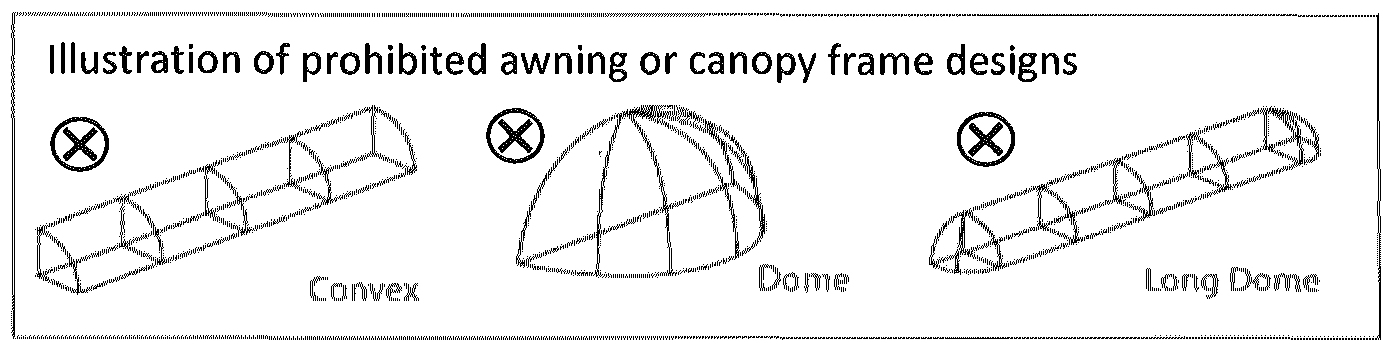
g.
Colors of awnings, canopies, and other covered-projected types of building features must enhance and complement the building to which they are attached, rather than overwhelm the building scheme. Colors must not call more attention to the projected-covered building feature than the building.
h.
The frame structure of such building features must be finished to match the metal storefront system color or the fabric color of the associated projected-covered type of building feature.
i.
Such building features are not prohibited from encroaching partially into the public right-of-way, provided that a City of Denton Right-of-Way Use permit/application has been completed and approved.
E.
Sidewalk Activity Standards:
1.
Bringing restaurant and retail activities out to the sidewalk is not prohibited, provided that:
a.
Unobstructed pedestrian walking is maintained.
b.
A City of Denton Right-of-Way Use permit/application has been completed and approved for any private activity that extends into the public right-of-way.
c.
Permanent railings for outdoor dining must not extend into the public right-of-way without an approved City of Denton Right-of-Way encroachment permit/form or exceed a maximum four feet from ground level.
F.
Exterior Lighting Standards:
1.
All newly installed exterior lighting must comply with the standards of Section 6.11 of the Denton Development Code (2019) as adopted by City Council on April 23, 2019, except as those standards are specifically modified within this section. Such lighting shall require a Certificate of Design Consistency (with the exception of temporary holiday lighting).
2.
The following types of newly installed exterior lighting are prohibited within the District:
a.
High-Intensity Discharge (HID) or fluorescent lights (except fluorescent bulbs that screw into standard socket fixtures).
b.
Lights that blink, flash, or change intensity or color (except in the case of theater marquee lighting).
3.
The following types of newly installed exterior lighting are not prohibited within the District, notwithstanding any restriction on them in Section 6.11:
a.
Fully shielded light fixtures (luminaires), except those containing directional lamps, which have an aggregate rated lamp output not exceeding 500 lumens.
b.
Decorative gaseous, light-emitting diode (LED), or other electrified or illuminated tubing or backlit "band" lighting, when used to:
i.
Accent one or more of a building's horizontal architectural elements (that is, along the rooflines including any peaks, arches, or bump-ups, or horizontally along the building's facade as lighted tubing or a backlit "band").
ii.
Outline or decorate the outermost edges only of awnings, but not to outline the awning as a whole.
G.
Sign Standards:
1.
All new signs installed in the District shall be required to comply with the standards of Chapter 33 of the Denton Municipal Code of Ordinances, including the requirement of an approved sign permit, when applicable. In addition, the following restrictions shall apply to all new signs within the District:
a.
Internally-lit acrylic cabinet signs are prohibited.
b.
Signs must not be installed in locations that damage or obstruct important architectural features.
c.
Signs must be compatible in scale, proportion, and design with the building's facade.
H.
Mural Standards:
1.
All new murals, including those proposed for buildings designated as local historic landmarks, shall require approval by City Council.
a.
If a mural on a separate panel is approved to be mounted onto a building, it must be mounted so as to prevent damage to the wall behind the panel.
2.
A mural must be compatible with the architectural and aesthetic components of the building or other structure on which it is installed,
3.
A mural must not detract from the character of the District, and not be detrimental to the public health, safety, and welfare
4.
On facades fronting on the Square Proper, murals may not cover more than 25 percent of the total area of the facade.
5.
A mural must not be painted on existing unpainted brick or stone surfaces.
6.
Measurement: For the purposes of this subsection, total area of the facade will be the result of a calculation of height of the building multiplied by the width of the building. Total area of the facade includes wall, fenestration, doors, and parapets (See illustration). Total area of the facade does not include decorative architectural elements projecting above the roofline which are less than one foot in width.
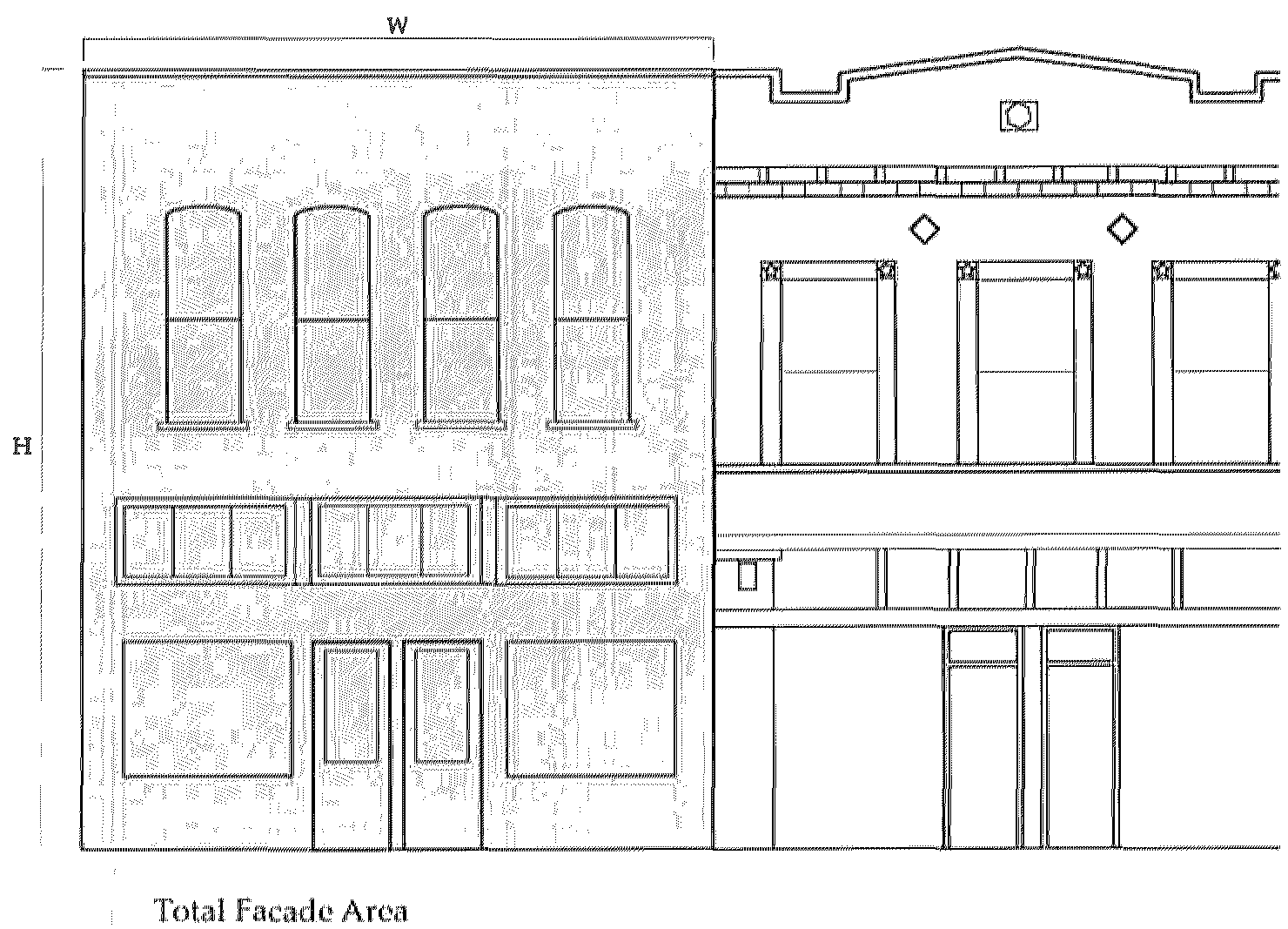
25% of the total area (H×W) of a facade facing the Square Proper may be painted with a mural.
I.
Roof Standards:
1.
Roof shape of new buildings, new facades, and new additions must appear flat.
2.
Roof, including roofing materials, of new buildings, new facades, and new additions to existing buildings, must not be visible from street view.
a.
This standard shall not be construed to prohibit visible parapets, cornices, or other decorative architectural features which are typically installed along or atop the edge of a roof.
J.
Building Equipment and Service Area Standards:
1.
Building Equipment and Service Areas shall include the following:
a.
Mechanical and electrical equipment and conduits.
b.
Elevator shaft.
c.
Ducts.
d.
Piping.
e.
Fire equipment.
f.
Water backflow devices.
g.
Solid waste and Recycling facilities.
h.
Utilities.
i.
Satellite dishes.
j.
Antennas (Excluding those types of macro cell telephone antennas for which local regulation is preempted by Federal regulation).
k.
Loading and unloading areas.
l.
Drainage facilities.
m.
Grease traps, interceptors, and bins/dumpsters.
2.
Building equipment and service areas shall be designed and located so that they are not the primary building feature and do not interfere with pedestrian or vehicular circulation.
3.
Solid waste and recycling facilities, as well as grease dumpsters, bins, barrels, or other grease storage devices shall not be visible from the public right-of-way.
4.
Roof-mounted building equipment must not be visible from the street or from adjacent properties at the same level or below.
5.
Screening materials, in type and color, shall complement the building with which they are associated and shall not draw attention away from the building with which they are associated.
K.
Historic Preservation Standards: The following standards shall apply to projects involving Contributing Buildings as depicted on the National Register for Historic Places' map of the Denton County Courthouse National Register District ("National Register District"):
1.
Existing facades and buildings must not be demolished or removed without approval by City Council of a Certificate of Design Consistency authorizing the demolition or removal, unless the current condition of the existing facade or building represents a life-safety issue as determined by the Building Official. Certificate of Design Consistency for a project involving such demolition or removal may not be approved unless it includes a Post-Demolition Redevelopment Plan which complies with Section 4.10.7L.2. City Council may only approve a Certificate of Design Consistency for a project that includes demolition of a Contributing Building or facade of a Contributing Building on one of the following bases:
a.
The applicant proposes, in their Post-Demolition Redevelopment Plan, to replace the structure or facade with a new structure or facade that is more compatible with the historic character of the Denton Square District.
i.
Applicant shall include the following in order to establish that proposed replacement will be more compatible:
a.
Records depicting the original construction of the structure or its appearance and condition during the Period of Significance of the National Register District (Period of Significance: 1882—1949), including drawings, pictures, or written descriptions.
b.
Records depicting the current condition of the structure, including drawings, pictures, or written descriptions.
c.
Any conditions proposed to be placed voluntarily on the new structure that would mitigate the loss of the existing building or facade.
d.
Any additional documentation determined by the Director to be necessary to establish the compatibility of the proposed replacement.
b.
The applicant can establish that an unreasonable economic hardship exists if required to maintain the current building or facade. Applicant must establish proof of hardship in accordance with Section 4.10.8.
c.
The applicant can establish that the existing facade did not exist during the Period of Significance for the National Register District (Period of Significance: 1882—1949), and it is being removed to reveal an older facade underneath, which was in existence during the Period of Significance.
i.
The existence of the original facade must be established with physical or documentary evidence in order to receive approval on this basis.
2.
Existing facades may not be covered over with new facade material.
3.
Existing window openings must remain and must not be filled in or covered over.
4.
New window openings shall not be added to existing facades unless proposed windows are reviewed and approved by City Council.
a.
To be eligible for approval, new window openings must be similar in number, style, and placement to existing window openings in the National Register District that date to the Period of Significance, as established by physical or documentary evidence.
L.
Demolition and Temporary Construction Standards: The following standards shall apply to all buildings within the District:
1.
No building or facade of a building in the District shall be demolished without approval of a Certificate of Design Consistency by City Council, except in cases when the Building Official has approved an Emergency Demolition and a permit has been issued for that Emergency Demolition.
2.
Applications for Certificates of Design Consistency for Demolition must include a Post-Demolition Redevelopment Plan, which must propose a building or facade to replace the demolished building or facade, and must include the following:
a.
Complete Architectural Drawings of proposed replacement building or facade, or, in cases where an existing underlying facade will be the replacement facade, a rendering of the expected appearance of the underlying facade, including any proposed restoration work;
b.
A guarantee agreement between the owner and the city that demonstrates the owner's intent and financial ability to construct the replacement building or facade, or restore an existing underlying facade. The guarantee must:
i.
Contain a covenant to construct the proposed structure by a specific date in accordance with architectural drawings approved by the city through the Certificate of Design Consistency Process;
ii.
Require the owner or construction contractor to post a performance and payment bond, letter of credit, escrow agreement, cash deposit, or other arrangement approved by the Director to ensure construction of the new structure; and
iii.
Be approved as to form by the city attorney.
c.
When demolition of the entire Contributing Building is proposed, the Post-Demolition Redevelopment Plan shall also include the following:
i.
Site Plan for proposed replacement structure; and
ii.
Plan for Temporary Construction Fencing meeting the standards of Section 4.10.7.L.3. Plan shall include a depiction of any decorative elements that will be added to Temporary Construction Fencing.
3.
Temporary Construction Fencing meeting the following standards shall be installed following any building demolition or creation of a vacant lot due to catastrophic loss:
a.
All temporary construction fencing requires application for and approval of a permit from the Department of Development Services.
b.
Temporary construction fencing must shield entire site from view and access from right-of-way.
c.
Temporary construction fencing must provide a continuous opaque screen along the front property line.
d.
Temporary construction fence may include decorative elements, such as a mural, but such decorative elements shall require a Certificate of Design Consistency approved by City Council.
4.
Emergency Demolition or Vacant Lot Due to Catastrophic Loss: The following standards shall apply to an emergency demolition or a vacant lot caused by catastrophic loss of a building due to a fire or other act of God:
a.
Emergency Demolition requires approval by the Building Official and issuance of a Demolition Permit.
b.
Temporary fencing meeting the standards of Section 4.10.7.L.3 must be installed within 30 days of the date of the emergency demolition or catastrophic loss.
c.
If building construction activity on the site is not begun within one year of the date of the emergency demolition or catastrophic loss of the building, temporary fence must be replaced by one of the options below. One extension of up to six months may be approved by Director if construction plans for the site have been submitted.
i.
Landscaped site, with non-opaque fence, meeting the following standards:
a.
The applicant shall submit a scaled plan showing the vacant lot layout, the proposed landscaping and irrigation, and the proposed maintenance plan, which shall include provisions for trash removal, erosion management, and landscape maintenance.
b.
Surface shall include grass or other living ground cover, in any combination, provided that the total site is covered.
c.
Irrigation shall be provided consistent with the applicable standards for such systems as described Subchapter 7 of the Denton Development Code.
ii.
Minimum six feet tall screening wall constructed out of brick, stone, or brick or stone veneer.
a.
Wall must be aligned with front wall of adjoining buildings.
b.
Wall shall provide a continuous opaque screen along the entire length of the front property line.
c.
Property owner must provide for ongoing maintenance of the wall in compliance with the provisions of Section 17-80 of the City of Denton Code of Ordinances.
d.
Upon redevelopment of the site, the screening wall must be removed.
iii.
Alternative plan for beautification or activation of lot in line with the Purpose and Overall Intent of the District, as approved by City Council.
(Ord. No. DCA18-0007e, § 5, 6-4-2019)
4.10.8 - Establishing Unreasonable Economic Hardship.
A.
Applicability. City Council may determine that an unreasonable economic hardship exists as a basis for approving a Certificate of Design Consistency for a project which includes a demolition of a Contributing Building or the facade of a Contributing Building.
B.
Burden of proof. When a claim of unreasonable economic hardship is asserted, the applicant must prove the following by a preponderance of evidence:
1.
The property containing the Contributing Building is incapable of earning a reasonable rate of return in its current or rehabilitated state, regardless of whether that return represents the most profitable return possible;
2.
The property containing the Contributing Building cannot be reasonably adapted for any other permissible use, whether by the current owner or by a purchaser, which would result in a reasonable rate of return;
3.
The property owner has demonstrated reasonable, good faith efforts to find a purchaser or tenant interested in acquiring or leasing the property containing the Contributing Building.
C.
Proof of hardship. The information to be considered as evidence of an unreasonable economic hardship must include, at a minimum, the following items, all of which must be submitted as part of a Certificate of Design Consistency application asserting an unreasonable economic hardship:
1.
The original purchase price of the Contributing Building;
2.
The name and legal status (e.g., partnership, corporation) of the owner(s);
3.
A signed building assessment report from a licensed engineer or contractor, as to the structural soundness of either the Contributing Building and/or facade of the Contributing Building, depending on what is proposed to be demolished, and the suitability for rehabilitation of what is proposed to be demolished, and including a cost estimate for repairs;
4.
A cost estimate for demolition of the Contributing Building or facade of a Contributing Building;
5.
The past and current use of the Contributing Building;
6.
The assessed value of the property containing the Contributing Building, according to the two most recent tax assessments;
7.
The amount of real estate taxes on the property containing the Contributing Building for the previous two years;
8.
The date of purchase or other acquisition of the property containing the Contributing Building;
9.
Principal balance and interest rate on the current mortgage and the annual debt service on the property containing the Contributing Building, if any, for the previous two years;
10.
All appraisals obtained by the owner or applicant within the previous two years in connection with the owner's purchase, financing or ownership of the property containing the Contributing Building;
11.
Any listing of the property containing the Contributing Building for sale or rent, asking price, and offers received;
12.
Any consideration given by the owner to profitable adaptive uses for the Contributing Building or, in cases when only the removal of the facade is proposed, for profitable adaptive uses that do not require removal of the facade;
13.
The Post-Demolition Redevelopment Plans for the property containing the Contributing Building or, in the case of removal of the facade of the Contributing Building, the plans for a replacement facade or restoration of an existing underlying facade;
14.
Proof that the owner's affirmative obligations to maintain the property containing the Contributing Building make it impossible for the owner to realize a reasonable rate of return on that property;
15.
Additional requirements for an income producing historic property:
a.
Annual gross income from the property from the previous two years;
b.
Itemized operating and maintenance expenses from the previous two years; and
c.
Annual cash flow, if any, from the previous two years;
16.
Additional information relevant to a determination of unreasonable economic hardship, as determined and requested by the Director;
17.
Claims of unreasonable economic hardship by the historic property owner must not be based on conditions resulting from the following:
a.
Evidence of demolition by neglect or other willful and negligent acts by the owner;
b.
Purchasing the property for substantially more than market value at the time of purchase;
c.
Failure to take into account historic properties in the planning and design stage of development or proposed development;
d.
Failure to perform normal maintenance and repairs;
e.
Failure to diligently solicit and retain tenants; or
f.
Failure to provide normal tenant improvements.
(Ord. No. DCA18-0007e, § 5, 6-4-2019)

