
Denton City Zoning Code
Subchapter 2
Administration and Procedures
2.11 - Development Criteria Manual Procedure
A.
Purpose. In order to optimize and facilitate the specification of safe, efficient, cost-effective design and development standards, this procedure for creating and updating Development Criteria Manuals is established. The intent is for design and development standards to be established quickly and efficiently, as a part of a collaborative dialog among land development professionals, both inside and outside the city.
B.
Minimum Standards and Responsibility. The standards established by the Development Criteria Manuals and the procedures set forth herein are not intended to supersede any requirement for submission and staff approval of designs sealed by a professional having appropriate licensure. Design and development standards and procedures established in the Development Criteria Manuals under this subsection are intended for use only as engineering and design guidelines, and to establish minimum standards. The responsibility for the sufficiency and appropriateness of any actual design shall remain the responsibility of the design engineer for the project, and the responsibility for the sufficiency of construction shall remain the responsibility of the contractor for the project. Users of the Development Criteria Manuals should be knowledgeable and experienced in the theories and application of the underlying standards or utilize someone who is knowledgeable and experienced. It is expected that all designs and construction of individual projects will meet or exceed these minimum standards.
C.
Procedure.
1.
Initial Approval. The baseline structure for each Development Criteria Manual is established by ordinance, using the Zoning Text Amendment Procedure found in Subsection 2.7.4. A Development Criteria Manual may be approved by the City Council following review and recommendation by the Planning and Zoning Commission. At the public hearings, the Planning and Zoning Commission and the City Council may hear comments from the public, outside professionals from the land development community, and staff. Approval should be based on comments made at the public hearing and other applicable federal, state and city laws and regulations. Approval shall be guided by the criteria set forth in Section 2.11D below and any other requirements to be considered under applicable law.
2.
Administrative Update. After initial approval, updates of the approved Development Criteria Manuals will proceed according to the following administrative procedure:
a.
Staff will present the proposed update before the Planning and Zoning Commission at a work session. No additional public notification is required beyond posting of the item on the work session agenda of the Planning and Zoning Commission. At the work session, the Planning and Zoning Commission may offer any suggestions or recommendations concerning the proposed update.
b.
Following the work session, staff will post the proposed update on the City of Denton web site along with the current Development Criteria Manual and at City Hall at the location for posting notices of all public meetings, for a period of not less than thirty (30) calendar days.
c.
During this thirty-day period, comments of interested persons and written protests or requests for review will be collected and staff will consider all comments filed and make an attempt to resolve all protests or requests for review within the thirty (30) calendar day period.
d.
After the thirty (30) calendar day period, staff will present the proposed update before the City Council at a public hearing. The proposed update will be processed as an ordinance, requiring public hearing notification prior to the City Council meeting, that meet the content, timing, and other notices specification outlined in the Development Handbook.
3.
Legislative Updates. Nothing in this subchapter shall prevent the City Council from making updates to the Development Criteria Manuals by ordinance including, without limitation, to establish fee schedules or to make other changes as they may deem to be necessary or appropriate.
D.
Approval Criteria. The following criteria shall be considered as guidelines for approving updates to the Development Criteria Manuals:
1.
Design Standards. Design and construction standards shall be set to establish a baseline that will promote the health, safety and welfare of the public and to promote cost-effective construction and design.
2.
Public Improvements. The design standards for public improvements should strive to minimize the ongoing costs to operate and maintain public improvements and to provide for an appropriate service life, to minimize the future burden on the public. The standards shall also consider the positive impact that properly designed and maintained public improvements have on the economic development and the welfare of the city as a whole.
3.
Private Improvements. The design standards for private improvements shall establish an appropriate baseline to protect the health, safety and welfare of the public, while promoting processes that are affordable and cost effective. The standards shall also encourage quality development with lasting value and maintain or enhance the property value of the development and its neighborhood or surrounding area.
4.
Aesthetics. Standards should promote aesthetics to the extent of recognizing the value and importance of maintaining or improving upon the neighborhood or surrounding area in a tasteful and compatible fashion, consistent with the City's Comprehensive Plan, so as to maintain or improve property values and attract quality development.
(Ord. No. DCA19-0014a, § 3(Exh. B), 11-19-2019; Ord. No. DCA22-0002d, § 2(Exh. A), 7-19-2022)
2.12 - Affordability Incentive Procedures.
1.
Purpose: The purpose of this section is to encourage the development of affordable housing within the City of Denton. The City is committed to fostering an economically diverse community with opportunities for everyone. The City has prioritized supporting affordable housing, and the implementation of this Affordability Incentive Process recognizes the public benefits affordable housing contributes to local communities and businesses.
2.
Definitions:
A.
"Low Income Household" - Those households earning 80% or less of Denton County Area Median Income. The Area Median Income (AMI), also known as Income Limit, is established and annually updated by the Department of Housing and Urban Development (HUD). AMI includes the following Income Categories:
1.
Extremely Low-Income Households (ELIH), earning no more than 30% of AMI as determined by the most Recent Income Limits set by HUD for Denton County or Persons Experiencing Homelessness (PEH).
2.
Very Low-Income Households (VLIH), earning no more than 50% of the AMI as determined by the most Recent Income Limits set by HUD for Denton County.
3.
Low-Income and Moderate-Income households (LIMIH), earning no more than 80% of the AMI as determined by the most Recent Income Limits set by HUD for Denton County.
3.
Applicability:
A.
Any development which provides dwelling units for Low Income Households, in accordance with the qualifications in Subsection 2.12.6A may be eligible for one or more Affordability Incentives.
B.
The Affordability Incentives may be utilized for the development of the following types of residential uses which include affordable units allocated for Low-Income Households at the percentages described in Table 2.12-B:
1.
Multifamily Dwelling,
2.
Single-Family Detached Dwelling,
3.
Townhome,
4.
Duplex,
5.
Triplex,
6.
Fourplex,
7.
Tiny Home Development,
8.
Accessory Dwelling Unit, or
9.
Manufactured Home Development (HUD Code).
C.
Duration of Affordability. Affordable housing units created by the Affordability Incentives Process shall remain affordable, as defined in Subsection 2.12.3.D, for at least 30 years.
D.
Definitions for Affordability. To be deemed affordable for the purposes of this Section the sale or rental price of a dwelling unit shall be based on the Income Limits for the year the housing unit is offered for sale or rent. The Income Limits for each Low-Income Household Income Category are as follows:
1.
Extremely Low-Income Households (ELIH): Housing units allocated to this Income Category, if for rent, shall be rented at a monthly rate no higher than 30% of the monthly income for a household at the ELIH AMI as determined by the most Recent Income Limits set by HUD for Denton County or Persons Experiencing Homelessness (PEH). If for ownership, they shall be sold at price limits established by the City for the HOME Investment Partnerships Program.
2.
Very Low-Income Households (VLIH): Housing Units allocated to this Income Category, if for rent, shall be rented at a monthly rate no higher than 30% of the monthly income for a household at VLIH AMI as determined by the most Recent Income Limits set by HUD for Denton County. If for ownership, they shall be sold at price limits established by the City for the HOME Investment Partnerships Program.
3.
Low-Income and Moderate-Income Households (LIMIH): Housing Units Allocated to this Income Category, if for rent, shall be rented at a monthly rate no higher than 30% of the monthly income for a household at LIMIH AMI as determined by the most Recent Income Limits set by HUD for Denton County. If for ownership, they shall be sold at price limits established by the City for the HOME Investment Partnerships Program.
E.
Applicability of other Development Regulations. Affordability Incentive Program participation is the only process required for approval of Affordability Incentives. Participation in the Affordability Incentives Program does not remove the obligation to obtain any other approvals required by this DDC.
4.
Procedure:
A.
Step 1: Pre-Application Activities.
1.
Pre-Application Conference. A pre-application conference is recommended in accordance with Subsection 2.4.3.
2.
Citizen Participation. Not required.
B.
Step 2: Application Submittal and Processing.
1.
Affordability Incentives Application. To apply for Affordability Incentives, the applicant must submit an Affordability Incentives Application. The application must include, but is not limited to:
a.
Legal description of the subject property;
b.
Identification of all the incentives that the project proposes to incorporate;
c.
Consent to modify the Agreement if the submitted project requires alteration through normal development review and approval process; and
d.
Any other information specifically requested by the Director of Community Services or their designee.
2.
Affordability Incentives Agreement. Prior to issuance of the building permit, the applicant must execute an Affordability Incentives Agreement (hereafter, the "Agreement") in a form approved by the City Attorney. The Agreement must include, but is not to be limited to:
a.
Duration of Affordability, which shall be 30 years;
b.
Evidence of compliance with incentive qualifications in Table 2.12-B;
c.
The information required to be in the Affordability Incentives Application, as provided in Section 2.12.4.B.1;
d.
Confirmation that the development shall not discriminate on the basis of race, color, national origin, age, religion, disability, familial status, sex, sexual orientation, or gender identity in the lease, use, or occupancy of the Development. Further the Development shall not deny admission to any person exclusively on the basis of such person receiving rental assistance payments under a local, state, federal or other housing assistance program, including, but not limited to, Section 8 of the United States Housing Act of 1937 as amended;
e.
A recordable security interest that protects the City's interests in the event that a developer applies Affordability Incentives to the platting or building phases but fails to provide affordable housing for the Duration of Affordability, or to the AMI Income Categories as agreed;
f.
A Right of First Refusal clause that requires the City be offered the chance to buy the property if the applicant decides to sell the property prior to the end of the Duration of Affordability;
g.
A default provision stating the conditions of default, which shall include, but not be limited to: Failure to provide the required number of affordable housing units as stipulated under the Agreement or conversion of the property to a use other than for affordable housing as defined under this section before the expiration of the Duration of Affordability; and
h.
Language that requires documentation of a recorded agreement, lien, or covenant running with the land, binding all the assigns, heirs, and successors of the applicant. The recorded agreement, lien, or covenant shall secure the required affordability provisions prior to the building permit for a Single-Family Detached Dwelling, Townhome, Duplex, Triplex, Fourplex, Tiny Home Development, or Manufactured Home development or Multifamily Dwelling building permit. Additionally, the recorded agreement, lien, or covenant must include all provisions related to the Agreement, including, but not limited to, Duration of Affordability, proposed incentives, minimum number of affordable housing units, required Income Categories, the City's Right of First Refusal, and remedies related to a failure to fulfill the terms of the agreement.
C.
Step 3: Staff Review and Action. In addition to traditional staff review, the Director or their designee (as applicable) shall review the draft Affordability Incentives Agreement, residential project, and proposed Affordability Incentives outlined in this Subchapter in conjunction with the City Attorney. No building permit shall be issued or land use approvals finalized, and no other permits shall be issued until the Affordability Incentives Agreement has been fully reviewed, approved, and executed by the City.
D.
Step 4: Scheduling and Notice of Public Meetings/Hearings. Not required.
E.
Step 5: Post-Decision Actions and Limitations. Post-decision actions and limitations in DDC Subsection 2.4.8 shall apply, with the following modifications:
1.
Monitoring Continued Affordability. The City of Denton Community Services Department shall be the responsible party to monitor the continued affordability of both rental and owner-occupied housing units.
2.
Resale of Affordable Homeownership Units. Affordable Housing units provided for under this Chapter may be sold or resold only to eligible households or a nonprofit organization through the end of the required Duration of Affordability.
3.
Conversion of Affordable Rental Units to Market Rate. Affordable Housing units provided for under this Chapter when sold or resold are still subject to the requirements in the Affordability Incentives Agreement in accordance to the recorded agreement, lien, or covenant running with the land, until the end of the affordability period specified. In the event that the terms of the agreement are not fulfilled, the City may pursue the remedies specified in the Affordability Incentives Agreement. For Affordable Housing units to be sold or resold at market rate prior to the end of the required Duration of Affordability, the benefit provided through this section shall be accounted for as follows:
a.
Reimbursement shall be made to the City of Denton as reasonable compensation for the value of all incentives originally granted.
i.
50 percent of net proceeds from the sale shall be paid to the City.
ii.
The City shall dedicate all such conversion payments towards future incentives offered through this section or other affordable housing initiatives as directed by City Council.
b.
A recorded agreement, lien, and covenant running with the land, binding all the assigns, heirs and successors of the applicant shall secure the conversion requirements in Subsection 2.12.4.E as outlined in Subsection 2.12.4.B.
5.
Approval Criteria: In reviewing the Affordability Incentives Agreement application, the Director or their designee shall consider the general approval criteria in Subsection 2.4.5 and the following criteria:
A.
The proposal complies with the Affordability Incentive Qualifications outlined in Table 2.12-B.
B.
Number, distribution, and building design of affordable housing units within the project area.
C.
A proportional amount of affordable housing units scheduled to be completed at or prior to the construction of related market rate housing units, for mixed-income developments constructed in phases exceeding 12 months.
D.
The Development shall not discriminate on the basis of race, color, national origin, age, religion, disability, familial status, sex, sexual orientation, or gender identity in the lease, use, or occupancy of the Development. Further the Development shall not deny admission to any person exclusively on the basis of such person receiving rental assistance payments under a local, state, federal or other housing assistance program, including, but not limited to, Section 8 of the United States Housing Act of 1937 as amended.
E.
Uniformity of building design between affordable and market rate dwelling units.
F.
Conformance with all other applicable standards in this DDC, except for deviations consistent with the requested Affordability Incentives.
6.
Qualifications and Incentives:
A.
Affordability Incentive Qualifications. To qualify for an Affordability Incentive(s), the residential development must have set aside for affordable units, as defined under Subsection 2.12.3.D, a portion of the unit total equal to or greater than the percentage provided in Table 2.12-B for the requested number of Affordability Incentives.
B.
Affordability Incentives. Projects providing affordable units may request one or more of the following incentives, depending upon the income level of the targeted households and the percentage of affordable units set-aside as described in Table 2.12-B.
1.
20% reduction in minimum yard/setback requirements in the applicable zoning district in Sections 3.2—3.5.
a.
Townhome developments are not eligible for this incentive, but may instead receive a 20% reduction in open space requirements.
2.
20% deviation from building coverage requirements in the applicable zoning district in Sections 3.2—3.5.
3.
20% reduction in minimum lot width in the applicable zoning district in Sections 3.2—3.5.
4.
20% reduction in minimum lot depth in the applicable zoning district in Sections 3.2—3.5.
5.
20% reduction in minimum lot area in the applicable zoning district in Sections 3.2—3.5.
6.
20% increase in maximum building height in the applicable zoning district in Sections 3.2—3.5, provided the development is still in compliance with Section 7.10.6.
7.
20% reduction in minimum unit size for townhome, duplex, multifamily dwelling, and tiny home developments as defined in Subsection 5.3.3.
8.
For multifamily dwellings, a 10 point reduction in the Landscaping Area Point System (development must provide at least two Elements from Section A and one Element from Section B, regardless of reduction) in Table 7.E.
9.
A reduction or waiver in parking requirements from Table 7.9-1:
a.
A reduction in parking requirements to not less than one parking space per affordable dwelling unit irrespective of the number of habitable rooms, or
b.
A reduction in parking requirements to not less than one-half parking space per affordable dwelling unit for dwelling units restricted to senior citizens, with senior being defined as those 62 years of age or older.
C.
Application within Multi-Lot Developments.
1.
Within a multifamily development, the use of any incentive for any building(s) on the lot shall count as the use of that incentive for the entire property.
2.
For multi-lot developments, different incentives may be utilized on different lots; however, the affordability percentage and duration for the entire development shall be based upon the lot with the highest number of incentives requested.
(Ord. No. DCA24-0010a, § 2(Exh. A), 10-15-2024)
2.1.1 - Purpose.
This subchapter establishes procedures for the processing of planning and zoning actions that affect the development and use of property subject to the planning jurisdiction of the city.
(Ord. No. DCA22-0002d, § 2(Exh. A), 7-19-2022)
2.1.2 - Organization of this Subchapter.
A.
Section 2.2, Summary Table of Review Procedures, includes a summary table listing the land use and development procedures in this DDC.
B.
Section 2.3, Review and Decision-Making Bodies, describes the duties and membership of the boards, commissions, and committees that have review and decision-making responsibilities under this DDC.
C.
Section 2.4, Common Review Procedures, describes standard procedures that are applicable to most application types.
D.
Section 2.5, Development Permits and Procedures, describes the procedures for site-specific development provisions.
E.
Section 2.6, Subdivision Procedures, describes the procedures for applications for subdivision and conveyance of land.
F.
Section 2.7, Plan and DDC Amendments, describes the procedures for amending the comprehensive plan or amending this DDC.
G.
Section 2.8, Flexibility and Relief Procedures, describes the procedures for applications to vary from strict conformance with this DDC and contains various relief provisions.
H.
Section 2.9, Historic Preservation Procedures, describes the procedures for various applications related to historic properties.
I.
Section 2.10, Design Standards Review Procedures, describes the procedures for various applications related to properties in design overlay districts.
(Ord. No. DCA18-0007e, § 2, 6-4-2019; Ord. No. DCA22-0002d, § 2(Exh. A), 7-19-2022)
♦Summary Table of Review Procedures
Table 2.2-A lists the development applications authorized in this DDC. For each type of application, the table indicates the role of city review, noticing requirements, and decision-making and appeal authorities.
(Ord. No. DCA18-0007e, § 3, 6-4-2019; Ord. No. DCA22-0002d, § 2(Exh. A), 7-19-2022; Ord. No. DCA23-0001b, § 2(Exh. A), 9-26-2023; Ord. No. DCA24-0002b, § 2(Exh. A), 4-16-2024)
2.3.1 - Purpose.
This section establishes and prescribes the basic duties and operating procedures of the administrative entities responsible for administering and enforcing this DDC.
(Ord. No. DCA22-0002d, § 2(Exh. A), 7-19-2022)
2.3.2 - City Council.
See Charter, Article II: The Council, in the Municipal Code of Ordinances.
(Ord. No. DCA22-0002d, § 2(Exh. A), 7-19-2022)
2.3.3 - Planning and Zoning Commission.
A.
Composition. See Charter, Article X: Planning and Zoning, in the Municipal Code of Ordinances.
B.
Operational Procedures.
1.
In accordance with Charter, Article X, Section 10.02, the Planning and Zoning Commission may adopt rules to govern its proceedings provided, however, that such rules are not inconsistent with state law or municipal ordinance.
2.
In addition to meeting not less than once each month as required by Charter, Article X, Section 10.03, meetings of the Planning and Zoning Commission may be held at the call of the chairperson at such other times as the Planning and Zoning Commission may determine and in accordance with the Open Meetings Act.
3.
The Planning and Zoning Commission shall keep minutes of its proceedings, showing the vote of each member upon each question or, if absent or failing to vote, indicating such fact, and shall keep a record of its examination and other official actions, all of which shall be immediately filed in the office of the Planning and Zoning Commission and shall be a public record.
4.
Tie-Vote for Non-Subdivision Applications.
a.
After closing the Planning and Zoning Commission public meeting or public hearing on any non-subdivision application, should a majority of voting Planning and Zoning Commissioners fail to recommend either approval or denial of the non-subdivision application, or approval of a modified non-subdivision application, city staff is directed to place the matter for vote on the next available Planning and Zoning Commission agenda as an item for individual consideration.
b.
A second failure of a majority of voting Planning and Zoning Commissioners to recommend either approval or denial of a proposed non-subdivision application, or approval of a modified non-subdivision application, shall be deemed either a denial of such non-subdivision application or, for public hearing items, a recommendation of denial to the City Council.
c.
For public hearing items, such failure shall not require a three-fourths vote of all members of the City Council qualified to vote in order for the non-subdivision application to be approved, as may otherwise be required by this DDC.
5.
Reconsideration:
a.
A member desiring to make a motion to reconsider any subdivision variance or recommendation for Specific Use Permit, Comprehensive Plan Amendment, Zoning (Map or Text) Amendment, Planned Development, or Alternative Environmentally Sensitive Area (ESA) Plan, shall notify the Director or designee no later than 10:00 a.m. Central time on the Thursday prior to the next succeeding official meeting of the Planning and Zoning Commission, except as provided in subsection b. below.
b.
A member desiring to make a motion to reconsider an agenda item that has already been publicly noticed for City Council consideration and scheduled to be presented at the following week City Council meeting, shall notify the Director or designee no later than 10:00 a.m. Central time on the Friday immediately following the Planning and Zoning Commission meeting. If the reconsideration request is not received within the designated timeframe, the item will be presented to City Council as scheduled.
c.
Motions to reconsider an agenda item can only be made by a member who voted with the prevailing side and can be seconded by any member.
d.
If the motion to reconsider prevails, the item must follow all requirements outlined in DDC Section 2.4.6 - Step 4: Scheduling and Notice of Public Meetings/Hearings, including public notice if applicable, prior to the Planning and Zoning Commission reconsideration.
e.
If the motion to reconsider fails, the original vote stands and, if applicable, all requirements outlined in DDC Section 2.4.6 - Step 4: Scheduling and Notice of Public Meetings/Hearings must be followed for the next available City Council date.
C.
Powers and Duties.
1.
The Planning and Zoning Commission shall have the review and decision authority as shown in Table 2.2-A, pursuant to the application-specific procedures outlined in this DDC.
2.
The Planning and Zoning Commission also has the powers and duties permitted under Article X, Section 10.03 in the Municipal Code of Ordinances, and § 211.007 and § 371.042 of the TLGC.
3.
The members of the Planning and Zoning Commission are held to the City of Denton's Ethics Code.
(Ord. No. DCA22-0002d, § 2(Exh. A), 7-19-2022; Ord. No. DCA24-0008a, § 2(Exh. A), 8-6-2024)
2.3.4 - Zoning Board of Adjustment.
A.
Composition.
1.
The Zoning Board of Adjustment shall consist of seven (7) members, each to be appointed by a majority of the City Council for staggered terms of two (2) years and may be removed for cause by the City Council. All members of the Zoning Board of Adjustment shall serve as a volunteer position. Vacancies shall be filled for the unexpired term of any member whose place becomes vacant for any cause, in the same manner as the original appointment was made.
2.
The City Council shall appoint three (3) alternate members of the Zoning Board of Adjustment who shall serve in the absence of one or more of the regular members when requested. It shall be deemed at their appointment that they have been requested by the Mayor and City Manager to fill in for an absent regular member whenever requested by the Director of Development Services. The alternates shall be designated the first, second, and third alternate, and shall serve in the absence of one or more members. Alternate members shall serve in their designated numerical order. For example, in the absence of one member of the Zoning Board of Adjustment, the first alternate shall serve.
3.
Alternate members, when appointed, shall serve for the same period as the regular members, which is for a term of two (2) years. Alternate members shall be subject to removal in the same manner as regular members. Any vacancy shall be filled in the same manner as for regular members for the unexpired term.
B.
Operational Procedures.
1.
General Procedures:
a.
All cases to be heard by the Zoning Board of Adjustment will always be heard by a minimum number of six (6) members.
b.
City Council may authorize the Zoning Board of Adjustment to adopt rules to govern its proceedings provided, however, that such rules are not inconsistent with this Subchapter or state law.
c.
Meetings of the Zoning Board of Adjustment may be held at the call of the chairperson or at such other times as the Zoning Board of Adjustment may determine and in accordance with the Open Meetings Law. The chairperson or, in their absence, the acting chairperson may administer oaths and compel the attendance of witnesses.
d.
The Zoning Board of Adjustment shall keep minutes of its proceedings, showing the vote of each member upon each question or, if absent or failing to vote, indicating such fact, and shall keep a record of its examination and other official actions, all of which shall be immediately filed in the office of the Zoning Board of Adjustment and shall be a public record.
2.
Appeal of Administrative Decision Procedures:
a.
Appeals to the Zoning Board of Adjustment of a decision made by an administrative official that is not related to a specific application, address, or project can be taken by any person aggrieved by the decision, the City Council, the City Manager, or any officer department, board, or bureau of the city affected by the decision.
b.
Appeals to the Zoning Board of Adjustment of a decision made by an administrative official that is related to a specific application, address, or project can be taken by a person who filed the application that is subject of the decision, a person who is the owner or representative of the owner of the property that is the subject of the decision, a person who is aggrieved by the decision and is the owner of real property within 200 feet of the property that is the subject of the decision, the City Council, the City Manager, or any officer, department, board, or bureau of the city affected by the decision.
c.
An appeal shall be submitted to the Development Services Department not later than the 20th calendar day after the decision is made. The Director of Development Services shall transmit to the Zoning Board of Adjustment all the documents constituting the records upon which the action appealed was taken from. Refer to Section 2.8.3 for Appeal of Administrative Decision procedures.
d.
An appeal shall stay all proceedings in furtherance of the action appealed from unless the Director of Development Services certifies to the Zoning Board of Adjustment, after the notice of appeal shall have been filed, that in their opinion such stay will cause imminent peril to life or property. In such case, proceedings shall not be stayed otherwise than by a restraining order which may be granted by the Zoning Board of Adjustment or a Court of Record on application or notice to the administrative official and on due cause shown. Criminal action commenced in the Municipal Court of the City shall not be stayed.
e.
No appeal to the Zoning Board of Adjustment for the same or a related action on the same piece of property shall be allowed prior to the expiration of six (6) months from a previous ruling by the Zoning Board of Adjustment on any appeal to such body unless other property in the immediate vicinity has within the said six (6) month period been changed or acted on by the Zoning Board of Adjustment or City Council so as to alter the facts and conditions upon which the previous Zoning Board of Adjustment action was based, as determined by the Zoning Board of Adjustment. Such change of circumstances shall permit the rehearing of an appeal by the Zoning Board of Adjustment prior to the expiration of a six (6) month period, but such conditions shall not have any force in law to compel the Zoning Board of Adjustment, after a hearing, to grant a subsequent appeal; such subsequent appeal shall be considered entirely on its merits and the peculiar and specific conditions related to the property on which the appeal is brought.
f.
At a public meeting related to an appeal, any interested party may appear before the Zoning Board of Adjustment in person or by agent or by attorney. The burden of proof shall be on the applicant to establish the necessary facts to warrant favorable action of the Zoning Board of Adjustment on any matter. Any action granting a variance authorizing the issuance of a Building Permit or Certificate of Occupancy shall be valid only for a period of ninety (90) calendar days from such action, unless the Building Permit or Certificate of Occupancy is secured in the ninety (90) day period, in which event the action shall be permanent. The Zoning Board of Adjustment shall have the authority to grant a longer period. If the Building Permit or Certificate of Occupancy is not secured within the ninety (90) day period, or within any extended period granted by the Zoning Board of Adjustment, the action of the Zoning Board of Adjustment shall become void without prejudice to a subsequent appeal, and such appeal shall be subject to the same regulations and requirements for hearing as specified herein, for the original appeal.
g.
The Zoning Board of Adjustment shall decide the appeal at the next meeting for which notice can be provided following the meeting and not later than the 60th day after the date the appeal was submitted.
C.
Powers and Duties.
1.
The Zoning Board of Adjustment shall have the review and decision authority as shown in Table 2.2-A pursuant to the application-specific procedures outlined in this DDC.
2.
The Zoning Board of Adjustment's jurisdiction shall extend to and include the hearing and deciding of final decisions regarding changes, the reestablishment, or termination of a nonconforming use.
3.
The Zoning Board of Adjustment shall be the body responsible for hearing appeals of administrative decisions under this DDC, unless otherwise specified elsewhere in this DDC, in accordance with the provisions of TLGC 211.010, as amended.
4.
The Zoning Board of Adjustment shall also have the powers and duties permitted under TLGC § 211.009 and Subpart B, Section 33.6: Appeal, Variances, and Special Exceptions, of the Municipal Code of Ordinances.
5.
The members of the Zoning Board of Adjustment are held to the City of Denton's Ethics Code.
(Ord. No. DCA22-0002d, § 2(Exh. A), 7-19-2022)
2.3.5 - Public Utility Board.
See Charter, Article XII: Public Utilities, in the Municipal Code of Ordinances.
(Ord. No. DCA22-0002d, § 2(Exh. A), 7-19-2022)
2.3.6 - Historic Landmark Commission.
A.
Composition. See Subpart A, Code of Ordinances, Chapter 2: Administration, Article XII: Historic Landmark Commission in the Municipal Code of Ordinances.
B.
Operational Procedures.
1.
The Historic Landmark Commission shall meet as often as necessary to dispose of the business of the Historic Landmark Commission or upon call by the Historic Landmark Commission chair or upon petition of a simple majority of Historic Landmark Commission members.
2.
Four members present shall constitute a quorum for the transaction of business, and all issues shall be decided by a simple majority of those members present and voting.
3.
The Historic Landmark Commission shall adopt appropriate rules and regulations for the conduct of its business and the election of its chair and other officers. The minutes of each meeting shall be filed in the office of the City Secretary.
C.
Powers and Duties. The Historic Landmark Commission shall have the review and decision authority as shown in Table 2.2-A, pursuant to the application-specific procedures outlined in this DDC, and the following additional powers and duties under this DDC:
1.
The Historic Landmark Commission shall thoroughly familiarize itself with buildings, structures, sites, districts, areas, and lands within the City that may be eligible for designation as historic landmarks, shall have review authority over the City's Historic Preservation Plan, and shall:
a.
Establish criteria to be used in determining whether certain buildings, structures, sites, districts, areas, lands, and other objects should be designated as historic landmarks;
b.
Establish guidelines to be used in determination of whether to grant or deny certificates of appropriateness for demolition;
c.
Suggest sources of funds for preservation and restoration activities and acquisitions, to include federal sources, state sources, private and foundation sources, as well as municipal sources; and
d.
Recommend, to the proper agencies, incentives designed to encourage historic preservation.
2.
The City's Historic Preservation Plan shall be presented to the Planning and Zoning Commission for consideration and recommendation to the City Council for inclusion in the Denton Comprehensive Plan.
3.
The Historic Landmark Commission shall recommend to the Planning and Zoning Commission ordinances designating certain buildings, structures, sites, districts, areas and lands in the city as historic landmarks.
4.
The Historic Landmark Commission shall hold a public hearing on all proposed ordinances and the owner of any land included in the proposed ordinance shall be given at least 10 calendar days written notice of the public hearing.
5.
If the Historic Landmark Commission finds that buildings, structures, sites, districts, lands or areas cannot be preserved without acquisition, the Historic Landmark Commission may recommend to the City Council that the fee or a lesser interest of the property in question be acquired by gift, device, purchase, eminent domain or otherwise, pursuant to the City's Charter and state and federal law.
6.
Where there are conditions under which the required preservation of a historic landmark would cause undue hardship on the owner, use district changes may be recommended by the Historic Landmark Commission.
7.
The designation of an historic landmark may be amended or removed using the same procedure provided in this DDC for the original designation.
8.
The Historic Landmark Commission shall provide information and counseling to owners of designated historic landmarks.
9.
Any person making application to have any building, structure, site, district, area or land designated as an historic landmark pursuant to the provisions of this article shall pay to the Development Services Department a filing fee in an amount determined and as from time to time amended by ordinance by the City Council, a copy of which ordinance is on file with the Department.
10.
The members of the Historic Landmark Commission are held to the City of Denton's Ethics Code.
(Ord. No. DCA22-0002d, § 2(Exh. A), 7-19-2022)
2.3.7 - Economic Development Partnership Board.
See Subpart A, Code of Ordinances, Chapter 2: Administration, Article IX: Economic Development Partnership Board, in the Municipal Code of Ordinances.
(Ord. No. DCA22-0002d, § 2(Exh. A), 7-19-2022)
2.3.8 - Health and Building Standards Commission.
See Subpart A, Code of Ordinances, Chapter 2: Administration, Article X: Health and Building Standards Commissions, in the Municipal Code of Ordinances.
(Ord. No. DCA22-0002d, § 2(Exh. A), 7-19-2022)
2.3.9 - Park and Recreation Board.
A.
See Subpart A, Code of Ordinances, Chapter 22: Parks and Recreation, in the Municipal Code of Ordinances.
B.
See Subpart A, Code of Ordinances, Chapter 22: Parks and Recreation, Article III: Park Dedication, in the Municipal Code of Ordinances for payment of fees in lieu of park land dedication and payment of park development fees.
(Ord. No. DCA22-0002d, § 2(Exh. A), 7-19-2022)
2.3.10 - City Administration.
A.
The Director of Development Services (referred to as "Director") shall have the responsibility for administering this DDC and shall have the review and decision-making responsibilities listed in Table 2.2-A, and elsewhere in this DDC.
B.
The Director shall also coordinate other types of review not specifically addressed in this DDC, but relevant to land use and governed by other parts of the Municipal Code of Ordinances, including but not limited to: clearing and grading; fire; health; and building permits.
(Ord. No. DCA22-0002d, § 2(Exh. A), 7-19-2022)
2.3.11 - Development Assistance Team.
A.
Composition.
1.
The Development Assistance Team (DAT) is an advisory group comprised of City staff members and outside agencies (as necessary) who meet to review and comment on development proposals and applications and to discuss other matters related to the city's review and management of development.
2.
The members of the DAT shall be composed of persons from various city departments, which have an interest in the development review and approval process, as designated by the Director.
B.
Powers and Duties of the Development Assistance Team. The DAT shall have the review authority and responsibilities shown in Table 2.2-A, and the following additional powers and duties under this DDC:
1.
To assist the Director in developing and maintaining a Development Handbook, on request;
2.
To provide expertise and technical assistance to the city's review and decision-making bodies on request; and
3.
To review and comment on proposed amendments to the Comprehensive Plan.
(Ord. No. DCA22-0002d, § 2(Exh. A), 7-19-2022)
2.4.1 - Overview.
A.
These common review procedures provide the foundation for specific review and approval procedures identified in Sections 2.5 through 2.9. The common review procedures are illustrated in Figure 2.4-1. Tailored versions of this illustration appear in each of the specific application types.
B.
Not all common review procedures apply to every development application type. Sections 2.5 through 2.9 identify how these common review procedures are applied to specific application types, and identify additional procedures and requirements beyond the common review procedures.
Figure 2.4-1: Summary of Common Review Procedures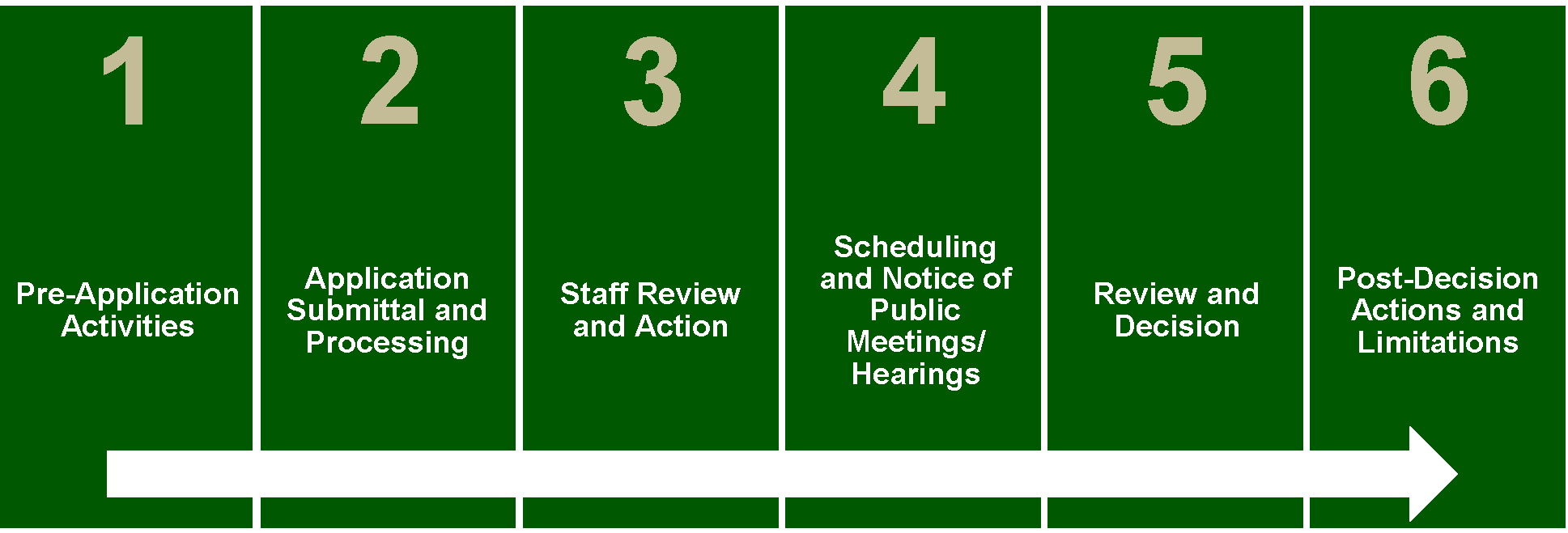
(Ord. No. DCA22-0002d, § 2(Exh. A), 7-19-2022)
2.4.2 - Consistency with State and Federal Provisions.
The notice, decision-making authority, public hearing, and other requirements for all approvals shall comply with the TLGC and other applicable state and federal provisions. This Subchapter shall be interpreted and applied in accordance with all applicable state and federal provisions. If these requirements conflict with state or federal provisions, then the state or federal provisions shall control.
(Ord. No. DCA22-0002d, § 2(Exh. A), 7-19-2022)
2.4.3 - Step 1: Pre-Application Activities.
A.
Pre-Application Conference.
1.
Purpose. Pre-application conferences are intended to provide an opportunity for a potential applicant to meet with city staff to review submittal requirements, procedures, and schedules; discuss details and potential impacts of the proposed project; and establish points of contact for the development review process.
2.
Applicability. A pre-application conference is recommended prior to submittal of certain types of applications, as listed in Table 2.2-A.
3.
Procedure.
a.
Request. The applicant may submit a request for a pre-application conference to the Development Services Department.
b.
Scheduling. The Director shall coordinate with the applicant and facilitate the meeting, including the time and location of the meeting.
c.
Meeting Process. The meeting shall be conducted pursuant to the requirements in the Development Handbook.
4.
Effect.
a.
Any information, comments, or other material provided to the potential applicant by the city shall expire after 45 calendar days of the pre-application conference.
b.
Any information or discussions held as part of the pre-application conference shall be binding on the city or the potential applicant, up to 45 calendar days.
c.
Discussions of potential conditions to mitigate impacts do not reflect actions by the decision-making body until and unless a decision-making body takes formal action to attach that condition to a development approval.
B.
Citizen Participation.
1.
Purpose. The citizen participation process provides the residents of Denton with an opportunity to actively participate in the city's development review procedures to help shape the direction of the city's development, thereby enhancing the welfare of the community.
2.
Applicability. The preparation and execution of a Citizen Participation Plan and submittal of a Citizen Participation Report is recommended prior to submittal of certain types of applications, as listed in Table 2.2-A Summary of Development Review Procedures.
3.
Citizen Participation Plan.
a.
Director Review. The Citizen Participation Plan is recommended to be reviewed by the Director prior to its execution by the applicant.
b.
Property Owner Names and Mailing Addresses. Upon request by the applicant, staff will provide to the applicant the names and mailing addresses of property owners within 200 feet of the subject property and residents within 500 feet of the subject property.
c.
Neighborhood Meetings.
i.
Two Neighborhood Meetings. The applicant is recommended to conduct a minimum of two neighborhood meetings.
a.
The first neighborhood meeting is recommended to occur prior to distribution of the city's first set of development review comments to the applicant.
b.
The second neighborhood meeting is recommended to occur prior to the first public meeting/hearing in which the application is heard.
ii.
Generally.
a.
Neighborhood meeting invitations should be sent out in advance to allow attendees time to prepare for the meeting.
b.
The invitation should include the date, time, and location of the scheduled neighborhood meeting.
c.
The invitation should include as much information about the project and subject request as possible to inform attendees regarding what is being proposed.
d.
Neighborhood meetings should be located in the City of Denton and as close to the subject property as is practical to help minimize the distance that attendees need to travel to participate.
e.
Neighborhood meetings should be scheduled to avoid, as much as possible, any conflict with other publicly scheduled meetings.
f.
Neighborhood meetings should take place during non-business hours to allow attendees who work during the day an opportunity to attend.
d.
Staff Attendance.
i.
It is recommended that the applicant keep the Development Services Department informed of the status of its citizen participation efforts by informing staff regarding the details for the neighborhood meeting.
ii.
Staff may attend neighborhood meetings to observe, collect information, and provide answers related to the Comprehensive Plan, this DDC, and all other applicable codes and ordinances of the City.
4.
Citizen Participation Report.
a.
Contents. A Citizen Participation Report prepared by the applicant is recommended and should include the following:
i.
Dates, times, and locations of all meetings that attendees were invited to attend to discuss the project and subject request.
ii.
The names and affiliation of those that attended that represent the applicant.
iii.
The names and department of staff that attended the meeting.
iv.
A sign-in sheet listing the names of the attendees that participated in the process.
v.
A written summary of the issues and/or concerns raised by the attendees and how the applicant proposes to resolve these issues and/or concerns. If the applicant is unable to resolve the issues and/or concerns raised by the attendees, the summary should state the reason why these issues and/or concerns cannot be resolved.
b.
Public Meeting/Hearing.
i.
Prior to the public meeting/hearing, staff may prepare a summary of the neighborhood meeting and include it as part of the staff's analysis.
ii.
If a Citizen Participation Report is submitted by the applicant, the report will be reviewed by staff and included as an exhibit as part of the backup that is sent to the decision-making body prior to the public meeting/hearing.
(Ord. No. DCA22-0002d, § 2(Exh. A), 7-19-2022)
2.4.4 - Step 2: Application Submittal and Processing.
A.
Authority to Submit Application. Unless expressly stated otherwise in this DDC, a development application shall be submitted by:
1.
The property owner, contract purchaser, or any other person having a recognized property interest in the land on which development is proposed; or
2.
A person authorized to submit the application on behalf of the owner, contract purchaser, or other person having a recognized property interest in the land; or
3.
If there are multiple owners, contract purchasers, or other persons authorized to submit the application, all such persons shall sign the application or a letter or document consenting to the application.
B.
Application Content.
1.
The application shall be submitted to the Development Services Department.
2.
The application shall be submitted on a form established by the Director.
3.
The applicant bears the burden of ensuring that an application contains sufficient information to demonstrate compliance with application requirements.
4.
The application shall include all required information as indicated in the Development Handbook, and any additional information requested by the Director or other staff during a pre-application conference to help demonstrate compliance with this DDC and other applicable city codes.
C.
Application Fees.
1.
Application fees shall be paid at the time of submittal according to the type of application. Fees shall be established by ordinance by the City Council.
2.
All fees required according to the City's adopted Fee Schedule or otherwise prescribed in the Municipal Code of Ordinances shall be paid to and collected by the Development Services Department.
3.
Where initial application fees are based on the estimated costs of review of the application by an outside consultant (for example, review of a project's traffic impacts by a traffic consultant), and the Director determines that additional funds are needed to complete the consultant's review, the Director may impose additional application fees to recover the city's actual costs in completing review. Prior to imposing such additional fees, the Director shall notify the applicant of the additional fees and provide the applicant with the option to move forward or withdraw the application.
D.
Submittal and Review Schedule. The Director shall establish a submittal and review schedule for development applications and shall include that information in the Development Handbook. The Director may amend the schedule to ensure effective and efficient review under this DDC.
E.
Determination of Application Completeness.
1.
Application Materials.
a.
No application is complete unless all of the information required by Subchapter 2: Administration and Procedures, the Development Handbook, and any application materials required by the Development Services Department, are included, and all required filing fees are paid.
b.
An application is not considered filed until it is complete.
c.
The applicant shall file an application in advance of any required public hearing or public meeting where the application is considered.
d.
The Director may establish a schedule for filing and reviewing any application that requires action by the City Council, Planning and Zoning Commission, Zoning Board of Adjustment, Historic Landmark Commission, Director, or Building Official. The schedule shall provide adequate time for notice and/or publication consistent with the applicable state statutes and this Subchapter.
e.
Completed applications shall be filed according to any published schedule.
f.
A determination of completeness shall not constitute a determination of compliance with the substantive requirements of this DDC, other Ordinances of the City of Denton, or state or federal law.
2.
Review Procedure.
a.
No later than 10 business days after an application is filed, the Director shall determine whether the application is complete and shall transmit a written determination to the applicant. If the written determination is not made within this time period, the application is deemed complete. Failure to complete this review within the specified time does not constitute approval and does not give rise to any cause of action against the City.
b.
If the application is determined not to be complete, the Director shall provide written notice to the applicant of the failure. The notice shall specify the necessary documents or other information and the date the application will expire if the documents or other information is not provided.
c.
Pursuant to TLGC 245.002(e), the application shall expire on or after the 45th calendar day after the date the application is filed if:
i.
The applicant fails to provide documents or other information required by Subsection 2.4.4B above; or
ii.
The Director provides the notice described in paragraph 2.4.4E.2.b, above; and
iii.
The applicant fails to provide the specified documents or other information within the time provided in the notice.
d.
If an application expires, the city shall not process the application. The applicant shall file a new application and pay the required fees to obtain the requested approval.
3.
Notice of Application Acceptance. When the Director determines that an application is filed in proper form and is ready to be formally accepted, the Director shall notify the applicant in writing. The application is then processed according to the remainder of this subchapter and the Development Handbook, including referrals to outside agencies and scheduling for public hearing and/or meetings, as applicable.
4.
Time Limits Triggered by Complete Application. Whenever this subchapter establishes a time period for processing an application, the time period does not begin until the Director has reviewed the application for completeness and the applicant has corrected all deficiencies in the application.
5.
Appeal. If the application is determined to be incomplete, the applicant may appeal that decision in writing to the Zoning Board of Adjustment pursuant to Subsection 2.8.3, Appeal of Administrative Decision.
F.
Minor Application Revisions.
1.
An applicant may revise an application after receiving notice of deficiencies following staff review according to Subsection 2.4.5, or on requesting and receiving permission from an advisory or decision-making body after that body has reviewed, but not yet taken action on, the application.
2.
Revisions shall be limited to changes that directly respond to specific requests or suggestions made by staff or the advisory or decision-making body, as long as they constitute only minor additions, deletions, or corrections and do not include significant substantive changes to the development proposed in the application or do not increase the intensity of land use, as determined by the Director.
3.
Whenever this subchapter establishes a time period for processing an application, minor application revisions may warrant restarting the time period, as determined by the Director.
4.
All other application revisions shall be processed as a new application per this Subsection 2.4.4.
G.
Application Withdrawal.
1.
After an application has been accepted for review, the applicant may withdraw the application at any time by submitting a letter of withdrawal to the Director.
2.
An applicant is not entitled to a refund of application fees for withdrawn applications; however, the Director may refund fees not expended if the application is withdrawn.
3.
If an applicant fails to respond to staff comments within 45 calendar days, or an application is otherwise determined by the Director to be inactive for a period of 45 calendar days, then the application is no longer valid.
H.
Concurrent Review.
1.
Where possible, without creating an undue administrative burden on the city's decision-making bodies and staff, this subchapter intends to accommodate the simultaneous processing of applications for different permits and approvals that may be required for the same development project in order to expedite the overall review process.
2.
Review and decision-making bodies considering concurrent applications shall render separate reports, recommendations, and decisions on each application based on the specific standards applicable to each request.
3.
Some forms of approval depend on the applicant having previously received another form of approval, or require the applicant to take particular action within some time period following the approval in order to avoid having the approval lapse. Therefore, even though this subchapter intends to accommodate simultaneous processing, applicants should note that each of the permits and approvals set forth in this subchapter has its own timing and review sequence.
4.
Environmental Sensitive Areas (ESAs) Compliance Review.
Environmental Sensitive Areas (ESAs) Compliance Review shall be reviewed concurrently with an application for a zoning compliance plan in accordance with Subsection 7.4.4: ESAs Procedures.
5.
An application for a zoning compliance plan approval may be submitted and reviewed concurrently with re-zonings, specific use permits, subdivision applications, and variance applications, provided that the Director shall not decide the zoning compliance plan approval application until after an official decision is made on the rezoning, subdivision, and/or variance application.
(Ord. No. DCA22-0002d, § 2(Exh. A), 7-19-2022)
2.4.5 - Step 3: Staff Review and Action.
A.
Refer Application to Staff and Review Agencies. The Director shall distribute the complete application to appropriate staff and appropriate internal and external review agencies per the Development Handbook.
B.
Staff Review and Application Revisions. Staff shall review the application and submit recommendations and comments to the applicant in a form established by the Director. The application shall not move forward for further review by the recommending or decision-making body until the Director determines that the applicant has adequately addressed staff's comments, or the applicant requests that the application move forward with a staff recommendation of denial.
C.
Applications Subject to Staff Recommendation.
1.
Staff Report. The Director shall submit a written report to the recommending or decision-making body. The Director's report should include the reports and recommendations of other city departments, if applicable, and should state whether or not the application complies with all applicable DDC requirements. The staff report may also include a recommendation for a decision by the authorized recommending or decision-making body and recommend how noted deficiencies may be corrected and negative impacts mitigated.
2.
Distribution and Availability of Application and Staff Report. The Director must submit a copy of the staff report to the applicant and recommending or decision-making body and must make the staff report and all related materials available for public review pursuant to the Development Handbook.
3.
Forwarding Applications for Review. A recommending or decision-making body may remand the application back to the Director for further consideration, and the City Council may remand the application back to a recommending body for further consideration.
D.
Applications Subject to Staff Decision. If an application is subject to staff review and a final decision by the Director pursuant to Table 2.2-A, the Director shall make a decision based on the development review standards applicable to the application type. The decision shall be in writing and shall clearly state reasons for a denial or for conditions of approval. The Director may, at his or her discretion, require that the application be forwarded to the recommending or decision-making body for review.
E.
Approval Criteria Applicable to all Applications.
1.
Generally.
a.
Unless otherwise specified in this DDC, the staff, recommending and decision-making bodies must review all development applications submitted pursuant to this subchapter for compliance with the general review criteria stated below.
b.
The application may also be subject to additional review criteria specific to the type of application, as set forth in sections 2.5 through 2.9.
c.
If there is a conflict between the general review criteria in this section and the specific review criteria in sections 2.5 through 2.9, the applicable review criteria in sections 2.5 through 2.9 controls.
2.
Prior Approvals. The proposed development shall be consistent with the terms and conditions of any prior land use approval, plan, development agreement, or plat approval that is in effect and not proposed to be changed. This includes an approved phasing plan for development and installation of public improvements and amenities.
3.
Consistent with Comprehensive Plan and Other Applicable Plans. The proposed development shall be consistent with the Comprehensive Plan and any applicable plans. The decision-making authority:
a.
Shall weigh competing plan goals, policies, and strategies; and
b.
May approve an application that furthers the overall goals of the Comprehensive Plan even if the development does not match the future land use designation in the Comprehensive Plan.
4.
Compliance with this DDC.
a.
The proposed development shall comply with all applicable standards in this DDC, unless the standard is to be lawfully modified.
b.
Compliance with these standards is applied at the level of detail required for the subject submittal.
5.
Compliance with Other Applicable Regulations. The proposed development shall comply with all other city regulations and with all applicable regulations, standards, requirements, or plans of the federal or state governments and other relevant jurisdictions. This includes, but is not limited to, wetlands, water quality, erosion control, and wastewater regulations.
6.
Consistent with Interlocal and Development Agreements. The proposed development shall be consistent with any adopted interlocal and applicable development agreements and comply with the terms and conditions of any such agreements incorporated by reference into this DDC.
7.
Minimizes Adverse Environmental Impacts. The proposed development should be designed to minimize negative environmental impacts and should not cause significant adverse impacts on the natural environment. Examples of the natural environment include water, air, noise, stormwater management, scenic resources, wildlife habitat, soils, and native vegetation.
8.
Minimizes Adverse Impacts on Surrounding Property. The proposed development should not cause significant adverse impacts on surrounding properties. The results of the citizen participation process may be appropriately considered under this section.
9.
Minimizes Adverse Fiscal Impacts. The proposed development should not result in significant adverse fiscal impacts on the city.
10.
Compliance with Utility, Service, and Improvement Standards. As applicable, the proposed development shall comply with federal, state, county, service district, city and other regulatory authority standards, and design/construction specifications for roads, access, drainage, water, sewer, schools, emergency/fire protection, and similar standards.
11.
Provides Adequate Road Systems. Adequate road capacity shall exist to serve the uses permitted under the proposed development, and the proposed uses shall be designed to ensure safe ingress and egress onto the site and safe road conditions around the site, including adequate access onto the site for fire, public safety, and EMS services.
12.
Provides Adequate Public Services and Facilities. Adequate public service and facility capacity shall exist to accommodate uses permitted under the proposed development at the time the needs or demands arise, while maintaining adequate levels of service to existing development. Public services and facilities include, but are not limited to, roads, domestic water, sewer, schools, public safety, fire protection, utilities, libraries, and vehicle/pedestrian connections and access within the site and to adjacent properties.
13.
Rational Phasing Plan. If the application involves phases, each phase of the proposed development shall contain all of the required streets, utilities, landscaping, open space, and other improvements that are required for that phase, and may not defer those improvements to subsequent phases.
F.
Conditions of Approval.
1.
Except for zoning map amendments or annexations, or where otherwise prohibited by law, where this DDC authorizes a review body to approve or deny an application subject to applicable criteria, the review body may approve the application with conditions necessary to bring the proposed development into compliance with this DDC or other regulations, or to mitigate the impacts of that development on the surrounding properties and streets.
2.
All conditions of approval shall be reasonably related to the anticipated impacts of the proposed use or development or shall be based upon standards duly adopted by the city. Such conditions may include those necessary to carry out the purpose and intent of the City's Comprehensive Plan, development agreements, other adopted city plans, and this DDC.
3.
No conditions of approval shall be less restrictive than the requirements of this DDC, except where the DDC expressly allows deviations.
4.
Any condition of approval that requires an applicant to dedicate land or pay money to a public entity in an amount that is not calculated according to a formula applicable to a broad class of applicants shall be roughly proportional both in nature and extent to the anticipated impacts of the proposed development, as shown through an individualized determination of impacts.
5.
During its consideration, the decision-making body may consider alternative potential conditions; however, no discussion of potential conditions shall be deemed an attempt or intent to impose any condition that would violate the federal or state constitutions, statutes, or regulations. Discussions of potential conditions to mitigate impacts do not reflect actions by the decision-making body unless and until the decision-making body takes formal action to attach that condition to a development approval.
6.
Unless otherwise provided in this DDC, any representations of the applicant in submittal materials or during public hearings shall be binding as conditions of approval.
7.
Failure to meet any condition of approval prior to the issuance of any type of permit shall negate the approval and the application shall be deemed denied.
(Ord. No. DCA22-0002d, § 2(Exh. A), 7-19-2022)
2.4.6 - Step 4: Scheduling and Notice of Public Meetings/Hearings.
A.
Scheduling.
1.
If an application is subject to a public hearing pursuant to Table 2.2-A Summary of Development Review Procedures, the Director shall schedule the public hearing for either a regularly scheduled meeting or special meeting of the appropriate recommending or decision-making body following submission of a completed application.
2.
Unless otherwise specified, notice for public hearings shall meet or exceed TLGC requirements.
B.
Public Notice Requirements.
1.
All public hearings required by this DDC shall be preceded by the notices identified in Table 2.2-A Summary of Development Review Procedures, and all such notices shall meet the content, timing, and other specifications in the Development Handbook.
2.
Applicants are responsible for any additional notice beyond the requirements in this DDC, other city ordinances, or state law.
C.
Constructive Notice.
1.
Minor Defects in Notice Shall Not Invalidate Proceedings. Minor defects in any notice shall not impair the notice or invalidate proceedings pursuant to the notice if a bona fide attempt has been made to comply with applicable notice requirements. Minor defects in notice shall be limited to errors in a legal description or typographical or grammatical errors that do not impede communication of the notice to affected parties. In all cases, however, the requirements for the timing of the notice and for specifying the time, date, and place of a hearing shall be strictly construed.
2.
Failure to Receive Notice Shall Not Invalidate Action. Failure of a party to receive written notice shall not invalidate subsequent action.
3.
Re-Noticing. A new notice is required if there is an increase in land use intensity, as determined by the Director, between the action described in the original notice and the final action.
(Ord. No. DCA22-0002d, § 2(Exh. A), 7-19-2022)
2.4.7 - Step 5: Review and Decision.
The application shall be subject to review, hearings, recommendations, and decisions as indicated in Table 2.2-A and the following:
A.
Generally.
1.
If the application is subject to a public hearing, the applicable review body shall hold a public hearing on the application in accordance with Subsection 2.4.6.
2.
The applicable review body shall consider the application, relevant support materials, staff report, and any evidence and public comments from the public hearing (if required).
3.
The applicable review body shall approve, approve with conditions, or deny the application based on the applicable approval criteria, including the general criteria in Subsection 2.4.5E, Approval Criteria Applicable to all Applications, and the specific standards in sections 2.5 through 2.9.
4.
If the review involves a quasi-judicial hearing, the recommendation or decision (as applicable) shall be based only on the record of the public hearing and shall:
a.
Be made in writing;
b.
Include findings of fact based on competent, material, and substantial evidence presented at the hearing;
c.
Reflect the determination of contested facts; and
d.
State how the findings support compliance with applicable review standards.
B.
Conditional Approvals. The decision-making body may incorporate or require, as part of a condition of approval, a written agreement between the applicant and the city that enforces the conditions. All conditions shall comply with the limitations in Subsection 2.4.5F, Conditions of Approval.
C.
Postponement of Public Hearings at Applicant's Request. An applicant may request one postponement of the scheduled public hearing at least five calendar days prior to the scheduled public hearing. If any publication or notice is provided by the city, the applicant is responsible for any costs or fees associated with the postponement. If the request is submitted less than five days prior to the scheduled public hearing, the decision-making body may, in its discretion, either hold or continue the public hearing.
D.
Continuances. The decision-making body may continue a public hearing to a specified date, time, and place. The date of continuance shall be made part of the motion and publicly announced at the public hearing. Publication or property owner notification of the continued date is not required, unless required by state law or recommended by the hearing body or the Director.
E.
Postpone a Decision. A decision-making body may close a public hearing and postpone the decision. The request shall appear on the next subsequent agenda unless the decision is deferred to a specific date.
F.
Other Rules to Govern. Other matters pertaining to the public hearing shall be governed by other provisions of these regulations applicable to the body conducting the hearing and its adopted rules of procedure.
(Ord. No. DCA22-0002d, § 2(Exh. A), 7-19-2022)
2.4.8 - Step 6: Post-Decision Actions and Limitations.
A.
Notice of Decision.
1.
Within 10 days after a final decision on an application, the Director shall provide written notification of the decision, unless the applicant was present at the meeting where the decision was made or required by law.
2.
If the review involves a quasi-judicial hearing, the Director shall, within 10 days after a final decision on the application, provide a written notification of the decision to the owner(s) of the subject site (unless the applicant was present at the meeting where the decision was made or required by law), and any other person that submitted a written request for a copy of the decision before its effective date.
B.
Appeal.
1.
A party aggrieved or adversely affected by any decision by the City Council or Zoning Board of Adjustment may seek review of the decision in the courts in accordance with applicable state law.
2.
A party aggrieved by other final decisions may appeal the decision in accordance with the procedures and standards in Subsection 2.8.3 and as set forth in sections 2.5 through 2.9, as applicable.
C.
Expiration of Approval.
1.
An application approval under this subchapter expires if no progress is made towards completion of the project within the established expiration dates provided in sections 2.5 through 2.9.
2.
Upon the expiration of an approved application, all previously approved applications for the same land shall also expire on the expiration date if the filing of an application was required to avoid expiration for the previously approved application(s).
3.
A project expires if, on the fifth anniversary of the date the first permit application was filed, no progress has been made towards completion of the project. A project also expires if on the fifth anniversary of the date of the last instance of progress toward completion of the project, and no additional progress toward completion has occurred.
4.
A change in ownership of the land shall not affect the established expiration time period of an approval.
5.
For purposes of this subsection, "project" and "progress towards completion of the project" are as defined in TLGC § 245, as amended.
6.
Any new application under this subchapter, or application to modify an existing approved application under this subchapter, shall be deemed to be a continuation of the same project, if the Director determines that the new or modified application is not materially different from the approved applications preceding it.
D.
Extensions of Approval Period.
1.
The original approval body may grant one extension of an approval period of up to one year for good cause.
2.
All requests for extensions shall be submitted in writing to the Director at least 30 calendar days prior to the expiration of approval.
3.
An extension request shall include:
a.
A narrative stating the reasons for the applicant's inability to comply with the specified deadlines; and
b.
A narrative describing any changes in the character of the neighborhood, the Comprehensive Plan, or this DDC that have occurred since approval of the permit/plan, and how any such changes affect the permit/plan; and
c.
The anticipated time schedule for completing the review project and/or the specific project.
4.
Additional review of the permit/plan may result in additional conditions, as applicable.
E.
Modification or Amendment of Approval. Unless otherwise provided in this DDC, any modification of an approved plan, permit, or condition of approval shall require a new application that is submitted and reviewed in accordance with the full procedure and fee requirements applicable to the particular type of the original application.
F.
Limitation on Subsequent Similar Applications.
1.
Except at City Council's request, following denial of an application, no application that is the same or substantially similar will be accepted within one year of the previous denial. For purposes of this provision, "substantially similar" shall mean any application that is not materially different in terms of proposed development or activities relative to the reasons for denial of a previously submitted application, as determined by the Director.
2.
This waiting period may be waived by the decision-making body provided that:
a.
There is a substantial change to circumstances, or new information available, relevant to the issues or facts considered during the previous application review; or
b.
The new application is materially different from the previous application, as determined by the Director.
(Ord. No. DCA22-0002d, § 2(Exh. A), 7-19-2022)
2.5.1 - Zoning Compliance Plan Review.
A.
Purpose. The zoning compliance plan review procedure is intended to ensure compliance with the development and design standards of this DDC and to encourage quality development reflective of the adopted goals and objectives of the city. The zoning compliance plan review procedure ensures that proposed development applications address and mitigate potential adverse impacts associated with the proposal.
B.
Applicability. A separate zoning compliance plan review is required for all development activities that meet one of the Tier 2 thresholds in Section 7.2.2B. All other activities are exempted from this review but may be required to submit similar documentation of zoning compliance with a building permit application.
C.
Zoning Compliance Plan Procedure. Figure 2.5-1 identifies the applicable steps from the common review procedures in Section 2.4 that apply to the review of zoning compliance plans. Additions or modifications to the common review procedures are noted below.
Figure 2.5-1: Summary of Zoning Compliance Plan Procedure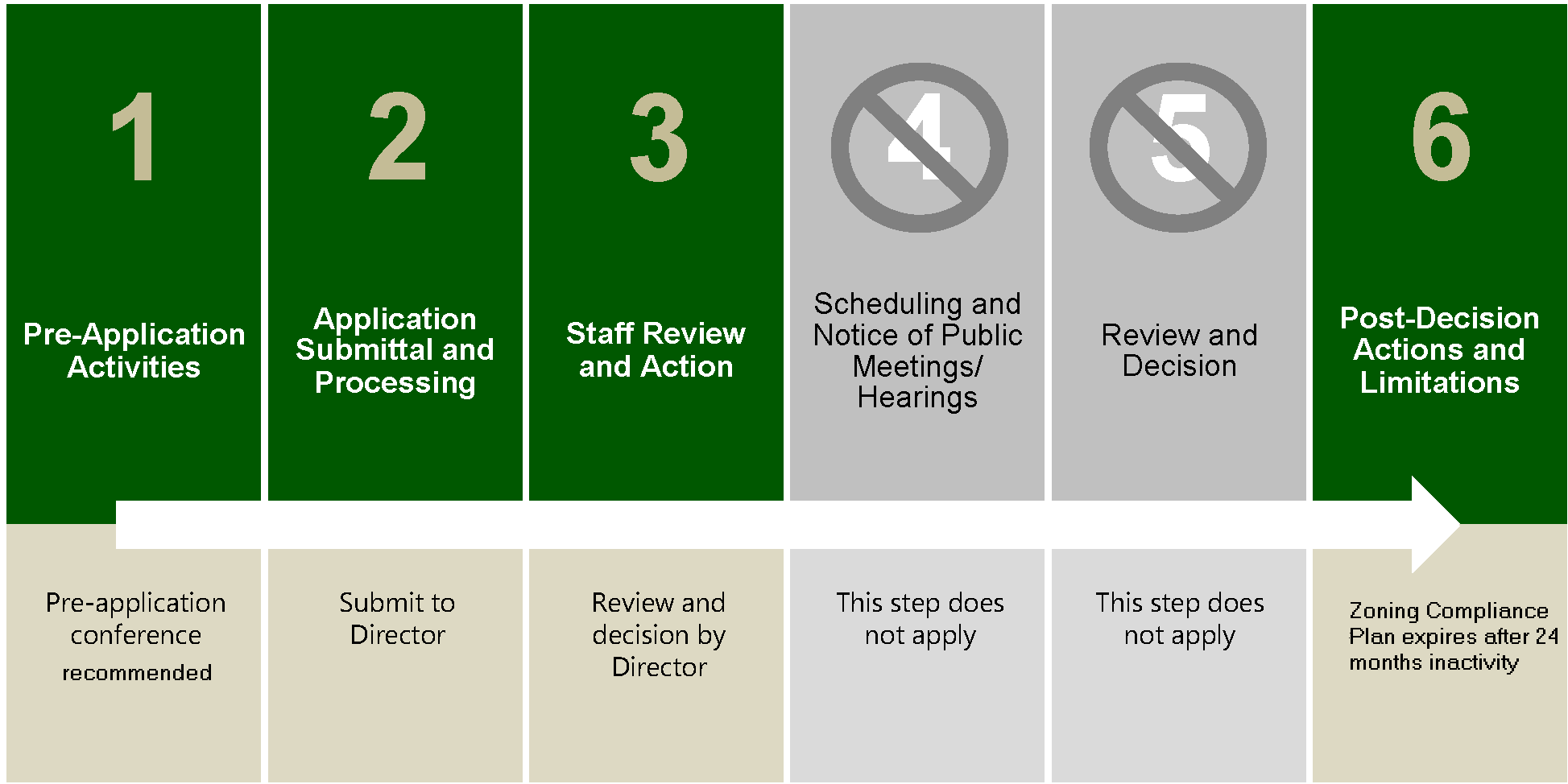
1.
Step 1: Pre-Application Activities.
a.
Pre-Application Conference. A pre-application conference is recommended in accordance with Subsection 2.4.3.
b.
Citizen Participation. Not required.
2.
Step 2: Application Submittal and Processing.
a.
Generally.
i.
The zoning compliance plan application shall be submitted and accepted, and may be revised or withdrawn, in accordance with Subsection 2.4.4.
ii.
The Director may require at any stage of review of any zoning compliance plan, submission of any plan, study, survey or other information, in addition to that specified in this DDC, or the Development Handbook, and at the applicant's expense, as determined necessary to enable review, recommendation, and/or approval of the zoning compliance plan.
iii.
General Contents of Application. The zoning compliance plan shall include, at a minimum, the following information and any other details as specified on the published checklist:
a.
Graphical and site data to define the lot area, development impact area, easements, and right-of-way dedications,
b.
The location and dimensions of existing and proposed improvements, including but not limited to, buildings, fences and walls, parking areas and drive aisles, sidewalks and pathways, fire lanes, utilities, drainage or water features, and streets, and
c.
Environmentally sensitive, tree preservation, and landscape areas.
3.
Step 3: Staff Review and Action. The Director shall review the zoning compliance plan application and approve, approve with conditions, or deny the application in accordance with the approval criteria in Subsection 2.5.1D, below.
4.
Step 4: Scheduling and Notice of Public Meetings/Hearings. Not required.
5.
Step 5: Review and Decision. Not applicable. Review and decision is by the Director under Step 3.
6.
Step 6: Post-Decision Actions and Limitations.
a.
No Building Permit without Approval. No building permit shall be issued until the zoning compliance plan and any associated development plans have been approved, and all conditions of approval have been met.
b.
Lapse of Approval. Unless otherwise provided in the conditions of approval, zoning compliance plans shall expire after 24 months if the use or construction has not obtained all necessary permits. Extensions may be granted by the Director for good cause shown due to unforeseen circumstances, such as an application for amendments to the approved zoning compliance plan. Such extensions may only be granted if a written request is made to the Director prior to expiration.
c.
Amendments. During construction, the Director may authorize minor adjustments without requiring resubmittal of a zoning compliance plan application provided such adjustments:
i.
Comply with the standards of this DDC;
ii.
Are necessary to meet provisions of the building code or other life safety code;
iii.
Are necessary to meet conditions of approval by other city, county, or state departments and/or agencies; or
iv.
Would not significantly alter the function, form, intensity, character, demand on public facilities, or impact on adjacent properties as approved with the zoning compliance plan.
d.
Appeal to the Zoning Board of Adjustment. The applicant may appeal the denial, revocation, or suspension of a zoning compliance plan to the Zoning Board of Adjustment in accordance with Subsection 2.8.3.
D.
Zoning Compliance Plan Review Approval Criteria. In reviewing a proposed zoning compliance plan application, the Director shall consider the general approval criteria in Subsection 2.4.5 and whether:
1.
The zoning compliance plan complies with all site specifications adopted by the city; and
2.
The zoning compliance plan complies with applicable standards in this DDC, including Subchapter 3: Zoning Districts; Subchapter 4: Overlay and Historic Districts; Subchapter 5: Use Regulations; Subchapter 7: Development Standards; and any other applicable standards of this DDC.
(Ord. No. DCA22-0002d, § 2(Exh. A), 7-19-2022)
2.5.2 - Specific Use Permit (SUP).
A.
Purpose. The specific use permit (SUP) procedure provides a mechanism for the city to evaluate proposed development and land uses that have unique or widely varying operating characteristics or unusual features. This procedure is intended to ensure compatibility with surrounding areas and that adequate mitigation is provided for anticipated impacts.
B.
Applicability.
1.
The SUP procedure shall apply to uses identified in Table 5.2-A: Table of Allowed Uses, as requiring a SUP. No such use may be established, enlarged, or altered without approval of a SUP.
2.
The City Council may grant, repeal, and amend SUPs for certain uses, but only where specified in this DDC.
C.
Specific Use Permit Procedure. Figure 2.5-2 identifies the applicable steps from the common review procedures in Section 2.4 that apply to the review of SUPs. Additions or modifications to the common review procedures are noted below.
Figure 2.5-2: Summary of Specific Use Permit Procedure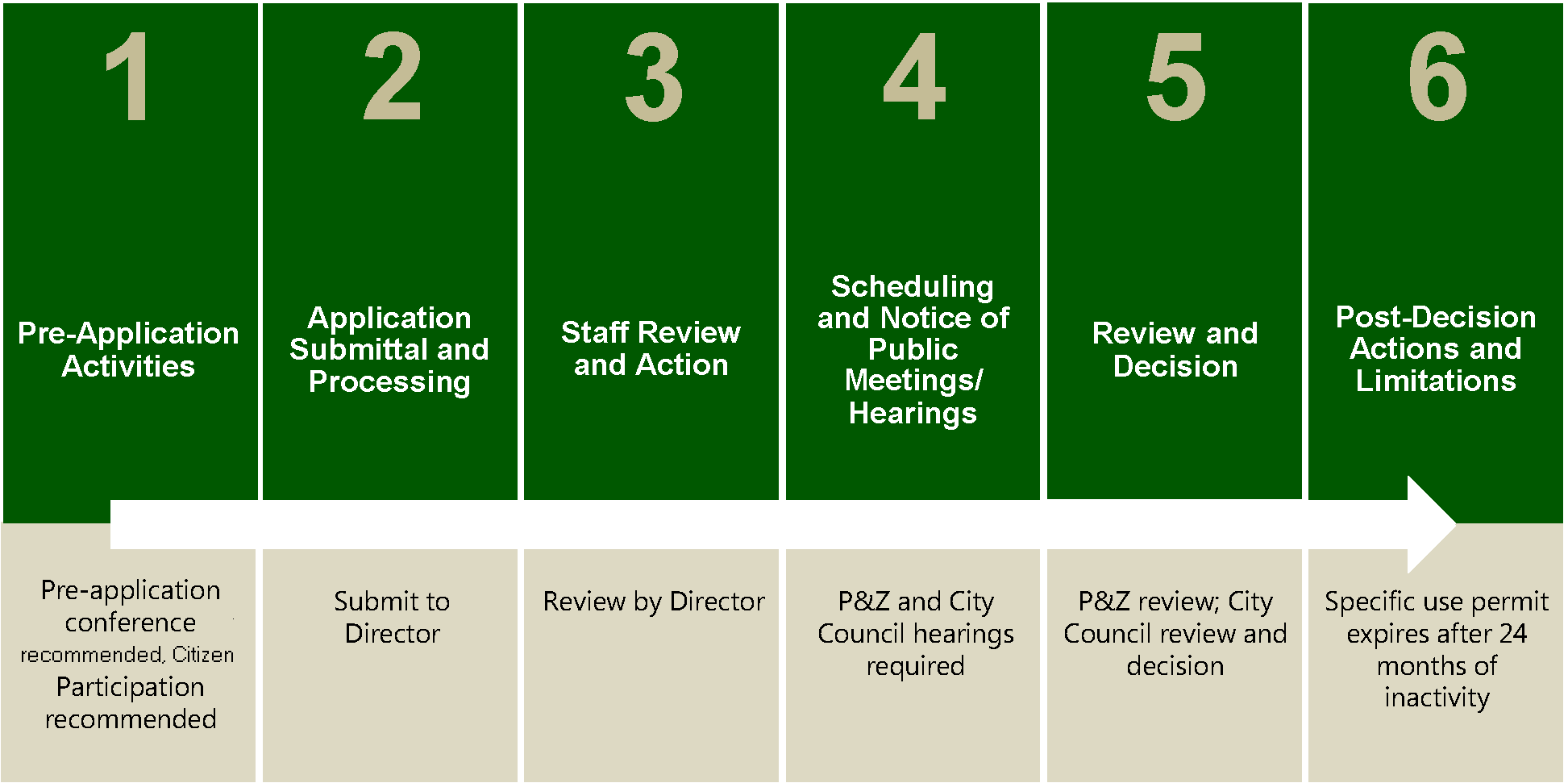
1.
Step 1: Pre-Application Activities.
a.
Pre-Application Conference. A pre-application conference is recommended in accordance with Subsection 2.4.3.
b.
Citizen Participation. Citizen Participation is recommended in accordance with Subsection 2.4.3B: Citizen Participation.
2.
Step 2: Application Submittal and Processing. The SUP application shall be submitted and accepted, and may be revised or withdrawn, in accordance with Subsection 2.4.4.
3.
Step 3: Staff Review and Action. The Director shall review the SUP application and prepare a staff report and recommendation in accordance with the approval criteria in Subsection 2.5.2D below.
4.
Step 4: Scheduling and Notice of Public Meetings/Hearings. The SUP application shall be scheduled for public hearings before the Planning and Zoning Commission and the City Council and shall be noticed pursuant to Table 2.2-A Summary of Development Review Procedures and Subsection 2.4.6.
5.
Step 5: Review and Decision.
a.
Planning and Zoning Commission Review and Recommendation. The Planning and Zoning Commission shall review the SUP application in accordance with the approval criteria in Subsection 2.5.2D below and shall forward its recommendation to the City Council.
b.
City Council Review and Decision.
i.
The City Council may review and approve, approve with conditions, or deny the SUP application in accordance with the approval criteria in Subsection 2.5.2D below.
ii.
If the Planning and Zoning Commission recommends denial of the SUP, the SUP shall become effective only by a three-fourths vote of all members of the City Council.
c.
Concurrent Review. An applicant may request a SUP approval concurrent with a rezoning.
6.
Step 6: Post-Decision Actions and Limitations. Post-decision actions and limitations in Subsection 2.4.8 shall apply with the following modifications:
a.
Effect of Approval. Approval of a Specific Use Permit authorizing the proposed specific land use to be developed on the subject property does not preclude or limit the development on the subject property for other uses permitted by right that do not require an approved Specific Use Permit within the subject property's zoning district.
b.
Expiration of a Specific Use Permit. If the authorized use or construction is not substantially underway within 24 months after the date of SUP approval, or an extension is granted pursuant to Subsection 2.4.8C, the SUP shall expire.
c.
Expansion or Enlargement.
i.
Expansion or enlargement of a SUP shall require a new application, unless the Director determines that the expansion or enlargement:
a.
Is not expected to increase potential negative impacts to surrounding property or the city; and
b.
Will not require adjustments to any standards greater than allowed through the minor modification procedures in Subsection 2.8.2.
ii.
Any expansion or enlargement of a SUP that does not meet the criteria for Director approval established above shall require review and recommendation by the Planning and Zoning Commission and review and approval by the City Council.
d.
Denial or Revocation of Permit.
i.
A SUP may be revoked or modified after notice to the property owner and a hearing before the City Council, for any of the following reasons:
a.
The SUP was obtained or extended by fraud or deception; or
b.
One or more of the conditions of approval imposed on the SUP has not been met or has been violated; or
c.
At the time of change of ownership or condition indicated in the original approval.
ii.
If a SUP is denied or revoked in accordance with this section, then the subject property shall not be eligible for resubmittal for 12 months unless the applicant can show a substantial change in circumstances to justify a resubmittal.
e.
Recording. All approved SUPs shall be referenced on the Official Zoning Map of City as "SUP."
D.
Specific Use Permit Approval Criteria. In reviewing a proposed SUP, the Planning and Zoning Commission and City Council shall consider the general approval criteria in Subsection 2.4.5 and whether:
1.
The specific use proposed is compatible with the surrounding area;
2.
The specific use proposed has negative impacts on future development of the area; and
3.
Any impacts associated with access, traffic, emergency services, utilities, parking, refuse areas, noise, glare, and odor have been adequately mitigated.
(Ord. No. DCA22-0002d, § 2(Exh. A), 7-19-2022)
2.5.3 - Temporary Use Permit.
A.
Purpose. The temporary use permit procedure provides a mechanism for the city to evaluate prospective uses and/or structures on private property of limited duration to ensure compliance with applicable standards of this DDC, including Section 5.5: Temporary Uses and Structures.
B.
Applicability. A temporary use permit is required before establishing, constructing, or installing any temporary use or structure designated as requiring a temporary use permit in Section 5.5: Temporary Uses and Structures.
C.
Temporary Use Permit Procedure. Figure 2.5-3 identifies the applicable steps from the common review procedures in Section 2.4 that apply to the review of temporary use permits. Additions or modifications to the common review procedures are noted below.
Figure 2.5-3: Summary of Temporary Use Permit Procedure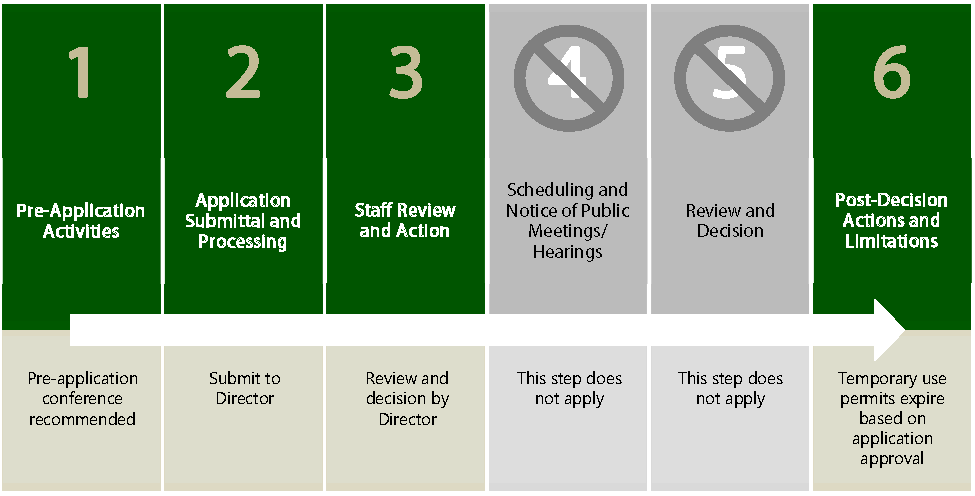
1.
Step 1: Pre-Application Activities.
a.
Pre-Application Conference. A pre-application conference is recommended in accordance with Subsection 2.4.3.
b.
Citizen Participation. Not required.
2.
Step 2: Application Submittal and Processing. The temporary use permit application shall be submitted and accepted, and may be revised or withdrawn, in accordance with Subsection 2.4.4.
3.
Step 3: Staff Review and Action. The Director shall review and approve, approve with conditions, or deny the temporary use permit application in accordance with the approval criteria in Subsection 2.5.3D below.
4.
Step 4: Scheduling and Notice of Public Meetings/Hearings. Not required.
5.
Step 5: Review and Decision. Not applicable. Review and decision is by the Director under Step 3.
6.
Step 6: Post-Decision Actions and Limitations. Post-decision actions and limitations in Subsection 2.4.8 shall apply, with the following modifications:
a.
Effect of Approval. A temporary use permit authorizes establishment, construction, or installation of the approved temporary use or structure in accordance with the terms and conditions of the permit.
b.
Expiration of Approval.
i.
A temporary use permit shall be valid beginning on the date specified on the permit and shall remain valid for the time period indicated on the permit, but in no event, longer than 12 months.
ii.
Upon request, the Director may grant a one-year extension; however, in no case shall a temporary use permit be valid for more than one year after its original expiration date. This one-year extension period may not be further extended.
iii.
Any temporary use permit requesting an approval period beyond one year shall require a specific use permit approval pursuant to Subsection 2.5.2.
c.
Removal and Restoration. Before the expiration of a temporary use permit, the permittee shall disconnect all temporary uses and structures, and associated property and equipment, and free the temporary use site from all trash, litter, and debris to the satisfaction of the Director.
d.
Appeal to the Zoning Board of Adjustment. The applicant may appeal the denial, revocation, or suspension of a temporary use permit to the Zoning Board of Adjustment in accordance with Subsection 2.8.3.
D.
Temporary Use Permit Approval Criteria. In reviewing a temporary use or structure, the Director shall consider the general approval criteria in Subsection 2.4.5 and whether the proposed use or structure:
1.
Complies with applicable temporary use standards in Section 5.5: Temporary Uses and Structures, as well as all other applicable standards in this DDC;
2.
Adequately mitigates any impacts associated with access, traffic, emergency services, utilities, parking, refuse areas, noise, glare, and odor; and
3.
Complies with all requirements and conditions of approval of any prior development permit or approval.
(Ord. No. DCA22-0002d, § 2(Exh. A), 7-19-2022)
2.5.4 - Zoning Verification Letter.
A.
Purpose. The zoning verification letter is an informational document not intended to grant approval for land development in any way. The sole purpose for this procedure is to provide a mechanism for the city to issue a formal confirmation of a property's zoning.
B.
Applicability. A zoning verification letter can be requested by any property owner or entity seeking to confirm the zoning of a property.
C.
Zoning Verification Letter Procedure. Figure 2.5-4 identifies the applicable steps from the common review procedures in Section 2.4 that apply to the review of a zoning verification letter. Additions or modifications to the common review procedures are noted below.
Figure 2.5-4: Summary of Zoning Verification Letter Procedure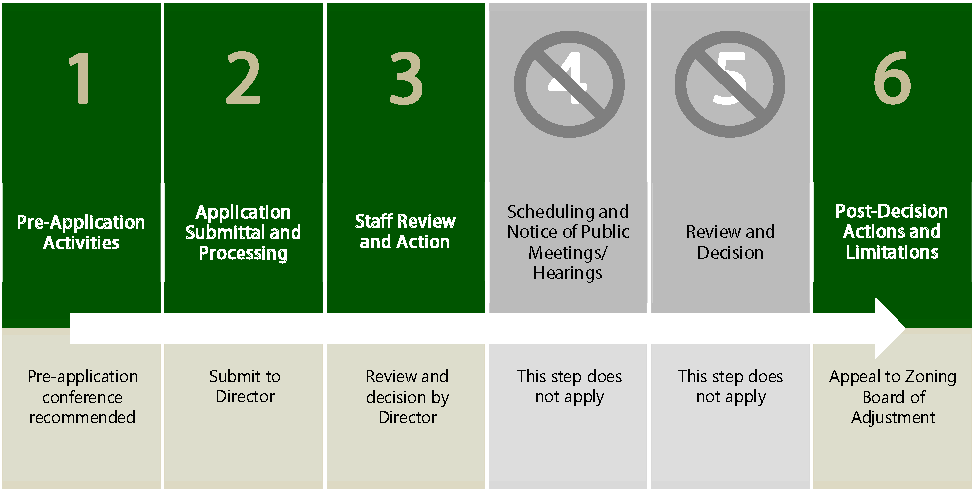
1.
Step 1: Pre-Application Activities.
a.
Pre-Application Conference. Not required.
b.
Citizen Participation. Not required.
2.
Step 2: Application Submittal and Processing. The zoning verification letter application shall be submitted and accepted, and may be revised or withdrawn, in accordance with Subsection 2.4.4.
3.
Step 3: Staff Review and Action. The Director shall issue a zoning verification letter after examination of the City's zoning map and records for the property.
4.
Step 4: Scheduling and Notice of Public Meetings/Hearings. Not required.
5.
Step 5: Review and Decision. Review and decision is subject to Subsection 2.4.7.
6.
Step 6: Post-Decision Actions and Limitations. Post-decision actions and limitations in Subsection 2.4.8 shall apply, with the following modifications:
a.
Effect of Approval. A zoning verification letter serves as confirmation of the zoning of a property.
b.
Appeal to the Zoning Board of Adjustment. The applicant may appeal the findings of a zoning verification letter to the Zoning Board of Adjustment in accordance with Subsection 2.8.3.
(Ord. No. DCA22-0002d, § 2(Exh. A), 7-19-2022)
2.5.5 - Environmental Sensitive Areas (ESAs) Field Assessments.
A.
Purpose. The environmentally sensitive areas (ESAs) field assessment procedure provides a mechanism for the city to confirm the presence of ESAs protected habitats and to correct any errors on the Official ESA Map.
B.
Applicability. Field assessments are required when there is reasonable evidence that ESAs, as depicted on the Official ESA Map, may not be accurate. ESA field assessments that require map adjustment shall supersede the Official ESA Map in determining what areas of a proposed development are subject to the requirements of Section 7.4: Environmentally Sensitive Areas.
C.
ESA Field Assessment Procedure. Figure 2.5-5 identifies the applicable steps from the common review procedures in Section 2.4 that apply to the review of ESA field assessments. Additions or modifications to the common review procedures are noted below.
Figure 2.5-5: Summary of ESA Field Assessment Procedure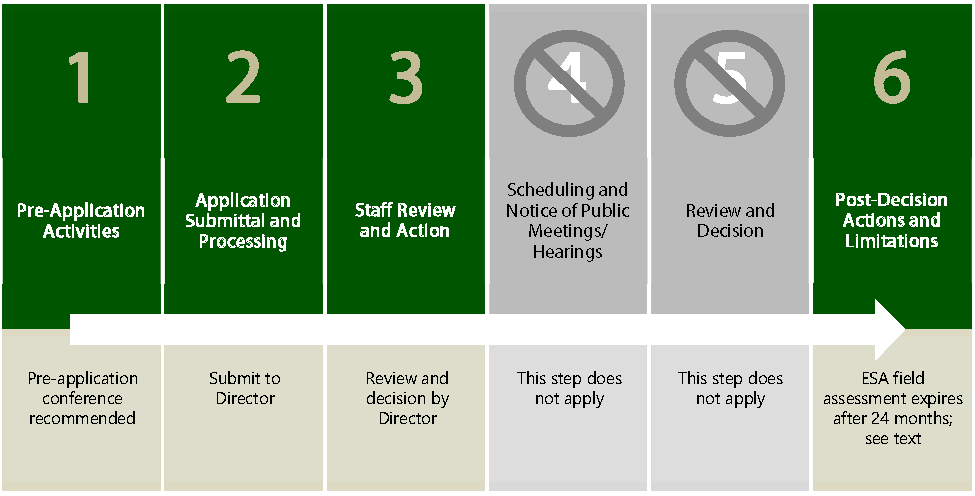
1.
Step 1: Pre-Application Activities.
a.
Pre-Application Conference. A pre-application conference is recommended in accordance with Subsection 2.4.3.
b.
Citizen Participation. Not required.
2.
Step 2: Application Submittal and Processing.
a.
Generally.
i.
The ESA field assessment application shall be submitted and accepted, and may be revised or withdrawn, in accordance with Subsection 2.4.4.
ii.
The Director may require additional information deemed appropriate and necessary to process the application.
iii.
An application for an ESA field assessment must be submitted and reviewed prior to or concurrently with the platting of property.
3.
Step 3: Staff Review and Action. The Director shall review an ESA field assessment application and approve, approve with conditions, or deny the application in accordance with the general approval criteria in Subsection 2.4.5, and any specific biological, hydrological, and soil identification standards included on the ESA field assessment forms provided by the city.
4.
Step 4: Scheduling and Notice of Public Meetings/Hearings. Not required.
5.
Step 5: Review and Decision. Not applicable. Review and decision is by the Director under Step 3.
6.
Step 6: Post-Decision Actions and Limitations.
a.
An ESA field assessment application shall expire 24 months after its approval, or if the natural conditions of the ESA have been significantly altered.
b.
A change in ownership of the land shall not affect the established expiration time period of an approval.
c.
For purposes of this section, progress towards completion of the project is as defined in TLGC § 245.005.
d.
Appeals to staff determinations shall follow the procedure in Section 2.8.3.
(Ord. No. DCA22-0002d, § 2(Exh. A), 7-19-2022)
2.5.6 - Vested Rights.
A.
Introduction and Purpose. TLGC, Chapter 245, commonly referred to as the state's "vested rights law," provides an opportunity for persons to "freeze" or "vest" governmental regulations by filing a permit application. Other laws, such as TLGC, § 211.016, also provide certain vesting to:
1.
Ensure that the city recognizes and protects all vested rights created by TLGC, Chapter 245, and other applicable laws;
2.
Ensure that all vested rights are made by the city only after the city is in receipt of all information necessary to allow the city to determine whether vested rights are present; and
3.
Provide a method of administrative review of vested rights.
B.
Vested Rights. For purposes of this DDC, any person who believes that they have obtained a vested right under TLGC, Chapter 245, or other applicable vested rights law, shall submit to the Director a petition explaining the factual and legal bases upon which the person relies to support their contention that they have a particular vested right and, consequently, is exempt or not subject to a particular city order, regulation, ordinance, rule, expiration date, or other properly adopted requirement otherwise applicable to development of the petitioner's property (hereinafter referred to collectively as "regulations"). The petition shall be accompanied by an unconditional waiver of any statutory time periods or time periods established by ordinance for review of any filed applications which are the subject of the petition. The petition shall include, at a minimum, the following:
1.
The name, mailing address, phone number, and fax number of the person (or the person's duly authorized agent);
2.
Identification of the property for which the person claims a vested right;
3.
Identification of the permit applications for which the applicant seeks relief under this DDC;
4.
Identification of the "project," as that term is defined in TLGC, Chapter 245 at § 245.001(3), and the permit application, permit or development plan giving rise to the project;
5.
Identification of the original application for the first permit in the series of permits required for the project, as described in TLGC, Chapter 245 at § 245.001(1) and § 245.002(a) and (b), and each subsequent permit application or permit constituting the series of permits, by type of permit and dates filed or approved by the city;
6.
Identification of any exemptions under this DDC or city ordinances to which the petitioner believes are applicable to the project defined;
7.
Identification of all pertinent city regulations in effect at the time the original application for the permit was filed that:
a.
The Petitioner contends control the approval, disapproval, or conditional approval of the application(s) for a permit for which relief is sought, pursuant to TLGC, Chapter 245 at § 245.002(a); and
b.
Identification of all current city regulations that the petitioner contends do not apply to the project due to the vested rights provided the person by TLGC, Chapter 245, or other applicable vested rights laws. Global references to a particular ordinance, statute or set of criteria, may be deemed insufficient and the city may consider the request for a vested rights to be incomplete and, hence, not subject to a staff determination at that time.
8.
Identification of all current city regulations that the petitioner accepts as applicable to the project.
C.
Vested Rights. The Director shall first determine whether the application is complete pursuant to Subsection 2.4.4: Step 2: Application Submittal and Processing. Once the application has been determined or deemed complete, the Director shall forward the vested rights petition, together with the required supporting information or documentation, to the City Manager and City Attorney for their respective reviews. Prior to rendering a final determination, the City Manager may request a pre-determination conference with the person to discuss the person's vested rights and to ensure that the nature of the claim is fully and completely understood by the City Manager. The City Manager, after consultation with the City Attorney, shall render a final administrative determination that grants the relief requested in the petition in whole or in part, or denies the requested relief in whole or in part within 30 days of the date the petition is complete. The City Manager's determination shall include a statement of the nature and scope of the project and the reasons for the decision, and shall identify those current regulations that are applicable to the project, if any, and prior existing regulations that are applicable to the project, if any.
D.
Board of Adjustment Appeal. If the petitioner believes that the City Manager's vested rights determination is in error, the petitioner shall have the right to appeal such determination to the City's Board of Adjustment pursuant to Subsection 2.8.1: Variance, which board shall have jurisdiction to hear and decide the appeal pursuant to Subsection 2.3.4: Zoning Board of Adjustment and TLGC, Chapter 211.
E.
Criteria for Deciding Petition. The City Manager, or the Board of Adjustment on appeal, shall decide the vested rights petition based upon the following factors:
1.
Whether the city received fair notice of the project and the nature of the permit sought;
2.
Whether the nature and scope of the project prevents the city from applying one or more current regulations to the proposed or pending applications;
3.
Whether any prior approved applications for the property have expired or have been terminated in accordance with law;
4.
Whether any statutory exception to a right asserted pursuant to TLGC, Chapter 245, is applicable to one or more current regulations;
5.
Whether any exemption from one or more regulations under the DDC or city ordinances is applicable to the project; and
6.
Whether the project is dormant.
F.
Binding Determination. The City Manager's final determination, if not timely appealed to the Board of Adjustment within 15 days after the decision is rendered by the City Manager, shall be immediately filed in the city's files related to the project and the determination shall be considered binding upon the city and the petitioner for the duration of the project. If an appeal is taken to the Board of Adjustment, the Board of Adjustment's decision shall be so filed and shall supersede the decision of the City Manager. Similarly, any decision by the Board of Adjustment regarding a vested rights petition, shall be filed in the city's files related to the project and the determination shall be considered binding upon the city and the petitioner for the life of the project. The City Manager's decision, or the Board of Adjustment's decision on appeal, shall be deemed filed on the first business day following the date on which action was taken by the City Manager or Board of Adjustment. Notwithstanding the binding nature of the city's final determination, the city and petitioner may, at any time, enter into an agreement that, to the extent authorized by law, modifies the final determination and the applicable regulations to be applied to the project.
G.
Judicial Review. Should the petitioner or city be aggrieved by or dissatisfied with the decision of the Board of Adjustment, the petitioner or city may pursue all legal remedies to appeal the decision to a court of competent jurisdiction pursuant to TLGC, Chapter 211.
(Ord. No. DCA22-0002d, § 2(Exh. A), 7-19-2022)
2.5.7 - Exaction Proportionality Determination and Appeal.
A.
Definitions. For purposes of this section:
1.
Permit shall carry the meaning defined for that term by TLGC, Chapter 245, as amended.
2.
Public facilities system means the collection of public infrastructure facilities owned or operated by or in behalf of the city for the purpose of providing services to the public, including existing and new developments.
3.
Public infrastructure improvement means an improvement to a component part of the above-defined public facilities system, required in whole or in part as a consequence of development, excluding those public infrastructure improvements funded by development impact fees under procedures authorized by TLGC, Chapter 395.
B.
Purpose, Applicability, and Designation.
1.
Purpose. The purpose of a proportionality appeal is to assure that a requirement to dedicate, construct or pay a fee for a public infrastructure improvement imposed on a proposed plat or development permit as a condition of approval does not result in a disproportionate cost burden on the property owner, taking into consideration the nature and extent of the demands created by the proposed development on the city's public facilities systems.
2.
Applicability. An appeal under this section may be filed by a property owner to contest any requirement to dedicate land, to construct improvements, or to pay development fees, other than impact fees, for a public infrastructure improvement, which requirement is imposed under the city's subdivision regulations to a plat application pursuant to this DDC, whether the requirement is applicable under uniform standards or is imposed pursuant to an individual evaluation of the proposed subdivision.
3.
Designation. The City Manager may designate and retain another licensed professional engineer to perform the duties assigned to the City Engineer by this section, as needed to adjust workflow or to provide specific expertise.
C.
Proportionality Determination by City Engineer. Prior to consideration and approval of a final plat application or other requested permit requiring dedication or construction of a public infrastructure improvement, and upon receipt of a written request by applicant or platting entity, the City Engineer shall prepare a report affirming that each public infrastructure improvement to be imposed as a condition of plat or permit approval is roughly proportionate to the demand created by the development on the city's public facilities systems, taking into consideration the nature and extent of the development proposed.
1.
In making his proportionality determination, the City Engineer may rely upon data submitted by the developer pursuant to the Development Handbook, as well as: findings pertaining to on-site improvements; the proposed or potential use of the land; the timing and sequence of development in relation to availability of adequate levels of public facilities; impact fee studies or other studies that measure the demand for services created by the development and the impact on the city's public facilities systems; the function of the public infrastructure improvements in serving the proposed development; the degree to which public infrastructure improvements to serve the subdivision are supplied by other developments; the anticipated participation by the city in the costs of such improvements; any reimbursements for the costs of public infrastructure improvements for which the proposed development is eligible; or any other information relating to the mitigating effects of the public infrastructure improvements on the impacts created by the development on the city's public facilities systems.
2.
The proportionality assessment must be based upon an individualized determination, related both in nature and extent to the impact of the proposed development, but no precise mathematical calculation is required. Wherever feasible and appropriate, the determination may incorporate or consider: applicable federal, state, local or regional data, statistics, guidelines, standards, methodologies or studies; or generally accepted best practices of the profession.
3.
Based upon his proportionality determination, the City Engineer shall affirm that the developer's portion of the costs required for infrastructure improvements does not exceed the amount that is roughly proportionate to the impacts of the proposed development.
4.
The City Engineer may promulgate any application requirements that may assist in making the proportionality determination required by this subsection.
D.
Commission Determination. The City Planning and Zoning Commission or other permitting authority shall take into account the City Engineer's report concerning the proportionality of public infrastructure improvement requirements to be applied to a proposed final plat application or permit approval, as the case may be, in making its decision on the plat application or permit approval, and shall identify any variation to the requirements that are to be included as conditions to plat or permit approval.
E.
Appeals.
1.
Who May Appeal. An appeal to the City Council under this section may be filed by a property owner or the applicant for a final plat or permit, in which a requirement to dedicate land for, construct or pay a fee (other than an impact fee) for a public infrastructure improvement has been applied or attached as a condition of approval by the decision-making body, or as grounds for recommending denial of the pending plat application.
2.
Time for Filing and Request for Extension of Time. The appeal shall be filed in writing within 10 days of the date the applicant receives the City Engineer's proportionality determination. The appeal shall be filed with the City Engineer, who shall place the item for consideration at an upcoming meeting of the City Council. Upon filing an appeal, the applicant is thereby requesting the postponement of consideration of a pending plat application by the Planning and Zoning Commission, or permit, as discussed under Subsection 2.5.7C, pending preparation of the study required by subsection (4) below, and completion of the appeal process, in which case the applicant shall also waive the statutory period for deciding plats for the time needed to decide the appeal by the City Council.
3.
Form of Appeal. An appeal under this subsection shall allege that application of the standard or the imposition of conditions relating to the dedication, construction or fee requirement is not roughly proportional to the nature and extent of the impacts created by the proposed development on the city's public facilities systems or does not reasonably benefit the proposed development.
4.
Study Required. The appellant shall provide a study in support of the appeal that includes the following information, within 30 days of the date of appeal, unless a longer time is requested in writing, not to exceed 60 days total:
a.
Total capacity of the city's roadway, drainage or park system to be used by the proposed development, employing standard measures of capacity and equivalency tables relating the type of development proposed to the quantity of system capacity to be consumed by the development. If the proposed development is to be developed in phases, such information also shall be provided for the entire development proposed, including any phases already developed.
b.
Total capacity to be supplied to the city's roadway, drainage or park facilities system by the dedication of an interest in land, construction of improvements or fee contribution. If the plat application is proposed as a phased development, the information shall include any capacity supplied by prior dedication, construction or fee payments.
c.
Comparison of the capacity of the city's public facilities system(s) to be consumed by the proposed development with the capacity to be supplied to such system(s) by the proposed dedication of an interest in land, construction of improvements, or fee payment. In making this comparison, the impacts on the city's public facilities system(s) from the entire development shall be considered.
d.
The amount of any city participation in the costs of oversizing the public infrastructure improvement to be constructed in accordance with the city's requirements.
e.
Any other information that shows the alleged disproportionality between the impacts created by the proposed development and the dedication, construction or fee requirement imposed by the city.
F.
Processing Application.
1.
Responsible Official. The City Engineer is the responsible official for evaluation and processing of an appeal under this subsection.
2.
Evaluation Recommendation. The City Engineer shall evaluate the appeal and supporting study and shall make a recommendation to the City Council based upon the information contained in the study, and the City Engineer's analysis based upon the same factors considered in making his original proportionality determination.
G.
Decision. The City Council shall decide the appeal based on the criteria listed in Subsection 2.5.7H, and may take one of the following actions:
1.
Deny the appeal, and impose the standard or condition on the plat or permit application in accordance with the City Engineer's recommendation or the Planning and Zoning Commission's decision on the plat;
2.
Deny the appeal, upon finding that the proposed dedication, construction or fee requirements are inadequate to offset the impacts of the subdivision on the public facilities system for water, wastewater, roadway, drainage or park improvements, and either deny the plat or permit application, or require that additional public infrastructure improvements be made as a condition of approval of the application;
3.
Grant the appeal, and waive in whole or in part any dedication, construction or fee requirement for public infrastructure improvements to the extent necessary to achieve proportionality; or
4.
Grant the appeal, and direct that the city participate in the costs of acquiring land for or constructing the public infrastructure improvement under standard participation policies.
H.
Criteria for Approval. In deciding an appeal under this section, the City Council shall determine whether the application of the standard or condition requiring dedication of an interest in land for, construction of, or payment of a fee for public infrastructure improvements is roughly proportional to the nature and extent of the impacts created by the proposed subdivision on the city's public facilities systems for water, wastewater, roadway, drainage or park facilities, and reasonably benefits the development. In making such determination, the City Council shall consider the evidence submitted by the appellant, the City Engineer's report and recommendation, considering in particular the factors identified in Subsection 2.5.7C.
I.
Action Following Decision. If the relief requested under the proportionality appeal is granted in whole or in part by the City Council, the dedication, construction or fee requirement initially recommended by the decision-making body as a condition of plat or permit approval shall be modified accordingly, and the standards applied or the conditions attached to approval of the plat or permit application shall be conformed to the relief granted.
J.
New Study Following Modification. If the plat or permit application is modified to increase the number of residential units or the intensity of non-residential uses, the responsible official may require a new study to validate the relief granted by the City Council.
K.
Expiration of Relief. If an applicant for plat or permit approval prevails on a proportionality appeal but fails to conform the plat or permit application to the relief granted by the City Council within the 90-day period provided, the relief granted by the City Council on the appeal shall expire.
1.
The Council may extend the time for filing the revised plat or permit application for good cause shown, but in any event, the expiration date for the relief granted shall not be extended beyond one year from the date relief was granted on the appeal.
2.
If the plat application for which relief was granted is denied on other grounds, a new petition for relief shall be required on any subsequent application.
(Ord. No. DCA22-0002d, § 2(Exh. A), 7-19-2022)
2.5.8 - Business Registration.
A.
Purpose. The business registration procedure provides a mechanism for the city to evaluate new and/or changes in use of any building, structure or site to ensure compliance with applicable standards of this DDC and other Codes and ordinances. A business registration is required for any business occupying a building, structure or site. The business registration ensures the city has updated occupancy information for individual non-residential units within the City of Denton.
B.
Applicability. A business registration shall be required prior to the use of any building, structure or site except that temporary uses and structures approved in accordance with Section 5.5, Temporary Uses and Structures, shall be exempt from business registration requirements.
C.
Business Registration Procedure. Figure 2.5-8 identifies the applicable steps from the common review procedures in Section 2.4 that apply to the review of a business registration application. Additions or modifications to the common review procedures are noted below.
Figure 2.5-8: Summary of Business Registration Procedure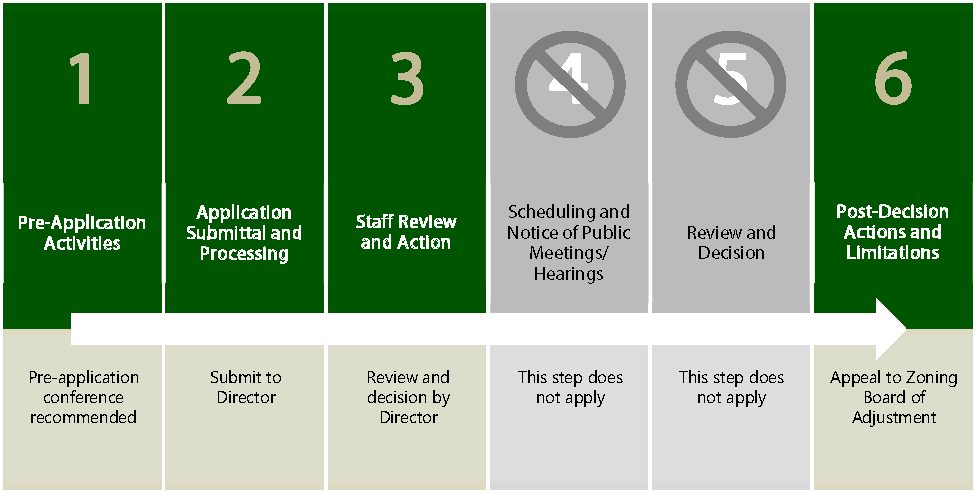
1.
Step 1: Pre-Application Activities.
a.
Pre-Application Conference. Not required.
b.
Citizen Participation. Not required.
2.
Step 2: Application Submittal and Processing. The business registration application shall be submitted and accepted, and may be revised or withdrawn, in accordance with Subsection 2.4.4.
3.
Step 3: Staff Review and Action. The Director shall issue a business registration when, after examination of the building, structure or site, the Department finds that the use of the building, structure or site complies with the applicable provisions of this DDC and other applicable Codes and ordinances.
4.
Step 4: Scheduling and Notice of Public Meetings/Hearings. Not required.
5.
Step 5: Review and Decision. Review and decision are subject to Subsection 2.4.7.
6.
Step 6: Post-Decision Actions and Limitations. Post-decision actions and limitations in Subsection 2.4.8 shall apply, with the following modifications:
a.
Effect of Approval.
i.
A business registration authorizes establishment of a new use of a building, structure or site and/or change of occupancy of an existing building or structure or site or recognizes nonconformity rights for an existing use with any additional terms and conditions of the registration.
ii.
The business registration shall clearly state that the proposed use of a building, structure or site complies with the provisions of this DDC or, in the case of a business registration establishing nonconformity rights, shall clearly state which provisions of the DDC are not met by the use.
iii.
For any proposed business registration requiring a building permit, a business registration shall be issued at the time of permitting.
b.
Revocation of a Business Registration.
i.
A business registration may be revoked by the Director if the use of the building, structure or site is inconsistent with the authorized use of the business registration.
ii.
The Director shall notify the registration holder in writing and provide 30 calendar days from the date of the letter for the permit holder to bring the use of the property into compliance with the business registration, or the business registration shall be revoked.
c.
Appeal to the Zoning Board of Adjustment.
i.
The applicant may appeal the denial, revocation, or suspension of a business registration to the Zoning Board of Adjustment in accordance with Subsection 2.8.3.
(Ord. No. DCA22-0002d, § 2(Exh. A), 7-19-2022)
2.5.9 - Traffic Impact Analysis.
A.
Purpose. The purpose of a Traffic Impact Analysis (TIA) is to assess the impacts of proposed development on the existing roadway system within the study area of the development, to assess the traffic flow needs within the development, and to specify measures which shall be included in any Civil Engineering Plans and Final Plats for the development in order to mitigate potential negative impacts identified by the assessment.
B.
Basis. The thoroughfare component of the Mobility Plan and the approved City of Denton traffic model.
C.
Applicability.
1.
A TIA will be required following review of a Trip Generation Study, as specified in the City of Denton Transportation Criteria Manual.
2.
A TIA will be required based on the traffic conditions as identified by the Trip Generation Study. A TIA shall accompany the initial application for a proposed development, or which shall accompany the initial non-zoning application, if traffic impact is determined by staff not to be relevant to a zoning request.
D.
Traffic Impact Analysis Procedure. Figure 2.5-9 identifies the applicable steps from the common review procedures in Section 2.4 that apply to the review of a Traffic Impact Analysis application. Additions or modifications to the common review procedures are noted below.
Figure 2.5-9: Summary of Traffic Impact Analysis Procedure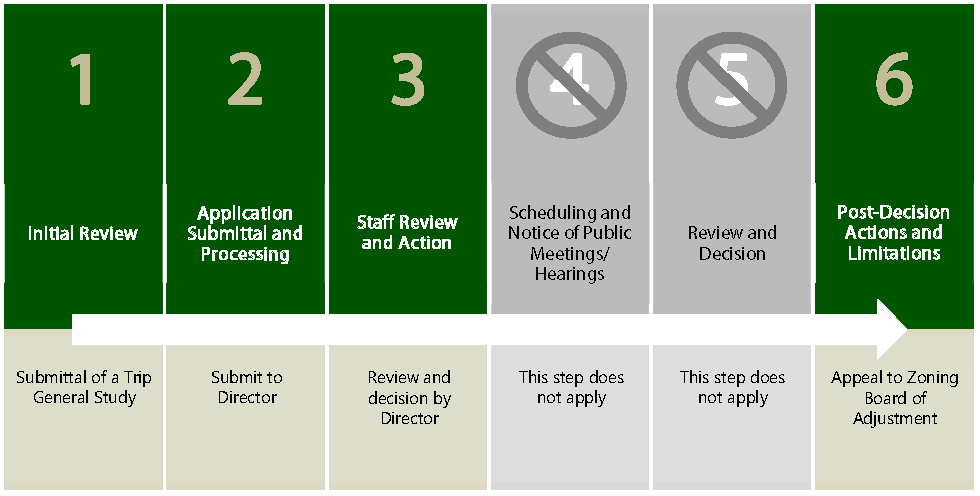
1.
Step 1: Initial Review.
a.
Review of Trip Generation Study. Determined by the City of Denton Engineer or designee.
b.
Scoping Meeting. Determined based on the Trip Generation Study.
2.
Step 2: Application Submittal and Processing.
a.
Applicability Determination. Following submission and review of the Trip Generation Study as part of the review of the initial application for a proposed development, the staff shall inform the applicant if, based on the applicability criteria outlined in the Transportation Criteria Manual, a Traffic Impact Analysis is required.
b.
Timing. A Traffic Impact Analysis, if determined to be required, shall be submitted, and review and determination shall be completed, prior to the acceptance of an application for Civil Engineering Plans, plats, or Building Permit for the subject development, or, if determined to be necessary by the Director, prior to placing a Zoning Amendment, Planned Development, or Specific Use Permit application on the Planning and Zoning or City Council agenda for consideration.
c.
Submission. A Traffic Impact Analysis shall be submitted, and may be revised or withdrawn, in accordance with Subsection 2.4.4.
3.
Step 3: Staff Review and Action.
a.
Staff will review the TIA and provide comments and recommendations in compliance with the Transportation Criteria Manual. Applicants will have the opportunity to resubmit the TIA with responses to staff recommendations and comments. The TIA shall not move forward to the next step until the staff determines that applicant has adequately responded to all staff recommendations and comments.
b.
When the applicant has submitted a TIA adequately addressing all staff recommendations and comments and the recommended mitigation measures meets the requirements of the Transportation Criteria Manual, the City of Denton Engineer or designee shall make a determination accepting the TIA.
4.
Step 4: Scheduling and Notice of Public Meetings/Hearings. Not required.
5.
Step 5: Review and Decision. Refer to Step 3.
6.
Step 6: Post-Decision Actions and Limitations. Post-decision actions and limitations in Subsection 2.4.8 shall apply, with the following modifications:
a.
Effect of Determination.
i.
The determination formalizes the mitigation necessary, establishing the inclusion of these measures as conditions for the approval of any Civil Engineering Plans, Plats, and Building Permits for the associated project.
b.
Criteria for Acceptance.
i.
Accurate and applicable traffic models were used in preparation of TIA.
ii.
TIA accurately and fully accounted for current and expected future development within the development study area.
iii.
Extent of the development study area used for TIA is appropriate to the size and nature of the development.
(Ord. No. DCA22-0002d, § 2(Exh. A), 7-19-2022)
2.5.10 - Real Estate Application.
A.
Purpose. The purpose of a Real Estate Application is to address public land rights requests related to; easement abandonments, right-of-way abandonments, encroachment requests, right-of-way use requests, and oil and gas pipeline license requests. The intent is for managing public land entitlements that endorse the public interest and infrastructure essential for fostering progress and development to emerge.
B.
Applicability. Public land rights request under this section may be requested by the property owner or owners that have a direct interest with the subject land rights. Each affected property owner shall be co-applicants to the request being made.
C.
Real Estate Application Procedure. Figure 2.5-10 identifies the applicable steps from the common review procedures in Section 2.4 that apply to the review of a Real Estate application. Additions or modifications to the common review procedures are noted below.
Figure 2.5-10: Summary of Real Estate Application Procedure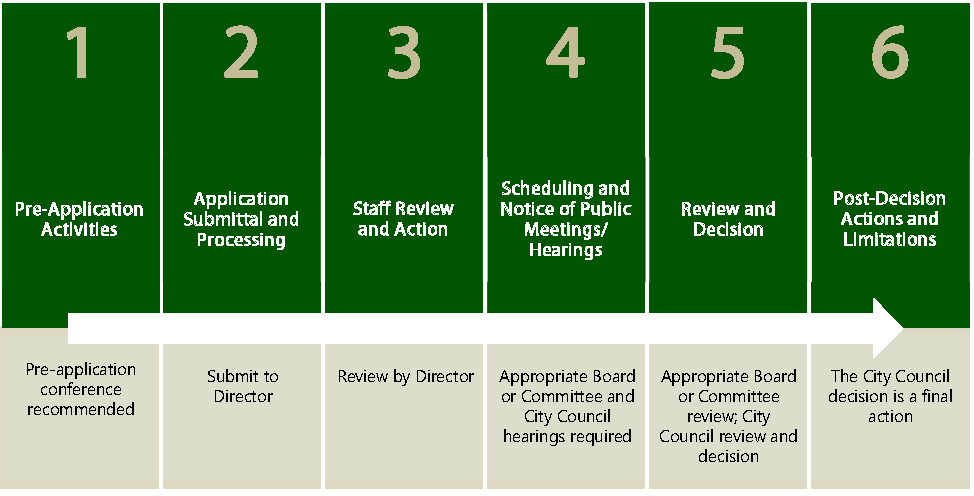
1.
Step 1: Pre-Application Activities.
a.
Pre-Application Conference. A pre-application conference is recommended in accordance with Subsection 2.4.3.
b.
Citizen Participation. Not required.
2.
Step 2: Application Submittal and Processing. The Real Estate application shall be submitted and accepted, and may be revised or withdrawn, in accordance with Subsection 2.4.4.
3.
Step 3: Staff Review and Action. Staff review and action is subject to Subsection 2.4.5, with the following modifications:
a.
Staff endorsement will be based on the nature of the request and public demand of the area. If an area is determined to be vital for the benefit of current or future public use, the request will be denied with no further action.
b.
Even with staff endorsement, the request may require a recommendation of approval from the Public Utilities Board (PUB) if utilities are affected or to the Traffic Safety Commission is traffic safety is an issue prior to the final review and consideration by City Council.
4.
Step 4: Scheduling and Notice of Public Meetings/Hearings. Given the nature of the public land rights request, a Real Estate application may be scheduled for public meetings before the PUB or Traffic Safety Commission for a recommendation. Following the meeting(s), the appropriate PUB or Traffic Safety Commission's recommendation will be forwarded to City Council. A Real Estate application shall be scheduled for public meeting before the City Council for consideration.
5.
Step 5: Review and Decision.
a.
The PUB or Traffic Safety Commission may review the Real Estate application and shall forward its recommendation(s) to the City Council.
b.
The City Council may approve, approve with conditions, or deny the Real Estate application.
6.
Step 6: Post-Decision Actions and Limitations.
a.
The City Council decision is a final action and may not be appealed.
b.
Approval of Real Estate application does not relieve the applicant from requirements or obligations, including fees, required by other sections of this DDC or any other Chapter of the Municipal Code of Ordinances or the Texas Local Government Code.
(Ord. No. DCA22-0002d, § 2(Exh. A), 7-19-2022)
2.5.11 - Certificate of Land and Use.
A.
Purpose. The certificate of land use procedure provides a mechanism for the city to evaluate new, existing, and/or changes in the use of land to ensure compliance with applicable standards of this DDC.
B.
Applicability. A certificate of land use shall be required prior to the use of land, except when a Certificate of Occupancy or Temporary Use Permit is required. The certificate of land use shall be used to confirm the proposed use is permitted as a primary use of the property or may be used to confirm the proposed use is a permitted accessory use to an established primary use of the property.
C.
Certificate of Land Use Procedure. Figure 2.5-11 identifies the applicable steps from the common review procedures in Section 2.4 that apply to the review of a certificate of land use. Additions or modifications to the common review procedures are noted below.
Figure 2.5-11: Summary of Certificate of Land Use Procedure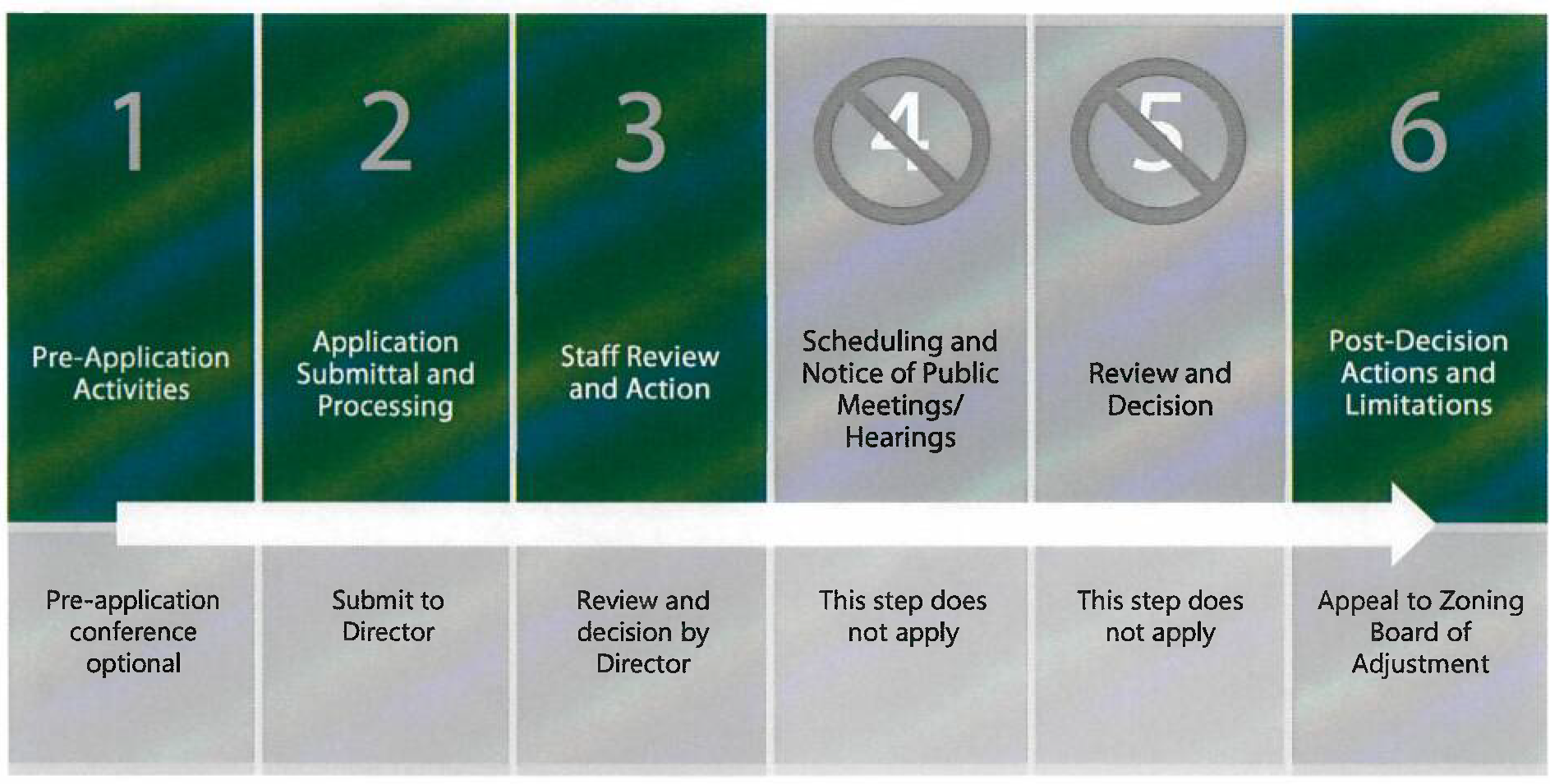
1.
Step 1: Pre-Application Activities.
a.
Pre-Application Conference. A pre-application conference is optional in accordance with Subsection 2.4.3.
b.
Citizen Participation. Not required.
2.
Step 2: Application Submittal and Processing. The certificate of land use application shall be submitted and accepted, and may be revised or withdrawn, in accordance with Subsection 2.4.4.
3.
Step 3: Staff Review and Action. The Director shall review the application and/or examine the site to determine conformance with the applicable standards. The applicable standards may include, but are not limited to: zoning, platting, parking, landscaping, lighting, noise, and other standards in accordance with Subsection 2.4.5.
4.
Step 4: Scheduling and Notice of Public Meetings/Hearings. Not required.
5.
Step 5: Review and Decision. The Director shall issue a certificate of land use, subject to any additional conditions, if the Director finds that the land use complies with the applicable provisions of this DDC and other applicable ordinances of the city in accordance with Subsection 2.4.7.
6.
Step 6: Post-Decision Actions and Limitations. Post-decision actions and limitations in Subsection 2.4.8 shall apply, with the following modifications:
a.
Effect of Approval.
i.
A certificate of land use authorizes establishment of a particular use on land, subject to any additional conditions.
ii.
The certificate of land use shall clearly state the approved permitted use of the land and any conditions associated with that use.
b.
Appeal to the Zoning Board of Adjustment. The applicant may appeal the denial, revocation, or suspension of a certificate of land use to the Zoning Board of Adjustment in accordance with Subsection 2.8.3.
(Ord. No. DCA24-0002b, § 2(Exh. A), 4-16-2024)
2.6.1 - General.
The following provisions apply to all subdivision procedures in this section:
A.
Timing of City Following Filing. The City shall review and take final action of any plat or civil engineering plan application within 30 calendar days of the application being filed in accordance with the procedures and timelines provided in TLGC § 212.009.
B.
Decisions and Post-Decision Actions. The authority responsible for approving the plat or civil engineering plans may either approve, approve with conditions, or deny the plat or plans.
1.
If a plat or plan is approved with conditions or denied, the reasons for such conditions or denial shall be provided in writing in accordance with TLGC § 212.0091.
2.
The applicant may submit a response to the approval conditions or disapproval. The response shall be submitted in accordance with the City's submittal calendar, and the Director or Commission shall approve or disapprove the response within 15 calendar days in accordance with TLGC § 212.0093.
3.
A one-time waiver of no more than 30 calendar days may be requested by the applicant prior to the Commission or Director's initial decision in accordance with TLGC § 212.009.
C.
Finding of Proportionality. Any payment of fees or construction costs or required easement, dedication, and/or reservation of land included on any plat application required in this section shall meet the requirements of TLGC, § 212.904.
D.
Applicability.
1.
These subdivision procedures shall apply to all land and all developments within the corporate limits of the City.
2.
In accordance with the City's Interlocal Agreement with Denton County, as may be amended and unless otherwise exempted in the following sections, the City's platting procedures as outlined in Sections 2.6.2 through 2.6.8 shall apply to areas within Division 1 of the extraterritorial jurisdiction (ETJ) of the City. All submittal requirements applicable to plats for areas within the corporate limits of the City shall apply to plats for areas within the Division 1 of the ETJ.
3.
Upon agreement with the county in accordance with the Interlocal Agreement, the City's Civil Engineering Plan process may be applied to areas within Division 1 of the ETJ of the City.
(Ord. No. DCA22-0002d, § 2(Exh. A), 7-19-2022)
2.6.2 - Administratively Approved Plat.
A.
Purpose. The administratively approved platting procedure is used to evaluate proposed plats that will create few lots and/or involve minimal adjustments to approved final plats. The administratively approved platting procedure also provides a mechanism for administrative platting decisions, to address plat errors, to apply minor adjustments to property boundaries, and for conveyance plats.
B.
Applicability. The administratively approved platting procedure shall apply to:
1.
Subdivisions of properties creating four or fewer lots fronting on an existing street and not requiring the creation of any new street or the extension of municipal facilities;
2.
An amending plat as permitted by TLGC § 212.016, as amended or superseded;
3.
A replat that does not require the creation of any new street or the extension of municipal facilities, as permitted by TLGC § 212.0065, as amended or superseded; and
4.
A conveyance plat, which is an interim plat recording the subdivision of property or defining the remainder of a property created by the approval of a final plat, and that creates four or fewer lots fronting on an existing street and not requiring the creation of any new street or the extension of municipal facilities. A conveyance plat may be used solely for the purpose of subdividing land and the recording of same, or recording a single existing lot or parcel created by other means. A conveyance plat allows the recording of a subdivision without requiring the construction or design of public improvements or collection of development fees. Easements, dedications, and reservations may be recorded on a conveyance plat.
C.
Administratively Approved Plat Procedure. Figure 2.6-1 identifies the applicable steps from the common review procedures in Section 2.4 that apply to the review of administratively approved plats. Additions or modifications to the common review procedures are noted below.
Figure 2.6-1: Summary of Administratively Approved Plat Procedure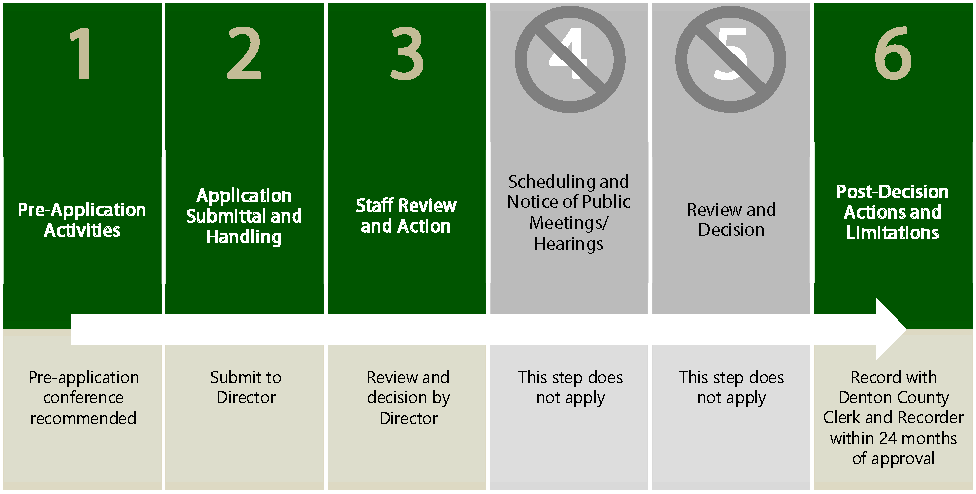
1.
Step 1: Pre-Application Activities.
a.
Pre-Application Conference. A pre-application conference is recommended in accordance with Subsection 2.4.3.
b.
Citizen Participation. Not required.
2.
Step 2: Application Submittal and Handling. The administratively approved plat application shall be submitted and accepted, and may be revised or withdrawn, in accordance with Subsection 2.4.4.
3.
Step 3: Staff Review and Action
a.
Director Review and Decision. The Director shall review and approve, approve with conditions, or refer the administratively approved plat to the Planning and Zoning Commission with a recommendation of disapproval in accordance with the approval criteria in Subsection 2.6.2D below.
b.
Referral to Planning and Zoning Commission.
i.
The Director, at their discretion, may refer the plat to the Planning and Zoning Commission.
ii.
The Director shall not disapprove an administratively approved plat but shall refer such plat to the Planning and Zoning Commission if the recommendation is denial.
4.
Step 4: Scheduling and Notice of Public Meetings/Hearings. Not required.
5.
Step 5: Review and Decision. Review and decision is subject to Subsection 2.4.7.
6.
Step 6: Post-Decision Actions and Limitations. Post-decision actions and limitations in Subsections 2.4.8 and 2.6.1 shall apply with the following modifications:
a.
Signing and Recording.
i.
After the approval of the plat, the applicant shall submit recording fees and the required number of copies of the plat and other items required for plat execution, as determined by the Director, to the city for recording with the county.
ii.
Upon receipt of all required fees and documents, the Director shall certify the plat and it shall be recorded with the Denton County Clerk and Recorder.
iii.
The Director shall forward one copy of the recorded plat to the property owner.
b.
Effect of Approval.
i.
Plat approval and acceptance by the city does not relieve the owner from obligations, including fees, required by other sections of this DDC or any other chapter of the Municipal Code of Ordinances pertaining to the improvement of the property or extension of services as required to make the property suitable for development.
ii.
Neither reservation nor dedication of right-of-way shall relieve the property owner from any obligation for street construction or assessments associated with public street improvement programs. Easements for access, utilities, and drainage shall be recorded on plats.
iii.
No building permits shall be issued, nor development begun, nor permanent utility service provided, for land that has only received approval of a conveyance plat. This information shall be set forth in bold type on the plat.
iv.
A conveyance plat may be vacated, replatted, or superseded in total or in part by compliance with the procedures and requirements of this DDC.
c.
Lapse of Approval.
i.
Any plat that has not been recorded with the county within 24 months of the date of approval shall be void.
ii.
Any plat withdrawn or voided must be resubmitted under current regulations and procedures and reapproved by the Planning and Zoning Commission or the Director and recorded with the county.
d.
Reservation of Rights-of-Way.
i.
Conveyance plats shall identify any future rights-of-way for public thoroughfares and streets specified on the city's thoroughfare plan;
ii.
The identification of the right-of-way does not grant any right or interest in the property to the city or other entity; and
iii.
The final alignment may be adjusted upon final platting in order to meet engineering design standards.
e.
Dedication of Rights-of-Way.
i.
Dedication of right-of-way shall be required where a plat is used to record the remainder of a tract created by the final platting of a portion of the property; and
ii.
The required right-of-way dedication shall be limited to that which is necessary to provide access to the property proposed for final plat approval and to complete turn lanes, intersections, and transitions in road pavement width resulting from development of property proposed for final plat approval.
D.
Administratively Approved Plat Approval Criteria. In reviewing an administratively approved plat application, the Director shall consider the general approval criteria in Subsection 2.4.5 and whether the application:
1.
Is consistent with the intent of the underlying zoning district;
2.
Complies with applicable dimensional and development standards in this DDC;
3.
Does not affect a recorded easement without approval from the easement holder;
4.
Will not result in adverse impacts to surrounding property;
5.
Will not limit the city's ability to provide adequate and sufficient facilities or services; and
6.
Complies with all other ordinances and plans and regulations adopted by the city, including the Comprehensive Plan and other long-range or special area planning documents.
(Ord. No. DCA22-0002d, § 2(Exh. A), 7-19-2022)
2.6.3 - Preliminary Plat.
A.
Purpose. The preliminary plat procedure provides a mechanism for the city to review an overall plan for a proposed subdivision to ensure compliance with this DDC, the Comprehensive Plan, other applicable city plans and regulations, and the adequate provision of facilities and services in the city.
B.
Applicability.
1.
A preliminary plat is optional within the corporate limits of the City.
2.
A preliminary plat is prohibited within the ETJ.
C.
Preliminary Plat Procedure. Figure 2.6-2 identifies the applicable steps from the common review procedures in Section 2.4 that apply to the review of preliminary plats. Additions or modifications to the common review procedures are noted below.
Figure 2.6-2: Summary of Preliminary Plat Procedure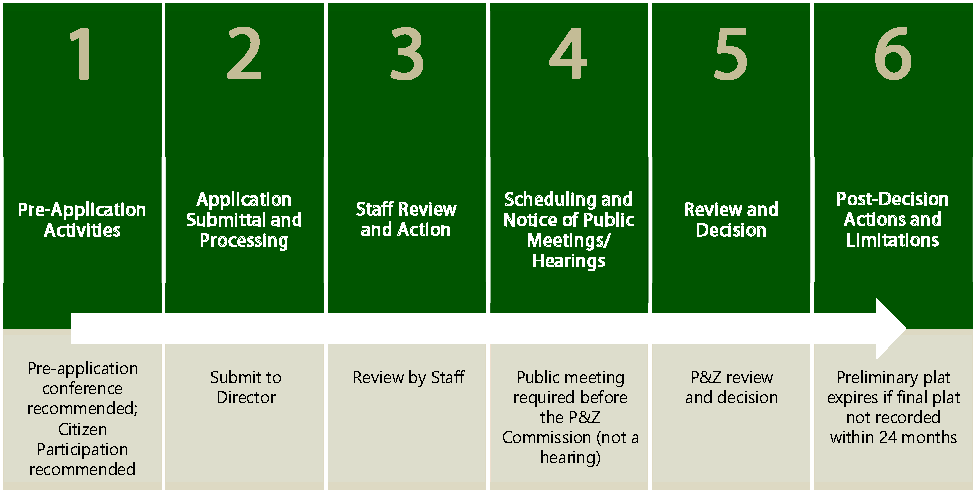
1.
Step 1: Pre-Application Activities.
a.
Pre-Application Conference. A pre-application conference is recommended in accordance with Subsection 2.4.3.
b.
Citizen Participation. Citizen Participation is recommended in accordance with Subsection 2.4.3B: Citizen Participation.
2.
Step 2: Application Submittal and Processing. The preliminary plat application shall be submitted and accepted, and may be revised or withdrawn, in accordance with Subsection 2.4.4.
3.
Step 3: Staff Review and Action. The Director shall review the preliminary plat application and prepare a staff report and recommendation that includes the City Engineer's findings when required by TLGC, § 212.904, in accordance with the approval criteria in Subsection 2.6.3D below.
4.
Step 4: Scheduling of Public Meetings. The preliminary plat application shall be scheduled for public meetings before the Planning and Zoning Commission.
5.
Step 5: Review and Decision. The Planning and Zoning Commission shall review and approve, approve with conditions, or deny the preliminary plat application in accordance with Section 2.6.1 and with the approval criteria in Subsection 2.6.3D below.
6.
Step 6: Post-Decision Actions and Limitations. Post-decision actions and limitations in Subsections 2.4.8 and 2.6.1 shall apply with the following modifications:
a.
Expiration of Approval. A preliminary plat shall become null and void 24 months from the date of approval or approval with conditions by the Planning and Zoning Commission, unless a final plat is filed and approved for all or part of the preliminary plat within that time or within the time provided by a phasing schedule approved for the preliminary plat, or a project has approved Civil Engineering Plans and the subject site has commenced clearing and grading.
b.
Effect of Approval.
i.
Within 24 months of approval of the final plat for the first phase of the development, or within such other period as may be provided in a phasing schedule approved by the Planning and Zoning Commission, a complete application for a final plat must be approved for the next phase of the development, continuing with each successive phase, until final plats have been approved for all the land subject to the original preliminary plat in accordance with this section or a phasing schedule approved by the Planning and Zoning Commission.
ii.
If the applicant fails to receive approval for a final plat for any phase of the development within the prescribed period, or within any extension granted pursuant to Subsection 2.6.3C.6.c, below, the original preliminary plat shall expire for that phase and for all other phases for which a final plat has not been approved or no longer remains in effect on the date of expiration.
iii.
If an approved final plat expires, the preliminary plat for that phase shall also expire, and all other phases for which a final plat has not been approved or is not pending approval, or has lapsed subsequent to approval, on the date of expiration.
c.
Extension of Preliminary Plat Approval.
i.
The Planning and Zoning Commission may extend a preliminary plat or any phase thereof pursuant to Subsection 2.4.8D: Extensions of Approval Period, and the following criteria:
a.
The request must be considered by the Planning and Zoning Commission before the preliminary plat or phase expires and must document the reasons for the extension.
b.
In determining whether to grant a request, the Planning and Zoning Commission shall take into account:
1.
The reasons for the requested extension;
2.
The ability of the applicant to comply with any conditions attached to the original approval;
3.
Whether the extension is likely to result in timely completion of the project; and
4.
The extent to which any newly adopted regulations should be applied to the proposed development.
c.
In granting an extension, the Planning and Zoning Commission may impose such conditions as are needed to assure that the land will be developed in a timely fashion and that the public interest is served, including compliance with one or more new adopted development standards.
D.
Preliminary Plat Approval Criteria. In reviewing a preliminary plat application, the Planning and Zoning Commission shall consider the general approval criteria in Subsection 2.4.5 and whether the preliminary plat:
1.
Provides a layout of lots, roads, driveways, utilities, drainage, and other public facilities and services designed to minimize the amount of disturbance to sensitive natural areas or other community resources;
2.
Provides evidence of public water and sewer system connections;
3.
Identifies and adequately mitigates known natural hazard areas; and
4.
Proposes reasonable project phasing in terms of infrastructure capacity.
(Ord. No. DCA21-0002a, § 2, 5-4-2021; Ord. No. DCA22-0002d, § 2(Exh. A), 7-19-2022; Ord. No. DCA23-0009a, § 2, 9-19-2023)
2.6.4 - Final Plat.
A.
Purpose. The final plat procedure completes the subdivision process and ensures compliance with the approved preliminary plat and applicable standards in this DDC.
B.
Applicability. The final plat procedure applies to all subdivisions in the city and the ETJ, unless otherwise stated in this DDC.
C.
Final Plat Procedure. Figure 2.6-3 identifies the applicable steps from the common review procedures in Section 2.4 that apply to the review of final plats. Additions or modifications to the common review procedures are noted below.
Figure 2.6-3: Summary of Final Plat Procedure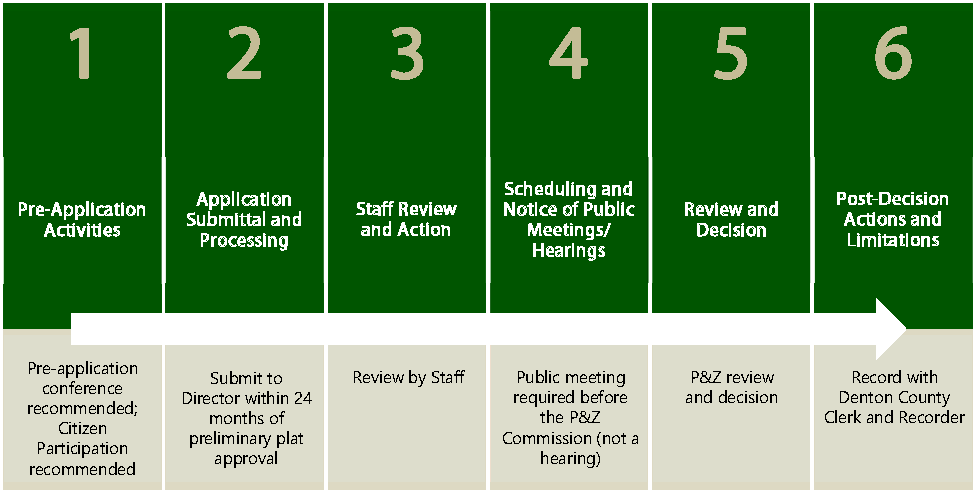
1.
Step 1: Pre-Application Activities.
a.
Pre-Application Conference. A pre-application conference is recommended in accordance with Subsection 2.4.3.
b.
Citizen Participation. Citizen Participation is recommended in accordance with Subsection 2.4.3B: Citizen Participation.
2.
Step 2: Application Submittal and Processing. The final plat application shall be submitted and accepted, and may be revised or withdrawn, in accordance with Subsection 2.4.4, and subject to the following modifications:
a.
The final plat application shall be submitted within 24 months of preliminary plat approval, or within six months as established in Subsection 2.6.3C.6;
b.
The final plat may reflect the entire area covered by a preliminary plat or any part thereof;
c.
ESA Compliance Review shall be reviewed concurrently with an application for a final plat in accordance with Subsection 7.4.4: ESAs Procedures; and
d.
The Director may require submittal of civil engineering plans for proposed streets, sidewalks, drainage, utility, or other public improvements associated with the final plat review. If required, a zoning compliance plan must be reviewed and approved prior to the submittal of Civil Engineering Plans.
3.
Step 3: Staff Review and Action. The Director shall review the final plat application and prepare a staff report and recommendation that includes the City Engineer's findings when required by TLGC, § 212.904, in accordance with the approval criteria in Subsection 2.6.4D below.
4.
Step 4: Scheduling and Notice of Public Meetings/Hearings. The final plat application shall be scheduled for public meetings before the Planning and Zoning Commission.
5.
Step 5: Review and Decision. The Planning and Zoning Commission shall review and approve, approve with conditions, or deny the final plat application in accordance with Subsection 2.6.1 and with the approval criteria in Subsection 2.6.4D below.
6.
Step 6: Post-Decision Actions and Limitations. Post-decision actions and limitations in Subsections 2.4.8 and 2.6.1 shall apply with the following modifications:
a.
Effect of Approval. The Director shall record the approved final plat in the appropriate records of Denton County.
b.
Expiration of Approval:
i.
An approved Final Plat which has not been filed in the appropriate records of Denton County within 24 months of its approval or approval with conditions shall be void unless an extension is granted by the Planning and Zoning Commission for good cause.
ii.
Any plat withdrawn or voided must be resubmitted under current regulations and procedures and reapproved by the Planning and Zoning Commission and recorded with the county.
D.
Final Plat Approval Criteria. In reviewing a final plat application, the Planning and Zoning Commission shall consider the general approval criteria applicable to all applications in Subsection 2.4.5 and whether:
1.
The final plat conforms to the approved preliminary plat, including any conditions of approval;
2.
The development will substantially comply with all requirements of this DDC; and
3.
The development will comply with the applicable technical standards and specifications adopted by the city.
(Ord. No. DCA22-0002d, § 2(Exh. A), 7-19-2022)
2.6.5 - Development Plat.
A.
Purpose. The development plat procedure provides a mechanism for any person who proposes development of a tract of land located within the corporate limits or within the city's extraterritorial jurisdiction that is not required by this DDC to prepare a preliminary or final plat.
B.
Applicability. Any person who proposes the development of a tract of land located within the corporate limits or within the city's extraterritorial jurisdiction that is not required by this DDC to prepare a preliminary or final plat, shall prepare a development plat in accordance with the elements required for preliminary and final plats by this subchapter unless:
1.
The development is excepted under Section 8.2.3: Exemptions; or
2.
The development is an addition or alteration to existing development which, after development, would result in development no less compliant with the DDC than before the development.
C.
Development Plat Procedure. Figure 2.6-4 identifies the applicable steps from the common review procedures in Section 2.4 that apply to the review of development plats. Additions or modifications to the common review procedures are noted below.
Figure 2.6-4: Summary of Development Plat Procedure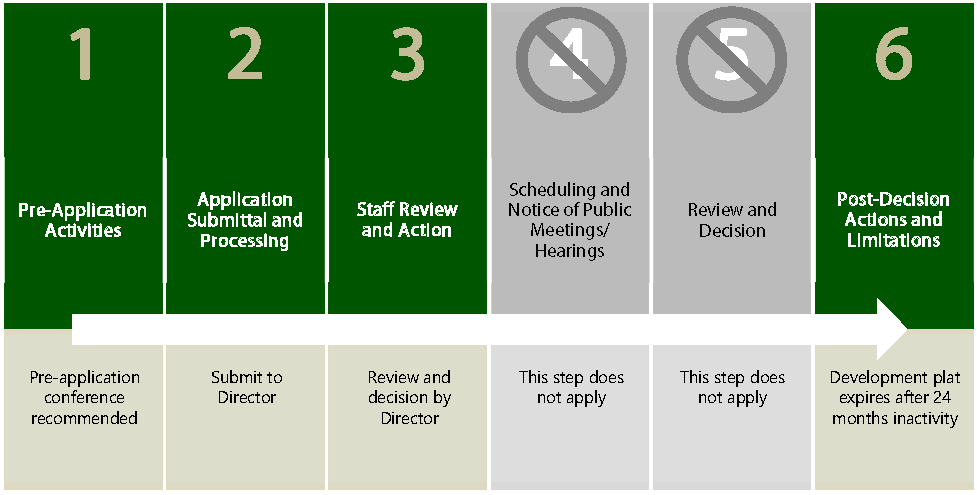
1.
Step 1: Pre-Application Activities.
a.
Pre-Application Conference. A pre-application conference is recommended in accordance with Subsection 2.4.3.
b.
Citizen Participation. Not required.
2.
Step 2: Application Submittal and Processing. The development plat application shall be submitted and accepted, and may be revised or withdrawn, in accordance with Subsection 2.4.4.
3.
Step 3: Staff Review and Action. The Director shall review the development plat application and approve, approve with conditions, or deny the application in accordance with Subsection 2.4.5 and TLGC, §§ 212.041 through 212.050, as amended. No new development may begin on the subject property until the development plat is filed and approved by the City.
4.
Step 4: Scheduling and Notice of Public Meetings/Hearings. Not required.
5.
Step 5: Review and Decision. Review and decision is subject to Subsections 2.6.1 and 2.6.5C.3.
6.
Step 6: Post-Decision Actions and Limitations. A development plat shall become null and void 24 months from the date of approval by the Director if no progress toward completion has been made per TLGC, § 245.005(c), as amended.
(Ord. No. DCA22-0002d, § 2(Exh. A), 7-19-2022)
2.6.6 - Gas Well Development Plat.
A.
Plats Required. Any person who proposes gas drilling or production on a tract of land located within the city's extraterritorial jurisdiction, shall submit a gas well development plat for review and approval by the city. If any portion of the proposed area to be platted lies within a floodplain, an ESA or within 1,200 feet of the flood pool elevation of Lake Ray Roberts or Lake Lewisville, a watershed protection permit application for such area(s) shall be submitted with the development plat application, and shall be decided before any decision on the plat.
B.
Gas Well Development Plats in Areas Subject to Flooding. No gas well development plat shall be approved for land located within a floodplain, an ESA or within 1,200 feet of the flood pool elevation of Lake Ray Roberts or Lake Lewisville until a watershed protection permit and, where applicable, a specific use permit or application for relief pursuant to Subsection 2.8.5, have been first approved. Denial or conditional approval of the applicable watershed protection permit or petition for review shall constitute grounds for denial or conditional approval of the gas well development plat for such land.
C.
Gas Well Development Plat Procedures. Gas well development plats shall be processed and approved in accordance with TLGC, §§ 212.041 through 212.050, as amended, and no new natural gas development may begin on property until the gas well development plat is filed and approved by the city in accordance with this DDC.
D.
Gas Well Development Plat Standards for Approval. Gas well development plats shall conform to the following standards:
1.
All proposed gas well development shall be in compliance with the Roadway Component of the Mobility Plan.
2.
Erosion control is required and shall comply with all local, state, and federal requirements or as required by the watershed protection permit or gas well development plat. The operator shall file a copy of the stormwater pollution plan if required by the EPA.
3.
Reserve pits within 200 feet of a body of water, creek or floodplain shall be lined to prevent water pollution.
4.
With the exception of vehicular access, no gas well development or activity is allowed in the FEMA designated 100-year floodway. Drilling within a flood fringe or other ESA shown on the map adopted by the city is allowed under the restrictions set forth in Subsection 6.3.9D: Watershed Protection Permit Standards.
5.
Where tree mitigation is required, pursuant to a watershed protection permit, any funds due shall be paid prior to final approval of a gas well development plat.
6.
No gas well development plat shall be approved until the applicant has entered into a road damage remediation agreement with the city in substantially the same form as the agreement on file in the City's Development Services Department and has paid all road damage remediation fees provided for in the agreement based in the road damage remediation calculations set forth in the attachments to the agreement. A road damage remediation agreement is not required if access to the well site is through roadways not maintained by the city.
7.
The gas well development plat shall provide for adequate required public facilities, which may include water supply, access roads, drainage, erosion control and other necessary supporting facilities identified on the plat. The design, location, and arrangement of all driveways and required parking spaces shall provide for the safe and convenient movement of vehicular and pedestrian traffic without adversely affecting the general public or adjacent developments.
8.
In addition to the requirements of Subsection 2.6.3: Preliminary Plat, if applicable, a gas well development plat shall:
a.
Identify truck routes and access points.
b.
Identify environmentally sensitive areas (ESA's) including floodplains and any proposed floodplain, creek and stream crossings.
i.
All floodplain, creek and stream crossings requiring the use of a culvert shall be designed to a 10-year storm frequency.
ii.
All floodplain crossings shall have no negative effects on surrounding property.
iii.
A drainage study sufficient to substantiate subsections (i) and (ii) above will be required as part of the submittal if crossings are proposed.
c.
Show the location and use of all structures within 1,000 feet of the wellhead.
d.
Identify the proposed source of water and any other public utilities required.
e.
Identify and show proposed method of erosion control.
f.
Identify the location of proposed lease lines and well locations.
i.
Label distance between wells and property lines.
ii.
Label distance between wells and structures within 500 feet of wells as measured from the property line.
iii.
Label distance between temporary holding ponds and floodplains.
g.
Provide typical well site schematics showing layout during drilling and upon completion of drilling.
h.
Show location of all proposed underground pipelines. As built drawings shall be filed with the city. All pipelines proposed in public rights-of-way shall require a right-of-way use agreement. The City Manager shall have the authority to enter into a right-of-way use agreement.
i.
Identify if pipelines connect with a gas distribution system.
j.
Clearly delineate the boundaries of the gas well drilling or production area with metes and bounds. All gas well drilling and production activities shall be limited to this area.
k.
A gas well development plat shall only contain one drilling or production area, and the area shall not be greater than five acres.
E.
Expiration of Gas Well Development Plat.
1.
If gas well drilling activities have not commenced within one year from the date of approval, the gas well development plat shall expire.
2.
A gas well development plat may not be extended.
3.
If the gas well development plat expires, then so too shall all associated watershed protection permits.
4.
Upon expiration of a gas well development plat, the applicant may reapply for a new gas well development plat, subject to all requirements of the DDC, as amended. If a watershed protection permit is required in conjunction with the gas well development plat, the applicant must also apply for a new watershed protection permit, subject to all requirements of the DDC, as amended.
5.
If gas well drilling or production has commenced, the gas well drilling and production area shall be subject to inspections by the city.
(Ord. No. DCA22-0002d, § 2(Exh. A), 7-19-2022)
2.6.7 - Replat.
A.
Purpose. The intent of the replat procedure is to outline the process for replatting any portion of an approved final plat, other than to amend or vacate the plat.
B.
Applicability. A replat of a subdivision or part of a subdivision may be recorded and is controlling over the preceding plat without vacation of that plat if the replat:
1.
Is signed and acknowledged by the owners of the property being replatted;
2.
Is approved by the municipal authority responsible for approving plats; and
3.
Does not attempt to amend or remove any covenants or restrictions.
C.
Replat Procedure. Figure 2.6-7 identifies the applicable steps from the common review procedures in Section 2.4 that apply to the review of Replat applications. Additions or modifications to the common review procedures are noted below.
Figure 2.6-7: Summary of Replat Procedure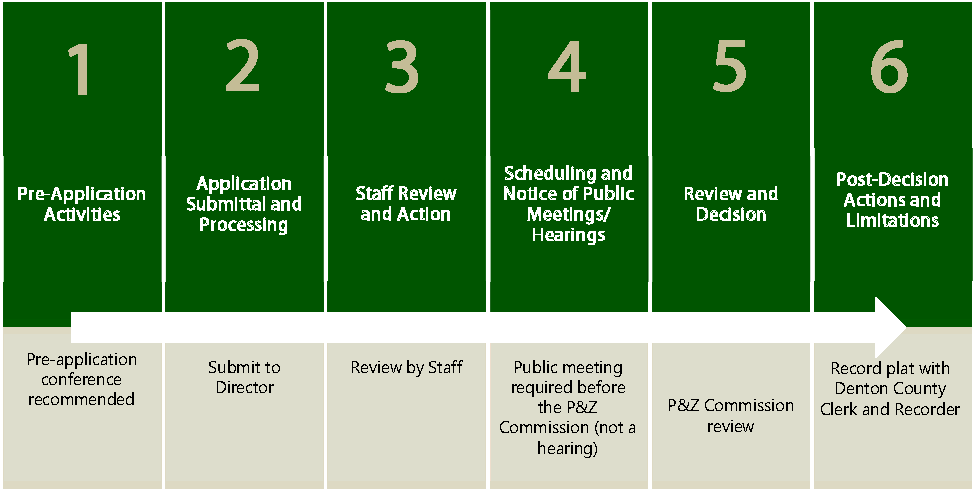
1.
Step 1: Pre-Application Activities.
a.
Pre-Application Conference. A pre-application conference is recommended in accordance with Subsection 2.4.3.
b.
Citizen Participation. Not required.
2.
Step 2: Application Submittal and Handling.
a.
Generally. The replat application shall be submitted and accepted, and may be revised or withdrawn, in accordance with Subsection 2.4.4.
b.
Contents of Application. The replat shall include, at a minimum, the following information and any other details as specified on the published checklist:
i.
Subdivision title block identifying lot, block, area, and location data.
ii.
Graphical and site data to define and dimension the area and the layout of existing and proposed lot(s) and block(s), existing and proposed easements, adjacent rights-of-way, and right-of-way dedications.
iii.
Adjacent properties labeled with owner, recording, zoning, and use information.
iv.
Labeled jurisdictional boundary lines adjacent to or intersecting the property.
v.
Location and dimensions of any floodplain, parkland, and environmentally sensitive areas.
vi.
Legal description of property, all necessary dedication and approval language, and appropriate signature blocks.
vii.
Applicable plat notes as required by this DDC, any City of Denton Criteria Manuals, and any state or federal agency.
3.
Step 3: Staff Review and Action.
a.
Director Review and Decision. A replat application is subject to administrative review and approval, approval with conditions, or recommendation of disapproval by the Director, in accordance with the approval criteria in Subsection 2.6.7D below, if:
i.
The replat involves four or fewer lots fronting an existing street that does not require the creation of any new street or the extension of municipal facilities; and
ii.
The replat does not require a public meeting or hearing before the Planning and Zoning Commission per TLGC § 212.015; or
iii.
The replat meets the criteria in TLGC § 212.0145 and does not require the creation of any new street or the extension of municipal facilities.
b.
Referral to Planning and Zoning Commission.
i.
The Director shall not deny a replat that is eligible to be administratively approved but shall refer such replat to the Planning and Zoning Commission if recommending disapproval.
ii.
The Director, at their discretion, may refer any replat that is eligible to be administratively approved to the Planning and Zoning Commission.
iii.
Any replat that requires a variance or exception as provided for in the Denton Development Code shall be referred to the Planning and Zoning Commission.
iv.
Any residential replats without vacation of the preceding plat shall be referred to the Planning and Zoning Commission and shall comply with the requirements of TLGC § 212.015 if:
1.
During the preceding five years, any of the area to be replatted was limited by an interim or permanent zoning classification to residential use for not more than two residential units per lot; or
2.
Any lot in the preceding plat was limited by deed restrictions to residential use for not more than two residential units per lot.
v.
All other replats without vacation of the preceding plat and that do not qualify for administrative approval shall be referred to the Planning and Zoning Commission.
vi.
In the case of referral to the Planning and Zoning Commission, the Director shall review the replat application and prepare a staff report and recommendation in accordance with the approval criteria. Staff report shall include the City of Denton Engineer's findings when required by TLGC § 212.904.
4.
Step 4: Scheduling and Notice of Public Meetings/Hearings.
a.
If referred to the Planning and Zoning Commission, the replat application shall be scheduled for public meetings before that body.
b.
Any replat that requires a variance or exception as provided for in the Denton Development Code shall be scheduled for public hearings before the Planning and Zoning Commission and noticed per TLGC § 212.015(b).
5.
Step 5: Review and Decision.
a.
Planning and Zoning Commission Review and Decision.
Planning and Zoning Commission Review and Decision Planning and Zoning Commission shall review and approve, approve with conditions, or disapprove the replat applications referred to them in accordance with the approval criteria in Subsection 2.6.7D below.
b.
Protest Procedure.
i.
If a proposed replat requires a variance or exception, the rules governing replat over protest contained in TLGC § 212.015(b-c) shall apply. The Director may prescribe forms for protest petitions.
ii.
Property owners of lots that are in the original subdivision and that are within 200 feet of the lot(s) to be replatted, as indicated on the most recently approved city tax roll, may file a written protest against the replat.
iii.
If written protests are received from owners of 20 percent or more of the area of the lots and land within 200 feet of the proposed replat, within the original subdivision, then approval shall require a three-fourths vote of the members present of the Planning and Zoning Commission for a replat to become effective. The area of streets and alleys shall be included in the area computations.
6.
Step 6: Post-Decision Actions and Limitations. Post-decision actions and limitations in Subsection 2.4.8 shall apply with the following modifications:
a.
Notification. Any approved residential replat that meets the criteria in Section 2.6.7C.3.b.iv and that did not require a variance shall be noticed to the public by the city no later than the 15th day after the date the replat is approved, pursuant to TLGC § 212.015(f-g), as amended.
b.
Signing and Recording.
i.
After the approval of the replat, the applicant shall provide the required number of signed copies of the plat and other items required for plat execution, as determined by the Director, to the city for recording with the county.
ii.
Upon receipt of all required fees and documents, the Director shall record the plat in the appropriate records of Denton County.
c.
Effect of Approval.
i.
Upon approval and recording of the replat, it is controlling over the previously recorded plat for the portion re-platted.
ii.
Plat approval and acceptance by the city does not relieve the owner from obligations, including fees, required by other sections of this DDC or any other chapter of the Municipal Code of Ordinances pertaining to the improvement of the property or extension of services as required to make the property suitable for development. Neither reservation nor dedication of right-of-way, as shown on the City's adopted Mobility Plan, or Capital Improvement Plan, shall relieve the property owner from any obligation for street construction or assessments associated with public street improvement programs. Easements for access, utilities, and drainage shall be recorded on replats.
d.
Lapse of Approval.
i.
Any replat that has not been recorded with the county within 24 months of the date of approval shall be void.
ii.
Any replat withdrawn or voided must be resubmitted under current regulations and procedures and reapproved by the Planning and Zoning Commission or the Director and recorded with the county.
D.
Replat Approval Criteria. In reviewing a replat application, the Director and/or Planning and Zoning Commission shall consider the general approval criteria in Subsection 2.4.5 and whether the application:
1.
Is consistent with the intent of the underlying zoning district;
2.
Complies with applicable dimensional and development standards in this DDC;
3.
Does not affect a recorded easement without approval from the easement holder;
4.
Will not result in adverse impacts to surrounding property;
5.
Will not limit the city's ability to provide adequate and sufficient facilities or services; and
6.
Complies with all other ordinances and plans and regulations adopted by the city, including the Comprehensive Plan and other long-range or special purpose area planning documents.
(Ord. No. DCA22-0002d, § 2(Exh. A), 7-19-2022)
2.6.8 - Vacating Plat.
A.
Purpose. The intent of the vacating plat procedure is to outline the process for vacation of all or a portion of a prior-approved plat.
B.
Applicability. The property owner of the tract covered by a plat may vacate the plat pursuant to TLGC, § 212.013, as amended. If dedicated by an instrument other than a plat, then the applicant shall follow the procedure established in Charter, Article XII: Public Utilities.
C.
Vacating Plat Procedure. Figure 2.6-8 identifies the applicable steps from the common review procedures in Section 2.4 that apply to the review of vacating plats. Additions or modifications to the common review procedures are noted below.
Figure 2.6-8: Summary of Vacating Plat Procedure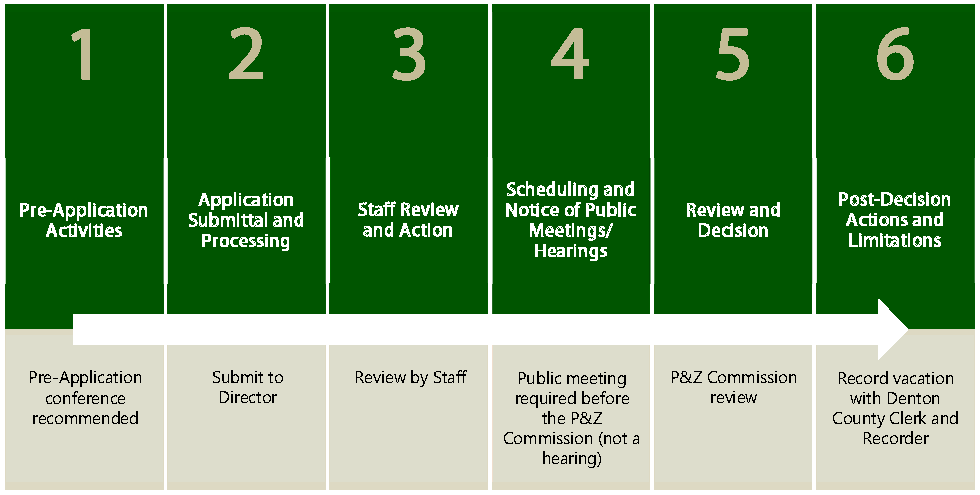
1.
Step 1: Pre-Application Activities.
a.
Pre-Application Conference. A pre-application conference is recommended in accordance with Subsection 2.4.3.
b.
Citizen Participation. Not required.
2.
Step 2: Application Submittal and Processing. The vacating plat application shall be submitted and accepted, and may be revised or withdrawn, in accordance with Subsection 2.4.4.
3.
Step 3: Staff Review and Action. The Director shall review the vacating plat application and prepare a staff report and recommendation in accordance with the general approval criteria applicable to all applications in Subsection 2.4.5.
4.
Step 4: Scheduling and Notice of Public Meetings/Hearings. The vacating plat application shall be scheduled for a public meeting before the Planning and Zoning Commission and shall be noticed pursuant to Table 2.2-A Summary of Development Review Procedures and Subsection 2.4.6.
5.
Step 5: Review and Decision.
a.
The Planning and Zoning Commission shall review and approve, approve with conditions, or deny the vacating plat application in accordance with the general approval criteria applicable to all applications in Subsection 2.4.5.
b.
As a condition of approval, the Planning and Zoning Commission may require the applicant to prepare a revised final plat in accordance Subsection 2.6.1 and with Subsection 2.6.4: Final Plat.
6.
Step 6: Post-Decision Actions and Limitations. Post-decision actions and limitations in Subsections 2.4.8 and 2.6.1 shall apply with the following modifications:
a.
The Director shall record the vacating plat with the Denton County Clerk and Recorder prior to the recordation of a new plat.
b.
Regardless of the Planning and Zoning Commission's action on the application, the applicant will have no right to a refund of any monies, fees, or charges paid to the city nor to the return of any property or consideration dedicated or delivered to the city except as may have previously been agreed to by the Planning and Zoning Commission.
(Ord. No. DCA22-0002d, § 2(Exh. A), 7-19-2022)
2.6.9 - Civil Engineering Plans.
A.
Purpose. Civil engineering plan review is intended to ensure that all required or proposed public improvements to be constructed, reconstructed, improved, or modified, including streets, sidewalks, bicycle infrastructure, drainage facilities, and utility improvements are designed to meet the DDC, Criteria Manuals and design specifications of the City of Denton.
B.
Applicability. Civil engineering plan review is required for all applications containing public improvements or impacting public infrastructure. The civil engineering plans are intended to provide review of detailed engineering drawings for all public improvements required to serve the proposed development.
C.
Civil Engineering Plans Procedure. Figure 2.6-9 identifies the applicable steps from the common review procedures in Section 2.4 that apply to the review of a Civil Engineering Plans application. Additions or modifications to the common review procedures are noted below.
Figure 2.6-9: Summary of Civil Engineering Plans procedure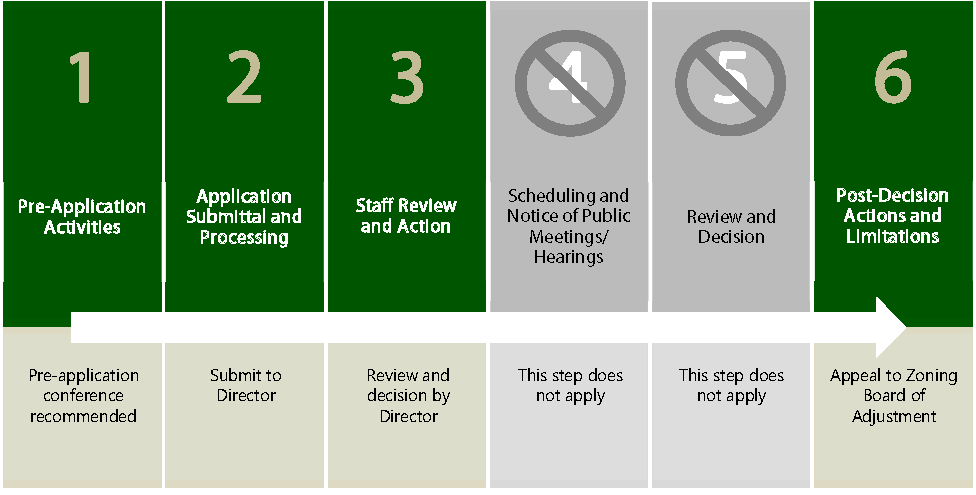
1.
Step 1: Pre-Application Activities.
a.
Pre-Application Conference. A pre-application conference is recommended in accordance with Subsection 2.4.3.
b.
Citizen Participation. Not required.
2.
Step 2: Application Submittal and Processing. The civil engineering plans shall be submitted and accepted, and may be revised or withdrawn, in accordance with Subsection 2.4.4, with the following additional application requirements:
a.
Application Contents. Civil engineering plans showing details of streets, culverts, bridges, storm sewers, water mains, sanitary sewers and all engineering details, other than buildings, of the proposed subdivision shall be submitted. Such plans shall be prepared by an engineer registered in the State of Texas and shall conform to the DDC, Criteria Manuals and standard specifications of the City of Denton. The civil engineering plans shall include, at a minimum, the following information and any other details as specified on the published checklist:
i.
General. North arrow, scale, date and mean sea level elevations of all improvements. The plans shall provide for a reference to elevation benchmark or monumentation used the in development of the plans. The civil engineering plans shall be signed and sealed by a professional engineer licensed by the State of Texas prior to bidding the project for construction.
ii.
Streets. The plan and profile of streets, drawn with a horizontal scale of one (1) inch equals forty (40) feet or larger, and appropriate corresponding vertical scale, showing the top of curb grades at one-hundred-foot intervals for straight grades and twenty-five-foot intervals for vertical curves. Typical right-of-way cross sections of streets, sidewalks, and alleys showing the width and type of pavement, base, and subgrade, the location within the right-of-way, and specific street crown information, including the pavement transition to split curbs, valley gutters, and stormwater inlets. Street design, layout, and connectivity shall be designed and constructed in accordance with the standards of Subsection 7.8 and the associated design criteria manual.
iii.
Sanitary Sewer Systems. Plan and profile for each sanitary sewer line showing existing ground level elevation at center line of pipe, pipe size, flow line elevation at all drops, and turns, and station numbers at fifty-foot intervals, with a section showing embedment, unless specified or permitted otherwise by the committee. Water and Wastewater improvements shall be designed and constructed in accordance with the standards or Subsection 7.6 and the associated design criteria manuals.
iv.
Water Systems. Plan and profile, when required, of the water distribution system showing pipe sizes and the location of valves, fire hydrants, fittings and other appurtenances, with a section showing embedment. Water and Wastewater improvements shall be designed and constructed in accordance with the standards of Subsection 7.6 and the associated design criteria manuals.
v.
Stormwater Management Systems. Plans and profile, when requested, of all proposed channels, ditches, underground systems, detention areas, and any other stormwater improvements, modifications, or facilities proposed to serve the development. The plans shall specify in detail the materials and sizing for all channels or ditches, stormwater pipes, pipe connections, inlets, outlets, manholes, culverts, bridges and any other drainage structures and improvements. Each improvement shall show the hydraulic data on which the design of the improvement was based. Stormwater management systems shall be designed and constructed in accordance with the standards of Subsection 7.5 and the associated design criteria manual.
vi.
Grading. A grading plan showing the existing and proposed topography in two-foot contours, proposed or minimum finished floor elevations, and the 100-year flood limits, if any. The grading plan shall consist of contours and spot elevations with water directional arrows to define the flow patterns. Land-disturbing activities shall be planned and constructed in accordance with the standards of Subsection 7.3.
vii.
Erosion Control. The location, size, and character of all temporary and permanent erosion and sediment control facilities with specifications detailing all on-site erosion control measures which will be established and maintained during all periods of development and construction. Land-disturbing activities shall be planned and constructed in accordance with the standards of Subsection 7.3.
3.
Step 3: Staff Review and Action. The Director, or designee, shall review the Civil Engineering Plan application and approve, approve with conditions, or disapprove with reasons, in accordance with Subsections 2.4.5 and 2.6.1.
4.
Step 4: Scheduling and Notice of Public Meetings/Hearings. Not required.
5.
Step 5: Review and Decision. Refer to Step 3.
6.
Step 6: Post-Decision Actions and Limitations. Post-decision actions and limitations are subject to Subsections 2.4.8 and 2.6.1, with the following modifications:
a.
Effect of Approval. Approval of civil engineering plans allows the release of plans for construction based on general compliance with the city's standards and regulations. An approved Final Plat, notice to proceed, and applicable permits must be issued prior to construction. An approval with conditions will contain a written agreement between the applicant and the city that enforces the conditions. All conditions shall comply with the limitations in Subsection 2.4.5F.
b.
Lapse of Approval.
i.
Unless otherwise provided in the conditions of approval, Civil Engineering Plans shall expire after 24 months if the use or construction has not obtained all necessary permits where the Final Plat has been recorded or not. A submission of new Civil Engineering Plans will be required, modified to be in accordance with current city construction standards.
ii.
Extensions may be granted by the Director for good cause shown due to unforeseen circumstances, such as an application for amendments to the approved Civil Engineering Plans. Such extensions may only be granted if a written request is made to the Director prior to expiration.
D.
Civil Engineering Plans Approval Criteria. In reviewing a proposed civil engineering plan application, the Director, or designee, shall consider the general approval criteria in Subsection 2.4.5 and whether:
1.
The plans comply with all technical specifications and design standards for streets, sidewalks, bicycle infrastructure, drainage and utility facilities, and other public infrastructure adopted by the city, including those standards within this DDC and all applicable criteria manuals, as they exist or may be amended;
2.
The lot on which the development is proposed has been or is in the process of legally platting or is otherwise exempt from platting requirements;
3.
The applicant has demonstrated application for any necessary permit(s) from an outside agency;
4.
A tree preservation and mitigation plan has been approved for the property on which the development is proposed, if applicable; and
5.
The required development contracts and bonds and/or payments have been submitted to the city for review in accordance with Section 8.4.6.
(Ord. No. DCA22-0002d, § 2(Exh. A), 7-19-2022)
2.7.1 - Comprehensive Plan Amendment.
A.
Purpose. The purpose of this section is to provide standards for amending the text and or maps of the Comprehensive Plan or for adoption of a new Comprehensive Plan. The amendment process is established to provide flexibility in response to changing circumstances and to reflect changes in public policy, and to advance the general welfare of the city.
B.
Applicability. An amendment to the Comprehensive Plan may be initiated by the City Council, the Planning and Zoning Commission, the Director, or the property owner(s) with an application executed by all property owners, or their authorized agents.
C.
Comprehensive Plan Amendment Procedure. Figure 2.7-1 identifies the applicable steps from the common review procedures in Section 2.4 that apply to the review of Comprehensive Plan amendments. Additions or modifications to the common review procedures are noted below.
Figure 2.7-1: Summary of Comprehensive Plan Amendment Procedure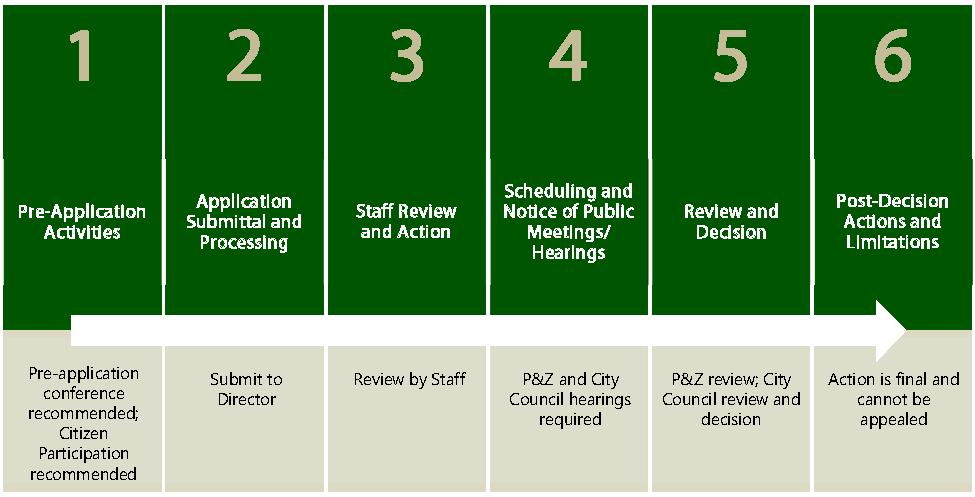
1.
Step 1: Pre-Application Activities.
a.
Pre-Application Conference. A pre-application conference is recommended in accordance with Subsection 2.4.3.
b.
Citizen Participation. Citizen Participation is recommended in accordance with Subsection 2.4.3B: Citizen Participation.
2.
Step 2: Application Submittal and Processing. The comprehensive plan amendment application shall be submitted and accepted, and may be revised or withdrawn, in accordance with Subsection 2.4.4.
3.
Step 3: Staff Review and Action.
a.
Director Review and Recommendation. The Director shall review the comprehensive plan amendment application and prepare a staff report and recommendation in accordance with the approval criteria in Subsection 2.7.1 D below.
4.
Step 4: Scheduling and Notice of Public Meetings/Hearings. The comprehensive plan amendment application shall be scheduled for public hearings before the Planning and Zoning Commission and the City Council and shall be noticed pursuant to Table 2.2-A Summary of Development Review Procedures, and Subsection 2.4.6.
5.
Step 5: Review and Decision.
a.
Planning and Zoning Commission Review and Recommendation. The Planning and Zoning Commission shall review the comprehensive plan amendment application in accordance with the approval criteria in Subsection 2.7.1 D below, and shall forward its recommendation to the City Council.
b.
City Council Review and Decision. The City Council may approve, approve with conditions, or deny the comprehensive plan amendment application in accordance with the approval criteria in Subsection 2.7.1D below. The adoption or amendment of a new comprehensive plan shall become effective by a simple majority vote of all members of the City Council.
6.
Step 6: Post-Decision Actions and Limitations. The City Council decision is a final action and may not be appealed.
D.
Comprehensive Plan Amendment Approval Criteria.
1.
Comprehensive plan amendments may be approved by the City Council only following a determination that the proposed amendment is consistent with the overall purpose and intent of the Comprehensive Plan and that any one of the following criteria has been met:
a.
There was an error in the original Comprehensive Plan adoption;
b.
The City Council failed to take into account then-existing facts, projections, or trends that were reasonably foreseeable to exist in the future;
c.
Events, trends, or facts after adoption of the Comprehensive Plan have changed the City Council's original findings made upon plan adoption; or
d.
Events, trends, or facts after adoption of the Comprehensive Plan have changed the character or condition of an area so as to make the proposed amendment necessary.
2.
In addition to the above-listed criteria, any proposed amendment is subject to the following additional review standards:
a.
That the amendment is not in conflict with any portion of the goals and policies of the plan.
b.
That the amendment constitutes a substantial benefit to the city and is not solely for the good or benefit of a particular landowner or owners at a particular point in time.
c.
The extent to which the proposed amendment and other amendments in the general area are compatible with the land use goals of the plan and that they avoid creation of isolated uses that will cause incompatible community form and a burden on public services and facilities.
d.
That the development pattern contained in the existing plan does not provide adequate and appropriate optional sites for the use or change being proposed in the amendment.
e.
That the impact of the amendment, when considered cumulatively with other applications and development in the general area, will not adversely impact the city or a portion of the city by:
i.
Significantly altering acceptable existing land use patterns;
ii.
Having significant adverse impacts on public services and facilities that are needed to support the current land use and that cannot be mitigated to the maximum extent feasible;
iii.
Adversely impacting environmentally sensitive areas or resources; or
iv.
Adversely impacting existing uses because of increased traffic on existing systems.
f.
That site conditions, including but not limited to topography, utility corridors/easements, drainage patterns, noise, odors, or environmental contamination, would make development under the current plan designation inappropriate.
(Ord. No. DCA22-0002d, § 2(Exh. A), 7-19-2022)
2.7.2 - Zoning Map Amendment (Rezoning).
A.
Purpose. The purpose of the zoning map amendment procedure (referred to as "rezoning") is to make amendments to the Official Zoning Map of the City of Denton to reflect changes in public policy, changed conditions, or to advance the welfare of the city. The purpose is neither to relieve particular hardships nor to confer special privileges or rights on any person.
B.
Applicability.
1.
A rezoning may be approved by the City Council following review and recommendation by the Planning and Zoning Commission.
2.
Rezonings should not be used when a specific use permit, or minor modification could be used to achieve a similar result.
3.
Changes to the characteristics of zoning districts (such as setback requirements) and development standards (such as parking requirements) shall be processed as zoning text amendments according to Subsection 2.7.4.
4.
A rezoning to a Planned Development is a distinct type of amendment to the Official Zoning Map and shall follow the procedures in Subsection 2.7.3.
C.
Rezoning Procedure. Figure 2.7-2 identifies the applicable steps from the common review procedures in Section 2.4 that apply to the review of rezonings. Additions or modifications to the common review procedures are noted below.
Figure 2.7-2: Summary of Rezoning Procedure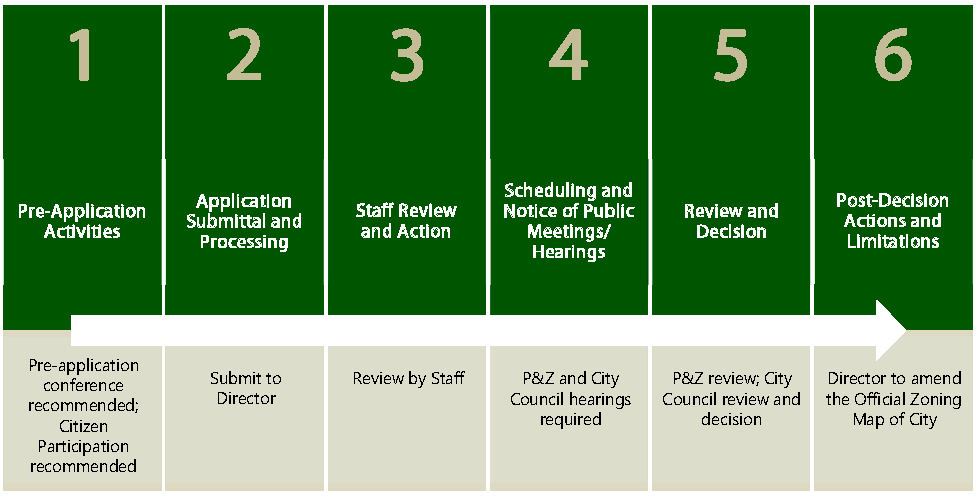
1.
Step 1: Pre-Application Activities.
a.
Pre-Application Conference. A pre-application conference is recommended in accordance with Subsection 2.4.3.
b.
Citizen Participation. Citizen Participation is recommended in accordance with Subsection 2.4.3B: Citizen Participation.
2.
Step 2: Application Submittal and Processing.
a.
The zoning map amendment application shall be submitted and accepted, and may be revised or withdrawn, in accordance with Subsection 2.4.4.
b.
In addition to the persons authorized to submit an application listed in Subsection 2.4.4A, the City of Denton may initiate a rezoning application following discussion at any Planning and Zoning Commission meeting.
3.
Step 3: Staff Review and Action. The Director shall review the rezoning application and prepare a staff report and recommendation in accordance with the approval criteria in Subsection 2.7.2D below.
4.
Step 4: Scheduling and Notice of Public Meetings/Hearings.
a.
The rezoning application shall be scheduled for public hearings before the Planning and Zoning Commission and the City Council and shall be noticed pursuant to Table 2.2-A Summary of Development Review Procedures and Subsection 2.4.6.
b.
Mailed notice shall be required if the Planning and Zoning Commission or City Council initiate an application to repeal and replace the Official Zone Map for all or substantially all of the city.
5.
Step 5: Review and Decision.
a.
Planning and Zoning Commission Review and Recommendation.
i.
The Planning and Zoning Commission shall review the rezoning application in accordance with the approval criteria in Subsection 2.7.2D, below, and shall forward its recommendation or report to the City Council.
ii.
After closing the public hearing, should a majority of voting Planning and Zoning Commissioners fail to recommend either approval or denial of a proposed amendment, or approval of a modified amendment, city staff is directed to place the matter for vote on the next available Planning and Zoning Commission agenda as an item for individual consideration. A second failure of a majority of voting Planning and Zoning Commissioners to recommend either approval or denial of a proposed amendment, or approval of a modified amendment, shall be deemed a recommendation to deny approval of any amendment to the City Council. Such failure is not subject to Subpart A, Section 2-29(g)(5)a., of the City Code of Ordinances, and shall not require a three-fourths vote of all members of the City Council qualified to vote as stated in paragraph 2.7.2C.5.b.ii.
b.
City Council Review and Decision.
i.
The City Council may review and approve, approve with conditions, or deny the rezoning application based on the approval criteria in Subsection 2.7.2D below.
ii.
If the Planning and Zoning Commission recommends denial of the rezoning, the rezoning shall become effective only by a three-fourths vote of all members of the City Council.
c.
Protest Procedure.
i.
The rules governing amendment over protest are contained in TLGC, Chapter 211. The Director may prescribe forms for protest petitions.
ii.
Property owners within 200 feet of a proposed rezoning, as indicated on the most recently approved city tax roll, may file a written protest against the rezoning. If written protests are received by owners of 20 percent or more of the area within 200 feet of the proposed rezoning, approval shall require three-fourths vote of the City Council for a rezoning to become effective. In such case, a supermajority vote shall not be required by the Planning and Zoning Commission.
iii.
The protest procedure process does not apply to citywide legislative rezonings.
6.
Step 6: Post-Decision Actions and Limitations. Post-decision actions and limitations in Subsection 2.4.8, shall apply with the following modifications:
a.
The City Council decision is a final action and may not be appealed.
b.
Following approval of a rezoning by City Council, the Director shall prepare a revision to the Official Zoning Map of city.
D.
Zoning Map Amendment Approval Criteria.
1.
In reviewing a proposed rezoning, the Planning and Zoning Commission and City Council shall consider the general approval criteria in Subsection 2.4.5 and whether:
a.
The proposed rezoning is consistent with the Comprehensive Plan;
b.
The proposed rezoning is consistent with relevant Small Area Plan(s);
c.
The proposed rezoning is consistent with the purpose statement of the proposed zoning district, as provided in Subchapter 3: Zoning Districts;
d.
There have been significant changes in the area to warrant a zoning change;
e.
The intensity of development in the new zoning district is not expected to create significantly adverse impacts to surrounding properties or the neighborhood; and
f.
Public facilities and services are available to adequately serve the subject property while maintaining adequate level of service to existing development; and/or
g.
There was an error in establishing the current zoning;
2.
These approval criteria shall not apply to legislative rezonings by the City Council.
(Ord. No. DCA22-0002d, § 2(Exh. A), 7-19-2022)
2.7.3 - Rezone to a Planned Development (PD) District.
A.
Purpose. The zoning classification of any parcel(s) may be changed to a Planned Development (PD) pursuant to this section. The purpose of rezoning to a PD are to ensure compatibility between development, to achieve greater flexibility than allowed by the strict application of this DDC, and/or to encourage unique or innovative land use concepts, while providing greater benefit to the city and ensuring efficient provision of services and utilities.
B.
Applicability. The PD procedure shall not be used when a specific use permit, minor modification, or rezoning to an existing base zoning district could achieve a similar result.
C.
Types of Planned Developments. A PD District may be created as an Overlay PD or as a Standard PD:
1.
Overlay PD.
a.
An Overlay PD is a PD intended to address concerns of neighboring property owners and to ensure the proposed rezoning and subsequent development are compatible with surrounding neighborhoods or less intensive uses. An Overlay PD may be used to restrict or expand the uses permitted within a base zoning district or to impose additional use-specific standards than already listed within Subchapter 5 upon a proposed use, or to modify setbacks, landscaping, screening, or buffering requirements along the borders adjoining residential uses or less intensive land uses than what is proposed within the Overlay PD.
b.
When, in the course of reviewing a request for a zoning map change to a base zoning district under Section 2.7.2, the Director, Planning and Zoning Commission, or City Council finds the need to impose conditions upon the requested rezoning to address compatibility concerns, the Overlay PD District may be utilized to do so.
2.
Standard PD. A Standard PD is intended to be used to achieve greater flexibility than is allowed by the strict application of this DDC. A standard PD may be used to permit new or unique land uses or combinations of uses or to propose innovative or creative development standards. A standard PD shall be built off of a base zoning district within this DDC.
D.
Rezoning to PD Procedure. Figure 2.7-3 identifies the applicable steps from the common review procedures in Section 2.4 that apply to the review of rezoning to a PD application. Additions or modifications to the common review procedures are noted below.
Figure 2.7-3: Summary of Rezoning to PD Procedure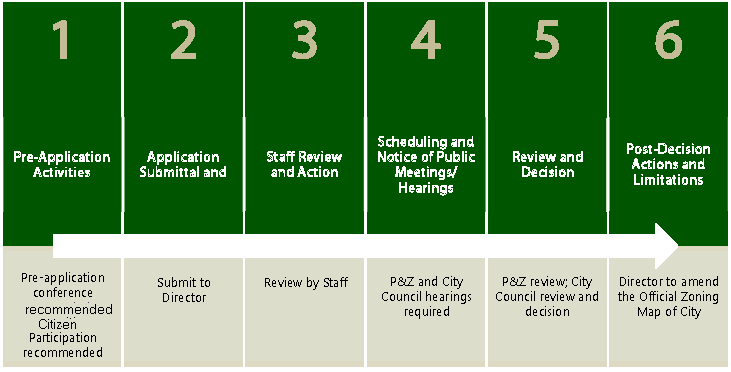
1.
Step 1: Pre-Application Activities.
a.
Pre-Application Conference. A pre-application conference is recommended to be held in accordance with Subsection 2.4.3. In addition, the applicant shall include a concept/schematic plan for review by the Director to help determine whether or not a proposed PD is the appropriate procedure for the applicant and the city. The concept/schematic plan shall include at a minimum the following:
i.
Proposed uses;
ii.
Number and type of dwelling or commercial units (as applicable);
iii.
Floor area of all buildings;
iv.
Floor area of each use for mixed-use buildings (if applicable);
v.
Proposed parking capacity and configuration;
vi.
General site planning layout and phasing; and
vii.
Summary of proposed deviations from DDC standards and a description of compensating public benefits achieved through the PD process.
b.
Citizen Participation. Citizen Participation is recommended in accordance with Subsection 2.4.3B: Citizen Participation.
2.
Step 2: Application Submittal and Processing.
a.
Generally.
i.
The PD application shall be submitted and accepted, and may be revised or withdrawn, in accordance with Subsection 2.4.4.
ii.
An Overlay PD application shall contain the list of conditions/restrictions proposed to ensure compatibility between the proposed development and neighboring properties. An Overlay PD application shall also contain any other information or data determined by the Director to be pertinent to the proposed Overlay PD.
iii.
An application for rezoning to a Standard PD shall include submittal requirements as specified in the Development Handbook, which shall include the items specified in PD Requirements below.
b.
Standard PD Requirements. The following items shall be incorporated as part of the authorizing ordinance for a Standard PD District.
i.
PD Regulations Document.
a.
Document Form. The PD Regulations Document shall be a written proposal explaining all aspects of the requested PD. This document establishes the development regulations for a planned development and specifically identifies where there are deviations from the DDC.
b.
Purpose and Intent. The Regulations Document shall contain a clear statement of both the purpose and intent of the PD District being established.
c.
Public Benefit. When an applicant is proposing deviations from the zoning provisions of this DDC to establish a PD District, the applicant's written proposal shall also describe how the PD District will generally provide public benefits greater than would be required if the project were not being developed as a PD District.
d.
Compliance with this DDC. Unless specifically modified by the PD Regulations Document, development within the PD shall comply with all standards in the DDC, at the time of development.
e.
Specification of Deviations. Where the applicant is proposing deviations from the zoning and development regulations of this DDC, the applicant shall specify both the existing regulations and the wording of each corresponding substitution, as proposed. The proposed PD District shall represent a quality development when weighed overall against the standards in the DDC. Deviations may be proposed from any section of this DDC except those specifically prohibited below.
ii.
PD Development Plan. To facilitate understanding of the requested PD, a PD Development Plan shall be provided to show the intended development in a graphic manner. Unless otherwise determined by the Director, at a minimum the development plan shall show the following:
a.
Location and types of uses shown within defined areas or development units;
b.
Access and circulation, including proposed streets, alleys, and driveways;
c.
Preliminary lot arrangements;
d.
Size, type and locations of buildings other than single-family dwellings;
e.
Density, height, and coverage of buildings;
f.
Landscaped areas, including screening and buffering areas;
g.
Parking areas and ratios applied for each use;
h.
Preliminary building elevations (may be excluded for single-family uses at the discretion of the Director);
i.
Proposed boundaries and sequencing of project phases; and
j.
Any other information or data determined by the Director to be pertinent to the development.
iii.
PD Phasing. In instances where a Planned Development is intended to be developed in multiple phases, the Director may authorize the phased approach to allow the PD Development Plan to be submitted as each phase is developed. Modifications to the PD Development Plan or initial approval of subsequent phases must follow the PD amendment process.
iv.
Prohibited Deviations from the DDC. Deviations from the following standards shall not be allowed in conjunction with a PD zoning district:
a.
Subchapter 6: Gas Wells.
b.
Section 7.4: Environmentally Sensitive Areas.
c.
Section 7.7.4: Tree Preservation.
An applicant may seek relief or alternative approvals to gas well, environmentally sensitive area, or tree preservation standards through processes outlined in those respective sections listed above. In instances where such relief or alternative to these standards would affect the design or layout reflected on a PD Development Plan, such relief or alternative approval shall be sought and achieved prior to or concurrently with the rezoning to PD District.
c.
Concurrent Reviews.
i.
A comprehensive plan amendment application submitted under Subsection 2.7.1 may be reviewed concurrently with a PD application.
ii.
The Director, Planning and Zoning Commission, or City Council may require review and approval of supporting analysis including, but not limited to, a Traffic Impact Analysis, or Drainage Analysis, concurrent with the review of the PD application.
3.
Step 3: Staff Review and Action. The Director shall review the PD application and prepare a staff report and recommendation in accordance with the approval criteria in Subsection 2.7.3E below.
4.
Step 4: Scheduling and Notice of Public Meetings/Hearings. The PD application shall be scheduled for public hearings before the Planning and Zoning Commission and City Council and noticed in accordance with Table 2.2-A Summary of Development Review Procedures and Subsection 2.4.6.
5.
Step 5: Review and Decision.
a.
Planning and Zoning Commission Review and Recommendation. The Planning and Zoning Commission shall review the PD application in accordance with the approval criteria in Subsection 2.7.3E below and shall forward its recommendation to the City Council.
b.
City Council Review and Decision.
i.
The City Council may review and approve, approve with conditions, or deny the PD application in accordance with the approval criteria in Subsection 2.7.3E below.
ii.
If the Planning and Zoning Commission recommends denial of the PD application, the rezoning shall become effective only by a three-fourths vote of all members of the City Council.
iii.
The City Council may also remand the PD application back to the Director or the Planning and Zoning Commission for further consideration.
iv.
If the City Council remands the PD application back to the Director or Planning and Zoning Commission, additional public hearings will be required before final adoption.
c.
Protest Procedure.
i.
The rules governing amendment over protest are contained in TLGC, Chapter 211. The Director may prescribe forms for protest petitions.
ii.
Property owners within 200 feet of a proposed rezoning, as indicated on the most recently approved city tax roll, may file a written protest against the rezoning. If written protests are received by owners of 20 percent or more of the area within 200 feet of the proposed rezoning, approval shall require three-fourths vote of the City Council for a rezoning to become effective. In such case, a supermajority vote shall not be required by the Planning and Zoning Commission.
6.
Step 6: Post-Decision Actions and Limitations.
a.
Adoption of a Planned Development District. At the time a PD zoning document is approved by the City Council, it becomes an integral part of this DDC for that PD District established by the city on the property. All future development within the adopted PD District shall thereafter be in conformity with the PD zoning document for that property.
b.
Future Development. Upon adoption of the PD District, the applicant may proceed with the development of the property in accordance with the PD Regulations Document and, the PD Development Plan by applying for preliminary and final plat(s) approval in accordance with the approved phasing.
c.
Administration and Enforcement.
i.
While ownership of a project may subsequently be transferred (in whole or in part), the PD District will continue to run with the land and be enforced for the total acreage of the PD District. It is the responsibility of the owner to notify all prospective purchasers of the existence of the PD District and the PD Development Plan.
ii.
In the event that the applicant has failed to comply with the conditions adopted by the City Council in conjunction with the approved PD Regulations Document and PD Development Plan, the city may proceed in accordance with Section 1.6: Enforcement.
d.
Amendments to a Planned Development.
i.
Generally.
a.
The applicant or its successors may request amendments to the PD Regulations Document and/or PD Development Plan.
b.
Amendments to the approved PD documents shall be delineated as major or minor amendments, according to the criteria set forth in this subsection.
c.
Amendments to the approved PD documents will not affect development units not included in the proposed amendment.
d.
Upon receipt of a PD amendment application, the Director shall determine if the proposed amendment constitutes a major or minor amendment subject to the criteria in subsections ii and iii below.
Any property that was in a PD prior to October 1, 2019 shall be designated as PD on the "Official Zoning Map of City" and shall be governed by the zoning regulations and development standards established by the PD ordinance, specifically including those regulations and standards incorporated (or excepted) from prior development codes or ordinances as they existed on the date of approval for each PD approval ordinance and amendment. Unless a vested rights petition approved pursuant to Subsection 2.5.6, all remaining zoning district regulations and design standards not addressed by the PD ordinance shall be governed by the development standards of this DDC, effective on October 1, 2019. Proposed changes to such properties shall follow the PD amendment procedures provided in this subsection.
ii.
Major Amendments.
a.
An amendment will be deemed major if it involves any one of the following:
1.
A change in the overall PD District boundary;
2.
A significant change to the approximate boundary of one or more development unit(s) from that approved in the PD District, as determined by the Director. A change to an individual development unit generally shall be deemed to be significant if it represents a 10 percent increase to the approximate gross area of the development unit as approved in the PD District;
3.
An increase of 10 percent or more of the approved number of projected dwelling units or gross leasable area (GLA) for an individual development unit;
4.
Any change in land use or density that is likely to negatively impact or burden public facilities and utilities infrastructure as determined by the Director;
5.
Any change in land use or density that is likely to negatively impact or burden mobility adjacent to the PD District or to the overall major street system; or
6.
Any other proposed change to the PD Regulations Document and PD Development Plan, which substantively alters one or more components of the PD District, including, but not limited to, the following: arrangement or number of buildings, configuration of streets or lots, placement of vehicular circulation or parking areas, or the location or effectiveness of open space or landscaping buffering and screening areas.
b.
If the Director determines the amendment to be major, the amendment request shall be processed under the Rezoning Procedure described in Subsection 2.7.2C.
iii.
Minor Amendments. Amendments not meeting one or more of the criteria listed above for major amendments shall be considered minor. If the Director determines the amendment to be minor, the Director may administratively act on the amendment and attach stipulations or conditions of approval thereto, to protect the public health, safety, and welfare.
E.
Rezoning to PD District Approval Criteria. In reviewing a proposed rezoning to a PD District, the Planning and Zoning Commission and City Council shall consider the general approval criteria in Subsection 2.4.5 and whether and to what extent the proposed PD District:
1.
Complies with the goals of the Comprehensive Plan;
2.
Complies with the goals of relevant Area Plans;
3.
Complies with this DDC, except where modifications are expressly authorized through the PD Regulations Document and PD Development Plan;
4.
Provides a greater level of building design quality, community amenities, and connectivity than would be required if the project were not being developed in a PD District;
5.
In the case of proposed residential development, that the development will promote compatible buildings and uses and that it will be compatible with the character of the surrounding area;
6.
In the case of proposed commercial, industrial, institutional, recreational and other non-residential uses or mixed-uses, that such development will be appropriate in area, location, and overall planning for the purpose intended;
7.
The provisions for public facilities such as schools, fire protection, law enforcement, water, wastewater, streets, public services and parks are adequate to serve the anticipated population within the PD District; and
8.
The conditions and/or restrictions imposed by the PD District are necessary and sufficient to address any significantly adverse impacts to surrounding properties or the neighborhood.
(Ord. No. DCA22-0002d, § 2(Exh. A), 7-19-2022; Ord. No. DCA22-0006a, § 2(Exh. A), 10-18-2022)
2.7.4 - Zoning Text Amendment.
A.
Purpose. This subsection describes the review and approval procedures for amending the text of this DDC to respond to changed conditions or changes in public policy, or to advance the general welfare of the city.
B.
Applicability. A zoning text amendment shall be initiated by the Director, the Planning and Zoning Commission, or the City Council.
C.
Zoning Text Amendment Procedure. Figure 2.7-4 identifies the applicable steps from the common review procedures in Section 2.4 that apply to the review of a zoning text amendment. Additions or modifications to the common review procedures are noted below.
Figure 2.7-4: Summary of Zoning Text Amendment Procedure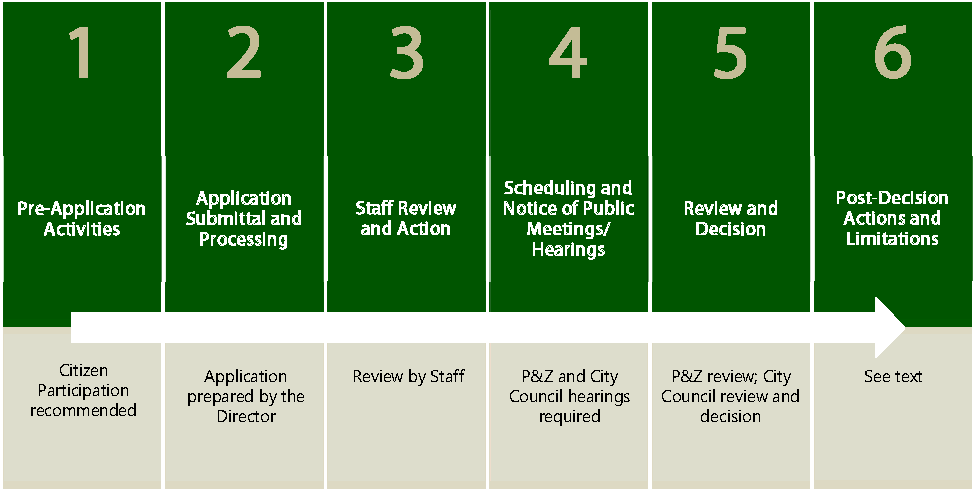
1.
Step 1: Pre-Application Activities.
a.
Pre-Application Conference. Not required.
b.
Citizen Participation. Citizen Participation is recommended in accordance with Subsection 2.4.3B: Citizen Participation.
2.
Step 2: Application Submittal and Processing. A zoning text amendment application shall be prepared by the Director. If the zoning text amendment is initiated by the Planning and Zoning Commission or City Council, the Director shall prepare the application at the request of the Planning and Zoning Commission or City Council.
3.
Step 3: Staff Review and Action. The Director shall review the zoning text amendment application and prepare a staff report and recommendation in accordance with the approval criteria in Subsection 2.7.4D below.
4.
Step 4: Scheduling and Notice of Public Meetings/Hearings. The zoning text amendment application shall be scheduled for public hearings before the Planning and Zoning Commission and City Council and noticed in accordance with Table 2.2-A Summary of Development Review Procedures.
5.
Step 5: Review and Decision.
a.
Planning and Zoning Commission Review and Recommendation. The Planning and Zoning Commission shall review the zoning text amendment application in accordance with the approval criteria in Subsection 2.7.4D below and shall forward its recommendation to the City Council.
b.
City Council Review and Decision.
i.
The City Council may review and approve, approve with conditions, or deny the zoning text application in accordance with the approval criteria in Subsection 2.7.4D below.
ii.
If the City Council remands the application back to the Director or Planning and Zoning Commission, additional public hearings may be required prior to final action.
6.
Step 6: Post-Decision Actions and Limitations. Post-decision actions and limitations in Subsection 2.4.8 shall apply with the following modifications:
a.
Approval of a zoning text amendment authorizes the approved revision to the text only. A zoning text amendment shall not authorize specific development activity.
b.
A zoning text amendment shall remain valid until the revised text of the DDC is subsequently amended in accordance with this Subsection 2.7.4.
D.
Approval Criteria for Code Text Amendments. A DDC text amendment is a legislative decision by the City Council. Prior to recommending approval or approving a proposed DDC text amendment, the Planning and Zoning Commission and City Council shall consider whether and to what extent the proposed amendment:
1.
Is consistent with the Comprehensive Plan, other adopted plans, and other city policies;
2.
Does not conflict with other provisions of this DDC or other provisions in the Municipal Code of Ordinances;
3.
Is necessary to address a demonstrated community need;
4.
Is necessary to respond to substantial changes in conditions and/or policy; and
5.
Is consistent with the general purpose and intent of this DDC.
(Ord. No. DCA22-0002d, § 2(Exh. A), 7-19-22)
2.7.5 - Annexation.
A.
Annexation Permitted.
1.
Generally. Annexation into the Denton city limits, whether involuntary or voluntary, may occur pursuant to the procedures outlined in TLGC, Chapter 43 and § 212.172; and City of Denton Charter, Section 1.03; and any other applicable city ordinance.
2.
Types of Annexation.
a.
Involuntary Annexation. An annexation of property into the Denton city limits initiated by the action of the municipality as an involuntary procedure, through TLGC Chapter 43 Subchapters C and C-1. Involuntary annexation does not follow the Voluntary Annexation process detailed below in Sections 2.7.5B.—D.
b.
Voluntary Annexation. An annexation of property into the Denton city limits initiated by the request of all of the property owner(s) within the area and subject to approval by City Council, pursuant to TLGC Chapter 43, as amended. Voluntary Annexation follows the process detailed below in Sections 2.7.5B.—D.
B.
Applicability. Voluntary annexation procedures apply to an annexation initiated by the request of each owner of land in the area to be annexed. These procedures do not apply to an annexation in which one or more owners of land in the area have not requested to be annexed.
C.
Voluntary Annexation Procedure. Figure 2.7-4 identifies the applicable steps from the common review procedures in Section 2.4 that apply to the review of a voluntary annexation. Additions or modifications to the common review procedures are noted below.
Figure 2.7-5: Summary of Voluntary Annexation Procedure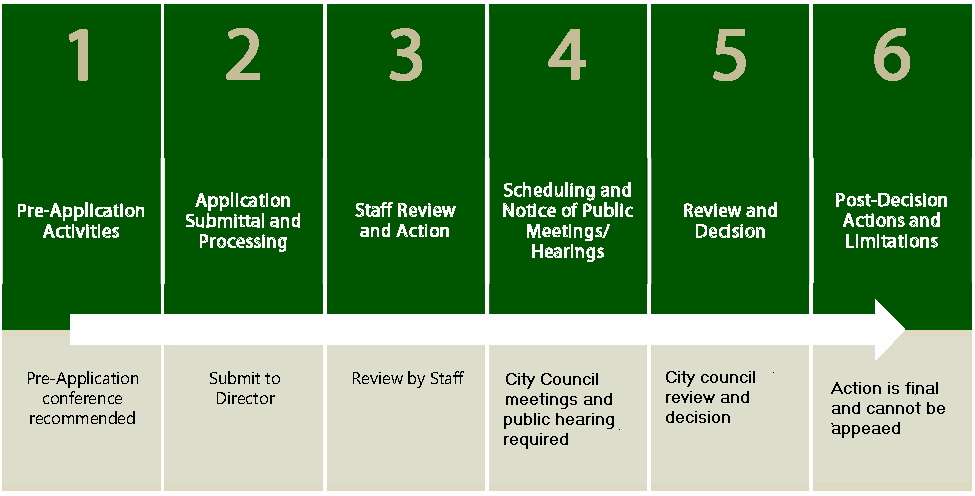
1.
Step 1: Pre-Application Activities.
a.
Pre-Application Conference. A pre-application conference is recommended in accordance with Subsection 2.4.3.
b.
Citizen Participation. Citizen participation is recommended in accordance with Subsection 2.4.3B.
2.
Step 2: Application Submittal and Processing.
a.
Generally.
i.
The Voluntary Annexation application shall be submitted and accepted, and may be revised or withdrawn, in accordance with Subsection 2.4.4.
ii.
A Voluntary Annexation application shall include submittal requirements as specified in the Development Handbook, which shall include an annexation petition.
b.
Annexation Petition. The annexation petition shall include, at a minimum, the following information and any other details as specified on the published checklist:
i.
Signed confirmation that all owners of property within the area are jointly submitting the request for annexation;
ii.
Graphical and site data to define the area requested for annexation;
iii.
The estimated population, number of dwelling units, and the number and general description of unique commercial or non-residential land uses located in the area requested for annexation;
iv.
Description of the purpose of requested annexation;
v.
Any zoning district(s) requested for the area by separate application, if any; and
vi.
Fiscal impact analysis using a model acceptable to the city to compare the estimated revenues generated by new development to the estimated costs of public services required to serve the development.
3.
Step 3: Staff Review and Action.
a.
Municipal Services Agreement.
i.
Staff shall prepare a Municipal Services Agreement in compliance with TLGC § 43.0672.
ii.
The Municipal Services Agreement shall be approved as to form and content by the City Attorney.
iii.
Staff shall provide a copy of the Municipal Services Agreement to the applicant for execution prior to the public meeting at which the ordinance adopting the agreement will be considered by the City Council.
b.
Review and Recommendation. The Director shall review the Voluntary Annexation application and prepare a staff report and recommendation in accordance with the approval criteria in Subsection 2.7.5D below.
4.
Step 4: Scheduling and Noticing of Public Meetings/Hearings.
a.
Items for Decision. The Director shall schedule the following items for public meeting or public hearing before City Council, according to the schedule detailed in Timing below:
i.
Municipal Services Agreement.
ii.
Annexation Petition Public Hearing.
iii.
Annexation Ordinance - First Reading.
iv.
Annexation Ordinance - Second Reading.
b.
Timing. In accordance with TLGC Chapter 43, Subchapter C-3, and the City's Charter, City Council must consider the items in a Voluntary Annexation Application in a specific order:
i.
The Municipal Services Agreement and associated ordinance shall be heard as an Item for Individual Consideration before City Council prior to holding a public hearing on the Annexation Petition, though the Municipal Services Agreement and the Annexation Petition may come before Council on the same date.
ii.
The Annexation Petition shall be scheduled for a public hearing before City Council. This public hearing shall follow, and shall not precede, the Municipal Services Agreement coming before City Council.
iii.
The Annexation Ordinance - Frist Reading shall be heard as an item for Individual Consideration before City Council following the public hearing on the Annexation Petition, though the Annexation Ordinance - First Reading may come before Council on the same date as the Municipal Services Agreement and Annexation Petition.
iv.
The Annexation Ordinance - Second Reading shall be heard as an item for Individual Consideration before City Council in a meeting which shall occur after the Annexation Ordinance - First Reading comes before City Council and at least 30 calendar days after the newspaper publication of the Annexation Ordinance, as required in Subsection 2.7.5C.4.d.ii below.
c.
Ordinance Reading Required. In each of the two public meetings in which the Annexation Ordinance comes before City Council, the ordinance caption shall be read into the official record of City Council.
d.
Noticing.
i.
Public Meetings/Hearing. Notices for the items for consideration in public meeting and public hearing shall be posted in accordance with DDC Table 2.2-A and Subchapter 2.4.6.
ii.
Ordinance Publication. Following the Annexation Ordinance - First Reading before City Council in a public meeting, the Director shall have the full Annexation Ordinance, along with any included exhibits when presented to City Council, published in the newspaper.
5.
Step 5: Review and Decision.
a.
City Council may review and approve, approve with conditions, or deny the Municipal Services Agreement ordinance at the conclusion of the public meeting on that item.
b.
If the City Council denies the Municipal Services Agreement, no further public meetings or hearings shall be held on the Voluntary Annexation application for the subject property, unless and until a Municipal Services Agreement and ordinance for that property comes before City Council for consideration in a subsequent public meeting and City Council votes for approval or approval with conditions of the ordinance.
c.
City Council shall not make a decision on the Voluntary Annexation application until the conclusion of the Annexation Ordinance - Second Reading.
d.
Following the Annexation Ordinance - Second Reading, City Council may review and approve, approve with conditions, or deny the Voluntary Annexation application, in accordance with the criteria in Subsection 2.7.5D below. A voluntary annexation application must be approved or approved with conditions by a vote of not less than four-fifths of City Council membership, in compliance with City of Denton Charter Section 1.03, or the application will be considered denied.
6.
Step 6: Post-Decision Actions and Limitations. Post-decision actions and limitations in DDC Subsection 2.4.8 and Code of Ordinances Section 1.03 shall apply with these modifications:
a.
Following approval of a voluntary annexation by City Council, the Director shall cause the Official Corporate Limits and official map of the City of Denton, Texas, to be modified to include the annexed property and the appropriate records of annexation as required by Code of Ordinances Section 2-1.
b.
Following approval, the Director shall provide notice of the annexation, including map and legal description of the annexed property, to the following state and district offices, as well as any others as required by state law or in the Development Handbook:
i.
Texas Comptroller Field Office, pursuant to Tax Code § 321.102;
ii.
Texas Comptroller of Public Accounts, pursuant to Tax Code § 321.102;
iii.
Denton County Appraisal District, pursuant to Tax Code § 6.07;
c.
The Director shall cause the signed Annexation Ordinance to be recorded in the appropriate records of Denton County in accordance with TLGC § 41.0015.
D.
Voluntary Annexation Approval Criteria. City Council shall consider the general approval criteria in Subsection 2.4.5, as well as the following criteria, in an analysis of immediate needs and consideration of the long-term effects:
1.
The annexation is consistent with the Comprehensive Plan.
2.
The owners of all property in the area have joined in the request for annexation.
3.
The annexation does not violate or conflict with any previously approved and complying non-annexation or similar agreement.
4.
The annexation is necessary to ensure that areas adjoining current city limits, which may have a significant impact upon the city in terms of service costs, increased traffic, drainage impacts, utility needs, or safety or health hazards due to anticipated future development, are brought into the city limits.
5.
The annexation will ensure that adequate land use and building controls are in place in areas where future growth is anticipated.
(Ord. No. DCA22-0002d, § 2(Exh. A), 7-19-2022)
2.8.1 - Variance.
A.
Purpose.
1.
This section describes the process for gaining relief from the strict application of the DDC, where literal enforcement of the DDC will result in an unnecessary hardship and where the variance is necessary to develop a specific parcel of land which cannot otherwise be developed in the same manner allowed for other similar parcels due to unique conditions on the property.
2.
The variance procedure may not allow a use in a zoning district where it is not currently permitted or alleviate inconveniences or financial burdens imposed on landowners.
B.
Applicability.
1.
Any property owner seeking relief from this DDC may request a variance when the strict application of the DDC would meet the approval criteria listed in Subsection 2.8.1 D. The Zoning Board of Adjustment shall decide all requests for variances.
2.
Any property owner seeking relief from Subpart B, Chapter 33: Signs and Advertising Devices, of the Code of Ordinances, may request a variance when the strict application of the standards in Subpart B, Chapter 33, of the Code of Ordinances would meet the approval criteria listed in Subsection 2.8.1D.
C.
Variance Procedure. The following variance procedure is established to comply with TLGC, §§ 211.008 and 211.009. Figure 2.8-1 identifies the applicable steps from the common review procedures in Section 2.4 that apply to the review of variances. Additions or modifications to the common review procedures are noted below.
Figure 2.8-1: Summary of Variance Procedure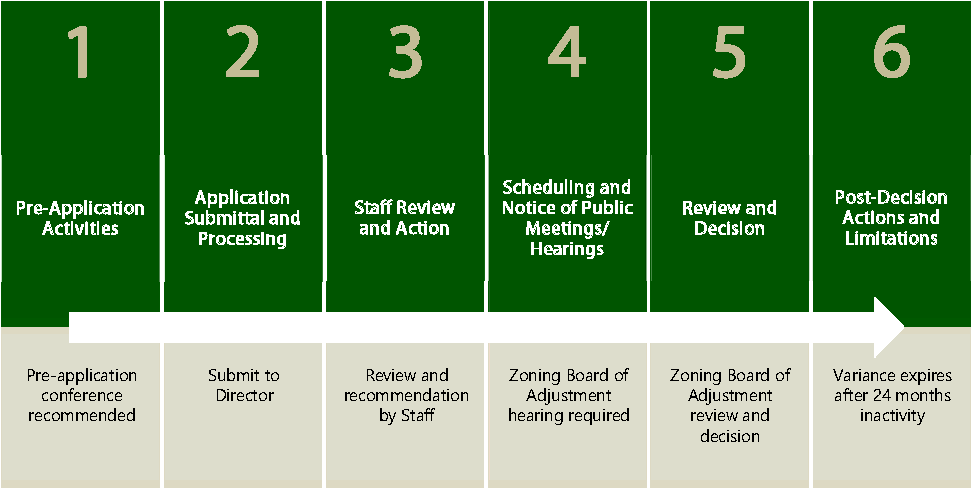
1.
Step 1: Pre-Application Activities.
a.
Pre-Application Conference. A pre-application conference is recommended in accordance with Subsection 2.4.3.
b.
Citizen Participation. Not required.
2.
Step 2: Application Submittal and Processing.
a.
The variance application shall be submitted and accepted, and may be revised or withdrawn, in accordance with Subsection 2.4.4.
b.
Initiation of a variance application may be made by recommendation of the Director or application by the property owner or their authorized agent.
3.
Step 3: Staff Review and Action. The Director shall review the variance application and prepare a staff report and recommendation to the Board of Adjustment in accordance with the approval criteria in Subsection 2.8.1D, below.
4.
Step 4: Scheduling and Notice of Public Meetings/Hearings. Variance applications shall be scheduled for a public hearing before the Zoning Board of Adjustment.
5.
Review and Decision.
a.
The Zoning Board of Adjustment shall review and approve or deny the variance application in accordance with the approval criteria in Subsection 2.8.1D below.
b.
After closing the public hearing, the Zoning Board of Adjustment shall take action consistent with this DDC and state law. A concurring vote of six (6) members of the Zoning Board of Adjustment shall be required to approve a variance application.
c.
The Zoning Board of Adjustment shall make written findings of fact and conclusions of law stating the facts upon which it relied when making its legal conclusions in reversing, affirming, or modifying any order, requirement, decision, or determination which comes before it under the provision of this DDC.
d.
All cases to be heard by the Zoning Board of Adjustment will always be heard by a minimum number of six (6) members.
6.
Post-Decision Actions and Limitations.
a.
Notice of Decision. The Director shall provide written notification of the Zoning Board of Adjustment's decision to the applicant.
b.
Expiration of Variance. If the property owner has not commenced development or obtained the required permits to carry out the approved variance within 24 months of the variance approval, the variance shall automatically expire.
c.
Non-Transferable. An approved variance shall apply only to the property or structure described in the approval and shall not be transferable to any other property or structure.
d.
Appeals. The decision of the Zoning Board of Adjustment is final and may be appealed to a district court or county court of law within 10 days after the date the decision is filed, in accordance with the procedures contained in TLGC, Chapter 211.
e.
Suspension and Revocation of a Variance.
i.
When the city determines there is a failure to comply with any term, condition, or requirement made as a condition of approval of the variance, the City Council may direct the Building Official or Director, as appropriate, to suspend the variance pending compliance with the terms, conditions, or requirements under which the variance was approved.
ii.
Notice of suspension or revocation of a variance shall be sent by certified mail with return receipt requested.
iii.
The Zoning Board of Adjustment shall hold a public hearing no later than 45 calendar days after notification. If the Zoning Board of Adjustment determines there is a failure to comply with any term, condition, or requirement made as a condition of the variance, the Zoning Board of Adjustment may revoke the variance or take such action as it considers necessary to ensure compliance.
iv.
A decision to revoke a variance is effective immediately. Notice of the decision by the Zoning Board of Adjustment shall be sent by certified mail.
D.
Variance Approval Criteria.
1.
In reviewing a variance application, the Zoning Board of Adjustment shall find that all of the following exist:
a.
Special circumstances or conditions apply to the parcel for which the variance is sought, which circumstances or conditions are peculiar to such parcel and do not apply generally to other parcels in the same district or neighborhood and that said circumstances or conditions are such that the strict application of the provisions of this DDC would deprive the applicant of the reasonable use of such parcel;
b.
The granting of the variance will not be detrimental to the public welfare or injurious to other property or improvements in the district or neighborhood in which the parcel is located;
c.
The variance granted is the minimum variance that will accomplish this purpose;
d.
The literal enforcement and strict application of the provisions of this DDC will result in an unnecessary hardship inconsistent with the general provisions and intent of this DDC and that in granting such variance the spirit of the DDC will be preserved and substantial justice done;
e.
The granting of a variance is not solely for the purpose of mitigating a financial hardship; and
f.
The condition or feature that creates the need for the variance did not result from the owner's actions.
2.
Any person desiring to erect or increase the height of any structure, or permit the growth of any natural object, or use their property, in violation of the airport zoning regulations prescribed Section 4.5: Municipal Airport Overlay District, shall provide a determination from the Federal Aviation Administration as to the effect of the proposal on the operation of air navigation facilities and the safe, efficient use of navigable airspace.
(Ord. No. DCA22-0002d, § 2(Exh. A), 7-19-2022)
2.8.2 - Minor Modification.
A.
Purpose.
1.
The minor modification procedure is intended to allow minor modifications or deviations from the dimensional or numeric standards of this DDC.
2.
Administrative adjustments are intended to provide greater flexibility when necessary, without requiring a formal zoning amendment.
3.
The minor modification procedure is not a waiver of current standards of this DDC and shall not be used to circumvent the variance procedure.
B.
Applicability.
1.
Allowed Modifications and Deviations. The minor modification procedures shall apply to the standards and limitations established in Table 2.8-A: Allowable Minor Modifications.
2.
Prohibited Modifications and Deviations. The minor modification procedure shall not apply to any proposed modification or deviation that result in:
a.
A change in permitted uses or mix of uses;
b.
A deviation from the use-specific standards in Section 5.3: Use-Specific Standards, excepted as specifically permitted in Table 2.8-A Allowable Minor Modifications;
c.
A deviation from sensitive area protection standards in Section 7.4: Environmentally Sensitive Areas;
d.
A change to a development standard that is already modified through a separate minor modification or variance;
e.
A change to a development standard that is already exempted from maximum building height pursuant to Subsection 3.7.5B; minimum setbacks pursuant to Subsection 3.7.3D or maximum building coverage pursuant to Subsection 3.7.6; or
f.
Requirements for public roadways, utilities, or other public infrastructure or facilities.
3.
Table of Allowable Minor Modifications. An application for a minor modification that is not related to a request for "reasonable accommodation" under the Federal Fair Housing Act or the Religious Land Use and Institutionalized Persons Act may request only the types of adjustments shown in Table 2.8A: Allowable Minor Modifications.
4.
Reserved.
5.
Religious Land Use and Institutionalized Persons Act of 2000 (RLUIPA).
a.
The Director may grant minor modifications in order to eliminate a substantial burden on religious exercise as guaranteed by the Federal Religious Land Use and Institutionalized Persons Act of 2000, as amended.
b.
In no circumstance shall the Director approve an adjustment that allows a religious assembly use, or any uses, structures, or activities accessory to it, in a zoning district where this DDC prohibits such use or accessory use, structure, or activity.
c.
A person may claim that a provision of the DDC substantially burdens the person's free exercise of religion. In making such a claim a person shall give written notice to the city by certified mail with return receipt requested, according to the provisions of Texas Civil Practice & Remedies Code § 110.001, et seq. (Vernon Supp. 2001).
d.
The Director may grant a waiver or partial waiver of the provisions of the DDC according to federal or state law to accommodate a person's free exercise of religion.
6.
Limitations on Minor Modifications. Except when requested as a reasonable accommodation for Federal Fair Housing Act ("FFHA") purposes, a request for a minor modification shall not be used to further modify a development standard that, as applied to the subject property, already qualifies as an exception to, or modification of, a generally applicable development standard required under Subchapter 7: Development Standards.
C.
Minor Modification Procedure.
1.
Generally.
a.
An application for a minor modification shall only be submitted and reviewed concurrently with an application for a specific use permit, temporary use permit, zoning compliance plan approval, or plat approval (minor, preliminary, final, conveyance, or replat).
b.
Each code standard in Table 2.8-A: shall be considered a separate minor modification request as it relates to the approval criteria in Subsection 2.8.2D, but multiple modifications may be considered in one minor modification application.
2.
Review and Decision.
a.
Where the concurrently reviewed application requires review and approval by the Director, the Director shall review and approve, approve with conditions, or deny the modification in accordance with the approval criteria in Subsection 2.8.2D. The Director may refer the minor modification to the Planning and Zoning Commission prior to making a decision.
b.
Where the concurrently reviewed application requires review and approval by the Planning and Zoning Commission or City Council, the Commission or Council, as applicable, shall review and approve, approve with conditions, or deny the modification in accordance with the approval criteria in Subsection 2.8.2D.
3.
Effect of Approval. Approval of a minor modification authorizes only the particular modification of standards approved, and only to the subject property of the application.
4.
Expiration of Minor Modification. A minor modification shall automatically expire if the associated development application is denied or if approval of the concurrently reviewed application expires, is revoked, or otherwise deemed invalid.
D.
Minor Modification Approval Criteria. In reviewing a proposed minor modification, the decision-making body shall consider the general approval criteria in Subsection 2.4.5 and whether and to what extent the minor modification is of a technical nature that:
1.
Compensates for an unusual site condition;
2.
Eliminates a minor inadvertent failure to comply with a DDC standard; or
3.
Protects a sensitive resource, natural feature, or community asset; and
4.
The minor modification will not produce an adverse change to the character of the neighborhood.
(Ord. No. DCA22-0002d, § 2(Exh. A), 7-19-2022; Ord. No. DCA23-0001b, § 2(Exh. A), 9-26-2023)
2.8.3 - Appeal of Administrative Decision.
A.
Purpose. The purpose of this section is to establish a remedy whereby persons claiming to have been aggrieved by a decision of the Director or other administrative official in administering this DDC may appeal that decision.
B.
Applicability. Any person may appeal a decision of an administrative office or agency made in the administration or enforcement of this DDC. Appeals shall be made to the appropriate body as indicated in Table 2.2-A Summary of Development Review Procedures, and in accordance with state law.
C.
Administrative Appeal Procedure. Figure 2.8-3 identifies the applicable steps from the common review procedures in Section 2.4 that apply to the review of administrative appeals. Additions or modifications to the common review procedures are noted below.
Figure 2.8-3: Summary of Administrative appeal Procedure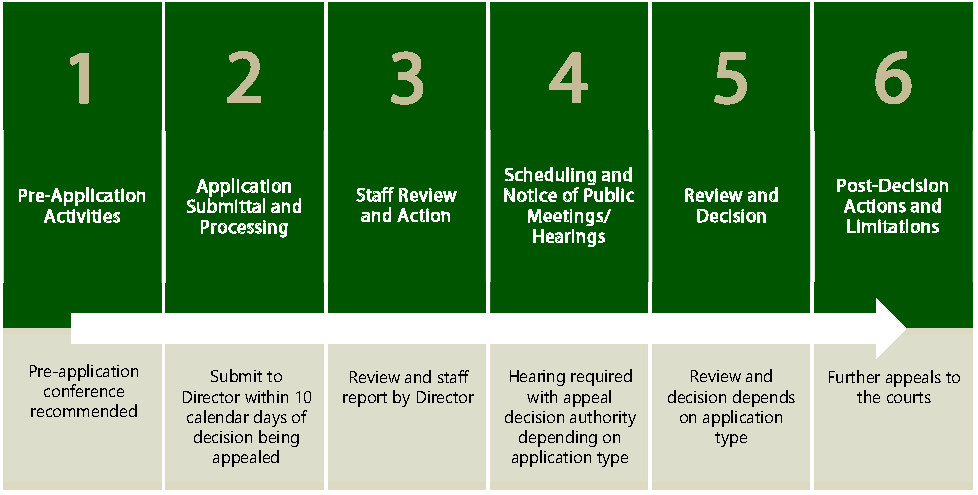
1.
Step 1: Pre-Application Activities.
a.
Pre-Application Conference. A pre-application conference is recommended in accordance with Subsection 2.4.3.
b.
Citizen Participation. Not required.
2.
Step 2: Application Submittal and Processing. An administrative appeal application shall be submitted and accepted, and may be revised or withdrawn, in accordance with Subsection 2.4.4, with the following modifications:
a.
Who May Appeal.
i.
Any of the following persons may appeal a decision that is not related to a specific application, address, or project:
1.
A person aggrieved by the decision; or
2.
Any administrative official, department, or board of the City of Denton.
ii.
Any of the following persons may appeal a decision that is related to a specific application, address, or project:
1.
The applicant who filed the application that is the subject of the decision;
2.
The owner or representative of owner of the property that is the subject of the decision; or
3.
An owner of real property within 200 feet of the property that is the subject of the decision who is aggrieved by the decision; or
4.
Any administrative official, department, or board of the City of Denton.
b.
Time Limit. Appeals shall be made in writing and filed with the Director within 20 calendar days of the action or decision being appealed.
c.
Appeal Application Content. The administrative appeal application shall include a written statement of the administrative decision being appealed, the specific section(s) in which the administrative decision was based on, the reason for the appeal, and any other information that supports the appeal.
d.
Stay of Proceedings. An appeal stays all proceedings from further action unless the official from whom the appeal is taken determines and certifies in writing to the board that a stay would create adverse impacts to the health, safety, or welfare of the city or neighborhood. In that case, the proceedings may be stayed only by a restraining order granted by the board or a court of record on application, after notice to the official, if due cause is shown.
3.
Step 3: Staff Review and Action. The Director shall review the appeal application and prepare a staff report in accordance with the general approval criteria applicable to all applications in Subsection 2.4.5, with the following modifications:
a.
Staff review shall only confirm that the application is complete and that the appeal is heard by the appropriate authority.
b.
The staff report shall not make a formal recommendation. The report shall include necessary facts to warrant an appeal, which shall be provided by the appellant/applicant.
4.
Step 4: Scheduling and Notice of Public Meetings/Hearings. An appeal shall be scheduled for public hearings before the Zoning Board of Adjustment or City Council, and noticed in accordance with Subsection 2.4.6.
5.
Step 5: Review and Decision.
a.
The appropriate decision-making body may affirm, reverse, or amend a decision or interpretation made by another decision-making body in accordance with the approval criteria in Subsection 2.8.3D below.
b.
When the appropriate decision-making body is the Zoning Board of Adjustment, the decision on the appeal shall be made at the next meeting for which notice can be provided following the public hearing of the appeal, and not later than the 60th calendar day after the date the appeal was submitted.
c.
The appeal decision-making authority may reverse a previous decision in whole or in part, or may modify the order, requirement, decision, or determination appealed from.
d.
The appeal decision-making authority may attach conditions of approval on any appeal to ensure the health, safety, and welfare of the city.
6.
Step 6: Post-Decision Actions and Limitations. Post-decision actions and limitations in Subsection 2.4.8 shall apply. Any further appeals from the appropriate appeal decision-making authority shall be made to the courts in accordance with state law.
D.
Appeals Approval Criteria. In considering an appeal, the appropriate decision-making body shall consider the approval criteria applicable to all applications in Subsection 2.4.5, and shall consider the following:
1.
The facts stated in the application, as presented by the appellant and/or the Director; and
2.
The requirements and intent of the applicable standards from this DDC compared to the written decision that is being appealed.
(Ord. No. DCA22-0002d, § 2(Exh. A), 7-19-2022)
2.8.4 - Alternative Environmentally Sensitive Area (ESA) Plan.
A.
Purpose. The alternative ESA plan provides the option to address the ESA regulations through a flexible discretionary process using the procedure outlined in Section 2.7.2: Zoning Map Amendment.
B.
Applicability. An alternative ESA plan is required when development deviates from regulations established in Section 7.4: Environmentally Sensitive Areas and encroaches or removes protected ESAs.
C.
Alternative ESA Plan Procedure. Figure 2.8-4 identifies the applicable steps from the common review procedures in Section 2.4 that apply to the review of alternative ESA plans. Additions or modifications to the common review procedures are noted below.
Figure 2.8-4: Summary of Alternative ESA Plan Procedure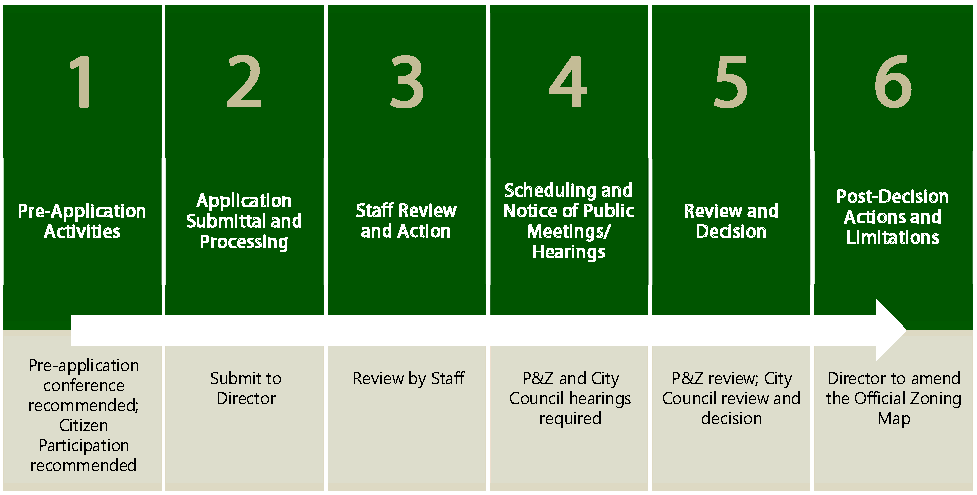
1.
Step 1: Pre-Application Activities.
a.
Pre-Application Conference. A pre-application conference is recommended in accordance with Subsection 2.4.3.
b.
Citizen Participation. Citizen Participation is recommended in accordance with Subsection 2.4.3B: Citizen Participation.
2.
Step 2: Application Submittal and Processing.
a.
Generally.
i.
The alternative ESA plan application shall be submitted and accepted, and may be revised or withdrawn, in accordance with Subsection 2.4.4.
ii.
The Director may require additional information deemed appropriate and necessary to process the application.
3.
Step 3: Staff Review and Action. The Director shall review the alternative ESA plan application and prepare a staff report and recommendation in accordance with the general approval criteria applicable to all applications in Subsection 2.4.5, and the approval criteria in Subsection 2.8.4D below.
4.
Step 4: Scheduling and Notice of Public Meetings/Hearings. The alternative ESA plan application shall be scheduled for public hearings before the Planning and Zoning Commission and the City Council and shall be noticed pursuant to Table 2.2-A Summary of Development Review Procedures, and Section 2.4.6.
5.
Step 5: Review and Decision.
a.
Planning and Zoning Commission Review and Recommendation. The Planning and Zoning Commission shall review the alternative ESA plan application in accordance with the approval criteria in Subsection 2.8.4D below and shall forward its recommendation to the City Council.
b.
City Council Review and Decision.
i.
The City Council may review and approve, approve with conditions, or deny the alternative plan application in accordance with the approval criteria in Subsection 2.8.4D below.
ii.
If the Planning and Zoning Commission recommends denial of the alternative ESA plan, the alternative plan shall become effective only by a three-fourths vote of all members of the City Council.
c.
Protest Procedure.
i.
The rules governing amendment over protest are the same as for a zoning amendment and are contained in TLGC, Chapter 211. The Director may prescribe forms for protest petitions.
ii.
Property owners within 200 feet of a proposed rezoning, as indicated on the most recently approved city tax roll, may file a written protest against the rezoning. If written protests are received by owners of 20 percent or more of the area within 200 feet of the proposed rezoning, approval shall require three-fourths vote of the City Council for an alternative plan to become effective. In such case, a supermajority vote shall not be required by the Planning and Zoning Commission.
6.
Step 6: Post-Decision Actions and Limitations.
a.
Post-decision actions and limitations in Section 2.4.8 shall apply. The City Council decision is a final action and may not be appealed.
b.
An approved Alternative ESA Plan shall expire after 24 months if progress has not been made toward completion of the project. Should an approved Alternative ESA Plan expire, a new Alternative ESA Plan must be applied for and approved before any permit may be released allowing encroachment upon or removal of the ESA.
D.
Alternative ESA Plan Approval Criteria. The City Council may approve the alternative ESA plan with conditions necessary to mitigate the impacts of the proposed development upon considering the factors and goals noted in this section.
1.
Mitigation goals are obtained by creating, expanding, and/or improving ESAs.
2.
Mitigation goals are obtained by preserving ESAs above the minimum requirements, exchanges between different types of ESAs, installing pollution prevention controls, and/or implementing best management practices or any other approaches that result in the improvement of the environment being impacted.
3.
Areas offered as mitigation are linked to existing or planned open space or conserved areas to provide an overall open space system.
4.
Development is arranged for maximizing access and utilization of the ESAs by citizens.
5.
Areas offered as mitigation are placed either in a lot or lots that incorporate a permanent conservation easement, a preserved habitat, restrictive covenants, or such other legal mechanism to allow for the long term conservation of said areas. Such legal mechanisms shall limit any future land disturbing activity or construction within the ESAs, shall run with the land, and shall be binding upon all successors and assigns of the current owner.
6.
The alternative ESA plan shall demonstrate that the property owner's alternative proposal results in a high-quality development meeting the intent of the standards in this DDC.
E.
Establish Revegetation.
1.
Vegetation established as a part of the approved revegetation plan are to be planted or seeded and maintained by the current property owner/developer for a period of three (3) years following installation. Any plants that are removed, destroyed, or die within that three (3) year period are required to be replaced by the current property owner/developer to achieve a minimum 90% survivability of trees and shrubs and 90% land cover rate for grasses and herbaceous plants.
2.
Following the installation and inspection of the revegetation, the property owner shall submit an annual report to the Environmental Services Director during the first three (3) years describing the cumulative mitigation work performed and the survivability of the plantings for staff review and inspection on the anniversary of the planting date. Within 30 calendar days of approval of the report by staff, the applicant shall replace any plants that were identified in the report as removed, destroyed, or dead.
(Ord. No. DCA19-0024b, § 2(Exh. A), 3-3-2020; Ord. No. DCA22-0002d, § 2(Exh. A), 7-19-2022)
2.8.5 - Watershed Protection Permit Relief.
A.
Purpose. The watershed protection permit allows a determination of whether the application of the standards in this DDC, as applied to a watershed protection permit and related development applications would, if not modified or other relief granted, constitute a regulatory taking under constitutional standards.
B.
Applicability. A property owner or authorized agent may file an application for relief under this subsection following final decision to deny or conditionally approve an application for a watershed protection permit and related applications within 10 calendar days.
C.
Application Submittal and Processing.
1.
The Director has the authority to establish requirements for applications in the Development Handbook. No application shall be accepted for filing until it is complete and the fee established by the City Council has been paid.
2.
Upon approval of an application in whole or in part by the City Council, the Director shall process the watershed protection permit, and related development applications, and the Director shall decide the applications consistent with the relief granted on the application, including any amendments to applicable standards approved by City Council.
3.
A denial of an application by the City Council is a final determination.
D.
Approval Criteria. In deciding whether to grant relief to the applicant, the City Council will consider whether there is any evidence from which it can reasonably conclude that the application of all or a part of the standards governing approval of a watershed protection permit under this DDC will deprive the applicant of all economically viable use of the land, based upon the following factors:
1.
Whether the operations proposed are consistent with protecting the ecological integrity and environmental quality, including protection of surface and ground water sources, of potentially impacted environmentally sensitive areas (ESAs).
2.
The nature and intensity of the uses allowed following application of the standards in the DDC to the watershed protection permit and related development applications, in comparison with the nature and intensity of the uses allowed without application of the standards.
3.
Whether the standards of the DDC, when applied to the watershed protection permit and related development applications, allow an economically viable use of the land.
4.
For applications in which it is alleged that there has been a devaluation of property, whether the adoption or application of standards in this DDC is the producing cause of any devaluation of the property.
5.
The extent to which the applicant's expectations for economically viable uses have been realized through actual or anticipated development on land or an interest in land originally part of the same tract or parcel as the land for which relief is sought under the application.
6.
The extent to which the applicant has taken advantage of any other relief measures provided by this DDC that would result in mitigation of economic impacts resulting from application of the standards in this DDC.
7.
The extent to which the owner of the property had actual or constructive notice of regulations or proposed changes in the standards governing watershed protection permits.
8.
Unique circumstances exist on the property on which the application is made related to size, shape, area, topography, surrounding conditions, and location that do not apply to other property in the vicinity.
9.
Whether there are other alternative well site locations.
10.
Any clam for relief pursuant to TLGC, Chapter 245.
E.
Review and Decision.
1.
In granting relief under the application, the City Council may waive or modify the standards to be applied to the watershed protection permit or related development applications and may impose reasonable conditions on related development applications in order to implement the relief granted.
2.
The City Council may also initiate an application for a zoning map amendment in order to afford the relief granted, provided that such application shall be decided in accordance with Subsection 2.7.2: Zoning Map Amendment (Rezoning). In such case, the City Council's decision on the application shall not be considered final until the application for the zoning map amendment is decided.
3.
The action taken by the City Council under this section shall not deprive the Planning and Zoning Commission or any responsible official of its final approval authority over subdivision plats and other development permits.
4.
No application for local permit under TLGC, Chapter 245, will be allowed for a watershed protection permit.
(Ord. No. DCA22-0002d, § 2(Exh. A), 7-19-2022)
2.8.6 - Interpretations.
A.
Purpose. The purpose of this section is to provide a uniform mechanism for rendering formal written interpretations of this DDC.
B.
Authority. Responsibility for making interpretations of provisions of this DDC is assigned as follows:
1.
The Director shall be responsible for all interpretations of the zoning and subdivision provisions in the text of this DDC, including, but not limited to:
a.
Interpretations as to which is the stricter and thus controlling provision in case of conflict with this DDC and other provisions of the Municipal Code of Ordinances;
b.
Interpretations of compliance with a condition of approval;
c.
Interpretations of whether an unspecified use falls within a use classification, use category, or use type allowed in a zoning district; and
d.
Interpretations of the zoning district boundaries on the Official Zoning Map.
2.
The City Engineer shall be responsible for all interpretations of the floodplain management and engineering provisions in the text of this DDC.
3.
The Building Official shall be responsible for all interpretations of building code provisions as they relate to this DDC, including interpretations relating to issuance of a certificate of zoning compliance.
C.
Interpretation Procedure. Figure 2.8-6 identifies the applicable steps from the common review procedures in Section 2.4 that apply to the review of interpretations. Additions or modifications to the common review procedures are noted below.
Figure 2.8-6: Summary of Interpretation Procedure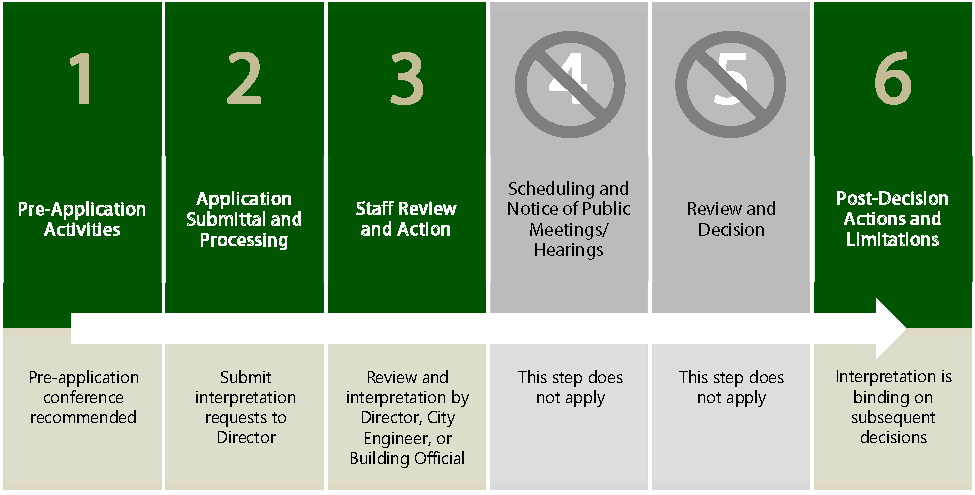
1.
Step 1: Pre-Application Activities.
a.
Pre-Application Conference. A pre-application conference is recommended in accordance with Subsection 2.4.3.
b.
Citizen Participation. Not required.
2.
Step 2: Application Submittal and Processing. A request for interpretation shall be submitted and accepted, and may be revised or withdrawn, in accordance with Subsection 2.4.4.
3.
Step 3: Staff Review and Action. The Director, City Engineer, or Building Official (as applicable) shall review the request for interpretation and render a decision based on the standards in Subsection 2.8.6D. The decision shall be in the form of a written interpretation and the decision-maker shall consult with the City Attorney and affected City Officials before rendering the interpretation.
4.
Step 4: Scheduling and Notice of Public Meetings/Hearings. Not required.
5.
Step 5: Review and Decision. Not applicable. Review and decision is by the Director, City Engineer, or Building Official under Step 3.
6.
Step 6: Post-Decision Actions and Limitations. Post-decision actions and limitations in Subsection 2.4.8 shall apply, with the following modifications:
a.
Effect of Approval. The written interpretation shall be binding on subsequent decisions by the Director or other city administrative officials in applying the same provision of this DDC or the Zoning Map in the same circumstance, unless the interpretation is reversed or modified on appeal to the Zoning Board of Adjustment or a court of law.
b.
Official Record of Interpretations. The Director shall maintain a record of written interpretations that shall be available for public inspection, on reasonable request, during normal business hours.
c.
Appeal to Zoning Board of Adjustment. Final decision on an Interpretation may be appealed to the Zoning Board of Adjustment in accordance with Section 2.8.3.
D.
Interpretation Standards.
1.
Statutory References. Unless otherwise specified, statutory references are to be construed as currently amended or superseded.
2.
Text Provisions. Interpretation of text provisions and their application shall be based on the standards in Section 9.1, Rules of Construction, and the following considerations:
a.
The clear and plain meaning of the provision's wording, as defined by the meaning and significance given specific terms used in the provision as established in Subchapter 9: Definitions, and by the common and accepted usage of the term;
b.
The intended purpose of the provision, as indicated by purpose statements, its context and consistency with surrounding and related provisions, and any legislative history to its adoption;
c.
The intent to give every provision meaning;
d.
The general purposes served by this DDC, as set forth in Section 1.2: Purpose; and
e.
Consistency with the Comprehensive Plan.
3.
Unspecified Uses. Interpretation of whether an unspecified use falls within a use classification, use category, or use type allowed in a zoning district shall be based the standards in Section 5.2.4: Clarification of New and Unlisted Uses, and the Comprehensive Plan.
4.
Zoning Map Boundaries. Interpretation of zoning district boundaries on the Official Zoning Map shall be in accordance with the standards in Subsection 3.1.1 B: District Boundaries, and consistent with the Comprehensive Plan.
(Ord. No. DCA22-0002d, § 2(Exh. A), 7-19-2022)
2.8.7 - Subdivision Variance.
A.
Purpose.
1.
This section describes the process for gaining relief from the strict application of the DDC, where literal enforcement of the DDC will result in an unnecessary hardship from the subdivision regulations and where the subdivision variance is necessary to develop a specific parcel of land which cannot otherwise be developed in the same manner allowed for other similar parcels due to unique conditions on the property.
2.
The subdivision variance procedure may not allow a use in a zoning district where it is not currently permitted or alleviate inconveniences or financial burdens imposed on landowners.
B.
Applicability. Any property owner seeking relief from the standards contained in the sections listed below may request a subdivision variance from the strict application of one or more of those specific standards when said variance would meet the approval criteria listed in Subsection 2.8.7D. The subdivision variance process is provided in addition to, and not in place of, any administrative flexibility or relief already provided for in Sections 2.8.1 through 2.8.6. A variance from a prohibition is not permitted and may not be requested. The Planning and Zoning Commission shall decide all requests for subdivision variances.
1.
7.8.5 Street Design.
2.
7.8.6 Street Connectivity.
3.
7.8.9 Driveways and Access.
4.
8.3.2 Lot Planning.
5.
8.3.3 Block Layout.
C.
Subdivision Variance Procedure. Figure 2.8-7 identifies the applicable steps from the common review procedures in Section 2.4 that apply to the review of a Subdivision Variance application. Additions or modifications to the common review procedures are noted below.
Figure 2.8-7: Summary of Subdivision Variance Procedure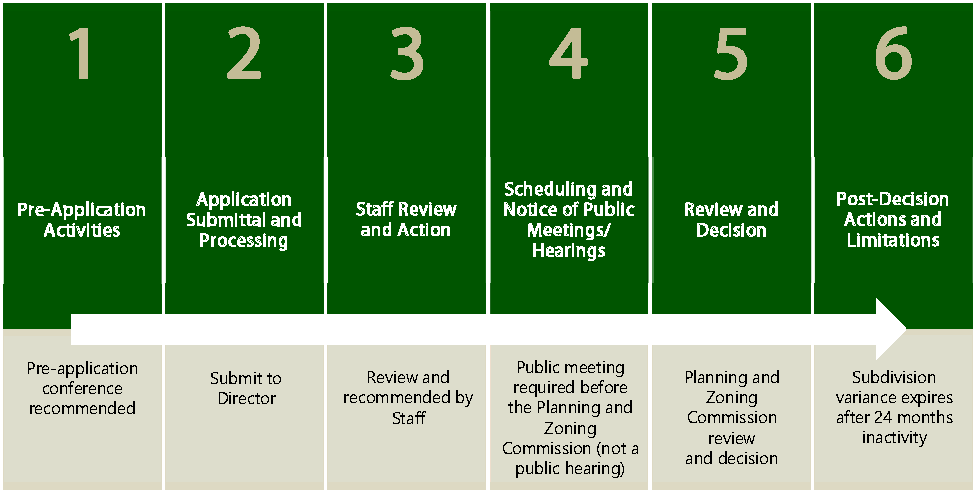
1.
Step 1: Pre-Application Activities.
a.
Pre-Application Conference. A pre-application conference is recommended in accordance with Subsection 2.4.3.
b.
Citizen Participation. Not required.
2.
Step 2: Application Submittal and Processing.
a.
The subdivision variance application shall be submitted and accepted, and may be revised or withdrawn, in accordance with Subsection 2.4.4.
b.
Initiation of a subdivision variance application may be made by recommendation of the Director or application by the property owner or their authorized agent.
3.
Step 3: Staff Review and Action. The Director shall review the subdivision variance application and prepare a staff report and recommendation to the Planning and Zoning Commission in accordance with the approval criteria in Subsection 2.8.7D below.
4.
Step 4: Scheduling and Notice of Public Meetings/Hearings. Subdivision variance applications shall be heard as an Item for Individual Consideration before the Planning and Zoning Commission.
5.
Step 5: Review and Decision.
a.
The Planning and Zoning Commission shall review and approve or deny the subdivision variance application in accordance with the approval criteria in Subsection 2.8.7D below.
b.
The Planning and Zoning Commission shall take action consistent with this DDC and state law. A majority vote of the Planning and Zoning Commission shall be required to approve a subdivision variance application.
c.
The Planning and Zoning Commission shall make written findings of fact and conclusions of law stating the facts upon which it relied when making its legal conclusions in reversing, affirming, or modifying any order, requirement, decision, or determination which comes before it under the provision of this DDC.
6.
Step 6: Post-Decision Actions and Limitations.
a.
Notice of Decision. The Director shall provide written notification of the Planning and Zoning Commission's decision to the applicant.
b.
Expiration of Subdivision Variance. If the property owner has not commenced development or obtained the required permits to carry out the approved subdivision variance within 24 months of the subdivision variance approval, the subdivision variance shall automatically expire.
c.
Non-Transferable. An approved subdivision variance shall apply only to the subject property described in the approval and shall not be transferable to any other property.
d.
Appeals. The decision of the Planning and Zoning Commission may be appealed to the City Council by the applicant.
e.
Suspension and Revocation of a Subdivision Variance.
i.
When the city determines there is a failure to comply with any term, condition, or requirement made as a condition of approval of the subdivision variance, the Planning and Zoning Commission may direct the Director, as appropriate, to suspend the subdivision variance pending compliance with the terms, conditions, or requirements under which the subdivision variance was approved.
ii.
Notice of suspension or revocation of a subdivision variance shall be sent by certified mail.
iii.
During a Planning and Zoning Commission public meeting, if the Planning and Zoning Commission determines there is a failure to comply with any term, condition, or requirement made as a condition of the subdivision variance, the Planning and Zoning Commission may revoke the subdivision variance or take such action as it considers necessary to ensure compliance.
iv.
A decision to revoke a subdivision variance is effective immediately. Notice of the decision by the Planning and Zoning Commission shall be sent by certified mail.
D.
Subdivision Variance Approval Criteria.
1.
The proposed subdivision variance is appropriate based on a finding that unreasonable hardships or difficulties may result from strict compliance with the subdivision regulations or the purposes of the regulations may be served to a greater extent by an alternative proposal.
2.
A subdivision variance may be approved so that substantial justice may be done and the public interest secured; provided that the subdivision variance shall not have the effect of nullifying the intent and purpose of these regulations.
3.
In reviewing a subdivision variance application, the Planning and Zoning Commission shall find that all of the following exist:
a.
The granting of the subdivision variance will not be detrimental to the public safety, health, or welfare or injurious to other property;
b.
Because of the particular physical surroundings, shape or topographical conditions of the specific property involved, a particular hardship to the owner would result, as distinguished from a mere inconvenience, if the strict letter of the subdivision regulations is carried out;
c.
The subdivision variance will not in any manner vary the provisions of the Comprehensive Plan, the Development Code, and the Denton Mobility Plan, except that those documents may be amended in the manner prescribed by law; and
d.
The special or peculiar conditions upon which the request is based did not result from or were not created by the act or commission of the owner or any prior owner, subsequent to the date of creation of the requirement from which a subdivision variance is sought.
(Ord. No. DCA22-0002d, § 2(Exh. A), 7-19-2022)
2.8.8 - Reasonable Accommodation.
A.
Purpose.
1.
The purpose of this procedure is to create and implement a reasonable accommodations process that is consistent with the Federal Fair Housing Amendments Act of 1988 (FHAA) 42 U.S.C. § 3601, et seq.
2.
The City adopts this reasonable accommodation process as a means to comply with its obligations under the FHAA.
3.
The purpose of a reasonable accommodation is to modify a specific City of Denton requirement to ensure an individual with a disability has an equal opportunity to use and enjoy a dwelling.
B.
Applicability.
1.
This process applies to the Denton Development Code.
2.
An application for an accommodation may be submitted at any time the accommodation may be necessary to afford an individual with a disability an equal opportunity to use and enjoy a dwelling, provided that the request is consistent with the evaluation criteria in Subsection 2.8.7D.3.i, below.
C.
Authority.
1.
The City Manager or designee, after consultation with the City Attorney, is authorized to grant a reasonable accommodation. An accommodation is reasonable when the accommodation is necessary to afford an individual with a disability an equal opportunity to use and enjoy a dwelling.
2.
The City Manager or designee, after consultation with the City Attorney, is authorized to grant an alternative reasonable accommodation.
3.
The City Manager, or designee, after consultation with the City Attorney, must deny a request for an unreasonable accommodation. An accommodation is unreasonable when the accommodation imposes an undue financial or administrative burden on the City; or requires a fundamental alteration in the nature of the City's land use and zoning regulations.
D.
Procedure.
1.
Step 1: Pre-Application Activities.
a.
Pre-Application Conference. A pre-application conference is recommended in accordance with Subsection 2.4.3.
b.
Citizen Participation. Not required.
2.
Step 2: Application Submittal and Processing.
a.
An application may be submitted by an individual with a disability, a representative of the individual with a disability, or a person that lives, or will live, with the individual with a disability.
b.
An application must be submitted in writing to the Director and must include, at a minimum, the following information:
1.
Name and address of the applicant requesting the accommodation;
2.
Name and address of each property owner, if not the same as the applicant;
3.
Address of the property for which the accommodation is requested;
4.
Owner Authorization Form for the property owner;
5.
Date of the request;
6.
Description of the requested accommodation and the DDC regulatory requirement for which accommodation is sought; and
7.
Reason the requested accommodation is necessary for each individual with the disability to use and enjoy the dwelling.
c.
If an applicant needs assistance to make a request for an accommodation, the Director will provide assistance including, but not limited to, transcribing a verbal request into a written request.
d.
An applicant is not required to pay a fee for an accommodation request.
3.
Step 3: Staff Review and Action.
a.
The Director shall first determine whether the application is complete pursuant to Subsection 2.4.4: Step 2: Application Submittal and Processing.
b.
The Director shall forward the request, together with the required supporting information or documentation, to the City Manager or designee and City Attorney for their respective reviews and a final determination within 30 calendar days from the date the request is deemed complete.
c.
If necessary to reach a determination on the request for an accommodation, the City Manager or designee and City Attorney may request further information from the applicant consistent with FHAA. The request must specify the information that is required. In the event additional information is requested, the 30-calendar day period to issue a decision is stayed until the applicant responds to the request.
d.
Prior to rendering a final determination, the City Manager may request a predetermination conference with the individual to discuss the request and to ensure that the nature of the accommodation is fully and completely understood by the City Manager, or designee.
e.
The City Manager, or designee, after consultation with the City Attorney, shall render a final determination that grants the Reasonable Accommodation in whole or in part, or denies the Reasonable Accommodation in whole or in part, or approves an alternative accommodation. The written decision must state the basis of the decision, including the factors described in Subsection 2.8.8D.3.i, below.
f.
An alternative reasonable accommodation may be the requested accommodation with conditions. The conditions must relate to the specific disability that causes the need for the accommodation.
g.
If the City Manager or designee denies the requested accommodation, the decision must include a proposed alternative reasonable accommodation.
h.
If the City Manager or designee fails to render a written decision within 30 calendar days, the request is deemed granted.
i.
The written decision on a request for an accommodation shall be consistent with the FHAA and based on the following factors:
1.
Whether the housing, which is the subject of the requested accommodation, will be used by an individual with a disability protected under fair housing laws;
2.
Whether the requested accommodation is necessary to afford an individual with a disability an equal opportunity to use and enjoy a dwelling;
3.
Whether the requested accommodation would impose an undue financial or administrative burden on the City; and
4.
Whether the requested accommodation would require a fundamental alteration in the nature of the City's land use and zoning regulations.
j.
If the City Manager or designee finds that the requested accommodation will impose an undue financial or administrative burden on the City or will require a fundamental alteration in the nature of the City's land use and zoning regulations, the City Manager or designee must find whether an alternative reasonable accommodation exists that would effectively meet the disability-related need.
k.
The decision shall be sent by certified mail, regular mail, and if requested by the applicant, by electronic mail.
4.
Step 4: Scheduling and Notice of Public Meetings/Hearings. Not required.
5.
Step 5: Review and Decision. Not applicable. Review and decision are by the City Manager, or designee, under Step 3.
6.
Post-Decision Actions and Limitations.
a.
A reasonable accommodation shall control over a conflicting DDC provision.
b.
A physical improvement to a property created via the reasonable accommodation process is a permitted nonconformity. The physical improvement may stay on the property in the event the individual with a disability no longer occupies the property, subject to the standards of Section 1.5.
c.
A reasonable accommodation does not alter an individual's obligation to comply with other applicable federal, state, and City requirements.
d.
Appeals. Only an applicant may appeal the written decision of the City Manager to the City Council in accordance with Section 2.8.3 Appeal of an Administrative Decision. Because this Reasonable Accommodation process is the City's implementation of the FHAA, it is not a zoning decision appealable under Tex. Loc. Govt. Code § 211.010.
(Ord. No. DCA23-0001b, § 2(Exh. A), 9-26-2023)
2.9.1 - General Provisions.
A.
Applicability. The following are the general provisions applicable to the creation of Historic Landmarks, Historic Districts, and Conservation Districts within the City of Denton, as defined under Subchapter 9: Definitions.
B.
Public Hearings.
1.
The Planning and Zoning Commission shall hold a public hearing as required in the same manner and with the same notice provisions as provided for zoning regulations in TLGC §§ 211.006—211.007, as amended, to consider any Historic Landmark, Historic District, or Conservation District designation ordinance after receiving a recommendation from the Historic Landmark Commission (HLC).
2.
Within 30 days after the public hearing, the Planning and Zoning Commission shall set forth in writing its recommendation, including the findings of fact that constitute the basis for its decision, and shall transmit its recommendation concerning the proposed ordinance to the City Council along with the recommendation of the HLC.
C.
Notices. Any notice required to be given under this Subsection, if not actually delivered, shall be given by depositing the notice in the United States mail, postage prepaid, addressed to the person or entity to whom such notice is to be given at his last known address. When notice is required to be given to an owner of property, such notice, delivered or mailed by certified or registered mail, may be addressed to such owner who has rendered his property for city taxes as the ownership appears on the last approved city tax roll.
D.
Recording of Decision. Upon passage of a Historic Landmark designation ordinance by the City Council, the City Secretary shall file a copy of the ordinance with the Denton County Tax Clerk.
E.
Amendments. The regulations, restrictions, and boundaries created under the authority of this DDC concerning Historic Landmarks and Historic and Conservation Districts may, from time to time, be amended, supplemented, changed, modified, or repealed pursuant to the public notice and hearing requirements, as amended, herein. If there is a written protest against such change signed by the owners of 30 percent or more, either of the area of the lots or land included in such proposed change or of the lots immediately adjoining the change and extending 200 feet therefrom, such amendment shall not become effective except by a simple majority of the City Council.
F.
Completeness Determination. Every application shall be subject to a completeness determination by the Historic Preservation Officer (HPO). Applications should be accompanied by all documents required by and prepared in accordance with the requirements of this DDC and all applicable city ordinances, rules, and regulations. An application deemed incomplete shall not bind the city as the official acceptance of the application for filing, and the incompleteness of the application shall be grounds for denial or revocation of the application. The HPO will make his/her completeness determination within 10 calendar days from the date of receipt of the application. An email or comment in the city's permit tracking program is considered a determination in writing. Applications will be deemed complete on the 11th business day after the application is received.
(Ord. No. DCA22-0002d, § 2(Exh. A), 7-19-2022)
2.9.2 - Certificate of Appropriateness.
A Certificate of Appropriateness (COA) is required for any exterior work that includes alterations, maintenance and or demolition to a property with a Historic Landmark Designation, within a Local Historic District, or within a Conservation District. A COA shall be obtained prior to the issuance of a building permit. The COA shall be posted at the project site. A COA may be required for work not otherwise requiring a building permit. The COA shall be required in addition to, and not in lieu of, any required building permit.
A.
General Provisions.
1.
Application. Prior to commencement of any work for which a COA is required, the applicant shall file an application for a COA with the City Development Services Department. The application shall contain such information as is requested from a form prepared by the HPO. Applications will be subject to the completeness determination in this subchapter.
2.
HPO Discretion. Upon receipt of an application for a COA, the HPO shall determine whether the application is to be administratively reviewed or reviewed by the HLC, using the requirements in this subsection. Generally, certificates of appropriateness for exclusively ordinary maintenance and minor exterior alternations may be administratively approved; however, the Director or the HPO may place a request for a COA on the agenda to be heard by the HLC at a public meeting based on the significance of the project or its potential for impact to a Historic District, Conservation District, or a Historic Landmark.
3.
Expiration. The COA shall expire one year from the date of issuance; existing COAs shall expire one year from the adoption of this DDC.
4.
Time Bar. After a final decision by the HLC is reached denying a COA, no further applications may be considered for the subject matter of the denied COA for one year from the date of the final decision, unless changed circumstances regarding the property or project are sufficient to warrant a new meeting, in the opinion of the HPO. The HLC may also waive the one-year requirement for resubmission, by a simple majority vote.
5.
Amendment. A COA may be amended by submitting an application for amendment to the HPO. The application shall then be subject to the standard COA review procedure.
6.
Emergency Procedure. If a structure requiring a COA is damaged and the Building Official determines that the structure or property will suffer additional damage without immediate repair, the Building Official may allow the property owner to temporarily protect the structure. In such a case, the property owner shall apply for a COA within 10 calendar days of the occurrence that caused the damage. The protection authorized under this subsection must not permanently alter the architectural features of the landmark or of the structure in the Historic or Conservation District.
7.
New Construction. Design for new construction on the site of a property, either individually designated as a Historic Landmark or located in a Historic or Conservation District, shall conform to applicable adopted design guidelines and a COA shall be required.
8.
Appeal. An applicant may appeal the HPO's decision to deny a COA by submitting to the HPO a written request for appeal within 10 calendar days of the decision. The written request for appeal starts the HLC Review procedure in this subchapter.
9.
Compliance Required. In considering an application for a COA, the HPO and the HLC shall review it for compliance with The Secretary of Interior's Standards for the Treatment of Historic Properties (The Standards), any applicable guidelines adopted by the City and any guidelines provided in this subchapter.
10.
Sustainability Guidelines. The use of sustainable practices in design is encouraged and the HPO and HLC shall use the Secretary of Interior's Guidelines on Sustainability for Rehabilitating Historic Buildings as a guide for decisions related to renewable energy such as: solar technology, wind power, insulation, HVAC, and similarly related topics.
11.
Building Code Requirements. Historic buildings may be exempted from building code requirements due to their status at the discretion of the Building Official. The Building Official may authorize certain exemptions in accordance with state law and the city's codes.
B.
Administrative Review. The HPO may administratively approve or deny a COA if the proposed work meets the following criteria:
1.
Ordinary Maintenance. Ordinary maintenance is defined as the process of stabilizing or repairing, deteriorated or damaged architectural features (including but not limited to roofing, windows, columns, siding, and repainting), and includes any work that does not constitute a change in design, material, color, or outward appearance, and includes in-kind replacement or repair. If the applicant is seeking a COA for ordinary maintenance only, the HPO may review the application to determine whether the proposed work complies with the regulations contained in this DDC and all applicable ordinances, and the HPO may administratively approve or deny the work.
2.
Minor Exterior Alteration. Minor exterior alteration shall be defined as the installation of or alteration to signage, fences, gutters and downspouts, incandescent lighting fixtures, landscaping, restoration of original architectural features that constitute a change from existing conditions, painting of wood or other appropriate elements including a change in color and additions and changes not visible from any street, as determined by the HPO, to the rear of the main structure or to an accessory structure. If the applicant is seeking a COA to authorize minor exterior alterations only, the HPO may review the application to determine whether the proposed work complies with the regulations contained in this DDC and all applicable ordinances, and administratively approve or deny the application.
3.
Conservation Districts. COAs for work in a Conservation District shall be approved by staff according to standards set when the Conservation District is created. Conservation Districts differ from Historic Districts in that they may be created to protect the physical attributes of an area. The preservation of architecture may or may not be a component of the regulations adopted for a given Conservation District.
4.
Public Notification. A COA that is subject to review before the Historic Landmark Commission requires a notice of public meeting sign to be posted on the property subject for review. Refer to the Development Handbook for requirements.
C.
Historic Landmark Commission Review. COAs for projects not subject to administrative review shall be approved or denied by the HLC at a public meeting pursuant to these procedures.
1.
Effect of Approval. If a COA has been approved by the HLC, then a certificate will be issued to the applicant, and copies of the certificate will be filed with the Planning Division in the Development Services Department.
2.
Deemed Approval. If final action has not been taken by the HLC within 75 days of the posting of the item on the HLC's agenda by the HPO, then the COA will be deemed approved and a certificate will be issued to the applicant. If all other requirements of this DDC and applicable regulations are met, and a building permit is required for the proposed work, the Building Official shall issue a building permit to the applicant for the proposed work.
3.
Appeal. If a COA has been denied, the applicant may appeal the decision in writing to the City Council by filing a written notice with the City Secretary within 10 calendar days of receiving the notice of the denial. City Council's decision is final and no further applications shall be considered.
D.
Demolition or Removal.
1.
Criteria. The HLC must consider the following criteria for a COA for demolition or removal:
a.
The state of repair of the building;
b.
The existing and/or potential usefulness, including economic usefulness of the building;
c.
The purposes behind preserving the structure as an historic structure; and
d.
The character of the neighborhood and all other factors it finds appropriate.
2.
Appeal Period. Any applicant or the owner of any property located within 200 feet of any landmark or structure in a Historic or Conservation District requiring a COA for demolition or removal, and who is aggrieved by a ruling of the HLC concerning the landmark or structure in a Historic or Conservation District, under the provisions of this subsection may, within 60 days after the ruling of the HLC, appeal to the City Council. Following a public hearing to be held within 30 days of the filing of a notice of such appeal with the City Secretary, the City Council may, by a favorable vote of three-fourths of all members of the City Council who are eligible to vote on the matter, uphold or overturn any ruling of the HLC made pursuant to this subsection. Applicants may not begin demolition or removal until after the appeal period has passed.
3.
Posting of Sign(s). An applicant for a COA for demolition is required to post a sign at the project site pursuant to city's sign posting requirements established in the Development Handbook.
(Ord. No. DCA22-0002d, § 2(Exh. A), 7-19-2022)
2.9.3 - Historic and Conservation District Designation.
The City Council may designate buildings, structures, sites, areas, and lands in the city as part of a Historic or Conservation District and define, amend, and delineate the boundaries thereof. This is a zoning designation in addition to any other use designation. The Official Zoning Map shall reflect the designation of Historic and Conservation Districts.
A.
Applications. Applications for consideration of a proposed Historic or Conservation District shall be based upon architectural, historical, archeological, or cultural importance or value and accompanied by the following information:
1.
A map showing the boundaries of the proposed District and the location of each contributing resource identified by a number or letter designation;
2.
Notation of state and national landmarks;
3.
A list and description of the particular importance or value of each specific buildings, structures, sites, areas, or lands of importance considered contributing to the District; and
4.
Sufficient photographs of each building, structure, site, area, or land of importance or value showing the condition, color, size, and architectural detail of each, and where possible:
a.
Date of construction;
b.
Builder or architect;
c.
Chain of uses and ownership;
d.
Architectural style;
e.
Materials;
f.
Construction technique; and
g.
Recognition by state or national government as architecturally or historically significant, if so designated.
B.
Procedures for Designation.
1.
Initiation. Designation as a District may be initiated by the Historic Landmark Commission (HLC) or by written petition in the form prescribed by this subsection. Such a request shall designate clearly the land proposed to be included.
2.
Applications. Requests for designation shall be made on a form obtained from the city. Completed applications shall be returned to the HPO for review and processing as applicable. The HPO is the administrative official with original jurisdiction to review applications and submitted written support for completeness.
3.
Expiration. Properly submitted applications shall remain valid for one year from the date it is deemed complete and thereafter shall be expired.
4.
Petition Required. The applicant must submit with the application, a petition with signatures of more than 50 percent of the owners of the property within the proposed District who collectively own more than 50 percent of the land area within the proposed District. Property ownership shall be verified using the last certified tax rolls of the appropriate county tax assessor collector for the proposed area. For purposes of calculating the support of more than 50 percent of the property owners, each property as listed on the tax rolls shall be counted individually, regardless of whether an individual or group owns multiple properties within the proposed area. Properties owned by governmental entities shall not be counted in the more than 50 percent support requirement, although their written preference may be submitted to any board, commission, or to City Council for their consideration. Additionally, for properties owned by more than one party, only one property owner need submit written support in order for the HPO to count the property in the calculation.
5.
Demolition and Exterior Alterations Prohibited. Any demolition or exterior alterations are prohibited for properties included in the area under consideration for designation while the application is being reviewed by the city. The Director of Development Services may approve a permit for demolitions or exterior alterations on a case-by-case basis.
6.
Decision. Once the HPO receives a completed application, the HLC shall hold a meeting to consider the application. The HLC shall make its recommendation for either approval or denial within 30 calendar days from the date of the public hearing for consideration by the Planning and Zoning Commission. The Planning and Zoning Commission shall schedule a public hearing to be held within 60 calendar days of receipt of the HLC's recommendation and shall forward its recommendation for either approval or denial to the City Council. The City Council shall, at a public hearing, review and either approve or deny the proposed district. Upon passage of any ordinance designating an area, or removing the designation of a district, the city shall send notice of the fact by mail to the owner or owners of affected property.
7.
Increasing Boundaries. Applications to increase the boundaries of a District shall be made following the same procedure for creating the district and may be made when one or more of the following criteria are met:
a.
When buildings, structures, sites, areas, or lands of importance or value related to the district are requested for inclusion; or
b.
When facts previously undisclosed to or unknown by the HLC are revealed which indicate that a particular building or site is possessed of special architectural, archeological, cultural, or historical importance or value.
8.
Appeal. If the HLC determines at a public hearing that the area is not eligible for a District classification, it shall notify the applicant of the fact in writing. Notice is given by depositing the notice, properly addressed and postage paid, in the United States mail. The notice must be sent to the address shown on the application. The decision of the HLC that an area is not eligible for Historic or Conservation District classification may be appealed to the City Council. The City Council's determination of eligibility on appeal is final. If the City Council determines that the area is not eligible as a District classification, no further applications for a District classification may be considered, for the area of request, for 24 months from the date of the decision. A property owner in the area of the request may apply for a waiver of the two-year limitation and must show changes in circumstances that alter the facts and conditions upon which the first decision was determined. The HPO shall determine if the application may go forward.
9.
Established Districts. Requirements of Subchapter 4: Overlay and Historic Districts, shall apply to the Historic or Conservation Districts, however, any conflict between this subsection and other provisions of Subchapter 4 shall be resolved in favor of this subsection.
10.
Regulations. The ordinance creating the District may contain regulations, special exceptions, or procedures that the HLC considers necessary to conserve the distinctive atmosphere or character of the area, or to minimize potential adverse impacts which could result from the creation of the District. In addition, all property owners must conform to existing building codes and this DDC.
C.
Approval Criteria.
1.
The purpose of Historic and Conservation Districts is to geographically define areas possessing significant concentration, linkage, or continuity of buildings, structures, sites, areas, or land which are united by architectural, historical, archeological, or cultural importance or significance for preservation purposes. They may also include a landmark or a group of landmarks.
2.
Any District must meet two of the following criteria:
a.
Include buildings, structures, or sites that have common character defining features and be of common form.
b.
Include buildings, structures, or sites which are similar in size, massing, and scale.
c.
Have a common streetscape or have similar spatial relationships or contain common visual qualities such as vegetation, vistas, orientation, set back, spacing, site coverage, exterior features, or materials.
d.
Contains properties and an environmental setting that meets two or more of the criteria for designation of a landmark (see Section 2.9.4: Historic Landmark Designation).
3.
Any District in the City of Denton that is listed on the National Register of Historic Places is presumed to be qualified for designation as a historic or conservation district or included as part of a larger Historic or Conservation District.
4.
For designation as a Historic District, a minimum of 51 percent of buildings, structures, or sites in the proposed District must be 50 years of age or be of historical significance.
(Ord. No. DCA22-0002d, § 2(Exh. A), 7-19-2022)
2.9.4 - Historic Landmark Designation.
The City Council may designate buildings, structures, sites, areas, and lands in the city as Historic Landmarks. This is a zoning designation in addition to any other use designation. A Historic Landmark does not have to be located in a Historic or Conservation District. The Official Zoning Map shall reflect the designation of Historic Landmarks.
A.
Procedures for Designation.
1.
The owner of the property seeking designation, or owner's representative, the Historic Landmark Commission (HLC), Planning and Zoning Commission, or the City Council may initiate a Historic Landmark designation by filing an application with the Historic Preservation Officer (HPO).
2.
Requests for designation shall be made on a form obtained from the HPO.
3.
Applications prepared and submitted by an authorized agent shall contain the signatures of the owner or owners unless created by resolution of the City Council or the HLC.
4.
Applications shall be considered by the HLC at a regular meeting. The HLC shall make a recommendation to the Planning and Zoning Commission regarding such designation. The Planning and Zoning Commission must make a recommendation to City Council for its consideration. The decision at City Council is final and cannot be appealed.
5.
Historic Landmark Commission-approved medallions for designated structures may be prepared and, subject to the approval of the owners, may be affixed to individually designated Historic Landmarks.
B.
Approval Criteria. The following criteria will be used in the designation of a Historic Landmark:
1.
Character, interest, or value as part of the development, heritage, or cultural characteristics of the city, state or the United States;
2.
Recognition as a recorded state historic landmark, a national historic landmark, or entered into the National Register of Historic Places;
3.
Reflects a distinguishing characteristic of an architectural type or specimen;
4.
Identification as the work of an architect or master builder whose individual work has influenced the development of the city;
5.
Reflects elements of architectural design, detail, material, or craftsmanship which represent a significant architectural innovation;
6.
Relationship to other distinctive buildings, sites, or areas which are eligible for preservation according to a plan based on architectural, historic, or cultural motif;
7.
Portrayal of the environment of a group of people in an area of history characterized by a distinctive architectural style;
8.
Archeological value in that it has produced or can be expected to produce data affecting theories of historic or prehistoric interest;
9.
Exemplification of the cultural, economic, social, ethnic, or historical heritage of the city, state, or the United States;
10.
Location as the site of a significant historic event;
11.
Identification with a person who significantly contributed to the culture and development of the city, state or the United States;
12.
A building or structure that, because of its location, has become of value to a neighborhood, community area, or the city; or
13.
Value as an aspect of community sentiment or public pride.
C.
Permits Pending Designation.
1.
From and after the date on which the question of whether or not a building, structure, or site within the city should be designated as an Historic Landmark is placed upon the agenda for any special or regular meeting of the HLC or from and after the date on which such agenda is posted in accordance with the provision of Chapter 551 of the Government Code (Texas Open Meetings Act), as amended, or from and after the date that the HLC approves or recommends a Preservation Plan or any amendment of any existing Preservation Plan which embraces or includes the building, structure, or site within the city, whichever date first occurs, no building permit allowing the construction, reconstruction, alteration, change, restoration, removal, or demolition of any exterior architectural feature of any building or structure then existing included or embraced in whole or in part within the scope of such agenda consideration or such preservation plan or such amendment thereof, as the case may be, and no permit allowing the demolition or removal of all or any part of any such building or structure may be issued by any official of the city nor, if no such permit is required, may any person or entity construct, reconstruct, alter, change, restore, remove, or demolish any exterior architectural feature of any such building or structure until the earliest of the following conditions have been met:
a.
A final and binding COA for the removal or demolition, as may be appropriate, has been issued by the HLC;
b.
The HLC fails to make a recommendation that some part or all of any such building or structure be designated an Historic Landmark or be included within an Historic Landmark or within a Preservation Plan or an amendment thereof within 60 days following the earliest of the dates described in this subsection, under the circumstances; or
c.
A final and binding decision has been made by the City Council that no part of any such building or structure shall be designated an Historic Landmark or shall be included within any designated Historic Landmark. However, should the City Council fail to act within 90 days from the date an appeal is filed, the requested permit shall be granted. The 90-day time limitation may be waived by the appellant to allow the City Council an additional 30 days in which to act.
2.
It shall be the duty of the HPO to furnish the Building Official with a copy or written notice of each such written order or such agenda or such Preservation Plan or amendment thereof, as the case may be, as promptly after the preparation thereof as is practicable. The failure to so furnish the Building Official with a copy or written notice thereof however, shall not have the effect of validating any building permit, removal permit or demolition permit issued without knowledge of any such written order or agenda. In any instance in which any such permit may not be required, it shall be the duty of the HPO to give notice of any such written order or such agenda or such Preservation Plan or amendment thereof to the owner of any building or structure included within the scope thereof, which notice shall be deemed complete when actually given, orally, or in writing, to such owner or when written notice there is deposited in the United States mail, postage prepaid, certified or registered, with return receipt requested, addressed to such owner, whichever event first occurs.
3.
Any permit issued to any person from or after the date of any such written order or such agenda or the approval or recommendation of such preservation plan or amendment thereof, as the case may be, shall be null, void, and of no force or effect until the earliest of the events described in subsections (1.a), (1.b), (1.c) above occur.
4.
Notwithstanding any other provision of this subsection, no building permit, removal permit or demolition permit shall be issued by the Building Official for any structure located in a National Register District except as authorized by this subsection. The Building Official shall notify the HPO immediately of any application requesting a building permit, removal permit or demolition permit for a structure located in a National Register District. No such permit shall be issued by the Building Official before the HLC has made a recommendation, or scheduled the structure on its agenda, or before the expiration of 60 calendar days, whichever is sooner. If a structure is placed on an agenda item, it shall be scheduled for a public hearing as soon as property owners within the National Register District are notified.
(Ord. No. DCA22-0002d, § 2(Exh. A), 7-19-2022)
2.9.5 - Maintenance; Demolition by Neglect.
A.
The exterior of any structure in a designated District, any designated Historic Landmark and any building determined by the HLC to meet the criteria for Landmark designation shall be maintained to ensure structural integrity.
B.
If the HLC finds that there are reasonable grounds to believe that the exterior of any structure in a designated District or any designated Historic Landmark is structurally unsound or in imminent danger of becoming structurally unsound, the HLC shall direct the HPO to notify in writing the owner of the structure of such fact.
C.
Upon giving a 10 calendar day written notice to the owner of record of such structure, the HLC shall hold a public meeting to determine if the structure is structurally unsound or in imminent danger of becoming structurally unsound. The HLC's report may include evidence of economic hardship or willful neglect.
D.
At the conclusion of the meeting, if the HLC finds that the structure is structurally unsound or in danger of becoming structurally unsound and that no valid reason exists as to why the owner cannot or should not undertake to safeguard the structural soundness of the building, it shall in writing notify the owner of record of the finding.
E.
The owner of record of a structure who has been notified by the HLC that such landmark is structurally unsound or in danger of so becoming, shall within 90 days of receipt of such notice, satisfy the HLC that reasonably necessary repairs to safeguard the structural soundness of the landmark have been effected.
F.
If the HLC determines that the building is structurally unsound but there are valid reasons why the owner cannot or should not undertake to safeguard the structural soundness of the building, it shall forward to the City Council its recommendation as to what action, if any, should be taken on the structure.
G.
Any applicant or interested person aggrieved by a ruling of the HLC under the provisions of this section may, within 60 days after the date of such ruling, appeal to the City Council.
(Ord. No. DCA22-0002d, § 2(Exh. A), 7-19-2022)
2.10.1 - Certificate of Design Consistency Procedure.
A.
Purpose. The Certificate of Design Consistency procedure provides a mechanism for the city to evaluate a proposed development or redevelopment projects within a design overlay district in order to ensure that such project meets the standards and/or principles established for that district by this DDC.
B.
Definitions. The words, terms, and phrases listed in Section 4.10.3, Definitions, when used in this subsection, shall have the meanings ascribed to them in Section 4.10.3, except where the context clearly indicates a different meaning.
C.
Applicability. When an applicant is seeking to undertake one of the actions listed in Section 4.10.5.A, a Certificate of Design Consistency shall be applied for and be approved prior to the issuance of any Building Permit, although a Certificate of Design Consistency and a Building Permit and other required permit review processes may be conducted simultaneously. A Certificate of Design Consistency shall be required in addition to, and not in lieu of, any required Building Permit.
D.
Procedure.
1.
Step 1: Pre-Application Activities.
a.
Pre-Application Conference. A Pre-Application Conference with the Director is recommended before an application is made for a Certificate of Design Consistency. The following information must be provided to the Director for discussion at the pre-application conference:
i.
Concept Plan.
ii.
Photographs of the site and adjoining properties.
2.
Step 2: Application Submittal and Processing.
a.
The Certificate of Design Consistency application shall be submitted and accepted, and may be revised or withdrawn, in accordance with Subsection 2.4.4 of the 2019 Denton Development Code as approved by City Council on April 23, 2019.
b.
The application must contain all information required for a Certificate of Design Consistency application as detailed in the Development Handbook. No application for a Certificate of Design Consistency shall be accepted for processing unless it is accompanied by the required information.
3.
Step 3: Determination of Procedure. Upon receipt of a complete application for a Certificate of Design Consistency, the Director must determine the appropriate review procedure prescribed by Sections 2.10.1.D.3.a.—d. below.
a.
Administrative Review. Applications for Certificates of Design Consistency may be reviewed by the Director if the proposed work meets the following criteria:
i.
Ordinary maintenance. Ordinary maintenance shall be defined as the process of stabilizing deteriorated or damaged architectural feature (including but not limited to roofing, windows, columns, and siding), and will include any work that does not constitute a change in design, material, or outward appearance, and include in-kind replacement or repair;
ii.
Minor exterior alteration. Minor exterior alteration shall be defined as the installation of or alteration to awnings, fences, gutters and downspouts; lighting fixtures; and restoration of original architectural features that constitute a change from existing conditions.
b.
City Council Review. Applications for Certificates of Design Consistency must be reviewed by the City Council in the following cases:
i.
The proposed work does not meet the criteria for either "ordinary maintenance" or "minor exterior alteration," as found in Section 2.10.1.D.3 of this subchapter.
ii.
The proposed work qualifies as "ordinary maintenance" and/or "minor exterior alternations," but, based on the significance of the proposed work or its potential to impact The Denton Square District, the Director has requested that the application be placed on the agenda to be heard by the City Council.
iii.
The application for a Certificate of Design Consistency for the proposed work has gone through the Administrative Review process and been denied, and that denial has been appealed to the City Council by the applicant.
c.
Local Historic Landmarks. Exterior alterations to local historic landmarks shall be governed by the procedures outlined in Sections 2.9 and 4.9 of the 2019 Denton Development Code approved by City Council on April 23, 2019, unless otherwise provided for in this chapter.
d.
Murals. Murals, as defined in Section 4.10.4, are subject to City Council review procedures in Section 2.10.1D.6.
4.
Step 4: Administrative Review and Decision. If the Director determines that a Certificate of Design Consistency application should be reviewed through the Administrative Review process, the following procedure must be used:
a.
The Director must review the application in accordance with the approval criteria in paragraph 2.10.1.D.4.a.i below. Based on this determination, the Director must either approve or deny the Certificate of Design Consistency application.
i.
Administrative Review Approval Criteria: The Director may approve an application for a Certificate of Design Consistency if:
a.
The proposed work complies with the standards of the Denton Square District found in Section 4.10.7, and
b.
The proposed work is consistent with the Purpose and Intent for the Denton Square District found in Section 4.10.1.
ii.
While the Director may encourage compliance with the Design Guidelines for The Denton Square District (see Guidelines), in no case may the Director deny a Certificate of Design Consistency due to non-compliance with the Design Guidelines.
b.
Documentation of the Director's decision to approve or deny the Certificate of Design Consistency application must be issued to the applicant, and copies must be filed with the Department of Development Services.
c.
The applicant may appeal an Administrative Review Procedure decision by submitting to the Director a written request for appeal within 10 days of the decision. When the written request for appeal is received, the procedure for this type of application moves to Step 5: Scheduling and Noticing of Public Meeting
5.
Step 5: Scheduling and Noticing of Public Hearing.
a.
Application Transmittal. If an application for a Certificate of Design Consistency has been determined by Director's determination or by appeal to require review by the City Council, the Director must forward the application to the City Council for review not later than 21 days after receipt of a completed application.
b.
Notice and Public Hearing. The Certificate of Design Consistency application shall be scheduled for a public hearing before the City Council and noticed pursuant to Section 2.4.6 of the Denton Development Code (2019) as adopted by City Council on April 23, 2019.
6.
Step 6: City Council Review and Decision.
a.
The City Council shall review and may approve the application for a Certificate of Design Consistency as submitted, approve the application with conditions, or deny the application, in accordance with the approval criteria in paragraph 2.10.1.D.6.a.i and, where applicable, in paragraph 2.10.1.D.6.b.
i.
City Council Approval Criteria. City Council may approve an application for a Certificate of Design Consistency, not involving demolition of a structure or facade if either of the following criteria are met:
a.
The proposed work complies with the Design Standards for the Denton Square District found in Section 4.10.7 and is consistent with the Purpose and Overall Intent of the District as shown in Section 4.10.1 of this DDC.
b.
Proposed work achieves, or is an improvement on, the Purpose and Overall Intent of the District found in Section 4.10.1 but does not conform to one or more specific Design Standards in Section 4.10.7.
b.
Demolition Approval Criteria. City Council may approve a Certificate of Design Consistency for a project involving demolition of a building or façade if one of the following two criteria has been met, in addition to the criteria in paragraph 2.10.1.D.6.a.i:
i.
Proposed work does not involve the demolition of a building or a façade of a building that is a Contributing Building as depicted on the National Register for Historic Places' map of the Denton County Courthouse National Register District, and, in the case of a building, proposed work meets the standards in Section 4.10.7.L.
ii.
Proposed work does involve the demolition of a building or a façade of a building that is a Contributing Building as depicted on the National Register for Historic Places' map of the Denton County Courthouse National Register District, and the project complies with the standards in Section 4.10.7.K.1.
c.
While the City Council may encourage compliance with the Design Guidelines for The Denton Square District (see Guidelines), in no case may the City Council deny a Certificate of Design Consistency due to non-compliance with the Design Guidelines.
d.
Documentation of City Council's decision to approve or deny the Certificate of Design Consistency application must be issued to the applicant, and copies must be filed with the Department of Development Services.
7.
Step 7: Post-Decision Actions and Limitations. Provisions of Section 2.4.8 of the 2019 Denton Development Code as adopted by City Council on April 23, 2019 shall apply to the Certificate of Design Consistency Process, with the following modifications:
a.
Effect of Approval. If the Director or City Council has approved a Certificate of Design Consistency, the following actions must be taken:
i.
Upon filing of the documentation of approval with the Department of Development Services, the Director shall issue the Certificate of Design Consistency to the applicant for the proposed work.
ii.
If all other requirements of the City's Municipal and Development Codes are met and a Building Permit is required for the proposed work, the Building Official shall issue a Building Permit to the applicant for the proposed work.
b.
Single Review. No applicant shall be required to come before the City Council more than once for the same project if approved.
(Ord. No. DCA18-0007e, § 4, 6-4-2019; Ord. No. DCA22-0002d, § 2(Exh. A), 7-19-2022)

