
Denton City Zoning Code
Subchapter 5
Use Regulations
5.2 - Table of Allowed Uses
Table 5.2-A: Table of Allowed Uses, lists the uses allowed in the base zoning districts. All uses are defined in Subchapter 9: Definitions.
1.
Development or use of a property for any other use not specifically allowed in Table 5.2-A: Table of Allowed Uses, or otherwise approved under the appropriate procedure is prohibited.
2.
Full access to a site across a property must occur through a zoning district that allows the proposed use. Emergency only access is exempt from this requirement.
(Ord. No. DCA22-0007a, § 2(Exh. A), 12-6-2022)
5.1.1 - Purpose.
This subchapter identifies the land uses allowed in the Denton zoning districts and establishes the standards that apply to certain uses (use-specific standards).
5.1.2 - Organization.
This subchapter is organized as follows:
A.
Section 5.2: Table of Allowed Uses, lists the uses allowed by zoning district and provides cross-references to applicable use-specific standards.
B.
Section 5.3: Use-Specific Standards, establishes the unique standards applicable to certain land uses.
C.
Section 5.4: Accessory Uses and Structures, establishes standards applicable to uses and structures that are accessory to the principal use of the property and/or structure.
D.
Section 5.5: Temporary Uses and Structures, establishes standards applicable to non-permanent (temporary) structures and uses.
E.
Section 5.6: Wireless Telecommunications Facilities, establishes standards applicable to wireless telecommunications facilities.
5.2.1 - Explanation of Table Abbreviations.
A.
Permitted By-Right Uses. A "P" in a cell indicates that the use is permitted by right in the respective zoning district. Permitted uses are subject to all other applicable regulations of this DDC.
B.
Specific Use Permit Required. An "S" in a cell indicates that the use is only permitted in the respective zoning district if approved as a specific use in accordance with the procedures in Subsection 2.5.2: Specific Use Permit (SUP).
C.
Prohibited Uses. A blank cell indicates that the use is prohibited in the respective zoning district.
D.
Use-Specific Standards. Regardless of whether or not a use is allowed by right or with approval of a specific use permit, additional standards may be applicable to that use. Use-specific standards are identified and cross-referenced in the last column of Table 5.2-A: Table of Allowed Uses. Uses marked with a "+" following the "P" or "S" in a zoning district indicates that use-specific standards apply to that use type in that zoning district. For example, "P + " indicates that a use is permitted by-right, but that additional standards apply in that zoning district.
5.2.2 - Organization of Table.
In Table 5.2-A: Table of Allowed Uses, land uses are classified into general use categories and specific uses based on common functional, product, or physical characteristics such as the type and amount of activity, the type of customers or residents, how goods or services are sold or delivered, and site conditions. This classification provides a systematic basis for assigning present and future land uses into appropriate zoning districts.
5.2.3 - Table of Allowed Uses.
(Ord. No. DCA19-0012a, § 2(Exh. A), 11-5-2019; Ord. No. DCA19-0023a, § 2(Exh. A), 1-7-2020; Ord. No. DCA19-0025a, § 2(Exh. A), 2-4-2020; Ord. No. DCA19-0027a, § 2(Exh. A), 2-4-2020; Ord. No. DCA20-0004, § 2, 10-20-2020; Ord. No. DCA22-0003a, § 2(Exh. A), 9-20-2022; Ord. No. DCA23-0010b, § 2(Exh. A), 9-19-2023; Ord. No. DCA23-0001b, § 2(Exh. A), 9-26-2023; Ord. No. DCA23-0011b, § 2(Exh. A), 12-5-2023; Ord. No. DCA24-0006a, § 2(Exh. A), 6-4-2024; Ord. No. DCA24-0009a, § 2(Exh. A), 8-20-2024; Ord. No. DCA23-0002l, § 2(Exh. A), 10-22-2024; Ord. No. DCA24-0011d, § 2(Exh. A), 5-20-2025)
5.2.4 - Classification of New and Unlisted Uses.
The following procedure shall apply if an application is submitted for a use category or use type that is not specifically listed in Table 5.2-A: Table of Allowed Uses. Submission and approval of such an application shall be required prior to approval of any other permit or development approval associated with the use.
A.
Director Determination of Appropriate Use Category and Use Type. The Director shall determine the appropriate use category and use type for the proposed use. In such determination, the Director shall consider the potential impacts of the proposed use including the nature of the use and whether it includes dwellings, sales, processing, storage, operations, employment characteristics, nuisances, requirements for public utilities, and transportation requirements.
B.
Establish Use-Specific Standards if Necessary. During the initial determination, the Director shall also determine whether or not additional use-specific standards are necessary to reduce potential impacts to the surrounding properties or the community.
C.
Post-Determination Actions.
1.
Appeals of administrative decisions shall be made pursuant to the procedures under Subsection 2.8.3: Appeal of Administrative Decision.
2.
If the determination of an appropriate use category and use type results in a finding that the use, structure, or activity will be a common use or would create confusion by remaining unlisted, the Director may initiate an application for a DDC text amendment pursuant to Subsection 2.7.4: Zoning Text Amendment, to revise Table 5.2-A: Table of Allowed Uses, accordingly. Until final action is taken on the DDC text amendment application, the use determination by the Director shall be binding.
5.3.1 - Generally.
A.
Applicability. Use-specific standards in this section shall apply to all zoning districts unless otherwise stated.
B.
Cross-References in Table of Allowed Uses. All uses with use-specific standards as indicated in the right-hand column of Table 5.2-A: Table of Allowed Uses, shall comply with the applicable standards in this section. All development shall also comply with the applicable standards in Subchapter 6: Development Standards, and other relevant provisions of this DDC.
C.
Resolution of Conflicting Standards. In case of a conflict between these use-specific standards and the standards in Subchapter 6: Development Standards, or other relevant provisions in this DDC, these use-specific standards shall govern, unless otherwise stated.
D.
Maximum Persons Occupying a Dwelling. No single dwelling unit shall have more than four unrelated persons residing therein, nor shall any "family" have, additionally, more than four unrelated persons residing with such family. Hotels, motels, bed and breakfast establishments, boarding houses, chapter house, dormitories, Community Homes, Group Homes, Elderly Housing, and Short-Term Rentals are exempt from this requirement. Additionally, any organization or institutional group that receives federal or state funding for the care of individuals is exempt from this requirement.
(Ord. No. DCA23-0001b, § 2(Exh. A), 9-26-2023; Ord. No. DCA23-0002l, § 2(Exh. A), 10-22-2024)
5.3.2 - Performance Standards for All Uses.
A.
Applicability.
1.
General. Unless exempted elsewhere in this DDC, the performance standards in this Subsection 5.3.2, shall apply to all uses in all zoning districts.
2.
Gas Wells. The standards in this Subsection 5.3.2 shall not apply to gas wells and/or gas well drilling and production as authorized in Subchapter 6: Gas Wells.
B.
Smoke and Particulate Matter. All operations and uses shall comply with federal, state, and county emissions standards.
C.
Odorous Matter. No use shall be located or operated which involves the emission of odorous matter in violation of Subpart A, Code of Ordinances, Chapter 17: Property Maintenance, Article II: Noise and Odors, Section 17.21: Odors.
D.
Hazardous or Explosive Hazard Material.
1.
A specific use permit shall be required for any use involving the storage, handling, or use of hazardous materials when the quantity is in excess of the exempt amount or maximum allowable per control area, as specified in the Building or Fire Code.
2.
Notwithstanding the above regulations regarding hazardous materials storage, any substance designated as highly hazardous and requiring a state or federal permit shall only be permitted in the HI zoning district, and shall require specific use permit approval.
E.
Toxic and Noxious Matter. No operation or use shall emit a concentration across any property line that will exceed 10 percent of the concentration (exposure) considered as the threshold limit for an industrial worker as such standards are set forth by the State Department of Health in Threshold Limit Values Occupational Health Regulation No. 3, a copy of which is hereby incorporated by reference and is on file in the office of the Building Official.
F.
Vibration. No operation or use shall at any time create earth-borne vibration beyond any property line if the source operation exceeds the limits of displacement set forth in the following table:
G.
Noise. No operation shall emit noise beyond the thresholds established in Subpart A, Code of Ordinances, Chapter 17: Property Maintenance, Article II: Noise and Odors, Section 17.20: Noise.
H.
Glare. No use or operation shall be located or conducted in such a manner that produces intense glare or direct illumination across any property line, nor shall any light be of an intensity that creates a nuisance or detracts from the use and enjoyment of adjacent property.
I.
Evidence of Compliance. The Director shall require such evidence of ability to comply with appropriate performance standards and mitigation measures as deemed necessary prior to issuance of a building permit and certificate of occupancy.
5.3.3 - Residential Uses.
A.
Single-Family Detached Dwelling
1.
Single-family detached structures shall comply with the design standards established in Section 7.10.3: Single-Family Detached, Duplex, Townhome, Triplex, and Fourplex Dwelling Site and Building Design.
2.
A specific use permit is required prior to the placement of a manufactured home HUD-code on any lot.
B.
Townhome.
1.
Each individual dwelling unit shall have a separate entrance facing the street frontage to which the building address is assigned. Buildings on corner lots may have entrances facing either street frontage.
2.
Each dwelling shall have direct access to a street or alley.
3.
Townhome structures shall comply with the design standards established in Section 7.10.3: Single-Family Detached, Duplex, Townhome, Triplex, and Fourplex Dwelling Site and Building Design.
4.
Each individual dwelling unit shall have a minimum of 900 square feet of living space floor area.
C.
Duplex, Triplex, and Fourplex.
1.
Each individual dwelling unit shall have a separate exterior entrance and separate utility meters.
2.
Duplex, triplex, and fourplex structures shall comply with the design standards established in Section 7.10.3: Single-Family Detached, Duplex, Townhome, Triplex, and Fourplex Dwelling Site and Building Design.
3.
Each individual duplex dwelling unit shall have a minimum of 900 square feet of living space floor area.
4.
Each individual triplex or fourplex dwelling unit shall have a minimum of 600 square feet of living space floor area.
D.
Multifamily Dwelling.
1.
In the MN, MD, and MR zoning districts, the ground floor fronting a public street shall have a minimum wall height of 12 feet.
2.
Multifamily buildings shall comply with the design standards established in Section 7.10.4: Multifamily Site and Building Design.
3.
Each individual dwelling unit shall have a minimum of 400 square feet of living space floor area.
4.
Buildings containing 1 or 2 dwelling units shall comply with the Building Mass and Form standards established in Section 7.10.3E: Building Mass and Form.
E.
Tiny Home Development. Tiny home developments shall be developed as part of a Planned Development and meet the following standards:
1.
Design and Layout.
a.
The minimum project size for tiny home development is 10,000 square feet.
b.
Tiny home developments shall have a minimum of four dwelling units.
c.
Each individual dwelling unit shall have a minimum of 300 square feet of living space floor area and a maximum of 500 square feet of living space floor area.
d.
Parking shall be located at the side or rear of each principal structure or in a separate designated shared parking area.
e.
A shared open space containing a minimum of 10 percent of the project area shall be provided.
f.
Each tiny home dwelling unit shall be separated by a minimum of ten feet.
2.
Operation and Ownership.
a.
Each tiny home dwelling unit shall be on a permanent foundation and shall be connected to public water and sanitary sewer.
b.
One accessory storage structure less than 100 square feet may be permitted for any unit that is part of a tiny home development approval.
c.
One accessory storage structure less than 600 square feet may be permitted as a shared maintenance storage facility for the tiny home development. Said structure shall be enclosed on all sides and separated from other structures by a minimum of five feet.
d.
Access drives within a tiny home dwelling development shall be constructed to city standards.
e.
Tiny home projects shall be organized as condominium developments meeting all requirements of Texas state law.
f.
Individual lots or portions of the site may not be subdivided for sale, except as allowed as part of a condominium development under Texas state law.
g.
Applicants proposing tiny home dwellings shall enter into a development agreement with the city requiring the condominium or other property owner's association to maintain all streets, utilities, and infrastructure that is not dedicated to and accepted by the city.
F.
Work/Live Dwelling.
1.
Size and Location.
a.
The residential component of a work/live dwelling shall not exceed 50 percent of the total gross floor area.
b.
The residential component shall be located above or behind nonresidential portions of the structure.
c.
The residential dwelling unit shall have a minimum of 400 square feet of living space floor area.
2.
Ownership. The nonresidential use shall be owned and operated by a resident of the work/live dwelling. Individuals that do not reside at the work/live dwelling may be employed by the owner.
G.
Manufactured Home Development (HUD Code).
1.
Dimensional and Design Standards.
a.
The minimum lot area required for a manufactured home development (HUD Code) shall be 10 acres.
b.
Each stand shall provide a minimum area of 5,000 square feet; however, no such stand shall be less than 40 feet in width nor less than 100 feet in depth.
c.
The minimum front yard setback shall be 15 feet from the nearest corner of the manufactured home to the front line of the stand.
d.
No manufactured home shall be closer than 15 feet to any adjoining public right-of-way.
e.
For other structures, the minimum front yard setback shall be at least 15 feet.
f.
The minimum distance between manufactured homes shall be 20 feet on the side and 16 feet on the front and rear.
g.
The area beneath the manufactured home structure shall be concrete to provide adequate support for the placement of the structure.
h.
Manufactured home development (HUD code) shall comply with the perimeter fencing standards established in Subsection 7.7.8: Walls, Fences, and Screening.
2.
Minimum Dwelling Size. Each individual dwelling shall have a minimum of 400 square feet of living space floor area.
3.
Parking.
a.
Parking shall be located at the side or rear of the principal structure.
b.
Required off-street parking shall be concrete, and all other parking areas shall be constructed of all-weather materials and located to eliminate interference with access to parking areas provided for other structures and for public parking within the development.
c.
A minimum parking area of 160 square feet per manufactured home space shall be provided for the storage of boats or vehicles in excess of two per manufactured home unit to minimize on-street parking and to facilitate the movement of emergency vehicles into and through the development.
4.
Recreation Area.
a.
All manufactured home developments shall have at least one recreation area, located in an area that is free of traffic hazards, easily accessible to all residents of the development, and centrally located (where topography permits).
b.
Recreation areas and facilities, such as playgrounds, swimming pools and community buildings, shall be provided that will meet the anticipated needs of the clientele the development is designed to serve.
c.
Not less than eight percent of the gross development area shall be devoted to recreational facilities, generally in a central location. In large developments, this may be decentralized. Recreation areas include space for community buildings and community use facilities such as adult recreation and child play areas and swimming pools, but not including vehicle parking, commercial, maintenance and utilities areas.
d.
When playground space is provided, it shall be so designated and shall be protected from traffic, thoroughfares, and parking areas.
5.
Accessory Uses. Manufactured home developments may include accessory service buildings associated with the development including: utilities; management office; repair shop; equipment storage; sanitary facilities; laundry facilities; and recreation facilities.
6.
Access and Traffic Circulation.
a.
Internal streets in manufactured home developments shall be privately owned, built, and maintained, and shall be designed for safe and convenient access to all stands and parking spaces and to facilities for common use of residents of the development.
b.
An internal street or common access route shall be provided to each stand. All internal streets or common access routes shall be a minimum of 30 feet in width from back of curb to back of curb. The internal streets shall be continuous and connect with either outer streets in the development, public streets, or in the alternative, shall be provided with a cul-de-sac having a minimum radius of 40 feet. All other streets shall have a minimum radius at intersections of 30 feet. No internal street ending in a cul-de-sac shall exceed 1,000 feet in length.
c.
All streets shall be constructed of at least two inches of asphalt, six inches of lime subgrade and with standard or surmountable curbs. Alternative materials for street construction may be approved by the City Engineer as long as the alternative exceeds the standards in this section or those established in a city criteria manual.
d.
Internal streets shall be maintained free of excessive cracks, potholes, and other hazards at the expense of the licensee. Inspection of the streets shall occur at least yearly in conjunction with other city inspections of the manufactured home development. The inspections shall be made by the City Engineer and shall cover the hazards listed in this subsection.
e.
All streets within the development shall be numbered or named in an approved manner.
f.
Interior streets shall intersect adjoining public streets at 90 degrees and at locations that will eliminate or minimize interference with the traffic on those public streets. Design of the interior streets shall be approved by the traffic engineer with respect to horizontal and vertical alignment, access points to city streets, parking locations, and internal access for emergency vehicles.
7.
Utilities and Services.
a.
All utility lines shall be installed underground in manufactured home developments.
b.
Water and sewer connections shall be made to the public supply of water in accordance with city standards.
c.
All water piping, fixtures, and other equipment shall be constructed and maintained in accordance with state and city regulations and requirements.
d.
Individual water meters shall be provided for each manufactured home dwelling.
e.
All manufactured home developments shall comply with the city's residential solid waste regulations.
H.
Elderly Housing.
1.
In the MN zoning districts, elderly housing shall be limited to a maximum of 55,000 square feet per lot.
2.
Buildings containing up to and including four dwelling units or resident beds must comply with the design standards established in Section 7.10.3: Single-Family Detached, Duplex, Townhome, Triplex, and Fourplex Dwelling Site and Building Design.
3.
Buildings containing more than four dwelling units or resident beds must comply with the design standards established in Section 7.10.4: Multifamily Site and Building Design.
I.
Community Home.
1.
Use, Operation, and Qualification. To qualify as a Community Home for Disabled Persons the entity must comply with Chapter 123, of the Texas Human Resources Code and the following regulations:
a.
Use.
i.
A Community Home must provide the following services to persons with disabilities who reside in the home: (1) food and shelter; (2) personal guidance; (3) care; (4) habilitation services; and (5) supervision.
ii.
No more than six residents and two supervisors, regardless of the legal relationship of those persons to one another are permitted to reside in a Community Home.
iii.
All residents must meet the definition of a person with a disability.
iv.
A community home should not be established within one-half mile of an existing community home.
v.
The residents of the community home may not keep, either on the premises of the home or on a public right-of-way adjacent to the home, motor vehicles in numbers that exceed the numbers of bedrooms in the home.
b.
Operation. A community based residential home may be operated by:
i.
The Texas Department of Aging and Disability Services;
ii.
A community center organized under Chapter A, Subchapter 534, of the Texas Health & Safety Code;
iii.
An entity subject to the Texas Non-Profit Corporation Act, Tex. Rev. Civ. Stat. Ann art. 1396-1.01, et seq. (Vernon 1997), as amended;
iv.
An entity certified by the Texas Department of Human Services as a provider under the medical assistance program serving persons in intermediate care facilities for persons with mental retardation; or
v.
An assisted living facility licensed under Chapter 247, of the Texas Health & Safety Code, provided that the exterior structure retains compatibility with the surrounding residential dwellings.
c.
Licensing. The community home must meet all applicable licensing requirements.
J.
Group Home.
1.
Specific Use Permit Procedure.
a.
Transfer. The Specific Use Permit shall be specific to the person named in the application and shall not be transferred without the prior written consent of the City through the issuance of a new Specific Use Permit.
b.
Application Requirements. In addition to SUP procedures outlined in DDC Section 2.5.2 and documentation required by the SUP application checklist, all applications must provide the following:
i.
Name and address of the operator;
ii.
Documentation that the Group Home has met federal, state, and local licensing requirements;
iii.
A separate bedroom for the care provider(s).
c.
When determining conformance with the SUP criteria for approval in DDC Section 2.5.2D, analysis of the proposed SUP may include impacts related to the following Group Home classifications:
i.
Maximum three residents, plus manager.
ii.
Maximum six residents, plus manager.
iii.
Maximum 15 residents, plus manager.
iv.
16 or more residents, plus manager.
2.
Location of Group Home. No other Group Home shall be located within a radius of 600 feet of another Group Home as determined by the City.
3.
Inspections.
a.
Compliance Inspection. Any duly authorized inspector of the City, including, but not limited to the Building Official, Health Official, Fire Chief, Fire Marshal, Police Chief, or Tax Assessor-Collector shall be permitted to make reasonable inspections of Group Home to determine compliance with this DDC and other applicable City ordinances.
b.
Right of Entry. Any duly authorized inspector of the City, as set forth in this subsection, shall have the power to enter at reasonable times upon any private or public property for the purpose of inspecting and investigating conditions relating to the enforcement of this subchapter. The inspector should seek the permission of a lawful adult occupant prior to entry. Upon refusal of entry, the City shall have all available remedies at law to gain entry, including but not limited to a court order showing probable violation of state or local law.
4.
Notices, Hearings, and Orders.
a.
Notice of Violations; Requirements of Notice; Suspension and/or Revocation. Whenever it is brought to the attention of the City that there has been a violation of any provision of this subchapter, the City shall give notice of such alleged violation to the operator or their respective agent, and each resident of the facility as provided. The notice shall:
i.
Be in writing;
ii.
Include a statement of the reasons for its issuance;
iii.
Allow a reasonable time of not less than 30 days nor more than one year, based upon the nature and severity of the violation and having due regard for the safety and protection of the community, for the performance of the corrective measures required;
iv.
Be served upon the operator, or the operator's agent; provided, however, that the notice shall be deemed to have been properly served upon the operator, or their respective agent, when a copy has been sent by mail to the operator or their respective agent's, last known address, or when the operator or respective agent, has been served with the notice by any method authorized or required by the laws of this state; and
v.
Contain an outline of remedial action, when, if taken, will result in compliance with the provisions of this subchapter. If the violation is not remedied in accordance with the notice, and a breach of the subchapter continues, then the City may suspend and/or revoke any approved Specific Use Permit in addition to any punishment provided. Residents of the facility shall be notified by mail of any notice of violations or orders by regular mail and/or posting of the notice in common areas of the facility.
b.
Vacation of Residents/Cessation of Operations. The notice shall also specify vacation by the residents for the period of suspension or as ordered by the City upon revocation. The City may order the immediate vacation and cessation of operations if the same is found to be in the best interest of the health, safety, and general welfare of the citizens of the City.
5.
Compliance Required. It shall be the responsibility of the operator to ensure that all requirements of this subchapter and conditions of the Specific Use Permit are met and maintained. Any violation of any of the provisions of this subchapter or conditions of the Specific Use Permit shall subject the operator to the general penalty provisions of this DDC.
(Ord. No. DCA22-0005a, § 2(Exh. A), 10-18-2022; Ord. No. DCA23-0001b, § 2(Exh. A), 9-26-2023)
5.3.4 - Public, Institutional, Religious, and Civic Uses.
A.
Club or Lodge.
1.
Operation. Club or lodge facilities shall be owned or operated by a non-profit or social welfare organization that is tax-exempt as described in the Internal Revenue Code (IRC), Section 501(c)(4). Such facilities shall be for special educational or recreational purposes, but not primarily for profit or to render a service that is customarily carried on for gain.
2.
R7 and MN Zoning District.
a.
Uses are limited to no more than 10,000 square feet of gross floor area per lot. A specific use permit is required for additional square footage for a club or lodge.
b.
Drive-through service is prohibited.
c.
Within a club or lodge, restaurant areas shall not exceed 5,000 square feet per lot.
3.
MR Zoning District.
a.
Uses are limited to no more than 20,000 square feet of gross floor area per lot.
b.
Drive-through service is prohibited.
c.
Within a club or lodge, restaurant areas shall not exceed 5,000 square feet per lot.
4.
LI and HI Zoning Districts. Uses are limited to no more than 20,000 square feet of gross floor area per lot.
B.
Day Care, Adult or Child. In the LI zoning district, day care is only allowed as an accessory use to the primary business within the same structure. Such accessory use shall be limited to serving only those employees or owners of the business or businesses within the same structure.
C.
Homeless Shelter.
1.
Separation. Unless municipal consent is granted under paragraph (3) below, a person may not construct or operate a homeless shelter within 1,000 feet of another homeless shelter or a public or private school. For purposes of this standard, distance is measured along the shortest straight line between the nearest property line of the homeless shelter and the nearest property line of another homeless shelter or a primary or secondary school, as appropriate.
2.
Notice.
a.
A person who intends to construct or operate a homeless shelter shall:
i.
Post notice of the proposed location of the shelter at that location; and
ii.
Provide notice of the proposed location of the shelter to the governing body of the municipality within the boundaries of which the shelter is proposed to be located.
b.
The person shall post and provide the notice required by paragraph (a) above before the 61st day before the date the person begins construction or operation of the homeless shelter, whichever date is earlier.
3.
Municipal Consent.
a.
Municipal consent to the construction or operation of a homeless shelter subject to paragraph (1) above is considered granted unless, before the 61st day after the date notice is received by the city under paragraph C.2., the city determines by resolution after a public hearing that the construction or operation of a shelter at the proposed location is not in the best interest of the city.
b.
The City Council may rescind a resolution adopted under paragraph (a) above.
D.
Religious Assembly. A religious assembly use may include accessory or subordinate uses and structures associated with its religious mission, such as: Rectories, convents, meeting halls, offices for administration of the institution, schools, educational facilities, dormitories for students, parsonages, dwelling units for religious organization personnel, recreational facilities, day care facilities, arenas or production studios, or any combination of such optional uses, provided that:
1.
Any accessory or subordinate uses are secondary to an active primary religious assembly use located on the same premises, regardless of whether such uses are owned, operated, managed, supported, or endorsed by, or otherwise affiliated with, any religious organization, mission or belief, and regardless of whether any religious message, teachings, customs, celebrations, ceremonies, rituals, rites, worship, or content are provided in conjunction with such uses; and
2.
Any uses having a residential component, such as rectories, convents, parsonages, dormitories and dwelling units, shall be located within an accessory structure, secondary to the main religious assembly use. The principal structure may not be used for any such residential use.
E.
Business or Trade School.
1.
MN and MD Zoning Districts. Uses are limited to no more than 5,000 square feet of gross floor area per lot.
2.
MR and SC Zoning Districts. Uses are limited to no more than 10,000 square feet of gross floor area per lot.
F.
Hospital Services. In the MR and SC zoning districts, main entries and ambulance loading zones shall not face residential zoning categories.
G.
Medical Clinic. In the MN, MD, and SC zoning districts, uses are limited to no more than 10,000 square feet of gross floor area per lot.
In the MN, MD, MR, and SC zoning districts, main entrances and ambulance loading zones shall not face residential zoning categories.
H.
Medical Office.
1.
R7 Zoning District. Uses greater than 10,000 square feet requires a specific use permit pursuant to Subsection 2.5.2: Specific Use Permit (SUP).
2.
MN Zoning District. Uses are limited to no more than 10,000 square feet of gross floor area per lot.
3.
MD and SC Zoning Districts. Medical Office uses with more than 25,000 square feet per lot shall require a specific use permit pursuant to Subsection 2.5.2: Specific Use Permit (SUP).
I.
Cemetery, Privately-Owned.
1.
A privately-owned cemetery shall comply with Texas Health and Safety Code Title 8, Subtitle C, Chapter 711, as amended.
2.
A privately-owned cemetery shall comply with rules adopted pursuant to Texas Health and Safety Code Title 8, Subtitle C, Section 711.012, as amended.
3.
A privately-owned cemetery may not be maintained in a manner that adversely affects public health, safety, or welfare.
4.
Privately-owned cemeteries identified in the following list and as depicted in Ordinance No. DCA23-0011b are hereby deemed allowed, conforming uses as they existed on the date of adoption of said Ordinance:
a.
Blue Mound Cemetery.
b.
Old Aton Cemetery.
c.
Pagetown Cemetery.
d.
Roselawn Memorial Park.
e.
Shiloh Cemetery.
f.
Trinity Cemetery.
5.
Any expansion or enlargement of a privately-owned cemetery requires a Specific Use Permit in accordance with DDC Section 2.5.2C.6.c., as amended. Cemetery Elements added or modified within the boundaries of the property of the privately-owned cemetery do not constitute an expansion or enlargement.
J.
Charter School.
1.
Use, Operation, and Qualification. The entity must comply with Texas Education Code, Subchapter D, Section 12.1058.
(Ord. No. DCA19-0012a, § 2(Exh. A), 11-5-2019; Ord. No. DCA19-0023a, § 2(Exh. A), 1-7-2020; Ord. No. DCA19-0023b, § 2, 1-14-2020; Ord. No. DCA23-0011b, § 2(Exh. A), 12-5-2023; Ord. No. DCA24-0009a, § 2(Exh. A), 8-20-2024)
5.3.5 - Commercial Uses.
A.
General Agriculture. Operations shall be conducted in a manner that does not create any of the hazards listed in the Texas Agriculture Code (TAC) Subchapter 251.0055(a)(1) and shall be in accordance with the Texas A&M AgriLife Extension Service manual provided for in TAC Subchapter 251.007.
B.
Commercial Animal Service (Indoor and Outdoor).
1.
Generally. When located inside of or within one thousand feet of a Residential Zoning District:
a.
Outdoor play/exercise areas shall not be located within 150 feet of any adjacent property unless such adjacent property is owned by the operator of the business.
b.
The outdoor play/exercise areas for all commercial animal service uses shall not be used after 9:00 p.m.
c.
No provision of this subsection is intended to prevent the provision and use of outdoor areas for animal relief.
2.
Commercial Animal Service (Indoor).
a.
Generally. For all zoning districts in which the use is allowed by right or subject to approval of a SUP, except for the MN, MD, and MR zoning districts, if an outdoor play/exercise area is proposed then the equivalent of no more than 50 percent of the proposed business square footage (based on Floor Area) shall be allocated for outdoor play/exercise areas.
b.
MN, MD, MR Zoning Districts:
i.
In the MN, MD, and MR zoning districts, the equivalent of no more than 25 percent of the proposed business square footage (based on Floor Area) shall be allocated for outdoor play/exercise areas.
ii.
Use is allowed by right in the MN and MD zoning districts if the entire business is indoors. If an outdoor play/exercise component is proposed in these zoning districts, a SUP shall be required, and subject to the limitations in i. above.
3.
Enclosed Building Requirement. Any area intended for animal boarding must be interior to a building. Any boarding area shall be fully enclosed. All boarding areas shall be climate controlled in a manner meeting at least the minimum standards applicable to animal quarantining and impoundment facilities in accordance with Texas Health and Safety Code Chapter 826.051.
C.
Commercial Stable. Operations shall be conducted in a manner that does not create any of the hazards listed in the Texas Agriculture Code (TAC) Subchapter 251.0055(a)(1) and shall be in accordance with the Texas A&M AgriLife Extension Service manual provided for in TAC Subchapter 251.007.
D.
Veterinary Clinic.
1.
In the MD zoning district, veterinary clinics are limited to no more than 5,000 square feet per lot.
2.
No livestock veterinary care shall be proposed on-site in MN, MD, or MR zoning districts
3.
If livestock veterinary care proposed on-site in SC, HC, LI, or PF zoning districts, a SUP shall be required.
E.
RV Parks.
1.
Generally.
a.
Occupation by a single user shall not exceed a period of six months.
b.
The principal business of a RV park shall be to provide sites for RVs, camper vehicles, and travel trailers. Mobile homes designed to meet residential building codes are prohibited.
c.
Plumbed sanitary facilities shall include a minimum of one men's and one women's toilet, lavatory, and shower for each 25 RV spaces that provide water and sewer hookups, and one men's and one women's toilet, lavatory, and shower for each 15 RV spaces that that do not provide water and sewer hookups.
d.
One sanitary dump station with water facilities shall be provided for every RV park.
2.
Site Design Standards.
a.
RV parks shall have a minimum land area of one-half acres.
b.
The maximum density for an RV park is 25 recreational vehicle stalls per one acre of gross land area.
c.
Recreational vehicles shall be separated from each other and from all other structures by a minimum of 10 feet. For the purposes of such measurement, any accessory to a recreational vehicle, such as an awning or individual storage facility, shall be considered as part of the recreational vehicle.
d.
No recreational vehicle shall be closer than 20 feet to the property line adjoining a public right-of-way nor closer than 15 feet to any residential zoning district as established in Table 3.1-A: Zoning District Designations.
3.
Access and Circulation.
a.
Entrances and exits may not be accessed through a residential zoning district as established in Table 3.1-A: Zoning District Designations, nor require traffic movement to or from the RV park through a residential zoning district.
b.
Access to a lot may be provided via a public access easement. There shall be no minimum required street frontage.
c.
Two-way and one-way traffic drive-aisle widths shall conform to the dimensional standards in this DDC and the Transportation Design Criteria Manual.
4.
Parking. Each RV space shall include parking for a recreational vehicle. Additional off-street parking shall be provided at community sanitary facilities.
5.
Accessory Uses. RV parks may include the following accessory uses: Service buildings associated with the campground or RV park including utilities, management office, repair shop, equipment storage, sanitary facilities, and laundry facilities; recreation facilities; equipment rentals; concessions; camping supply sales; and up to two residential dwelling units or permanent recreational vehicles for the purpose of housing a resident manager and caretaker.
F.
Bar, Tavern, or Lounge.
1.
The storage of raw and/or spent materials associated with crafting of alcoholic beverages shall be kept in a fully enclosed structure, building, or container.
2.
The distribution of manufactured or alcoholic beverage products is prohibited.
G.
Mobile Food Court.
1.
Operation.
a.
Participating mobile food businesses or other authorized vendors shall obtain a business license and any other permits or approvals as required by the Municipal Code of Ordinances prior to operation at a mobile food court.
b.
All activities associated with a mobile food court must comply with all health department requirements.
c.
All proposed activities shall be conducted on private property owned or otherwise controlled by the applicant.
d.
The proposed mobile food court shall not impede pedestrian or vehicular traffic in the public way.
e.
Live music shall conform to established noise standards in the City of Denton.
2.
Design.
a.
A minimum lot or parcel area of 2,000 square feet is required to operate a mobile food court.
b.
All dimensional and development standards of the underlying zoning district shall be met prior to approval of a mobile food court.
c.
Hard surface paving at the vehicular entrance to the mobile food court, and for each individual mobile food business is required. Alternatives to asphalt and cement may be approved as part of the specific use permitting process.
d.
The mobile food court shall not occupy required parking stalls of any principal use of the site.
H.
Private Club.
1.
RR, MN, and MD Zoning Districts.
a.
Private clubs shall be limited to sit down only, no more than 100 seats, and no more than 4,000 square feet of restaurant area.
b.
Drive up service is prohibited.
2.
MR, SC, LI, and HI Zoning Districts. Uses are limited to no more than 10,000 square feet of gross floor area.
I.
Restaurant.
1.
In the MN zoning district, restaurants shall not exceed 10,000 square feet per lot.
2.
The storage of raw and/or spent materials associated with crafting of alcoholic beverages shall be kept in a fully enclosed structure, building, or container.
3.
The distribution of manufactured or alcoholic beverage products is prohibited.
J.
Restaurant, with Drive-Through. All drive-through facilities shall comply with the Transportation Design Criteria Manual; Subsection 7.9.7: Loading Areas and Drive-Throughs; and the off-street parking, loading, and stacking requirements established in Section 7.9: Parking and Loading.
K.
Administrative, Professional, and Government Office.
1.
R3, R4, and R6 Zoning Districts. Administrative, professional, and government office uses shall not exceed 10,000 square feet per lot.
2.
R7 Zoning District. Uses greater than 10,000 square feet require a specific use permit pursuant to Subsection 2.5.2: Specific Use Permit (SUP).
3.
MN and MD Zoning Districts. Administrative, professional, and government office uses with more than 25,000 square feet per lot shall require a specific use permit pursuant to Subsection 2.5.2: Specific Use Permit (SUP).
L.
Bank or Financial Institution.
1.
R7 Zoning District.
a.
Drive-through facilities are prohibited.
b.
Banks or financial institutions shall only be allowed as part of a mixed-use building.
2.
MN, and MD Zoning Districts. Drive-through facilities require a specific use permit approval pursuant to Subsection 2.5.2: Specific Use Permit (SUP).
M.
Musician Studio. Musician studios shall conform to established noise standards in the City of Denton.
N.
Credit Access Business.
1.
Credit access businesses shall not be located within 1,000 feet of another credit access business, measured in a direct line from property line to property line.
2.
Credit access businesses shall register with the city pursuant to City Ordinance 2013-073.
O.
Laundry Facility, Self-Service.
1.
R7 Zoning District. Self-service laundry facilities shall only be permitted as an accessory use to multifamily dwellings, and such use shall be located within a multifamily structure.
2.
MN, MD, and MR Zoning Districts. Individual self-service laundry facilities shall not exceed 2,500 square feet per lot.
P.
Tattoo and Body Piercing Parlor. Tattoo and body piercing parlors shall comply with licensing and certification requirements of the Texas Department of State Health Services.
Q.
General Retail Unless Otherwise Specified, Less than 5,000 Square Feet. In the R7 zoning district, general retail shall only be allowed as part of a mixed-use building.
R.
General Retail Unless Otherwise Specified, More than 15,000 Square Feet. In the LI and HI zoning districts, general retail uses with more than 25,000 square feet per lot shall require a specific use permit pursuant to Subsection 2.5.2: Specific Use Permit (SUP).
S.
Bed and Breakfast.
1.
Size and Number of Guest Units.
a.
In the RR, R4, R6, R7, and MN zoning districts, the maximum number of guest units for any bed and breakfast establishment shall be five.
b.
In all other zoning districts, the maximum number of guest units for any bed and breakfast establishment shall be eight.
2.
Location and Operation.
a.
Bed and breakfast establishments shall be within 200 feet of a collector or arterial street. Distances shall be measured along a public street or alley access to the site from the arterial or collector street.
b.
The business owner or manager shall be required to reside on the property or on an adjacent property.
T.
Short-Term Rental.
1.
Registration Requirements. No person or entity shall advertise, offer to rent, or rent, lease, sublease, license, or sublicense a dwelling unit or bedroom within the city as a short-term rental for which a registration has not been properly made and filed with the Development Services Department. Registration shall be made upon forms furnished by the city for such purpose and shall specifically require the following minimum information:
a.
Name, address, phone number and e-mail address of the property owner and the management company (if applicable) of the short-term rental property;
b.
Verification that the proposed short-term rental dwelling unit or bedroom is managed by the property owner or by a management company;
c.
Name, address, phone number and e-mail address of the designated Local Emergency Contact;
d.
If the applicant does not own the property where the short-term rental is located, the registrant must provide written authorization, signed by the property owner before a notary public, authorizing the registrant to operate a short-term rental on the premises;
e.
A submission of a sketch floor plan of the dwelling unit or bedroom with dimensional room layout; and
f.
A site plan/survey of the property indicating maximum number of vehicles that can be legally parked on the property, without encroaching onto streets, sidewalks or alleys, other public rights-of-way or public property. The site plan/survey is required to ensure compliance with Section 5.3.5T.2.C.
2.
Registration Certificates.
a.
Residential Zoning Districts.
i.
One thousand (1,000) Registration Certificate Limit. The Department of Development Services shall issue a maximum of one thousand (1,000) short-term rental registration certificates per calendar year in Residential Zoning Districts (RR-R7). Registration certificates are per short-term rental unit, and the registration certificate cap applies to all residential use types (including multi-family) in residential districts.
ii.
The Department of Development Services shall process applications in the order of receipt and shall issue new registration certificates in the order that complete applications are received.
iii.
If the number of registration certificates reaches the one thousand (1,000) registration certificates, then the Department of Development Services shall stop processing applications and add applicants to a waiting list.
iv.
A maximum of two (2) short-term rental registration certificates may be issued per parcel.
v.
A short-term rental unit cannot be within 100 feet of an existing short-term rental unit, measured at the property boundary. This does not apply to units on the same parcel.
vi.
All short-term rental registration certificates expire on December 31 of each calendar year.
vii.
Renewal season takes place from November 1 through December 31 of each year. Only renewal applications are accepted during this time.
b.
Non-residential Zoning Districts.
i.
Registered short-term rentals in non-residential zoning districts do not count toward the 1,000 registration certificate cap.
ii.
In multifamily developments, no more than ten percent of the units within a given development may be registered as a short-term rental.
iii.
At least two short-term rental units shall be allowed per multifamily development.
iv.
Short-term rentals within non-residential zoning districts are not subject to the 100-foot separation rule.
3.
Operation.
a.
External Signage. There shall be no external on-site or off-site advertising signs or displays indicating the property is a short-term rental.
b.
Limit on Occupants Allowed. No more than two adult guests per bedroom, plus no more than two additional adults shall be allowed when renting a property as a short-term rental, except that there shall be a maximum occupancy of ten persons, adults and children.
c.
Limits on Number of Vehicles. The maximum number of vehicles allowed at a short-term rental shall be limited to the number of available off-street parking spaces.
d.
Advertisements and Contracts. Any advertisement of the property as a short-term rental and all rental contracts must contain language that specifies: The allowed maximum number of occupants; maximum number of vehicles; and states that the short-term rental may not be used for the sole or primary purpose of having a party venue (e.g. wedding reception, concert, bachelor or bachelorette party, or any similar activity that would assemble large numbers of attendees).
e.
Restrictions and Enforcement. The following actions are violations of this DDC and are enforceable as established in Section 1.6 Enforcement Actions.
i.
To advertise, offer, operate or allow to be operated as a short-term rental without first registering, in accordance with this DDC, the property in which the rental is to occur;
ii.
To operate a short-term rental that does not comply with all applicable city and state laws and codes;
iii.
To operate a short-term rental without paying the required hotel occupancy taxes;
iv.
To offer or allow the use of a short-term rental for the sole or primary purpose of having a party venue (e.g. wedding reception, concert, bachelor or bachelorette party, or any similar activity that would assemble large numbers of attendees);
v.
To permit the use of short-term rental for the purpose of: Housing sex offenders; operating a structured sober, recovery or other purpose living home or similar enterprise; selling illegal drugs; selling alcohol or another activity that requires a permit or license under the Alcoholic Beverage Code; or operating as a sexually oriented business;
vi.
To fail to update all required registration materials within 30 days if there is a change in Local Emergency Contact, property ownership, or property management company for a registered short-term rental.
vii.
To operate a short-term rental in a vehicle. Refer to Chapter 17, Section 17-2 of the City's Municipal Code of Ordinances for the definition of vehicle and Section 17-101.A(12) prohibiting the use a vehicle for living or sleeping quarters;
viii.
To operate a short-term rental within a non-permanent structure;
ix.
To not have a Local Emergency Contact available to respond to complaints; and
x.
To not correct any violation(s) found during inspection.
4.
Written Briefing and Safety Features.
a.
Informational Written Briefing. Each registrant operating a short-term rental shall provide to guests, in writing, a brochure or e-brochure that includes:
i.
The contact information of the designated Local Emergency Contact;
ii.
Pertinent neighborhood information including, but not limited to, parking restrictions, restrictions on noise and amplified sound, and trash collection schedules; and
iii.
Information to assist guests in the case of emergencies posing threats to personal safety or damage to property, including emergency and nonemergency telephone numbers for police, fire, and emergency medical services providers and instructions for obtaining severe weather, natural or manmade disaster alerts and updates.
b.
Safety Features. Each short-term rental registrant shall provide, in the premises, working smoke detectors in accordance with adopted codes, at least one working carbon monoxide detector and alarm, and one working fire extinguisher. The premises shall, otherwise comply with all applicable City regulations, including but not limited to Building and Fire Codes.
5.
Notification of Approval of Short-Term Rental Registration. Within 10 days of the approval of a short-term rental registration, the city shall send notice to all property owners within 100 feet of the subject property, and shall include the contact information of the designated Local Emergency Contact, and pertinent information about standards regulating short-term rentals.
6.
Registration Term, Fees, and Revocation.
a.
All short-term rental registrations approved under this DDC shall expire on December 31 of each calendar year.
b.
The fee for registration of a short-term rental is identified in the City's adopted fee Schedule.
c.
In lieu of the revocation standards in Subsection 1.6.5B.4, the Director may revoke a short-term rental registration if the registrant has:
i.
Received three notices for violations of the Property Maintenance Code or citations for violations of the Denton Development Code, any other ordinance of the city, or any state or federal law on the premises within the preceding 12-month time period. Examples of such violations include, but are not limited to, noise violations, trash and debris violations, violations for parking vehicles in a manner that impedes the sidewalk or is on an unimproved surface; or
ii.
Knowingly permitted three notices for violations of the Property Maintenance Code or citations for violations of the Denton Development Code, any other ordinance of the city, or any state or federal law on the premises by any other person within the preceding 12-month time period; or
iii.
Knowingly made a false statement on the registration application.
d.
Notice of the revocation shall be given to the registrant in writing, served by certified United States mail to the registrant's mailing address on record. The revocation shall become effective fourteen (14) days from the date of mailing.
e.
The Director's decision is final unless the owner files a written appeal pursuant to the procedures established in Subsection 2.8.3: Appeal of Administrative Decision.
f.
In the event registrant's short-term rental registration is revoked by the Director and the registrant fails to successfully appeal the Director's decision, no second or additional registration shall be issued for a short-term rental on the premises for 12 months of the date such registration was revoked.
7.
Right to Inspect Premises. The City of Denton reserves the right, with reasonable notice to the owner or property management company (as applicable), to inspect the dwelling unit or bedroom to determine compliance with this DDC as well as other applicable city codes.
a.
If only a portion of the premises (bedroom) is offered for rent, then that portion, plus shared amenities and points of access, may be inspected.
b.
If, upon completion of an inspection, the premises are found to be in violation of one or more provisions of applicable city codes and ordinances, the city shall provide written notice of such violation and shall set a re-inspection date for a violation to be corrected prior to renewal of registration.
c.
Inspections shall be required within six (6) months for all new registrations, when a registration is transferred to another owner, or when additions or modifications are performed to the property which requires a City building permit. Inspections may be required for renewals or upon a violation of any ordinance of the city, state, or federal law.
d.
Inspections shall occur between the hours of 8:00 a.m. and 5:00 p.m.; provided, however, that in cases of emergency where extreme hazards are known to exist which may involve imminent injury to persons, loss of life, or severe property damage, the building official or designee may enter the short-term rental at any time and upon presentation of identification without the owner's permission.
U.
Automotive Fuel Sales.
1.
Outdoor storage of auto-related equipment and parts (including tires) shall be maintained entirely within an enclosed structure or shall be opaquely screened from all rights-of-way, residential zoning districts, and residential uses, and shall comply with standards in Subsection 7.7.8: Walls, Fences, and Screening.
2.
Outdoor display of retail supplies, including auto-related consumable products applied and/or installed by a customer off premise, is permitted.
3.
Auto repair and servicing shall constitute an Automotive Repair, Major or Minor use.
4.
The sale and leasing of motor vehicles shall constitute an Automotive Sales and Leasing use.
V.
Automotive Repair Shop, Major.
1.
All auto repairs and maintenance services shall be conducted within an entirely enclosed structure.
2.
Outdoor storage and display of auto-related equipment, parts (including tires), discarded parts and wrecked or inoperable motor vehicles is prohibited, except:
a.
Within the MR, SC, HC, and GO Zoning Districts auto-related equipment, parts (including tires), discarded parts and wrecked or inoperable motor vehicles shall be maintained entirely within an enclosed structure or shall be opaquely screened from all rights-of-way, residential zoning districts, and residential uses with a minimum eight (8) foot tall wall or fence of masonry, elevated and sealed wood or a combination of such materials.
b.
Within the LI and HI Zoning Districts discarded parts and wrecked or inoperable motor vehicles shall be maintained entirely within an enclosed structure or shall be opaquely screened from all rights-of-way, residential zoning districts, and residential uses, and shall comply with standards in Subsection 7.7.8: Walls, Fences, and Screening.
c.
Within the LI and HI Zoning Districts outdoor storage and display of auto-related equipment and parts (including tires) is permitted.
3.
Outdoor display of retail supplies, including auto-related consumable products applied and/or installed by a customer off premise, is permitted.
4.
The sale of motor vehicles shall constitute an Automotive Sales and Leasing use. The leasing of motor vehicles as a secondary use is permitted.
5.
Noise levels shall comply with City ordinance standards.
W.
Automotive Repair Shop, Minor.
1.
All auto repairs and maintenance services shall be conducted within an entirely enclosed structure.
2.
Outdoor storage and display of auto-related equipment, parts (including tires), discarded parts and wrecked or inoperable motor vehicles is prohibited, except:
a.
Within the MN, MR, SC, HC, and GO Zoning Districts auto-related equipment, parts (including tires), discarded parts and wrecked or inoperable motor vehicles shall be maintained entirely within an enclosed structure or shall be opaquely screened from all rights-of-way, residential zoning districts, and residential uses with a minimum eight (8) foot tall wall or fence of masonry, elevated and sealed wood or a combination of such materials.
b.
Within the LI and HI Zoning Districts discarded parts and wrecked or inoperable motor vehicles shall be maintained entirely within an enclosed structure or shall be opaquely screened from all rights-of-way, residential zoning districts, and residential uses, and shall comply with standards in Subsection 7.7.8: Walls, Fences, and Screening.
c.
Within the LI and HI Zoning Districts outdoor storage and display of auto-related equipment and parts (including tires) is permitted.
3.
Outdoor display of retail supplies, including auto-related consumable products applied and/or installed by a customer off premise, is permitted.
4.
The sale of motor vehicles shall constitute an Automotive Sales and Leasing use. The leasing of motor vehicles as a secondary use is permitted.
5.
Noise levels shall comply with City Ordinance standards.
X.
Automotive Wrecking Service, Impound Lot, Junkyard, and Salvage Yard.
1.
Automotive wrecking services, impound lots, junkyards, and salvage yards shall comply with the Texas Administrative Code regarding vehicle storage facilities.
2.
Stored vehicles shall be screened from public view from all rights-of-way, residential zoning districts, and residential uses.
3.
Stored vehicles shall not be located within the floodplain, water-related habitat, riparian buffers, or other environmentally sensitive areas.
4.
Best management practices addressing stormwater quality must be implemented and maintained on-site. Management practices must attain the pollutant removal capabilities recommended for parking areas in the Integrated Storm Water Management (ISWM) Manual, as published by the North Central Texas Council of Governments, or similar practices consistent with low impact development (LID) approaches. This standard does not apply to automotive wrecking service, impound lot, junkyard, or salvage yard establishments that do not provide outdoor storage of vehicles, equipment, parts, or other materials.
5.
Any expansion of a nonconforming salvage yard shall require a specific use permit.
Y.
Equipment Sales and Rental.
1.
Repairs and maintenance services of equipment shall be conducted entirely within an enclosed structure.
2.
Inoperable or wrecked equipment or materials shall be maintained entirely within an enclosed structure or shall be opaquely screened from all residential zoning districts, and residential uses, and shall comply with standards in Subsection 7.7.8: Walls, Fences, and Screening.
Z.
Sexually Oriented Business.
1.
Purpose and Intent. It is the purpose of this subsection to regulate sexually oriented businesses in order to promote the health, safety, morals, and general welfare of the citizens of the City, and to establish reasonable and uniform regulations to prevent the deleterious location and concentration of sexually oriented businesses within the City. The provisions of this subsection have neither the purpose nor effect of imposing a limitation or restriction on the content of any communicative materials, including sexually oriented materials. Similarly, it is not the intent nor effect of this subsection to restrict or deny access by adults to sexually oriented materials protected by the First Amendment, or to deny access by the distributors and exhibitors of sexually oriented entertainment to their intended market. Neither is it the intent nor effect of this section to condone or legitimize the distribution of obscene material.
2.
Findings. Based on evidence concerning the adverse secondary effects of adult uses on the community presented in hearings and in reports made available to the City Council, and on findings incorporated in the cases of City of Renton v. Playtime Theatres, Inc., 475 U.S. 41 (1986), Young v. American Mini Theatres, 426 U.S. 50 (1976), FW/PBS, Inc. v. City of Dallas, 493 U.S. 215 (1990); Barnes v. Glen Theatre, Inc., 501 U.S. 560 (1991), City of Erie v. Pap's a.m., 120 C. Ct. 1382 (2000), and on studies in other communities including, but not limited to: Phoenix, Arizona; Minneapolis, Minnesota; St. Paul, Minnesota; Houston, Texas; Indianapolis, Indiana; Amarillo, Texas; Garden Grove, California; Los Angeles, California; Whittier, California; Austin, Texas; Seattle, Washington; Oklahoma City, Oklahoma; Cleveland, Ohio; Beaumont, Texas; Dallas, Texas; Newport News, Virginia; Bellevue, Washington; New York, New York; and St. Croix County, Wisconsin; and also on findings from the "Report of the Attorney General's Working Group On The Regulation Of Sexually Oriented Businesses" (June 6, 1989, State of Minnesota), the City Council finds:
a.
Sexually oriented businesses lend themselves to ancillary unlawful and unhealthy activities that are presently uncontrolled by the operators of the establishments. Further, there is presently no mechanism to make the owners of these establishments responsible for the activities that occur on their premises.
b.
Certain employees of sexually oriented businesses, defined in this section as adult theaters and adult cabarets, engage in higher incidence of certain types of illicit sexual behavior than employees of other establishments.
c.
Sexual acts, including masturbation, and oral and anal sex, occur at sexually oriented businesses, especially those that provide private or semi-private booths or cubicles for viewing films, videos, or live sex shows.
d.
Offering and providing such space encourages such activities, which creates unhealthy conditions.
e.
Persons frequent certain adult theaters, adult arcades, and other sexually oriented businesses for the purpose of engaging in sex within the premises of such sexually oriented businesses.
f.
At least 50 communicable diseases may be spread by activities occurring in sexually oriented businesses, including, but not limited to syphilis, gonorrhea, human immunodeficiency virus infection (HIV-AIDS), genital herpes, hepatitis B, Non A, Non B amebiasis, salmonella infections and shigella infections.
g.
According to the best scientific evidence, AIDS and HIV infection, as well as syphilis and gonorrhea, are principally transmitted by sexual acts.
h.
Sanitary conditions in some sexually oriented businesses are unhealthy, in part, because the activities conducted there are unhealthy, and, in part, because of the unregulated nature of the activities and the failure of the owners and the operators of the facilities to self-regulate those activities and maintain those facilities.
i.
Numerous studies and reports have determined that semen is found in the areas of sexually oriented businesses where persons view "adult" oriented films.
j.
The findings noted in paragraphs (a) through (f) raise substantial governmental concerns.
k.
Sexually oriented businesses have operational characteristics that should be reasonably regulated in order to protect those substantial governmental concerns.
l.
The general welfare, morals, health, and safety of the citizens of the City will be promoted by the enactment of this section.
3.
Location of Sexually Oriented Businesses. The location regulations of this subsection are enacted pursuant to the authority of TLGC, Chapter 211. All other provisions of this subsection are enacted pursuant to the City's police power and the authority of Article XI, Section 5, of the Texas Constitution. Sexually oriented businesses shall comply with the following separation requirements:
a.
A sexually oriented business shall not operate adjacent to an arterial street and within 1,000 feet of the following uses:
i.
A school, church, adult or child day care, elderly housing facility, hospital, public park or playground, residential zoning district, or lot devoted to a residential use; or
ii.
Another sexually oriented business.
b.
The distance between shall be measured in a straight line, without regard to intervening structures or objects, from the closest exterior walls of the structures in which the sexually oriented business is located to the nearest property line.
c.
Only one sexually oriented business is allowed in a building, structure, or portion of a building or structure.
4.
Additional Regulations for Escort Agencies.
a.
An escort agency shall not employ any person under the age of 18 years.
b.
A person commits an offense if he or she acts as an escort or agrees to act as an escort for any person under the age of 18 years.
5.
Additional Regulations for Nude Model Studios.
a.
A nude model studio shall not employ any person under the age of 18 years.
b.
A person under the age of 18 years commits an offense if he or she appears in a state of nudity in or on the premises of a nude model studio. It is a defense to prosecution under this subsection if the person under 18 years was in a restroom not open to public view or view of persons of the opposite sex.
c.
A person commits an offense if he or she appears in a state of nudity or knowingly allows another to appear in a state of nudity in an area of a nude model studio premises which can be viewed from the public right-of-way.
6.
Additional Regulations for Adult Theaters and Adult Motion Picture Theaters.
a.
A person commits an offense if he or she knowingly allows a person under the age of 18 years to appear in a state of nudity in or on the premises of an adult theater or adult motion picture theater.
b.
A person under the age of 18 years commits an offense if he or she knowingly appears in a state of nudity in or on the premises of an adult theater or adult motion picture theater.
c.
It is a defense to prosecution under this section if the person under 18 years was in a restroom not open to public view or view of persons of the opposite sex.
7.
Additional Regulations for Adult Motels.
a.
Evidence that a sleeping room in a hotel, motel, or similar commercial establishment has been rented and vacated two or more times in a period of time that is less than 10 hours creates a rebuttable presumption that the establishment is an adult motel as that term is defined in Subchapter 9: Definitions.
b.
A person commits an offense if, as the person in control of a sleeping room in a hotel, motel, or similar commercial establishment that does not comply with the location requirements of this subsection, he or she rents or sub-rents a sleeping room to a person, and, within 10 hours from the time the room is rented, he or she rents or sub-rents the same sleeping room again. The terms "rent" or "sub-rent" mean that act of permitting a room to be occupied for any form of consideration.
8.
Regulations Pertaining to Exhibition of Sexually Explicit Films or Videos.
a.
A person who operates or causes to be operated a sexually oriented business, other than an adult motel, which exhibits on the premises in a viewing room of less than 150 square feet of floor space, a film, video cassette, or other video reproduction distinguished or characterized by an emphasis on matter depicting "specified sexual activities" or "specified anatomical areas," shall comply with the following requirements:
i.
The establishment shall provide for one or more manager's stations, none of which shall exceed 32 square feet of floor area. The manager's stations shall be designed to provide a monitoring location for the operators or employees of the establishment during business hours and to exclude members of the general public. The interior of the premises shall be configured so that there is an unobstructed view from a manger's station of every area of the premises to which any patron is permitted access for any purpose, excluding restrooms. Restrooms may not contain video reproduction equipment. If the premises has two or more manager's stations then the interior of the premises shall be configured in such a manner that there is an unobstructed view of each area of the premises to which any patron is permitted access for any purpose from at least one of the manager's stations. The view required in this subsection must be by direct line of sight from the manager's station.
ii.
It is the duty of the owners and operator of the premises to ensure that at least one employee is on duty and situated in each manager's station at all times that any patron is present inside any part of the premises.
iii.
It shall be the duty of the owners and operator, and it shall also be the duty of any agents and employees present in the premises, to ensure that the view area specified subsection (a)(i) above, remains unobstructed by any doors, walls, merchandise, display racks, or other materials at all times that any patron is present in the premises and to ensure that no patron is permitted access to any area of the establishment that does not have an unobstructed view from a manager's station.
iv.
The premises shall be equipped with overhead lighting fixtures of sufficient intensity to illuminate every place in which patrons are permitted access at an illumination of not less than one footcandle as measured at the floor level.
v.
It shall be the duty of the owners and operator, and it shall also be the duty of any agents and employees present in the premises, to ensure that the illumination described above is maintained at all times that any patron is present in the premises.
b.
A person having a duty as provided in subsections (a)(i) through (a)(v) above commits an offense if he or she knowingly fails to fulfill that duty.
9.
Defenses to Enforcement. It is a defense to prosecution under this subsection that the person appearing in a state of nudity did so in a modeling class operated:
a.
By a proprietary school licensed by the State of Texas;
b.
By a college, junior college, or university supported entirely or partly by taxation;
c.
By a private college or university which maintains and operates educational programs in which credits are transferable to a college, junior college, or university supported entirely or partly by taxation; or
d.
In a structure:
i.
Which has no sign visible from the exterior of the structure and no other advertising that indicates a nude person is available for viewing; and
ii.
Where in order to participate in a class a student must enroll at least three days in advance of the class; and
iii.
Where no more than one nude model is on the premises at any one time.
e.
It is a defense to prosecution under this subsection that each item of descriptive, printed, film, or video material offered for sale or rental, taken as a whole, contains serious literary, artistic, political, or scientific value.
f.
Each day on which a violation occurs shall be separate and distinct violation.
(Ord. No. DCA19-0023a, § 2(Exh. A), 1-7-2020; Ord. No. DCA22-0008a, § 2(Exh. A), 3-7-2023; Ord. No. DCA23-0002a, § 2(Exh. A), 7-25-2023; Ord. No. DCA23-0010b, § 2(Exh. A), 9-19-2023; Ord. No. DCA23-0002l, § 2(Exh. A), 10-22-2024; Ord. No. DCA24-0011d, § 2(Exh. A), 5-20-2025)
5.3.6 - Industrial Uses.
A.
Craft Alcohol Production. In the MD, MR, and SC zoning districts:
1.
On-premise consumption or retail sales shall be required to operate a craft alcohol production establishment.
2.
Areas used for production, bottling, packaging, storing, and other manufacturing related activities shall not exceed 10,000 square feet of gross floor area per lot. Additional square footage shall require specific use permit approval pursuant to Subsection 2.5.2: Specific Use Permit (SUP).
3.
The storage of raw and/or spent materials shall be kept in a fully enclosed structure, building, or container.
4.
The establishment shall operate in full compliance with all rules and regulations of the Texas Alcoholic Beverage Commission.
B.
Food Processing, Less than 2,500 Square Feet.
1.
MN, MD, MR, and SC Zoning Districts. Only on-premises sales shall be allowed. Distribution, warehousing, or wholesaling activities are prohibited.
2.
All Zoning Districts. If the proposed use is within 200 feet of a residential zoning district, approval is subject to a specific use permit pursuant to Subsection 2.5.2: Specific Use Permit (SUP).
C.
Food Processing, More than 2,500 Square Feet.
1.
MN, MD, MR, and SC Zoning Districts. Only on-premises sales shall be allowed. Distribution, warehousing, or wholesaling activities are prohibited.
2.
All Zoning Districts. If the proposed use is within 200 feet of a residential zoning district, and greater than 5,000 square feet per lot, then approval of a specific use permit shall be required pursuant to Subsection 2.5.2: Specific Use Permit (SUP).
D.
Manufacturing, Artisan. In the MN and MD zoning districts:
1.
Artisan manufacturing uses shall be limited to 10,000 square feet per lot.
2.
If within 200 feet of a residential zoning district or residential use, artisan manufacturing uses shall be limited to 5,000 square feet per lot, unless a specific use permit is approved pursuant to Subsection 2.5.2: Specific Use Permit (SUP), and permits the use to exceed 5,000 square feet per lot.
3.
All activities shall occur entirely within an enclosed structure.
E.
Manufacturing, Low-Impact.
1.
In the MD Zoning District, uses are limited to a maximum of 10,000 square feet of gross floor area per lot.
2.
In the MR, SC, and HC Zoning Districts, uses with more than 10,000 square feet of gross floor area per lot shall require a Specific Use Permit pursuant to Subsection 2.5.2: Specific Use Permit (SUP).
3.
In the MD, MR, SC, HC, and GO Zoning Districts, all activities shall occur entirely within an enclosed structure.
F.
Outdoor Storage (as a Primary Use).
1.
Materials shall not be stored in areas intended for vehicular or pedestrian circulation.
2.
Materials stored outdoor shall be setback at least five feet from all property lines.
3.
Outdoor storage shall be opaquely screened from all rights-of-way, residential zoning districts, and residential uses, and shall comply with standards in Subsection 7.7.8: Walls, Fences, and Screening.
G.
Self-Service Storage.
1.
Building Materials.
a.
Except for fenestrations, as noted in subsection (1)(b) below, each elevation shall be constructed of 100 percent masonry, stone, architectural concrete block with integrated color (split-face CMU), stucco, or concrete tilt-wall (colored or stamped).
b.
The materials in subsection (1)(a) above shall not apply to fenestrations such as doors, windows, glass, and entryway treatments.
c.
Glass shall not account for more than 70 percent of the exterior wall area.
2.
Doors. Overhead bay doors and/or storage unit doors shall not be visible from adjacent properties or public right-of-way.
3.
Fencing and Buffers.
a.
Fencing materials shall be limited to masonry and wrought iron and shall comply with Subsection 7.7.8: Walls, Fences, and Screening.
b.
Landscape buffers shall be provided in accordance with Section 7.7.6: Compatibility Landscape Buffer Requirements.
4.
Other Activities.
a.
Rental of storage units, rental of storage space for recreational vehicles (RV) and boats, and the sale of moving related items are allowed uses.
b.
No other land use or business activity within storage units is allowed.
c.
The rental of moving trucks and moving related equipment shall constitute an Equipment Sales and Rental use.
d.
The sale and leasing of recreational vehicles (RVs) and boats shall constitute an Automotive Sales and Leasing use.
5.
Outdoor Storage. Outdoor storage of recreational vehicles (RVs) and boats is prohibited, except:
a.
Within the MN, MD, MR, SC, HC, and GO Zoning Districts recreational vehicles (RVs) and boats shall be maintained entirely within an enclosed structure or shall be opaquely screened from all rights-of-way, residential zoning districts, and residential uses with a minimum eight (8) foot tall wall or fence of masonry, elevated and sealed wood or a combination of such materials.
b.
Within the LI and HI Zoning Districts recreational vehicles (RVs) and boats shall be maintained entirely within an enclosed structure or shall be opaquely screened from all rights-of-way, residential zoning districts, and residential uses, and shall comply with standards in Subsection 7.7.8: Walls, Fences, and Screening.
H.
Warehouse and Wholesale Facility. In the MR and SC zoning districts, uses shall be limited to a maximum of 55,000 square feet of gross floor area per lot.
I.
Data Center, Modular.
1.
Modular structures, on-site electrical equipment, and any associated outdoor storage shall be opaquely screened from view of the public right-of-way and any adjacent residential use or zoning district utilizing any combination of the allowed fence and wall materials for industrial uses identified in Subsection 7.7.8. If non-opaque fence or wall materials are proposed, evergreen plant materials must be provided at appropriate intervals to make the screening opaque at planting.
2.
Modular structures, on-site electrical equipment, and any associated outdoor storage area shall be setback no less than 100 feet from an adjacent residential zoning district or an existing residential use, measured from the property line.
3.
At least two elements from Table 7.E: Landscape Area Point System, Section A Right-of-Way Elements shall be provided along all public rights-of-way, regardless of whether front parking or drive-aisles are proposed.
4.
An environmental noise and vibration assessment is required with the initial application, prepared by a professional qualified in the area of noise mitigation, detailing how the proposed use complies with the maximum permissible noise levels described in number 5 below. The environmental noise and vibration assessment must:
i.
Identify operation noise impacts;
ii.
Provide documentation establishing the ambient noise level prior to installing any modular structures and on-site electrical equipment;
iii.
Detail how the impacts will be mitigated. In determining noise mitigation, specific site characteristics shall be considered, including but not limited to the following:
a.
Nature and proximity of adjacent development, location and type;
b.
Seasonal and prevailing weather patterns, including wind directions;
c.
Vegetative cover on or adjacent to the site; and
d.
Topography.
iv.
The applicant shall be responsible for verifying compliance with the environmental noise and vibration assessment noise mitigation measures after the installation.
5.
Data center operations, including on-site electrical equipment, shall not cause any noise measuring more than 60 dba on the A-weighting utilizing properly calibrated sound measuring instrumentation measured at the property line, or shall not cause an increase in the ambient noise level in the area more than 3 dba.
6.
On-site Electric Substations shall comply with Section 7.13.7 Electric Substation Design of the Denton Development Code.
J.
Data Center, Warehouse.
1.
In the MR and SC Zoning Districts, the use shall be limited to a maximum of 55,000 square feet of gross floor area per lot.
2.
Buildings shall comply with the design standards established in Section 7.10.5: Nonresidential and Mixed-Use Building Site and Building Design.
3.
On-site electrical equipment and any associated outdoor storage shall be opaquely screened from view of the public right-of-way and any adjacent residential use or zoning district utilizing any combination of the allowed fence and wall materials for industrial uses identified in Subsection 7.7.8. If non-opaque fence or wall materials are proposed, evergreen plant materials must be provided at appropriate intervals to make the screening opaque at planting.
4.
On-site electrical equipment, and any associated outdoor storage area shall be setback no less than 100 feet from an adjacent residential zoning district or an existing residential use, measured from the property line.
5.
An environmental noise and vibration assessment is required with the initial application, prepared by a professional qualified in the area of noise mitigation, detailing how the proposed use complies with the maximum permissible noise levels described in number 6 below. The environmental noise and vibration assessment must:
i.
Identify operation noise impacts;
ii.
Provide documentation establishing the ambient noise level prior to installing any modular structures and on-site electrical equipment;
iii.
Detail how the impacts will be mitigated. In determining noise mitigation, specific site characteristics shall be considered, including but not limited to the following:
a.
Nature and proximity of adjacent development, location and type;
b.
Seasonal and prevailing weather patterns, including wind directions;
c.
Vegetative cover on or adjacent to the site; and
d.
Topography.
iv.
The applicant shall be responsible for verifying compliance with the environmental noise and vibration assessment noise mitigation measures after the installation.
6.
Data center operations, including on-site electrical equipment, shall not cause any noise measuring more than 60 dba on the A-weighting utilizing properly calibrated sound measuring instrumentation measured at the property line, or shall not cause an increase in the ambient noise level in the area more than 3 dba.
7.
On-site Electric Substations shall comply with Section 7.13.7 Electric Substation Design of the Denton Development Code.
(Ord. No. DCA19-0025a, § 2(Exh. A), 2-4-2020; Ord. No. DCA22-0003a, § 2(Exh. A), 9-20-2022; Ord. No. DCA22-0008a, § 2(Exh. A), 3-7-2023)
5.3.7 - Public and Semi-Public Utility Uses.
A.
Power Stations, Electric Substations, Interchanges, and Switch Stations.
1.
Compliance with Electric Standards. Electric substations and switch stations shall comply with the standards in Section 7.13: Electric Standards. A site plan demonstrating substantial conformance with all the applicable design standards identified in Section 7.13: Electric Standards, shall be submitted.
2.
Procedures for Review. An applicant shall submit an application for a specific use permit pursuant to Subsection 2.5.2: Specific Use Permit (SUP), unless it is able to meet all the following requirements:
a.
Use of the property is associated with a City Council approved Capital Improvements Plan (CIP) or other City Council approved Master Plan.
b.
A public hearing was held at the City Council for the selection of the site to include:
i.
Written notice of the public hearing was provided to property owners within 200 feet and physical addresses within 500 feet of the subject property at least 12 days prior to the public hearing;
ii.
A sign advertising the public hearing was posted on or adjacent to the property at least 12 days prior to the public hearing; and
iii.
Proposed screening wall location and design were reviewed and approved by the City Council.
c.
A neighborhood meeting was held at least 15 days prior to the public hearing at City Council for the acquisition of the site.
B.
Solar Collector as a Principal Use. Solar collectors shall conform to all height, setback, and landscaping requirements within their respective zoning district. The following additional standards apply to all solar collectors:
1.
All solar collector systems shall be in compliance with all currently adopted building codes;
2.
Solar collector systems that use concentrator technologies and have not incorporated anti-glare measures into the system or installation shall be placed in areas so that the concentrated solar glare shall not be directed onto inhabited adjacent properties or roadways; and
3.
The design of the solar collector system shall use materials, colors, textures, screening, and landscaping similar to their background or the existing natural environment to the most reasonable extent possible without prohibiting the installation.
C.
Wind Energy Conversion System (WECS).
1.
For All Wind Energy Systems.
a.
No tower shall be lit, except to comply with Federal Aviation Authority (FAA) standards.
b.
All wiring between the wind system and the substation shall be buried underground.
c.
All proposed wind systems shall conform to established noise standards in the City of Denton.
2.
For Large Wind Energy Systems.
a.
The minimum acreage for a large wind system shall be established based on the setbacks of the turbine(s) and the height of the turbine(s);
b.
All turbines located within the same large wind system property shall be of a similar tower design, including the type, number of blades, and direction of blade rotation;
c.
Large wind systems shall be setback at least one and one-half times the height of the turbine and rotor diameter from the property line. Large wind systems shall also be setback at least one and one-half times the height of the turbine from above ground telephone, electrical lines, and other uninhabitable structures;
d.
Towers shall not be climbable up to 15 feet above ground level.
5.4.1 - Purpose.
The purpose of this section is to establish minimum standards for accessory uses and structures that are incidental and subordinate to principal uses. These standards are intended to minimize adverse impacts on surrounding properties and the community.
5.4.2 - Accessory Uses and Structures Allowed.
All principal uses allowed in a zoning district pursuant to Table 5.2-A: Table of Allowed Uses, shall be deemed to include those accessory uses, structures, and activities typically associated with that use, unless specifically prohibited in this section. Accessory uses and structures are subject to the standards in this section and any applicable use-specific standards for the associated principal use in Section 5.3: Use-Specific Standards. Typical accessory uses are included in the use definitions in Subchapter 9: Definitions.
5.4.3 - General Standards for Accessory Uses and Structures.
A.
The combined square footage of the principal structure and accessory structure(s) shall not exceed the zoning district maximum building coverage specified in Subchapter 3: Zoning Districts.
B.
Accessory structures, with the exception of donation boxes, non-residential detached carports, gas station car wash facilities, and security/entry booths, are prohibited in front and side yards. Accessory structures for public or private schools may be located in side yards, but shall not be located in front yards.
C.
Where permitted, accessory structures shall be set back a minimum of three feet from all property lines.
D.
No portion of an accessory structure may be located in, or encroach upon, any easement.
E.
All accessory structures that require a building permit shall be architecturally compatible with its associated principal structure and/or screened from view of abutting properties and public rights-of-way.
F.
Where permitted, accessory outdoor storage shall be located to the rear of the principal structure, shall be subject to the screening standards in Subsection 7.7.8: Walls, Fences, and Screening, and shall be limited to goods or materials sold or used on the premises as part of the principal use of the property.
(Ord. No. DCA24-0006a, § 2(Exh. A), 6-4-2024)
5.4.4 - Additional Standards for Specific Accessory Uses.
A.
Accessory Dwelling Unit. Accessory dwelling units ("ADUs") shall comply with the following standards:
1.
Generally.
a.
Only one ADU shall be allowed per lot.
b.
ADUs shall only be permitted on lots where the principal use is a single-family detached dwelling.
2.
Size.
a.
ADUs on Lots Smaller than 10,000 Square Feet.
i.
ADUs shall not exceed 50 percent of the square footage of the principal dwelling unit on the lot.
ii.
ADUs shall not exceed 1,000 square feet per lot.
b.
ADUs on Lots 10,000 Square Feet or Larger. ADUs shall not exceed 50 percent of the square footage of the principal dwelling unit on the lot.
3.
Location and Design.
a.
ADUs may be attached or detached units.
i.
Attached ADUs shall be fully attached to or within the principal structure on the lot. "Attached" shall mean at least one-quarter of the total wall area or the floor or ceiling of the ADU shall be fully connected to a wall, floor, or ceiling of the principal residential structure.
ii.
Detached ADUs shall be located to the side or rear of the principal dwelling unit.
b.
ADUs shall have a separate exterior entrance from the principal dwelling unit and shall contain cooking, sleeping, and sanitary facilities.
4.
Public Services and Utilities. Separate water or sewer service for the ADU shall not be allowed. Separate metering of other utilities is allowed.
5.
Ownership Requirements. Ownership of the ADU may not be legally severed from ownership of the associated lot and any other structures on such lot.
B.
Donation Box. Donation boxes shall comply with the following:
1.
General.
a.
A donation box shall not be an allowed accessory use to those uses listed under the headers Residential Uses Household Living and Industrial Uses as provided for in Table 5.2-A: Table of Allowed Uses.
b.
The storage of donated materials, goods, supplies shall occur only within the permitted donation box. Donated items shall not be stored outside of the permitted donation box.
c.
A donation box shall not be used for the donation and collection of hazardous chemicals, mechanical equipment, or electrical equipment.
d.
A maximum of one donation box is allowed for buildings 50,000 square feet or less. One additional donation box may be permitted for every additional 50,000 square feet (or portion thereof) of floor area of the principal structure. In no instance shall more than three (3) donation boxes be permitted on a single lot.
e.
For shopping center sites, a site shall be defined as the lot or contiguous area of real property which encompasses all the buildings, structures, appurtenances and land devoted to a common use occupying and using multiple contiguous lots. Shopping center sites shall be subject to the same square footage requirements provided in Subsection (l)(d) and no more than three (3) donation boxes may be permitted on a shopping center site. Pad sites or outparcels platted independent of the parent lot(s) shall be considered included as part of the shopping center site.
2.
Location and Design.
a.
Donation box placement must comply with the minimum front-, side-, and rear-yard setback of the applicable zoning district.
b.
Donation boxes shall be located on an improved surface, but may not be located in any part of a public easement, fire lane, required parking space, maneuvering lane, public right-of-way, or Vision Clearance Area.
c.
The base area of a donation box shall not exceed 50 square feet in size.
d.
The height of a donation box shall not exceed eight feet in height.
e.
A donation box shall not be allowed to contain text and/or illustrations related to any off-premises businesses and/or organization. A donation box may contain signage related to the entity/organization for which donations are being solicited.
f.
A donation box shall be required to display the name, address, phone number, and e-mail of a designated local contact who is responsible for the maintenance and upkeep of the donation box as well as a current permit decal issued by the city.
g.
Donation boxes shall be constructed from sturdy, weather resistant material in accordance with the city's adopted building code.
3.
Registration and Permitting. No person or entity shall place and utilize a donation box for which a registration has not been properly made and fee paid and filed with the Development Services Department and a permit decal issued by the city. Permits shall be valid for 12 months and registration shall be made upon forms furnished by the city for such purpose and shall require the following minimum information:
a.
Name, address, phone number, and e-mail address of the property owner and the owner and operator of the donation box (if different);
b.
Name, address, phone number and e-mail address of the management company if the donation box is to be managed by a management company that is not the property owner nor the owner and operator of the donation box;
c.
Name, address, phone number and e-mail address of the designated local contact responsible for the maintenance and upkeep of the donation box;
d.
If the applicant does not own the property where the donation box is to be located, the applicant must provide written authorization, signed by the property owner before a notary public, authorizing the applicant to place a donation box on the premises; and
e.
A site plan/survey of the property including the principal use, associated parking, and proposed location of the donation box to ensure compliance with Section 5.4.4B.2.
4.
Maintenance and Upkeep.
a.
The permit holder and the property owner shall be held jointly and severally liable and responsible for the maintenance, upkeep, and servicing of the donation box and clean up and removal of any donations left on the property outside of the donation box. Any maintenance, service, or cleanup associated with a donation box shall be completed within 24 hours of notification and/or issuance of citation by the city to the designated local contact for the box or the management company and/or owner listed on the registration.
b.
The city shall have the authority to abate any property in violation of this subsection that is deemed a public nuisance under any other provision of the Code of Ordinances.
c.
The visual and structural integrity of the donation box must be maintained continuously.
d.
The current permit decal for the specific donation box must be affixed and displayed at all times on the outside of the donation box.
5.
Revocation of Permit.
a.
Grounds. Any permit issued hereunder may be revoked by the City if the permit holder has received two citations for violation(s) of this Subsection or any other provision of this code within a 12-month time period or has knowingly made a false material statement in the application or otherwise becomes disqualified for the issuance of a permit under the terms of this Subsection.
b.
Notice. Notice of the revocation shall be given to the permit holder in writing, with the reasons for the revocation specified in the notice, served either by personal service or by certified United States mail to their last known address. The revocation shall become effective the date following personal service or if mailed, three days from the date of mailing.
c.
Stay. Any appeal of revocation pursuant to Section 2.8.3 shall stay the revocation until said appeal is finalized.
d.
Removal of box; impoundment. Upon finalization of any revocation, the permit holder shall remove said donation box no later than ten days after said final decision. Upon expiration of this ten-day grace period, the donation box shall acquire noncompliant status and be subject to immediate impoundment without further notice.
e.
One-year waiting period. In the event the permit of any permit holder is revoked by the city, no subsequent permit shall be issued to such person or affiliated entity within one year of the date such permit revocation was finalized.
C.
Home Occupations. Home occupations shall comply with the following:
1.
General.
a.
A home occupation shall be permitted only when it is an accessory use to a single-family detached, duplex, or townhome dwelling unit.
b.
A home occupation shall not involve any external structural alteration of the dwelling unit.
2.
Employees. The home occupation shall be operated by the person(s) residing in the principal dwelling. No more than two employees that do not reside on the property shall be allowed on the premises at any given time.
3.
Patrons. No more than four patrons shall be allowed on the premises at one time.
4.
Hours of Operation. No home occupation shall remain open for visitation by patrons between the hours of 8:00 p.m. and 8:00 a.m.
5.
No External Display of Products. There shall be no external display of products or any other externally visible evidence of the home occupation.
6.
Outdoor Storage and Activities.
a.
No outdoor storage of materials, goods, supplies, or equipment associated with a home occupation shall be allowed.
b.
All activities related to the home occupation shall be operated entirely within the principal dwelling unit. Outdoor activities are strictly prohibited.
7.
Signage. Home occupations shall not be allowed to place an advertisement, sign, or display on or off the premises.
8.
Product Sales. A home occupation may include the sale of products on the premises, provided compliance is maintained with all other standards in this subsection.
9.
Prohibited Equipment and Materials. There shall be no chemical, mechanical, or electrical equipment on the premises, other than that normally found within a dwelling unit.
10.
Parking and Business-Related Vehicles (Vehicles Marked or Equipped Commercially). No on-street parking of business-related vehicles shall be allowed at any time. No business vehicles larger than a van, panel truck, or pickup truck shall be permitted to park overnight on the premises. The number of business-related vehicles shall be limited to one.
11.
Allowable Home Occupations. Any use not listed in Subsection (C)(12) below shall be deemed an allowable home occupation so long as the use is allowed pursuant to Table 5.2-A: Table of Allowed Uses, and complies with the standards of this DDC.
12.
Prohibited Home Occupations. The following uses are examples of home occupations that shall be prohibited:
a.
Retail sales;
b.
Medical doctors, or any practice of physical and/or medical application, including chiropractors;
c.
Dentists;
d.
Minor or major automobile or equipment repair;
e.
Commercial greenhouses or nurseries; and
f.
Animal grooming.
D.
Outdoor Storage, Accessory. In addition to complying with all EPA regulations, the International Fire Code, and all other applicable ordinances, statutes, rules and regulations, outdoor storage:
1.
Shall be limited to materials sold or used on the premises as part of the principal use of the property.
2.
Shall not be located between the front building façade and the adjacent street frontage.
3.
Materials shall not be stored in areas intended for vehicular or pedestrian circulation.
4.
Materials stored outdoors shall be setback at least five feet from all property lines.
5.
Within the HC and GO Zoning Districts outdoor storage shall be maintained entirely within an enclosed structure or shall be opaquely screened from all rights-of-way, residential zoning districts, and residential uses with a minimum eight (8) foot tall wall or fence of masonry, elevated and sealed wood or a combination of such materials.
6.
Within the LI, HI and PF Zoning Districts outdoor storage shall be opaquely screened from all rights-of-way, residential zoning districts, and residential uses, and shall comply with standards in Subsection 7.7.8: Walls, Fences, and Screening.
E.
Sale of Produce and Plants Raised on Premises. Operations shall be conducted in a manner that does not create any of the hazards listed in the Texas Agriculture Code (TAC) Subchapter 251.0055(a)(1) and shall be in accordance with the Texas A&M AgriLife Extension Service manual provided for in TAC Subchapter 251.007.
F.
Solar Collector, (Ground- or Building-Mounted).
1.
If the solar collector is not flush with the roof, the applicant shall minimize the visibility of the collector from a public street, park, or open space to the most reasonable extent possible without prohibiting the installation.
2.
Ground-mounted collectors are allowed as an accessory structure and shall only be located outside of required setbacks.
3.
Ground-mounted accessory solar collectors shall not exceed the height of the principal structure on the lot or parcel.
G.
Wind Energy Conversion System (WECS), Small (Ground-Mounted).
1.
Generally.
a.
An individual ground-mounted WECS shall be set back from the property line and the principal structure at least one and one-half times the height of the WECS structure.
b.
The height limit for an accessory WECS shall be the height limit in the underlying zoning district, as long as the WECS meets the setback established in Subsection (1)(a) above.
c.
The distance between the ground and the rotor blade (when the rotor blade in its lowest position) shall be a minimum of 20 feet.
2.
RR and R1 Zoning Districts.
a.
Lots where the proposed WECS will be located shall have a minimum lot area of two acres.
b.
A maximum of one WECS per lot is permitted by right; more than one WECS per lot shall require approval of a specific use permit pursuant to Subsection 2.5.2, Specific Use Permit (SUP).
H.
Wind Energy Conversion System (WECS), Small (Building-Mounted). Rooftop WECS shall be considered an accessory use if the following are satisfied:
1.
The maximum height of the rooftop WECS does not exceed a height of 10 feet above the roof or the top of a parapet, whichever is higher. The height shall be measured from the base of the WECS where it is mounted on the building to the highest point of the arc of the blades' elevation. If the WECS does not use blades, then height is measured from the base of the WECS where it is mounted on the building to the highest point of the WECS;
2.
The WECS is securely attached to the structure in compliance with all currently adopted Building Codes; and
3.
The blade rotor plane shall be at least four feet away from any window and at least 12 feet above any patio with human access.
Figure 5.4-A: Building-Mounted WECS Height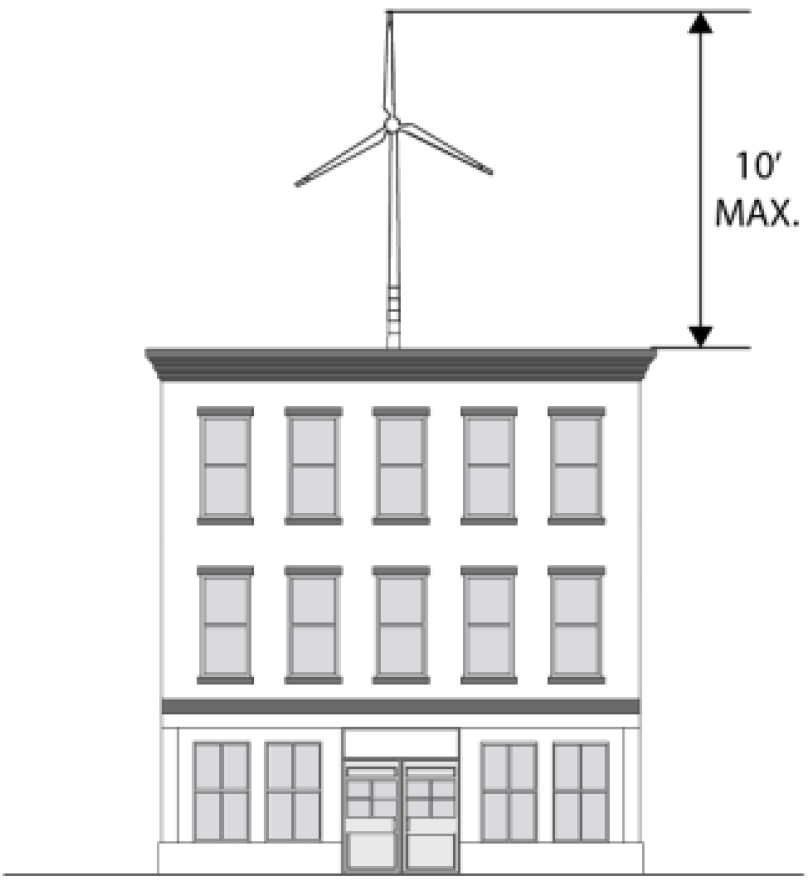
(Ord. No. DCA22-0008a, § 2(Exh. A), 3-7-2023; Ord. No. DCA23-0010b, § 2(Exh. A), 9-19-2023; Ord. No. DCA24-0006a, § 2(Exh. A), 6-4-2024)
5.4.5 - Additional Standards for Specific Accessory Structures.
A.
Swimming Pools. Discharge of swimming pools and backwash filters must be plumbed to the sanitary sewer.
5.5.1 - Purpose.
The purpose of this section is to allow certain uses and structures of a limited duration subject to specified conditions. This section is intended to ensure that such uses or structures do not negatively impact surrounding properties and are discontinued upon the expiration of a set time period.
5.5.2 - Temporary Uses and Structures Allowed.
The Director may permit temporary uses in accordance with Table 5.2-A: Table of Allowed Uses, and according to any applicable use-specific standards.
5.5.3 - Approval Process for Temporary Uses and Structures.
A.
General.
1.
Prior to establishing a temporary use or structure, a temporary use permit shall be approved pursuant to Subsection 2.5.3: Temporary Use Permit.
2.
Neither the granting of a temporary use permit, nor compliance with its terms, shall constitute a defense to prosecution under any law or ordinance, other than as stated in this section. A temporary use permit serves only to conditionally permit the temporary use of property, provided that the permittee strictly complies with all permit requirements and restrictions.
B.
Conditions.
1.
The Director may prescribe reasonable conditions upon a temporary use permit to protect the public health, safety, and general welfare of the community, with particular attention to areas proximately located to the permitted temporary use. Such conditions may include specific performance standards, noise mitigation measures, lighting restrictions, restrictions on hours of operation, odor control measures, off-street parking requirements, traffic restrictions, and other standards designed to minimize adverse impacts on surrounding areas.
2.
The Director may condition issuance of a temporary use permit upon either or both of the following:
a.
The applicant's demonstration of full compliance with all applicable permitting, licensing, surety, insurance, and performance standards of any governmental, administrative, or regulatory body exercising jurisdiction over the requested temporary use; and/or
b.
The applicant's posting of bonds or other securities in an amount, and of a type, reasonably sufficient to remediate, repair, and restore any public lands, infrastructure, or easements, or any public or private floodplains or environmentally sensitive areas, which could foreseeably suffer damage, directly or indirectly, as a consequence of the requested temporary use, regardless of whether such damages are actually caused by the applicant or by third-party participants in the temporary activity.
C.
Posting the Temporary Use Permit. The applicant shall post the permit issued by the city in a prominent location on the site where the temporary use is established.
D.
Revocation of a Temporary Use Permit. The Director may revoke a temporary use permit if it is determined that:
1.
The applicant misrepresented any material fact on his or her application, or supporting materials;
2.
The temporary use fails or ceases to comply with applicable standards or criteria for issuance of a permit;
3.
The operation of the temporary use violates any applicable statute, law, ordinance, or regulation; or
4.
The operation of the temporary use constitutes a nuisance or poses a real or potential threat to the health, safety, or welfare of the public.
5.5.4 - General Standards for Temporary Uses and Structures.
A.
Compliance with this DDC. Temporary uses and structures are subject to the dimensional standards in Subchapter 3: Zoning Districts, and the development standards in Subchapter 7: Development Standards, unless otherwise stated in this section.
B.
Compatibility. Temporary uses shall be compatible in intensity, characteristics, and appearance with existing land uses in the surrounding area of the proposed location. Factors such as location, access, traffic generation, noise, light, dust control, and hours of operation shall be considered.
C.
Required Licenses. The applicant shall obtain all necessary licenses required by this DDC and by state law.
D.
Operation and Development. All temporary uses, except occasional sales, shall comply with the following:
1.
Location.
a.
Temporary uses shall comply with applicable setback requirements. In situations where temporary storage containers and other portable storage units are used for loading and unloading purposes and the only placement location is on an existing driveway, temporary storage containers and other portable storage units may encroach into a required setback.
b.
Display, sales, and other temporary use-related activities shall be conducted on private property and not on public land or rights-of-way, unless specifically permitted in writing by the Director.
2.
Access and Circulation.
a.
Vehicular access points, public roads and rights-of-way, and pedestrian or bicycle paths shall not be damaged or obstructed. Public roads may be closed for a temporary special event where specifically authorized by the City Council.
b.
Temporary structures and all associated devices shall be of a temporary nature, movable, and shall not block visibility for vehicles or pedestrians on or off the lot so as to create a safety hazard.
c.
Temporary uses and structures may occupy required off-street parking only if specified and approved as part of a temporary use permit.
3.
Hours of Operation. Hours of operation shall be compatible with the adjacent land uses.
4.
Maintenance and Clean Up. The applicant shall guarantee that all trash and debris generated by the temporary use will be removed within 24 hours at no expense to the city.
5.
Signs. Signs shall comply with Subpart B, Chapter 33, Signs and Advertising Devices, in the Municipal Code of Ordinances.
E.
Occasional Sales. No more than three occasional sales may be allowed upon the premises of a residential dwelling in any 12-month period (limited to one sale every four months), with a limit of three days per time, per lot.
5.5.5 - Annual Permit Allowance and Renewal Periods.
A.
An applicant may renew, or receive a new temporary use permit for the same activity on the same lot in accordance with the following limitations:
B.
All uses not specifically listed in the table above shall be permitted for a maximum period of 30 days per calendar year, per lot, subject to Director approval. Applicants may not obtain a permit for a temporary use for the same lot if that site has exceeded the time limitation for that calendar year.
5.5.6 - Additional Standards for Specific Temporary Uses and Structures.
A.
Temporary Storage Containers and Other Portable Storage Units.
1.
Temporary storage containers and other portable storage units shall be located on an improved surface, but may not be located in any part of a fire lane, required parking space, maneuvering lane, public right-of-way, or visibility triangle.
2.
The property where the temporary storage container or other portable storage unit is located shall contain a principal structure, and the storage container or other portable storage unit will be considered accessory to the principal structure.
3.
Storage containers and other portable storage units that are less than 120 square feet, located in a rear yard, and are screened from public view are not required to obtain a temporary use permit.
B.
Concrete or Asphalt Batching Plant, Temporary.
1.
Permit Requirements. Applicants for a permit to operate a temporary concrete or asphalt batching must submit a letter from the Texas Commission on Environmental Quality (TCEQ) indicating that the proposed facility is exempt from the permitting procedures under the standard exemption, as amended.
a.
Concrete Batching Plants.
i.
When both wastewater and stormwater discharges will be generated on-site, concrete batch plants must be permitted under TCEQ discharge permit TXG110000.
ii.
When only stormwater discharges will be generated on-site, concrete batch plants may be included in construction stormwater permit TXR150000 for the construction site, if located at the construction site.
2.
Location.
a.
Temporary concrete batching plants (including associated stationary equipment and stockpiles) shall be located at least 300 feet from any recreational area, school, residence or other structure not occupied or used solely by the owner of the property upon which the facility is located. This distance limitation does not apply to structures within the boundaries of the project for which the facility is to pour concrete, provided that the facility is located on or contiguous to the project.
b.
Temporary asphalt batching plants shall be located at least one-half mile from any recreational area, school, or residence, or any other structure not occupied or used exclusively by the owner of the property upon which the facility is located.
3.
Operational Standards.
a.
The facility shall be operated in a manner that eliminates unnecessary dust, noise, and odor (including, with limitation, covering trucks, hoppers and chutes, loading and unloading devices, mixing operation and maintaining driveways and parking areas free of dust).
b.
All stockpiles shall be sprinkled with water or dust suppressant chemicals, or both, as necessary to achieve maximum control of dust emissions. The stockpile sprinkler system shall be operable at all times.
c.
Spilled cement and fly ash used in the batch shall be cleaned up immediately and contained or dampened to minimize dust emissions due to wind erosion and vehicle traffic.
d.
All open-bodied vehicles transporting material from a dry batch plant to the paving mixer shall be loaded with a layer of sand on top, and the truck shall be covered with a tarp to minimize the emission of dust under existing conditions.
e.
The applicant shall clear the site of all equipment, material, and debris upon completion of the project.
4.
Hours of Operation. The facility may operate only between the hours of 6:00 a.m. and 8:30 p.m., Monday through Friday, from June 1 to September 30; 7:00 a.m. and 8:30 p.m., Monday through Friday, from October 1 to May 31; 8:00 a.m. and 8:30 p.m. on Saturdays; and 1:00 p.m. and 8:30 p.m. on Sundays.
5.
Revocation of Permit. In addition to the criteria established in Subsection 5.5.3D, the Director may terminate or revoke a temporary use permit for a concrete or asphalt batching plant for any of the following reasons:
a.
The facility fails to comply with any of the requirements as listed in this subsection; or
b.
The facility violates any of the standards as listed on the standard exemption list adopted by the Texas Commission on Environmental Quality (TCEQ), as amended.
6.
Additional Approval Required for Off-Site Temporary Batch Plants. A Specific Use Permit (SUP) is required for all temporary batching facilities grinding, mixing, or otherwise preparing concrete, asphalt, or its ingredients or products for transportation to another site other than the site on which the batching facility is being located.
C.
Field or Construction Office.
1.
Field or construction offices may only be approved for licensed contractors working on construction projects for which permits have been issued. They shall be located on the same property and within the same project area where the work is being performed and shall not encroach into any public right-of-way. Field or construction or offices shall be required to meet all applicable state and local building and set-up codes.
2.
Field or construction offices may not be used as a dwelling unit or residence.
(Ord. No. DCA19-0027a, § 2(Exh. A), 2-4-2020)
5.6.1 - Purpose and Goals.
A.
The purpose of this section is to establish guidelines regulating the location of telecommunication towers and antennas with the objective of minimizing their number, to protect and promote public safety, and to mitigate any adverse visual impacts on the community, while promoting the provision of telecommunications service to the public.
B.
The goals of these regulations are to:
1.
Protect residential areas and land uses from potential adverse impacts of towers and antennas;
2.
Encourage the location of towers in non-residential areas;
3.
Minimize the total number of towers throughout the community;
4.
Encourage the joint use of new and existing tower sites as a primary option, rather than construction of additional single-use towers;
5.
Encourage users of towers and antennas to locate them, to the extent possible, in areas where the adverse impact on the community is minimal;
6.
Encourage users of towers and antennas to configure them in a way that minimizes the adverse visual impact through careful design, siting, landscape screening, and innovative camouflaging techniques;
7.
Enhance the ability of providers of telecommunications services to provide such services to the community quickly, effectively, and efficiently; and
8.
Avoid potential damage to adjacent properties from tower failure through engineering and careful siting of tower structures.
5.6.2 - Compliance with Telecommunications Act.
A.
The regulations contained in this DDC have been developed under the following general guidelines as provided in the federal Telecommunications Act of 1996:
1.
Cities have local authority over "placement, construction, and modification" of cellular telephone facilities and other personal wireless telecommunication service facilities;
2.
Regulations "shall not unreasonably discriminate among providers of functionally equivalent services;"
3.
Regulations "shall not prohibit or have the effect of prohibiting the provision of personal wireless services;"
4.
"Denial shall be in writing and supported by substantial evidence;" and
5.
Cities may not "regulate the placement, construction, and modification of personal wireless service facilities on the basis of environmental or radio frequency emissions to the extent that such facilities comply with the Federal Communication Commission regulations concerning such emissions."
B.
Notwithstanding any other provision of this section, telecommunications towers and antennas, when permitted by federal law and the laws of the State of Texas, shall be regulated and governed by the use regulations and requirements of this section.
5.6.3 - Applicability.
All new towers and antennas within the corporate limits of the city shall be subject to these regulations, except as provided in paragraphs (A) and (B) below:
A.
Amateur Radio Station Operators/Receive Only Antennas. This section shall not govern any tower or installation of any antenna that is under 70 feet in height and that is owned and operated by a federally-licensed amateur radio station operator or is used exclusively for receive only antennas.
B.
Pre-Existing Towers or Antennas. Pre-existing towers and pre-existing antennas shall not be required to meet the requirements of this DDC, except the requirements of subsections 5.6.7A, B, and H.
5.6.4 - General Provisions.
A.
Applications. All applications for rezoning or a specific use permit for a telecommunications tower, antenna, or other facility to provide a telecommunications service shall include a completed supplemental information form provided by the city regarding said facilities. In addition to any information required for applications for a specific use permit, applicants shall submit the following information:
1.
A detailed master antenna plan, clearly indicating the location of the proposed tower, on-site land uses and zoning, adjacent land uses and zoning, and other information deemed necessary by the Director.
2.
A legal description of the property and leased land, if applicable.
3.
The setback distance between the proposed tower and the nearest residential unit, platted residentially zoned properties, and unplatted residentially zoned properties.
4.
The separation distance from other towers shown on an updated site plan or map.
5.
A landscape plan showing specific landscape materials.
6.
Method of fencing and finished color and, if applicable, the method of camouflage and illumination.
B.
Platted Lots. Unless an exception is granted by the Planning and Zoning Commission, telecommunications facilities requiring rezoning or a specific use permit, including towers and related equipment buildings, shall be located on a platted lot.
C.
Technical Assistance. When a rezoning or specific use permit is required to comply with the provisions of this section, and when the technical information provided by the applicant is beyond the technical capacity of city staff to review, the applicant, in addition to the usual application fee, shall reimburse the city for the actual cost to the city for the services of a technical expert to review the application and/or information supplement, up to a maximum of $5,000.
D.
Pre-Application Meetings. Prior to leasing or purchasing facilities, the telecommunications service provider is encouraged to meet with the Director or his or her designee to determine if the location will require a specific use permit or other approvals, and to review the merits of potential locations.
E.
Master Antenna Plan. To facilitate co-location and coordination of telecommunication sites, the city shall, within 30 days of its effective date, notify the providers of telecommunications services, as that term is defined by federal law, of the enactment of this section. Said providers shall, within 90 days of the date of such notice, provide the city with their respective master antenna plans. Said plans shall include detailed maps, showing the locations and characteristics of all telecommunications towers and antennas serving any portion of the city and indicating coverage areas for current and, to the extent possible, future telecommunications towers and antennas. Providers shall also provide the city with any updates to the above documents within 90 days of their creation.
5.6.5 - Allowed Telecommunications Uses.
5.6.6 - Telecommunications Use-Specific Standards.
A.
Building-Mounted Panels.
1.
MD Zoning District.
a.
Panels shall be mounted to a nonresidential or multifamily structure.
b.
Panels shall be designed as "stealth" or otherwise camouflaged or concealed from view from a public or private right-of-way or residential zoning district.
2.
MN, MR, and GO Zoning Districts. Panels shall be designed as "stealth" or otherwise camouflaged or concealed from view from a public or private right-of-way or residential zoning district.
B.
Building-Mounted Whips.
1.
RR Zoning District.
a.
Whips shall be mounted to a nonresidential or multifamily structure.
b.
Whips shall be designed as "stealth" or otherwise camouflaged or concealed from view from a public or private right-of-way or residential zoning district.
2.
MD Zoning District. Whips shall be mounted to a nonresidential or multifamily structure.
C.
Roof-Mounted Arrays. Arrays shall be mounted to a nonresidential structure with more than 5,000 square feet of floor area.
D.
Building/Roof-Mounted Under 2m Diameter.
1.
MD Zoning District. Antenna shall be mounted to a nonresidential or multifamily structure.
2.
MN, MR, and GO Zoning Districts. Antenna shall be mounted to a nonresidential structure with more than 5,000 square feet of floor area.
E.
Building/Roof-Mounted Over 2m Diameter. In the MD, MR, and GO zoning districts, antenna shall be mounted to a nonresidential structure with more than 100,000 square feet of floor area.
F.
Ground-Mounted Over 3m Diameter. In the MD zoning district, antenna shall be mounted to a nonresidential structure with more than 5,000 square feet of floor area.
5.6.7 - Telecommunications Towers.
A.
Applicable Federal and State Standards. All telecommunications towers and antennas shall be erected and operated in compliance with current FCC and FAA rules and regulations and other applicable federal, state, and local standards. If such standards and regulations are changed, then the owners of the towers and antennas governed by this section shall bring such towers and antennas into compliance with such revised standards and regulations within six months of the effective date of such standards and regulations, unless a different compliance schedule is mandated by the controlling state or federal agency.
B.
Structural Standards. Telecommunications tower structures must conform to the most current revision of EIA 222 standards. Guyed telecommunications towers shall be designed and located so that if the structure should fall it would avoid habitable structures and public streets. To insure structural integrity, the owners of the tower shall ensure that it is maintained in compliance with all applicable provisions of Subpart B, Chapter 28: Building and Building Regulations, of the Municipal Code of Ordinances, and all applicable state or local building codes and safety regulations, as well as the regulations published by the Electronic Industries Association (EIA) as amended from time to time. If, upon inspection, the city concludes that a tower fails to comply with such codes and standards and constitutes a danger to persons or property, then, upon notice being provided to the owner of the tower, the owner shall have 30 days to bring the tower into compliance with these standards.
C.
Co-Location. Towers shall be designed and built to accommodate a minimum of two cellular or PCS providers, if over 75 feet in height. The owner of the tower must certify to the city that the tower is available for use by other telecommunications service providers on a reasonable and nondiscriminatory basis.
D.
Fencing. Security fencing shall be installed by a wrought iron or steel chain link fence with evergreen hedge, or a masonry wall, each not less than six feet in height. The exterior of equipment buildings and/or metal equipment cabinets visible from residential areas or public rights-of-way must have a neutral aggregate finish or be painted to reflect the color and character of adjoining structures or blend with adjacent landscaping and other surroundings.
E.
Setbacks. All telecommunication towers as well as guys and guy anchors shall be located within the buildable area of the lot and not within required front, rear, or side setbacks. Telecommunication towers in excess of 400 feet in height shall be set back a minimum of 2,600 feet from the right-of-way of all controlled access federal and state roadways designated as freeways to provide unobstructed flight paths for helicopters.
F.
Signage. Except as otherwise permitted in this section, no signage, lettering, symbols, images, or trademarks in excess of 200 square inches shall be placed on or affixed to any part of a telecommunications tower, antenna, antenna array, equipment building, or security fencing other than as required by FCC regulations or other applicable law.
G.
Lighting. Except as otherwise permitted in this DDC, no signals, lights, or illumination of any kind shall be permitted on or directed toward any tower unless required by the FCC, the FAA, or other appropriate public authority.
H.
Abandonment.
1.
In the event the use of any wireless communication facility, which would include any telecommunications tower or other antenna support structure, has been discontinued for a period of 360 days, the antenna support structure shall be deemed to be abandoned. Determination of the date of abandonment shall be made by the Building Official, who shall have the right to request documentation from the owner/operator regarding the issue of usage.
2.
Upon determination of abandonment, the owner/operator of the antenna support structure shall remove same within 90 days of receipt of notice from the Building Official notifying the owner/operator of such abandonment. If said antenna support structure is not removed within 90 days, the Building Official may cause it to be removed at the owner's expense.
5.6.8 - Tower Location.
A.
Historical/Cultural. Except for compatible alternative mounting structures that effectively camouflage or conceal the presence of telecommunications antennas, telecommunications facilities should not be located on or within 300 feet of property zoned historic or property included in a national or local historic zoning district. In addition, said facilities should, wherever possible, be located so as to ensure that historic or culturally significant vistas, and landscapes are protected and that the views of and vistas from architecturally and/or historically significant structures are not impaired or diminished.
B.
Residential Zoning. Except as provided in Table 5.6-E, telecommunications towers are not permitted in any residential zoning district and must be a minimum of a three to one distance to height ratio from a single-family residential use and one to one distance to height ratio from a multifamily use.
C.
Towers Permitted by Right. Free standing monopole telecommunications towers 85 feet or less in height are permitted except as provided in Table 5.6-E, except for the MD zoning district and other applicable sections of this subchapter.
D.
Towers Requiring a Specific Use Permit. All telecommunication towers to be located in the MD zoning district are permitted with a specific use permit. Telecommunication towers in excess of 50 feet in height and monopole towers in excess of 85 feet in height are permitted, except as provided in Table 5.6-E.
E.
Tower Spacing. Any new telecommunications tower in excess of 180 feet in height must be located a minimum of one mile from any existing tower in excess of 180 feet in height.
F.
Alternative Mounting Structures.
1.
New alternative mounting structures 100 feet or less in height are permitted, except as provided in Table 5.6-E, and other applicable subsections of this section.
2.
New alternative mounting structures in excess of 100 feet in height are permitted, except as provided in Table 5.6-E, and other applicable subsections of this section.
3.
Alternative mounting structures must be similar in color, scale, and character to adjoining buildings or structures, or blend with the landscaping and other surroundings immediately adjacent to them so as to generally avoid the creation of unique visual objects that stand out in the environment.
5.6.9 - Antenna Mounting.
A.
Purpose. The purpose of this subsection is to promote public safety and maintain order and harmony within the city's business, cultural, and residential zoning districts by restricting the size and location of telecommunication antennas. The objective is to avoid the creation of visual distractions, prevent obstructions to the view of pedestrians and motorists on public thoroughfares, and to insure the structural integrity of supporting structures.
B.
Whip and Panel Antenna Mounting.
1.
Individual telecommunications antennas are allowed on existing electric distribution poles, light standards, and telecommunication towers in excess of 40 feet in height, provided that:
a.
A joint use agreement is executed; and
b.
The antenna is not located within the power zone of the electric distribution pole.
2.
Antennas shall not be placed on electric transmission towers.
3.
The total length of any antenna does not exceed 15 percent of the height of the structure. The height of a telecommunications tower is determined by the highest point of any and all components of the structure, including antennas.
4.
Existing structures in excess of 50 feet in height may, as a matter of right, be rebuilt, if necessary, to support or contain a new antenna, provided that the new structure is the same height and substantially the same in appearance as the structure it replaces.
5.
Building-mounted panel antennas are permitted on non-residential buildings and multifamily dwellings in all zoning districts; provided that they are mounted flush with the exterior of the building and that they do not project above the roof line, nor more than 30 inches from the surface of the building to which they are attached. The antenna's appearance shall be such that its color and texture blends with the surrounding surface of the building.
6.
Whip antennas are permitted on non-residential buildings and multifamily dwellings in all zoning districts, provided that the total length of said whip antennas, regardless of mounting method or location, does not exceed 15 percent of the height of the building.
7.
Only one building/roof-mounted antenna support structure, less than 100 square feet in area, is permitted per 5,000 square feet of building floor area.
C.
Dish Antenna Mounting.
1.
Dish antennas shall not be permitted in any front setback area or side yard setback adjacent to any roadway.
2.
Ground-mounted dish antennas in excess of five feet in height shall be screened from roadways and adjacent property by a minimum six foot high screening fence, evergreen hedge, or masonry wall.
3.
Dish antennas in excess of 10 feet in height or more than 10 feet in diameter are permitted, except as provided in Table 5.6-E.
4.
Building/roof-mounted dish antennas that are one meter or less in diameter are permitted, except as provided in Table 5.6-E, and other applicable regulations of this section.
5.
Building/roof-mounted dish antennas two meters or less in diameter are permitted on all buildings in excess of 5,000 square feet of building floor area except as provided in Table 5.6-E, and other applicable regulations of this section.
6.
Only one building/roof-mounted dish antenna that is two meters or less in diameter, is permitted per 5,000 square feet of building floor area, except as provided in Table 5.6-E, and other applicable regulations of this section.
7.
Building/roof-mounted dish antennas in excess of two meters in diameter may be permitted on buildings in excess of 100,000 square feet of building floor area, except as provided in Table 5.6-E, and other applicable regulations of this section.
8.
Building/roof-mounted dish antennas in excess of one meter in diameter in residential zoning districts shall be painted to have an appearance that blends with the building on which they are located, or to be located so that they are not visible from any adjacent roadway.
9.
Building/roof-mounted dish antennas in excess of two meters in diameter in non-residential zoning districts shall be painted or screened with enclosures so as to have an appearance that blends with the building on which they are located, or to be located so that they are not visible from any adjacent roadway.
5.6.10 - Structural Certification.
Prior to the installation of any building/roof-mounted telecommunications antenna, antenna array, or support structure the Building Official shall be provided with an engineer's certification that the structure will support and not be adversely affected by the proposed antenna and associated equipment.
5.6.11 - Appeal.
Any entity that desires to erect or use telecommunication facilities that wishes to present evidence that such entity would be limited by the current ordinances or regulations of the city dealing with zoning and land use may apply for such use under this section. The City Council shall, upon a showing that strict application of regulations would prohibit or have the effect of prohibiting personal wireless service, as defined by federal law, modify the subject regulations, consistent with the spirit and intent of this subchapter and section, to the extent necessary to prevent the prohibition.

