
Dewitt City Zoning Code
ARTICLE XV
SIGNS
Sec. 78-401.- Purpose and intent.
The intent of this article is to regulate signs, to minimize outdoor advertising, and to protect public safety, health and welfare; minimize abundance and size of signs to reduce visual clutter, motorist distraction, and loss of visibility; promote public convenience; preserve property values; and enhance the aesthetic appearance and quality of life within the city. The requirements contained herein are intended to be content neutral. The following objectives are accomplished by establishing the minimum amount of regulations necessary concerning the size, placement, construction, illumination, and other aspects of signs in the city in order to:
a.
Protect the public right to receive messages, including religious, political, economic, social, philosophical and other types of information protected by the First Amendment of the U.S. Constitution.
b.
Maintain and improve the image of the city by encouraging signs of consistent size which are compatible with and complementary to related buildings and uses, and harmonious with their surroundings.
c.
Recognize that the proliferation of signs is unduly distracting to motorists and non-motorized travelers, reduces the effectiveness of signs directing and warning the public, causes confusion reduces desired uniform traffic flow, and creates potential for accidents.
d.
Recognize that the principal intent of commercial signs, to meet the purpose of these requirements and serve the public interest, should be for identification of an establishment on the premises, and not for advertising special events, brand names or off-premise activities, as these can be advertised more appropriately by other methods.
e.
Eliminate potential conflicts between business signs and traffic control signs, which could create confusion and hazardous consequences.
f.
Enable the public to locate goods, services and facilities without excessive difficulty and confusion by restricting the number and placement of signs.
g.
Prevent placement of signs which will conceal or obscure signs of adjacent uses.
h.
Prevent off-premise signs from conflicting with other land uses.
i.
Prevent signs that are potentially dangerous to the public due to structural deficiencies or disrepair.
j.
Prohibit portable commercial signs in recognition of their significant negative impact on traffic safety and aesthetics.
Sec. 78-402. - Definitions.
For the purpose of the following regulations, the following definitions shall apply:
a.
Abandoned sign: See obsolete sign.
b.
Awning or canopy sign: A sign affixed flat against the surface of an awning. An awning or canopy is a retractable or fixed shelter constructed of non-rigid materials on a supporting framework that projects from the exterior wall of a building.
c.
Banner sign: A sign made of fabric, plastic, or other non-rigid material without an enclosing structural framework.
d.
Billboard: A sign which identifies a use or advertises products and services not available on the site or parcel on which the sign is located.
e.
Changeable message signs: A sign on which the message is changed mechanically, electronically or manually, including time/temperature signs.
f.
Corner parcel: A lot at the intersection of two (2) streets.
g.
Day: For the purpose of these regulations, a calendar day rather than a business day.
h.
Directional sign: A sign which gives directions, instructions, or facility information for the use on the lot on which the sign is located, such as parking or exit and entrance signs.
i.
Freestanding sign: A permanently affixed sign which is erected upon or supported by the ground on one (1) or more poles, uprights or braces, including pole or pylon signs.
j.
Ground or monument sign: A three-dimensional, self-supporting, base-mounted freestanding sign, consisting of two (2) or more sides extending up from the base, and upon which a message, business, group of businesses or center name is affixed.
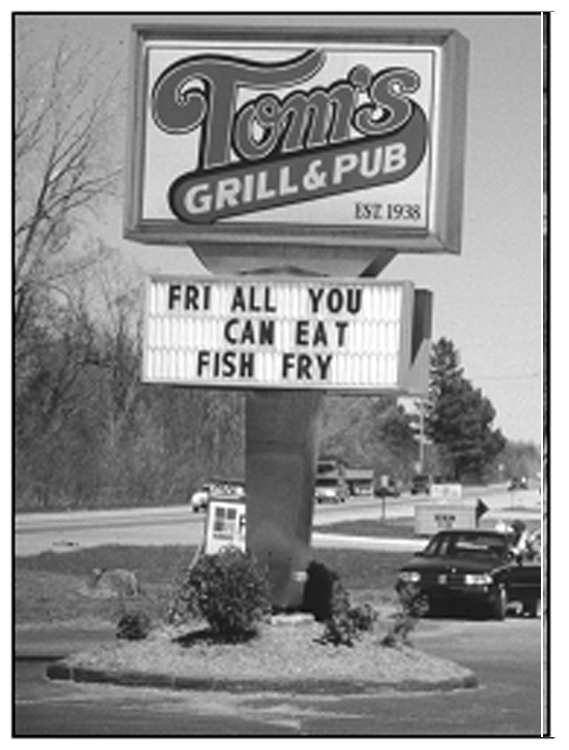
Freestanding Sign
k.
Marquee sign: A sign affixed flat against the surface of a theater marquee. A marquee is a permanent structure constructed of rigid materials that project from the exterior wall of a building.
l.
Motor vehicle sign: A sign measuring more than two (2) square feet in size that is mounted, placed, written, or painted on a vehicle or trailer, whether motor-driven or not.
m.
Obsolete sign: A sign that advertises a product that is no longer made or an event that has already occurred, or that advertises a business that has closed.
n.
Off-premise sign: A sign which identifies a use or advertises products and services not available on the site or parcel on which the sign is located (e.g. billboards, garage sale signs, residential open house signs, signs providing directions to a business).
o.
People sign: Signs held by people to direct visitors or advertise for a business.
p.
Pole or pylon sign: See freestanding sign.
q.
Portable sign: A sign designed to be moved easily and not permanently attached to the ground, a structure, or a building, including signs with wheels, A-frame signs, signs mounted on vehicles for advertising purposes, hot-air and gas filled balloons, pennants, streamers, ribbons, pinwheels, non-governmental flags and searchlights.
r.
Poster panel signs: A sign that is located outside of a business on a daily basis for the purpose of providing the public with information about the business (e.g. products and services offered, daily specials etc.). Poster panel signs include sandwich signs and "A" frame signs.
s.
Projecting sign: A sign, other than a wall sign, that is affixed to any building or wall and whose leading edge extends more than twelve (12) inches beyond such building or wall.
t.
Reader board, message board or changeable message sign: The portion of a sign on which copy is changed manually or electronically.
u.
Roof line: The top edge of a roof or parapet wall, whichever is higher, but excluding any cupolas, chimneys, or other minor projections. The roofline is the highest point of the roof surface if a flat roof; to the deck of mansard roofs, and to the mean height level between eaves and ridge of gable, hip and gambrel roofs.
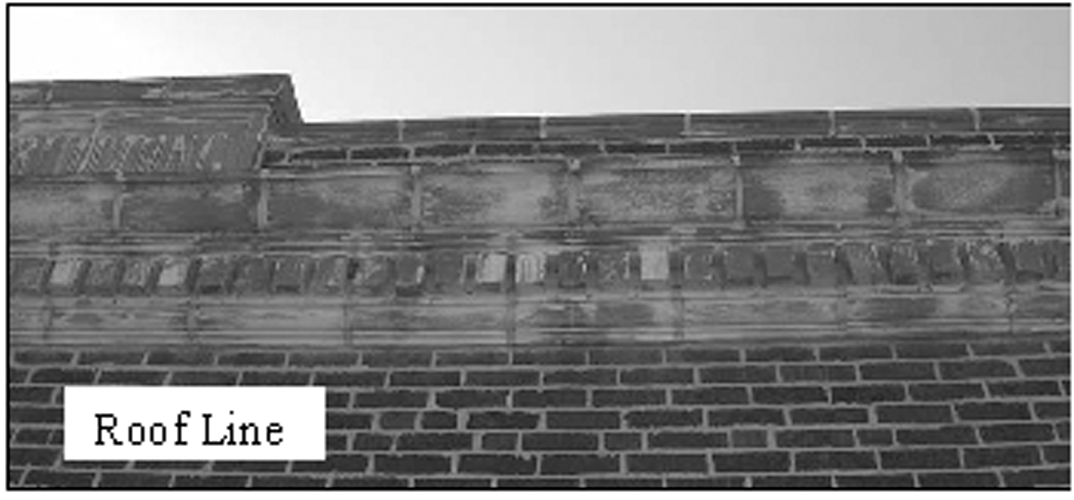
Roof Line
v.
Roof sign: A sign erected above the roof line of a building.
w.
Sign: Any words, numerals, figures, devices, designs, pictures or trademarks erected on or otherwise affixed to a building, wall board, plate or any other structure, or on a vehicle or trailer, for the purpose of advertising or identifying an establishment, product, service, or activity.
x.
Subdivision sign: A permanent on-premises sign identifying a vehicular entrance to a residential subdivision or residential complex.
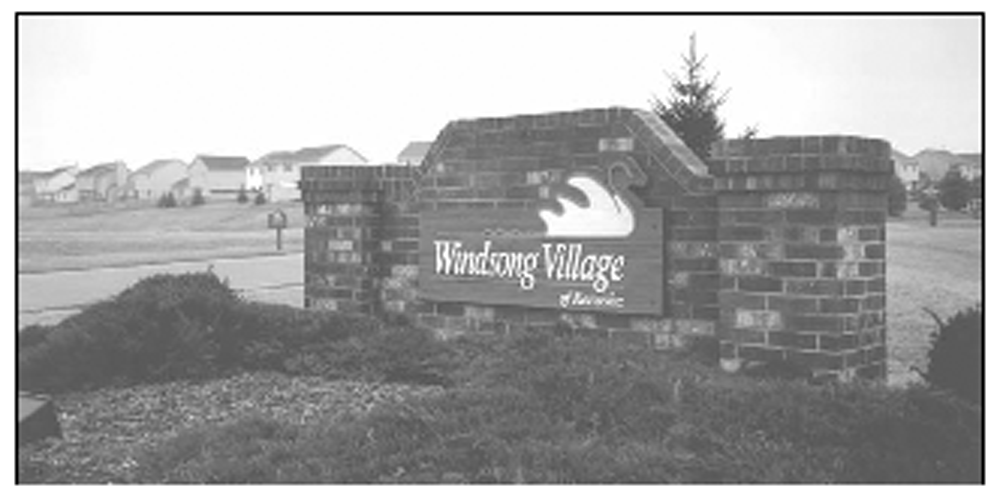
Subdivision Sign
y.
Temporary sign: A sign, banner or other advertising device constructed of cloth, canvas, fabric, plastic or other light temporary material, with or a without structural frame, that is not permanently attached to the ground or a structure or any other sign intended for a limited period of display but not including decorative display for holidays or public demonstration.
z.
Umbrella sign: A sign printed or otherwise attached to an umbrella, including umbrellas used in outdoor seating areas.
aa.
Wall sign: A sign painted or attached directly to and parallel to the exterior wall of a building.
bb.
Window sign: A sign installed inside a window and intended to be viewed from the outside.
(Ord. No. 2018-05, § 1, 7-9-2018)
Sec. 78-403. - Exempt signs.
The following signs are permitted in all districts on premises with permission of the landowner without a written sign permit, and provided they are not located in the public right-of-way or in conflict with the provisions of Section 78-36, Intersection Visibility.
a.
Banners provided they are erected no more than fifteen (15) days.
b.
Directional signs, not exceeding six (6) square feet in display area on each side.
c.
Enclosed signs. Any sign that is located completely within a building and is not visible from the outside.
d.
Flags, provided there are not more than three (3) flags per lot and the maximum size of each flag is fifty (50) square feet.
e.
Non-conforming signs existing on the effective date of the adoption of the ordinance. Removal of the sign shall constitute an elimination of the non-conforming status.
f.
Permanent signs on vending machines, gas pumps, and ice containers indicating the contents, provided that the sign on each device does not exceed three (3) square feet in area a limit of one (1) sign per vending machine, gas pump or ice container.
g.
Signs by a public body to protect the public, provided that such signs do not exceed two (2) square feet in area.
h.
Regulatory, directional and street signs erected by a public agency in compliance with Michigan Manual of Uniform Traffic Control Devices Manual, and the Uniform Federal Accessibility Standards and Michigan Barrier Free Manual.
i.
Traffic control signs including directional, warning, or informational signs when authorized by a public agency having appropriate jurisdiction which conforms to the requirements of the Michigan Manual of Uniform Traffic Control Devices.
(Ord. No. 2018-05, § 1, 7-9-2018)
Sec. 78-404. - Prohibited signs.
Any sign not expressly permitted is prohibited in all districts, including but not limited to the following:
a.
Spinners, pennants, or streamers, other than those of a governmental or educational institution, or not used for the purpose of commercial advertisement or attraction, hung overhead to draw attention to a business or its merchandise on display.
b.
Billboards, either as on or off-premise signs.
c.
Except for signs erected by governmental and educational institutions, no sign shall contain any moving or animated parts nor have the appearance of having any moving or animated parts. No sign shall employ any flashing, moving, oscillating, blinking, or variable intensity light or intermittent lights resembling the flashing lights customarily used in traffic signals, or police, fire, ambulance, or rescue vehicles, or lights so bright as to be blinding or distracting to a vehicle
d.
Changeable message signs.
e.
Signs located in the right-of-way of public streets or highways, attached to a utility pole, fence or affixed to a tree except as may otherwise be permitted by this article.
f.
Obsolete signs.
g.
People signs.
h.
Pole or pylon signs.
i.
Portable signs, except where expressly allowed in this article.
j.
Any type of signage shall not be permitted on a public or private radio, television, cellular phone, or water towers with the exception of the name of the municipality.
k.
Signs on road furniture, such as benches, pedestrian lights, and decorative trash receptacles, not including commemorative plaques or engravings not larger than one-half (0.5) square foot.
l.
A sign that would interfere with, mislead, or confuse a vehicle driver, including signs that simulate or could in any way be confused with the lighting of emergency vehicles or traffic signals.
m.
Any sign which obstructs the ingress or egress from a required door, window, or other required exit.
n.
Signs that obstruct any approved traffic control device, road sign, or signal from view; interfere with site distance necessary for traffic safety; or distract from visibility of existing traffic signs or devices.
o.
Any sign not attached to a building and erected within ten (10) feet of a fire hydrant.
p.
No commercial vehicle may be parked on a business premises or an industrial lot for a time period exceeding forty-eight (48) hours
q.
Motor vehicle signs. It shall be unlawful to park, place or store a vehicle or trailer on which there is a motor vehicle sign on private or public property.
(a)
Presumption. There shall be a presumption that this subsection has been violated if the motor vehicle sign is visible from a street and one (1) or more of the following circumstances exist:
1.
The motor vehicle sign is attached to a vehicle or trailer that is unregistered or not operable;
2.
The motor vehicle sign is larger in any dimension than or extends beyond any surface of the vehicle or trailer to which it is attached.
3.
The motor vehicle sign is attached to a vehicle or trailer that is parked or stored in a public right-of-way or an area not designed, designated, or commonly used for parking.
4.
The motor vehicle sign is attached to a vehicle or trailer that is regularly parked or stored in a "front yard" or "side yard," as such terms are defined in the DeWitt Zoning Ordinance, that abuts a street, when there are other areas of the property designed, designated, or available for the parking or storage of the vehicle or trailer that are not visible from the street or do not abut streets; or
5.
The motor vehicle sign is attached to a vehicle or trailer that is regularly parked or stored within fifty (50) feet of a street, when there are other areas of the property designed, designated, or available for the parking or storage of the vehicle or trailer that are more distant from the street or not visible from the street.
(b)
Rebuttal of presumption. The presumption set forth in (a), above, may be rebutted by evidence showing all of the following:
1.
The vehicle is temporarily parked in a particular location in the course of conducting personal activities or business activities that involve the loading or unloading of goods for customers, providing services to off-site customers, conducting off-site business, or engaging in work breaks;
2.
The activities in 1., above, are being actively undertaken during the period of such parking;
3.
The activities in 1., above, require the presence of the vehicle for purposes of transporting equipment, people, supplies and/or goods necessary for carrying out such activities; and
4.
The activities in 1., above, are not, other than incidentally, related to advertising, identifying, displaying, directing, or attracting attention to an object, person, institution, organization, business, product, service, event or location.
r.
Any sign or sign structure which:
(a)
Is structurally unsafe;
(b)
Constitutes a hazard to safety or health by reason of inadequate maintenance, dilapidation, or abandonment;
(c)
Constitutes a hazard to safety or health by reason of blocking views;
(d)
Is capable of causing electric shock to a person who comes in contact with it;
(e)
Is unlawfully installed, erected, or maintained;
(f)
Is located in public street or utility right-of-way, except where expressly permitted herein; or
(g)
Is not kept in good repair, such that it has broken parts, missing letters, non-operational lights, or has deteriorated, such that its structural support or frame or sign panels are visibly bent, broken, dented, or torn as to constitute an unsightly, hazardous or harmful condition
(h)
Does not meet applicable requirements of any adopted city building code.
s.
Any sign installed, erected or maintained on city property, unless approved and installed or erected by the city.
(Amend. of 1-14-2014; Ord. No. 2018-05, § 1, 7-9-2018)
Sec. 78-405. - General requirements for permitted signs—All districts.
a.
Sign location. Unless otherwise provided in these regulations, no sign, except those established by the City of DeWitt, Clinton County, state or federal governments shall be located in, project or overhang into any public right-of-way or dedicated easement.
b.
Measuring sign area.
1.
Sign area shall be measured as the square footage of the sign face and any frame or other material or color forming an integral part of the display or used to differentiate it from the background against which it is placed.
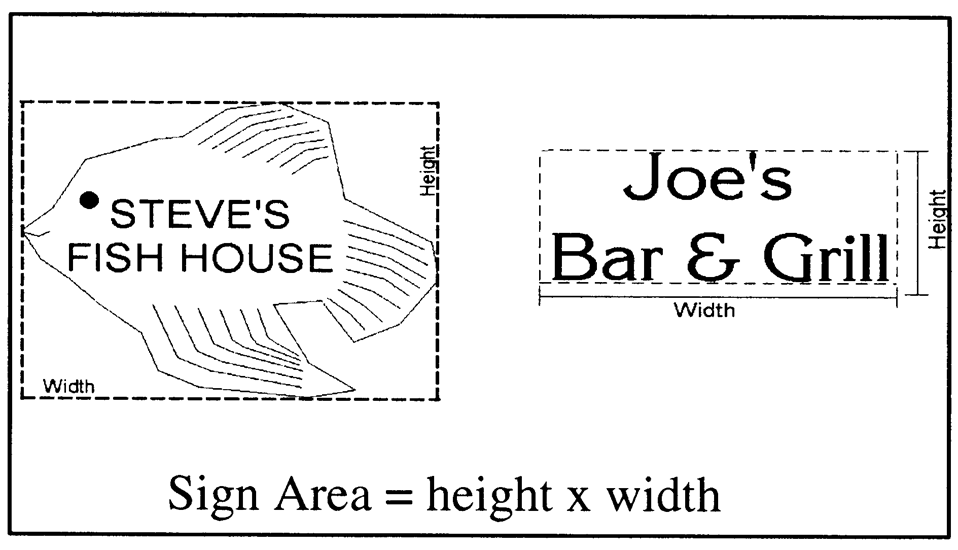
Measuring sign area
2.
When a sign consists solely of lettering or other sign elements printed, painted or mounted on a window or a wall of a building without any distinguishing border, panel or background, the calculation for sign area shall be measured by enclosing the most protruding edges of the sign elements within a parallelogram or rectangle.
3.
The area of a double-faced sign shall be computed using only one (1) face of the sign provided that: 1) the outline and dimensions of both faces are identical, and 2) the faces are back to back so that only one (1) face is visible at any given time.
c.
Measuring sign height.
1.
The permitted height of all signs supported by the ground shall be measured from the level of the ground, adjacent to the sign to the highest point of the sign.
2.
The permitted height shall not be measured from an area of ground that has been built-up or constructed in a manner that has the effect of allowing a higher sign height than permitted by these regulations (e.g. the height of signs erected on a berm shall be measured from the finished grade adjacent to the berm in the manner noted in the illustration).
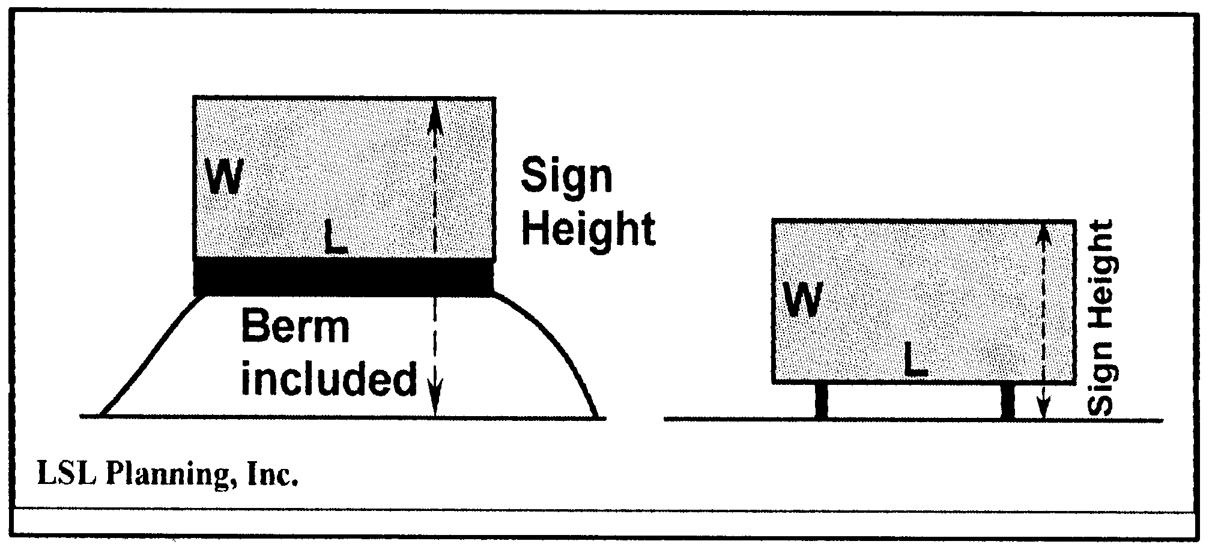
Measuring sign height
d.
Design and construction.
1.
Signs shall be designed to be compatible with the building and landscaping used on the property to promote an overall unified and aesthetic effect in accordance with the standards set forth herein.
2.
Monument signs must be landscaped with a combination of low shrubbery and perennial/annual plantings.
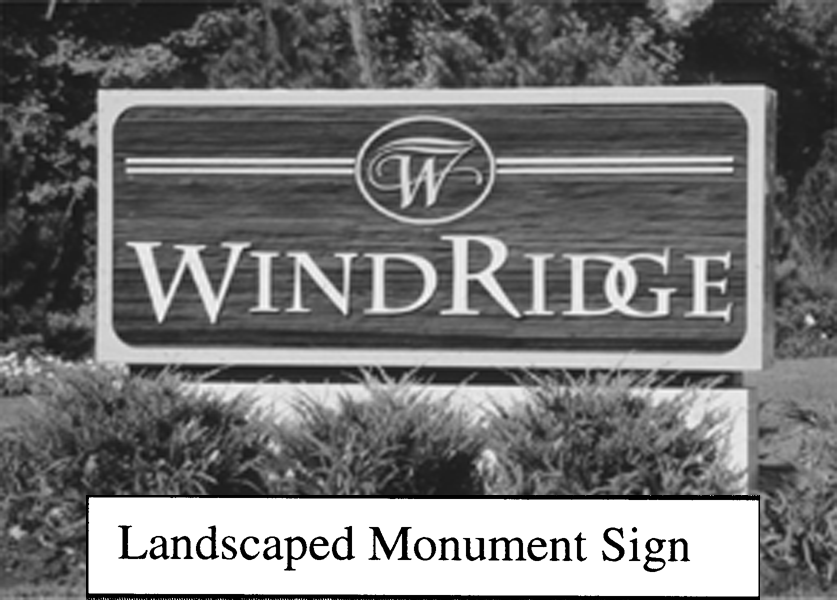
Landscaped Monument Sign
3.
The maximum distance between parallel sign faces on a double-faced sign shall be twenty (20) inches.
4.
Every sign shall be constructed and maintained in a manner consistent with the building code provisions and maintained in good structural condition at all times. All signs shall be kept in an attractive appearance and shall be neatly painted, stained, sealed or preserved including all metal parts and supports.
5.
All signs erected, constructed, reconstructed, altered or moved shall be constructed in such a manner and of such materials so that they meet the applicable State of Michigan Building Code.
6.
All portable signs shall be constructed and maintained by the owner in such a manner and of such materials so that they withstand typical environmental conditions.
e.
Illumination.
1.
Signs shall be illuminated only by steady, stationary, shielded light sources directed solely at the sign (i.e. front lighted signs) or internal to it (i.e. back lighted signs).
a)
Front lighted signs: 'Front lighted signs' are signs that are illuminated by an external light source. An example of a front lighted sign is a wall sign that is illuminated by gooseneck lights that are located in front of the sign, as illustrated in the graphic in this subsection.
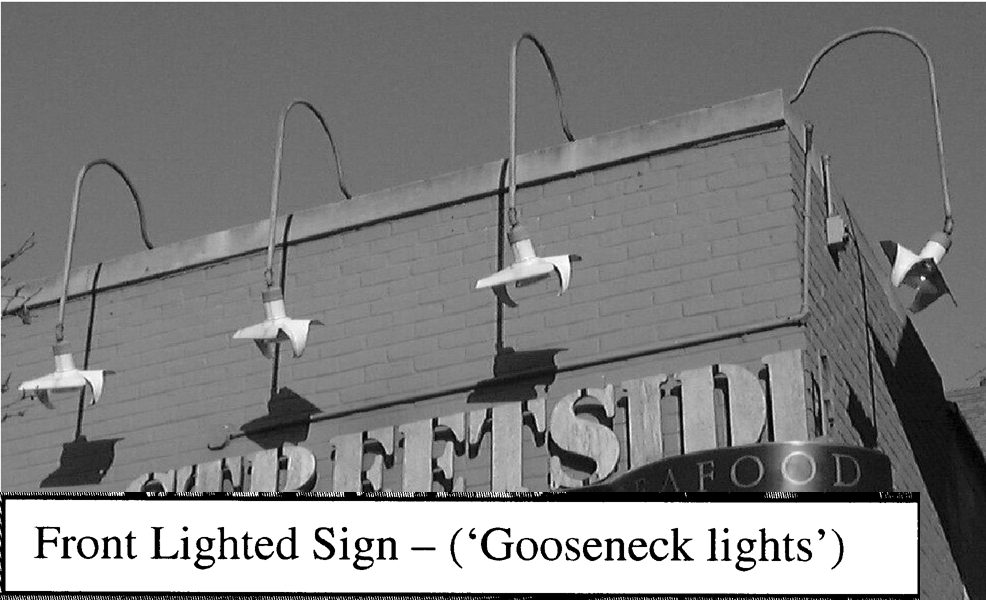
Front Lighted Sign—"Gooseneck lights"
b)
Back lighted signs: 'Back lighted signs' are signs that are illuminated by an internal light source. An example of a back lighted sign is a monument sign that is illuminated by several fluorescent or neon bulbs that are located within the sign cabinet.
2.
Lights shall be shaded so as not to project onto adjoining properties or thoroughfares.
3.
Use of glaring undiffused lights or bulbs shall be prohibited.
4.
Underground wiring shall be required for all illuminated signs not attached to a building.
5.
Use of exposed neon lighting within a sign is prohibited except for an "open" sign no larger than four (4) square feet.
f.
Location.
1.
Setbacks.
(a)
All signs, unless otherwise provided for, shall be set back a minimum of ten (10) feet from any public road right-of-way line. This distance shall be measured from the nearest edge of the sign, measured at a vertical line perpendicular to the ground to the right-of-way.
(b)
Side yard setbacks for signs shall be the same as that required for the main structure or building, and provided that all non-residential district signs shall be set back at least one hundred (100) feet from any residential district.
2.
Measurement. The following guidelines shall be used to determine compliance with setback and distance measurements:
(a)
Two (2) signs. The distance between two (2) signs shall be measured along a straight horizontal line that represents the shortest distance between the two (2) signs.
(b)
Sign and property line. The distance between a sign and a property line shall be measured along a straight horizontal line that represents the shortest distance between the sign and the property line.
(c)
Sign and other. The distance between a sign and a parking lot or building shall be measured along a straight horizontal line that represents the shortest distance between the sign and the outer edge of the parking lot or building.
g.
Construction requirements. The following construction requirements apply to all permanent signs.
1.
Fastenings. All signs must be erected in such a manner and with such materials to remain safe and secure during the period of use. All bolts, cables, and other parts of such signs shall be kept painted and free from corrosion. No sign may be placed upon a tree or utility pole, except signs of a unit of government or utility.
2.
Support location. No pole, cable or support of any nature shall be placed on any publicly owned property road right-of-way, or proposed road right-of-way.
3.
Sign safety.
(a)
All signs shall be erected so that any part including cables, guys, etc. shall have a minimum clearance of four (4) feet from any electrical conductor, electric light pole, road lamp, traffic light, or other public utility pole or standard.
(b)
All signs shall be designed to comply with minimum wind pressure and other requirements set forth in the adopted Building Code. Signs with electrical connections shall comply with Electrical Code requirements, including the application, inspection, and approval of an electrical permit.
4.
Sanitation. Property surrounding any ground sign shall be kept clean, sanitary and free from obnoxious and offensive substances, free from weeds, rubbish, and flammable material.
5.
Safety triangle. No sign shall be located within, project into, or overhang the triangular area formed at the intersection of any two (2) road right-of-way lines (existing or proposed) by a straight line drawn between said right-of-way lines at a distance along each line of twenty-five (25) feet from their point of intersection.
Sec. 78-406. - Specific sign requirements—All districts (other than CB) and residential properties in CB district.
The
following requirements apply to signs in all districts, other than the CB, central business commercial district, and to signs on property used for residential purposes within the CB district.
a.
Subdivision entrance signs. The following are additional regulations applicable to ground signs and decorative walls for residential subdivisions.
1.
Subject to the provisions of this article, a sign identifying entrances to a residential subdivision within the city may be permitted and shall harmonize with aesthetic considerations of the subdivision. These signs shall not by reason of their size, location, construction, or manner of display, endanger persons or property, cause a traffic hazard, or be incompatible with adjoining property use.
2.
The location of subdivision identification signs may be within the public street right-of-way, but not in the traveled portion thereof for vehicular traffic. Written approvals of proposed sign placement and location shall first be obtained from appropriate city department heads, including the chief of police, the fire chief and the head of the department of public services.
3.
The sign shall contain the name of the subdivision only.
4.
All such signs shall be maintained in good condition and be visually attractive. The immediate area surrounding the sign shall be landscaped.
5.
Maintenance of all signs shall be at the expense of the owner or owners of the signs, which may be the subdivision property owners association, proprietor of the plat or other responsible person or entity.
6.
The owner(s) of such signs shall obtain liability insurance coverage for injury to persons and damage to property, arising out of their ownership, use or maintenance, in limits suitable to the city. Such insurance shall be primary to all other insurance coverage, shall include the city as a named insured, and shall be maintained at all times while the sign is located within the public street right-of-way. Proof of insurance shall be furnished to the city.
7.
As a condition of approval of the placement of subdivision signs in the public street right-of-way the owner(s) of the sign shall enter into an agreement with the city in which the owner(s) covenants to hold the city harmless from any injury to persons and/or property damage arising out of the ownership, use and maintenance of the signs, and to indemnify the city for any injury and/or damage it may sustain by reason of such ownership, use or maintenance, including costs and attorney's fees.
8.
Removal and replacement of such signs shall be by application to the development official. Approval shall be granted by the development official unless safety conditions, sign modifications, utility placement or relocation, street widening or relocation, need of other municipal improvements, or other such changing conditions occur which may for reasons of public health, safety, and welfare make replacement impractical. The city may require removal of such signs in the public right-of-way, at the owner's expense in any such cases where the public health, safety, or welfare as adversely affected by the continued existence of the sign in its location.
Table XV-01
Specific Sign Requirements
Sec. 78-407. - Downtown sign regulations.
a.
The regulations in Section 78-407 are intended to regulate the placement, size, construction and manner of display of signs and outdoor advertising in downtown DeWitt in order to protect public safety, health and welfare; minimize abundance and size of signs to reduce visual pollution, motorist distraction, and loss of sight distance; protect the constitutional right of free speech while imposing reasonable regulation; promote public convenience; preserve property values; promote aesthetics as a means of protecting the community's welfare and enhancing the aesthetic appearance and quality of life within the city.
The following regulations shall apply to all signs on property used for non-residential purposes within the area of downtown DeWitt that is zoned CB, central business district. Signs on property used for residential purposes within the area of downtown DeWitt and signs on property in other areas of the City of DeWitt are not subject to the following regulations.
b.
Specific sign regulations.
1.
Wall signs.
a)
One (1) wall sign shall be permitted per street frontage on each parcel. One (1) wall sign shall also be permitted on sides of buildings facing a parking lot. In the case of a multi-tenant building or shopping center, one (1) wall sign shall be permitted for each tenant having an individual means of public access. Tenants occupying a corner space in a multi-tenant structure shall be permitted to have one (1) sign on each side of the building. Where several tenants share a common entrance in a multi-tenant structure, only one (1) wall sign shall be permitted, with the total permitted sign area being allocated among the tenants.
b)
Wall signs shall extend no greater than eight (8) inches from the exterior face of the wall to which it is attached.
c)
Wall signs shall not have an area that exceeds one hundred (100) square feet or ten (10) percent of the area of the wall to which it is attached, whichever is less. A wall sign facing a parking area shall not have an area that exceeds fifty (50) square feet or five (5) percent of the area of the wall to which it is attached, whichever is less
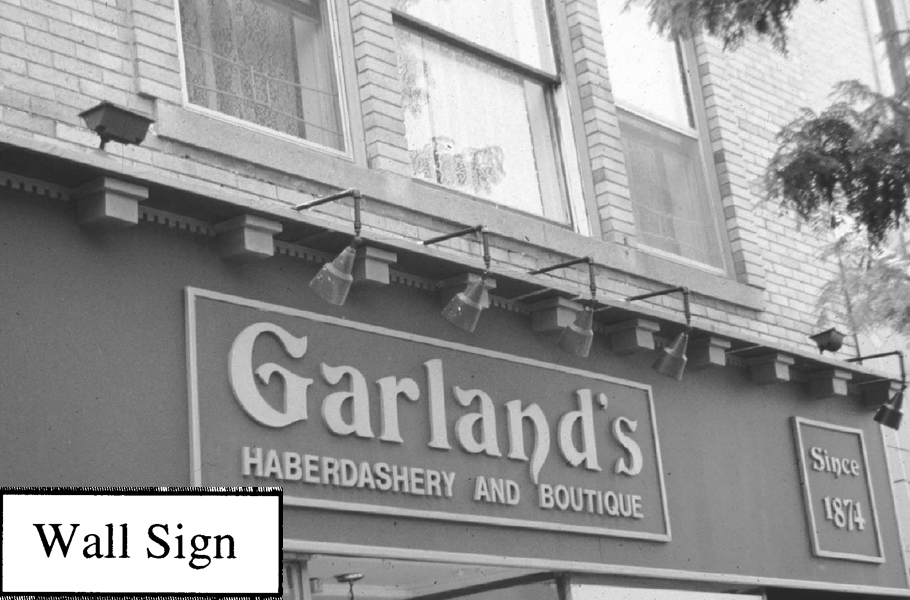
Wall Sign
d)
The height of wall signs shall not exceed the maximum building height specified for the district it is located.
e)
Wall signs shall not extend above the wall of the building.
2.
Awnings and canopies.
a)
Awnings or canopies may project a maximum of six (6) feet into the public right-of-way. In no case shall the awning or canopy be less than three (3) feet from any street curb line.
b)
Awnings or canopies must be a minimum of eight (8) feet above the ground level or sidewalk, whichever is greater.
c)
Lettering or logos shall not cover more than one-third (⅓) of the awning or canopy.
d)
Any lettering or logos on the awning or canopy shall be included within the calculation of total permitted wall sign area.
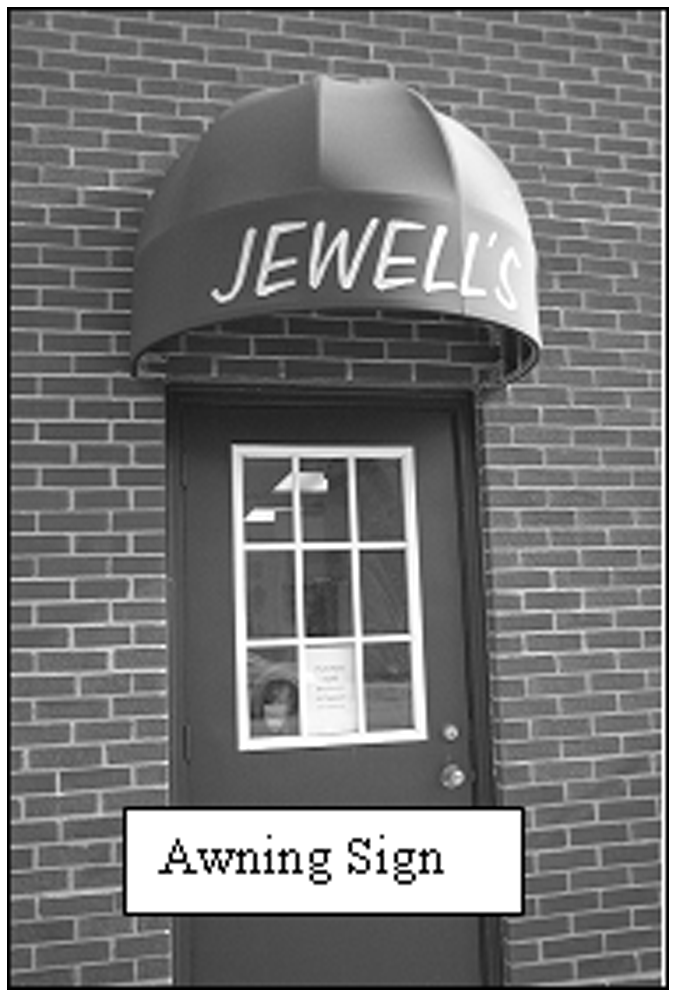
Awning Sign
e)
Awnings and canopies shall not be illuminated or backlit. However, building mounted lighting may illuminate the area above or below the awning or canopy.
3.
Directional signs. Directional signs used to direct vehicular or pedestrian traffic to driveways, parking areas, loading areas, or to certain buildings or locations on the site, shall not exceed four (4) square feet in area, and four (4) feet in height. Directional signs may be located in the front setback area, provided they are setback at least fifteen (15) feet from the existing or planned right-of-way line and do not include a logo.
Directional signs are only permitted in those locations where the city's development official concurs they are needed.
4.
Poster panel signs (i.e. sandwich signs, A-frame signs). Poster panel signs, including sandwich signs and "A" frame signs, shall be permitted subject to the following:
a)
The area of the sign shall not exceed seven (7) square feet per side.
b)
One (1) such sign shall be permitted per customer entrance.
c)
The sign shall be no greater than three and one-half (3½) feet in height.
d)
The sign shall not be illuminated in any manner.
e)
The sign shall be located a minimum of two (2) feet from the edge of the curb and must be located so that at least a five (5) foot wide sidewalk is maintained between the sign and the building wall for pedestrian traffic flow and safety.
f)
The sign is permitted only during operating business hours and must be stored inside when the business is not open.
g)
The sign shall be kept neatly painted, stained, sealed or preserved including all metal parts and supports.
h)
The sign shall be erected, constructed, reconstructed, altered or moved in such a manner and of such materials so they meet applicable State of Michigan Building Standards.
i)
All portable signs shall be constructed and maintained by the owner in such a manner and of such materials so that they withstand typical environmental conditions.
j)
The sign must be constructed of weather-proof, durable material and kept in good repair and appearance.
5.
Temporary signs. Temporary signs shall be in accordance with the requirements set forth in Table 2.
6.
Projecting signs. Projecting signs are permitted subject to the following:
a)
Signs must be a minimum of eight (8) feet above the ground level or sidewalk, whichever is greater.
b)
The maximum sign area is sixteen (16) square feet, with a maximum sign area of eight (8) square feet on each side of the sign.
c)
One (1) projecting sign is permitted per property, except in the case of a corner lot which is permitted two (2) signs.
d)
Signs shall be illuminated only by steady, stationary, shielded light sources directed solely at the sign. Use of glaring undiffused lights or bulbs shall be prohibited.
e)
Projecting signs may project a maximum of six (6) feet into the public right-of-way. In no case shall the projecting sign be less than three (3) feet from any street curb line.
SCHEDULE OF SIGN REGULATIONS—CB District
Table 1 Permanent Signs
The following table summarizes regulations for permanent non-residential signs in downtown DeWitt, on property zoned central business district.
Table 2
Temporary Signs—CB District
The following table includes regulations for temporary non-residential signs in downtown DeWitt, on property zoned central business commercial district. These signs require a permit.
Sec. 78-408. - Sign permit application—All districts.
a.
Requirements.
1.
Permits required. Except for temporary signs and those exceptions otherwise noted, permits are required for all signs.
2.
Exceptions to permit. No permit shall be required for ordinary servicing or repainting of an existing sign message, cleaning of a sign, or changing of the message on the sign where the sign is designed for such changes (such as lettering on a marquee).
b.
Procedure.
1.
Application form. Application for a permit for a sign shall be filed with the city and shall provide the following information:
a.
Name, address, and telephone number of the applicant.
b.
Location of the building, structure, or lot on which the sign is to be attached or erected.
c.
Position of the sign in relation to buildings, structures, and property lines within one hundred (100) feet of the proposed sign.
d.
Plans showing the dimensions, materials, method of construction, and attachment to the building or in the ground.
e.
Copies of stress sheets and calculations, if deemed necessary, showing the structure as designed for dead load and wind pressure.
f.
Name and address of the person, firm, or corporation owning, erecting, and maintaining the sign.
g.
Information concerning required electrical connections.
h.
Details of proposed illumination.
i.
A bond, as may be required by this article.
j.
Written consent of the owner or lessee of the premises upon which the sign is to be erected.
k.
Other information required to make the determination that the sign is in compliance with all applicable laws and regulations.
2.
Application review.
a.
Planning commission review. All locations for placement of a sign submitted in conjunction with the proposed construction of a new building or addition to an existing building or as part of a site plan review required by this ordinance shall be reviewed by the planning commission as a part of the required site plan review. The location, size and height of all existing and proposed signs must be shown on the site plan.
b.
Administrative review. The development official shall review the sign permit application for any sign proposed on a site or existing building where no other new construction is proposed.
c.
Issuance of a permit. Following review and approval of a sign application by the city development official, the development official shall have the authority to issue a sign permit upon payment by the applicant of the required fees.
d.
Denial of a permit. The development official shall deny the application for any sign that does not comply with the requirements of this ordinance or is found to be inconsistent with any of the requirements herein. If denied, the applicant may apply for a variance from the ZBA.
e.
A permit is null and void if the sign is not installed within six (6) months.
Sec. 78-409. - Sign inspection and maintenance.
a.
Sign inspection.
1.
Responsibility for compliance. The owner of any property on which a sign is located is declared to be responsible for the permit, erection, inspection, safety, condition, and removal of a sign and the area in the vicinity thereof.
2.
Inspection of new signs. All signs for which a permit has been issued shall be inspected by the Building Inspector upon installation. Approval shall be granted only if the sign has been constructed in compliance with the approved plans and applicable requirements of city ordinances and codes.
3.
Inspection before enclosure. In cases where fastenings or anchorages are to be eventually bricked in or otherwise enclosed, the sign erector shall advise the building inspector when such fastenings are to be installed so that inspection may be completed before enclosure.
4.
Inspection of existing signs. The development official or building inspector may at such times as deemed necessary, inspect any sign allowed under this section. If upon inspection a sign is found to be unsafe or in a condition that does not comply with all the provisions of this section, the development official shall give notice of such condition to the owner for such sign who shall cause to be made the necessary repairs or alterations, or remove the sign.
b.
Sign maintenance.
1.
Maintenance of signs. All signs shall:
(a)
Be kept in compliance with the plans and specifications filed and approved for issuance of the construction permit.
(b)
Be kept and maintained in a safe condition, consistent with adopted building and mechanical codes.
(c)
Conform to all the provisions of this article at all times.
2.
Correction of defects. If the development official finds that any sign is unsafe, insecure, improperly constructed, or poorly maintained, the sign erector, owner of the sign, or owner of the land shall make the sign safe and secure by completing any necessary reconstruction or repairs, or entirely remove the sign in accordance with the timetable established by the development official. Existing signs determined to be unsafe and an immediate hazard to health or safety shall be removed or repaired within twelve (12) hours of notification.
3.
Removal of obsolete signs. Any sign that no longer identifies a business that is in operation; or identifies an activity or event that has already occurred shall be considered abandoned and shall be removed by the owner of the property within seven (7) calendar days of the cessation of operation. The owner of the property shall be responsible for removal of all signs and sign faces used in conjunction with a business upon vacation of a commercial or industrial establishment. Where a sign structure and frame can typically be reused by a new occupant in a leased or rented building, the building owner shall not be required to remove the sign structure and frame in the interim periods when the building is not occupied. During the interim period, a panel, satisfactory to the development official, shall be placed over any openings in the sign structure.
Sec. 78-410. - Legal non-conforming signs.
a.
Any sign existing at the time of adoption of these regulations which does not comply with all provisions shall be considered a legal non-conforming sign and may be permitted to continue if the sign is properly maintained and not detrimental to the health, safety and welfare of the community.
b.
Nothing shall prevent the strengthening or restoring to a safe condition of any portion of a sign declared unsafe by the building inspector. Such signs may be improved only to the extent that such improvement does not exceed fifty (50) percent of the current market value of the existing sign structure.
c.
Subject to exceptions below, any legal non-conforming signs may be continued in operation and maintained after the effective date of these regulations provided that the signs shall not be:
1.
Structurally altered so as to extend their useful life;
2.
Expanded;
3.
Relocated;
4.
Re-established after damage of more than fifty (50) percent of the value at the time of such damage or destruction;
5.
Modified in any way that would increase the degree of non-conformity of such sign.
d.
Abandonment of a non-conforming sign shall terminate immediately the right to maintain such a sign.
e.
All portable signs, except those specifically permitted by these regulations that exist on the effective date of these regulations shall be removed immediately upon the enactment of these regulations.
f.
Any illegal non-conforming signs that exist on the effective date of these regulations shall be removed immediately upon the enactment of these regulations and may only be replaced by signs that conform to these regulations.
g.
Compliance with Building Code. All signs shall comply with the pertinent requirements of the city's adopted Building Code, as amended from time to time, except as modified by these regulations.
Sec. 78-411. - Criteria for variance from sign regulations.
The ZBA may hear requests for variances from these regulations. The ZBA may require the applicant to present photographs of similar signs, color renderings or to erect a temporary mock-up of the sign on the site prior to rendering a recommendation or decision on a variance request. A variance may be granted by the ZBA only in cases involving practical difficulties or unique conditions regarding the sign and/or its location. Requests for variance shall be reviewed for compliance with the following:
a.
Variances may be granted for any one (1) of the following conditions:
1.
The applicant has demonstrated a variance is needed due to a practical difficulty on the site, such as varied topography, horizontal or vertical road curvature, or presence of existing structures or desired trees that limits visibility of a sign on the premises compared to similar sites with conforming signs in the same zoning district; or
2.
A variance is warranted due to the relatively large size of the site, frontage or building in comparison to other establishments in the same zoning district; or
3.
A variance would significantly improve the conformity of an existing sign.
b.
To grant a variance for one (1) of the conditions specified above, all of the following standards must also be met:
1.
The need for the variance is not self-created.
2.
The inability to conform with the regulations is due to a practical difficulty or unique condition that includes more than mere inconvenience or mere inability to attain a supposed higher financial return; and
i)
That the alleged practical difficulties or unique condition, or both, are exceptional and peculiar to the property of the person requesting the variance, and result from conditions which do not exist generally throughout the city; and
ii)
That allowing the variance will result in substantial justice being done, considering the public benefits intended to be secured by the regulations, the individual practical difficulties that will be suffered by a failure to grant a variance, and the rights of others whose property would be affected by the allowance of the variance; and will not be contrary to the public purpose and general intent of these regulations; and
iii)
The variance granted is the minimum necessary to allow the applicant to enjoy the same rights as other establishments in the same zoning district, have a reasonable outlet for free speech and meet the intent of the downtown sign regulations; and
iv)
The variance will not adversely affect the health, safety and welfare of the public.
Sec. 78-412. - Fees/costs.
a.
Fees. Any application for a sign permit or other request for other action pursuant to the regulations set forth in this article shall be subject to and accompanied by a fee as established by resolution of the city council. Such fees shall be collected in advance of any application review, inspection, or issuance of any permit or approval. Upon notification of deficient payment of fees, the development official shall cause any permits to be suspended and reject applications for new permits directly associated with the request.
b.
City costs. All costs incurred by the city in removing signs not in accord with this article shall become a lien on the property on which said sign is erected and may be collected at law from those responsible for said sign or equity by foreclosure and sale of the land upon which the sign was erected or may be assessed to the property and collected as a property tax.

