
Dunsmuir City Zoning Code
CHAPTER 17
92 - SPECIAL PROVISIONS
Sections:
17.92.010 - Application.
All regulations specified in this chapter shall be subject to the general provisions, conditions, and exceptions contained in this title.
(Ord. No. 575, § I(Exh. A), 6-29-2023)
17.92.020 - Site plan.
A.
When a site plan is required by this title, the applicant shall submit at least one (1) copy of the site plan to the city clerk for review. The site plan should be drawn to scale and shall indicate clearly and with full dimensions the information required.
B.
Site plan requirements:
1.
Exterior boundary lines, dimensions, and size of the property.
2.
North arrow and scale.
3.
Name of property owner, property address, and assessor parcel number(s).
4.
Label all adjacent streets or rights-of-way.
5.
All existing and proposed buildings and structures, including their location, size (approximate square footage), height, and proposed or existing use (e.g., home, garage, fence, etc.).
6.
Location and name of adjacent and on-site streets/alleys.
7.
Location and dimensions of all existing/proposed easements, points of access, driveways and parking areas, and pavement type.
8.
All areas proposed for grading or landscaping.
9.
Distances from all structures to property lines, easements, and other structures on the property.
10.
Any nearby buildings relevant to the application and their use.
11.
Any existing significant natural features, such as watercourses.
C.
The city shall approve, approve with such conditions as are deemed necessary to protect the public health, safety, peace, comfort, and general welfare, or disapprove the site plan. In approving the site plan, the city or planning commission shall ascertain that all applicable provisions of this title are complied with.
D.
Revisions by the applicant to an approved site plan shall be made pursuant to the initial application procedure set forth in this chapter.
(Ord. No. 575, § I(Exh. A), 6-29-2023)
17.92.030 - Official plan lines.
Whenever an official plan line has been established for any street, required setbacks shall be measured from such line and in no case shall the provisions of this title be construed as permitting any encroachment upon any official plan line.
(Ord. No. 575, § I(Exh. A), 6-29-2023)
17.92.040 - Second dwelling units.
The following development standards shall apply to second dwelling units:
A.
The second dwelling unit shall have been constructed prior to January 1, 2017, and in accordance with all laws in effect at the time.
B.
The maximum square footage of a second dwelling unit is one thousand two hundred (1,200) square feet.
C.
A maximum building height of twenty-five (25) feet is permitted.
D.
Second dwelling units shall comply with the setback requirements of the zoning district in which they are located, except that a rear yard setback of no less than five (5) feet shall be permitted.
E.
Either the second dwelling unit or the primary dwelling unit must be occupied by the owner of the property.
F.
The required off-street parking for the primary dwelling unit plus one (1) off-street parking space per bedroom for the second dwelling unit must be provided.
G.
One (1) second dwelling unit per parcel is allowed.
H.
The second dwelling unit can be attached or detached from the primary dwelling unit.
I.
The second dwelling unit shall be architecturally compatible with the primary dwelling unit or the immediate neighborhood.
J.
The second dwelling unit shall be compatible with the scale of the adjoining residence and blend into the existing neighborhood.
K.
All HVAC or other mechanical units shall be placed not in public view or shall be screened from public view by a fence, wall, or permanent landscaping.
L.
The second dwelling unit shall not exceed the allowable density for the lot upon which it is located.
(Ord. No. 575, § I(Exh. A), 6-29-2023)
17.92.050 - Manufactured homes.
Pursuant to Government Code Section 65852.3(a), a manufactured home shall be permitted on any lot zoned for a conventional single-family dwelling if such manufactured home is placed on a permanent foundation in compliance with Health and Safety Code Section 18551. Said manufactured home is subject to all requirements for a single-family residence in the applicable zone district in which it is proposed to be located. Manufactured homes which are more than ten (10) years old are not permitted. Proof of the date of manufacture of the manufactured home shall be required at the time of building plan check submittal.
(Ord. No. 575, § I(Exh. A), 6-29-2023)
17.92.060 - Manufactured home parks.
A.
Site Area. A manufactured home park shall have a minimum site area of two (2) acres and shall have not less than three thousand (3,000) square feet of area for each manufactured home space located on the site.
B.
Open Space. A minimum of one hundred (100) square feet of outdoor or indoor recreation area shall be provided for each manufactured home lot exclusive of required yards or vehicle parking areas. The minimum size for any single outdoor recreation area shall be two thousand five hundred (2,500) square feet.
C.
Location Restrictions. No manufactured home space or dwelling unit shall be located in a front, side or rear yard required of the zoning district within which it may be located.
D.
Accessory Structures. No accessory structure other than a carport, garden structure, storage building, sun or wind shelter shall be erected within a manufactured home space for the use of the occupants of an individual manufactured home.
E.
Separation Requirements. The minimum distance between manufactured homes shall be ten (10) feet. The minimum distance between an accessory structure on one (1) site and a manufactured home on an adjacent site shall be ten (10) feet.
F.
Landscaping and Screening. No less than five (5) feet of yard adjoining a property line of a manufactured home park shall be landscaped and permanently maintained. The planning commission may require additional landscaping and fences or walls where necessary to ensure privacy, protect adjoining property, insulate against wind, noise or glare, or screen unsightliness.
(Ord. No. 575, § I(Exh. A), 6-29-2023)
17.92.070 - Recreational vehicles.
No motorhome, recreational vehicle, camper van, or other vehicle shall be used for human habitation or occupied for living or sleeping quarters except when installed within a licensed recreational vehicle park or mobile home park. Recreational vehicles or motor homes maintained upon any lot, piece, or parcel of land, other than a recreational vehicle park or manufactured home park, shall comply with the following conditions:
A.
Outside Maintenance. Such vehicles shall not be parked or maintained in any required setback.
B.
Use as a Residence. Such vehicles shall not be used for sleeping quarters, nor shall any sanitary or cooking facilities contained therein be used.
C.
Connected to Utilities. Such vehicles shall not be connected to utilities, including but not limited to water, wastewater, electricity, or gas.
D.
Temporary exceptions to the above restrictions may be granted pursuant to Sections 15.44.090 (Temporary nonresidential use) and 15.44.100 (Emergency temporary use).
(Ord. No. 575, § I(Exh. A), 6-29-2023)
17.92.080 - Recreational vehicle parks.
A.
Purpose. This section establishes standards for the development and operation of recreational vehicle (RV) parks to ensure RV parks conform to applicable state laws and regulations, are compatible with surrounding land uses, and provide a suitable environment for travelers and other occupants.
B.
Compliance with State Law. All RV parks shall conform to Title 25, Chapter 5 of the California Administrative Code, Division 13 of the and all other state laws and regulations that apply to RV parks. In the event of conflict between this section and any controlling state law or regulation, the state law or regulation shall apply. If the state law or regulation is not controlling, then the more restrictive provision shall apply.
C.
Occupancy Requirements.
1.
Maximum Length of Occupancy. No more than thirty (30) days in one (1) continuous stay, and no more than ninety (90) days in any consecutive three hundred sixty-five (365)-day period.
2.
Permitted Vehicles. Occupancy of an RV space is limited to one (1) RV and one (1) additional motor vehicle. Permanent buildings are prohibited within RV spaces.
3.
Tag of Certification. An RV which stays for more than thirty (30) continuous days in a RV park shall have a tag of certification documenting compliance with state and federal RV manufacturing requirements. A tag of certification may be issued by:
a.
The California Department of Housing and Community Development under Section 4032, Title 25, Division 1, Chapter 3 of the California Code of Regulations ("state insignia") or other state or Canadian province; or
b.
The Recreational Vehicle Industry Association (RVIA) or a third-party certification company recognized by the city as being substantially equivalent.
4.
Registration Required.
a.
RV parks shall maintain a register listing the name, home address, vehicle identification number, and length of each of each park occupant. Erasures or alterations on the register is prohibited and unlawful.
b.
Each register page shall include a statement that the register is open to city inspection at all times. Registers shall be kept in a conspicuous place and shall be made available for city inspection upon request.
5.
City Verification. The city has the authority to allow a designated city staff member to visit an RV park, record vehicle identification numbers, vehicle license numbers and vehicle model types in spaces.
D.
Development Standards.
1.
Park Size and Dimensions.
a.
Minimum RV park area: Five (5) acres total and two thousand (2,000) square feet per RV space.
b.
Minimum street frontage: One hundred (100) feet.
2.
RV Space Size and Dimensions.
a.
Minimum RV space area: One thousand (1,000) square feet.
b.
Minimum RV space depth: Forty (40) feet.
c.
Minimum RV space frontage on an internal RV park road: Twenty (20) feet.
3.
RV Park Roadways.
a.
Minimum internal roadway width: Twenty-eight (28) feet.
b.
Minimum entry roadway width: Thirty-two (32) feet or sixteen (16) for one-way traffic originating and terminating in a two-way roadway.
c.
Roadways shall be paved to a thickness and material to meet city standards.
4.
Setbacks.
a.
Structures and vehicles shall be setback the minimum distance from exterior park boundaries as required by the applicable zoning district.
b.
Structures and vehicles shall be setback a minimum of ten (10) feet from vehicles in separate spaces, buildings, and roadways.
c.
The main entrance of a park shall have an additional ten (10) feet of landscaped setback above the minimum front setback of the applicable zoning district.
5.
Permanent Buildings.
a.
RV parks may contain one (1) or more permanent buildings solely to serve residents of the park.
b.
Permanent buildings shall comply with the development standards of the applicable zoning district and the setback requirements in subsection (D)(4) of this section.
c.
Permanent buildings may not occupy more than fifteen (15) percent of an RV park.
d.
Permanent buildings may be used only for the following purposes:
i.
RV park administration and office.
ii.
Recreational amenities and meeting areas.
iii.
Sales of packaged food, sundries and other convenience items customarily sold by convenience stores.
iv.
Storage of park equipment, excluding commercial storage for nonresidents of the RV park.
v.
Other subordinate uses as described in the conditional use permit for the RV park which are necessary and customary in order to operate a park.
6.
Amenities. RV parks shall provide amenities in proportion to the area of each park as follows:
a.
Restrooms: One (1) restroom building for the first fifty (50) spaces, plus one (1) additional building for each additional one hundred (100) spaces. Restrooms shall include toilets and shower facilities.
b.
Solid waste stations: One (1) solid waste station per two hundred (200) spaces in addition to a sewer connection for each space.
c.
Recreation centers: One (1) recreation center per two hundred (200) spaces. Recreation centers may contain swimming pools, picnic shelters, horseshoe pits, athletic fields, volleyball courts, shuffleboard courts, tennis courts, and similar facilities.
7.
Landscaping.
a.
All required front setbacks and RV park entrances shall be landscaped consistent with city standards and requirements.
b.
The minimum landscaped area for each RV space is ten (10) percent of the space area or two hundred (200) feet, whichever is greater. At least one (1) tree shall be planted, if not already present, and maintained within each RV space. No more than seventy (70) percent of a space shall be nonpermeable (paved) area.
c.
The minimum landscaped area for the RV park is twenty (20) percent of total area, including individual RV space landscaping. Required amenities listed in subsection (6)(c) of this section, including recreational buildings and pools, may be counted within the park landscaping requirement.
8.
Sewer. Each RV space shall be connected to a sewer lateral meeting city standards which is connected to the RV park master sewer system. The RV park master sewer system shall be connected to the city sewer system. Septic tank connections are prohibited.
9.
Water. Each vehicle space shall be connected to a water lateral meeting city standards which is connected to the RV park master water system, providing potable, safe and sanitary water. The RV park master water system shall be connected to the city water system.
10.
Perimeter Screening. Each RV park shall have a perimeter fence or wall built to city standards, at least six (6) feet high, except that a fence or wall is not required in the landscaped front setback if individual RV spaces are not visible through the setback area from an adjacent public roadway.
11.
Accessory buildings and awnings. An RV space may contain temporary accessory building as follows:
a.
Accessory Buildings. One factory-enamel-coated metal shed per RV space, not to exceed fifty (50) square feet in area, which is portable and not permanently affixed to the ground. Permitted use of such shed may include storage of the personal effects of the occupant or shelter for a pet.
b.
All accessory buildings and awnings within RV spaces shall be the property of the occupants of the space and shall not remain on the space after the occupants have vacated the space; nor shall the park owner own or maintain such accessory buildings or awnings on spaces.
12.
Signs. RV parks may have identification, directory, and directional signs pursuant to Chapter 17.80 (Signs).
(Ord. No. 575, § I(Exh. A), 6-29-2023)
17.92.090 - Open space requirements for multifamily developments.
On each multifamily development of five (5) units or more within any district, except the Town Center (T-C) zoning district, whether such development is on a single recorded lot or on two (2) or more adjacent recorded lots, such development shall be provided with usable and accessible open space for the recreation and outdoor living enjoyment of the development's residents and their guests. Such open space shall not be less than twenty-five (25) percent of the size of residential living space and shall satisfy the following criteria:
A.
Open space may be provided in more than one location.
B.
To qualify as required open space, such area shall have no area less than twenty (20) square feet and at least fifty (50) percent open to the sky or trees above and free of any overhead structural or architectural projections.
C.
Open space shall be landscaped and/or otherwise improved to serve the outdoor needs of occupants. Improvements may consist of plantings, gardens, walkways, patios, pools, shade elements, recreation equipment and facilities, and such other appurtenances as are appropriate to serve the outdoor living needs of the residents.
D.
Garages, carports, open off-street parking areas, vehicular access driveways, trash enclosures, and non-landscaped areas shall not be included in calculating required open space.
(Ord. No. 575, § I(Exh. A), 6-29-2023)
17.92.100 - Single-room occupancy.
The following development standards shall apply to single-room occupancy residential units:
A.
Tenancy of single-room occupancy residential units shall not be less than thirty (30) days.
B.
Each unit shall accommodate a maximum of two (2) persons.
C.
No unit may exceed four hundred (400) square feet.
D.
Single-room occupancy residential unit facilities shall provide individual or shared bathing facilities and may provide individual or shared kitchen facilities.
E.
Common laundry facilities shall be provided at a rate of one (1) washer and dryer per ten (10) units, with a minimum of one (1) washer and dryer.
F.
An on-site management office or manager's unit shall be provided.
G.
Each unit shall have a separate closet.
H.
On-site parking shall be provided in accordance with Chapter 17.76 (Off-Street Parking).
(Ord. No. 575, § I(Exh. A), 6-29-2023)
17.92.110 - Emergency shelters.
The following development standards shall apply to emergency shelters:
A.
Physical Characteristics.
1.
The facility shall comply with applicable state and local uniform housing and building code requirements.
2.
The facility shall have on-site security during all hours when the shelter is in operation.
3.
The facility shall provide exterior lighting on pedestrian pathways and parking lot areas on the property. Lighting shall reflect away from residential areas and public streets.
4.
The facility shall provide secure areas for personal property.
B.
Maximum Number of Beds per Facility. Emergency shelters shall not exceed fifteen (15) beds.
C.
Limited Terms of Stay. The maximum term of staying at an emergency shelter is six (6) months.
D.
Parking. The emergency shelter shall provide on-site parking pursuant to Chapter 17.76 (Off-Street Parking).
E.
Emergency Shelter Management. Emergency shelters shall provide on-site management.
(Ord. No. 575, § I(Exh. A), 6-29-2023)
17.92.120 - Fences, walls, hedges, and equivalent screening.
A.
An administrative fence permit shall be obtained from the city prior to the installation of any fence or wall.
B.
No fence or wall shall hereafter be constructed to exceed six (6) feet in height within the area encompassed by the rear yard setback or the side yard setback to the front yard setback line, nor shall any fence, wall, hedge, or equivalent screening exceed four (4) feet in height within the area encompassed by the front yard setback.
C.
When there is no requirement for a front yard setback, the maximum height of any fence, wall, hedge, or equivalent screening within a front yard or along the front lot line shall be limited to six (6) feet.
D.
No fence, wall, hedge, or equivalent screening shall be located within three (3) feet of a fire hydrant such that it hinders access to the hydrant as determined by the fire chief.
E.
The applicant shall submit a site plan for any proposed fence or wall to the city for review and approval. The site plan shall include all property dimensions, outlines of existing structures, location of all driveways and streets, and any other access onto the property, and shall clearly delineate the proposed fences and/or walls. An elevation of the proposed fence or wall with height measurements shall also be included.
F.
All fences and walls shall be constructed of durable and weather-resistant materials as approved by the city. The use of cardboard or other corrugated material, tarps, barbed wire, rope, electrified fence, glass, razor wire, or similar materials in conjunction with a fence or wall, or by itself within any zoning district, is prohibited.
G.
Fences and walls used for noise control shall be made of materials most suited for noise reduction, and which minimize reflective sound.
H.
Decorative columns, post caps, or similar features not more than one (1) foot in height may be added on top of fences or walls. Such features shall be consistent with the design and materials of the fence or wall and shall not be less than eight (8) feet apart generally.
I.
A single arbor-style entry element, substantially open to the passage of light and air, may be allowed provided the entry element is located over a walkway or pathway and does not exceed eight (8) feet in height, five (5) feet in width, and three (3) feet in depth.
J.
Fences, walls, hedges, equivalent screening, and combinations thereof shall be measured in height from the uphill perspective if located on a grade or slope.
K.
Where the topography of sloping sites or a difference in grade between adjoining sites warrants an increase in height to maintain a level of privacy or to maintain effectiveness of screening as typically provided by such fence, wall, hedge, or equivalent screening under similar circumstances, up to two (2) feet may be added to the height limits in subsection A of this section and administratively approved subject to the following:
1.
No hedge or equivalent landscape screening that exceeds four (4) feet in height shall be located within five (5) feet of the front property line;
2.
Lattice, decorative wrought iron, or other material that is at least fifty (50) percent open to the passage of light and air when viewed horizontally, excluding framing, may be added to the top of a fence or wall provided the lattice, decorative wrought iron, or other material is determined by the city clerk, or their designee, to be compatible with the design and materials of the fence or wall;
3.
The proposed height increase shall not create a hazard to vehicular or pedestrian traffic;
4.
Review of the proposed height increase shall include consultation with fire, law enforcement, and public works, and notification to all owners of property that border the proposed fence or wall; and
5.
Permits for fences and walls that exceed the height limits in subsection A of this section shall not be issued until ten (10) days have elapsed from the approval thereof and, in the event an appeal is filed, shall not be issued until a decision has been made by the appropriate decision-making body.
L.
Notwithstanding the foregoing, the street intersection of a corner lot shall have no fence, hedge, wall, or equivalent screening exceeding three feet in height within a triangle of twenty-five (25) feet along the side of each street, or ten (10) feet along the side of each alley, as measured from the intersection unless the owner of such property obtains a use permit for a greater height by a showing that no hazard exists to vehicular or pedestrian traffic. Such permit may be granted by the planning commission provided all provisions of this code are otherwise satisfied and the planning commission determines no safety hazard is created by the greater height.
M.
Ordinary maintenance and repairs may be made to any nonconforming fence or wall provided the fence or wall is not enlarged, expanded, or relocated and no more than fifty (50) percent of the nonconforming fence or wall is replaced within a one (1)-year period. When more than fifty (50) percent of the nonconforming fence or wall is to be replaced within a one (1)-year period, the entire fence or wall shall be brought into compliance.
N.
Fences, walls, hedges, and equivalent screening that do not meet the above standards shall only be authorized upon the applicant first obtaining a conditional use permit.
O.
Applicants aggrieved by a decision made under this section may appeal the decision to the planning commission pursuant to Section 17.140.020 (Appeals of Administrative Action).
(Ord. No. 575, § I(Exh. A), 6-29-2023)
17.92.130 - Outdoor lighting.
A.
Purpose. It is the purpose of this section is to accomplish the following:
1.
Promote a safe, glare-free, and pleasant nighttime environment for residents and visitors;
2.
Protect and improve safe travel for all modes of transportation;
3.
Prevent nuisances caused by unnecessary light intensity, glare, and light trespass;
4.
Protect the ability to view the night sky by restricting unnecessary upward projection of light;
5.
Better ensure land use compatibility; and
6.
Promote lighting practices and systems that conserve energy.
B.
Applicability.
1.
New Outdoor Lighting. All outdoor lighting fixtures installed after the effective date of this section, when located on a property used for a public, quasi-public, multifamily, commercial, industrial, or institutional use, shall conform to the requirements established by this section.
2.
Existing Outdoor Lighting. All existing outdoor lighting fixtures installed prior to the effective date of this section, when not in conformance with this section and located on a property used for a public, quasi-public, multifamily, commercial, industrial, or institutional use, shall be brought into conformance within one (1) year of the effective date of this section.
C.
Exemptions.
1.
The following are exempt from the provisions of this section:
a.
Seasonal displays using multiple low wattage bulbs of approximately fifteen (15) lumens or less, provided that they do not constitute a fire hazard, create a nuisance, and are maintained in a safe condition.
b.
All temporary lighting used for the construction or repair of roadways, utilities, and other public infrastructure.
c.
Streetlights, vehicular lights, and all temporary emergency lighting needed by law enforcement, the fire department, and other emergency services.
d.
All lighting required by state or federal regulatory agencies.
2.
The city manager or their designee may authorize additional property specific exemptions when proposed outdoor lighting does not conflict with the purposes of this section. An application for such an exemption must be made in writing and include an outdoor lighting plan pursuant to subsection E of this section.
D.
General requirements. The following general standards apply to all non-exempt outdoor lighting fixtures:
1.
All outdoor lighting fixtures shall be designed, located, and installed aimed downward or toward structures located on the same premises, retrofitted if necessary, and maintained in order to prevent glare, light trespass, and light pollution.
2.
Fixtures and lighting systems shall be in good working order and maintained in a manner that serves the original design intent of the system.
3.
Outdoor lighting shall be designed to avoid harsh contrasts in light levels between the property on which it is located and adjacent properties.
4.
Fixture Types. All new outdoor lighting shall use full cut-off luminaries with the light source downcast and fully shielded with no light emitted above the horizontal plane, with the following exceptions:
a.
Fixtures that have a maximum output of four hundred (400) lumens or less, regardless of the number of bulbs, may be left unshielded provided the fixture has an opaque top to prevent the light from shining upward.
b.
Motion activated flood lights that have an output of three thousand (3,000) lumens or less, provided that the lamps are not illuminated more than five (5) minutes per activation, the lamp is not visible from adjacent residences or public streets, no direct glare is produced, and the fixture is oriented downward to prevent light from shining upward.
c.
Floodlights that do not meet the definition of "full cut-off" may be used if permanently directed downward, if no light is projected above the horizontal plane, and if fitted with external shielding to prevent glare and off-site light trespass. Unshielded floodlights and "barnyard"-type fixtures are prohibited.
5.
Accent Lighting. Architectural features may be illuminated by uplighting, provided that the light is effectively contained by the structure, the lamps are low intensity to produce a subtle lighting effect, and no glare or light trespass is produced. For national flags, statues, public art, or other objects of interest that cannot be illuminated with down-lighting, upward lighting may only be used in the form of one (1) narrow-cone spotlight that confines the illumination to the object of interest.
6.
The provisions of this section are not intended to prevent the use of any design, material, or method of installation or operation not specifically prescribed herein, provided that the city manager or their designee has approved any such alternative. A proposed alternative may be approved if it provides at least approximate equivalence to the applicable specific requirements of this section, or if it is otherwise satisfactory and complies with the intent of this section.
E.
Outdoor lighting plans.
1.
An outdoor lighting plan shall be submitted in conjunction with an application for a building permit for new multifamily, commercial, or industrial structures five thousand (5,000) square feet and larger. The building official or their designee may request outdoor lighting plans from applicants for other types of projects due to project location, size, or proposed use, as necessary. An outdoor lighting plan shall include at least the following:
a.
Manufacturer specification sheets, cut-sheets, or other manufacturer provided information for all proposed outdoor lighting fixtures to show fixture diagrams and light output levels;
b.
The proposed location, mounting height, and aiming point of all outdoor lighting fixtures, preferably on a site plan; and,
c.
If building elevations are proposed for illumination, drawings for all relevant building elevations showing the fixtures, the portions of the elevations to be illuminated, the luminance level of the elevations, and the aiming point for any remote light fixture.
2.
If needed to review the proposed outdoor lighting fixture installation, the building official or their designee may require additional information following the initial outdoor lighting plan submittal, including but not limited to a written narrative to demonstrate the objectives of the lighting, photometric data, Color Rendering Index (CRI) of all lamps and other descriptive information on the fixtures, computer generated photometric grid showing foot-candle readings every ten (10) feet within the property or site and ten (10) feet beyond the property lines (an iso-foot-candle contour line style plan may be acceptable), and/or landscaping information to describe potential screening.
3.
The building official, or their designee, may approve, deny, or require modifications to any outdoor lighting plan in order to meet the purpose of this section.
(Ord. No. 575, § I(Exh. A), 6-29-2023)
17.92.140 - Temporary structures.
A.
A conditional use permit for any such temporary structure shall be required in accordance with procedures set forth in Chapter 17.88 (Use Permits and Variances). Any non-complying aspects of the temporary structure shall only be approved by the planning commission if it makes the findings required by Section 17.88.060 (Action by the Planning Commission on a Use Permit).
B.
In cases where the planning commission is able to make the findings required by Section 17.88.060, the planning commission may, but is not obliged to, issue a temporary approval for a specific time period, not to exceed twelve (12) months.
C.
All temporary structures, which may not otherwise be subject to building code requirements, shall still meet all of the accessory building setback requirements of this title.
(Ord. No. 575, § I(Exh. A), 6-29-2023)
17.92.150 - Commercial outdoor dining and seating.
A.
No person or business shall place or caused to be placed any outdoor dining or seating for commercial purposes or use without first obtaining an outdoor dining and seating permit.
B.
Applications for outdoor dining and seating permits shall be accompanied by an outdoor seating plan and the applicable fee established by resolution of the city council.
C.
The city manager or their designee, in acting upon any application for an annual outdoor dining and seating permit, shall either approve, approve with conditions, or deny the issuance of a permit based on the following principles and standards:
1.
That the proposed outdoor dining and seating are in compliance with all applicable provisions of this section;
2.
That the proposed outdoor dining and seating are so arranged as to ensure the protection of public health, safety, and general welfare, and prevent interference with users of the right-of-way and holders of other permits; and
3.
That the proposed outdoor dining and seating and associated business will properly comply with the provisions and development standards prescribed in this title, or as prescribed by the planning commission.
D.
All outdoor dining and seating shall conform to the following standards:
1.
A minimum of four (4) feet of clear space on the sidewalk is required for the safe passage of pedestrians.
2.
All umbrellas used in outdoor dining and seating areas shall be a minimum height of seven (7) feet.
3.
The outdoor dining and seating area shall be operated and maintained in accordance with the approved outdoor seating plan.
4.
When located within twenty (20) feet a fire hydrant or standpipe fixture, the placement of outdoor dining and seating furniture, apparatus, decoration, or appurtenance used in connection therewith shall be reviewed and approved by the fire chief.
5.
No furniture, apparatus, decoration, or appurtenance used in connection with the operation of the outdoor dining and seating shall be:
a.
Located in or project or protrude into the required pedestrian passageway;
b.
Be located in such a way as to impede the safe and speedy ingress and egress to or from any building or structure; or
c.
Be attached to the sidewalk or sidewalk surface, nor shall any of those items cause damage to the sidewalk in any manner.
6.
Any table service provided shall be provided by persons engaged or employed for that purpose and shall be furnished to seated patrons only. Table service is not required, and retail food establishments that do not provide table service may provide outdoor dining and seating for their patrons.
7.
As a condition of the issuance of the outdoor seating permit, the permit holder shall defend, indemnify and hold harmless the city and shall present, along with each application or renewal application for an annual permit, evidence of liability insurance in a form acceptable to the city manager.
(Ord. No. 575, § I(Exh. A), 6-29-2023)
17.92.160 - Community gardens.
A.
Purpose and Applicability. This section establishes standards for community gardens to provide the following benefits:
1.
Strengthen the health and social fabric of the community by encouraging and supporting community gardens.
2.
Encourage sustainable food production and distribution.
3.
Increase community access to fresh local produce.
B.
Performance Standards.
1.
The growing, production, or sale of agricultural products may not involve hazardous materials or processes or create offensive or objectionable noise, vibration, odors, heat, dust, or electrical disturbance perceptible by a person beyond the lot line of the subject lot.
2.
The cultivation of cannabis is prohibited in community gardens.
C.
Sales and Donations.
1.
When located within a mixed-use or commercial zoning district, the sale of agricultural products grown and produced on-site is permitted.
2.
The donation of agricultural products grown and produced on-site is permitted in all zoning districts where community gardens are allowed.
3.
If selling or donating products to the public, the use shall comply with all applicable food safety laws, including the California Health and Safety Code.
D.
Garbage and Compost.
1.
Garbage and compost receptacles must be screened from the street and adjacent properties by utilizing landscaping, fencing, or storage structures and all garbage shall be removed from the site weekly.
2.
Compost piles and containers must be set back at least ten (10) feet from residential buildings when a community garden abuts a residential use or mixed-use development.
E.
Farm Equipment. Use of mechanized farm equipment is not permitted in the R-1, R-2, R-3, and MU-1 zoning districts, and when the community garden is located within one hundred (100) feet of a residential use in any zoning district, with the following exceptions:
1.
Heavy equipment may be used initially to prepare the land for agricultural use.
2.
Landscaping equipment designed for household use is permitted.
3.
Equipment when not in use must be enclosed or otherwise screened from sight.
F.
Exceptions. Exceptions to the foregoing provisions may be granted by the planning commission with a use permit provided the use would not increase vehicular traffic, parking congestion, noise, nuisance odors, or negatively impact the public health, safety, peace, comfort, or general welfare.
(Ord. No. 575, § I(Exh. A), 6-29-2023)
17.92.170 - Garage sales.
A.
Frequency and Duration of Sale. It is unlawful for any person or persons to conduct, cause or permit to be conducted, at the same address, more than one (1) garage sale within thirty (30) calendar days and more than two (2) garage sales during any calendar year. No single garage sale shall continue for more than two (2) consecutive days.
B.
Property Permitted to be Sold. It is unlawful for any person or persons to sell or offer to sell at any garage sale any property other than personal property accumulated for personal use by the occupant or occupants residing at the address at which said sale is to be held; provided, however, nothing herein shall prohibit neighbors in the same residential area from conducting a combined garage sale at one specified address.
C.
Advertising. It is unlawful to place a sign or other form of advertisement of a proposed garage sale upon any public property within the city. It is unlawful to exhibit a sign or other form of advertisement for more than one (1) day prior to the day said sale is to commence, or to allow such sign to remain after 8:00 p.m. on the termination date of such sale. Two (2) signs only, not exceeding twenty (20) by thirty (30) inches in size, may be placed in the front or side yard of the premises where the sale is conducted.
D.
Hours of Operation. It is unlawful to conduct a garage sale before 7:00 a.m. or after 6:00 p.m.
E.
Notification Prior to Sale. Prior to conducting any garage sale, any person proposing to conduct a garage sale shall notify the city, which such notification shall include all of the following:
1.
Name and address of person proposing to conduct garage sale.
2.
Location of proposed sale.
3.
Date(s) during which the proposed sale is to be conducted.
F.
Violation - Penalty. Any person violating any of the provisions of this section is guilty of an infraction with a fine of fifty dollars ($50.00) for the first offense, one hundred dollars ($100.00) for the second offense within one (1) year, and two hundred fifty dollars ($250.00) for the third offense within one (1) year. Nothing herein shall be construed to prevent the city from seeking injunctive or other relief which may be necessary to enforce the provisions of this code.
(Ord. No. 575, § I(Exh. A), 6-29-2023)
17.92.180 - Height limits.
A.
Buildings and structures up to ten (10) feet taller than the established height limit may be permitted in all zoning districts, except the T-C zoning district, upon first securing a use permit for the increased height limit. In any zoning district where a conditional use permit is secured for an increased height limit, all setbacks shall be increased by one (1) foot for each foot or portion of a foot in excess of the established height limit.
B.
The exceptions to established height limits in subsection A of this section shall not apply to the height limits for fences, walls, hedges, and equivalent screening pursuant to Section 17.92.120 (Fences, walls, hedges, and equivalent screening).
C.
Spires, chimneys, machinery, towers, radio and television towers, penthouses, scenery lofts, cupola, water tanks and similar architectural structures may be built and used to a height of not more than fifteen (15) feet above the height limit established for the district in which the structures are located; provided, however, that no such architectural structure in excess of the allowable height shall be used for sleeping or eating quarters or for any commercial advertising purpose.
D.
Public utility distribution and transmission lines, and towers and poles for such lines, are allowed in all districts to greater heights than established for the district in which the structures are located.
(Ord. No. 575, § I(Exh. A), 6-29-2023)
17.92.190 - Setback exceptions.
A.
Where four (4) or more lots in a block have been improved with buildings, the minimum required front yard for the main building shall be the average of the front yards of the improved lots if less than the front yard requirements herein.
B.
Architectural features such as cornices, eaves, and canopies shall not extend more than two (2) feet into the front, side, and rear yard setbacks.
C.
Open uncovered porches or landing places shall not extend more than four (4) feet into any side yard setback, and not more than six (6) feet into any front yard setback.
D.
On any parcel of land existing at the time of adoption of the ordinance codified herein and having an average width of less than fifty-five (55) feet, and the owner thereof owns no adjoining land, then the width of each side yard may be reduced to ten (10) percent of the width of such parcel, but in no case to less than three (3) feet.
E.
In case an accessory building is attached to and made structurally a part of the main building, it shall comply in all respects with the requirements of this title applicable to the main building except as provided for in this title.
F.
Notwithstanding subsections G and H of this section, an accessory building or structure in a residential or mixed-use zoning district shall not project into the front yard setback, and unless attached shall be located at least ten (10) feet from any residential dwellings existing or under construction on the same lot or any adjacent lot. In the case of a corner lot where there is a key lot abutting said corner lot, an accessory building shall not project beyond the front yard required on the key lot.
G.
Fences, walls, hedges, and equivalent screening may occupy setbacks to the extent provided in Section 17.92.120 (Fences, walls, hedges, and equivalent screening). Vegetation, however, may be subject to the California Solar Shade Control Act.
H.
Arbors may occupy setbacks subject to the extent provided in Section 17.92.120 (Fences, walls, hedges, and equivalent screening). Arbors shall not be connected to or supported by a building, nor shall they be designed to support loads other than vines or similar plantings.
I.
Signs. Signs in conformance with the sign regulations codified in Chapter 17.80 (Signs) may occupy setbacks to the extent provided in that chapter.
J.
Sloped Lots.
1.
For sloped lots, the measurement shall be made as a straight, horizontal line from the property line to the edge of the structure, not up or down the hill slope.
2.
On steep, upsloping interior lots, a minimum five (5)-foot front yard setback shall be allowed for the construction of an attached or unattached private garage and associated entries, not including rooms, provided that the following conditions are met:
a.
The elevation of the lot, at all points measured twenty (20) feet from the property line adjacent to the street from which access will be taken, shall be at least seven (7) feet above the elevation at the centerline of the street.
b.
No portion of the garage shall exceed fifteen (15) feet in overall height as measured from all points along the centerline of the street perpendicular to the garage.
c.
No portion of the garage shall be located closer than thirty (30) feet to the centerline of the street.
FRONT YARD SETBACK ON UPSLOPING LOTS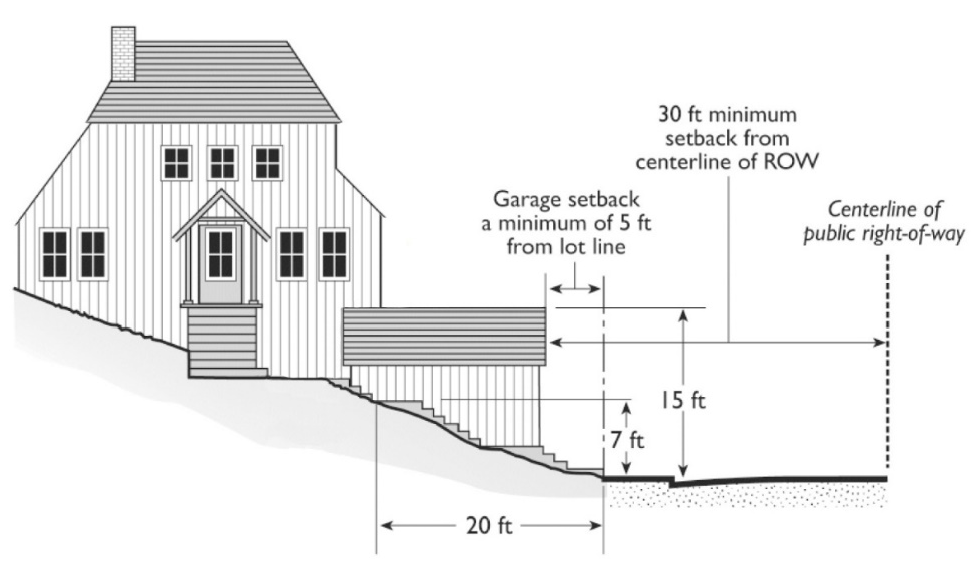
(Ord. No. 575, § I(Exh. A), 6-29-2023)
17.92.200 - Dish-type or satellite antennas.
No person shall install, either as owner or agent, or employee of the owner, or as an independent contractor for the owner, or otherwise, any dish-type or satellite antenna, any additions thereto or substitution for such antenna, when such antenna exceeds three (3) feet in diameter, unless a use permit is obtained in accordance with the provisions of this title. Any such use permit for the placement of dish-type or satellite antenna shall be conditioned upon the following:
A.
In any residential or mixed-use zoning district, such antennas shall be treated as an accessory structure and shall comply with height, setback, and lot coverage requirements for the zoning district in which it is located.
B.
Dish-type or satellite antenna placed within a residential or mixed-use zoning district shall be screened from view of streets and abutting properties by use of fences, hedges, or appropriate plant materials.
C.
Within the T-C, C-S, L-M, and M zoning districts, a site plan shall be submitted showing the location for placement of such antenna, in addition to such other information as is required for a use permit. As to each such antenna site, there shall be available nine hundred (900) square feet of property which is not otherwise required for parking or otherwise occupied by structures and improvements upon the property.
D.
The restrictions as set forth in subsections A and B of this section shall not be applicable to a licensee pursuant to Chapter 5.20 (Community Antenna Television System) or commercial broadcast station, except to the extent that any such condition may be imposed by the planning commission as a condition for issuance of such use permit.
(Ord. No. 575, § I(Exh. A), 6-29-2023)
17.92.210 - Cargo containers.
A.
Use in Residential and Mixed-Use Districts. The permanent use of prefabricated exterior storage containers, such as cargo containers or truck trailers, is prohibited in the R-1, R-2. R-3, MU-1, MU-2, and MU-3 zoning districts. Temporary use of storage containers in these zoning districts may be approved subject to the following:
1.
A use permit is required for temporary use of storage containers pursuant to Section 17.92.140 (Temporary structures).
2.
Temporary use of cargo containers may be approved for up to six (6) months. A one-time extension of up to twelve (12) months may be granted in the case of unforeseeable property damage or natural disaster.
B.
Use in Commercial Districts.
1.
The use of storage containers in the T-C district is prohibited.
2.
The use of storage containers in the S-C district may be approved as an accessory use to the primary permitted use subject to obtaining a conditional use permit. The planning commission shall determine appropriate siting, time limits, and other conditions as may be necessary to minimize potential impacts to adjacent properties.
C.
Use in Manufacturing Districts.
1.
The use of storage containers in the L-M district may be approved as an accessory use to the primary permitted use subject to obtaining a conditional use permit. The planning commission shall determine appropriate siting, time limits, and other conditions as may be necessary to minimize potential impacts to adjacent properties.
2.
The use of storage containers in the M district is permitted as an accessory use to the primary permitted use.
D.
General Requirements. The use of storage containers in any zoning district within the city limits must adhere to the following conditions:
1.
Storage containers may only be used for the storage of merchandise, inventory, shelving displays, or other incidental items related to the operation of the business.
2.
Business or sale of merchandise shall not be conducted from the storage container, nor shall the storage container be used a habitable space, office, or meeting area, and shall be kept closed and secured at all times other than when items are being moved to or from the storage container.
3.
Storage containers must be oriented to minimize the view from the public right-of-way. In no case shall storage containers be placed so as to cover, block, or otherwise impact required parking, or impact circulation and emergency access.
4.
Storage containers shall be painted in a color matching or similar to the field color of the primary structure and/or properly screened with screening walls and/or landscaping. Graffiti shall be removed within twenty-four (24) hours from any storage container or screening.
5.
The placement of any signs, advertising copy, banners, or similar item is prohibited on storage containers.
6.
No more than two (2) storage containers with a combined floor area of no more than six hundred and forty (640) square feet shall be allowed. Storage containers shall not exceed a height of ten (10) feet.
7.
Storage container location: Setbacks shall be the same as those for the underlying zone.
E.
Additional permitted temporary uses of storage containers include the following:
1.
Construction sites.
2.
This section shall not apply to a location with a permitted business actively engaged in transporting cargo containers or truck trailers provided such container or trailer is only on the property temporarily and is not utilized for outside storage purposes.
(Ord. No. 575, § I(Exh. A), 6-29-2023)
17.92.220 - Trash and recycling enclosures.
A.
When Required. All new and expanded commercial and industrial development with a floor area exceeding seven hundred fifty (750) square feet, all intensifications of commercial and industrial uses that increase the square footage by fifty (50) percent or more, all new mixed-use projects, and all new multifamily residential projects shall provide and maintain at least one (1) trash and recycling enclosure. Trash and recycling enclosures may be located indoors or outdoors to meet the requirements of this section.
B.
Location.
1.
General.
a.
Outdoor trash and recycling enclosures required under this section shall not be located within any required setback.
b.
Enclosures shall be located so that no dwelling is closer than twenty (20) feet, including those on abutting properties, or more than one hundred (100) feet from a residential unit if located on property occupied by a residential use. No minimum distance from dwellings is required if dumpsters are located within a fully enclosed room.
c.
No outdoor trash and recycling enclosure shall be located within any public right-of-way, or in any location where it would obstruct pedestrian walkways, vehicular access, reduce motor vehicle sightline, or in any way create a hazard to health and safety.
2.
Exception. Enclosures that have been approved in conjunction with a discretionary permit or approval may be located within a required side yard or rear yard setback, provided no part of the enclosure is less than three (3) feet from any property line.
C.
Maintenance. Outdoor trash and recycling enclosures required shall be maintained in the following manner:
1.
There shall be the prompt removal of visible signs of overflow of garbage, recycling, smells emanating from the enclosure, graffiti, pests, and vermin.
2.
Trash enclosure covers shall be closed when not in use.
3.
Trash enclosures shall be easily accessible for garbage and recyclables collection.
4.
Trash enclosures shall be regularly emptied of garbage and recycling.
D.
Design of Enclosure Area.
1.
Each trash and recycling enclosure shall be of a material and colors that complement the architecture of the buildings they serve or shall have exterior landscape planting that screens the walls.
2.
The trash and recyclables enclosure shall provide convenient and secure access to the containers to prevent access by unauthorized persons and minimize scavenging, while allowing authorized persons access for disposal and collection of materials.
3.
An opening shall be provided so that pedestrians can access the enclosure without opening large gates.
4.
Lighting shall be provided at enclosures for residential and mixed-use developments for nighttime security and use.
5.
All outdoor trash and recycling enclosures shall be a minimum of five (5) feet tall to screen unsightly views. The design of the structure and the materials used shall be compatible with the on-site architecture.
6.
Designs, materials, or methods of installation not specifically prescribed by this section may be approved by city. In approving such a request, the reviewing authority shall find that the proposed design, materials, or method provides approximate equivalence to the specific requirements of this section or is otherwise satisfactory and complies with the intent of these provisions.
(Ord. No. 575, § I(Exh. A), 6-29-2023)
17.92.230 - Screening.
All exterior mechanical and electrical equipment associated with new multifamily residential, mixed-use, commercial, and industrial development shall be screened or incorporated into the design of buildings so as not to be visible from the street. Equipment to be screened includes, but is not limited to, all roof-mounted equipment, air conditioners, heaters, utility meters, cable equipment, telephone entry boxes, backflow prevention devices, irrigation control valves, electrical transformers, pull boxes, and all ducting for air conditioning, heating, and blower systems. Screening materials shall be consistent with the exterior colors and materials of the building.
(Ord. No. 575, § I(Exh. A), 6-29-2023)
17.92.240 - Temporary uses.
A.
Purpose. The purpose of this section is to allow for those short-term and intermittent activities that the planning commission determines would be compatible with adjacent and surrounding uses.
B.
Temporary Use Permit Required. Upon approval of a temporary use permit, the planning commission may allow a short-term and/or intermittent use in any zoning district.
C.
Activities. Only those short-term and intermittent activities with no potential to significantly impact the environment or to detrimentally affect those working and living in the vicinity may be approved by the planning commission.
D.
Applications. Applications for temporary use permits shall be made and processed in accordance with the procedures for conditional use permits set forth in Chapter 17.88 (Use Permits and Variances).
E.
In cases where the planning commission is able to make the findings required by Section 17.88.060 (Action by the Planning Commission on a Use Permit), the planning commission may, but is not obliged to, issue a temporary approval for a specific time period, not to exceed twelve (12) months.
(Ord. No. 575, § I(Exh. A), 6-29-2023)

