
Duvall City Zoning Code
CHAPTER 14
38 - LANDSCAPING STANDARDS
14.38.010 - Purpose.
A.
Landscaping is an important element of overall site or subdivision design. Landscaping shall be designed to complement: the architecture of buildings and other structures, street design and layout, retaining walls, natural features, topography, other site elements. Landscaping shall also be designed to complement and/or enhance the visual appearance of the surrounding area. Landscaping design shall be based on a well-defined concept addressing the function, design, plant types, maintenance, and irrigation of the landscape area.
B.
The landscape design shall include a composition of plant materials that create a visual character appropriate to the site and surrounding area, such as stylized, formal, informal, or natural design. The design shall include a suitable combination of trees, shrubs, groundcover plants, vines, lawns and herbaceous material, including native and northwest adapted plants. The number and size of plants shall be determined in a way that addresses color, texture, form, line, proportion, and scale in both the horizontal and vertical plane.
C.
Landscaping shall be designed to preserve the aesthetic character of the community, improve the aesthetic quality of the built environment, promote retention and protection of existing vegetation and reduce the impacts of development on storm drainage systems and natural habitats by: providing visual relief from large expanses of parking areas; providing visual relief from long building elevations; providing physical separation between residential and non residential zones; providing visual screen and barriers as a transition between differing land uses; retaining existing vegetation and significant trees by incorporating them into the site design; enhancing the city's appearance and character through the use of street trees; visually unifying the city and its neighborhoods; reducing erosion and storm water runoff; replacing existing vegetation and trees; promoting proper plant selection and continuous maintenance so that plant materials can flourish; adequately screening parking areas, fences, retaining walls and other less attractive features.
D.
Implementation of the landscape standards shall also be consistent with the design standards contained in DMC 14.34 Design Guidelines.
E.
The landscape standards in this chapter are minimum requirements. The City encourages thoughtful consideration of how additional trees, shrubs, and plants can enhance a property and increase its value and beauty.
F.
To provide for long term maintenance after the bonding period.
(Ord. 1056 § 1 Exh. A (part), 2007)
(Ord. No. 1233, § 2(Exh. B), 2-6-2018)
14.38.020 - Applicability.
All new developments, including developments that require approval of a long or short subdivision, site plan, conditional use permit, shoreline substantial development permit, or development agreement, shall be consistent with the landscape standards. Additionally, additions to existing buildings that require site plan approval and conditional use permits shall comply with the landscape standards to the greatest extent possible as determined by the director.
(Ord. 1056 § 1 Exh. A (part), 2007)
(Ord. No. 1233, § 2(Exh. B), 2-6-2018)
14.38.030 - Unique or special circumstances.
The director shall have the authority to vary these standards in unique or special circumstances to assure the fulfillment of the stated purpose of this section, to allow for flexibility and innovation of design, and to provide a superior landscape plan. Special circumstances or unique conditions shall be reviewed with the director prior to submittal of a landscape plan. Examples of special conditions might include:
A.
Preservation of wildlife habitat;
B.
Preservation of significant natural area and existing vegetation;
C.
Compliance with special easements;
D.
Special site uses;
E.
Relationship with adjacent property;
F.
Preservation of significant trees; and
G.
Preservation of views.
(Ord. 1056 § 1 Exh. A (part), 2007)
(Ord. No. 1233, § 2(Exh. B), 2-6-2018)
14.38.040 - Landscape plan approval.
A.
A development application submittal shall include a preliminary landscape plan in compliance with the guidelines outlined in this chapter. A checklist prepared by the city sets out all required items to be included on a landscape plan. A final landscape plan that is consistent with the preliminary plan, and is consistent with that checklist and with the conditions of approval, shall be submitted and approved prior to a construction drawing approval or building permit issuance.
B.
Landscape plans for subdivisions, site plans, and other projects shall be prepared by a licensed landscape architect and stamped and signed by such professional.
C.
As determined by the director, the city may use a licensed landscape architect to perform peer review of submitted landscape plans. The costs of such review shall be paid by the developer.
(Ord. 1056 § 1 Exh. A (part), 2007)
(Ord. No. 1233, § 2(Exh. B), 2-6-2018)
14.38.050 - Landscape plan design criteria—General.
A.
Preserve as much existing native vegetation as possible, with preference given to plant groupings. Fill in native vegetation with evergreen trees and shrubs in natural and random patterns where possible.
B.
Provide areas on-site for active and/or passive recreational purposes consistent with open space requirements in DMC 14.64, Additional Development Standards.
C.
Provide separation between incompatible adjacent land uses or activities, and reduce the impact of wind, lighting, and noise and/or the perception of noise.
D.
Design landscaping to accommodate changes in design between adjacent sites, within a site, and from native vegetation areas.
E.
Design foundation plantings to create an effective change from public to private space and from the vertical to horizontal plane at building edges.
F.
Design plantings to soften elevations, reduce the visual impact of less desirable development and/or structures such as large blank walls, retaining walls, dumpster areas, service areas, and large areas of pavement.
G.
Use plantings to highlight significant site features and to define site use areas and circulation corridors without interfering with the use of such areas. Examples include site and building entrances, pedestrian walkways, gathering areas, and plazas.
H.
Design landscaping to use plants and planting techniques that reduce water consumption.
I.
Plants shall be selected and arranged according to the following design criteria:
1.
Arrange plants in a composition that creates an overall unified and balanced design.
2.
Select a variety of plants providing interest, accent and contrast, using as many native species as possible.
3.
Select plants with an awareness of their growth requirements, tolerances, ultimate size, preferences for soil, climate and sun exposure, and negative impacts.
4.
Develop a planting design compatible with, and conforming to, the overall project design concept and adjoining properties.
5.
Provide plants of adequate size, in an appropriate quantity, and at a spacing, that fulfills the function and design objectives within the stipulated time.
J.
Landscaping shall be installed on private property adjacent to rights-of-way. Where there is right-of-way between the back of sidewalk or curb and the property line, landscaping shall be installed in that area by the adjacent developer in a complementary manner to the on site landscaping. Landscaping in the right-of-way shall not be used as part of minimum landscaping requirements or to meet perimeter landscaping requirements, except that trees planted in the right-of-way can be counted towards meeting tree requirements.
K.
If subdivision fencing is proposed, fences shall be constructed at the back edge of the required landscaping area or easement. Fences are not permitted within any landscaping area, tract, or easement.
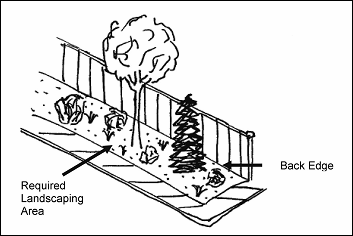
Fences shown at back edge of required landscaping area or easement
L.
If private homeowner fences are proposed, fences shall be constructed at the back edge of the required landscaping area tract or easement.
M.
Existing trees and shrubs on a proposed development site may be used to meet requirements where such plant material is:
1.
Consistent with tree protection standards, DMC 14.40;
2.
Consistent with the planting design concept;
3.
Likely to survive;
4.
Healthy, has the natural form of the species, and is of a quality equal to or better than available nursery stock.
N.
The minimum size of any planting area shall be one hundred (100) square feet except where otherwise indicated, and no less than five feet in width or length.
O.
All areas maintained in a previous manner which exceed the required landscape area must be seeded or otherwise planted to reduce erosion and stormwater runoff. The director shall determine appropriate landscaping types for such areas based on the location and use of such areas.
P.
Tree circles a minimum of two feet in diameter are required when trees are planted in grass areas, except that tree circles are not required in natural area plantings.
(Ord. 1056 § 1 Exh. A (part), 2007)
(Ord. No. 1233, § 2(Exh. B), 2-6-2018)
14.38.060 - Minimum landscape area requirements.
Areas counted toward landscape area requirements include all landscaping located on a project site, with the exception of native growth protection areas, right-of-way landscaping, or the open water portion of a stormwater pond.
A.
Landscaping percentage minimum requirements are as follows:
B.
The landscaping percentage is of the gross project site, excluding sensitive areas and buffers.
(Ord. 1056 § 1 Exh. A (part), 2007; Ord. No. 1215, § 5, 3-7-2017)
(Ord. No. 1233, § 2(Exh. B), 2-6-2018)
14.38.070 - Parking lot landscaping.
A.
General Criteria.
1.
All parking lots shall be planted with sufficient trees so that within 10 years, 50 percent of the surface area of the lot is shaded.
2.
Parking lot landscaping shall be dispersed throughout the parking lot in islands, buffers, and planter strips.
3.
Curbing and step out areas shall not be used in calculating the minimum square footage or width requirements for parking lot landscaping.
4.
Parking lots and structures shall be screened with landscaping buffers to the following standards:
a.
Zero to one hundred (100) spaces = five feet in width;
b.
Over one hundred (100) spaces = ten (10) feet in width.
5.
Landscape area per parking stall—Twenty-five (25) square feet minimum.
6.
Minimum landscape island size—One hundred (100) square feet.
7.
Minimum landscape island width—Five feet.
8.
Maximum distance between parking stall and landscaped strip or island—Fifty (50) feet.
9.
Trees shall be planted in vehicle use landscape areas at a minimum of one tree for each four parking stalls. No more than eight stalls between landscape islands.
10.
Parked vehicles may overhang landscaped areas up to eighteen (18) inches when wheelstops are provided and only groundcover is located in the that area.
11.
Parking stalls adjacent to a landscape area shall have an eighteen (18) inch step out area. See illustration below.
(Ord. 1056 § 1 Exh. A (part), 2007)
(Ord. No. 1233, § 2(Exh. B), 2-6-2018)
14.38.080 - Types of planting.
The applicant shall indicate on the preliminary landscape plan the types of planting to be provided in each area of the site, including the specific tree, shrub and ground cover types, locations, and size; and planting specifications. The types of planting shall be consistent with the following definition of planting types:
A.
Type I—Solid Screen.
1.
Type I planting is intended to provide a solid sight barrier.
2.
Type I planting shall consist of evergreen trees a minimum height of 6 feet at planting, and evergreen shrubs which will provide an eighty (80) percent sight-obscuring screen at the time of planting; or a combination of sixty (60) percent evergreen/forty (40) percent deciduous trees and sixty (60) percent evergreen/forty (40) percent deciduous shrubs, backed by one hundred (100) percent sight-obscuring decorative wall or fence.
3.
The width of the barrier shall be a minimum of five to twenty (20) feet as set out in 14.38.090, unless otherwise specified by the director.
4.
Landscape strips fifteen (15) feet or less in width—One tree required for every fifteen (15) to twenty (20) linear feet depending on the type of tree proposed.
5.
Landscape strips greater than fifteen (15) feet—One tree for every one hundred fifty (150) square feet.
6.
Shrubs—one shrub for every twenty (20) square feet.
7.
Groundcover on centers to cover the ground within two years.
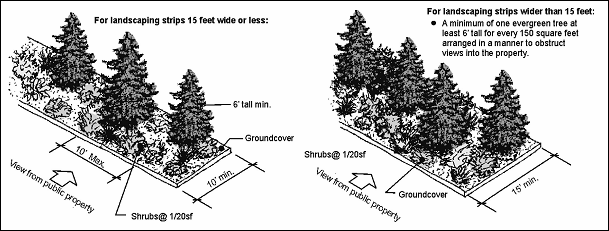
Type I—Solid Screen Examples
B.
Type II - Visual Screen.
1.
Type II planting is intended to create a visual separation that is not necessarily one hundred (100) percent sight-obscuring.
2.
Type II planting shall be evergreen or a mixture of evergreen and deciduous trees with large shrubs and groundcover interspersed with the trees, and/or a decorative wall or fence. Type II planting shall include a minimum of sixty (60) percent evergreen trees and evergreen shrubs. The width of the barrier shall generally be at least five to fifteen (15) feet, unless otherwise specified by the director.
3.
Landscape strips fifteen (15) feet or less in width—Trees required an average of twenty (20) to thirty (30) feet on center depending on the type of tree proposed.
4.
Landscape strips greater than fifteen (15) feet—One tree for every three hundred (300) square feet.
5.
Shrubs—One shrub for every twenty-five (25) square feet.
6.
Groundcover on centers to cover the ground within two years.
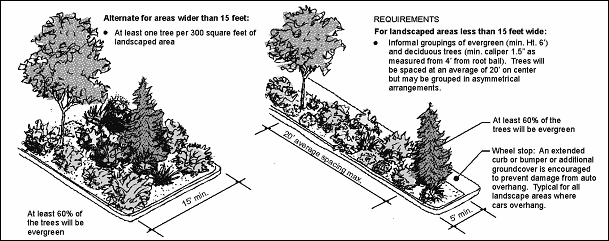
Type II—Visual Screen Examples
C.
Type III—Low Cover.
1.
Type III planting is intended to provide visual interest, to complement other plant materials, and for erosion control.
2.
Type III planting shall consist of a mixture of evergreen and deciduous shrubs, and/or groundcover, and/or perennial or annual flowers to provide a fifty (50) percent covering of the entire planting area at the time of planting.
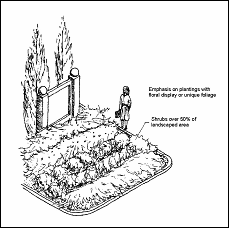
Type III—Low Cover Example
D.
Type IV—Open Area Planting.
1.
Type IV planting is intended to provide visual interest and shade in large open areas, particularly parking lots.
2.
Type IV planting shall consist of trees planted with supporting shrubs and groundcover. Lawn may be substituted for groundcover where the width of the planting area exceeds ten (10) feet in the narrowest dimension. Evergreens can be used where sight distance allows. Up to one hundred (100) percent of the trees proposed for a parking area may be deciduous.
3.
One tree required for every three hundred (300) square feet.
4.
Shrubs—One shrub for every twenty-five (25) square feet.
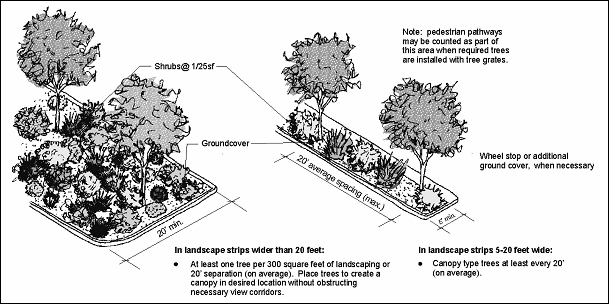
Type IV—Open Area Planting
E.
Type V—Wildlife Corridor
1.
Type V plantings are intended for wildlife corridors. Type V planting shall consist of trees, shrubs, and ground covers that are native to the Puget Sound and are appropriate to the conditions of the site.
2.
Wildlife corridors shall be maintained, enhanced, and replanted where appropriate, based on the type of habitat in the general vicinity.
3.
Wildlife corridors of woodland, wetland, and stream habitat shall be maintained or enhanced with native materials that provide habitat and cover for woodland, wetland, and stream wildlife species.
4.
Invasive species shall be removed from these areas and replaced with appropriate native plantings.
5.
Size and number of plantings shall be determined at the time of plan development depending on site needs and conditions. Plantings shall typically consist of infilling with native deciduous and/or evergreen trees, understory shrubs, and native groundcover.
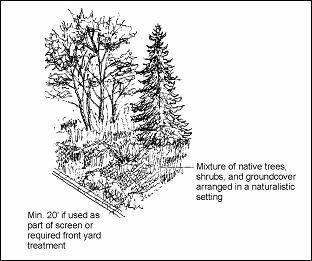
Type V—Natural Planting Example
(Ord. 1056 § 1 Exh. A (part), 2007)
(Ord. No. 1233, § 2(Exh. B), 2-6-2018)
14.38.090 - Landscape area width and type.
[A.]
Landscaping shall be installed at the minimum width and of the type as set out in 14.38.090.A.
Table 14.38.090.A—Landscaping Width and Type
(1) The area between two retaining walls shall have five feet of unencumbered landscaping (i.e. drainage rock areas shall not be considered part of the five feet).
(2) Areas shall be placed in a tract. The landscaping tract shall not be considered part of the required building setback
(3) Areas shall be placed in a tract or easement shall be maintained by an association
(4) The trail shall include five feet of trail surface, five feet of landscaping on each side, and a four foot split rail fence at the edge of the landscaped areas
B.
Landscaping requirements for other uses are as determined to be appropriate by the director.
(Ord. 1056 § 1 Exh. A (part), 2007)
(Ord. No. 1233, § 2(Exh. B), 2-6-2018)
14.38.100 - Buffer requirements between zones and uses.
Table 14.38.100.A sets out minimum buffers from the zoning district listed in the column to the adjacent zoning district listed in the row. The buffer would be on the property of the zoning district listed in the column. Buffers are required when properties in the zoning district column abut a property in a residential zone. Rights-of-way between properties shall act as a buffer and an additional buffer shall not be required unless determined to be necessary to mitigate for specific impacts in specific circumstances.
Table 14.38.100.A
1 The ten (10) foot buffer is required for commercial and/or mixed use developments abutting R-8 residential zones. Attached or detached residential uses do not require such a buffer unless they are above a commercial development.
2 The ten (10) foot buffer is required for multi-family development, including apartments and condominiums. Detached or attached single-family units with individual back yards shall not be required to install the buffer, but shall meet required setbacks.
;rn0;9; 3 ;en;;hg; A twenty (20) foot buffer is required for the portion of the property that is solely residential; that buffer can be reduced to ten (10) feet adjacent to the commercial portion of the property. ;rn0;9; 4 ;en;;hg; The buffer is required for multi-family developments and those uses listed as Conditional Uses within the R20 zone as listed in DMC Section 14.16.040. All other uses must meet applicable setbacks.B.
A masonry or solid wood fence may also be required between Light Industrial (LI), Public Facility (PF), and Mixed Use-Institutional (MU-I) zones and adjacent residential zoning districts. Such fence shall be at the discretion of the director and shall be required when the industrial or public facility zone development has potential noise and/or visual impacts on adjacent properties that can be mitigated by a fence.
C.
When a development occurs on a property listed in table 14.38.100.A, and there is a single- or multi-family use on an abutting property and the property is not zoned residential, a ten (10) foot minimum buffer is required. Such buffer requirement shall be waived if the property on which the single- or multi-family use is located on is under application review for redevelopment.
D.
Buffers as required by Table 14.38.100.A shall be planted with Type I landscaping.
E.
Required buffers shall be provided outside of fences, visible to the adjacent property that requires the buffer protection.
(Ord. 1056 § 1 Exh. A (part), 2007; Ord. No. 1215, § 6, 3-7-2017)
(Ord. No. 1233, § 2(Exh. B), 2-6-2018)
14.38.110 - Plant materials.
A.
All plants shall be of the type, size and condition specified in this chapter. They shall exhibit normal habits of growth for the species, shall have buds intact, and shall be free of disease, insects, indications of strawberry root weevil, seed and weed roots, and scars, bruises and breaks.
B.
Plant names shall conform to the latest edition of "Standard Plant Names" as adopted by the American Joint Committee of Horticultural Nomenclature.
C.
All plants shall conform to American Association of Nurserymen (AAN) grades and standards as published in the "American Standard for Nursery Stock" manual.
D.
All plants shall be hardy for the Duvall area.
E.
Plants shall be well suited to the local climate and soil conditions. Selection shall consider soil type and depth, the amount of maintenance required, spacing, exposure to sun and wind, the slope and contours of the site, and compatibility with existing native vegetation preserved on the site. Preservation of existing vegetation is strongly encouraged. The use of xeriscape (low water usage) and plantings approved for low impact development techniques are highly encouraged.
F.
All plants shall be from stock which has been cultivated and acclimatized to conditions similar to those prevailing at the project site.
G.
All plants shall have the following minimum size at installation:
1.
Street trees—Deciduous only permitted: two and five-thirds inch caliper, measured at breast height.
2.
Other deciduous trees—Two-inch caliper, measured at breast height.
3.
Evergreen trees: eight to ten (10) foot minimum height range.
4.
Vine maples and other multi-stemmed trees: six to eight-foot minimum range.
5.
Medium and tall shrubs: minimum five gallon size.
6.
Groundcover: four inches minimum pot size planted eighteen (18) inches on center and cover within two years.
7.
Groundcover: one gallon minimum pot size planted a maximum of three feet on center, depending on growth habits and cover within two years.
H.
Exotic or invasive plants are not permitted. The director can require any plant type to be exchanged for another based upon peer review of a landscape plan. Groundcover shall be selected for rapid growth and coverage in order to reduce erosion and maintenance.
I.
Mulch.
1.
Required plantings, except turf or areas of established ground cover, shall be covered with two inches or more of organic mulch to minimize evaporation and runoff. Mulch shall consist of materials such as yard waste, sawdust, and/or manure that are fully composted. All mulches used in planter beds shall be kept at least six inches away from the trunks of shrubs and trees.
2.
Bark, mulch, gravel or other nonvegetative material shall only be used in conjunction with groundcover plantings to assist growth and maintenance or to visually complement plant material. Nonvegetative material is not a substitute for and shall not appear to be dominant over plant material.
J.
Plants shall be spaced appropriately for their type, function and the landscape design (massing, individual display, etc.). For example, plants used for screening may need to be spaced more closely.
(Ord. 1056 § 1 Exh. A (part), 2007)
(Ord. No. 1233, § 2(Exh. B), 2-6-2018)
14.38.120 - Street trees.
A.
Trees listed in the recommended street tree list, as prepared by the city, are required to be installed on all public streets. Exceptions from the recommended street tree list must be submitted by a landscape architect with a brief description of the tree type and proposed spacing and be approved by the director.
B.
Street trees shall be planted along roadway corridors and street frontages at a minimum of twenty-five (25) feet on center and a maximum of forty (40) feet on center, depending on tree type.
C.
Street trees shall be planted according to the guidelines outlined in this chapter.
D.
Removal of street trees without approval of the director is prohibited and may be subject to enforcement action.
E.
Street tree plantings on arterials shall be consistent in species and variety and of a type designated in the recommended street tree list.
F.
The average spacing for street trees may be adjusted to allow for sight lines, utilities, traffic signs, light standards, driveways and other street appurtenances.
G.
Trees adjacent to public streets that are not planted in a separated landscape strip shall be installed as follows:
1.
Deciduous trees shall be planted at least four feet from the face of curb to center of tree in tree pits that measure four feet by four feet.
2.
Coniferous trees shall be planted at least ten (10) feet from curbs depending on species.
3.
Trees shall have a clear trunk to a height of six feet above the ground.
4.
Sidewalks with tree grates shall meet DMC 14.34, Design Standards— General.
H.
Residential street trees.
1.
Residential street trees shall be located either in a minimum five foot landscape strip separated from the sidewalk or adjacent to the sidewalk or back of curb and at least five feet from edge of sidewalk or curb.
2.
A minimum of one street tree is required for each lot and shall be on the lot or, if a landscape strip is required, in that landscape strip.
3.
The landscape strip shall be planted with grass, groundcover, or a variety of shrubs, ornamental grass, perennials and groundcover.
4.
A stepping stone, walkway, or other means of traversing the planter strip from the street must be provided at each residence.
5.
The director may provide for departures where unique site features make it difficult to comply with the standard.
(Ord. 1056 § 1 Exh. A (part), 2007)
(Ord. No. 1233, § 2(Exh. B), 2-6-2018)
14.38.130 - Planting standards.
A.
All planting areas shall be a minimum of five feet in width, except where a greater width is required for the health and survival of the plants, or is required by other specific provisions of this chapter.
B.
Plantings shall meet the city requirements for sight clearance at intersections (see DMC 14.64.160), and shall not conflict with pedestrian or traffic safety.
C.
All required planting areas shall extend to the curb line, street edge, or edge of sidewalk.
D.
Permanent curbs or structural barriers/dividers shall enclose planting areas in vehicle use areas.
E.
In parking lots, trees may be planted no closer than four feet from pavement edges where vehicles overhang planted areas.
F.
Narrow parking lot islands or peninsulas shall not be planted in sod because of potential problems with maintenance. Location of larger parking spaces adjacent to islands is suggested to reduce damage to plant materials.
G.
A minimum five foot wide planting area shall be provided between all building walls and paved areas except at service and pedestrian accesses or as specified in DMC 14.34, Design Guidelines.
H.
Planting areas within existing and proposed water and sewer or pedestrian easements and rights-of-way shall be primarily Type III or Type IV plantings. Trees shall not be planted within eight feet of a water or sewer pipeline unless approved by the director. Shrubs shall be at least four feet from hydrants.
I.
Topsoil for Grass and Groundcover.
1.
Topsoil shall be natural, sandy, fertile, friable, and possess characteristics of the representative productive soils in the vicinity. It shall not be excessively acid or alkaline nor contain toxic substances which may be harmful to plant growth.
2.
Topsoil shall be without admixture of subsoil. It shall be reasonably free from clay lumps, stones, stumps, debris, roots or similar substances two inches or more in diameter, or other objects which might be a hindrance to the plant growth.
3.
Topsoil shall meet the following specifications:
4.
Grass shall be installed on a minimum of six inches of topsoil, sixty-five (65) to seventy-five (75) percent compacted. Groundcover shall be installed in a minimum of four inches of topsoil, sixty-five (65) to seventy-five (75) percent compacted.
5.
In roadway landscape strips, the soil shall be amended by tilling the top twelve (12) inches and blending in six inches of three-way topsoil and then capping that with a minimum of six inches of three-way topsoil. Landscape strips shall be free of construction debris including but not limited to construction materials and roadbed materials.
J.
Soil specifications to enhance the hydrologic benefits of disturbed soils on sites that have been graded and cleared of vegetation shall include.
1.
A minimum organic content of ten (10) percent by dry weight for all planting beds and other landscaped areas;
2.
Organic matter content in turf areas that requires maintenance or supports foot traffic shall be five percent;
3.
Organic matter content pH shall be between 5.5 and 7.0;
4.
Planting bed shall be mulched with two to three inches of organic material;
5.
The soil shall be scarified or tilled soil to an eight-inch depth (or to a depth needed to achieve a total depth of twelve (12) inches of uncompacted soil after the amendment is added). Soil within the dripline of existing trees to be retained shall not be tilled or scarified within three feet of the dripline. The soil amendment shall be incorporated no deeper than three to four inches to reduce damage to roots.
K.
Fertilization. All fertilizer applications to turf or trees and shrubs shall follow Washington State University, National Arborist Association or other accepted agronomic or horticultural standards.
(Ord. 1056 § 1 Exh. A (part), 2007)
(Ord. No. 1233, § 2(Exh. B), 2-6-2018)
14.38.140 - Grading.
A.
Existing and proposed contours and retaining walls shall be shown on the preliminary and final landscape plans. All landscape berms or mounds shall also be shown with elevations on the grading plan submitted to the Public Works Department.
B.
Graded slopes in planting areas shall not exceed a 3 horizontal (H): 1 vertical (V) slope in order to decrease erosion potential and to make maintenance easier.
C.
Graded slopes planted with grass shall not exceed a 4(H): 1(V) slope.
D.
On ungraded slopes equal to or greater than 2(H): 1(V), erosion control netting or alternative procedures shall be used to prevent erosion.
E.
Planting areas shall be provided with adequate drainage.
(Ord. 1056 § 1 Exh. A (part), 2007)
(Ord. No. 1233, § 2(Exh. B), 2-6-2018)
14.38.150 - Irrigation.
A.
All plants shall receive sufficient water to assure their survival.
B.
Irrigation shall be required in all planting areas unless waived by the director.
C.
Individual residential lots are not required to install irrigation unless the landscape areas are owned in common.
D.
Drainage. All landscapes shall have adequate drainage, either through natural percolation or through an installed drainage system. A percolation rate of one-half inch of water per hour is acceptable.
(Ord. 1056 § 1 Exh. A (part), 2007)
(Ord. No. 1233, § 2(Exh. B), 2-6-2018)
14.38.160 - Performance assurance.
A.
Prior to the issuance of any construction permits for a project, performance security in an amount equal to one hundred fifty (150) percent of the landscaping material, irrigation, and installation cost shall be submitted to the city to guarantee installation of the required planting/irrigation. Such costs shall be based on a copy of a contract for such purchase and installation or bid for the required work. Required planting/irrigation shall be installed within six months of the date of final construction permit approval or the issuance of a certificate of occupancy, whichever is later. If the requirements are not met in the allotted time, the city may use the security to complete the planting/irrigation.
(Ord. 1056 § 1 Exh. A (part), 2007)
(Ord. No. 1233, § 2(Exh. B), 2-6-2018)
14.38.170 - Maintenance requirements.
A.
General landscaping—A maintenance bond, cash deposit, or other security in a form acceptable to the city attorney covering ten (10) percent of the cost of the performance assurance bond shall be in place prior to the release of a performance bond and shall be required for two years following installation.
B.
Whenever planting has been required to comply with the landscape provisions this chapter, the plant materials shall be permanently maintained in compliance with such regulations, approved plans and approval conditions, in such manner as to accomplish the purpose for which they were required. Failure to maintain required planting which creates substandard landscape shall disqualify such landscape for consideration as a legal nonconforming use.
C.
The director is authorized to notify the owner of any property upon which landscaping was installed as a condition of approval under this chapter that planting is not being adequately maintained, and the specific nature of such failure to maintain. The notice shall specify a date by which the property owner shall be expected to comply.
D.
Upon the failure to perform the required maintenance within the date specified by the notice, the director is authorized to collect funds under the maintenance bond or other security, and cause the required maintenance to be completed.
E.
When funds have not been set aside or the performance assurance has expired, the director is authorized to request the city attorney to institute legal action to recover the cost of the required maintenance, and upon receipt of the funds to cause the maintenance to be done.
F.
Maintenance as used in this section includes replacement of dead, diseased or damaged plant materials, removal of weeds and/or invasive species, and repair of irrigation systems.
G.
The property owner is required to maintain all on site landscaping.
H.
In subdivisions or site plans where the right-of-way contains landscaping, the adjacent property owner, homeowner's association or like mechanism, is required to maintain that landscaping. Such requirement shall be noted on the face of the plat or site plan. If there are such requirements that are maintained by an organization other than the adjacent homeowner, or if there are common areas on a property, a homeowner's association is required.
I.
Required landscape buffers are to be maintained by a homeowner's association, management company, or like mechanism as approved by the director.
J.
Required tree replacement plantings shall be maintained for a minimum of three years in the amount of fifty (50) percent of the performance bond.
(Ord. 1056 § 1 Exh. A (part), 2007)
(Ord. No. 1233, § 2(Exh. B), 2-6-2018)
14.38.180 - Maintenance after the bonding period had ended.
A.
Ongoing maintenance of required landscape areas after a maintenance bond has been released;
1.
Non residential required landscaping shall be maintained in a healthy live manner by the property owner.
2.
Residential landscaping shall be maintained in a healthy live manner by the homeowner or home owner's association if applicable.
(Ord. 1056 § 1 Exh. A (part), 2007)
(Ord. No. 1233, § 2(Exh. B), 2-6-2018)

