
Duvall City Zoning Code
CHAPTER 14
64 - ADDITIONAL DEVELOPMENT STANDARDS
14.64.010 - Purpose.
The purpose of this chapter is to establish requirements for determining basic dimensional standards and to set out development standards for specific types of uses. The standards and rules are established to provide flexibility in project design, provide solar access, and maintain privacy between adjacent uses. The Public Works Development Designs Standards, DMC 14.34, Design Guidelines as applicable, shall apply to all developments.
(Ord. 1056 § 1 Exh. A (part), 2007)
(Ord. No. 1233, § 4(Exh. D), 2-6-2018; Ord. No. 1231, § 4(Exh. C10), 12-19-2017)
14.64.020 - Densities and dimensions.
The density and dimension tables are arranged in a matrix format and are located in each specific zoning district, DMC 14.12—DMC 14.32.
(Ord. 1056 § 1 Exh. A (part), 2007)
(Ord. No. 1233, § 4(Exh. D), 2-6-2018; Ord. No. 1231, § 4(Exh. C10), 12-19-2017)
14.64.030 - Measurement methods.
The following provisions shall be used to determine compliance with this title:
A.
Street setbacks shall be measured from the edge of a street right-of-way or temporary turnaround.
B.
Lot area shall be the total horizontal land area contained within the boundaries of a lot.
C.
Impervious surface calculations shall not include areas of turf, landscaping, natural vegetation, surface water retention/detention facilities, or other similar facilities as determined by the public works director.
(Ord. 1056 § 1 Exh. A (part), 2007)
(Ord. No. 1233, § 4(Exh. D), 2-6-2018; Ord. No. 1231, § 4(Exh. C10), 12-19-2017)
14.64.040 - Calculations—Gross usable area, residential.
The permitted number of units shall be determined as follows:
A.
The maximum allowed number of dwelling units shall be computed by multiplying the land use per gross useable area by the applicable residential density.
B.
When calculations result in a fraction, the fraction shall be rounded to the nearest whole number as follows:
1.
Fractions of .50 or above shall be rounded up; and
2.
Fractions of .49 or below shall be rounded down.
Figure 14.64.040.3
C.
On lots that contain sensitive areas, a density credit for such areas may be allowed in accordance with DMC 14.42, Sensitive Area Regulations.
(Ord. 1056 § 1 Exh. A (part), 2007)
(Ord. No. 1233, § 4(Exh. D), 2-6-2018; Ord. No. 1231, § 4(Exh. C10), 12-19-2017)
14.64.050 - Lot area—Prohibited reduction.
Any portion of a lot that was required to calculate and ensure compliance with the standards and regulations of this title shall not be subsequently subdivided or segregated from such lot.
(Ord. 1056 § 1 Exh. A (part), 2007)
(Ord. No. 1233, § 4(Exh. D), 2-6-2018; Ord. No. 1231, § 4(Exh. C10), 12-19-2017)
14.64.060 - Setbacks—General.
A.
For the purpose of applying setback regulations, the following shall be applied: the front shall be toward the street or access corridor from which the lot is addressed; the rear is opposite to the front or as nearly so as the lot shape permits; and the sides are ninety (90) degrees to the front or as nearly so as the lot shape permits.
B.
All setbacks shall be measured at right angles, or as near to right angles as possible, to the nearest property line in a plane horizontal to the ground, or in the case of access corridors for single-family residential development, from the nearest edge of the easement to the foundation line of the structure.
Where a lot fronts on more than one street, both frontages shall have front yard setbacks consistent with Figure 14.12.050C.
(Ord. 1056 § 1 Exh. A (part), 2007)
(Ord. No. 1233, § 4(Exh. D), 2-6-2018; Ord. No. 1231, § 4(Exh. C10), 12-19-2017)
14.64.070 - Setbacks—Specific building or use.
When a building or use is required to maintain a specific setback from a property line or other building, such setback shall apply only to the specified permitted or accessory building or use defined within the zone.
(Ord. 1056 § 1 Exh. A (part), 2007)
(Ord. No. 1233, § 4(Exh. D), 2-6-2018; Ord. No. 1231, § 4(Exh. C10), 12-19-2017)
14.64.080 - Setbacks—Modifications.
The following setback modifications are permitted:
A.
When the common property line of two lots is covered by a building(s), the setbacks required by this chapter shall not apply along the common property lines.
B.
When a lot is located between two lots, each of which is developed with a building having nonconforming street setbacks, the required street setback for such lot may be the average of the two nonconforming setbacks or sixty (60) percent of the required street setback, whichever results in the greater street setback. This is applicable only when the buildings on the adjacent lots are allowed uses in accordance with the zoning district and the proposed building use is similar to those uses.
(Ord. 1056 § 1 Exh. A (part), 2007)
(Ord. No. 1233, § 4(Exh. D), 2-6-2018; Ord. No. 1231, § 4(Exh. C10), 12-19-2017)
14.64.090 - Setbacks—Utility corridors.
A.
In subdivisions and short subdivisions, areas used as utility corridors as identified in this title shall be contained in separate tracts, rights-of-way or easements.
B.
In other types of land development permits, easements shall be used to delineate such corridors.
C.
All buildings shall maintain a minimum distance of five feet from property or easement lines delineating the boundary of utility corridors, except for utility structures necessary to the operation of the utility corridor, and as set out in DMC 14.34, Design Guidelines. A greater setback, to a maximum of ten (10) feet, may be required by the public works director on a case-by-case basis.
(Ord. 1056 § 1 Exh. A (part), 2007)
(Ord. No. 1233, § 4(Exh. D), 2-6-2018; Ord. No. 1231, § 4(Exh. C10), 12-19-2017)
14.64.100 - Setbacks—Alleys.
For lots with alley access; garages, and other accessory buildings may be located on the rear lot line of the alley. Garages facing the alley are subject to an additional five foot setback and shall not be closer than fifteen (15) feet from the centerline of the alley.
(Ord. 1056 § 1 Exh. A (part), 2007)
(Ord. No. 1233, § 4(Exh. D), 2-6-2018; Ord. No. 1231, § 4(Exh. C10), 12-19-2017)
14.64.110 - Setbacks—Adjoining half-street or designated arterial.
In addition to providing the standard street setback, a lot adjoining a half-street or designated arterial shall provide an additional width of street setback sufficient to accommodate construction of the planned half-street or arterial.
(Ord. 1056 § 1 Exh. A (part), 2007)
(Ord. No. 1233, § 4(Exh. D), 2-6-2018; Ord. No. 1231, § 4(Exh. C10), 12-19-2017)
14.64.120 - Setbacks—Projections allowed.
A.
On ground and upper floor uses in all districts and on upper floor uses in the OT, MT, UT-1st and RIV zoning districts, fireplace structures, bay or garden windows, enclosed stair landings, closets, or similar structures may project into any setback; provided such projects are:
1.
Limited to two per façade;
2.
Not wider than seven feet; and
3.
Not more than twenty-four (24) inches into an interior setback or into a street setback.
B.
Uncovered porches and decks which exceed eighteen (18) inches above the finished grade may project:
1.
Eighteen (18) inches into interior setbacks; and
2.
Five feet into the street setback except where the allowable setback is zero feet as in the OT, MT, UT-1 st and RIV zones.
C.
Uncovered porches and decks not exceeding eighteen (18) inches above the finished grade may project to the property line.
D.
Roof eaves, including any part of a roof structure whether supported by diagonal bracing to the building, may no project more than:
1.
Twenty-four (24) inches into an interior setback;
2.
Twenty-four (24) inches into a street setback except where the allowable setback is zero feet as in the OT, MT, UT-1st and RIV zones; or
3.
Be less than seven feet measured vertically above the finished ground level in the vicinity of the projection.
E.
Fences may project into any setback; provided that the sight distance requirements are maintained along street corridors.
(Ord. 1056 § 1 Exh. A (part), 2007)
(Ord. No. 1233, § 4(Exh. D), 2-6-2018; Ord. No. 1231, § 4(Exh. C10), 12-19-2017)
14.64.130 - Heights—How to measure.
Applicants are required to work with the topography of a site when designing a building.
A.
Residential buildings.
1.
The building height on the uphill side shall be determined by measuring the vertical distance from the average elevation of the building corners to the eave line of the roof.
2.
The building height on the downhill side shall be determined by measuring the vertical distance from the average elevation of building height of the corners to the eave line of the roof.
B.
Non residential buildings.
1.
The building height on the uphill side will be determined by measuring the vertical distance from the average finished grade of the sidewalk to the eave line of the roof.
2.
The building height on the downhill side will be determined by measuring the vertical distance from the average finished grade of the sidewalk to the eave line of the roof.
C.
Buildings that are at the sidewalk grade on lots fronting on Main Street as of the date of this Title adoption, and that have a previously existing flat grade, and that are being redeveloped and/or removed to allow for redevelopment, shall be permitted to develop a three story building on the lot if all other provisions of this title can be met.
(Ord. 1056 § 1 Exh. A (part), 2007)
(Ord. No. 1233, § 4(Exh. D), 2-6-2018; Ord. No. 1231, § 4(Exh. C10), 12-19-2017)
14.64.140 - Heights—Exceptions to limits.
The following structures may be erected above the height limits to the minimum height necessary to support the use as determined by the director:
A.
Roof structures housing or screening elevators, fire access stairways, tanks, ventilating fans or similar equipment required for building operation and maintenance; and
B.
Fire or parapet walls, skylights, flagpoles, chimneys, smokestacks, church steeples, communication transmission structures, private amateur radio facilities, utility line towers and poles, and similar structures.
(Ord. 1056 § 1 Exh. A (part), 2007)
(Ord. No. 1233, § 4(Exh. D), 2-6-2018; Ord. No. 1231, § 4(Exh. C10), 12-19-2017)
14.64.150 - Lot divided by zone boundary.
When a lot is divided by a zone boundary, the following rules shall apply:
A.
When a lot contains both residential and nonresidential zoning, the zone boundary between the zones shall be considered a lot line for determining permitted building height and required setbacks on the site.
B.
When a lot contains residential zones of varying density, any residential density transfer within the lot shall only be allowed from the portion with the lesser residential density to that of the greater residential density.
C.
Uses on each portion of the lot shall only be those permitted in each zone.
(Ord. 1056 § 1 Exh. A (part), 2007)
(Ord. No. 1233, § 4(Exh. D), 2-6-2018; Ord. No. 1231, § 4(Exh. C10), 12-19-2017)
14.64.160 - Sight distance requirements.
Except for utility poles and traffic control signs, the following sight distance provisions shall apply to all intersections and site access points:
A.
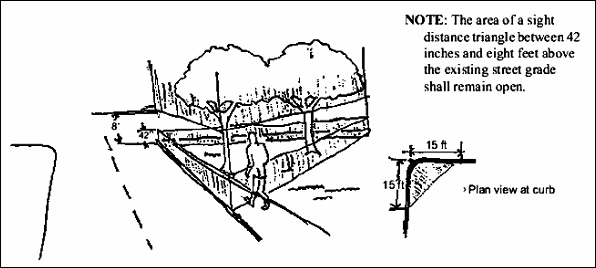
A sight distance triangle area as determined by DMC 14.64.160.B shall contain no fence, berm, vegetation (tree trunks acceptable if they are not sight obscuring), on-site vehicle parking area, signs or other physical obstruction between three and one-half feet and eight feet above the existing street grade;
Figure 14.64.160.A Site Distance Triangle
B.
The sight distance triangle at:
1.
A street intersection shall be determined by measuring fifteen (15) feet along both street property lines beginning at their point of intersection. The third side of the triangle shall be a line connecting the endpoints of the first two sides of the triangle; or
2.
A site access point shall be determined by measuring fifteen (15) feet along the street lines and fifteen (15) feet along the edges of the driveway beginning at the respective points of intersection. The third side of each triangle shall be a line connecting the endpoints of the first two sides of each triangle; and
C.
Structures or landscaping that are located in required street setbacks may be required to be removed or modified, if:
1.
Such improvements prevent adequate sight distance to drivers entering or leaving a driveway;
2.
No reasonable driveway relocation alternative for an adjoining lot is feasible; or,
3.
Clear lines of sight are obstructed by such structures, landscaping or objects as to pose a potential public safety hazard as determined by the director.
(Ord. 1056 § 1 Exh. A (part), 2007)
(Ord. No. 1233, § 4(Exh. D), 2-6-2018; Ord. No. 1231, § 4(Exh. C10), 12-19-2017)
14.64.170 - Nonresidential land uses in residential zones.
Except for utility facilities and uses, all nonresidential uses located in the residential zones (R4-R20) shall be subject to the following requirements:
A.
Building coverage by a nonresidential use shall not exceed the coverage allowed for a residential use as set out in DMC 14.12—14.16.
B.
Impervious surface coverage by a nonresidential use shall not exceed the coverage allowed for a residential use as set out in DMC 14.12—14.16.
C.
Buildings and structures shall conform to the setback requirements set out in DMC 14.12—14.16.
D.
One single-family detached dwelling unit allowed as an accessory use to a church or school shall conform to the setback requirements of the zone.
E.
Parking areas are permitted within the required setback area from property lines; provided, such parking areas are located outside of the required landscape area.
F.
Sites shall abut or be accessible from at least one public street functioning at a level consistent with the public works development design standards.
G.
The building height shall conform to the zone in which the use is located.
(Ord. 1056 § 1 Exh. A (part), 2007)
(Ord. No. 1233, § 4(Exh. D), 2-6-2018; Ord. No. 1231, § 4(Exh. C10), 12-19-2017)
14.64.180 - Fences.
A.
Fences are permitted as follows:
1.
The sight distance requirements of DMC 14.64.160 shall be observed.
2.
No fence shall be located on any public right-of-way.
3.
Fences shall not be constructed of a material which has a color or surface finish which can cause glare or eye discomfort or other safety hazards.
4.
New barbed wire fences are not permitted in any zone within City limits, except as specified in the light industrial and public facility zone section. Existing barbed wire fences are permitted until a new fence is proposed or the subject property redevelops, whichever occurs sooner.
5.
Electric fences shall be not be permitted except in non-residential zoning districts and in specific cases by permit from the city. Such fences shall not be permitted adjacent to the primary public right-of-way. Electric fences shall comply with the requirements stated below:
a.
Warning signs located at maximum intervals of seventy-five (75) feet when within five feet of and essentially parallel to a property line and without protective fence.
b.
Electric fence charging units shall bear a seal of approval by Underwriter's Laboratories or by the U.S. Bureau of Standards.
c.
Invisible fences are permitted in residential districts and are permitted adjacent to the primary public right-of-way in the same manner as a residential zone fence.
6.
Whenever a fence is placed on top of a new retaining wall and/or original grade, the height of the fence and the retaining wall/grade together shall not exceed six feet measured from the original grade unless otherwise approved by the planning director. Departures from this requirement are not typically given to fences fronting a public right-of-way.
7.
Arbors are allowed in conjunction with fences or standalone, provided:
a.
The arbors do not exceed ten (10) feet in height;
b.
Whenever an arbor is placed on top of a retaining wall and/or original grade, the height of the arbor and the retaining wall/grade together shall not exceed ten (10) feet measured from the original grade;
c.
Where the portion of the arbor exceeds the maximum allowed fence height, the construction material used shall provide minimum eighty (80) percent transparency.
B.
Residential Zone Fences.
1.
In residential zoning districts, fences may be constructed to a maximum height of four feet in front yards and six feet on the sides and rear of a lot, except as specified in this section.
2.
For the purposes of this regulation, the front yard shall begin at the front corner of the dwelling unit.
3.
Front yard fences shall be designed to be see through, except as specified in this section.
C.
Residential zone fences located along the following routes (NE Cherry Valley Rd, NE Big Rock Rd, NE 150th St, NE 145th St, NE 152nd St (Bruett Rd.), NE Stephens St., 3rd Ave NE, 275th Ave NE and Batten Rd NE:
1.
Front yard fences may be permitted as approved by the Planning director above the four height limitation provided that they choose one of the following options:
a.
Front yard fences may be a maximum of six feet tall and solid, provided that a Type II six-foot wide landscaping buffer is provided between the back edge of sidewalk and the fence. See DMC 14.38 Landscaping for Type II planting specifications; or,
b.
Front yard fences may be a maximum of six feet tall, four feet of which is solid from sidewalk grade to four feet above grade, provided that the top two feet are decoratively patterned. Fences shall be set back a minimum of four feet from the back edge of sidewalk, and Type III low cover landscaping shall be provided between the sidewalk and the fence.
D.
Mixed Use and Commercial Zone Fences.
1.
Fences are not permitted adjacent to the primary street frontage unless approved by the city as part of a site plan approval or other permit.
2.
Fences may be constructed of any suitable material to a maximum height of six feet on any part of a lot (barbed wire not permitted), other than the primary street frontage.
3.
Chain link industrial type fence or fence of other suitable material approved by the director may be constructed to a maximum height of six feet on any part of a lot except within a setback adjoining a street, or adjacent to the primary street frontage.
E.
Light Industrial and Public Facility Zone Fences.
1.
In the LI and PF zone, chain link industrial type fence or fence of other suitable material approved by the director may be constructed to a maximum height of six feet, excluding barbed wire, on any part of a lot, except fences are not permitted adjacent to the primary street frontage unless approved as part of the site plan approval or other permit.
2.
Barbed wire may be used along the top of industrial type fence provided the lowest strand has a minimum height of six feet from ground level and such wire is approved as part of the site plan approval, if applicable.
F.
Where possible, the use of landscaping instead of fences is encouraged. Landscaping is not subject to the six foot height restriction of this section, except that landscaping is subject to the four foot front yard restriction in residential zoning districts.
G.
Gated residential communities shall not be permitted.
H.
Fences for city-owned facilities and public and private schools. Fences for city-owned facilities and public and private schools may be constructed above the six-foot fence height limitation upon site plan review by the planning department. Specific conditions may be required by the director on a case by case basis (i.e. landscaping). The applicant shall obtain a permit from the building department for any fence constructed over six feet.
(Ord. No. 1233, § 4(Exh. D), 2-6-2018; Ord. No. 1231, § 4(Exh. C10), 12-19-2017; Ord. No. 1174, § 1, 11-25-2014; Ord. 1056 § 1 Exh. A (part), 2007)
14.64.190 - Swimming pools.
A.
Excavated or surface type swimming pools may be installed for private or communal residential use in the, R4—R8, UT-1st, MU12, R12 and R20 zoning districts.
B.
A six foot high fence of chain link, wood, or other secure material with locking gate shall be constructed around all swimming pools to control access by unauthorized or unattended persons.
(Ord. 1056 § 1 Exh. A (part), 2007; Ord. No. 1215, § 7, 3-7-2017)
(Ord. No. 1233, § 4(Exh. D), 2-6-2018; Ord. No. 1231, § 4(Exh. C10), 12-19-2017)
14.64.200 - Animal boarding facilities and kennels.
A.
Structures containing animals, not including dogs and cats that are pets at a single-family residence, shall be set back a minimum of fifty (50) feet from a property line adjacent to a residential use or zone. Special screening may be required to screen such facilities from adjacent residential uses.
B.
The application for project permit application and/or business license shall contain the number of animals proposed to be served by the facility. The number can be reduced by the director if it is necessary to ensure the neighboring properties will not be impacted by noise, odor, sanitation, and runoff problems.
C.
Animal boarding facilities shall be located inside a structure. Outdoor runs for exercising animals are permitted with a sound attenuating fence required. Runs may be required to be set back and/or screened from adjacent properties.
(Ord. 1056 § 1 Exh. A (part), 2007)
(Ord. No. 1233, § 4(Exh. D), 2-6-2018; Ord. No. 1231, § 4(Exh. C10), 12-19-2017)
14.64.210 - Automobile, recreational vehicle and boat sales, rental, and service.
A.
Vehicles that are for sale are only permitted in areas remaining after on-site parking and landscaping requirements have been met.
B.
Vehicles shall be stored on paved parking areas.
C.
Outdoor loudspeaker systems are prohibited.
D.
Servicing of vehicles shall occur inside a building.
F.
All wash areas shall be covered and drainage from such areas be in accordance with the public works development design standards and be approved by the public works director.
(Ord. 1056 § 1 Exh. A (part), 2007)
(Ord. No. 1233, § 4(Exh. D), 2-6-2018; Ord. No. 1231, § 4(Exh. C10), 12-19-2017)
14.64.220 - Adult use businesses.
Adult use business, also referred to as "sexually oriented businesses" are as defined in DMC 14.06.
A.
Applicants proposing an adult use business shall comply with the provisions of this title, and the more detailed and specific provisions of DMC 5.02, Sexually-Oriented Businesses.
B.
Adult use businesses shall not be located within 1,000 linear feet of any of the following uses or zones: R4, R4.5, R6, R8, R12, R20, MU12 zoning districts; public or private pre-K—12 schools, licensed daycare facilities, public parks, community centers, libraries, religious institutions that conduct classes for minors, or another adult use business.
(Ord. 1056 § 1 Exh. A (part), 2007)
(Ord. No. 1233, § 4(Exh. D), 2-6-2018; Ord. No. 1231, § 4(Exh. C10), 12-19-2017)
14.64.230 - Sidewalk cafes.
A.
Applicability.
1.
This section applies to all sidewalk cafés whether located on a public or private sidewalk.
2.
Sidewalk cafés shall be accessory uses only to an abutting restaurant, pub or coffee shop under the same ownership and/or management and that are permitted by this title.
3.
In addition to compliance with this section, sidewalk cafés shall be consistent with the DMC 14.34, Design Guidelines and with all other applicable city regulations.
B.
Sidewalk café standards. In order to be issued a permit for a sidewalk café, an applicant must meet the following standards and provide documentation as requested:
1.
There shall be a minimum 5 foot wide unobstructed pedestrian corridor outside the fenced area to the nearest street tree, utility pole, fire hydrant, etc., unless a wider width is required by the Director due to other standards and regulations.
2.
If a fence is required and/or proposed as part of the café, the placement of the fence shall be consistent with the applicable standards established by the Americans with Disabilities Act and shall not obstruct vehicular traffic or parking or the use of any crosswalk, wheelchair ramp or bus zone;
3.
If alcohol is to be served, the outside area shall be fenced off from the pedestrian corridor by a railing, planters, or other similar devices approved by the city. The fencing shall be a maximum of forty-two (42) inches in height and a single opening shall be provided through the fenced area for customers or as required by the Washington State Liquor Control Board requirements;
4.
The applicant must be the owner or occupant of the abutting property and operate a café or restaurant abutting the sidewalk café area;
5.
The applicant must have a valid city business license;
6.
Liquor, as defined in RCW 66.04.010, as now existing or hereafter amended, may be sold at a sidewalk café when authorized in both the street use permit and provided for in this chapter and by permit of the Washington State Liquor Control Board and not otherwise;
7.
In the right-of-way, unless expressly authorized by the public works director, no pavement shall be broken, no sidewalk surface disturbed and no permanent fixture of any kind shall be installed in or on the sidewalk area in connection with a sidewalk café;
8.
Lighting of the sidewalk café must not be excessive;
9.
No product displays or signage, other than umbrellas bearing a product name, are permitted in a sidewalk café;
10.
If the proposed sidewalk café serves liquor, such service shall be associated with a restaurant that serves its primary menu during all hours of operation;
11.
A street use permit is required to allow a portion of a public right-of-way to be used as a sidewalk café. Such permit is valid from the date issued and is subject to the requirements of this chapter. A street use permit is automatically renewed each year unless rescinded by the public works director due to non-compliance with this section or for public needs of the right-of-way. The public works director has the authority to issue the permit if the criteria set out in this chapter are met, as recommended by the director, and to otherwise deny the permit.
C.
Sidewalk café application. In addition to the street use permit application, if required, a person proposing a sidewalk café must submit a sidewalk café application that provides for the following:
1.
Documentation that the standards set out in 14.64.230.B are met;
2.
Proposed number of tables and chairs;
3.
Proposed hours of operation;
4.
A dimensioned or scaled plan showing the restaurant's storefront, the location of the fencing, the unobstructed walking area, the square footage of the area proposed to be fenced off, and other requested information;
5.
If a fence is proposed, a plan showing the design of the fence and materials and colors proposed. Such fence shall be designed in a way to complement the adjacent building. Fence styles that are permitted include decorative metal fences, wood fences in combination with planters, and similar types of fencing. The city may require samples of materials and colors to be submitted.
D.
Sidewalk café approval. The Director may include such terms or conditions in the approval that are deemed appropriate, including but not limited to:
1.
Restrictions as to the area proposed for use; the number of tables and chairs; and the days and hours of use;
2.
For sidewalk café areas in the public right-of-way, a requirement that the area be cleared when not in use as a sidewalk café, or upon the order of the director, the fire chief, or other city officer such as the chief of police;
3.
Provisions that the applicant maintain the sidewalk in a clean and safe condition for pedestrian travel;
4.
Regulations on lighting and illumination of the sidewalk café and limitations on noise;
5.
The director or public works director may suspend or revoke the permission granted for sidewalk cafés in the public right-of-way if an applicant violates this chapter, any implementing rules, or terms and conditions of this permit,
6.
The public works director may require a sidewalk café in a public right-of way to be temporarily or permanently removed due to a public works project that will affect the area.
(Ord. 1056 § 1 Exh. A (part), 2007)
(Ord. No. 1233, § 4(Exh. D), 2-6-2018; Ord. No. 1231, § 4(Exh. C10), 12-19-2017)
14.64.240 - Open space standards—Residential.
A.
The purpose of this section is to establish open space requirements in residential zone districts. These standards shall apply to the R-4, R-4.5, R-6, R-8, R-12, R-20 and MU12 (ground floor residential portion of the site).
B.
Open spaces shall be distributed through out the site.
C.
10 percent of the developable area shall be established as open space and neighborhood recreation facilities. Developable is the gross area of the site minus sensitive areas and right-of-way.
D.
A portion of the sensitive area can be counted toward open space. To count sensitive areas in the open space requirement the area shall contain: a trail in the outer portion of a sensitive area buffer, a small viewing and/or seating area, and interpretive signage. The trail area only shall be calculated toward the required open space requirement.
E.
The open space and recreational facilities shall be readily accessible to all dwelling units with pedestrian trails or sidewalks.
F.
Except for sensitive areas, the open space area shall be a minimum width of twenty-five (25) feet. The length of the open space area shall be no more than twice the width unless approved by the planning director.
G.
The open space shall not have more than five percent grade unless approved by the director.
H.
Landscaped areas such as planting strips and medians shall not be counted toward the minimum open space requirement.
I.
To the extent feasible, neighborhood recreation areas shall be centrally located within a neighborhood.
J.
Open space provided under this section is in addition to the usable open space required for each lot in accordance DMC 14.34 Design Guidelines.
K.
Open space shall include both passive and active spaces as determined by the director.
L.
The design of the open space shall be approved by the public works and planning directors.
M.
See DMC 14.34 Design Guidelines for other provision for open space requirements.
N.
Utility corridors may be allowed in open space areas as approved by the public works director and the planning director.
(Ord. 1056 § 1 Exh. A (part), 2007; Ord. No. 1215, § 8, 3-7-2017)
(Ord. No. 1233, § 4(Exh. D), 2-6-2018; Ord. No. 1231, § 4(Exh. C10), 12-19-2017)
14.64.241 - Model home.
A.
Purpose. The purpose of this chapter is to permit the construction of a limited number of model homes, on an approved preliminary plat, prior to final plat approval. Allowing model homes provides the opportunity for builders and developers to showcase their product prior to final plat approval. Nothing in this chapter shall be construed as permitting model homes in short subdivisions.
B.
Approval Authority. The planning and public works director are authorized to approve, approve conditionally, or deny model home applications.
C.
Criteria. A subdivision having received preliminary plat approval is eligible for model homes, provided the following criteria are met:
1.
The applicant has submitted and received all required permits and approvals required of the preliminary plat approval;
2.
Construction of the plat infrastructure must be substantially complete as determined by the city engineer and public works director. All curb/gutter, pavement base layer, and city utilities shall be installed and approved prior to model home construction;
3.
All critical areas upon or immediately adjacent to the areas of the subdivision serving the model home(s) have been protected or mitigated, in accordance with adopted critical areas regulations and preliminary plat approval;
4.
All general facilities charges, impact fees, and building department fees shall be paid prior to model home building permit release;
5.
An instrument has been recorded against the parcels containing the model home(s) stating, "model home(s) are subject to removal should the preliminary plat not receive final plat approval or the approval period has expired." This instrument shall remain in effect until the plat is recorded or the home(s) are removed;
6.
The model home shall comply with the preliminary plat approval, municipal code standards and requirements;
7.
Lot property corners of all lots proposed to be used for the model home(s) have been set by a licensed, professional land surveyor in accordance with the preliminary plat lot configuration.
D.
Number Permitted. The number of model homes permitted for each subdivision shall not to exceed two homes.
E.
Application Requirements. The following information shall be required in addition to the standard submittal requirements for a single-family residential building permit:
1.
The applicant shall have written authorization from the property owner permitting the model home(s) if the applicant is other than the owner of the approved preliminary plat;
2.
Title report current within the last thirty (30) days;
3.
Name of approved preliminary plat as well as the proposed name of the final plat (if different);
4.
Parent tax parcel number(s) involved in the complete development;
5.
Date of preliminary plat approval;
6.
Date of preliminary plat approval expiration;
7.
Copy of adopting resolution or motion approving the preliminary plat approval;
8.
Overall site plan showing the preliminary plat, including phases (if applicable) and the location of all proposed model homes;
9.
Submittal of financial securities at one hundred fifty (150) percent of a contractor's cost estimate, approved by the city, necessary to restore the site to conditions existing prior to the construction of the model home(s) and all associated structures and improvements.
F.
Occupancy Requirements. No model home shall be occupied for residential use prior to recording of the final plat. No model home shall be sold, leased, rented or otherwise transferred in ownership until the final plat is recorded, unless the property interest is transferred in conjunction with a transfer in interest of the plat as a whole.
G.
Duration Permitted. The model home(s) and/or sales trailer may be used for no more than twenty-four (24) months from the date of the model home permit approval, or no longer than the expiration of the preliminary plat approval, whichever is greater.
H.
Removal. The model home(s) and all associated improvements, including but not limited to a sales trailer and parking lot, shall be removed within six months of the following occurrences:
1.
Preliminary plat approval has expired and no extension has been granted.
2.
The subdivision was denied final plat approval and/or requires substantial improvements not consistent with the design of the preliminary approved as determined by the planning and public works director.
3.
The permitted approval period has expired.
(Ord. No. 1148, § 1(Exh. A), 3-14-2013)
Editor's note— Section 1 Exh. A, of Ord. No. 1148, adopted March 14, 2013, added new provisions designated as § 14.64.240. Inasmuch as said section already exists, in order to avoid duplication, and at the discretion of the editor, said provisions have been redesignated as § 14.64.241.
14.64.250 - Specialty light industrial/manufacturing standards.
A.
Small-scale light industrial/manufacturing business whose products are of an art/craft or specialty food or beverage nature, which contain a customer service space component.
B.
A minimum of twenty-five (25) percent of the gross floor area shall contain a customer service space. A customer service space includes a showroom, tasting room, restaurant, or retail space; this may also include an opportunity for customers or the general public to observe the product fabrication or manufacturing process.
C.
The applicant shall provide documentation that any noise related to the light industrial/manufacturing operation is not a "public nuisance noise" as defined in DMC [Section] 6.04.010. The applicant shall also be required to provide documentation that any odor related to the light industrial/manufacturing operation would not have a detrimental effect on neighboring uses. The applicant shall be required to submit noise and/or odor studies prepared by the appropriate professionals as requested. Such studies shall be used by the Director to make a decision whether to allow or not allow a specific use.
D.
Drive-through facilities are prohibited.
E.
All activities except loading and those outlined in DMC [Section] 14.64.230 shall occur within buildings; outdoor storage/repair is prohibited.
(Ord. No. 1233, § 4(Exh. D), 2-6-2018; Ord. No. 1231, § 4(Exh. C10), 12-19-2017; Ord. No. 1148, § 1(Exh. A), 3-14-2013)
14.64.350 - Watershed Management
The purpose of this section is to designate watershed subbasin management groups within the City, implementing the City's 2015 Watershed Plan and adopted goals and policies of the 2015 Comprehensive Plan (adopted June 2016), protecting important watershed processes and functions. By establishing a framework for regulating land use and development consistent with subbasin management group priorities, this chapter provides for:
A.
Protection and conservation of high-functioning subbasins and watershed processes;
B.
Prevention of cumulative adverse environmental impacts to watershed processes;
C.
Facilitation of more intense developments and land use activities and to less sensitive subbasins; and
D.
Reasonable use of private property in accordance with 2015 Comprehensive Plan Land Use Element and Environment and Sustainability Element goals and polices.
A.
Subbasin Management Groups. Subbasins across Duvall and urban growth areas are designated according to the following five management categories:
1.
Group 1 - Protect/Restore.
a.
Applies to the Snoqualmie River Floodplain and Cherry Creek Floodplain subbasins as shown in Figure ES-7.
b.
Assigned to subbasins that are of highest importance to multiple watershed processes and are a high priority for protection and restoration.
2.
Group 2A - Highest Conservation
a.
Applies to five subbasins, generally along the eastern and southern edges of the city and urban grown areas, including Cherry Creek C, Cherry Creek D-West, Cherry Creek D-East, Middle Weiss Creek, and Lower Weiss Creek, subbasins as shown in Figure ES-7.
b.
Assigned to subbasins that are the highest priority for conservation and are likely not appropriate for much additional development. Assessment results show moderate importance to multiple watershed processes that are also highly intact.
3.
Group 2B - Moderate Conservation
a.
Applies to Cherry Creek B and Upper Weis Creek subbasins as shown in Figure ES-7.
b.
Assigned to subbasins that may be appropriate for some additional development, but also require protection of areas important for remaining watershed processes.
4.
Group 2C - Lowest Conservation
a.
Applies to three subbasins including Cherry Creek A, Unnamed Southern Tributary - Lower, and Unnamed Southern Tributary - Upper subbasins as shown in Figure ES-7.
b.
Assigned to subbasins where more intense development is appropriate. The remaining resources and areas important to watershed processes would benefit from protection.
5.
Group 3 - Urban Development
a.
Applies to four subbasins in historic downtown Duvall, including Old Town, Coe-Clemmons Lower, Coe-Clemmons Upper, and Thayer subbasins as shown in Figure ES-7.
b.
Assigned to subbasins where more intense development should be focused. These subbasins are below average for water flow importance and have the highest existing degradation.
B.
Subbasin Boundary Determinations.
1.
Subbasin boundaries as depicted on Figure ES-7 are approximate, based on remote-sensing digital elevation model data and City surface and stormwater infrastructure mapping.
2.
For purposes of development proposal review, the City shall assume subbasin extents and boundaries as shown on Figure ES-7 are accurate, unless the following criteria are met:
a.
A project applicant may complete site assessment and survey to update subbasin boundaries;
b.
Assessment results shall be documented in a technical report submitted by a qualified professional in environmental hydrology and/or engineering.
c.
The technical report shall include a site plan depicting the updated subbasin boundary; and
d.
The director, may, at their discretion and at the applicant's expense, retain a qualified consultant in environmental hydrology and/or engineering to review and confirm the applicant's reports, studies, and plans.
(Ord. No. 1233, § 4(Exh. D), 2-6-2018; Ord. No. 1148, § 1(Exh. A), 3-14-2013)
Editor's note— Per an email dated 5-9-2018, and at the direction of the city, this section was renumbered as 14.64.350.
14.64.360 - Mobile food units.
A.
Purpose.
1.
This Ordinance aims to establish the regulatory parameters necessary for allowing Mobile Food Units to operate within the City in a manner that promotes economic development and tourism and protects public health, safety, and welfare.
B.
Applicability.
1.
The regulations of this Ordinance shall apply to all mobile food vendors (hereafter "vendors") engaged in cooking, preparing, and distributing food and/or beverage with or without charge within City limits from a Mobile Food Unit, except those vendors operating under a special event permit or school-sponsored event, whom shall only be required to adhere to the provisions listed in the "Operational Requirements" and "Fuel Source" sections of this Ordinance.
2.
The regulations of this Ordinance do not apply to Mobile Food Units operating on private property catering for private events that are not open to the general public.
C.
Definitions.
1.
In addition to the definitions contained within DMC Chapter 14.06, the following definitions apply to the regulations outlined in this Ordinance:
a.
"Lot, Developed" means any lot or parcel with real property improvements, such as buildings and hard surfaces (such as a parking lot).
b.
"Lot, Undeveloped" means any lot or parcel in its natural state with no real property improvements, such as buildings and hard surfaces (such as a parking lot).
c.
"Mobile Food Unit" shall have the exact definition as provided (and as amended) in Washington Administrative Code Section 246-215-01115(75)—see also Section 246-215-01115(50) except for subsection (a)(ii) which does not pertain to this Ordinance.
d.
"Mobile Food Vendor" or "Vendor" means a person who cooks, prepares, distributes, peddles, sells, or offers for sale food and/or beverages to the public from a mobile food unit.
e.
"Staging Area" means the total geographical area a mobile food vendor utilizes in commerce.
D.
Approvals Required.
1.
To operate a mobile food unit within the City, the business owner shall first obtain and maintain the following:
a.
Vehicle/trailer licensing and registration from the State of Washington or recognized by the State of Washington.
b.
Auto Insurance for the Mobile Food Unit, if conducted from a motor vehicle (from the business owner's preferred insurer).
c.
All permits and approvals required by King County Public Health Department.
d.
All permits and approvals required by the Washington State Department of Labor and Industry (L&I), including having a current Labor and Industry Vendor/Concession metal insignia affixed to the Mobile Food Unit.
e.
Local fire department operational permit (if using liquid propane, charcoal, wood, or oil frying equipment).
f.
A Mobile Food Unit permit issued by the City of Duvall.
g.
A Washington State business license.
h.
A City of Duvall-issued business license endorsement; and
i.
A City of Duvall sign permit if a commercial A-Board Sign is to be utilized.
E.
Application.
1.
A business owner (or their authorized agent) operating a Mobile Food Unit within the City shall first make a written application to the City of Duvall Community Development Department for a Mobile Food Unit permit. Only applications deemed complete by the Community Development Director or their designee shall be accepted. A complete application for a Mobile Food Unit permit shall include the following information:
a.
Business name.
b.
Property address(es), tax parcel ID number(s), zoning district(s), and property owner name(s) of the location(s) where the Mobile Food Unit(s) will operate.
c.
Name, phone number, email contact, and dated signature of the applicant.
d.
Name, phone number, e-mail contact, mailing address, and dated signature of the business owner (if different from the applicant).
e.
Notarized signature of the property owner (for applicants proposing to operate on private property not owned by the business owner).
f.
A current copy of the vehicle registration for the Mobile Food Unit if conducted from a motor vehicle (to be submitted annually with vendor permit renewal application).
g.
A current copy of the auto insurance policy for the Mobile Food Unit if it is conducted from a motor vehicle (to be submitted annually with the vendor permit renewal application).
h.
An 8½" × 11" color photo of the Mobile Food Unit while in operation, showing the front and vending side of the unit.
i.
A brief description of the preparation methods and food/beverage products for sale, including a copy of the proposed menu.
j.
A site plan that identifies the linear distance (in feet) between the features listed in the Location Requirements section of this Ordinance and the Mobile Food Unit's general layout and dimensions of the Mobile Food Unit staging area; and
k.
A copy of all permits and approvals required by the King County Public Health Department and the Washington State Department of Labor and Industries. This requirement shall be met within thirty (30) days of the City's approval of a Mobile Food Unit permit; however, no Mobile Food Unit shall operate within the City until King County and Washington State permits and approvals have been issued copies supplied to the City.
2.
Within thirty (30) days after filing a complete application for a Mobile Food Unit permit, the Community Development Director or their designee shall notify the applicant of the City's decision on the application. The Community Development Director or their designee shall consider the regulations outlined in this Ordinance in determining whether to approve or deny an application. If the application is denied, the applicant shall receive a written statement explaining the reason(s).
3.
The Community Development Director or their designee is authorized to include any reasonable conditions of approval necessary to ensure compliance with this Ordinance's purpose and regulatory components, international building code, and international fire code as adopted in DMC Title 10.
4.
The applicant shall pay the city an application fee equivalent to the cost of a Temporary Use Permit as listed in the City's adopted Fee Schedule for the Mobile Food Unit permit.
F.
Administration.
1.
Mobile Food Unit permits are valid for twelve (12) months from the date of issuance. Operation of a Mobile Food Unit without a valid land-use permit is prohibited. Renewal applications should be submitted at least thirty (30) days before the expiration of the prior permit to avoid a lapse in approval. Mobile Food Units with an expired permit shall not continue operation while a renewal permit is under review.
2.
Mobile Food Unit permits are non-transferable to other Mobile Food Units or business owners.
3.
Mobile Food Unit permits are valid for operating up to two Mobile Food Units within City limits at any one time by any one business owner.
4.
The Community Development Director may immediately revoke or suspend a Mobile Food Unit permit or deny either the issuance or renewal thereof if they find that:
a.
The application contains fraudulent information or is a misrepresentation of the facts.
b.
The applicant or vendor has violated or failed to meet any of the regulations of this Ordinance or conditions of the permit.
c.
Any licenses or permits required by this Ordinance that other governmental agencies issue have been suspended, revoked, or canceled.
d.
The Mobile Food Unit is being operated in a way that creates a public nuisance or constitutes a danger to public health, safety, and welfare.
5.
Upon denial, suspension, or revocation, the City shall notify the applicant in writing of the action taken and the reason(s) thereof. After giving such notice by certified mail or in person, if the vendor has not ceased operation within twenty-four (24) hours from the time of notification, the City may cause the removal of any Mobile Food Units found in violation of this Ordinance and is authorized to store such unit until the owner thereof shall redeem it by paying the removal and storage charges.
6.
Any vendor whose City issued permit is denied, suspended, or revoked according to this section shall not be given a new Mobile Food Unit permit upon submittal of a new application for thirty (30) days for the first offense and twelve (12) months for the second offense.
G.
Customer Amenities.
1.
At least one 30-gallon or greater refuse bin shall be provided by the vendor for use by customers during all hours of operation, situated in a prominent location for each Mobile Food Unit.
2.
Outdoor seating accommodations may be provided following the following:
a.
Seating accommodations shall be set up no sooner than ½ hour before the opening of business and are removed no later than ½ hour after the close of business.
b.
Seating accommodations shall be situated on private property unless utilized during an authorized event that takes place within a public right-of-way or on publicly owned property.
c.
Seating accommodations shall be situated in a manner that does not impede pedestrian or vehicular traffic flow or obstruct vehicular sight-distance triangles at intersections.
d.
Seating accommodations shall be kept clean, in good working order, be wind resistant, and
3.
Canopies shall be adequately anchored to the ground to prevent movement.
4.
Food containers and cutlery provided to customers shall be made of compostable material.
H.
Fuel Source.
1.
Gas systems on Mobile Food Units shall comply with NFPA 58. In addition, container connection must comply with Table 2-3.3.2(a) of NFPA 58.
2.
The Fire jurisdiction with authority or consulting firm representative shall approve Mobile Food Units.
I.
Goods Available for Sale.
1.
All goods for sale shall only be stored and displayed within the Mobile Food Unit and its apparatus. A vendor shall not utilize an external table, crate, carton, rack, beverage dispenser, or any other device to increase the selling or display capacity.
J.
Hours of Operation.
1.
All business activity related to Mobile Food Units shall be temporary, the duration of which shall not exceed fifteen (15) consecutive hours within twenty-four (24) hours at any location, public or private.
2.
Daily business activity related to Mobile Food Units shall only occur between 7:00 am and 10:00 pm. However, set-up and take-down may occur within one-half hours before and after those times.
K.
Lighting.
1.
All exterior lighting shall be displayed to minimize light trespassing onto neighboring properties, buildings, rights-of-way, and critical areas. The Community Development Director is authorized to determine what constitutes an unacceptable amount of light trespass based on field observation and/or complaints from the public. The offending Mobile Food Unit operation is required to modify or turn off the offending light source.
2.
All internal and external lighting sources shall be stationary.
L.
Location Requirements.
1.
Mobile Food Units are permitted to operate within the following zoning classifications and areas of the City:
a.
Commercial (CO)
b.
Mixed Use Institutional (MUI)
c.
Light Industrial (LI)
d.
Mixed Use-12 (MU-12, non-residential area only)
e.
Old Town (OT)
f.
Midtown (MT)
g.
Uptown-1 st Ave (UT-1 st )
h.
Public Facilities/Parks and Open Space (only during a city-permitted special event or school-sponsored event)
Public Rights-of-Way (only during a city-permitted special event)
2.
Mobile Food Units may remain in the exact location or relocate to other approved locations during permitted hours of operation.
3.
Mobile Food Units shall meet the following setback requirements as measured directly from the shortest distance between the feature and the mobile food unit:
4.
Mobile Food Units shall not block or obstruct any driveway, drive isle, emergency/fire lane, fire hydrant, sight distance triangle, sidewalk, or designated pedestrian path.
5.
Mobile Food Units shall only be permitted on developed lots.
M.
Noise.
1.
Mobile Food Units shall be subject to the noise control requirements of DMC Chapter 6.04.
2.
Any generator utilized by the Mobile Food Unit shall be located wholly within the said Mobile Food Unit.
N.
Number of Allowable Mobile Food Units.
1.
In determining the total number of Mobile Food Units permitted to operate simultaneously on any developed lot or within any existing commercial development shall be determined by the following criteria, provided that in no instance shall there be more than three Mobile Food Units on one lot or commercial development (whichever is more restrictive):
a.
Whether the parking requirements listed under this Ordinance's "Parking and Circulation" section can be met.
b.
Whether all setback requirements listed under the "Location Requirements" section of this Ordinance can be met; and
c.
The set-up area requirements listed under the "Set-Up & Storage" section of this Ordinance can be met whether there is sufficient space.
O.
Operational Requirements.
1.
In compliance with Chapter 296-150V of the Washington Administrative Code (WAC), a vendor operating a Mobile Food Unit shall first obtain a permit through the Washington State Department of Labor and Industries (L&I) and affix the insignia to the vehicle (see Figure 1).
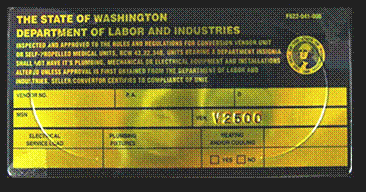
Figure 1 - L&I Permit Insignia
2.
In compliance with Section 105.5.32 of the International Fire Code (IFC), a vendor operating a Mobile Food Unit that is equipped with appliances that produce smoke or grease-laden vapors or utilize liquified petroleum gas (LPG) systems or Compressed Natural Gas (CNG) systems shall first obtain an operational permit from any King County Fire Agency. Mobile Food Unit cooking that produces grease-laden vapors shall have proper ventilation and protection following IFC 609 and IFC 904.12.6.
3.
A Class-K portable fire extinguisher is required for cooking with solid fuels, vegetable oil, animal oils, and/or fats.
4.
Fire extinguishers shall meet IFC 904.12.5, IFC 906, and National Fire Protection Association (NFPA) 10 standards. In addition, personnel inside a Mobile Food Unit should have working knowledge of fire extinguisher use and manual activation of the hood suppression system.
5.
Sufficient propane shall be provided for uninterrupted use during operation. No propane refueling shall occur without a total shutdown of the Mobile Food Unit and associated operations.
P.
Parking and Circulation.
1.
A minimum of three on-site and demarcated parking spaces shall be provided per Mobile Food Unit; however, such spaces do not have to be exclusively reserved for use by mobile foot unit customers. In addition, if there is adjacent on-street parking available, two on-street spaces may count toward the minimum parking requirement except within rights-of-way located adjacent to properties zoned Old-Town or Mid-Town provided; however, the on-street parking spaces cannot be exclusively reserved for use by the vendor or their customers.
2.
The staging area for a Mobile Food Unit shall not disrupt established or required vehicular circulation routes.
Q.
Set-Up and Storage.
1.
Each Mobile Food Unit in operation shall have a minimum staging area of three hundred sixty (360) square feet with a minimum width of eighteen (18) feet and a minimum length of twenty (20) feet.
2.
All mobile food vendors shall comply with all laws, rules, and regulations regarding food handling. In addition, all vehicles, equipment, and devices used for handling, storing, transporting, and/or selling food shall comply with all laws, rules, and regulations respecting such vehicles, equipment, and devices as established by the King County Health Department.
3.
Mobile Food Units shall be kept in good repair.
4.
Mobile Food Units shall be designed and situated to serve walk-up customers only—no drive-thru service shall be allowed.
5.
Vendors shall be responsible for always keeping the staging area of the Mobile Food Unit clear of litter and debris. In addition, the vendor shall make provisions for the proper disposal of all refuse by utilizing refuse containers serviced by Waste Management.
6.
At the close of each business day, vendors shall be responsible for taking down and packing up all associated equipment, including outdoor seating accommodations, tents, trash receptacles, etc.
7.
All items associated with a Mobile Food Unit operation shall be stored within the Mobile Food Unit or a permitted building (outdoor storage containers are prohibited).
8.
Mobile Food Units stored within City limits during non-business hours shall not be stored on public rights-of-way, public property, or undeveloped lots.
R.
Signage.
1.
Under state law, signs painted on or permanently affixed to Mobile Food Units shall be allowed by right. Signs displayed on the exterior of Mobile Food Units that are not legally and permanently affixed to the vehicle are expressly prohibited.
2.
Each Mobile Food Unit shall be limited to one commercial A-Board sign under a separate temporary sign permit subject to the requirements of DMC § 14.50.150(A) (Temporary Signs).
3.
Using pennant flags, streamers, balloons, or similar displays is prohibited.
S.
Utilities.
1.
All wastewater generated by a Mobile Food Unit shall be disposed of following state and local regulations. Mobile Food Units shall be self-contained. Any illicit discharge described herein would warrant immediate termination of the City-issued permit.
2.
No water, greywater, or black water discharge shall be allowed in landscape strips, storm drains, sanitary sewer systems (including existing connections or facilities), or streets.
3.
No permanent/temporary water or sewer connections are allowed.
4.
Mobile Food Units may obtain electrical service from several sources; however, electrical service from a generator shall only be obtained from an onboard generator. No power cable or equipment shall be extended at grade (or above) across any public right-of-way or pedestrian pathway.
(Ord. No. 1315, § 1, 4-4-2023; Ord. No. 1323, § 2, 10-17-2023; Ord. No. 1327, § 2, 3-5-2024)
Editor's note—
Section 2 of Ordinance 1315 states, "Duration of Interim Controls. This interim Ordinance
shall be in effect for six (6) months, commencing on the effective date and ending
six months later, unless extended or unless a final ordinance is adopted amending
the Duvall Municipal Code and rescinding the interim controls before their expiration."
Per an email dated August 1, 2023, and at the direction of the city, this section
was set out herein as 14.64.360.

