
Duvall City Zoning Code
CHAPTER 14
44 - PARKING STANDARDS AND DESIGN
14.44.010 - Purpose.
The purposes of this chapter are to implement the policy provisions of the transportation element of the comprehensive plan, the downtown subarea plan, and the city-wide visioning plan to provide adequate parking for all uses allowed in this code; to reduce demand for parking by encouraging alternative means of transportation including public transit, rideshare and bicycles; and to increase pedestrian mobility and safety in urban areas by: setting minimum off-street parking standards for different land uses that assure safe, convenient, and adequately sized parking facilities; providing incentives to rideshare through preferred parking arrangements; providing for parking and storage of bicycles; providing safe direct pedestrian access from public rights-of-way to structures and between developments; minimizing the visual impact of parking areas on the streetscape and pedestrian environment.
(Ord. No. 1347, § 2, 2-3-2026; Ord. 1056 § 1 Exh. A (part), 2007)
14.44.020 - Authority and application.
A.
Before final site plan approval or certificate of occupancy is granted for any new or enlarged building, whichever comes first, or a certificate of occupancy is given for a change or expansion of use in any existing structure, the applicant shall be required to meet the provisions of this chapter and the applicable provisions of DMC Chapter 14.34, Design Guidelines, related to parking lot design and landscaping.
B.
If this chapter does not specify a parking requirement for a land use, the director shall establish the minimum requirement based on either parking requirements for a similar use, parking requirements as established by state law, or a study of anticipated parking demand. If the director requires a study, the applicant shall provide sufficient information to demonstrate that the parking demand for a specific land use will be met. Parking studies shall be prepared by a professional engineer with expertise in traffic and parking analysis, unless the director authorizes an equally qualified individual.
C.
If any portion of the required amount of off-street parking has been proposed to be provided off-site, the applicant shall provide written contracts with affected landowners showing that required off-street parking shall be provided in a manner consistent with the provisions of this chapter. The director shall review the contracts for compliance with this chapter. If approved, the contracts shall be recorded with the King County records, elections, and licensing division as a deed restriction on the title to all applicable properties. These deed restrictions may not be revoked or modified without the director's authorization.
D.
A parking facility which is required for one establishment or use shall not be considered as part of the parking facility necessary for any other use, except for shared as provided in DMC Section 14.44.050.
E.
All proposed parking facilities are subject to DMC Chapter 14.34, Design Guidelines.
(Ord. No. 1347, § 2, 2-3-2026; Ord. 1056 § 1 Exh. A (part), 2007)
14.44.030 - Criteria for preexisting uses/buildings.
A.
The following regulations shall apply to preexisting uses or buildings:
1.
A development in existence before the adoption of these regulations or at the time of its annexation to the city, if later, and which does not have sufficient parking space in accordance with this chapter, may continue to operate with the parking deficiency as long as no enlargement or land use change is made which would require additional parking spaces;
2.
When a preexisting use is enlarged to require additional parking spaces, the requirements of this chapter shall apply only to the enlargement.
3.
When additional uses are placed on the same lot with the preexisting use or an enlarged lot of which the preexisting use lot is a part, the requirements of this chapter shall apply only to the additional use;
4.
When a preexisting use is terminated, the area vacated shall not be occupied by a use requiring more parking spaces than the terminated use, unless the necessary additional parking spaces are provided.
5.
Existing commercial buildings in the OT zoning district shall be permitted to change uses without the requirement of additional parking if the director determines such additional parking could not physically be provided, except that additional parking shall be required for any new square footage for commercial and/or residential uses.
Example:
B.
When a preexisting building, which does not have sufficient parking, is remodeled or rehabilitated but not enlarged, the existing use of the building may continue without providing additional parking.
(Ord. No. 1347, § 2, 2-3-2026; Ord. 1056 § 1 Exh. A (part), 2007)
14.44.040 - Computation of off-street parking spaces.
A.
Off-street parking areas shall contain at a minimum the number of parking spaces as set out in subsection H of this section. Off-street parking ratios, expressed as the number of spaces per square foot, refer to the usable or net floor area, excluding nonpublic areas. Nonpublic areas include, but are not limited to, building maintenance areas, storage areas, closets, or restrooms. If the formula for determining the number of off-street parking spaces results in a fraction, the number of off-street parking spaces shall be rounded to the nearest whole number, with fractions of 0.50 or greater rounding up and fractions below 0.50 rounding down.
B.
An applicant may request a modification of the minimum required number of parking spaces by substantiating that parking demand can be met with a reduced parking requirement. In such cases, the director may approve a reduction of up to fifty (50) percent of the minimum required number of spaces. Such additional reduction shall not apply to OT, UT-1st, or RIV zoning districts; however, if it can be clearly documented that the building's hours of use require different parking at different times, the director may reduce the parking requirement.
C.
When the city has received a shell building permit application, off-street parking requirements shall be based on the possible tenant mix or uses authorized by the zone designation and compatible with the limitations of the shell permit. A minimum of twenty (20) percent shall be assumed for the restaurant.
D.
In light industrial developments, a minimum of twenty (20) percent of gross floor area shall be assumed as office when calculating parking requirements. When the range of possible uses results in different parking requirements, the director will establish the parking requirement based on a likely range of uses.
E.
Within the OT, UT-1st, or RIV zoning districts, parking requirements may be fifty (50) percent of the minimum requirements indicated in the following table and only if a traffic impact assessment can determine the need for a reduction.
F.
In any development required to provide twelve (12) or more parking spaces, bicycle parking shall be provided, as specified in Section 14.44.060.
G.
The maximum number of parking spaces provided for a specified use or building shall be one and one-half times the minimum number of spaces set out in subsection H of this section, and if the additional parking need is documented in a traffic impact assessment, the requirements of which are set out by the public works director. The director may allow an increase in parking spaces if documentation as to the need for such additional spaces is provided and approved. Such additional parking shall not be located in front of a building and shall be consistent with DMC Chapter 14.34, Design Guidelines.
H.
When calculating minimum off-street parking requirements for residential development, the following parking requirements shall apply:
1.
Parking may be enclosed or unenclosed.
2.
Tandem parking spaces shall be permitted to meet minimum off-street parking requirements at a rate of one space for every twenty (20) linear feet.
3.
Up to a maximum of six (6) parking spaces in a legally nonconforming gravel surface parking area shall count towards the minimum required off-street parking.
4.
Off-street parking shall not be required as a condition of permitting a residential development if compliance with tree retention would otherwise make a proposed residential development or redevelopment infeasible. It shall be the applicant's responsibility to prove infeasibility, subject to the director's approval.
I.
Parking requirements shall be as set out in the following table:
Off-Street Parking Requirements
(Ord. No. 1347, § 2, 2-3-2026; Ord. 1056 § 1 Exh. A (part), 2007)
14.44.050 - Shared parking requirements.
The amount of required off-street parking may be reduced by an amount determined by the director when shared parking facilities for two or more uses are proposed, provided:
A.
The total parking area exceeds five thousand (5,000) square feet;
B.
The parking facilities are designed and developed as a single on-site common parking facility, or as a system of on-site and off-site facilities;
C.
All parking facilities are connected with improved pedestrian walkways, and no building or use involved is more than one thousand (1,000) feet from the most remote shared facility;
D.
The amount of the reduction shall not exceed ten (10) percent for each use, unless:
1.
The regular hours of operation for each use are separated by at least one hour, or
2.
A parking demand study is prepared by a professional traffic engineer and submitted by the applicant, documenting that the hours of actual parking demand for the proposed uses will not conflict and that uses will be served by adequate parking if shared parking reductions are authorized.
E.
The total number of parking spaces in the common parking facility is not less than the minimum required spaces for any single use;
F.
The parking requirement has not already been reduced by fifty (50) percent as allowed by DMC Section 14.44.040(B);
G.
A covenant or other contract for shared parking between the cooperating property owners is approved by the director. This covenant or agreement must be recorded with the King County Records, Elections, and Licensing Services Division as a deed restriction on both properties. It cannot be modified or revoked without the director's consent.
H.
If any requirements for shared parking are violated, the affected property owners must provide a remedy satisfactory to the director or provide the full amount of required off-street parking for each use, in accordance with the requirements of this chapter, unless the director approves a satisfactory alternative remedy.
(Ord. No. 1347, § 2, 2-3-2026; Ord. 1056 § 1 Exh. A (part), 2007)
14.44.060 - Bicycle parking requirements.
Bicycle parking requirements shall apply to all commercial, office, light industrial, mixed-use, and multifamily residential developments.
A.
Bicycle parking shall be bike racks or locker-type parking facilities unless otherwise specified.
B.
Off-street parking areas shall contain at least one bicycle parking space for every twelve (12) spaces required for motor vehicles, except as follows:
1.
The director may reduce bike rack parking facilities when it is demonstrated that bicycle activity will not occur at that location.
2.
The director may require additional spaces when it is determined that the use or location will generate a high volume of bicycle activity. Such a determination will include, but not be limited to, the following uses:
a.
Park and playfield;
b.
Marina;
c.
Library, museum, and arboretum;
d.
Elementary or secondary school;
e.
Sports club; or
f.
Retail business (when located along a developed bicycle trail or designated bicycle route).
C.
Bicycle facilities for patrons shall be located on site and shall be designed to allow either a bicycle frame or wheels to be locked to a structure attached to the pavement.
D.
All bicycle parking and storage shall be located in safe, visible areas that do not impede pedestrian or vehicle traffic flow.
E.
One indoor bicycle storage space shall be provided for every two dwelling units in townhouse and apartment residential uses, unless individual garages are provided for every unit. The director may reduce the number of bike rack parking spaces if indoor storage facilities are available to all residents.
F.
Bicycle parking shall have direct access to both the public right-of-way and to the main entrance of the principal use.
G.
For facilities with multiple buildings, building entrances, or parking lots, bicycle parking shall be located in areas of greatest use and convenience to bicyclists.
H.
Bicycle parking facilities shall be separated from motor vehicle parking and maneuvering areas by a barrier or sufficient distance to prevent damage to the parked bicycles.
I.
Lighting shall be provided in a bicycle parking area so that all facilities are thoroughly illuminated and visible from adjacent sidewalks or motor vehicle parking lots during all hours of use. Bicycle parking shall be at least as well-lit as motor vehicle parking.
(Ord. No. 1347, § 2, 2-3-2026; Ord. 1056 § 1 Exh. A (part), 2007)
14.44.070 - ADA parking requirements.
A.
Off-street parking and access for physically disabled persons shall be provided in accordance with Section 595 of the regulations adopted pursuant to the Revised Code of Washington (RCW) 19.27 State Building Code and RCW 70.92 Provisions for Aged and Handicapped. The building official shall determine all ADA parking requirements in accordance with Chapter 11 of the International Building Code (IBC).
(Ord. No. 1347, § 2, 2-3-2026; Ord. 1056 § 1 Exh. A (part), 2007)
14.44.080 - Guest parking requirements.
A.
Single-family, multifamily residential and mixed-use commercial/residential developments without adequate, safe on- or off-site parking, as determined by the director, shall be required to provide one guest parking space per seven residential units, unless the applicant can demonstrate other means of meeting such requirement as approved by the director. The city may require additional parking spaces consistent with the development design standards.
B.
The applicant shall provide an on- and off-site parking plan at the time of application.
C.
Guest parking areas shall meet the dimensional standards as listed per Section 14.44.130(B).
D.
The director has the authority to require additional guest parking spaces in cases where adequate on- or off-site guest parking is not available.
(Ord. No. 1347, § 2, 2-3-2026; Ord. 1056 § 1 Exh. A (part), 2007)
14.44.090 - Loading space requirements.
A.
Every nonresidential building engaged in retail, wholesale, manufacturing, or storage activities shall provide loading spaces in accordance with the standards in subsection B of this section:
B.
C.
Each loading space required by this section shall be a minimum of ten (10) feet wide and thirty (30) feet long, and have an unobstructed vertical clearance of fourteen (14) feet six inches, and shall be surfaced, improved, and maintained as required by this chapter. Loading spaces shall be located so that trucks shall not obstruct pedestrian or vehicle traffic movement or project into any public right-of-way. All loading areas shall be separated from required parking areas and designated as truck loading spaces.
D.
Any loading space located within one hundred (100) feet of areas zoned for residential use shall be screened and operated as necessary to reduce noise and visual impacts. Noise mitigation measures may include architectural or structural barriers, berms, walls, or restrictions on operating hours.
E.
Multi-story self-service storage facilities shall provide two loading spaces, and single-story facilities one loading space, adjacent to each building entrance that provides common access to interior storage units. Any floor-area additions or structural alterations to a building shall be required to provide loading space (s) as outlined in this chapter.
(Ord. No. 1347, § 2, 2-3-2026; Ord. 1056 § 1 Exh. A (part), 2007)
14.44.100 - School drop off areas.
At the time of development of a new and/or expanded K—12 school, provisions shall be made for the drop off of students. The area required for drop-off shall be determined by the director in consultation with the applicant.
(Ord. No. 1347, § 2, 2-3-2026; Ord. 1056 § 1 Exh. A (part), 2007)
14.44.110 - Drive-thru facilities.
A.
A stacking space shall be an area measuring nine feet by twenty (20) feet with direct forward access to a service window of a drive-thru facility. A stacking space shall be located to prevent any vehicles from extending onto the public right-of-way or interfering with any pedestrian circulation, traffic maneuvering, or other parking space areas. Stacking spaces for drive-thru or drive-in use may not be counted toward the required parking spaces.
B.
Uses providing drive-up or drive-thru services shall provide vehicle stacking spaces as follows:
1.
For each drive-up window of a pharmacy or dry cleaning laundry, a minimum of three stacking spaces shall be provided;
2.
For each drive-up window of a bank/financial institution, business service, or other drive-thru use not listed, a minimum of five stacking spaces shall be provided; and
3.
For each service window of a drive-thru restaurant, a minimum of seven stacking spaces shall be provided.
C.
To reduce congestion and turning lane conflicts, drive-thru facilities may not take access from a major arterial such as Main Street/SR-203. Parking lot and drive-up/thru windows must be provided from a secondary street or road.
D.
Drive-thru facilities are not permitted between a building and a street.
E.
Drive-thru facilities that have negative traffic impacts on adjacent roads and/or businesses may require additional traffic controls at the drive-thru businesses' expense.
F.
Where drive-thru facilities are located adjacent to a through lane, the drive-thru shall be constructed of a different material than the through lane, or a four to five-foot planter strip shall be installed between the through lane and the drive-thru lane.
G.
The city may require additional stacking lanes based on the applicant's traffic impact assessment.
(Ord. No. 1347, § 2, 2-3-2026; Ord. 1056 § 1 Exh. A (part), 2007)
14.44.120 - Carpool and vanpool parking.
The Commute Trip Reduction (CTR) Law states that employers with one hundred (100) or more employees working a single shift shall implement programs that reduce the number of commute trips by encouraging people to ride public transit, carpool, vanpool, bike, or walk. At such time when an employer or commercial development in Duvall has this number of employees, the following carpool and vanpool parking regulations shall apply:
A.
Ten (10) percent, but not fewer than one of the required spaces for industrial, institutional, and office developments shall be designated for use as carpool/vanpool parking.
B.
The carpool/vanpool spaces shall be clearly marked "Reserved—Carpool/Vanpool Only."
C.
Designated carpool/vanpool spaces shall be the closest employee parking spaces to the building entrance commonly used by employees, except for any ADA parking spaces provided.
D.
Parking in reserved areas shall be limited to vanpools and carpools established through ride share programs by public agencies and to vehicles meeting minimum rideshare qualifications set by the employer.
(Ord. No. 1347, § 2, 2-3-2026; Ord. 1056 § 1 Exh. A (part), 2007)
14.44.130 - Off-street parking area design standards.
A.
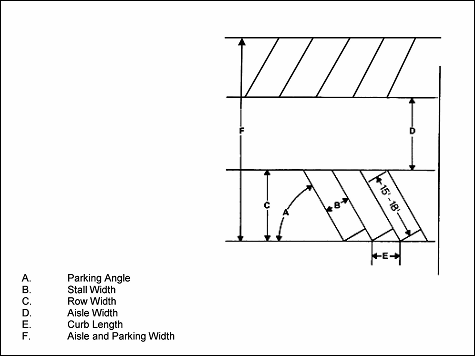
The minimum parking space and aisle dimensions are shown in the following table.
B.
Minimum Parking Space and Aisle Dimensions.
Notes:
1. Dimensions are in feet. Parking space dimensions are measured from the centerline of the division stripe.
2. When parking lots may have substantial traffic by trucks or other large vehicles, the director may establish larger minimum dimensions.
3. Aisle turns must be at least fourteen (14) feet in width.
4. Residential parking minimum stall width is eight (8) feet, and minimum row width is twenty (20) feet, except as required for compliance with ADA parking requirements per DMC 14.44.070.
5. Tandem parking minimum stall width is eight (8) feet, and the minimum stall length is forty (40) feet.
C.
Aisles which do not provide direct access into a parking space shall be a minimum width of twenty (20) feet.
D.
Parking facilities shall have permanent markings showing entrances, exits, traffic direction, and parking spaces, except where the director finds such requirements are not applicable.
E.
Subject to director review and approval, up to twenty-five (25) percent of the total number of spaces to be provided in any development may be sized to accommodate compact cars, subject to the following:
1.
Each space shall be clearly identified as a compact car space by painting the word "COMPACT" in capital letters, a minimum of eight inches high, on the pavement at the base of the parking space and centered between the striping.
2.
Aisle widths and parking stall sizes shall conform to the standards set out in this section.
3.
The compact stalls shall be dispersed around the site.
F.
Off-street parking areas shall not be located more than five hundred (500) feet from the building they are required to serve for all uses except those specified below; where the off-street parking areas do not abut the buildings they serve, the required maximum distance shall be measured from the nearest building entrance that the parking area serves and in accordance with the following:
1.
For all single detached dwellings, the parking spaces shall be located on the same lot they serve;
2.
For all other residential dwellings, at least a portion of the parking areas shall be located within one hundred (100) feet of the building they serve;
3.
For all nonresidential uses permitted in residential zones, the parking spaces shall be located on the same lot they are required to serve, and at least a portion of parking areas shall be located within one hundred fifty (150) feet from the nearest building entrance they serve;
4.
Parking lots shall be arranged as to permit the internal circulation of vehicles between parking aisles without reentering adjoining public streets; and
5.
ADA accessible parking shall be provided in accordance with DMC Section 14.44.070.
G.
Parking facilities shall be designed so that exiting vehicles are not required to back into streets, except for residential uses of less than four dwellings per lot on local access streets.
H.
Wheel stops are required in all parking areas to prevent vehicles from overhanging walkways, property lines, or other limits of a parking area and to prevent damage to landscaping.
I.
Any parking spaces abutting a required landscaped area on the driver or passenger side of the vehicle shall provide an additional eighteen (18) inches above the minimum space width requirement to provide a place to step other than in the landscaped area. The extra width shall be separated from the adjacent parking space by a parking space division stripe.
J.
The parking space depth may be reduced a maximum of two feet when vehicles overhang a walkway under the following conditions:
1.
Wheelstops or curbs are installed, or the walkway is increased by two feet. The remaining walkway shall not be reduced in width as required in DMC Chapter 14.34.
K.
Driveways providing ingress and egress between off-street parking areas and abutting streets shall be designed, located, and constructed in accordance with the provisions of the public works development design standards and DMC Chapter 14.34, Design Guidelines.
L.
Lighting shall be provided for the safety of traffic and pedestrian circulation on the site, as required by the director. Lighting shall be designed to minimize direct illumination of abutting properties and adjacent streets.
M.
Any surface used for vehicle parking or storage shall have direct and unobstructed driveway access. Residential parking spaces shall be on a paved surface or consist of grass block pavers.
N.
Vanpool and carpool parking areas shall meet the following minimum design standards:
1.
A minimum vertical clearance of seven feet three inches shall be provided to accommodate van vehicles if designated vanpool/carpool parking spaces are located in a parking structure; and
2.
A minimum turning radius of twenty-six (26) feet four inches with a minimum turning diameter (curb to curb) of fifty-two (52) feet five inches shall be provided from parking aisles to adjacent carpool/vanpool parking spaces.
O.
No dead-end alley may provide access to more than eight required off-street parking spaces.
P.
Any parking stalls located in enclosed buildings must be totally within the enclosed structure.
Q.
The slope of access easements and tracts, and the hill of entrance and exit driveways, including driveways for detached single-family residences, shall not exceed eight percent for the first ten (10) feet from the face of the abutting right-of-way curb. Thereafter, the slope shall not exceed fifteen (15) percent as set out in the public works development design standards.
(Ord. No. 1347, § 2, 2-3-2026; Ord. 1056 § 1 Exh. A (part), 2007)
14.44.140 - Pedestrian circulation, access and design.
The following general pedestrian design standards shall apply to all developments in Duvall. They should be reviewed together with DMC Chapter 14.34, Design Guidelines, and other applicable chapters of this title:
A.
All uses shall provide pedestrian access onto the site. Pedestrian access points shall be provided at all pedestrian arrival points to the development, including the property lines, adjacent lots, abutting street intersections, crosswalks, and at transit stops. Pedestrian access shall be located as follows:
1.
Access points at property edges and to adjacent lots shall be coordinated with existing development to provide circulation patterns between developments.
2.
Residential developments shall provide links between cul-de-sacs or groups of buildings to allow pedestrian access from within the development and from adjacent developments to activity centers, parks, common tracts, open spaces, schools, or other public facilities, transit stops, and public streets.
B.
Pedestrian walkways shall form an on-site circulation system that minimizes the conflict between pedestrians and traffic at all points of pedestrian access to on-site parking and building entrances. Pedestrian walkways shall be provided when the pedestrian access point or any parking space is more than seventy-five (75) feet from the building entrance or principal on-site destination, and as follows:
1.
All developments that contain more than one building shall provide walkways between the principal entrances of the buildings.
2.
All nonresidential buildings set back more than one hundred (100) feet from the public right-of-way shall provide for reasonably direct pedestrian access from the building to buildings on adjacent lots.
C.
Pedestrian access and walkways shall meet the following minimum design standards:
1.
Access and walkways shall be well-lit and physically separated from driveways and parking spaces by landscaping, berms, barriers, grade separation, or other means to protect pedestrians from vehicular traffic.
2.
Access and walkways shall have a minimum of sixty (60) inches of unobstructed width and meet the surfacing standards of the Duvall road standards for walkways or sidewalks.
3.
Access shall be usable by mobility-impaired persons. It shall be designed and constructed to be easily located by the sight-impaired pedestrian by either grade change, texture, or other equivalent means.
4.
A crosswalk shall be required when a walkway crosses a driveway or a paved area accessible to vehicles.
5.
Wherever walkways are provided, raised crosswalks or speed bumps shall be located at all points where a walkway crosses the lane of vehicle travel.
D.
Blocks in excess of nine hundred (900) feet shall be provided with a crosswalk at the approximate midpoint of the block, or as the public works director determines to be appropriate.
E.
Compliance with DMC Chapter 14.34, Design Guidelines, for parking lot design, circulation, landscaping, and other applicable design standards.
(Ord. No. 1347, § 2, 2-3-2026; Ord. 1056 § 1 Exh. A (part), 2007)
14.44.150 - Off-street parking construction standards.
Off-street parking areas shall be asphalt cement pavement (ACP) or portland cement concrete (PCC) unless otherwise permitted by this Chapter. Typical approved sections are illustrated in the development design standards. Residential driveways shall be constructed of concrete. Fire access and secondary parking areas may be built with low-impact or permeable pavements, including, but not limited to, grasscrete, porous asphalt pavement (PCP), and modular interlocking concrete block (MICB). Parking areas may be paved or constructed with other surfaces as approved by the public works director.
(Ord. No. 1347, § 2, 2-3-2026; Ord. 1056 § 1 Exh. A (part), 2007)
14.44.160 - Internal circulation road standards.
Internal access roads to off-street parking areas shall conform to the surfacing and design requirements for private commercial roads set in the development design standards and DMC Chapter 14.34, Design Guidelines.
(Ord. No. 1347, § 2, 2-3-2026; Ord. 1056 § 1 Exh. A (part), 2007)

