
Duvall City Zoning Code
CHAPTER 14
46 - EXTERIOR LIGHTING STANDARDS
14.46.010 - Purpose.
The purposes of this chapter are to: regulate exterior lighting in order to avoid unsafe and unpleasant conditions as the result of poorly designed or installed exterior lighting; discourage excessive lighting; regulate the type of light fixtures, lamps and standards; protect adjacent properties and residential units from the adverse effects associated with nonresidential and multi-family exterior lighting; protect Snoqualmie Valley views from the adverse effects of lighting; minimize light spill into the dark night sky.
(Ord. 1056 § 1 Exh. A (part), 2007)
(Ord. No. 1233, § 3(Exh. C), 2-6-2018)
14.46.020 - Applicability.
A.
A lighting plan shall be required for all new development or redevelopment:
B.
These regulations do not apply to subdivisions or individual dwelling units, with the exception of common areas. Examples of common areas include, but are not limited to open space, pathways, clubhouses, parking lots and play areas.
C.
These regulations are not applicable to street lighting within public rights-of-way.
D.
These regulations do not apply to lighting necessary for emergency equipment and work conducted in the interests of law enforcement or for the safety, health, or welfare of the public.
E.
Sign lighting is governed by Chapter 14.50, Sign Code.
(Ord. 1056 § 1 Exh. A (part), 2007)
(Ord. No. 1233, § 3(Exh. C), 2-6-2018)
14.46.030 - General requirements.
A.
To reduce overall energy consumption and eliminate unneeded lighting, exterior lighting installations shall include timers, dimmers, sensors, and/or photocell controllers that turn the lights off during daylight hours or when lighting is not needed.
B.
Exterior lighting installations shall be designed to avoid harsh contrasts in lighting levels.
C.
Light heads for parking lots and display area light fixtures shall not have bulbs or reflectors that project below the bottom rim of the fixture unless shielded by a softening diffuser.
D.
Lighting levels shall not exceed .2-foot candles measured 5 feet outside an exterior property line. An exception may be approved by the director adjacent to rights-of-way.
E.
Fixtures and lighting systems shall be maintained in good working order.
F.
Vegetation and landscaping shall be maintained in a manner that does not obstruct security lighting.
G.
Open-air parking lot lighting shall be designed to provide sufficient illumination for comfort and safety and shall be adequate to facilitate the activities taking place in a given location.
H.
Lighting of outside areas shall not be used to attract attention to a business.
I.
Lighting fixtures shall be of a type or adequately shielded to prevent glare from normal viewing angles.
J.
Lighting fixture and pole types may be specified and required by the city.
K.
Lighting of sensitive areas and buffers shall not be permitted.
L.
Lighting shall be consistent with DMC 14.34, Design Guidelines.
(Ord. 1056 § 1 Exh. A (part), 2007)
(Ord. No. 1233, § 3(Exh. C), 2-6-2018)
14.46.040 - Lighting plan requirements.
The applicant shall submit to the planning department sufficient information, in the form of an overall exterior lighting plan, to enable the director to determine that the applicable provisions will be satisfied.
A.
The exterior lighting plan shall include, at a minimum, the following information:
1.
Manufacturer specification sheets, cut-sheets or other manufacturer provided information for all proposed lighting fixtures.
2.
The proposed location, mounting height, and aiming point of all exterior lighting fixtures.
3.
If building elevations are proposed for illumination, drawings shall be provided for all relevant building elevations showing the fixtures, the portions of the elevations to be illuminated, the luminance levels of the elevations, and the aiming point for any remote light fixture. If only architectural lighting below five-foot candles is proposed, this section or any portion of it may be waived by the director.
4.
A brief written narrative which describes the objectives of the lighting.
5.
Photometric data, Color Rendering Index (CRI) of all lamps (bulbs), and other descriptive information of the fixtures, and if applicable or required, designation as Illuminating Engineering Society of North America (IESNA) "cut-off" fixtures.
6.
A computer generated photometric grid showing foot candle readings every ten (10) feet within the property or site, and ten (10) feet beyond the property lines at a scale specified by the director. Iso-foot candle contour line style plans may be substituted for the photometric grid.
7.
For exterior lighting installations within fifty (50) feet of upper level living units, horizontal and vertical projection of photometric data is required.
8.
If needed to review proposed exterior lighting installations, the director may require additional information following the initial lighting plan submittal, including but not limited to:
a.
Landscaping information that indicates mature tree size;
b.
Shrubbery and other vegetation in order to evaluate the long-term and seasonal effectiveness of lighting or screening of lighting.
(Ord. 1056 § 1 Exh. A (part), 2007)
(Ord. No. 1233, § 3(Exh. C), 2-6-2018)
14.46.050 - Lighting standards for uses within 50 feet of R4, R4.5, R6, R8, R12, MU12 or MUI zones.
A.
The following requirements shall apply:
1.
Lighting poles shall be no taller than fifteen (15) feet and shall be installed at a maximum of seventeen (17) feet above the grade of the area to be lit.
2.
Lighting fixtures shall be aimed and shielded in a manner that shall not direct illumination on adjacent residential zones. Fixtures shall be of a type or adequately shielded to prevent glare from normal viewing angles.
(Ord. 1056 § 1 Exh. A (part), 2007)
(Ord. No. 1233, § 3(Exh. C), 2-6-2018)
14.46.060 - Open-air parking lot lighting.
A.
Open-air parking lots shall comply with the standards of this chapter in addition to the other requirements of this title.
B.
Open-air parking lot lighting shall be designed to provide for uniform lighting throughout the facility with no dark patches or pockets.
C.
Open-air parking lot lighting shall be designed to provide sufficient lighting to identify parking features and provide pedestrian safety.
D.
In order to direct light downward and minimize the amount of light spilled into the dark night sky, all lighting fixtures serving open-air parking lots, except as allowed in DMC 14.44, Parking Standards and Design, shall be full cut-off fixtures as defined by the Illuminating Engineering Society of North America (IESNA).
E.
If the design of an area suggests the use of parking lot lighting fixtures of a particular "period" or architectural style the director may permit and/or require alternatives or supplements to the lighting described above.
F.
The following mounting height regulations shall apply to open-air parking lot lighting:
1.
The maximum permissible mounting height of all other outside lighting shall be twenty-five (25) feet.
G.
The table below establishes open-air parking lot lighting standards.
Table 14.46.060.H
(Ord. 1056 § 1 Exh. A (part), 2007)
(Ord. No. 1233, § 3(Exh. C), 2-6-2018)
14.46.070 - Canopy lighting and lighting of service stations.
A.
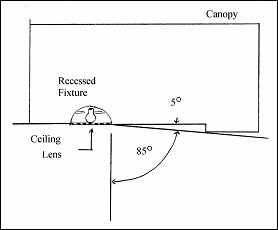
In order to minimize the extent of direct glare, light fixtures mounted on canopies shall be recessed so that the lens cover is recessed or flush with the bottom surface (ceiling) of the canopy or shielded by the fixture or the edge of the canopy so that light is constrained to eighty-five (85) degrees or less from vertical. Subsection B of this section, entitled Recessed Fixture, illustrates this.
B.
Figure 14.46.070. Recessed Fixture.
C.
Lights shall not be mounted on the top or sides of the canopy. The sides shall not be illuminated in any manner.
D.
Areas around and under canopies and islands shall be illuminated so that the minimum horizontal luminance at grade level is at least one-foot candle and no more than five-footcandles. At the discretion of the director, increased lighting levels may be permitted for enhanced security purposes only.
(Ord. 1056 § 1 Exh. A (part), 2007)
(Ord. No. 1233, § 3(Exh. C), 2-6-2018
14.46.080 - Lighting of outdoor performance, sport and recreation facilities.
A.
Lighting levels and pole heights for outdoor performance, sports, and recreation facilities shall not exceed by more than five percent of the Illuminating Engineering Society of North America published standards for the proposed activity.
B.
Where playing fields or other special activity areas are to be illuminated, lighting fixtures shall be specified, mounted, aimed and shielded so that their beams fall within the primary playing area and immediate surroundings, and so that no direct illumination is directed off the site.
C.
The main lighting shall be turned off as soon as possible following the end of the event. The main lighting shall not remain on longer than thirty (30) minutes following the end of the event. Where feasible, a low level lighting system shall be used to facilitate patrons leaving the facility, cleanup, nighttime maintenance and other closing activities. The low level lighting system shall provide a horizontal illumination level at grade of no more than four-footcandles.
(Ord. 1056 § 1 Exh. A (part), 2007)
(Ord. No. 1233, § 3(Exh. C), 2-6-2018)
14.46.090 - Architectural accent lighting.
A.
Lighting fixtures used to accent architectural features, materials, colors, style of buildings, or art shall be located, aimed and shielded so that light is directed only on those features.
B.
Lighting fixtures used to accent architectural features, materials, colors, style of buildings, or art shall not generate excessive light levels, cause glare, or direct light beyond the façade onto neighboring properties, streets or the night sky.
C.
The maximum illumination of any vertical surface or angular roof surface shall not exceed five-footcandles.
D.
Flags of the United States or Washington State may be illuminated from below provided such lighting is focused primarily on the individual flag or flags to limit light trespass and spill into the dark night sky.
(Ord. 1056 § 1 Exh. A (part), 2007)
(Ord. No. 1233, § 3(Exh. C), 2-6-2018)
14.46.100 - Lighting of landscaping.
Illumination of landscaping shall utilize diffused or muted lighting, avoid glare, and minimize light trespass beyond landscaping onto neighboring properties, streets, or the night sky.
(Ord. 1056 § 1 Exh. A (part), 2007)
(Ord. No. 1233, § 3(Exh. C), 2-6-2018)

