
Edgewater City Zoning Code
ARTICLE 19
Signs
Sec. 16-19-10.- Purpose and intent.
(a)
The purposes and intent of this Article are to promote the public health, safety and welfare and to advance the desired aesthetic goals of the community by establishing sign standards and requirements that are reasonable, effective and nondiscriminatory. Accordingly, the goals of this Article are to:
(1)
Recognize that signs are a necessary means of useful communication for the convenience of the public.
(2)
Provide a reasonable balance between the right of an individual to communicate and the right of the public to be protected against the visual discord resulting from the unrestricted proliferation of signs and similar devices.
(3)
Protect the public from damage or injury caused by signs that are poorly designed or maintained and from distractions or hazards to pedestrians or motorists caused by the indiscriminate placement or use of signs.
(4)
Ensure signs are well designed and contribute in a positive way to the City's visual environment, express local character and help develop a distinctive image for the City.
(5)
Distinguish between exempt, prohibited and permitted signage in order to further the City's desire to minimize the administrative burden associated with processing sign permits.
(6)
Assure that existing signs are kept in good repair.
(b)
In addition to the regulations contained in this Article, those properties zoned commercial or residential-commercial shall comply with design standards adopted by the City Council, as may from time to time be amended. Where the design standards conflict with this Article, this Article shall control.
(Ord. 10-14 §2, 2014; Ord. No. 2016-03, §1, 2-4-2016)
Sec. 16-19-20. - Permanent sign permits and administration.
(a)
Application. Any person, organization, corporation or business entity desiring to construct, erect, remodel or change any sign within the City is required to make application for a permit on appropriate forms supplied by the City Manager, which permit shall be issued prior to the commencement of work on the sign. The City shall neither accept nor act upon any application for a sign permit from any person, organization, corporation or business entity that is required to have a business license under applicable provisions of this Code unless such person, organization, corporation or business entity shall first provide written evidence of having such a license in full force and effect.
(b)
Procedure:
(1)
Applications for permanent sign permits shall be made in writing on forms furnished by the City. The application shall contain:
a.
The location by street number of the proposed sign structure;
b.
Names and addresses of the owner, sign contractor and erectors;
c.
Legible site plan which includes the specific location of the sign;
d.
Scaled drawings (no less than one (1) inch equals ten (10) feet), indicating sizes, dimensions, specifications, colors, materials, specific locations, source of illumination and mounting methods of the proposed sign structure. A certification by a structural engineer may be required by City staff for a freestanding or projecting sign;
e.
A description of the lighting to be used, if applicable;
f.
Proof of public liability insurance covering projecting wall signs;
g.
If the sign is to be located off the premises of the holder of the sign permit, a written lease or permission from the property owner of the site on which the sign will be located;
h.
Sign permit fee as established by the current Fee Schedule; and
i.
Such other information as determined necessary by the City Manager for proper review and evaluation of the application.
(c)
Approvals. All signs regulated by this Article shall be reviewed and approved by the City Manager. The City Manager shall review all applications for sign permits to determine compliance with the criteria set forth in Subsection (e) of this Section. Upon approval of a sign permit, the sign permit shall be issued to the applicant and the applicant may apply for any building or electrical permits required for the sign. No sign shall be erected or displayed prior to the approval of a sign permit for the same.
(d)
Inspections. The City shall have the authority to make periodic inspections of all existing signs for compliance with this Section. Final approval of any sign as erected is contingent upon inspection of said sign for compliance with the approved sign application and plan within fourteen (14) days after erection. The applicant is responsible for requesting a final sign inspection after a sign has been erected.
(e)
Sign permit review criteria:
(1)
Sign meets the requirements of this Article;
(2)
Sign conforms to the requirements of the building and electrical codes;
(3)
Sign conforms to the size, height, material and location requirements of this Chapter for the zoning district in which it is located; and
(4)
Sign will not interfere with pedestrian, vehicular safety or be erected within the road right-of-way or near the intersection of any roads or driveways in such a manner as to obstruct free and clear vision of motorists or pedestrians or at any location where, by reason of the position, shape or color, it may interfere with, obstruct the view of or be confused with any authorized traffic sign, signal or device. Signs located at an intersection must be outside of the sight distance triangle as defined in Section 16-20-20.
(Ord. 10-14 §2, 2014; Ord. No. 2016-03, §1, 2-4-2016)
Sec. 16-19-30. - Temporary sign permits, administration and standards.
(a)
Application. To ensure compliance with the regulations of this Article, a temporary sign permit shall be required in order to erect, move, alter, reconstruct or repair any temporary sign, except signs that are exempt from permits pursuant to Subsection 16-19-50(a) of this Article.
(b)
Procedures. Refer to Subsection 16-19-20(b) of this Article.
(c)
Sign review criteria. Refer to Subsection 16-19-20(e) of this Article.
(d)
Additional temporary sign standards.
(1)
An approved temporary sign permit shall be valid for forty-five (45) days from the date of approval, excepting, temporary portable sign permits, which permits may be valid for any length of time.
(2)
One (1) location may display no more than one (1) temporary sign at any time and may be granted a maximum of two (2) temporary sign permits per calendar year. For purposes of this Paragraph, location means the area in which a business is authorized to be conducted, as set forth in the approved City business license for such business, or the total lot area of a lot used for residential purposes.
(3)
Notwithstanding any other provision of this Article, the total area of a temporary sign shall not exceed eighteen (18) square feet.
(Ord. 10-14 §2, 2014; Ord. No. 2016-03, §1, 2-4-2016)
Sec. 16-19-40. - Sign installation and maintenance.
(a)
Installation.
(1)
All signs shall be mounted so that the method of installation is concealed.
(2)
Projecting signs shall be mounted so they generally align with others in the block.
(3)
All signs and all components thereof, including sign structures and sign faces, shall be kept neatly painted, in a good state of repair and in compliance with all building and electrical codes.
(4)
Owners of projecting signs extending over public right-of-way shall be required to maintain public liability insurance in an amount to be determined appropriate by the City, in which the City is named as an "other insured."
(b)
Maintenance.
(1)
The owner of a sign and the owner of the premises on which such sign is located shall be jointly and severally liable to maintain such sign, including any illumination sources, in neat and orderly condition and in a good working order at all times, and to prevent the development of any rust, corrosion, rotting or other deterioration in the physical appearance or safety of such sign. The sign must also be in compliance with all building and electrical codes.
(2)
The owner of any sign regulated by this Article shall be required to keep signs and supporting hardware, including temporary signs, structurally safe, clean, free of visible defects and functioning properly at all times. Repairs to signs shall be equal to or better in quality of materials and design than the original sign.
(3)
Any sign that is inoperable, unsafe, dilapidated or otherwise in violation of this Code is hereby declared to be a nuisance and shall be abated pursuant to abatement procedures outlined in Section 7-1-50 of this Code.
(4)
The ordinary preventive maintenance of a lawfully existing sign which does not involve a change of placement, size, lighting, color or height shall not require a sign permit.
(Ord. 10-14 §2, 2014; Ord. No. 2016-03, §1, 2-4-2016)
Sec. 16-19-50. - General regulations.
(a)
Exempt signs. The following devices are exempt from the requirement that a sign permit be obtained and shall not be included in the calculation of maximum permissible sign area because they either do not create safety hazards or aesthetic disruption, or they promote public safety:
(1)
Address signs measuring less than two (2) square feet in area.
(2)
A maximum of two (2) residential signs, not otherwise exempt under this Subsection (a), with an aggregate area not to exceed ten (10) square feet, meeting all height requirements of the applicable zoning district.
(3)
Signs posted by or on the order of a public employee in the performance of their duty and signs required by local, state or federal law.
(4)
From September 1st through November 15th of any calendar year, temporary signs, not exceeding three (3) square feet per sign, meeting all height requirements of the applicable zoning district.
(5)
Flags, not exceeding twenty-four (24) square feet per flag, meeting all height requirements of the applicable zoning district.
(6)
Directional signs directing traffic or pedestrian movement into premises or within premises, not exceeding three (3) square feet in area for any one (1) business, and horizontal directional signs painted on paved areas.
(7)
Exterior warning signs necessary to provide notice of an unapparent safety risk, such as "beware of dog," "warning: electromagnetic device in use" or notification of a security system, each not exceeding one (1) square foot in area.
(8)
Vehicle signs. Signs permanently or magnetically attached to motor vehicles or trailers which are being operated or stored in the normal course of business, such as signs on delivery trucks; provided that the primary purpose of such vehicles is not for the display of signs and provided that such vehicles are parked or stored in areas appropriate to their use as vehicles.
(9)
One mural per exterior building wall facing the side or rear lot line of the property upon which the building is located, not to exceed sixty-four (64) square feet and not exceeding the height of the wall to which it is attached. For purposes of this Subsection, a "mural" means a pictorial illustration containing no text which is applied directly to or incorporated in an exterior building wall or door.
(10)
"Ghost signs." For purposes of this Subsection, a "ghost sign" is a sign of at least fifty (50) years-of-age, painted on an exterior building wall.
(b)
Prohibited signs. The following devices are inconsistent with the purpose and intent of this Article and are prohibited in all zone districts:
(1)
Any sign that does not comply with the requirements of this Article.
(2)
Flashing, rotating, blinking or moving signs, animated signs, signs with moving, rotating or flashing lights or signs that create the illusion of movement, except for digital electronic message signs in conformance with this Code.
(3)
Any sign that is erected in such a location as to cause visual obstruction or interference with motor vehicle traffic, or traffic control devices including any sign that obstructs clear vision in any direction from any street intersection or driveway. See Section 16-20-20 for regulations related to site distance triangles.
(4)
Roof signs.
(5)
Any sign other than traffic control signs erected, constructed or maintained within, over or upon the right-of-way of any road or highway, except in the case of a sign for which a permit has been issued pursuant to this Article.
(6)
Any sign which interferes with free passage from or obstructs any fire escape, downspout, window, door, stairway, ladder or opening intended as a means of ingress or egress or providing light or air.
(7)
Any sign located in such a way as to deny an adjoining property owner visual access to an existing sign.
(8)
Vehicle-mounted signs, excepting those that are exempt under Subsection (a)(8).
(9)
Searchlights, except for temporary use not exceeding seven (7) days per calendar year.
(10)
All temporary signs, except those for which a temporary sign permit has been issued in accordance with Section 16-19-30.
(11)
Pole signs.
(12)
Unsafe signs. Signs that are structurally unsafe, not kept in good repair or that constitute a hazard to safety or health by reason of inadequate maintenance, dilapidation, damage, abandonment or inability to meet later and/or vertical loads, as determined by the City Manager.
(13)
Obsolete signs. Any sign located on the premises of a business that is no longer in operation thirty (30) days or more after the business ceases operations and any off-premises sign owned or controlled by such a business. Temporary signs located pursuant to a permit issued under Section 16-19-30 are not obsolete signs.
(Ord. 10-14 §2, 2014; Ord. No. 2016-03, §1, 2-4-2016; Ord. 2025-02 §1, 2025; Ord. 2025-09 §1, 2025)
Sec. 16-19-60. - Sign measurement.
(a)
Height and clearance.
(1)
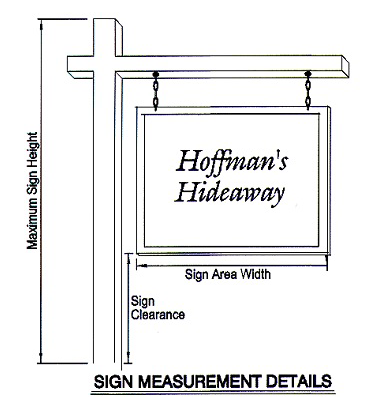
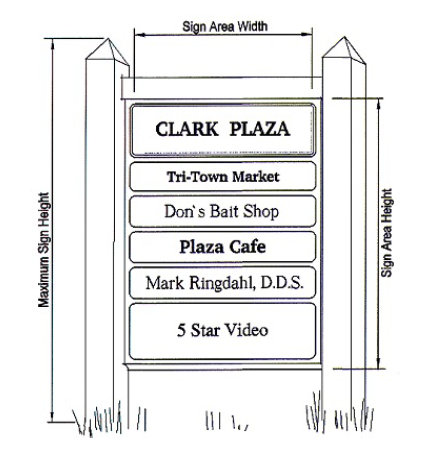
Freestanding and awning signs. The maximum height of a freestanding or awning sign shall be measured from the highest point of a sign to the ground surface beneath it. When berms are used in conjunction with signage, the height of the sign shall be measured from the mean elevation of the fronting street.
(2)
Wall signs. The height of a wall sign shall be measured from the highest point of a sign to the lowest point. No point of any wall sign shall be located higher than the wall to which the sign is affixed.
(3)
Clearance. Sign clearance is measured from the lowest point of a sign to the ground surface beneath it.
(b)
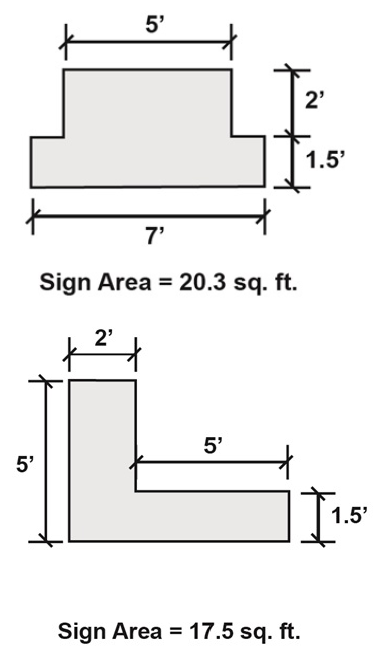
Area. Except as otherwise provided herein, sign area is the entire surface area of a sign, including nonstructural trim. Only one (1) side of a double-faced freestanding or projecting sign shall count toward the aggregate size measurement, provided that both sides are identical.
(1)
Standard geometric shapes. When the surface area of a sign consists of a conventional geometric shape, such as a circle, an oval, a rhombus, a trapezoid or a triangle, the accepted mathematical formulas for calculating area will be used to determine the surface area of a sign.
(2)
Cutout letters. Sign area for cutout letters or display applied directly to the building surface and lacking a defined border or trim shall include the total area within the periphery of the cutout letters on display, which can be enclosed within a rectangle or series of attached rectangles.
(3)
Irregular geometric shapes. If a sign consists of a symbol or statuary, or an irregular geometric shape without an accepted mathematical formula for calculating area, the entire surface area of the symbol or statuary, which can be enclosed within a rectangle or the closest geometric shape, shall be determined as the sign area.
(4)
Awning sign area includes only that area of an awning occupied by text and/or graphics. The area of said text and/or graphics shall be defined and calculated as set forth in subsections (b)(1) through (3), as applicable.
(Ord. 10-14 §2, 2014; Ord. No. 2016-14, §1, 2016)
Sec. 16-19-70. - Sign illumination.
(a)
Use a direct light source. All lighted signs shall have their lighting directed in such a manner as to illuminate only the face of the sign. When external light sources are directed at the sign surface, the light source must be concealed from pedestrians' and motorists' "lines of sight."
(b)
Signs must be illuminated in a way that does not cause glare onto the street and adjacent properties. Signs shall be lighted only to the minimum level for nighttime readability.
(c)
All lighted signs shall meet all applicable electrical codes, and the electrical components used shall bear the label of an approval agency. Additionally, electrical permits shall be obtained for electric signs.
(1)
Flashing, moving, blinking, chasing or other animation effects shall be prohibited on all signs except time and temperature signs. See Paragraph 16-19-80(2) below for regulations pertaining to digital electronic message board signs.
(2)
Neon tubing is an acceptable method of sign illumination for window signs in commercial districts.
(3)
The use of individually cut, back-lit letter signs is encouraged.
(Ord. 10-14 §2, 2014)
_____
Sec. 16-19-80. - Sign types and standards.
The following standards outline requirements for all sign types, provided, however, that certain sign types and locations shall comply with the requirements established by Section 16-19-90.
Sign Types
(1)
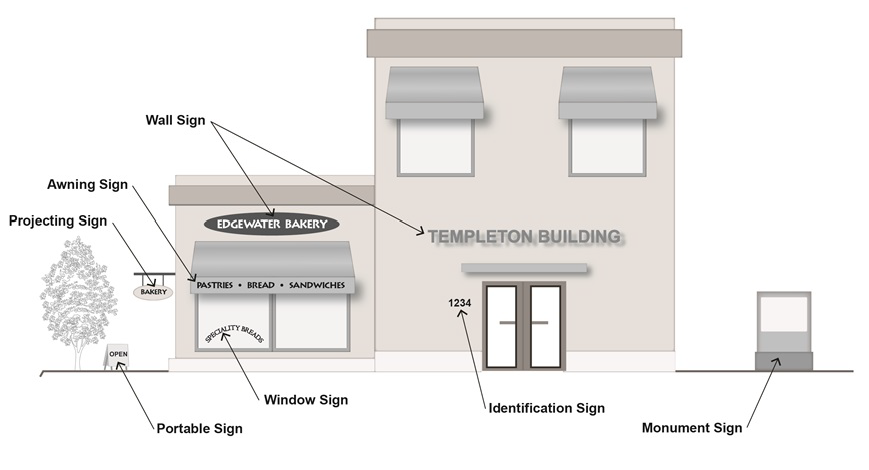
Awning signs. An awning sign is a wall sign which is painted, stitched, sewn or stained onto the exterior of an awning. An awning is a movable shelter supported entirely from the exterior wall of a building and composed of nonrigid materials except for the supporting framework.
a.
Location. Signs may be placed only on awnings that are located on first-story building frontages, including those fronting a parking lot or pedestrian way. No awning sign shall project beyond, above or below the face of an awning.
b.
Maximum area, height and length. No structural element of an awning shall be located less than eight (8) feet above finished grade. Awnings on which awning signs are mounted may extend over a public right-of-way no more than five (5) feet from the face of a supporting building. No awning, with or without signage, shall extend above the roofline of any building. The maximum length of the awning or canopy shall be the length of the structure to which it is attached. It may be continuous around the corner of a building.
c.
Required maintenance. Awnings shall be regularly cleaned and kept free of dust and visible defects.
(2)
Digital electronic message signs. These are digital signs designed to give a message through a sequence of progressive changes of text, image or degree of lighting. A digital electronic message sign is limited to monument type signs only and must be integral or part of the overall sign face.
a.
Location. Digital electronic message signs are prohibited in all zone districts, except the C-1 District along Sheridan Boulevard.
b.
Maximum area and height. Sign area is limited to one (1) square foot for each lineal foot of business frontage; maximum area is forty (40) square feet when located within ten (10) feet of any property line, eighty (80) square feet total. Height is limited to eight (8) feet maximum.
c.
Electronic message display requirements. The electronic message display must be programmed so it does not change more frequently than once every eight (8) seconds and the message change occurs instantaneously, without use of scrolling, flashing, blinking or other similar transitions. The board shall contain static messages only, changed only through dissolve, slide or fade transitions, but which may otherwise not have movement, or the appearance or optical illusion of movement varying light intensity, of any part of the board, design or pictorial segment of the board. The change of message using dissolve or fade transition shall not exceed one (1) second of time between each message displayed on the board.
d.
Dimming software required. The message display must be provided with automatic dimming software or solar sensors to control brightness for nighttime viewing and varying daytime lighting conditions. The intensity of the light source shall not produce glare, the effect of which constitutes a traffic hazard or is otherwise detrimental to the public health, safety or welfare.
e.
Illumination. Lighting from the message module shall not exceed six hundred (600) nits (candelas per square meter) between sunset and sunrise as measured from the sign's face. Lighting from the message module shall not exceed five thousand (5,000) nits or three tenths (0.3) foot-candle over the ambient light, whichever is lower, between sunrise and sunset as measured from the sign's face.
(3)
Address signs.
a.
Address signs. Each residence and each commercial establishment shall be required to visibly display address numbers on the front of each building and on the alley side of the fence, garage or principal structure, as applicable, to allow quick identification by emergency services.
1.
Sign type. Signs may be of wall, monument or projecting type (but not projecting over public property).
2.
Sign area. Sign area is limited to two (2) square feet, excepting address signs for multiple-family dwellings, which may not exceed sixteen (16) feet in aggregate area per dwelling.
3.
No sign permit shall be required for address number signs.
(4)
Monument signs. A monument sign is a permanent sign, the entire bottom of which is affixed to the ground and not to a building.
a.
Location. The sign may be located only along a site frontage adjoining a public street. Ground signs shall not be located on public property except by specific approval of the City Council.
b.
Maximum height and area. Maximum sign height is eight (8) feet. Maximum area is one (1) square foot for each lineal foot of business frontage. Maximum area is fifty (50) square feet when located within ten (10) feet of any property line; for each addition of ten (10) feet of setback from the closest property line, the sign area may be increased by an additional fifty (50) square feet up to a maximum of three hundred (300) square feet.
c.
Design. The design of a monument sign shall be consistent with the overall scale of the building. The design and placement of the sign shall not obstruct traffic safety sight distance areas.
d.
Landscaping requirements. Landscaping shall be provided at the base of the supporting structure equal to twice the area of one (1) face of the sign. For example, twenty (20) square feet of sign area equals forty (40) square feet of landscaped area. The Planning and Zoning Commission may reduce or waive this requirement if it is determined that the additional landscaping would not contribute significantly to the overall aesthetic character of the project.
(5)
Off-premises signs. An off-premises sign is a sign located off the premises of the principle business or use conducted by the holder of the sign permit.
a.
Off-premises signs may be of monument or wall type and must comply with all comparable sign type requirements set forth in this Section and Section 16-19-90.
b.
Off-premises signs shall not count towards total permitted signage for the principle business or use conducted by the holder of the sign permit; however, off-premises signs may not exceed twenty-five (25) percent of the total permitted sign area of such principle business or use. Off-premises signs shall count towards total permitted signage for the premises upon which the sign is located.
c.
All applications for off-premises signs must include a written lease or permission from the property owner of the site on which the sign will be located.
(6)
Portable sign. A portable sign is an A-frame or sandwich board style sign, in good maintenance and suitable for outdoor use.
a.
Maximum area, height and width. Portable signs shall have a maximum area per side of eight (8) square feet, a maximum height of four (4) feet and a maximum width of two (2) feet.
b.
Location. Signs must be placed directly in front of the permittee's property. At no time shall the placement of a portable sign, as permitted by this Section, reduce the sidewalk width to less than forty-two (42) inches.
c.
Signs must be weighted sufficiently to prevent movement by wind.
d.
Signs may only be displayed during hours the permittee's business is open to the public.
e.
Portable signs are prohibited on Sheridan Boulevard.
(7)
Projecting signs. A projecting sign is any sign supported by a building wall and projecting therefrom at least twelve (12) inches or more horizontally beyond the surface of the building to which the sign is attached, with a maximum of two (2) sign faces, each of which is located perpendicularly to the building façade to which it is attached. They are not permitted in conjunction with wall or monument signs.
a.
Maximum and minimum sign area. Sign area is limited to one (1) square foot for each lineal foot of business frontage; maximum area is fifty (50) square feet.
b.
Location. Projecting signs shall be placed only on a ground floor facade, except for businesses located above the ground level with direct exterior pedestrian access. Mount projecting signs so they generally align with others in the block. Projecting signs shall not be higher than the wall from which the sign projects if attached to a single-story building, or the height of the bottom of any second story window if attached to a multi-story building. Any projecting sign that encroaches in the public right-of-way shall obtain of a revocable permit prior to installation.
c.
Clearance. Projecting signs must have eight (8) feet of clearance and may not extend more than four (4) feet or less than one (1) foot from the building wall except where the sign is an integral part of an approved canopy or awning.
d.
Sign structure. Sign supports and brackets shall be compatible with the design and scale of the sign.
(8)
Temporary signs. Temporary signs are intended to be displayed for a limited period of time. Temporary signs are subject to the requirements of Section 16-19-30, in addition to this subsection.
a.
Banners, feather banners, inflatables, yard signs or other similar devices. Banner signs may not exceed one-quarter (¼) the length of the individual store frontage to which they are affixed, and may not extend above height of wall to which it is affixed, doors or windows. Signs shall be constructed of cloth, canvas or plastic.
b.
Miscellaneous sign types. For purposes of this Subsection, any sign types not listed above shall be classified as miscellaneous temporary sign types and may not be displayed unless approval is granted by the City Manager as to size, height, configuration, illumination, placement and materials. Strict interpretation of the intent and purpose of this Section shall be applied to all requests for approval of miscellaneous temporary sign types.
(9)
Wall signs. A wall sign is any sign painted on, incorporated in or affixed to the building wall, or any sign consisting of cut-out letters or devices affixed to the building wall with no background defined on the building wall.
a.
Height and area. Wall signs shall not exceed the height of the wall to which it is attached. Maximum wall sign area is:
For businesses with less than fifty (50) lineal feet of business frontage: The smaller of: two (2) square feet for each lineal foot of business frontage or twenty (20) percent of the wall area.
For businesses with fifty (50) to one hundred (100) lineal feet of business frontage: The smaller of: one and one-half (1½) square feet for each lineal foot of business frontage or fifteen (15) percent of the wall area.
For businesses with greater than one hundred (100) lineal feet of business frontage: The smaller of: one (1) square foot for each lineal foot of business frontage or ten (10) percent of the wall area.
b.
Location. The sign shall not be placed to obstruct any portion of a window, doorway or other architectural detail. Locate wall signs on buildings at the first floor level only. No part of a wall sign shall be located more than twenty-five (25) feet above grade level. Wall signs shall not be higher than the eave line of the principal building.
c.
Projection from wall. No sign part, including cut-out letters, may project from the surface upon which it is attached more than required for construction purposes and in no case more than twelve (12) inches.
(10)
Window signs. A window sign is a sign that is painted on, applied or attached to a window or that can be read through the window from the public right-of-way, placed at or below the second floor level.
a.
Maximum area. When a sign is displayed in or on a window and is visible beyond the boundaries of the lot upon which the sign is displayed, the total area of such sign shall not exceed:
1.
On Sheridan Boulevard and within commercial zone districts on West 20th Avenue from Sheridan to Ingalls Street, thirty-five (35) percent of the window or door area at the ground floor level; and
2.
Within commercial zone districts on West 25th Avenue from Sheridan to Harlan Street, twenty-five (25) percent of the window or door area at the ground floor level.
b.
Lighting. All illuminated window signs shall be included in the total allowable sign area for the premises.
(Ord. 10-14 §2, 2014; Ord. No. 2016-03, §1, 2-4-2016)
Sec. 16-19-90. - Dimensional sign standards.
(a)
Residential signs. Residential signs may include and shall be limited to:
(b)
Commercial signs. Commercial signs located on Sheridan Boulevard or on West 20th Avenue between Sheridan Boulevard and Ingalls Street may include and shall be limited to:
(Ord. 10-14 §2, 2014; Ord. No. 2016-03, §1, 2-4-2016)

