
Edgewater City Zoning Code
ARTICLE 3
Districts and District Regulations
Sec. 16-3-10.- Districts established.
In order to carry out the provisions of this Chapter, the City is divided into the following use districts:
(Prior code 23-51; Ord. 09-14 §9, 2014; Ord. No. 2015-06, §1, 5-28-2015; Ord. 2025-16 §3, 2025)
Sec. 16-3-20. - Zoning map.
The boundaries of the zoning districts are shown upon the district map of the City, entitled "zoning district map," and on file in the office of the City Clerk and which is by reference declared to be a part of this Chapter.
(Prior code 23-52; Ord. 09-14 §9, 2014)
Sec. 16-3-30. - Annexations.
(a)
All territory which may be hereafter annexed to the City shall be classified and determined to be in one (1) of the use districts specified in Section 16-3-10 above, in accordance with the Comprehensive Plan of the City, as adopted and established for said territory. No other zoning designation shall be permitted until a public hearing is held for such purpose as specified for amendments in Article 25 of this Chapter.
(b)
An application for annexation to the City shall be accompanied by a land use application fee and by a development review cash deposit as set forth in the Fee Schedule adopted by the City Council from time to time.
(Prior code 23-53; Ord. 15-10 §3, 2010; Ord. 09-14 §9, 2014)
Sec. 16-3-40. - Use and density schedules.
The schedules of regulations in the following sections applying to the use of the land; and the use, lot area, lot width, height, yards and setback of and about buildings, and all other matters contained herein, as indicated for the various districts established by this Chapter, are adopted and declared to be part of this Chapter and may be amended in the same manner as any other part of this Chapter.
(Prior code 23-54; Ord. 09-14 §9, 2014)
Sec. 16-3-50. - Lot area or width less than required.
Where a lot, as shown on a subdivision plat which was of record in the office of the County Clerk and Recorder on or before June 1, 1963, has a smaller area or less width, or a smaller area and less width than the minimums required in this Chapter, the use of such lot or any building thereon, or the erection, conversion or structural alteration of a building or buildings thereon, shall be subject to the same requirements for a lot whose area and width conform to the minimums required in this Chapter.
(Prior code 23-55; Ord. 09-14 §9, 2014)
Sec. 16-3-60. - Reserved.
Editor's note— Ord. 2022-09 §1, adopted Sept. 20, 2022, repealed § 16-3-60, which pertained to area eighty percent or more than minimum and derived from Prior code 23-56; and Ord. 09-14 §9, adopted in 2014.
Sec. 16-3-70. - Reserved.
Editor's note— Ord. 2022-09 §1, adopted Sept. 20, 2022, repealed § 16-3-70, which pertained to width eighty percent or more than minimum and derived from Prior code 23-57; and Ord. 09-14 §9, adopted in 2014.
Sec. 16-3-80. - Front yard or through lot.
On a through lot, the front yard requirements of the district or districts in which such lot is located shall apply to each street frontage.
(Prior code 23-58; Ord. 09-14 §9, 2014)
Sec. 16-3-90. - Extensions into front yard.
Every part of a required frontage yard shall be open and not obstructed from its lowest point upward, except as provided in this Chapter, except for landscaping, fencing not prohibited by Section 16-20-10, open fire escapes and stairways, chimneys, one-story unenclosed porches which extend not more than eight (8) feet into the required front yard and which measure at least forty percent (40%) of the length of the front façade of the dwelling it serves, and balconettes which extend not more than one (1) foot into the required front yard, provided that such balconettes are located on structures that also include a front porch.
(Prior code 23-59; Ord. 12-08 §1, 2008; Ord. 09-14 §9, 2014; Ord. 2017-05 §4, 2017; Ord. 2020-20 §2, 2020)
Sec. 16-3-100. - Built-up area; front yard requirements.
If fifty percent (50%) or more of the main buildings within a built-up area in any district except the R-C district have less than the required front yard, no new main building need have a front yard greater than the average prevailing in the built-up area. If fifty percent (50%) or more of the main buildings within a built-up area in any district have more than the required front yard, each new main building must have a front yard not less than the average prevailing in the built-up area, except that, for the purpose of computing such average, a front yard in excess of fifty (50) feet shall be deemed to be fifty (50) feet. For the purposes of this Section, an area shall be deemed "built up" if fifty percent (50%) or more of the lots within two hundred (200) feet of each side lot line of any particular lot have been improved with buildings.
(Prior code 23-60; Ord. 09-14 §9, 2014)
Sec. 16-3-110. - Extensions into required side yard.
Chimneys, roof overhangs or cosmetic features may extend not more than two (2) feet into the required side yard.
(Prior code 23-61; Ord. 09-14 §9, 2014)
Sec. 16-3-120. - Extensions into required rear yard.
Chimneys and open fire escapes or stairways or cosmetic features may extend not more than eight (8) feet into a required rear yard. One-story enclosed or unenclosed porches, decks and patios may extend not more than twelve (12) feet into the required rear yard.
(Prior code 23-62; Ord. 09-14 §9, 2014)
Sec. 16-3-130. - Bulk plane.
(a)
Purpose and intent. The purpose and intent of this Section is to accommodate new construction and additions while protecting the health, safety and general welfare of the community. The following regulations are necessary in order to:
(1)
Reduce building massing impacts on neighboring properties;
(2)
Promote privacy; and
(3)
Preserve access to sunlight.
(b)
Applicability. The bulk plane standards in this Section shall apply to principal and accessory buildings in all zone districts that are newly constructed, or modified by the construction of an addition thereto, on or after June 1, 2014.
(c)
Standard. No building or portion thereof shall be constructed or maintained beyond the bulk plane except as provided for in Subsection (e) below.
(d)
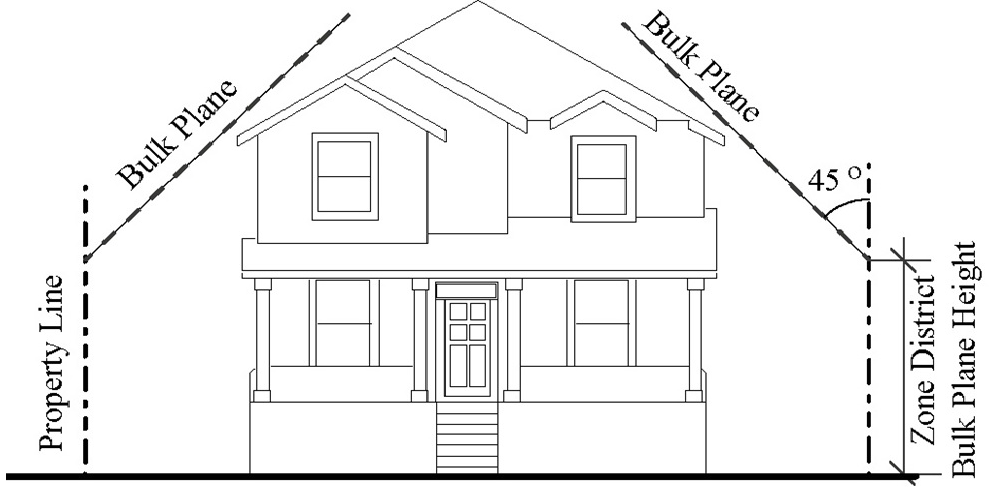
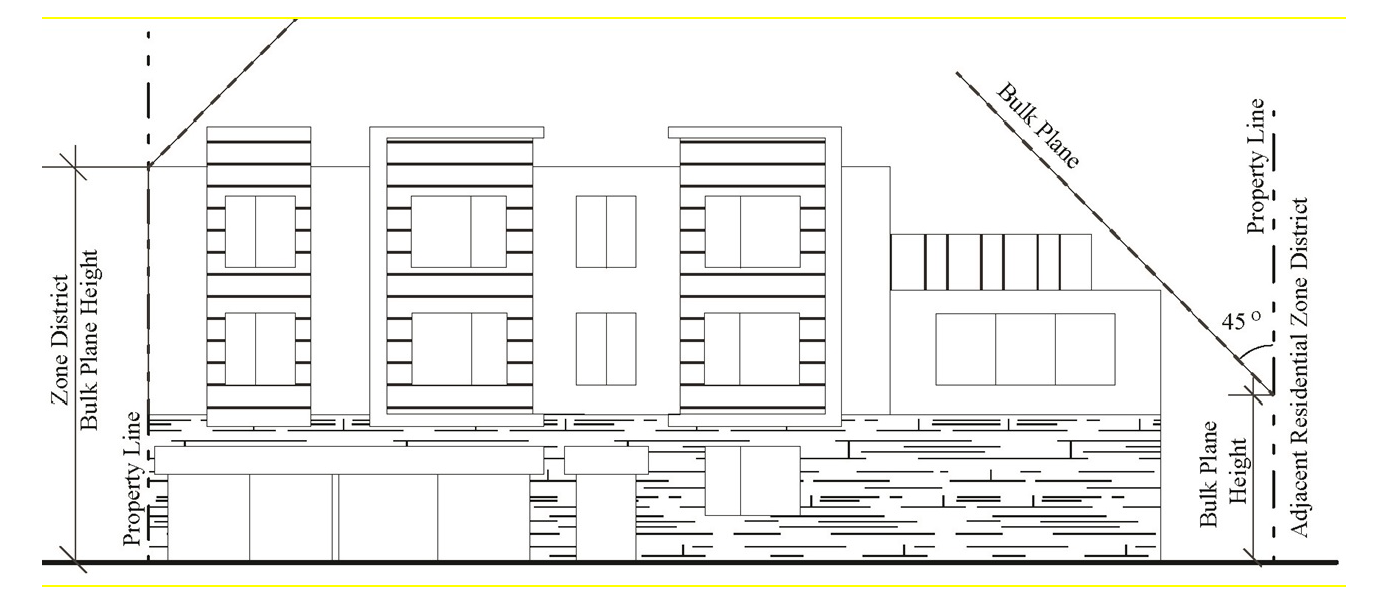
Measurement. The starting height for the bulk plane shall be measured at the height required by the chart below. For all principal structures and structures located wholly or partially within the front or rear yards, the baseline elevation from which the starting height is measured shall be the level of the curb adjacent to the center point of the front lot line; provided, however, that, if the grade of the lot exceeds a three (3) percent change in elevation between the front and rear lot lines, then such baseline elevation shall be the average of the existing front and rear lot line elevations. For accessory structures located entirely within the back yard, the baseline elevation from which the starting height is measured shall be the center point of the rear property line. The bulk plane shall start at each property line and extend to the center of the property at a forty-five (45) degree angle.
_____
_____
(e)
Encroachments. The following building elements may encroach beyond the bulk plane as specified.
(1)
Roof overhangs or eaves, provided that they do not extend more than thirty (30) inches horizontally beyond the bulk plane.
(2)
A rooftop solar system that is flush-mounted to the roof or mounted at up to a fifteen-degree angle measured from a horizontal plan, provided that the roof structure supporting the solar system does not extend beyond the bulk plane.
(3)
Dormers, provided that:
a.
The highest point of any dormer is at or below the height of the primary roof ridge.
b.
The portion of any dormer that extends beyond the bulk plane has a maximum width of twelve (12) feet including any roof overhang.
c.
The dormer does not extend more than six (6) feet vertically beyond the bulk plane.
d.
The combined width of all dormers does not exceed fifty percent (50%) of the length of the roof on which they are located.
e.
The space between dormers is not less than six (6) feet.
f.
The dormer is inset at least three (3) feet from the nearest building wall.
(4)
Chimneys, provided that:
a.
The highest point of any chimney does not extend more than five (5) feet vertically beyond the bulk plane.
b.
The portion of any chimney that extends beyond the bulk plane has a maximum width of six (6) feet including any roof overhang.
(Prior code 23-63; Ord. 12-08 §1, 2008; Ord. 09-14 §9, 2014; Ord. 2015-06 §2, 2015; Ord. 2016-13 §1, 2016; Ord. 2016-19 §1, 2016; Ord. 2017-05 §5, 2017; Ord. 2018-14 §1, 2018)
Sec. 16-3-140. - Determination of unlisted uses.
The City Manager has the authority to determine in writing that a use not specifically authorized as permitted or conditional in any particular zone district under this Chapter shall nonetheless be authorized as a permitted or conditional use on the basis of the proposed use being similar to a listed use, compatible in character and impact with other uses in the zone district, consistent with the intent of the district, and which would not be objectionable to nearby properties by reason of odor, dust, fumes, gas, noise, radiation, heat, glare, vibration, traffic generation, parking needs or outdoor storage or use. The City Manager's decision may be appealed to the Board of Adjustment in accordance with Article 24 of this Chapter.
(Ord. 09-14 §9, 2014)
Sec. 16-3-150. - Application of building regulations.
The development of property must comply with all applicable requirements of this Chapter and of the City's Building Regulations, set forth in Chapter 18 of this Code. Compliance with one (1) applicable regulation does not excuse or constitute a defense to the prosecution of a violation of another applicable regulation.
(Ord. 09-14 §9, 2014)
Sec. 16-3-160. - Off-street parking and loading requirements.
In all zoning districts, off-street parking and loading spaces for the use of the occupants, employees and patrons of all buildings, structures and premises erected, altered, used or extended after the effective date of this section shall be provided and maintained as herein prescribed, unless otherwise specifically provided.
(1)
Purpose. The purpose of these parking and loading regulations is to:
a.
Allow flexibility in addressing vehicle parking, loading, and access issues;
b.
Present a menu of strategies to solve parking issues for varying site constraints and conditions throughout the city;
c.
Assure that off-street parking, loading, and access demands associated with development are met without adversely affecting other nearby land uses and surrounding neighborhoods;
d.
Lessen congestion upon the public streets in the city;
e.
Accommodate and encourage multi-modal transportation usage; and
f.
Reduce the visual impact of parking and loading areas from sidewalks, streets, and adjacent residential properties.
(2)
Applicability. This section shall apply only to new development, major changes of use, the alteration of existing uses or structures for which a site development plan is required under Article 16 of Chapter 16, and amendments to existing site development plans and planned unit developments, established after the effectiveness of this section.
a.
Applicability to existing uses.
1.
No existing property, use or structure shall be deemed nonconforming solely because of the lack of off-street parking or loading requirements prescribed in this section.
2.
Off-street parking or loading spaces existing on the effective date of this section that either meet or exceed the off-street parking and loading requirements of this section may be altered so long as the resulting altered parking or loading spaces meet the minimum requirements of this section.
b.
Alteration of existing uses or structures. Unless otherwise expressly stated in this section, the off-street parking and loading standards of this section apply when an existing use or structure is altered in a manner that requires approval of a new or amended site development plan pursuant to Article 16 of Chapter 16, or approval of a new or amended planned unit development pursuant to Article 28 of Chapter 16.
Additional off-street parking and loading spaces shall be required only to serve the expanded and/or altered area, not any area that remains unchanged. Table 1 below sets forth an example for applying this standard:
c.
Major change of use. Except as otherwise provided herein, off-street parking and loading spaces shall be provided in the number required by this section for any change of use that results in a change in the classification of such use under the Schedule of Off-Street Parking, Table 5, set forth below, when such new use requires more than four (4) additional off-street parking spaces. If such change in use does not require a site development plan under Article 16 of Chapter 16, these parking requirements shall be reviewed and imposed as a part of the business license amendment that must be processed for such change in use pursuant to Section 6-1-90.
d.
Planned unit developments. In planned unit developments approved pursuant to Article 28 of Chapter 16, the amount of off-street parking shall be determined on a case-by-case basis as part of the city's consideration of the planned unit development application. However, the Planning Commission and the City Council may use the off-street parking and loading requirements of this section as the starting point for determination of the applicable minimum standards.
e.
Applicability of parking lot design standards to existing uses. Parking lot design standards shall apply to existing uses as follows:
f.
Parking plan required. All plans for the construction of any parking spaces, excluding those for single and two-family dwellings, must be approved by the City Manager and a parking facility building permit issued before construction commences. No such land shall be used for parking until inspected and approved by the City Manager. The plan must contain the following minimum information:
1.
Number, location and size of parking stalls.
2.
Widths of aisles and islands.
3.
Location of landscaping areas and type of landscaping, including size, species, and number as required in subsection (5)e.
4.
Type of surfacing.
5.
Scale and north arrow.
6.
Location of streets, curb cuts and property boundaries.
7.
Traffic directional arrows, signage and markings.
8.
Loading areas.
9.
Drainage provisions.
10.
Location and direction of proposed lighting.
11.
Location, height, and type of walls or fences to be constructed.
g.
Notwithstanding any other provision of this Subsection (2), in determining the number of off-street parking and loading areas required by this Section when all or a portion of property changes use, a credit shall be provided for the number of parking spaces provided by the prior existing use(s) without regard to whether the prior existing uses or structures in which they are located continue; provided, however, that this calculation shall not result in a reduction in the overall number of existing parking spaces on a property.
(3)
Shared parking.
a.
Purpose. The purpose of these shared parking regulations is to provide the option for users near one another that have different peak parking demands or different operating hours to share off-street parking facilities to:
1.
Encourage the efficient use of land and resources;
2.
Reduce development costs while not adversely affecting traffic patterns and creating minimal spillover parking;
3.
Encourage complimentary forms of development; and
4.
Help reduce the amount of land devoted to parking while providing a sufficient number of spaces.
b.
Shared parking standards.
1.
Calculation. The number of shared parking spaces for two (2) or more distinguishable land uses shall be determined by using the following procedure:
i.
Calculate the number of parking spaces required for each individual land use as set forth in Table 5 (Schedule of Off-Street Parking).
ii.
Multiply the required number of parking spaces from Step 1 by the percentages in each of the six (6) time periods in Table 4.
iii.
For each time period, add the number of spaces required for all applicable land uses to obtain a total for each of the six (6) time periods.
iv.
Select the time period with the highest total parking requirement and use that total as the shared parking allowance.
2.
Shared parking procedure.
i.
Mixed occupancy on single parcel or building. In the case of mixed uses on a single parcel or within a single building, the City Manager may approve a shared use of parking in accordance with Table 4, (Shared Parking Matrix). In the event one (1) or more use within such a mixed-use parcel or building changes in such a manner as to increase the total number of required shared parking spaces for the parcel or building, the new use(s) must provide all additional required parking spaces either on or off-site.
ii.
Off lot shared parking.
(A)
Shared parking agreement. In the case of off lot shared parking where the off lot site is owned by others, a written agreement between the city, the owner who shall provide the additional parking, and the owner of the property seeking the parking shall be executed. Said agreement shall be recorded as a deed restriction and shall specify the number and location of the parking spaces. Approval of said agreement by the city shall consider the impact of the parking on adjacent or nearby residential properties. Said agreement may be terminated only if adequate onsite or offsite parking space is provided through other means as approved by the City Manager. The agreement shall be recorded with the Jefferson County Clerk and Recorder's Office and may be terminated only by the execution of a release of the agreement by all three (3) parties or their heirs, successors or assigns, or as otherwise authorized by law.
(B)
Location of off lot shared parking. Off-lot parking may be used provided said parking area is within four hundred fifty (450) feet of the nearest point on the structure or use for which the parking is intended to serve and the off-lot parking is a permitted use as listed in the Table of Uses for the zone district in which the off-lot parking will be located.
3.
Off lot shared parking pedestrian access. All parking spaces for any off lot shared parking shall have direct pedestrian access to the main entry of the building or use they are intended to serve as determined by the City Manager. Shared parking that is located across an arterial street shall be accessible to pedestrians using an existing traffic signal which includes a pedestrian crossing phase to cross the arterial street. The total walking distance from the main entry of the building to the shared parking, by way of the traffic signal crossing of the street, shall not exceed four hundred fifty (450) feet.
4.
Miscellaneous shared parking provisions. The total requirements for off-street parking spaces may be utilized as the sum of the requirements for each of the various uses computed separately.
i.
Off-street parking spaces for one (1) use shall not be construed as providing required parking for any other use except as provided for under planned developments or under a shared parking arrangement as approved by the City Manager in accordance with this subsection.
ii.
In no instance may required handicapped accessible parking spaces be provided off lot as part of a shared parking agreement.
iii.
In no instance may on-street parking be utilized as part of a shared parking agreement.
(4)
Parking reductions.
a.
Applications for parking reduction. Upon application, the City Manager may grant a parking reduction not to exceed thirty (30) percent of the required number of vehicular parking spaces without a variance process. Such parking reduction application shall describe the unique facts and circumstances of the particular property, development and/or use that justify a reduction in parking requirements. By way of illustration and not of limitation, such facts and circumstances may include unique physical characteristics of the site, existing and immutable physical constraints of the site and adjacent land uses, the internal capture of customers visiting multiple establishments on one (1) trip in a multiple use development, the provision of bicycle and motorcycle parking spaces, shuttle service, valet service and transportation demand management (TDM) techniques to be implemented by the user, such as employee bus passes, car pool incentives or off-site employee parking arrangements, .
b.
Parking reduction criteria. Parking reductions may only be granted by the City Manager upon finding that the proposed reduction:
1.
Will create minimal spillover parking onto adjacent property or public rights-of-way;
2.
Will not adversely affect traffic circulation patterns on or off site;
3.
Will promote quality urban design equally or better than a plan that strictly complies with the standards in this section; and
4.
If based upon the internal capture of customers visiting multiple establishments on one (1) trip in a multiple use development, have been calculated based upon the Institute of Transportation Engineer's Multi-Use Trip Generation Calculation Worksheet per the Trip Generation Handbook.
The City Manager may require a traffic generation study prepared by a professional engineer in order to determine that the criteria in above have been met.
c.
The City Manager shall notify the Planning Commission and City Council of all parking reduction applications received under this subsection (4) and the disposition thereof in accordance with a policy promulgated by the City Manager.
d.
Parking reductions by variance. An application for a parking reduction beyond those authorized by subsection (4)a. shall be processed and considered by the Board of Adjustment in accordance with Section 16-24-60.
(5)
Standards.
a.
General provisions.
1.
Planned unit developments. In planned unit developments, parking shall be considered with regard to the standards set forth in this section for the various use requirements. Where it is desired to share the parking spaces between two (2) or more uses, the regulations set forth in subsection (3) (Shared parking) shall be used to determine the appropriate shared parking arrangements.
2.
Mixed occupancy and collective parking. In the case of mixed uses on a single parcel or within a single building, or of collective parking for several buildings or uses on two (2) or more parcels, the total requirements for off-street parking spaces shall be the sum of the requirements for each of the various uses computed separately. Off-street parking spaces for one (1) use shall not be construed as providing required parking for any other use except as provided for under an approved planned unit development or as approved shared parking pursuant to subsection (3).
3.
Location of parking areas.
i.
Off-street parking spaces for any use shall be provided and located on the same lot as the use or uses they are intended to serve except as provided for herein.
ii.
If sufficient parking spaces cannot be accommodated on the lot for any use, off-lot parking may be used in accordance with subsection (3) (Shared parking).
iii.
Multifamily parking lots. Parking for multifamily development shall not be placed within the minimum front yard setback. Where parking is to be placed within a side or rear yard which is adjacent to a public street, a landscape buffer of at least ten (10) feet is required.
b.
Summary table.
* Passenger loading area(s) required.
** Truck loading area(s) required.
Table Notes:
(1)
When student is used as a unit of measure, the requirement shall be based upon the maximum designed enrollment capacity.
(2)
For operations which contain more than one (1) use category (e.g. motel/restaurant), the City Manager shall require parking computed by using the "mixed occupancy" provisions in subsection (5)a.2.; however, the City Manager may allow for up to fifty percent (50%) reductions in parking for secondary uses where it is clearly shown that the maximum parking demand peaks will not coincide.
c.
Uses not specified. In the case of a use not specifically mentioned, the requirements for off-street parking spaces for a similar use shall be determined by the City Manager based upon comparison to similar uses. their decision may be appealed to the Board of Adjustment.
d.
Construction standards. All areas used for wheeled traffic for access, parking and sales or storage shall be properly graded. Notwithstanding any other provision of this Code to the contrary, all off-street access and parking areas associated with a non-residential use shall be surfaced with concrete, asphalt or pavers. All off-street access and parking areas associated with a residential use shall meet the construction standards set forth in Section 16-22-80.
e.
Parking area landscaping. Parking area landscaping shall be provided as set forth below. Landscaping in off street parking areas may count towards the required total area of landscaping required under any other provision of this Chapter 16 or [of] Chapter 17.
1.
Landscape buffering for parking and loading areas.
i.
Adjacent to R-1 and R-2 zone districts. Whenever a parking lot or loading area boundary adjoins property zoned R-1 or R-2, a landscape buffer of six (6) feet from said lot or boundary shall be provided. Within the six (6) foot landscape buffer, a view-obscuring fence, decorative wall or landscaped hedge with a natural height of forty-two (42) inches shall be provided; provided, however, that the height of such fence, wall or hedge may be lowered, in full or in part, to comply with any other applicable provision of this Code limiting such height, such as maximum fence height restrictions and sight-triangle maintenance requirements.
In addition, grass or other acceptable groundcover or trees and/or shrubs shall be planted within the landscape buffer areas as approved by the City Manager through a landscape plan.
ii.
Between public right-of-way and structure(s). When a parking lot or loading area is placed between the public right-of-way and the structure(s) for which it is provided, a screening of the parking area shall be established between the right-of-way and the parking area. This view-obscuring screen shall be composed of live plantings, berms, fences or walls, or a combination thereof. The height of the screening shall be subject to all other applicable requirements of this Code.
f.
Parking area lighting.
1.
Any lighting used to illuminate any off-street parking area shall not have a negative impact on the surrounding area.
2.
The light source shall be indirect, diffused or shielded type fixtures, installed to reduce glare and the consequent interference with adjacent streets and adjoining residential properties.
3.
Fixtures shall be attached to a building or mounted on poles.
g.
Off-street loading.
1.
Off-street loading areas shall be provided according to the following schedule for commercial uses. All such areas shall be located so that no vehicle loading or unloading merchandise shall be parked in front of any property or block traffic in any street or public right-of-way including alleys, and must meet the following:
2.
Off-street loading areas must have a minimum dimension of fifteen (15) by thirty (30) feet. Where loading areas are covered; a minimum height of fifteen (15) feet is required. Where semi-trailer trucks typically unload, the minimum loading area size shall be fifteen (15) feet by sixty (60) feet by fifteen (15) feet high. No portion of a loading vehicle may protrude into a public right-of-way; and
3.
Off-street loading areas shall be required for each commercial use according to the following table, unless it can be demonstrated to the satisfaction of the City that sufficient loading is available from an adjacent alley or other suitable area, which alley or area is shown not to impede vehicular traffic or pedestrian use when used for loading purposes:
h.
Handicapped parking. For all uses other than one- and two-family dwellings, parking shall be provided for the handicapped at the minimum rate consistent with the following table. The minimum width of an accessible parking space shall be eight and one-half (8½) feet with an adjacent accessible aisle with a minimum width of five (5) feet. Two (2) accessible parking spaces may share a common aisle. Said spaces shall have a minimum access aisle length of twenty (20) feet.
One (1) in every six (6) accessible spaces, but not less than one (1), shall be designated "van accessible" and shall be a minimum of eight (8) feet in width and shall be served by an access aisle a minimum of eight (8) feet in width. "Van accessible" spaces may also be a minimum of eleven (11) feet in width with a minimum access aisle width of five (5) feet in accordance with ANSI 117.1 — Accessible and Usable Buildings and Facilities.
1.
Signage; location; etc. Each handicapped space shall be marked with a freestanding sign containing the International Symbol of Accessibility and shall be a minimum of sixty (60) inches above the floor of the parking space, measured to the bottom of the sign. Signage for van accessible spaces shall contain the designation "van accessible". The International Symbol of Accessibility shall also be painted on the pavement. Said parking space shall be located as near to the entrance of the use as practically possible and shall be so designed (unless it is impossible to do so) that circulation between the vehicle and the building entrance shall not involve crossing any area used for vehicular circulation. The total number of spaces provided for the handicapped shall be included in the total number of parking spaces otherwise required by this section.
i.
Drive-thru and vehicle stacking requirements. Stacking spaces shall be a minimum of eight and one-half (8½) feet wide and eighteen (18) feet long and shall not double as a circulation driveway, maneuvering area or off-street parking space. Stacking spaces shall be required as set forth in Table 8.
j.
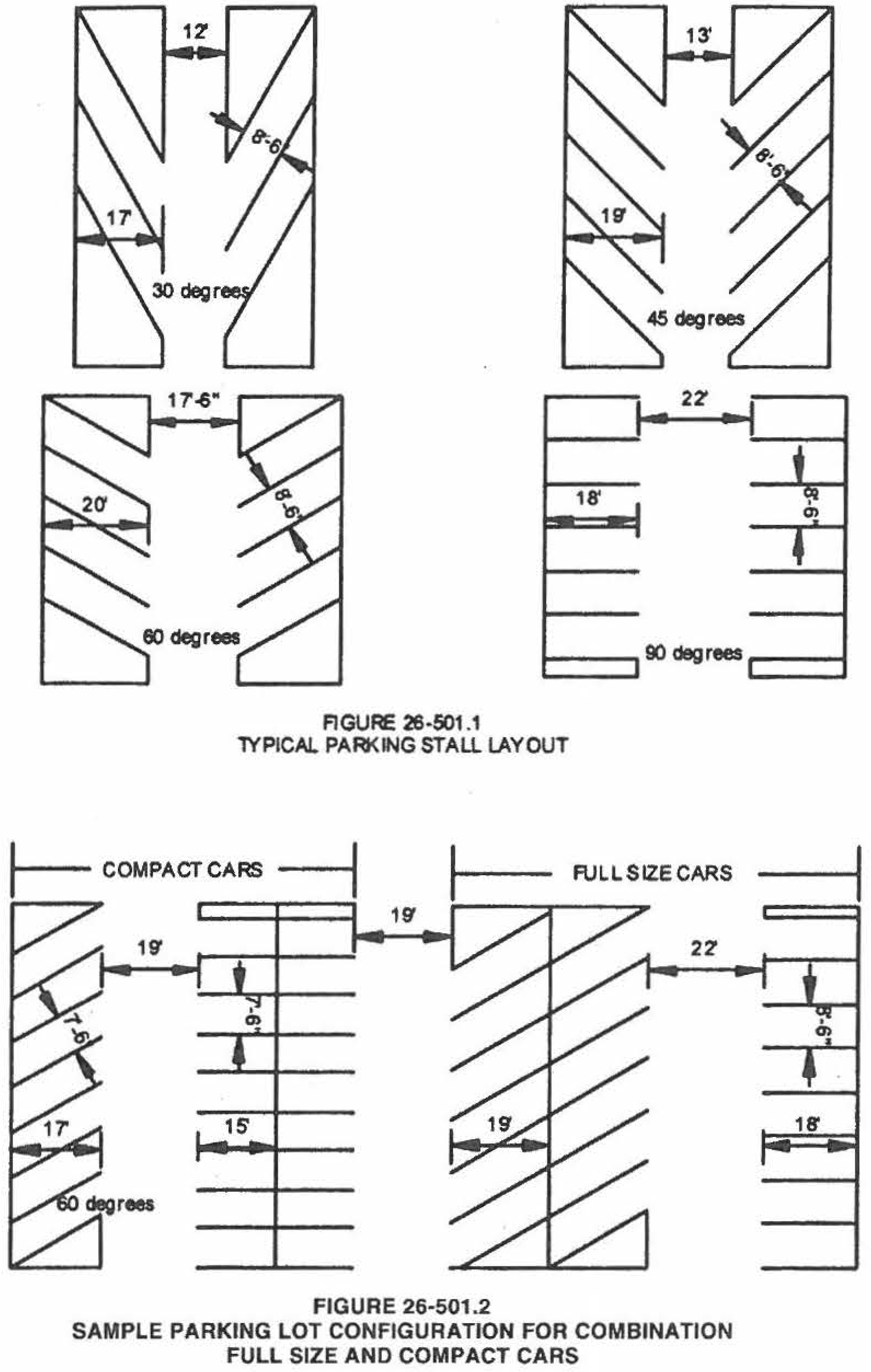
Parking space and aisle dimensions. The following table establishes the minimum parking lot space and aisle dimensions for full-size and compact automobiles.
Minimum Parking Standards
The following diagram illustrates typical parking stall layout for full-sized and compact cars in accordance with the above standards:
k.
Miscellaneous.
1.
Auxiliary storage of vehicles. The auxiliary storage of motorized or non-motorized vehicles cannot occur within six (6) feet of the front property line. Any storage area must be hard surfaced and must be built so that the material used as to the parking surface stays contained within the parking pad (with the use of concrete curbs, railroad ties, etc.).
2.
Usable parking spaces. Any parking stall which is unusable due to maneuverability difficulties or does not have clear access into and out of its parking space shall not be considered in the count of the total number of available parking spaces on the property. Double-loaded spaces (parking where one (1) vehicle blocks another) are considered unusable, except when serving one- and two-family dwellings.
3.
Back-out parking. Except for single- and two-family dwellings, all parking areas shall be designed so that vehicles exiting from the parking area will not be required to back out across any public sidewalk or public right-of-way, unless an exception has been granted by the City Manager.
4.
One-way traffic flow. Parking which is designed for one-way traffic shall be clearly indicated as such by the use of a sign or arrow designating the direction of traffic flow and by the words "one-way."
5.
Marking of parking spaces. Parking spaces shall be marked and maintained on the pavement and any other directional markings/signs shall be installed as required by the city to ensure the approved use of space, direction of traffic flow and general safety conform to the approved parking plan.
6.
Fractions. When units of measurements determining number of required parking spaces result in the requirement of a fractional space, any fraction shall require one (1) parking space.
7.
Compact car parking. In parking lots with thirty (30) spaces or more, twenty (20) percent of the required parking spaces may be designated for compact cars; provided, however, that compact car parking area or spaces shall be clearly labeled or otherwise distinguished from full-sized parking areas or spaces.
8.
Bumper, curb and wheel stops. To ensure the proper maintenance of these facilities, parking areas shall be designed so that a parked vehicle does not overhang the public right-of-way, public sidewalk, or adjacent property. A permanent curb, bumper, wheel stop or similar device shall be installed which shall be adequate to protect the right-of-way, sidewalk, or adjacent property from vehicular overhang and to protect any structure from vehicular damage. If such protection is provided by means of a method designed to stop the wheel rather than the bumper of the vehicle, the stopping edge shall be placed no closer than two (2) feet from the edges of the public right-of-way, sidewalk or building. A parked vehicle may overhang a landscape area up to two (2) feet. Such landscaped area must be low maintenance and may be included as a part of the length of the parking stall.
9.
Restrictions on the use of nonresidential parking areas. No parking area shall be used for the sale, storage, repair of, dismantling or servicing of any vehicles, equipment, materials or supplies. This shall not apply to vehicles on sales lots and does not preclude emergency repairs to a motor vehicle.
10.
Use and maintenance of parking area. For all uses, including single- and two-family dwelling uses, parking of vehicles shall be limited to those areas specifically developed for parking and shall not be permitted within landscaped areas, designated fire lanes, loading zones, or other areas not designed and developed for parking. All parking and drive areas shall be maintained so as to prevent unsafe conditions. The provisions of this subsection (5)k.10. shall apply to both existing and future conditions.
11.
Variances to standards. Variances to parking requirements shall be processed pursuant to Section 16-24-60, unless otherwise specified in this section.
(6)
Vehicular access. Vehicular access to any property shall be controlled in such a manner as to protect the traffic-carrying capacity of the street upon which the property abuts, as well as the safety and security of adjacent properties.
a.
Curb cut restrictions. For new single- and two-family dwellings, vehicular access to parking shall be from the alley adjacent to the rear property line, where such an alley exists or is to be provided, regardless of the existence of one (1) or more curb cuts along any other property line upon which the dwelling is located. Any such existing curb cuts must be eliminated and no new curb cuts shall be permitted in association with such uses.
b.
Spacing of vehicle access.
1.
For all uses other than single- and two-family dwellings, no vehicle entrances or exits may be closer than twenty-five (25) feet to any parallel property line except when used for joint access for two (2) or more lots.
2.
For all uses other than single- and two-family dwellings, vehicle entrances or exits on the same lot shall be spaced at not less than one-hundred (100) foot intervals. The one-hundred (100) foot spacing shall be measured from the interior edge of both access points.
3.
For all uses, corner lots shall have no vehicular entrances or exits located closer than twenty-five (25) feet from any two (2) intersecting rights-of-way, except when one (1) or both of such rights-of-way are arterial or major collector streets, such distance shall be fifty (50) feet.
4.
The City Manager may approve a modification or waiver to the vehicle access standards and requirements stated in this subsection (6)b. based upon consideration of traffic characteristics, both on and off of the site, with the primary purpose of preserving public safety.
c.
Curb cut widths.
1.
Multi-family residential uses. For all multi-family residential uses, curb cuts for property access shall be not less than ten (10) feet and not more than twenty-four (24) feet in width.
2.
Commercial and industrial zone districts. Curb cuts in commercial and industrial districts shall not be more than thirty-five (35) feet in width when serving an individual property and shall not in any instance be less than twenty (20) feet.
3.
Joint curb cuts. A joint curb cut, one (1) which serves more than one (1) property, may not exceed forty-five (45) feet in width.
4.
Modification or waiver. The City Manager may approve a modification or waiver to the vehicle access standards and requirements stated in this subsection (6)c. based upon consideration of traffic characteristics, both on and off of the site, with the primary purpose of preserving public safety.
(Ord. 2016-05 §1, 2016; Ord. 2019-07 §§2, 3, 2019; Ord. 2020-20 §7, 2020; Ord. 2025-02 §1, 2025; Ord. 2025-16 §§4, 5, 2025)

