


El Centro City Zoning Code
DIVISION 10
MIXED-USE 2 OVERLAY ZONE
Sec. 29-96. - Purpose and intent.
MU2 mixed-use 2 overlay zone. This overlay zone is applied on parcels within the more intensive general commercial and tourist commercial zones, as depicted on the adopted zoning map. The intent of the overlay zone is to provide for a mix of missing middle housing, multi-family residential, and non-commercial uses to support an active, community- or regional-serving serving corridor, area, or activity center. This overlay zone includes the development of high-medium to higher density apartment, condominium, townhouse, duplex and triplex dwellings with a minimum density of twenty-one (21) dwelling units per acre and a maximum density of thirty (30) dwelling units per net acre, on lots not less than seven thousand two hundred (7,200) square feet in net area. A maximum density of thirty-eight (38) dwelling units per net acre may be approved for senior-only projects or a senior portion of a project in compliance with article IV, division 4, density bonus. Because mixed-use development includes both residential and nonresidential uses, the overlay zone includes both density and intensity standards.
Overall, the MU2 overlay zone intends to:
(1)
Implement the mixed-use goals and policies of the general plan, by creating or reactivating vital areas for living, working, shopping, and recreating.
(2)
Ensure that mixed-use development is of high quality and contains a unified development plan with thoughtful integration of complementary residential uses.
(3)
Provide a variety of housing types and densities to support the diverse population and local workforce.
(4)
Create a lively setting for more intense commercial activities that promotes a mix of local and regional serving businesses.
(5)
Enrich opportunities for amenity spaces, artwork and community involvement.
(6)
Support walkability within an individual project and throughout the mixed-use area, with an emphasis on facilitating pedestrian, bicycling, and transit connections.
(7)
Enhance economic development, community identity and property values within El Centro.
(8)
Provide opportunity to further activate and support the El Centro mall area by enabling the development of housing in close proximity to an established retail area.
(Ord. No. 24-03, § 2, 9-17-24)
Sec. 29-97. - Mixed-use 2 overlay zone use regulations.
Development and redevelopment in the mixed-use 2 overlay zone shall be pursuant to the underlying (CG general commercial or CT tourist commercial) zone use regulations identified in section 29-61.
Mixed-use developments and stand-alone residential developments shall be permitted uses, only if the project fully complies with all development and design standards of this division.
(Ord. No. 24-03, § 2, 9-17-24)
Sec. 29-98. - Mixed-use 2 overlay zone development standards.
The following minimum property development standards identified in table 29-98.1 shall apply to all land and buildings in the mixed-use overlay zones, except that any lot shown on an official subdivision map duly approved and recorded, or any lot for which a bona fide deed had been duly recorded prior to the effective date of this chapter may be used as a building site. See also article III of this chapter for exceptions to, or clarification of, these regulations.
Additionally, before any building, structure, or use of land outside of a building or structure, is established in a mixed-use 2 overlay zone, a site plan shall be submitted to and approved by the community development director, pursuant to article V, division 3 of this chapter. If specified by this chapter, such site plan review shall be conducted by the planning commission and/or city council.
Table 29-98.1 Mixed-use Overlay Zones Development Standards
(Ord. No. 24-03, § 2, 9-17-24)
Sec. 29-99. - Mixed-use 2 overlay zone design standards.
(a)
Purpose. These design standards are intended to assist the project applicant in understanding the city's requirements for high quality development. These mandatory standards complement the development regulations contained in this division by providing good examples of potential design solutions and by providing design interpretations of the various mandatory regulations. These standards ensure the highest level of design quality while at the same time providing the flexibility necessary to encourage creativity on the part of project designers.
(b)
Primary community amenity spaces in residential buildings.
(1)
The primary community amenity spaces of a residential building or complex (such as lobbies, gyms, leasing offices, shared work spaces, clubhouses, community rooms, recreation rooms, and lounges) shall be located directly adjacent or within one hundred (100) feet distance of a public way, private drive, primary building entrance, and/or primary pedestrian path.
(c)
Block connectivity.
(1)
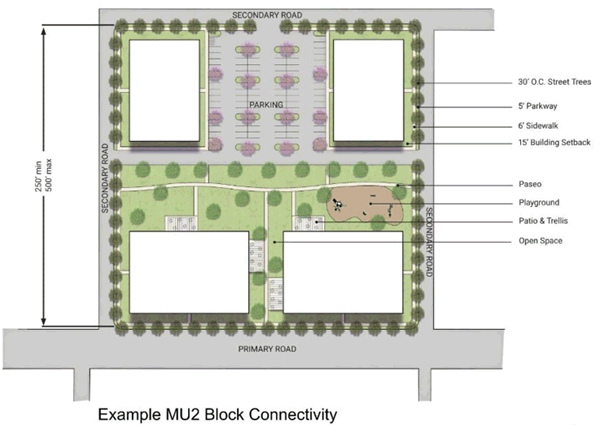
Orient development in ways that create compact blocks and lots. A 'block' is defined as an area of development that is delineated on all sides by any of the following elements: public streets, paseos, trails, parks, community facilities, and/or private internal streets. Except where site-specific circumstances preclude it, blocks within the MU-2 overlay zone shall have a maximum of perimeter of two thousand (2,000) feet.
(2)
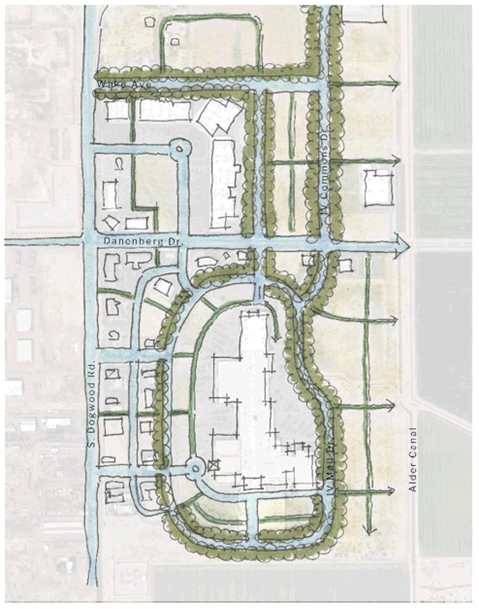
A minimum of one (1) paseo and one (1) bicycle access way into the development shall be provided for approximately every five (5) acres of developable area.
(3)
Private drives shall connect public rights-of-way to multiple locations within a development. Where private drives are provided, they shall comply with the following:
a.
Private drives shall be designed to reduce conflicts between vehicles and pedestrian and bicycle circulation.
b.
Sidewalks shall be provided along both sides of private drives.
c.
The alignment of private drives shall be coordinated and connected to the public right-of-way, emphasizing interconnected streets and the ability to reach local destinations through multiple routes.
d.
The number of trees required for each private drive frontage shall be calculated at the average rate of one (1) twenty-four (24)-inch box canopy tree for every forty (40) feet of private drive frontage. Tree spacing may be varied to accommodate site conditions or design considerations.
(4)
New streets or private roads shall be provided throughout the development area in order to create an orderly network of streets, connections and developable parcels. New streets shall be provided so that minimum block sizes are two hundred fifty (250) feet, but no block length shall exceed five hundred (500) feet in length.
(5)
The pedestrian circulation of MU-2 developments shall include three (3) or more of the following features:
a.
Artwork.
b.
Open air cafe; with food service.
c.
Covered arcade, colonnade, or veranda.
d.
Recessed building entrance with a minimum recess of ten (10) feet.
e.
Widened sidewalk with a minimum width of fifteen (15) feet.
f.
Pedestrian through block connection (paseo) with a minimum width of ten (10) feet.
g.
Plaza with a minimum width of forty (40) feet and a minimum depth of twenty (20) feet.
(d)
Building siting, access, orientation, and shade.
(1)
Developments shall comply with design standards under section 29-91(b).
(e)
Building frontage design.
(1)
Developments shall comply with design standards under section 29-91(d).
(f)
Building scale, massing, and articulation.
(1)
Developments shall comply with design standards under section 29-91(e).
(g)
Circulation and parking.
(1)
Developments shall comply with design standards under section 29-91(f).
(h)
Open spaces and public access.
(1)
Developments shall comply with design standards under section 29-91(g).
(i)
Buffers and screening.
(1)
Developments shall comply with design standards under section 29-91(h).
(j)
Buffers and screening from existing commercial service areas.
(1)
New residential buildings abutting or facing the rear and service side of commercial shopping centers and other "big box" stores shall be set back from the right-of-way with a twenty (20) foot-wide buffer zone.
(2)
The twenty (20) foot-wide buffer zone shall include open space and landscaped areas and slopes, including the following: trellises, garden walls and fences not exceeding six (6) feet in height, retaining walls, lighting, signage, and pedestrian circulation elements.
(3)
The minimum fifteen (15) foot-wide landscaped area (trees, shrubs and groundcover) shall be provided in the twenty (20) foot-wide buffer.
(4)
New residential buildings shall be oriented with the long dimension of the building perpendicular to existing commercial centers.
(k)
Roof treatments.
(1)
Developments shall comply with design standards under section 29-91(i).
(l)
Building materials, finishes, and colors.
(1)
Developments shall comply with design standards under section 29-91(j).
(m)
Street trees and streetscape improvements.
(1)
Street trees shall be placed in a continuous parkway. Provide a forty (40)square foot minimum area for all trees to allow for adequate root zone that is clear of anything with a footing that could cause potential damage to trees or roots. Landscaping and irrigation, decorative boulders, and small signage may be allowed in this area.
(2)
Street tree species to be consistent the entire stretch of each street segment.
(3)
Ground plane treatment at the tree cutouts or parkway shall include a combination of understory planting, rock mulch and boulders. Turf shall not be placed within parkway areas. (See table 29-142.2 and table 29-142.3 for groundcover and shrub lists.)
(4)
All developments are encouraged to use medians and parkways for stormwater collection and treatment in order to make a landscape feature out of the stormwater system. Concrete lined channels shall not be used for stormwater treatment areas.
(5)
Developments shall comply with design standards under section 29-91(k)(4)and(5).
(n)
Refuse and recycling.
(1)
Developments shall comply with design standards under section 29-91(l).
(o)
Drive-through business.
(1)
Developments shall comply with design standards under section 29-91(m).
(p)
Lighting.
(1)
Developments shall comply with design standards under section 29-91(n).
(Ord. No. 24-03, § 2, 9-17-24)