


El Centro City Zoning Code
DIVISION 7
SINGLE-FAMILY NEIGHBORHOOD OVERLAY ZONE
Sec. 29-84. - Purpose and intent.
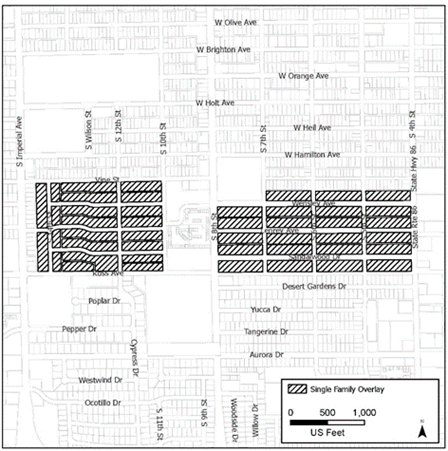
SF single-family neighborhood overlay zone. This zone is applied on parcels within the existing single-family neighborhoods shown on figure 29-84.1. These older residential neighborhoods were developed in the early part of the 1920s and represent a historic character that the city wishes to preserve. The intent of the overlay zone is to protect these existing neighborhoods from development that is out of character, scale, and architectural style with the existing development. The single-family neighborhood overlay zone is intended to implement the single-family neighborhood overlay general plan land use designation.
Figure 29-84.1. Single-Family Overlay Zone
(Ord. No. 24-03, § 2, 9-17-24)
Sec. 29-85. - Single-family neighborhood overlay zone use regulations.
Development and redevelopment in the single-family neighborhood overlay zone shall be pursuant to the R1 single-family residential zone use regulations identified in section 29-53.
(Ord. No. 24-03, § 2, 9-17-24)
Sec. 29-86. - Single-family neighborhood overlay zone development standards.
Development and redevelopment in the single-family neighborhood overlay zone shall be pursuant to the R1 single-family residential zone development standards identified in section 29-54, except the setback regulations in section 29-87(b)(1) and (2) below shall also apply.
(Ord. No. 24-03, § 2, 9-17-24)
Sec. 29-87. - Single-family neighborhood overlay zone design standards.
(a)
Purpose. In addition to the general design standards identified in section 29-55, new development and redevelopment activities in the single-family neighborhood overlay zone, must also be consistent with the design standards of this section. These standards are intended to preserve single-family neighborhoods and avoid new development or redevelopment that would conflict with the nature of existing development in the single-family neighborhood overlay zone.
(b)
Site planning and building orientation.
(1)
For vacant sites, new development shall maintain the average existing setbacks (front, side, and rear) on the block as determined by the community development director.
(2)
For redevelopment of parcels developed as of the effective date of this zoning ordinance, the setbacks (front, side, and rear) of the existing primary residence and any accessory structures shall be maintained.
(3)
To the extent residential windows face the windows of an adjacent unit, the windows shall be offset to maximize privacy. Windows, balconies or similar openings shall be oriented to minimize direct line-of-sight into adjacent units within the development. To provide privacy for adjacent residential units, windows on the second and higher floors of buildings, which directly face or abut residential zones, may be designed either as translucent, louvered, be offset from existing residential windows, or utilize another solution to achieve privacy for the adjacent residential units.
(c)
Mass and scale.
(1)
Building facades and garages that face existing residential units shall be designed to be compatible with the setbacks and scale of the existing development.
(2)
The mass and scale of a new development shall be compatible with neighboring development and not overwhelm them with disproportionate size or a design that is out of character.
(3)
Building scale shall be reduced through the proper use of window patterns, structural bays, roof overhangs, awnings, moldings, fixtures and other details that promote a "human" scale.
(d)
Architecture. New development and redevelopment shall be constructed in a style (1920s bungalows) similar and complementary to existing development on-site and/or within the same block, as appropriate.
(e)
Landscaping. Landscaping shall be in scale with the proposed development and of similar size at maturity as surrounding landscaped developments.
(Ord. No. 24-03, § 2, 9-17-24)