


El Centro City Zoning Code
DIVISION 8
MIXED-USE ZONE
Sec. 29-88. - Purpose and intent.
Mixed-use zones providing a range of medium to high residential dwelling unit densities, a variety of housing types, and a mix of pedestrian-oriented commercial uses are hereby established to achieve the following purposes.
MU1 mixed-use 1 zone. This zone is intended to provide for a mix of multi-family residential, live/work and smaller scale, pedestrian-oriented commercial uses (including retail, artisan manufacturing, grocery stores, pharmacies, financial institutions, cafes and restaurants, offices, personal services, dry cleaners/laundromats) and similar uses deemed by the director as compatible with residential neighborhoods. This zone includes the development of medium high density apartment, condominium, townhouse, duplex, and triplex dwellings with a minimum density of twelve (12) dwelling units per net acre and a maximum density of twenty-five (25) dwelling units per net acre, on lots not less than seven thousand two hundred (7,200) square feet in net area. A maximum density of thirty-two (32) dwelling units per net acre may be approved for senior-only projects or a senior portion of a project in compliance with article IV, division 4, density bonus. Because mixed-use development includes both residential and nonresidential uses, the zone includes both density and intensity standards.
Overall, the MU1 zone intends to:
(1)
Implement the mixed-use goals and policies of the general plan, by creating or reactivating vital areas for living, working, shopping, and recreating.
(2)
Ensure that mixed-use development is of high quality and contains a functionally integrated development plan.
(3)
Provide a variety of housing types and densities to support the diverse population and local workforce.
(4)
Create a more vibrant, comfortable, and welcoming environment that fosters a mix of businesses and entrepreneurs to serve residents and visitors.
(5)
Enrich opportunities for amenity spaces and artwork.
(6)
Promote walkability within an individual project and throughout the mixed-use corridor area and support increased bicycling and transit use.
(7)
Increase awareness of design considerations among the citizens of El Centro.
(8)
Upgrade the visual appearance of El Centro's primary vehicular corridors.
(9)
Enhance community identity and property values within El Centro.
(Ord. No. 24-03, § 2, 9-17-24)
Sec. 29-89. - Mixed-use zones use regulations.
The uses identified in table 29-89.1 shall be permitted uses where the symbol "P" appears. Where the symbol "C" appears, the use requires a conditional use permit pursuant to article V, division 6 of this chapter. The symbol "X" indicates that the use is prohibited.
Mixed-use developments, artisan lofts, live/work, and stand-alone residential developments shall be permitted uses, only if the project fully complies with all development and design standards of this division.
Within the MU1 zone, only the following occupations are intended for the commercial/office component of the live/work use: accountants; architects; artists and artisans; attorneys; computer software and multimedia related professionals; consultants; engineers; fashion, graphic, interior and other designers; insurance; medical offices; real estate and travel agents; photographers, and other occupations deemed by the director to be similar and compatible with residential neighborhoods.
Table 29-89.1 Mixed-use Zones Use Regulations
1 Meeting the requirements of California Government Code 65662.
2 Meeting the requirements of California Government Code 65651.
(Ord. No. 24-03, § 2, 9-17-24)
Sec. 29-90. - Mixed-use zones property development standards.
The following minimum property development standards identified in table 29-90.1 shall apply to all land and buildings in the mixed-use zones, except that any lot shown on an official subdivision map duly approved and recorded, or any lot for which a bona fide deed had been duly recorded prior to the effective date of this chapter may be used as a building site. See also article III of this chapter for exceptions to, or clarification of, these regulations.
Additionally, before any building, structure, or use of land outside of a building or structure, is established in a mixed-use zone, a site plan shall be submitted to and approved by the community development director, pursuant to article V, division 4 of this chapter. If specified by this chapter, such site plan review shall be conducted by the planning commission and/or city council.
Table 29-90.1 Mixed-use Zones Development Standards
(Ord. No. 24-03, § 2, 9-17-24)
Sec. 29-91. - Mixed-use zones design standards.
(a)
Purpose. These design standards are intended to assist the project applicant in understanding the city's requirements for high quality development. These mandatory standards complement the development regulations contained in this division by providing good examples of potential design solutions and by providing design interpretations of the various mandatory regulations. These standards ensure the highest level of design quality while at the same time providing the flexibility necessary to encourage creativity on the part of project designers.
(b)
Building siting, access, orientation, and shade.
(1)
The whole project site shall contain a functionally integrated development plan to provide order, compatibility, and an appropriate mix of uses.
(2)
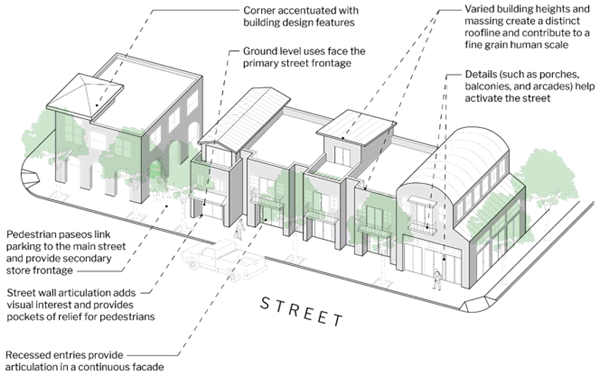
Consistent with crime prevention through environmental design (CPTED) principles, orient building doors, windows, and entrances to relate directly to public and private streets, drives, paseos, greenways, and common open space amenities.
(3)
Provide safe and direct pedestrian access from ground level residential units to streets and communal areas. Provide alley access for residential use as available.
(4)
Provide safe and direct pedestrian access from ground level commercial to the primary street frontage.
(5)
For sites greater than one (1) acre in area, incorporate informal outdoor areas and pedestrian nodes that can function as gathering spaces into the overall site design. These areas shall adjoin the development's common facilities, such as the play areas, courtyards, barbecue area, and community buildings.
(6)
Circulation components shall provide physical and visual connections with adjacent uses.
(7)
All alleys shall be paved for vehicular traffic if utilized for vehicular access. Green alleys are encouraged with pervious paving with a high albedo, such as permeable pavers, porous asphalt, reinforced grass pavement (turf-crete), stone pavers and other permeable materials.
(8)
The workspace of a live/work or artisan loft dwelling unit shall be accessible from the street and open to the street.
(9)
When adjacent to a public street, outdoor dining areas shall provide a minimum of five (5) feet of unobstructed pedestrian circulation and shall be placed at least twenty (20) feet away from an intersection.
(10)
All developments shall provide shade for at least fifty (50) percent of the required common open space areas, as measured at 2:00 p.m. on June 21. Shade shall be provided through the following design elements: arcades, colonnades, pergolas, verandas, covered porches, fixed canopies, awnings, trellises, or other shade structures, or shade trees.
(11)
Permanent shade structures such as canopies and arcades shall maintain a vertical clearance of at least ten (10) feet above finished grade.
(12)
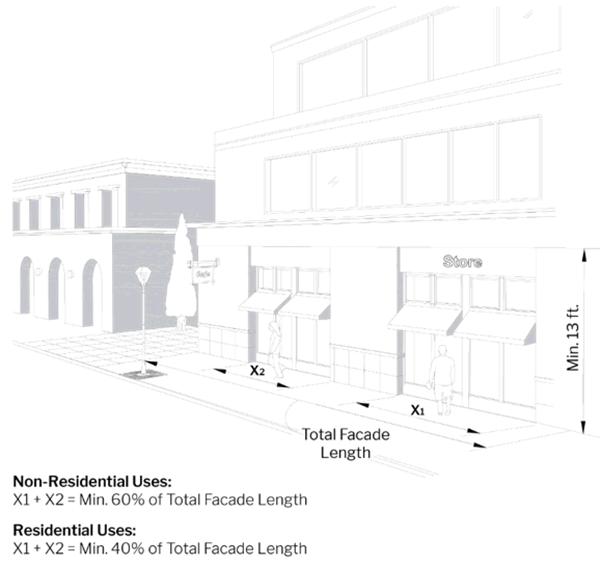
For non-residential uses, a minimum of sixty (60) percent of the street wall area on the ground floor shall be transparent. For residential uses, a minimum of forty (40) percent of the street wall area on the ground floor shall be transparent.
(13)
Ground floor spaces shall provide a clear floor to ceiling height of thirteen (13) feet minimum.
(c)
Sidewalk zone.
(1)
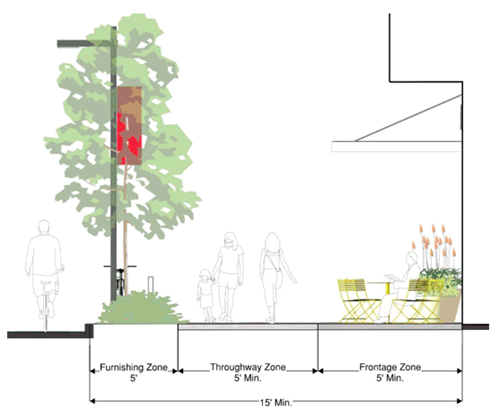
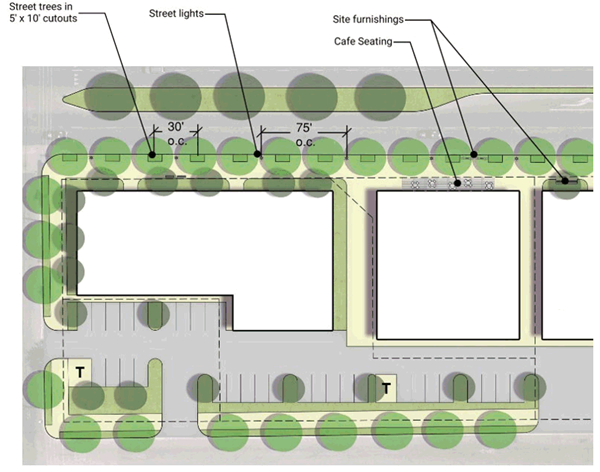
All sidewalk zones shall be a minimum of fifteen (15) feet from the face of the existing curb to allow for a wider pedestrian zone and encourage cafe seating and activation of the sidewalk. See also section 29-91(k), street trees and streetscape improvements. The sidewalk zone shall consist of the following three (3) areas:
a.
Furnishing area: Five (5) feet wide and adjacent to the curb. Area includes street trees, understory planting, light poles, bike racks and/or trash and recycle receptacles. This width shall remain consistent throughout the mixed-use zone.
b.
Throughway area: Minimum five (5) feet wide of unobstructed walking surface, consisting of ADA compliant paving. Note this area may be increased to allow for a wider sidewalk area.
c.
Frontage area: Minimum five (5) feet wide closest to building. This area may be widened to allow for additional cafe seating, benches or other amenity areas adjacent to the building.
(d)
Building frontage design.
(1)
Activate the street facades of buildings by providing a minimum of two (2) frontage elements listed below. A minimum of two (2) elements must be provided for every thirty (30) feet of the building street facade length (frontage elements selected may repeat and may encroach into the required front setback per section 29-114(h).):
| a. Covered porch | 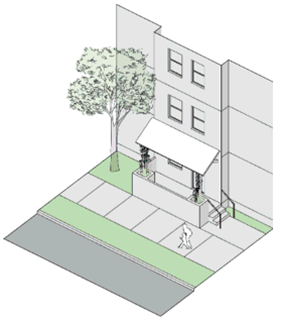 |
| b. Gated stoop | 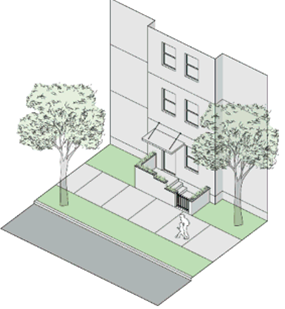 |
| c. Recessed entrance | 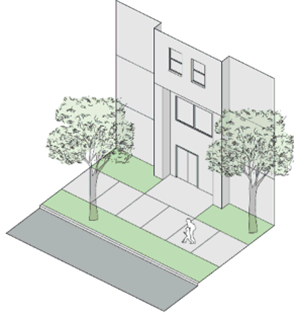 |
| d. Arcade or colonnade | 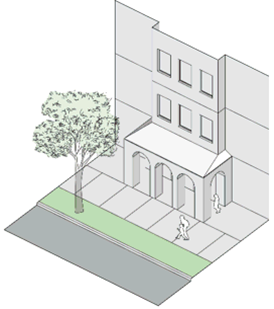 |
| e. Bay windows | 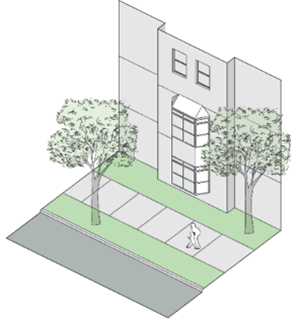 |
| f. Awnings, overhangs, or trellises projecting a minimum of two (2) feet | 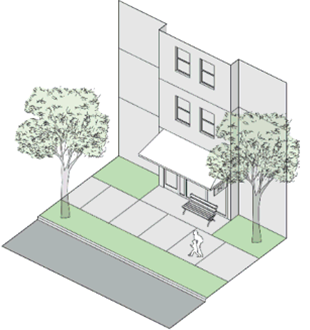 |
| g. Yard, Forecourt, planter | 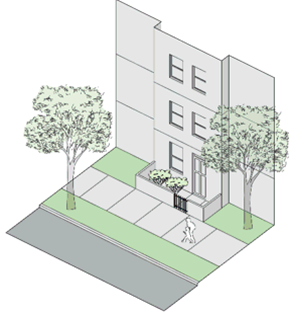 |
| h. Storefront with a minimum 60 percent transparent on the ground floor. | 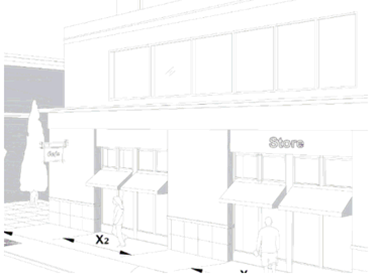 |
(e)
Building scale, massing, and articulation.
(1)
Entries shall be easily identified by architectural accents or massing. Emphasize each business or dwelling unit's entry and differentiate it through architectural elements such as porches, stoops, or roof canopies, and detailing such as paint color, trim, materials, or awnings.
(2)
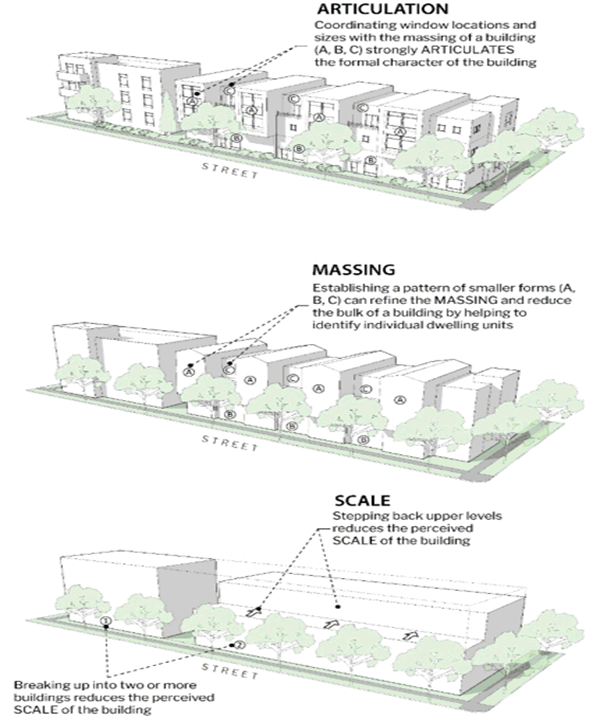
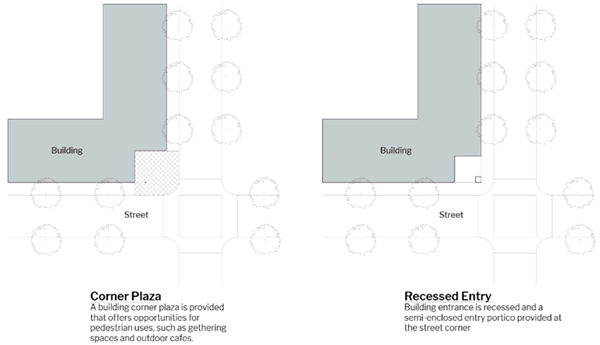
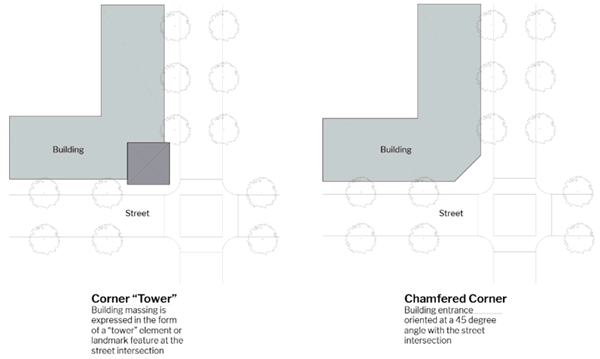
Reduce the visual bulk of new mixed-use development by incorporating any three (3) of the following design features:
a.
Accentuated building corners (this shall be achieved with architectural treatments, such as a change in material, greater building height at the corner, rounded or chamfered building facades, pronounced building forms, enhanced window treatments or projections - such as awnings, trellises, parapets, roof overhangs, etc.).
b.
Fenestration elements, such as recessed windows, decorative panels and trim, color accents, offsets and framed openings.
c.
Patterned garage doors with painted trim or varied garage door colors.
d.
A change in materials and finishes, providing at least three (3) materials and finishes across the building facade.
e.
A horizontal offset in the building plane consisting of a minimum two (2) foot offset in the building facade for every thirty (30) feet of building frontage.
f.
A ten (10) foot stepback for habitable space of the third floor.
(f)
Circulation and parking. The following standards shall apply to all parking areas with ten (10) or more vehicle parking spaces:
(1)
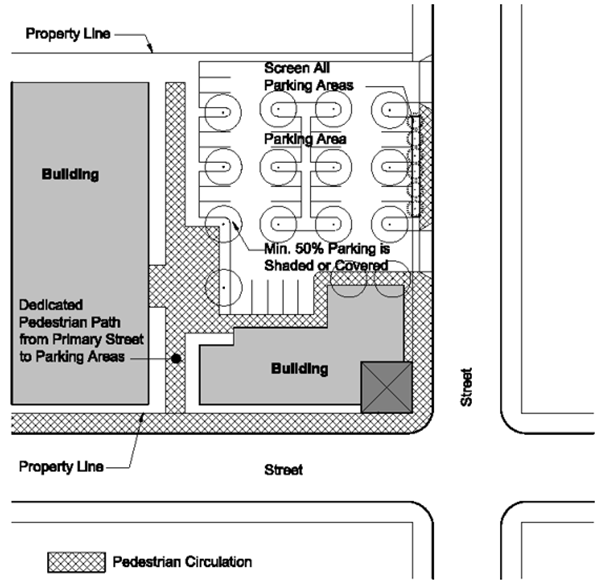
Minimize cross circulation between vehicles and pedestrians by providing a continuous, clearly marked walkway from parking areas to main entrances of buildings.
(2)
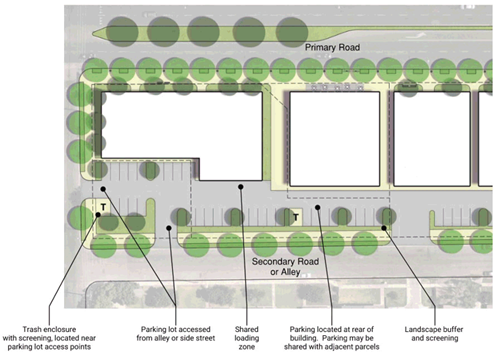
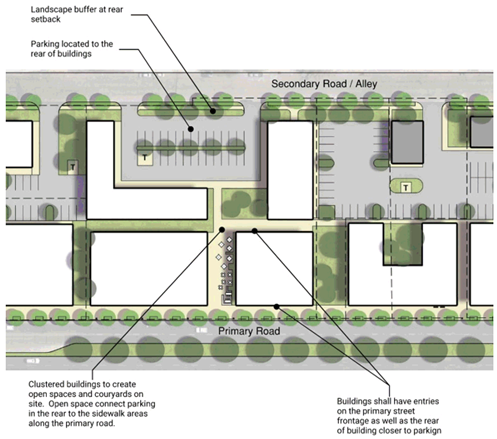
Parking shall be located to the rear or side of the building. Secondary entries from the parking lots shall be provided for all buildings.
(3)
Vehicle access and curb cuts shall be on secondary streets or alleys, when available. Vehicle access and curb cuts shall comply with section 29-137 and city roadway standards.
(4)
Surface parking lots shall be separated from buildings by a minimum of ten (10) feet along the entire building frontage facing the parking area (including a minimum four (4) foot-wide walkway and six (6) foot-wide landscaped area with breaks as needed for access).
(5)
Shared parking is highly encouraged. Parking lot access may require a shared access easement with adjacent property owners. See section 29-138, shared parking facilities.
(6)
Provide enhanced paving, textured paving, colored paving, and/or marked striping at all pedestrian and bicycle crossings in parking areas (such as concrete surface treatment, brick, terra-cotta or stone pavers).
(7)
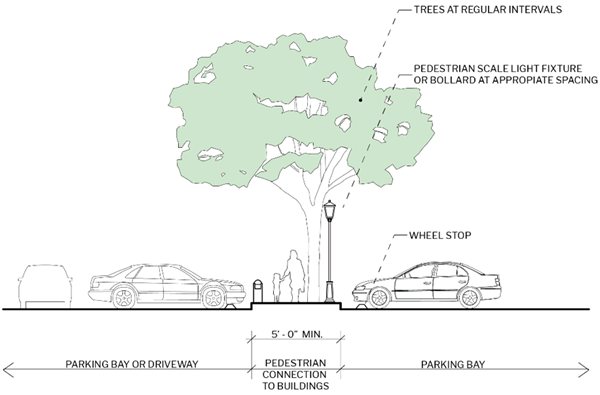
Provide walkways and/or corridors between residences, parking areas, and all site facilities for safe access. Provide pedestrian walkways and paths that are clearly identified and made safe and accessible through the use of hardscape design, landscaping and lighting.
(8)
Pedestrian connections shall be provided from the street to the parking lot. These connections shall be located in the side setbacks and may be widened to provide additional public realm spaces.
(9)
For sites with alley frontage, primary vehicle access shall be taken from the alley.
(10)
For sites greater than one (1) acre in area, provide multiple pedestrian access points.
(11)
Incorporate any two (2) or more of the following design features in surface parking areas of the development:
a.
Carports/shade structures providing a minimum of fifty (50) percent shade covering for parking area.
b.
A minimum ten (10) foot-wide landscape area (trees, shrubs, groundcover) at the exterior perimeter of all parking lots. The ten (10) foot landscape area shall consist of existing and established native and naturalized vegetation and new container plant material comprised of minimum of twenty-four (24)-inch box trees and one (1) and five (5) gallon shrubs and groundcover. New planting shall consist of a combination of small, medium, and large-scale trees, shrubs, and groundcover. (See table 29-142.2 and table 29-142.3 for groundcover and shrub lists.)
c.
One (1) tree per two hundred (200) square feet of landscaping or one (1) tree per every five (5) parking spaces, whichever is more. The required trees shall be a minimum of twenty-four (24)-inch box in size when planted. Trees shall be of appropriate size and trunk diameter for the specified container and tree type. Tree spacing may be varied to accommodate site conditions or design considerations; however, the total number of trees calculated for all parking areas shall be maintained.
d.
Increased pervious paving with a high albedo, such as permeable pavers, porous asphalt, reinforced grass pavement (turf-crete), stone pavers and other permeable materials.
(g)
Open spaces and public access.
(1)
New structures shall be clustered to create plazas, courtyard or pedestrian paseos within the development and prevent long rows of structures.
(2)
Open space areas shall be clustered into larger, landscaped areas rather than equally distributing them into areas of low impact such as at building peripheries, behind a structure or in other areas of little impact to the public view.
(3)
Development within the mixed-use zone is encouraged to provided open spaces with public access. The spaces may include paseos, pocket parks or plazas and may include a variety of uses from seating, playground equipment, fitness equipment, outdoor cafes, splash pads, public art or other uses.
(4)
When public access to open spaces is limited, it shall be controlled with six (6) foot high fences and gates with a minimum of fifty (50) percent opacity for safety and security purposes.
(5)
Open space. Residential development shall have efficient access to common and private open space, whether public or private, for passive or active recreation and for social activities. Common open space includes amenities open to all residents and their visitors, such as game courts, swimming pools, gardens, fitness areas, play equipment, picnic areas, barbeque areas, community gardens, or landscape gardens. No portion of off-street parking spaces, driveways, covered pedestrian access ways or utility areas such as laundries, clothes drying yards or trash areas shall constitute common open space. Private open space includes areas connected or adjoining a dwelling unit for the exclusive use of the occupants and their visitors, such as balconies, porches, or patios. All open space shall conform to the following standards:
a.
For two (2) to four (4) dwelling units (attached) on a single lot, a minimum of three hundred (300) square feet of open space with a minimum width and depth of twenty (20) feet shall be provided for each dwelling unit.
b.
For five (5) or more dwelling units on a single lot or building site, a minimum of one hundred fifty (150) square feet per dwelling unit of common open space shall be provided, not less than fifty (50) percent of which shall be located in a single common area with a minimum width and depth of twenty (20) feet.
c.
Private open space shall be provided as follows:
i.
For dwelling units with one (1) or more bedrooms a minimum of fifty (50) square feet of private open space shall be provided contiguous to each dwelling unit.
ii.
For studio or efficiency units a minimum of fifty (50) square feet of private open space shall be provided contiguous to each dwelling unit, except that the amount of required private open space may be reduced when additional common open space is provided. For every additional square foot of common open space provided, private open space may be reduced by one (1) square foot.
iii.
Private open space shall have a minimum width and depth of five (5) feet; and be screened from ground level exterior visibility by a wood or masonry fence not more than fifty (50) percent open and not less that fifty-four (54) inches high, or, if on a deck or balcony, not less than forty-two (42) inches high.
d.
A surface shall be provided which allows convenient use for outdoor activities. Such surface shall be any practicable combination of lawn, garden, flagstone, wood planking, concrete, asphalt, or other serviceable, dust free surfacing. Slope shall not exceed five (5) percent. No portion of off-street parking space, driveways, covered pedestrian access ways or utility areas such as laundries or trash areas shall constitute open space.
e.
Pools with incidental cabanas and restrooms, and paved recreation areas may be developed in the required common space.
f.
Rooftop amenities may also be included in the required common open space if they are accessible to all residents.
g.
Not less than twenty-five (25) percent, but no more than fifty (50) percent, of common open space shall be permanently landscaped.
h.
When a private open space area greater than ninety-six (96) square feet with a minimum width of eight (8) feet is provided for each dwelling unit, the total common open space requirements may be reduced by twenty-five (25) percent.
i.
Required common open spaces shall be centrally located to the majority of residential units in the development to promote a sense of community. The design and orientation of open spaces shall take advantage of available sunlight and be sheltered from the wind, noise and traffic on adjacent streets, and incompatible uses. Open space areas located within courtyards are preferred to provide resident privacy and security.
j.
Common open spaces and children's play areas shall be visible from individual residential units and be connected to the internal pedestrian system in the development.
k.
Private open spaces shall be contiguous to and have direct pedestrian access from the residential units they serve.
l.
All common open space areas shall be ADA accessible and feature ADA accessible features.
m.
Single projects that occur on multiple lots, as a part of a single phase of development, may cluster open space into a single location on a single lot rather than providing open space on each individual lot.
(h)
Buffers and screening.
(1)
Clearly differentiate public and private areas, and residential and non-residential uses, with separate building entrances, building and landscape design features, building separations, access control or a change in levels and materials.
(2)
Provide landscape buffers and/or low patio walls to reduce noise impacts and protect the privacy of residential units along high-traffic streets and intense uses.
(3)
All buildings shall provide a landscape buffer area within the rear and side yard setback area (See table 29.90.1, Mixed-use Zone Development Standards). The landscape area shall consist of existing and established native and naturalized vegetation and new container plant material comprised of twenty-four (24)-inch box trees at a minimum of twenty-five (25) feet on center and understory planting with minimum one (1) and five (5) gallon shrubs and groundcover. New planting shall consist of a combination of small, medium, and large-scale trees, shrubs, and groundcover. (See table 29-142.2 and table 29-142.3 for groundcover and shrub lists.)
(4)
Whether on a roof, side of a structure or on the ground, screen all mechanical equipment, utilities, trash enclosures, service/maintenance areas and parking zones of buildings and developments and provide buffers to mitigate nuisances and reduce their visual dominance. The method of screening shall be architecturally integrated with the adjacent structure in terms of materials, color, shape, size, and surrounding landscape. Individual mechanical equipment shall be continuously screened.
(5)
Vines, shrubs, and trees shall be used around garages, tuck-under parking spaces, and underground parking entrances to reduce their visual dominance.
(6)
Screen surface parking lots with landscape plantings, berms, and fencing, in accordance with sections 29-142 and 29-143.
(7)
Use open spaces, such as pedestrian plazas, paseos, greenways and courtyards, to serve dual functions as valuable community space and buffers between different uses.
(8)
A six (6) foot high solid masonry wall with a painted, stucco, or natural decorative masonry or adobe surface shall be constructed and maintained where a rear or interior side property line abuts a residential use or zone, in accordance with section 29-143.
(9)
Screening for outdoor storage (including cart storage) shall be determined by the height of the material or equipment being screened. Chain-link fencing is prohibited. When allowed, exterior storage shall be confined to portions of the site least visible to public view. Where screening is required, a combination of elements shall be used including solid masonry walls, berms, and landscaping.
(10)
Roll-up doors, drive-through aisles, and similar features shall be screened from view of adjacent streets by building orientation and/or the provision of landscaping, trellises, berms, or low walls that are consistent with the architecture and exterior materials of the building.
(i)
Roof treatments.
(1)
Provide variation in the roof lines of new development through breaks in parapets, varied parapet heights, pitched roofs, gabled roofs, and/or mansard roofs.
(2)
Provide variable or stepped building heights, both to provide visual interest and give the appearance of a collection of smaller structures.
(3)
All roof top equipment, including roof ladders, shall be screened from public view by screening materials of the same nature as the structure's basic materials. Mechanical equipment shall be located below the highest vertical element of the building.
(4)
The following roof materials shall not be used:
a.
Corrugated metal (standing rib metal roofs are permitted);
b.
Highly reflective surfaces (copper roofs may be considered); and
c.
Illuminated roofing.
(j)
Building materials, finishes, and colors.
(1)
The development's dwelling units, community facilities, and other structures shall provide a unified appearance through a consistent use of building materials, textures, and colors.
(2)
Exterior columns or supports for site elements, such as trellises and porches, shall utilize materials and colors that complement the materials and colors of other elements in the development.
(3)
Brick, stone, terra cotta, tiles, and copper shall be left in their natural colors. Veneer shall turn corners and avoid exposed edges.
(4)
Storefronts shall be of a non-reflective glazing. Mirrored glazing is prohibited for all storefronts facing an arterial street.
(5)
Use visually penetrable materials, such as wrought iron or tubular steel, for front yard fences and gates to encourage self-policing and discourage crime. Chain-link fencing is prohibited.
(6)
Add to the visual richness of facades by incorporating any two (2) or more of the following decorative details in new development:
a.
Tile base or trim at wall base, around windows, doors, and openings.
b.
Clay tile vents.
c.
Wood brackets/knee braces.
d.
Recessed niches.
e.
Window grilles.
f.
Pot shelfs.
g.
Wrought iron railing.
h.
Sconce lighting.
i.
Corbels.
j.
Stone or stucco window trim.
k.
Shutters.
(7)
Exterior building and roofing colors shall be appropriate to and enhance the architectural style and materials of the structure. Intense primary and secondary colors shall be avoided as the dominant overall color for a structure. The use of earth tones and soft muted colors is encouraged.
(8)
Exterior stairs (residential). When provided, simple, clean, bold projections of stairways are required to complement form of the structure. Stairways shall be of smooth stucco, plaster, or wood, with accent trim of complementary colors and railings appropriate to the architectural style of the structure. Thin-looking, open metal, prefabricated stairs are not allowed.
(k)
Street trees and streetscape improvements.
(1)
Street trees shall be placed in tree cutouts or a continuous parkway. Provide a fifty (50) square foot minimum area for all trees to allow for adequate root zone that is clear of anything with a footing that could cause potential damage to trees or roots. Landscaping and irrigation, decorative boulders, and small signage may be allowed in this area.
(2)
Ground plane treatment at the tree cutouts or parkway shall include a combination of understory planting, rock mulch and boulders. (See table 29-142.2 and table 29-142.3 for groundcover and shrub lists.)
(3)
For all new development, street tree species for Adams Avenue shall be Quercus virginiana (Southern Live Oak) and for S. Imperial Avenue shall be Ulmus parvifolia (Chinese Evergreen Elm).
(4)
For all mixed-use zones, streetlights shall match the city's adopted standard. These lights consist of a tall fixture to illuminate the street, low fixture to illuminate the sidewalk and decorative banner arms. Decorative banner arms shall face the street and the light post shall be set back thirty (30) inches from the back of the curb so that banners do not stick into travel lanes. Lights shall be placed at a maximum spacing of seventy-five (75) feet on center but may be spaced closer if needed to provide higher footcandles for adequate illumination of the sidewalk to meet code requirements.
(5)
All developments shall include one of the following furnishings for every fifty (50) linear feet of frontage street, located within the public right-of-way or front yard setback. Furnishings shall be coordinated with adjacent development to ensure a variety of furnishings are placed within the streetscape and that amenities are not duplicated with adjacent developments. Furnishings shall be a consistent design along the entirety of the street frontage. All furnishings shall comply with city requirements and regulations.
a.
Trash and recycle receptacles. Minimum thirty-five (35) gallon made of powder coated steel and covered with a lid to reduce water intrusion and to discourage inappropriate refuse use. Provide one (1) recycle and one (1) trash receptacle. Receptacles shall be surface mounted to the sidewalk.
b.
Benches: Provide a six (6) foot long bench with backs, arms and a center arm as a sleep deterrent. Benches shall consist of powder coated steel and/or aluminum slats and be permanently anchored to the sidewalk.
c.
Bike parking: Provide bike parking for a minimum of four (4) bikes with surface mounted bike racks. Bike racks shall consist of powder coated steel or stainless steel.
(l)
Refuse and recycling.
(1)
Refuse and recycling bins shall be located in a separate room, enclosed niche/recess area, or walled enclosure and must be well-screened with landscaping to protect adjacent uses from noise and odors.
(2)
All refuse and recycling storage in exterior areas shall be covered with a trellis or similar shade canopy structure.
(3)
All exterior areas set aside for storage and pickup of refuse and recycling bins shall be screened from view from any street or public place (excepting an alley serving a mixed-use zone), or from any property in a residential zone, by a six (6) foot high solid masonry wall with a painted, stucco, or natural decorative masonry or adobe surface on at least three (3) sides. All refuse and recycling storage shall be maintained below said wall or fence. Chain-link fencing is prohibited.
(4)
For mixed-use development, residential and non-residential waste streams shall be collected separately.
(5)
Refuse and recycling storage areas shall be located away from public streets at the rear or side of buildings and shall not be located within any required setback areas or impede parking lot access.
(6)
Refuse and recycling storage areas shall be conveniently accessible to the employees/residents of the units/buildings they are designed to serve. A clear and lighted pedestrian route shall be established to each trash area.
(7)
Refuse and recycling storage areas shall be located in a manner that is easily accessible for refuse pickup companies. Trash enclosures may be shared with adjacent development when adequately sized.
(8)
Each refuse and recycling storage area shall be provided with decorative solid heavy gauge metal gates designed with cane bolts to secure the gates when in the open and closed positions. Gates shall be designed not to swing into any drive aisle, parking space, walkway, and shall not otherwise interfere with onsite and offsite circulation. Gates shall be kept closed to provide screening, except during disposal or collection activity.
(m)
Drive-through business.
(1)
The minimum lot size of any drive-through business shall be ten thousand (10,000) square feet.
(2)
All drive-through fast food restaurants shall provide a drive-through lane with a minimum length of one hundred twenty (120) feet and a minimum width of ten (10) feet. All other drive-through businesses shall include a drive-through lane with minimum dimensions of thirty-six (36) feet in length and ten (10) feet in width.
(3)
Any drive-through lane shall have a shade canopy provided over the drive-through at the service or pick-up window.
(4)
All drive-through or drive-in fast food restaurants must have a minimum separation of five hundred (500) feet from any other business that operates a drive-through business.
(n)
Lighting.
(1)
Lighting shall be used to provide illumination for the security and safety of on-site areas such as building entrances, parking, loading, shipping and receiving, walkways and working areas.
(2)
The design of light fixtures and their structural support shall be architecturally compatible with the main structures on-site. Illuminators shall be integrated within the architectural design of the structures.
(3)
All lighting fixtures shall be shielded to confine light spread within the site boundaries.
(Ord. No. 24-03, § 2, 9-17-24)