


El Centro City Zoning Code
DIVISION 9
MEDICAL OFFICE OVERLAY ZONE
Sec. 29-92. - Purpose and intent.
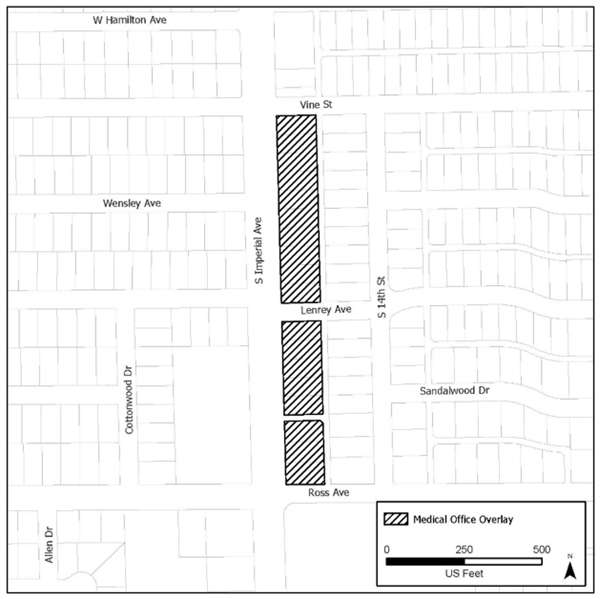
MO medical office overlay zone. This overlay zone is applied on parcels along S. Imperial Avenue shown on figure 29-92.1, in close proximity to the existing regional medical facilities and uses and provides options for residential property on lots not less than six thousand (6,000) square feet in area to transition to medical/professional office, remain single-family residential, or allow a combination of both uses in a live/work project. The underlying R1 single-family residential zoning remains in place to provide legal conforming land use status. Because potential development includes both residential and medical/professional office uses, the overlay zone includes both density and intensity standards.
Overall, the MO overlay zone intends to:
(1)
Implement the goals and policies of the general plan, by supporting the integration of living and working uses.
(2)
Provide new opportunities for employment uses at appropriate intensities and locations.
(3)
Identify a specific area in close proximity to the El Centro Regional Medical Center appropriate for the transition to medical and other small professional offices.
(4)
Encourage the transition from the current pattern of driveways serving each residence taking direct access from Imperial Avenue to alley-oriented access to improve safety and traffic flow along Imperial Avenue.
(5)
Support redevelopment of properties to medical/professional office and live/work (medical/professional office use).
(6)
Provide right-of-way that allows for a continuous bike lane along Imperial Avenue to implement the general plan circulation element.
Figure 29-91.1 Medical Office Overlay Zone
(Ord. No. 24-03, § 2, 9-17-24)
Sec. 29-93. - Medical office overlay zone use regulations.
Development and redevelopment in the medical office overlay zone shall be pursuant to the R1 single-family residential zone use regulations identified in section 29-53.
Additionally, medical office uses (including chiropractic, dentistry and veterinary), professional offices uses noted below, and live/work shall be subject to site plan review and shall be permitted uses, only if the project fully complies with all development and design standards of this division.
Within the MO overlay zone, only the following occupations are intended for the professional office component of the live/work use: medical offices; accountants; architects; attorneys; computer software and multimedia related professionals; consultants; engineers; photographers, and other occupations deemed by the director to be similar and compatible with residential neighborhoods.
(Ord. No. 24-03, § 2, 9-17-24)
Sec. 29-94. - Medical office overlay zone development standards.
The following minimum property development standards identified in table 29-94.1 shall apply to all land and buildings in the medical office overlay zone, except that any lot shown on an official subdivision map duly approved and recorded, or any lot for which a bona fide deed had been duly recorded prior to the effective date of this chapter may be used as a building site. See also article III of this chapter for exceptions to, or clarification of, these regulations.
Additionally, before any structures and outdoor uses for medical/professional office uses and live/work (medical/professional office use) are established in a medical office overlay zone, a site plan shall be submitted to and approved by the community development director, pursuant to article V, division 3 of this chapter.
Table 29-94.1 Medical Office Overlay Zone Property Development Standards
(Ord. No. 24-03, § 2, 9-17-24)
Sec. 29-95. - Medical office overlay zone design standards.
(a)
Purpose. New development and redevelopment activities in the medical office overlay zone must be consistent with the design standards of this section. These standards are intended to transition homes to medical/professional offices and avoid new development or redevelopment that would conflict with the nature of existing residential development in the medical office overlay zone. These standards ensure the highest level of design quality while at the same time providing the flexibility necessary to encourage creativity on the part of project designers.
(b)
Parking and access.
(1)
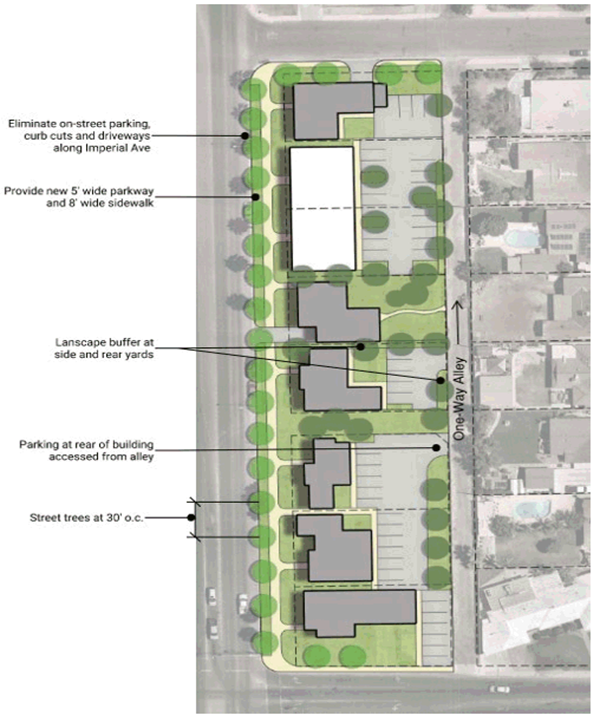
Off-street parking for business patients and patrons shall be accessed from a rear alley and located at the rear of the lot. Use of the front yard and existing driveway(s) of existing homes for patient and patron parking is prohibited. Existing driveways shall be used for delivery vehicles and residents only.
(2)
Parking areas shall be bordered on all sides that face abutting properties by perimeter walls/fencing with a minimum height of six (6) feet and screening that provides a minimum opacity of fifty (50) percent.
(3)
Redevelopment and new development of medical/professional offices or live/work shall not take access from Imperial Ave. All existing curb cuts along Imperial Ave shall be removed as part of any project. Parking access shall be taken from the alley to improve traffic flow and safety.
(4)
Alleys shall be paved as a part of any proposed project and shall utilize green alley principles, which must include some pervious paving areas to account for stormwater treatment. Types of pervious paving may include but are not limited to porous concrete, porous asphalt, permeable pavers, turf block, gravel pave, grass pave or grasscrete. A twelve (12) foot-wide paved area for regular vehicular traffic shall be provided for all alleys within the MO overlay zone.
(5)
Shared parking is highly encouraged. Parking lot access may require a shared access easement with adjacent property owners. See section 29-138, shared parking facilities.
(6)
Incorporate any two (2) or more of the following design features in surface parking areas of the development:
a.
Carports/shade structures providing a minimum of fifty (50) percent shade covering for parking area.
b.
A minimum ten (10) foot-wide landscape area (trees, shrubs, groundcover) at the exterior perimeter of all parking lots. The ten (10) foot landscape area may consist of existing and established native and naturalized vegetation and new container plant material comprised of minimum of twenty-four (24)-inch box trees and one (1) and five (5) gallon shrubs and groundcover. New planting should consist of a combination of small, medium, and large-scale trees, shrubs, and groundcover. (See table 29-142.2 and table 29-142.3 for groundcover and shrub lists.).
c.
One (1) tree per two hundred (200) square feet of landscaping or one (1) tree per every five (5) parking spaces, whichever is more. The required trees shall be a minimum of twenty-four (24)-inch box in size when planted. Trees shall be of appropriate size and trunk diameter for the specified container and tree type. Tree spacing may be varied to accommodate site conditions or design considerations; however, the total number of trees calculated for all parking areas shall be maintained.
d.
Increased pervious paving with a high albedo, such as permeable pavers, porous asphalt, reinforced grass pavement (turf-crete), stone pavers and other permeable materials.
(c)
Street trees and streetscape.
(1)
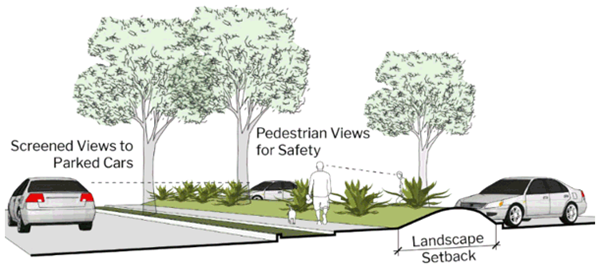
A five (5) foot-wide continuous parkway shall be added along Imperial Avenue and shall be planted with street trees with a spacing of thirty (30) feet on center. The parkway ground plane treatment shall include a combination of understory planting, rock mulch and boulders. (See table 29-142.2 and table 29-142.3 for groundcover and shrub lists.).
(2)
Street tree species shall be Ulmus parvifolia (Chinese Evergreen Elm) and shall be consistent for entire length of street.
(3)
Furnishings shall be a consistent, cohesive design along the entirety of the street frontage. All furnishings shall be approved by the city and in compliance with city requirements and regulations.
(4)
An eight (8) foot-wide concrete sidewalk consisting of ADA compliant paving shall be provided adjacent to the parkway. ADA compliant walks shall connect the public sidewalk to any building.
(5)
All on-street parking shall be eliminated from Imperial Avenue within the MO overlay zone to allow for dedicated bike lanes.
(d)
Front door.
(1)
The front door to the business shall be visible from the street, easily accessible by foot, and connected by a continuous pedestrian path that leads to the street. The pathway connecting the front door of the business to the street must be independent from the driveway of an existing/previously existing house.
(2)
If a gate is provided between the front door and the street, the gate shall be clearly marked as the main entrance to the business and include a doorbell, directory, call box, or other means of communication for patients and patrons to be allowed access to the business.
(3)
Exterior waiting areas are prohibited. All waiting and reception areas of the business shall be interior to the building.
(e)
Compatibility.
(1)
New medical/professional office buildings that replace existing single-family residential shall be limited to two (2) stories.
(2)
Where a proposed medical/professional office building abuts existing residential uses on adjacent lots, an additional five (5)-foot side yard setback shall be provided, except that where the proposed development provides clearstory windows with a sill height of a minimum of five (5) feet or zero windows facing the side yard, the minimum side yard setback may remain in place according to table 29-94.1.
(3)
Where a proposed medical/professional office building abuts existing residential uses on adjacent lots, an offset of a minimum two (2) feet in the building plane (either horizontally or vertically) shall be required for every one hundred (100) square feet of building facade.
(4)
Reflective or mirrored glass facing interior property lines is prohibited.
(f)
Buffers and screening.
(1)
All buildings shall provide a landscape buffer area within the rear and side yard setback area (See table 29.94.1, medical office overlay zone development standards). The landscape area shall consist of existing and established native and naturalized vegetation and new container plant material comprised of twenty-four (24)-inch box trees at a minimum of twenty-five (25) feet on center and understory planting with minimum one (1) and five (5) gallon shrubs and groundcover. New planting shall consist of a combination of small, medium, and large-scale trees, shrubs, and groundcover. (See table 29-142.2 and table 29-142.3 for groundcover and shrub lists.)
(2)
A six (6) foot high solid masonry wall with a painted, stucco, or natural decorative masonry or adobe surface shall be constructed and maintained where a rear or interior side property line abuts a residential use or zone.
(g)
Lighting.
(1)
All lighting on the property shall be designed to be directed inward into the property to minimize glare and spillover into neighboring properties.
(2)
Lighting shall be used to provide illumination for the security and safety of on-site areas such as parking and walkways. Lights shall not be designed for or used as an advertising display.
(h)
Signage.
(1)
Provide clear and visible signage on both the street and rear side of the site indicating the location of patient and patron parking entrance(s).
(2)
Provide a clear and visible professional sign indicating the name and service of the business. The sign shall conform to the following design standards:
a.
Size. The maximum size shall be ten (10) square feet.
b.
Illumination. All signs shall be externally illuminated. Internally illuminated signs are prohibited.
c.
Location. Except as provided below, all signs shall be affixed to the building facade above the primary public entrance to the business. A sign placed over the building facade shall not cover a window, door, or architectural detail of the building. A sign may project out from the building facade up to one (1) foot if parallel to the facade and four (4) feet if perpendicular to the facade (a "projecting sign").
d.
Monument and directory signs. Business name and directory signage may be mounted to a monument, post, or garden wall/fence located in the front yard of the property and shall be limited in size to ten (10) square feet and eight (8) feet in height.
e.
Material. Sign materials shall include wood, faux wood, metal, or plastic with a minimum thickness of one-half (½) inch. Vinyl is prohibited.
f.
Advertising. All advertising shall be provided in separate and removable freestanding signs and shall not be affixed to the building.
(Ord. No. 24-03, § 2, 9-17-24)