
Flushing City Zoning Code
ARTICLE 2
- DEFINITIONS
Sec. 153.201.- Interpretation.
The following rules of construction apply to the text of this chapter:
(1)
The particular shall control the general.
(2)
In case of any difference of meaning or implication between the text of this chapter and any caption or illustration, the text shall control.
(3)
The word "shall" is always mandatory and not discretionary. The word "may" is permissive.
(4)
Words used in the present tense shall include the future tense; and words used in the singular shall include both the plural and the singular, unless the context clearly indicates the contrary.
(5)
A "building" or "structure" includes all or any part thereof.
(6)
The phrase "used for" includes "arranged for," "designed for," "intended for," maintained for," or "occupied for."
(7)
The word "person" includes an individual, a corporation, a partnership, an incorporated association, or any other similar entity.
(8)
Unless the context clearly indicates the contrary, where a regulation involves two or more items, conditions, provisions, or events connected by the conjunction "and," "or," "either…or," the conjunction shall be interpreted as follows:
a.
"And" indicates that all the connected items, conditions, provisions, or events shall apply. The ampersand (&) may be used instead if the word "and."
b.
"Or" indicates that the connected items, conditions, provisions, or events may apply singly or in any combination.
c.
"Either…or" indicates that the connected items, conditions, provisions, or events shall apply singly but not in combination.
(9)
The phrase "used for" includes "arranged for," "designed for," "intended for," maintained for," or "occupied for."
(10)
Terms not herein defined shall have the meaning customarily assigned to them. For terms which are not defined in this chapter, the definition of the term shall be taken from Webster's Dictionary.
(11)
"Development Rights" as required by the State of Michigan Zoning Enabling law are not included because they are intended for large tracts of land in active farming. Such land is not currently and not likely to be available in the City of Flushing.
(Ord. No. 2025-01, 1-13-2025)
Sec. 153.202. - Definitions.
A
Abutting means having a common border with or being separated from such a common border by a right-of-way, alley, or easement.
Addition means an extension or increase in floor area or height of a building or structure.
Adult foster care facility means a governmental or nongovernmental establishment subject to state licensing procedures as may be required having as its principal function the receiving of adults for foster care. It includes facilities and foster care family homes for adults who are aged; emotionally disturbed, developmentally disabled, or physically handicapped who require supervision on an ongoing basis but who do not require continuous nursing care. Adult foster care facility does not include a nursing home, a home for the aged, an alcohol or a substance abuse rehabilitation center, a hospital for the mentally ill, or similar facilities.
Aged means an adult whose chronological age is 60 years of age or older, or whose biological age, as determined by a physician, is 60 years of age or older.
Airport approach plan and airport layout plan means a plan, or an amendment to a plan, filed with the Zoning Commission under Section 151 of the Aeronautics Code of the State of Michigan, 1945 PA 327, MCL 259.151.
Airport manager means a term defined in Section 10 of the Aeronautics Code of the State of Michigan, 1945 PA 327, MCL 259.10.
Airport zoning regulations means airport zoning regulations under the Airport Zoning Act, 1950 (Excess) PA 23, MCL 259.465, for an airport hazard area that lies in whole, or part of the area affected by this chapter.
Alley means any dedicated public way affording a secondary means of access to abutting property, and not intended for general traffic circulation.
Alterations means any change, addition, or modification in construction or type of occupancy, or in the structural members of a building, such as walls or partitions, columns, beams or girders, the consummated act of which may be referred to herein as "altered" or "reconstructed."
Arcade shall mean any place of business or establishment whose principal use shall be the housing of mechanical amusement devices. Mechanical amusement devices include any machine, which, upon the insertion of any coin, slug, token, plate, or disc, or which, for a fee paid to the operator or owner, may be operated by the public generally for use as a game, entertainment, or amusement, whether or not registering a score. It shall include such devices as marble machines, ski ball, mechanical grab machines, television display devices, or machines and all games, operations, or transactions similar thereto whether operated principally by mechanical means or electrical means or a combination thereof, under whatever name they may be indicated or called.
Architectural features means architectural features of a building or a structure shall include cornices, eaves, gutters, belt courses, sills, lintels, bay windows, chimneys, and decorative ornaments.
B
Basement means that portion of a building which is partly or wholly below grade but so located that the vertical distance from the average grade to the floor is greater than the vertical distance from the average grade to the ceiling. A basement shall not be counted as a story.
Block means the property abutting one side of a street and lying between the two nearest intersecting streets, (crossing or terminating) or between the nearest such street and railroad right-of-way, un-subdivided acreage, lake, river, or live stream; or between any of the foregoing and any other barrier to the continuity of development, or corporate boundary lines of the municipality.
Breezeway means a structure for the principal purpose of connecting the main building or buildings on a property with other main buildings or accessory buildings.
Buffer area means an area, usually landscaped, intended to separate and partially obstruct the view of two adjacent land uses or properties from one another.
Building means a structure erected on site, a mobile home or mobile structure, a manufactured or precut structure, above or below ground, having a roof or walls and built for, or capable of, the shelter or enclosure of persons, animals, chattels, or property of any kind.
Building footprint means the area of a lot or site included within the surrounding exterior walls of a building or portion of a building, exclusive of courtyards. In the absence of surrounding exterior walls, the building footprint shall be the area under the horizontal projection of the roof.
Building height means the vertical distance measured from the established grade to the highest point of the roof surface if a flat roof; to the deck of mansard roofs; and to the mean height level between eaves and ridge of gable, hip and gambrel roofs. When the terrain is sloping, the ground level is measured at the wall line. See figure 2-1. The height of detached accessory structures shall be the distance from grade to the top of a parapet wall in the case of a flat roof, and to the peak of the roof for mansard, gable, hip, and gambrel roofs.
Figure 2-1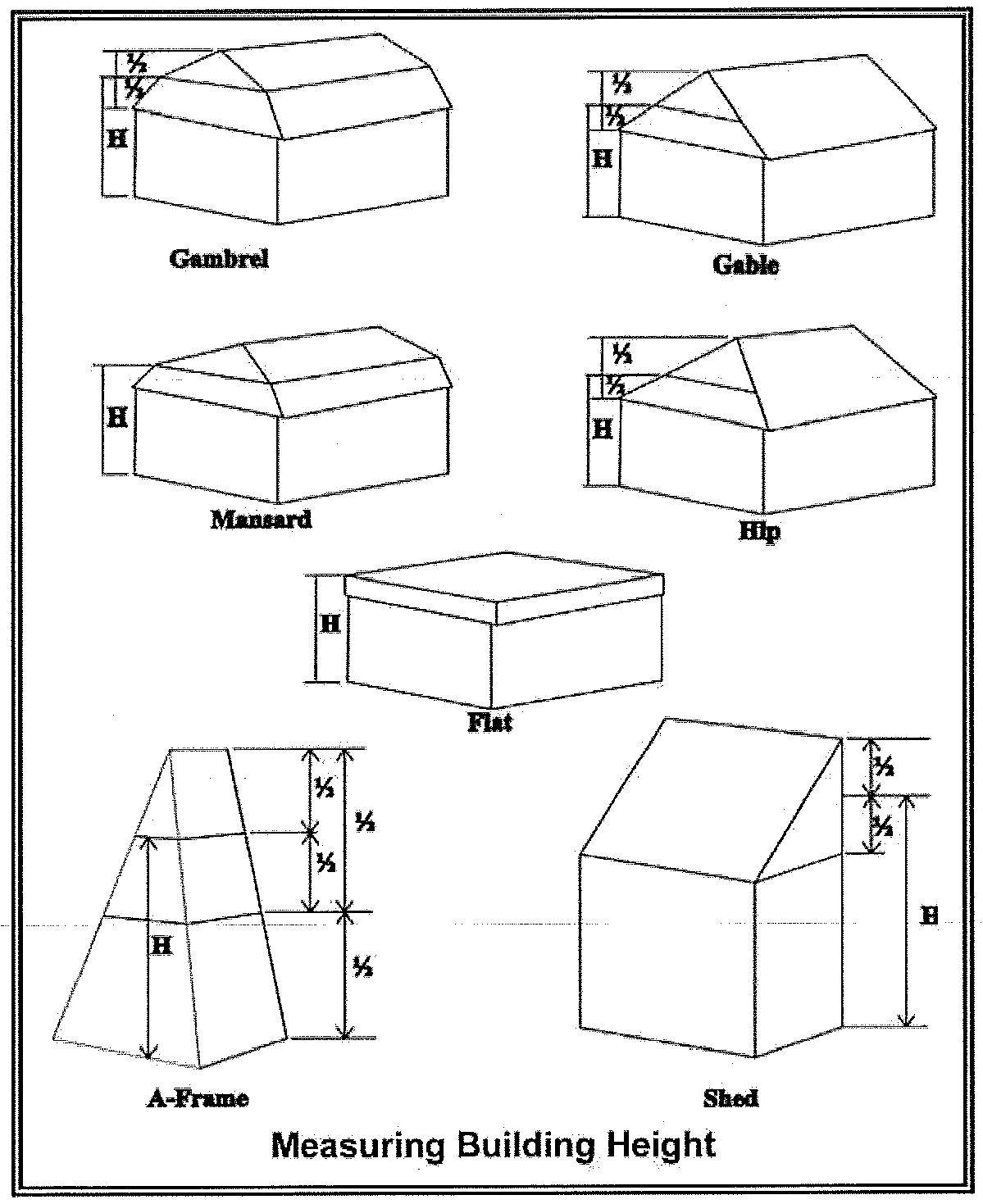
C
Cluster development means a development design technique that concentrates buildings in specific locations on a site to allow the remaining land to be used for recreation, common open space, and preservation of environmentally sensitive areas.
Conservation easement means the term defined in Section 2140 of the Natural Resources and Environmental Protection Act, 1994 PA 451, MCL 324.2140.
Curb cut means the providing of vehicular ingress and egress between property and an abutting public street.
D
Development means the construction of a new building or other structure on a zoning lot, the relocation of an existing building on another zoning lot, or the use of open land for a new use.
Direct recharge area means that portion of a drainage basin in which water infiltrating vertically from the surface will intercept the water table.
District means a portion of the incorporated area of the municipality within which certain regulations and requirements or various combinations thereof apply under the provisions of this chapter.
Dwelling unit means a building or portion thereof, designed for occupancy by one family for residential purposes and having cooking and sanitary facilities.
E
Earth berm means a mound of earth planted with ground cover, grass, trees, or other landscaping material intended to minimize the view of parking areas and reduce noise and dust from adjacent uses and passersby.
Easement means a grant of one or more property rights by the property owner to and/or for the use by the public, a corporation, or another person or entity.
Erected means built, constructed, altered, reconstructed, moved upon, or any physical operations on the premises which are required for construction, excavation, fill, drainage and the like, shall be considered a part of erection.
Essential services means a public utility or municipal department utilizing underground, surface, or overhead gas, electrical, steam, fuel, or water transmission or distribution systems, collection, communication, supply or disposal system, but not including buildings.
Excavation means any breaking of ground, except common household gardening and ground care.
F
Farm means the land, plants, animals, buildings, structures, including ponds used for agricultural or aquacultural activities, machinery, equipment, and other appurtenances used in the commercial production of farm products.
Family means a single individual doing their own cooking and living upon the premises as a separate housekeeping unit, or a collective body of persons doing their own cooking and living together upon the premises or a separate housekeeping unit in a domestic relationship based upon birth, marriage, or other domestic bonds distinguished from a group occupying a boarding house, lodging house, club, fraternity, or hotel.
Fence means any permanent partition, structure, or gate erected upon or near, but not limited to, the dividing line between adjoining property owners, for the purpose of separating, screening, enclosing or protecting property. Hedges, ornamental shrubs, trees and bushes shall be considered fences when placed in a manner or position to serve as such.
Floodplain (flood prone area) means any land area susceptible to being inundated by water from any source.
Floor area, gross means the sum of the gross horizontal areas of the several floors of the building measured from the exterior faces of the exterior walls or from the centerline of walls separating two buildings. The "floor area" of a building shall not include the basement floor area except when more than one-half of the basement height is above grade. "Floor area" shall include elevator shafts and stairwells at each floor, floor space used for mechanical equipment (except equipment, open or enclosed, located on the roof), attic space having headroom of seven feet, ten inches or more, interior balconies, and mezzanines. Any space devoted to off street parking or loading shall not be included in "floor area."
Floor area, residential means for the purpose of computing the minimum allowable floor area in a residential dwelling unit, the sum of the horizontal areas of each story of the building shall be measured from the exterior faces of the exterior walls or from the centerline of walls separating two dwellings. The floor area measurement is exclusive of areas of basements, unfinished attics, attached garages, breezeways, and enclosed and unenclosed porches.
Floor space, usable means that area used for or intended to be used for the sale of merchandise or services, or for the use to serve patrons, clients, or customers. Such floor area which is used or intended to be used principally for the storage or processing of merchandise, hallways, or for utilities or sanitary facilities, shall be excluded from this computation. Measurement of usable floor area shall be the sum of the horizontal areas of the several floors of the building, measured from the interior faces of the exterior walls.
Foster care means the provision of supervision, personal care, and protection in addition to room and board, for 24 hours per day, five or more days per week, and for two or more consecutive weeks of compensation.
Frontage means the minimum width required in a use district which abuts a public right-of-way or private road. See figure 2-2.
Figure 2-2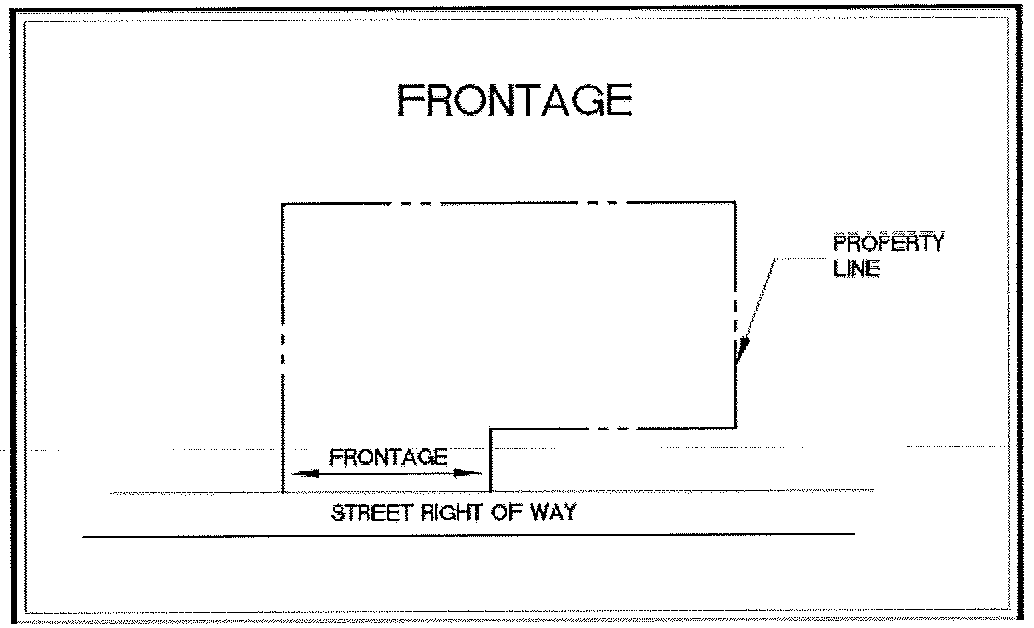
G
Garage, private means an accessory building or portion of a main building designed or used solely for the storage of motor driven vehicles, boats, and similar vehicles owned and used by the occupants of the building to which it is accessory.
Governmental agency means any department, commission, independent agency, or instrumentality of the United Sates, of a state, county, incorporated or unincorporated municipality, authority, district, or governmental unit.
Grade means the ground elevation established for the purpose of regulating the number of stories and the height of buildings. The building grade shall be the level of the ground adjacent to the walls of the building if the finished grade is level. If the ground is not entirely level, the grade shall be determined by averaging the elevation of the ground for each face of the building, measured at a distance four feet out from the edge of the building.
Greenbelt means a strip of land of definite width and location reserved for the planting of shrubs and/or trees to serve as an obscuring screen or buffer strip in carrying out the requirements of this chapter.
Greenway means a contiguous or linear open space, including habitats, wildlife corridors, and trails, that links parks nature reserves, cultural features, or historic sites with each other, for recreation and conservation purposes.
Groundwater gradient means the slope (gradient) of the groundwater surface, thereby defining the direction of groundwater movement.
H
Historic district means an area containing buildings or places in which historic events occurred or having special public value because of notable architectural or other features relating to the cultural or artistic heritage of the community of such significance to warrant conservation and preservation. A historic district officially exists when a local historic district is organized and then researches and determines the historic value of a specific area and makes it a local historic district, when it is placed the Michigan Register of Historic Places after research and evaluation, or when it is nominated or placed on the National Register of Historic Places.
I
Improvements means those features and actions associated with a project that are considered necessary by the body or official granting zoning approval to protect natural resources or the health, safety, or welfare of the residents of the City of Flushing and future users or inhabitants of the proposed project or project area, including roadways, lighting, utilities, sidewalks, screening, and drainage. Improvements do not include the entire project that is subject to zoning approval.
Intensity of development means the height, bulk, area, density, setback, use, and other similar characteristics of development.
J
Junk yard means an area where waste, used, or secondhand materials are bought and sold, exchanged, stored, baled, packed, disassembled, or handled including but not limited to scrap iron and other metals, paper, rags, rubber tires, and bottles. See section 153.103(5) storage of flammable materials.
K
Reserved, currently no definition pertaining to this chapter.
L
Legislative body means the county board of commissioners of a county, the board of trustees of a township, the council of a city or village, or other similar duly elected representative of a county, township, city, or village.
Loading space means an off-street space on the same lot with a building, or group of buildings, for the temporary parking of a commercial vehicle while loading and unloading merchandise or materials.
Local unit of government means a county, township, city, or village.
Lot means a measured portion of a parcel or tract of land, which is legally described and fixed in a recorded plat, or site condominium master deed.
Lot area means the total horizontal area within the lot lines of the lot.
Lot, corner means a lot abutting on and at the intersection of two or more streets.
Lot coverage means the part or percent of the lot occupied by buildings including accessory buildings.
Lot depth means the horizontal distance between the front and rear lot lines, measured along the median between the side lot lines.
Lot, interior means any lot other than a corner lot.
Lot lines means the lines bounding a lot as defined herein (see figure 2-3):
(1)
Front lot line. In the case of an interior lot, is that line separating said lot from the streets. For a corner lot, all lot lines abutting a street right-of-way are considered a front lot line.
(2)
Rear lot line. That lot line opposite the front lot line. In the case of a lot pointed at the rear, the rear lot line shall be an imaginary line parallel to the front lot line, not less than ten feet long lying farthest from the front lot line and wholly within the lot.
(3)
Side lot line. Any lot line other than the front or rear lot line. In the case of a corner lot, the property owner may choose which lot line is the rear lot line, and which is the side lot line.
Figure 2-3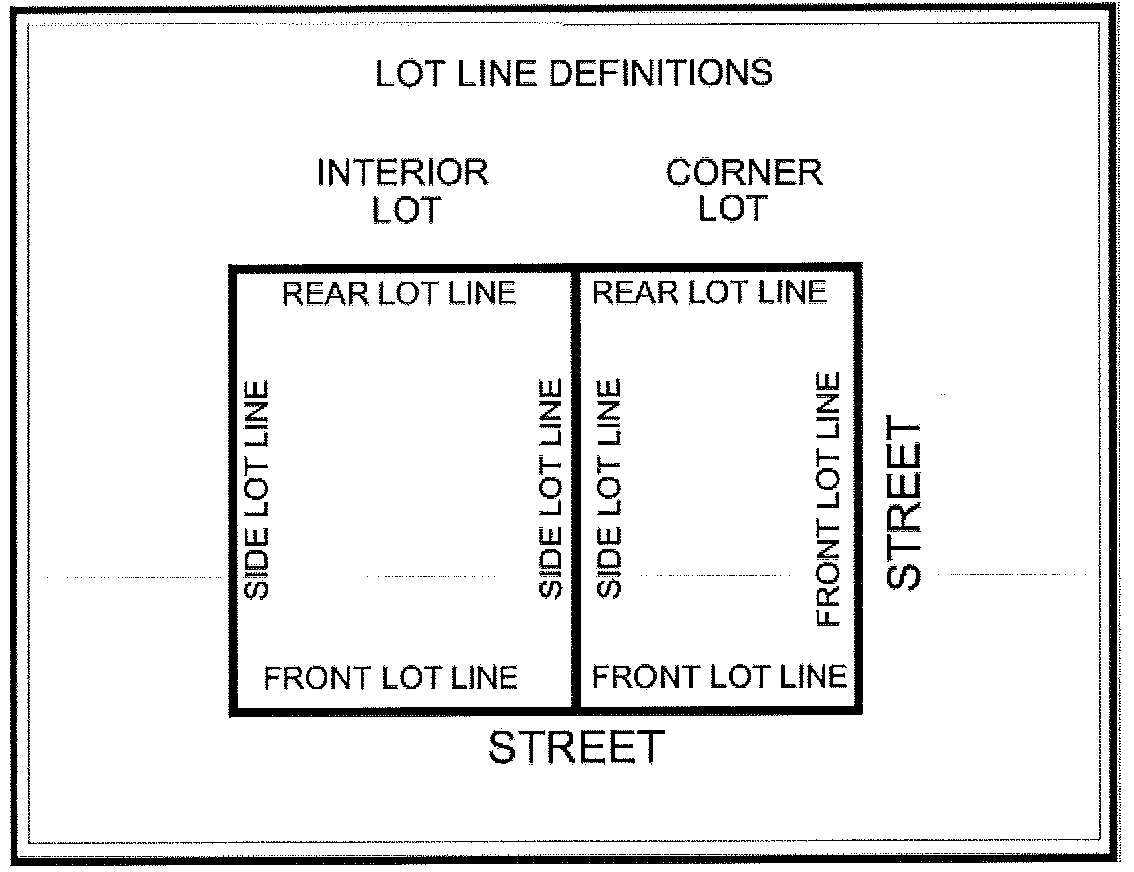
Lot of record means a lot which exists in a subdivision plat as shown on the records of the county register of deeds, or a lot or parcel described by metes and bounds, the description of which has been so recorded. Whenever an owner has combined two or more lots as contained on any recorded plat into a single building site, whereby more than one lot is necessary to satisfy the requirements of this chapter, said combination of lots shall be deemed to be a single lot of record for the purposes of this chapter.
Lot, through means any interior lot having frontage on two more or less parallel streets as distinguished from a corner lot.
Lot, width means the horizontal straight-line distance between the side lot lines, measured between the two points where the front setback line intersects the side lot lines or in the case of a corner lot, the side lot line and opposite lot line. See figure 2-4.
Figure 2-4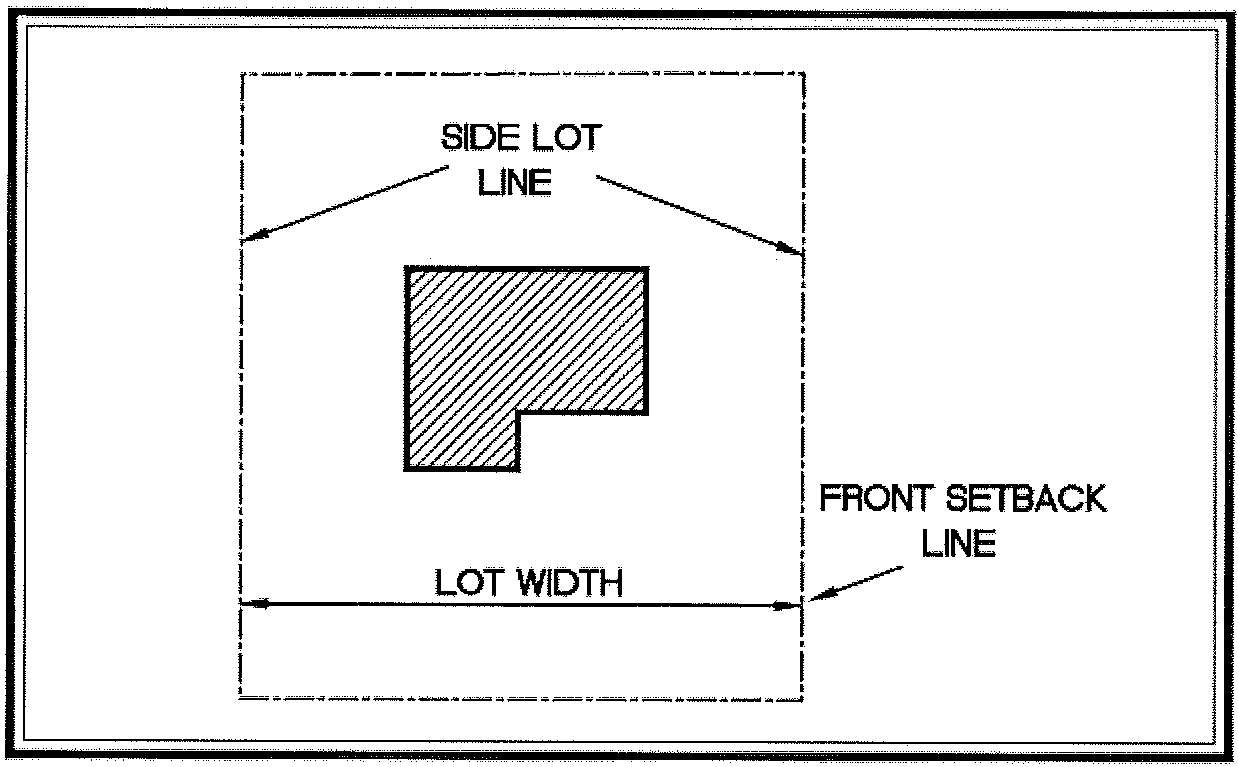
Lot, zoning means a single tract of land, which may include one or more lots of record, which conform to this chapter for area, size, and frontage dimensions in the district.
M
Marijuana, also known as marihuana or cannabis shall have the meaning given to it in Section 7601 of the Michigan Public Health Code PA 368 of 1978, MCL 333.7106, as referred to in Section 3(d) of the Michigan Medical Marihuana Act MCL 333.26423 (d). Any other term pertaining to marijuana in this chapter and not otherwise defined shall have the meaning given to it in the Michigan Medical Marihuana Act or in the rules and regulations of the Michigan Department of Community Health issued with respect to the Act.
Master plan means the comprehensive community plan including graphic and written proposals indicating the general location for streets, parks, schools, public buildings, and all physical development of the municipality, and includes any unit or part of such plan, and any amendment to such plan or parts thereof.
Medical use of marijuana means the acquisition, possession, cultivation, manufacture, use, internal possession, delivery, transfer or transportation or paraphernalia relating to the administration of marijuana to treat or alleviate a registered qualifying patient's debilitating medical condition or symptoms associated with the debilitating medical condition, as defined under the Michigan Medical Marihuana Act, P.A. 2008, Initiated law, MCL 333.26423(d).
Mezzanine means an intermediate floor in any story occupying not to exceed one-third of the floor area of such story.
Motorized home means a self-propelled motor vehicle which provides the amenities of day to day living while used as a means of transportation for recreational or travel purposes.
Municipality means City of Flushing, Michigan.
N
Non-conforming building means a building or portion thereof lawfully existing at the effective date of the ordinance from which this chapter is derived or amendments thereto and that do not conform to the provisions of this chapter in the district in which it is located.
Non-conforming lot means any lot, out lot, or other parcel of land which does not meet the land area or dimension requirements of this chapter.
Non-conforming use means a use which lawfully occupied a building or land at the effective date of this chapter, or amendments thereto, and that does not conform to the use regulations of the district in which it is located.
Nuisance factors means an offensive, annoying, unpleasant, or obnoxious thing or practice, a cause or source of annoyance, especially a continuing or repeating invasion of any physical characteristics of activity or use across a property line which can be perceived by or affects a human being, or the generation of an excessive or concentrated movement of people or things, such as, but not limited to: 1) sound, 2) dust, 3) smoke, 4) odor, 5) glare, 6) fumes, 7) light, 8) vibration, 9) shock waves, 10) heat, 11) electronic or atomic radiation, 12) effluent.
O
Occupied includes arranged, designed, built, altered, converted to, rented or leased, or intended to be occupied.
Off-street parking facility means a facility providing vehicular parking spaces along with adequate drives and aisles, for maneuvering, so as to provide access for entrance and exit for the parking of more than three vehicles.
P
Parking space means an area of definite length and width, said area shall be exclusive of drives, aisles, or entrances giving access thereto, and shall be fully accessible for the parking of permitted vehicles.
Planning commission means the City of Flushing planning commission as established by the City of Flushing City Council under provisions of the Michigan Zoning Enabling Act (Public Act 110 of 2006), as amended.
Plot plan means a plat of a lot, drawn to scale, showing the actual measurements, the size and location of any existing structures or structures to be erected, the location of the lot in relation to abutting streets and other such information.
Population means the population according to the most recent Federal Decennial Census or according to a special census conducted under Section 7 of the Glenn Steil State Revenue Sharing Act of 1971, 1971 PA 140, MCL 141.907, whichever is more recent.
Porch or deck means a projection on a building or structure containing a floor, which may be either totally enclosed or open.
Principal use or structure means the main use to which the premises are devoted and the principal purpose for which the premises exist.
Projections means projections from a building that are necessary for the shading of a building or features such as sills, cornices, and chimneys. Such projections may extend into required yards only as allowed by the provisions of this chapter.
Public building means buildings devoted to the use of a governmental agency, as distinguished from buildings that are government financed, but are intended for private use; e.g., public housing.
Public utility means a person, firm, or corporation, municipal department, board, or commission duly authorized to furnish and furnishing under federal, state, or municipal regulations to the public: gas, steam, electricity, sewage disposal, communication, transportation, or water.
Q
Reserved, currently no definition pertaining to this chapter.
R
Recharge pond/lagoon means a natural or manmade recharge area or pond designed and maintained to recharge stormwater, cooling water, and/or treated water to the groundwater at a rate greater than that is occurring naturally. (Please note that for certain discharges, a DNR discharge permit is required.)
Recreational vehicle means a vehicle which moves one or more persons over the ground, air, water, ice, or snow, and which is either self-propelled or connects to a vehicle which is self-propelled.
Regulated substances means substances to be regulated hereinafter referred to as regulated substances, as chemicals and mixtures of chemicals which are health hazards. Regulated substances are:
(1)
Those list of substances as defined and listed by the Michigan Occupation Safety and Health Administration, as regulated under Title III of the Superfund Amendments and Reauthorization Act (SARA) and as currently reported on MIOSHA safety data sheets.
(2)
Petroleum and non-solid petroleum derivatives (except non-PCB dielectric fluids).
Right-of-way means a strip of land acquired by reservation, dedication, forced dedication, prescription, or condemnation and intended to be occupied or occupied by a road, crosswalk, railroad, electric transmission lines, oil or gas pipeline, waterline, sanitary storm sewer, and other similar uses.
Room means for the purpose of determining lot area requirements and density in a multiple-family district, a room is a living room, dining room, or bedroom. A room shall not include the area in kitchen, sanitary facilities, utility provisions, corridors, stairways, hallways, and storage. Plans presented showing one-, two-, or three-bedroom units and including a "den," "library," or other extra room shall count such extra room as a bedroom for the purpose of computing density.
S
Screening means a method of visually shielding or obscuring one abutting or nearby structure or use from another by fencing or walls.
Setback (required) means the distance required to obtain minimum front, side, or rear yard open space provisions of this chapter, except for roofs, which may project not more than 12 inches into the setbacks. See figure 2-5.
Setback (actual) means the distance between the lot line and existing principal building. See figure 2-5.
Sexual oriented business (also known as adult entertainment uses) means any use of land, whether vacant or combined with structures or vehicles thereon by which said property is devoted to displaying or exhibiting material for entertainment, a significant portion of which includes matter or actions depicting, describing or presenting specified sexual activities or specified anatomical areas.
(1)
Specified sexual activities.
a.
Human genitals in a state of sexual stimulation or arousal.
b.
Acts of human masturbation, sexual intercourse, or sodomy.
c.
Fondling or other erotic touching of human genitals, pubic region, buttock, or female breast.
(2)
Specified anatomical areas.
a.
Less than completely and opaquely covered: 1) human genitals, pubic region; 2) buttock; and 3) female breast below a point immediately above the top of the areola.
b.
Human male genitals in a discernibly turgid state, even if completely and opaquely covered.
Adult entertainment use shall include, but not be limited to the following:
(3)
An adult motion picture theater is an enclosed building with a capacity of 50 or more persons used for presenting material which has a significant portion of any motion picture or other display depicting or relating to "specified sexual activities" or "specified anatomical areas" for observation by patrons therein.
(4)
An adult mini motion picture theater is an enclosed building with a capacity for less than 50 persons used for presenting material which has as a significant portion of any motion picture or other display depicting, describing or presenting "specified sexual activities" or "specified anatomical areas."
(5)
An adult motion picture arcade is any place to which the public is permitted or invited wherein coin or slug operated or electronically or mechanically controlled still or motion picture machines, projectors, or other image producing devices are maintained to show images to five or fewer persons per machine at any one time, and where a significant portion of images so displayed depict, describe or relate to "specified sexual activities" or "specified anatomical areas."
(6)
An adult bookstore is a use which has a display containing books, magazines, periodicals, slides, pictures, cassettes, or other printed or recorded material which has as a significant portion of its content or exhibit matter or actions depicting, describing, or relating to "specified sexual activities" or "specified anatomical areas" or an establishment with a (substantial) segment or section devoted to the sale or display of such material.
(7)
An adult cabaret is a nightclub, theater, or other establishment which features live performances by topless and/or bottomless dancers, "go go" dancers, exotic dancers, strippers, or similar entertainers, where a significant portion of such performances show, depict or describe "specified sexual activities" or "specified anatomical areas."
(8)
An adult motel is a motel wherein matter, actions or other displays are presented which contains a significant portion depicting, describing, or relating to "specified sexual activities" or "specified anatomical areas."
(9)
An adult massage parlor is any place where for any form of consideration or gratuity, massage, alcohol rub, administration of fomentations, electric or magnetic treatment, or any other treatment or manipulation of the human body occurs as part of or in connection with "specified sexual activities" or where any person providing such treatment, manipulation, or service related thereto exposes "specified anatomical areas."
(10)
An adult model studio is any place where, for any form of consideration or gratuity, figure models who display "specified anatomical areas" are provided to be observed, sketched, drawn, painted, sculptured, photographed, or similarly depicted by persons paying such considerations or gratuities, except that this provision shall not apply to any bona fide art school or similar education institution.
(11)
An adult sexual encounter center is any business, agency, or person who, for any form of consideration or gratuity, provides a place where three or more persons, not all members of the same family may congregate, assemble, or associate for the purpose of engaging in "specified sexual activities" or exposing "specified anatomical areas."
Significant portion as used in the above definitions, the phrase "significant portion" shall mean and include:
(1)
Anyone or more portions of the display having continuous duration in excess of five minutes.
(2)
The aggregate of portions of the display having duration equal to ten percent or more of the display.
(3)
The aggregate of portions of the collection of any materials or exhibits composing the display equal to ten percent or more of the display.
Display as used in the above definitions, the word display shall mean any single motion or still picture, presentation, dance or exhibition, live act, or collection of visual materials such as books, films, slides, periodicals, pictures, video cassettes, or any other printed or recorded matter which is open to view or available to the general population whether for free or otherwise.
Figure 2-5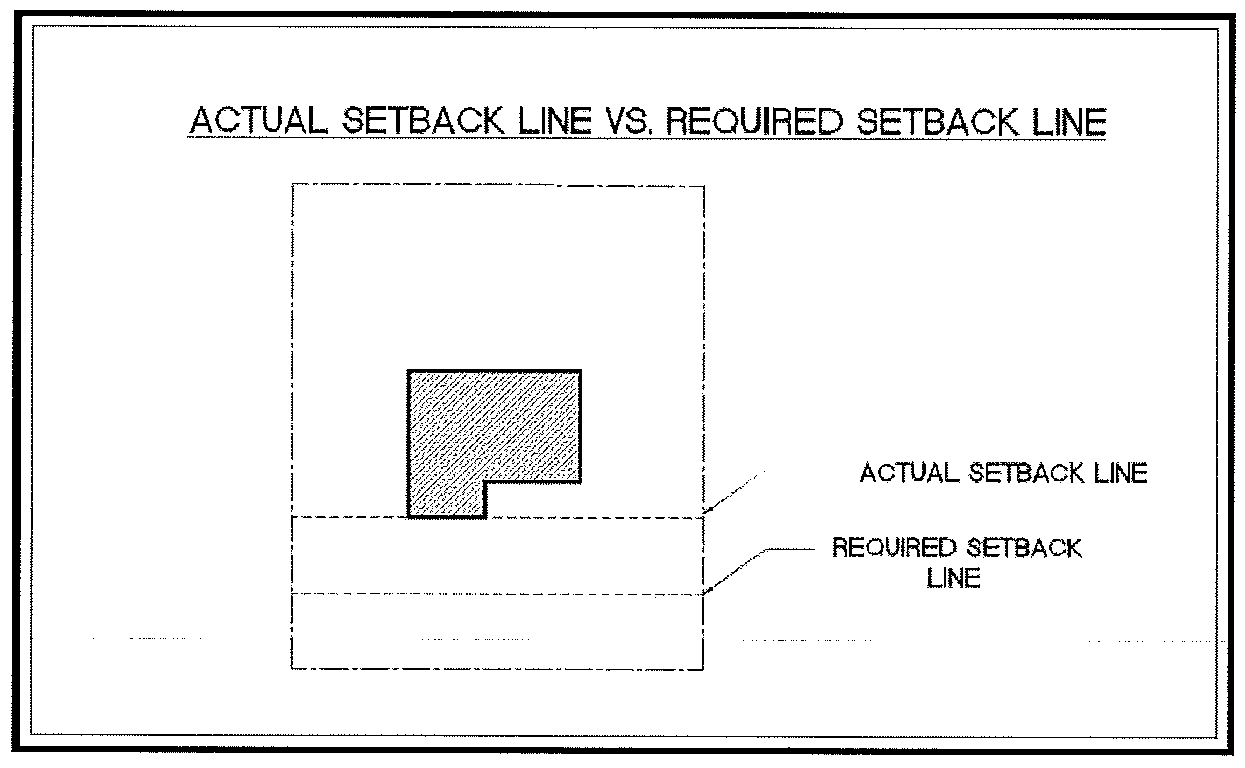
Sign shall mean any object, device, logo, display, or structure, or part thereof, which is intended to advertise, identify, display, direct, or attract attention to a, person, institution, organization, message, business, product, service, event, or location by any means. A sign shall include any banner, bulbs, or other lighting devices, streamer, pennant, balloon, propeller, flag (other than the official flag of any nation, state, or nonprofit organization) and any similar device of any type or kind whether bearing lettering or not. Signs shall not include murals or other artistic works displayed on buildings or structures.
(1)
A-frame or sandwich board. A movable sign not secured or attached to the ground or surface upon which it is located.
(2)
Accessory sign. A sign which is accessory to the principal use of the premises.
(3)
Beacon lights. Search lights, or intensive spotlights directed in an upward direction intended to attract attention to a business, event, or other use.
(4)
Bench sign. A sign located on the seat or back of a bench or seat placed on or adjacent to a public right-of-way.
(5)
Off-premise sign. Any sign which contains a message unrelated to or not advertising a business transacted or goods sold or produced on the premises on which the sign is located; also called a remote sign or non-accessory sign.
(6)
Canopy (awning) sign. A sign that is mounted or painted on, or attached to, an awning or canopy projecting from and supported by the building and extending beyond the building wall, that is otherwise permitted by this chapter.
(7)
Decorative display. A temporary display designated for the entertainment or cultural enrichment of the public and having no direct or indirect sales or advertising.
(8)
Electronic/digital sign. Signs whose alphabetic, pictographic, or symbolic informational content can be changed or altered on a fixed display screen composed of electrically illuminated segments.
(9)
Freestanding sign (pole or pylon). A sign attached to a permanent foundation supported from the ground by one or more poles, posts, or similar uprights, with or without braces, upon which announcements, declarations, displays, etc., may be placed.
(10)
Inflatable sign. A sign consisting of a balloon or other gas or air-filled figure that is not combustible.
(11)
Monument sign. A sign attached to a permanent foundation and not attached or dependent for support from any building, pole, posts, or similar uprights.
(12)
Marquee sign. A sign attached to or hung from a marquee, canopy, or other structure projecting from and supported by the building and extending beyond the building wall.
(13)
Portable sign. Any sign not permanently attached to the ground or other permanent structure, or a sign designed to be transported, including, but not limited to, signs designed to be transported by means of wheels; sign converted to a- or t-frames; menus and sandwich board signs; balloons used as signs; umbrellas used for advertising; and signs attached to or painted on vehicles parked and visible from the public right-of-way, unless said vehicle is used in the normal day-to-day operations of the business.
(14)
Projecting sign. A sign which is affixed to any building or structure other than a marquee, and any part of which extends beyond the building wall and the horizontal sign surface is not parallel to the building wall.
(15)
Roof sign. A sign which is erected, constructed, and maintained above any portion of the roof or exterior wall of a building or structure, and for purposes of this chapter, roof signs shall be prohibited.
(16)
Residential subdivision sign. A permanent monument sign marking the entrance to a residential platted subdivision or condominium subdivision.
(17)
Temporary sign. A sign, banner, or other advertising device constructed of cloth, canvas, fabric, plastic, or other light temporary material, with or without a structural frame, or any other sign, intended for a limited period of display.
(18)
Wall sign. A sign which is attached directly to a building wall with the horizontal sign surface parallel to the building wall, including signs painted on any building wall. Wall signs shall not project above the roof or parapet line and may not project more than one foot beyond the face of the building wall.
(19)
Window sign. A sign, either permanent or temporary and/or illuminated or non-illuminated, placed in the window area of any use located in a nonresidential district.
Sign area shall be computed as including the entire area within a regular geometric form or combination of such forms comprising all the display area of the sign and including all the elements of the matter displayed. An area so created shall include all solid surfaces, as well as all openings. Structural members not bearing copy of display material shall not be included in computation of sign area. Where a sign has two or more faces, the area of all faces shall be included in determining the area of the sign, except that where two such faces are placed back-to-back, parallel to one another, and less than 24 inches apart, the area of the sign shall be the area of one face. Where a sign has two or more faces, that portion of the sign structure connecting the sign faces shall not be used for display purposes. Signs painted on a wall are also regulated by the provisions of this chapter. See figure 2-6. (Refer also to section 153.905(1). nonconforming uses of structures and land.)
Figure 2-6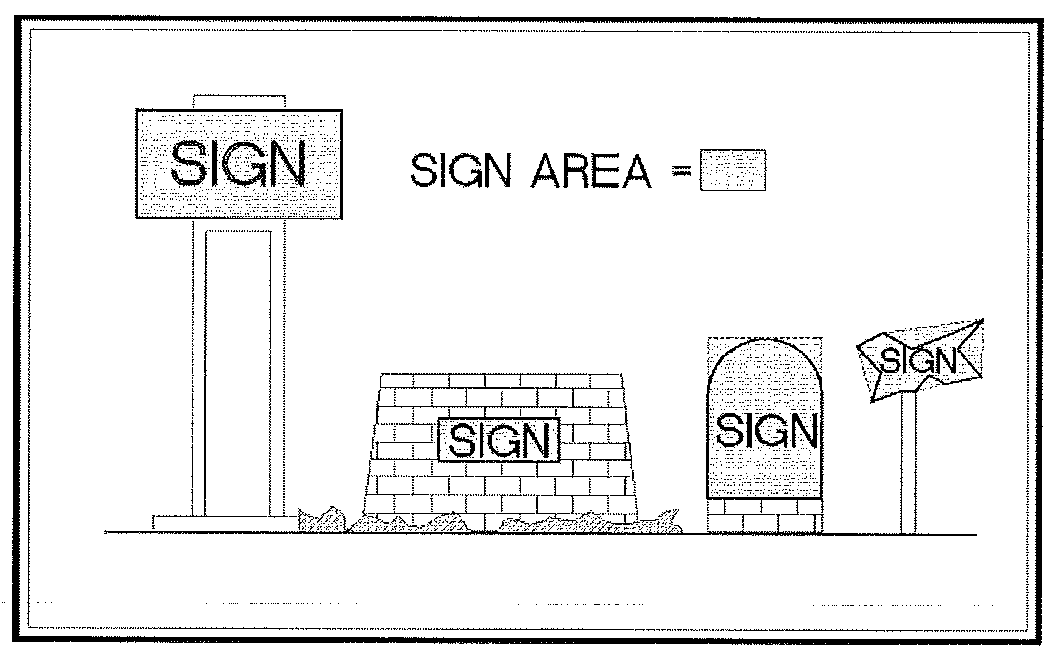
Sign height shall be computed as the distance from the base of the sign at normal grade to the top of the highest attached component of the sign. Normal grade shall be construed to be the lower of: 1) existing grade prior to construction; or, 2) the newly established grade after construction, exclusive of any filling, berming, mounding, or excavating solely for the purpose of locating the sign. In cases in which the normal grade cannot reasonably be determined, sign height shall be computed on the assumption that the elevation of the normal grade at the base of the sign is equal to the elevation of the nearest point of the crown of a public street or the grade of the land at the principal entrance to the principal structure on the zoning lot, whichever is lower. The sign shall be non-moving. See figure 2-7.
Figure 2-7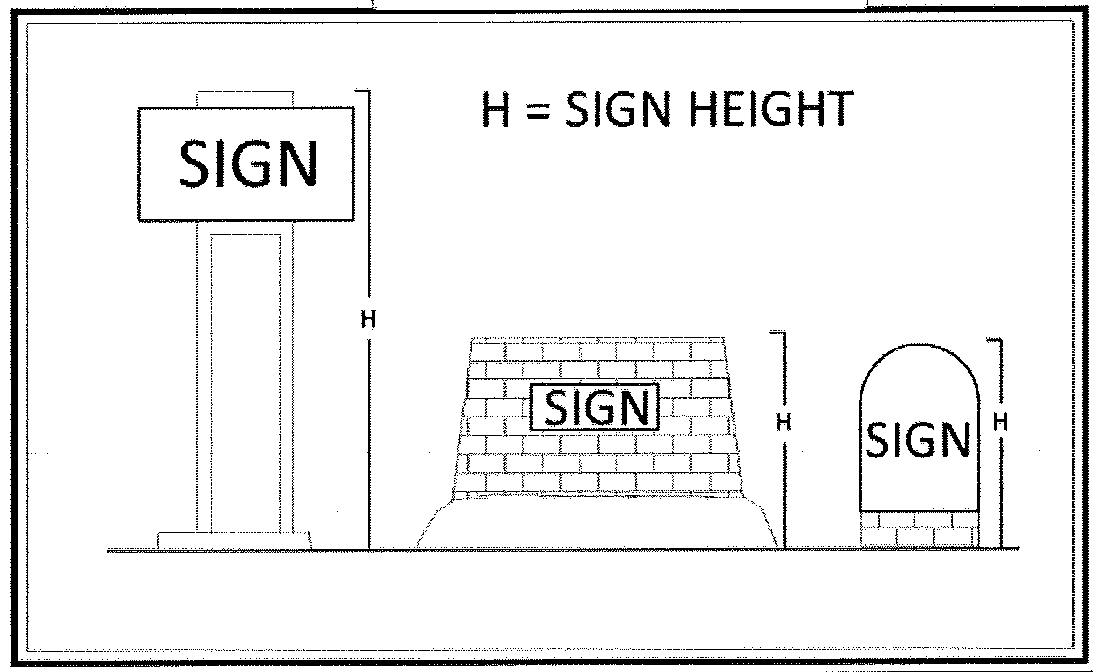
Site plan means the documents and drawings required by this chapter to ensure that proposed land use or activity is in compliance with the City of Flushing Zoning and other ordinances and state and federal statutes.
Special use means any use of land listed as a Principal Use Permitted Subject to Special Conditions which, due to its potential effect on adjacent lands, in particular, and the overall city in general, requires approval by the planning commission according to the standards as provided in this chapter.
Story means that part of a building, except a mezzanine as defined herein, included between the surface of one floor and the surface of the next floor, or if there is no floor above, then the ceiling next above. A basement shall not be counted as a story.
Story, half means an uppermost story lying under a sloping roof having an area of at least 200 square feet with a clear height of seven feet. For the purposes of this chapter, the usable floor area is only that area having at least five feet clear height between floor and ceiling.
Street means a public dedicated right-of-way, other than an alley, which affords the principal means of vehicular access to abutting property including emergency response vehicles.
Structure means anything constructed or erected, the use of which requires location on the ground or attachment to something having location on the ground.
Subdivision means the partitioning or splitting of a parcel or tract of land by the proprietor thereof or by their heirs, executors, administrators, legal representatives, successors, or assigns for the purpose of sale, or lease of more than one year, or of building development that results in one or more parcels of less than 40 acres or the equivalent, and that is not exempted from the platting requirements of the Land Division Act, Public Act No. 288 of 1967, as amended.
Swimming pool means any constructed or portable pool, used for swimming or bathing over 24 inches in depth, a diameter exceeding 12 feet or with a surface area exceeding 160 square feet.
T
Temporary use or temporary building means a use or building permitted by the planning commission, or this chapter, to exist during a specified period of time.
Tent means a moveable shelter made of canvas, skins, or other flexible materials supported by pole(s) or other framework. A tent is used exclusively for temporary purposes approved by the city planning commission or zoning administrator as allowed by this chapter for certain functions.
U
Underground storage tank means any one or combination of tanks (including underground pipes connected thereto) which is used to contain an accumulation of regulated substances and the volume of which (including the volume of underground pipes connected thereto) is ten percent or more beneath the surface of the ground. Flow-through process tanks are excluded from the definition of underground storage tanks.
Underlying zone means the zoning as it exists under the overlay zone.
Undeveloped state means a natural state preserving natural resources, natural features scenic or wooded conditions, agricultural use, open space, or a similar use or condition. Land in an undeveloped state does not include a golf course, but may include a recreational trail, picnic area, children's play area, greenway, or linear park. Land in an undeveloped state may be, but is not required to be, dedicated to the use of the public.
Use means the purposes, for which land or a building is arranged, designed or intended, or for which land or a building is or may be occupied.
V
Variance means permission to depart from the literal requirements of this chapter.
Variance, nonuse means a departure from the provisions of this chapter relating to setbacks, side yards, frontage requirements, lot size, parking, signage, and other requirements of the applicable zoning district.
W
Wall, obscuring means a structure of definite height and location to serve as an obscuring screen in carrying out the requirements of this chapter.
X
Reserved, currently no definition pertaining to this chapter.
Y
Yards means the open spaces on the same lot with a main building that is unoccupied and unobstructed from the ground upward except as otherwise provided in this chapter, and as defined herein (see figure 2-8):
(1)
Front yard. An open space extending the full width of the lot, the depth of which is the minimum horizontal distance between the front lot line and the nearest point of the main building. In the case of corner lots, front yard shall be deemed to exist along each street frontage.
(2)
Rear yard. An open space extending the full width of the lot, the depth of which is the minimum horizontal distance between the rear lot line and the nearest point of the main building. In the case of a corner lot, the rear yard may be opposite either street frontage.
(3)
Side yard. An open space between a main building and the side lot line, extending from the front yard to the rear yard, the width of which is the horizontal distance from the nearest point on the side lot line to the nearest point of the main building.
Figure 2-8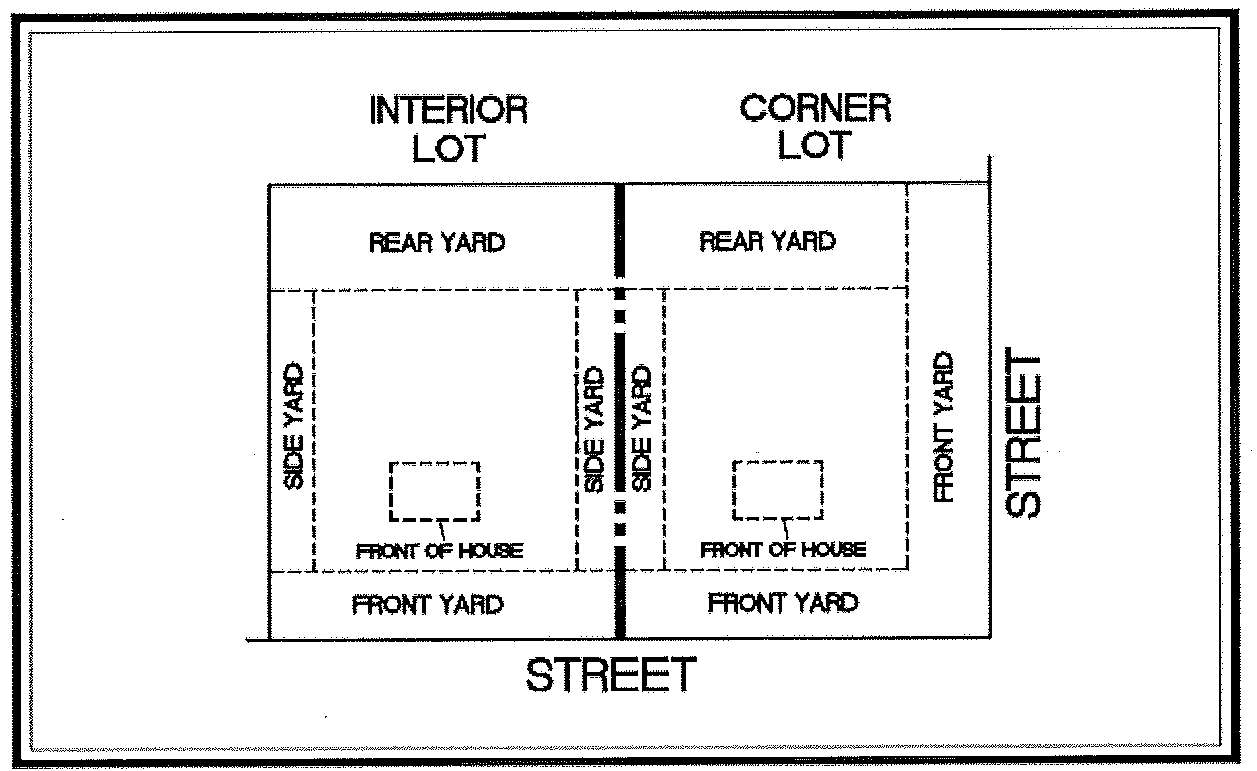
Z
Zoning board of appeals means the City of Flushing zoning board of appeals created under the Michigan Zoning Enabling Act, Public Act 110 of 2006, as amended.
Zoning district means a zoning district is a portion of the city within which, on a uniform basis, certain uses of land and buildings are permitted, and within which contain yard, open spaces, lot area, and other requirements are established by this chapter.
Zoning jurisdiction means the area encompassed by the legal boundaries of the City of Flushing.
Zoning official (administrator) means the administrative official designated by the City of Flushing administrator with the responsibilities of administering and enforcing this chapter.
Zoning permit means a written approval by the zoning administrator that is required before obtaining a building permit to commence construction, reconstruction, or alteration of any building or structures.
(Ord. No. 2025-01, 1-13-2025)

