
Forest City City Zoning Code
CHAPTER 10
- INFRASTRUCTURE
10.1 - Street Standards.
10.1.1 Conformance with Comprehensive Transportation Plan (CTP).
The location and design of streets shall be in conformance with Rural Planning Organization's Comprehensive Transportation Plan. In any case where any part of a development lies within the corridor of a thoroughfare shown on a roadway corridor official map adopted pursuant to NCGS Chapter 136, Article 2E, no development approval shall be granted with respect to the property in the roadway corridor. Provided, however, no development plat approval shall be delayed by the provision of the roadway corridor official map procedure for more than three (3) years from the date of its original submittal.
10.1.2 General Provisions.
(A)
The Town has adopted North Carolina Department of Transportation (NCDOT) construction standards. Unless otherwise specified in this Ordinance, street design criteria shall meet the standards in the latest published edition of NCDOT's Subdivision Roads Minimum Construction Standards.
(B)
For Traditional Neighborhood Developments (TND), the latest published edition of the NCDOT Division of Highways Traditional Neighborhood Development Guidelines shall be followed. In the absence of TND specific design guidelines, the criteria of the Subdivision Roads Minimum Construction Standards shall be followed.
(C)
All proposed streets shall be graded to the full width of the right-of-way and improved with a pavement width and standard curb and gutter and storm drainage section as required for the particular classification of street. All grading, pavement and curb and gutter shall be designed and installed in accordance with Town standards and the approved construction documents. Where bridges are required, such shall be installed to fit the cross-section of the street classification. In addition, street paving and curb and gutter and storm drainage, in accordance with the above conditions, shall be installed in the following situations:
(1)
Any existing street segment that has not been accepted for maintenance by either the Town or the NCDOT, and that is to serve as the required frontage for one (1) or more lots created pursuant to these regulations, shall be improved and dedicated to the public, as provided for above, in such a way that the street segment meets the standards of these regulations for the particular classification of street, including right-of-way width. Such street segment shall be directly connected to the existing public street system by way of at least one (1) public street accepted for maintenance by either the Town or the NCDOT. No development shall be permitted on any street that is an island not connected directly to the public street system.
(2)
Where a development fronts on any existing street segment maintained by either the Town or the NCDOT and the street does not meet the minimum standards of these regulations for the classification of street, the developer shall improve the portion of street adjoining the development to meet the minimum standards including construction and width. When the development adjoins only one (1) side of an existing street, one-half (½) of the minimum right-of-way shall be provided, measured from the centerline of the street.
(3)
The Town Board of Commissioners may require pavement and widening or pavement and widening and curb and gutter and storm drainage for turning lanes along any street that forms a significant entrance to a proposed development where in the opinion of the Town Board of Commissioners such improvements are necessary in order to provide for safe vehicular movement into and out of the proposed development.
(4)
Where a street is stubbed into adjoining property for future extension and such street serves as the frontage for one (1) or more lots, which are not corner lots, the Town Board of Commissioners may require the pavement of a temporary turn-around in a form similar to a cul-de-sac on such street where in the Town Board of Commissioners opinion such turnaround is necessary for the public convenience, safety and service.
(5)
Private streets where permitted shall be constructed to NCDOT standards for paved residential streets in a 50 foot right-of-way. Curb and gutter is not required. Private streets where provided shall be subject to an owners ssociation agreement that provides for assessment for maintenance.
10.1.3 Street Design.
(A)
Street Design Criteria by Street Type.
* Add a minimum of eight (8) feet of pavement width for any street with on-street parking.
FIGURE 10.1: RECOMMENDED LOCAL STREET SECTION
(with on-street parking)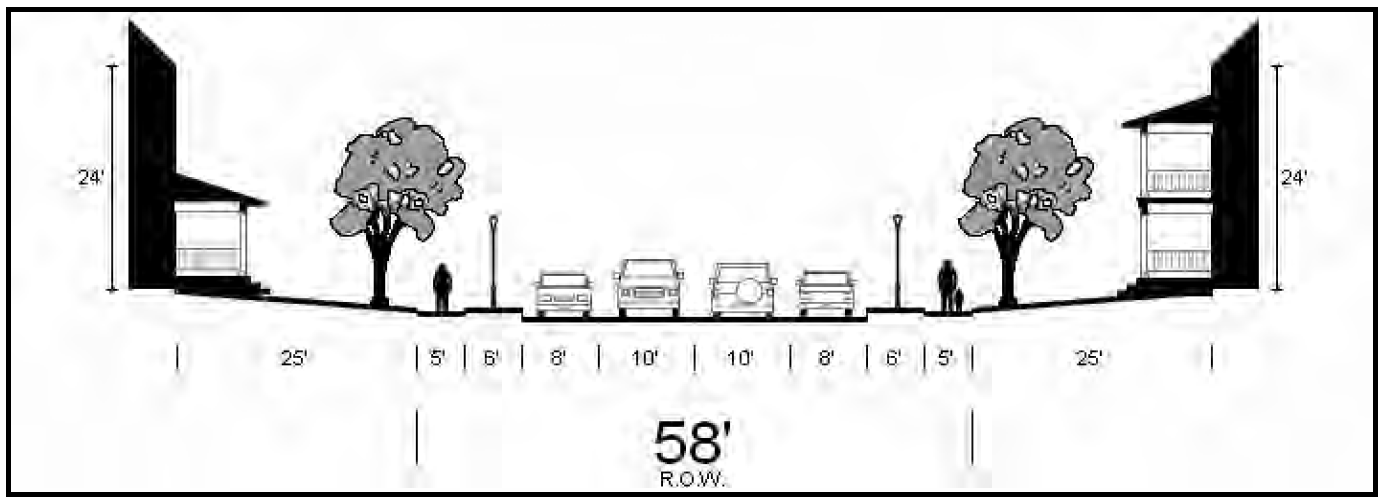
(not on-street parking)
This cross section should only be used for lots with a minimum of three (3) on-site parking spaces.
FIGURE 10.2: RECOMMENDED ALLEY SECTION
(Two-way)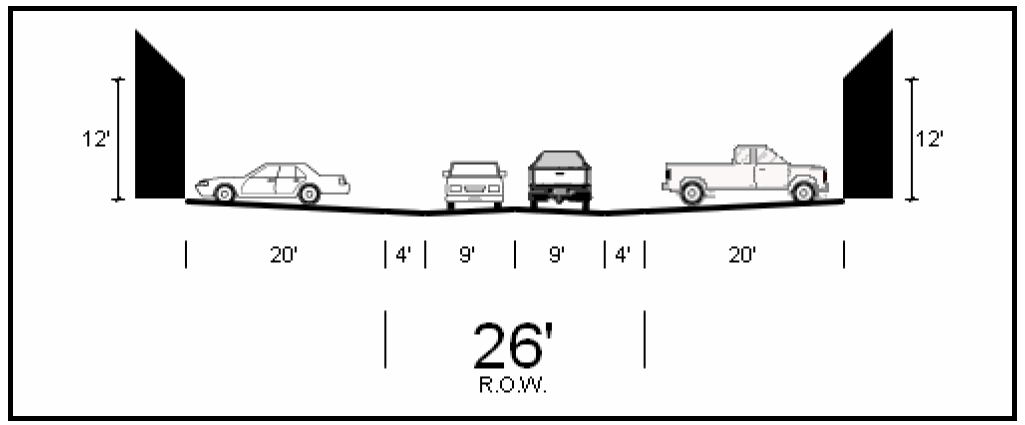
(One-way)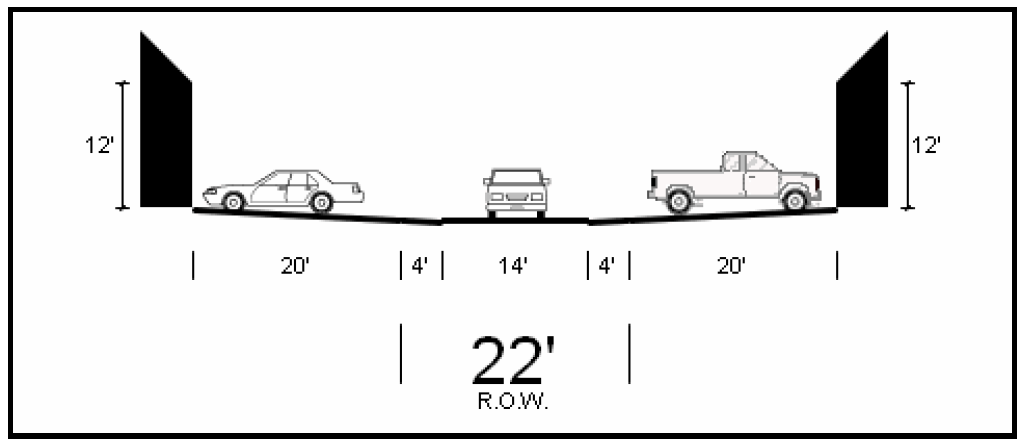
(B)
Street Grades.
(1)
Street grades shall be not more than 12 percent (12%) nor less than [one]-half of one percent (½%).
(2)
Grades approaching intersections shall not exceed five percent (5%) for a distance of not less than 100 feet from the centerline of said intersection.
(C)
Horizontal Curves. Where a centerline deflection angle of more than 10 degrees occurs, a circular curve shall be introduced, having a centerline radius of not less than the following:
(1)
Major and Minor Arterials Streets: 300 ft.
(2)
Collector Streets: 200 ft.
(3)
Local Streets: 100 ft.
(D)
Vertical Curves. All vertical curves shall have such length as necessary to provide safe sight distance and a gradual change in grade.
(E)
Tangents. A tangent of at least 100 feet shall be provided between curves on all streets.
(F)
Curb and Gutter. Curb and gutter is required along all new streets. The minimum width for vertical curb and gutter is two feet six inches (2'-6") and for valley curb and gutter is two feet (2'-0"). Minimum turning radius for residential curb cuts is two feet (2'-0'') and for commercial curb cuts is five feet (5'-0").
FIGURE 10.3: VERTICAL CURB AND GUTTER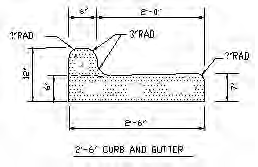
FIGURE 10.4: VALLEY CURB AND GUTTER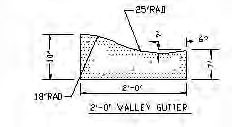
FIGURE 10.5: DRIVEWAY CUTS IN CURB AND GUTTER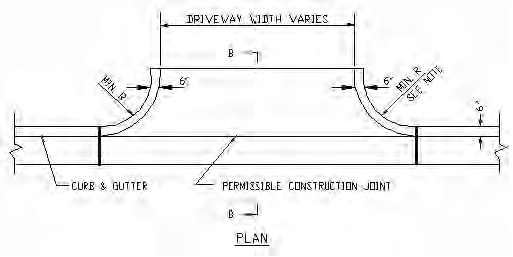
Min. 2'-0"
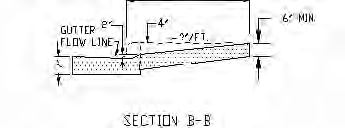
FIGURE 10.6: CURB AND GUTTER TRANSITION AT CUL-DE-SAC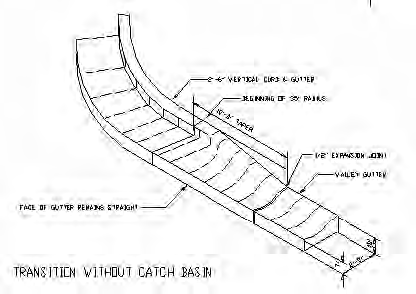
(G)
Sidewalks.
(1)
Sidewalks shall be provided along the frontage street and at least on one (1) side of the new streets for all developments.
(2)
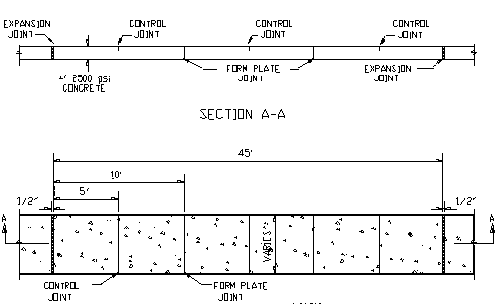
Sidewalks shall be at least five (5) feet wide and shall be separated from the street by a minimum four (4) foot buffer. The minimum thickness of the concrete shall be four (4) inches. At vehicular traffic areas such as driveways the minimum thickness shall be six (6) inches. Also poured in place dummy joints shall be installed to match the width and expansion joints every 20 feet.
FIGURE 10.7: SIDEWALK DETAILS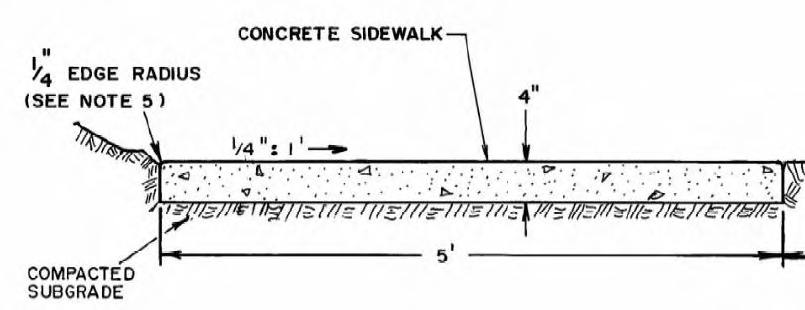
10.1.4 Access Management and Connectivity.
New streets shall be designed in relationship to adjoining property and land uses. Except where the Board of Commissioners determines that a different scheme is more appropriate, the proposed street system shall extend existing and projected streets at no less than the required minimum width for the classification of the street and shall be in conformance with the following criteria:
(A)
Street Classification. All streets within and adjoining the development shall be classified according to function by the Board of Commissioners. Each street segment shall be classified in accordance with the Schedule of Street Classifications contained in the Appendix of these regulations and as defined herein. The classification of a street segment shall determine the cross-section and design standard to which that street segment shall be designed and constructed. Street design standards for each street classification are shown in the appendix. Street and roadway drainage system construction shall be in acceptance with North Carolina Department of Transportation standards.
(B)
Connection to Adjoining Property. Proposed streets shall be extended to the boundary of the development for connection to existing streets on the boundary of adjoining property or for future connection. Cul-de-sacs shall not be used to avoid connection with an existing street to avoid the extension of a thoroughfare or collector street, or to avoid connection to adjoining property. In general, cul-de-sacs shall not be used to provide access to development on the boundary of the development. Cul-de-sacs shall not exceed 800 feet in length unless necessitated by topography or property accessibility and specifically approved by the Board of Commissioners. Measurement shall be from the point where the centerline of the dead end street intersects with the centerline of a general circulation street to the center of the turnaround of the cul-de-sac. Where one cul-de-sac extends from another cul-de-sac, the end of each cul-de-sac shall be no more than 800 feet from a general circulation street as measured by the centerline of the streets.
(C)
Connection to State Streets. An approved NCDOT permit is required to connect to any existing state system street.
(D)
Restriction of Access. Where a development abuts or contains an existing or proposed thoroughfare, the Town Board may require marginal access streets, reverse frontage or such other treatment, as may be necessary for adequate separation of through and local traffic.
(E)
Reserve Strips, Half Streets and Private Streets. Reserve strips and non-access easements adjoining street rights-of-way for the purpose of preventing access to or from adjacent property (except those required by the Town Board to prevent access to thoroughfares) and half-streets shall not be permitted under any condition. Private streets are not permitted.
(F)
Secondary Access. At least two (2) entry points, constructed to NCDOT road standards, shall be provided in developments that contain 100 or more dwelling units and to all lots within the development. Alternatives may be allowed by the Town Board if the curb cuts for the two (2) accesses cannot meet the minimum distance allowed according to NCDOT regulations at any location.
(G)
Fire Access. For developments of greater than 30 lots, a minimum 30 foot secondary access easement is required for Fire Department access. The easement shall be cleared so that a fire truck may pass, but does not have to be improved to public road standards.
(H)
Street Alignment and Separation.
(1)
Streets shall be designed so as to intersect as nearly as possible at right angles, and no street shall intersect any other street at an angle of less than 60 degrees. Streets crossing natural areas or streams shall cross at or near to right angles as possible within limits of topographic conditions. Offset intersections shall be avoided. A minimum intersection offset of 200 feet shall be maintained. See Subsection (3) for more detailed intersection offset requirements.
(2)
Median breaks shall be provided to allow safe and efficient movement of traffic. The desirable spacing of median breaks shall be at 1,000 foot intervals, with the minimum allowable spacing to be at 500 foot intervals.
(3)
Intersections of roadways controlled by a traffic signal should be spaced along roadways at the following intervals:
(4)
Four-legged intersections not controlled by a traffic signal should be spaced along roadways at the following intervals:
(5)
Three legged intersections not controlled by a traffic signal should be spaced along roadways at the following intervals:
(I)
Culs-de-sac.
(1)
A cul-de-sac with a minimum 40-foot radius right-of-way and 30-foot radius pavement surface is required for all dead end streets.
(2)
Permanent dead end streets shall not exceed 800 feet in length unless necessitated by topography or property accessibility.
(3)
If the road length does not exceed 300 feet and if construction difficulties will not permit a turnaround, the use of "Y" or a "T" or other turning space of a design which will allow a vehicle with a wheel base of at least 20 feet to complete a turning movement with a maximum of one (1) backing movement, may be permitted if approved by the Town Board.
10.1.5 Street Names and Signs.
(A)
Proposed streets, which are obviously in alignment with others already existing and named, shall bear the names of existing streets. In no case shall the name for proposed streets duplicate or be phonetically similar to existing street names, irrespective of the use of suffix street, avenue, boulevard, driveway, place, or court.
(B)
Standard street name signs will be installed by the Town at all intersections in accordance with Town standards. The developer may, however, with the approval of the Board of Commissioners of design and material, install a different street name sign type at no cost to the Town. In such case, the developer or his successors or assignees shall be responsible for replacing such signs in instances of loss, damage or deterioration; otherwise, the Town will replace such signs with its standard sign. Outside the Town limits the developer shall be responsible for installing street name signs at all intersections in accordance with NCDOT standards.
(C)
Street names shall be submitted to and approved by Rutherford County E-911 Addressing.
(D)
In no case shall the name of a proposed development or street duplicate or be phonetically similar to existing development names or street names, irrespective of the use of suffix street, avenue, boulevard, driveway, place, or court.
10.1.6 Traffic Control Signs, Signals and Markings.
Traffic control signs, signals and markings will be installed by the Town in accordance with Town standards and specifications inside the Town. Outside the Town the developer shall be responsible for installing such facilities in accordance with NCDOT standards and specifications.
10.1.7 Development Entrance Markers and Landscaped Medians.
The Town Board may permit development entrance markers and landscaped medians within the public right-of-way subject to the following conditions and any additional conditions the Town Board may find to be appropriate in the individual circumstance:
(1)
The Town will not be responsible for maintenance.
(2)
An entity responsible for maintenance shall be created.
(3)
No such improvements shall interfere with sight distance or with normal maintenance requirements or otherwise pose a hazard to vehicular or pedestrian traffic.
(4)
In the event of loss, damage or lack of maintenance, the Town may remove all improvement and maintain the area in accordance with Town standards.
(5)
NCDOT must approve any such developments in streets to be maintained by NCDOT.
10.1.8 Construction in Public Right-of-Way and Easements.
The design and construction of any facilities whether required or provided, within public right-of-way and easements shall be in accordance with Town design and construction standards.
10.1.9 Right-of-Way Dedication.
Proposed developments that adjoin existing streets maintained by either the Town or NCDOT shall dedicate the additional street right-of-way necessary to meet the minimum width requirements for the type of classification of the adjoining street. When any part of the development is on both sides of an existing street, the entire minimum right-of-way shall be provided. When the development is located on only one (1) side of an existing street, one-half (½) of the minimum right-of-way, measured from the centerline of the existing street, shall be provided. The dedication requirements of this Section shall not apply to infill single-family residential and two-family residential lots fronting on existing streets that have already been accepted for maintenance by the Town or NCDOT.
(Ord. of 6-20-16(2))
10.2 - Utility Standards.
10.2.1 Water and Sanitary Sewer Systems.
(A)
All developments shall be designed to provide Town water and sewer or meet Health Department requirements for on-site systems where Town services are not available. Water and sewer system shall be designed in accordance with Town standards. The developer shall be responsible for obtaining all necessary permits and approvals.
(B)
The Town may, in order to serve future development, require the developer to install certain oversized water and sewer improvements and/or to increase such improvements to a size and/or extend beyond that necessary for the needs created by a non-residential development. In such cases, the Town shall enter into an agreement to reimburse the developer for the oversizing and/or extension based upon rates as agreed to by the Town.
(C)
All waterline extensions must be constructed according to the latest edition of Title 15A.18C "Rules Governing Public Water Systems." All sewer extensions must be constructed according to the latest edition of Title 15A.2T "Minimum Design Criteria for the Permitting of Gravity Sewers". All pump stations and force mains must be constructed in accordance with Title 15A.2T "Minimum Design Criteria for Permitting of Pump Stations and Force Mains".
(D)
All proposed water and sewer facilities are subject to the review and approval of the Town's consulting engineer prior to the application for a permit from the correct permitting authority.
(E)
If substandard water and sewer services are within the immediate vicinity of the project and would require extending or accessing these facilities for the purpose of the development, then the developer is responsible for upgrading the facilities at no additional expense to the Town to meet the minimum design standards,
(F)
Any development, which has public water system lines available, shall be required to extend the public water system throughout the development to each lot located therein. All required water line extensions shall include appropriate valves, hydrants, taps and service to the property line of each lot as required by the standards of the Town. All required sewer line extensions shall include appropriate manholes, lift stations pumps, clean outs, taps and service to the property line of each lot as required by the standards of the Town.
(1)
For developments within or partially within the Town, the term "available" shall mean that there is an existing water line of adequate size and water flow and/or pressure either crossing the development property or immediately available from an adjacent public right-of-way or the town indicates its commitment to extend such a water line to the property line of the development at no cost to the developer.
(2)
For developments located entirely outside the boundaries of the Town but within the jurisdiction of this Chapter, the term "available" shall mean that there is an existing water line of adequate size and water flow and/or pressure within the distances shown on the Table below of the outside boundary line of the development or the Town indicates its commitment to extend such a water line within the distances shown on the Table below of the property line of the development at no cost to the developer and there are no legal or topographic problems which prevent the developer from connecting onto and extending the existing system to the development. In the event there are phases to the development or else the development is a part of a larger tract of land owned or under the control of the developer, then, and in that event, public water service shall be deemed to be available if an existing or proposed public water system line extends or will be extended within the distances shown on the Table below to the larger tract of the land.
(3)
In the event the Town elects not to extend a water line of sufficient size, flow and/or pressure, to the development (if in the Town) or within the distance shown on the Table below of the development boundary (if outside the Town) because of topographic features, legal obstacles, or financial reasons, then, the developer shall not be required to extend water lines to each lot nor provide water service to the development.
(4)
In any case where a water or sewer system intended to serve more than two (2) lots is proposed to be installed in a development as part of the plan approval process, such system shall be considered to be a "Required Improvement" within the context of this Article regardless of whether such a system is an extension of the Town system or not and such system shall be required to be installed by the developer. This requirement includes both facilities within the development and off-site facilities, which are essential to providing the service to the property.
10.2.2 Utility Location.
(A)
Utilities shall be located as depicted below within the right-of-way. All electrical and telephone lines in new developments shall be buried. Sewer lines shall be located under the street pavement as approved by the Public Works Department. Lines shall be buried to the depth required by Public Works or the utility provider.
FIGURE 10.8: UTILITY LOCATION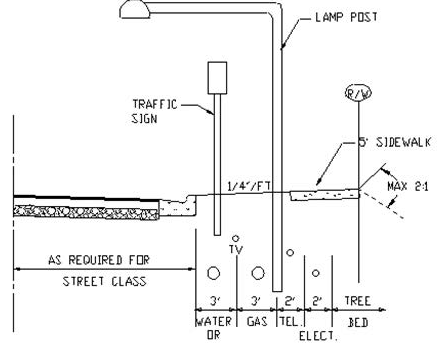
(B)
Utility pedestals shall be located minimum of two (2) feet behind the sidewalk and near property lines between buildings and shall be screened with a wall, fence, or evergreen landscaping.
(C)
To provide for electric, telephone and gas service, community antenna television distribution systems, water and sewer lines and other such facilities within the subdivision, appropriate utility easements not less than 20 feet shall be provided on the final plat. The locations of such easements shall be based upon the approved construction plans. All subdivision plats shall have a note stating that all lot lines shall be subject to a 10 foot utility easement centered on the lot line. All utilities and wire services shall be placed underground. The developer shall be responsible for incorporating the design of all utilities and services into the easement and construction design.
(D)
All utilities located outside of the public right-of-way shall require a 20 foot easement centered on the utility line. No structures or retaining wall shall be allowed within this easement. The Town may require a developer to reserve a 20 foot utility easement for the purpose of extending sewer to adjacent properties at a location specified by the Town's consulting engineer.
10.2.3 Lighting.
(A)
Applicability. The provisions of this Section shall apply to the installation of all outdoor lighting within the jurisdiction of this Ordinance except that the following shall be exempt from this Section:
(1)
Outdoor lighting installed for governmental purposes by local, state or federal governmental units and their agents.
(2)
Outdoor lighting required to be installed by laws or regulations of a local, state or federal governmental units.
(B)
Prohibited Outdoor Lighting. The following types of outdoor lighting are prohibited unless exempt by Section 10.2.3(A) above:
(1)
Light fixtures that imitate an official highway or traffic control light or sign.
(2)
Light fixtures in the direct line of vision with any traffic control light or sign.
(3)
Light fixtures that have a flashing or intermittent pattern of illumination.
(4)
Privately-owned light fixtures located in the public right-of-way.
(5)
Light fixtures that are a source of glare by their design, orientation or intensity.
(6)
Searchlights.
(7)
Unshielded open vertical light fixtures.
(8)
Light fixtures that violate any law of the State of North Carolina relative to outdoor lighting.
(C)
Plan Approval Required. Outdoor lighting for non-residential developments is subject to approval by the Administrator. The lighting plan shall show sufficient information to determine compliance with the standards of this Section and may require a photometric plan upon determination of the Administrator. In approving lighting plans the Administrator may modify the standards of this Section where the applicant agrees and where equal or better performance would result. In granting modifications, the Administrator may require such conditions as will secure, insofar as practicable, the objectives of the requirements modified.
(D)
Outdoor Lighting Requirements.
(1)
Outdoor lighting fixtures shall be installed in a manner to protect the street and neighboring properties from direct glare or hazardous interference of any kind. Glare or hazardous interference are situations where the sensation produced by luminance within the visual field is sufficiently greater than the luminance to which the eyes are adapted, such as to cause annoyance, discomfort, or loss in visual performance and visibility.
(2)
Outdoor lighting shall be constructed and operated to minimize the spillover of obtrusive light onto property outside the boundaries of the property on which the lighting is sited which could result in annoyance, discomfort or distraction to persons on the other property.
(3)
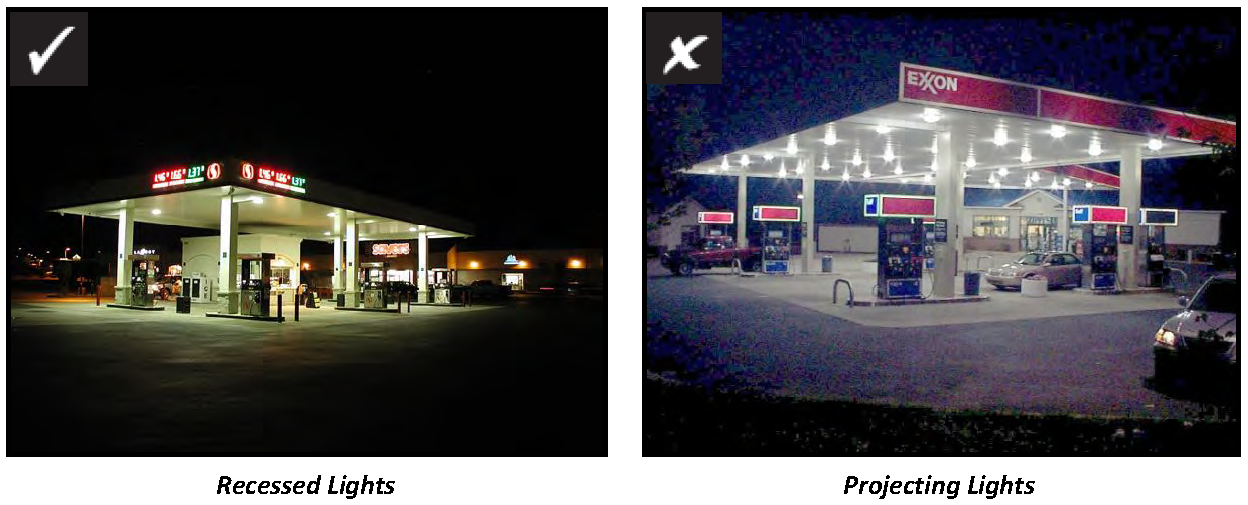
Gas station canopy lights should be recessed into the canopy to minimize light spillover.
(4)
All outdoor lighting fixtures, subject to this Section, except for temporary and emergency lighting, that would otherwise cause glare or obtrusive spillover shall be shielded, recessed or otherwise oriented or treated in such a way to prevent glare or obtrusive spill over.
(5)
As a general principle, all outdoor lighting shall be directed downward and away from adjoining property and streets.
(6)
All floodlights shall be installed such that the fixture shall be aimed down at least 45 degrees from vertical, or the front of the fixture is shielded such that no portion of the light bulb extends below the bottom edge of an external shield. Floodlights and display lights shall be positioned such that any such fixture located within 50 feet of a public street right-of-way is mounted and aimed perpendicular to and away from the right-of-way, with a side-to-side horizontal aiming tolerance not to exceed 15 degrees from perpendicular to the right-of-way.
(7)
The mounting height of all outdoor lighting shall not exceed 40 feet above finished grade, except that the mounting height of outdoor sports field and outdoor performance area lighting fixtures shall not exceed 80 feet from finished grade. This shall not apply to publicly owned recreational facilities.
(8)
All light fixtures shall meet the IESNA definition of cutoff fixtures. Forward throw fixtures (Type IV light distribution, as defined by the IESNA) are required within 25 feet of any public street right-of-way. Alternatively, directional fixtures (such as floodlights) may be used provided they shall be aimed and shielded in accordance with this Section.
(9)
Sign lighting shall be regulated in accordance with Chapter 6.
(E)
Street Lighting. The Town will install streetlights at appropriate locations in accordance to Town standards and specifications inside the Town. Where different light standards are proposed the developer shall enter into an agreement with the Town. Outside the Town the developer shall install streetlights at locations and to specifications approved by the Town.
(Ord. of 6-20-16(2))
10.3 - Stormwater Management.
10.3.1 Stormwater System Requirements.
(A)
The developer shall provide a street surface water drainage system constructed to the standards of the NCDOT, as reflected in the latest published edition of Guidelines for Drainage Studies and Hydraulic Design, subject to review by the Town of Forest City engineer or Town appointee.
(B)
Stormwater design shall follow the most recent edition of NCDENR Division of Water Quality Stormwater Best Management Practices.
(C)
Post-development run-off rate shall be the same as pre-development run-off rate. This may be achieved with on-site storm water detention, LID design (as described in the latest published edition of Low Impact Development: A Guidebook for North Carolina) or other methods approved the Town's consulting engineer. Detention facilities shall be designed to maintain the pre-development rate from the one-year, 10-year and 24-hour design storm events.
(D)
The design of storm drainage systems and plans, including calculations, shall clearly indicate the easements and dedicated areas required for the construction and maintenance of the drainage system.
(E)
It shall be the responsibility of the developer to provide a drainage system, which is designed to meet the following objectives:
(1)
No surface water shall be channeled or directed into a sanitary sewer.
(2)
Connect onto an existing storm drainage system, where feasible.
(3)
Where an existing storm drainage system cannot feasibly be extended to the subdivision, a drainage system shall be designed to protect the proposed development and adjacent properties from water damage.
(4)
Provide for adequate drainage from all roads, parking lots and other developed areas.
(5)
Provide a suitable building area on each lot intended for building development, which is safe from inundation, erosion, or subsidence.
(6)
Prevent both the unnecessary impoundment of natural drainage ways and the creation of areas of standing water.
(7)
Ensure the existing drainage ways serving adjacent properties are maintained.
(8)
Ensure that natural runoff levels are not substantially increased in order to prevent harmful flooding downstream and to maintain desirable groundwater levels.
(9)
Protect all roads, driveways, utilities and other types of development from major damages caused by improper drainage control.
(F)
Surface drainage courses shall have side slopes, where feasible, or at least two (2) feet of horizontal distance for each one (1) foot of vertical distance (2:1). Courses should be of sufficient size to accommodate the drainage area and be designed to comply with the standards and specifications for erosion control as required by the North Carolina Sedimentation Pollution Control Act, NCGS 143-34.12, Chapter 113k Article 4, and the North Carolina Administration Code Title 15, Chapter 4, and any locally adopted erosion and sedimentation control ordinance.
(G)
The minimum grade along the bottom of a surface drainage course shall be a vertical fall of at least one (1) foot in each 200 feet of horizontal distance.
(H)
Stream banks and channels downstream from any land disturbing activity shall be protected from increased degradation by accelerated erosion caused by increased velocity of runoff from the land disturbing activity in accordance with the North Carolina Sedimentation Pollution Control Act, NCGS 143.34.12, Chapter 1 13A, Article 4, and the North Carolina Administrative Code Title 15, Chapter 4, and any locally adopted erosion and sedimentation control ordinances.
(I)
Any dam constructed within a subdivision which is greater than 15 feet in height (measured from the lowest point on downstream top of the dam to the highest point on the fill) and is also greater than 10 acre-feet in area (measured from the top of the dam) shall comply with the North Carolina Dam Safety Law of 1967 and the North Carolina Administrative Code Title 15, Subchapter 2K.
10.3.2 Easements.
(A)
Where a development is traversed by a water course, drainage way, channel, or stream, there shall be provided a storm water easement or drainage right-of-way conforming substantially with the lines of such water course, and such further width or construction, or both as may be adequate for the purpose of drainage.
(B)
No fences or structures shall be constructed across an open drainage channel that will reduce or restrict the flow of water. The Administrator may require any water course or stormwater management facility to be located within dedicated a drainage easement officially recorded at the Rutherford County Register of Deeds as a "public storm drainage easement" that provides sufficient width for maintenance.
(C)
Where easements are required, they shall be noted on the Final Plat.
10.3.3 Grading Standards.
The following standards shall be followed in establishing the grading plan for a development:
(A)
No grading shall take place in an undisturbed stream buffer as required by Section 7.3.
(B)
Developments shall be designed and constructed with a positive drainage flow away from buildings and towards approved storm water management facilities. Plans for drainage facilities shall be approved and sealed by a registered Professional Engineer.
(C)
In the design of site grading plans, all impervious surfaces in the proposed development (including off street parking) shall be considered.
(D)
Site grading and drainage facilities shall protect sinkholes, wetlands, ponds and lakes from increased sediment loading.
(E)
All disturbed areas within the dedicated right-of-way and easements of any development street shall be restored with vegetation and the landscaping standards of Chapter 8 shall be met.
(F)
All grading shall meet North Carolina's Sedimentation and Erosion Control standards.
(G)
No grading in the future right-of-way of the Town of Forest City shall exceed one (1) vertical foot for two (2) horizontal feet.
(Ord. of 6-20-16(2))
10.4 - Fire Protection Standards.
(A)
The developer shall install fire hydrants meeting Town standards on all water lines at intervals of 500 feet and on all dead-end lines.
(B)
Multi-family residences and subdivisions (apartments, townhouses, condominiums, etc.) shall require fire hydrants located such that each structure or portion thereof will be within 500 feet of a hydrant.
(C)
Non-residential subdivisions shall require fire hydrants to be located such that each structure or portion thereof will be within 500 feet of a hydrant. This determination shall be made via vehicle access routes, (roadways, fire lanes, etc.) and by hose placement from the firefighting equipment in lieu of linear measurements. Fire hydrants shall be located at the right-of-way and the hydrant shall be located as not to exceed 500 feet between hydrants. When practical hydrants shall be located at street intersections, with intermediate hydrants between intersections, and at entrance drives to the property.
(D)
For any structures that have a sprinkler system or a standpipe system, a fire hydrant shall be located no more than 100 feet from the fire department connection. This hydrant shall be dedicated to the fire department connection and shall be in addition to the hydrants required above. When possible, fire hydrants shall be located a minimum of 50 feet from any structure.
(E)
In proposed subdivisions, where all structures have not been constructed, hydrant spacing shall be measured along the street right-of-way with spacing provided as shown above.
(F)
Dead end water mains shall be provided with a fire hydrant. Water mains serving fire hydrants shall be eight (8) inches diameter minimum. Each phase of a project shall be designed and constructed to provide the minimum number of hydrants necessary to conform with the above requirements upon completion of the phase.
(G)
The determination of distance shall be made via vehicle access routes (roadways, fire lanes, etc.) and by hose placement from the firefighting equipment located adjacent to the fire hydrant in lieu of direct measurements. The distances specified above are meant to reflect the actual length of fire hose which would be laid by the fire department to reach the structure in the event of a fire at or in that structure. Distances shall be measured beginning at the point of the structure farthest from the hydrant, thence along an unobstructed pathway to a point in the centerline of the street, thence along the centerline of the street to a point opposite the hydrant. Unobstructed Pathway means a route which may be taken by firemen in laying fire hose. The unobstructed pathway shall be, and remain, free of trees and shrubs, walls, fences, wells, structures, or other obstacles to the passage of firefighters, hose and equipment for a width of 10 feet and a minimum vertical distance of 13 feet and six (6) inches (13'-6") and shall not be through, under, or over any portion of any structure, ditch or waterway.
(H)
The developer of any new subdivision, subdivision or project, or development, whether it be single or multiple, or whether residential or commercial, is responsible for funding and installing the required fire hydrant(s) and water main to comply with the above requirements.
(Ord. of 6-20-16(2))
10.5 - Garbage and Refuse Collection.
(A)
All nonresidential development shall be required to provide one (1) or more dumpsters for solid waste collection that are:
(1)
Located so as to facilitate collection and minimize any negative impact on persons occupying the development site, neighboring properties, or public rights-of-way;
(2)
Located in the side or rear yard; and
(3)
Screened in accordance with Section 8.6.
(B)
The method of garbage disposal shall be indicated on each Site Plan or Preliminary Plat that is submitted.
(Ord. of 6-20-16(2))
10.6 - Installation of Markers and Monuments.
Prior to the approval of the Final Plat, permanent reference points shall have been placed in accordance with the following requirements:
(A)
In accordance with the "Manual of Practice for Land Surveying" Vol. I, at least one corner of the Development shall be designated by course and distance (tie) from a readily discernible reference marker. If a corner is within 2,000 feet of a U.S. Coast and Geodetic Section or N.C. Grid System coordinated monument, then this corner shall be marked with a monument so designated by computed X and Y coordinates which shall appear on the map with a statement identifying this section or monument to an accuracy of 1:15000. When such a monument or station is not available, the tie shall be made to some pertinent and readily recognizable land mark or identifiable point, physical object or structure.
(B)
Within each block of a development at least two (2) monuments designed and designated as control corners shall be installed. The surveyor shall employ additional monuments if and when required.
(C)
A steel or wrought iron pipe or the equivalent not less than three-fourths (¾) inches in diameter and at least 30 inches in length shall be set at all corners, except those located by monuments.
(D)
Land surveys within the Town limits shall have a maximum error of closure of 1:10000, and beyond the Town limits the maximum error of closure shall be 1:7500.
(Ord. of 6-20-16(2))

