
Forest City City Zoning Code
CHAPTER 9
- PARKING AND DRIVEWAYS
9.1 - Purpose and Applicability.
(A)
The purpose of this Chapter is to ensure that adequate and well-designed parking is provided for developments in the Town of Forest City.
(B)
Unless otherwise specified, the requirements of this Chapter apply to all developments except single-family detached residential and two-family attached residential (duplexes). The expansion of existing development shall follow these requirements to the greatest extent possible.
(Ord. of 6-20-16(2))
9.2 - Off-Street Parking Requirements.
9.2.1 General Provisions.
(A)
All off-street parking areas shall be landscaped in accordance with the regulations in Chapter 8.
(B)
No off-street parking area shall be located over a septic tank field.
(C)
Off-street parking areas shall be properly maintained in all respects. In particular, off-street parking area surfaces shall be kept in good condition (free from potholes, etc.) and parking space lines or markings shall be kept clearly visible and distinct.
(D)
All parking, including for single-family and two-family residential, shall be in designated areas with a durable wearing surface and shall not take place on lawn or landscaped areas.
9.2.2 Parking Lot Design.
(A)
Parking lots shall not be located closer than 10 feet from a public right-of-way.
(B)
Off-street parking areas shall be designed so that parked vehicles do not encroach upon, extend onto, or cause vehicles to back into public rights-of-way, sidewalks or strike against or damage any wall, vegetation, utility, or other structure. Curbs or bumpers are required and shall be a minimum of six (6) inches high.
(C)
Off-street parking areas shall be designed to facilitate adequate movement and access by sanitation, emergency and other public service vehicles.
(D)
No surface parking or circulation driveway is permitted within any required or established buffer area, except that driveways providing access to the parking area may be installed across these areas.
(E)
No new off-street parking area in the C-1, C-T, or C-2 districts shall extend toward a public street right-of-way beyond the front wall of the closest adjacent building. See Figure 9.1.
FIGURE 9.1: PARKING LOCATION IN RELATION TO BUILDINGS IN THE C-1, C-T, AND C-2 DISTRICTS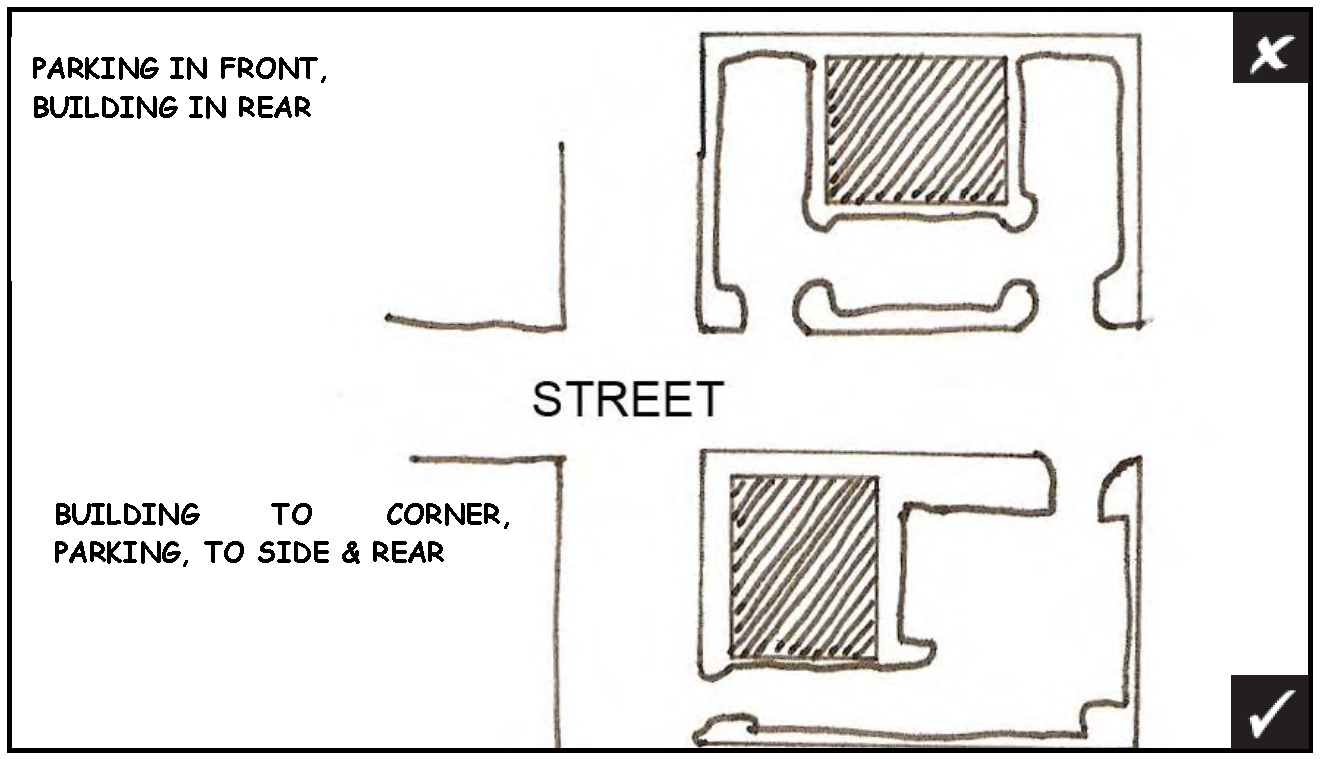
(F)
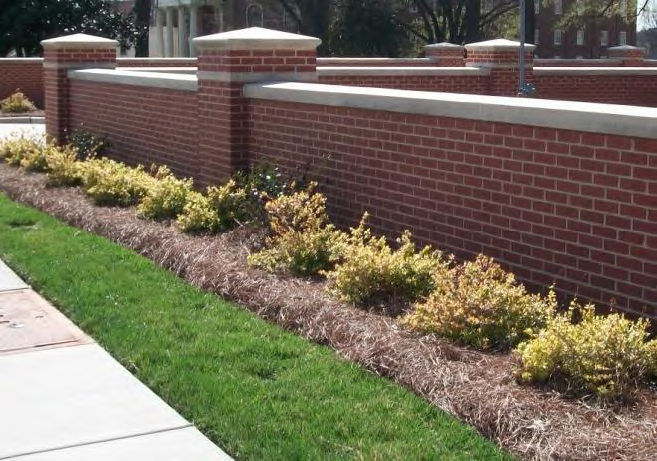
All new or expanding off-street parking areas in the C-1, C-T, and C-2 districts that abut a public street right-of-way shall be screened with a hedgerow or masonry wall of at least three (3) feet in height.
(G)
For non-residential uses (except for civic uses and developments in the Industrial zoning district), a maximum of two (2) rows of parking spaces may be located in the front yard of the principal building. All other parking shall be located in either the rear or side yards of the principal building. For large-scale developments with large parking areas that have more than two (2) rows of parking in front, parking may be shared and screened with outparcel buildings as shown in the figure below:
FIGURE 9.2: EXAMPLE OF PARKING AREA FOR LARGE SCALE DEVELOPMENT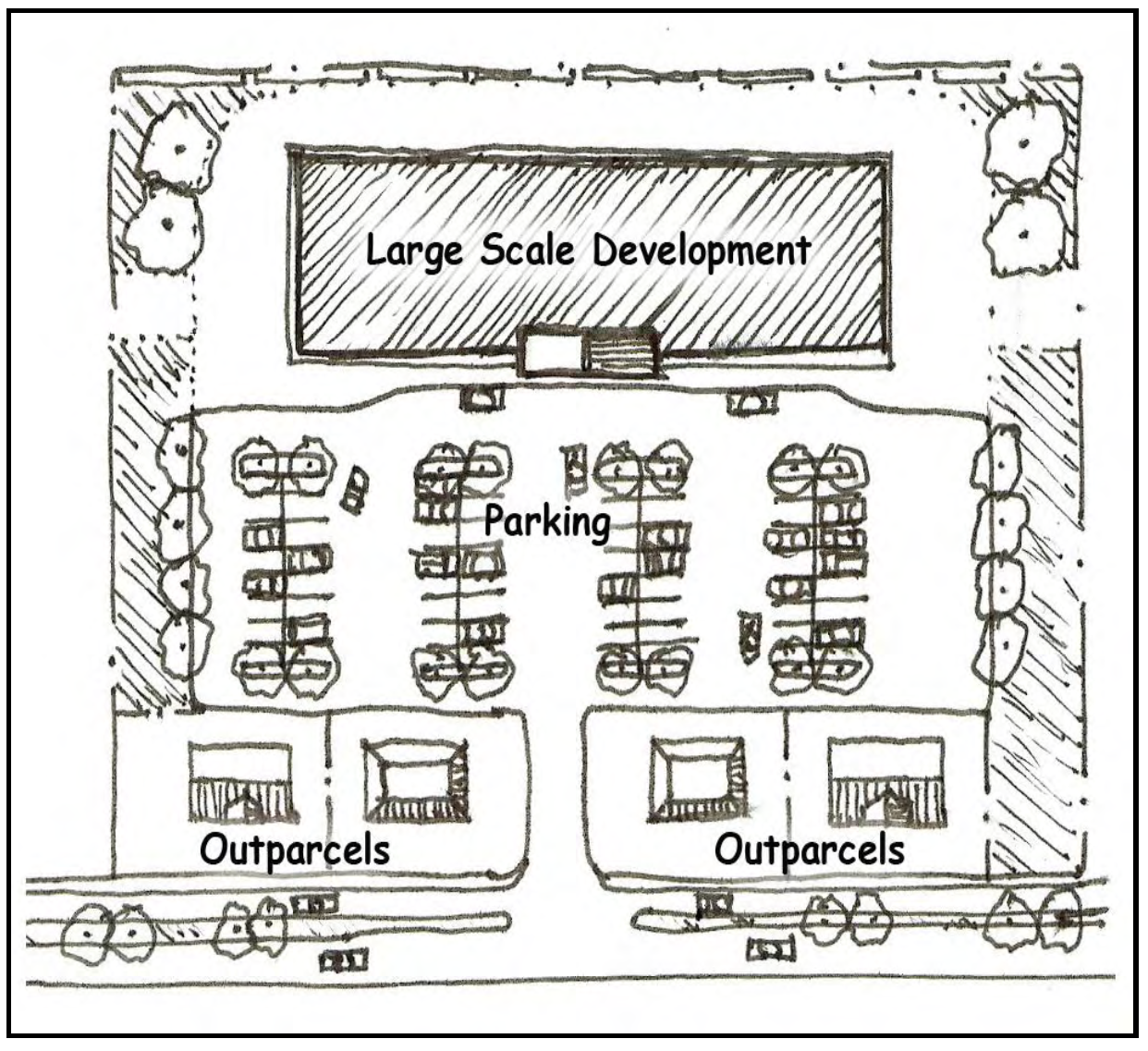
9.2.3 Parking Dimensions.
Parking shall meet the following dimensional requirements:
N/A=Not applicable
FIGURE 9.3: PARKING DIMENSIONS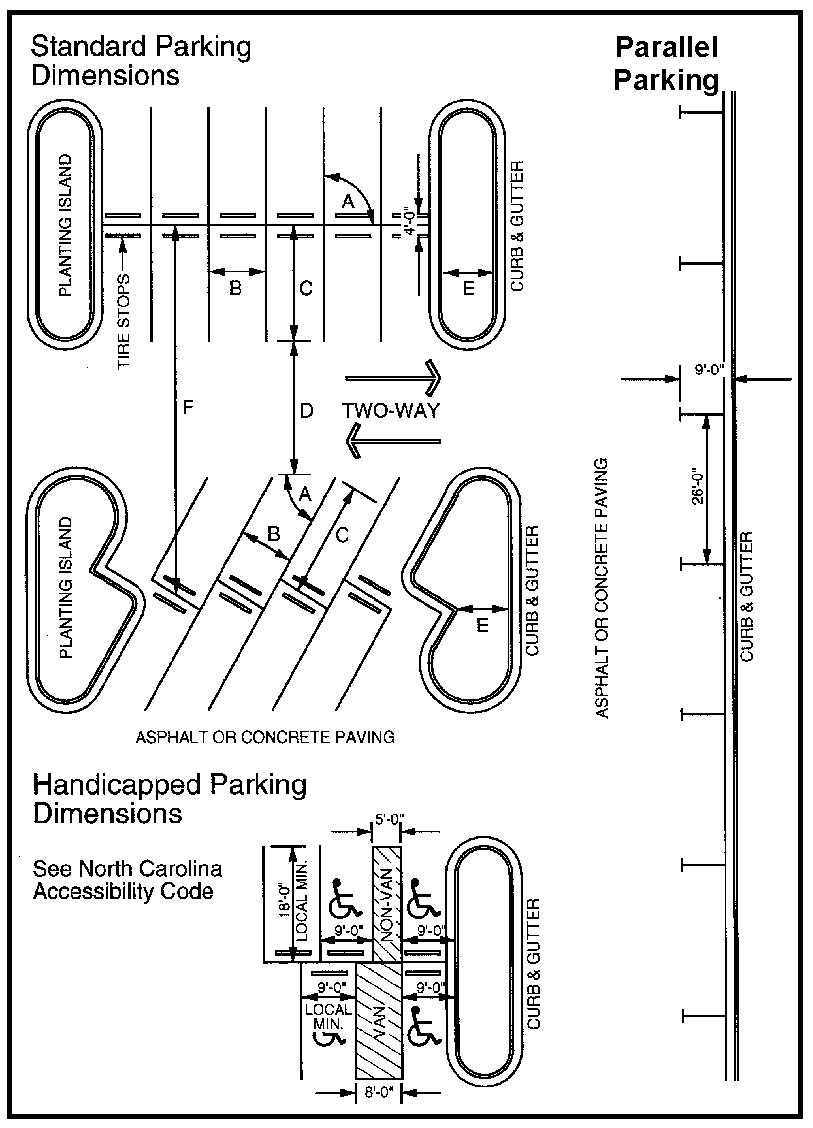
9.2.4 Parking Surface.
(A)
All parking areas (except for single-family and two-family residential uses) shall be paved with asphalt, concrete, pavers or similar paving material and shall be landscaped in accordance with the requirements of Section 8.3.2.
(B)
All paved parking areas a minimum of four (4) inches of concrete or two (2) inches of asphalt shall be used. Spaces in paved parking areas shall be appropriately demarcated with painted lines or other markings. Paved parking areas for greater than 10 parking spaces shall have curb and gutter.
(Ord. of 6-20-16(2); Amend. of 12-16-19(1))
9.3 - Number of Parking Spaces Required.
(A)
All developments shall provide a sufficient number of on-site parking spaces to accommodate the number of vehicles that ordinarily are likely to be attracted to the development in question. Non-residential uses within the C-1 and C-T zoning districts are exempt from this requirement. Residential uses within the C-1 and C-T zoning districts shall demonstrate to the Administrator that sufficient parking is available within four hundred (400) feet. No on-street parking on Main Street shall be utilized for residential uses within the C-1 or C-T districts.
(B)
When determination of the number of parking spaces required by the Parking Requirements Table results in a requirement of a fractional space, any fraction of ½ or less may be disregarded, while a fraction in excess of ½ shall be counted as one (1) parking space.
(C)
The Town recognizes that the Parking Requirements Table set forth in this Section cannot and does not cover every possible situation that may arise. Therefore, in cases not specifically covered, the permit-issuing authority is authorized to determine the parking requirements using the Table as a guide.
(D)
See the Parking Requirements Table below for minimum parking space requirements. The Administrator may reduce the minimum number of parking spaces required by up to 10 percent if the applicant can demonstrate that the number of required parking spaces is excessive or inadequate due to use or property constraints.
SECTION 9.3 NUMBER OF PARKING SPACES REQUIRED
(Ord. of 6-20-16(2); Amend. of 6-19-17; Amend. of 12-16-19(1))
9.4 - Parking Location, Shared Parking and Connectivity.
9.4.1 Parking Location.
(A)
On all off-street parking lots, the required space shall be provided on the same plot with the use or on a lot separated therefrom by not more than 400 feet, except for single-family and two-family residential uses, which must be provided on the same parcel.
(B)
Where provision of required off-street parking for a building or other uses established subsequent to the adoption of this Section involves one (1) or more parcels or tracts of land that is not a part of the plot on which the principal use is situated, the applicant for a permit for the principal use shall submit with his application for a Zoning Permit an instrument duly executed and acknowledged, which subjects the parcels or tracts of land to parking uses in connection with the principal use for which it is made available. The applicant shall cause said instrument to be registered in the office of the Register of Deeds upon the issuance of a Zoning Permit.
(C)
Unless otherwise listed below, parking for uses shall only be allowed in districts in which the use is allowed. Parking for the following uses shall be allowed in the O-I, C-2, C-3, M-1 and PRD districts:
(1)
Residential uses
(2)
Civic, government and institutional uses
(3)
Office and service
(4)
Retail and wholesale uses
(5)
Recreation and entertainment uses
(D)
No on-street parking on Main Street shall be utilized for residential uses within the C-1 or C-T zoning districts.
9.4.2 Shared Parking.
The joint use of shared off-street parking between two (2) uses may be made by contract by two (2) or more adjacent property owners. Developments that operate at different times may jointly use or share the same parking spaces with a maximum of one-half (½) of the parking spaces credited to both uses.
9.4.3 Parking Connectivity.
(A)
Adjacent parking lots shall be interconnected between the sites unless natural features prevent connection.
(B)
Driveway stubs shall be provided to adjacent properties on major thoroughfares in the same zoning district as the property that is being developed.
FIGURE 9.4: PARKING CONNECTIVITY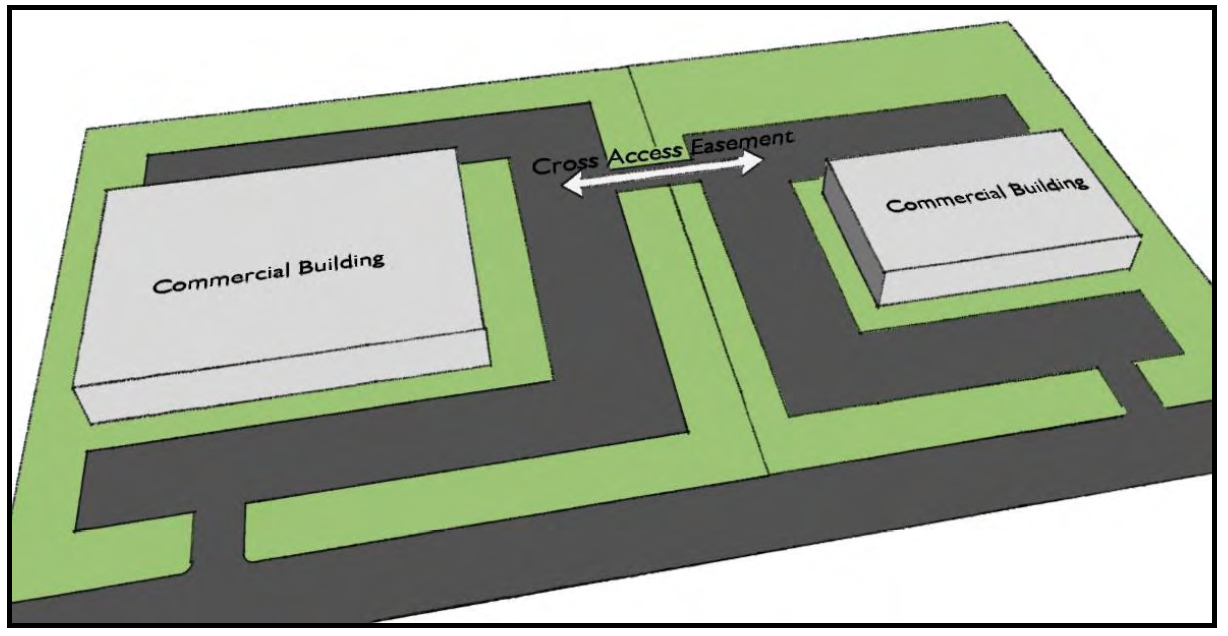
(Ord. of 6-20-16(2); Amend. of 6-19-17; Amend. of 12-16-19(1))
9.5 - Loading Area Requirements.
(A)
Subject to Subsection (E), whenever the normal operation of any development requires that goods, merchandise, or equipment be routinely delivered to or shipped from that development, a sufficient off-street loading and unloading area must be provided in accordance with this Section to accommodate the delivery or shipment operations in a safe and convenient manner.
(B)
The loading and unloading area must be of sufficient size to accommodate the numbers and types of vehicles that are likely to use this area, given the nature of the development in question. The following Table indicates the number and size of spaces that, presumptively, satisfy the standard set forth in this Section. However, the permit issuing authority may require more or less loading and unloading area if reasonably necessary to satisfy the foregoing standard.
1 Minimum dimensions of 12 feet × 55 feet and overhead clearance of 14 feet from street grade required.
(C)
Loading and unloading areas shall be so located and designed so that the vehicles intended to use them can:
(1)
maneuver safely and conveniently to and from a public right-of-way; and
(2)
complete the loading and unloading operations without obstructing or interfering with any public right-of-way or any parking space or parking lot aisle.
(D)
No area allocated to loading and unloading facilities may be used to satisfy the area requirements for off-street parking, nor shall any portion of any off-street parking area be used to satisfy the area requirements for loading and unloading facilities.
(E)
Compliance with the provisions of this section is required only to the extent reasonably possible whenever the following conditions exist:
(1)
a lot contains one (1) or more structures constructed before the effective date of this Ordinance;
(2)
a change in use that does not involve any enlargement of a structure is proposed for such lot; and
(3)
the loading area requirements of this Section cannot be satisfied because there is not sufficient area available on the lot that can practicably be used for loading and unloading.
(Ord. of 6-20-16(2))
9.6 - Parking of Commercial and Recreational Vehicles.
(A)
On any residentially zoned lot of less than one (1) acre in size, commercial vehicles which may be parked on an overnight basis shall be limited to vans and trucks of no greater than three (3) axles. This requirement shall not be interpreted to prohibit vehicles from loading and unloading household goods in any residential district for a period of up to 24 hours.
(B)
No residentially-developed lot may be used as the base of operation for any freight hauling truck.
(C)
For purposes of this Ordinance, a recreational vehicle shall not be deemed a dwelling unit and the usage of a recreational vehicle for living, sleeping or housekeeping purposes and the connection of such vehicle to utility services (other than for periodic maintenance and/or repair purposes) shall be prohibited unless the vehicle is located in a camping and recreational vehicle park so designed to accommodate recreation vehicles.
(Ord. of 6-20-16(2))
9.7 - Driveways.
(A)
Driveways shall be not less than 10 feet in width for one-way traffic and 18 feet in width for two-way traffic.
(B)
Ten (10)-foot wide driveways are permissible for two-way traffic when:
(1)
The driveway is not longer than 50 feet; and
(2)
The driveway provides access to not more than five (5) parking spaces; and
(3)
Sufficient turning space and stacking area is provided so that vehicles need not back into a public street.
(C)
In no case shall a driveway width exceed 24 feet, except as required by NCDOT.
(D)
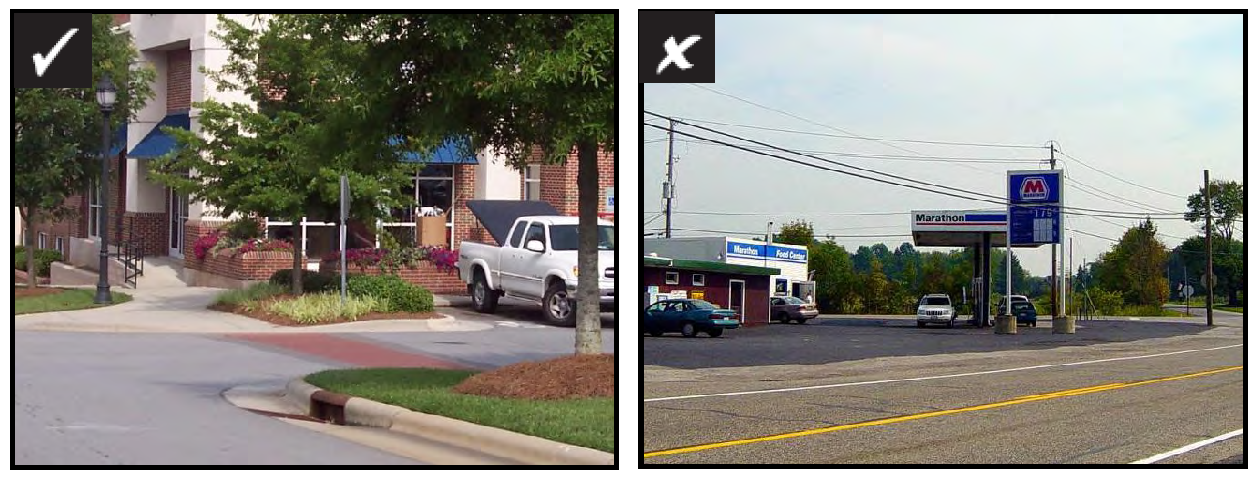
Only one (1) combined entrance and exit connection will be permitted where the frontage is less than 300 feet. Any lot of record in existence on the effective date of this section shall be allowed one (1) access point to the roadway notwithstanding the provisions of this Section that may prohibit such access; provided, however, that two (2) or more lots under common ownership shall be considered one (1) lot and shall comply with the requirements of this section. The maximum number of access points shall be as follows:
(E)
Driveways shall be as nearly perpendicular to the street right-of-way as possible and shall not exceed 10 percent grade.
(F)
Driveways shall line up with other driveways across the street and be shared between adjacent uses wherever possible.
(G)
Driveways connected to state-maintained streets shall comply with NCDOT standards.
(H)
The arrangement of driveways for multi-family residential and non-residential uses should be related to adjacent driveways and nearby street intersections and meet the following criteria:
(1)
Driveways serving streets with traffic volumes in excess of 300 ADT or accessing thoroughfares shall be located a minimum of 250 feet from the point of tangency of the radius of curvature of the intersecting street.
(2)
The minimum distance between the centerlines of driveways into shopping centers or facilities generating in excess of 300 ADT shall be a minimum of 400 feet.
(3)
Full access driveways open to signalization should be 1,000 feet apart. Driveways which access thoroughfares and serve more than 1,500 ADT shall provide deceleration lanes in approach to the driveway.
(Ord. of 6-20-16(2))

