
Forest City City Zoning Code
APPENDIX A
DEFINITIONS3
Editor's note— Ord. of 1- 7-19(1), adopted January 7, 2019, repealed the former Appendix A, and enacted a new Appendix A as set out herein. The former Appendix A pertained to similar subject matter and derived from Ord. of 6-20-16(2).
A.1 - Purpose
For the purpose of interpreting this ordinance, certain words, concepts and ideas are defined herein. except as defined herein, all other words used in this ordinance shall have their everyday meaning as determined by their dictionary definition.
(Ord. of 1- 7-19(1))
A.2 - Interpretation
(A)
Words used in the present tense include the future tense.
(B)
Words used in the singular number include the plural, and words used in the plural number include the singular.
(C)
Any word denoting gender includes the female and the male.
(D)
The word "person" includes a firm, association, organization, partnership, corporation, trust and company as well as an individual.
(E)
The word "lot" includes the word "plot" or "parcel" or "tract."
(F)
The word "shall" is always mandatory and not merely directory.
(G)
The word "structure" shall include the word "building."
(H)
The term "street" shall include the word "road."
(I)
The term "Zoning Map," shall mean the Official Zoning Map of Forest City, North Carolina.
(J)
The term "Town Board" shall mean the "Town Board of Commissioners of the Town of Forest City, North Carolina."
(K)
The term "Planning Board" shall mean the "Planning Board of the Town of Forest City, North Carolina."
(L)
The term "Board of Adjustment" shall mean the "Board of Adjustment of the Town of Forest City."
(M)
The term "Board of Planning and Adjustment" shall mean the body of appointed members that serve as both the "Planning Board" and the "Board of Adjustment" of the Town of Forest City.
(N)
The term "Administrator" shall mean the "Administrator, Subdivision Administrator, Floodplain Administrator, or Unified Development Ordinance Administrator of the Town of Forest City, North Carolina."
(O)
The terms "Planning Department" and "Planning Staff" shall mean the "Planning Department of the Town of Forest City, North Carolina."
(P)
The terms "Ordinance", "Code" and "Unified Development Ordinance" shall be synonymous and refer to the "Town of Forest City Unified Development Ordinance."
(Ord. of 1- 7-19(1))
A.3 - Acronyms and abbreviations
Below is a list of acronyms and abbreviations (other than zoning districts) and their meanings found throughout the Ordinance:
• ADA: Americans with Disabilities Act
• BFE: Base Flood Elevation
• DUA: Dwelling Units per Acre
• ETJ: Extraterritorial Jurisdiction
• FEMA: Federal Emergency Management Agency
• FIRM: Flood Insurance Rate Maps
• HOA: Homeowners Association
• UDO: Unified Development Ordinance
• NC: North Carolina
• NCDENR: North Carolina Department of Environment and Natural Resources
• NCDOT or DOT: North Carolina Department of Transportation
• NCGS or GS: North Carolina General Statute
• ROW: Right-of-way
• RPO: Rural Planning Organization
• SR: Secondary Road in the North Carolina Secondary Road system
• TND: Traditional Neighborhood Development
• US: United States of America
(Ord. of 1- 7-19(1))
A.4 - Definitions
Abandonment. A use shall be deemed to be abandoned when:
(1)
The use is discontinued (other than in association with the settlement of an estate or for any use which is seasonal in nature); or
(2)
The premises are devoted to another use; or
(3)
When the characteristic equipment and furnishings of a non-conforming nonresidential use have been removed from the premises and have not been replaced by the same or similar equipment within one hundred and eighty (180) days; or
(4)
Failure to take all positive action to resume the non-conforming use with reasonable dispatch, including the failure to advertise the property for sale or for lease.
Accessory Dwelling. A single-family residential unit that is subordinate to the principal dwelling located on the same property and is used as a rental unit, guest house, or as the residence of an immediate family member of the owner and occupant of the principal dwelling.
Accessory Structure. A structure that is subordinate to and serves a principal use or structure; is clearly subordinate in area, extent, or purpose to the principal use or structure served; and is located on the same lot as the principal use or structure. In no event shall "accessory structure" be construed to authorize a principal use or structure not otherwise permitted in the district in which the use is located. Accessory structures include, but are not limited to, detached garages, storage buildings, pools and pool houses. Manufactured homes, trailers, recreational vehicles, PODs, similar items, or parts thereof, are not accessory structures.
Accessory Use. A use customarily incidental and subordinate to the principal use or structure and located on the same lot with such principal use or structure.
Addition. An extension or increase in the footprint or floor area of building or structure.
Adjacent. Having common property boundaries or lot lines which are not separated by a street or alley or body of water.
Administrator. The appointed Town staff member that administers this Ordinance.
Adult Oriented Business. An adult arcade, adult bookstore or adult video store, adult cabaret, adult motel, adult motion picture theater, adult theater, escort agency, nude model studio, sexual encounter center (including adult massage parlor and adult health club), sexually orientated device business or any combination of the foregoing or any similar business. As used in this Ordinance the following definitions shall apply:
Adult Arcade (also known as "Peep Show"). Any place to which the public is permitted or invited wherein coin-operated or slug-operated or electronically, electrically, or mechanically controlled still or motion picture machines, projectors, or other image-producing devices are maintained to show images to persons in booths or viewing rooms where the images so displayed depict or describe "specific sexual activities" or "specified anatomical areas."
Adult Bookstore or Adult Video Store. A commercial establishment, which is in the business of offering for sale or rental any form of consideration any one (1) of more of the following: books, magazines, periodicals or other printed matter, or photographs, films, motion pictures, videocassettes or video reproductions, slides, or other visual representation that depicts or describes "specific sexual activities" or "specified anatomical area"; or instruments, devices or paraphernalia that are designed for use in connection with "specified sexual activities."
Adult Cabaret. A nightclub, bar, restaurant, or other commercial establishment that regularly features, exhibits or displays as one (1) of the principal business purposes:
(1)
Persons who appear nude or semi-nude; or
(2)
Live performances which are characterized by the exposure of "specified anatomical areas" or by "specified sexual activities"; or
(3)
Films, motion pictures, videocassettes, slides, or other photographic reproductions, which depict or describe "specific sexual activities" or "specified anatomical areas."
Adult Motel. A hotel, motel or similar commercial establishment that:
(1)
Offers accommodations to the public for any form of consideration which provides patrons with closed-circuit television transmissions, films, motion pictures, video cassettes, slides, or other photographic reproductions that depict or describe "specified sexual activities" or "specified anatomical areas" as one (1) of its principal purposes; or
(2)
Offers a sleeping room for rent for a period of time that is less than ten (10) hours;
(3)
Allows a tenant or occupant of a sleeping room to sub-rent the room for a period of time that is less than ten (10) hours.
Adult Motion Picture Theater. A commercial establishment where, for any form of consideration, films, motion pictures, video cassettes, slides, or similar photographic reproductions are regularly shown as one (1) of its principal business purposes that depict or describe "specified sexual activities" or "specified anatomical areas."
Adult Theater. A theater, concert hall, auditorium, or similar commercial establishment which regularly features exhibits or displays, as one (1) of its principal business purposes, persons who appear in a state of nudity or semi-nude, or live performances that expose or depict "specified anatomical areas" or "specified sexual activities."
Escort. A person who, for any tips or any other form of consideration, agrees or offers to act as date for another person, or who agrees or offers to privately model lingerie or to privately perform a striptease for another person.
Nude Model Studio. Any place where a person who appears nude or semi-nude, or who displays "specified anatomical areas," is provided to be observed, sketched, drawn, painted, sculptured, photographed or similarly depicted by other persons who pay money in any form of consideration. Nude Model Studio shall not include a proprietary school licensed by the State of North Carolina or a college, junior college or university supported entirely or in part by public taxation; a private college or university which maintains and operated educational programs in which credits are transferable to a college, junior college, or university supported entirely or partly by taxation; or in a structure:
(1)
That has no sign visible from the exterior of the structure and no other advertising that indicates a nude or semi-nude person is available for viewing; and
(2)
Where in order to participate in a class a student must enroll at least three (3) days in advance of the class; and
(3)
Where no more than one (1) nude or semi-nude model is on the premises at any one (1) time.
Nude or A State of Nudity.
(1)
The appearance of a human anus, male genitals or female genitals; or
(2)
A state of dress, which fails to opaquely cover a human anus, male genitals or female genitals.
Semi-Nude. A state of dress in which clothing covers no more than the genitals, pubic region and areola of the female breasts, as well as portions of the body covered by supporting straps or devices.
Sexual Encounter Center. A business or commercial enterprise that, as one (1) of its principal business purposes, offers for any form of consideration physical contact in the form of wrestling or tumbling (including sexually oriented massaging) between persons of the opposite sex, or similar activities between male and female persons and/or between persons of the same sex when one (1) or more of the persons is in a state of nudity or semi-nude.
Sexually Oriented Devices. Any artificial or simulated specified anatomical area or other device or paraphernalia that is designed principally for specified sexual activities but shall not mean any contraceptive device.
Specified Anatomical Areas. Human genitals in a state of sexual arousal.
Specified Sexual Activities. Is and includes any of the following:
(1)
The fondling or other erotic touching of human genitals, pubic region, buttocks, anus, or female breasts; or
(2)
Sex acts, normal or perverted, actual or simulated, including intercourse, oral copulation, sodomy; or
(3)
Masturbation, actual or simulated; or
(4)
Excretory functions as part of or in connection with any of the activities set forth in 1. through 3. above.
Alley. A public or private way which affords only a secondary means of access to abutting property and is not intended for general traffic circulation.
Alteration. A change in the size, configuration, or location of a structure; or a change in the use of a structure or lot from a previously approved or legally existing size, configuration, location, or use.
Amendment, Text. A change to any text of the Forest City Unified Development Ordinance.
Amendment, Zoning Map (Rezoning). A change of the zoning designation of a property or properties on the Forest City Zoning Map.
Animal Services. A public or private facility for medical or surgical treatment, grooming, breeding, selling, or boarding of animals. Unless outdoor kennels are specifically allowed, all facilities associated with animal services shall be located indoors.
Apartment building. A multi-family residential building or portion thereof which provides three (3) or more dwelling units which share means of egress and other essential facilities. (Source: NC State Building Code, Vol. 1, Section 202)
Appeal. A request by an applicant for the Board of Adjustment to review a decision or interpretation by the Administrator.
Artist, craftsman. A professional who creates a low volume of unique works of art, sculpture, pottery, furniture, jewelry, or similar items. This does not include the on-site retail sales of items. Higher volume and mass-produced items shall be considered manufacturing.
Auditorium, assembly hall. Places of gathering for sporting events, performing arts events, or similar events.
Awning. A structure made of cloth, metal, or other material affixed to a building in such a manner that the structure may be raised or retracted from a building to a flat position against the building, but not to include a canopy.
Bar. A commercial establishment in which the primary activity is the consumption of alcoholic beverages and the primary source of income is from the sale of alcoholic beverages.
Bed and Breakfast Inn. A use, that takes place within a building that prior to such an establishment was a single family dwelling, which consists of renting one (1) or more rooms on a daily basis to tourists, vacationers and business people, where provision of meals is limited to the breakfast meal, available only to guests.
Bedroom. A fully enclosed interior room with a closet, door, and window for egress.
Best Management Practices (BMP). A structural or nonstructural management-based practice used singularly or in combination to reduce non-point source inputs to receiving waters in order to achieve water quality protection goals.
Billiard Parlor. Any room where one (1) or more billiard tables or pool tables are kept, or any place where any person can play the game of billiards or pool by the payment of a fee or charge or by purchase, possession, or presentation of a ticket or token; where a charge is made, direct or indirect, for caring for clothing or other property or for any service rendered; or where any person may gain admission by the payment of dues or subscription of membership in any society, club, or organization. Notwithstanding the foregoing definition, a billiard parlor shall not include a location having no more than three (3) pool and billiard tables when an additional separate and distinct business or function is being operated at the same location by the owner of the tables at the same times that the tables are being used, and the pool and/or billiard tables are not necessary for the continued operation, profitability or existence of the business or function being conducted at the same location as the tables. Billiard parlors are subject to the requirements of Chapter 5, Article 4 of the Town of Forest City Code of Ordinances.
Block. A unit of land bounded by streets or by a combination of streets and public land, waterways, or any other barrier to the continuity of development.
Boarding House. A building or portion thereof which contains not more than five (5) rooms designed or intended to be used for residential occupancy for compensation. It may also serve meals for compensation to the boarders.
Bona Fide Farm and Agricultural Uses. In accordance with NCGS 106-581.1, For purposes of this Ordinance, the terms, "bona fide farm" "agriculture," "agricultural" and "farming" refer to all of the following:
(1)
The cultivation of soil for production and harvesting of crops, including, but not limited to, fruits, vegetables, sod, flowers and ornamental plants.
(2)
The planting and production of trees and timber.
(3)
Dairying and the raising, management, care and training of livestock, including horses, bees, poultry and other animals for individual and public use, consumption and marketing.
(4)
Aquaculture as defined in NCGS 106-758.
(5)
The operation, management, conservation, improvement and maintenance of a farm and the structures and buildings on the farm, including building and structure repair, replacement, expansion and construction incident to the farming operation.
(6)
When performed on the farm, "agriculture," "agricultural" and "farming" also include the marketing and selling of agricultural products, agritourism, the storage and use of materials for agricultural purposes, packing, treating, processing, sorting, storage and other activities performed to add value to crops, livestock and agricultural items produced on the farm and similar activities incident to the operation of a farm.
Uses which shall not be deemed as "agricultural uses," for the purposes of this Ordinance, include zoos, kennels, equestrian facilities, commercial slaughtering.
Buffer. A strip of land with natural or planted vegetation located between a structure and a side or rear property line intended to separate and partially obstruct the view of two (2) adjacent land uses or properties from one another. A buffer area may include any required screening for the site.
FIG. A.1: BUFFER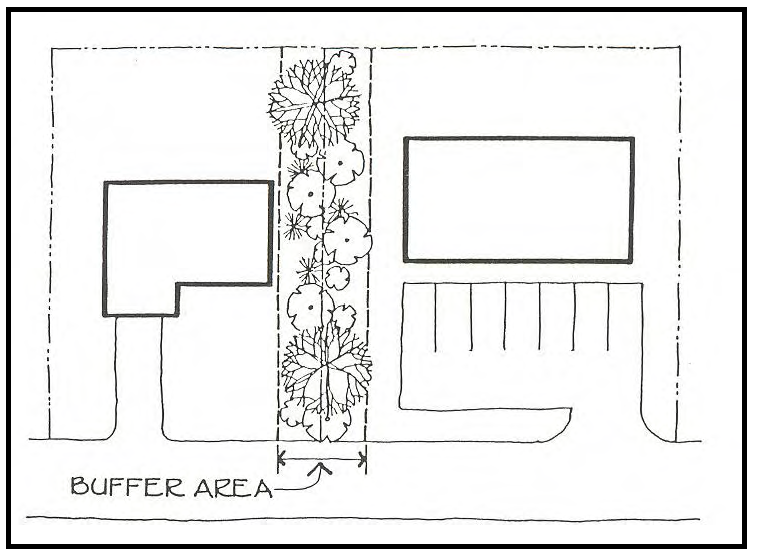
Buffer, Vegetative (Undisturbed Buffer). An area of natural or planted vegetation through which stormwater runoff flows in a diffuse manner so that the runoff does not become channelized and which provides for infiltration of the runoff and filtering of pollutants. The buffer is measured landward from the normal pool elevation of impounded structures and from the bank of each side of streams or rivers.
Buildable Area. The area of a lot remaining after the minimum yard and open space requirements of this Ordinance have been met.
Building. A temporary or permanent structure having a roof supported by exterior walls or constructed columns and which can be used for residence, business, industry, or other public or private purposes or accessory thereto. The term "building" shall be construed as if followed by the words "or parts thereof."
Building Envelope. The three-dimensional (3-D) space within which a structure is permitted to be built on a lot and that is defined by maximum height regulations, and minimum yard setbacks or build-to lines, buffers, easements, or other applicable regulations.
Building Footprint. The land area on which a building is located or proposed for location.
Building Height. The vertical distance from the mean grade elevation taken at the fronting street side of a structure to the parapet or roofline of a flat roof, the eaves of a pitched roof, or the deck line of a mansard roof. Towers, spires, steeples and enclosed rooftop mechanical equipment are not counted in height measurements.
FIG. A.2: HEIGHT FOR DIFFERENT ROOF TYPES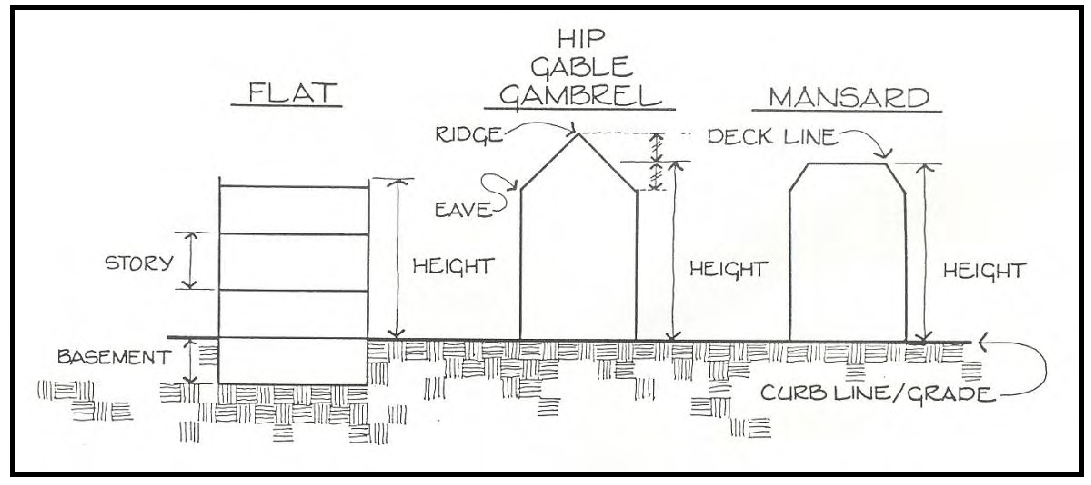
Building Line. The line formed by the facades of buildings which creates a frame defining the public realm. Respecting building lines means to place walls or landscaping in such a manner as to continue the frame where there is an absence of buildings.
Building Permit. A permit obtained from the Town of Forest City Building, Zoning and Planning Department which sets the inspection schedule and construction techniques for a project subject to NC Building Code.
Build Out. The completed construction of all phases of a development as allowed by all Ordinances which regulate an area. The scale of build out can be from a single lot to the entire Town's jurisdiction.
Build-to Line. The line at which construction of a building is to occur on a lot. A build-to line runs parallel to the front property line and is established to create an even building facade line on a street.
Built-upon Area. Built-upon areas shall include that portion of a development project that is covered by impervious or partially impervious cover including buildings, pavement, gravel roads, recreation facilities (e.g., tennis courts), etc. (Note: Wooden slatted decks and the water area of a swimming pool are considered pervious.)
Caliper. The size of tree's trunk diameter as measured six (6) inches above the ground for trees four (4) inches or less, and as measured twelve (12) inches above the ground for trees larger than four (4) inches.
Campgrounds. Land containing two (2) or more campsites which are located, established, or maintained for occupancy by people in temporary living quarters, such as tents, recreation vehicles, or travel trailers which are used for recreation or vacation purposes. A manufactured home park shall not be deemed a campground.
Campsite. Any plot of ground within a campground intended for the exclusive occupancy by a cabin, recreation vehicle, or tent.
Canopy. A permanent structure other than an awning attached or unattached to a building for the purpose of providing shelter to patrons or automobiles, or as a decorative feature on a building wall. A canopy is not a completely enclosed structure.
Caretaker's Residence. An accessory dwelling unit to be used exclusively as living quarters for the caretaker(s) of that property or a specific use or operation taking place on the property.
Carrying Capacity. The amount of traffic which can be accommodated on a street without reducing the service level of the street as defined by the North Carolina Department of Transportation or street design standards of this Ordinance. Carrying capacity is determined by the amount of traffic per land per hour.
Cemetery. Property used for the interment of the dead, which use may include the commercial sale and location of burial lots, crypts, or vaults for use exclusively on the subject property. A cemetery shall not be used for the preparation or embalming of bodies or the cremation of bodies. Setback for cemeteries shall be measured from the nearest structure or gravesite. This definition shall be construed to include bona fide pet cemeteries.
Certificate of Occupancy (CO). A certificate allowing the occupancy or use of a building and certifying that the structure or use has been constructed or will be used in compliance with this Ordinance and all other applicable regulations.
Change of Use. Any use of a building or land that significantly differs from the previous use. Significant change of use shall mean a change from one (1) land use category to another in the Permitted Uses Table, a large increase in the required parking for a use, or a use that requires a Special Use Permit.
Church. See "Religious Institution."
Civic Uses. Uses intended to serve as public gathering places. Such uses include governmental offices, churches or other places of worship, schools, post offices and non-profit or charitable clubs and organizations.
Commercial Use. All retail sales establishments, office uses (i.e.: medical and financial), service industry uses (i.e.: restaurants, hotels/motels/inns), wholesale businesses and general business (i.e.: mini-storage, automotive repair).
Common Open Space. Land and/or water areas within the site designated for development, not individually owned or dedicated for public use, which are designed and intended for the common use or enjoyment of the residents of the development but not including any lands occupied by streets, street rights-of-way, or off-street parking.
Common Open Space, Improved. Common open space which has been improved with recreational areas and amenities such as, but not limited to, ballfields, tennis courts, swimming pools, nature trails, clubhouses, etc.
Communications Offices. Newspaper, internet, telephone and similar communications businesses with no retail sales or visible towers or transmission equipment.
Conditional Zoning District. A district created through the approval of a zoning map amendment with a site specific plan in which the uses are limited to those in the base zoning district and are subject to conditions imposed by the Town Board of Commissioners.
Condominium. The ownership of single units in a multi-unit structure with common areas and facilities, real estate portions of which are designated for separate ownership and the remainder of which is designated for common ownership solely by the owners of those portions. Real estate is not a condominium unless the undivided interests in the common elements are vested in the unit owners. (Sources: Unit Ownership Act {NCGS 47A-3} and NC Condominium Act NCGS 47C-1-103)
Construction Trailer. A structure standing on wheels towed or hauled by another vehicle and used for neither overnight nor year-round occupancy at the construction site on a temporary basis for office purposes.
Contiguous. Next to, abutting, or touching and having a boundary, or portion thereof, which is contiguous including properties traversed or separated by a road, stream, right-of-way or similar man-made or natural configuration. The term "contiguous" shall also mean "abutting" or "adjacent."
Correctional Facility. A facility operated by Rutherford County or the State of North Carolina (or a private contractor thereof) used for the temporary incarceration of persons after arrest or pending hearing or trial or for the incarceration and or housing of persons serving sentences or incarceration or housing of persons serving criminal sentences.
Country Club. A private recreational facility open to members and their guests. Uses at a country club frequently include golf courses, swimming pools (outdoors) and club-houses. Meal service may be available, but is generally limited to members and their guests. A country club may be developed as a free-standing entity or as part of a residential community or planned residential development.
Cul-De-Sac. The turn around at the end of a dead-end street.
Cut-off. The point at which all rays emitted by a lamp, light source, or luminaire are completely eliminated (cut-off) at a specific angle above the ground.
Cut-off Angle. The angle formed by a line drawn from the direction of light rays at the light source and a line perpendicular to the ground from the light source, above which no light is emitted.
Cut-off Light (Fixture). A light with elements such as shields, reflectors, or refractor panels that direct and cut off light at a cut-off angle that is less than 90°.
FIG A.3: CUT-OFF LIGHT (FIXTURE)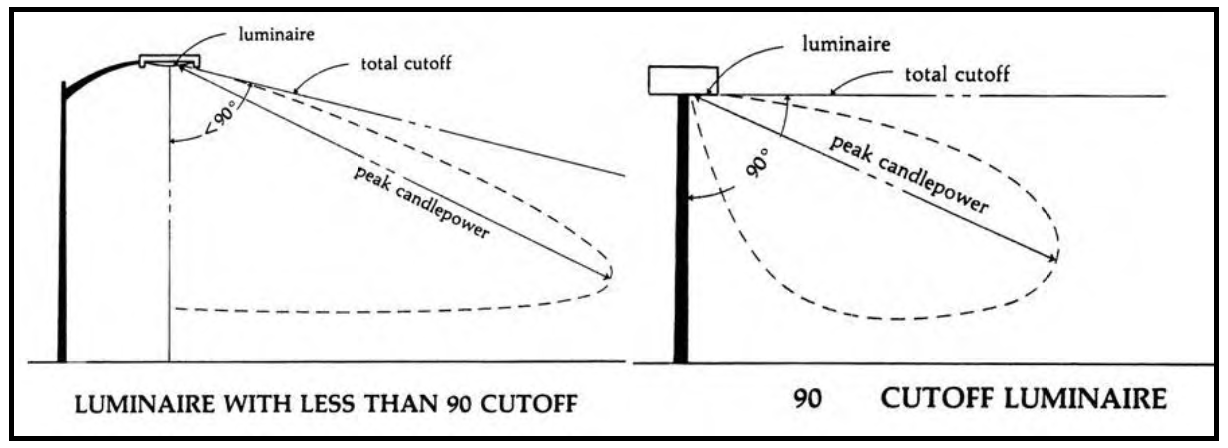
Daycare Center. A place where daytime care is provided to more than five (5) children, handicapped persons, or senior citizens unrelated by blood or marriage to, and not the legal wards or foster children of the attendant adult within an occupied residence. Persons who are related by blood or marriage to the attendant adult shall not be counted as patrons of the daycare center.
Dedication. A gift by the owner of a portion of his property to another party without any compensation being given for the transfer. Dedication typically refers to right-of-way for streets and utilities or open space dedication for parks, playgrounds, etc. The dedication is made by written instrument on a plat and is completed with an acceptance by the other party, typically a government body.
Density. A ratio expressed as the number of dwelling units per acre (DUA). The ratio is derived by dividing the total number of dwelling units by the total land area (in acres) used or proposed to be used for purposes such as buildings, roads, public facilities and open spaces.
Development. Any land disturbing activity which adds to or changes the amount of impervious or partially impervious cover on a land area or which otherwise decreases the infiltration of precipitation into the soil.
Development, Existing. Those projects that are built or those projects that at a minimum have established a vested right under NCGS 160D-108 as of the effective date of this Ordinance based on at least one (1) of the following criteria:
(1)
Substantial expenditures of resources (time, labor, money) based on a good faith reliance upon having received a valid local government approval to proceed with the project, or
(2)
Having an outstanding valid building permit as authorized by the General Statutes, or
(3)
Having an approved site specific or phased development plan.
Distribution Use. A use in which products or goods are brought in or manufactured on-site and are trucked off-site.
Disturbed Ground. Any area of ground on a site which during construction is dug up, filled, graded, built on or used for storage or parking.
Drip Line. An imaginary vertical line extending from the outer most portion of the tree canopy to the ground.
FIG A.4: DRIPLINE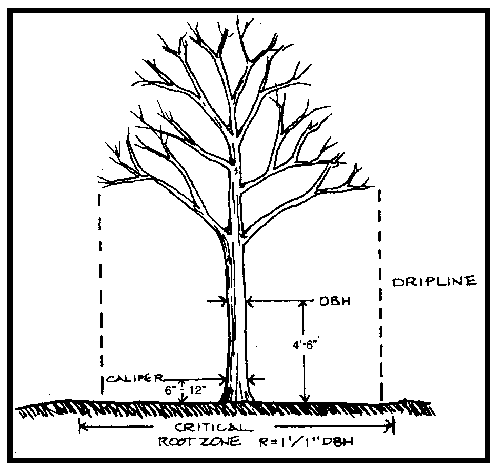
Drive-through use. A facility designed to enable a person to transact business while remaining in a motor vehicle. This includes drive-in facilities in which vehicles pull into a designated parking spot to transact business.
Dwelling. Any building, structure, manufactured home, or mobile home, or part thereof, used and occupied for human habitation or intended to be so used, and any outhouses and appurtenances belonging thereto or usually enjoyed therewith.
Dwelling Unit. A single unit providing complete, independent living facilities for one (1) or more persons, including permanent provisions for living, sleeping, eating, cooking, and sanitation.
Dwelling, Multi-family. The development of three (3) or more attached dwelling units. This includes townhomes, apartments, quadraplexes, triplexes and more than one (1) duplex (two-family dwelling).
Dwelling, Single-family (detached). A separately owned residence for use by one (1) family as a housekeeping unit with space for eating, living, cooking and sanitation (Source: NCGS 87-15.5) where the dwelling unit is on a separate lot of record, no lot contains more than one (1) dwelling unit, no dwelling unit shares a wall with another dwelling unit, and each dwelling unit is surrounded on all sides by yard.
Dwelling, Two-Family Attached (Duplex). A building, or portion thereof, arranged or designed to be occupied by two (2) families, the structure having only two (2) dwelling units located on the same lot of record and sharing a common wall.
FIG A.5: TWO-FAMILY DWELLING (DUPLEX)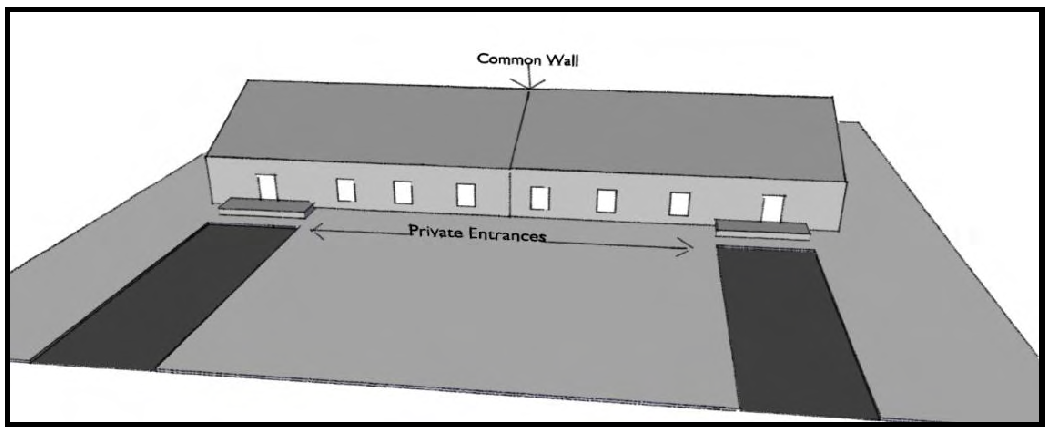
Easement. A grant by the property owner of a strip of land for a specified purpose and use by the public, a corporation, or persons.
Easement, access. A recorded right-of-way, made of crushed gravel or pavement, which is graded and cleared of brush so as to permit access by all vehicles.
Electronic Gaming Operation. Any business establishment which is engaged in providing electronic games of chance, skilled games, fish games, sweepstakes, or similar activity, whether as a principal or an accessory use, where cash, merchandise, or other items of value are redeemed or otherwise distributed, whether or not the value of such distribution is determined by electronic games played, by predetermined odds, or skill. The term also includes, but is not limited to, internet sweepstakes, internet sweepstakes café, video sweepstakes, or cybercafés. This does not include any lottery endorsed by the State of North Carolina or indoor recreational facilities that utilize vintage arcade and pinball machine for amusement.
Emergency Services. Police department, fire department, rescue squad, emergency medical technicians, ambulatory services, or similar services that respond in the event of an emergency.
Encroachment. The part of a structure which intrudes into an easement, dedicated right-of-way, or required setback.
Equestrian Facilities. Businesses that specialize in the boarding of horses, horse riding, riding lessons, equestrian competition, or similar equestrian uses.
Extraterritorial Jurisdiction (ETJ). An area outside a municipality, extending up to one (1) mile from the municipal boundary, where, when established, the Town exercises planning, zoning and development regulations, subject to NCGS 160D-202.
Façade. The vertical surface of a building which is set along a Building Line. The elevation of a facade is the vertical surface area. Façades are subject to visual definition by building height, setback lines, recess lines (a line prescribed for the full width of the façade above which the façade sets back. The location of a recess line is determined by the desired height to width ratio of the enfronting space or by a desired compatibility with existing buildings), and transition lines (a line prescribed for the full width of the façade expressed by a variation of material or by a limited projection such as a cornice or balcony).
Family. Any number of persons related by blood, adoption or marriage or no more than four (4) persons not related by blood, adoption or marriage, living together as a single housekeeping unit sharing the same domestic facilities. It does not include congregate residential care facilities; family care and group care facilities; foster homes for children; homes for the aged and infirmed; family-care homes for the aged and infirmed; day care facilities; day care centers; and family day care homes; shelter homes for children and/or families including foster shelter homes and group shelter homes; adult day care centers; day nurseries; preschool centers; hospitals; nursing homes; sanitariums; and dormitories, fraternal organizations, or other organized social or institutional residential situations.
Family Care Home for the Handicapped. A home with support and supervisory personnel that provides room and board, personal care and habilitation services in a family environment for not more than six (6) resident handicapped persons, as defined by NCGS 168-21(2). This does not include adult care homes, group homes, residential care homes, child or adolescent care homes and health care homes that do not care for handicapped persons.
Family Members, Direct. Direct lineal descendants (children, grandchildren and great grandchildren) and direct lineal ascendants (father, mother, grandfather and grandmother); and brothers, sisters, nieces and nephews.
Farmers' Market. An outdoor market open to vendors at which locally grown fruits and vegetables are sold on a retail basis.
Flag. A piece of durable fabric of distinctive design attached to a permanent pole that is used as a symbol, decorative feature, or advertisement.
Flat Roof. The silhouette formed by a roof line that is typically less than 2:1 slope. This is separate from the roof line which can be stepped or flat in appearance through architectural elements such a cornices, mansards and parapets; or pitched as with residential homes.
Flood Damage Prevention Definitions.
Accessory Structure (Appurtenant Structure) means a structure located on the same parcel of property as the principal structure and the use of which is incidental to the use of the principal structure. Garages, carports and storage sheds are common urban accessory structures. Pole barns, hay sheds and the like qualify as accessory structures on farms, and may or may not be located on the same parcel as the farm dwelling or shop building.
Addition (to an existing building) means an extension or increase in the floor area or height of a building or structure.
Appeal means a request for a review of the Floodplain Administrator's interpretation of any provision of the FDP-O.
Area of Shallow Flooding means a designated Zone AO on a community's Flood Insurance Rate Map (FIRM) with base flood depths determined to be from one (1) to three (3) feet. These areas are located where a clearly defined channel does not exist, where the path of flooding is unpredictable and indeterminate, and where velocity flow may be evident.
Area of Special Flood Hazard see Special Flood Hazard Area (SFHA).
Base Flood means the flood having a one (1) percent chance of being equaled or exceeded in any given year.
Base Flood Elevation (BFE) means a determination of the water surface elevations of the base flood as published in the Flood Insurance Study. When the BFE has not been provided in a Special Flood Hazard Area, it may be obtained from engineering studies available from a Federal, State, or other source using FEMA approved engineering methodologies. This elevation, when combined with the Freeboard, establishes the Regulatory Flood Protection Elevation.
Basement means any area of the building having its floor subgrade (below ground level) on all sides.
Building see Structure.
Chemical Storage Facility means a building, portion of a building, or exterior area adjacent to a building used for the storage of any chemical or chemically reactive products.
Development means any man-made change to improved or unimproved real estate, including, but not limited to, buildings or other structures, mining, dredging, filling, grading, paving, excavation or drilling operations, or storage of equipment or materials.
Disposal means, as defined in NCGS 130A-290(a)(6), the discharge, deposit, injection, dumping, spilling, leaking, or placing of any solid waste into or on any land or water so that the solid waste or any constituent part of the solid waste may enter the environment or be emitted into the air or discharged into any waters, including ground waters.
Elevated Building means a non-basement building which has its lowest elevated floor raised above ground level by foundation walls, shear walls, posts, piers, pilings, or columns.
Encroachment means the advance or infringement of uses, fill, excavation, buildings, structures or development into a floodplain, which may impede or alter the flow capacity of a floodplain.
Existing Manufactured Home Park or Manufactured Home Development means a manufactured home park or development for which the construction of facilities for servicing the lots on which the manufactured homes are to be affixed (including, at a minimum, the installation of utilities, the construction of streets, and either final site grading or the pouring of concrete pads) was completed before the initial effective date of the floodplain management regulations adopted by the community.
Flood or Flooding means a general and temporary condition of partial or complete inundation of normally dry land areas from:
(1)
the overflow of inland or tidal waters; and/or
(2)
the unusual and rapid accumulation or runoff of surface waters from any source.
Flood Boundary and Floodway Map (FBFM) means an official map of a community, issued by the Federal Emergency Management Agency, on which the Special Flood Hazard Areas and the floodways are delineated. This official map is a supplement to and shall be used in conjunction with the Flood Insurance Rate Map (FIRM).
Flood Hazard Boundary Map (FHBM) means an official map of a community, issued by the Federal Emergency Management Agency, where the boundaries of the Special Flood Hazard Areas have been defined as Zone A.
Flood Insurance means the insurance coverage provided under the National Flood Insurance Program.
Flood Insurance Rate Map (FIRM) means an official map of a community, issued by the Federal Emergency Management Agency, on which both the Special Flood Hazard Areas and the risk premium zones applicable to the community are delineated.
Flood Insurance Study (FIS) means an examination, evaluation and determination of flood hazards, corresponding water surface elevations (if appropriate), flood hazard risk zones and other flood data in a community issued by the Federal Emergency Management Agency. The Flood Insurance Study report includes Flood Insurance Rate Maps (FIRMs) and Flood Boundary and Floodway Maps (FBFMs), if published.
Flood Prone Area see Floodplain
Flood Zone means a geographical area shown on a Flood Hazard Boundary Map or Flood Insurance Rate Map that reflects the severity or type of flooding in the area.
Floodplain means any land area susceptible to being inundated by water from any source.
Floodplain Administrator is the individual appointed to administer and enforce the floodplain management regulations.
Floodplain Development Permit means any type of permit that is required in conformance with the provisions of the FDP-O, prior to the commencement of any development activity.
Floodplain Management means the operation of an overall program of corrective and preventive measures for reducing flood damage and preserving and enhancing, where possible, natural resources in the floodplain, including, but not limited to, emergency preparedness plans, flood control works, floodplain management regulations and open space plans.
Floodplain Management Regulations means the FDP-O and other zoning overlays, development regulations, building codes, health regulations, special purpose overlays and other applications of police power. This term describes Federal, State or local regulations, in any combination thereof, which provide standards for preventing and reducing flood loss and damage.
Floodproofing means any combination of structural and nonstructural additions, changes, or adjustments to structures which reduce or eliminate flood damage to real estate or improved real property, water and sanitation facilities, structures and their contents.
Floodway means the channel of a river or other watercourse and the adjacent land areas that must be reserved in order to discharge the base flood without cumulatively increasing the water surface elevation more than one (1) foot.
Freeboard means the height added to the Base Flood Elevation (BFE) to account for the many unknown factors that could contribute to flood heights greater than the height calculated for a selected size flood and floodway conditions, such as wave action, blockage of bridge openings and the hydrological effect of urbanization of the watershed. The Base Flood Elevation (BFE) plus the freeboard establishes the Regulatory Flood Protection Elevation.
Functionally Dependent Facility means a facility which cannot be used for its intended purpose unless it is located in close proximity to water, limited to a docking or port facility necessary for the loading and unloading of cargo or passengers, shipbuilding, or ship repair. The term does not include long-term storage, manufacture, sales, or service facilities.
Hazardous Waste Management Facility means, as defined in NCGS 130A, Article 9, a facility for the collection, storage, processing, treatment, recycling, recovery, or disposal of hazardous waste.
Highest Adjacent Grade (HAG) means the highest natural elevation of the ground surface, prior to construction, immediately next to the proposed walls of the structure.
Historic Structure means any structure that is:
•
Listed individually in the National Register of Historic Places (a listing maintained by the US Department of Interior) or preliminarily determined by the Secretary of Interior as meeting the requirements for individual listing on the National Register;
•
Certified or preliminarily determined by the Secretary of Interior as contributing to the historical significance of a registered historic district or a district preliminarily determined by the Secretary to qualify as a registered historic district;
•
Individually listed on a local inventory of historic landmarks in communities with a Certified Local Government (CLG) Program; or
•
Certified as contributing to the historical significance of a historic district designated by a community with a Certified Local Government (CLG) Program. Certified Local Government (CLG) Programs are approved by the US Department of the Interior in cooperation with the North Carolina Department of Cultural Resources through the State Historic Preservation Officer as having met the requirements of the National Historic Preservation Act of 1966 as amended in 1980.
Lowest Adjacent Grade (LAG) means the elevation of the ground, sidewalk or patio slab immediately next to the building, or deck support, after completion of the building.
Lowest Floor means the lowest floor of the lowest enclosed area (including basement). An unfinished or flood resistant enclosure, usable solely for parking of vehicles, building access, or limited storage in an area other than a basement area is not considered a building's lowest floor, provided that such an enclosure is not built so as to render the structure in violation of the applicable non-elevation design requirements of the FDP-O.
Manufactured Home means a structure, transportable in one (1) or more sections, which is built on a permanent chassis and designed to be used with or without a permanent foundation when connected to the required utilities. The term manufactured home does not include a recreational vehicle.
Manufactured Home Park or Development means a parcel (or contiguous parcels) of land divided into two (2) or more manufactured home lots for rent or sale.
Market Value means the building value, not including the land value and that of any accessory structures or other improvements on the lot. Market value may be established by independent certified appraisal; replacement cost depreciated for age of building and quality of construction (Actual Cash Value); or adjusted tax assessed values.
Mean Sea Level means, for purposes of the FDP-O the National Geodetic Vertical Datum (NGVD) as corrected in 1929, the North American Vertical Datum (NAVD) as corrected in 1988, or other vertical control datum used as a reference for establishing varying elevations within the floodplain, to which Base Flood Elevations (BFEs) shown on a FIRM are referenced. Refer to each FIRM panel to determine datum used.
New Construction means structures for which the start of construction commenced on or after the effective date of the initial floodplain management regulations and includes any subsequent improvements to such structures.
Non-Encroachment Area means the channel of a river or other watercourse and the adjacent land areas that must be reserved in order to discharge the base flood without cumulatively increasing the water surface elevation more than one (1) foot as designated in the Flood Insurance Study report.
Post-FIRM means construction or other development for which the start of construction occurred on or after the effective date of the initial Flood Insurance Rate Map.
Pre-FIRM means construction or other development for which the start of construction occurred before the effective date of the initial Flood Insurance Rate Map.
Principally Above Ground means that at least fifty-one (51) percent of the actual cash value of the structure is above ground.
Recreational Vehicle (RV) means a vehicle, which is:
•
Built on a single chassis;
•
Four hundred (400) square feet or less when measured at the largest horizontal projection;
•
Designed to be self-propelled or permanently towable by a light duty truck; and
•
Designed primarily not for use as a permanent dwelling, but as temporary living quarters for recreational, camping, travel, or seasonal use.
Reference Level is the top of the lowest floor for structures within Special Flood Hazard Areas designated as Zone A1-A30, AE, A, A99 or AO.
Regulatory Flood Protection Elevation means the Base Flood Elevation plus the Freeboard. In Special Flood Hazard Areas where Base Flood Elevations (BFEs) have been determined, this elevation shall be the BFE plus two (2) feet of freeboard. In Special Flood Hazard Areas where no BFE has been established, this elevation shall be at least two (2) feet above the highest adjacent grade.
Remedy a Violation means to bring the structure or other development into compliance with State and community floodplain management regulations, or, if this is not possible, to reduce the impacts of its noncompliance. Ways that impacts may be reduced include protecting the structure or other affected development from flood damages, implementing the enforcement provisions of the FDP-O or otherwise deterring future similar violations, or reducing Federal financial exposure with regard to the structure or other development.
Riverine means relating to, formed by, or resembling a river (including tributaries), stream, brook, etc.
Salvage Yard means any non-residential property used for the storage, collection, and/or recycling of any type of equipment, and including, but not limited to, vehicles, appliances and related machinery.
Solid Waste Disposal Facility means any facility involved in the disposal of solid waste, as defined in NCGS 130A-290(a)(35).
Solid Waste Disposal Site means, as defined in NCGS 130A-290(a)(36), any place at which solid wastes are disposed of by incineration, sanitary landfill, or any other method.
Special Flood Hazard Area (SFHA) means the land in the floodplain subject to a one (1) percent or greater chance of being flooded in any given year.
Start of Construction includes substantial improvement, and means the date the building permit was issued, provided the actual start of construction, repair, reconstruction, rehabilitation, addition placement, or other improvement was within one hundred and eighty (180) days of the permit date. The actual start means either the first placement of permanent construction of a structure on a site, such as the pouring of slab or footings, the installation of piles, the construction of columns, or any work beyond the stage of excavation; or the placement of a manufactured home on a foundation. Permanent construction does not include land preparation, such as clearing, grading, and filling; nor does it include the installation of streets and/or walkways; nor does it include excavation for a basement, footings, piers, or foundations or the erection of temporary forms; nor does it include the installation on the property of accessory buildings, such as garages or sheds not occupied as dwelling units or not part of the main structure. For a substantial improvement, the actual start of construction means the first alteration of any wall, ceiling, floor, or other structural part of the building, whether or not that alteration affects the external dimensions of the building.
Structure means a walled and roofed building, a manufactured home, or a gas, liquid, or liquefied gas storage tank that is principally above ground.
Substantial Damage means damage of any origin sustained by a structure during any one-year period whereby the cost of restoring the structure to its before damaged condition would equal or exceed fifty (50) percent of the market value of the structure before the damage occurred. See definition of substantial improvement. Substantial damage also means flood-related damage sustained by a structure on two (2) separate occasions during a ten-year period for which the cost of repairs at the time of each such flood event, on the average, equals or exceeds twenty-five (25) percent of the market value of the structure before the damage occurred
Substantial Improvement means any combination of repairs, reconstruction, rehabilitation, addition, or other improvement of a structure, taking place during any one-year period for which the cost equals or exceeds fifty (50) percent of the market value of the structure before the start of construction of the improvement. This term includes structures which have incurred substantial damage, regardless of the actual repair work performed. The term does not, however, include either:
•
Any correction of existing violations of State or community health, sanitary, or safety code specifications which have been identified by the community code enforcement official and which are the minimum necessary to assure safe living conditions; or
•
Any alteration of a historic structure, provided that the alteration will not preclude the structure's continued designation as a historic structure.
Threat to Public Safety and/or Nuisance means anything which is injurious to the safety or health of an entire community or neighborhood, or any considerable number of persons, or unlawfully obstructs the free passage or use, in the customary manner, of any navigable lake, or river, bay, stream, canal, or basin.
Variance is a grant of relief from the requirements of the FDP-O.
Violation means the failure of a structure or other development to be fully compliant with the community's floodplain management regulations. A structure or other development without the elevation certificate, other certifications, or other evidence of compliance is presumed to be in violation until such time as that documentation is provided.
Water Surface Elevation (WSE) means the height, in relation to mean sea level, of floods of various magnitudes and frequencies in the floodplains of coastal or riverine areas.
Watercourse means a lake, river, creek, stream, wash, channel or other topographic feature on or over which waters flow at least periodically. Watercourse includes specifically designated areas in which substantial flood damage may occur.
Floor Area Ratio. The gross floor area of all buildings and structures on a lot divided by the lot area. When computing this figure, the gross floor area of all enclosed parking deck buildings shall be excluded.
FIG A.6: FLOOR AREA RATIO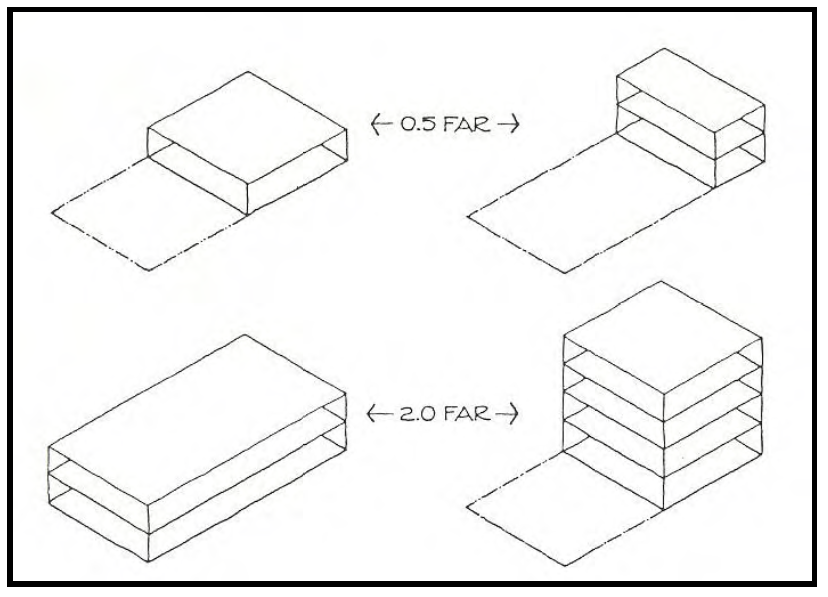
Footcandle. A unit measuring the luminance from a light source. Originally the footcandle was the luminance at one (1) foot from a standard candle. It was then defined as the luminance produced by one (1) lumen of luminous flux evenly distributed over a square foot. Though not an SI unit, footcandles are widely used to set lighting levels.
Frontage. The lot boundary along a public street.
Gated Community. A residential development that is entirely surrounded by a wall or fence with restricted access at entrance gates.
Golf Course. A tract of land for playing golf, improved with tees, fairways, hazards and which may include clubhouses and shelters.
Government Buildings. A structure or group of structures intended to carry out the necessary day-to-day functions of federal, state, county, or local government including government offices and public works facilities. This shall not include emergency services, animal control with outdoor kennels, park-related structures, colleges and universities, schools, utility facilities, correctional institutions, landfills or related structures, or hazardous material storage as these uses are defined separately herein.
Grade of Street. The height of the top of the curb, or if no curb exists, the height of the edge of pavement in the lane of travel adjacent to the side of the street at which grade is being measured.
Gross Floor Area. The sum of the gross horizontal areas of each floor of the principal building, measured from the exterior walls or from the center line of the party walls, including the floor area of accessory structures. The term does not include any area used exclusively for the parking of motor vehicles or for building or equipment access such as stairs, elevator shafts and maintenance crawlspaces or unused attics. This term also excludes pedestrian walkways and common areas within enclosed shopping areas.
Ground Cover. Low growing plants such as grasses, ivies, creeping bushes and similar decorative plantings. Where required by this Ordinance, ground covers shall have the capability of soil stabilization and erosion control.
Group Home. See Residential Care Home.
Handicapped. A person with a temporary or permanent physical, emotional, or mental disability including, but not limited to, mental retardation, cerebral palsy, epilepsy, autism, hearing and sight impairments, emotional disturbances and orthopedic impairments but not including mentally ill persons who are dangerous to others as defined in G.S. 122C-3(11)b.
Hazardous Material. Any substance listed as such in: SARA Section 302, Extremely Hazardous Substances, CERCLA Hazardous Substances, or Section 311 of CWA (oil and hazardous substances).
Home Occupation, Child Care. A type of home occupation in which the occupant of a home cares for not more than five (5) children in addition to his or her own children during daytime hours. Persons who are related by blood or marriage to the attendant adult shall not be counted as patrons of the daycare.
Home Occupation, Customary. Any use conducted for gain entirely within the dwelling and carried on by the occupants thereof, which use is clearly incidental and subordinate to the residential use and which does not change the character thereof and in connection with which there is no display. When observed from beyond the lot on which it is located, the home occupation does not give visual, audible, sensory, or physical evidence that the property is used for any nonresidential purpose.
Home Occupation, Rural. A use conducted for gain within an accessory structure on a residential lot in the R-1 district that may include office and service uses inside a fully enclosed building.
Hospital. An institution providing physical and mental health services primarily for human in-patient medical or surgical care for the sick or injured, including related facilities such as laboratories, out-patient services, training facilities, central service facilities, emergency services and staff offices.
Hotel/Motel. A facility offering transient lodging accommodations to the general public and which may provide additional services such as restaurants, meeting rooms and recreation facilities.
Impervious Surface. Any material which reduces and prevents absorption of stormwater into previously undeveloped land. This includes, but is not limited to, buildings, roads, pavement, gravel surfaces, etc. Items not considered to be impervious include the water area of a swimming pool and wooden slatted decks.
Impervious Surface Ratio. The gross area of all impervious surfaces on a lot divided by the lot area.
Industrial Development. Any non-residential development that requires an NPDES permit for an industrial discharge and/or requires the use or storage of any hazardous material for the purpose of manufacturing, assembling, finishing, cleaning or developing any product or commodity.
Infill. The development of new buildings on vacant sites in a primarily built-up area.
Institutional Use. A use of a semi-public nature that typically serve community needs including, but not limited to, daycares, colleges, private schools, hospitals, research facilities, museums, residential care facilities and other long-term medical care facilities.
Instructional School. A private business that instructs students on skills that may include, but are not limited to, dance, gymnastics, martial arts, art and music.
Junkyard. Any land or land and structure in combination in which structures are incidental to the operation of the principal activity, used for the storage, baling, packing, sorting, handling, disassembling, purchase or sale of any materials which are used, salvaged, scrapped or reclaimed, but are capable of being reused in some form, including, but not limited to, metals, bones, rags, fibers, paper, cloth, rubber, rope, bottles machinery, tools, appliances, fixtures, utensils, lumber, boxes, crates, pipe, pipe fittings, tires, motor vehicles and motor vehicle parts.
Kennel. An establishment wherein any person engages in business or practice, for fee, of boarding, breeding, grooming, letting for hire, or training of more than three (3) domesticated animals at any one (1) time; or an establishment wherein any person engages in the business or practice, for a fee, of selling more than one (1) litter of domesticated animals at any one (1) time or the selling of any three (3) individual domesticated animals (not defined as litter herein) at any one (1) time. Domesticated animals, for the purpose of this Ordinance, shall be defined as dogs, cats and other generally acceptable household pets. Litter, for the purpose of this Ordinance, shall be defined as the progeny resulting from the breeding of two (2) domesticated animals. The following shall not constitute the operation of a kennel as defined above and in no way shall this provision regulate the following:
•
The ownership of domesticated animals as household pets.
•
The ownership of domesticated animals for hunting or tracking purposes;
•
The ownership of domesticated animals for the purpose of exhibiting at shows, obedience or field trials; and
•
The ownership of domesticated animals for the purpose of protecting or guarding of residences or commercial establishments.
Kennel, outdoor. A commercial enterprise that involves the containment or boarding of animals outside a permanently constructed building for an extended period of time. This does not include fenced areas for brief animal exercise.
Landowner. Any owner of a legal or equitable interest in real property, including the heirs, devise, successors, assigns and personal representative of such owner. The owner may allow a person holding a valid option to purchase, to act as his agent or representative for purposes of submitting proposed site specific development plan in the manner allowed by this Ordinance.
Loading Space, Off-Street. An off-street space or berth on the same lot with a building or contiguous to a group of buildings for the temporary parking of commercial vehicles while loading or unloading merchandise or materials.
Lot. A parcel of land whose boundaries have been established by some legal instrument such as a recorded deed or a recorded map and which is recognized as a separate legal entity for purposes of transfer of title.
Lot Area. The total area circumscribed by the boundaries of a lot, except that when the legal instrument creating a lot shows the boundary of the lot extending into a public street right-of-way, then the lot boundary for purposes of computing the lot area shall be the street right-of-way line, or if the right-of-way line cannot be determined, a line running parallel to and thirty (30) feet from the center of the traveled portion of the street.
Lot Types.
Corner Lot A lot located at the intersection of two (2) or more streets. A lot abutting on a curved street or streets shall be considered a corner lot if straight lines drawn from the foremost points of the side lines to the lot meet at an interior angle of less than 135°.
FIG. A.7: CORNER LOT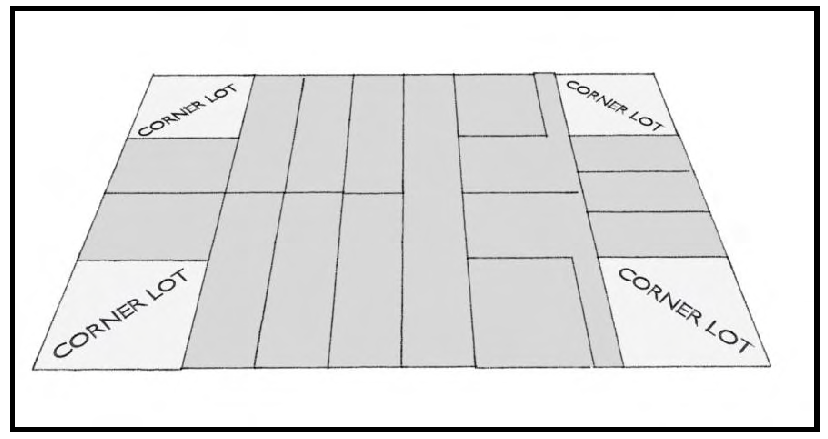
Double Frontage Lot. See Through Lot.
Flag Lot. An irregularly shaped lot where the building portion of the lot is connected to its street frontage by an arm or pole of the lot. The pole portion does not meet the minimum lot width of the district, but the building portion of the lot does.
FIG. A.8: FLAG LOT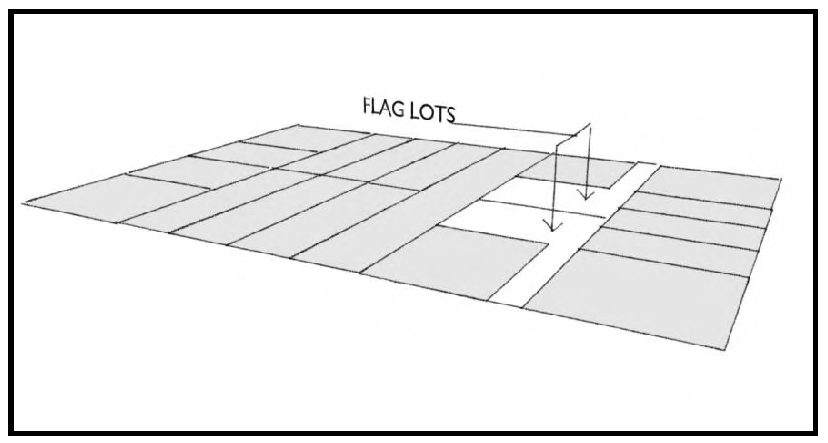
Interior Lot. A lot other than a corner lot with frontage on only one (1) street.
FIG. A.9: INTERIOR LOT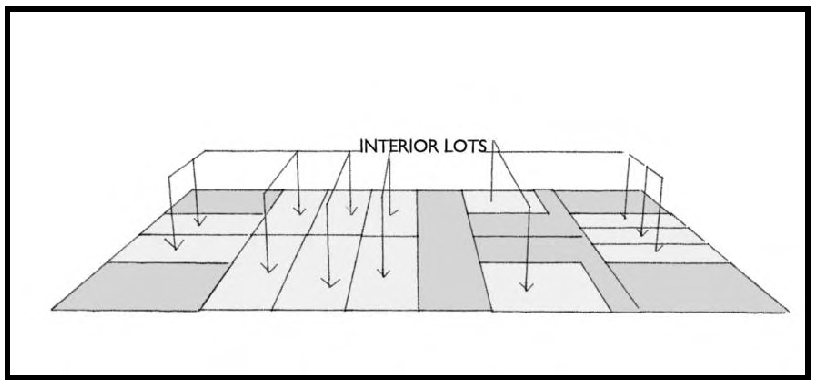
Through Lot. A lot other than a corner lot with frontage on more than one (1) street. Through lots abutting two (2) streets may be referred to as double frontage or reverse frontage lots.
FIG. A.10: THROUGH LOT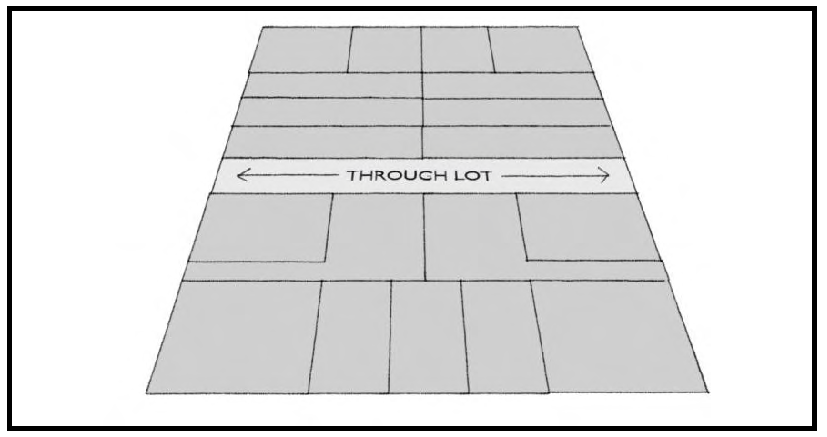
Reverse Frontage Lot. A lot on which the frontage is at right angles or approximate right angles (interior angles less than 135°) to the general pattern in the area. A reverse frontage lot may also be a corner lot, an interior lot or a through lot.
Single-tier Lot. A lot that backs upon a limited access highway, a railroad, a physical barrier, or another type of land use, and to which access from the rear is usually prohibited.
Lot Depth. The average horizontal distance between the front and rear lot lines.
Lot, Irregularly Shaped. Lots located at corners or intersections, which create shapes with three (3) sides or with more than four (4) sides and contain corner angles greater or less than 90°. The front yard of such lots shall be determined with respect to adjacent homes and the maintenance of street vistas.
Lot Line. A line bounding a lot that divides one (1) lot from another or from a street or any other public or private space.
Lot Line, Front. In the case of an interior lot, the lot line separating said lot from the street; in the case of a corner lot or through lot, the lot line separating said lot from the street that is designated as the front street in the request for a permit.
Lot Line, Rear. A lot line which is opposite and most distant from the front lot line, and in the case of an irregular or triangular-shaped lot, a line ten (10) feet in length within the lot parallel to and at the maximum distance from the front lot line.
Lot Line, Side. Any lot line that is not a front lot line or rear lot line; a lot line separating a lot from a side street is an exterior lot line, while a lot line separating a lot from another lot, or lots, is an interior lot line.
FIG A.11: LOT LINES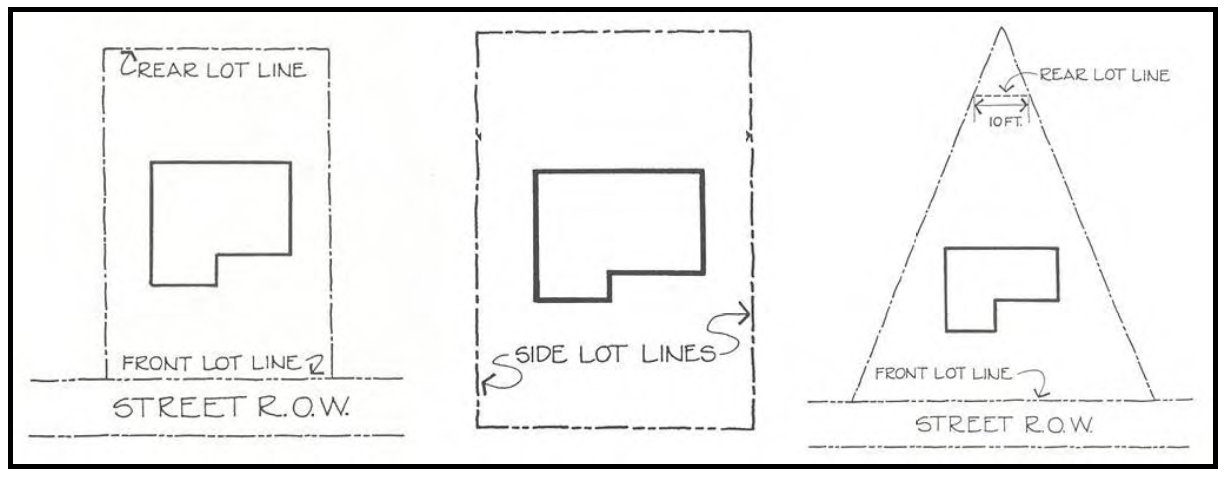
Lot of Record. Any lot for which a plat has been recorded in the Register of Deeds Office of Rutherford County, or described by metes and bounds, the description of which has been so recorded.
Lot, substandard. A parcel of land held in separate ownership, occupied or intended to be occupied by a principal building or structure together with accessory buildings, and uses, having insufficient size to meet the lot width, lot area, yard, off-street parking areas, or other open space provisions of this Ordinance.
Lot Width. The distance from side lot line to side lot line measured at the required minimum front yard setback parallel to the front property line. For flag lots, the front setback shall be set at the location where the minimum lot width is first met.
Manufactured Home. A dwelling unit that (i) is not constructed in accordance with the standards set forth in the North Carolina State Building Code, and (ii) meets or exceeds the construction standards promulgated by the US Department of Housing and Urban Development that were in effect at the time of construction.
Manufactured Home Park. Any premises where two (2) or more manufactured homes are parked for living and sleeping purposes, or any premises used or set apart for the purpose of supplying to the public parking space for two (2) or more manufactured homes for living and sleeping purposes, and which include any buildings, structures, vehicles or enclosures used or intended for use as part of such manufactured home park.
Manufactured Home Space. Any premises within a manufactured home park used or intended to be used or occupied by one (1) manufactured home, together with automobile parking space, utility structures, and other required facilities incidental thereto.
Manufacturing, processing, and assembly. The assembly, fabrication, production or processing of goods and materials. This shall not include uses designated as small scale manufacturing, resource extraction and recycling and salvage operations.
Manufacturing, Small Scale. The assembly, packaging, processing, production or fabrication of goods in a manner that does not create a noticeable amouny of noise, dust, odor, smoke, glare or vibration outside of the property on which the activity takes place. Small scale manufacturing occurs entirely in an enclosed building, generally does not require outdoor storage of good[s] or materials, and does not generate high amounts of truck traffic.
Massing. The shape and form buildings assume through architectural design. There are ten (10) architectural design elements which create urban space. A specific project may not need to incorporate all ten (10) elements.
(1)
Building Silhouette: Similar pitch and scale to a roof line.
(2)
Spacing between building façades: Setbacks or notches between primary facades which frame the structure.
(3)
Setback from property line: Building setback and/or primary facade setback from property line.
(4)
Proportion of windows, bays, and doorways: Vertical or horizontal elements tied together in bands across facade lengths.
(5)
Proportion of primary façade: Size of facades similar in area and height to width ratios.
(6)
Location and treatment of entryways: Important visual commonality between structures.
(7)
Exterior materials used: Similar materials and treatment add to detail and monumentality of a building.
(8)
Building Scale: Similarity of building height and configuration.
(9)
Landscaping: Ties together buildings and defines space.
(10)
Shadow patterns form decorative features: The light and dark surfaces from materials used and projections from window bays and setbacks create visual breaks.
Microbrewery/Micro distillery/Micro winery. A facility in which beer, wine, or other alcoholic beverages are brewed, fermented, or distilled for distribution and consumption, and which possesses the appropriate license from the State of North Carolina Alcoholic Beverage Control Commission. Associated tasting rooms, brewpubs, or restaurants for the consumption of on-site produced beer, wine, or distilled products are permitted on the premises. In general, a microbrewery produces less than fifteen thousand (15,000) barrels of beer annually according to the American Brewers Association, and a microdistillery produces less than fifty thousand (50,000) proof gallons of spirits per year according to the American Distilling Institute. Microwineries primarily source fruit from local farms but do not farm fruit on site.
Mini-Warehouse. A structure containing separate storage spaces of varying sizes leased or rented on an individual basis that does not include outdoor storage.
Mixed-use Building. A minimum of a two (2) story building in which the ground floor contains a commercial enterprise and at least one (1) of the floors above contains residential units.
Manufactured home. See Manufactured Home.
Modular Home. A dwelling unit constructed in accordance with the standards set forth in the North Carolina State Building Code and composed of components substantially assembled in a manufacturing plant and transported to the building site for final assembly on a permanent foundation. Among other possibilities, a modular home may consist of two (2) or more sections transported to the site in a manner similar to a manufactured home (except that the modular home meets the North Carolina State Building Code), or a series of panels or room sections transported on a truck and erected or joined together on the site.
Modular Home, Off-frame. A dwelling unit which is constructed in compliance with the North Carolina Building Code and is brought to the site and set in place on a permanent foundation by a crane. A steel frame is not used for the support of the structure.
Modular Home, On-frame. A dwelling unit which is constructed in compliance with North Carolina Building Code on a steel frame and is brought to the site on steel frames and the axles are removed. The steel frame is used to support the structure on top of a permanent foundation.
Motor Vehicle Services. Any building, premises, and land, in which or upon the primary use of land is a business which involves the maintenance, servicing or sale of new or used automobiles or similar vehicles including any vehicle leasing, rental, parking service, preparation or repair work conducted. This definition includes, but is not limited to, auto body shops, auto service stations, car washes, gas stations, and oil/lube servicing. This does not include the sale of parts or related products (i.e. auto parts store).
Mural. A mural is a hand-painted visual image on the exterior wall of a building that is a one-of-a-kind piece of original artwork, and that does not contain text, lettering, or trademarked symbols. A mural shall not be considered a sign for the purposes of this Ordinance.
Nightclub. An establishment that is either public or private in which people gather for dancing and/or listening to taped or live music and there is the sale and consumption of alcoholic beverages on premises.
Nonconforming Lot. Any lot of record which does not meet the minimum yard or area requirements established in these regulations at the time of this Ordinance's adoption or any amendment thereto.
Nonconforming Sign. A sign that, on the effective date of this Ordinance or the date of any subsequent amendment thereto, does not conform to one (1) or more of the regulations set forth in this Ordinance.
Nonconforming Structure. Any structure lawfully existing on the effective date of these regulations, or any amendment to it rendering such structure nonconforming, which does not comply with all of the standards and regulations of these regulations or any amendment thereto.
Nonconforming Use. Any use lawfully being made of any land, building or structure on the effective date of these regulations or on the effective date of any amendment thereto rendering such use non-conforming, which does not comply with all the regulations of these regulations or any amendment thereto, whichever might be applicable.
Nonprofit Organization. An organization that does not distribute its surplus funds to owners or shareholders, but instead uses them to help pursue its goals.
Nursery. A commercial enterprise conducted on land where flowers, shrubs and similar horticultural products are raised and sold to general public. Nurseries may include the use of greenhouses for growing purposes.
Office Use. Professional occupations within a building or buildings which do not generally involve the on-site sale of goods to customers.
Open Space. Any area which does not consist of buildings, streets, right of ways, parking, or easements, and serves as a passive or active recreational area, as conservation land for important vistas and topographic features, or as pervious area for watershed requirements. This area provides, or has the potential to provide, environmental, social and/or economic benefits to the community whether direct or indirect. Open space is categorized by type and includes playgrounds, plazas, squares, parks, greens, greenways, greenbelts, and nature preserves.
Outdoor Storage. The storage of goods, products, or vehicles as an ancillary use by their owner or on a commercial basis outside of a permanently constructed building.
Outparcel. A parcel of land associated with and located within a shopping center or multi-tenant non-residential development, which is designated on an approved site plan as a location for a structure with an intended use.
Overlay District. A set of regulations which add an additional layer of design provisions to an underlying regulating district.
Package Treatment Plant. A small self-contained sewage treatment facility built to serve developed areas which lie beyond the service area of sanitary sewers.
Parapet. That portion of a building wall that extends above the roof line.
Park. Areas developed either for passive or active recreational activities. Parks may include, but shall not be limited to walkways, benches, open fields, multi-use courts, playgrounds, swimming and wading pools, amphitheaters, etc. The term park shall not include zoos, travel trailer parks, amusement parks, or vehicle, equestrian or dog racing facilities.
Parking Bay. A parking module consisting of one (1) or more sets of one (1) or two (2) rows of parking spaces and the aisle from which motor vehicles enter and leave.
Parking Space, Off-Street. An area located outside of any street right-of-way which is designed to accommodate the parking of vehicles which meets all area requirements contained in Chapter 8 of this Ordinance.
Pedestrian-Oriented Development. Development which accommodates the needs of the pedestrian. Such development will have parking to the side or rear of a building, will mix uses and provide them in proximity to one another, will allow the pedestrian the option or choice of not having to use a car to accomplish certain trips, and will provide a variety of interesting and detailed streetscapes which balance the need of the pedestrian and car equally.
Perennial Stream. A watercourse shown on a USGS map as a solid blue line that flows in a well-defined channel a majority of the year.
Personal Service Uses. Services provided by licensed professional stylists, aestheticians, and therapists including, but not limited to, hair care, nail care, waxing, massage therapy, and similar spa services.
Photometric. Data regarding the luminous intensity of light sources on a particular site.
Pitch, Roof. The slope of a roof expressed as rise over run (i.e. for a roof that rises four (4) inches vertically for every twelve (12) inches it runs horizontally the pitch is 4:12).
Plan, Existing Features. A plan submitted with the Sketch Plan that shows the existing features of a site including, but not limited to, topography, watercourses, stands of trees, significant trees, rock outcroppings, and environmentally sensitive areas.
Plan, Improvement. A plan that shows how a developer will install, bond, or guarantee improvements for a development (i.e. roads, turn lanes, water, sewer, etc.).
Plan, Phased Master. A plan which has been submitted to the Administrator by a landowner for phased development which shows the type and intensity of use for a specific parcel or parcels with a lesser degree of certainty than the plan determined by the Administrator to be a site specific development plan.
Plan, Site-Specific. A plan which has been submitted to the Administrator by a landowner describing with reasonable certainty the type and intensity of use for a specific parcel or parcels of property.
Plan, Sketch. An informal plan, indicating major features of a tract, its surroundings and the general layout of a proposed development.
Plat, Final. A map of all or a portion of a development that is the legal instrument for recordation. Final plats shall be consistent with the approved Preliminary Plat and be reviewed and recorded following the installation or guarantee of improvements.
Plat, Preliminary. A development plan indicating the proposed layout of a development and engineering documents prior to the installation of improvements.
Planned Development. An area planned as a single entity containing one (1) or more residential, commercial, and mixed-use clusters located on tracts or lots.
Premises. A parcel of real property with a separate and distinct number or designation shown on a recorded plat, record of survey, parcel map or development map. When a lot is used together with one (1) or more contiguous lots for a single use or planned development, all of the lots so used, including any lots used for off-street parking, shall be considered a single premises for purposes of these regulations.
Principal Structure. A building in which is conducted the principal use on the lot on which said building is situated. In any residential zoning district, any structure containing a dwelling unit shall be deemed to be the principal building on the lot where it is located.
Principal Use. The primary or predominant use of any lot.
Private Club. A for-profit establishment as defined by NCGS 18B-1000(5) which holds an ABC permit from the State of North Carolina.
Produce Stand. The sale of any form of agricultural or horticultural products at a retail stand located on the same site where the products are grown. Off-site produce stands shall be considered temporary uses and shall meet the requirements of such.
Quasi-judicial. The process by which the Board of Adjustment reviews requests for Special Use Permits, Variances, Appeals, and other matters requiring evidentiary hearings as set forth in this Ordinance. Sworn testimony is given during the public hearing and an evidentiary record is kept and voted upon based on specified findings of fact.
Recreation Facility, Associated with a residential development. Facilities not open to the general public including swimming pools, ball courts, playgrounds, clubhouses, parks, picnic areas, and similar uses associated with a residential development for the use of the residents of the development and their guests.
Recreation Facility, Fitness. Commercial establishments engaged in providing indoor recreation services related to fitness including, but not limited to, exercise clubs, ball courts, swimming pools, YMCA, or similar uses which are operated on a fee or membership basis primarily for persons that do not reside on the same lot with the recreational use. Fitness facilities may include accessory uses, such as snack bars, pro shops, and locker rooms, which are designed and intended primarily for the use of patrons of the principal recreational use.
Recreation Facility, Indoor. Commercial establishments engaged in providing indoor recreation services such as bowling, skating, vintage arcades, trampoline parks, and similar facilities.
Recreation Facility, Outdoor. Commercial establishments engaged in providing outdoor recreation services including golf driving ranges, miniature golf, skateboard parks, water slides, batting cages & similar uses.
Recreation Facility, Public. An area or facility designed to meet the demand for active recreation, including ball fields, parks, playgrounds, golf courses, tennis courts, swimming pools, tot lots, recreation centers, and similar uses, available to the public and under the management or control of a public agency.
Recreation Vehicle. A vehicular-type unit without a permanent foundation, which can be towed, hauled or driven and primarily designed as temporary living accommodation for recreational, camping and travel use and including, but not limited to, travel trailers, truck campers, camping trailers and self-propelled motor homes. A recreation vehicle shall not be considered as being a single-family dwelling.
Religious Institution. A building or structure, or group of buildings or structures, which by design and construction are primarily intended for conducting organized religious services whose site may include an accessory area for the interment of the dead. Daycare centers (which have enrollment capacities in excess of twenty-five (25) enrollees) and/or schools operated by the church on the facilities of the church shall be considered separate principal uses.
Repair Services (indoor). The repair of any item that takes place entirely within an enclosed structure with no outdoor storage.
Residential Care Facility. An institutional facility maintained for the purpose of providing skilled rehabilitative, nursing care, medical care, or other supervisory care at a lower level than that available in a hospital.
Residential Development. Buildings for residence such as detached single-family dwellings, two-family dwellings (duplexes), multi-family dwellings (apartments, condominiums, townhouses) their associated accessory structures, and home occupations.
Restaurant. A commercial establishment where food and drink are prepared, served, and consumed primarily within the principal building.
Retail Uses. Establishments engaged in selling goods or merchandise to the general public for personal or household consumption and rendering services incidental to the sale of such goods.
Rezoning. See Amendment, Zoning Map.
Roof Line. The highest point of a flat roof and mansard roof and the lowest point of a pitched roof, excluding any cupolas, chimneys or other minor projections.
Screening. A fence, wall, hedge, landscaping, earth berm, buffer area or any combination of these provided to create a visual and/or physical separation between certain land uses. Screening may be located on the property line or elsewhere on the site.
Service Uses. Uses that include the provision of work that does not typically result in ownership of physical goods and that create benefits by facilitating a change in customers, a change in their physical possessions, or a change in their intangible assets. (i.e. beauty shops, dry cleaning, appliance repair, check cashing, etc.) This does not include motor vehicle services.
Setback. A distance measured inward from a property line which shall remain unoccupied by structures and parking areas except as permitted by this Ordinance.
Setback, Front. The required distance from the fronting or primary street right-of-way to a structure or parking area. Driveways may be located in this area unless otherwise specified by this Ordinance.
Setback, Rear. The required distance from the rear property line to a structure or parking area. Driveways may be located in this area unless otherwise specified by this Ordinance.
Setback, Side. The required distance from the side property line to a structure or parking area. Driveways may be located in this area unless otherwise specified by this Ordinance.
Setback, Side Corner. The required distance from the non-fronting or non-primary street right of way to a structure or parking area. Driveways may be located in this area unless otherwise specified by this Ordinance.
A.12: SETBACKS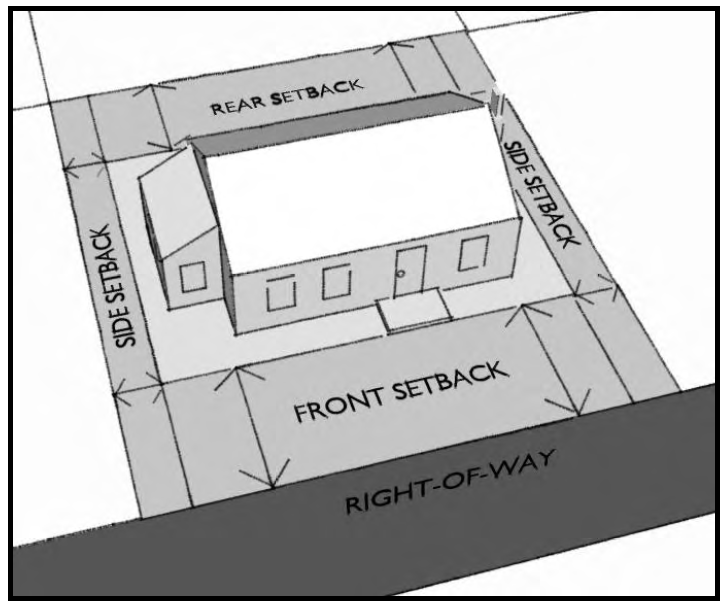
Setback, Sign. The required distance from the property line or right-of-way to the nearest point of the sign or its supporting member.
Sewer, Public. An approved sewage disposal system serving ten (10) or more connections, including municipal and sanitary district sewerage systems as well as "package" plants constructed in a location and to specifications approved by the County Sanitarian in consultation with the with the NC Division of Health Services.
Shopfront. A business or retail use. The facade of a shopfront is aligned directly on the building line with the entrance at grade. This is typical for sidewalk retail. Shopfronts often have awnings or a colonnade.
Shopping Center. A group of three (3) or more retail establishments comprising more than fifteen thousand (15,000) square feet of gross floor area that is constructed and developed in one (1) or more phases with customer and employee parking and merchandise and other loading facilities provided on-site. A shopping center may be located and developed on one (1) or more lots and may include one (1) or more principal buildings.
Sight Triangle. The triangular area formed by a diagonal line connecting two (2) points located on intersecting property lines (or a property line and the curb or a driveway) within which no planting, structure, sign, fence, wall, or obstruction shall be placed or maintained.
FIG. A-13: SIGHT TRIANGLE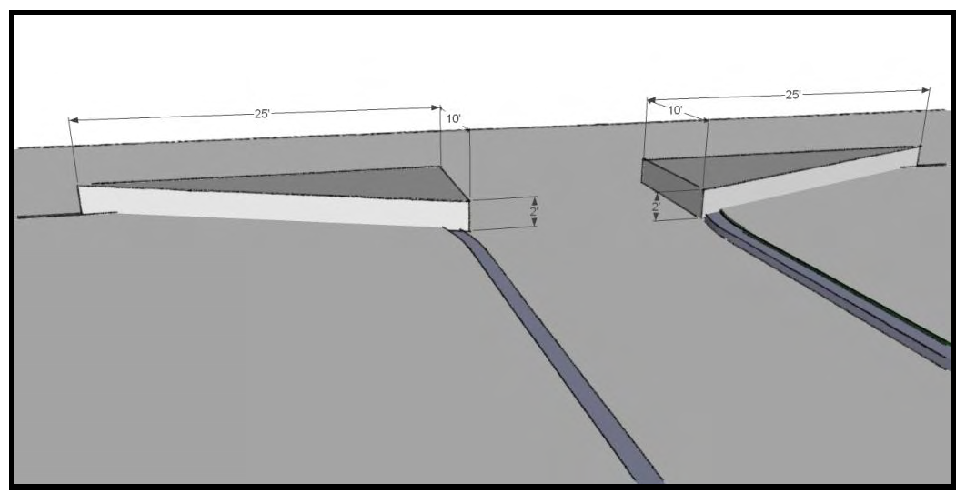
Sign (see Chapter 6 for sign type pictures and illustrations). Any object, device, fixture, display or structure, or part thereof, situated outdoors, that uses any color, form, graphic, illumination, symbol, or writing to advertise, announce the purpose of, or identify the purpose of a person or entity, or to communicate information of any kind to the public. This definition shall not include murals for the purposes of this Ordinance.
Sign Area. The entire face of a sign including the advertising surface and any framing, trim, or molding, but not including the supporting structure. In computing area, only one (1) side of a double-faced sign shall be considered.
Signs, Canopy and Awning. Signs attached to or painted or printed onto a canopy or awning. For the purposes of the Ordinance, the permitted size of a canopy or awning sign will be calculated on the basis of the size of the building wall to which the canopy is attached. It will, for measuring purposes, be considered a wall sign.
Signs, Flashing. Signs that use an intermittent or flashing light source or windblown and/or mechanical moved reflective material to attract attention.
Signs, Freestanding. Signs that are not affixed to a building and is securely and permanently mounted in the ground.
Signs, Government. Signs posted or authorized by various local, state, and federal agencies in the performance of their duties including providing community information and facilitating economic development. Such signs include regulatory signs, traffic signs, welcome signs, bulletin boards, and wayfinding signs.
Signs, Historic. A sign within the C-1 zoning district and National Register Historic District originally established prior to January 1, 1967.
Signs, Illuminated. Signs lit from either internal or external light sources.
Signs, Incidental. Signs used in conjunction with equipment or other functional elements for a use or operation that cannot be read from the street right-of-way which inform or instruct customers or visitors on-site (i.e. drive-through menu boards, gas pump signs, bulletin boards, signs within sports stadiums).
Signs, Legal and Warning. Signs erected to warn of danger or hazardous conditions such as signs erected by public utility companies or construction companies; signs required for or specifically authorized for a public purpose by any law, statute or ordinance.
Signs, Monument. Free-standing permanent ground signs in which the bottom of the signs are no than three (3) feet from the ground.
Signs, Off-Premises. Signs that draw attention to or communicate information about entities at locations other than the premises where the signs are located. This includes billboards.
Signs, On-Premises. Signs that draw attention to entities on the premises where the signs are located.
Sign, Pole. A detached sign erected and maintained on a free-standing frame, mast, or pole and not attached to any building but not including ground-mounted or monument signs. The bottom of such sign is more than three (3) feet from the ground.
Sign, Portable. Any sign not permanently attached to the ground or other permanent structure, or a sign designed to be transported, including, but not limited to, signs designed to be transported by means of wheels or signs that stick in the ground on metal frames.
Sign, Principal Use. A sign which constitutes the sole and/or principal use of land.
Sign, Projecting. Any sign other than a wall, awning, canopy, or marquee sign, which is affixed to a building and is supported only by the wall on which the sign is mounted and has two (2) sign faces perpendicular or close to perpendicular to the wall face.
Sign, Roof. A sign erected or maintained in whole or in part upon or over the roof or parapet of a building.
Sign, Temporary. A sign not permanently attached to the ground or to a building that is made out of plastic, vinyl, canvas, plywood or other non-permanent material.
Sign, Wall. Any sign directly attached to an exterior wall of a building or dependent upon a building for its support and is parallel to the wall face. Signs directly painted on walls shall be considered wall signs.
Signs, Window (temporary). Signs temporarily attached or temporarily painted to a window or door, announcing sale or special features.
Site Specific Development Plan. A plan, which has been submitted to the Town by a landowner describing with reasonable certainty the type and intensity of use for a specific parcel or parcels of property.
Sleeping Unit. A room or space in which people sleep, which can also include permanent provisions for living, eating, and either sanitation or kitchen facilities but not both. Such rooms and spaces that are also part of a dwelling unit are not sleeping units.
Solar Power Generation (Individual Use). Solar panels used for electric power generation for an individual use as a primary or supplemental power source for that use only.
Solar Farm. A collection of solar panels used for surplus electric power generation that is sold for use by off-site uses.
Stormwater Runoff. Rain which falls onto impervious surfaces and is not absorbed into the ground immediately. Stormwater runoff carries pollutants from paved surfaces into streams and rivers and causes flooding by speeding up the rate of water flow into streams and rivers.
Street, Private. Any right-of-way used for purposes of motor vehicle travel which has not been accepted for maintenance or ownership purposes by a public entity.
Street, Public. A public right-of-way set aside for public travel and either which has been accepted for maintenance by NCDOT or the Town, has been established as a public road prior to the date of adoption of this Ordinance, or which has been dedicated to the NCDOT or the Town for public travel by the recording of a plat of a development with the County Register of Deeds Office.
(1)
Highway: A traffic artery designed primarily to carry heavy volumes of through vehicular traffic.
(2)
Major Street: A street designed primarily to carry heavy volumes of local vehicular traffic.
(3)
Collector Street: A street designed to carry medium volumes of vehicular traffic, provide access to major street system and collect the vehicular traffic from the intersecting minor streets.
(4)
Minor Street: A street, the principal purpose of which is to provide vehicular access to the properties abutting it.
(5)
Cul-de-Sac: A street permanently terminated by a turn-around.
(6)
Marginal Access Street: A minor (service) street which parallels and is immediately adjacent to a major street or highway; and which provides access to abutting property.
Street Orientation. The direction of the architectural front facade of a building in relation to the street.
Street Right-of-Way. An area of land occupied or intended to be occupied by a public street, for such purpose, areas claimed by a municipality or the State of North Carolina for such purposes, or actually used for such purposes.
Structure. A combination of materials to form a construction for use, occupancy, or ornamentation whether installed on, above, or below the surface of land or water. Anything constructed or erected, the use of which requires more or less permanent location on the ground or which is attached to something having a more or less permanent location on the ground.
Subdivision. For the purpose of this Ordinance, "Subdivision" shall mean all divisions of a tract or parcel of land into two (2) or more lots, building sites, or other divisions for the purpose of sale or building development (whether immediate or future) and shall include all divisions of land involving the dedication of a new street or a change in existing streets; but the following shall not be included within this definition nor be subject to the regulations of this Section:
(1)
The combination or recombination of portions of previously subdivided and recorded Lots where the total number of Lots is not increased and the resultant Lots are equal to or exceed the standards of this Ordinance;
(2)
The division of land into parcels greater than ten (10) acres where no street right-of-way dedication is involved;
(3)
The public acquisition by purchase of strips of land for the widening or opening of streets;
(4)
The division of a tract in single ownership whose entire area is no greater than two (2) acres into not more than three (3) lots, where no street right-of-way dedication is involved and where the resultant Lots are equal to or exceed the standards of this Ordinance;
(5)
The division of land into burial plots where no street right-of-way dedication is involved; and,
(6)
The division of land by will. (Note: Although the division of land by will is exempt from the requirements of this Ordinance, the resultant lots may not be eligible for a Zoning Permit if the lots do not meet the dimensional standards and requirements of this Ordinance.)
Subdivision Administrator. See Administrator.
Subdivision, Major. Major Subdivisions are those subdivisions which involve more than five (5) lots or more than ten (10) acres, those Subdivisions which involve the dedication of new street segments (but not simply widening), those Subdivisions where special developments are involved as permitted by this Ordinance, and those Subdivisions that involve dedication or reservation of land for open space, school sites and other public purposes.
Subdivision, Minor. Minor Subdivisions include all other subdivisions that meet the definition of subdivision but do not meet the definition of a major subdivision.
Temporary Emergency Residence. A temporary dwelling unit used following the destruction or severe damage of a permanent dwelling unit following fire or other natural disaster while the permanent dwelling is being repaired or rebuilt.
Temporary Structures. Buildings placed on a lot for a specific purpose which are to be removed within a specified time period. Examples of temporary structures include monitoring stations, mobile classrooms or office space, construction trailers and guard houses, manufactured housing placed on a lot for temporary housing while principle home renovations are being done, and produce stands. The duration permitted for a temporary structure is established by this Ordinance.
Theater, Drive-in. An establishment for the viewing of movies or performing arts primarily from parked motor vehicles.
Theater, Indoor. An establishment for the viewing of movies or performing arts that is inside a fully-enclosed building.
Theater, Open-air. An establishment for the viewing of movies or performing arts that is not inside a fully-enclosed building, including amphitheaters.
Townhome (Townhouse). An individual dwelling unit constructed in a series of attached units separated by property lines that comprise a multi-family dwelling building. (Source: NC Building Code, Vol. 1, Section 201.3)
Tree, Large (Canopy). A tree, either single or multi-stemmed (i.e., in clump form) which has a height of at least eight (8) feet and is of a species which, at maturity, can be expected to reach a height of more than thirty-five (35) feet under normal growing conditions in the local climate. If the tree is single-stemmed, it shall have a caliper of at least two and a half (2 ½) inches at the time of planting measured six (6) inches up from the highest root of the tree. Also known as a canopy tree.
Tree, Small (Ornamental). A tree, either single or multi-stemmed (i.e., in clump form) which has a height of at least eight (8) feet and is of a species which at maturity, can be expected to reach a height less than thirty-five (35) feet under normal growing conditions in the local climate. If the tree is single-stemmed, it shall have a caliper at the time of planting of at least two and one-half (2 ½) inches measured six (6) inches up from the highest root of the tree. Also known as an ornamental or understory tree.
Utility Facilities. Publicly or privately owned facilities or systems for the generation or distribution of gas, electricity, or water; the collection and disposal of sewage or refuse; the transmission of communications; or similar functions necessary for the provision of public services.
Variance. Permission granted on the basis of proof of physical hardship by the Board of Adjustment following quasi-judicial proceedings to depart from or relax the literal requirements of this Ordinance relating to dimensional requirements such as setbacks, side yards, street frontage, and lot size that, if applied to a specific lot, would significantly interfere with the use of the property.
Vehicle Storage. The outdoor storage of vehicles for an automobile service use. This does not include inoperable vehicles (junk vehicles) which would constitute a junkyard.
Vested Right. The right to undertake and complete a development or use of property under the terms and conditions of an approved Site Specific Plan currently in effect or as otherwise allowed by law.
Vocational School. A center for higher education that teaches specific job skills.
Warehouse Use. A building or group of buildings for the storage of goods or wares belonging either to the owner of the facility or to one (1) or more lessees of space in the facility or both, with access to contents only through management personnel. This does not include mini-warehousing or mini-storage.
Wholesale. A place of business primarily engaged in selling merchandise to retailers, to industrial, commercial, institutional or professional business users, or to other wholesalers. The majority of all sales of such businesses shall be for resale purposes. Wholesale clubs and similar membership warehouses, where membership is easily available to the consuming public, and similar businesses shall not be deemed wholesale sales operations.
Wind Energy Facility. An electric generating facility, whose main purpose is to supply electricity, consisting of one (1) or more Wind Turbines and other accessory structures and buildings, including substations, meteorological towers, electrical infrastructure, transmission lines and other appurtenant structures and facilities. For the purpose of this Ordinance, the term does not apply to roof-mounted or building integrated roof mounting systems.
Wind Energy Facility (Individual). A single system designed to supplement other electricity sources as an accessory use to existing buildings or facilities, wherein the power generated is used primarily for on-site consumption. A small wind energy conversion system consists of a single wind turbine, a tower, and associated control or conversion electronics, which has a total rated capacity of ten (10) kW or less.
Wind Farm. A wind energy conversion system consisting of more than one (1) wind turbine, tower, and associated control or conversion electronics, which has a total rated capacity of more than ten (10) kW.
Winery. An operation where wine is fermented and produced from fruit primarily grown on-site for distribution and consumption, and which possesses the appropriate license from the State of North Carolina Alcoholic Beverage Control Commission. A winery may include associated retail outlets, tasting rooms, and restaurants.
Wireless Telecommunication Tower. A tower supporting licensed or unlicensed wireless telecommunication facilities including cellular, digital cellular, personal communication services (PCS), specialized mobile radio (SMR), enhanced specialized mobile radio (ESMR), commercial or private paging services, or similar services marketed or provided to the general public. This definition does not include services by noncommercial entities in the Amateur Radio Service, Public Safety Radio Service, or licenses assigned to non-profit organizations, such as the Red Cross, Civil Air Patrol, Military Affiliated Radio Service (MARS) that are licenses by the Federal Communications Commission.
Yard. An open space located on the same lot with a building, unoccupied and unobstructed from the ground upward, except by trees, shrubbery or as otherwise provided herein. A yard is the area created by the setback.
Yard, Front. A yard extending across the full width of the lot and extending from the closest front wall of the building to the property line or established edge of a right-of-way, whichever is closer.
Yard, Rear. A yard extending across the full width of the lot and extending from the closest rear wall of the main building to the rear of the property.
Yard, Side. A yard which extends from the closest side wall of a building to the nearest side property line or the established edge of the street right-of-way, whichever is closer, if the lot is a corner lot.
Zoning Permit. A permit issued by the Town conferring the right to undertake and complete the development and use of property.
(Ord. of 1- 7-19(1); Amend. of 1-16-20(1); Ord. No. FCUDO-2021-03, att., 6-21-21; Amend. of 10-3-22(3))

